Weaving wealth: the art of Taíno belts
The Taíno, the collective name for the indigenous peoples of the Caribbean's Greater Antilles – a mosaic of various cultures, speaking different languages – were the first people of the New World to encounter Europeans in 1492.Footnote 1 In the aftermath of those initial Spanish/Taíno interactions, when indigenous materials were presented at the Spanish court as evidence of New World wonders, Taíno belts were among the objects highlighted and admired by the early historians who witnessed these events. The sixteenth-century chronicler Bartolome de Las Casas, in recalling Columbus's triumphant return to the Spanish court in 1493, notes that the admiral brought:
green parrots, which were very beautiful and colourful, and also guaycas, which are jewelled masks made from fish bones [shells], inlaid and decorated with pearls and gold, as well as some belts made in the same way with admirable artistry, and many samples of the finest native goldwork and other things never before seen or heard of in Spain.Footnote 2
Here, amidst a wealth of exotic imports, belts and guaycas/guaízas are highlighted by Las Casas as objects worthy of note, reflecting his knowledge of their importance among the Taíno. These objects had a high indigenous value, considered to be suitable as gifts between caciques (chiefs)Footnote 3 – a value that continued in European courts, though perceived differently. The cacical wealth given to Columbus was, in turn, given again – amidst the full spectacle of such an historic event at court – to the Spanish monarchs, who then circulated it to family and the elite of their court as proof of their new Crown possessions.
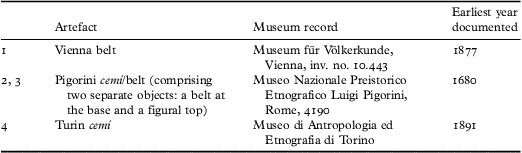
Just such a rare Taíno belt, linked by some scholars to Columbus's initial voyages,Footnote 4 is now in the Museum für Völkerkunde in Vienna (Fig 1). Its incorporation of European materials – mirrors, jet beads and brass – marks it as an object that spans the momentous period when the Old and the New Worlds first collided. It is one of only two extant Taíno cotton artefacts to feature foreign goods (the other being the cemí in the Museo Nazionale Preistorico Etnografico Luigi Pigorini, in Rome) and one of only four Taíno cotton artefacts known to have survived intact (Table 1). The cemí (a representation of a spirit, deity or ancestor) that forms the belt's central figure is summarily depicted to feature just the head and hands – a convention firmly rooted within traditional Taíno iconography – framed by a rich tapestry of woven cotton and shell beads. It offers a privileged window on to one of the most prestigious of Taíno valuables – a personal ornament that literally wrapped the wearer in wealth, status and spiritual power. The meticulous construction and rich investment of finely worked shells and cotton underscore its value and importance to the original owner, and its survival is a reflection of the value it had in Europe. It interweaves the histories of two cultures separated by the Atlantic, and its importance to both will be explored here. This paper charts the original context and use of Taíno belts and gives an account of the Vienna belt's collection history before progressing to a detailed consideration of its dating and construction – combining indigenous beads and European goods – and concluding with a consideration of how and when these disparate materials were incorporated into the belt.
Cotton belt with indigenous shell beads and European jet, brass and mirror additions, featuring a central cemí figure. Full length, with straps, 1,165mm (beaded strap only, 855mm), height 70mm. With the cotton bands bound tightly, it would have fitted a 33½-inch waist. Photograph: author; courtesy of the Museum für Völkerkunde, Vienna, inv. no. 10.443

Surviving Taíno cotton artefacts

Cacical gifts: Taíno belts, Taíno wealth
On 18 December 1492, within a few days of reaching Hispaniola (today's Dominican Republic/Haiti) and without even disembarking from his flagship, Columbus was presented with his first Taíno belt. A young cacique, whose name is not recorded, had travelled from his village to where the Santa Maria was anchored. He was reportedly carried in a litter by four men and had a retinue of more than 200 attendants.Footnote 5 Columbus noted that after inviting the cacique to take a meal with him aboard the ship, one of the cacique's attendants ‘brought a belt that was somewhat like the Castillian ones but of a different workmanship, and he gave it to me’.Footnote 6 Columbus, in turn, gave the cacique a variety of gifts, including red shoes, amber beads and a flask of flower water, which, after the latter's return to the beach, were carried in a procession before the cacique by ‘a man who seemed to be one of the most important personages’.Footnote 7 This was the first time Columbus had exchanged gifts directly with a Hispaniolan chief, and the description hints at some of the protocols involved.
Four days later, on 22 December, after travelling further west along the coast of what is now Haiti, Columbus anchored the Santa Maria in the vicinity of cacique Guacanagari's village, in the cacicazgo of Marién (north-eastern Haiti). By way of invitation to Columbus, Guacanagari sent canoes with a large welcoming group, including one of his ‘principal servants’, who presented Columbus with a fine belt featuring a mask inlaid with gold.Footnote 8 Las Casas describes this event and the belt as follows:
the ambassador was sent with a belt that, instead of a purse, had a mask, which had two large ears, a tongue and nose of hammered gold; this belt was made with something like fine stones, very small and pearl-like, made of white fish bones [shells], interspersed with some coloured ones, like a kind of needlework; [it was] worked in such a way, with the cotton thread so tightly sewn and with such beautiful skill, that both the front and back of the belt appeared beautifully made … all in white, that it was a pleasure to see, as if it was woven on a frame and in the way that the weavers make the edges of chasubles in Castile; and [it] was so hard and so strong that without doubt I believe an arquebus could not shoot through it, or only with difficulty; it was four fingers in width, in the manner of those used by the kings and great lords of Castile, embroidered or made of gold thread.Footnote 9
In both descriptions, each cacique presented a belt to Columbus via their ‘principal attendant’, doing so at the very start of the encounter – in one case, even before the protagonists had met. These exchanges appear distinct from the lively daily trade taking place between the Taíno and the ship's crew, where food, cotton and small pieces of gold were bartered for glass beads, hawk's bells and bits of cloth. In this sense, it is noteworthy that belts, among the select group of objects that distinguished members of the Taíno elite, were the first ‘official’ presents from the chiefs to the admiral. Gifts of belts were undoubtedly made to honour Columbus in recognition of his authority – from one high-ranking individual to another – but may also have been offered to entice the admiral to visit the cacique's village, and ultimately establish beneficial ties. Maintaining this ‘spirit of the gift’, Columbus himself then offered these objects to the Spanish monarchs upon his return to Europe in 1493, continuing the circulation of ‘wealth’ within elite circles: ‘the … admiral gave [these belts] to the Catholic Monarchs, Don Ferdinand and Doña Isabella, who considered and highly praised their artistry’.Footnote 10
In traditional Taíno society, cotton wealth – in the form of belts, caps, ligatures, masks and capes – was prominently displayed on the cacique's person, the quantity and quality undoubtedly reflecting the status and prosperity of the individual and his or her cacicazgo. One account notes the lavish display that greeted Columbus's first visit to Jamaica, in 1494, when a cacique in full regalia, accompanied by his family and ‘vassals’, came to the ship in three canoes with ‘much ceremony … [and] pomp’.Footnote 11 Several of the chief's retinue wore cotton caps covered with green or white parrot feathers, ‘ingeniously worked’, and one, identified as a ‘herald’, wore a cloak of red feathers. The cacique was resplendent with a guanin (a gold-copper alloy) pendant ‘as large as a plate’, stone beads ‘which they also value highly’ and guanin ear ornaments. On his head he wore a ‘garland of small stones, green and red, arranged in order, and intermingled with some larger white stones, producing a pleasing effect’ and ‘although he was naked, he wore a girdle, of the same workmanship as the garland, and all the rest of his body was exposed’.Footnote 12 The description echoes Las Casas’ comments about designs in beadwork woven into the belts – where these costly additions probably reflected the resources to which the cacique had access, and his influence in being able to bring them together. Depictions of belts, both realistic and stylised, also feature in other forms of Taíno art. They are worn by important figural cemís (Fig 2) and are depicted on such elite objects as duhos (ceremonial chairs: Fig 3), which again reinforces their symbolic ‘weight’ and value. There is also the long-standing argument that the enigmatic Greater Antillean stone collars or rings were chiefly regalia in their own right, visually alluding to perishable textile belts,Footnote 13 underlining the powerful, symbol-laden nature of belts, whether of cotton or of stone.
Ceramic sculpture, possibly of the mythic ancestor Deminán Caracaracol, who was the source of cassava bread, tobacco and cohoba, and from whose back emerged a female turtle, the progenitor of the Taíno people. He wears a belt featuring a central cemí positioned at the base of his spine. From the Dominican Republic; height 410mm, width 210mm, depth 190mm. Photograph: author; courtesy of the National Museum of the American Indian, 053753
A duho, or ceremonial seat, featuring an anthropozoomorphic creature on all fours. The wide, carved band halfway up the high back is a depiction of a belt wrapped around the figure's waist. The carving also features other forms of cotton wealth, including a cap and arm bands decorated with incised lines. Possibly from Haiti; length 715mm, width 306mm, height 425mm (max). Photograph: author; courtesy of the Musée du quai Branly, 71.1950.77.1
In this sense, cotton belts were not simply vehicles for the lavish display of indigenous valuables (shells, guanin, cemís): they carried a ‘semantic load’ and ideological significance now difficult to unravel. They were quintessentially personal objects, worn at the critical midway point of the body, below the navel and above the genitals (both important foci in Taíno myth and art),Footnote 14 and so were intimately associated with the wearer, both in terms of absorbing the essential oils/essences of their bodyFootnote 15 and of connecting visually and metaphorically to the very sources of life.
Belts may have had parallels with other Taíno artefacts, such as guaízas (masks), which José Oliver argues were ‘the extension of the living cacique's soul’.Footnote 16 This residual essence, transferred with the object in exchanges, was a constant referent to the original source – the individual who gave it. Guaízas, like belts, were among the gifts exchanged between the Taíno and Europeans at their first encounters;Footnote 17 they were also incorporated into belts, judging by the frequent presence of drill holes in many of the extant examples, as well as both artefactual and archival evidence for a central face (a cara or caratula) in belts.Footnote 18 Thus, both belts and guaízas may have semantically overlapped, and embodied unique, personal contexts that extended throughout their ‘lives’ and histories.
For belts, the layering of symbolism was undoubtedly interwoven from a number of sources connected both to their manufacture and to their later histories, not least the gender relations that may have underscored their creation. On the basis of ethnographic analogy with lowland South American cultures, Peter Roe has suggested that Taíno belts were key masculine accoutrements,Footnote 19 yet they were probably woven by women, who are documented as the weavers in Taíno society,Footnote 20 as they are in many South American cultures.Footnote 21 Judging by cronista accounts of Taíno cacicas (female chiefs) controlling the distribution of such elite goods as duhos,Footnote 22 it is possible that they may also have controlled access to belts. Once made and augmented with personal wealth and imagery,Footnote 23 belts would go on to accrue further significance: they may have played a role during name exchanges, or guaitiao – a Taíno custom that bound two parties (including Europeans) to long-term reciprocal obligations.Footnote 24 Some of these histories may have been recounted when belts were further exchanged,Footnote 25 adding to the significance of the transaction and incorporating each new event in the narrative that made up part of the belt's value and meaning.
When Columbus returned to Marién on his second voyage to the Americas in November 1493, the number of gifts given to him by Guacanagari increased exponentially. No doubt this was intended to appease Columbus after the crew members whom he had left behind under the protection of Guacanagari to establish the first Spanish settlement, La Navidad, had been murdered, apparently by the rival cacique Caonabó. The initial meeting between Columbus and Guacanagari was thus tense; Nicoló ScillacioFootnote 26 mentions that ‘gifts of friendship and pledges of loyalty were exchanged’, in an effort to re-establish peaceful relations. On Guacanagari's part, these gifts included:
a gold pendant, which he was wearing on his forehead [and which] he eagerly offered … to the admiral. He also took off the cotton diadem from his own head and put it on Columbus's, and in addition to this gave him twelve sword-belts of marvellous workmanship (several of them were notable for nuggets of gold worked very artistically into the silk).Footnote 27
Although the quantity of belts differs between cronistas (Andrés Bernáldez, for example, says Guacanagari presented only five or six belts), there is a consensus that several belts were given and that they were ‘finished with different coloured stones and a head piece adorned with the same stones’.Footnote 28 They were undoubtedly among those Columbus once again presented to Ferdinand and Isabella upon his return to court in 1496: ‘On arrival at Burgos he was well received by the Catholic Monarchs, to whom he presented a great quantity of things and specimens that he brought from the Indies, including … many masks and belts with plates of gold set in place of eyes and ears.’Footnote 29 BernáldezFootnote 30 also notes that the admiral brought back many indigenous things of woven cotton, including crowns, masks, belts and collars.
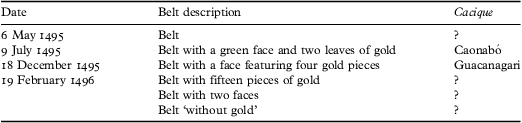
Not all belts, however, may have been acquired as gifts. After the Navidad massacre, Columbus considered Caonabó a threat and captured him in the autumn of 1494.Footnote 31 In an inventory compiled after Sebastian de Olaño (the official receiver) left Hispaniola, the entry for 10 March 1495 begins by noting indigenous ‘treasures’ being brought to the Spanish, including material specifically attributed to Caonabó's family and members of his cacicazgo. On 9 July 1495, a belt with ‘a green face and two leaves of gold … was brought by some of Caonabó's men’ and, along with a number of other cotton valuables (guaízas, naguas and a hammock), was entered into the inventory.Footnote 32 The final entries on 19 February 1496 – including a vomiting spatula with twenty-seven pieces of gold and a ‘carátula’, or guaíza, with seven pieces of gold – are specifically noted as having been ‘taken from Caonabó and his heirs when they were imprisoned’.Footnote 33
These valuables, including the belt, may have been offered to the Spanish in efforts to gain Caonabó's release, but that was not the outcome. Instead, Caonabó and the captured members of his family were sent to Spain in 1496. Caonabó died en route, but his brother allegedly survived; according to Bernáldez,Footnote 34 Columbus ordered him to wear some of the regalia ‘when entering … cities and other inhabited places’. The objects owned by Caonabó – the first indigenous ruler to oppose colonial rule – were also part of the spectacle of Columbus's meeting with the Catholic Monarchs: ‘they especially brought out a crown, which they said belonged to the cacique Caonabó, very large and high … [depicting] the devil’.Footnote 35 Objects associated with the cacique clearly had a cachet at court, and continue to fascinate.Footnote 36
The inventory notes six belts in total (Table 2), three of which had masks decorated with gold. Caonabó's belt, inventoried on 19 July 1495, featured two gold leaves, Guacanagari's had a face (‘cara’) with four gold pieces (18 December 1495), and a belt with fifteen pieces of gold was inventoried on 19 February 1496. The period in question, from early 1495 to early 1496, was a critical time for indigenous/Spanish engagement, when alliances were forged or severed: gifts were probably exchanged to signal an intention to establish and maintain beneficial interactions, in the spirit of Guacanagari's gift of belts to Columbus. Guacanagari appears to have been the most generous cacique, perhaps because the alliance with the Spanish had brought access to foreign wealth and power and improved his position with more powerful caciques.
Belts listed in inventory of 1495–6
Even after links between the Spanish and the Taíno had disintegrated, and war ravaged much of the Greater Antilles, belts maintained a value that was recognised by Europeans: they were among items of indigenous war booty auctioned in Puerto Rico in 1511.Footnote 37 Some of these pieces may also have been sent back to Europe, but documentation is sparse for examples other than those acquired by Columbus. Many of the belts brought back to Europe did not survive in the centuries that followed. There is mention, for example, of ‘four Indian belts, one three fingers wide with white and black beads’ in the 1598 inventory of Albrecht v's kunstkammer in Munich, Germany.Footnote 38 Unfortunately, much of that collection was lost during the Thirty Years War (1618–48), and no further record of these belts remains.Footnote 39 Only three belts exist today and only two retain their cotton framework: one in Vienna and the other in Rome, where it currently serves as the base of the composite Pigorini cemí (Table 1).Footnote 40 The stylistic similarity between the two has long been acknowledged,Footnote 41 and some comparative discussion of the Vienna and Pigorini pieces will follow, though the focus of this paper is on the Vienna belt.
The belt in the Museum für Völkerkunde, Vienna
The belt was first documented in 1877, when it was transferred from the Vienna Schatzkammer to the Ambraser Sammlung collection; its history before this date is obscure.Footnote 42 The core of the Ambraser Sammlung was the original Ambras collection – a very important early collection established by Archduke Ferdinand ii (1529–95) in Tyrol, and considered by several researchers to be the original repository of the belt.Footnote 43 Parts of this sixteenth-century collection were moved from Tyrol to Vienna for safekeeping during the early nineteenth century, and, between 1820 and 1880, it was further augmented with transfers from other important collections, including the Schatzkammer. In 1880, when the Ambraser Sammlung collection was moved to Vienna's Imperial and Royal Court Museum of Natural History (the predecessor to the Museum für Völkerkunde), the provenance of each acquisition was duly noted in the catalogue: in the case of the belt, the Schatzkammer.Footnote 44 The belt's description in the catalogue suggests that any associated documentation had long ago disappeared. It said:
Plaited woollen belt, covered with countless small rings of different colours, which are cut from sea shells, at the front it bears a head, consisting of the same sort of small rings, with eyes of mirror-glass. Probably Malaysian and from the East Indian Archipelago.
The Malaysian/East Indian Archipelago attribution was later crossed out in pencil – perhaps when Franz Heger, the head of the Anthropology/Ethnography Department at the Natural History Museum, attributed the belt to the Congo in 1888,Footnote 45 or when Annemarie Schweeger-Hefel correctly identified it as a Taíno piece in 1952.Footnote 46 That its true provenance is Hispaniolan is based largely on ethnohistoric references to similar belts in the region, its stylistic similarity to the belt depicted on the ceramic figurine recovered from the Dominican Republic (Fig 2), and the parallels between the belt's two-dimensional designs and those seen in the region's Chican Ostionoid ceramics.
The Schatzkammer was as venerable as the famed Ambras collection, being the imperial treasury of Vienna, its collections established in 1556 by Ferdinand i's court antiquary, Jacopo Strada. Ferdinand i (1503–64) deposited a sizeable collection of treasures, as did Rudolf ii (1552–1612) and Ferdinand ii (1578–1637), both significant collectors in their own right. Rudolf ii, for example, spent his formative years (1563–71) at the Spanish court of Philip ii, where he may have had access to the court's Americas collections, and later established in Prague one of Europe's most extensive ‘cabinets of curiosities’, which included American materials.Footnote 47
These patrons had connections spanning much of Europe, whence their collections were amassed – from botanical and mineralogical specimens to Italian paintings, specially transported over the Alps for Rudolf's cabinet. Indeed, links to early Italian collections have been suggested for the belt, as it bears strong similarities to the cotton cemí and belt in the Museo Nazionale Preistorico Etnografico Luigi Pigorini in Rome.Footnote 48 The Pigorini cemí is a composite sculpture consisting of an elaborate, figural top, positioned over an adult-sized belt, wrapped around a wooden base.Footnote 49 Stylistically, these three pieces – the Pigorini cemí/belt and the Vienna belt – appear to suggest the same source, perhaps even the same maker,Footnote 50 and may also have shared a common history in European collections prior to being separated.Footnote 51 The Pigorini cemí/belt can be traced back to the 1680 inventory of Fernando Cospi's collection in Bologna, but not to the earlier 1677 catalogue, so it is probable that they entered the Cospi collection between the years 1677 and 1680.Footnote 52 And if the three beaded pieces did indeed have a common early collection history, they may share an Italian provenance pre-dating 1680.Footnote 53 At this time, Italian collections – notably those of the Medici – held ‘curios’ from the Americas, and these did include other Taíno pieces.Footnote 54 It is possible that the three beaded pieces found their way to Italy through a myriad possible connections that may have included the Spanish court and/or the Vatican. More detailed investigation is needed to illuminate their histories – if, indeed, the documents survive to make this possible.
Indigenous wealth
While a clearer placing of the Vienna belt in European collections awaits archival research, the piece itself can inform us on a variety of issues – from the resources used in its construction to when it may have been manufactured. It is made almost entirely out of two key forms of indigenous wealth: cotton and a lavish quantity of shell and possibly seed beads, conforming well to early cronista descriptions. The vibrant colours are natural to the materials used: the white of Lobatus gigas (queen conch), reds from Chama sarda (the cherry jewel box clam) and black from the seeds of vegetables or fruit.Footnote 55 These strong, contrasting colours enhance the rhythmic geometry of the designs – a fitting example of what the cronistas called a ‘kind of needlework’ in shell, done to ‘pleasing effect’.Footnote 56 The angular designs are consistent on depictions of belts in other media – such as the belt featured on a ceramic figurine (Fig 2) – as well as depictions of a wide variety of other elite cotton regalia (such as headdresses and armbands) on large-scale sculptures and duhos.Footnote 57 The Vienna belt's designs are precise, maintaining straight lines despite variation in the size of the hand-made beads, which range from 0.6mm to 2mm in thickness (with an average diameter of c 5mm). To facilitate this, two thinner beads are occasionally woven together to bring them in line with the thickness of other beads. The materials and methodical approach to their layout and design parallel the treatment and finish of the Pigorini cemí and belt.Footnote 58
A rough count provides an estimate of nearly 11,000 beads – some 1,200 on the central figure itself and 9,500 on the straps to either side. When one considers that each bead was individually made, the sheer volume emphasises the amount of labour that went into the belt's creation. Las Casas, in describing the manufacture of shell beads and supporting cotton weave for Taíno ornaments, notes:
two things are wonderous: the first, that [the beads] being so small [are made] … without iron instruments, without drills, without chisels, but only … with a flint or stone or with fish spine or bone, drilled with such subtlety and delicacy that it seems an impossible thing. The other that must be considered is the durability of the cotton thread, because they were so well sewn or set, and so firmly placed, that these contecitas [shells?] or stones or argentería [jewels?] lasted perpetually.Footnote 59
The seventeenth-century historian Sieur de la Borde noted that among the neighbouring Carib/Kalinago (Lesser Antilles), shell beads were made by rubbing them on stones ‘until they become round and about two lines in diameter and half a line in thickness … and they could not make one piece to perfection and pierce it with the tools that they use in less than three days … There are three to four thousand of these pieces in a necklace’.Footnote 60 Elizabeth Carlson, who excavated a bead-manufacturing site on Grand Turk, Turks and Caicos Islands – where Taínos from Hispaniola would travel specifically to utilise the shell resources for the manufacture of small beads – undertook replication studies and notes that ‘making five beads in a day per person in a mass production atmosphere would not be unreasonable. In a period of two months a person could complete 300 beads … Ten people could conceivably return home after one season with 3,000 beads’.Footnote 61 This single belt would thus have constituted well over six months’ work for ten specialists.
The processing and weaving of the cotton was itself a considerable investment of time: ‘[g]rowing, picking, ginning, carding and spinning cotton represented a substantial part of the labour in cotton textiles … These steps, plus dyeing and weaving … form a labour-intensive sequence that continually adds value’.Footnote 62 Once sufficient quantities of cotton were gathered and cleaned, additional materials (including animal hair) may have been added to enhance the strength of the spun yarn or, alternatively, to enhance its symbolic meaning, as may be the case with the Turin cemí.Footnote 63 In the samples extracted from the Vienna belt, occasional dark fibres were also seen looped within the twists of the yarn (Fig 4). The largest of the sampled yarns was two-strand, Z-spun and S-plied with approximately twelve twists per inch (2/S/12 tpi). Z-spun, S-plied yarns were also used in the Pigorini and Turin cemí,Footnote 64 suggesting a standard spinning technique. Yarn would have been spun and stockpiled in people's homes or in cacical warehouses, in preparation for such work – but given the day-to-day requirements, it would have been in constant demand, and hence required a constant investment of time and effort.
Left: the largest of two 14C samples taken from the frayed end of the right strap, showing fifteen twists; length 15mm (excluding frayed ends), diameter 1mm. Right: a detail of the same sample showing dark hair-like material attached to the surface. Photograph: author
The belt itself is a solid, weighty construction. The shell beads add considerable volume to the three layers of cotton weave that make up the belt's base. Their integration testifies to the weavers’ intuitive understanding of how to provide internal structure and support for a functional object – essentially a wearable work of art. For example, the end of the undamaged strap enters neatly between the outer (beaded front) and inner (back) layers of the belt, acting as a reinforcement for this weak area while providing a seamless appearance to the finished object (Fig 5). The fine mesh that supports the beadwork designs consists of two threads criss-crossing below each bead (Fig 6), securing each firmly in place and ensuring that, even if one bead is damaged, the others are unaffected and that the textile remains tight. How this and other surface designs (hands, earflares, etc) are all integrated within the interior of the first cotton layer is not visible, but Las Casas, whose words reveal a deep appreciation for Taíno weaving, notes that ‘the inside – or reverse – where we expect [to find] all the cotton thread with which the [shell beads] were positioned or sewn, reveals so many knots and turns, as if it had been painted’.Footnote 65 The quality of work suggests that the belt was meant for frequent and long use and was created by a specialist of some skill and experience.
The left strap integrated into the terminal end of the belt, between the woven cotton layers – a technique that reinforces this vulnerable area while providing a seamless appearance. Photograph: author; courtesy of the Museum für Völkerkunde, Vienna, inv. no. 10.443
Damaged area between the eyes of the cemí, exposing the underlying layer of cotton mesh that secures the beads in place individually. Photograph: author; courtesy of the Museum für Völkerkunde, Vienna, inv. no. 10.443
The belt's composite nature is most clearly evident in the treatment of the head of the cemí. Here the mask, earflares and hands appear to have been created as separate elements that were then integrated into the main belt during its construction. A carved wooden base, seen partially at the cemí's mouth, gives structure and support to the cotton weave of the face: a comparable wooden facial base in the collections of the Museum of the American IndianFootnote 66 shows that these were relatively light structures, with shallowly carved eyes and mouth. The back of the cemí's head reveals a circular base weave similar to that of the earflares, and its completeness suggests the separate weaving of these elements before they were added to the belt. This is further supported by the presence of tightly woven beads in relatively inaccessible areas – the transition between the chin and belt base, for example (see Fig 12) – which would not have been possible if the cemí head and belt were woven as one construction. The hands also appear to have been woven in the round and added shortly before the completion of the belt. This treatment, as well as that of the belt's flat weaves and the way the beads are secured to the surface, closely parallels the weaving patterns and techniques used in the Pigorini cemí/belt.
Many aspects of the above weaving techniques are also consistent with those seen in the Turin cemí recovered from a cave in the Dominican Republic in the late nineteenth century.Footnote 67 The Turin cemí dates to ad 1439–1522 (76.7 per cent probability), and provides a good indication of the traditional techniques used in cotton sculpture.Footnote 68 One such example is the reliance on a framework to give structure and to facilitate weaving around the cemí's head – wood in the case of the Vienna belt and a human skull in the Turin cemí. The use of liana-encased cotton to give three-dimensional definition to key areas, such as the hands, is a technique featured in all three pieces (Pigorini, Vienna and Turin cemís), as is the compact solid structure of the weave. Their composite nature – where different body elements, such as the head, were made separately and then interwoven with other elements during the construction – is also common to all three, and the belt shares with the Pigorini cemí/belt the mesh technique of securing each bead individually, indicating that the same process was used both for shell beads and later for European glass beads (as seen in the Pigorini cemí). In addition, all feature upturned palms (Fig 7), a stylistic convention seen in many Taíno ceremonial objects, including cohoba stands and vomiting spatulas: the gesture probably had a ritual significance. These aspects, among others, draw the three cotton sculptures together both technically and stylistically.
Depiction of hands; left to right: Pigorini cemí; Vienna belt; Turin cotton cemí. Photographs: author; courtesy of the S-MNPE – L. Pigorini, Roma-EUR – su concessione del Ministero dei Beni e della Attività Culturali e del Turismo, 4190; Museum für Völkerkunde, Vienna, inv. no. 10.443; Museo di Antropologia ed Etnografia di Torino
Chronology
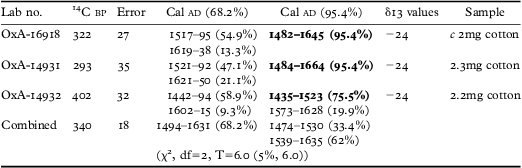
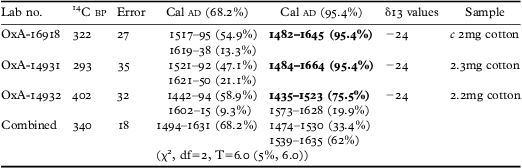
To establish when the belt was woven, three separate samples of cotton were extracted for AMS radiocarbon dating from inconspicuous, frayed areas on the belt's right side: a single strand, roughly 2mg in weight (OxA-16918) and two small samples of cotton, collectively less than 5mg in weight (OxA-14931-2). Cotton fibres (or ‘lint’) are produced on an annual basis, and so are an excellent material for radiocarbon dating as they are not subject to in-built age. Although the Taíno stored both raw and spun cotton in cacical ‘warehouses’, as well as their own homes, it is unlikely that they stored them for long given the constant demand for cotton products – from naguas (women's skirts) to hammocks. Hence the dates are expected to provide a good indication of when the belt was constructed.
The results are summarised in Table 3. Two of the dates (OxA-16918, 322 ± 27: ad 1482–1645; OxA-14931: 293 ± 35: ad 1484–1664) are very similar, although the third (OxA-14932, 402 ± 32: ad 1435–1628, at 95.4 per cent probability) is slightly older; as a result, the three dates marginally fail to combine (χ2, df=2, T=6.0 (5%, 6.0)).Footnote 69 However, given that there is no rationale for excluding the outlying determination, the combined result will form the basis of discussion.Footnote 70 This combined result of 340 ± 18 years calibrates to ad 1475–1635 (95.4 per cent probability), but is bimodal with one peak at ad 1475–1531 (33.3 per cent) and a second at ad 1540–1635 (62.1 per cent). The imprecision of the determination is due to its position within a plateau in the calibration curve in the sixteenth century (Fig 8). Although a post-1550 date cannot be excluded solely on the basis of the radiocarbon (14C) results, the dramatic cultural dislocation and population losses that followed European contact make this unlikely: such an artefact was viable only within a context that maintained traditional values of meaning and reciprocity, a context that came to an end shortly after the (forced) introduction of the encomieda system along with Christianity and European social mores.Footnote 71 Taking this into account, the most likely date range is the earlier part of the bimodal, between ad 1475 and 1531. Given the European goods present and, critically, assuming that they were integral to the belt's construction (see below), this may be constrained further, to post-1492. This actually makes very little difference to the result, as the calibrated probability only extended back to ad 1475. Alternatively, if the foreign objects are later additions, the full range needs to be considered. In other words, while the 14C dates confirm a sixteenth-century attribution for the belt, its placement within this century relies, first, on the interpretation of the foreign items and, secondly, on our current understanding of the continuity of Taíno elite craftsmanship/artistry.
Radiocarbon dates for the Vienna belt
OxCal plot of the combined dates for the Vienna belt (Bronk Ramsey 2010; Reimer et al 2009). The plateau in the calibration curve between 1475 and 1625 is apparent
Previous scholarship has proposed that both the Pigorini cemí/belt and the Vienna belt must have been made shortly after European contact, when traditional culture was still intact and artistry was at its height – especially given the presence of imported materials such as mirrors, jet beads and brass. Peter Roe, for example, places the manufacture date as 1510–15 for the Pigorini piece, stating that ‘it must have been commissioned by a high-ranking cacique favored by the Spaniards in the period after contact but before Taíno culture and its standards of craftsmanship dissolved’.Footnote 72 If the Pigorini cemí/belt and Vienna belt do indeed share a history, then this timeline could extend to both pieces. Feest suggests a date of c 1525–50 specifically for the belt, and Vega, outlining several possible scenarios for when the pieces were produced, appears to favour a date between 1519 and 1558.Footnote 73 Schweeger-Hefel provides the widest range for both Pigorini and Vienna pieces, ad 1520–1600, based on the presence of convex mirrors and African materials that she suggests were not available before the second quarter of the sixteenth century (but see below); she sets the date of almost complete Taíno cultural decline at 1610.Footnote 74 For the belt specifically, she favours a date ‘just before or after 1550’.
The 14C dates presented here do not discount any of these possibilities, but they do provide a range of dates that pushes the timeline for the belt back to the mid-fifteenth century, while potentially extending the period to the late sixteenth century. A thorough review of the European materials – as well as the adhesives used to secure them – may assist in further refining the chronology.
Post-1492 additions: the ‘foreign’ materials
The belt's cemí mask features mirrors (Fig 9), jet beadsFootnote 75 and brass pins – each with implications for the object's history. Mirrors were introduced as items of exchange from the time of Columbus's first contact with the Taíno: ‘The admiral gave to Guacanagari many things from Spain, such as glass beads … and mirrors.’Footnote 76 Coccio Sabellico noted that the natives ‘eagerly loaded the sailors with gold, and they greedily took glass vessels in exchange for it, along with … mirrors’,Footnote 77 a comment echoed by another Italian contemporary, Trevisan: ‘To those who offered a strap or a bell or a piece of mirror or some other like thing, they gave the gold which they had.’Footnote 78 These accounts suggest that mirrors were available to the sailors, which at this time would have been convex mirrors of thin glass coated with lead, the most common mirror during the medieval and Renaissance periods.Footnote 79 In contrast, the flat, slightly thicker, tin/mercury-amalgam mirrors that revolutionised the glass industry did not come into production until the sixteenth century, with the first known manufacturer established in 1507.Footnote 80 These later mirrors, which were larger and brighter than those of the medieval period, were the prerogative of the wealthy in Europe: production was difficult, time-consuming and costly, and so these mirrors were extremely expensive.Footnote 81 As a result, demand for the cheaper lead mirrors continued, and their manufacture was documented in Books of Trade well into the late sixteenth century.Footnote 82 Hence, if the mirrors in the belt are convex, as first suggested by Schweeger-Hefel,Footnote 83 their period cannot be constrained to post-ad 1520 solely on the basis of mirror style, as convex, lead-backed mirrors were popular in the late fifteenth century and continued to be made in parallel with the flat tin-mercury mirrors. Without a study of the chemical composition of the mirror's backing, the problem ultimately comes down to a visual assessment of the degree of flatness which, given the size of the eye inlays, is difficult to determine.
Left eye mirror, showing natural deterioration. Note the way it has been cut and positioned within the cotton boundary, secured by reddish resins. Photograph: author; courtesy of the Museum für Völkerkunde, Vienna, inv. no. 10.443
Mirrors are mentioned only in passing in Deagan's comprehensive study of artefacts from colonial Spanish sites in Florida and the Caribbean,Footnote 84 mainly because so few examples survive archaeologically. There is only one known sixteenth-century example from an archaeological context in the south-eastern United States,Footnote 85 suggesting that their export to the Americas remained relatively rare (and that they probably had a long period of reuse) in the early contact period. It was not until 1563 that Spain decreed that colonising expeditions to the New World had to take goods for trade, including mirrors.Footnote 86 What this suggests is that if the mirrors were added to the belt shortly after contact, they were rare items for the time, which in turn suggests that the cacique who possessed this piece was a person of means and connections.
Beads, particularly glass beads with their bright, lustrous surfaces, proved popular among the Taíno – as they did among most indigenous communities in the Americas – and shipping records indicate that between 1511 and 1526 roughly 179,000 beads were shipped to the Spanish colonies, reaching 10 million between 1583 and 1613.Footnote 87 Las Casas notes that glass beads, ‘having the further merit of novelty and rarity, were added to the conch disks and to the cibas, coloured stones, held in high regard, as gifts worthy of a cacique’.Footnote 88 In contrast, jet beads are not known as a late fifteenth- and early sixteenth-century exchange commodity in Spanish/Taíno interactions. Generally, they are rare in the Caribbean during the sixteenth century, perhaps because they were more expensive than glass, and had a religious resonance with the Spanish, who used them predominantly in rosaries and amulets.Footnote 89 For example, shipping records indicate that 107 jet rosaries were exported to the Caribbean between 1526 and 1618 – in contrast to 240 made of glass, plus the bulk quantities of glass beads noted above. Although these numbers probably under-represent the actual quantities, as materials were infrequently recorded, this still serves as an indication of the comparative rarity of jet beads during this period, something further supported by the archaeological record.Footnote 90 Jet imports increased post-1590, and jet beads – for both necklaces and rosaries – are more frequently encountered in Spanish colonial sites by the mid-seventeenth century.Footnote 91 Placing the belt's jet beads chronologically is difficult because of the much smaller dataset available for the purposes of comparison, and because jet beads were cut by hand and so quite individual in style. To date, it has not been possible to find an exact match for the two styles seen on the belt. The two jet beads on the head of the cemí (Fig 10) are broadly comparable to facetted ornaments recovered from Santa Elena (South Carolina) and St Augustine (Florida), dating to the last quarter of the sixteenth century.Footnote 92 The single, small faceted jet bead placed in the right earflare (Fig 11) is reminiscent of beads dating to 1650–1700, although these are substantially larger (c 11–13mm) than that on the belt (4mm).Footnote 93 Given the above, there is no firm way to establish the dates of the beads on style alone, and although it is possible that they date to the sixteenth century, the general rarity of jet in the Caribbean at this time make their incorporation into the belt even more extraordinary than the mirrors (where cronista documentation exists for their direct exchange with the Taíno). The only other example of jet associated with an indigenous artefact comes from Burial 84 (14C dated to ad 1475–1690, 88% probability) at the site of El Chorro de Maíta, Cuba, consisting of a necklace of white coral beads strung with one spherical jet bead, for which the researchers suggest a late sixteenth-century date based on style.Footnote 94
Six-sided jet bead secured with brass wire, possibly from a belt buckle. Jet bead length 12.5mm, width 7.3mm (max); width of central hole 4.2mm. Photograph: author; courtesy of the Museum für Völkerkunde, Vienna, inv. no. 10.443
Right earflare. Inner diameter of earflare 15.2mm; jet bead diameter 4mm. Photograph: author; courtesy of the Museum für Völkerkunde, Vienna, inv. no. 10.443
Only the tips of the brass pins securing the jet beads on the head of the cemí are visible (Figs 10 and 14), so without a computerised tomography (CT) scan to determine their full length and shape it is difficult to gauge what these may have been originally. It is possible that they were taken from buckles – perhaps the ‘ring and pin’ buckle style given the shape of the pin's head. This style of buckle appears in the first half of the sixteenth century on Spanish sites, although ‘buckles are generally more useful for suggesting function rather than chronology’.Footnote 95 Brass is known to have been of particular interest to the Taíno – brass imports such as aiglets (rolled metal lace-ends) were sought in exchanges because of the metal's similarity to guanin, which was valued above gold by the Taíno.Footnote 96
Aside from the European goods, there has been a suggestion that the shells used for the teeth of the cemí are West African Marginella sp., specifically Marginella monilis Laur., now Prunum monilis) (Fig 12).Footnote 97 However, it is unclear how both the identification and the assignment of an African provenance were made, given that the shell's aperture, a key diagnostic feature, is not visible. Marginella is a genus of over 650 species, many of which are West African, but it also occurs in tropical seas worldwide, including the Caribbean and the Americas.Footnote 98 Equally, there are a number of other small, white shell species from the Caribbean (such as Volvarina lactea, Hyalina lucinda) that could also be candidates, and it would be important to revisit this issue in future research. Apart from the issues of identification and provenance, the insertion of separate shells to represent individual teeth is not typical of Taíno art: these are normally depicted with a single large inlay of carved shellFootnote 99 or simply as a sheet of gold or guanín.Footnote 100 The only extant Taíno sculpture featuring individual teeth is the Turin cotton cemí, where the teeth are those of the actual human maxilla and mandible – but even here, the teeth are tightly bound with vegetable fibre cords, which in turn are well integrated into the wider cotton structure:Footnote 101 no such approach is seen in the Vienna belt. What is also curious is the unfinished appearance of the wood surface below the teeth. If the centrally excavated area was meant to be on view, giving the mouth a more three-dimensional appearance by receding into the background when framed with the teeth, its unfinished ‘raw’ appearance is at odds with the overall quality of the belt – and with the typical excellence of wood-carving in the region.Footnote 102 Normally, these types of recessed mouths were never meant to be visible; they were carved specifically to lodge a single inlay more securely in place, the latter sometimes having a custom-made ridge fitting neatly within the mouth's groove. There are also no remnants of original resins on the visible wooden base of the mouth, whereas one would expect some sort of adhesive, given that the cotton ‘lips’ would do little to hold the individual shells in place. Failing to secure an area so critical to the depiction and visual impact of the cemí – certainly if it contained such exotic foreign ‘wealth’ as African shells – goes against the care and attention that went into the creation of the rest of the belt. There is, however, some red staining to the cotton around the mouth, and some red resin, similar in appearance to that used in the eyes, is lodged deeply within the lip grooves, holding the Marginella in place.Footnote 103 If the cemí ever held a single inlay in the mouth, it is possible that the resins within the mouth groove were removed, perhaps to refresh the area with the Marginella, but judging by the gaps in the mouth – specifically the way that the cotton has moulded around those shells that are now lost (Fig 13) – it is clear that this was done quite some time ago.
Individual shell teeth set against an internal wooden framework. Note the yellow resin adhering to the wood where two teeth (now lost) were previously attached (cf Schweeger-Hefel Reference Schweeger-Hefel1952, figs 1–2). Photograph: author; courtesy of the Museum für Völkerkunde, Vienna, inv. no. 10.443
The underside of the chin of the cemí, featuring tightly woven beadwork disappearing against the belt base, and the mouth, featuring rounded gaps where three shell teeth were once set. The way that the cotton has moulded around the shape of the now missing teeth suggests some age to their placement. Photograph: author; courtesy of the Museum für Völkerkunde, Vienna, inv. no. 10.443
Indeed, a closer inspection of the resinous substances on the surface reveals that a number of different materials were used on the cemí, suggesting different treatments over time. There is the thick, opaque red resin visible within the eyes, remnants of which are also deeply embedded in the mouth. Intriguingly, this red material is reminiscent of the resin present on the large Taíno feast dish in the collections of the Museo di Antropologia e Etnologia in Florence, which has been identified as pine resin and AMS radiocarbon-dated to ad 1445–1628 (95.4 per cent confidence).Footnote 104 These red resins could be original to the Vienna belt, or at least contemporaneous with its radiocarbon determinations (ad 1475–1635). In contrast, a yellowing adhesive, probably a recent addition, is present in the mouth, apparently used to secure the teeth, perhaps after they had become loose. A comparison of the current belt with photographs in Schweeger-Hefel's 1952 publication clearly shows that an additional two lower front teeth were once present, yet the yellowing residue is present in the gaps that remain, suggesting that this treatment pre-dates 1952.Footnote 105 Another substance – clear and glossy – covers part of the jet bead and surrounding cotton in the right earflare and has the appearance of gelatin, isinglass or a synthetic adhesive.Footnote 106 The small jet bead is slotted into a much larger cotton framework, which seems to have been made to hold a large disc of inlay, suggesting that the earflare was not custom-made to house the bead. Lastly, there is a waxy substance below the larger jet beads on the head of the cemí, suggesting the material was added to the surface to secure them – and possibly consolidate the surrounding damaged area – after the shell beads had been woven in (Fig 14). These could all be treatments that date from the belt's later history, raising questions over the security of association between the jet beads and shell teeth with the original (indigenous) framework for the belt. Further work is needed to resolve these issues, and could usefully include a detailed chromatography mass spectrometry (GC/MS) study of the adhesives and, if appropriate, their radiocarbon dating, alongside taxonomic identification and isotopic analyses to help determine the provenance of the shells.
Waxy residues below the jet bead on the head, covering the surrounding damaged areas with missing shell beads. Photograph: author; courtesy of the Museum für Völkerkunde, Vienna, inv. no. 10.443
The key issue, for understanding both the object and the dates, revolves around when the exotic materials were added to the belt – whether they were part of the indigenous manufacture sequence or later additions in the history of the piece, either within a Taíno context or to enhance the object for display in Europe. The latter would not have been an isolated occurrence. Although it is clear that the Taíno desired exotic imports, which they quickly assimilated into their own scales of value,Footnote 107 we must not underestimate the keen interest in Europe for objects from newly discovered lands, especially the drive of some of the ruling elite to acquire pieces for their private museums.Footnote 108 By far the most desirable objects to display in these museums were ‘wonder-provoking items: spectacular or ingeniously created things, and curious or strange artifacts that had no resemblance to European productions’.Footnote 109 Indeed, some early Mexican stone carvings in the Schloss Ambras collections were ‘enhanced’ specifically for display in the sixteenth and seventeenth centuries, while one piece of Mexican featherwork was restored after 1519 with stylistically atypical ‘Aztec’ iconography and foreign dyes.Footnote 110 Others, such as the ‘Xolotl’ figure in Vienna's Museum für Völkerkunde, may have been made specifically as curios designed to appeal to the early post-Conquest Spanish market.Footnote 111 The Pigorini cemí/belt, the object that most likely shared a history with the Vienna belt, has a turned wooden base to which the beaded cemí figure and separate belt were nailed. This appears to have been done some time ago – the nails are hand-cut, and now quite rusted. The presence of both these hand-cut nails and the wooden base suggests the mounting of the two objects for display. The incorporation of a carved rhinoceros-horn mask into the weave of the Pigorini cemí – first identified at the turn of the twentieth centuryFootnote 112 – has also raised some questions: Asian and African horn was an extremely valuable commodity in the sixteenth century,Footnote 113 and so would be an unusual item to export to the Americas, where the demands for basic European necessities (clothing, food and wines, livestock) during the early settlement period outstripped the need for such unusual luxury commodities. Nor would it have been the kind of possession West African slaves would have been able to take with them.Footnote 114 It has therefore been suggested by some that the Pigorini cemí is a pastiche that may have been among the items made in Europe, ‘not as forgeries but to create and present even more attractive and wonderful curiosities’.Footnote 115
If doubts can be raised over a material that is actually woven into the structure of the Pigorini cemí, then materials simply adhering to the surface require particular scrutiny. The features that hold the mirrors and jet beads in the belt would have traditionally held gold/guanín or shell inlays. As is clear from the 1495–6 inventory, any goldwork on belts was noted down with particular interest, and probably did not last long in Spanish hands, especially given their tendency to melt down much of the goldwork taken from the Americas.Footnote 116 Indeed, there is damage to the nasal area on the belt's cemí that suggests other materials – possibly a guanín nasal ring (known to have been worn by the Taíno) – may have also been present at one point. If the mirrors, jet beads and shell teeth are not additions made by the Taíno themselves – perhaps added when repairing an older piece with new foreign valuables or after having exchanged or traded the guanin inlays to meet Spanish demands – then it is possible that they were added in Europe to make the piece more attractive for display once the goldwork had disappeared. Given the relative scarcity of mirrors and jet during the early colonial period, as discussed above, and the belt's undoubtedly long collection history in Europe, this is a possibility that needs to be considered. As exotics, ethnographic materials had a value in private museums. Further analysis is needed to determine whether the foreign materials have a secure association with the belt.
Discussion and conclusion
This unique object, straddling a critical period in Taíno/European interaction, raises questions not only about rare Taíno valuables and their use and meaning but how these elite objects, still conforming to the canons of Taíno art, may have been altered to function in different contexts. Among the Taíno, belt exchanges smoothed the way for socio-political manoeuvring: lavishly decorated with valuables including shell beads and guanin, these ‘badges of distinction’Footnote 117 were fitting gifts between one cacique and another, and, when the time came, this honour was extended to high-status foreign visitors. Columbus's earliest encounters with Hispaniolan chiefs hint at the established protocols for this type of exchange, where, on behalf of the cacique, a high-ranking member of his/her cacicazgo presented the belt as an invitation/incentive to further interaction. While it is not possible to sustain the attribution of the Vienna belt to specific individuals such as GuacanagariFootnote 118 or Caonabo,Footnote 119 it was undoubtedly the prized possession of a cacique of means and connections.
In its style the Vienna belt conforms to depictions of belts on Taíno ceramics as well as early sixteenth-century descriptions of examples brought back to Europe. It is clear from the inclusion of the cemí, the elegant geometry of the shell beadwork and the tight cotton weave that this was a prize of Taíno artistry, in keeping with established aesthetics. Indeed, as Vega first noted,Footnote 120 such features would be hard to imitate in Europe (in the sense of early forgeries specifically made for European collections) as the aesthetic sense and techniques employed would be completely foreign. Even the added mirrors, jet beads and brass appear to maintain these aesthetics, applied as they are to areas where inlays would originally have been featured, or ornaments would have hung – facts that argue for this to be the work of indigenous hands. If, on the other hand, these were additions incorporated to cover up the loss of original guanin or shell inlays (in efforts to make the object appear more complete and so more desirable for an important private collection) then they are very subtle additions done in the spirit of the original. Unlike the dramatic alterations made to some early Mesoamerican artefacts for the purposes of display – such as the creation of elaborate scenes on baroque mounts crafted in precious metalsFootnote 121 – the additions to the belt conform to the shapes of the original materials that may have been lost and echo their qualities (especially their bright, reflective surfaces). This is not out of context with the treatment of other early artefacts that were ‘enhanced’ or reworked to maintain the style of the originals,Footnote 122 or produced specifically by colonial artists for European collectionsFootnote 123 to keep up with the demand for antiquities from newly ‘discovered’ lands.
A number of possibilities can be proposed for the history of the belt within the context of the 14C dating results (ad 1475–1635) and the material studies thus far completed. For example, the belt could have been woven prior to, or within the first few decades of, European contact, and its mask inlaid with guanin or shell, entirely within indigenous traditions. Like other Taíno sculptural arts, it was carefully curated over its years of use.Footnote 124 With the influx of European goods, the original inlays may have been renewed, a practice that is also suggested by recent research on inlays in Taíno wood carvings. It may then have been given, traded or looted, entering Europe to circulate in private hands before its eventual documentation in the Schatzkammer inventory of 1877. This assumes that the object was moulded solely by indigenous hands, which may or may not be correct given the unusual nature of some of the European additions. A number of variations on this scenario are equally possible: for example, the belt, once in European hands, may have had any guanin inlays extracted, or may have lost its shell inlays if these were present. This did little to diminish its value given its historical significance and exotic cachet, and so it entered various private collections, where at some early point materials were added to enhance its appearance for display. Sixteenth-century European ports did a bustling trade in exotics, importing everything from African rhinoceros horn and shells to New World curios.Footnote 125 In the hands of an entrepreneur these diverse materials may have coalesced in the merging of an original Taíno belt with European mirrors, jet, brass and, possibly, African shells.
There is also the possibility – as suggested by previous researchersFootnote 126 – that the belt was created by a Taíno artisan specifically to accommodate freshly acquired European goods, and so must post-date 1492. However, some of the inlays give the appearance of surface additions, not fully integrated into the belt, which is somewhat at odds with the overall quality of the piece. Although the mirrors are cut specifically to the dimensions of their cotton frames, the earflare's jet bead is dwarfed by the cotton framework that surrounds it, and the shell teeth have clearly come loose, requiring what are almost certainly modern adhesives to keep them in place. Given that the belt was made to be worn and to be long lasting, one would expect that these exotic and highly valuable additions would be better secured within the weave, as is seen in the care taken over the shell mesh keeping each bead in place. Unfortunately, the method of attachment of the jet bead in the earflare is not visible because of the later glue covering the area. If it is indeed attached with cotton yarn and integrated into the framework of the earflare then this would provide some security of association. Alternatively, could the same resinous material used for the eye inlays be lodged deeply in the earflare, suggesting that they were added at the same time? And is this resin contemporaneous with the cotton? Only through linking up the various strands will it be possible to confirm associations between the ‘exotics’, and between them and the belt, and in so doing explore the belt's history in greater detail.
Acknowledgements
The study was supported by grants from the Leverhulme Trust and the Getty Foundation, and from the Oxford Radiocarbon Accelerator Dating Service (ORADS), with administrative support through National Museums Liverpool (NML). Gerard van Bussel, curator of North and Central American collections at the Museum für Völkerkunde (MfV), has been most helpful during my two study visits in 2005 and 2010 and over my many subsequent questions. I am indebted to the MfV conservator, Florian Rainer, who took such careful 14C samples, and to Christian Feest for his insights on the history of the belt. Conservators Vivien Chapman, Tracey Seddon and Siobhan Watts, of the NML, shared their expertise and facilitated the use of equipment at the National Conservation Centre. Elizabeth J Hylen, librarian at the Rakow Research Library, Corning Museum of Glass, forwarded detailed references on sixteenth-century mirrors, and Kathleen Deagan and Jeffery Mitchem contributed their knowledge of sixteenth-century jet beads. Per Thorling Hadsund's assistance with the history of early European mirrors was most useful. Tom Higham, Deputy Director of the Oxford Radiocarbon Laboratory, contributed comments on the 14C dates run by the laboratory. Danni Hofmann, Walter Hofmann and Rick Schulting very kindly translated the German texts, the latter also making insightful comments on earlier versions of this paper. Two reviewers have also enhanced this paper, particularly Peter Roe, who is to be thanked for his insights into the ‘semantic weight’ of Taíno belts. I am grateful to Rachel Menyuk, National Museum of the American Indian, and André Delpuech, Museé du quai Branly, for permission to include Figures 2 and 3, respectively.