This article approaches party position-taking from a new angle, viewing it as an internal factional process rather than as strategic decisions taken by a unitary agent. We assume that parties are ideologically based and pursue their own policies, that they are internally factionalized and operating under high levels of uncertainty. Using these assumptions, the integrated theory requires two basic pieces of information to predict parties’ policy moves: past policy shift and past vote share. When a party loses votes, it will reverse its leftward or rightward move. When a party gains votes, it will continue in the same direction. However, a party will not make two consecutive moves in the same direction, even after a vote gain, owing to factional constraints. These are the core predictions of the integrated dynamic theory we present below. To check them, we examine every policy shift made by parties in twenty-four democracies over the post-war period, finding strong evidence for these ideas. This has implications for theories of party competition, political representation and spatial modelling, which we discuss immediately below.
Two views on how popular preferences get translated into public policy have held sway in the post-war era – convergence on the median and the party mandate. Both double as theories of party policy-making, because the way in which parties define the options on which electors vote is central to democratic representational processes.
Party convergence ensures efficient representation by postulating that parties adopt more or less the same policies close to the median elector. This position maximizes their vote at least under two (or quasi-two) party competition, as any majority has by definition to include the median. The median electoral preference is also the one at the least aggregate distance from all the others, and therefore the preference which, if chosen as public policy, best maximizes popular satisfaction (or minimizes dissatisfaction). This result is guaranteed if all the parties which are capable of forming a government have policies close to the median.
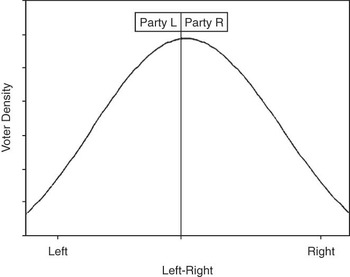
Convergence ideas have been most famously expounded by Downs in the form of Figure 1.Footnote 1 Where two parties compete to maximize their vote, electors cluster around the median and vote on policy grounds within a one-dimensional left–right space, convergence will occur and good representation is assured.
Schematic of hypothetical elector and party locations, for a normally distributed electorate in a two-party system Note: Formulated by the authors on the basis of Downs’s Convergence and Marginal Vote-Seeking Hypotheses (Anthony Downs, An Economic Theory of Democracy (New York: Harper, 1957), pp. 118–24).

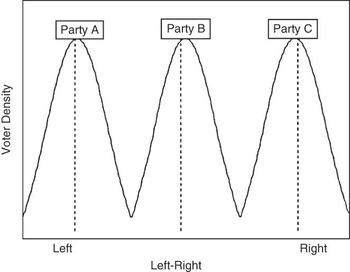
Often overlooked is Downs’s second model, illustrated in Figure 2, which postulates non-convergence in the context of a multi-modal distribution of electoral preferences (where sizeable groups back quite distinct left–right preferences) and a multiparty system.Footnote 2 Here (although his reasoning is somewhat ambiguous, as noted by Barry),Footnote 3 Downs seems to argue that even vote-seeking parties will be sensitive to marginal losses and gains of votes, and hence will oscillate around substantially the same policy position over time.
Schematic of hypothetical elector and party locations, for a multi-modal electorate distribution in a three-party system Note: Formulated by the authors on the basis of Downs’s Convergence and Marginal Vote-Seeking Hypotheses (Economic Theory, pp. 118–24).

Parties offering different options to electors, who then choose to vote for the one closest to their own position, are at the heart of the second leading theory of political representation – the party mandate. For this to be conferred, electoral choice between distinct policy options is vital, and therefore parties have to take up different policy positions to provide it.Footnote 4 Parties offer a range of policy options; electors choose between these options; the most popular option attracts the most votes; this policy option is then effected in government by the party which proposed it. In this way, the popularly preferred option becomes public policy without parties having to converge, and indeed with a premium on maintaining their own traditions and identity.Footnote 5
Policy differentiation, as the name implies, is ideological in nature rather than vote maximizing: parties maintain their particular identity and continuity by attracting like-minded people to them rather than pursuing vote and office as a prime objective. However, as Downs’s discussion of the multiparty case makes clear, we note that party differentiation also results from local vote maximizing where the electoral distribution of preferences is sufficiently lumpy, as in Figure 2.
The next section reports evidence which favours party differentiation rather than convergence and evaluates different explanations of this form of position-taking by parties. The third section briefly describes the predecessors of the integrated explanation we ourselves present. The fourth section specifies this integrated model in terms of its assumptions and predictions. The fifth section develops a three-party simulation to demonstrate its plausibility. The sixth section introduces the data used to evaluate it and checks its ‘postdictions’ of party policy shifts in twenty-four post-war democracies. The final section comments on wider implications of our findings for democratic theory and future research.
From Theory To Evidence: Convergence Or Differentiation?
Downs’s models provide a context for our analysis of party policy behaviour by relating it to the central question of political representation and its spatial modelling. His models also raise specific research questions. Do parties converge in policy terms? If not, what are the mechanisms by which differentiation is maintained – incremental vote-seeking or ideological?
For thirty years after Downs’s Economic Theory was published in 1957, such questions had to be answered by critical argument or by more or less formal modelling supported by case studies.Footnote 6 Full checks against the evidence were impossible in the absence of comparative evidence over time on party policy movements. This was supplied in the 1980s by the Manifesto Research Group and its successor, the Comparative Manifesto Project (MRG-CMP), which coded the sentences of every significant party’s platform or manifesto into fifty-six policy categories in twenty-four (increasing to fifty-four) countries, for the entire post-war period.Footnote 7
These data made it possible to evaluate Downsian-style models – first of all on the assumption that policy can be plausibly summarized in terms of position and movement along a left–right continuum. The MRG-CMP created such a scale by opposing party emphases on government intervention, welfare and peace, on the left, to freedom, traditional morality and military strength, on the right. The scale plausibly traces out party movements over time in a large number of countries,Footnote 8 permitting detailed representations of how parties related to each other in dynamic policy terms.
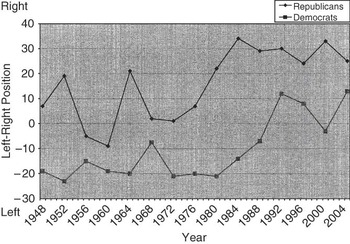
This is illustrated in Figure 3 for the American case, which shows how Republican and Democratic position-taking matches the historical record of the post-war period, catching Goldwater’s and Reagan’s moves to the right in 1964 and 1980, and Clinton’s repositioning of the Democrats in 1992. Mapping the American parties in this way also has analytic implications. As the purest example of a two-party system in the contemporary world, the American case provides a crucial test for the convergence thesis. If parties do converge on the median, they should have nearly identical positions at each election, or at least come closer together over time. Quite the opposite emerges from this actual case: Democrats and Republicans remain distinct and even seem to strengthen their differences over time. At points their zigzag movement brings them momentarily closer, but then they move apart again.Footnote 9 This strong general pattern of policy movement also carries implications for party differentiation, as pictured in Figure 2 above. Party behaviour is much more dynamic than that represented there. The zigzag pattern of change does not seem clearly related to electoral success or failure: Clinton’s move to the centre in 1992 brought electoral success, but so did Reagan’s move to the right in the early 1980s. This suggests that party policy is shaped more by internal considerations than electoral calculations – a possibility we systematically develop below.
Right–left movement of US parties, 1948–2004 Note on sources: The figure has been calculated by the authors from the data supplied with MPP and MPPII.

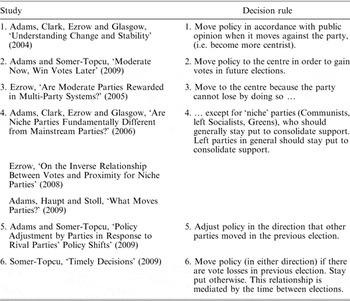
Controlling for the policy zigzag which appears in all countries covered by the MRG-CMP data, a series of studies by Adams and his associates has tried to explore the Downsian concepts further by relating party movements to shifts in public opinion on the Eurobarometer left–right scale.Footnote 10 Their results are summarized in Table 1 in the form of rules which parties seem to use in deciding on their policy moves.Footnote 11 As is evident from the table, tendencies to converge are present when parties react to electoral movements of opinion. But they are limited. Parties move towards the centre rather than truly converge. And there are exceptions. ‘Niche’ parties, with stronger ideological bases and more extreme positions, neither moderate normally, and nor should they; if they were to do so, they would lose votes.Footnote 12 Other parties react to moves of opinion against them, rather than to all moves of opinion, as Downs would imply. In short, the tendencies to convergence discovered in these detailed studies are incremental and marginal rather than the mainspring of party behaviour, as one would expect if the convergence thesis were to be upheld. As such, they confirm the picture of dynamic policy differentiation by parties which emerges in Figure 3.
Inductive Decision Rules for Policy Movement by Generally Support-Seeking Parties

References: James Adams, Michael Clark, Lawrence Ezrow and Garrett Glasgow, ‘Understanding Change and Stability in Party Ideologies: Do Parties Respond to Public Opinion or to Past Election Results?’ British Journal of Political Science, 34 (2004), 589–610; James Adams, Michael Clark, Lawrence Ezrow and Garrett Glasgow, ‘Are Niche Parties Fundamentally Different from Mainstream Parties? The Causes and the Electoral Consequences of Western European Parties: Policy Shifts, 1976–1998’, American Journal of Political Science, 50 (2006), 513–29; James Adams, Andrea Haupt and Heather Stoll, ‘What Moves Parties? The Role of Public Opinion and Global Economic Conditions in Western Europe’, Comparative Political Studies, 42 (2009), 611–39; James Adams and Zeynep Somer-Topcu, ‘Moderate Now and Win Votes Later: The Electoral Consequences of Parties’ Policy Shifts in Twenty-Five Post War Democracies’, Journal of Politics, 71 (2009), 238–48; James Adams and Zeynep Somer-Topcu, ‘Policy Adjustment by Parties in Response to Rival Parties’ Policy Shifts: Spatial Theory and the Dynamics of Party Competition in Twenty-Five Post-War Democracies’, British Journal of Political Science, 39 (2009), 825–46; Lawrence Ezrow, ‘Are Moderate Parties Rewarded in Multiparty Systems? A Pooled Analysis of Western European Elections, 1984–1998’, European Journal of Political Research, 44 (2005), 881–98; Lawrence Ezrow, ‘On the Inverse Relationship between Votes and Proximity for Niche Parties’, European Journal of Political Research, 47 (2008), 206–20; Zeynep Somer-Topcu, ‘Timely Decisions: The Effects of Past National Elections on Party Policy Change’, Journal of Politics, 71 (2009), 238–48.
All the relevant evidence suggests, therefore, that parties differentiate themselves from each other, most of the time.Footnote 13 In the next two sections, we examine ways in which such differentiation is produced and sustained, with particular emphasis on whether differentiation is adequately explained by strategic support-maximizing calculations.
Localized Vote-Seeking Or Ideological Alternation?
The first comprehensive use of the Manifesto evidence to check out theories of party movement was described in ‘A New Spatial Theory of Party Competition’ (NST) in 1994.Footnote 14 This made two novel suggestions:
1. Policy was heavily constrained by long-standing party ideology, and therefore there was only limited movement outside parties’ own ideological area and only limited leapfrogging of one party by another.Footnote 15
2. In deciding on their constrained policy moves, different parties use different decision rules inspired either by ideological or vote-maximizing considerations, or a mixture of both – all under great uncertainty about the nature of their popular support.
Specifically, the rules were:Footnote 16
(i) Stay put in the face of uncertainty – what attracted votes last time will also do so this time and you remain ideologically sound.
(ii) Alternate – zigzag to left and right at each election in response to internal and external pressures on the leadership. These could be popular reactions against the policies pursued in governmentFootnote 17 or (linking with our discussion below) the changing strengths of internal ‘moderate’ and ‘extreme’ factions.
(iii) React to past results. ‘Parties evaluate policies in terms of whether a previous leftward or rightward shift was associated with vote gains or losses.’ If a gain, stay where you are or continue the movement; if a loss, change direction.
(iv) Rational Expectations (from Robertson’s Theory of Party Competition).Footnote 18 Parties adjust their behaviour according to whether they think the next election will be competitive – in which case they move to the centre – or non-competitive – when they cease to need votes and follow their ideological preferences by going to the extremes.
(v) Marker Party. Parties outflank their closest ideological rivals by taking more extreme positions to the left or right than they do.
In the background there are always ideological limits, guaranteeing generally differentiated party positions. Within these, however, some rules are vote-orientated (past results, rational expectations), some are entirely ideological (marker) and some are mixed (stay put, alternative).
How does one decide whether individual parties actually apply one rule rather than another? Operationally, one can pick out the rule that best characterizes a party’s actual moves (1945–92) utilizing the MRG-CMP ‘maps’.Footnote 19 Alternation best fitted forty parties; past results, twenty; rational expectations, nine; stay put, one; marker, two. Over their ‘best-fitting’ parties, the rules postdicted actual party moves with success rates varying from 0.65 to 0.81 and an overall rate of 0.68.
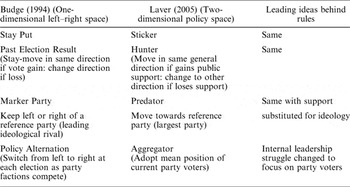
The idea that different parties use different decision criteria has been taken over more recently to generate a simulation using remarkably similar rules to model party competition under strictly support-seeking conditions.Footnote 20Table 2 compares the decision rules presented in each study. We note two differences. First, the changed labels attached to the decision rules in the simulation reflect their new use as support-maximizing strategies by office-seeking parties. In addition, the simulation for which they provide the dynamic sets parties in a two-dimensional policy space where electoral policy preferences are measured by quarterly (Irish) poll responses.
Budge’s (1994) and Laver’s (2005) Decision Rules Governing Party Movements in Policy Space

In terms of the fit between the simulation and anecdotal evidence on Irish party behaviour during the period, all parties but Labour were judged to act as ‘Hunters’ – moving each time in response to support gains or losses associated with their last move. Labour was characterized as a ‘Sticker’ – i.e., staying put from one time point to another.Footnote 21
Two dimensions need not co-define a common space. They could be separable ‘economic’ and ‘social’ dimensions – often derived from the manifesto data which we use below. Tavits finds that party shifts on an ‘economic’ dimension are associated with vote gains, while policy shifts on social values are punished by losses – possibly under the influence of ideology.Footnote 22 Money and Andrews, however, find parties making bigger strategic moves on the social side than the economic one.Footnote 23
In whatever kind of space the parties are represented, the predominant strategies keep them distinct in policy terms over time. Alternation does this, and so does responding to marginal increases or losses in support or vote. ‘Hunters’, in Laver’s simulation, circle the centre rather than meeting there, while Money and Andrews’s ‘niche predators’ are also constrained, for ideological reasons, to their own neighbourhood (not to mention parties that stay put).
Adams has also attempted to explain the observed differentiation of parties from each other in ideological and policy terms by modifying the proximity voting assumptions which underlie most support-seeking models.Footnote 24 Specifically, he assumed that a varying number of each party’s supporters were attracted to it on non-current policy grounds. This could be through a long-standing affiliation or identification with the party, or an ideological attachment, or even previous policy stands. What is important is that this motivation does not relate to current party policy and thus limits the vote gains a rival party can get from moving up in policy terms on its target. By doing so the party gains the policy proximity voters but not the otherwise affiliated ones. Thus, its vote gains progressively diminish as it moves ever closer to its rival, while at the same time it loses some of its own policy proximity voters to rivals on the other wing, or to abstention. Hence, in the next election, it moves back to something like its old position, only to move up on its neighbour again in the succeeding election.
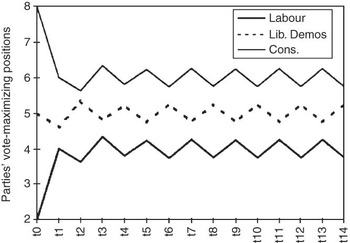
For the dynamics, we consider Adams’s simulation for British parties, illustrated in Figure 4. The predicted, regular, zigzag pattern fits reasonably with the observed paths of British parties. This supports the idea that factors other than policy adjustment enter into the vote equation and affect party strategies – though in this case only indirectly and for parties seeking marginal gains.
British parties’ simulated left–right positions over successive time periods, for a single-peaked preference distribution among electors Source: Permission to reproduce this figure from James Adams, ‘A Spatial Theory with Biased Voters: Party Policies Viewed Temporally and Comparatively’, British Journal of Political Science, 31 (2001), 121–58, at p. 137, is gratefully acknowledged.

Adams’s introduction of mixed motive voting nevertheless subverts many of the other models discussed above. These models base themselves on public opinion oriented, support-seeking and proximity assumptions. In Adams’s model, voters’ policy views do not fully determine their vote. Parties still adjust policy with votes in mind – it is one of the ways they exercise electoral influence. But they do so under deep uncertainty about how voters will react. This leaves the way open to ideology, whose classic function is to provide explanations for otherwise unclear events, and to use these explanations as a basis for action.Footnote 25 Of course, there is ambiguity regarding these explanations and subsequent action recommendations – thus leading to inter-party and intra-party (i.e. factional) conflict.
Sustained attempts to explain party policy change in terms of local vote-seeking and loss avoidance have had limited success.Footnote 26 These studies then point to ideological factors (for example, the presence of niche parties) that could explain discrepancies between the postulated effects of parties’ vote-seeking motivations and parties’ observed policy shifts. This suggests that we examine ideology and vote-seeking together to explain party policy behaviour. Another implication is that internal processes – rather than strategic calculations made by a unified leadership – explain the policy zigzags which are a conspicuous feature of observed party movement. We follow through on this observation below by arguing that policy change is driven by a process of factional alternation of control of the party, temporarily suspended when a party achieves vote success. Ideology, party factions, parties’ vote shares and their consequences are put together in the next section to form our dynamic theory.
An Integrated Dynamic Theory
Our theory cuts through complications in the previous discussion by:
(a) Setting party movement in a unidimensional left–right space. While some analysts suggest using two dimensions, it remains unclear whether they should be combined to create a Euclidian two-dimensional space, or separated out into ‘economic’ and ‘social’ spaces. The nature and effects of policy movement in the separate dimensions are also under dispute. Previous analyses using a combined left–right dimension reveal a strong tendency for party movement to take place on this universally recurring policy cleavage. This requires further explanation and – if possible – prediction, before moving on to more complicated representations.
(b) Using past vote as the sole exogenous reference point, rather than electoral preferences and support, as reflected in opinion polls. Vote itself is problematic for parties to explain in policy terms given mixed motive voting, and is only marginally under their control. Vote gains and losses do, however, provide a rare concrete reference for parties to react to.
(c) Systematically incorporating ideology. Ideology has been rigorously excluded in favour of office-seeking and vote-seeking party motivations, but usually creeps back into the explanations. Ideology ‘explains’ to leaders and activists why parties received the vote that they did – and it necessarily shapes policy,Footnote 27 powering change through factional alternation.
Factions complicate matters slightly by abandoning the conception of parties as unitary agents. Without the extra dynamic provided by internal ideological conflict, however, it is difficult to explain the strong alternating but contained policy movement observed in parties (see Figure 3). From this point of view, we are explaining an observed phenomenon – policy zigzags – by an inferred and possibly unobservable one – factional conflict. We make two points in this regard:
(a) Explaining observed by unobservable factors is a widely accepted practice in scientific explanation – witness the invocation of genes to explain species differentiation, or of atoms to explain spontaneous (‘Brownian’) movement in liquids. Both entities were postulated long before there was a possibility of directly observing them, as is the case with sub-atomic particles today.
(b) The above arguments notwithstanding, party factions are observable! Histories and descriptive studies are replete with accounts of their activities in every country and party. Southern and Northern Democrats, and neo-Conservatives and Christians in the United States; ‘Wet’ and ‘Dry’ Conservatives, and New and Old Labour in Britain – all have been much discussed. In addition, the party factions of Italy and Japan have been well documented, and characterized as perhaps stronger and more cohesive political forces than the parties they inhabit.
Interestingly, recent research has shown a tendency to focus on factions as the explanation for a wide range of party behaviour – from leadership and other structural changes to coalition formation.Footnote 28 Our own factional theory meshes well with these new approaches.
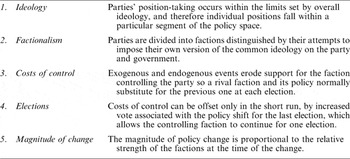
We maintain that factional struggles power the policy ‘alternation’ pattern observed on the left–right continuum. However, alternation is interrupted when policy shifts are associated with vote gains in the previous election, in the manner summarized in Table 3. Past vote influences this pattern because factions not only want to push the party towards their own version of its ideology, but also to see that ideology controlling and/or influencing government. Few parties can realistically hope to win elections. Rather, stabilizing or marginally increasing votes bolsters party chances of entering a coalition government. If a previous policy shift is linked to an increase in vote share (and probability of influencing government), even the opposing faction has some motivation for compromising in the short run. However, the ideological costs are too high for an opposing faction to accept this situation for more than one election.
Assumptions of an Integrated Factional Theory of Party-Policy Making

Of course, all party leaders and members subscribe to a broad common ideology of left or right – Communism, Socialism, Christian Social doctrine, Welfare or Market Liberalism, Neo or traditional Conservatism. These are the bases of the well-known Party Family groupings and give parties their common identity and continuity. They thus set limits on the kind of current policy parties are able to adopt. Any Socialist party that totally abandons its concern about welfare imperils its own existence. Hence, the first assumption of Table 3 is that parties remain, in spatial terms, within a particular segment of the policy dimension. Uninhibited free movement, as implied by office-seeking or vote-seeking assumptions, is just not an option. Drawing on what we know about political parties, this seems entirely reasonable.Footnote 29
At the same time, ideologues are also notorious for disagreeing, often bitterly, about the precise implications of their ideology, particularly for current action. Is welfare best strengthened by spending more on the current system or by modernizing it? Party adherents often split on questions like these which stem from ‘fundamentalist’ or ‘modernizing’ versions of their ideology – the ‘Old Left’ as opposed to ‘New Labour’ in the British case. This common experience of factional infighting is what powers Assumption 2 in the table, about each faction wishing to impose its own version of current policy, more to the left or right, on the party as a whole. The bitterness of disagreements varies, but there is rarely a party without differing currents of opinion on what to do next, within the terms of their shared ideology.
Events usually accumulate against the faction in control – the faction makes too many concessions to coalition partners, blunders and/or becomes involved with scandals and blunders. Hence, its position is weakened, and the other faction(s) with their opposing interpretations of events are strengthened. They (re)gain control and impose a different, leftist or rightist, line. Or a standoff occurs. In any case, the previous line is not pursued.
Assumption 3 thus takes the concept of ‘costs of control’, a common variable in modelling and predicting the electoral fortunes of incumbent parties, and applies it to the incumbent faction in a similar way.Footnote 30 The widespread use of ‘costs of control’ in the voting studies with regard to governments’ loss of support should lend it credibility here, as the same mechanisms are at work.
Costs are, however, only relevant when they are not outweighed by other factors. It is here that a concern with votes comes in. If our review of the existing literature on party movement shows anything, it is that we cannot dispense with either vote-seeking or ideological considerations. Our model differs from most of the ones previously proposed by reversing their order of importance and regarding ideology as primarily important and vote-seeking as secondary.
Even ideologues, however, have to give some weight to electoral success in a democracy. This is recognized in Assumption 4. While no party can hope to attain majorities, either electoral or parliamentary, under multiparty systems in most countries, vote increases do give them more influence. A faction credited with having attracted votes with its policy shift can, therefore, continue in the same policy direction after an election. Ideological frustration then mounts, and prevents further shifts in that direction – whatever the results. At the fourth election, there is either a standoff between the factions or a move in the opposite direction to the previous one.
Logically, the magnitude of such moves should be determined by the relative strengths of the factions pushing against each other. The stronger one faction is relative to the others the more it overcomes resistance and carries its preferred policy further. This is the thinking behind Assumption 5 in Table 3, which summarizes precisely this view of the relationship between factional forces.
Factional competition for the dominance of their own version of the shared ideology thus accounts for the major features of party policy change – both its direction and magnitude. Realistically, factions – with their ambitions to affect government as well as party policy – take election results into consideration. But these are difficult to interpret except through ideology. Previous vote only has a minor, short-term effect – interrupting policy alternation rather than replacing it.
These five assumptions benefit from drawing together some of the empirical findings and rules discussed above, while also providing a framework for a general simulation of the processes at work and a searching empirical investigation of their validity. If validated, the assumptions have important implications for political representation as a whole: the theory of the mandate – that parties offer consistently differentiated but varied choices to electors – is consistent with these assumptions.
Modelling Party Decision-Making
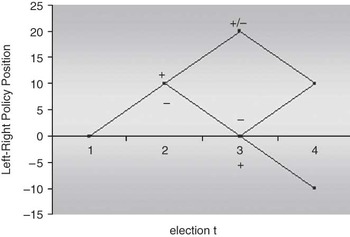
Table 3 presents the assumptions of our model in a general form. These give rise to a precise specification of how parties take up policy positions. This is presented as a decision tree in Figure 5, which reports a four-election sequence of policy movements leftwards (down) or rightwards (up) on the vertical left–right dimension.Footnote 31
The postdictions of the integrated dynamic theory presented as a party decision-tree Note: Minus and plus signs indicate changes in the party’s vote share during the election (i.e., the first change in vote takes place during Election 2). Downward slopes indicate leftward policy shifts and upward slopes indicate rightward shifts. For ease of presentation, this version of the model assumes: all policy shifts are ten units in magnitude; there are only definite moves to the left and right; and no ‘staying put’.

The first move (rightwards) is exogenously given. At Election 2 the party tacks back to the left (as shown in the figure), unless there is an election gain, indicated by a plus sign (+). In this case, as shown in the figure, the party continues to the right. Whatever be the result of Election 3, however, the party will then reverse to the left – again as shown in the figure.
As noted above, if the party encounters a vote loss (−) at Election 2, it reverses its previous move and goes left – again as shown in the figure. If Election 3 then registers a vote gain, the newly initiated leftward move will continue (and will then be reversed after Election 4). If not, and the party loses votes at Election 3, it is reversed again to the right.
The overall consequence of four-election, three move sequences of the sort observed in Figure 5 is to produce a policy zigzag between left and right. However, this is not a pure zigzag as predicted by Adams’s reasoning and simulation (Figure 4). Rather, it is an interrupted zigzag, where moves may continue in the same direction after a vote gain. But they will then be reversed.
In our model, each party decides independently of the others, as no mutual strategic calculations are involved. This gives us the opportunity to put their decision trees together to produce a full-blown simulation, which we then examine for plausibility. We do so in the next section.
A Dynamic Simulation Of Factional Effects On Party Policy
Our assumptions generate a spatial expectation of party policy movement as an interrupted zigzag. What does the model look like when operationalized as a simulation? And do the model’s assumptions appear realistic when we compare them with observed patterns of party movement over time along the left–right continuum?
The complete rules for the simulation are given in the notes to Figure 6 illustrated by the ‘Tree’ (Figure 5) already discussed. The rules faithfully reflect the major features of our assumptions in Table 3, assuming the existence of alternating factions and the temporary interruption caused by a vote gain. Note that – because of the inward-looking ideological nature of policy decisions – each party arrives at its position independently of the others, and therefore no strategic interactions with rivals occur.
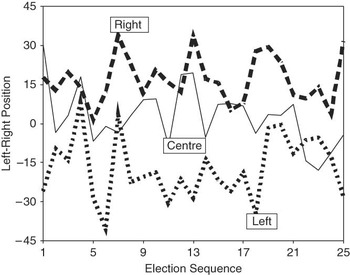
A simulation of three-party policy dynamics from the assumptions of the integrated factional theory (see Table 3) Notes: Rules for the three-party simulation of the integrated factional theory of policy making: 1. Create a large number (2000) of party positions with: (a) Left Party, mean = −13 and standard deviation = 13 (normal distribution); (b) Right Party, mean = +13 and standard deviation = 13 (normal distribution); (c) Centre Party, mean = 0 and standard deviation = 13 (normal distribution). 2. Each party has two factions, each covering half of the party’s distribution. Thus: (a) Left Party faction 1 > −13.0, faction 2 < −13.0; (b) Right Party faction 1 > +13.0, faction 2 < +13.0; (c) Centre Party faction 1 > 0, faction 2 < 0. 3. To start the simulation, enter the large number of party positions at a randomly selected point and apply the rules to generate the sequence. (a) Accept as given the left and right party positions as the starting position of each of the parties. (b) Let the sequence of position taking develop by picking out the party positions which conform to the rules for 25 elections. (c) With the constraint under the rules below that the left party cannot take a left–right position > 10 or the right party <−10. (d) A party’s policy position alternates without regard to what other parties are doing between that of a left and right faction, (e) except when there is a vote gain in the second election of an election pair, in which case the position in the third election becomes that of the faction in control at the second election, and (f) each party gains or loses votes at random, and (g) under the constraint that a vote gain by one major party implies a vote loss by the other major party (right and left parties). This procedure randomizes the size of left–right shifts and, therefore, by extension the relative size of factions producing them.

Figure 5 illustrates that our theory does indeed produce a plausible representation of policy shifts for three parties, which are generally compatible with the pictures of observed party movements for the post-war years for countries approximating to three-party systems.Footnote 32 Parties alternate policy positions quite regularly but not in the uniform manner of Adams’s simulation.
As in the latter, parties rarely leapfrog – again echoing a feature of actual party movement. Generally, parties also stick to their own segment of left–right space, in spite of moving within it – a feature which, of course, contributes to their continuing identity and distinctiveness (as again in Adams’s representation).
These aspects of the simulation go against the centrist assumptions which dominate the inductive rules for party movement summarized in Table 1 – and of course against Downsian convergence ideas in general (as illustrated in Figure 1). At times the movement is towards the centre – and this possibly continues over two elections. But then the party pulls away. This process continues without a final equilibrium, unless the equilibrium is characterized by staying within a given range or segment of the space. These segments differ widely between parties, however. This, in turn, rules out the possibility of parties sharing policies for an extended period of time and, more specifically, the possibility of a shared set of parties’ policies overlapping with the preference of the median voter. While the lack of a final equilibrium perhaps creates difficulties for formal models of party policy movement, the different policy stands taken by parties are consistent with and indeed necessary for electoral choice under mandate theory.Footnote 33
Non-convergence is a feature of our model shared with Adams’s simulation and with models based on local support maximization (compare with the Downsian displayed above in Figure 2). Different assumptions may indeed all produce simulation results broadly compatible with observed party behaviour. Many investigations stop here. We go on to check ‘postdictions’ from our assumptions against observed party moves over a fifty-year period – a sterner test than any faced by the models or rules reviewed earlier. In the next section, we go into the precise data and operationalizations involved in this test.
Data And Operationalization
We check the theory against observations taken from the well-known Manifesto Dataset, which has been used for much of the research we report above, and extensively documented elsewhere.Footnote 34 Specifically, the Manifesto Dataset includes estimates of parties’ left–right positions, which are based on the additive left–right scale described above (see footnote 8). We employ this operationalization of the left–right dimension for the empirical analysis, following most of the research in this field.Footnote 35 The scale runs from −100 (pure left) to +100 (pure right), though the effective range for almost all parties is −40 to +40. Left–right scores are assigned to each party in each election, and the direction of movement is estimated as the difference between left–right scores in successive elections. Negative scores denote leftward inter-election shifts, and positive scores, rightward shifts. Our interest, of course, like that of Adams and his associates, is in the policy shifts made by each party between elections, and we examine four-election sequences to establish the postdictive success of the theory.
Election gain or loss is likewise estimated from the vote figures in the CD-Rom published in MPP and MPP II. We use the vote figures to estimate the effect of a gain associated with a rightward or leftward policy shift in interrupting the normal alternation.
One crucial bit of information necessary to testing the full theory is, however, lacking. The result is that we cannot properly investigate Assumption 5, on the magnitude of predicted policy change. The missing information relates to the relative strength of party factions at each election. We would expect – where a change of direction is indicated under Assumptions 2–4 – that its size is proportional to the relative strength of the factions. Where the opposing faction is stronger, it can push for a complete change. Where no faction is markedly stronger, there may be a standoff around the status quo. Lacking information on factional strengths at each time point, all we can postdict is that a definite swing in a certain direction will not take place. While such a prediction covers direction fairly well, we have to leave magnitude out. This indicates an immediate line of future research in this area given the success of our directional postdictions.
Deriving Specific Postdictions From The Theoretical Assumptions
Our theory integrates many of the decision rules of the NST: alternation is the normal pattern; vote gains cause temporary interruptions of policy alternation (i.e. vote gains cause policy continuation); and there is a possibility of standoffs between factions of equal strength. Thus, our theory incorporates elements of alternation, reacting to past election results and staying put – each is a decision rule from the NST. Furthermore, the ‘marker’ rule (sticking to a certain position vis-à-vis other parties) is implicitly covered by Assumption 1 in Table 3, because parties stick to particular segments of policy space.
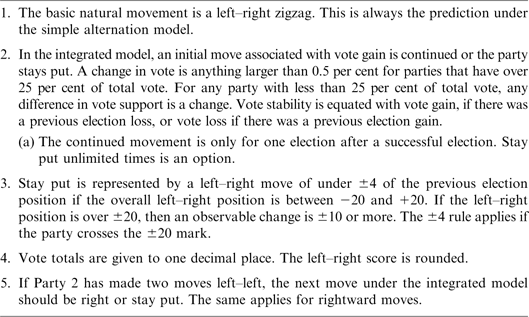
Table 4 operationalizes two models of party movement. We use the simple prediction of a left–right zigzag, as in Adams’s simulation (Figure 4), as a baseline postdictive model against which to assess our own. There is little difficulty in operationalizing this and it is covered in Rule 1 of the table.
Operational Rules for Calculating Success of a Simple Alternation Model and the Integrated Models in Terms of Observed Party Movement along a Left–Right Dimension
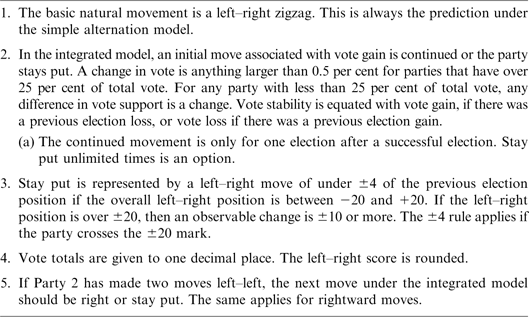
The integrated model, dealing with two variables, is more complicated to operationalize. First, we have to deal with vote gain. Rule 4 clarifies numerical conventions. Rule 2 suggests that there is more tolerance of minor fluctuations in vote on the part of large parties, and how stability is regarded differently if it follows on previous gains or losses. These operational distinctions may be varied without affecting our substantive results.
Much more important is the expectation that vote gains are associated with policy moves in the same direction as before – but only for one election. Since we do not know the relative strengths of factions, we are unable to say when parties would stay put or move in the indicated direction. Thus, our postdictions gain their edge by prohibiting moves in an inappropriate direction. The exact magnitudes of movement must wait until we have the data to predict them from factional strengths.
Of course, it is possible that small changes of party position are simply due to error, or are relatively unobservable to voters outside the party. To discount error variation, we use the generalized estimate uncovered independently by Tavits and by Klingemann et al. of ±4.Footnote 36 We also reason, however, that parties at relatively extreme ideological positions have to make a bigger shift to render it observable; otherwise, this move will be ignored as substantively insignificant. For parties standing above ±20 on the left–right scale, we therefore require a shift of over 10 points to make the movement both statistically and substantively significant. Weighting the interval more for (statistically and substantively) significant change in the case of extreme positions seems reasonable. Limited experiments that drop the extra ±6 point criterion for extreme parties make little difference to our results.
Rule 5 in Table 4 again picks up the logic of factional difference being the main influence on party policy change: even moves accompanied by election gains are aborted after the third election in the series, as opponents gain strength internally.
To see how the rules in Table 4 operate in practice, we apply them to the American Republicans, whose post-war movements (along with the Democrats) were mapped in Figure 3. Here, the case is presented for illustrative purposes rather than as an empirical test, which we apply on a wide comparative basis in the following section.Footnote 37
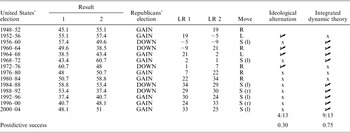
Results achieved by the two models are reported in Table 5. As is evident from Figure 3, there seems to be a general pattern of Republican alternation, but not always in line with expectations generated by the models. The rightward policy shift from 1948 to 1952 sets a baseline from which we evaluate the next move, but this policy shift does not in itself contribute to checking the models since there is no previous move with which to compare the current one. Eisenhower’s overwhelming victory in 1952 was associated with a rightward move, but the platform moves left in 1956. This policy shift fits only the simple alternation model. If the Republicans had continued rightwards, or even stayed put, the integrated model would have been accurate with its first postdiction.
Calculating the Postdictive Success of Two Models of Party Policy Movement for US Republicans, 1948–2004

Note: To decide which way a party should move after staying put, the marginal left (S(l)) or right (S(r)) move it has made is required. This is taken as indicating the previous direction of movement. Ticks indicate postdictive success and crosses postdictive failure of the model for each move.
The leftward move in 1952–56 produced a vote gain, and therefore the Republicans stayed at the same position in 1960. The integrated dynamic theory notches an accurate postdiction, whereas the alternation model fails to characterize the policy shift accurately in this instance.
This marginal leftward move from 1956–60 is associated with vote loss, however, and the Republicans shift rightward under Goldwater from 1960–64 – a policy shift that is accurately postdicted by both the alternation and integrated models. The 1960–64 shift under Goldwater produced a vote loss and thus both models again postdict correctly the Republicans’ leftward move under Nixon in 1964–68. Nixon then stays put in 1972, which accords with the integrated dynamic theory, but not the alternation model.
Ford’s rightward move in 1976 was unlucky but was continued up to 2004 – usually associated with electoral gains, but contrary to pure alternation ideas. From 1984, Republicans stayed in substantially the same ideological position, the far right, no doubt owing to a standoff between a strong neo-conservative faction and a weakened liberal wing only strong enough to prevent further rightist moves.
The numbers at the bottom of the columns for the two models summarize the proportion of observed Republican moves that were anticipated (or not) under the models. The interruptions to the simple zigzag expected under the pure policy alternation model give it a low predictive success rate of just 0.30. The integrated dynamic theory’s expectation of an interrupted zigzag is broadly confirmed at 0.75 of all moves.
Comparative Checks On The Models Of Policy Movement 1945–2005
The postdictive analysis of American Republicans in Table 5 is illustrative rather than conclusive. One party in one country, however important, hardly confirms or disconfirms the models. However, it does show how the MRG-CMP data on left–right positions can be brought to bear on the postdictions generated by our assumptions. For each party in each country we generate a similar table by hand. The observations reported in them were computerized and are available on a website associated with the authors.Footnote 38 The results are reported below.
We analysed the policy shifts of 163 parties in twenty-four countries during the post-war period.Footnote 39 Over 1,737 party policy moves, parties move to the left, stay put and move right 33.51 per cent, 32.53 per cent and 33.97 per cent of the time, respectively. If we eliminate the stay put option, 809 of the parties’ moves are discretely leftwards, and 810 are discretely rightwards (positive).Footnote 40 Thus, when we eliminate the stay put option, leftward or rightward moves occur approximately half the time each (0.4997 and 0.5003, respectively).
We note two important data-related features to the analysis. First, while most inferential studies seek to draw representative samples with the intention of accurately describing the target population, our sample and target populations almost completely overlap. The goal of the study is to characterize the policy shifts of significant parties in general elections in established democracies since 1945, and our analyses incorporate estimates based on observations for all of these policy shifts. The implication is that descriptive statistics may tell us more about our directly observable population than inferential statistics.
We also control for uncertainty around the point estimates produced by measurement error by incorporating a four-point ‘buffer’ for discrete moves to the left or right. That is, distinct moves only register when a party moves more than four units. The four-point buffer thus leaves us reasonably certain that when we report a policy move as discretely to the left or right, the manifesto actually moved to the left or right. On this basis, we proceed to postdict parties’ policy moves using the integrated model.
Just as with the American Republicans, we apply the rules in Table 4 to the policy shifts of our 163 parties across the twenty-four countries in the analysis. The outcome of the postdiction exercise is that the integrated model characterizes policy shifts with a success rate of 0.72. We find that this figure remains relatively stable across political systems with plurality (0.77) and proportional representation (0.70) voting rules.Footnote 41
This marginal contrast in success rates between proportional representation (PR) and plurality election systems is intriguing, but not one that we have the resources or time to explore fully. Vote gains and losses may have more impact on parties in plurality, winner takes all, elections. Under PR they often have minimal effects on the coalition negotiations that ensue. In plurality systems, by contrast, factions may be more organized and divided off from each other in the large parties associated with winner-take-all elections than in the smaller parties generally associated with PR.
We can get some insight into this point by comparing results for the simple alternation model under the two systems. Its success rate in postdicting actual policy moves under plurality systems is 0.42 and under PR it is 0.44 (overall, the success rate is 0.435). Similar estimates for the simple alternation model, contrasted with the slightly larger difference between systems for the integrated model (which considers previous vote share), support the idea that votes perhaps do matter more for intra-party factional disputes in plurality systems.
Comments on the difference election systems make are largely speculative at this stage. Our main concern is with the overall success of the postdictions from our integrated theory, given that they are quite well supported under both systems. The question is how well? Clearly, they outperform predictions from straightforward alternation with a simple zigzag. Predicting nearly three out of four specific party moves is a good performance in general social science terms, where such specific forecasts are rarely even attempted. But how can we assess the success rate more systematically?
We have already suggested that our data have more of the characteristics of a population than a sample of party moves. Hence, an assessment of the strength rather than the statistical significance of the findings is more relevant to our evaluation (though we also consider significance in relation to our success rates). Given the predictive form taken by our checks, the most appropriate way of assessing what the integrated dynamic theory adds to our knowledge is through a reduction of the error statistic. Putting ourselves in the position of an observer wishing to know the outcome in advance, we ask: how far does the more developed dynamic theory give us better advance knowledge of the outcomes than some naïve rule?Footnote 42
There are three possible candidates for a contrasting, naïve benchmark to compare with the rules derived from the integrated factional theory, and we use them all below: most obvious is the simple alternation, straight zigzag, derived from some form of reasoning like that of Adams in Figure 4 above. This predicts that the move between each pair of elections will be the opposite of that made last time – and clearly so, with no allowance for staying put. We already compared the success rate of this model with our own for American Republicans, in Table 5.
The success rate of the pure zigzag prediction for all the parties we consider is 0.44, markedly below that of our own theoretical expectation of an interrupted zigzag at 0.72. Lambda b also shows a relatively high proportional reduction of error at 0.50. The relatively low success rate of the zigzag prediction could be attributed in part to the trichotomous framework (i.e. left, stay, right) in which we examine the model: the ‘stay put’ option could mute the actual success rate of the zigzag prediction, because each time a party stays put, the zigzag prediction fails.
Accordingly, we evaluate the pure zigzag prediction under more friendly terms by employing dichotomous outcomes and separating moves into leftward and rightward shifts. For this limited set of analyses, dropping the ‘stay put’ option, we assume that measurement errors balance each other out.Footnote 43 Under the dichotomous framework, the success rate of the zigzag prediction is 0.62, a rate that is stable across plurality and PR systems, and Λ b remains fairly high at 0.26.
These are strong results, especially since the expectation of interrupted alternation is based both on theoretical reasoning and a convincing simulation (Figure 6). Nevertheless, the alternation assumption is also a very strong component of our own model, and therefore the two rules are not entirely independent of each other. We could conceivably be criticized here for stacking the odds in our favour by using a weaker version of our own theory as the basis for comparison.
Because of this, we make two other comparisons. The first is with a rule that is clearly antithetical to the alternation argument – that is, predicting the next move to be the same as the last (or staying put). This rule clearly contrasts with alternation, and is also a natural candidate as an atheoretical form of prediction that is often quite powerful, given the inertia inherent in many socio-political phenomena (election results and government expenditures, for example). If a party stays put, this constitutes a predictive success for the ‘continuity’ model. In addition, this model is successful when a party moves in the same direction as the last time.
The additional advantages of using this rule as a basis of assessment are, first, that, like our own theory, it is possible to apply without advance knowledge of the actual data, so that both are truly a priori in nature. Secondly, its leading assumption of inertia and continuity explicitly contrasts with the strong expectation of alternation built into our theory.
This naïve ‘continuity’ rule has a 56 per cent success rate over all our data (interestingly, invariant between the two types of election system). So it clearly performs less well than the predictions derived from the integrated theory. The value of Λ, the reduction of the error statistic, is 0.37. Clearly, this is a strong challenger to the success of our own model. But even so, the latter shows up well in the comparison.
There is, however, another naïve rule conventionally applied in assessing predictive success. This uses the most frequent outcome to characterize all outcomes and compares the error rate of this ‘naïve’ tactic with that of the theory under examination.
This rule is clearly not as naïve as the other two benchmarks in that it presumes previous knowledge of the empirical outcomes. Also, as we shall see, it gains strength from the strong alternation tendencies present in the data, which are anticipated in our own theory. The rule of predicting the most frequent outcome is thus empirically cognate to our own theoretical expectations and does not provide the strong conceptual contrast that expectations of inertia and continuity do.
For these very reasons, however, it forms a tough check on our theory. As noted above, parties in the twenty-four post-war democracies stay put 32.53 per cent and move rightwards 33.97 per cent of the time. Putting these categories together, we get a success rate for the joint characterizations stay put and move right of 66.5 per cent compared to 72.1 per cent of the integrated theory. These results are closer to those of our model than the other naïve rules and yield a value of Λ of 0.17 for proportional reduction of error. However, this result still demonstrates that the integrated theory reduces error even under the unrealistic assumption that these two rules are contrasting and independent of each other.
Using an inferential test of the difference based on the assumption that we are dealing with a sample of party policy shifts rather than a population, a one-sample t-test also reveals a significant difference between the two last success rates (t = 4.94). In addition to these summary tests, we also carried out an extensive sensitivity analysis by cross-tabulating previous party moves against present ones under differing conditions. These are reported on our website. The most striking finding is that the ‘stay–stay’ entry (i.e. the cell that counts the number of times parties stay put in two successive elections) in all the tables is overpopulated in terms of actual observations as compared to theoretical expectations. While the findings that we present in these tables are consistent with the integrated dynamic theory, the ‘stay–stay’ entries in these tables highlight pathways for its future refinement.
General Conclusions
There is surprising comparative support for an explanation of party policy-making that is non-strategic, process-based and views parties as inward looking, conflictual and dominated by ideology. These characteristics are strengthened by the great uncertainties that parties operate under, which in the end only allow accredited election results to affect their decisions and then only temporarily. With this behavioural optic, we can postdict three out of four individually observed policy moves over a variety of parties, countries and electoral systems, and generate plausible simulations of party left–right movement as an interrupted zigzag.
This dynamic helps guarantee long-term party competition by keeping parties distinctive. While at times it encourages moves to the centre, this is not necessarily convergence, as other parties may be moving away from the centre at the same time. However, they are unlikely to move too far to extremes as another change of direction will bring them back to the centre again. Parties decide where to move individually rather than collectively and this helps guarantee electoral choice between their programmes in a way that convergence theories do not.
The strength of convergence ideas – fifty years after Downs’s two-party model (illustrated in Figure 1) – is shown by the way in which the decision rules of the NST have been modified by most of the research we have reviewed into support-seeking ones. Only Adams’s simulation (Figure 4) bases itself on something very like ideology. Yet parties are nothing if not ideological, policy-pursuing entities. Ideology is the very basis on which we distinguish them from each other. Office and vote-seeking theories of policy behaviour thus start from an inherent contradiction: ideologically differentiated parties are assumed to adjust their policy so as to maximize outside support – and to blur their own distinctiveness in doing so! This, in spite of the fact that retention rather than maximization of support is what is important in a multiparty coalition environment.
One general conclusion to which our research leads, therefore, is that we should first seek to explain party behaviour in its own ideological terms, before imputing less obvious office-seeking motives to it. Of course, vote (not the same as office) enters in, but as a subsidiary element in the internal ideological struggle, rather than a dominant one.
Breaking with the unitary agent view of parties is a second aspect of our theory. There is abundant historical evidence for the continuous presence of factions in parties. But ours is a rare attempt to link them systematically to party behaviour.Footnote 44 Again, the introduction of factions tends to undermine office-seeking views of party behaviour, for if one faction aims at office, the opposing ones cannot be doing so. In our explanation, of course, ideology remains dominant: its ambiguities fuel factional struggle while its certainties unite the party against the others.
In terms of future research, however, it is clearly the party factions which demand attention. If, as we think, it is the relative strength of factions which decides whether the party position remains where it is, as opposed to moving decisively in the indicated direction, we clearly need to have the data to provide a full check on our theory and its implications, and that is an immediate priority.
In the meantime, the directional implications of our theory seem to be well upheld, and to provide a dynamic for party-position taking that has been missing to date. As pointed out at the beginning of this article, the question of whether parties converge or differentiate their positions and why is absolutely crucial for our understanding of representational processes – the central political processes under democracy. By providing convincing evidence and a mechanism for continued party differentiation, our investigation comes down on the side of electoral choice as the vehicle for representation, the view embodied in mandate theory.