Introduction
Nasal polyposis is a chronic inflammatory disease of the nose and paranasal sinuses mucosa. The condition is characterised by the protrusion of benign, oedematous polyps from the meatus into the nasal cavities. Nasal polyposis affects nearly 4 per cent of the total population in Western countries, and presents a real challenge to the physician because of its severity, chronicity and recurrence rate.Reference Bachert, Watelet, Bevaert and Van Cauwenberge1 Nasal polyposis is not a single pathology; it is probably a multifactorial disease and is sometimes associated with asthma, with sensitivity to aspirin, and with other pulmonary diseases such as primary ciliary dyskinesia and cystic fibrosis.Reference Pawankar2 For example, the aspirin triad (nasal polyposis, asthma and sensitivity to aspirin), first reported by Widal in 1922, is a well recognised clinical entity.Reference Falliers3
Histopathological studies of the paranasal sinus mucosa of typical nasal polyposis patients has demonstrated eosinophilic tissue infiltration. In addition to increased eosinophilic cell infiltration, increased production and expression of a variety of proinflammatory chemokines and cytokines have been demonstrated in nasal polyposis mucosa. These factors (i.e. interleukin 5, interleukin 3, beta chemokine RANTES (regulated upon activation, normal T cell expressed, and secreted) and GM-CSF (granulocyte-macrophage colony-stimulating factor) can contribute to chronic eosinophilic inflammation by regulating the activation, migration and survival of eosinophils.Reference Pawankar2, Reference Eliashar and Levi-Schaffer4
Nevertheless, the relationship between nasal polyposis and eosinophils is not clear in the literature. Does the presence or severity of nasal symptoms in patients with nasal polyposis correlate with the presence of marked eosinophilic infiltration? Are the results of medical treatment of nasal polyposis influenced by the presence of eosinophilic infiltration? No obvious response appears in the literature. This prospective study aimed to assess the role of eosinophilic infiltration in the symptoms and treatment of patients presenting with nasal polyposis.
Materials and methods
Materials
We included a total of 144 new, consecutive patients (61.1 per cent male, 38.9 per cent female; mean age ± standard error of the mean, 47.4 ± 0.9 years) suffering from nasal polyposis, with a mean post-operative follow up of 64.3 ± 2.8 months.
Three concomitant inclusion criteria were used; these have been developed in a previous paper.Reference Bonfils5
In short, the first inclusion criterion was diagnostic; only patients with nasal polyposis were included. This diagnosis was based on two criteria: (Reference Bachert, Watelet, Bevaert and Van Cauwenberge1) the presence of bilateral polyps in the nasal cavities on endoscopic examination (rigid optic 30° endoscope; Storz, Tuttlingen, Germany); and (Reference Pawankar2) the existence on computed tomography (CT) scans of bilateral opaque areas in the ethmoidal sinuses (whether located in the anterior or posterior ethmoid portions).Reference Bonfils, Norès, Halimi and Avan6 Polyp size was not an inclusion criterion, and was rated on a three-point scale as follows: one = mild (i.e. small polyps not reaching the lower edge of the middle turbinate); two = moderate (i.e. medium-sized polyps extending between the upper and lower edges of the inferior turbinate); and three = severe (i.e. large polyps extending below the lower edge of the inferior turbinate).
The second inclusion criterion was clinical; surgery was proposed when nasal polyposis symptoms had not been reduced to a state compatible with near-normal life, with little or no impairment of the patient's activities.
The third inclusion criterion was therapeutic. Before surgery was contemplated, all patients received systematic medical treatment. Three different therapeutic measures were applied:Reference Bonfils, Norès, Halimi and Avan6 washing of the nasal cavities, steroid spray and oral steroid administration. Washing of the nasal cavities was carried out twice daily with a sterile physiological solution. Patients received intranasal steroid spray (beclomethasone) at a daily dose of 1000 µg (as 500 µg twice daily) in each nasal cavity. Systemic steroid treatment was systematically prescribed for all patients on entrance into the study, with the exception of patients for whom it was contraindicated (e.g. uncontrolled psychosis, acute viral infection, acute infectious disease or allergy to the particular steroid used) (n = 3). Each systemic steroid course comprised prednisolone 1 mg/kg body weight per day for an initial six-day period (as one single dose with breakfast). At every visit, the regimen was tailored to the patient's needs. Whenever possible (i.e. every time the symptoms had been reduced to a level compatible with near-normal life, with little or no impairment of the patient's activities), the steroid spray dosage was lowered.Reference Bonfils, Norès, Halimi and Avan6 Dosage reduction was achieved progressively by 250-µg steps. However, if the patient's physical condition clearly threatened to deteriorate, the prescribing physician resorted to a new course of systemic steroid administration (as one single dose with breakfast). Under the third inclusion criterion, patients were enrolled into the study when more than three systemic courses of prednisolone per year proved to be necessary to control their nasal polyposis symptoms.
Methods
Clinical evaluation
All patients were examined, treated, operated upon and followed up by the same physician for the entire duration of the study. Assessments were conducted at baseline and then two to four times a year after surgery. Asthma, sensitivity to aspirin, bronchial hyper-responsiveness and allergy were evaluated before any treatment. At each visit, nasal function was assessed regarding five symptoms: nasal obstruction, anterior rhinorrhoea, posterior rhinorrhoea, facial pain and loss of sense of smell. The severity of each symptom was evaluated according to a three-point scale, whereby zero = no symptoms, one = moderate symptoms (i.e. frequently troublesome but not sufficient to interfere with normal daily activities or sleep), and two = severe symptoms (i.e. interfering with normal activities or sleep). Regarding sense of smell, anosmia was graded as two, hyposmia as one and normal olfactory function as zero. Grading was performed at baseline and at each evaluation (before any clinical, endoscopic or CT examination). At baseline, the patient was asked to evaluate their mean symptom severity over the past year. At each visit, the patient was asked to evaluate their mean symptom severity since the previous visit.
After surgery, endoscopic examination was performed at each visit in order to measure polyp size. Polyp size was rated on a five-point scale, whereby: zero = normal mucosa, 0.5 = absence of polyps but mucosal thickening; one = mild polyps (i.e. small polyps not reaching the upper edge of the middle meatus antrostomy); two = moderate polyps (i.e. medium-sized polyps extending between the upper and the lower edges of the inferior turbinate); and three = severe polyps (i.e. large polyps extending below the lower edge of the inferior turbinate). Pre- and post-operative polyp sizes one, two and three were rated identically.
Therapeutic procedure
Functional endoscopic sinus surgery (FESS) was performed between 1995 and 2005 by the same surgeon and under general anaesthesia. The same surgical procedure was realised for all patients without any medical pre-operative procedure. The FESS procedure began with an inferior resection of the middle turbinate. The incision was parallel to the inferior free margin of the middle turbinate. Fenestration of the maxillary antrum was realised after resection of the uncinate process and identification and widening of the maxillary ostium with retrograde forceps, with preservation of the maxillary mucosal lining. Next, the posterior ethmoid cells were opened and their party walls totally removed up to the white roof. After completion of a sphenoidotomy, the anterior ethmoid cells were exenterated and the nasofrontal duct was identified. Lasers and microdebriders were never used in these procedures. Broad-spectrum antibiotics were prescribed for three days post-operatively.
After surgery, all patients received systematic medical treatment. The usual medical treatment began by the end of the first month. Three different therapeutic measures were systematically applied:Reference Bonfils, Norès, Halimi and Avan6 washing of the nasal cavities, steroid spray and oral steroid administration if needed. Washing of the nasal cavities was carried out twice a day with a sterile physiological solution. Patients received intranasal steroid spray (beclomethasone) at a daily dose of 1000 µg (as 500 µg twice daily) in each nasal cavity. No oral steroid administration was systematically given after surgery. At every visit, the regimen was tailored to the patient's need. Whenever possible (i.e. every time the symptoms had been reduced to a state compatible with near-normal life, with little or no impairment of the patient's activities), the steroid spray dosage was lowered.Reference Bonfils, Norès, Halimi and Avan6 Dosage reduction was achieved progressively by 250-µg steps. However, if the patient's physical condition clearly threatened to deteriorate, the prescribing physician resorted to a new course of systemic steroid administration (i.e. prednisolone 1 mg/kg body weight per day for a six-day period). Furthermore, a new surgical procedure was proposed when more than three systemic courses of prednisolone per year proved to be necessary to control severe nasal polyposis symptoms.
Quantification of eosinophils
Nasal polyps removed during FESS were analysed. Mucosal biopsies were included in totality, fixed in 10 per cent formol and paraffin-embedded. Standard 5µm sections were stained with haematoxylin–eosin–safran and examined under a light microscope. Initially, the entire section was viewed, in order to establish the diagnosis. Then, the overall inflammatory infiltration was semi-quantitatively established (as low, moderate or high). The percentage of eosinophils compared with all inflammatory cells was estimated at high power (×400) magnification by examining several sections, counting the eosinophils in 10 overlapping, consecutive high-power fields and then calculating the average number of eosinophils. Estimations were made for right and left nasal polyps, and mean eosinophilic infiltration was determined from data from the two sides.
Statistics
The severity of each nasal symptom was obtained, for each patient, at baseline and at the end of each visit. A clinical global severity index was derived, representing the mean score of the three main symptoms under analysis: nasal obstruction, posterior rhinorrhoea and loss of sense of smell. The polyp grade was also recorded at each examination. One goal of the analysis was to compare the mean symptom severities, global severity index and polyp grades at baseline (i.e. before FESS) and then at six months and one, two, three, five and seven years post-operatively.
At every visit, the physician recorded the patient's precise drug consumption over the preceding period. The amount of steroid consumption (in micrograms) was separated into two subsets: oral treatment (prednisolone) and topical therapy (beclomethasone). For oral steroid consumption, results are given for the year before surgery and then for the first year, second year, third year, combined fourth and fifth years, and combined sixth and seventh years post-operatively. For local steroid consumption, results are given for the year before surgery and then for the first six months, six to 12 months, end of second year, end of third year, end of fifth year, and end of seventh year post-operatively.
Patients were split into two groups. The first group (n = 73) comprised patients with >50 per cent eosinophilic infiltration of nasal polyposis mucosa. The second group (n = 71) comprised patients with ≤50 per cent eosinophilic infiltration of nasal polyposis mucosa. The study aimed to investigate any possible differences in clinical outcome as a function of these two eosinophilic infiltration groups.
Statistical analysis was performed using Statview 5.0 software (Statview Inc). For all continuous variables, applicable data were expressed as mean ± standard error of the mean (SEM). Being a composite of several, rather independent qualitative variables, the global severity index was taken to be a continuous variable, and the sample size was large enough for the global severity index distribution to be unimportant. For all continuous variables entering comparisons, Student's unpaired t-test was used to compare mean values between the two groups of patients. Repeated-measures analysis of variance (ANOVA) was performed for the pooled data (at baseline and at six months and one, two, three, five and seven years post-operatively), with time as the within factor, group (i.e. eosinophilic infiltration of more or less than 50 per cent) as the between factor, and an interaction between time and group. Repeated-measures ANOVA was used for within-group comparisons (factor time).
An actuarial analysis using the Kaplan–Meier life table method was performed with regard to the three- and five-year symptom control rates. Two three- and five-year actuarial symptom control rates were studied for each symptom. The three- and five-year actuarial symptom control rates were studied as a function of either the presence of the symptom or the presence of the severe symptom. Severe symptoms were those which interfered with normal activities or sleep. Regarding olfaction, severe loss of sense of smell was rated as anosmia. Comparison was performed with a logrank test. Statistical significance was assumed when the p value was less than 0.05.
Results
Distribution of eosinophilic infiltration
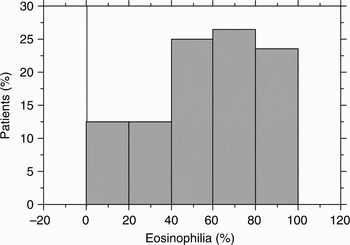
Figure 1 shows the distribution of eosinophilic infiltration in the nasal polyposis patients studied. The mean eosinophilic infiltration (mean ± SEM) was 53.2 ± 2.0 (n = 144). Eighteen patients (12.5 per cent of the population) had an eosinophilic infiltration lower than 20 per cent. Eighteen patients (12.5 per cent of the population) had an eosinophilic infiltration ranging from 20 to 40 per cent. Thirty-six patients (25 per cent) had an eosinophilic infiltration ranging from 40 to 60 per cent. Thirty-eight patients (26.4 per cent) had an eosinophilic infiltration ranging from 60 to 80 per cent.
Distribution of mucosal eosinophilia within nasal polyps of nasal polyposis patients, following functional endoscopic sinus surgery.

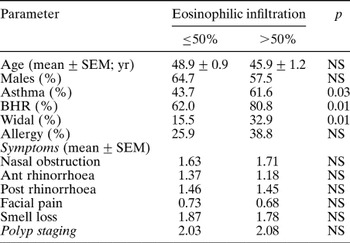
Patients were separated into two groups: those with eosinophilic infiltration >50 per cent (n = 73), and those with eosinophilic infiltration ≤50 per cent (n = 71). The two groups did not differ with regard to age and sex ratio (Table I). The prevalences of asthma (p = 0.03, chi-square test), bronchial hyper-responsiveness (p = 0.01) and aspirin idiosyncrasy (p = 0.01) were higher in the group with eosinophilic infiltration >50 per cent, compared with the group with ≤50 per cent.
Patients' Characteristics, by extent of Eosinophilic infiltrationFootnote *

* n=144. SEM = standard error of the mean; yr = years; BHR = bronchial hyper-responsiveness; ant = anterior; post = posterior
Baseline symptoms before surgery
The three most disabling symptoms of nasal polyposis were anosmia, nasal obstruction and posterior rhinorrhoea. The severity of each symptom was recorded pre-operatively for each patient. Nasal symptom scores did not differ between the two eosinophilic infiltration groups (i.e. infiltration >50 per cent or ≤50 per cent) (Table I). The two eosinophilic infiltration groups had almost identical clinical global severity indices (1.65 ± 0.05 vs 1.64 ± 0.05, respectively) and mean polyp grades (2.03 ± 0.10 vs 2.08 ± 0.10, respectively) (Table I).
Symptom improvement after surgery
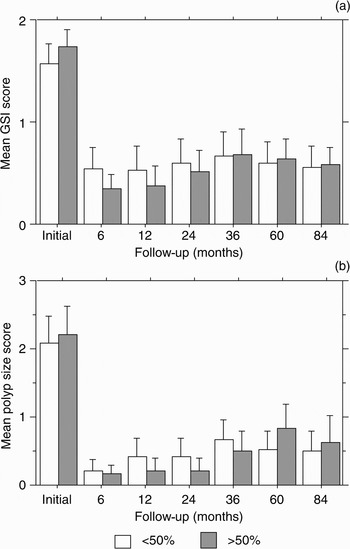
Patients' mean follow up was 64.3 ± 2.8 months (n = 144). A significant decrease (p < 0.001) in mean global severity index was observed in both eosinophilic infiltration groups, comparing baseline and six months' post-operative results (Figure 2a). In contrast, the mean global severity index remained stable in both groups between six months and seven years post-operatively. A significant decrease (p < 0.001) in mean polyp grade was observed in both eosinophilic infiltration groups following surgery (Figure 2b). No significant difference was found between the two eosinophilic infiltration groups in the progression of mean global severity index or nasal polyp grade.
(a) Mean global severity indices (GSI) and (b) mean nasal polyp size scores, at initial pre-operative baseline and then over 84-month (seven-year) post-operative follow up after functional endoscopic sinus surgery, for patients with ≤50% and >50% eosinophilic infiltration.

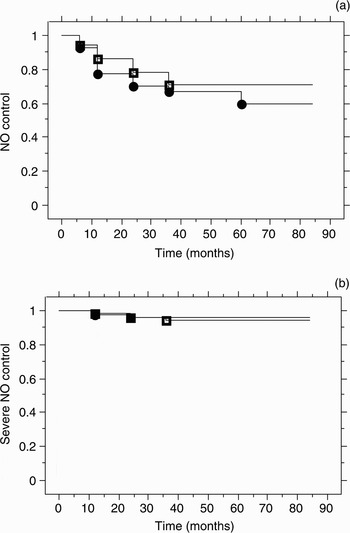
The three- and five-year actuarial symptom control rates were studied as a function of either the presence of the symptom, or the presence of the severe symptom. The three- and five-year actuarial nasal obstruction control rates were respectively 67.2 and 59.3 per cent in the ≤50 per cent eosinophilic infiltration group and 71.0 and 71.0 per cent in the >50 per cent eosinophilic infiltration group (p = 0.25; Figure 3). The three-year severe nasal obstruction control rates were respectively 95.8 per cent in the ≤50 per cent eosinophilic group and 94.0 in the >50 per cent eosinophilic group (p = 0.71; Figure 3). Thus, no significant difference was found between the two groups in terms of control of nasal obstruction. Similar results were obtained with five-year actuarial data.
Nasal obstruction (NO) control in patients with >50% (squares) and ≤50% (circles) eosinophilic nasal polyp infiltration. Three- and five-year actuarial symptom control rates were studied as a function of the presence of either (a) nasal obstruction or (b) severe nasal obstruction. No significant differences were noted between the two eosinophilic infiltration groups, regardless of symptom severity.

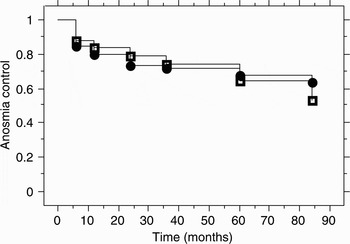
The three- and five-year actuarial anosmia rates were respectively 71.5 and 67.4 per cent in the ≤50 per cent eosinophilic infiltration group and 73.8 and 64.2 per cent in the >50 per cent eosinophilic infiltration group (p = 0.88; Figure 4). Thus, no significant difference was found between the two groups in terms of sense of smell.
Anosmia in patients with >50% (squares) and ≤50% (circles) eosinophilic nasal polyp infiltration. Three- and five-year actuarial symptom control rates were studied as a function of the presence of anosmia. No significant difference was noted between the two eosinophilic infiltration groups.

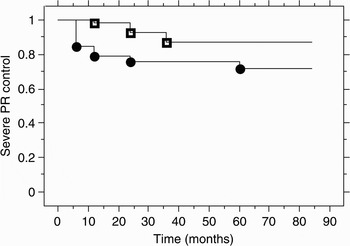
The three- and five-year actuarial severe posterior rhinorrhoea control rates were respectively 76.1 and 72.2 per cent in the ≤50 per cent eosinophilic infiltration group and 87.5 and 87.5 per cent in the >50 per cent eosinophilic infiltration group (p = 0.01; Figure 5). Thus, a significant difference was found between the two groups in terms of posterior rhinorrhoea control.
Posterior rhinorrhoea (PR) control in patients with >50% (squares) and ≤50% (circles) eosinophilic nasal polyp infiltration. Three- and five-year actuarial symptom control rates were studied as a function of the presence of severe posterior rhinorrhoea. A significant difference was noted between the two eosinophilic infiltration groups (p = 0.01); patients with ≤50% eosinophil infiltration had significantly poorer control of posterior rhinorrhoea.

Relationship between nasal obstruction, posterior rhinorrhoea and anosmia improvement
The relationship between nasal obstruction and smell loss improvement was estimated with a three-year follow-up period, after FESS whatever the eosinophilic infiltration (n = 118 patients). There was a significant relationship between nasal obstruction and smell loss (χ2 test, χ2 = 15.3, p = 0.004).
The relationship between nasal obstruction and posterior rhinorrhoea was estimated over a three-year post-operative follow-up period in the two eosinophilic infiltration groups. For patients with >50 per cent eosinophilic infiltration (n = 54), there was a statistically significant relationship between post-operative nasal obstruction and posterior rhinorrhoea (chi-square = 20.7, p = 0.0003). For patients with ≤50 per cent eosinophilic infiltration (n = 64), there was no significant relationship between nasal obstruction and posterior rhinorrhoea (chi-square = 8.5, p = 0.07).
Post-operative drug consumption
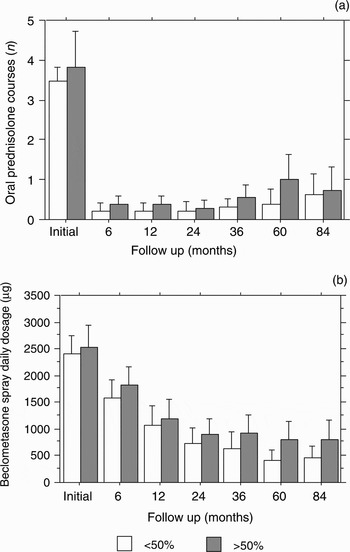
The mean post-operative drug consumption of the two eosinophilic infiltration groups was compared (Figure 6). A significant decrease (p < 0.001) in mean oral prednisolone consumption was observed for both groups, comparing baseline and after post-operative results. In contrast, this parameter remained stable, comparing the first and seventh post-operative years. A significant decrease (p < 0.001) in mean beclomethasone spray consumption was observed for both eosinophilic infiltration groups, comparing baseline and after post-operative results. This parameter continued to decrease, comparing the first and seventh post-operative years. The quantities of oral prednisolone and beclomethasone spray consumed were similar between the two eosinophilic infiltration groups.
Means plus 95% confidence intervals for patients' consumption of (a) oral prednisolone (measured as number of courses in the preceding clinical period) and (b) beclomethasone spray (measured as daily dosage in the preceding clinical period), at initial pre-operative baseline and then over 84-month (seven-year) post-operative follow up after functional endoscopic sinus surgery, in patients with ≤50% eosinophilic infiltration and >50% eosinophilic infiltration of nasal polyps. No significant difference was found between the two groups in terms of consumption of either form of steroid.

Discussion
This study compared the outcomes of surgical plus medical (i.e. steroid) treatment in nasal polyposis patients with ≤50 per cent and >50 per cent nasal polyp eosinophilic infiltration, in order to determine the role of eosinophilic infiltration in this condition. This prospective study had three strict inclusion criteria. The number of patients included was significant (144 consecutive patients) and the mean post-operative follow-up period was long (64.3 ± 2.8 months). The two eosinophilic infiltration groups had similar clinical characteristics (i.e. age, sex ratio, allergy prevalence and pre-operative clinical status) (Table I). The only difference between these groups was a higher prevalence of asthma, bronchial hyper-responsiveness and Widal triad syndrome in the >50 per cent eosinophilic infiltration group. This high percentage of eosinophils in the nasal mucosa of patients with Widal triad has been previously documented in the literature.Reference Pawankar2, Reference Eliashar and Levi-Schaffer4 A recent study showed that combined surgery and corticosteroid therapy was effective in the treatment of severe nasal polyposis, producing significant and long-term improvements in symptoms and nasal polyp size.Reference Bonfils5 Bronchial hyper-responsiveness did not influence the outcome. However, bronchial hyper-responsiveness is not a risk factor for surgery in patients with nasal polyposis.Reference Bonfils and Avan7 Therefore, we conclude that the two eosinophilic infiltration groups can be compared.
All patients received three different types of therapy, both pre- and post-operative:Reference Bonfils, Norès, Halimi and Avan6 washing of the nasal cavities, steroid spray and oral steroid administration. Washing of the nasal cavities was always carried out twice a day with a sterile physiological solution. There was no difference between the two eosinophilic infiltration groups in terms of intranasal steroid spray consumption, either before or after surgery. Severe exacerbations of nasal polyposis requiring oral corticosteroids represent the most serious manifestation of this disease; they reduce the patient's quality of life, and have a high cost to the health service in terms of doctor consultations, drug use and professional activity alterations i.e. modifications of their professional activities. We found that the mean number of oral corticosteroid courses required was similar for the two eosinophilic infiltration groups. In general, surgical and medical treatments were similar in the two eosinophilic infiltration groups (Figure 6). Therefore, the two groups can be compared.
Most publications in the literature agree on the fact that nasal polyposis management should be based primarily on a strictly medical approach, with surgery only in the case of corticosteroid failure.Reference Bachert, Watelet, Bevaert and Van Cauwenberge1 The results of the present study show that combined surgery and corticosteroid therapy was effective in the treatment of severe nasal polyposis, producing significant and long-term improvements in symptoms and nasal polyp size in the first six months after FESS; moreover, these parameters remained stable between six months and seven years after surgery (Figures 3 to 5).Reference Bonfils5
As regards the effect of FESS on nasal symptoms, nasal obstruction improvement was significant, while improvement in anosmia was significant but more limited. Post-operative improvements in nasal obstruction and anosmia were similar in both eosinophilic infiltration groups (Figures 2 to 4). The main difference between the two groups was in posterior rhinorrhoea control. The three- and five-year actuarial posterior rhinorrhoea control rates were respectively 76.1 and 72.2 per cent in the ≤50 per cent eosinophilic infiltration group and 87.5 and 87.5 per cent in the >50 per cent eosinophilic infiltration group (p = 0.01; Figure 5). Thus, the two groups significantly differed in terms of posterior rhinorrhoea control. Therefore, reduced eosinophilic infiltration of nasal polyps can be considered a significant risk factor for treatment efficacy (steroids plus surgery) regarding posterior rhinorrhoea control in patients with nasal polyposis.
Topical and systemic corticosteroids are the first choice for medical treatment of nasal polyposis.Reference Hissaria, Smith, Wormald, Taylor, Vadas and Gillis8, Reference Patiar and Reece9 They are effective in decreasing nasal polyposis symptoms and polyp size and in inhibiting eosinophilic infiltration into polyp tissue.Reference Hissaria, Smith, Wormald, Taylor, Vadas and Gillis8–Reference Hamilos, Thawley, Kramper, Kamil and Hamid11 We found that about 50 per cent of nasal polyposis patients who had undergone FESS and were receiving steroid therapy had >50 per cent eosinophilic infiltration of their nasal polyps. In this population, most of the patients had asthma (62 per cent), bronchial hyper-responsiveness (80 per cent) and/or Widal triad (33 per cent). Thus, these three characteristics seem to be associated with a limitation of steroidal inhibition of polyp eosinophilic infiltration. This fact could explain why the presence of bronchial hyper-responsiveness and/or aspirin idiosyncrasy is considered a major risk factor for steroid insensitivity in patients with nasal polyposis.Reference Bonfils and Avan12 In a recent publication,Reference Bonfils and Avan12 a total of 55 nasal polyposis patients with and 45 patients without bronchial hyper-responsiveness were treated according to a standardised protocol combining short-term oral prednisolone and daily intranasal beclomethasone spray. When this dual medical treatment was effective, no differences in terms of symptom improvement or drug consumption were found between the two groups after a mean follow-up of three years. However, the percentage of patients sensitive to this dual modality varied as a function of the presence or absence of bronchial hyper-responsiveness. The medical treatment proved to be successful in 93.4 per cent of patients without bronchial hyper-responsiveness, in only 82.2 per cent of patients with bronchial hyper-responsiveness, and in only 60 per cent of patients with Widal triad syndrome. Thus, bronchial hyper-responsiveness and Widal triad syndrome may be considered risk factors for steroid insensitivity in nasal polyposis. These data could explain the fact that a very high percentage of surgically treated patients receiving strict medical treatment display bronchial hyper-responsiveness (i.e. a ratio near 2).
After FESS, all of our patients had similar outcomes in terms of nasal obstruction and sense of smell. Thus, we conclude that FESS is effective in treating these two major symptoms of nasal polyposis, regardless of the level of eosinophilic infiltration. Hence, control of eosinophilic infiltration is not necessary to improve nasal obstruction and anosmia. This effect can be explained by a specific aspect of surgery. It is very difficult to evaluate the degree of mucosal reduction achieved by FESS. Such evaluation is not possible during surgery. Recently however, such evaluation has been estimated from CT scans. The mean percentage of mucosal reduction achieved by total sphenoethmoidectomy has been estimated at approximately 75 per cent. Thus, FESS could be estimated to reduce the mucosal surface of the ethmoid sinuses by a factor of four.Reference Bonfils, Avan, Halimi and Malinvaud13 Such reduction could explain the efficacy of surgery in treating nasal obstruction in nasal polyposis patients; the greater the mucosal surface reduction, the less the nasal obstruction. Moreover, we found a significant relationship between nasal obstruction and anosmia improvement (p < 0.001). Thus, greater mucosal surface reduction could be expected to achieve greater restoration of sense of smell.
In patients with >50 per cent eosinophilic nasal polyp infiltration, there was a significant relationship between nasal obstruction ans posterior rthinorrhea. Nasal obstruction is secondary to the important volume of polyps. The important volume of polyps is secondary to the mucosal surface area. Then, if surgery decrease the mucosal surface area (75 per cent less), then surgery decrease the volume of polyps and then the nasal obstruction. As there was a relationship between nasal obstruction and posterior rhinorrhea, we suggest that the same factor could explain both nasal obstruction and posterior rhinorrhea decrease. This factor is the decrease of the mucosal surface area. Then this rhinorrhea decrease was not related to eosinophilic infiltration control.
In patients with ≤50 per cent eosinophilic nasal polyp infiltration, the three- and five-year actuarial posterior rhinorrhoea control rates were respectively 76.1 and 72.2 per cent; these were significantly lower than the corresponding rates in patients with >50 per cent eosinophilic infiltration (p = 0.01). There was no relationship between nasal obstruction and posterior rhinorrhoea improvement (p = 0.07). Thus, in these nasal polyposis patients, improvement in posterior rhinorrhoea would not appear to be explained by a decrease in mucosal surface area. Moreover, in such patients, steroids were effective in inhibiting eosinophilic infiltration into polyp tissue. Some studies have assessed the role of eosinophils in mucin synthesis and goblet cell metaplasia. T-helper 2 induced airway mucus production is independent of eosinophils.Reference Cohn, Homer, MacLeod, Mohrs, Brombacher and Bottomly14 Inhibition of eosinophil infiltration by local steroids in nasal polyposis was not associated with a reduction in mucin gene and protein expression, suggesting that mucin synthesis can occur in the absence of eosinophils in polyps. Neutrophil infiltration seems unaffected by steroid treatment and could contribute to mucin production.Reference Burgel, Cardell, Ueki and Nadel10
• This study tested the hypothesis that eosinophilic infiltration of nasal polyps could be a determining factor in the success of surgery for this condition
• Eosinophilic infiltration of nasal polyps appeared to influence the results of surgery as regards posterior nasal discharge, but had no influence on nasal obstruction or olfaction
These results could be useful in separating two clinical features of nasal polyposis, as follows.
First, patients with a high percentage of nasal polyp eosinophilia (>50 per cent) who have received steroids plus surgical treatment have a high prevalence of asthma, bronchial hyper-responsiveness and Widal triad syndrome. In these patients, improvement in nasal polyposis symptoms is not related to a decrease in eosinophilic infiltration, and thus not related to steroid treatment. Therefore, in these patients, FESS is effective by decreasing the volume of pathological mucosa, and thus reducing nasal obstruction, anosmia and posterior rhinorrhoea.
Second, patients with a low percentage of nasal polyp eosinophilia (≤50 per cent) have a significantly lower prevalence of asthma, bronchial hyper-responsiveness and Widal triad syndrome. In these patients, steroids are effective in decreasing eosinophilic nasal polyp infiltration, and FESS can improve nasal obstruction and anosmia by decreasing the volume of pathological mucosa. However, neither steroid treatment nor FESS is effective in controlling posterior rhinorrhoea. In this population, mucin production may be controlled by other mechanisms independent of eosinophils.