Introduction
Our abilities to prevent gastrointestinal illnesses transmitted via water, food and animal vehicles are dependent on two critical assumptions: first, that we know the causative agents of these illnesses and, second, that we know the risk factors for acquiring infections with these known agents. Unfortunately proposed risk factors for known enteric infections are primarily based on data from outbreaks despite the fact that the vast majority of these infections are sporadic and not outbreak-related. Furthermore, the etiologies of many gastrointestinal illnesses are not known. Even many outbreaks of gastrointestinal illnesses cannot be attributed to a specific agent. Here we outline gaps in our knowledge so as to prompt investigation into discerning the causes of unexplained enteric illnesses and to determining the mechanism of acquisition of sporadic infections with known reportable enteric pathogens. It was not possible to consider critically each candidate pathogen, each disorder and all studies. However, we hope that this review increases the appreciation that there are large voids in our knowledge about what causes human enteric infections and about how sporadic human infections from known pathogens are really acquired and that these voids need to be filled to increase food microbiologic safety.
The undetermined sources of reportable enteric infections (REIs)
Food-borne exposures continue to contribute to burden of disease but geographic trends also suggest environmental risks
The sources of most gastrointestinal infections remain unknown despite popular and medical misconceptions based on outbreak data that certain vehicles are the predominant modes of transmission of certain pathogens. Indeed when intense investigations are applied it has become apparent that vehicles that have caused well-publicized epidemics are probably not responsible for many sporadic infections.
For example, during calendar year 2005 there were 2461 total cases of infection caused by Campylobacter, Salmonella, Giardia, Escherichia coli O157, Shigella and Yersinia in the State of Washington (Washington State Department of Health, Reference Allander, Jartti, Gupta, Niesters, Lehtinen, Osterback, Vuorinen, Waris, Bjerkner, Tiveljung-Lindell, van den Hoogen, Hyypia and Ruuskanen2006). However, of these reported infections only 2.4% overall were attributed to food-borne outbreaks (ranging from 0% for Giardia to 17% for E. coli O157:H7). Based on 1998–2002 data (Lynch et al., Reference Lynch, Painter, Woodruff and Braden2006) only 0.8, 7.8, 5.3, 0.3, 30.9 and 1.6% of the reported infections caused by Campylobacter, Salmonella, Shigella, Cryptosporidium, E. coli O157 and Yersinia respectively could be attributed to food-borne outbreaks. Extrapolating from 2001 data (Blackburn et al., Reference Brooks, Bergmire-Sweat, Kennedy, Hendricks, Garcia, Marengo, Wells, Ying, Bibb, Griffin, Hoekstra and Friedman2004; Yoder et al., Reference Yoder, Blackburn, Craun, Hill, Levy, Chen, Lee, Calderon and Beach2004) only 0.6 and 0.03% of these infections are secondary to recreation and drinking water outbreaks respectively. Clearly the majority of REIs appears sporadic and while these illnesses might be associated with occult epidemics their sources remain undetermined.
Enteric infections account for an estimated 76 million illnesses 325,000 hospitalizations and 5000 deaths in the US annually (Mead et al., Reference Mead, Slutsker, Dietz, McCaig, Bresee, Shapiro, Griffin and Tauxe1999). The USDA Economic Research Service estimates that costs related to five food-borne pathogens (Campylobacter, Salmonella, E. coli O157, non-O157:H7 Shiga toxin-producing enterohemorrhagic E. coli, and Listeria monocytogenes) account for US $6.9 billion annually (http://www.ers.usda.gov/briefing/Food-borneDisease/features.htm). These infections are often referred to as food-borne and yet the epidemiology and scientific understanding of such enteric illnesses are evolving. For example, new pathogens have emerged (e.g. E. coli O157) and many organisms have reservoirs in healthy animals from which spread can occur directly or through an increasing variety of food. In addition changes in US food production practices and the increased availability of imported foodstuffs play increasing roles in disease transmission as do recreational and drinking water vehicles (Mead et al., Reference Mead, Slutsker, Dietz, McCaig, Bresee, Shapiro, Griffin and Tauxe1999). Therefore we need thorough ascertainment of evolving risk factors related to infection and it is especially critical to study sporadic cases because of their numeric predominance. An enhanced understanding of the precise nature of these infections will inform effective and economically efficient prevention strategies.
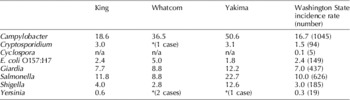
One such area and risk factor that needs investigation is the environment. Accumulated data suggest that residents of rural locales especially those with high frequencies of exposure to livestock are at increased risk of acquiring sporadic enteric infections (Haus-Cheymol et al., Reference Haus-Cheymol, Espie, Che, Vaillant and Desenclos2006; Strachan et al., Reference Strachan, Dunn, Locking, Reid and Ogden2006). Within Washington State for example Yakima and Whatcom counties have the largest and second largest number of cattle farms and the highest and third highest densities of cattle respectively (United States Department of Agriculture, Reference Adak, Cowden, Nicholas and Evans2002); these counties also have the State's highest incidence of E. coli O157:H7 infections (Washington State Department of Health, Reference Allander, Jartti, Gupta, Niesters, Lehtinen, Osterback, Vuorinen, Waris, Bjerkner, Tiveljung-Lindell, van den Hoogen, Hyypia and Ruuskanen2006) (Table 1). Other studies demonstrate the importance of animal contact with acquisition of Campylobacter and E. coli O157:H7 infections (Innocent et al., Reference Innocent, Mellor, McEwen, Reilly, Smallwood, Locking, Shaw, Michel, Taylor, Steele, Gunn, Ternent, Woolhouse and Reid2005; Marcus et al., Reference Marcus, Varma, Medus, Boothe, Anderson, Crume, Fullerton, Moore, White, Lyszkowicz, Voetsch and Angulo2007) and seroepidemiologic data and other data support the concept of increased risk of E. coli O157:H7 in rural residents (Michel et al., Reference Michel, Wilson, Martin, Clarke, McEwen and Gyles1999; Evans et al., Reference Evans, Chalmers, Chart, Salmon, Kench, Coleman, Meadows, Morgan-Capner, Softley, Sillis and Thomas2000; Valcour et al., Reference Valcour, Michel, McEwen and Wilson2002; Haack et al., Reference Haack, Jelacic, Besser, Weinberger, Kirk, McKee, Harrison, Musgrave, Miller, Price and Tarr2003; Carroll et al., 2005). In one attempt to find vehicles for sporadic enteric infections among Danish children Ethelberg et al. (Reference Ethelberg, Olesen, Neimann, Schiellerup, Helms, Jensen, Bottiger, Olsen, Scheutz, Gerner-Smidt and Molbak2006) associated day care attendance and contact with other individuals with diarrheal illness as risk factors. However, after eliminating viral illnesses and diarrhea of unknown etiology, these investigators found an association between foreign travel and socioeconomic factors only. Domestic vehicles of acquisition were not identified.
2005 Washington State incidence rates/100,000 population by organism and county (Washington State Department of Health, Reference Allander, Jartti, Gupta, Niesters, Lehtinen, Osterback, Vuorinen, Waris, Bjerkner, Tiveljung-Lindell, van den Hoogen, Hyypia and Ruuskanen2006)

* Incidence rates not calculated in the report for <5 cases.
Below we exemplify four pathogens, discuss their sporadic and geographic epidemiologies, and highlight the need to determine more about modes of acquisition of these infecting organisms especially non-food sources.
The case of E. coli O157:H7 infections
While large outbreaks implicated ground beef as a vehicle of E. coli O157:H7 infection (Riley et al., Reference Riley, Remis, Helgerson, McGee, Wells, Davis, Hebert, Olcott, Johnson, Hargrett, Blake and Cohen1983; Bell et al., Reference Bielaszewska, Prager, Köck, Mellmann, Zhang, Tschäpe, Tarr and Karch1994) most E. coli O157:H7 infections are not attributable to identifiable outbreaks. Additionally, when ground beef is included in surveys of sporadic disease this vehicle does not explain the vast majority of cases (Michel et al., Reference Michel, Wilson, Martin, Clarke, McEwen and Gyles1998; Evans et al., Reference Evans, Chalmers, Chart, Salmon, Kench, Coleman, Meadows, Morgan-Capner, Softley, Sillis and Thomas2000; Marcus et al., Reference Marcus, Varma, Medus, Boothe, Anderson, Crume, Fullerton, Moore, White, Lyszkowicz, Voetsch and Angulo2007). Subsequent outbreaks have suggested a considerably wider range of potential vehicles such as alfalfa (Breuer et al., 2001; Ferguson et al., Reference Ferguson, Scheftel, Cronquist, Smith, Woo-Ming, Anderson, Knutsen, De and Gershman2005), radish sprouts (Michino et al., Reference Michino, Araki, Minami, Takaya, Sakai, Miyazaki, Ono and Yanagawa1999), lettuce (Ackers et al., Reference Aureli, Fiorucci, Caroli, Marchiaro, Novara, Leone and Salmaso1998), unpasteurized juices (Cody et al., Reference Cody, Glynn, Farrar, Cairns, Griffin, Kobayashi, Fyfe, Hoffman, King, Lewis, Swaminathan, Bryant and Vugia1999), water (Swerdlow et al., Reference Swerdlow, Woodruff, Brady, Griffin, Tippen, Donnell, Geldreich, Payne, Meyer, Wells, Gveene, Bright, Bean and Blake1992; Krewski et al., Reference Krewski, Balbus, Butler-Jones, Haas, Isaac-Renton, Roberts and Sinclair2002; Olsen et al., Reference Olsen, Miller, Breuer, Kennedy, Higgins, Walford, McKee, Fox, Bibb and Mead2002), unpasteurized dairy products (Djuretic et al., Reference Djuretic, Wall and Nichols1997; Honish et al., Reference Honish, Predy, Hislop, Chui, Kowalewska-Grochowska, Trottier, Kreplin and Zazulak2005) and spinach (Centers for Disease Control and Prevention, Reference Allander, Andreasson, Gupta, Bjerkner, Bogdanovic, Persson, Dalianis, Ramqvist and Andersson2006). Additionally, there is discordance between case reporting and case occurrence which could lead to incomplete epidemiologic assessments of outbreaks (Michel et al., Reference Michel, Wilson, Martin, Clarke, McEwen and Gyles2000).
Sporadic and outbreak-related data suggest environmental and agricultural sources for infection via contact with animals and their excreta (Parry et al., Reference Parry, Salmon, Willshaw and Cheasty1998; Locking et al., Reference Locking, O'Brien, Reilly, Wright, Campbell, Coia, Browning and Ramsay2001; Innocent et al., Reference Innocent, Mellor, McEwen, Reilly, Smallwood, Locking, Shaw, Michel, Taylor, Steele, Gunn, Ternent, Woolhouse and Reid2005). Interestingly E. coli O157:H7 has a disproportionately higher incidence in the rural UK (Evans et al., Reference Evans, Chalmers, Chart, Salmon, Kench, Coleman, Meadows, Morgan-Capner, Softley, Sillis and Thomas2000) and rural residents have serologic evidence for increased exposure to this pathogen in the US (Haack et al., Reference Haack, Jelacic, Besser, Weinberger, Kirk, McKee, Harrison, Musgrave, Miller, Price and Tarr2003), Canada (Reymond et al., Reference Reymond, Johnson, Karmali, Petric, Winkler, Johnson, Rahn, Renwick, Wilson, Clarke and Spika1996) and Scotland (Strachan et al., Reference Strachan, Dunn, Locking, Reid and Ogden2006). These epidemiologic findings are consistent with data demonstrating cattle as an important reservoir of E. coli O157 and the ability of the organism to survive in the environment for months (Wang et al., Reference Wang, Zhao and Doyle1996; Besser et al., Reference Birkhead, Vogt, Heun, Evelti and Patton1997; Rahn et al., Reference Rahn, Renwick, Johnson, Wilson, Clarke, Alves, McEwen, Lior and Spika1997; Kudva et al., Reference Kudva, Blanch and Hovde1998). In one multistate study several factors were identified with largely sporadic cases of E. coli O157:H7 infection: eating rare hamburgers, imbibing untreated surface water and contact with cattle, whereas produce consumption in general diminished risk (Marcus et al., Reference Marcus, Varma, Medus, Boothe, Anderson, Crume, Fullerton, Moore, White, Lyszkowicz, Voetsch and Angulo2007).
The case of Salmonella infections
Salmonella infections could be acquired by exposure to agricultural reservoirs. Salmonella has been documented in swine and dairy farms and outbreak data have demonstrated human infection following farm animal contact (Maguire et al., Reference Maguire, Codd, Mackay, Rowe and Mitchell1993). However, epidemiologic data have not demonstrated such strong rural associations in North America. Foods certainly transmit Salmonella and outbreak vehicles have included sprouts eggs (St Louis et al., Reference St Louis, Morse, Potter, DeMelfi, Guzewich, Tauxe and Blake1988; Sobel et al., Reference Sobel, Hirshfeld, McTigue, Burnett, Altekruse, Brenner, Malcolm, Mottice, Nichols and Swerdlow2000; Kimura et al., Reference Kimura, Reddy, Marcus, Cieslak, Mohle-Boetani, Kassenborg, Segler, Hardnett, Barrett and Swerdlow2004; Chittick et al., Reference Chittick, Sulka, Tauxe and Fry2006), poultry (Chittick et al., Reference Chittick, Sulka, Tauxe and Fry2006), milk (De Buyser et al., Reference De Buyser, Dufour, Maire and Lafarge2001), orange juice (Cook et al., Reference Cook, Dobbs, Hlady, Wells, Barrett, Puhr, Lancette, Bodager, Toth, Genese, Highsmith, Pilot, Finelli and Swerdlow1998; Public Health Agency of Canada, Reference Ackers, Mahon, Leahy, Goode, Damrow, Hayes, Bibb, Rice, Barrett, Hutwagner, Griffin and Slutsker1999; Centers for Disease Control and Prevention, 1991), beef (Centers for Disease Control and Prevention, 1981; Davies et al., Reference Davies, O'Neill, Towers and Cooke1996; Wegener and Baggesen, Reference Wegener and Baggesen1996), fresh produce (Centers for Disease Control and Prevention, 1991; Sivapalasingam et al., Reference Sivapalasingam, Friedman, Cohen and Tauxe2004) including pre-bagged ready-to-eat salads (Sagoo et al., Reference Sagoo, Little, Ward, Gillespie and Mitchell2003), cilantro (Campbell et al., Reference Campbell, Mohle-Boetani, Reporter, Abbott, Farrar, Brandl, Mandrell and Werner2001), and peanut butter (Scheil et al., Reference Scheil, Cameron, Dalton, Murray and Wilson1998; Anon., 2007). Egg (Hennessy et al., Reference Hennessy, Cheng, Kassenborg, Ahuja, Mohle-Boetani, Marcus, Shiferaw and Angulo2004; Marcus et al., Reference Marcus, Varma, Medus, Boothe, Anderson, Crume, Fullerton, Moore, White, Lyszkowicz, Voetsch and Angulo2007) and poultry (Humphrey et al., Reference Humphrey, Mead and Rowe1988; Kimura et al., Reference Kimura, Reddy, Marcus, Cieslak, Mohle-Boetani, Kassenborg, Segler, Hardnett, Barrett and Swerdlow2004) consumption and exposure to birds and reptiles (Marcus et al., Reference Marcus, Varma, Medus, Boothe, Anderson, Crume, Fullerton, Moore, White, Lyszkowicz, Voetsch and Angulo2007) have been identified as risks for sporadic infections acquired domestically in the United States. Interestingly 0.2% of retail ready-to-eat salads in the UK (Sagoo et al., Reference Sagoo, Little, Ward, Gillespie and Mitchell2003) and 7% of Seattle retail sprouts samples (Samadpour et al., Reference Samadpour, Barbour, Nguyen, Cao, Buck, Depavia, Mazengia, Yang, Alfi, Lopes and Stopforth2006) were contaminated with Salmonella. Less information is available on the sources of sporadic infection with Salmonella. Limited data suggest that consumption of chicken particularly commercially prepared chicken, home-prepared eggs (Kimura et al., Reference Kimura, Reddy, Marcus, Cieslak, Mohle-Boetani, Kassenborg, Segler, Hardnett, Barrett and Swerdlow2004; Marcus et al., Reference Marcus, Varma, Medus, Boothe, Anderson, Crume, Fullerton, Moore, White, Lyszkowicz, Voetsch and Angulo2007), shrimp and pork and eating sprouts in general or even having sprouts in the household are associated with salmonellosis (Denno et al., Reference Denno, Keene, Patnode, Chudek, Duchin and Tarr2007). Exposure to pets particularly reptiles and amphibians and poultry have also been implicated as has recreational beach play (Mermin et al., Reference Mermin, Hutwagner, Vugia, Shallow, Daily, Bender, Koehler, Marcus and Angulo2004; Jones et al., Reference Jones, Ingram, Fullerton, Marcus, Anderson, McCarthy, Vugia, Shiferaw, Haubert, Wedel and Angulo2006; Denno et al., Reference Denno, Keene, Patnode, Chudek, Duchin and Tarr2007).
The case of Campylobacter infections
Campylobacter, the most common REI in many locales (Blaser et al., Reference Campbell, Mohle-Boetani, Reporter, Abbott, Farrar, Brandl, Mandrell and Werner1982; de Wit et al., Reference de Wit, Koopmans, Kortbeek, Wannet, Vinje, van Leusden, Bartelds and van Duynhoven2001a, Reference de Wit, Koopmans, Kortbeek, van Leeuwen, Vinje and van Duynhovenb; Denno et al., Reference Denno, Keene, Patnode, Chudek, Duchin and Tarr2005; Centers for Disease Control and Prevention, Reference Allander, Andreasson, Gupta, Bjerkner, Bogdanovic, Persson, Dalianis, Ramqvist and Andersson2006; Washington State Department of Health, 2006), has been detected in retail meats (Nielsen et al., Reference Nielsen, Engberg and Madsen1997; Zhao et al., Reference Zhao, Ge, De Villena, Sudler, Yeh, Zhao, White, Wagner and Meng2001; Jorgensen et al., Reference Jorgensen, Bailey, Williams, Henderson, Wareing, Bolton, Frost, Ward and Humphrey2002; Fitch et al., Reference Fitch, Sachen, Wilder, Burg, Lacher, Khalife, Whittam and Young2005) and is transmitted via food particularly poultry (Hopkins et al., Reference Hopkins, Olmsted and Istre1984; Oosterom et al., Reference Oosterom, den Uyl, Banffer and Huisman1984; Deming et al., Reference Deming, Tauxe, Blake, Dixon, Fowler, Jones, Lockamy, Patton and Sikes1987; Kapperud et al., Reference Kapperud, Skjerve, Bean, Ostroff and Lassen1992, Reference Kapperud, Espeland, Wahl, Walde, Herikstad, Gustavsen, Tveit, Natas, Bevanger and Digranes2003; Ikram et al., Reference Ikram, Chambers, Mitchell, Brieseman and Ikam1994; Schorr et al., Reference Schorr, Schmid, Rieder, Baumgartner, Vorkauf and Burnens1994; Adak et al., Reference Beatty1995; Eberhart-Phillips et al., Reference Eberhart-Phillips, Walker, Garrett, Bell, Sinclair, Rainger and Bates1997; Studahl and Andersson, Reference Studahl and Andersson2000; Effler et al., Reference Effler, Ieong, Kimura, Nakata, Burr, Cremer and Slutsker2001; Rodrigues et al., Reference Rodrigues, Cowden, Wheeler, Sethi, Wall, Cumberland, Tompkins, Hudson, Roberts and Roderick2001; Wingstrand et al., Reference Wingstrand, Neimann, Engberg, Nielsen, Gerner-Smidt, Wegener and Molbak2006) including poultry brought into the home raw (Kapperud et al., Reference Kapperud, Skjerve, Bean, Ostroff and Lassen1992; Ikram et al., Reference Ikram, Chambers, Mitchell, Brieseman and Ikam1994). Transmission via recreational (Schonberg-Norio et al., Reference Schonberg-Norio, Takkinen, Hanninen, Katila, Kaukoranta, Mattila and Rautelin2004) and contaminated water (Hopkins et al., Reference Hopkins, Olmsted and Istre1984; Kapperud et al., Reference Kapperud, Skjerve, Bean, Ostroff and Lassen1992, Reference Kapperud, Espeland, Wahl, Walde, Herikstad, Gustavsen, Tveit, Natas, Bevanger and Digranes2003; Adak et al., Reference Beatty1995; Eberhart-Phillips et al., Reference Eberhart-Phillips, Walker, Garrett, Bell, Sinclair, Rainger and Bates1997; Schonberg-Norio et al., Reference Schonberg-Norio, Takkinen, Hanninen, Katila, Kaukoranta, Mattila and Rautelin2004; O'Reilly et al., Reference O'Reilly, Bowen, Perez, Sarisky, Shepherd, Miller, Hubbard, Herring, Buchanan, Fitzgerald, Hill, Arrowood, Xiao, Hoekstra, Mintz and Lynch2007) has been observed primarily during outbreaks. However, the relative risk and specific nature of these risks (i.e. via consuming any versus consuming undercooked food commercially prepared versus home-cooked or via cross-contaminated food) have varied.
Consumption of unpasteurized milk (Hopkins et al., Reference Hopkins, Olmsted and Istre1984; Anon., Reference Acheson1986; Schmid et al., Reference Schmid, Schaefer, Plikaytis, Schaefer, Bryner, Wintermeyer and Kaufmann1987; Birkhead et al., Reference Breuer, Benkel, Shapiro, Hall, Winnett, Linn, Neimann, Barrett, Dietrich, Downes, Toney, Pearson, Rolka, Slutsker and Griffin1988; Studahl and Andersson, Reference Studahl and Andersson2000; Potter et al., Reference Potter, Kaneene and Hall2003) is a risk factor for sporadic Campylobacter infections. There are higher rates of Campylobacter infection in rural populations (Thompson et al., Reference Thompson, Cahoon and Hodge1986) suggesting agricultural links. Contact with animals (including poultry cattle swine cats and dogs) that excrete Campylobacter are likely sources of human infection (Blaser and Reller, Reference Caeiro, Mathewson, Smith, Jiang, Kaplan and Dupont1981; Hopkins et al., Reference Hopkins, Olmsted and Istre1984; Deming et al., Reference Deming, Tauxe, Blake, Dixon, Fowler, Jones, Lockamy, Patton and Sikes1987; Salfield and Pugh, Reference Salfield and Pugh1987; Kapperud et al., Reference Kapperud, Skjerve, Bean, Ostroff and Lassen1992, Reference Kapperud, Espeland, Wahl, Walde, Herikstad, Gustavsen, Tveit, Natas, Bevanger and Digranes2003; Adak et al., Reference Beatty1995; Eberhart-Phillips et al., Reference Eberhart-Phillips, Walker, Garrett, Bell, Sinclair, Rainger and Bates1997; Studahl and Andersson, Reference Studahl and Andersson2000; Tenkate and Stafford, Reference Tenkate and Stafford2001). Eating at a table service restaurant (Friedman et al., Reference Friedman, Hoekstra, Samuel, Marcus, Bender, Shiferaw, Reddy, Ahuja, Helfrick, Hardnett, Carter, Anderson and Tauxe2004) and contact with persons with diarrhea (Oosterom et al., Reference Oosterom, den Uyl, Banffer and Huisman1984) are other likely vehicles.
The case of Shigella infections
Humans and several other primates are the only natural hosts for Shigella. However, Shigella has been responsible for numerous food-borne outbreaks (Keusch and Bennish, Reference Keusch, Bennish, Evans and Brachman1998) probably because of human contamination of food. Incidence rates are higher in economically disadvantaged minorities including Hispanics (Keusch and Bennish, Reference Keusch, Bennish, Evans and Brachman1998). Risk factors for sporadic cases of Shigella infection are however, unknown, in general populations.
The preponderance of data regarding routes of transmission of these four REIs arises from outbreak investigations and yet the majority of infections are sporadic. The identification of vehicles of acquisition for specific pathogens contributes to overall knowledge regarding risk factors for infection. This information correlated with regional variations related to sources can provide an evidence base to guide hazard control and other prevention efforts.
The undetermined cause of many cases of enteric infections
The infectious causes of most cases of diarrhea remain unknown even with intense microbiologic evaluation. A roster of plausible candidate pathogens is now available but it is critical to determine if such agents are found more frequently in cases than controls. Measures to advance food safety using epidemiologic science require a thorough knowledge of the causes of human diseases. Our ignorance of the cause of many cases of gastroenteritis is a major impediment to their prevention. Genomic sequencing and nucleic acid arrays now permit novel powerful and minimally biased analyses of human specimens.
The elusive cause of diarrhea
Even when broad efforts are applied a bona fide microbiologic cause of diarrhea frequently cannot be established (Caeiro et al., 1999; Waters et al., Reference Waters, Ford-Jones, Petric, Fearon, Corey and Moineddein2000; de Wit et al.,Reference de Wit, Koopmans, Kortbeek, Wannet, Vinje, van Leusden, Bartelds and van Duynhoven2001a, Reference de Wit, Koopmans, Kortbeek, van Leeuwen, Vinje and van Duynhovenb; Cohen et al., Reference Cohen, Nataro, Bernstein, Hawkins, Roberts and Staat2005; Denno et al., Reference Denno, Stapp, Boster, Qin, Clausen, Del Beccaro, Swerdlow, Braden and Tarr2005, Reference Denno, Keene, Patnode, Chudek, Duchin and Tarr2007; Klein et al., Reference Klein, Boster, Stapp, Wells, Qin, Clausen, Swerdlow, Braden and Tarr2006; Vernacchio et al., Reference Vernacchio, Vezina, Mitchell, Lesko, Plaut and Acheson2006a, Reference Vernacchio, Vezina, Mitchell, Lesko, Plaut and Achesonb). For the purposes of this review ‘bona fide’ diarrheagenic agents found to varying extents in North America (many of which are acquired from contaminated food or water) are Campylobacter jejuni, E. coli O157:H7, selected non-O157:H7 Shiga toxin-producing E. coli (STEC), Salmonella, Shigella, Vibrio and Yersinia spp.; Clostridium difficile following antibiotic administration in non-infants; Giardia lamblia; Entamoeba histolytica, Cryptosporidium parvum, Microsporidia, Cyclospora, Isospora; rotavirus caliciviruses, astroviruses and adenoviruses. Diverse factors underlie our ignorance about the causes of specific cases of diarrhea (Sherman and Tarr, Reference Sherman and Tarr2005) including expense (thorough evaluations cost hundreds of dollars) and futility (diagnosis rarely leads to treatment or when pathogens are detected late in illness the offending agent is often already cleared or the patient is already improved). Importantly the currently available methods for the detection of many of these pathogens lack sensitivity and in some cases specificity. Even in outbreaks which offer unique chances to determine causes, etiologies often escape detection. For example, in 2004 29 of Washington State 58 enteric infection clusters were classified as caused by an unknown agent or characterized as ‘viral’ without an agent being recovered (http://www.doh.wa.gov/notify/nc/incidence/food-borne.pdf).
Candidate pathogens warrant assessment as to their association with human disease in the United States
The problem of determining etiologies in cases of gastroenteritis is magnified by the challenges of defining exactly what constitutes a pathogen. Many non-O157:H7 STEC (Tarr and Neill, Reference Tarr and Neill1996; Johnson et al., Reference Johnson, Thorpe and Sears2006), non-jejuni Campylobacter (Lawson et al., Reference Lawson, Logan, O'Neill, Desai and Stanley1999), E. coli with enterotoxigenic (ETEC), enteropathogenic (EPEC) or enteroaggregative (EAggEC) loci (Nataro and Kaper, Reference Nataro and Kaper1998) L. monocytogenes (Riedo et al., Reference Riedo, Pinner, Tosca, Cartter, Graves, Reeves, Weaver, Plikaytis and Broome1994; Dalton et al., Reference Dalton, Austin, Sobel, Hayes, Bibb, Graves, Swaminathan, Proctor and Griffin1997; Miettinen et al., Reference Miettinen, Siitonen, Heiskanen, Bjorkroth and Korkeala1999; Aureli et al., Reference Bielaszewska, Zhang, Tarr, Sonntag and Karch2000; Ooi and Lorber, Reference Ooi and Lorber2005), Aeromonas and Pleisiomonas spp. (Essers et al., Reference Essers, Burnens, Lanfranchini, Somaruga, von Vigier, Schaad, Aebi and Bianchetti2000; Shigematsu et al., Reference Shigematsu, Kaufmann, Charlett, Niho and Pitt2000), Helicobacter pylori (Frenck and Clemens, Reference Frenck and Clemens2003), Blastocystis hominis (Cirioni et al., Reference Cirioni, Giacometti, Drenaggi, Ancarani and Scalise1999), Dientamoeba fragilis (Cuffari et al., Reference Cuffari, Oligny and Seidman1998; Preiss et al., Reference Preiss, Ockert, Broemme and Otto1991), and community-acquired non-antibiotic-associated C. difficile (Riley et al., Reference Riley, Cooper, Bell and Golledge1995) can be excreted in the absence of diarrhea (Cobb et al., Reference Cobb, Curtis, Bansi, Slade, Mehal, Mitchell and Chapman1996; Hellard et al., Reference Hellard, Sinclair, Hogg and Fairley2000; Svenungsson et al., Reference Svenungsson, Lagergren, Ekwall, Evengard, Hedlund, Karnell, Lofdahl, Svensson and Weintraub2000) calling into question their pathogenicity. Additionally, many such agents are ‘nominated’ as pathogens only because they possess a single virulence trait. In reality, the ability to cause disease in humans probably depends on additional virulence loci. Non-O157:H7 STEC are good examples of this challenge. For example, merely possessing genes encoding Shiga toxin does not by itself define a human pathogen (Tarr and Neill, Reference Tarr and Neill1996) because auxiliary bacterial virulence traits are generally necessary for disease association (Beutin et al., Reference Blackburn, Craun, Yoder, Hill, Calderon, Chen, Lee, Levy and Beach2004; Bielaszewska et al., Reference Blaser and Reller2005, Reference Breitbart, Hewson, Felts, Mahaffy, Nulton, Salamon and Rohwer2007). Nonetheless, some non-O157:H7 STEC are clearly pathogens by virtue of their identification in clusters of disease (Paton et al., Reference Paton, Ratcliff, Doyle, Seymour-Murray, Davos, Lanser and Paton1996, Reference Paton, Woodrow, Doyle, Lanser and Paton1999; Hashimoto et al., Reference Hashimoto, Mizukoshi, Nishi, Kawakita, Hasui, Kato, Ueno, Takeya, Okuda and Takeda1999; Feng et al., Reference Feng, Weagant and Monday2001; McCarthy et al., Reference McCarthy, Barrett, Hadler, Salsbury, Howard, Dingman, Brinkman, Bibb and Cartter2001; Werber et al., Reference Werber, Fruth, Liesegang, Littmann, Buchholz, Prager, Karch, Breuer, Tschape and Ammon2002; Misselwitz et al., Reference Misselwitz, Karch, Bielazewska, John, Ringelmann, Ronnefarth and Patzer2003; Brooks et al., 2004; Bielaszewska et al., Reference Blaser, Reller, Luechtefeld and Wang2006).
Candidate diarrheagenic (for humans) bacteria, such as non-O157:H7 Shiga toxin-producing E. coli, are found in food (Samadpour et al., Reference Samadpour, Ongerth, Liston, Tran, Nguyen, Whittam, Wilson and Tarr1994, Reference Samadpour, Barbour, Nguyen, Cao, Buck, Depavia, Mazengia, Yang, Alfi, Lopes and Stopforth2006; Acheson, Reference Andersen2000; Jaeger and Acheson, Reference Andersen2000) and food animals (Gyles et al., Reference Gyles, Johnson, Gao, Ziebell, Pierard, Aleksic and Boerlin1998; Hussein and Bollinger, Reference Hussein and Bollinger2005; Keller et al., Reference Keller, Wieland, Wittwer, Stephan and Perreten2007; Mora et al., Reference Mora, Blanco, Blanco, Dahbi, Lopez, Justel, Alonso, Echeita, Bernardez, Gonzalez and Blanco2007). Confirming or refuting the role of these agents as pathogens is necessary to prioritize research on the ecology, biology and reservoirs of such organisms. Rigorous data form the foundation for appropriate regulations. Filling this void in our knowledge will lead to outcome measures for strategies to target microbial contamination of food by identifying or refuting pathogenicity of organisms that might be transmitted by food.
Technology now permits accurate and economical non-culture detection of pathogens
Current strategies for identifying an infectious agent in cases of gastroenteritis employ cumbersome Balkanized slow and expensive technology. For example, identification of bacterial etiologies relies on the performance of cultures on variably selective agar and broth media and then characterizing resulting colonies or broth cultures using serologic, biochemical and other phenotypic assays (such as toxin detection). Antigen detection or toxin assays applied directly to stool or stool filtrate are employed to detect rotavirus adenovirus astrovirus and C. difficile. Detection of parasites relies on direct observation of ova or organisms or detection of parasitic antigens. Moreover, these technologies have been developed to detect organisms based on known characteristics and thus are blind to new or evolving pathogens. However, emerging technologies may hold promise for the revolution of diagnostic methods and strategies and for the identification of emerging agents of disease.
Novel viral pathogens
The spectrum of human diarrheagenic viruses is unknown but probably broad. Traditional technologies for viral identification even if utilizing molecular-genetic detection rely on viral cultivation immune electron microscopy (Kapikian et al., Reference Kapikian, Wyatt, Dolin, Thronhill, Kalica and Chanock1972), animal inoculation and serologic–epidemiologic studies to discover or validate new pathogens. These efforts are potentially applicable to situations where serum or fresh stool is available and there is a good candidate agent. However, in view of their intensity and cost, these techniques are best applied either to clusters of infection or to high frequency agents of disease. The effort involved in identifying antibody responses, viral cultures or animal challenges to find novel agents would be exorbitant if the percent of infected patients is low.
However, after a candidate viral etiologic agent is identified and its genome is sequenced, individualized assays such as enzyme immunoassay (EIA) and genetic detection methodologies, in particular the polymerase chain reaction (PCR), can be used. These techniques however, have limitations. EIA cannot discover novel agents and is critically dependent on the quality of antiserum/antibody employed. EIAs are additionally constrained by existing knowledge such that antibodies can only be made to antigens after the identities of the expressed molecules are known. PCR is sensitive but its use is predicated upon sufficient knowledge to design primers. Also, while PCR that detects multiple different loci simultaneously (multiplex PCR) does enable the identification of more than one agent in a single analyte, it is often difficult to design compatible primer sets for multiplexing without considerable empiric validation. Also, one is limited to a relatively small number of targets in a single assay and identification using degenerate PCR (allowing variation in target) requires confirmatory efforts such as sequencing hybridization of the resulting amplicons or restriction analysis. Clearly, novel approaches that circumvent technologic difficulties of viral detection and the biases inherent in EIAs and PCR are needed to discover novel human viruses. Viral microarrays are one technologic advance to discover novel viruses associated with food-borne illness.
A validated DNA microarray for highly parallel viral detection eliminates many theoretical and practical problems of viral discovery and diagnosis. Initially >140 viral genome sequences were used to design a long (70-mer) DNA microarray on glass slides (Eisen and Brown, Reference Eisen and Brown1999) to capture diverse viral nucleic acids from polymicrobial milieus (Wang et al., Reference Wang, Coscoy, Zylberberg, Avila, Boushey, Ganem and DeRisi2002). The most conserved 70-mers were selected from each known virus to maximize the probability of detecting all members of a given family including unsequenced novel or variant members. This approach successfully detected a panel of known human respiratory viruses in vitro and nasal washings from experimentally and naturally infected subjects (Wang et al., Reference Wang, Coscoy, Zylberberg, Avila, Boushey, Ganem and DeRisi2002). These results were independently confirmed by conventional virus-specific PCR assays.
A second generation array incorporating oligonucleotide elements from every fully sequenced reference genome (∼1000 viruses) was subsequently developed and validated when severe acute respiratory syndrome coronavirus (SARS) appeared in 2003 (Wang et al., Reference Wang, Urisman, Liu, Springer, Ksiazek, Erdman, Mardis, Hickenbotham, Magrini, Eldred, Latreille, Wilson, Ganem and DeRisi2003). Specimen DNA that binds to the array can be scraped and sequenced (Wang et al., Reference Wang, Urisman, Liu, Springer, Ksiazek, Erdman, Mardis, Hickenbotham, Magrini, Eldred, Latreille, Wilson, Ganem and DeRisi2003).
The value of screening human specimens with this highly parallel microarray assay is evident. In addition to screening for all known diarrheagenic viruses this approach provides a rational basis and strategy for virus discovery. Unrecognized members of existing viral families can be detected by hybridization to the highly conserved sequences represented on the microarray. Moreover, this system's use of 70-mers can tolerate significant mutations and still yield detectable hybridization. This technique permits the parsimonious application of valuable specimens because the nucleic acids are derived only from two different extraction processes: one for RNA and one for DNA. Microarray analysis is less economical than multiplex PCR but the multitude of agents that can be found is dramatically larger.
A complementary approach is the use of in-depth massively parallel sequencing. This approach has been applied to respiratory secretions from patients with respiratory tract infections to identify human bocavirus (Allander et al., Reference Besser, Hancock, Pritchett, McRae, Rice and Tarr2007b) and two novel polyomaviruses from humans (Allander et al., Reference Bell, Goldoft, Goldoft, Griffin, Davis, Gordon, Tarr, Bartleson, Lewis, Barrett, Wells, Baron and Kobayashi2007a; Gaynor et al., Reference Gaynor, Nissen, Whiley, Mackay, Lambert, Wu, Brennan, Storch, Sloots and Wang2007). Briefly, secretions from patients are cloned (with or without pooling) and sequenced. Novel sequences identified from the sequenced libraries that appear microbial in origin are then used to create primers to interrogate specimens from patients and controls with conventional PCR to assess potential associations with disease. Mass sequencing of stool samples from healthy individuals has revealed the presence of a large diversity of phage and plant viruses (Breitbart et al., Reference Carroll, Gibson and McNamara2003; Zhang et al., Reference Zhang, Breitbart, Lee, Run, Wei, Soh, Hibberd, Liu, Rohwer and Ruan2006).
Novel bacterial pathogens
Classic bacteriology will not identify many agents that are postulated to cause diarrhea. Examples include ETEC which have been isolated in this country (Caeiro et al., 1999; Beatty, Reference Bielaszewska, Prager, Zhang, Friedrich, Mellmann, Tschäpe and Karch2004) and EaggEC (Nataro, Reference Nataro2005) which were recently associated with diarrhea in Cincinnati children (Cohen et al., Reference Cohen, Nataro, Bernstein, Hawkins, Roberts and Staat2005). Classic microbiologic studies would also overlook H. pylori which has been proposed to cause infectious acute childhood diarrhea (Sullivan et al., Reference Sullivan, Thomas, Wight, Neale, Eastham, Corrah, Lloyd-Evans and Greenwood1990; Passaro et al., Reference Passaro, Taylor, Meza, Cabrera, Gilman and Parsonnet2001) though there is contradictory literature on the diarrheagenic role of this agent (Kehrt et al., Reference Kehrt, Becker, Brosicke, Kruger and Helge1997; Rahman et al., Reference Rahman, Mahalanabis, Sarker, Bardhan, Alvarez, Hildebrand, Beglinger and Gyr1998; Rothenbacher et al., Reference Rothenbacher, Blaser, Bode and Brenner2000) and it is somewhat unlikely that this gastric pathogen has a major role in diarrhea. L. monocytogenes, which has been incriminated in epidemic gastroenteritis in the United States (Riedo et al., Reference Riedo, Pinner, Tosca, Cartter, Graves, Reeves, Weaver, Plikaytis and Broome1994; Dalton et al., Reference Dalton, Austin, Sobel, Hayes, Bibb, Graves, Swaminathan, Proctor and Griffin1997) and overseas (Miettinen et al., Reference Miettinen, Siitonen, Heiskanen, Bjorkroth and Korkeala1999; Aureli et al., Reference Bielaszewska, Zhang, Tarr, Sonntag and Karch2000) though not in sporadic cases of diarrhea in at least one North American study (Sauders et al., Reference Sauders, Pettit, Currie, Suits, Evans, Stellrecht, Dryja, Slate and Wiedmann2005) would also be overlooked. The epsilon-proteobacteria encompasses two families: the Campylobacteraceae and the Helicobacteriaceae which have additional members that might be unrecognized as causes of diarrhea (Fox, Reference Fox2002). C. jejuni and Campylobacter coli are most commonly recognized as a cause of acute gastroenteritis but other pathogenic epsilon-proteobacteria Campylobacter upsaliensis, Campylobacter hyointestinalis, Campylobacter fetus and Arcobacter spp. (Lawson et al., Reference Lawson, Logan, O'Neill, Desai and Stanley1999; Lehner et al., Reference Lehner, Tasara and Stephan2005) have been associated with acute gastroenteritis and are potential food-borne pathogens. Arcobacter spp. are potentially important emerging food-borne pathogens that potentially share transmission vehicles similar to those that transmit C. jejuni (Son et al., Reference Son, Englen, Berrang, Fedorka-Cray and Harrison2007). A number of non-pylori intestinal Helicobacters have been suggested as causes of human diarrhea (Fox et al., Reference Fox, Chien, Dewhirst, Paster, Shen, Melito, Woodward and Rodgers2000; Solnick and Schauer, Reference Solnick and Schauer2001). Helicobacter canadensis (Fox, Reference Fox2002) and Helicobacter pullorum (Melito et al., Reference Melito, Woodward, Bernard, Price, Khakhria, Johnson and Rodgers2000) have been reported to cause acute gastroenteritis resembling that caused by C. jejuni and C. coli, while Helicobacter fennelliae and Helicobacter cinaedi appear to have a predilection for causing gastroenteritis and invasive disease in immunocompromised patients (Andersen, Reference Beutin, Krause, Zimmerman, Kaulfuss and Gleier2001). The recognition of these organisms as pathogens has been hampered by the fact that the routine microbiologic techniques developed to isolate C. jejuni and C. coli are suboptimal for the growth of these atypical organisms (Lastovica and le Roux, Reference Lastovica and le Roux2000).
We have recently published two studies that demonstrate the high proportion of diarrheal illness that remains etiologically unexplained despite intensive microbiologic investigation applied to specimens. The studies were performed at the Seattle Children's Hospital and Regional Medical Center Emergency Department (Klein et al., Reference Klein, Boster, Stapp, Wells, Qin, Clausen, Swerdlow, Braden and Tarr2006) and two additional urban ambulatory practices in Seattle (Denno et al., Reference Denno, Stapp, Boster, Qin, Clausen, Del Beccaro, Swerdlow, Braden and Tarr2005). These sites serve a geographically and demographically diverse pediatric outpatient population. All stools were tested for Aeromonas spp., C. jejuni, E. coli O157:H7, non-O157:H7 STEC Pleisiomonas shigelloides and Salmonellae, Shigella, Vibrio and Yersinia spp. Stools submitted in sufficient quantity were additionally tested for parasites by microscopy (wet mount, concentrate, trichrome and auramine stains, and fluorescent antibody analysis for G. lamblia and C. parvum). C. difficile toxin by cytotoxicity assay and adenovirus, astrovirus, and rotavirus by EIA. The resulting data indicate that many cases of diarrhea even in high acuity populations such as a children's hospital emergency department remain unexplained in terms of etiology even though a broad and expensive array of microbiologic testing is performed. Even though most cases of diarrhea currently remain unexplained, a subset is plausibly caused by novel viruses E. coli, L. monocytogenes or epsilon-proteobacteria and this area is worthy of further and intense investigation.
Clearly, thoroughly evaluating stools for known and yet-to-be discovered viruses and candidate bacterial pathogens that would be overlooked on standard cultures is warranted. Knowing the causes of human gastrointestinal infections is inherent to food safety and currently our knowledge is limited. Data regarding disease etiology are needed to assess risk, improve product safety and prevent disease. By applying advanced technology to associate unexplained diarrhea in case-control studies with known and unknown agents, investigators will be able to establish or refute the role of certain organisms in human disease. The establishment of an agent as a pathogen will lead to interventions to reduce its ability to infect humans. Such data are needed to provide guidance on practices aimed at controlling hazards assessing risks and directing resources.
Acknowledgments
We thank Ms Beth Wolf for expert assistance in manuscript preparation. USDA research support (NRI 2002-35212-12335) is gratefully acknowledged for enabling us to generate data that have prompted us to consider the concepts and issues described in this review. We also thank Dr William Keene for helpful discussions. This review was based on a talk delivered at the conference of Research Workers in Animal Diseases, Chicago, Illinois, December 3, 2006.