Introduction
Animal pests are known to cause ~10% yield loss in agricultural production despite the increased use of chemical pesticides globally (Oerke, Reference Oerke2006). Broad use of insecticides as a result of agricultural intensification has negatively impacted key ecosystem services such as crop pollination and biological control (Roubos et al., Reference Roubos, Rodriguez-Saona and Isaacs2014). Biological control by insect natural enemies has substantial economic and ecological value (Losey and Vaughn, Reference Losey and Vaughn2006) and within an integrated pest management (IPM) concept, the combined use of chemical insecticides and natural enemies is a key element of success (Gentz et al., Reference Gentz, Murdoch and King2009; Guedes et al., Reference Guedes, Smagghe, Stark and Desneux2016).
Natural enemies such as predators and parasitoids are usually more sensitive to insecticides than their herbivores prey or hosts (Brunner et al., Reference Brunner, Dunley, Doerr and Beers2001). The frequent and unjustified use of insecticides is likely to have detrimental effects on the natural enemies’ population (Hassan et al., Reference Hassan, Hafes, Degrande and Herai1998; Papachristos and Milonas, Reference Papachristos and Milonas2008; Wang et al., Reference Wang, He, Guo and Luo2012; Skouras et al., Reference Skouras, Brokaki, Stathas, Demopoulos, Louloudakis and Margaritopoulos2019). Integration of insecticides with biological control is usually considered incompatible, especially for broad-spectrum insecticides such as organophosphates (Desneux et al., Reference Desneux, Decourtye and Delpuech2007; Torres and Bueno, Reference Torres and Bueno2018). Τhe negative impact of insecticides can be minimized by promoting the use of selective insecticides or selective application that allows complementary action of natural enemies (Torres and Bueno, Reference Torres and Bueno2018).
An important group of natural enemies is the egg parasitoids of the genus Trichogramma (Hymenoptera: Trichogrammatidae). There are more than 210 species described in the genus Trichogramma (Pinto Reference Pinto2006). Several Trichogramma species are used worldwide as biocontrol agents against important pests on a variety of crop plants (Smith, Reference Smith1996; Parra and Zucchi, Reference Parra and Zucchi2004; Kumar et al., Reference Kumar, Sekhar, Kaur, Sithanantham, Ballal, Jalali and Bakthavatsalam2013; Cascone et al., Reference Cascone, Carpenito, Slotsbo, Iodice, Sørensen, Holmstrup and Guerrieri2015; de Lourdes Corrêa Figueiredo et al., Reference de Lourdes Corrêa Figueiredo, Cruz, da Silva and Foster2015).
Trichogramma species are important biocontrol agents of major lepidopterous pests of olives (Herz and Hassan, Reference Herz and Hassan2006). For this reason, their fauna in olive groves in the Mediterranean basin has been explored (Hegazi et al., Reference Hegazi, Herz, Hassan, Agamy, Khafagi, Shweil, Zaitun, Mostafa, Hafez, El-shazly, El-said, Abo-abdala, Khamis and El-kemny2005; Herz et al., Reference Herz, Hassan, Hegazi, Khafagi, Nasr, Youssef, Agamy, Blibech, Ksentini, Ksantini, Jardak, Bento, Pereira, Torres, Souliotis, Moschos and Milonas2007). Trichogramma species are particularly sensitive to pesticides (Hassan et al., Reference Hassan, Hafes, Degrande and Herai1998) and within the olive grove ecosystem are likely to become exposed to several pesticides used for controlling common olive pests (Youssef et al., Reference Youssef, Nasr, Stefanos, Elkhair, Shehata, Agamy, Herz and Hassan2004). In addition, new introductions of Trichogramma species have occurred in the Mediterranean to manage new invasive insects (Biondi et al., Reference Biondi, Guedes, Wan and Desneux2018) and their integration with commonly used pesticides within IPM programs is highly sought after. A common naturally occurring egg parasitoid in the Mediterranean agroecosystems is Trichogramma cordubensis (Herz et al., Reference Herz, Hassan, Hegazi, Khafagi, Nasr, Youssef, Agamy, Blibech, Ksentini, Ksantini, Jardak, Bento, Pereira, Torres, Souliotis, Moschos and Milonas2007) whereas Trichogramma achaeae, native in the South America is currently commercially available and used against major pests such as Tuta absoluta (Meyrick) (Lepidoptera: Gelechiidae) in Mediterranean countries (Cascone et al., Reference Cascone, Carpenito, Slotsbo, Iodice, Sørensen, Holmstrup and Guerrieri2015; Schäfer and Herz, Reference Schäfer and Herz2020).
Since insecticides are the primary means of plant protection in agriculture, it is imperative to use them efficiently against target pests while having the minimum negative impact on natural enemies. There are limited studies on the impact of insecticides against T. cordubensis. In an earlier study, Vieira et al. (Reference Vieira, Oliveira and Garcia2001) tested different pesticides, including insecticides that are not currently used and showed reduced emergence of T. cordubensis adults in relation to control. In a more recent study (Fontes et al., Reference Fontes, Roja, Tavares and Oliveira2018) that tested the acute toxicity of chlorpyrifos-methyl on T. achaeae adults, it was shown that this insecticide was extremely harmful compared to other insecticides such as thiamethoxam and deltamethrin. The latter had a negative impact on the parasitism rate; however, the adult parasitoid emergence rate was unaffected.
Here we aimed to investigate the influence of application timing of insecticides in relation to Trichogramma development. We specifically tested the influence of four insecticides belonging to different groups of the mode of action, applied before and after oviposition on sentinel eggs by two Trichogramma species that are important in the Mediterranean agroecosystems.
Materials and methods
Insects rearing
Hosts
Cultures of Ephestia kuehniella Zeller (Lepidoptera: Pyralidae) were obtained from the lab rearing maintained on a fine semolina at constant temperature 23 ± 2°C and 16:8 (L:D). Adults of E. kuehniella were transferred every other day to new rearing media to lay fresh eggs that were collected to be used for the rearing of Trichogramma parasitoids. Eggs were sterilized under ultraviolet radiation for 14 min to avoid the emergence of larvae and stored at 4°C. E. kuehniella culture was maintained in Benaki Phytopathological Institute (BPI) for over 20 years.
Parasitoids
T. achaeae was obtained by Anthesis Ltd (Kifisia, Greece) and T. cordubensis was provided by Annette Herz from Julius Kühn-Institut, Germany. Both species were reared on E. kuehniella eggs glued with Arabic gum onto green paperboard cards (12 × 1 cm), in a growth cabinet (Sanyo) at 25 ± 2°C, 40 ± 10% relative humidity and 16:8 (L:D), in glass tubes (15.5 cm × 1.5 cm diameter). Upon the emergence of adult parasitoids, a new card with approximately 200 glued eggs of E. kuehniella was introduced into the glass tube for female parasitoids to oviposit. When parasitized eggs turned black, the card was removed to a new glass tube to obtain newly emerged adult parasitoids. Parasitoid wasps were in rearing at BPI for 3 years before they were used in the experiments.
The tested insecticides
We studied four commonly commercial insecticides with a different mode of action: chlorpyrifos-methyl (Reldan 225 EC), deltamethrin (Decis 25 EC), pyriproxyfen (Admiral 10 EC) and thiamethoxam (Actara 25 WG). These insecticides are broadly used until now for the management of common pests in olive groves, such as olive moth (Prays oleae), olive black scale (Saissetia oleae) and olive fly (Bactrocera oleae), as well as in tomato to control indigenous and invasive pests (Tzanakakis, Reference Tzanakakis2006; Biondi et al., Reference Biondi, Guedes, Wan and Desneux2018). Distilled water was used as control. Insecticide solutions were prepared at the recommended dose of the product for use at cover sprays against insect pests of olive and tomato (chlorpyrifos-methyl 675 mg a.i. l−1; deltamethrin 12.5 mg a.i. l−1; pyriproxyfen 50 mg a.i. l−1; thiamethoxam 6.25 mg a.i. l−1) and 3 ml of each insecticide solution was applied using a Potter Precision Laboratory Spray Tower, Burkard Scientific at 2 bar.
Insecticide bioassays
The toxicity of the insecticides was estimated by spraying fresh E. kuehniella eggs (<24 h old) in four different parasitism times, i.e. one day before the eggs were offered to parasitoids for oviposition and subsequently on the first (egg stage), third (larva stage) and sixth (larva–pupal stage) day post-parasitism.
Twenty E. kuehniella eggs were glued onto paperboard cards (1 × 1 cm), placed in a glass tube and stored in a growth cabinet at 25°C, 16:8 L:D. Two adult female parasitoids 2–3 days old were introduced into the glass tube for 24 hours. Cardboards were observed daily until the emergence and death of the parasitoids. Twenty replicates were used for each treatment.
The parasitism rate (host eggs becoming darker in color when the parasitoids inside have pupated) and the emergence rate, calculated by the number of adult parasitoids that eventually emerged was recorded.
Statistics
Generalized linear modeling (in SPSS) was used to explore how insecticide and application time (before and after oviposition) influence parasitism rates (logistic regression with binary data) and emergence in two parasitoid species (logistic regression assuming quasi-binomial distributed errors). A full model including species, insecticide and application time was used taking into account over dispersion. Bonferroni post-hoc tests among estimated marginal means of different factors (insecticide, application time) were also conducted in order to extract general conclusions about specific treatment influences on parasitism and emergence rates. Emergence rates were calculated over the parasitized egg observed.
Results
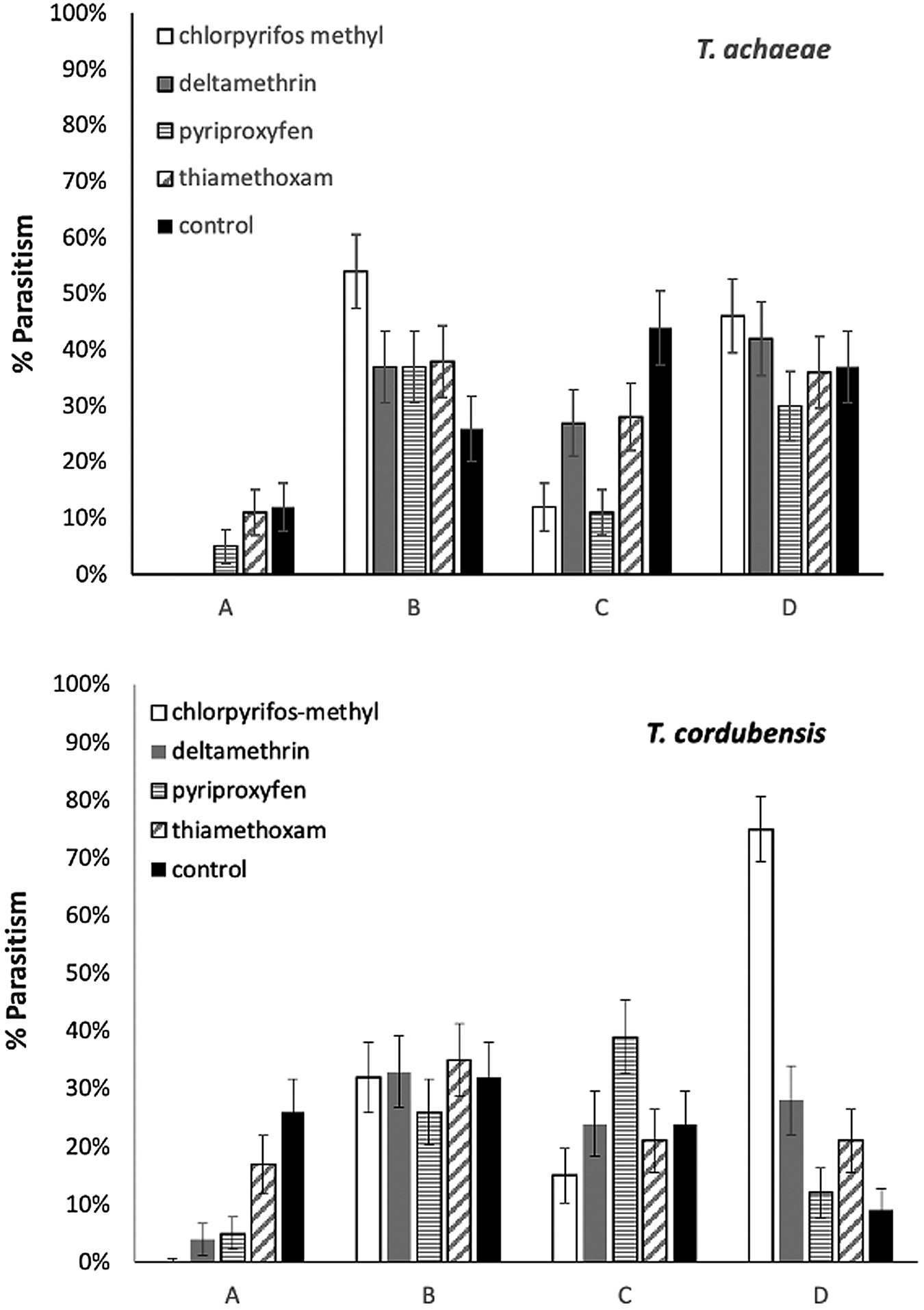
Parasitism rates did not differ between the two Trichogramma species (binary logistic regression: G 1 = 0.207, n = 971, P = 0.650). However, parasitism rates were significantly influenced by insecticide (binary logistic regression: G 4 = 4.317, n = 971, P = 0.002) and application time in relation to insecticide application (G 3 = 59.433, n = 971, P < 0.001), with parasitism rates being particularly lower when insecticides were applied one day before host eggs were offered to the parasitoids, especially for thiamexotham, deltamethrin and chlorpyrifos-methyl (fig. 1). Moreover, the interaction of Trichogramma species with application time as well as the insecticide with application time was also significant (G 3 = 4.928, n = 971, P = 0.002; G 12 = 8.743, n = 971, P < 0.001).
Estimated means (±SE) for parasitism rate by T. achaeae and T. cordubensis following the application of insecticides at different times (A: one day before oviposition; B: one day after oviposition; C: 3 days after oviposition; and D: 6 days after oviposition).

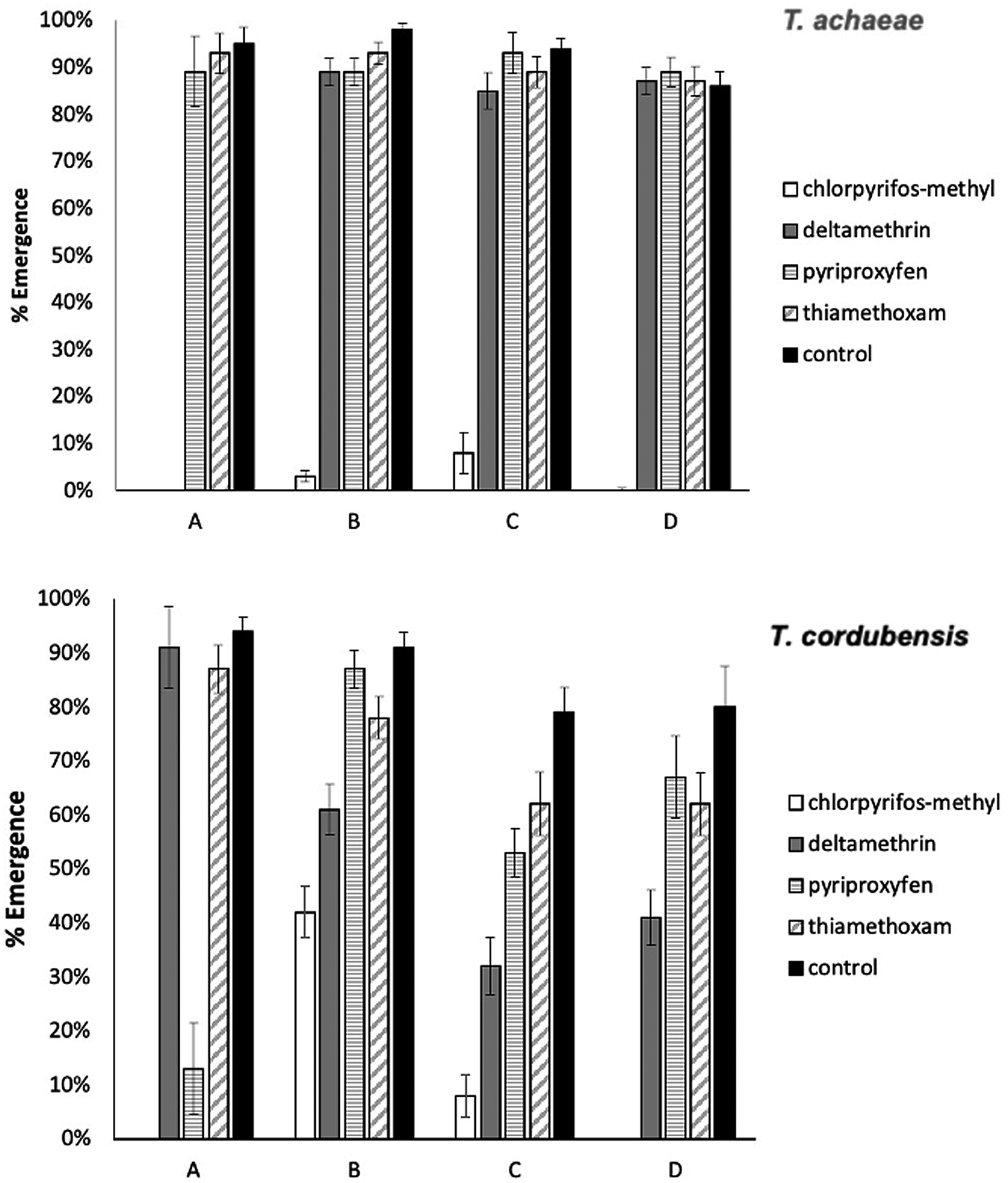
Emergence rates were significantly higher in T. achaeae than T. cordubensis (F 1,507 = 23.823, P < 0.001). Emergence rates were also significantly influenced by insecticide treatment (F 4,507 = 15.030, P < 0.001) and application time (F 3,507 = 28.795, P < 0.001). In addition, all interactions between Trichogramma species, insecticide and application time were significant (Trichogramma species × insecticide: F 4,507 = 28.752, P < 0.001; Trichogramma species × application: F 3,507 = 4.474, P = 0.004; insecticide × application: F 12,507 = 7.641, P < 0.001). Emergence rates on insecticide treatments were significantly lower than control (fig. 2); thiamethoxam and pyriproxyfen had milder effects overall on emergence rates, followed by deltamethrin whereas emergence rates plummeted in chlorpyrifos-methyl application.
Estimated means (±SE) for the emergence rate of T. achaeae and T. cordubensis following the application of insecticides at different times (A: one day before oviposition; B: one day after oviposition; C: 3 days after oviposition; and D: 6 days after oviposition).

Discussion
The present study shows that insecticides and application time influence parasitism and emergence rates in both Trichogramma species. The influence of insecticide on parasitism and emergence rate was affected by application time in both parasitoids. Moreover, the emergence rate was different in the two Trichogramma species.
The toxicity of insecticides to Trichogramma parasitoids has been investigated for several species and insecticides with various modes of action. In the current study, we tested the effect of an organophosphate (chlorpyrifos-methyl), a neonicotinoid (thiamethoxam), a pyrethroid (deltamethrin) and a juvenile hormone mimic (pyriproxyfen). Although chlorpyrifos-methyl is now banned from use in EU (COMMISSION IMPLEMENTING REGULATION (EU) 2020/17) and there are restrictions in place on the use of thiamethoxam (COMMISSION IMPLEMENTING REGULATION (EU) 2018/785), they are still applied in several agricultural producing areas of the world. These insecticides are known for their acute toxicity on different Trichogramma species. Chlorpyrifos-methyl has been classified as harmless to slightly harmful to the egg–larval, and moderately harmful to pupal stages of Trichogramma pretiosum, respectively (Bueno et al., Reference Bueno, Bueno, Parra and Vieira2008; Souza et al., Reference Souza, Carvalho, Moura, Couto and Maia2014), and harmful for T. achaeae (Fontes et al., Reference Fontes, Roja, Tavares and Oliveira2018). Neonicotinoids are known for their negative effects on non-target organisms including Trichogramma parasitoids (Trichogramma dendrolimi, Trichogramma ostriniae and Trichogramma confusum) (Jiang et al., 2019). In previous studies, thiamethoxam has been proven to be highly toxic to different Trichogramma species adults such as T. dendrolimi, T. ostriniae and T. confusum (Li et al., Reference Li, Zhang, Zhang, Lin, Lu and Gao2015; Jiang et al., Reference Jiang, Liu, Huang, Yu, Zhang, Zhang and Mu2019). In the present study, the insecticide type had a significant impact on parasitism and the emergence rate of adult parasitoids for both species. When parasitized eggs were sprayed with insecticides 6 days after parasitism, developing parasitoid larvae were not affected and a high parasitism rate was observed for chlorpyrifos-methyl treated eggs. However, the emergence rate was zero. Chlorpyrifos-methyl had a profound negative impact on adult parasitoid's emergence followed by deltamethrin. The negative impact of deltamethrin in the emergence of T. cordubensis adult parasitoids was also shown in a previous study (Vieira et al., Reference Vieira, Oliveira and Garcia2001).
However, the influence of insecticides on parasitism and emergence depended on the application time. In our study, exposure of adult parasitoids to tested insecticides 24 h after application, resulted in a significant reduction to parasitism. Overall, parasitism rate was very low when application occurred 24 h before the introduction of the adult parasitoids, indicating that there was a residual effect of the insecticides that impaired parasitism by adult parasitoids (Moura et al., Reference Moura, Carvalho, Pereira and Rocha2006; Turchen et al., Reference Turchen, Golin, Butnariu, Guedes and Pereira2016). However, adult parasitoids were not only exposed to residues of insecticides but also to treat eggs that may hamper their acceptance as hosts by the female parasitoids. Adult parasitoids of Trichogramma chilonis exposed at sublethal doses of spinosad were unable to discriminate between unparasitized and parasitized host eggs (Wang et al., Reference Wang, Lü, He, Shi and Wang2016). Our results are in agreement with a previous study where application of chlorpyrifos 24 h prior to exposure of T. achaeae adult parasitoids resulted in zero parasitism and approximately 75% reduction in parasitism when deltamethrin and thiamethoxam were applied (Fontes et al., Reference Fontes, Roja, Tavares and Oliveira2018). However, in our study, the impact of insecticides was assessed at different times of parasitoid development within the host, showing that parasitism rate was higher when insecticides were applied after parasitoids oviposition compared to insecticide application before oviposition. This finding indicates that insecticides did not affect the immature development of the parasitoids. On the other hand, the emergence of parasitoids was affected by the application time in the opposite way than parasitism. Higher emergence rates were observed when insecticides were applied early, before or soon after oviposition of parasitoids than when applied towards larval–pupal and pupal stage of developing parasitoids. When chlorpyrifos was applied to egg, larval–pupal and pupal stages of T. pretiosum, emergence was reduced drastically from 40.7 to 5.9% (Souza et al., Reference Souza, Carvalho, Moura, Couto and Maia2014) whereas in another study no adults emerged when application occurred at the pupal stage of T. pretiosum (Moura et al., Reference Moura, Carvalho, Pereira and Rocha2006). It is known that the application time of insecticides has a strong impact on parasitism by egg parasitoids (Bayram et al., Reference Bayram, Salerno, Onofri and Conti2010; Ogburn and Walgenbach, Reference Ogburn and Walgenbach2019) and for Trichogramma specifically (Fontes et al., Reference Fontes, Roja, Tavares and Oliveira2018). Trichogramma parasitoids are more susceptible to insecticides at the adult stage than larva because larvae are protected by the eggshell (Hassan et al., Reference Hassan, Bogenschütz, Brown, Firth, Huang, Ledieu, Naton, Oomen, Overmeer, Rieckmann, Samsøe-Petersen, Viggiani and van Zon1983). Moreover, adult emergence of Trichogramma parasitoids can be inhibited by insecticide residues on the host eggshell even when application occurs just one day prior to emergence (Takada et al., Reference Takada, Kawamura and Tanaka2001; Turchen et al., Reference Turchen, Golin, Butnariu, Guedes and Pereira2016).
In the present study, for both Trichogramma species, the application of insecticides after oviposition did not influence adversely parasitoid immature development until pupation probably because of protection provided by the eggshell (Turchen et al., Reference Turchen, Golin, Butnariu, Guedes and Pereira2016). However, the emergence of adult parasitoids was substantially impaired when chlorpyrifos-methyl and deltamethrin were applied at the pupal stage, close to emergence. Organophosphates such as chlorpyrifos-methyl are known for their high toxicity against natural enemies, and their capacity to penetrate the insect cuticle (Stock and Holloway, Reference Stock and Holloway1993) and therefore, are more likely to come in contact with the developed pupae beneath the eggshell (Wheeler, Reference Wheeler, Resh and Cardé2009). Additionally, pyrethroids and hormone mimic compounds cause various levels of toxicity on parasitoid species, depending also on their application time (Carvalho et al., Reference Carvalho, Godoy, Parreira and Rezende2010; Wang et al., Reference Wang, He, Guo and Luo2012).
The two Trichogramma species have shown different susceptibility levels on the same insecticide, at the same application time, as also evinced on other toxicity studies, and these observed differences are explained by physiological or behavioral attributes of different species (Guedes et al., Reference Guedes, Smagghe, Stark and Desneux2016; Stark et al., Reference Stark, Banks and Acheampong2004; Wang et al., Reference Wang, Chen, An, Jiang, Wang, Cai and Zhao2013).
Although our results were obtained under laboratory conditions, important information was retrieved for the integration of commonly used insecticides in olives (and other crops), with the use of Trichogrammatid parasitoid wasps. These results will be useful in narrowing down insecticides tested together with Trichogramma releases in semi-field and field studies. For instance, our results confirm that broad-spectrum insecticides such as chlorpyrifos-methyl are not compatible with the use of Trichogramma parasitoids (Amaro et al., Reference Amaro, Bueno, Pomari-Fernandes and Neves2015; Torres and Bueno, Reference Torres and Bueno2018). Moreover, the application time of insecticides in relation to the developmental stage of Trichogramma parasitoids should be taken also into account for the timing of releasing the parasitoids. Our study shows that although emerging adults might come in contact with insecticide residues, they will probably be less affected than foraging adults (Torres and Bueno, Reference Torres and Bueno2018) and therefore timing of insecticide application can be harnessed in order to increase their selectivity. Finally, within an IPM approach the potential sub-lethal effects of applied insecticides that have been documented for Trichogramma species should not be neglected (Fontes et al., Reference Fontes, Roja, Tavares and Oliveira2018).
Acknowledgements
We would like to thank two anonymous reviewers for their constructive comments that greatly improved the manuscript. We thank Annete Hertz for providing us the T. cordubensis population.