Introduction
Micronutrient deficiencies (MNDs) are a prevalent concern, affecting populations in both developing and developed nations. Iron, calcium, and vitamin deficiencies are particularly common; impacting approximately two billion people worldwide (Ramakrishnan, Reference Ramakrishnan2002). It is rare for MNDs to occur in isolation; more often, multiple deficiencies coexist. Addressing MNDs is crucial and has traditionally been managed through methods such as supplementation, food fortification, and dietary diversification. Tamarind pulp is a highly nutritious food, offering considerable energy (239 kcal per 100 g), dietary fibre (5 g), and an array of essential minerals and vitamins, including calcium, magnesium, phosphorus, potassium, iron, thiamin, riboflavin, and niacin. This makes tamarind an affordable and accessible source of multiple vitamins and minerals, especially for rural communities (Food Data Central, 2022). Identifying sweet tamarind varieties that combine good taste with high nutritional value could greatly enhance dietary options to combat these deficiencies.
Tamarindus indica L., a member of the Fabaceae family and the Caesalpinaceae subfamily, is an evergreen tree known for its slow growth and can reach heights of up to 90 feet. The tree is characterized by its short, sturdy trunk, drooping branches, and an umbrella-shaped canopy. Every part of the tamarind tree, from its fruit pulp, seeds, and flowers to its leaves and wood, has valuable applications in food, medicine, fuel wood, construction, trade, and industrial processes. The tamarind fruit, commonly referred to as a ‘pod,’ contains pulp, seeds, fiber, and a shell. The pulp, recognized for its sticky texture and tangy-sour flavour, is the most commercially valuable part and is widely utilized to enhance the taste of beverages, syrups, sauces, and curries. Additionally, it is processed into products like tamarind juice concentrate, tamarind pulp powder, tartaric acid, pectin, tartrates, and alcohol.
India is the world's largest producer and exporter of tamarind, with the marketability of tamarind fruit steadily rising in both domestic and international markets. However, despite India's dominant position, the import of sweet tamarind from Thailand has also surged, reaching 2.67 million USD in 2022 (DGCIS, 2023). This growing import highlights a critical gap: while tamarind trees are abundant across Indian states such as Karnataka, Chhattisgarh, Madhya Pradesh, Andhra Pradesh, Jharkhand, Telangana, Maharashtra, Tamil Nadu, Kerala, Odisha, Bihar, and Bengal, the focus of research has largely been on sour tamarind. Studies have documented significant variations in sour tamarind fruit morphology, including differences in size, shape, pulp weight, pulp percentage, seed weight, and shell weight (El-Siddig et al., Reference El-Siddig, Gunasena, Prasad, Pushpakumara, Ramana, Viyayanand and Williams2006; Singh et al., Reference Singh, Singh and Joshi2008; Fandohan et al., Reference Fandohan, Assogbadjo, GlèlèKakaï, Kyndt and Sinsin2011; Van den Bilcke et al., Reference Van den Bilcke, Alaerts, Ghaffaripour, Simbo and Samson2014; Kanupriya et al., Reference Kanupriya, Karunakaran, Singh, Venugopalan, Samant and Prakash2024). Despite the growing market demand for sweet tamarind, research on its identification and characterization in India is limited. This study addresses this gap by focusing on sweet tamarind accessions, which have been underexplored despite their commercial potential. By identifying and characterizing sweet tamarind, this work advances the understanding of its agronomic and nutritional traits, potentially unlocking new opportunities for India to capitalize on its existing resources and reduce dependency on imports.
Chhattisgarh, the 9th largest state in India, spans 4.67 million hectares of cultivable land and 6.35 million hectares of forest. Tamarind production is crucial for the region, generating 24,000 man-days of employment annually from January to April. The Bastar division, in southern Chhattisgarh, produces around 21,430 metric tons of tamarind fruit, valued at approximately USD 12.4 million. Jagdalpur Krishi Upaj Mandi, Asia's largest tamarind auction centre, also handles about 5660 tons of tamarind seeds worth USD 3.62 million (Gupta et al., Reference Gupta, Mukherjee, Nag and Akhilesh2017). The rural population of Bastar collects tamarind fruits from January to April and engages in activities such as deshelling and deseeding until June. These fruits are rich source of macro- and microminerals, vitamins, fibres, antioxidants, and polyphenols benefiting poor people by supplying a nutritional diet in rural areas and generating additional income. Previous surveys in Chhattisgarh have reported presence of sweet types with low acidity levels, ranging from 3.60 to 17.75% (Kanupriya et al., Reference Kanupriya, Karunakaran, Singh, Venugopalan, Samant and Prakash2024). To reduce dependence on sweet tamarind imports from Thailand, it is crucial to scientifically characterize and document the various sweet tamarind varieties and elite accessions available in India. Identifying these superior accessions can enhance their utilization, provide additional income to economically disadvantaged rural communities, and improve their quality of life. Tamarind also holds cultural and historical importance in Chhattisgarh, making the documentation of local accessions essential for preserving cultural heritage and fostering community pride. As a result, a survey was conducted to evaluate the existing fruit diversity through in situ characterization and to document sweet tamarind varieties and elite accessions with commercial potential in Bastar.
Materials and methods
Study area
The southern division of Chhattisgarh, Bastar, was selected for this study. This region spans from 80° 35′E to 82° 15′E longitude and 17° 46′N to 20° 35′N latitude, covering an area of 39,114 km2. The Indravati River is a significant waterway in this area. Bastar features a hot sub-humid climate with reddish, calcareous soils that are neutral to slightly acidic. The area experiences hot summers and cool winters, with an annual rainfall ranging from 1200 to 1600 mm, predominantly falling between July and September. Summers are relatively cooler compared to neighbouring plains, with temperatures ranging from 3 to 47°C and an average annual temperature of 27°C. The region is largely covered by tropical dry deciduous forests and mixed vegetation. Surveys and sampling were carried out in collaboration with local agricultural officers to identify sweet tamarind trees. These trees were found growing along household boundaries, in garden lands, and on village community lands. An initial field survey was conducted in 2019 to identify tamarind trees with promising traits. In the first year, 88 samples were collected, representing a diverse range of tamarind accessions. Over the following years, these samples underwent detailed morphological and biochemical analysis. Based on the results, the selection was refined to 29 sweet tamarind accessions, which were identified for further in-depth study due to their superior traits and market potential (online Supplementary Table S1).
Sample collection
Adult fruiting trees that had naturally grown, rather than being deliberately planted, were randomly sampled at each site. The selection of sweet tamarind trees was guided by discussions with local residents. Detailed passport information, including GPS coordinates, was recorded. From each tree, ten fruit samples were randomly collected for morphological analysis. The pods were then transported to the Indian Institute of Horticultural Research in Bengaluru, where they were stored and analysed. Nine morphological traits of collected pods were assessed and expressed as means to evaluate the diversity. These included total pod weight, pulp weight, shell weight, fibre weight, and seed weight, all measured using a precision balance accurate to 0.01 g. Pod length was measured with a tape measure, from the pod tip to the pedicel, with curved surfaces measured along the outer curve. The pulp percentage was calculated using the formula: (pulp mass/pod mass) × 100.
Biochemical analysis
The pulp of the fruit samples was extracted to analyse various biochemical parameters such as Vitamin C, total phenols, flavonoids, antioxidant activity, sugars, and acidity using standard procedures. Three independent biological replications for each accession were used for the analysis. Vitamin C content was determined by 2, 6-dichlorophenol-indophenol (DCPIP) method (AOAC 967.21) and calculated as mg ascorbic acid equivalent per100 g pulp weight. Total phenols and flavonoids were extracted from 2 g of pulp with 80% ethanol as per modified method of Singh et al. (Reference Singh, Roy, Kanupriya, Tripathi, Kumar and Shivashankara2022). Pulp was soaked in 80% ethanol for one day. Next day it was repeatedly grinded in pestle and mortar, till the debris became colourless. The extract was centrifuged at 10,000 g for 15 min at 4 °C, and the supernatant was collected and made up to 50 ml. The total phenol content was estimated by the Folin-Ciocalteau method using a UV–vis spectrophotometer (Singleton et al., Reference Singleton, Orthofer and Lamuela-Raventos1999). Extract (0.5 mL) was taken in test tube and 0.2 ml of Folin-Ciocalteau's Phenol Reagent was added followed by 3.3 ml of distilled water. After mixing, it was kept in dark at room temperature for 30 min. Absorbance was measured at 700 nm. Total phenol content was expressed as gallic acid equivalents. Total flavonoid content was estimated using aluminium chloride/ sodium nitrite methodat 510 nm and expressed in units of Catechin equivalents (Zhishen et al., Reference Zhishen, Mengcheng and Jianming1999). Total antioxidant potential was estimated by DPPH (1,1-diphenyl-2-picrylhydrazyl) method as well as FRAP (ferric-reducing antioxidant power) method. Free radical scavenging activity using DPPH assay was performed as described by Singh et al., Reference Singh, Jyothi, Reddy and Shivashankara2018 and the absorbance was measured at 515 nm. The percentage inhibition of DPPH of the sample extract was calculated by the following equation:

Where A 0 was the absorbance of the blank control (containing all reagents except the sample extract); A was the absorbance of the test sample. The FRAP assay was performed according to the method described by Benzie and Strain (Reference Benzie and Strain1996). The FRAP reagent consists of 300 mM acetate buffer (pH 3.6), 10 mM TPTZ in 40 mMHCl, and 20 mM FeCl3 in the ratio 10:1:1 (v:v:v). 1.8 ml of FRAP reagent was mixed with 0.2 ml of plant extract, incubated at 37°C for 30 min in a water bath. The intensity of colour developed was measured at 593 nm against reagent blank. In both the methods, ascorbic acid was used for standard curve preparation and antioxidant activity was expressed as ascorbic acid equivalent antioxidant capacity (AEAC). The total sugar content was estimated using Fehling's reagents by titration method as described by Sadasivam and Manickam (Reference Sadasivam and Manickam1992).One gram pulp was extracted with water for titratable acidity estimation. Sample was homogenized using pestle mortar. Titratable acidity of the extract was measured by titrating with NaOH (0.01 N) in the presence of phenolphthalein indicator. The acidity % was calculated using the following formula and expressed as tartaric acid equivalent.

Where, TAE- Tartaric Acid Equivalent; 0.075 is milliequivalent factor for tartaric acid
Mineral analysis
Samples were processed, separated and dried in the oven at 60⁰C to constant weight procedure as described by Piper (Reference Piper1966), grinded in porcelain pestle and mortar and stored in air tight containers. The analysis was carried out using three independent replications for each accession. The concentration of nitrogen in samples was determined by Kjeldhal's method (KjeltekAut-Analyzer, Gerhardt, Germany) (Humphries, Reference Humphries1956), phosphorous by vanadomolybdate method (Piper, Reference Piper1966) using UV-visible Spectrophotometer (Shimadzu UV-1900i, Milton Keynes MK12 SRE, UK) and potassium by flame photometer (Chapman and Pratt, Reference Chapman and Pratt1961). The concentration of calcium, magnesium and micronutrients were determined using Atomic Absorption Spectrophotometer (AAS 280 FS Agilent Technologies, Santa Clara, USA) by wet digest method with HNO3 and HCLO4 in 10:4 ratio (Piper, Reference Piper1966).
Statistical analyses
Descriptive statistics were performed to analyse the data, including calculating the mean, range, standard deviation, and coefficients of variation (CV) for the variables. The CV, which is obtained by dividing the standard deviation by the mean and multiplying by 100, was used to assess the variability among the parameters. Correlations between the traits were determined using the Spearman correlation coefficients. Relationships among accessions were investigated by principal component analysis (PCA). Mean values were used to create a correlation matrix from which standardized principal component (PC) scores were extracted. To avoid the effects due to scaling differences, mean of each character was normalized prior to cluster analyses using Z scores. Hierarchal cluster analysis was performed using hclust function and the Ward's method using R software. The Shannon and Weaver diversity index (H′) was computed using phenotypic frequencies to assess the phenotypic diversity for each character.
Selection of plus trees with superior fruit characteristics
This was based on morphological, biochemical, and nutritional analyses. To identify the best sweet tamarind trees for breeding and propagation, low acidity was considered the most important trait, as tartaric acid can overshadow the fruit's natural sweetness (Van den Bilcke et al., Reference Van den Bilcke, Alaerts, Ghaffaripour, Simbo and Samson2014). Additional traits evaluated included total sugar content, pulp fraction, calcium levels, iron levels, and phenol content. The pulp fraction is particularly important as it represents the amount of usable pulp from the fruit, while iron and calcium are vital nutrients, and high phenol content suggests strong antioxidant properties. A web diagram was constructed to visualize these fruit traits (Simbo et al., Reference Simbo, De Smedt, Van den Bilcke, De Meulenaer, Van Camp, Uytterhoeven, Tack and Samson2013). For each trait, the tree with the lowest value set the baseline at zero, while the tree with the highest value (excluding acidity) was assigned a score of one, representing an 'ideal' tree for that trait. Other trees were then ranked according to these criteria.
Results
Diversity in fruit traits
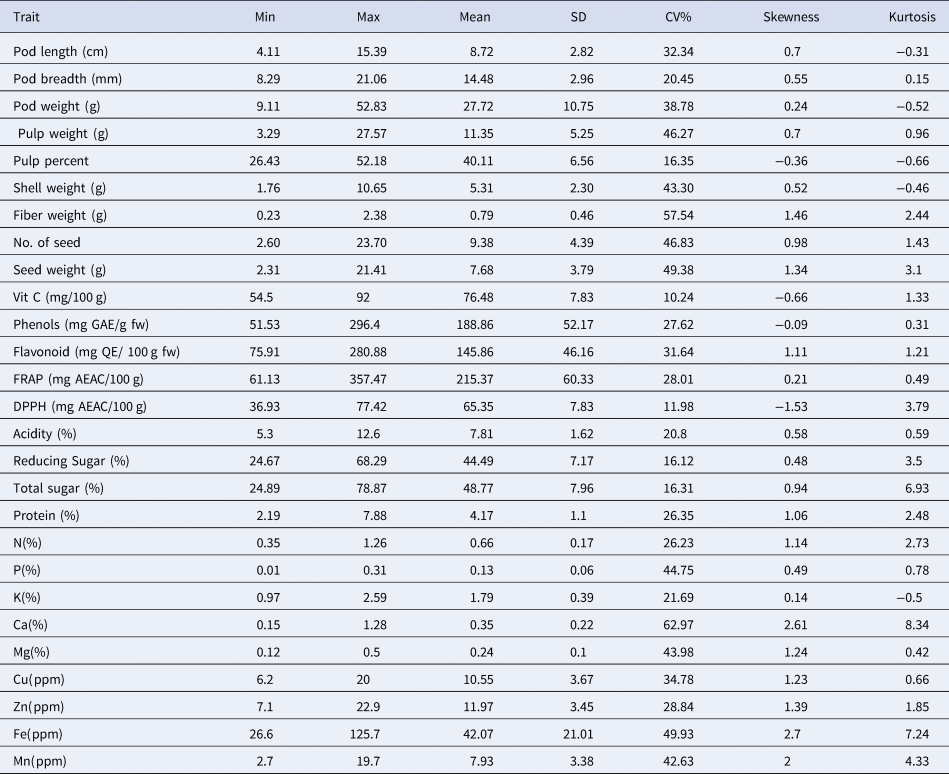
Descriptive statistics were computed for 27 quantitative traits across 29 sweet tamarind collections (Table 1). The collections exhibited substantial variability in all measured traits. The average pod weight varied significantly, ranging from 9.11 to 52.83 g, with a standard deviation of 10.75, the highest among all morphological traits, and a coefficient of variation of 38.78. The heaviest pods were found in accession B18 (52.83 g), followed by B13 (48.93 g), while accession B26 had the lightest (9.11 g) (online Supplementary Table S2). Pulp percentage ranged from 26.43 to 52.18%, with an average of 40.11%. Notably, in tamarind, pulp recovery rate of over 40% is considered superior, and 13 of the 29 accessions met this criterion, with B18 achieving the highest pulp percentage (52.18%). Among the morphological traits, fibre weight had the highest coefficient of variation (57.54%), followed by seed weight (49.38%), number of seeds (46.83%), and pulp weight (46.27%). Pod length varied between 4.11 and 15.39 cm, and pod breadth ranged from 8.29 to 21.06 mm.
Range, mean, standard deviation, coefficient of variation, skewness, and kurtosis for morphological and nutritional fruit traits of 29 Tamarindus indica accessions

Eight biochemical parameters were assessed in the study. The vitamin C content in the pulp (mg/100 g) ranged from 54.5 to 92. Accession B13 exhibited the highest vitamin C content (92), followed by B9 (90.5) and B28 (89.0). Significant variability was observed in phenol content (mg GAE/g fw), which ranged from 51.53 in accession B29 to 296.4 in B7, with a standard deviation of 52.17. Flavonoid content (mg QE/100 g fw) also showed considerable variation, ranging from 75.91 in B29 to 280.88 in B13. The FRAP (mg AEAC/100 g) exhibited the highest standard deviation among all biochemical parameters (60.33), with values ranging from 61.13 to 357.47 and a mean of 215.37. The DPPH assay (mg AEAC/100 g) displayed low variation, with a range of 36.93 to 77.42, observed in the pulp of B29 and B11, and a mean value of 65.35. Total titratable acidity (%) – an important quality indicator – ranged from 5.3% in B21 to 12.6% in B27, with a mean of 7.81%. Eight accessions had acidity levels below 7.00%. Reducing sugar content varied between 24.67 and 68.69%, while total sugar content ranged from 24.89 to 78.87%. Accession B15 had the highest values for both reducing and total sugars, while B10 recorded the lowest. The coefficient of variation was highest for flavonoids (31.64%), followed by FRAP (28.01%), phenols (27.62%), protein (26.35%), and acidity (20.8%). The remaining biochemical parameters had CV values below 20%.
The mineral content in the pulp samples exhibited significant variability. Major minerals such as nitrogen (N), phosphorus (P), potassium (K), calcium (Ca), and magnesium (Mg) showed considerable differences. For instance, P content increased 26-fold, ranging from 0.01 to 0.31%, with an average of 0.14%. N, Ca and Mg contents increased by 3.60, 8.48, and 4.31 times, respectively, with N ranging from 0.35 to 1.26%, Ca from 0.15 to 1.28%, and Mg from 0.12 to 0.50%. P content ranged from 0.97% in accession B1 to 2.59% in B25. In contrast, trace elements such as copper (Cu), zinc (Zn), iron (Fe), and manganese (Mn), showed less variability. Zn levels ranged from 7.10 ppm in B24 to 22.90 ppm in B7, with an average of 11.97 ppm. Fe content varied from 26.60 ppm in B14 to 125.70 ppm in B8.
Skewness and Kurtosis were calculated to further investigate the genetic divergence among the accessions. Positive skewness was observed in traits such as seed weight, fiber weight, flavonoid content, protein and minerals. In contrast, negative skewness was found in traits like pulp percentage, vitamin C, phenol content, and DPPH. Kurtosis, which reflects the distribution tails' heaviness, revealed a platykurtic (positive) pattern in traits such as fiber weight, seed weight, DPPH, reducing sugars, total sugars, calcium, iron, and manganese. On the other hand, a leptokurtic (negative) distribution was observed for traits including pod length, shell weight, pod weight, pulp percentage, and K. The morphological diversity indices (H′) (online Supplementary Table S3) for individual traits ranged from 0.00 for fiber weight to 1.00 for vitamin C, with an overall mean diversity index of 0.92. The standardized Shannon and Weaver diversity indices were categorized as low (0–0.33), intermediate (0.34–0.66), and high (0.67–1). Only few morphological traits, including pod length, pod breadth, and pulp percentage, along with certain minerals like K, Cu, and Zn, exhibited high genetic diversity, being polymorphic. Conversely, the majority of biochemical traits demonstrated high diversity indices, exceeding 0.7.
Correlations between fruit traits
Spearman's rank correlation coefficients for the studied fruit traits are illustrated in Fig. 1. According to Skinner et al. (Reference Skinner, Bauchan, Auricht and Hughes1999), correlation coefficients greater than 0.71 or less than −0.71 are considered biologically significant, as they suggest that more than 50% of the variation in one trait can be predicted by another. In our analysis, we identified meaningful correlations, such as between pod weight and pulp weight (r = 0.93), shell weight (r = 0.70), number of seeds (r = 0.89), and seed weight (r = 0.89). Additionally, phenol content was positively correlated with DPPH, while flavonoid content showed a positive correlation with FRAP, and these two traits were also significantly correlated with each other. Reducing and total sugar content were positively correlated, as were N and protein content. Among the mineral content in the pulp, Ca exhibited a relatively strong positive correlation with Mg (r = 0.77), and a moderate positive correlation with Fe (r = 0.48) and Cu (r = 0.44). Fe also showed moderate positive correlations with Cu (r = 0.55), P (r = 0.50), and K (r = 0.41).
Map of linear correlations between quantitative variables. Size and colour intensity of the circles indicate the magnitude of correlation.

Principal component, biplot and cluster analysis
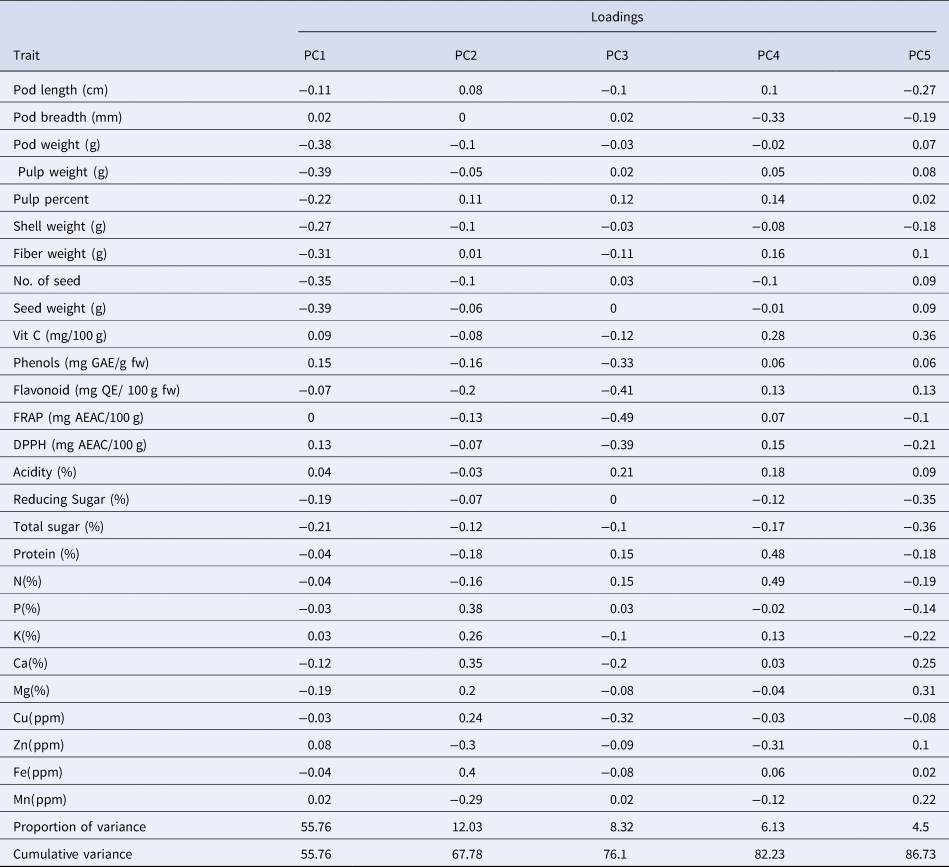
Table 2 presents the percentage of variation attributed to the first five principal components (PCs) along with the vector loadings for each trait and PC. Together, the first five PCs accounted for 86.73% of the variation observed in the sweet tamarind collection. Traits with high positive or negative values made a proportionally larger contribution to the differentiation of accessions. PC1, the most significant component, explained 55.76% of the variation, distinguishing accessions based on morphological traits such as seed weight, pulp weight, pod weight, number of seeds, fibre weight, shell weight, and total sugar content. These variables had strong negative loadings, indicating an inverse relationship with PC1. In PC2, which accounted for 12.03% of the variation, the mineral content of the pulp – specifically Fe, P, Ca, K, Cu, and Mg – played a key role in accession differentiation, with these minerals showing high positive loadings, while Zn and Mn had high negative loadings. PC3, which represented 8.32% of the total variation, captured the diversity in antioxidant-related traits such as flavonoids, phenols, FRAP, and DPPH, along with acidity. PC4 was primarily associated with the protein and nitrogen content of the pulp, while PC5 was linked to vitamin C, reducing sugars, and total sugars.
The first five principal components (PCs) with loadings for quantitative traits in T. indica

A biplot was generated using PC1 and PC2 to compare accessions based on multiple traits and to identify superior types (Fig. 2). The accessions were distributed across all four quadrants, with B27, B8, B26, B29, B14, B18, and B13 standing out as distinct. Key traits such as Fe, P, phenols, flavonoids, seed weight, and pulp weight emerged as crucial factors for selection.
Two-dimensional bi-plot for PC1 and PC2 (67.78% of total variance) based on quantitative characters of tamarind accessions.

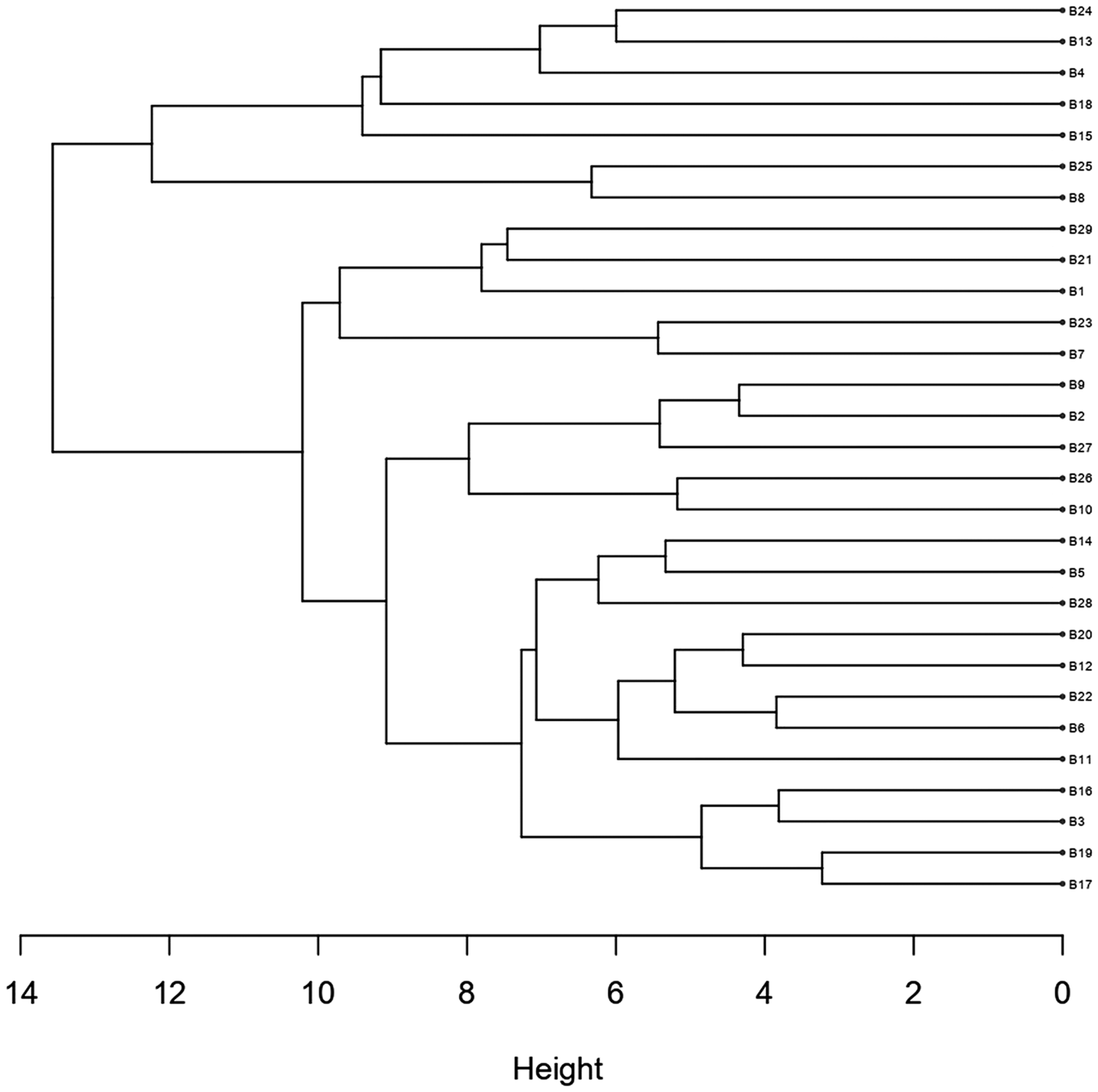
Additionally, a dendrogram (Fig. 3) was created using the quantitative traits, illustrating the relationships among the tamarind population studied. This analysis revealed at least five main groups. Group I included seven accessions, all of which were sweet types with acidity ranging from 5.7 to 8.8%, and most had high pulp recovery (>40%) except for B15. Group II comprised five accessions with low pulp recovery (<40%), including the sweetest tamarind, B21, with an acidity as low as 5.3%. Group III consisted of eight accessions, mostly characterized by high acidity (7.2–12.6%) except for B26 (5.4%) and low pulp recovery, with the exceptions of B5 and B28. Group IV contained five accessions with high pulp recovery, except for B11. The final cluster consisted of four accessions with high pulp recovery and medium acidity levels (8.3–8.9%).
Hierarchal clustering of 29 tamarind accessions based on quantitative characters.

Selection of plus trees with superior fruit traits
Five trees (B21, B26, B15, B25, and B7) were identified as having the best combination of desirable fruit traits, making them suitable for commercial production through grafting or as potential parents in breeding programs (Fig. 4; online Supplementary Fig. S1). These trees outperformed the average in at least three of the five fruit traits analysed. Additionally, five sweet types with acidity levels below 6% were identified (B26, B21, B15, B12, B11), although their pulp recovery was less than 40 percent. Furthermore, trees with high nutritional value, characterized by elevated antioxidant levels (B13, B7, B5) and mineral content (B25, B27, B8), were also identified.
Multi-trait web diagram of tree-to-tree variation in fruit traits. Trees superior in the commercially important fruit traits are shown here.

Discussion
This study of fruit variation among individual sweet tamarind trees demonstrates significant potential for identifying trees with fruit characteristics that exceed the species average. Such variation is consistent with findings from earlier studies on sour tamarind (El-Siddig et al., Reference El-Siddig, Gunasena, Prasad, Pushpakumara, Ramana, Viyayanand and Williams2006; Singh et al., Reference Singh, Singh and Joshi2008; Divakara, Reference Divakara2009; Hazarika and Lalrinpui, Reference Hazarika and Lalrinpui2020; Menon et al., Reference Menon, Asna, Menon, Pooja, Gopinath and Singh2023; Kanupriya et al., Reference Kanupriya, Karunakaran, Singh, Venugopalan, Samant and Prakash2024). The wide differences in shape, size, and fruit quality among various tamarind accessions present extensive opportunities for selection and hybridization. The coefficient of variation (CV) ranged from 10.24 to 62.97%, reflecting both genetic diversity and environmental influences. The CV range for mineral content (26.23–62.97%) was notably higher than that for morphological traits (16.64–58.55%) and biochemical traits (10.24–31.67%). These trend likely results from the greater environmental impact on mineral content compared to the more stable genetic control over morphological and biochemical traits. Similar patterns have been observed in guava (Chiveu et al., Reference Chiveu, Naumann, Kehlenbeck and Pawelzik2019) and onion (Chandel et al., Reference Chandel, Singh, Kumar, Taak and Khar2024). Factors such as the cross-pollinated nature of the crop, its adaptation to various climatic conditions, and propagation through seed may contribute to this variation (Usha and Singh, Reference Usha and Singh1996). Economically important traits such as pulp percentage, vitamin C content, and reducing and total sugar content exhibited CVs below 20%, indicating that these traits are less affected by environmental factors and are more strongly governed by genetics, which could be beneficial in ensuring consistent trait expression regardless of environmental conditions.
Data on the frequency distribution of tamarind indicates that farmers have begun the domestication process. However, this process appears to be at an early stage, as evidenced by several data sets (e.g., seed weight, fiber weight, flavonoids, protein, N, Ca, Mg, Cu, Zn, Fe, and Mn) that show positive skewness and a tendency towards bimodality. Traits with low kurtosis and skewness suggest that these traits have undergone less intensive selection or exhibit natural variability, implying that they may not have been heavily influenced by domestication or selective breeding. The Shannon diversity index was higher for biochemical traits compared to morphological traits. Morphological traits, being simpler and more single-dimensional (e.g., fruit length, fruit size), tend to show less variation. In contrast, biochemical traits are more complex and multi-dimensional (e.g., protein levels, antioxidants), leading to greater variability.
According to DUS guidelines, tamarind with acidity levels below 8% is classified as sweet (Singh et al., Reference Singh, Singh and Joshi2008). However, sweet tamarind from Thailand typically has an acidity of 3.12 ± 1.18% and total sugar content of 48.79 ± 14.44%. In our collection, five accessions exhibited acidity levels ranging from 5.3 to 5.9%, with total sugar content varying between 34.15 and 68.29%. Additionally, other economically significant traits included pod lengths from 6 to 15 cm and pulp percentages from 27.2 to 41.2%. These accessions also showed high levels of antioxidants, including vitamin C (54.5 to 79.5 mg/100 g), phenols (170 to 278.11 mg GAE/g), flavonoids (101 to 204.09 mg QE/100 g), FRAP (60 to 77.42 mg AEAC/100 g), and DPPH (60 to 77.42 mg AEAC/100 g). The remaining accessions were categorized into medium acidity (6–8%, 10 accessions) and high acidity (>8%, 14 accessions). Menon et al. (Reference Menon, Asna, Menon, Pooja, Gopinath and Singh2023) reported that out of 113 accessions from Kerala, only two were classified as sweet types with acidity levels under 8%. This highlights the potential of the Chhattisgarh region for discovering sweet tamarind varieties, echoing earlier findings by Awasthi and Sharma (Reference Awasthi and Sharma1998) about a red-fleshed tamarind tree with sweet pulp (TSS > 85%) from Faraskot village, Dantewada, Bastar district of Chhattisgarh. Additionally, Kanupriya et al. (Reference Kanupriya, Karunakaran, Singh, Venugopalan, Samant and Prakash2024) reported a mean acidity of 7.85 ± 3.07% in 88 samples from Chhattisgarh.
The strong correlations observed between fruit mass and pulp mass in this study suggest that selecting for fruit pulp can be effectively based on fruit mass. Principal Component Analysis (PCA) and cluster analysis highlighted significant variations among tamarind accessions. PC1 alone accounted for more than half of the total variability (55.76%). Analysis of the loadings for PC1 revealed that larger and heavier pods tended to be richer in flavonoids, reducing sugars, total sugars, nitrogen, protein, Ca, Mg, and Fe. These pods were slightly lower in Vitamin C, phenols, DPPH values, and Zn content, while other nutrients and compounds (such as FRAP, acidity, P, K, Cu, and Mn) showed minimal or no significant correlation with pod size and weight. The biplot axes illustrated the geometrical distances between cultivars, reflecting the diversity in the measured variables. The projection of variables onto the factors plane displayed distinct groups of fruit morphological traits, biochemical parameters, and mineral content of the pulp. A preliminary review of the hierarchical clustering dendrogram revealed both similarities and differences within each cluster. Elite accessions (B21, B26, B15, B25, and B7) were identified for having the most desirable combination of traits, including low acidity, high pulp recovery, high total sugar content, high antioxidant capacity, and significant mineral content.
Conclusion
The study revealed that the Chhattisgarh region possesses a diverse sweet tamarind germplasm resource with a broad range of fruit traits. This research was instrumental in identifying valuable germplasm for future breeding programs. PCA analysis highlighted several diverse accessions, including B27, B8, B26, B29, B14, B18, and B13, which could serve as distinct parents for breeding efforts. The collection also presented strong candidates aligned with our objectives. Overall, accessions B21, B26, B15, B25, and B7 emerged as the most promising for sweet tamarind market segment based on a comprehensive evaluation. However, the desirable fruit characteristics are distributed across various germplasm sources, indicating that hybridizations will be necessary to consolidate these desirable traits. More extensive surveys in this region could further aid in the identification of accessions with lower acidity and enhanced sweetness, strengthening the sweet tamarind germplasm pool for breeding and commercialization.
Supplementary material
The supplementary material for this article can be found at https://doi.org/10.1017/S1479262124000649.
Funding statement
This research did not receive any specific grant from funding agencies in the public, commercial, or not-for-profit sectors.
All data generated or analysed during this study are included in this published article [and its online Supplementary information files].
Competing interests
The author(s) declare no competing interests.
Ethical standards
The authors declare that there is no ethical issue(s) in this study.
The author(s) declare that appropriate permissions for collection of plant or seed specimens were obtained.