Introduction
Almost three decades have passed since Kachru (Reference Kachru, Quirk and Widdowson1985) proposed his three-circle model of World Englishes. Although this model is often challenged, few would deny its significance in opening the dialogue and raising awareness of issues related to World Englishes. The context of the project described in this paper is South Korea, one of what Kachru's model refers to as an ‘expanding circle country’. Reflecting on the idea of South Korea as an ‘expanding circle country’, this article briefly examines how Korea has expanded and continues to expand as a nation, juxtaposing it alongside the university speaking class I was teaching, as I look toward expanding both my own and my students' minds through exploring World Englishes within a university speaking course.
In its long history, South Korea has been repeatedly invaded and attacked by outsiders, eventually leading the country to try to isolate itself from the outside world, earning it the nickname ‘hermit kingdom’. Now, centuries later, Korea is smoothly interconnected with the world. The influence of modern globalization on Korea is apparent, with international cars, fashion accessories and English phrases prominent throughout the country, particularly in the cosmopolitan capital city of Seoul. Likewise, Korea's influence can be felt throughout the world, for example in Korean cars, electronics, and the K-Pop surge exemplified by the pop star Psy's famous ‘Gangnam Style’ dance, which recently took the world by storm. Products and culture flow freely between South Korea and other countries and are for the most part welcomed on both sides. In many ways, the English language is no exception. Recent years have seen an English fever, or yeongeo yulpung, sweep the nation (Jeon, Reference Jeon2009; J.K. Park, Reference Park2009; J.S.Y. Park, Reference Park2009). English has been identified as a means to acquire social mobility and cultural capital (Bourdieu, Reference Bourdieu and Richardson1986). However, South Korea continues to look toward so-called ‘native speakers’ of English, granting prestige to varieties of English from ‘native English-speaking’ countries (J.K. Park, Reference Park2009; J.S.Y. Park, Reference Park2009). In fact, per the Korean government authority, the visa needed to teach English in Korea (E-2) is available for those who are ‘a citizen of a country where English is the primary language (USA, Canada, Australia, New Zealand, England, Ireland and South Africa only)’ (Consulate General of the Republic of Korea, 2011).
Rationale and reasons for implementing the course
According to Jenkins (Reference Jenkins2006), teacher action is necessary to promote acceptance of global varieties of English and increased levels of confidence. Llurda (Reference Llurda and Sharifian2009) agrees, drawing attention to the need for balance between teaching skills and language education, coupled with open communication around the acceptance of varieties of Englishes. Freire's emancipatory approach challenges dominant ideologies, raising awareness of the social constructions as they have influenced the world, encouraging the questioning and reshaping of one's own views (Freire, Reference Freire1970). Fueled by a desire not to force a change nor to impose my own views, in teaching this course I sought to raise awareness and provide a platform for university students (potential future language educators) to reflect on and discuss issues related to World Englishes, such as the global spread of the language, varieties and commonly accepted norms and standards.
Course details
This paper describes the creation and implementation of a course designed to integrate a World Englishes focus into a required English-speaking class at tertiary level in a Korean university. I explain the process of implementing the curriculum in two sections of the same course, supplemented with reflections from the students' blogs and my own teaching reflections.
At the private university where the course was offered in a suburb of Seoul, South Korea, all students are required to pass a minimum of four semesters of English courses prior to graduation. In the spring of 2011, I was asked to teach two undergraduate English-speaking classes for foreign language education majors, with the majority of learners majoring in English language and literature.
Having taught university English conversation courses in Korea for approximately 10 years prior to this pilot course, I felt adequately prepared to teach the courses but wasn't completely satisfied with previous experiences. I enjoyed teaching the courses but struggled with a nagging feeling, questioning how much the students were really benefitting from their semester-long course with a mere 25 hours of course instruction. I wanted to offer learners opportunities to improve their speaking, but I also wanted to go beyond what my previous conversation courses had offered.
The course was implemented with three main objectives: to improve students' communicative competence and confidence speaking in English; to raise students' awareness of World Englishes; and to promote a more critical questioning of the global spread of English, and the so-called standards and norms associated with English.
Each class met once per week for 15 weeks, for two back-to-back 50-minute sessions, separated by a 10-minute break. Both classes met on Mondays, with Class 1 meeting from 11:00–12:50 and Class 2 from 2:00–3:50. Class 1 had 19 females and 10 males, and Class 2 comprised 15 females and 5 males. The majority of both classes were students who had gone straight to university after graduating from high school, although several of the male students had taken time off from their studies to complete their mandatory 2-year military service. Several students had also taken a year off, with many having undertaken both overseas and domestic travel during their hiatuses from school. As they were majoring in English language and literature, overall these students had a solid grasp on the English language and demonstrated quite high levels of proficiency.
Course content
The course syllabus was initially designed to integrate an English-speaking class and a content-based course with a World Englishes theme. Each day's course objectives included both linguistic and World Englishes content-based objectives.
Course tasks
To bridge communicative speaking practice with meaningful tasks related to raising awareness of World Englishes, the course included several elements I will detail, including discussions, blog postings, activity tasks, and a final web posting project.
Class discussions
Class discussions were focused on various themes designed to deconstruct and problematize notions, such as that of ‘standard English’. As the classes consisted of 29 and 20 students, it was paramount that students were given opportunities both to speak out in class and also to have their voices heard. In order to accomplish this, I regularly used the Think-Pair-Share discussion model (Lyman, Reference Lyman and Anderson1981), in which individuals first silently reflect upon the issue, then discuss their thoughts with a partner before beginning the whole group discussion. I found this strategy to be very effective in giving all learners enough time to sort their own thoughts out and gain confidence in presenting them to a small audience before sharing them with the whole group, if they so desired.
Blog postings
Owing to the numbers of learners, time restrictions on the class, and individual personality differences, it was inevitable that not all learners would be able to actively share and fully contribute to every class discussion. I used online blogging as a way to fill this gap, which encourages learner autonomy by providing space for each learner to both individually and cooperatively engage in critical reflection (Mynard, Reference Mynard2007). Each learner set up a blog (publicly visible only to those fellow students also enrolled in the course) and was asked to post weekly reflections. At times, specific questions or topics for reflection were given, and at other times, individuals were free to select topics of reflection. Students were also encouraged (and at various times required) to post comments on their classmates' posts.
As the class progressed, the written blog posting came to evolve into a voice blog. This came about as one learner challenged the reasoning behind blogging in an English speaking class. Agreeing with the points she raised, I decided to revise the blog at the midpoint of the class, offering students the option of either typing a written blog or posting a recorded voice blog—at which point the majority of the class immediately changed to voice blogging. For the remainder of the semester, voice blogging replaced the written blog.
Activity tasks
Within each class period, I sought to engage learners in tasks that would promote critical reflection while simultaneously drawing attention to World Englishes. Detailed below are four examples and brief descriptions of selected activities included in the course.
1) Re-designing Kachru's concentric circle model. In the second class meeting, Kachru's concentric circle model was shown and discussed. In discussing the model, learners were asked to identify any elements of the model they might create differently. Excerpts from Rajadurai's (Reference Rajadurai2005) article encouraging a revisit of the three-circle model were shared, and learners brainstormed in small groups any additional challenges. To complete the project, each small group was asked to create a group poster—a visual representation re-conceptualizing the population of English speakers around the world—and share it with the class.
2) Varieties and dialects ‘21 accents’ clip. ‘Who has an accent?’ The YouTube video ‘21 accents’ was played and learners were asked to listen to it twice, paying attention to which country each accent represented. Learners were asked to listen and write down which country the listeners were from. Following the video, learners were asked which accent was the easiest to understand and why, segueing to a discussion on which varieties of English were most commonly used in Korea and the effect that exposure has on intelligibility.
3) Debate—Devil's Advocate. A debate activity was also included, creating a platform for learners to reflect and discuss a specific issue. Class began with an introduction to debate strategies and a short video clip of a local televised university team debate. A short reasoning lesson was included, with learners asked to create sentences using different types of reasons—expert opinion, common sense, statistics and examples. Models of various reasons were given, and examples were elicited using the resolution, ‘All high school students in Korea should be required to wear school uniforms.’ The meaning of devil's advocate was discussed, and students were asked to play devil's advocate with a partner—with both students first agreeing with the following sentences for 2 minutes, stopping and then having another conversation on the same topic, this time disagreeing with the idea. Two topics were given: (1) Hangul (the Korean alphabet characters) should be Romanized; and (2) English should be a required subject for all students in Korea beginning in the first grade of elementary school.
4) Challenging the native speaker fallacy. Although the ‘native speaker fallacy’ (Phillipson, Reference Phillipson1992) – the idea that one who speaks a language as a ‘native speaker’ is a competent language teacher – has been heavily criticized in the TESOL community (e.g. Jenkins, Reference Jenkins2009; Kumaravadivelu, Reference Kumaravadivelu2003; Kuo, Reference Kuo2006), the ‘native speaker’ is often still privileged in Korea (Jeon, Reference Jeon2009; J.K. Park, Reference Park2009), which is evidenced by the fact that E-2 language teaching visas have been issued to more than 20,000 ‘native English-speaking’ English teachers in 2012 (KIS, 2012).
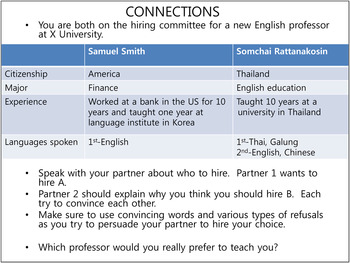
The following activity was designed to initiate a discussion on the ‘native/non-native’ dichotomy. Learners were given the scenario shown in Figure 1.
Slide from March 28, 2011 class.

Because the lesson's linguistic point was focusing on persuasions and refusals, these communicative strategies were integrated into the activity.
Final web posting
Learners were asked to create an approximately 5-minute video to be posted to the course website. Learners were free to work individually or with a partner and could create any type of video, with the one stipulation that it should in some way be connected to the theme of World Englishes. Each learner was to post their video blog and comments on at least five other groups' video presentations.
Reflections on the course
Having described the basic structure and several examples of the course content, I now shift my focus to reflections on the course. Collected through emergent data design, the two main reflections I will focus on are students' resistance to the course and whether long-term benefits may be realized through the course.
In the beginning I was met with much more student resistance than I had expected. Admittedly, the course content was a departure from the students' expectations. Many students did not expect World Englishes content, or in fact any content that was not language-specific, to be integrated into the class. At the end of course reflections, many students again brought up the World Englishes topic in the speaking course, most now expressing satisfaction with it, ‘not the topic that was familiar to me and not the topic that is spoken frequently in conversation classes. But I really really enjoyed the class!!’ However, not all were happy with the choice, with others describing the topic as too difficult: ‘The hard thing was that she liked to discuss a current world English situation. For me, it was a quite academical and picky topic.’ Another seemed to have taken the course at a rather superficial level, protesting ‘this topic is too difficult to think about it for a moment and it is not interesting. Of course, it's a serious topic these days and we should think about it at least once ^^.’
Another shared theme was the heavier than expected workload: ‘I first thought this 2 hour conversation class will be easy and won't have so much homework. However, very different from my expectation, the topics given to us to talk were very interesting and weekly assignment that we have to post on this blog was actually fun’ and ‘It is a good class except that I had to spend my whole energy of body to enjoy the class.’ Although students reflected positively on it at the completion of the course, there were some grumbling students as assignments were announced during the semester.
A point of satisfaction which arose through the class is that I think it did challenge learners to think about new ideas and old ideas in new ways, thus expanding horizons. One of the most commonly cited benefits at the end of the course reflections was comments relating to ‘increased confidence’. One male reflected, ‘I know that even though don't speak English well, I could say Class gaves me confidence.’ His comments indicate to me that although his language proficiency may have increased, it may not be from this that the increased confidence was derived, but rather from the acceptance of different varieties of Englishes, feeling absolved from trying to emulate the elusive ‘native speaker’ model. Some students did report increases in speaking skills, often coupled with other areas, such as ‘I could improve my speaking skills in this class but also I learned how to teach students’, citing the class activities and implementation of technology and using blogs with their future students.
Although I have thought about it, to quote my student ‘at least once’, I cannot be certain of the long-term effect, if any, this class might have on the students, but I do know that it has had a long-term effect on me. Having taught this class, I have certainly been challenged, and I have also enjoyed seeing and hearing students' expanding and growing thoughts. I would like to re-connect this by revisiting Kachru's three-circle model. As the context in which this course was taught, South Korea, is positioned in the ‘expanding circle’, I feel satisfied in saying that we, myself included, are truly ‘expanding’ through this course.
Several months after the course had finished, I happened to meet one young man who had been on the course. He was one of the students who had been somewhat abrasive on the first day, questioning why we were talking about these issues in a speaking course. On the day that I met him, however, he thanked me for the course and told me that after taking it, he had decided to become an English teacher rather than his original goal of becoming an English translator, because he felt encouraged and wanted to encourage others.
Conclusions
This paper shares my own experiences of integrating aspects of World Englishes into a speaking class at university level in South Korea. Responding to Llurda's (Reference Llurda and Sharifian2009) and Jenkins' (2006) calls for teacher action to include raising awareness and acceptance of varieties of Englishes, I aimed to utilize these speaking classes as spaces for people to use and enhance their English-speaking skills, while simultaneously fostering an environment suitable for reflecting on and problematizing dominant ideologies in Korea pertaining to English. As we cooperated to look deeper at and to de-construct various notions of English and its usage, we were all challenged in many different ways.
I would like to end with a personal challenge to readers of this paper, a challenge to continue to support and share the World Englishes movement as it continues to gather momentum, circling, spiraling, spreading, expanding throughout the world. I encourage each reader to take any of these ideas that appeal to you, reflect on them, improve them if you are teaching, adapt them to fit your own teaching contexts, and use them to raise awareness, promoting the idea of expansion—expanding our minds, expanding our teaching comfort zones, and expanding our worlds.
Acknowledgements
I thank Dr Gloria Park for inspiration and support. I also thank all reviewers for feedback on this article. Portions of this paper were presented at the 18th Annual Conference of the International Association for World Englishes in Hong Kong.
 SHANNON TANGHE is an assistant professor at Dankook University in the Graduate School of TESOL in Yongin, South Korea. She has recently completed a PhD in English (Composition and TESOL) from Indiana University of Pennsylvania in the United States. She has been teaching in Korea for the past 14 years. Her major research interests include World Englishes, teacher development and education, and teacher collaboration. E-mail: tango987@hotmail.com