Parmigiano Reggiano is a hard-cooked cheese, ripened for at least 12 months and produced from raw and semi-skimmed milk exclusively in northern Italy. Its traditional production is governed by a strict standard certification in compliance with EC Regulation 2081/92, bearing a Protected Designation of Origin (PDO) since 1955. This unique artisanal procedure gives its organoleptic properties and qualities, being one of the most renowned Italian cheeses worldwide (Fox et al., Reference Fox, Guinee, Cogan and McSweeney2017). Outside Europe, where PDO is rarely recognized, Parmigiano Reggiano is generally known as Parmesan and is processed quite differently to meet the standard regulations of each country. In the United States, for example, Parmesan is smaller, with shorter ripening time, cooked to a lower temperature, salted more heavily and made with pasteurized milk. In Brazil, some natural colors or synthetic dyes are authorized for use, as well as some preservatives such as nisin, lipases and proteases. In addition, the ripening time of Parmesan in Brazil depends on the size of the cheese, with at least 6 months for cheeses up to 10 kg (Brasil, 1997a).
Parmesan is not a typical Brazilian cheese, but grated Parmesan is very popular in Brazil. According to the USDA Annual Dairy Report, Parmesan sales account for 8% of total Brazilian cheese sales (Ming and Wood, Reference Ming and Wood2020). The downside of it's international success is that Parmigiano Reggiano is one of the most counterfeited foodstuffs in the world. The three main authenticity issues described can be classified into: (i) inappropriate dairy cattle nutrition (use of silage and fermented feeds, which is not allowed), (ii) geographical origin (misleading label and/or no traceability) and (iii) insufficient ripening time (Silvestri et al., Reference Silvestri, Aquilani, Piccarozzi and Ruggieri2020).
Specifically for grated Parmesan, another authenticity issue is the over addition of rind and/or low value cheeses with higher moisture and no ripening time. Although this industrial practice can be regulated in some countries to cheapen production costs, if the percentage of non-Parmesan cheese exceed the compliance standards, this procedure becomes an economically motivated food fraud, with minimal sensorial changes. The maximum percentage allowed by statutory Brazilian regulation is 25% of non-Parmesan cheeses (Brasil, 1997b).
Most of the methods used to evaluate the authenticity of grated Parmesan are based on the rind percentage (that should be lower than 18% as stated by the Parmigiano Reggiano consortium, which is lower than the Brazilian regulation) and on the ripening time. UREA-page electrophoresis is a traditional method that can be used to detect modifications in the proteolysis pattern of Parmesan. Due to plasmin (the major proteolytic enzyme in cooked cheeses), β-casein is progressively degraded into the ɣ-CNs during ripening time (mainly after 4–5 months). β-casein is no longer detectable by gel electrophoresis in a 48-month aged Parmesan. Previous pioneering research, most notably that of Mayer et al. (Reference Mayer, Rockenbauer and Mlcak1998), found that the resulting coefficients between ɣ-CNs and β-casein can be used to deduce the age of the Parmesan cheese. Those authors proposed a minimum threshold of 0.8 (ɣ-CNs/β-casein) for all grated Parmesan products, corresponding to the proteolysis index of an approximately 6-month-old cheese.
Our objectives were to investigate the compositional and microbiological quality of grated Parmesan cheese sold in Brazil, as well as its authenticity, with special emphasis on the electrophoretic patterns and rate of proteolysis, identifying samples that were compliant to the parameters set in the statutory Brazilian regulation.
Material and methods
Sampling
All major supermarket chains operating in Londrina were considered, retrieving their location from the on-line phone book. During the study period, all chains (a total of 12) were visited by a trained team to visually inspect the displays stands of the whole store, looking for Brazilian brands of grated Parmesan cheese. We found 8 different brands being sold on all 12 supermarket chains. The sampling included all these eight brands of grated Parmesan cheese found in Londrina city between June and September 2017, manufactured and packed at Brazilians dairy plants under federal inspection. Brands from outside Brazil or without federal inspection were not considered in this study.
To include different batches (with different manufacture date) of the same brand, the on-site visit methodology was performed three times between June and September 2017 (one visit every 4–5 weeks). A total of 24 commercial samples of grated Parmesan (3 batches of 8 Brazilian brands) were purchased for analysis. In addition to commercial samples, a standard sample was prepared by mixing three varieties (Italian brands) of grated Parmigiano Reggiano ripened from 12 to 18 months and certified with Protected Designation of Origin.
Compositional and microbiological analysis
All compositional analyses were performed three times for each sample. The authentic samples (with PDO) were processed according AOAC Official Method 2001.14, grating wedge samples (4°C) into granules of 1–3 mm with mixing to make the standard sample of grated parmesan (AOAC, 2002). The commercial samples were processed as purchased. All samples were immediately analyzed for moisture first, avoiding losses due to storage. The method 4A:1982 of the International Dairy Federation was the reference method for determination of the moisture (IDF, 1982): 3 g of sample was dispersed in 25 g dried sand and dried for 2 h, plus 1 h periods as necessary to constant weight (a change of <0.0005 g) in a forced-air oven at 102°C.
The samples were analyzed for protein content according to the Joint ISO/IDF Standards for Milk Analysis ISO 8968-4 : 2016 (ISO, 2016) and the optimized version of AOAC Method 920.123 for hard, semihard, and processed cheese (Lynch et al., Reference Lynch, Barbano and Fleming2002). The digestion phase was carried out in micro-Kjeldahl tubes with 1 g of samples (weighed in a filter paper) with K2SO4, CuSO4⋅5H2O as catalyst solution and 25 ml of H2SO4. The tubes were digested in Kjeldahl digestion units (430°C) until obtaining a clear and colorless solution, and then 30 min longer. After digestion, the sample was distilled in a nitrogen distiller and the distillate received a 4% boric acid solution with indicator, which was then titrated with a standardized 0.1 N hydrochloric acid solution. The conversion factor used for the conversion of total nitrogen to protein was 6.38.
For the determination of the fat content, the standard ISO 3433 : 2008 was applied (ISO, 2008). First, H2SO4 was placed into a Gerber cheese butyrometer through the neck until the acid level reached a height of about half the body of the butyrometer. Using a spatula, 3 g of the sample was transferred to the butyrometer and it was maintained in water-bath at 65°C for 5 min, shaking the butyrometer for 10s. This procedure was repeated until the protein was completely dissolved, followed by the addition of 1 mL of iso-amyl alcohol, shaking (3s) and addition of H2SO4 until the level reached the 35% graduation mark. The contents were mixed and the butyrometer was placed in a water-bath at 65°C for 5 min, followed by centrifugation at 350 G for 5 min (Centrifuge Gerber Universal, Gerber Instruments). Before reading, the butyrometer was placed into a water-bath at 65°C for 5 min. Then, the rubber stop was handled to adjust the fat column on to a main graduation mark and the percentage of fat was read on the butyrometric scale.
Microbial indicators of contamination were analyzed in duplicate. For this, 25 g of the samples were diluted in 225 ml of peptone sterile water 0.1 g/dl and 1 ml aliquots of the decimal dilutions were inoculated in PetrifilmTM Staph Express 131 plates (3 M Microbiology, St. Paul, USA) to identify Coagulase-positive Staphylococci (37°C/24 h), Petrifilm™ EC plates 132 to search total coliforms and Escherichia coli (35°C/48 h) and Petrifilm™ YM plates for mold and yeast (25°C/5 d). The results were expressed as CFU/g of sample. Salmonella spp. was detected using Reveal Salmonella 2.0, a rapid immunoassay test (Neogen Corporation, Lansing, USA).
The results from compositional and microbiological analysis were used to discriminate between grated Parmigiano Reggiano cheese samples that were compliant to the parameters set in the statutory Brazilian regulation and those that were not.
Electrophoretic analyses
All samples (commercial and reference sample) were mixed at a 1 : 50 mass ratio with resolving buffer pH 8,4 containing 6 M urea, 1.08% Tris-Cl and 0.09% EDTA and defatted by centrifugation (10 000 G, 10 min, at 25o C ± 1° C). The liquid phase (1000 μl) was mixed in bromophenol blue 0.1% (60 μl) and 50 μl 2-mercaptoethanol. UREA-page was performed according to Creamer (1991). Samples (10 μL) ran in a 4% acrylamide gel (pH 8.8) and in a 12% resolving gel (pH 8.8), with 20 mA and 150 V for 100 min. Molecular mass was determined using 10–250 kDa standards (Bio-Rad Laboratories, Inc., California, USA) with bovine serum albumin and α-lactalbumin (Sigma-Aldrich Co., Missouri, USA).
The quantitative determination of the milk proteins and their hydrolysis products was done by densitometry of scanned gels (LabImage 1D L340 software, Kapelan Bio-Imaging GmbH, Leipzig, Germany). The gels were scanned (L-PIX EX Gel Documenter coupled to a LTB DUPLO transilluminator, Loccus Ltd., São Paulo, Brazil) and the relative concentration of the proteins was measured by the software. Each protein band and the background area between lanes were automatically selected and manually corrected. The volume was calculated by the software (taking into account the area under each densitometric peak). The background value was subtracted from each band and the total sum was considered the integrated volume for each protein band.
The coefficient between ɣ-CNs and β-casein (ɣ-CNs/β-casein) was used to identify samples with ripening time less than 6 months, the minimum required for Parmesan cheese in accordance with the statutory Brazilian regulation (Brasil, 1997a; Mayer et al., Reference Mayer, Rockenbauer and Mlcak1998).
Results and discussion
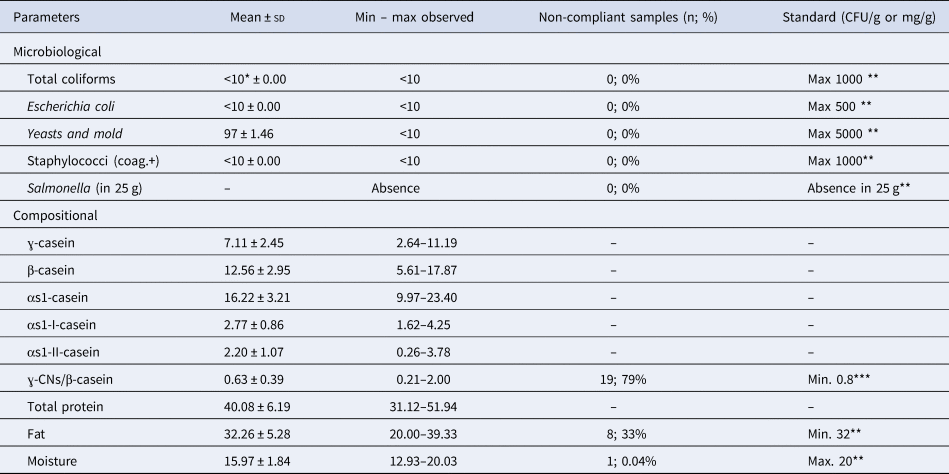
Salmonella, coagulase-positive Staphylococci, total coliforms, and E. coli were not detected (Table 1). The yeast and mold counts were under the maximum allowed in accordance with the statutory Brazilian regulation (Table 1). Taken together, these results indicate good microbiological quality, absence of enteropathogens and low environmental contaminants. In general, grated Parmesan cheese is sold in the Brazilian market after being dried to a moisture content of about 15%. Indeed, according to the label information, all samples analyzed were dried. Due to its packaging conditions and intrinsic parameters (such as low water activity, the presence of organic acids and consequently low pH), hard and ripened cheese have low microbiological risks, with few foodborne illnesses linked to its consumption (Choi et al., Reference Choi, Lee, Lee, Kim and Yoon2016). In addition, Salmonella and Staphylococcus aureus strains responsible for food poisoning are not to be expected in cheeses with starter cultures and their bacteriocins, such as Parmesan (Serrano et al., Reference Serrano, Zweifel, Corti and Stephan2018; Possas et al., Reference Possas, Bonilla-Luque and Valero2021).
Means (± standard deviation) of microbiological (CFU/g) and compositional (mg/g) parameters of 24 grated Parmesan cheese samples with federal inspection sold in Londrina (Brazil) between June and September 2017, and frequency of non-compliant samples

*No colonies were detected in a dilution of 1 : 10; **Brasil, 1997a, 1997b and 2019; *** Mayer et al. (Reference Mayer, Rockenbauer and Mlcak1998).
Regarding compositional analysis, the fat content was responsible for 33% of the non-compliant samples (Table 1). Milk for Parmesan cheese manufacture is usually standardized by cream removal with a casein:fat ratio of 1.05 to 1.15. This proportion is a key requirement for the authenticity of Parmesan, since the fatty acids contribute to its unique fruity flavor, mainly driven by ethyl butanoate and ethyl hexanoate formation during the ripening time. More specifically, the esterolytic and lipolytic activities of lactic acid bacteria are responsible for liberating short n-chain fatty acids and short n-chain ethyl esters from milk fat, demonstrating that the casein:fat ratio together with water activity and starter and adjunct starter lactic acid bacteria are important parameters for the flavor development of Parmesan (Fenster et al., Reference Fenster, Rankin and Steele2003).
The high occurrence of samples with low fat content (about one-third) could be the result of excessive skimming of milk by dairy plants, an economically motivated food fraud since cream is the main value-added dairy component which can be used as an ingredient in many food formulations, such as infant milk formula, cookies, ice cream etc. More recently, minor components isolated from milk fat are being used as emulsifiers in premium-priced food products (Mohan et al., Reference Mohan, O'Callaghan, Kelly and Hogan2021).
It should be noted that the high protein content and the low moisture observed in Table 1 reflects the drying process used in the commercial samples to enhance the shelf life. In consequence, the protein and moisture content are higher when compared to fresh samples. The protein yield is also influenced by the fermentation time and amount of bacterial culture (Aliwarga et al., Reference Aliwarga, Christianti and Lazarus2017). The longer the fermentation time, the greater the decomposition of amino acids and the higher the protein content. On the other hand, if the culture concentration is too high the lower availability of nutrients for each bacterium decreases the protein yield. The wide variability of protein content observed in Table 1 may be due to the lack of standardization of those industrial parameters.
Surprisingly, about 80% of the samples did not meet the minimum coefficient between ɣ-CNs and β-casein (ɣ-CNs/β-casein), suggesting insufficient ripening time (Table 1). This practice can also be classified as an economically motivated food fraud to cheapen production costs. The Parmigiano Reggiano Consortium requires at least 12 months of ripening time. Indeed, the Italian standard samples of grated Parmigiano Reggiano analyzed showed a coefficient of ɣ-CNs/β-casein of 2.11 (±0.29). However, the ripening time of Parmesan in Brazil can be shorter and depends on the size of the cheese, with at least 6 months for cheeses up to 10 kg, 8 months for cheeses between 10 and 20 kg and 12 months for cheeses with more than 20 kg (Brasil, 1997a). According to Mayer et al. (Reference Mayer, Rockenbauer and Mlcak1998), a coefficient of 0.8 (ɣ-CNs/β-casein) correspond to a 6-month-old cheese, and this index tends to increase during the ripening time. In our study, about 42% of the samples barely achieved an index of 0.5 (median 0.53), and all brands had at least one non-conforming batch.
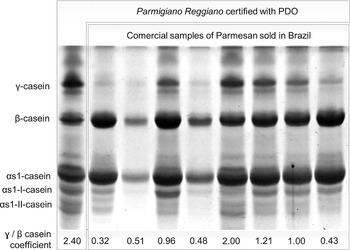
From the scanned gels it was possible to identify β-casein, γ-casein (as the major degradation from β-casein), αs1-casein and its degradation products: αs1-I-casein and αs1-II-casein. Each casein fraction has a characteristic pattern over the ripening time. The concentration of bovine β-casein, for example, decreases after 4–5 months of ripening, being absent after 48 months. The ratio (ɣ-CNs / β-casein) progressively increased by a factor of 4.5 in the ripening time from 12 to 50 month (D'Incecco et al., Reference D'Incecco, Limbo, Hogenboom, Rosi, Gobbi and Pellegrino2020). This typical pattern of ripened cheese was clearly observed in the standard sample of Italian grated Parmigiano Reggiano (certified with Protected Designation of Origin: Figure 1 and online Supplementary Figure S1). On the other hand, most of the commercial samples of grated Parmesan showed lighter bands of γ-casein, αs1-I-casein and αs1-II-casein, endorsing the insufficient ripening time and, consequently, the lack of authenticity of the grated Parmesan samples manufactured and packed at Brazilians dairy plants. This indicates a need for more regulatory efforts regarding the quality control and frauds.
Urea-PAGE electrophoresis gel of protein fractions and ɣ-CNs/β-casein coefficient of 8 brands (first batch of three analyzed) of grated Parmesan cheese with federal inspection sold in Londrina (Brazil) between June and September 2017.

The last survey at national level for grated cheese was conducted in 2003 by the Instituto Nacional de Metrologia, Qualidade e Tecnologia (INMETRO), a Brazilian regulatory agency for legal metrology, conformity assessment and accreditation. This surveillance covered 18 brands (of 52) with 39% of noncompliant samples for moisture (Inmetro, 2003). By contrast, the fat content and the ripening time were the most common noncompliant parameters detected in our research. It should be noted that moisture is an indirect parameter for age, decreasing progressively during the ripening time (Júnior et al., Reference Júnior, Fernandes, Costa, Magalhães, de Paula and Sobral2019). However, the industrial drying of grated cheese is a regulated practice in Brazil to increase the shelf life. According to the label information, all samples analyzed were dried, which could have disguised the insufficient ripening time evidenced by the coefficient ɣ-CNs / β-casein. Indeed, the wide variability of the compositional parameters observed in Table 1 for protein, moisture and fat content indicates the lack of standardization in the industrial drying. According to Freitas et al. (Reference Freitas, Polachini, de Souza and Telis-Romero2016) there is a lack of data regarding the drying process of grated Parmesan cheese, especially regarding isotherm sorption and thermodynamics, fundamental parameters in the drying process modelling, and consequently, to the equilibrium and identity of Parmesan cheese.
As far as we know, this is the first study evaluating the ripening time of grated Parmesan sold in Brazil. The limitation of our study is that it is not representative of the whole country, nevertheless we have exposed a problem. Literature on grated Parmesan is scarce in Brazil, and most focuses on the microbiological quality, compositional parameters and aflatoxin M1 contamination (Trombete et al., Reference Trombete, Castro, Teixeira, Saldanha and Fraga2014; Gomes et al., Reference Gomes, Alves, Pimentel and Klososki2015; Aguilar et al., Reference Aguilar, Rossi, Vidal, Ribeiro and Rossi2016). In line with our results, the overall compositional quality of grated Parmesan from the Brazilian market is somewhat inadequate or unsatisfactory, mainly for moisture and fat content. However, the microbiological quality is often in compliance with Brazilian legislation, mainly for samples grated, manufactured, and packed at Brazilians dairy plants. Thus, the research to date has tended to focus on microbiological/toxicological hazards rather than the proteolysis pattern of grated Parmesan cheeses.
In conclusion, despite its microbiological safety, the authenticity of grated Parmesan from the Brazilian retail market may be under threat, with insufficient ripening time and fat content, both classified as economically motivated food fraud. From our results, it is highly recommended that future surveys include and emphasize the ripening time as the main quality parameter of grated Parmesan cheese. The present study confirms previous findings regarding the inconsistent quality of grated Parmesan sold in Brazil and contributes additional evidence about its authenticity.
Supplementary material
The supplementary material for this article can be found at https://doi.org/10.1017/S0022029922000310.
Acknowledgements
The authors would like to thank CAPES (Coordenação de Aperfeiçoamento de Pessoal de Nível Superior Coordination for the Improvement of Higher Education Personnel) for financial support and FUNADESP (Fundação Nacional de Desenvolvimento do Ensino Superior Particular-National Foundation for Development of Private Education) for fellowship.