1. Introduction
In the 1970s the fuelwood situation in developing countries was described as desperate. Many were concerned that people in developing countries used more wood for fuel than was being regenerated by forest growth (e.g., Eckholm, Reference Eckholm1975; Eckholm et al., Reference Eckholm, Foley, Barnard and Timberlake1984). The expected implications were massive deforestation followed by environmental problems, increased collection times, and reduced energy consumption with implications for nutrition and health. Based on such gap models a number of large-scale interventions were launched during the 1980s and 1990s both to increase the supply of biomass as well as to reduce the demand through substitution to other forms of energy. However, both the underlying assumptions of gap models and the relevance and efficiency of the resulting interventions were already heavily criticized by the late 1980s.Footnote 1
Despite the perceived failures of many interventions it is difficult to disregard that fuelwood scarcity is an issue of very real importance in the lives of many rural households in developing countries. Fuelwood is arguably the most important product from local forests for most people.Footnote 2 Fuelwood needs have therefore been a driving concern behind people-centered forest interventions such as ‘social forestry’. Regarding fuelwood scarcity most observers now recognize that the situation is neither so stark nor as simple as initially perceived. Certainly there has been progress in our understanding of the relationship between institutions, market forces, household decisions, and physical forest stocks. Nonetheless, much about fuelwood, its substitutes, the policies affecting its availability and use, and the impacts of such policies on the environment, the individuals who collect it, and households that consume it still remain speculative. In this paper we argue that more careful economic analysis, especially at the household level, is an important tool for choice and targeting of fuelwood-related interventions. The objective of the paper is thus to review recent evidence in the household-based empirical economics literature of fuelwood scarcity and then relate this evidence to various forestry-related policy instruments. Given the recent interest in local management of natural forests, we will in particular focus on the impact that local forest management might have on fuelwood availability in our discussion. This focus on the recent economics literature with an emphasis on demand and policy issues related to fuelwood scarcity and community management also distinguishes the paper from other reviews such as Dewees (Reference Dewees1989), Hyde and Köhlin (Reference Hyde and Köhlin2000), and Arnold et al. (Reference Arnold, Köhlin and Persson2006).
In the next section we review what the empirical economics literature informs us about the fuelwood crisis today. In the third section we extend the review of the economic fuelwood literature to see how the empirical evidence on household demand for and supply of fuelwood can shed light on the viability of various policy interventions. The section is concluded by a discussion of the implications of devolution of natural forest management to local institutions for the availability and distribution of fuelwood. The paper closes with a summary of current insights and a discussion of unresolved issues and foci for future research.
2. Fuelwood scarcity and its implications
When do people face scarcity of fuelwood?
Under conditions of perfect competition a price reflects the marginal cost of a good, and rising prices indicate increasing economic scarcity. However, most fuelwood in the developing world is collected at the household level for internal consumption. Since it usually is not traded in well-functioning markets, its market price is not as reliable as a measure of its scarcity.Footnote 3
To a household a self-produced good such as fuelwood becomes more economically scarce when the household has to forego more of some other household resource in order to obtain it. In this case, the household's implicit or ‘shadow’ price increases. For fuelwood, this is often defined as the opportunity cost of the time spent collecting since labor is often the primary input to fuelwood production. Ideally one would like to capture the individual- and season-specific opportunity cost of the specific hours spent collecting, but this makes data collection prohibitively expensive. In practice, the opportunity cost of labor usually is measured as the wage rate (either male or female, depending on which is more appropriate), or as the marginal product of agricultural labor (e.g., Jacoby, Reference Jacoby1993). Dewees (Reference Dewees1989) makes the point that labor shortages are often more important for household fuel use decisions than physical scarcity of wood. This is consistent with the notion of economic scarcity. The opportunity cost of using a unit of labor to collect fuelwood is higher if there is less labor available to the household or in peak agricultural seasons, when the marginal product of labor is greater. In these cases households may exhibit responses consistent with increased economic scarcity of fuelwood, even though physical stocks have not changed. In general, it is in labor-constrained households that we expect to see the most costly adaptations to fuelwood shortages.
Non-price indicators of scarcity have been sought in order to target interventions. Decreases in forest stocks have been the most conspicuous, although not very reliable. Changes in actual collection times come closer to a welfare impact but need to be weighted by the opportunity cost of time. Certain household behaviors also may be used as indicators of increased economic scarcity. Decreases in fuelwood consumption, use of low quality fuel such as twigs, crop residues, or dung, changes in cooking and food preparation habits are all typical examples of potential responses to higher fuelwood scarcity. However, each of these can also occur for a variety of reasons not necessarily related to either the physical or economic scarcity of fuelwood. For example, Mekonnen (Reference Mekonnen1999) finds that households in Ethiopia do not use less dung when trees are more available. This is most likely due to the particular burning qualities of dung that make it well suited to combine with fuelwood in cooking the national dish injera. While increased scarcity may cause certain behaviors in some cases, and the relationship between these behaviors and scarcity is an important avenue for analysis, the behaviors should not be used blindly as indicators of scarcity.Footnote 4
Rather than focusing exclusively on indicators of scarcity, policy analysis should be based on the implications that the economic scarcity of fuelwood has on household welfare. Unfortunately, this effect is even harder to measure than the scarcity itself. Higher fuelwood shadow prices to a household, or higher prices for marketed fuels, all else constant, indicate less household utility. But how much less will vary from household to household depending on household preferences, income, and the availability of feasible substitutes for the more expensive fuel. Certainly it seems clear that the more substitution options available to a household, the better it will be able to cope with increased fuelwood scarcity in a way that minimizes welfare loss. Since the end of the 1980s it has been assumed that the welfare loss for such adaptation is rather low (Arnold et al., Reference Arnold, Köhlin, Persson and Shepperd2003). However, that is an empirical issue, and one that sometimes demands quite elaborate analysis.Footnote 5
This is an important question for policy. Does increasing scarcity of fuelwood cause such a burden on households that it warrants intervention? Generally speaking, interventions are warranted in cases where market failures lead to significant amounts of inefficiency, or where there are distributional consequences that are deemed socially undesirable. Fuelwood scarcity is often caused by market failures; for example, forest degradation due to open access conditions, or the lack of a well-functioning market for labor. In the former, forest degradation may lower the marginal productivity of time spent collecting wood. In the latter, a labor-constrained household without recourse to a labor market may face a higher opportunity cost for the time spent collecting (e.g., because household members must spend more time in agricultural activities instead of hiring lower cost labor).Footnote 6 In the remainder of this section we discuss several of the most common reasons given for caring about fuelwood scarcity, and review what the empirical economics literature has to say about each.
Implications of fuelwood scarcity
Much concern over fuelwood scarcity has to do with the potential consequences of households using less fuelwood and of using more time to collect it. It is clear that households respond to increasing scarcity of fuelwood by using less. Many household studies indicate that fuelwood consumption decreases as market or shadow prices increase, although typically not by a large amount.Footnote 7 Moreover, most empirical results from Nepal and India indicate that households tend to spend more time collecting fuelwood as it becomes more costly as measured by either market price (Amacher et al., Reference Amacher, Hyde and Kanel1999), by a shadow price (Cooke, Reference Cooke1998a), or by a physical measurement such as decreases in forest stock or decreases in forest accessibility (Amacher et al., Reference Amacher, Hyde and Joshee1993a; Köhlin, Reference Köhlin1998; Heltberg et al., Reference Heltberg, Arndt and Sekhar2000). While these studies are somewhat geographically limited, there are enough of them for there to be concern about who is spending the extra time collecting and what activities they forego when they collect.
An exception to these collection time results is a recent study by Van't Veld et al. (Reference Van't Veld, Narain, Gupta, Chopra and Singh2006) that finds that households do not spend more time searching for fuelwood when biomass availability from common areas decreases. Instead, households are less likely to collect from common areas at all and are more likely to use privately produced fuel. This highlights the many margins on which households may make choices when fuelwood becomes scarcer.
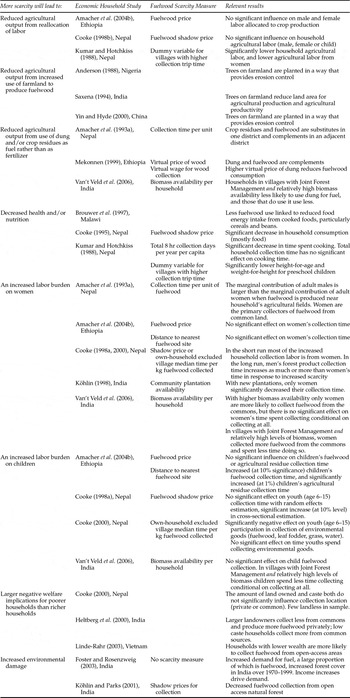
Table 1 lists the primary concerns that are often discussed with regard to fuelwood scarcity and the relevant empirical economics household literature that has addressed it. One potential cause for concern is declining agricultural output as a result of reallocating inputs away from agriculture. The evidence is sparse, but does not suggest that any decline in agricultural production is immediate. Studies indicate that households avoid reducing agricultural labor input even as they spend more time in fuelwood collection (Cooke, Reference Cooke1998b), avoid using dung as fuel at times of the year when it is useful as fertilizer (Van't Veld et al., Reference Van't Veld, Narain, Gupta, Chopra and Singh2006), and often plant trees in such a way as to provide erosion control, thus providing some benefit to agricultural production as well as a cost (Anderson, Reference Anderson1988; Yin and Hyde, Reference Yin, Hyde and Hyde2000). Additionally, the cross-price evidence between fuelwood and dung, and fuelwood and crop residues is mixed as to whether the fuels are substitutes or complements. Moreover, even if more crop residues are used as fuel when fuelwood becomes scarcer, it is still unclear that their combustion decreases agricultural production. Many of the combustible crop residues would not be suitable for soil regeneration.Footnote 8 The use of dung and crop residue as fuel may also be timed in such a way as to avoid hurting crop production. Given the evidence to date, it certainly appears that households will alter their behavior in such a way as to minimize the impact on their agricultural output. While most developing country governments are interested in increasing agricultural productivity, these results indicate that fuelwood interventions are not likely to be the best way to go about this.
Common concerns about fuelwood scarcity

Another potential cause for concern about fuelwood scarcity is lowered nutrition from changes in cooking habits due to either a reallocation of labor away from food preparation, or changes in the amount and kind of fuel used. There is extremely little economic evidence regarding this set of adjustment possibilities. What little evidence there is indicates that there may be negative nutrition consequences, at least in some cases. These results, and also observations from anthropological and sociological studies regarding changes in cooking habits (e.g., Vermeulen, Reference Vermeulen and Köhlin2003), encourage further economic investigation into the consequences of fuelwood scarcity for household health. Under what circumstances do households choose to make changes that will adversely affect nutrition or health? Are there different health effects on different household members? Does a decrease in cooking time necessarily reduce nutrition? It would seem that household welfare might be reduced if women have to spend more time cooking when they switch to crop residues because the residues require more attention. Studies that address these questions should measure very explicitly the effect of fuelwood scarcity on the change in cooking or eating habits and also on the resulting specific nutritional or health outcomes for different household members.
A related concern has to do with the adverse health consequences of indoor smoke from biomass fuel combustion. There is a growing epidemiological literature from a variety of countries that ties indoor smoke from fuelwood and other biomass combustion to serious health problems such as acute lower respiratory infections, chronic lung disease, adverse pregnancy outcomes, and blindness.Footnote 9 In general, however, there has been very little attention in the economics literature on fuelwood-related health issues. While this is increasing, particularly with regard to indoor air pollution, there is little evidence on the effect of disease on household fuel choice and use, of household fuel choice on health, and of fuelwood-related interventions on health. It should be noted that there have been some interventions designed to address, at least in part, fuelwood scarcity that may also lead to adverse health consequences. One study that addresses this issue is Amacher et al. (Reference Amacher, Ersado, Grebner and Hyde2004b). They find that micro-dams in Tigray, Ethiopia increase the productivity of both fuelwood and crop production, but do so at the expense of more sick time due to increased malaria. Frustratingly, when malaria (or other disease) imposes a labor constraint on households, the opportunity cost of collecting fuelwood is likely to be higher, thus increasing its scarcity to the household.
Another set of concerns about increased fuelwood scarcity relates to the potential distributional consequences of household labor reallocation. In particular, there is some concern that women, particularly those in rural areas, often spend many more hours working than do men once household tasks are included. If women are the ones spending more time collecting fuelwood when it is scarcer, this simply increases their workload relative to men even more which raises an equity issue. It might also be detrimental to women's health and their ability to participate in other important tasks such as agriculture, food preparation, and childcare. Likewise, a related concern is that children may be required to spend disproportionately more time in collection thus potentially affecting their health or schooling attainment.
From the relatively sparse economic literature available, it does not appear that the worst can automatically be assumed. For example, some observe that child care and fuelwood collection may at times be a joint activity (Amacher et al., Reference Amacher, Hyde and Rafiq1993a; Mekonnen, Reference Mekonnen1998). It is also not clear that women always bear more labor costs of fuelwood scarcity than men, although there are locations and households where that is the case. Relatively broad evidence indicates that fuelwood collection is not necessarily just a female task, as is often assumed in the forestry and development circles. Studies from Ethiopia, Madagascar, India, Nepal, Vietnam, and Indonesia all find that both men and women collect, and on some occasions men are the primary collectors.Footnote 10 Indeed, in Orissa, India Köhlin (Reference Köhlin1998) finds that men actually collect more fuelwood than women do and that the marginal products of men for the collection activity are greater than the marginal products of women.
Table 1 lists the handful of studies that provide detailed examinations of intrahousehold labor allocation to forest product collection including fuelwood. The results in these studies highlight several important points. First, they reinforce the point made above that it cannot automatically be assumed that fuelwood scarcity (or alleviation of that scarcity) will primarily affect women's labor, although of course it may. The Cooke Nepal studies indicate that although women are the primary fuelwood collectors and they initially provide most of the increased labor to fuelwood collection when it is scarcer, in the long run men's forest product collection time increases as much or more than women's time. Amacher et al. (Reference Amacher, Hyde and Joshee1993a) drew the comparable conclusion that when scarcity increases to the point that households grow fuelwood on their own agricultural lands, then men begin to collect more – perhaps because they already spend more time in the fields.
Second, as evident in the Amacher et al. (Reference Amacher, Hyde and Joshee1993a) conclusion, male and female fuelwood collection is likely to vary by fuelwood source. In Orissa, Köhlin (Reference Köhlin1998) finds that men, adolescents, and higher caste women do more of their collecting from village woodlots, while lower caste women collect more from the less accessible natural forest whether they are collecting for market supply or for their own domestic use. He also finds that when newly established community plantations increased the availability of biomass, only women significantly decreased their collection time (Köhlin, Reference Köhlin1998). Given symmetry, this would imply that a reduction in availability of biomass would adversely affect women primarily. Van't Veld et al. (Reference Van't Veld, Narain, Gupta, Chopra and Singh2006) find that when there is more biomass in common areas, women, but not men or children, are more likely to collect from the common areas, although those that choose to collect do not spend significantly more time doing so. These varied results indicate that forestry interventions that affect biomass availability in different areas may very well influence household labor allocation in different ways.
A final point from these studies is that seasonality clearly is important to household labor allocation decisions regarding fuelwood. For example, Cooke (Reference Cooke1998a) finds that men may contribute more labor to forest product collection during slack seasons for agriculture or when there are few off-farm labor opportunities, and children may collect more during the heavy summer agricultural period. Both Cooke (Reference Cooke1998a) and Van't Veld et al. (Reference Van't Veld, Narain, Gupta, Chopra and Singh2006) find that fuelwood is often collected and stored in the dry season when agricultural activity is less intense. Thus, households show evidence of choosing who will collect and at what time in a manner that minimizes the cost to the household.
From this small and geographically limited amount of evidence, it is not clear that worsening inequities for women, or for children, as a result of increasing fuelwood scarcity are a general phenomenon. It appears likely that negative consequences on women will vary across location and household, and by what outcome (e.g., health, education, leisure) is measured. If household labor equity concerns are to be a motivation for fuelwood-related interventions, this indicates that careful targeting of the projects will be needed.
The plight of relatively poor households is another reason to be concerned about increasing scarcity of fuelwood. It seems quite likely that increasing fuelwood scarcity will decrease the welfare of poor households more than that of relatively better off households. Some have noted that poor households often become sellers of woodfuels, essentially using open access resources to generate income (Hyde and Köhlin, Reference Hyde and Köhlin2000). The degradation of these resources, or the closure of them through community management efforts, is likely to have a stronger effect on poorer households who rely on them more extensively. In the urban markets, poorer households may face higher prices for charcoal and fuelwood due to buying smaller quantities at a time (e.g., Stevenson, Reference Stevenson1989). It seems plausible that they are likely to be hurt the most if prices rise further. In rural areas, poor households have relatively few alternatives available to them as fuelwood becomes scarcer. Households with little or no land have much less ability to produce fuelwood themselves, or even to use crop residues as a substitute fuel. The evidence to date (see table 1) is mixed as to whether the amount of land a household owns, or household caste, influences whether households collect fuelwood from common areas or produce fuel on their own land. In general, however, empirical analysis has overlooked the rural landless and the very poor, despite the fact that these are the people we are often most interested in helping.
A final reason policy makers may care about woodfuel scarcity is that fuelwood and charcoal production and use may have substantial environmental impacts. Historically there has been concern about deforestation and forest degradation, but more recently there has also been interest in the relationship between biofuels and global warming. First, fuelwood and charcoal production may increase deforestation and forest degradation in some areas. Increasing scarcity makes it worthwhile for producers to go further into open access forests. Increased erosion, loss of watershed capabilities, and loss of biodiversity may occur as a result. While this relationship is often raised, and the environmental and economic consequences of open access resources are well developed in theory, there is very little empirical evidence that formally ties production of these goods explicitly to changes in measures of forest quantity or quality.Footnote 11 Most studies linking charcoal or fuelwood production to deforestation are either theoretical or dependent on simulations; for example, Clarke and Shrestha (Reference Clarke and Shrestha1989a), Hyde and Seve (Reference Hyde and Seve1993), and Bluffstone (Reference Bluffstone1995) for fuelwood, and Hofstad (Reference Hofstad1997) and Chomitz and Griffiths (Reference Chomitz and Griffiths1997) for charcoal. Given the paucity of purely empirical evidence, we have little understanding of exactly how much deforestation or degradation is caused specifically by fuelwood or charcoal production, or of the spatial dynamics of that deforestation. Thus, we have no good empirical evidence with which to evaluate the social costs of woodfuel production, and no clear picture of how much policy intervention will affect environmental conditions. As Clarke and Shrestha (Reference Clarke and Shrestha1989b) point out, fuelwood collection may often be a by-product of other land-clearing activities such as agriculture. In these cases, policies geared toward lowering fuelwood use such as fuelwood taxes or alternative fuel subsidies may not have much, if any, environmental impact.
The second large environmental issue is the relationship between fuelwood use and global warming. Substantial switching from biofuels to fossil fuels with rising incomes and urbanization could lead to increased greenhouse gas emissions and a development that contradicts the long-term ambitions in the Kyoto protocol. However, this contradiction might not be as dire after all. First of all, Smith (Reference Smith2002) notes that even if 2 billion people shift to liquefied petroleum gas (LPG) it would add less than 2 per cent to global greenhouse gas (GHG) emissions, while the positive health effects would be dramatic. While fuelwood induced indoor air pollution is estimated to cause 9.8 million premature deaths by the year 2030 in Africa alone, a rapid transition to petroleum fuels is estimated to delay 3.7 million of these deaths (Bailis etal., Reference Bailis, Ezzati and Kammen2005). Actually, even the GHG effect from such a change might be positive. In a recent study by Venkataraman et al. (Reference Venkataraman, Habib, Eiguren-Fernandex, Miguel and Friedlander2005), it is found that the combustion of solid biofuels is the largest source of soot in India and that this soot not only has serious health implications, it also has an atmospheric radiation balance about 10 times the effect of greenhouse gases. Even without considering such decreases in emissions of particulate matter, Bailis et al. (Reference Bailis, Ezzati and Kammen2005) predict that large shifts to the use of fossil fuels would reduce GHG emissions by 1–10 per cent by 2050 as compared to scenarios that include various proportions of fuelwood and charcoal combinations.
It should be noted that there can be positive environmental effects from woodfuel scarcity. Using household, village and satellite data, Foster and Rosenzweig (Reference Foster and Rosenzweig2003) determine that increased demand for forest products, a large component of which is for fuelwood, led to increased forest cover in India between 1970 and 1999. When the price of fuelwood increases enough, households often start producing fuelwood themselves and they may even plant trees. Sufficient scarcity may also spur changes in how community resources are managed. Community management of woodlots or natural forest areas may allow forests to regenerate. For example, Köhlin and Parks (Reference Köhlin and Parks2001) show that community plantations decrease the collection in open access natural forests in Orissa. Still, there is a missing link between such observations of changes in collection and evidence of changes in forest quality. While there is need for more evaluation of private tree planting and community management of wood resources, it seems likely that higher woodfuel scarcity may spur these activities in some cases. An important point to keep in mind is that planting trees or undertaking management of a forest both have costs. They will only be worthwhile if the goods they generate are valued highly enough. Thus, policies designed to dampen the price of fuelwood may actually make it less likely that people will plant trees or take steps to protect them. Community forest management is discussed in greater detail in section 3.
3. Household behavior, market behavior, and policy interventions
The previous section showed that there are a number of ways in which fuelwood scarcity might affect welfare. However, we still need to evaluate whether scarcity of fuelwood is a problem that warrants policy intervention and, if so, what policy interventions are best suited for dealing with the problem. It is possible to identify several important areas where empirical investigation can shed light on choices regarding fuelwood production and consumption and the effects of policy on these choices. The relevant household model for such analyses tells us that households' internal demand and supply functions will be functions of exogenous variables, notably wages, market prices, exogenous income, fixed agricultural capital such as land, measures of community-based natural resources, and household demographic characteristics. Where households produce all of their own fuelwood, a household's shadow price is the relevant price variable. Of particular interest for policy makers is the effect of wages, market prices, income, natural resource availability, and various household characteristics such as ethnicity and education level, on supply and demand decisions. Estimating fuelwood demand and supply equations that contain these key explanatory variables should therefore be a primary goal for empirical economic work.Footnote 12
Demand-side interventions
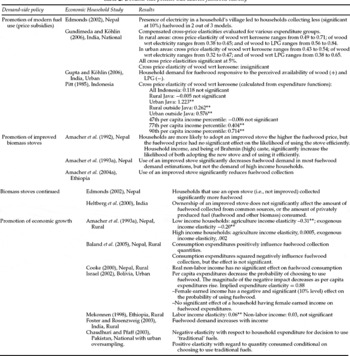
Table 2 presents several demand-side policy avenues available to policy makers and relevant household economic research for each category. Demand-side interventions include promoting the use of alternative modern fuels (e.g., through price subsidies), promoting more-efficient use of fuelwood (e.g., through the use of improved biomass stoves), and promoting income growth. We evaluate the prospects for each of these in turn.
Demand-side policies that address fuelwood scarcity

*significant at 10%; **significant at 5% or better.
The empirical literature to date is concentrated on estimates of fuelwood demand, and it covers a wide variety of experiences: African and Asian, urban and rural, higher and lower income groups. Hyde and Köhlin (Reference Hyde and Köhlin2000) summarize such studies. The range of own-price elasticities of demand found is −0.11 to −1.47 with only one of ten estimates greater than 1 in absolute value. The prices used in these studies ranged from market prices to various measures or indicators of a household's shadow price for fuelwood. These results indicate that rural fuelwood demand generally is own-price inelastic. Increases in the scarcity of fuelwood do induce reductions in fuelwood consumption, although those reductions are small. In terms of the welfare implications of scarcity that were discussed in the previous section, this implies that there might be a smaller concern for negative consumption implications, while the opportunity cost in terms of increased labor or money spent on fuelwood might be substantial.
Small elasticities imply that there are few close substitutes readily available. This challenges the conventional wisdom that fuelwood is easily substituted by other fuels (Persson, Reference Persson1998). Although these estimates come from a variety of case studies, many of them are from South Asia. More case studies, particularly from Africa where fuelwood is also commonly used, would help confirm the inelasticity of fuelwood demand as a general phenomenon. If fuelwood demand generally is own-price inelastic, then it also decreases the scope for demand-side policies.
As shown in table 2, relatively few household demand studies have estimated cross-price effects with respect to market fuels such as kerosene, LPG, and electricity. The results in table 2 generally indicate that households in both rural and urban areas perceive fuelwood and modern fuels as either unrelated goods or as weak substitutes. There is variation, however, both between rural and urban households, between richer and poorer households, and between different modern fuels. Additional analysis is needed to sort out the conditions that predispose households to be more or less responsive to changes in the price and availability of alternative fuels. The preliminary conclusion that can be drawn from the available own-price and cross-price elasticity estimates in the literature is that there is limited potential for market interventions that change the price of fuelwood or substitute fuels to affect the demand for fuelwood.
Technical substitutes for fuelwood also exist. Specifically, various types of ‘improved stove’ can burn wood more efficiently than traditional stoves, thus leading to the possibility that their use will reduce fuelwood consumption. While initial attempts at promoting the use of improved stoves met with many failures, more careful targeting should lead to improved adoption and use rates. Barnes et al. (Reference Barnes, Krutilla and Hyde1994), in their review of stove improvement and dissemination programs, conclude that programs meet with the most success when they target specific areas where woodfuels are scarce, and indeed that fuel scarcity is a more effective inducement for households to actually use the stoves than a subsidy is. However, there are still very few household studies that formally estimate the degree of influence factors such as fuelwood scarcity have on the adoption and efficient use of improved stoves. Amacher et al. (Reference Amacher, Hyde and Joshee1992) provide some evidence that fuelwood scarcity does lead to a higher likelihood of adopting an improved stove, but the study also finds that fuelwood scarcity does not significantly influence whether the household uses the stove efficiently or not.
There is also little economic investigation of the impact using an improved stove has on actual household fuelwood demand. The studies listed in table 2 provide mixed evidence on whether household use of an improved stove reduces fuelwood use. Whether stove ownership, or even use, reduces household fuelwood consumption depends on a variety of factors that the studies in table 2 do not address. For example, stoves may be in disrepair or not operated efficiently, households may only use the improved stove for some but not all cooking and use a traditional stove during other times, or stoves may be designed to reduce harmful emissions within the house but not necessarily to conserve fuelwood.
A final demand-side possibility is that promoting economic growth in general will induce households to switch to modern fuels such as kerosene as their incomes increase. Studies that investigate the effect of income on fuelwood demand are listed in table 2. Although it is generally expected from the energy ladder hypothesis that higher income decreases the use of fuelwood as it is substituted for by cleaner and more efficient fuels, it is interesting to note that many estimated income elasticities of demand for fuelwood are actually insignificant, very low, or even positive. This implies that for many, particularly poor rural households, fuelwood is a normal good not easily substituted for. The low elasticities also imply that when households are hit by income shortfalls, they cannot easily reduce their fuelwood expenditure, instead shifting the burden to other consumption.
Two studies (Israel, Reference Israel2002 and Chaudhuri and Pfaff, Reference Chaudhuri and Pfaff2003) find that the effect of household expenditures on fuelwood consumption can be decomposed into the decisions of whether or not to use fuelwood as fuel, and how much fuelwood to use conditional on using it. Both studies find that higher expenditures (as a proxy for income) decreases the probability of using fuelwood at all, but, for those that do use it, more expenditures leads to higher consumption. This implies that marginal increases in income may reduce the number of fuelwood users, but not necessarily decrease the total amount of fuelwood being consumed. It should be noted that both of these studies are cross-sectional and include both fuelwood-using and non-fuelwood-using households. Israel's sample is urban, while Chaudhuri and Pfaff's data oversamples urban households. In rural areas of some countries almost all households use fuelwood precluding this type of analysis, and feasible access to modern fuels may be quite limited due to low population densities, high transportation costs, and lack of information. That not only price and income is important for the choice of fuel is becoming increasingly apparent (see e.g. Masera et al., Reference Masera, Saatkamp and Kammen2000; Heltberg, Reference Heltberg2004, Reference Heltberg2005; Gupta and Köhlin, Reference Gupta and Köhlin2006; Gundimeda and Köhlin, Reference Gundimeda and Köhlin2006). Panel data that track rural household fuel choices over time, as well as other variables relevant to the fuel choice/use decision, including the prices (shadow prices) and accessibility of both fuelwood and modern fuels, would be most useful for understanding the conditions under which the majority of fuelwood-using households would switch to modern fuels.
From the evidence presented here, in rural areas it does not appear that widespread switching to modern fuels by households moving up the ‘energy ladder’ with incremental increases in income is likely to happen soon. More specifically, Gundimeda and Köhlin (Reference Gundimeda and Köhlin2006) show that for rural India expenditure elasticities of demand for fuelwood are above 1 until expenditures increase above 750 Rs per month, while rural average monthly expenditures are Rs 500. Similarly, in urban areas of India the expenditure elasticity of demand for fuelwood does not drop dramatically until the households have a fairly high income, above 2250 Rs per month, representing the highest decile.Footnote 13
Two recent attempts to estimate global energy, including fuelwood demand, also indicate that overall world fuelwood demand is not likely to decline soon. In a major revision of its global fuelwood and charcoal data FAO estimated regional demand and made projections of fuelwood consumption until 2030. Consumption is expected to continue to increase in Africa and South America over that time period, and to peak in South Asia in 2010. However, fuelwood consumption is already decreasing in Southeast Asia and East Asia (Broadhead et al., Reference Broadhead, Bahdon and Whiteman2001). Another study, by the International Energy Agency (2002), estimates that in 2030, 700 million people in Africa, 1700 million people in Asia and 70 million people in Latin America will be dependent on fuelwood and other biomass fuel.
Supply-side interventions
Far fewer studies have focused on estimating supply than demand, so there is minimal evidence about the responsiveness of fuelwood supply to output prices. Indications that the supply of fuelwood is relatively own-price elastic would imply that small increases in the price of a fuel would induce a larger increase in fuel production. If this were the case, increasing scarcity would not appear to be an immediate problem. Amacher et al. (Reference Amacher, Hyde and Kanel1999) find that rural market suppliers of fuelwood in Nepal respond positively to increases in market price, although the degree of responsiveness varies by region. The own-price elasticity is 0.36 in the Tarai and 2.99 in the Hill region, implying suppliers are much more price-responsive in the Hills. Although this is only one study, it implies that supply responsiveness is likely to vary significantly from region to region. Understanding the reasons for this variation is an important but unexplored avenue for research.
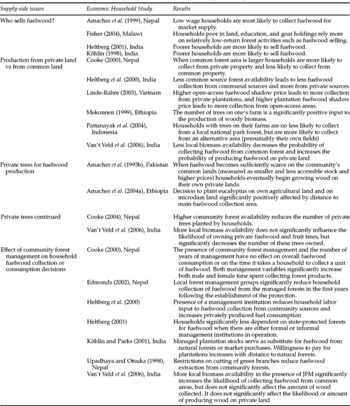
It is also important to understand more about what resources are used to produce the fuelwood for sale. If higher prices induce more production from open access areas rather than private property, there may be inefficiencies associated with negative externalities that arise from this activity. The open-access conditions therefore would be an appropriate place for policy intervention. There are also distributional considerations. Lower income and landless households may be more likely to be market suppliers of fuelwood. A handful of studies support this latter contention (see table 3). While these studies provide some insight, overall the empirical evidence on the sale of fuelwood, who sells it, and what resources are used to produce it is very scant.
Supply-side fuelwood issues and community forest management

There is more evidence on household collection of fuelwood for own consumption. Evidence from a range of cases (Nepal, Madagascar, Ethiopia, India, Malawi, and Indonesia) indicates that the collection of fuelwood generally declines with decreases in the available forest stock and with decreases in the accessibility of the remaining stock.Footnote 14 Households also appear to choose collection sites rationally. For example, Hegan et al. (Reference Hegan, Hauer and Luckert2003) find in Zimbabwe that households are less likely to collect from collection sites where physically collecting the wood is difficult or that require traversing difficult terrain.
There is mounting evidence that private tree resources are substituted for common forest resources in fuelwood production when the community resources are scarce enough. Evidence presented in table 3 from India, Nepal, Vietnam, Ethiopia, and perhaps Indonesia indicates that private trees and trees in common forests are substitutes in the production of fuelwood for rural households, at least for households with land. Whether households will actively plant trees for fuelwood once common alternative sources become scarcer is a related question. If households will plant, at what level of fuelwood scarcity will they decide that planting trees for fuel is a worthwhile investment? Will they choose instead to use an alternative fuel before fuelwood scarcity attains this level? There is no formal and direct estimate known to us of the effect of any measure of fuelwood scarcity on the decision to plant trees. There is some evidence, however, that households do plant trees from which they obtain fuelwood, at least in some cases. The studies presented in table 3 consistently indicate that local forest availability and accessibility influence the number of trees households grow on their private land. Scherr (Reference Scherr1995) also indicates that forest product price has a positive influence on the number of trees grown by Kenyan households.
The literature could be more extensive and more rigorous, but these observations do suggest that actively growing trees for fuelwood is a preferred way for some households to cope with increasing fuelwood scarcity. The policy implications of this might very well be to create the most conducive environment for private tree planting initiatives. Tree crops typically have a long gestation period, which necessitates secure owner rights to the mature crop. The competitiveness is also improved if there are no large tracts of de facto open access forests around. Finally, a well-functioning credit market encourages long-term investments, a common area for government intervention. More direct interventions have not always been very successful. Subsidy of seedlings can be costly and also undermine a commercial market for seedlings. Free dissemination of seedlings can easily also have negative equity implications since the rich typically are those that can benefit from such programs.
Community management of fuel-producing resources
Increasing scarcity of fuelwood may also prompt local communities to engage in some sort of community management of fuel-producing resources. Theoretically, community management that establishes clear and enforced property rights over previously open access woodlands can alleviate environmental problems from overexploitation and raise the net income generated from the resource. For example, communities may plant trees, establish woodlots, and restrict grazing or extraction of woodland resources. However, increased fuelwood availability is far from the only rationale for devolution of management of natural forests to local institutions. Many countries have experienced that state-controlled natural forests have turned to de facto open access with general mismanagement and over-utilization as a result, including much fuelwood collection. Such forests could have substantial potential as sources of timber, pulpwood and other commercial products. There is thus an obvious risk that improved management practices, particularly of natural forests, may decrease the availability of fuelwood as the management is likely to target higher value products. This would affect all those who previously used the forest for fuelwood collection, but most of all those who happen to be outside the designated management group. According to the Indian experience, the utilization of community plantations is affected by the relative prices of its various products. As a fuelwood intervention it is therefore likely to be more efficient when markets are thin since alternative fuels would be relatively more expensive and other uses of the biomass, e.g. as pulpwood or for construction, would be less profitable.
It is also possible that community managed resources provide new options for household collection of biomass fuels as Köhlin (Reference Köhlin1998) found in Orissa, India. On balance, however, more existing economic studies indicate that community forestry activities restrict access to fuelwood collection from the managed forest. Most of these studies focus on India and Nepal. From the results listed in table 3 it seems that community management can serve to induce households to either reduce fuelwood collection or change the source of collection, but the effect is likely to vary based on the actual management practices and local fuel substitution possibilities. Agarwal's comprehensive account of field visits in 87 community forest groups in both India and Nepal support the economic empirical results (2001). In many cases forest protection had led to marked increased scarcity of fuelwood and women gave ample examples of increased collection time as well as many other adaptation patterns. Unfortunately, the rigid closure regimes were typically not lifted as the forest recovered. Women in most villages Agarwal visited reported a persistence of fuelwood shortages even after years of protection.
These results imply that there are likely to be important distributional consequences to community forest management, both between men and women and between rich and poor.Footnote 15 The poorest households are often those with the fewest substitution possibilities if the management restricts fuelwood collection from previously open access areas. Although it appears that private land production of fuelwood or other biomass for fuel is a preferred option for many households, this is not feasible for landless households. Thus, it is quite possible that poorer households, or women, are hurt disproportionately by a given restriction.
There is a small but growing literature investigating these distributional issues. Several studies, all from India and Nepal, have found that there is a bias in the design of community forestry groups, whereby most benefits accrue to richer households and to men, and that less benefit, or more cost, accrues to poorer households and women (Agarwal, Reference Agarwal2001; Kumar, Reference Kumar2002; Adhikari, Reference Adhikari2003). Adhikari finds that household wealth, education, caste and gender have significant impact on forest-related incomes. Even in relative terms rich households depend more on the forest than poor – gross income from the community forest is 22 per cent and 14 per cent of total household income for rich and poor respectively for the communities in his study. From an ex ante social cost–benefit analysis over 40 years of community forest management in six villages in India Kumar concludes that the landless and marginal farmers would have negative returns in seven out of eight scenarios.Footnote 16 He therefore attributes their participation to social pressure in the village. Agarwal and Adhikari both argue that the lack of participation by women in the forestry group decision-making process contributes to this bias.Footnote 17 It is likely that greater involvement by women would bias the management more towards supply of fuelwood than commercial products. In all three of these studies restrictions on fuelwood collection were important in many of the forestry groups investigated.
Happily there is evidence that this negative bias toward poor households and women is not inevitable. Bandyopadhyay and Shyamsundar (Reference Bandyopadhyay and Shyamsundar2004), using survey data from 524 villages in five Indian states, find that households that participate in such activities consume more fuelwood than those who do not participate. Furthermore, they find no significant negative effect on the consumption of female headed households or ‘backward castes’. However, scarcity measures, such as forest availability and fuelwood price, are important for participation, and the authors caution against the rapid application of community forestry to areas where scarcity is not perceived.
From the results presented here, it appears that the way community forest management has been practiced in many places in India and Nepal has often been biased against traditionally disadvantaged groups. This need not always be the case, however. More research into distributional issues of community forestry is needed to clarify under what conditions and institutional designs any negative bias can be reduced or eliminated. Evidence given here indicates that giving women more voice in the decision-making of local management groups is likely to help. Another important consideration would be to explicitly take into account fuelwood substitution possibilities for poorer households when designing local forest management institutions.
4. Conclusions and issues for further study
The empirical evidence presented in this paper allows us to make some generalizations about household behavior regarding the consumption and production of fuelwood. The most salient point is that with sufficient scarcity households do alter their behavior and appear to do so in ways that are least costly to them. Fuelwood consumption tends to be own-price inelastic, implying that, while its consumption decreases with increases in its price (market or shadow), household fuelwood expenditures increase. In rural areas this fuelwood-related expenditure increase is often in the form of increased labor allocated to collection. The literature suggests that household labor allocations are consistent with economic rewards rather than with external perceptions of absolute cultural norms like ‘women collect’. Men may even collect more than women when the returns to male collection are greater than the returns to women's collection effort, although this may be unusual because other male wage opportunities are generally greater (Hyde and Köhlin, Reference Hyde and Köhlin2000). The literature on the implications of fuelwood scarcity indicates that there are probably many such instances of scarcity, but that the incidence is conditioned on household-specific factors, particularly endowments of labor, land, human capital, and other assets. Unfortunately, there is little analysis carried out on the actual welfare implications of such scarcity that could form the basis for efficient interventions.
The literature also suggests that when the relative prices of different fuels change, households do substitute one fuel for another at least to some extent, whether by using different types of fuels or by using fuelwood collected from different sources. Rural households with land often switch to biomass fuels produced on their own property, and appear to grow trees or bushes for fuelwood in cases where fuelwood scarcity is high enough and alternative fuel substitutes too expensive or inaccessible. Poor households without land may continue to collect fuelwood from increasingly distant and degraded open access natural areas. For most users of fuelwood, namely households in rural areas, there appears to be little feasibility to promoting large-scale switching to modern fuels in the near term. Low cross-price elasticities (although there aren't many studies of this) and relatively low incomes compared to households in urban areas tend to support this contention. Available studies do not indicate that households in rural areas choose to switch to a modern fuel in the case of increasing fuelwood scarcity.
Assuming there are justifiable efficiency or equity reasons for governments to get involved, what policy tools seem best for alleviating problems associated with fuelwood scarcity? On the demand side, promoting improved stoves is a demand-side option that should be explored further, particularly given additional benefits from reducing adverse health impacts from indoor air pollution. Future research should aim to clarify the conditions under which improved stoves are adopted and used efficiently, and the amount by which they actually reduce fuelwood use in practice. This would help tremendously with targeting of programs and evaluating their benefits. For households in rural areas it appears that subsidizing modern fuels such as kerosene or LPG is not likely to be of much help given low incomes and problems with accessibility. Making improvements in infrastructure (e.g., roads) that would improve accessibility, rather than subsidizing fuels, may make a much larger difference. Fuel subsidies in urban areas should also be treated with caution, given the propensity for benefits to be captured by relatively richer households, and the usually large budgetary cost of such programs.
For most rural households, feasible substitution options for fuelwood from forests are crop residues, dung, and private production of woody biomass. Supply-side interventions therefore are perhaps more likely to have a widespread effect. Strengthening property rights and promoting the functioning of a credit market which rural households can access are likely to be policy actions that can help households help themselves with regard to fuelwood scarcity. Community forestry still offers considerable hope for helping the poorest cope, but forest management must be designed, and then actually implemented, in such a way that focuses on producing benefits that accrue to the poorest households. The empirical evidence that we have reviewed in this paper indicates, although not conclusively, that although there might be efficiency gains from devolution of forest management to local communities, it is often at the expense of availability of fuelwood. Regulations on access seem to affect poor households the most since they have less capability to handle the adjustment. They are also likely to negatively affect women, and female-headed households in particular, due to their limited involvement in the management of the forest resource. As noted below, specific research is needed that sheds light on the conditions under which community forestry best benefits poorer households.
There is considerable scope for additional useful empirical economic analysis using household survey data. In general, there have been few economic empirical estimates of supply and demand functions for fuelwood. Most available evidence pertains to rural household collection and consumption of fuelwood. Two other notable gaps exist in the literature. Most evidence available has been drawn from studies in South Asia. More studies from Africa where many households also rely on fuelwood would add confidence to any generalizations we can draw from existing studies. And most studies ignore or overlook the very poor and landless, despite the fact that these households are often the primary focus of development programs. These households are likely to be the hardest hit by increasing fuelwood scarcity, but there is very little evidence on how they respond to the scarcity and how they are affected by policies designed to alleviate scarcity problems.
More specifically, there are numerous questions that are still unresolved. One set of questions has to do with the effects of fuelwood scarcity on household decisions and welfare. Does fuelwood scarcity reduce agricultural productivity due to labor reallocation and the burning of dung or crop residues? Research that formally ties fuelwood scarcity to these outcomes needs to estimate the elasticities of substitution between the relevant fuelwood source and labor, crop residues and dung; the actual change in the application of labor, crop residues and dung; and finally the subsequent impact on agricultural production. What is the effect of fuelwood scarcity on the health and nutrition of household members? Under what circumstances do households choose to make changes that will adversely affect nutrition or health? Research is needed that estimates the effect of fuelwood scarcity measures specifically on food and nutrients consumed, who consumes them, time spent cooking and by whom, and on health indicators for household members. Related questions are under what conditions a decrease in cooking time or change in cooking fuel reduces nutrition or health indicators, and whether any such decrease is more likely to be felt by specific groups or individuals (e.g. poor women).
Another set of questions has to do with evaluating the effect of demand-side interventions. More demand estimates from Africa would confirm the inelasticity of fuelwood demand as a general phenomenon. As indicated above, research that formally relates fuelwood scarcity and household characteristics to the adoption and use of improved stoves could help with targeting improved stove programs. More investigation of the factors that induce households to switch fuels, especially households in rural areas, would also be very useful. At what prices and income levels do households switch fuels? What are other important household characteristics and accessibility conditions that influence this decision? Such research should include well-thought-out fuelwood scarcity measures as well as income and market prices of substitutes, and should estimate cross-price elasticities that can be compared across studies.
A third set of questions relate to fuelwood supply. How responsive is fuelwood supply to fuelwood scarcity measures, and what influences this responsiveness? There is very little empirical economic information on who sells wood and where sold wood is produced. More evidence is available on household production for the household's own use, but this evidence is still thin. Does fuelwood scarcity lead households to plant trees from which they obtain fuelwood, or do households choose to adapt in other ways such as by switching fuel types? How do credit markets, land tenure and security, the availability of open access forest, and the price of forest products including fuelwood influence the tree planting decision? All of these questions have received relatively little empirical attention.
A fourth set of questions involves community forest management as it relates to fuelwood. While there is a growing literature on community forestry, there is still much need for empirical household-level investigation to evaluate its effect on household decisions and welfare, and how this varies across different types of households. One question is whether fuelwood collection restrictions lead some households, especially the landless, to collect in remaining open access areas. This could intensify pressure on remaining unprotected forest areas. Indeed, the economics literature is sparse on evaluating whether community forest management restrictions have much of an effect on forest quality at all, either on the managed resource or on neighboring open-access forests.Footnote 18 Other questions include those regarding the implications of specific institutional design and management practices, and of instituting community management over different types of resources (e.g., plantations, natural forests). How do these specifics influence the collection and consumption of fuelwood by local households, and what are the distributional consequences? An important dimension that needs to be considered in this research is the actual autonomy that these local institutions have from the government, and in particular from the forest service.Footnote 19 Sarin et al. (Reference Sarin, Singh, Sundar, Bhogal, Edmunds and Wollenberg2003) give numerous examples from India where state-directed devolution have reduced existing both de jure and de facto local space for forest management.
A final set of questions has to do with the relationship between fuelwood production and consumption and environmental conditions. Empirical research is needed that formally ties production of fuelwood and charcoal, and increasing scarcity of these, to measures of environmental damage (e.g., deforestation and forest degradation, erosion, loss of watershed capabilities, loss of biodiversity). These effects are often assumed, and may very well be the case in some places, but there is little hard empirical evidence on the subject. Likewise, empirical evaluation of the effects of fuelwood-related policies such as improved stoves or community forestry on local environmental conditions is sorely lacking, even though the environmental benefits of such policies may be thought to be important. To the environmental considerations should also be added the relationship between fuelwood use and global warming. Consideration of the net atmospheric effect of any fuelwood-related policy or intervention now adds a significant dimension for future analyses. In order to incorporate both local and global environmental implications of interventions, there is a need for impact analyses that evaluate the net impact of forestry projects that increase both carbon sequestration and the availability of biofuels. It is also important that the experiences from past forestry and energy interventions are drawn upon, now that similar efforts are planned as part of flexible mechanisms to reduce carbon emissions. With more careful household analyses, including price, cross-price, and income elasticities of demand for various fuels, emission scenarios would be more reliable and policies better targeted.
Household survey data, supplemented with data on local social, market, and environmental conditions, is needed to address most of these questions. While the specific data needed may vary, depending on the specific questions a study is designed to address, there are a few common points one should consider. Careful attention should be paid to obtaining measures of fuelwood scarcity, including not only market prices where available but ideally also enough data to estimate shadow values. Care should be taken to include rural landless and other relatively disadvantaged groups in the sample. Often a random sample will not be adequate to address important questions of distributional impact due to there being a relatively small number of the disadvantaged in a community. Ideally a study will be able to use longitudinal data. There are the obvious informational advantages of longitudinal data, but it will also be particularly useful for investigating issues such as rural household fuel switching behavior where cross-sectional data simply isn't adequate due to lack of variation. Where seasonal variation is likely, panel data over seasons should be collected.
Given the importance of fuelwood to so many households worldwide, it is important to understand how fuelwood scarcity and fuelwood-related policies influence household choices for better or worse. This paper has attempted to synthesize the main results from numerous empirical household studies with the intent of identifying implications for policy and pointing out where important questions remain unanswered. Addressing the coping capabilities of the very poor and the open-access conditions of woodlands appear to be two ways of dealing with fuelwood scarcity that are likely to have high social rates of return. However, it appears that specific policies to address these issues will be most successful if they take into account local social, economic, and natural resource conditions when they are designed. Finally, communicating the right information to policymakers about the potential impacts of their own decisions is critical. This is the ultimate goal of most woodfuel research and analysis. Filling in the large gaps in our knowledge about fuelwood will make any such communication much more effective.