Introduction
As of 2013, twenty states and the federal government had implemented civil commitment or “sexually violent predator” (SVP) statutes that involuntarily commit certain high-risk sexual offenders to state mental health facilities upon completing their sentences (Jackson and Covell Reference Jackson, Covell, Harrison and Rainey2013). These states must provide avenues for release, and the conditional release program in California provides a case in point: SVPs who wish to leave the state hospital can choose to participate in treatment, the fifth phase of which is heavily supervised, court-approved release into a community. California's conditional release program began in 2003, and by October 2014, 26 individuals labeled as SVPs had entered the state's conditional release program.Footnote 1
Each of these releases has invoked strong community opposition and collective mobilization against both the SVPs in question and the decision makers who determine the timing and location of SVP placements. Community members claim that the state has purposely endangered them and obstructed their right to have input in placement decisions. State, regional, and local officials who take part in placement decisions claim that community members are reacting hysterically, with a “not-in-my-backyard” mentality that obscures very real constraints on siting decisions. These conflicting viewpoints stem from an inherent contradiction in SVP laws, which define some sex offenders as extremely dangerous, but then require their release into local communities.
The current study examines how the inherent contradiction embedded in SVP statutes produces siting conflicts over SVP placements. Using data from ethnographic case studies of disputes over SVP placements in three communities in California, I analyze how decision makers and community members understood and tried to resolve the problems created by contradictory signals about the dangerousness of SVPs. Whereas previous studies have conceptualized societal reactions to sex offenders as moral panic, I take the novel approach of drawing from the literature on siting unwanted facilities to better understand local opposition to sex offenders. I link this literature to research on legal mobilization by proposing a new concept of legal signals to explain a mechanism by which laws produce local siting conflicts. Doing so recasts community hysteria over sex offenders as legally informed struggles for local control over public safety, which has implications for both sociolegal theory and sex offender policy making.
A Moral Panic Over Sex Offenders?
A narrative of moral panic has dominated sociolegal explanations of societal reactions to sex offenders. Sutherland (Reference Sutherland1950, 544) laid the foundation of the moral panic explanation with his contention that sexual psychopath laws arose from hysteria based on “false or questionable” ideologies about sex crimes and criminals. Subsequent work conceptualized the public outcry over sex offenders and the resulting legislation as a “cycle of panic” (Jenkins Reference Jenkins1998, 215) and a “routinization of panic” (Lancaster Reference Lancaster2011, 13) in which sex crimes stir broader social anxieties about sexuality as well as changes in family, racial, and economic structures. In their panic about these issues, the public calls for more regulations on sex offenders to protect perceived vulnerable women and children, and “media crusades” (McAlinden Reference McAlinden2006, 200) and “political crusading” (Zgoba Reference Zgoba2004, 401) fuel the moral panic. Legal regulations that appear in the midst of these panics facilitate a “perpetual panic” over sex offenders that spikes when media reports of new sex crimes emerge (Burchfield, Sample, and Lytle Reference Burchfield, Sample and Lytle2014).
The moral panic explanation of societal reactions to sex offenders is problematic for several reasons. First, Leon (Reference Leon2011, 188) argues that a “panicky public” does not explain increased punitiveness toward sex offenders, and that relying on this explanation has “chilled critical analysis of current approaches to sex crime and punishment.” She argues for more focus on how sex crime policy is shaped by institutions that place offenders in communities and experts who guide policy making and punishment. Similarly, Janus (Reference Janus2006, 150) maintains that the moral panic explanation has precluded “sensible policy” on sex offenders, which should take the public's concerns seriously and recognize that some of their outrage stems from a desire to have a “sense of control over their own safety and involvement in the construction of public policy that affects them and their families.” Both scholars also point out that moral panic explanations have focused scholarly attention toward the inaccuracies in public opinion rather than the institutional and local factors that shape community opposition. The current study responds to these critiques by drawing on insights from the literature on siting unwanted facilities to provide a new explanation for community opposition to sex offenders.
Community Reactions to Sex Offenders as Local Siting Conflicts
At the local level, a wide variety of disputes deal with where to site undesirable people and/or facilities; these include nuclear power plants, biohazard labs, prisoner reentry facilities, prisons, adult theaters, marijuana dispensaries, and group foster homes, among others. While there are inherent differences between SVP placements and siting unwanted facilities,Footnote 2 debates over sex offender laws often dehumanize these offenders by treating them as a type of pollution (Lynch Reference Lynch2002) or nuclear waste (Janus Reference Janus2006, 21). This aligns the issue of finding housing for sex offenders more closely with controversies over siting toxic waste and other unwanted facilities than with those over prisoner reentry.Footnote 3
Exaggerated perceptions of harm and misinformation about the real risks of victimization play a key role in moral panic explanations of societal responses to sex offenders. Research on siting conflicts has demonstrated that perceived harm (Ansolabehere and Konisky Reference Ansolabehere and Konisky2009; Hunold and Leitner Reference Hunold and Leitner2011) and misinformation about potential dangers (Cousin and Siegrist Reference Cousin and Siegrist2010; Cousin, Dohle, and Siegrist Reference Cousin, Dohle and Siegrist2011) factor in to opposition to unwanted facilities, but perceptions of unfairness in decision-making processes also fuel conflicts over projects such as public housing (Ruming Reference Ruming2013) and waste facilities (Leonard, Doran, and Fagan Reference Leonard, Doran and Fagan2009; Wolsink and Devilee Reference Wolsink and Devilee2009; Krutli et al. Reference Krutli, Stauffacher, Pedolin, Moser and Scholz2012). These findings mirror those of sociolegal research on procedural justice, which suggests that individuals are more likely to believe justice was done if they believe the procedures are fair (Tyler Reference Tyler2006).
Other research on siting conflicts suggests that unfair siting outcomes, which disproportionately target racially and socioeconomically disadvantaged communities (Mohai, Pellow, and Roberts Reference Mohai, Pellow and Roberts2009), may motivate local opposition to these decisions. While racial discrimination clearly plays a role in decisions to place environmental hazards in predominately minority communities (Pastor, Sadd, and Hipp Reference Pastor, Sadd and Hipp2001; Pellow Reference Pellow2004; Mohai, Pellow, and Roberts Reference Mohai, Pellow and Roberts2009), “sociopolitical explanations” highlight decision makers’ desires to avoid local opposition (Mohai, Pellow, and Roberts Reference Mohai, Pellow and Roberts2009). From this perspective, authorities and industry actors recognize that racially and socioeconomically marginalized communities have less political power to resist unwanted projects, so they increase the odds of a successful siting outcome by siting hazardous facilities in those communities (Bullard Reference Bullard2000; Pellow Reference Pellow2004; Saha and Mohai Reference Saha and Mohai2005).
Marginalized communities do resist, but, as one comprehensive review has noted, few studies have examined the dynamics or causes of mobilization against unpopular siting decisions in racially, socioeconomically, and/or politically marginalized communities (Mohai, Pellow, and Roberts Reference Mohai, Pellow and Roberts2009). Those who have taken on this topic suggest that claims of “environmental injustice” play a central role in opposition efforts (McDowell Reference McDowell2013; Beamish Reference Beamish2015). For example, marginalized communities that mobilized against proposed biohazard labs (Beamish Reference Beamish2015) and landfills (McDowell Reference McDowell2013) claimed injustice in siting decisions based on historical legacies of siting unwanted facilities in their towns. From this perspective, siting conflicts such as those over SVP placements may reflect a process in which those routinely excluded from local power structures try to claim their “right to the city,” a self-governing political community in which all work together to govern themselves (Purcell Reference Purcell1997; Harvey Reference Harvey2003; Marcuse Reference Marcuse2009).
The literature on siting conflicts suggests that, consistent with recent critiques, moral panic cannot fully explain community opposition to SVP placements. Perceived procedural and substantive injustices, as well as desires for local control over public safety, likely contribute to local outrage. However, the mechanism by which broad understandings of sex offenders translate into local action against them remains unclear. I employ insights from the literature on legal mobilization to propose such a mechanism.
Theoretical Framework
SVP placements amplify the sociolegal processes involved in local siting conflicts because they require state authorities to “site” a perceived danger in communities within the context of highly publicized and sometimes contradictory state and national laws. These laws produce siting conflicts through what I call “legal signals.” The concept of legal signals stems from Edelman, Leachman, and McAdam's (2010) conceptualization of the relationship between the law and social movements as overlapping fields that constantly interact and inform each other. From this perspective, the law operates as not only a tool, but also as a “normative influence” on collective action (Edelman, Leachman, and McAdam Reference Edelman, Leachman and McAdam2010, 662). Previous studies in this line of thinking demonstrate that state and national laws shape social movements by providing legitimate frames for articulating grievances (Paris Reference Paris2006, Reference Paris2010), legally acceptable identities for mobilization (Abrego Reference Abrego2008), and tactics for bringing about social change (McCann Reference McCann1994; Vanhala Reference Vanhala2012). Drawing on this previous research, I define legal signals as the implicit messages embedded in state laws that provide guidance for action or inaction. These messages need not be deliberately implanted in state laws by policy makers, and many legal signals may be unintended messages that inadvertently produce certain kinds of action or inaction.
I argue that legal signals help transform legal consciousness, or individuals’ everyday understanding of the law (Ewick and Silbey Reference Ewick and Silbey1998), into action. When people mobilize law in response to personal harms such as sexual harassment (Blackstone, Uggen, and McLaughlin Reference Blackstone, Uggen and McLaughlin2009), discrimination (Bumiller Reference Bumiller1988), and other rights violations (Morrill et al. Reference Morrill, Tyson, Edelman and Arum2010), they are acting on their interpretations of legal signals about the nature of the harm and appropriate responses to it. Contradictory legal signals can produce conflict when different groups act on competing interpretations of signals in order to make decisions and assert their rights. Such is the case with siting conflicts over SVP placements.
The Core Contradiction in California's SVP Laws
The core contradiction in SVP statutes is the social construction of an extremely dangerous subject who is then deemed safe enough to be released into local communities. In California, when a sex offender nears the end of his or her term of incarceration, the Department of State Hospitals conducts psychiatric evaluations and risk assessments to determine if the sex offender “has a diagnosed mental disorder that makes the person a danger to the health and safety of others in that it is likely that he or she will engage in sexually violent criminal behavior” (Cal. Welf. & Inst. § 6600(a)(1)). A judge or jury evaluates the expert evidence and determines whether a particular sex offender should be labeled as a “sexually violent predator” and committed to a state hospital. Although the SVP label lumps offenders with a variety of sex offenses and levels of risk into one category, the label itself implies a “worst of the worst” categorization that highlights some of the rarest types of sex offenses and neatly classifies a heterogeneous group of offenders as “outsiders” (Janus Reference Janus2006; Prentky, Barbaree, and Janus Reference Prentky, Barbaree and Janus2015).
In California, the SVP label applies even to those who have successfully completed in-patient treatment, further complicating the public's perception of these offenders. According to the SVP statute, the Department of State Hospitals must conduct annual evaluations of the SVPs in its custody. Those in custody can choose to participate in treatment, but many do not. By one estimate, over 80 percent of SVPs in California's state hospitals chose not to participate for a variety of reasons, including not wanting to admit to the crimes they had been charged with and objecting to the treatment program as a “scam” to keep them indefinitely confined to the state hospital (D'Orazio et al. Reference D'Orazio, Arkowitz, Adams and Maram2009). For those who do participate in treatment, annual evaluations determine whether they have made sufficient progress to be considered for conditional release, in which case individuals may “petition the court for conditional release to a less restrictive alternative or for an unconditional discharge” (Cal. Welf. & Inst. § 6604.9(d)).Footnote 4 Upon reaching this phase, hospital representatives, defense attorneys, and prosecutors appear before a judge to determine the appropriateness of and terms for conditional release. Even when conditional release is granted, the sex offender remains classified as a sexually violent predator.
Despite the continued signal of dangerousness, the process of placing SVPs in communities has little statutory guidance. The statute states that “the community program director, or his or her designee, shall make the necessary placement arrangements” (Cal. Welf. & Inst. § 6608(i)). It specifies neither the process by which those involved should “make the necessary placement arrangements” nor the role of surrounding communities in this process. This legal silence leaves it to decision makers to develop their own processes for siting the sociolegally constructed dangerous subjects in communities.
Once a site has been chosen, the Department of State Hospitals must notify local law enforcement and the district attorney at least thirty days before recommending a placement location to the court. Those entities have fifteen days to submit written comments to the court for consideration in determining the final placement site. Although public notification is not required, agencies notified of proposed placements sometimes choose to invite public comment to include in their response to the court. This is when public confrontations begin, as decision makers try to convince local residents that despite the implication that “sexually violent predators” are extremely dangerous, they can be safely released into communities. The three case studies in the current research demonstrate how decision makers and communities try to resolve this inherent contradiction in California's SVP law.
Methods
To investigate the role of California's SVP statute and other sex offender laws in local siting conflicts, I chose three cases from a population of twenty-one SVP placements that had occurred or were in the process of being finalized at the time of the study in 2009. In the tradition of qualitative, theory-building research, I aimed to maximize the theoretical generalizability of the findings by choosing cases that varied on key theoretical dimensions (Luker Reference Luker2008), including local political contexts, mobilization efforts, and placement outcomes. I assessed these dimensions for each placement by compiling data from media reports and interviewing key informants from the Department of State Hospitals and “Health Corp,” the organization that contracts with the state to run the conditional release program.
The Cases
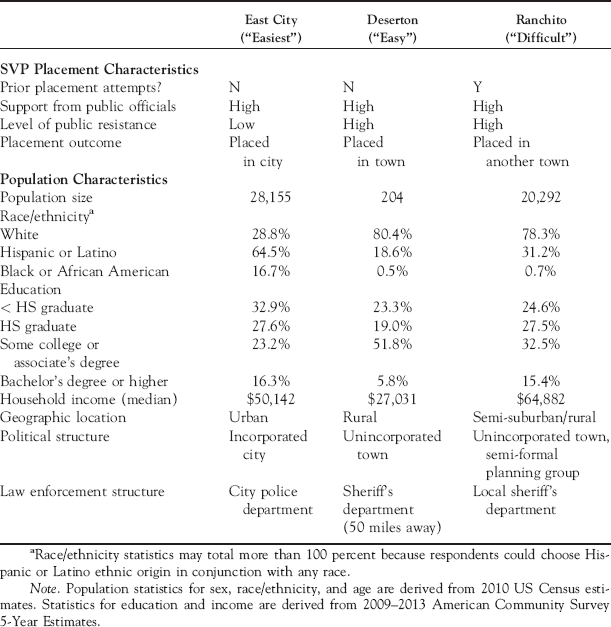
Four categories of SVP placements emerged from the media and interview data: easiest, easy, difficult, and most difficult. The “easiest” and “easy” placements occurred on the first attempt and involved high levels of support from local and regional officials, but varying levels of public resistance. On the other hand, the “difficult” and “most difficult” placements required multiple attempts, involved high levels of public resistance, and had varying levels of support from local and regional officials. The cases in the current study represent the first three of these categories.Footnote 5 Table 1 reports the characteristics of each of these siting conflicts as well as information about the demographics, geography, and political and legal structures of each place.
Characteristics of SVP Siting Conflicts and Local Populations

| East City (“Easiest”) | Deserton (“Easy”) | Ranchito (“Difficult”) | |
|---|---|---|---|
| SVP Placement Characteristics | |||
| Prior placement attempts? | N | N | Y |
| Support from public officials | High | High | High |
| Level of public resistance | Low | High | High |
| Placement outcome | Placed in city | Placed in town | Placed in another town |
| Population Characteristics | |||
| Population size | 28,155 | 204 | 20,292 |
| Race/ethnicityFootnote a | |||
| White | 28.8% | 80.4% | 78.3% |
| Hispanic or Latino | 64.5% | 18.6% | 31.2% |
| Black or African American | 16.7% | 0.5% | 0.7% |
| Education | |||
| < HS graduate | 32.9% | 23.3% | 24.6% |
| HS graduate | 27.6% | 19.0% | 27.5% |
| Some college or associate's degree | 23.2% | 51.8% | 32.5% |
| Bachelor's degree or higher | 16.3% | 5.8% | 15.4% |
| Household income (median) | $50,142 | $27,031 | $64,882 |
| Geographic location | Urban | Rural | Semi-suburban/rural |
| Political structure | Incorporated city | Unincorporated town | Unincorporated town, semi-formal planning group |
| Law enforcement structure | City police department | Sheriff's department (50 miles away) | Local sheriff's department |
a Race/ethnicity statistics may total more than 100 percent because respondents could choose Hispanic or Latino ethnic origin in conjunction with any race.
Note. Population statistics for sex, race/ethnicity, and age are derived from 2010 US Census estimates. Statistics for education and income are derived from 2009–2013 American Community Survey 5-Year Estimates.
The “easiest” and “easy” cases occurred in two disparate communities, both of which failed to stop the SVP placements in their towns. East CityFootnote 6 was an urban, densely populated, incorporated city in northern California with a racially mixed population that included predominantly Hispanic or Latino individuals, followed by whites and black or African American residents. The city had a formal municipal political system and a police department. By contrast, rural, unincorporated, sparsely populated, and predominantly white, Deserton had no formal political body and relied on the sheriff's department for law enforcement. In both places, there was a good working relationship between local officials and Health Corp, and the SVPs were placed on the first attempt. Despite similar levels of support from local officials, the levels of public resistance varied between Deserton and East City, with a longer period of more organized and intense resistance in Deserton than in East City.
The “difficult” case occurred in Ranchito, an unincorporated, semi-suburban town of just over 20,000 mostly white individuals that relied on its county's sheriff's department for law enforcement, but had a slightly more formalized political structure than Deserton, including a planning group that advised the board of supervisors on land-use issues. The proposed SVP placement there involved high public resistance and high levels of support from county officials for the placement. The SVP was ultimately placed in another town because the local landlord changed his mind about renting to the state.
Data Collection
I compiled comprehensive case studies of each siting conflict by conducting semi-structured, in-depth interviews with residents and local officials, searching online archives and media sources, and observing community meetings and protest events. I identified community members to interview by approaching people at notification meetings, calling those quoted in media articles, and asking respondents to identify others involved in the response. In East City and Ranchito, I also contacted people living near the SVP's house by mail, telephone, and in person. I conducted a handful of in-person interviews in each community, but the majority of interviews were conducted over the telephone. This approach yielded a total of fifty interviews with residents: twelve in Deserton, eighteen in East City, and twenty in Ranchito.
Compared to the overall populations in each place, a higher proportion of the community members I interviewed were female, and they were older and had higher levels of education and income. I interviewed a higher proportion of white individuals in Deserton and Ranchito, and a higher proportion of those who identified as black or African American in East City. These differences between population and sample statistics are not surprising given that older individuals with higher socioeconomic status are more likely to participate in civic life in California, and that civic engagement is patterned by race in that a larger proportion of whites reports civic engagement, followed by those who identify as black (Ramakrishnan and Baldassare 2004).
I also interviewed a key informant from Health Corp, as well as twenty officials: six in Deserton, eight in East City, and six in Ranchito. In each place, I attempted to contact those who represented the town politically, prosecutors and public defenders, and representatives from local law enforcement. Through initial interviews, I identified others involved in housing search groups and other aspects of the SVP placement process. The final sample consisted of seven attorneys involved in the cases, three nonattorneys involved in housing search processes, seven local political officials, and three county and municipal law enforcement officers.
The Production of Siting Conflicts
Despite differences between cases, interpretations of contradictory legal signals shaped siting conflicts over SVP placements in very similar ways across places. These signals informed decision makers’ choices about siting and community notification, and community members’ reactions to those decisions.
Housing Groups Find “Ideal” Hosts for Dangerous Subjects
Decision makers involved in siting a variety of perceived hazards and unwanted facilities tend to choose sites based on the likelihood that surrounding communities will mount effective opposition (Bullard Reference Bullard2000; Aldrich Reference Aldrich2008). As a result, low-income communities composed predominantly of racial minorities tend to house more garbage and hazardous waste facilities (Pellow Reference Pellow2004; Saha and Mohai Reference Saha and Mohai2005; Taylor Reference Taylor2014), and areas with concentrated rural disadvantage tend to house more prisons (Eason Reference Eason2010). A similar dynamic prevailed with SVP placements: decision makers knew that no community would welcome an SVP, so they searched for what I call “ideal” hosts, or those places that complied with legal requirements for sex offender housing and had communities that would ostensibly mount less powerful resistance than those in other areas.
Three legal mandates narrowed housing options to rural towns and the outskirts of urban areas. One section of the SVP statute requires SVPs to return to their county of last residence (Cal. Welf. & Inst. § 6608.5) and another requires that SVPs “not be placed within one-quarter mile of any public or private school providing instruction in kindergarten or any of grades 1 to 12, inclusive” if they have a history of victimizing children (Cal. Welf. & Inst. § 6608.5(f)). The state's residency restriction statute also mandates that sex offenders may not “reside within 2000 feet of any public or private school, or park where children regularly gather” (Cal. Pen. § 3003.5(b)). These laws, in conjunction with other political and practical concerns, contributed to an informal understanding of the characteristics of an “ideal” host community, which, when put into practice, highlighted and reinforced regional inequalities between communities.
Communities in relatively rural areas had fewer people, less political clout, and fewer resources to successfully fight an SVP placement; communities in urban areas with less political clout and fewer resources would also do. Although decision makers did not explicitly refer to these communities as “ideal hosts,” their discussions of placement decisions presumed that some communities made more sense for SVP placements than others. In one particularly revealing conversation, an individual who had been involved in numerous SVP placement decisions described his perspective on reactions in different communities:
You could imagine in a very sort of well-heeled community that … they'd just call their political leader. … So, I think in higher socioeconomic areas, the ways that people attack it are gonna be different there. Because you know, there's the pitchfork and torch, you know, from the Frankenstein movie, you know, “we're gonna go burn the monster.” And then there's the more sophisticated way to burn the monster. So you can get picket signs and you can stand out in front of places … Or, you can be very sophisticated and put political pressure [on decision makers and other officials].
He went on to say that these differences figured into discussions about where to house SVPs because the “well-heeled” communities could potentially cause more problems. As his explanations imply, by constructing the “monster” to be released and then providing no guidance on site selection processes, the SVP statute implicitly guided decision makers toward sites in less politically powerful communities.
Decision makers never explicitly discussed how intersections of race, class, and geography played into their choices of communities, but their decisions suggest that these factors entered into site choice. Community members agreed. As one individual from Ranchito explained, “with some folks, there's an assumption that if you go to what you think, what they think is a more rural community, that it'll be maybe easier to kind of hide somebody in that community.” In Deserton, a community member remarked on the connection between their limited voice in regional politics and the siting decision, explaining: “If I was a politician who was running for office and was making these decisions, I would do the same damn thing.” These community members in predominantly white communities did not mention race, but those in East City often referenced their racial and class status as a key reason for the siting decision. One explained that the SVP would not have been placed in predominantly white neighboring areas because they, unlike East City, had “political juice.” He went on to say, “I mean, the establishment is always doing what they choose to do and you know as people of color, we're always on the short end of that stick.” Together, all these comments suggest that race, class, and geography shaped communities’ political capital, which in turn played a key role in site selection and local perceptions of those decisions.
Community members assumed that their political powerlessness contributed to siting decisions, and they were right. For the placement that ultimately occurred in Deserton, the housing committee initially identified a nearly ideal site in another town: it was within the required county, far enough from schools, and relatively close to treatment facilities. Yet, according to those on the search committee, county officials objected to the placement because local residents had recently protested a proposed jail site near their town. As one committee member explained, “there was already significant community opposition to the jail being built within ten miles of this community. So, they were trying to protect the jail site. And they didn't want it tainted with an SVP being placed in the same general area.” The political infeasibility of that location contributed to the appeal of Deserton, a tiny, unincorporated rural place that was fifty miles from the nearest town. Deserton had little to offer in terms of reintegration: the community of 200 people was very close-knit, and the closest treatment facility was in the next town over. The proposed site in the middle of the desert had no existing home, so the county would have to build a trailer on the bare land. Despite these issues, a judge ordered the placement there after a year of searching for properties and reviewing over 100 potential options throughout the county.
The proposed placement in Ranchito seemed more compatible with reintegration goals, but still occurred in a relatively powerless community in the region. After a three-month search for housing in the required county, a local landlord agreed to rent his property to the state. The proposed home complied with residence restrictions, had few direct neighbors, and was relatively close to treatment facilities. Many community members described their town as having a “rural atmosphere,” which they believed contributed to the siting decision. Indeed, when asked about the features of the location that made it a good place to put the SVP, one person involved in the housing search said: “It was fairly rural. And it was fairly … It wasn't nearly as rural as the place that was laid out in [another part of the] county, but it's not a populated downtown area.” While her answer focused on the physical features of the place, the town, like many rural areas, was also unincorporated, which meant the community had less political clout in the region than the nearby metropolitan city.
Decision makers could not always place SVPs in rural towns. Relatively small and densely populated counties forced housing committees to settle for more urban areas, as was the case with the placement in East City. There, a county-wide search lasted over a year and resulted in reviews of over 1,000 properties. Few locations complied with residence restrictions, and landlords in legally acceptable areas often refused to rent their homes to the state. These challenges resulted in a site almost completely at odds with an “ideal” location: it was near schools in a densely populated urban neighborhood. According to those involved in the placement process, when the length of the search began to raise concerns about the constitutionality of keeping the SVP in custody, the judge reviewed a handful of homes that did not comply with residence restrictions and then declared the home in East City the most suitable for the placement.
This outcome suggests that the geographic isolation and small populations of rural areas may have served as a proxy for a community's lack of political power to resist a siting decision. In this respect, the site in East City was an “ideal” location because the community of mostly lower- and working-class racial minorities had less political clout than nearby wealthier, whiter communities.
The placements in Deserton, East City, and Ranchito suggest that decision makers responded to legal signals about SVPs’ dangerousness by adopting their own politically informed ideas about which sites would best address legal regulations and concerns about public safety. These decision makers chose sites based on considerations similar to those involved in siting unwanted facilities (cf. Bullard Reference Bullard2000; Aldrich Reference Aldrich2008), and communities with less political clout bore the brunt of their decisions (Pellow Reference Pellow2004; Saha and Mohai Reference Saha and Mohai2005; Eason Reference Eason2010; Taylor Reference Taylor2014). The SVP statute set the foundation for these inequalities by remaining silent on site selection processes.
Decision Makers Inform “Hysterical” Communities
After choosing sites, decision makers had every reason not to notify communities about impending SVP placements. Nothing in California's SVP statute or community notification law requires public involvement in SVP siting decisions. Once a site has been chosen, the SVP statute requires only that the Department of State Hospitals notify “the sheriff or chief of police, or both, the district attorney, or the county's designated counsel” in the community where the recommended site is located (Cal. Welf. & Inst. § 6609.1(a)(1)), and that law enforcement “may notify any person designated by the sheriff or chief of police as an appropriate recipient of the notice” (Cal. Welf. & Inst. § 6609.2).Footnote 7 These elements of the statute allowed local officials to notify the public, but did not require them to do so. Similarly, California's sex offender community notification law required that the Department of Justice “make available information concerning persons who are required to register pursuant to Section 290 to the public via an Internet Web site…” (Cal. Pen. § 290.46(a)(1)), but did not require active community notification.
Decision makers also shared the stereotype that communities would react with panicked vigilantism. For instance, one decision maker for the placement in Deserton characterized the public's concerns as “irrational fears” and went on to explain that they did not publicize the exact date when the SVP would move in because they “were afraid that somebody would show up and put a bullet in his head.” Others stated that communities in general react with “raw emotion” and “They go crazy.” Despite these fears of vigilantism and legal signals that active community input was not necessary, decision makers in Deserton, Ranchito, and East City felt compelled to hold community notification meetings.
Their reasoning for holding the meetings demonstrates the predicament in which the SVP statute's contradictory signals about dangerousness put them. One member of the housing search committee in Deserton explained that they felt a “responsibility to tell people” because “we thought it would be really, it would be unethical and unprofessional to just slide him out there and not tell anybody. So we thought, ‘You know what, we don't have to do it, but we do have to do it.’” The sense of ethical obligation that she described stemmed from a recognition that communities needed to know about the potential dangers involved in SVP placements.
Others were less sure of the value of notification meetings, but they still emphasized the need for communities to voice their concerns. One attorney involved in the placement in East City said she had “mixed feelings about the whole public notification” because:
Like, I understand why it is because you're saying “Look, this is one of the few in the small percentage who's the worst of the worst and he's getting out now.” And I can understand why people want to know that. But, like I said, it increases anxiety and gives people this false sense of security that they were safe before the SVP got there. … I don't know that the public notification in just SVP cases really is all that helpful. Other than the fact that it gives the community an opportunity to be heard.
Her explanation demonstrates that the inherent contradiction in the SVP statute contributed to the perceived need for active community notification. Decision makers felt they had to notify the public because of the presumed dangers posed by SVPs, but notification meetings would also highlight these dangers and, in doing so, may have caused more problems than they were worth.
Meetings in Deserton, Ranchito, and East City occurred at different points in the siting process. Community members in Ranchito found out about the proposed placement in their town when the planning group chair organized a community meeting during the fifteen-day comment period. The chair, a long-time Ranchito resident and local realtor, felt compelled to hold the meeting as soon as she heard about the proposed SVP placement so that the community would have a venue to voice its concerns. Individuals in Deserton and East City were not aware of the opportunity to provide feedback during this period, but local law enforcement, some of whom had been involved in the placement decision, organized their community meetings after the judge in each case had ordered the final placements.
The meetings in all three places began with a panel of local officials, law enforcement, and Health Corp representatives presenting information about the SVP and the conditional release process. After these presentations, meetings were opened to public questions and comments. As with other types of controversies over siting radioactive waste (Barthe and Mays Reference Barthe and Mays2001) and biocontainment labs (Beamish Reference Beamish2015), community meetings about SVP placements mainly involved decision makers managing information about the SVP and community members contesting expert opinions about the hazards involved with the siting decision.
Audience members’ questions and comments indicated that they believed SVPs posed extreme danger to their communities and they wanted to know what would happen in the event of a reoffense.Footnote 8 In East City, one audience member asked who was responsible when the SVP “strikes again.” The Health Corp representative responded that the SVP himself was responsible, to which the audience mumbled its disapproval. In Deserton, many residents asked how they should protect themselves, especially given their remote location and long response times by law enforcement. When the sheriff's division chief responded that they should only engage in legal actions, a man in the back of the room whispered to his friend: “What if something happens to him?” Similar suspicions about an SVP's threat to the community prevailed in Ranchito, where one resident described the SVP as a “time bomb” and another asked if there was any “guarantee that children will not be molested” if he moved into town.
Protecting children became a key point of contention, as community members invoked signals from California's 2,000-foot residency restriction law to argue that placement decisions would lead to new victims. This law signaled that excluding identified sex offenders from some areas would increase public safety, and community members interpreted this to mean that placing SVPs in communities with children would lead to future sex crimes. As a school principal in Ranchito argued in a letter to the judge: “[The SVP] must not be placed in such proximity to our school, to bus stops for our schools, or to any area where this repeated sexual predator can find access to the children in our community.” For her, any “access” was unacceptable. Similarly, in Deserton, residents opposed the location of the SVP's trailer in the middle of an area of the desert in which children “hung out” and walked through on the way to the café. Even in East City, where the SVP had targeted adult women rather than children, residents wondered why the judge had placed him in a neighborhood where “he's surrounded by children.”
Empirical evidence contradicts the assumptions made by residency restriction laws, showing that residential proximity to children does not increase the likelihood of sexual offenses (Levenson Reference Levenson and Wright2009; Terry Reference Terry2011) and that family members and acquaintances perpetrate the vast majority of sexual offenses (Planty et al. Reference Planty, Lynn, Christopher, Marcus and Hope2013). Nonetheless, by ostensibly protecting the spaces where vulnerable populations were present, the signals from residency restriction laws provided an opening for local residents to oppose SVP placements on the grounds that the placements would endanger the community, and children in particular.
Panelists responded to these concerns as best they could. A Ranchito resident explained: “They weren't saying this guy's not dangerous. They weren't trying to blow smoke up anybody. They were acknowledging that he's a high-risk guy and they were in great detail about the plans to mitigate that. … But they never said, ‘This guy's no danger.’” Decision makers tried to be honest about the potential dangers, but providing details about their “plans to mitigate” the dangers never assuaged community members’ fears.
An East City woman's comment explains why. She said, as recorded in field notes: “If you're so sure that he's ready to leave treatment, he wouldn't have all these conditions.” With this statement, she clearly mobilized the inherent contradiction in the SVP statute to challenge the siting decision: if SVPs are as dangerous as the law makes them sound, then they should not be let out into communities. While decision makers held notification meetings to increase public safety and mitigate some local opposition, their actions inadvertently fueled siting conflicts as community members recognized and reacted to contradictory legal signals about the dangerousness of SVPs.
Community members’ discussions of SVPs reveal how the SVP label signaled the extreme danger that provoked their fears during community notification meetings. A Ranchito resident explained: “He should not be out because he's a violent sexual predator. He didn't just pat a little kid on the butt and try to see what kind of underwear they were wearing; he hurt children.” In East City, a resident surmised that the placement became such a big issue in the community “because of the violent nature of his crime.” As these comments indicate, the “sexually violent” part of the legal label signaled the dangerousness of the person being placed in each town.
The “predator” part of the label reinforced the perceived danger by signaling that SVPs were not human and could not be cured. For instance, a person in Ranchito compared SVPs to wild animals: “You know how some people like to take wild animals and make them pets and then they get killed? … It's a wild animal. … [Y]ou can't control its instincts, right? Well, I think these pedophiles, or the extremes like this [SVP] character, the extremes, you never know when he's gonna go off.” A Deserton man echoed this analogy by comparing SVPs to pit bulls that repeatedly attack people. For these community members, the “predator” part of the legal label invoked images of a dangerous wild animal instinctually preying on vulnerable populations.
The majority of those I spoke with did not explicitly compare SVPs to animals, but the term “predator” still signaled a fundamental difference between these individuals and “normal” human beings, which contributed to their perceived dangerousness. Community members described the problem with SVPs as “something in their DNA,” “something [that] short-circuited in their brain,” and as having “arrested development” and “a sickness.” These perceived fundamental flaws in SVPs’ biological makeup contributed to a belief that they could never be cured or “talked out of” their impulses to sexually abuse others. “You cannot rehabilitate somebody like that,” said a Ranchito community member. “There's something just wrong with them …” A county official summed up the “incredible picture” created by the SVP label as “these kind of fire-breathing guys with red eyes who are going to throw you to the ground, beat you, rape you, cut off your head.” As these comments suggest, the legal label of “sexually violent predator” signaled that these offenders were not human, increasing fear that they would reoffend when given the chance.
From community members’ perspectives, these sociolegally constructed dangerous individuals had no place in their towns. Yet, the law required their release without any input from local communities. This inherent contradiction extended community members’ concerns beyond a fear of the perceived dangerous individual to claims of procedural injustices rooted in signals from California's community notification law.
“Hysterical” Communities in “Ideal” Locations Protest Perceived Injustices
Upon learning about notification meetings, community members in all three places expressed their outrage in terms of a right to know about potential threats. “If we have dangerous people in our midst,” said a Ranchito resident, “how could we not be informed about it?” In Deserton and East City, where SVPs actually moved in, protestors described their actions as “doing our part letting people know” and “mak[ing] the community aware of what was going on.” One resident explained, “the whole purpose of [protesting] was to express our discomfort and to get out the information to the people of the community.” A Ranchito resident summed it up as, “I don't want to live next door to a sexual predator on the one hand. On the other hand, if I know who he is and where he is, that's kind of a benefit to me, isn't it?” These community members assumed that knowing about an identified sex offender would reduce the chances that they or their children would become victims.
Community notification does not appear to reduce recidivism or increase self-protective behaviors (Bandy Reference Bandy2011; Terry Reference Terry2011). However, as decision makers for SVP placements found out, making information available to local residents about identified sex offenders can create and reinforce a sense of “information entitlement” (Logan Reference Logan2009) in which community members believe they have a right to information. Nationally mandated community notification laws such as the one in California further reinforce this sense of entitlement by signaling to communities that knowledge increases public safety, a theme reflected in community members’ claims that they had a right to know about potential threats.
Those in Deserton, Ranchito, and East City also adopted a broader interpretation of the legal signal that knowledge increases safety. As with local opposition to public housing projects (Ruming Reference Ruming2013) and waste facilities (Leonard, Doran, and Fagan Reference Leonard, Doran and Fagan2009; Wolsink and Devilee Reference Wolsink and Devilee2009; Krutli et al. Reference Krutli, Stauffacher, Pedolin, Moser and Scholz2012), community members claimed that they had a right to know about and be involved in decision-making processes, and that SVP placement processes had unfairly excluded them from siting decisions. While the SVP statute said nothing about community involvement in placement decisions, community members interpreted signals from California's community notification law as affording them a right to know about identified threats and a responsibility of the state to involve communities in ensuring public safety.
When community members learned of proposed SVP placements, many were suspicious that decision makers were trying to “slide” an SVP into their town. An East City man described his initial reaction as a feeling that the community had been “raped.” A man in Deserton explained: “It was kind of like [the SVP] was being dropped out of space. We didn't know what was the process that led up to a selection of a residence for a person. We had no idea at all what was behind him coming.” A Ranchito resident echoed this sentiment by saying: “The community was upset that it was just kind of popped, you know, ‘Surprise!’ The feeling was I think that it was intended to be kind of a stealth ‘let's move him in’ without letting the community know about it beforehand.” All these comments suggest that community members believed they had a right to know not only about individual SVPs, but also about the decision-making processes leading up to SVP placements.
Some community members hoped that notification meetings would give them a chance to have input into placement decisions. A woman from Deserton explained that she had expected “them to listen to us and that we were gonna have some kind of say if this person was gonna come here or not.” Similar ideas emerged in East City, where a man said he believed going into the meeting that they could “turn [the decision] around,” and in Ranchito, where one individual “was hopeful that the community's input would have influence” over the final decision.
Community members in Deserton believed so strongly that they might be able to participate in the final decision that they strategized about how to be taken seriously by those holding the meeting. One woman explained that when they were trying to come up with “a game plan” for the meeting, “we tried to keep people as calm and focused as much as we could and make them look at it from a logical perspective because getting hysterical wasn't going to do us any good.” They recognized the stereotype of communities as hysterical, and they tried to exercise their perceived right to participate in siting decisions by presenting “logical” concerns.
Those who attended the meetings in Deserton and East City were sorely disappointed. “They weren't there for our input,” said a Deserton resident. “They were there to give us information about what they're doing. Not what they're planning on doing or what they'd like to do, but this is what we're doing.” The expectation of input into final siting decisions increased frustration among community members when they realized that decisions had already been made. A community member in Deserton explained: “It didn't matter what you said to them, he was coming out here. ‘Too late, the judge already made the decision, you're it.’ And that's what it all boiled down to and that's when people really got upset. Because you just basically already did it, why did we have this meeting? You could have cared less what we had to say.” A resident in East City expanded on this perspective by describing SVP placements as “orchestrated. It's an agenda to move these people in because the state says that they can be placed in, in houses.” These “orchestrated agendas” left no room for the community participation to which local residents believed they were entitled.
By contrast, the meeting in Ranchito lived up to community members’ expectations. Many believed that the community had been able to provide input into the final decision. As one individual put it, “I appreciated them giving us the information and giving us the opportunity to have a say and not just doing it. Rather than just sticking him in a house somewhere here.” Another explained: “They put the opportunities out there for the community to say their piece and that's what it's all about. That's democracy.” Those in Ranchito believed that despite their initial concerns about the placement process, it had been fair in the end. This perceived fairness of the process may have stemmed from their success in stopping the SVP placement. The day after the community meeting, the prospective landlord called a press conference, tore up the rental deposit check, and declared that he would never have agreed to rent the home had he known what the state planned to do with it.
The landlord claimed in an interview and on television that he had planned before the community meeting to tear up the rental deposit, but some community members believed that pressure at the meeting had persuaded him to terminate the rental agreement. One resident explained that after the meeting she had approached the landlord:
I showed him a picture of my children and told him, “I am only asking you to think about what you're doing. Think about this, look at these children. These are the children in our community that are at risk. Think about putting them in this position.” And that's all I had to say. And I walked out. In tears.
This type of pressure occurred before, during, and after the meeting, contributing to a dynamic that one community member described as, “[b]asically, the residents just shamed him into [backing out of the rental agreement].” Regardless of the landlord's true motivations, the proposed placement failed in Ranchito, leading some residents to conclude that the process had been fair. As one put it, the community's response to the SVP placement was “one of our better success stories of giving input.” Despite their initial assessments of the placement process as unfairly excluding their participation, these community members believed that the meeting had provided them the necessary forum to participate in the final placement decision.
Community members in Deserton and East City saw things differently. They felt excluded throughout the placement process and their opposition efforts ultimately did not stop the SVP placements in their towns. In the days following the notification meeting in East City, the mayor organized a large protest. Local activists, most of whom lived in the immediate vicinity of the proposed placement location, also protested by picketing, delivering petitions to the out-of-town landlords, and discussing a potential lawsuit. As one local leader explained: “We met and we talked and we tried every legal way that we knew how, but the only other way was to uh, we would have to get an attorney and go from a legal angle and we had no money, so …” They believed that litigation would help their cause, but they could not find someone with the legal skills necessary to navigate the courts. When the SVP moved in a week before the announced date, some discussed continued action, but talk of a unified response ultimately gained little traction. The SVP moved in without incident and protests died down shortly thereafter.
While those active in the East City community's opposition to the placement had little faith that they would gain a voice in the placement decision, some felt they had to show their dissatisfaction with their exclusion from the placement process. They described the placement as another attempt to “dump” a problem person in their city, with one resident explaining: “The consensus was that everybody just felt that they were being dumped on again.” Yet, they still protested. One woman explained that while she found the picketing physically and emotionally difficult, “it was worth it” because “if you don't stand up for something …” Another echoed this sentiment by comparing the community's response to the SVP placement with community groups that “try to take a stand for things they believe in.” These community members struggled to assert their perceived right to know about and participate in decisions adversely affecting their community. Even when they believed that their actions would not change the final decision, they still tried to have a voice.
Deserton residents shared the frustration of being excluded from siting decisions. Similar to community members in East City, they believed they had been routinely “dumped” on. According to one community member: “The county doesn't care about us except when they want to dump somebody like that on us.” Another agreed by saying: “People are a little tired of ‘It's just the desert, just dump him out there.’” They too believed they had a right to participate in siting decisions and they struggled to assert this right in light of the SVP placement. However, in contrast to East City, those in Deserton believed the opposition efforts were successful.
After the community notification meeting in Deserton, a local resident sued the county for failing to secure the proper permits to put a trailer on the previously unoccupied land and later for failing to release documents related to county-level meetings and discussions about the SVP placement. The community supported his efforts by going to court and holding fundraisers for court fees and travel costs. They won both cases. When the county released heavily redacted documents, the case proceeded all the way to the California Supreme Court, which declined to review the case. The litigation may have continued, but local activists ended their fight when a national news program aired a story about the community's opposition to the placement, which included a segment in which the district attorney stated that he would not allow another SVP placement in Deserton. Satisfied with this public statement, community members ended their campaign against the siting decision.
For many in Deserton, drawing attention to the perceived injustice of the placement counted as a victory. As one person said, “from our point of view [the media attention] was a big success because the county had tried to hush this thing up.” Another community member's account of the response and its outcome highlighted the importance of being heard in the community's narrative of their success. He said:
They probably thought that this was gonna be easy pickings, so to speak. Who would care out here anyway? A bunch of dummies and old retired folk. A bunch of losers living in trailer parks and stuff like that. So they thought, “Oh we'll just put that right out here and nobody will care.” Well, all hell broke loose. [He laughed.] And it didn't work out for them. They've got egg all over their face. All of the sudden, they've got [a national news correspondent] doing interviews and articles being written in [a national newspaper] and stuff like that. So, this is the sort of thing that they don't want.
As his description indicates, community members resisted the choice of their town to house an SVP by protesting in the most vocal way they could: through litigation, a strategy that other social movements have successfully used to gain power in political battles (McCann Reference McCann1994). While they still believed the process had violated their rights to know about and be involved in placement decisions, their ability to mobilize the courts, and later the media, in their favor contributed to their assessments of the opposition efforts as successful. They had not changed the ultimate outcome of the placement decision, but they had been able to have a say in the process.
Underlying all these claims of injustice were the inherently contradictory signals provided by the SVP statute. Community members ardently believed that the person coming to their town, a person labeled as the worst of the worst type of sex offender, could not and should not be allowed to reenter society. From this perspective, the law itself allowed for grave injustices to occur by requiring SVPs to be released into communities without any sort of local input. A Ranchito resident summed it up best by saying: “We just need to keep an eye on the government and make sure they're doing their job and keeping these people away from our children.” As with perceptions of fairness in litigation efforts (Berrey, Hoffman, and Nielsen Reference Berrey, Hoffman and Nielsen2012), community members assessed the fairness of SVP placements in terms of both placement processes and outcomes. Their interpretations of legal signals from the SVP statute and other sex offender laws shaped their sense of injustice, which was rooted in perceptions of SVPs’ dangerousness and communities’ rights to know about and be involved in proactively protecting their communities.
Conclusion
The current study has shown how contradictory signals about the dangerousness of SVPs produced siting conflicts in California. Despite the legal signal that SVPs posed an extreme threat to society, California's SVP statute said little about how sites should be chosen and communities should be involved. In light of this legal silence, decision makers adapted their own processes, which included selecting relatively powerless “ideal” hosts and then notifying communities of upcoming placements. These decisions reinforced inequalities between communities and highlighted community members’ exclusion from decision-making processes. Community members responded by pointing out the contradiction in the SVP statute and drawing on signals from other sex offender laws to mount their opposition. Their interpretations of the signals from the state's residency restriction and community notification laws contributed to a belief that siting decisions had been unfair because they had resulted in SVPs living too close to children without providing an opportunity for community input into the decisions.
These findings complicate moral panic explanations of societal reactions to sex offenders. Consistent with critiques of the conceptualization of these reactions as moral panic (Janus Reference Janus2006; Leon Reference Leon2011), institutional and local factors shaped community opposition to SVP placements. In particular, contradictory legal signals about the dangerousness of SVPs and the role of communities in ensuring their own public safety contributed to perceived unequal siting processes and outcomes. Unfortunately for community members, the translation of these same signals into action empowered decision makers at the expense of communities. Without legal restrictions on site choice, decision makers chose sites based at least in part on political feasibility, which increased the chances that communities with less political capital would receive SVP placements. Even though decision makers held notification meetings—a subtle resistance to the SVP statue's legal signal that community involvement was not necessary—these meetings did not allow community members to have input into final placement decisions.
Even so, some communities exercised more power than others during these siting conflicts. In Ranchito, arguably the least “ideal” community based on its predominantly white racial composition, higher socioeconomic status, more suburban atmosphere, and semi-formal political structure, community members effectively stopped the SVP placement in their town. They too perceived the placement as unjust and invoked legal signals to make their claims, but they were able to leverage those signals in their favor as they convinced the local landlord to side with them against the state. Thus, even when community members interpreted legal signals in similar ways, those interpretations interacted with existing race, space, and class inequalities to shape siting conflicts.
Theoretical Implications
By revealing the sociolegal dynamics at play in local siting conflicts, the current study advances our understanding of the role of the law in collective action efforts and, more broadly, in producing and reinforcing inequalities. As with conflicts over SVP placements, inequalities in site selection (Pellow Reference Pellow2004; Saha and Mohai Reference Saha and Mohai2005; Mohai, Pellow, and Roberts Reference Mohai, Pellow and Roberts2009; Eason Reference Eason2010; Taylor Reference Taylor2014), lack of community participation (Leonard, Doran, and Fagan Reference Leonard, Doran and Fagan2009; Wolsink and Devilee Reference Wolsink and Devilee2009; Krutli et al. Reference Krutli, Stauffacher, Pedolin, Moser and Scholz2012; Ruming Reference Ruming2013), and claims of injustice in siting decisions (McDowell Reference McDowell2013; Beamish Reference Beamish2015) all feature prominently in existing explanations of disputes over siting a wide range of unwanted facilities. Conflicts over siting SVP placements involve similar political dynamics, but findings from the current study suggest that legal signals also impact site selection, community involvement, and perceptions of justice in siting decisions.
The impacts of legal signals on siting conflicts extend traditional conceptions of how the law shapes collective action in at least three ways. First, activists often choose among competing legal frames to assert their rights, and their choices can shape the outcome of their cases (Paris Reference Paris2010). By contrast, in one-shot, short-term siting conflicts, community members have little time to organize their efforts, and even less time to haggle over which competing legal frames will best serve their interests. These community members are not usually experts in the relevant laws and they have little understanding of the court decisions that create the situations to which they react. Yet, signals from state laws shape their arguments. While these local activists do not specifically choose legal frames to assert their rights, contradictory legal signals help them translate their everyday understandings of the law into claims of injustice while at the same time providing fodder with which decision makers can defend their decisions.
Second, state laws can empower potential activists when they provide a legitimate identity for asserting rights (Abrego Reference Abrego2008). In siting conflicts, state laws may signal that local residents should organize in the name of their communities. However, this identity does not always empower those communities. Decision makers’ interpretations of and responses to legal signals about community involvement can preclude already marginalized communities from stopping siting decisions. When community members rely on other legal signals to assert their rights, they may be perceived as hysterical, uninformed, and too emotional to legitimately participate in siting processes. In these instances, identities provided by the law make it easier for decision makers to retain their power in siting decisions.
Finally, while access to the courts may create opportunities for activists to use the law to gain leverage in political battles (McCann Reference McCann1994; Vanhala Reference Vanhala2012), signals from state laws can also draw activists into local conflicts in ways that highlight and reinforce their powerlessness in state-level decisions. By the time siting decisions become public knowledge, interpretations of legal signals have already guided decision makers to choose sites where communities have less access to political power. Informing communities of these siting decisions emphasizes that they have no say in protecting themselves from perceived threats or from state-imposed decisions. When they try to assert their rights to self-governance and local control over public safety, the most racially and socioeconomically disadvantaged communities find that contradictory legal signals interact with their lack of political and economic capital to privilege decision makers over communities.
In all three of these ways, contradictory legal signals undermine local opposition efforts. This conception of the role of the law in collective action provides a counter to traditional legal mobilization accounts that portray the law as a powerful strategic tool for gaining leverage in social movements. Future research must continue this line of inquiry by examining whether and to what extent policy makers draft legislation to explicitly include legal signals. If they realize the contradictions in their policies and use signals to guide decision-making processes and local responses to decisions, then they, too, play a direct role in producing siting conflicts.
Policy Implications
The clear impacts of legal signals on conflicts over SVP placements also suggest some changes that could be made to existing policies to mitigate some of the difficulties inherent in reintegrating high-risk sex offenders into society. First, naming individuals with the highest levels of risk as “sexually violent predators” serves little purpose other than to exacerbate local opposition to reintegration efforts and direct the public's attention away from addressing the broad societal causes of sexual violence (Janus Reference Janus2006; Prentky, Barbaree, and Janus Reference Prentky, Barbaree and Janus2015). Categorizing sex offenders by risk level has some empirical support (Prentky, Barbaree, and Janus Reference Prentky, Barbaree and Janus2015) and other sex offender laws also hinder reintegration efforts (cf. Hudson Reference Hudson2005; McAlinden Reference McAlinden2007; Levenson and Tewksbury Reference Levenson and Tewksbury2009), but eliminating the SVP label would remove one hurdle in the already fraught process of reintegrating sex offenders into society.
Two other issues featured prominently in the current study: inequalities in site selection and the lack of local input in siting decisions. Mandated community inclusion in siting processes would begin to address both issues. Without opportunities to engage in productive conversations with decision makers about the relative merits and drawbacks of potential site choices, community members remain an outside entity with the potential to disrupt siting decisions rather than potential partners in siting processes. Participation in siting decisions may not eliminate tensions between community members and decision makers (Cooke and Kothari Reference Cooke and Uma2001), but inclusion in the form of ongoing partnerships between these two groups can help (Quick and Feldman Reference Quick and Feldman2011). For SVP placements, housing search committees should include a representative sample of local residents from potentially affected communities. Their role should be similar to that of local authorities who draw on their knowledge of local places to discuss the feasibility and suitability of proposed sites.
While community inclusion may seem unrealistic when it comes to “siting” SVPs, some evidence suggests that community members will productively participate in efforts to reintegrate sex offenders into society. Circles of Support and Accountability (COSAs) provide one model by which this can happen: community volunteers build a network of support for sex offenders reentering society after incarceration and they hold these individuals accountable for their actions within the community (Fox Reference Fox2015). COSAs have been implemented for high-risk offenders in a number of countries, including the United States, and they have had positive effects on reintegration outcomes (Cesaroni Reference Cesaroni2001; Bates, Saunders, and Wilson Reference Bates, Saunders and Wilson2007; Wilson, Cortoni, and McWhinnie Reference Wilson, Cortoni and McWhinnie2009; Duwe Reference Duwe2013; Fox Reference Fox2015). A similar model should be employed with SVP placements.
SVP placements share some similarities with other siting conflicts, and the suggestions to revisit legal labels and mandate community inclusion in siting processes apply to these conflicts as well. However, the dynamics uncovered in siting conflicts over SVP placements must be analyzed in other contexts. Siting decisions governed by stricter regulations on site selection and community participation may provide more opportunities for contradictions and ambiguities to fuel tensions between decision makers and communities. Decisions that invoke differing levels of fear and risk may dampen or amplify the effects of legal signals on siting conflicts. As demonstrated with the case of conflicts over SVP placements, any analysis of these effects of legal signals must attend to the ways laws privilege decision makers over community members, perpetuating inequalities as communities struggle to assert their rights to local control over matters of public safety.