Introduction
Increasing attention has been paid to the situation of staff working in dementia care and their well-being. We know that one of the most important aspects contributing to job satisfaction is to be able to provide person-centered care (Orrung Wallin et al., Reference Orrung Wallin, Jakobsson and Edberg2012). Similarly, we know that inability to provide the care needed is a major source of strain (Edberg et al., Reference Edberg, Bird, Richards, Woods, Keeley and Davis-Quarrell2008). Interventions directed to improve the prerequisites for care provision thus, in turn, affect the well-being of the staff. To date, there are few instruments developed to measure care-related aspects of staff strain, and there is a lack of instruments developed for the dementia care context. Such an instrument is urgently required to evaluate the effects of interventions aimed at staff caring for people with dementia.
Even though most staff working in dementia care are generally satisfied with their work and find it rewarding (Brodaty et al., Reference Brodaty, Draper and Low2003; Castle et al., Reference Castle, Degenholtz and Rosen2006), they also report stress and strain. Commonly reported examples of work-related contributions to strain are organizational and management issues such as low staffing levels, excessive workloads and competing demands, lack of emotional and practical support, leadership styles, low levels of autonomy, and even job uncertainty (Moniz-Cook et al., Reference Moniz-Cook, Woods and Gardiner2000; Brodaty et al., Reference Brodaty, Draper and Low2003; Edvarsson et al., Reference Edvardsson, Sandman, Nay and Karlsson2009). This is supported by a review of the literature about aspects that contributed to workplace stress (McVicar, Reference McVicar2003) where heavy workload, the work environment, poor leadership, professional conflicts, and emotional demands of caring were found to contribute to stress. Stress and strain are inter-related concepts, and Knapp (Reference Knapp1988) suggests that stress refers to the work situation, while strain can be seen as an effect of stress. The fact that staff do experience significant stress (Edberg et al., Reference Edberg, Bird, Richards, Woods, Keeley and Davis-Quarrell2008; Edvardsson et al., Reference Edvardsson, Sandman, Nay and Karlsson2009) is a serious issue because their well-being has been shown to be inextricably linked with the quality of care, and therefore affects the quality of life of residents (Edvardsson et al., Reference Edvardsson, Sandman, Nay and Karlsson2009). We also know that stress and feelings of inadequacy increase the risk for misunderstandings and failures in the provision of nursing care, and that a greater level of job strain seems to be associated with more verbal behavioral symptoms among residents (Edvardsson et al., Reference Edvardsson, Sandman, Nay and Karlsson2008). It is thus important to highlight job-related strain among residential staff, not only for their own well-being but also for the effects on the quality of care provided.
Staff in residential care are often inadequately trained, grossly underpaid, and accorded low status (Beck et al., Reference Beck, Ortigara, Mercer and Shue1999), and caring for people with dementia in residential facilities is a physically and emotionally difficult job, which requires a large range of personal and practical skills (Edvardsson et al., Reference Edvardsson, Sandman, Nay and Karlsson2009). Accordingly, one of the most obvious causes of staff stress might be the sheer intrinsic difficulty of working with people with cognitive impairment, and especially where psychological and behavioral symptoms may be present (Morgan et al., Reference Morgan, Stewart, D’Arcy, Forbes and Lawson2005; Bird et al., Reference Bird, Llewellyn-Jones, Korten and Smithers2007; Edvardsson et al., Reference Edvardsson, Sandman, Nay and Karlsson2008; Schmidt et al., Reference Schmidt, Dichter, Palm and Hasselhorn2012). The presence of behavioral and psychological symptoms (BPSD) is, however, not the only stressor in the care of people with dementia. Instruments measuring staff stress or burden in relation to patients’ behavior only (e.g. Schmidt et al., Reference Schmidt, Dichter, Palm and Hasselhorn2012) thus have limitations concerning the overall picture of staff's experience of strain in their work. For example, staff who have more experience and insight into caring for people with dementia, are more likely to know how to meet their needs and are therefore less likely to encounter stressful situations or, when they do, less likely to be stressed by them (Morgan et al., Reference Morgan, Stewart, D’Arcy, Forbes and Lawson2005). Within-staff factors, such as attitude, confidence and self-efficacy, skills, and knowledge, appear to be key variables (Morgan et al., Reference Morgan, Stewart, D’Arcy, Forbes and Lawson2005; Duffy et al., Reference Duffy, Oyebode and Allen2009), and the way staff perceive and respond to residents is an equally crucial variable. Faced with the same behavior by the same resident at the same time, one staff member may find it intolerable, another may be unable to see what the problem is. Even senior staff will disagree about who in their facility displays behavioral symptoms (Bird et al., Reference Bird, Llewellyn-Jones, Korten and Smithers2007).
In summary, there are diverse reasons why dementia care staff experience strain and sometimes outright distress. Given that many report overall satisfaction despite low pay and status and the difficulty of the work, it seems important to ameliorate the factors that do exacerbate stress so that the quality of their working life can be improved and, by extension, the lives of those in their care. To do this, it is necessary to identify the principal contributors to staff stress. So far, most work on this issue has tended to use generic work stress or burnout instruments, attitude scales, or mental health scales (e.g. Morgan et al., Reference Morgan, Stewart, D’Arcy, Forbes and Lawson2005; Duffy et al., Reference Duffy, Oyebode and Allen2009) with limited applicability to the dementia-specific context.
Aim
The aim of this study was to develop a dementia-specific scale for staff: the Strain in Dementia Care Scale (SDCS).
Material and methods
Design
The development of the scale had its point of departure in a revision of the Strain in Nursing Care Scale (SNCS) (Hallberg and Norberg, Reference Hallberg and Norberg1993), which was developed in 1990 and later used in a modified version in Australia (Brodaty et al., Reference Brodaty, Draper and Low2003; Bird et al., Reference Bird, Llewellyn-Jones, Korten and Smithers2007). The original scale comprised 21 positive and negative patients’ characteristics (such as being aggressive, calm, stubborn, unpredictable, and grateful). The scale had a two-fold response format, where the nurses (a) should rate as to what degree they found the characteristics to be present, and (b) to what degree they found it easy or difficult to handle. Each response alternative ranged from 1–4. We investigated the face validity of the scale during focus group discussions (Edberg et al., Reference Edberg, Bird, Richards, Woods, Keeley and Davis-Quarrell2008) and found it to be poor as dementia care had changed significantly since the SNCS was developed. We therefore decided to develop a new scale with new items, but kept the two-fold response format measuring the frequency as well as the level of stress the nurses experienced.
The instrument was developed in three steps. In step 1, 64 items were derived from focus group discussions. In step 2, exploratory factor analysis was applied to the 64-item scale, which had been trialed on a large sample. Step 3 comprised a confirmatory factor analysis (CFA) based on a revised 29-item scale answered by a new sample of dementia care staff. As each step required a new sample and different analyses, each step will be presented separately and in chronological order.
Step 1. Deriving items
Sample and data collection
Discrete items were derived from focus group interviews with staff in Australia, Sweden, and the United Kingdom, two focus groups in each country, in all six focus groups, with 5–7 participants (n = 35) which asked explicitly about their experience of strain in dementia care. The participants were licensed nurses, social care workers, and nurses’ aides with a mean age of 44 years (range 20–62 years) and a mean experience of 11 years (range 3–26 years) in dementia care, working in residential care, day care, or home care. The qualitative results of the focus group interviews showed that the nurses referred to the complexity of their situation and highlighted environmental factors such as “the system,” community attitudes, other staff, residents’ family members, and also their home situation as contributors to job strain. With regard to caring for people with dementia, three main sources of strain could be identified: being unable to reach; trying to protect; and having to balance competing needs (Edberg et al., Reference Edberg, Bird, Richards, Woods, Keeley and Davis-Quarrell2008).
Analysis
Two of the authors (Anna-Karin Edberg and Mike Bird) worked independently and made a line by line manifest content analysis of the text (cf. Graneheim and Lundman, Reference Graneheim and Lundman2004) to identify comments related to the experience of strain. The comments were thereafter transformed into a statement expressing a feeling, thought, or situation, which participants reported as causing distress. Some were verbatim, for example: “When a resident dies I feel as though I have lost a friend.” Others, where a concept was described in different ways by different individuals, were made into generic statements (e.g. “I cannot understand why residents behave the way they do”). Thereafter the same authors met and reached consensus on the 64 items which eventually comprised the main part of the preliminary scale (Section 1).
At a latent level (cf. Graneheim and Lundman, Reference Graneheim and Lundman2004), the transcripts also showed frank feelings such as frustration, fear, and sadness but also the fact that staff generally enjoyed their work and found it satisfying. Given that the main scale is about strain and therefore unremittingly negative, it seemed important to provide also an opportunity to state positive aspects of the work. Accordingly, mainly for clinical reasons, we devised the second part of the instrument (Section 2) which gave respondents a chance to endorse 11 positive or negative generic emotions: satisfaction, fear, frustration, joy/happiness, powerlessness, guilt, helplessness, anger, disgust, sadness on behalf of the residents, and personal sadness.
The scoring for Section 1 was modified from the original SNCS (Hallberg and Norberg, Reference Hallberg and Norberg1993) using two subscales, frequency and stress. Against each statement, respondents were asked how frequently they experienced the situation, thought, or feeling on a four-point scale from never/seldom to very often. They were then asked to record their level of stress when the situation thought or feeling did occur on a four-point scale from no/hardly any to high stress. Scoring for Section 2 required respondents to record how often they experienced each of the 11 emotions during a day at work on a six-point scale from never to all the time. There was also an opportunity to state other frequently experienced emotions not on the list.
The first 64-item version of the scale was produced in English, taking cultural differences concerning Australia, the United Kingdom, and Scandinavia into account, and translated into Swedish and back again into English by different interpreters, corresponding to the first three stages described by Beaton et al. (Reference Beaton, Bombardier, Guillemin and Ferraz2000). These versions were compared by Mike Bird and Anna-Karin Edberg, both of whom are bilingual (in English and Scandinavian) and differences which subtly changed the meaning were noted by the authors separately. These differences were discussed in the research team and with the interpreters, corresponding to the fourth stage as described by Beaton et al. (Reference Beaton, Bombardier, Guillemin and Ferraz2000). Consensus was then reached on the final wording of both Swedish and English versions of the scale. Beaton et al. (Reference Beaton, Bombardier, Guillemin and Ferraz2000) further highlight that psychometric testing of initial and adapted versions is essential in the process of cross-cultural adaptation of instruments (stages 5 and 6). This is further described below.
Step 2. Exploratory factor analysis (EFA) of the 64-item scale
Sample and data collection
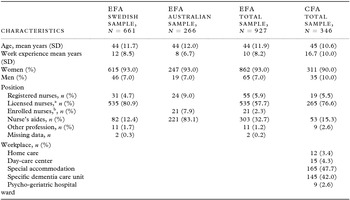
The preliminary 64-item scale was distributed during 2007–2008 to 927 dementia care staff, 661 from Sweden and 266 from Australia, with a mean age of 44 years (SD 11.90) (for description of the sample, see Table 1). For the Swedish sample, the scale was distributed through an Internet link to staff working in 18 municipalities and two university hospitals, covering residential care, day care, home care, and hospital care. The scale was also offered as hard copy to some participants due to their poor Internet skills. The Australian questionnaires were distributed to dementia care staff in 17 local residential facilities.
Characteristics of the two samples for the exploratory factor analysis (EFA), n = 927 and the confirmatory factor analysis, n = 346

Note: aTwo-year training, bOne-year training.
Analysis
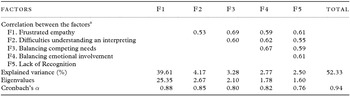
One hundred and three questionnaires (11.1%) had more than 15% of the items unanswered, so these were removed, leaving a final sample of 824 questionnaires for analysis. For the remaining 1.10% of missing data (item range: 0–4.46%), sample mean imputation was used, in line with the suggestions by Saunders et al. (Reference Saunders, Morrow-Howell, Spitznagel, Dori, Proctor and Pescarino2006). Assumptions of normality, factorability, linearity, multi-collinearity, and singularity were satisfied. An exploratory factor analysis based on the stress subscale was then performed, using SPSS 19, for the combined sample using maximum likelihood extraction followed by Varimax Rotation. This yielded a five-factor solution, which accounted for 52.33% of the total variance. The factors were selected through an examination of the scree plot, and on the basis of eigenvalues >1. Twenty-five items with loadings ≥0.50 were retained. Separate EFAs conducted on the samples from each country revealed four additional items, which scored highly on the Swedish sample alone. The Australian sample appeared to mask the utility of these items. We decided to keep them at this stage as the Swedish sample was much larger (n = 661 compared with n = 266). The 64-item version with factor loadings for each item can be found as supplementary material attached to the electronic version of this paper (available at www.journals.cambridge.org/jid_IPG). Details of the EFA are presented in Table 2 and show that there was good internal consistency, calculated with Cronbach's α, within the factors with good overall consistency for the scale. Significant relationships existed between all factors.
The exploratory factor analysis (n = 824). Correlation between the factors and internal consistency

Note: aAll correlations were p < 0.001 (calculated with Pearson's correlation).
In Section 2 of the scale, the daily emotions most frequently experienced were joy/happiness, which was scored as 4 or higher by 75.5% (n = 623) of the sample, and satisfaction, scored as 4 or higher by 72.4% (n = 597). No emotions substantially different from those already included were suggested by respondents, so we made no changes to Section 2 at this stage.
The following five factors were extracted from the EFA: The first factor (F1), frustrated empathy, comprising seven items, show that suffering by residents or family itself causes strain, often compounded by perceptions that resident distress is exacerbated by deficiencies in care. The second factor (F2), difficulties understanding and interpreting, comprised seven items covering aspects of strain related to being unable to comprehend the needs of residents. The third factor (F3), balancing competing needs, comprised five items covering aspects of strain related to the pressure of multiple demands. The fourth factor (F4), balancing emotional involvement, comprised five items covering aspects of strain related to emotional engagement with residents. Finally, the fifth factor (F5), lack of recognition, included five items covering aspects of strain related to devaluation of the work by others. The new version of the scale thus comprised 29 items.
Step 3. Confirmatory factor analysis of the 29-item scale
Sample and data collection
For the CFA of the 29-item scale, a new sample comprising 346 Swedish aged care and dementia care staff was recruited during 2009–2010. The sample came from the baseline data collection of an intervention study in residential care facilities and from an Internet survey to nurses working in day care or home care (for description of the sample for the CFA, see Table 1).
Analysis
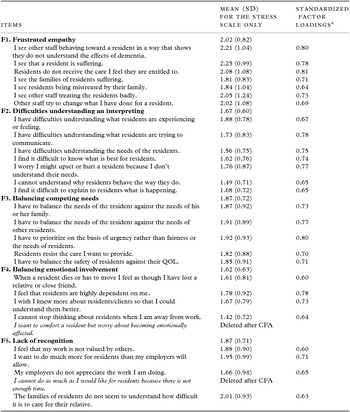
Thirty-five questionnaires (9.8%) had to be removed because more than 15% of the data was missing, leaving a final sample of 311. Sample mean imputation was used for the remaining 0.80% of the missing data (item range: 0–1.92%), in line with the suggestions by Saunders et al. (Reference Saunders, Morrow-Howell, Spitznagel, Dori, Proctor and Pescarino2006). Assumptions of normality, linearity, multi-collinearity, and singularity were satisfied and no outliers were found. The five-factor model from the EFA in step 2 was tested using CFA via SPSS AMOS 19. Given the normally distributed data, maximum likelihood estimation was used. Following an initial run with the 29 items included, two items with low factor loading (<0.06) were removed from the model. They were: “I want to comfort a resident but worry about becoming emotionally affected” (in F4, balancing emotional involvement); and, “I cannot do as much as I would like for residents because there is not enough time” (in F5, lack of recognition). The model was rerun with the remaining 27 items. All 27 items correlated well with the corresponding factor, with significant factor loadings for F1, frustrated empathy (range: 0.64–0.81), F2, difficulties understanding and interpreting (range: 0.65–0.78), F3, balancing competing needs (range: 0.70–0.80), F4, balancing emotional involvement (range: 0.60–0.78), and F5, lack of recognition (range: 0.60–0.71) (Table 3).
Confirmatory factor analysis (n = 311) of the final 27-item Strains in Dementia Care Scale

Note: aAll standardized factor loadings were p < 0.001.
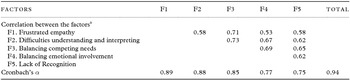
Good internal consistency was found within the factors, with Chronbach's α for each of the factors ranging between 0.75 and 0.89. While Chronbach's α for the overall scale indicated the possibility of redundancy in the items, this likely resulted from the large sample size and high number of items. The mean inter-item correlation was, however, well within acceptable guidelines (0.39) and inter-item correlations were <0.70, suggesting a lack of redundancy in the items. No further post-hoc modifications were indicated from the analysis because of the adequate goodness-of-fit indices, and the residual analysis did not indicate any issues. Significant correlations were found between all factors (Table 4).
The confirmatory factor analysis (n = 311). Correlations between the factors and internal consistency

Note: aAll correlations were p < 0.001 (calculated with Pearson's correlation).
Given common problems from relying solely on the χ 2 significance test to determine model fit (Tanaka, Reference Tanaka, Bollen and Long1993), several goodness-of-fit indices were examined. Despite a significant χ 2 (χ 2 = 761.85, df = 314, p < 0.01), which likely resulted from the large sample size, all other indices were indicative of adequate fit between the model and the observed data (χ 2/df = 2.43, Root Mean Square Error of Approximation = 0.06, Comparative Fit Index = 0.90).
In Section 2 of the scale, the most frequently daily emotions were satisfaction, joy/happiness, powerlessness, frustration, and fear. As the item sadness had two versions: (a) on behalf of the residents, and (b) for myself, we decided to merge these items into one: sadness. Based on the results, we decided to omit the items guilt, helplessness, anger, and disgust.
Results
The final scale
The final 27-item scale, comprising five factors, frustrated empathy, difficulties understanding and interpreting, balancing competing needs, balancing emotional involvement, and lack of recognition, is shown in the Appendix, and can be used without permission from the authors. Section 2 is included mainly for clinical reasons, to enable respondents the opportunity to express positive emotions about care.
Discussion and clinical implications
The five factors, frustrated empathy, difficulties understanding and interpreting, balancing competing needs, balancing emotional involvement, and lack of recognition, are linked, but are conceptually distinct and would probably require different interventions. For example, balancing competing needs is partly to do with resources, while difficulties understanding and interpreting is associated with communication issues and knowledge about the needs of individual residents. The nature and diversity of the factors confirm previous findings that the sheer intrinsic difficulty of the work is not necessarily the most important source of stress among staff caring for people with dementia (Brodaty et al., Reference Brodaty, Draper and Low2003; Edberg et al., Reference Edberg, Bird, Richards, Woods, Keeley and Davis-Quarrell2008), and that some causal factors have nothing to do with resident's behavior. Items that implicitly or explicitly express the sheer difficulty of the work per se appear mostly in the factors, balancing competing needs, and difficulties understanding and interpreting.
Frustrated empathy
Frustrated empathy was by far the strongest factor within the SDCS and accounted for 39.61% of the variance. The paradigmatic item is: “Residents do not receive the care I feel they are entitled to.” It confirms, with a much larger sample, the over-riding theme identified in our original focus groups that many staff have a very strong desire to provide the best possible care but that much of the stress comes from frustration of this desire (Edberg et al., Reference Edberg, Bird, Richards, Woods, Keeley and Davis-Quarrell2008). Four items in this factor show that what is interpreted as mistreatment by others is a source of stress, for example, where respondents perceive other nurses as not understanding the effects of dementia. If scores are high on this factor, and subsequent investigation indicates inconsistent care or mistreatment, systemic changes to ensure continuity of person-centered care and, where necessary, education to increase dementia-literacy among staff and/or family could be required. Empathy is sufficiently strong that observing residents or family suffering is enough to cause stress in itself, but it is also implicit in items that fall under other factors. For example, failure to understand the needs of residents (F2) or emotional involvement (F4) would not be an issue without the basic empathic desire to provide good care. That is, Factor one (F1) is the background theme for a significant proportion of the scale, although not all of it. In a sense, it is because of empathy that nurses are stressed; if they did not care, stress would probably be less.
Difficulties understanding and interpreting
The second factor, difficulties understanding and interpreting, suggests that problems in comprehending the world of the resident, including needs and behavior, is a source of stress in itself. A representative statement is: “I find it difficult to understand what residents are experiencing or feeling.” Communication between resident and staff is the fundamental component of this factor. It is a critical issue because the provision of humane care, including intimate personal care, depends upon staff understanding the individual needs of residents whose cognitive impairment often makes communication difficult or impossible, other than through behavior, which may be perceived as “disturbed.” It is encapsulated in the SDCS item within this factor: “I worry I might upset or hurt a resident because I don't understand their needs,” which itself has clear links with the empathy expressed in Factor one and emotional attachment of factor four. If high scores are obtained on this factor, it clearly requires hands-on education or clinical supervision involving, if possible, those in the facility who do have the skills and knowledge to understand the needs of residents and communicate these skills to others. Such discussions need to be resident-specific and focus on increasing the understanding of what their residents are communicating in specific situations, for example, expressions of physical or emotional needs or as a reaction to a disturbing environment (cf. Edberg et al., Reference Edberg, Moyle and Chan2012). The individualized element is reflected in recent reviews of communication training in dementia, which found that it was most effective where the training took place one-to-one with the resident, including in daily care interventions (Vasse et al., Reference Vasse, Vernooij-Dasses, Spijker, Rikkert and Koopmans2010). However, it must not be seen as a “single dose intervention.” Eggenberger et al. (Reference Eggenberger, Heimer and Bennett2013) note that it requires a committed organizational framework which sees communication with residents as a crucial component of care so that learning to understand and have empathy with their needs is an on-going process.
Balancing competing needs
Factor three, having to balance competing needs, is probably inevitable in dementia care. Although conceptually coherent as a factor, there is a subtle difference in orientation between some items. Items such as, “I have to prioritize on the basis of urgency rather than fairness or the needs of residents,” can reflect inadequate resources, staffing, or organization. Items such as, “I have to balance the safety of residents against their quality of life,” can also be related to resources or organization, for example, having to keep residents locked in because of limited staff numbers or care skills. However, they can equally apply to the balance of having to provide care, including intimate care, to people whose cognitive impairment makes it difficult for them to understand why or what is happening, and it is significant that, “Residents resist the care I want to provide,” also appears in this factor. Neither meaning in this factor can be seen in isolation. As in all the other factors, they implicate the need for effective and supportive organization; Orrung Wallin et al. (Reference Orrung Wallin, Jakobsson and Edberg2015) found that a high level of organizational support explained much of the variance in predicting low strain scores on the SDCS.
Balancing emotional involvement
Factor four, balancing emotional involvement, shows stress as a result of emotional involvement with residents, for example: “When a resident dies or has to move I feel as though I have lost a relative or close friend.” There is a small but compelling literature showing that high levels of emotional engagement can occur among residential care staff (Beck et al., Reference Beck, Ortigara, Mercer and Shue1999; Edvardsson et al., Reference Edvardsson, Sandman, Nay and Karlsson2009). Other than frustrated empathy, the factor which underpins much of the scale, factor four, is therefore the strongest overt reflection of the fact that, for many nurses, caring for people with dementia is not a cold professional transaction but involves complex human relationships: “Nurses and patients with severe dementia share each other's daily life existentially by being together, as well as practically by doing together” (Berg et al., Reference Berg, Hallberg and Norberg1998).
Unfortunately, emotionally engaged staff rarely receive any help or support, not even when residents die (e.g. Rickerson et al., Reference Rickerson, Somers, Allen, Lewis and Casarett2005). The fact that, regardless of the country and care system, participants in our focus group discussion (Edberg et al., Reference Edberg, Bird, Richards, Woods, Keeley and Davis-Quarrell2008) said this was the first time anybody had asked them how they felt also suggests that the chance to express feelings is rare. If scores on factor four are high, residential facilities may need to reconsider this rather surprising lack of support. Setting up systems that allow staff to freely express feelings about a resident, for example, that they are frightened or angry, has been an integral part of interventions, which significantly increase quality of care (Edberg et al., Reference Edberg, Hallberg and Gustafson1996), as well as being an essential component in interventions targeting behavioral and psychological symptoms in dementia (Bird et al., Reference Bird, Llewellyn-Jones and Korten2009).
Lack of recognition
The items in factor five, lack of recognition, suggest that perceived devaluation of what they do is a source of stress for staff, for example: “My employers do not appreciate the work I am doing.” Given the low pay and status of many employed in residential dementia care (Beck et al., Reference Beck, Ortigara, Mercer and Shue1999), it is disappointing that failure of others – including management – to acknowledge the difficult and emotionally demanding tasks that they do emerges as a distinct source of stress. This is supported in the findings from Orrung Wallin et al. (Reference Orrung Wallin, Jakobsson and Edberg2015) showing that organizational and environmental support was associated with low levels of strain, as well as feeling supported by a positive working climate. Where there are high scores on this factor, it would seem that regular provision of genuinely meant positive reinforcement might be all that is required. However, the failure of many facilities to establish a structure to allow staff to discuss their emotional concerns, alluded to in the discussion on factor four, suggests that they are simply unaware of these as an issue or do not consider it important to emotionally support their staff. If the SDCS begins to be used, we hope this issue will become more salient, as well as the general issue of strain in dementia care more generally. As alluded to throughout the discussion of individual factors, none can be seen in isolation, and “single dose interventions” (Eggenberger et al., Reference Eggenberger, Heimer and Bennett2013) are unlikely to reduce staff's strain.
Psychometric properties of the scale
Validity
The process of developing the final 27-item scale included several steps. Empirical data in the form of focus group interviews, where staff in Australia, the United Kingdom, and Sweden were explicitly asked what stressed them about dementia care was the fundamental basis of the items comprising the scale, thus contributing to its content validity as well as face validity. Construct validity was obtained through a first exploratory factor analysis based on a large sample of staff in Australia and Sweden. The revised scale was then distributed to a new sample and a CFA was performed. In both analyses, the sample exceeded 10 individuals for each item included, as recommended by many authors (e.g. Streiner and Norman, Reference Streiner and Norman2008).
The construct and divergent validity of the scale has been investigated by Orrung Wallin et al. (Reference Orrung Wallin, Edberg, Beck and Jakobsson2013) using inter-scale correlations, intra-scale correlations, and corrected item-total correlations. Their results showed that SDCS correlated positively (r = 0.62) with an instrument measuring a closely linked concept, Stress of conscience (Glasberg et al., Reference Glasberg2006), and correlated negatively with two instruments measuring job satisfaction (r = −0.52 and −0.60 respectively). Intra-scale correlations between SDCS total score and the factors ranged from 0.75 to 0.86, while corrected item-total correlation ranged from 0.31–0.71 (Orrung Wallin et al., Reference Orrung Wallin, Edberg, Beck and Jakobsson2013).
Sensitivity
The study by Orrung Wallin and co-workers (Reference Orrung Wallin, Edberg, Beck and Jakobsson2013) found no floor or ceiling effects for total and factor scores for the SDCS, but major floor effects when investigating data quality in relation to each item. Floor effects, i.e. scores >15% of the minimum scores in the instrument, were detected for all items but two, and varied from 17.4 to 60.0%, with a mean floor effect of 33.0%. There are two possible reasons for the high percentage of floor scores: either the nature of the questions might influence the participants to answer in a socially desirable way (Streiner and Norman, Reference Streiner and Norman2008), or the response alternatives are too wide, thus limiting the sensitivity of the scale. Orrung Wallin et al., (Reference Orrung Wallin, Edberg, Beck and Jakobsson2013) suggest that the SDCS would improve with a modification at the item level, changing the lowest score on the frequency subscale from “never/seldom” to just “never” and from “none/hardly any” to “none” on the stress subscale. In the final version of the scale (see Appendix), we have therefore adjusted the response alternatives accordingly.
Another important aspect concerns the high percentage of internal missing data. In the two samples used in this study, 11.1% (EFA) and 9.8% (CFA) had more than 15% of the items missing, which meant that they had to be excluded from analysis. In the study by Orrung Wallin et al. (Reference Orrung Wallin, Edberg, Beck and Jakobsson2013), the frequency subscale in the SDCS had 19.1% missing items for the total score and ranged from 5.2–13.0% for the factors. The stress subscale in the SDCS had 24.3% missing for total score and ranged from 9.6–16.5 for the factors. This calls for future development of the format of the SDCS as the two subscales might be confusing. Orrung Wallin et al. (Reference Orrung Wallin, Edberg, Beck and Jakobsson2013) found similar results for the stress of conscience scale, which has a similar format.
Reliability
The α-values ranging from 0.75 to 0.89 indicate that the internal consistency of the instrument is satisfactory. The high α for the total score (r = 0.94), however, indicates that there might be some redundancy in the instrument. Orrung Wallin and co-workers (Reference Orrung Wallin, Edberg, Beck and Jakobsson2013) tested α for the deletion of individual items but found that it did not exceed the α on the total score, so we have retained 27 items. Test-retest reliability was also investigated in the study by Orrung Wallin et al. (Reference Orrung Wallin, Edberg, Beck and Jakobsson2013) through distributing the instrument to 114 nurse assistants, and then retesting after 14 days. The intra-class correlations (ICC) showed acceptable stability on both factors and total scores, ranging from 0.66–0.85. At item level, the ICC varied between 0.37 and 0.77.
Limitations and strengths
The main limitation of this study is that participants in the focus groups from which the scale items were drawn could be seen as an elite group. There was representation from care assistants to directors of nursing but they all cared about the topic enough to give up two evenings for no reward other than refreshments and the never before experienced chance to discuss how they felt about their work (Edberg et al., Reference Edberg, Bird, Richards, Woods, Keeley and Davis-Quarrell2008). It is possible that another sample would produce some different items. However, the fact the overwhelming theme from that study – a strong desire to give residents the care they deserved, frustrated by many impediments – was by far the major factor in two much larger and diverse samples from two countries suggests that the focus groups were relatively representative.
Since this is a scale measuring strain among staff caring for people with dementia, the factors were produced solely from the stress subscale. In practice, the scale has been used to date as an outcome measure with separate total and factor scores for frequency and stress. It is a further limitation that, although the original five factors were derived from an EFA using the combined Swedish and Australian sample, the CFA was based on a Swedish sample only. This calls for further research and subsequent analyses in other samples as well as development of norms from different samples. Further, using EFA and CFA on an ordinal scale format might be questioned. Factor analysis has, however, been well documented as an essential element of questionnaire design and development, and it is, according to, among others Rattary and Jones (Reference Rattary and Jones2007), acceptable to treat such types of response as interval data to allow for the use of common parametric tests.
The strengths of this study are as follows: First, unlike most studies, which have used generic burnout or stress instruments, the scale is based directly on what nurses told us caused them stress, systematically refined down to 27 items. Second, because of this, the measure relates directly to their clinical experience – it emerges from the care situations that residential dementia care staff face daily. Accordingly, although it is partially intended for use as a generic staff stress outcome instrument, it has the potential to be more than an outcome measure following interventions aimed at improving these aspects of care. It is a diagnostic instrument in its own right. Elevated stress and/or frequency scores on the scale overall or within individual factors, will provide guidance about where interventions to support staff need to be introduced, for example, in understanding residents’ needs, reducing occasions when they are simultaneously faced with multiple urgent tasks, or in the need for more emotional support. Since staff well-being is linked inextricably with the quality of care, and addressing many of the items in the Strain in Dementia Nursing Scale may improve staff skills and perceptions, the scale therefore has the potential to improve quality of life for both staff and those in their care.
We suggest that the scale can be used (a) as an outcome measure in residential care intervention studies; (b) to help residential facilities identify interventions needed to improve staff well-being, and, by extension, those they care for; and (c) to generally make more salient the critical issue of staff strain and the importance of ameliorating it. One major issue is, however, the lack of time that nurses working in dementia care experience, which in turn might influence the possibility to use the measurement as a basis for reflection and discussion in their daily work. This calls for an involved and supportive leadership, especially concerning the implementation of interventions needed.
Conclusions
The SDCS was derived directly from staff working in dementia care and has been tested and refined on a large sample. It has adequate validity, sensitivity, and reliability. It is intended, first as a generic staff stress outcome instrument to be used in intervention studies. Second, it is intended to help residential dementia care facilities identify whether they need to provide more support to their staff and, if so, help them focus the intervention. It could be ensuring consistency of care, helping staff increase their skills in communicating with and understanding the needs of residents, reducing situations where they are faced with multiple urgent needs, or providing a structure so that staff can obtain emotional support and acknowledgment of the work they do.
Conflict of interest
None.
Description of authors’ roles
Anna-Karin Edberg and Mike Bird designed the study. Anneli Orrung Wallin was responsible for the Swedish data collection under supervision of Anna-Karin Edberg. Katrina Anderson and Mike Bird were responsible for data collection in Australia. Katrina Anderson was responsible for the statistical design of the study, and carried out statistical analyses. Anna-Karin Edberg and Mike Bird had the main responsibility of the manuscript, but all authors participated in the discussion of the draft. The final manuscript was approved by all the authors.
Acknowledgments
We are most grateful to all nurses who participated in the study and for financial support from Swedish Brain Power Consortium and King Gustav V and Queen Victoria Freemason Foundation.
Supplementary material
To view supplementary material for this article, please visit http://dx.doi.org/10.1017/S1041610215000952
Strain in Dementia Care Scale (SDCS)
(27-item version 2015)