INTRODUCTION
The majority of malaria-associated human mortality is caused by Plasmodium falciparum, a haemosporidian parasite of man that occurs in most tropical and sub-tropical regions of the world and is transmitted by anopheline mosquito species. It has long been recognized that understanding the mosquito immune response to infection by P. falciparum may be the key to finding ways of interrupting its transmission. Thus parasitologists and, more recently, insect molecular biologists have focused their research on mosquito immune-related genes and particularly on genes responsible for mosquito refractoriness to the malaria parasite, as well as on parasite-induced fitness costs to mosquito vectors. Since experimental infections of humans or primates are usually not possible much of that research is based on vertebrate/mosquito/Plasmodium model-systems which, as will be discussed in the next sections, often involve mosquito/Plasmodium associations that do not occur in nature.
Ecological immunology is a relatively new discipline that focuses on the mechanism and function of immune responses in their ecological context. Since its focus is on population level processes, ecological immunology uses naturally-occurring host-parasite association as model systems. When it comes to research on mosquito/Plasmodium interactions, ecological immunology investigates how ecological factors affect interactions between mosquito vectors and the malaria parasite to create and maintain variation in host immune responses and Plasmodium virulence in natural populations. However, in contrast to what is commonly accepted in Ecological Immunology, when it comes to malaria research, studies of mosquito/Plasmodium interactions still largely rely on the non-natural model-systems used in the past. This paradox forms the basis of the ongoing controversy on the use of model-systems for ecological immunological studies of mosquito/malaria interactions and can be explained by the discipline's dual origins in Evolutionary Ecology and Parasitology.
EVOLUTIONARY ECOLOGY IN THE LATE 1980s–1990s
In order to understand the foundation of ecological immunology one needs to take a closer look at fundamental research in ecology in the late 1980s and 1990s. This period of time saw important transitions in a research discipline that had grown increasingly intolerant of classic observational studies and advocated instead experimentation as the only rigorous way for testing causal relationships between natural processes. Epitomized by the work of Richard Dawkins (Dawkins, Reference Dawkins1976), Bill Hamilton (Hamilton, Reference Hamilton1964a, Reference Hamiltonb) and others, evolutionary thought had progressively permeated ecology's every topic, effectively bridging it with what was previously known as evolutionary biology whilst paving the way for evolutionary ecology. The study of host–parasite interactions is a particularly dynamic and fast-expanding field of research focusing on topics as diverse as the evolution of parasite virulence (Ewald, Reference Ewald1983; May and Anderson, Reference May and Anderson1983; Ebert and Herre, Reference Ebert and Herre1996), parasite local adaptation (Ebert, Reference Ebert1994; Gandon et al. Reference Gandon, Capowiez, Dubois, Michalakis and Olivieri1996), and the role of parasites in sexual selection and the evolution of ornaments (Hamilton and Zuk, Reference Hamilton and Zuk1982; Andersson, Reference Andersson1986; Folstad and Karter, Reference Folstad and Karter1992). In order to maximize the strength of inferences, the emphasis is deliberately placed on field experiments of natural hosts and parasite populations, as well as on the thoroughness of experimental design and analysis. Parasite-imposed fitness costs are also studied in relation to host life-history trade-offs, such as those between current reproduction and future reproduction or survival (Forbes, Reference Forbes1993; Perrin, Christe and Richner, Reference Perrin, Christe and Richner1996; Richner and Tripet, Reference Richner and Tripet1999). Given their underlying importance in relation to most of the above-mentioned topics, host immune defences received increasing attention and by the mid-nineties, there were enough research groups measuring and manipulating body condition and immune responses in natural host-parasite associations (Lochmiller, Vestey and Boren, Reference Lochmiller, Vestey and Boren1993; Moller and Saino, Reference Moller and Saino1994; Deerenberg et al. Reference Deerenberg, Arpanius, Daan and Bos1997) to warrant a review on that emerging discipline. ‘Ecological Immunology: costly parasite defenses and trade-offs in Evolutionary Ecology’ (Sheldon and Verhulst, Reference Sheldon and Verhulst1996) focuses almost entirely on vertebrate host-parasite associations with the exception of a single study on bumble bees (Konig and Schmid-Hempel, Reference Konig and Schmid-Hempel1995). However, in the next few years insect ecological immunology began to establish itself as a field of research in its own right (Kraaijeveld and Godfray, Reference Kraaijeveld and Godfray1997; Schmid-Hempel and Schmid-Hempel, Reference Schmid-Hempel and Schmid-Hempel1998; Siva-Jothy, Tsubaki and Hooper, Reference Siva-Jothy, Tsubaki and Hooper1998; Kurtz, Reference Kurtz2000; Rolff and Siva-Jothy, Reference Rolff and Siva-Jothy2003).
THE PRAGMATIC HERITAGE OF PARASITOLOGY
In stark contrast to evolutionary ecology, parasitology's applied research emphasizes practicality and feasibility, and often relies on non-natural host-parasite model systems to study the life-stages of parasites inside their hosts. Given the impracticality of experimentally infecting primates, studies dating as early as the 1930s compared the permissiveness of various mosquito species to bird malaria first (Huff, Reference Huff1927), and later rodent malarias in order to find an alternative model system to human malaria (Garnham, Reference Garnham1963; Killick-Kendrick and Peters, Reference Killick-Kendrick and Peters1978). Ideal mosquito-malaria associations were those in which the malaria parasite completed its entire cycle in a manner comparable to what was known of P. falciparum in its natural vectors (Garnham, Reference Garnham1963; Killick-Kendrick and Peters, Reference Killick-Kendrick and Peters1978). The observed difference in permissiveness between vector species was first considered to be the key to understanding mosquito-malaria interactions; until accumulating evidence that variation in resistance also occurred between individuals within species led researchers to drop that avenue of research altogether (Huff, Reference Huff1935). Eventually, a limited number of model systems established themselves: the avian malaria-based systems Aedes aegypti/Plasmodium gallinaceum and Culex pipiens fatigans/P. cathermerium; and several associations based on rodent malarias, Anopheles gambiae and An. stephensi/Plasmodium berghei and P. yoelii and An. stephensi/P. chabaudi (Garnham, Reference Garnham1963; Yoeli et al. Reference Waters, Higgins and McCutchan1965; Killick-Kendrick and Peters, Reference Killick-Kendrick and Peters1978). For a long time, model systems involving these unnatural mosquito/Plasmodium associations were the only option for experimental studies of mosquito/Plasmodium interactions and they make for the vast majority of the current literature on mosquito/malaria interactions (Tripet, Aboagye-Antwi and Hurd, Reference Tripet, Aboagye-Antwi and Hurd2008). The positive side of that heritage is that we know quite a lot about the development of Plasmodium in the mosquito and about the mosquito immune response. The downside, of course, is that much of our current understanding of mosquito-Plasmodium interactions stems from non-natural model systems and remains to be validated using natural associations. This should pave the way for research on the processes that create and maintain variation in mosquito immune responses and Plasmodium development in natural populations (Boete, Reference Boete2005; Tripet et al. Reference Tripet, Aboagye-Antwi and Hurd2008).
MOSQUITO-PLASMODIUM MODEL SYSTEMS AND THEIR INFERENCES
One can see how the focus of evolutionary biologists on fundamental research, their evolutionary considerations and awareness of experimental designs and the strength of inferences will drive them away from non-natural systems which – in their view – cannot generate inferences applicable to the ‘real world’ of natural populations. This view has to be contrasted with that of parasitologists who consider studying life-threatening diseases a priority that warrants the development of practical laboratory-based model systems in order to conduct applied research ultimately leading to disease control. Today's literature on the ecological immunology of mosquito/Plasmodium interactions reflects these contrasted heritages (Tripet et al. Reference Tripet, Aboagye-Antwi and Hurd2008). In the following sections, I will discuss several aspects of host-parasite interactions that clarify the limitations of non-natural model systems and emphasize the importance of ecological immunological studies based on natural associations.
Host-parasite interactions as a complex phenotype
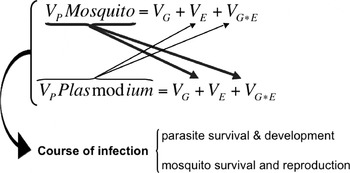
In the natural environment, the outcome of mosquito infections with Plasmodium gametocytes are particularly complex phenotypes (Fig. 1). In simple quantitative genetics terms the variation observed in such phenotypes can be summarized by two equations: The first one describing the phenotypic variation in the infected mosquitoes (e.g. survival, immune response level and body condition) which is determined by variation in mosquito genetic and environmental factors, and interactions between those factors; and the second one describing the phenotypic variance of the infecting Plasmodium parasites (survival, multiplication, rate of development, etc.) which is determined by variation in parasite genetic and environmental factors and interactions between those factors (Tripet et al. Reference Tripet, Aboagye-Antwi and Hurd2008). Both host and parasites equations strongly influence the outcome of infections and their respective phenotypic variances can be considered an essential component of each other's ‘environment’ (Fig. 1). The importance of mosquito and Plasmodium genetic and environmental factors on parasite development and virulence – i.e. parasite-induced fitness costs to the host in the form of decreased fertility or survival (see discussion below) – has been demonstrated using non-natural model-systems and in a few studies of natural associations (reviewed in Tripet et al. Reference Tripet, Aboagye-Antwi and Hurd2008).
Phenotypic variance components in infected mosquitoes (first equation) and in Plasmodium parasites (second equation). Where V P is the phenotypic variance among individuals, V G the genetic variance, V E the variance due to the direct effect of the environment, and V G*E the genotype-by-environment interaction, which occurs when the effect of the environment differs among genotypes. Thus, the phenotypic variance observed among hosts and parasites in natural populations is due to genetic and environmental factors as well as the interactions between the two. Both host and parasites strongly influence the course of infection and their respective phenotypic variances can be considered an essential component of each other's ‘environment’ that strongly affect their V E and V G*E terms.

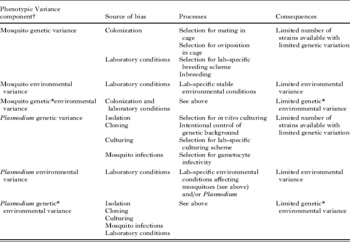
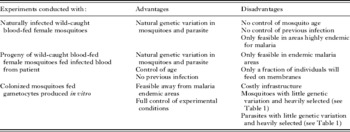
One of the challenges of ecological immunology is to help understand how ecological factors affect mosquito/malaria interactions to create and maintain variation in mosquito immune defence and Plasmodium virulence in natural populations. In this regard, laboratory-based studies are constrained by a variety of factors that tend to decrease phenotypic variation among individuals through various selection pressures (Table 1). This is true even in laboratory studies of natural mosquito/Plasmodium associations whose inferences should be more easily extrapolated to natural populations than those from non-natural associations. Generally, the lack of phenotypic variation in mosquitoes and parasites that characterizes laboratory experiments limits our ability to study the whole palette of host-parasite interactions (Table 1). However, laboratory-based studies conducted far away from malaria endemic countries are not the only option available to researchers. Indeed, the increasing large number of facilities dedicated to malaria research in African countries makes it ever easier for studying mosquito-malaria interactions nearer to the field (Table 2).
Common factors associated with laboratory-based experiments that negatively affect studies of mosquito-malaria interactions

† Note that the importance of some of these factors has been tested experimentally (reviewed in (Tripet et al. Reference Tripet, Aboagye-Antwi and Hurd2008)).
* This corresponds to a multiplication sign (see Fig. 1).
Commonly available options to study naturally-occurring interactions between Anopheles gambiae and Plasmodium falciparum

Host-parasite coevolution and local adaptation
Coevolution between hosts and their parasites is commonly seen as an evolutionary arms race between populations of parasites that evolve to maximize their fitness, which depends on their successful transmission to new hosts, and population of hosts that evolve mechanisms to limit their own fitness loss to parasites (Price, Reference Price1980, Reference Price1984; Poulin, Morand and Skorping, Reference Poulin, Morand and Skorping2000). In doing so, hosts exert selection pressures on their parasites and, reciprocally, parasites exert selection pressures on their host, something that can readily be understood in mosquito/Plasmodium association given how strongly they are expected to affect each other's fitness components (see Fig. 1). One must keep in mind that reciprocal selection also occurs between the vertebrate hosts and the asexual Plasmodium stages; hence malaria evolution is essentially an intimate, triangular affair between parasite, vector and vertebrate hosts. In this regard, it is worth remembering that human, rodent and bird malarias cannot develop in each other's vertebrate hosts thereby underlining crucial genetic differences between those parasites.
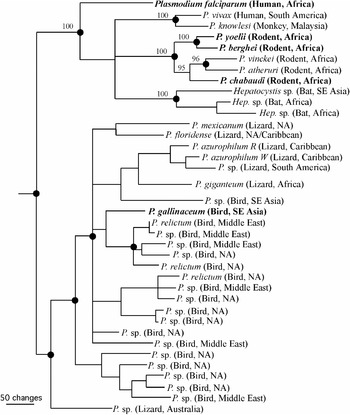
Detecting and quantifying host-parasite coevolution is not a simple task especially when parasite specificity is low. In parasites with high specificity, such as Plasmodium, coevolution translates in congruence between the host and parasite phylogenies in what is commonly know as phylogenetic tracking (Poulin, Reference Poulin2007). Recovering the macroevolutionary history of Plamodium and other Haemosporidia has kept systematic parasitologists confused for decades and, until recently, there was still considerable debate on the most likely common ancestor of P. falciparum (Roy and Irimia, Reference Roy and Irimia2008). The most recent and complete analyses included sequence data from the nuclear, mitochondrial and plastid genomes (Perkins, Sakar and Carter, Reference Perkins, Sarkar and Carter2007; Martinsen, Perkins and Schall, Reference Martinsen, Perkins and Schall2008) and compared the distribution of rare indels in the rDNA and full mitochondrial genomes in a large number of Haemosporidia (Roy and Irimia, Reference Roy and Irimia2008). The results from both approaches do not support a common P. falciparum and rodent malaria clade but suggest instead that they share a distant ancestor (Fig. 2) (Martinsen et al. Reference Martinsen, Perkins and Schall2008; Roy and Irimia, Reference Roy and Irimia2008). The hypothesis of a common origin with bird malaria (Waters, Higgins and McCutchan, Reference Waters, Higgins and McCutchan1991, Reference Waters, Higgins and McCutchan1993) is not supported either. P. falciparum sequence data is very distinct from those distant relatives. For example, there is an average 14·1% DNA sequence divergence (range 12·3–15·3%) between P. falciparum and any of the rodent malarias whilst the average level of divergence between all rodent malarias is 6·4% (Martinsen personal communication). P. falciparum's closest relative would be the simian-human malaria parasite P. reichenowi (Roy and Irimia, Reference Roy and Irimia2008). Thus, these results provide evidence of some level of phylogenetic tracking between the phylogenies of Plasmodium and that of their vertebrate hosts. Using the mutation rate in the sequence of the small subunit ribosomal RNA and circumsporozoite surface protein genes as molecular clocks Escalante et al. (Escalante and Ayala, Reference Escalante and Ayala1994, Reference Escalante and Ayala1995) estimated that P. falciparum may have split from its simian ancestor ~8–10 millions of years ago an event that may have coincided with the split between hominids and other great apes. Phylogenetic tracking between Plasmodium species and their insect vectors is more diffuse given that Plasmodium species are commonly transmitted by several mosquitoes species. However, evidence of phylogenetic tracking can still be detected at higher taxonomic levels. In their study, for example, Martinsen et al. (Reference Martinsen, Perkins and Schall2008) show that all Plasmodium species fall within a single well-supported clade and that they are all transmitted by mosquitoes (Culicidae) apart from a single exception. Similarly, other genera of haemosporidia tended to form distinct clades each transmitted by different Dipteran vector families (Martinsen et al. Reference Martinsen, Perkins and Schall2008).
Majority-rule consensus phylogram recovered using maximum parsimony and Bayesian analyses of four genes across the parasite three genomes (modified with permission from (Martinsen et al. Reference Martinsen, Perkins and Schall2008). Only part of the tree is presented here. Rodent and avian malarias commonly used in studies of mosquito/Plasmodium interactions are in bold. Dots on notes indicate ⩾95% posterior probability support nodal support values estimated by Bayesian analysis. Parsimony bootstrap values greater or equal to 95% are also indicated. Taxon labels are the genus based on morphology seen in microscope blood smears, and species when that identification could be made with confidence. Vertebrate hosts and region of samples are indicated.

Because parasites have typically shorter generation times and higher migration rates, and are under stronger selection pressure than their hosts, they are predicted to be adapted to their local host populations (Price, Reference Price1980; Gandon and Michalakis, Reference Gandon and Michalakis2002). Transplantation experiments are thus another approach to reveal coevolution, this time at the microevolutionary scale. Such studies compare the average parasite reproductive rate between combinations of sympatric and allopatric host and parasite populations. Local adaptation of parasites, which translates into higher reproductive rates of the parasite on sympatric hosts has been found only in some of the studies that tested for it (Ebert, Reference Ebert1994; Prugnolle et al. Reference Prugnolle, De Meeus, Pointier, Durand, Rognon and Theron2006). As shown by theoretical studies and a recent meta-analysis of all published studies on local adaptation, the likelihood that parasites will be more adapted to their local host depends on the migration rate of the parasite considered (Gandon and Michalakis, Reference Gandon and Michalakis2002; Greischar and Koskella, Reference Greischar and Koskella2007).
Regardless of the direction of changes in parasite reproductive rate found in transplantation experiments, such significant difference between host and parasite populations within their species underline the importance of ongoing local coevolutionary processes. In natural mosquito/Plasmodium associations, recent experiments have showed evidence of local adaptation or differences between allopatric versus sympatric mosquito and Plasmodium populations in An. gambiae and An. stephensi infected with P. falciparum, and in An. pseudopunctipennis and An. albimanus infected with P. vivax (Hume et al. Reference Hume, Tunnicliff, Ranford-Cartwright and Day2007; Joy et al. Reference Joy, Gonzalez-Ceron, Carlton, Gueye, Fay, Mccutchan and Su2008).
Trade-offs between fitness and immune defences
Given the strong evidence for the occurrence of micro and macro-coevolution between Plasmodium and its hosts, it is not surprising that few of the non-natural mosquito/Plasmodium combinations examined by parasitologists have been found to complete their exogenous life stages in a natural association-like fashion. From an evolutionary biologist's point of view, the optimization of non-natural mosquito/Plasmodium model systems essentially gives up on coevolutionary considerations and is equivalent to creating artificial host-switches. Host switches, of course, do occur in nature; but they are essentially chance events often accompanied by increased virulence of parasites on their new permissive hosts (Ebert and Herre, Reference Ebert and Herre1996).
Due to the limited number of publications available on natural mosquito/Plasmodium interactions, quantifying differences between unnatural model systems versus natural associations is difficult. One aspect of infection for which such comparison has been possible are potential Plasmodium-induced fitness costs in terms of mosquito survival (Ferguson and Read, Reference Ferguson and Read2002). In a particularly interesting meta-analysis of the limited number of studies available on this topic, Ferguson and Read (Reference Ferguson and Read2002) found a significant negative effect of Plasmodium on mosquito survival across the literature based on non-natural model systems but not in studies focusing on natural associations. These results confirm the expectation that artificial mosquito/Plasmodium model-systems may only crudely replicate natural interactions and may be associated with higher parasite virulence.
Molecular biology of mosquito immune responses
Thanks to whole-genome transcript analysis, molecular biologists working on mosquito immune responses now have powerful tools to quantitatively and qualitatively compare natural and non-natural associations. Consequently, they too have repeatedly emphasized the limitations of non-natural model-systems (Cohuet et al. Reference Cohuet, Osta, Morlais, Awono-Ambene, Michel, Simard, Christophides, Fontenille and Kafatos2006; Dong et al. Reference Dong, Aguilar, Xi, Warr, Mongin and Dimopoulos2006; Michel et al. Reference Michel, Suwanchaichinda, Morlais, Lambrechts, Cohuet, Awono-Ambene, Simard, Fontenille, Kanost and Kafatos2006). For example, Dong and colleagues (Reference Dong, Aguilar, Xi, Warr, Mongin and Dimopoulos2006) in a comparison of An. gambiae's gene expression during invasion of the midgut with P. falciparum and P. berghei, found stark differences in the number of regulated genes. In P. falciparum infections, 471 genes corresponding to 3·4% of the transcriptome were regulated in contrast to P. berghei infections where no less than 1102 genes or 8·1% of the transcriptome changed (Dong et al. Reference Dong, Aguilar, Xi, Warr, Mongin and Dimopoulos2006). Importantly, studies looking at the function of individual immunity-related genes through reverse genetics found that only a fraction of those genes affected infections with human and rodent malaria in a comparable manner (Dong et al. Reference Dong, Aguilar, Xi, Warr, Mongin and Dimopoulos2006; Mendes et al. Reference Mendes, Schlegelmilch, Cohuet, Awono-Ambene, De Iorio, Fontenille, Morlais, Christophides, Kafatos and Vlachou2008). Immunity genes whose importance for human malaria has been validated through experimental studies of the natural mosquito/Plasmodium association are thought to be essential and ancestral components of the mosquito's immune's response architecture (Mendes et al. Reference Mendes, Schlegelmilch, Cohuet, Awono-Ambene, De Iorio, Fontenille, Morlais, Christophides, Kafatos and Vlachou2008).
CONCLUSIONS
Whilst artificial model-systems obviously must retain some basic characteristics of the natural associations of their host and parasite components, it is difficult to assess just how much can be learned from artificial model systems and how much will have to be re-visited using natural associations (Tripet et al. Reference Tripet, Aboagye-Antwi and Hurd2008). The potential severity of the problems associated with inferences generated through the study of non-natural parasite associations partially depends on the questions asked. Whilst we can reasonably assume that fundamental or ancestral-like physiological and developmental characteristics are shared between all vertebrate malarias, the same cannot be said of questions relating to population biology and micro-evolutionary processes. The problems and concerns discussed above have been hinted at or voiced by an increasing number of researchers including evolutionary biologists, molecular biologists and parasitologists (Boete, Reference Boete2005; Cohuet et al. Reference Cohuet, Osta, Morlais, Awono-Ambene, Michel, Simard, Christophides, Fontenille and Kafatos2006; Dong et al. Reference Dong, Aguilar, Xi, Warr, Mongin and Dimopoulos2006; Martinsen et al. Reference Martinsen, Perkins and Schall2008). Indeed, understanding how ecological factors affect mosquito/malaria interactions to create and maintain variation in mosquito immune defence and Plasmodium virulence in natural populations is generally recognized as paramount to our quest to resolve the malaria problem. However, recognizing that further advances in this field strongly depend on increasing our research effort based on studies of natural vector/Plasmodium associations whilst simultaneously minimizing the use of non-natural ones is still not fully accepted. It is hoped that the above discussion will serve as a strong incentive, for studying mosquito/Plasmodium interactions using P. falciparum and its natural vectors, and for doing so closer to the field.
ACKNOWLEDGMENTS
I thank Ellen Martinsen for her estimates of sequence divergence and Hilary Hurd, Fred Aboagye-Antwi, Doug Paton as well as two anonymous referees for their comments on the manuscript.