The stigma of mental illness is an old and complex phenomenon whose devastating influence on the lives of people with mental illness remains, despite the growing literacy of the public (Pescosolido, Reference Pescosolido2013). According to Goffman, stigma is a state where an individual is discredited because of a mark or a condition such as a mental illness (Goffman, Reference Goffman1963). In the case of mental illness, research has demonstrated that some of the stigmatizing attitudes towards people with mental illness include the belief that the person is responsible for his/her condition (Corrigan, Markowitz, Watson, Rowan, & Kubiak, Reference Corrigan, Markowitz, Watson, Rowan and Kubiak2003). Therefore, anti-stigma campaigns have been carried out to inform the public that mental illness is an illness like any other and one that has biogenetic causes. The purpose of these campaigns was to reduce blame attributions and to tackle the belief that people with mental illness are not really ill.
However, recent international studies have shown the public, despite its increased literacy concerning the biogenetic causes of mental illness, persists in endorsing negative and stigmatizing attitudes towards the mentally ill, especially in the case of schizophrenia (Read, Haslam, Sayce, & Davies, Reference Read, Haslam, Sayce and Davies2006). The review by Read and his colleagues has even shown that medicalizing beliefs about schizophrenia lead to increased stigma. According to these authors, these medicalizing beliefs (or illness model) include biogenetic explanations and lay diagnostic labeling. In effect, a meta-analytic review has shown that endorsing biogenetic causes, as well as labeling lead to an increase in dangerousness beliefs and higher levels of social distance towards people with schizophrenia (Kvaale, Gottdiener, & Haslam, Reference Kvaale, Gottdiener and Haslam2013).
Similarly, in the French context, where the media (re)produce a very stereotypical and image of schizophrenia, associated with danger and crime (Lampropoulos, Wolman, & Apostolidis, Reference Lampropoulos, Wolman and Apostolidis2017), it has been shown that dangerousness is more frequently associated with the term “mental illness” than the terms “madness” or “depression” (Roelandt, Caria, Defromont, Vandeborre, & Daumerie, Reference Roelandt, Caria, Defromont, Vandeborre and Daumerie2010). Moreover, an online survey using a representative sample has shown that the public desires a higher level of social distance from people with schizophrenia than from people with depression (Angermeyer, Millier, Rémuzat, Refaï, & Toumi, Reference Angermeyer, Millier, Rémuzat, Refaï and Toumi2013). Besides, this research has shown that schizophrenia is more frequently conceptualized as an illness with biogenetic illness and people with schizophrenia are perceived as more dangerous than people with depression.
We consider however, that despite the relevance of schizophrenia conceptualizations concerning stigmatizing attitudes, research should also take into consideration the important question posed by Link and Phelan (Link & Phelan, Reference Link, Phelan, Aneshensel, Phelan and Bierman2013), namely, why do people stigmatize? Phelan and her colleagues have insisted on the fact that the stigma of mental illness is an intergroup phenomenon that seems to have a social function and helps people attain three generic social purposes: a) Exploitation/domination or keeping people down, b) enforcement of social norms or keeping people in, c) avoidance of disease or keeping people away (Link & Phelan, Reference Link, Phelan, Aneshensel, Phelan and Bierman2013). Concerning the first purpose of domination, Link and Phelan (Reference Link, Phelan, Aneshensel, Phelan and Bierman2013) claim that groups that seek dominance and social power tend to adopt ideologies and beliefs that legitimate and perpetuate their dominant positions.
Social Dominance Theory (Pratto, Sidanius, & Levin, Reference Pratto, Sidanius and Levin2006) supports the fact that these legitimizing myths can be separated into “hierarchy-enhancing legitimizing myths” that “provide moral and intellectual justification for group-based oppression and inequality” and “hierarchy-attenuating legitimizing myths” that counter dominance. Social Dominance theory further suggests that “everything else being equal, dominants will generally show greater endorsement of hierarchy-enhancing legitimizing myths” (Pratto et al., Reference Pratto, Sidanius and Levin2006, p. 276). According to these authors, some examples of such hierarchy-enhancing myths given by these authors are racist beliefs, sexist ideas, notions of “fate” or even the belief in a just world. We claim that in the case of schizophrenia stigma, these hierarchy-enhancing myths involve medicalizing beliefs about schizophrenia and the belief that persons with schizophrenia are dangerous. However, as Social Dominance theorists claim, individual adoption of such legitimizing myths is not just the product of one’s social position and belonging to a certain dominant group. Rather, it is linked to a certain psychosocial construct, which is called Social Dominance Orientation (SDO), which reflects the individual’s preference for intergroup dominance and exploitation.
In the case of the stigma of schizophrenia, it has been shown that participants’ SDO underpins stigmatizing attitudes towards persons with schizophrenia (Haqanee, Lou, & Lalonde, Reference Haqanee, Lou and Lalonde2014). However, only a few studies have taken into consideration the link between the beliefs about schizophrenia and the individuals’ SDO. Kvaale and Haslam (Reference Kvaale and Haslam2016) have demonstrated how ideological factors can predict the impact of biogenetic causal beliefs on the stigma of schizophrenia, but not on medicalizing beliefs in general. Thus, in line with stigma literature and the Social Dominance theory, we claim that the public’s SDO leads to the adoption of beliefs that legitimate and perpetuate discrimination against persons with schizophrenia. Such legitimizing myths include medicalizing beliefs about schizophrenia and the belief that persons with schizophrenia are dangerous.
Current research
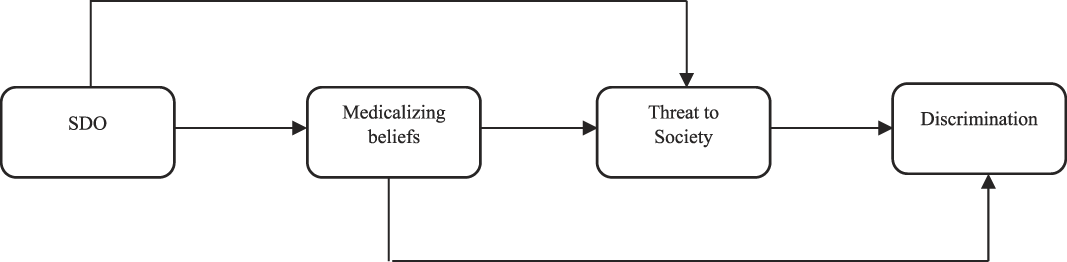
In this research, we intend to investigate whether participants’ SDO is both connected to medicalizing beliefs about schizophrenia as well as the belief that persons with schizophrenia are dangerous. Further, based on the review of Read et al. (Reference Read, Haslam, Sayce and Davies2006), we make the hypothesis that medicalizing beliefs about schizophrenia will be associated with dangerousness beliefs. These beliefs will in turn be linked to higher levels of discriminating intentions. Our hypotheses are presented schematically in Figure 1.
Proposed Model of Stigma of Schizophrenia

Methods
Sample and Procedure
Participants were 238 undergraduate students attending Aix-Marseille University (107 male and 131 female) and the average age of students was 20.4 years (SD = 3.03). Participants were recruited from the Humanities and Social Sciences Faculty. Before completing the questionnaire, the participants were asked to answer to a consent form and were informed that the study was anonymous and the answers confidential. The participants were then told that the researcher was interested in people’s evaluation of different behaviors, based on a scenario. All participants were then presented with the questionnaire that included a vignette and several different measures.
Materials
Vignette
The subjects evaluated a vignette describing a person meeting the Diagnostic and Statistical Manual of Mental Disorders, 4th Edition, (DSMIV) criteria for a diagnosis of schizophrenia. These depicted symptoms included delusions, auditory hallucinations, disorganized behavior and avolition. The vignettes were translated and adapted from the research of Pescosolido, Medina, Martin, and Long, Reference Pescosolido, Medina, Martin and Long2013. No labels or explanations of the depicted person’s condition were offered.
Social Dominance Orientation
A validated French version of the scale was used (Duarte, Dambrun, & Guimond, Reference Duarte, Dambrun and Guimond2004). This comprises 10 items and has a one-factor structure. The scale is rated on a 7-point Likert scale ranging from totally disagree to totally agree. The scale showed an acceptable reliability (α = .767).
Beliefs about the Depicted Person’s Situation
According to Read et al. (Reference Read, Haslam, Sayce and Davies2006), medicalizing beliefs or the “illness model” includes biogenetic explanations of schizophrenia and diagnostic labeling. In order to assess biogenetic explanations two items were measured as to whether: “[Name’s] situation is caused by…”: a) his genes, b) a brain disease. Another item also measured whether the subjects believed that: “[Name’s] situation is caused by a mental illness” and one item measured to what extent the participants believed that: “[Name] is suffering from schizophrenia”. Items were rated using a 7-point scale (1 = totally disagree; 7 = totally agree). A non-linear principal component analysis was carried out, all four items loaded on one factor (α = .677).
Further, we measured perceived dangerousness with a single item: “Do you think [Name] is a threat to society”. This question was rated from 1–7 with 1 being totally disagree and 7 being totally agree.
Discriminating Intentions
According to Link and Phelan (Reference Link, Phelan, Aneshensel, Phelan and Bierman2013), stigma leads to discrimination and status loss of persons with schizophrenia. This discrimination can take place either in everyday “casual” interactions or on a sociopolitical level and can concern the civil rights of persons with schizophrenia. In this study, we measure both desired social distance concerning everyday situations and discriminating attitudes, this time on a sociopolitical level.
Concerning the more “casual” aspects of discrimination, six items measured social distance and were taken from Link, Cullen, Frank, and Wozniak, Reference Link, Cullen, Frank and Wozniak1987. The items measured participants’ willingness to socially interact with the depicted person, in various social relationships (e.g. neighbor, co-worker, child career). The scale showed a good reliability (α = .817) and was used as a single factor. Items were rated from 0–3 with 0 being very unwilling and 3 very willing. The scale was reversed and higher scores indicated a higher desire for social distance.
The following five items were assessed in order to measure discriminating attitudes, this time on a socio-political level: “In my opinion, persons like [Name]: should be locked in special centers for safety reasons; should not have kids; should not be allowed to vote; should not be allowed to work; should be treated even without their consent”. The scale’s reliability was acceptable (α = .699) and all items were analyzed as a single factor. Items were rated from 1–7 with 1 being totally disagree and 7 being totally agree and a higher total score showed a higher level of discriminating attitudes.
Data Analyses
Descriptive analyses were performed on IBM SPSS 20. To investigate the links among our variables, a Structural Equation Modelling analysis was carried out on IBM AMOS 20. Two separate models were tested, one for the relation of the examined variables with the desired social distance and one testing the link with discrimination on a sociopolitical level.
Results
Descriptive Statistics
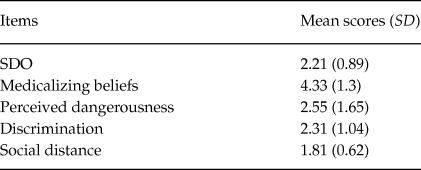
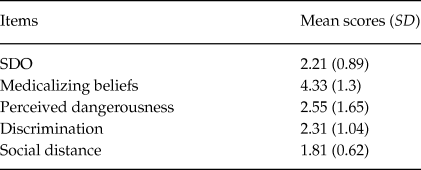
The descriptive statistics for the scales and the items are summarized in Table 1. The subjects’ mean SDO was quite low (M = 2.21, SD = .89). The participants’ mean scores on medicalizing beliefs show that in general they endorsed medicalizing beliefs in order to explain the depicted individual’s condition (M = 4.33, SD =1.3). The subjects also generally considered the depicted individual as not so dangerous (M = 2.55, SD = 1.65). Concerning discrimination, while the subjects’ scores on attitudes relative to socio-political discrimination were quite low (M = 2.31, SD = 1.04), social distance intentions were quite high (M = 1.81, SD = .62). Men scored higher on SDO than women, M = 2.46 vs M = 2.01, t(238) = 4.05, p < .001, but no significant difference was found between male and female participants concerning sociopolitical discrimination, M = 2.30 vs M = 2.33, t(238) = –.26, p = .80, and social distance, M = 1.74 vs M = 1.87, t(238) = –1.54, p = .12.
Distribution of Measures (Mean Value and Standard Deviation)
Relationship between individual’s SDO, medicalizing and dangerousness beliefs and discrimination
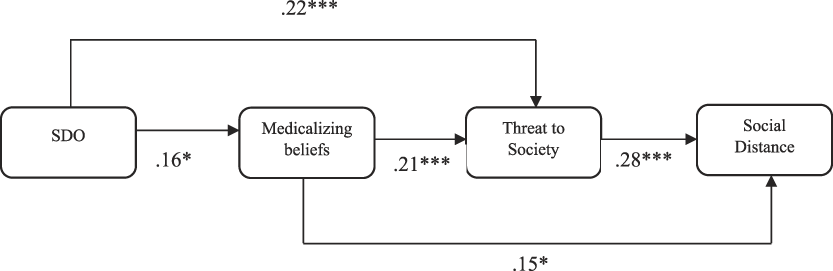
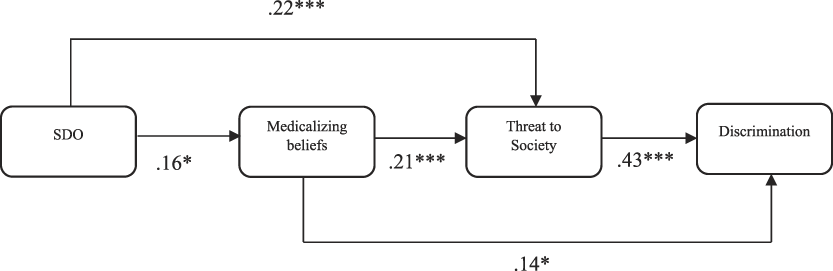
Figures 2 and 3 show the SEM standardized path coefficients. The asterisks represent the statistical significance of these coefficients. For the model of social distance, goodness-of-fit tests yielded a non-significant chi square, χ2(1) = 0.49; p = .48), which confirms that the model fits the observed data. The model’s baseline fit was adequate (TLI = 1.06; CFI = 1.00) as was the Root Mean Square Error of Approximation index (RMSEA = .000). For the model of socio-political discrimination (Figure 2), goodness-of-fit tests yielded a non-significant chi square, χ2(1) = 0.01; p = .92), and the model’s baseline fit was adequate (TLI = 1.18; CFI = 1.00) as well as the Root Mean Square Error of Approximation index (RMSEA = .000).
Proposed Structural Equation Model for Social Distance
χ2(1) = 0.49; p = .48; TLI = 1.06; CFI = 1.00; RMSEA = .000.
Only statistically significant connections are depicted. The number next to each connector is the value of the standardized regression weights, and their significance is represented with asterisks: *p < .05, **p < .01, ***p < .001

Proposed Structural Equation Model for Socio-political Discrimination
χ2(1) = 0.01; p = . 92; TLI = 1.18; CFI = 1.00; RMSEA = .000.
Only statistically significant connections are depicted. The number next to each connector is the value of the standardized regression weights, and their significance is represented with asterisks: *p < .05, **p < .01, ***p < .001.

SDO was connected to higher endorsement of the belief that the depicted individual was dangerous. It was also related to higher endorsement of medicalizing beliefs about the condition of the depicted individual which in turn was related to higher endorsement of the belief that the individual was dangerous. Medicalizing beliefs were also associated with discriminating intentions. Further, the belief that the individual is dangerous was related to more discriminating intentions, both for the case of social distance and for socio-political discrimination. Finally, connection between the SDO and the discriminating intentions did not reach statistical significance.
Discussion
The purpose of our study was to provide evidence that the relationship between medicalizing schizophrenia, dangerousness beliefs and discrimination as demonstrated by the review of Read et al. (Reference Read, Haslam, Sayce and Davies2006) is connected to the public’s ideological orientations and more precisely to their SDO. Indeed, we showed that higher SDO is associated with higher endorsement of legitimizing myths-beliefs that are in turn associated with discriminating intentions. Consistent with the results of Read and his colleagues (2006), medicalizing schizophrenia is linked to higher dangerousness beliefs and discriminating attitudes. Moreover, participants’ SDO is associated with both more medicalizing beliefs about schizophrenia and the belief that persons with schizophrenia are dangerous.
Our results suggest that campaigns with slogans such as “an illness like any other” are related to stigmatizing attitudes towards people with schizophrenia. Despite the good intentions behind these campaigns, several authors have been warning that presentation of schizophrenia as a disease that has a biogenetic etiology could backfire concerning stigma (Corrigan & Watson, Reference Corrigan and Watson2004; Phelan, Reference Phelan2005). This result, often explained in terms of essentialism (Haslam, Reference Haslam2000), could be explained by the fact that the more one believes that schizophrenia is a disease, the more one considers that persons with schizophrenia who are radically different to “normal” people, have no control over their thoughts and acts, which makes them more dangerous. On the other hand, recent research has shown that endorsing the psychosocial causes of schizophrenia leads to less stigmatizing attitudes (Angermeyer & Matschinger, Reference Angermeyer and Matschinger2003). We agree thus with other authors (Corrigan & Watson, Reference Corrigan and Watson2004; Pescosolido et al., Reference Pescosolido, Martin, Long, Medina, Phelan and Link2010; Read et al., Reference Read, Haslam, Sayce and Davies2006) who support that when presenting schizophrenia, a more balanced approach is necessary that is based on facts and data about both mental illness and its stigma. Stigma is a complex phenomenon that needs a “multidimensional approach” (Corrigan & Watson, Reference Corrigan and Watson2004) in order to fight it. Campaigns presenting schizophrenia as an “illness like any other” or relabeling schizophrenia would not be enough to tackle stigmatizing attitudes.
Furthermore, our model suggests that campaigns that only target the causal beliefs about schizophrenia or the belief that persons with schizophrenia are dangerous, may neglect some other important factors that are connected to the stigma phenomenon. Not taking into consideration the issues of social power and intergroup dominance at stake reduces the phenomenon to a simple problem of information and knowledge. The previous decade has shown us that the stigma of schizophrenia is not just a question of the public’s mental health literacy level. Rather, it is the relationship between “us” and “them” which is linked to issues of domination and to enforcement of norms (Link & Phelan, Reference Link, Phelan, Aneshensel, Phelan and Bierman2013). Thus, even though we consider that educational campaigns that deconstruct stereotypes and that present advances of medical treatment of schizophrenia would be important for the fight against stigma, anti-stigma efforts should go beyond the public’s accurate knowledge of schizophrenia and its treatment. Future anti-stigma campaigns should take the issue of power into consideration with messages that talk about the rights of people with schizophrenia and the social discrimination that this group faces. Finally, as Corrigan suggests, diminishing stigma implies fighting against discrimination and prejudice (Corrigan, Reference Corrigan2014). This fight mainly concerns people with lived experience, who, as in the case of racism or homophobia should be the principal focus and the “leading force” in anti-stigma efforts. Besides, as a recent study has demonstrated, active coping (i.e. trying to do something against stigma) of people with schizophrenia is positively related to reported well-being, while negative coping (i.e. avoiding facing the problem) is associated with negative well-being outcomes (Magallares, Perez-Garin, & Molero, Reference Magallares, Perez-Garin and Molero2016).
Our work has some limitations that should be taken into consideration before generalizing the results of the current research. Firstly, our sample consisted only of Humanities students, a population that shares several characteristics such as young age and as our analysis shows, rather low levels of SDO and discriminating intentions. Previous meta-analyses have highlighted the weaknesses of the use of college students in social science research, due to homogeneity of their responses and the differences in effects found compared to research with non-student populations (Peterson, Reference Peterson2001). In addition, research has shown that other components of stigma should be taken into consideration, such as emotions (Link & Phelan, Reference Link, Phelan, Aneshensel, Phelan and Bierman2013). Further limitations concern the relatively weak internal consistency of the medicalizing beliefs and the fact that we have measured dangerousness with a single item. Future research should take these limits into consideration. We consider however, that despite these limitations, our research could serve as a guiding frame for developing future research on the stigma of schizophrenia.
Our research constitutes a first attempt, based on the review on the impact of medicalizing beliefs (Read et al., Reference Read, Haslam, Sayce and Davies2006), to specifically measure medicalizing beliefs and how they relate to ideological orientations and stigmatizing attitudes. Future research should provide a more standardized measure for medicalizing beliefs. Further, future researches should include a measure of hierarchy-attenuating beliefs that could also be useful for anti-stigma campaigns. Moreover, given all the well-documented problems with self-reported measures (Greenwald, McGhee, & Schwartz, Reference Greenwald, McGhee and Schwartz1998), especially when it comes to politically incorrect attitudes and undesirable behaviors such as stigmatization and discrimination, it would be interesting to know whether the same model would hold if implicit measures are used to assess outcome variables. Further behavioral measures, such as the computer-based behavioral measure used in previous research (Michinov, Dambrun, Guimond, & Méot, Reference Michinov, Dambrun, Guimond and Méot2005) consisting in placing minority group members in a hierarchical structure, could also be adjusted to the group of people with schizophrenia and used in order to further explore the relation between SDO and stigma of schizophrenia.