Introduction
The use of aromatherapy for therapeutic symptom benefit has been practiced for centuries. Aromatherapies and essential oils were used for primary medical treatment prior to the discovery of modern pharmaceuticals (Robins, Reference Robins1999; Herz, Reference Herz2009). The mechanism of impact for aromatherapies is based on scent exposure activating the olfactory bulb, cerebral cortex, hypothalamus, and limbic systems (Cook & Lynch, Reference Cook and Lynch2008; Herz, Reference Herz2009). This activation associates the stimulation provided by the aromatherapy compound to memories, emotions, and peripheral autonomic and somatic responses. Reported benefits of aromatherapy use include the improvement of distress, mood, memory, cognitive performance, sleep pattern, energy level, and nausea, as well as an overall subjective sense of health (Lahlou, Reference Lahlou2004; Chien et al., Reference Chien, Cheng and Liu2012; Buckle, Reference Buckle2014; Ali et al., Reference Ali, Al-Wabel and Shams2015). The positive psychological impact among aromatherapy utilizers with neurological disorders has been well documented (Holmes & Ballard, Reference Holmes and Ballard2004; Yang et al., Reference Yang, Lin and Wu2015). Perceived effectiveness of aromatherapy for soothing symptoms has promoted the increasing interest in essential oil utilization in conjunction with modern-day medical practices (Buckle, Reference Buckle2014).
Over one-half of families utilize complementary and alternative medicine (CAM) for pediatric ailments, with approximately 15%–20% of those families utilizing aromatherapy (Shakeel et al., Reference Shakeel, Little and Bruce2007). While more than 60% of families using CAM practices for their child would recommend them to others, over one-half of the families claimed that their respective physicians were unaware of CAM use for their child (Adams et al., Reference Adams, Dagenais and Clifford2013). Improved aromatherapy understanding among palliative care clinicians may foster open communication among providers and families regarding CAM usage.
The medical literature lacks robust investigation into the impact that aromatherapy has on symptoms for children, particularly in palliative care settings (Hongratanaworakit, Reference Hongratanaworakit2004; Maddocks-Jennings & Wilkinson, Reference Maddocks-Jennings and Wilkinson2004; Post-White & Hawks, Reference Post-White and Hawks2005). Aromatherapy has shown improvement in pediatric patients’ responses to pain, as well as a reduction in stress-related symptoms (Jafarzadeh et al., Reference Jafarzadeh, Arman and Pour2013; Marofi et al., Reference Marofi, Sirousfard and Moeini2015; Bikomoadi et al., Reference Bikmoradi, Khaleghverdi and Seddighi2017). Initial pediatric studies provide initial evidence that aromatherapy positively impacts symptom management among cohorts of pediatric patients, especially when utilized as a supportive care technique in conjunction with a primary medical intervention (Nord & Belew, Reference Nord and Belew2009; Ndao et al., Reference Ndao, Ladas and Cheng2012; Soltani et al., Reference Soltani, Soheilipour and Hajhashemi2013). Aromatherapy usage, specifically among palliative care populations, is not well studied. Louis and Kowalski (Reference Louis and Kowalski2002) revealed that aromatherapy in end-of-life adult patient populations improved blood pressure and pulse, pain, anxiety, and depression, as well as a sense of well-being (Louis & Kowalski, Reference Louis and Kowalski2002). Our study team was not able to locate literature quantifying the effect of aromatherapy for the symptom burden of pediatric patients receiving pediatric palliative care. This study objective was to quantify the supportive care benefits of aromatherapy for nausea, pain, or anxiety symptoms among pediatric patients receiving palliative care using child-reported validated symptom burden scales at specific time points, 5 and 60 minutes, after aromatherapy use.
Methods
The local independent review board waived approval as the aromatherapy pilot intervention was institutionally approved as part of a larger integrative therapy quality improvement project. Participants were enrolled through our free-standing pediatric hospital in a convenience sampling manner with consecutive offering of aromatherapy sachet based on new palliative care consults for stated symptom intervention (nausea, pain, or mood support consult). Inclusion criteria included age greater than 2 years. Exclusion criteria for receiving an aromatherapy sachet included allergy to any ingredient; recent or active bronchospasm, asthma, or reactive airway; current supplemental oxygen use (out of institutional precaution); or perfume sensitivity. Pediatric participants were excluded from the study if they were not able to self-report their symptom burden in 1 of 3 ways: by pointing or engaging in a gesture (such as deliberate blinking) to reveal scale response; verbalizing or vocalizing to reveal scale response; or marking the scale number. Children with severe neurologic impairment were, thus, excluded. Pediatric participants were screened for exclusion by chart review and conversation with the patient and family to confirm that the recipient of the sachet met the inclusion criteria. Exclusion from aromatherapy sachet resulted in the use of a non-scented visual imagery envelope for guided assistance in deep breathing relaxation (control group). The same instructions script was used for aromatherapy breathing as for visual imagery breathing. This visual imagery envelope contained a calming nature photograph for the child to look at while breathing deeply and calmly. The first 90 children who were not able to receive aromatherapy still participated in the deep breathing that would have occurred with the provision of aromatherapy.
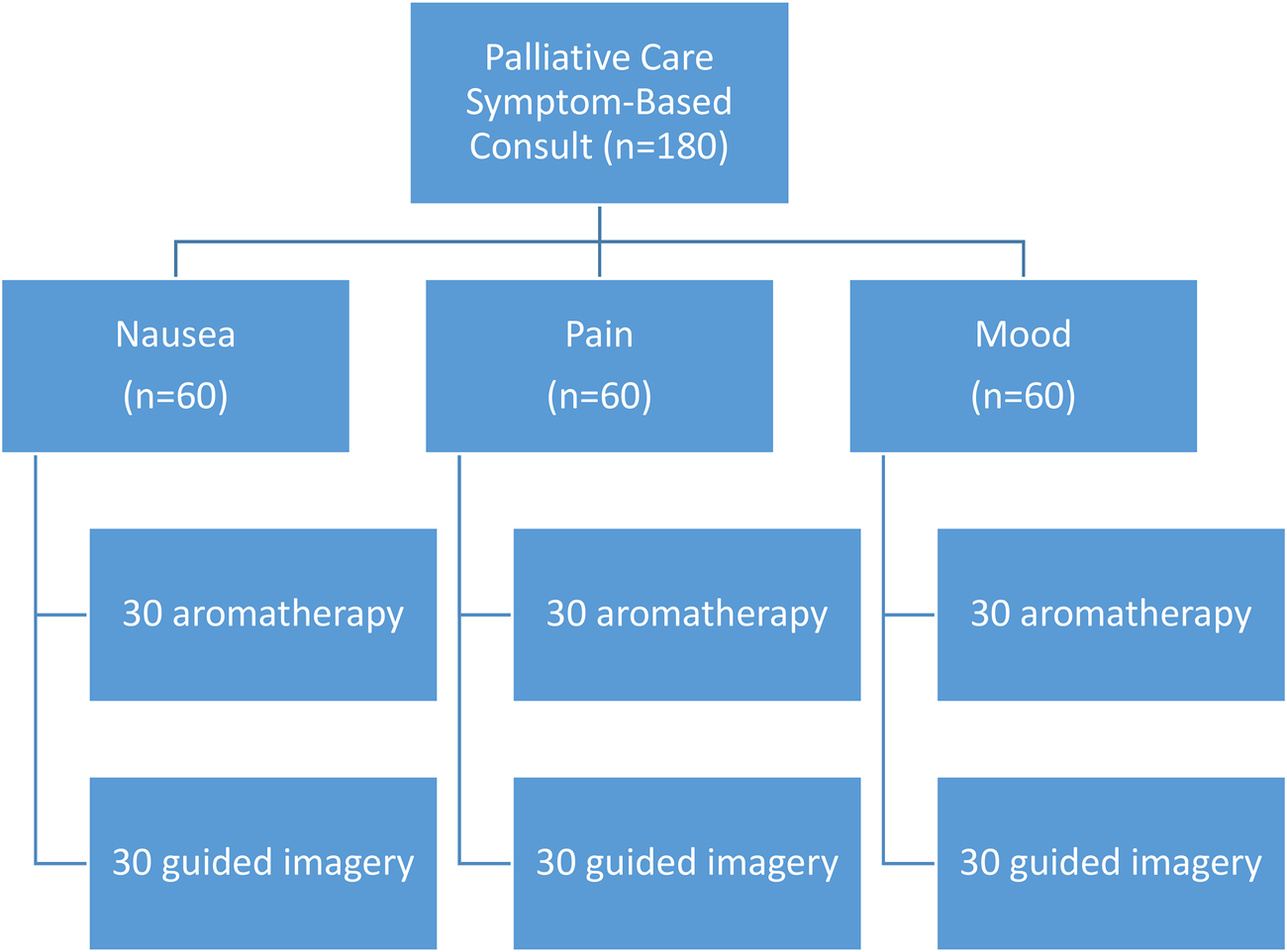
Participants included 180 pediatric patients receiving palliative care consultations for nausea, pain, or anxiety symptom intervention (Figure 1). All children receiving a palliative care consult for 1 of these 3 symptom burdens were consecutively enrolled. This intervention occurred prior to further palliative care consultation interventions and prior to a therapeutic relationship being established with the palliative care team. Thirty participants received aromatherapy and 30 received visual imagery for each of the 3 symptom arms for a total of 60 participants in each symptom arm and no duplicate participants across symptom arms (n = 180 enrollees). The decision to start with 30 participants per arm in this pilot study was based on access to that number of aromatherapy sachets (a convenience resource decision). The upper bound of 30 patients per symptom group was chosen based on experience that a higher number would likely be unrealistic in terms of time and based on annual palliative care consult number would not be an optimal utilization of a limited sample of future participants available for a larger implementation study.
Enrollment algorithm graph.

Patient education on either aromatherapy or visual imagery was provided verbally to the patient and caregiver. Education included potential benefits, directions for use, and safety precautions. Written education on aromatherapy and visual imagery was available in both English and Spanish. Consent from the guardian and assent from the child were obtained verbally.
The aromatherapy sachet product was presented to the hospital infection prevention team and value analysis team for their review and approval prior to study start. Personal aromatherapy sachets are designed based upon the principles of fluid dynamics utilizing special outer packaging to protect the oils from degradation. When squeezed, the sachet permits the release of therapeutic scent. Sachets continue to dispense effective doses when squeezed, allowing for discreet, convenient, and effective relief at home or on the go for up to 30 days after opening. The 3 aromatherapy intervention arms included the following smell sachets: nausea (ginger, cardamom, spearmint, and fennel) for stomach upset, nausea, and emesis; focus (peppermint, rosemary, frankincense, and bergamot) for distraction from pain or generalized discomfort; and calm (lavender, orange, juniper berry, patchouli, and ylang-ylang) for mood such as stress or anxious feelings.
The palliative care physician or research associate enrolled patients and assigned patients to the intervention. First-time use occurred in the presence of a palliative care medical provider. The palliative care clinician provided the following verbal instructions during first use for both aromatherapy sachet and visual imagery envelope participants: “Let your nose do the work. Open the sachet or envelope and hold palm-width away from your nose as you take a few slow, calm, relaxing whiffs (3–5 deep breaths). Together, we will breathe in calm and breathe out stress. Please stop immediately and report to me if you feel dizzy, more nausea, or uncomfortable when breathing together.” The palliative care practitioner then documented assessments, interventions, and child response in the study participant's medical record. The child was prompted for scale completion at study onset, at 5 minutes, and again at 60 minutes by the practitioner. Participants did not receive a pharmaceutical intervention for the symptom during the hour post-aromatherapy introduction.
Validated patient report outcome scales utilized included the Baxter Retching Faces (BARF) visual numeric 1–10 scale for nausea, the Wong-Baker (FACES) visual numeric 1–10 scale for pain, and the Children's Anxiety and Pain Scale (CAPS) visual numeric 1–5 scale for mood. The pediatric study participant drew his/her score on a pre-printed paper with the scale according to the symptom level reported. For the 33 (18%) patients unable to draw on the paper because of dexterity or physical ability, verbal report or physical gesture after looking at the scale was accepted. Each child completed the one scale for the symptom for which they were assigned (1 scale format per participant).
Two difference scores were calculated for each subject per condition between baseline and 5 minutes post-therapy and between baseline and 60 minutes post-therapy. Aggregate and subgroup differences in pre- and post-condition scores were compared using Wilcoxon signed-rank tests. The p values calculated were based on the Wilcoxon signed-rank test. Subgroup comparisons, according to the location of intervention (home, hospital, clinic, etc.), were Bonferroni adjusted for multiple comparisons.
Results
Participant ages ranged from 4 to 17 years, with a mean age of 9.2 years. Diagnoses included oncologic/hematologic (n = 52, 34%), cardiac/pulmonary (n = 47, 29%), neurologic (n = 33, 21%), nephrologic/urologic (n = 20, 11%), endocrine (n = 17, 7%), and orthopedic (n = 11, 4%). Study location included: 14 home visit setting; 22 infusion room, 45 outpatient palliative care clinic, and 61 inpatient hospital room. Enrollment and participation occurred between August 2016 and August 2018. No child or adolescent who met the inclusion criteria for aromatherapy sachet declined to receive an aromatherapy sachet (100% participation for those patients meeting aromatherapy eligibility criteria). All 90 participants in the visual imagery envelope arm were assigned to that arm because they had met exclusion criteria for aromatherapy use: 41 (45%) because of a reactive airway; 37 (41%) because of current supplemental oxygen use; 8 (9%) because of perfume sensitivity; and 4 (4%) because of an allergy to an essential oil product. There were no baseline differences between groups other than the exclusion criteria.
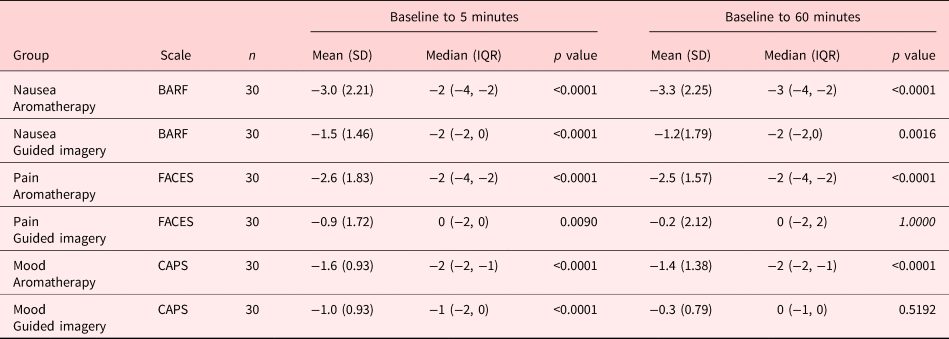
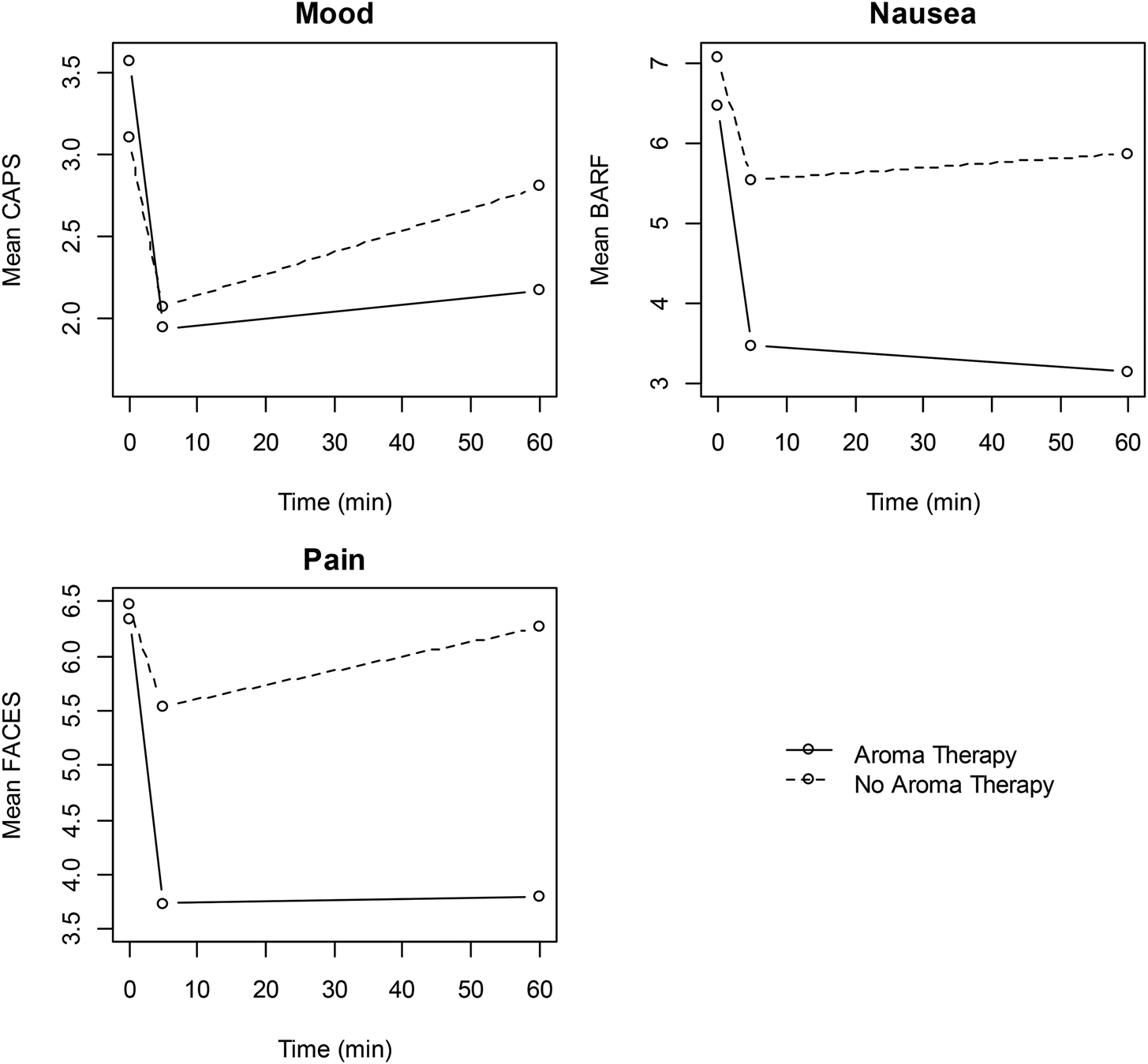
Aromatherapy intervention resulted in improved nausea, pain, and anxious feelings at 5 minutes and continued at 60 minutes post-exposure (p < 0.001). Table 1 summarizes the mean and standard deviation (SD), as well as the median and interquartile range (IQR) for each symptom group and intervention arm. The reported mean is the mean between the final scale score at 60 minutes and the initial scale score at 5 minutes. For all cases, a negative value indicated that the baseline score was higher than the post score, meaning that the patient felt better. Figure 2 provides time plots of the symptom burden from pre-intervention to the intervention, 5 minutes post-intervention, and 60 minutes post-intervention.
Summary of scale score comparisons according to the symptom and intervention group

Plots of symptom burden scores according to time points.

The baseline mood score was noted to be a mean of 9.2/10 in the aromatherapy group and 9.1/10 in the visual imagery group. The nausea baseline was 9.4/10 in the aromatherapy group and 9/10 in the visual imagery group. The pain baseline was 8.8/10 in the aromatherapy group and 9.3/10 in the visual imagery group. The mean difference score shows the difference in score between baseline pre-intervention and 5 minutes after the intervention; the median reported is the median of scores between baseline pre-intervention and 5 minutes after the intervention. The mean SD reports the baseline score compared with 60 minutes after the intervention. The comparisons presented are wholly within-person, as the “other” group was not a true control because the patients in this group were ineligible for participation in aromatherapy.
A subgroup analysis based on the location of aromatherapy delivery demonstrated a significant improvement in the BARF nausea scale scores by a mean -2.8 for the 12 patients who had aromatherapy in an oncology infusion room (p = 0.01). A mean scale change of -2.1 (standard deviation [SD] 1.83) for pain and -1.7 (SD 1.00) for mood in the hospital setting was demonstrated (p < 0.03 and p < 0.001, respectively). As for the other location subgroups analyzed, the difference was too small to demonstrate.
There were no adverse medical harms as a result of study participation. One child in the aromatherapy arm experienced sneezing after aromatherapy use but did not require pharmaceutical intervention for the sneezing, and this did not progress into further respiratory symptoms or signs of allergy or distress.
The trial stopped after 30 participants were accrued in both arms of each of the three symptom burden domains.
Discussion
This pilot study revealed the feasibility and symptom impact of aromatherapy on nausea, pain, and anxious feelings for pediatric patients receiving palliative care consultations and able to self-report their symptom burden. Our study revealed an interesting chronology to aromatherapy use. Patients in the visual imagery cohort appeared to rebound toward the 60-minute post-intervention mark, but patients in the aromatherapy cohort maintained their comfort longer.
Visual imagery and deep breathing impact
A fascinating finding was how visual imagery paired with deep breathing for the control group showed improvement in symptom burden in this study. Our study team viewed the visual imagery envelope as a way to include children who may have been looking forward to aromatherapy but were then excluded because of the eligibility criteria. Yet, the study results clearly showed how visual imagery paired with deep breathing alone impacted the symptom burden. Visual imagery partnered with deep breathing was previously documented to have a significant impact on a patient's well-being and coping ability by promoting relaxation and being a distraction (Rusy & Weisman, Reference Rusy and Weisman2000; Gerik, Reference Gerik2005). There have been calls for systematic protocol development utilizing mind-body therapies such as deep breathing and visual imagery for use in high-stress units such as the emergency department because of their clinical utility (Khan & Weisman, Reference Khan and Weisman2007). Pain management improvement has even been demonstrated among patients undergoing independent internet-training modules, emphasizing the therapeutic potential of these interventions (Hicks et al., Reference Hicks, von Baeyer and McGrath2006).
The mechanism of deep breathing has been tied to stimulation of the parasympathetic nervous system, inducing feelings of relaxation and calmness (Vempati & Telles, Reference Vempati and Telles2002; Raghurai & Telles, Reference Raghuraj and Telles2003), resulting in improved attention, affect, and cortisol levels among distressed patients (Ma et al., Reference Ma, Yue and Gong2017). Relaxing deep breathing significantly increases the pain threshold and decreases sympathetic activity, as compared with attentive deep breathing, but both attentive and relaxing deep breathing exercises help combat negative situational feelings (Busch et al., Reference Busch, Magerl and Kern2012). Deep breathing exercises have been shown to produce relaxation, as well as serve as a distraction outlet, in pediatric patients undergoing vaccinations and painful injections providing acute pain relief (Peretz & Gluck, Reference Peretz and Gluck1999; French et al., Reference French, Painter and Coury1994). The use of visual imagery has produced significant improvement in chronic pain control among pediatric patients with recurrent abdominal pain (Ball et al. Reference Ball, Shapiro and Monheim2003; Brent et al., Reference Brent, Lobato and LeLeiko2009). Utilization of both therapies in conjunction with one another (aromatherapy partnered with deep breathing) has the generalizable potential to produce therapeutic benefit.
Reflection on aromatherapy selection
In selecting the mode of aromatherapy delivery, the pediatric palliative care team engaged in an extensive review of aromatherapy product formats used in various health care settings. Prior to product selection, the palliative care team completed a listserv survey of current aromatherapy modes of delivery. While 5 responding centers each reported using essential oil liquid vials, our concern for contamination, dermatologic impact, accidental ingestion, and spills warranted further product search. Four pediatric settings on the listserv reported using aromatherapy diffusers, but this was not deemed acceptable in our local setting because of inhalation exposure of unintended recipients (the risk of patients or staff exposure to diffused essential oils). The sachet format of aromatherapy was, thus, selected because of its individual, localized, and non-topical use and overall high safety profile. Because essential oils are steam distilled prior to placement in the sachet by the aromatherapy company, the sachet format is the least allergenic and even marketed as non-allergenic.
Strengths and limitations
Limitations of the study include a single study site location and high rate of exclusion (50%) because of existing pulmonary or allergy conditions. The scales were applied to younger age cohorts than the formal validation of the scale for a total of 7 study participants (FACES scale validated for ages 3 years or older, CAPS scale validated for age 4 years or older, and BARF validated for ages 5 years or older). Neither the participants nor the researcher was blinded in the study. The use of deep breathing for relaxation in the control arm (many of whom had underlying respiratory diagnoses) could have been a limitation as some of these patients do better when not focusing on their breathing. A lack of assessment of whether a patient received a pharmaceutical intervention for the symptom in the hours prior to aromatherapy introduces potential confounders. Our study team recognized a priori that the aromatherapy intervention was intended to serve as supportive care along with standard medical care rather than to replace pharmaceutical interventions. The palliative care provider serving as the administrator of the intervention may have introduced bias. Strengths of the study include creative implementation of a “control arm” using visual imagery and inclusion of validated, developmentally relevant symptom burden scales. A strength of the study included empowerment of a child's perspective with the implementation of patient-reported scales rather than relying on a proxy report.
Future direction
Definitive future trial research may investigate the impact of aromatherapy use longitudinally to include tracking concurrent or subsequent pharmaceutical medication use to quantify whether aromatherapy and guided imagery decrease the need for pharmaceutical interventions for children. There is a need for more investigations into aromatherapy benefits among pediatric populations receiving palliative care services to validate the relevancy and effectiveness further. Particularly, with a larger cohort, there may be an opportunity to engage in a subgroup analysis to investigate symptom burden impact for neurologically impaired children who may be able to participate in aromatherapy passively and may experience symptom improvement based on non-verbal assessment. This study cohort was limited to those pediatric patients able to identify (whether by vocalization or gesture) their own symptom burden scale. This pilot study reveals the potential for aromatherapy to serve as a feasible, implementable support for children and adolescents receiving palliative care for nausea, pain, or anxiety symptom-based consultations.