Introduction
European grandparents are important providers of informal care to their grandchildren (Hank and Buber, Reference Hank and Buber2009). In the 2015 round of the Survey of Health, Ageing and Retirement in Europe (SHARE) (Börsch-Supan et al., Reference Börsch-Supan, Brandt, Hunkler, Kneip, Korbmacher, Malter, Schaan, Stuck and Zuber2013), nearly half (45%) of grandparents reported looking after grandchildren, and nearly one-fifth (18.5%) of those providing care reported doing so ‘almost daily’ (author's own calculations). Across Europe, cuts to public services to families subsequent to the 2008–2009 financial crisis have led to the implicit expectation that grandparents will step in to fill the gap in child care (Glaser and Hank, Reference Glaser and Hank2018), for instance by providing more daily care. At the same time, many European countries have recently implemented reforms to delay retirement in order to minimise the economic and budgetary costs associated with population ageing (European Commission, 2018). Daily grandchild care represents a substantial time commitment, which grandparents may find hard to combine with employment.
A growing body of research suggests that the onset of grandparenthood reduces labour supply (Rupert and Zanella, Reference Rupert and Zanella2018; Backhaus and Barslund, Reference Backhaus and Barslund2019). However, we know little about the direct association between daily grandchild care and grandparents’ employment. Studying this association is important: first, it can help identify whether grandparenthood reduces labour supply by presenting individuals with time commitments incompatible with (full-time) work. Second, it can indicate whether and how family policies may support grandparents’ labour force participation. If daily grandchild care is associated with lower employment, increased welfare support to child care may help retain grandparents in the labour market. In the absence of a direct association, however, additional public child care may have little effect on grandparents’ employment.
Rates of intensive grandparental care vary across European countries (Herlofson and Hagestad, Reference Herlofson, Hagestad, Arber and Timonen2012). Welfare familism, defined as the degree to which social policies assume families to be responsible for the care of their dependent members (Leitner, Reference Leitner2003), is strongly associated with the provision of daily grandchild care at the national level (Igel and Szydlik, Reference Igel and Szydlik2011; Bordone et al., Reference Bordone, Arpino and Aassve2017). Still, it is unknown whether any association between daily grandchild care and grandparents’ employment varies across countries with different child-care policies. While previous research suggests that the negative relationship between grandparenthood and labour supply is independent of the country-context (Backhaus and Barslund, Reference Backhaus and Barslund2019), the association between grandparents’ employment and daily grandchild care likely depends on the child-care policy regime.
I use SHARE data for 20 European countries to study the association between daily grandchild care provision and employment among grandmothers and grandfathers aged 50–69. I make a novel contribution by testing for heterogeneity in this association across country groups characterised by different child-care policy orientations, as measured by the combination of two macro-level indicators: formal child-care service utilisation and paid parental leave. Unlike most previous research on the topic, I consider daily grandchild care, rather than the presence of grandchildren, as the main explanatory variable. Focusing on such high frequency of care allows grandchild care commitments that may be difficult to combine with employment to be isolated. I use a simultaneous equations approach to account for the potential selection of grandparents with different unobserved traits into work and grandchild care provision, and I investigate how daily grandchild care is associated with grandparents’ employment at the extensive margin (i.e. the probability of working) and at the intensive margin (i.e. the number of weekly working hours).
Background
Grandparenthood, grandchild care and employment
A growing number of studies find a negative relationship between grandparenthood and employment, both at the extensive and at the intensive margin. In this literature, the extensive margin is operationalised as the probability of being employed or self-employed as opposed to inactive, and the intensive margin is indicated by the number of working hours. Performing survival analysis on data from the Health and Retirement Study in the United States of America (USA), Lumsdaine and Vermeer (Reference Lumsdaine and Vermeer2015) find that, among older women, the birth of the first or of an additional grandchild leads to an increase in the probability of retirement by 8.5 and 1.4 per cent, respectively. Rupert and Zanella (Reference Rupert and Zanella2018) apply an instrumental variable approach to data from the US Panel Study of Income Dynamics, exploiting variation in the timing of becoming a grandparent by gender of the first-born adult child, as daughters tend to have children earlier than sons. They find that becoming a grandmother reduces women's working time by 30 per cent, but that grandparenthood has no effect on men's employment. Asquith (Reference Asquith2018) exploits variation in US state-by-year access to reproductive technologies to instrument grandparent status, and finds that grandfathers are 5.7 per cent more likely to be retired for each additional grandchild, while grandmothers work 120 hours less per year and are 8.4 per cent less likely to work in response to each additional grandchild.
Among the European studies, Backhaus and Barslund (Reference Backhaus and Barslund2019) apply the same identification strategy as Rupert and Zanella (Reference Rupert and Zanella2018) to pooled SHARE data from nine European countries. They find that being a grandmother reduces women's probability of working by 20 per cent, with no effect on men. Analyses of women in Austria (Frimmel et al., Reference Frimmel, Halla, Schmidpeter and Winter-Ebmer2017) and England (Zanasi et al., Reference Zanasi, Sieben and Uunk2020) find that the birth of the first grandchild is linked with an increase in the probability of leaving the labour market. Applying survival analysis to Swedish register data, Kridahl (Reference Kridahl2017) shows that grandparents of both sexes retire earlier than non-grandparents. Studies analysing cross-national comparative data also suggest that, across Europe, being a grandparent is associated with stronger preferences towards early retirement (Hochman and Lewin-Epstein, Reference Hochman and Lewin-Epstein2013) and with women's early retirement behaviour (Van Bavel and De Winter, Reference Van Bavel and De Winter2013). Collectively, these findings suggest that in Europe becoming a grandparent induces individuals to leave the labour force and/or to work fewer hours. Moreover, the negative effects of grandparenthood appear to be greater for women, with lower or no effects for men (Backhaus and Barslund, Reference Backhaus and Barslund2019). However, it remains unclear whether, among grandparents, the provision of grandchild care is linked with employment. This is important to understand in order to identify whether public child-care provision can support delayed retirement by relieving grandparents of care responsibilities.
A few studies investigate the association between grandchild care provision and employment. Using SHARE, Hank and Buber (Reference Hank and Buber2009) analyse the correlates of grandchild care and find that, in Europe, employed grandparents are less likely to provide it than non-employed grandparents. Using the same data-set to examine the predictors of retirement, De Preter et al. (Reference De Preter, Van Looy and Mortelmans2013) find that older workers who look after their grandchildren at least weekly are over twice as likely to retire at follow-up as those who do not. This evidence, however, is difficult to interpret, since the negative association may be explained by two non-mutually exclusive mechanisms: selection and role conflict.
Grandparents may select into paid work and family care based on both observable and unobservable characteristics. Among the observable characteristics, grandparents’ health, socio-economic status and family structure simultaneously determine their ability and necessity to work and provide child care (De Preter et al., Reference De Preter, Van Looy and Mortelmans2013; Arpino and Bordone, Reference Arpino and Bordone2017). Unobservable characteristics relate to grandparents’ personality traits and preferences towards work and family care. These include family needs and attitudes towards gender roles and family obligations. In particular, the fact that some individuals are more family-oriented while others are more career-oriented may result in grandparents who provide grandchild care having lower employment rates or working hours, even in the absence of any direct association between grandchild care and employment (Lakomý and Kreidl, Reference Lakomý and Kreidl2015). Lakomý and Kreidl (Reference Lakomý and Kreidl2015) analyse SHARE data to study how different employment statuses relate to the intensity of grandchild care. They find a positive association between being in part-time – as opposed to full-time – work and higher frequencies of grandchild care for paternal grandmothers. However, the association does not hold when controlling for time-invariant heterogeneity across grandparents using individual fixed effects, suggesting that it is mostly attributable to selection. The authors conclude that the choice between full-time and part-time work may be influenced by the same unobserved factors that also impact the frequency of grandchild care.
Accounting for selection, any direct negative association between grandchild care and employment may be explained by role conflict theory (Goode, Reference Goode1960). Both working and looking after grandchildren require time and energy (Lakomý and Kreidl, Reference Lakomý and Kreidl2015). Grandparents may be unable to combine the two roles and thus not engage in (or give up) either one or the other. Role conflict is most likely to arise when grandparents are faced with daily or almost-daily child-care responsibilities. As it has been shown in relation to informal care-givers of older adults (Heitmueller, Reference Heitmueller2007), net of selection, care provision is only negatively associated with labour market participation at high frequencies (i.e. over 20 hours a week). Intuitively, looking after a grandchild once a week or less often is unlikely to pose work–family reconciliation problems, as grandparents may easily combine full-time employment with grandchild care performed on weekends or days off from work. In this article, I consider grandchild care performed daily or almost daily, and test for whether it is in conflict with employment among grandparents aged 50–69. I use a simultaneous equations approach to account for the fact that grandparents may select into employment and daily grandchild care based on observed and unobserved characteristics.
Familism in child-care policies and daily grandchild care
The comparative literature on welfare regimes and intergenerational support defines familism (or familialism) as the extent to which families, rather than the state or the market, are considered responsible for the care and financial support of their dependent members, particularly young children and non-self-sufficient older adults (Leitner, Reference Leitner2003; Saraceno, Reference Saraceno2016). With respect to informal care-giving, familistic policies generally strengthen family care responsibilities (Leitner, Reference Leitner2003). They may do so through the absence of state- or market-provided alternatives to family care, in what has been named ‘familism by default’ (Saraceno and Keck, Reference Saraceno and Keck2010); or by actively supporting the family caring function through financial assistance (e.g. cash-for-care transfers) and employment protection to family care-givers (e.g. leave schemes), resulting in a model of ‘supported familism’ (Saraceno and Keck, Reference Saraceno and Keck2010; Saraceno, Reference Saraceno2016). By contrast, de-familising policies are those aimed at unburdening families from their support functions (Leitner, Reference Leitner2003). ‘De-familisation’ predominantly works through the provision of services, either directly by the state, or subsidised and provided via the market (Saraceno, Reference Saraceno2016). Since the provision of services and leave schemes are not mutually exclusive, some policy patterns may also result in ‘optional de-familisation’, by which family care-givers can choose between outsourcing the care or providing it themselves (Saraceno and Keck, Reference Saraceno and Keck2010; Herlofson and Hagestad, Reference Herlofson, Hagestad, Arber and Timonen2012).
Policies that partition responsibilities and obligations between the family, the state and the market inevitably reflect and regulate the division of responsibilities between genders (Lewis, Reference Lewis1992). Since care is predominantly women's work, familism is strongly related to the gender division of roles, and to the extent to which working-age women participate in the labour market (Saraceno and Keck, Reference Saraceno and Keck2011; Thévenon, Reference Thévenon2011). In general, de-familisation through service provision promotes women's employment by relieving them of care responsibilities (Saraceno and Keck, Reference Saraceno and Keck2011). Empirical evidence shows that, in countries where child-care services are widespread and parental leave schemes are generous (usually found in Northern Europe), the prevalence of grandchild care is high, but its intensity is relatively low, with most grandparents providing care once a week or less often (Igel and Szydlik, Reference Igel and Szydlik2011; Bordone et al., Reference Bordone, Arpino and Aassve2017). This reflects the fact that, since many mothers work, grandparents are often needed to complement formal child care (Herlofson and Hagestad, Reference Herlofson, Hagestad, Arber and Timonen2012).
At the other end of the policy spectrum, familism by default is not conducive to mothers’ employment, because it does not offer alternatives to family care (Saraceno and Keck, Reference Saraceno and Keck2011). In countries characterised by familistic child-care policies (usually in Southern Europe), relatively low female employment means that the demand for grandparental care is lower than in the North, and fewer grandparents provide any care (Igel and Szydlik, Reference Igel and Szydlik2011; Di Gessa et al., Reference Di Gessa, Glaser, Price, Ribe Montserrat and Tinker2016). However, the scarce provision of services (often combined with low availability of part-time employment) mean that working mothers may require full-time care from the grandparents (Arpino et al., Reference Arpino, Pronzato and Tavares2014). Thus, a large proportion of grandparents who provide care tend to do so daily (Bordone et al., Reference Bordone, Arpino and Aassve2017). The implications of long leave schemes for women's participation in the labour market are ambiguous, depending on the extent to which employment protection to family care-givers is combined with the possibility of outsourcing care (Lewis, Reference Lewis2006; Thévenon, Reference Thévenon2011), as well as on the availability of part-time employment for mothers (Bordone et al., Reference Bordone, Arpino and Aassve2017). Thus, mothers’ need for daily grandchild care may depend on whether services are provided in addition to generous parental leave.
Attempting to position European countries on to the familism/de-familisation spectrum is an arduous task, because every country presents a combination of different policy approaches with respect to different dimensions of intergenerational support (Saraceno and Keck, Reference Saraceno and Keck2010). However, countries can be classified according to specific policy areas of interest. In the following analysis, I adopt a classification of European countries that is based solely on policies related to the care of young children, which are relevant to the study of grandchild care (Bordone et al., Reference Bordone, Arpino and Aassve2017), and its association with grandparents’ employment. Saraceno and Keck (Reference Saraceno and Keck2010) propose two indicators for classifying countries according to their child-care policy mix: the percentage of children under the age of three enrolled in formal child care, an indicator of de-familisation; and effective parental leave, defined as the duration of paid parental leave multiplied by the replacement rate of the leave benefit, an indicator of supported familism. Depending on the level of each indicator, countries can be grouped into four policy regimes, which differ in the share of child-care responsibilities borne by families, and in the extent to which working-age mothers participate in the labour market:
(1) Optional de-familisation: both child-care service utilisation and weeks of effective parental leave are high (i.e. above the across-country average). Families can easily outsource child care to public services, but they may also choose to provide care themselves, as mothers’ employment is protected through generous leave schemes.
(2) Service de-familisation: child-care service utilisation is high, but the length of effective parental leave is low (i.e. below the across-country average). De-familisation occurs predominantly through service provision or subsidisation, and it promotes mothers’ employment by relieving them of child-care responsibilities.
(3) Supported familism: formal child-care utilisation is low, while effective parental leave is high. The welfare state encourages family care by supporting parents in taking care of children. Long periods of leave may encourage mothers to remain in the labour market by granting job protection but, in combination with the low provision of services, they may also make it harder for them to return to work.
(4) Familism by default: both child-care service utilisation and effective leave are low. Families are implicitly expected to take care of children, but not supported in this role, making it difficult for mothers to reconcile work and child-care responsibilities.
While following the policy regimes proposed by Sarceno and Keck (Reference Saraceno and Keck2010) and used by Bordone et al. (Reference Bordone, Arpino and Aassve2017) in their study of grandchild care provision, this classification differs from those used by the authors in two ways. First, Saraceno and Keck identify three types of regimes (familism by default, supported familism and de-familisation), but add that ‘there may also be a fourth variant that offers an option between supported familialism and de-familialisation, but this is a rare case’ (2010: 676). I explicitly consider this fourth variant as optional de-familisation. Given my focus on potential role conflict between grandchild care and employment, I find it particularly important to distinguish between ‘optional’ and ‘service’ de-familisation. As I argue below, the two regimes may lead to different levels of need for daily grandparental care, resulting in it having different associations with employment. Leitner (Reference Leitner2003) and Herlofson and Hagestad (Reference Herlofson, Hagestad, Arber and Timonen2012) use the term ‘optional familialism’ to refer to a child-care policy context where family care is supported through extensive leave, but can easily be outsourced to public services. I rename this cluster ‘optional de-familisation’ in order to draw attention to the availability of child-care services.
Second, unlike Bordone et al. (Reference Bordone, Arpino and Aassve2017), I use child-care enrolment (as opposed to ‘child-care coverage’) to indicate de-familisation. Following previous studies (Di Gessa et al., Reference Di Gessa, Glaser and Tinker2016), I select enrolment because it combines a supply-side element (the availability of services) with actual take-up rates for formal child care, which are more strongly related to unobserved country-level factors linked to grandchild care, such as norms about family responsibilities and cultural preferences about the outsourcing of child care (Arpino et al., Reference Arpino, Pronzato and Tavares2014; Di Gessa et al., Reference Di Gessa, Glaser, Price, Ribe Montserrat and Tinker2016). As such, I consider it a more ‘complete’ indicator of the level of de-familisation. For comparability with Bordone et al. (Reference Bordone, Arpino and Aassve2017), in Appendix S1 (in the online supplementary material) I present an alternative classification of countries based on child-care coverage, defined as the number of weeks of coverage available if all children were enrolled (Saraceno and Keck, Reference Saraceno and Keck2008).
While empirical research consistently finds a North–South gradient in the prevalence and frequency of grandchild care provision in Europe (Igel and Szydlik, Reference Igel and Szydlik2011; Bordone et al., Reference Bordone, Arpino and Aassve2017), nothing is known about whether some child-care policy regimes are more conducive than others to work–family reconciliation or role conflict among grandparents. In this study, I test for heterogeneity in the relationship between daily grandchild care and grandparents’ employment across the four child-care regimes described above.
In the optional de-familisation country cluster, grandparents are not needed nor normatively expected to act as full-time care-givers. They may select into employment or daily child care, or combine the two roles out of personal preference. Thus, I do not expect to find evidence of role conflict in these countries. In the service de-familisation group, the absence of generous leave schemes (combined with high service utilisation) may impose some requests on grandparents’ time, as grandparents may be needed to complement formal child care, for instance by picking up children from nurseries. While these commitments are unlikely to result in a lower probability of working (extensive margin), employed grandparents may work fewer hours if performing such daily tasks, resulting in a negative association at the intensive margin. In the supported familism cluster, grandparents may act as full-time care-givers for mothers who remain in employment, and thus be less likely to work, resulting in role conflict at the extensive margin of employment. In countries characterised by familism by default, traditional gender roles are persistent (Leitner, Reference Leitner2003), with older women much less likely to work than men. Grandmothers may self-select into employment or care for grandchildren full-time. Thus, for grandmothers, I do not expect to find role conflict at the extensive margin. However, I expect employed grandmothers who provide daily care to work substantially fewer hours than those who do not. By contrast, grandfathers are unlikely to provide grandchild care or, if they do so, to combine it with employment. Thus, I expect to observe a large negative association between daily child care and the probability of working for grandfathers, which may partly or fully be explained by selection.
Data and method
Data and sample selection
SHARE is a multi-disciplinary longitudinal survey representative of the population aged 50 and over in various European countries and Israel, excluding individuals living in institutions (Börsch-Supan et al., Reference Börsch-Supan, Brandt, Hunkler, Kneip, Korbmacher, Malter, Schaan, Stuck and Zuber2013). I analyse pooled data from the first (2004–2005) to the sixth (2015) wave of SHARE. For each respondent, only information collected during the first wave at which they were interviewed is used. Thus, for respondents interviewed at all waves, only the Wave 1 observation is considered; for respondents present from Wave i onwards, only the ith wave observation is considered. The third (2008–2009) and seventh (2017) waves are excluded, as the former only contains retrospective information, while the latter only contains regular modules for respondents who were previously interviewed (and retrospective modules for new respondents). Pooling first-observation data allows as much information as possible to be retained while treating the sample as cross-sectional. The main focus of the study lies in differences in employment outcomes between grandparents who provide daily grandchild care and grandparents who do not, rather than in changes in employment over time within grandparents. I analyse data from the 20 European countries present in SHARE Waves 1–6. These are Austria, Belgium, Croatia, Czech Republic, Denmark, Estonia, France, Germany, Greece, Hungary, Ireland, Italy, Luxembourg, The Netherlands, Poland, Portugal, Slovenia, Spain, Sweden and Switzerland.
I restrict the analytic samples to grandmothers and grandfathers aged 50–69 who have at least one grandchild aged 0–14. The age range for grandparents covers the transition to retirement (Riedel and Hofer, Reference Riedel and Hofer2013), and it is commonly used in studies of later-life employment (Pollak and Sirven, Reference Pollak and Sirven2016). The age range for grandchildren isolates grandchild care performed when grandchildren are young, and it is similar to those used in previous research (Hank and Buber, Reference Hank and Buber2009; Bordone et al., Reference Bordone, Arpino and Aassve2017). However, the two child-care policy indicators (child-care services and effective parental leave) predominantly relate to care provision to much younger children (i.e. under three). While it is not possible to restrict the samples to grandparents of very young children due to the small number of observations, I assess the sensitivity of the results to lowering the bandwidth to ages 0–10 (Bordone et al., Reference Bordone, Arpino and Aassve2017) and 0–5, which gives the smallest possible sample allowing meaningful estimation.
When studying the determinants and consequences of grandchild care provision it is essential to adopt a multigenerational perspective (Igel and Szydlik, Reference Igel and Szydlik2011). Therefore, grandparent–parent dyads are used as the primary units of analysis. In the data-set, each grandparent has a number of dyads corresponding to the number of adult children (parents) who have children of their own (grandchildren) aged 0–14. In SHARE, the questionnaire section on grandchild care provision is only asked to the ‘family respondent’, the first person in a couple to start the main interview after completing the cover screen. The analyses are therefore restricted to these respondents. Since grandparents with co-resident grandchildren share household consumption with them, co-residential grandchild care may motivate paid work as a source of income, and thus have a different association with grandparents’ employment than non-co-residential care (Ho, Reference Ho2015). Since this mechanism is beyond the scope of this study, observations for which the grandparent lives in the same household as any grandchild (3.9% of the sample) are excluded from the analytic sample.
The analyses of the probability of employment (extensive margin) are based on the samples of grandmothers and grandfathers aged 50–69 who report being either economically active (i.e. employed or self-employed) or economically inactive (i.e. retired or home-makers). Grandparents who are unemployed at the time of the interview (5.3% of the sample) are excluded, since unemployment has been found to have a different association from other statuses with grandparental child care (Lakomý and Kreidl, Reference Lakomý and Kreidl2015). Grandparents who report being ‘permanently sick or disabled’ (5.5% of the sample) are also excluded, as they are unlikely to provide daily grandchild care and retaining them may confound the association.
After excluding grandparents who do not meet the inclusion criteria or have missing values on any variable of interest, the samples for the analyses of the probability of employment consist of 16,976 grandmother–parent dyads corresponding to 11,164 grandmothers; and 11,092 grandfather–parent dyads corresponding to 7,393 grandfathers. For the analyses of average weekly working hours (intensive margin), the samples are further restricted to grandmothers and grandfathers who report being employed or self-employed at the time of the interview. This results in sample sizes of 5,975 grandmother–parent dyads corresponding to 4,161 grandmothers; and 4,735 grandfather–parent dyads corresponding to 3,298 grandfathers.
Measures
The primary outcome of analysis is grandparents’ employment. To study differences in employment at the extensive margin, a binary variable indicating whether a grandparent reports being employed or self-employed (as opposed to retired or a home-maker) at the time of the interview is coded. For the intensive margin, a continuous variable is used for the self-reported number of weekly working hours among employed or self-employed grandparents.
The main explanatory variable is a binary indicator of daily grandchild care provision. Grandparents are classified as providing grandchild care for the parent in each dyad if the grandparent reports looking after any young children (0–14) of that parent ‘almost daily’.
A set of controls for grandparents’ characteristics are included, which have been found to correlate with both employment and grandchild care provision (Komp et al., Reference Komp, Van Tilburg and Broese Van Groenou2010; Igel and Szydlik, Reference Igel and Szydlik2011; Lakomý and Kreidl, Reference Lakomý and Kreidl2015; Arpino and Bordone, Reference Arpino and Bordone2017), all measured at the time of the interview. Grandparents’ age is categorised into five-year groups to control for non-linear decreases in labour force participation by age, and for the fact that older grandparents may be less likely to provide grandchild care (Hank and Buber, Reference Hank and Buber2009). To account for joint decision-making among couples about retirement timing (Riedel et al., Reference Riedel, Hofer and Wogerbauer2015) and for the fact that non-married grandparents are usually less likely to provide care (Hank and Buber, Reference Hank and Buber2009), a variable combining marital status and partner's work status is included, categorised into whether respondents are not married, married to a partner who works for pay or married to a partner who does not work. In addition, total household size is controlled for.
Higher-educated and wealthier individuals tend to work until later in life (Komp et al., Reference Komp, Van Tilburg and Broese Van Groenou2010) and are generally more likely to provide grandchild care, but less likely to provide it daily (Igel and Szydlik, Reference Igel and Szydlik2011; Arpino and Bordone, Reference Arpino and Bordone2017). Using the International Standard Classification of Education (ISCED) 1997 codes, grandparents’ educational attainment is classified into three levels: low (up to lower-secondary education, ISCED 0–2), intermediate (upper secondary education and vocational training, ISCED 3–4) and high (tertiary education, ISCED 5–6). Controls are added for household net worth, which is the sum of all household assets minus liabilities, adjusted by household size and split into five quantile groups calculated separately by country; and rural (as opposed to urban) dwelling, which has been found to be positively associated with grandchild care and negatively with employment (Van der Meer, Reference Van der Meer2006; Arpino and Bordone, Reference Arpino and Bordone2017).
Since healthier individuals are more likely to be engaged in both grandchild care and work (De Preter et al., Reference De Preter, Van Looy and Mortelmans2013; Arpino and Bordone, Reference Arpino and Bordone2017), controls are added for grandparents’ health status as indicated by the number of limitations with activities of daily living (ADL). I control for depressive status, coded as binary using the Euro-D scale, where those reporting four or more depressive symptoms are considered ‘depressed’. Because depression is potentially endogenous to both employment and grandchild care provision (Kim et al., Reference Kim, Kang and Johnson-Motoyama2017), its coefficient should be interpreted with caution. However, excluding it from the model does not change the results. Since a partner's health status may also influence the decision to work (De Preter et al., Reference De Preter, Van Looy and Mortelmans2013), an indicator of whether the grandparent has a partner who suffers from any ADL limitations is included.
The characteristics of the parents are important determinants of grandchild care provision (Hank and Buber, Reference Hank and Buber2009; Igel and Szydlik, Reference Igel and Szydlik2011), and they may confound the association between grandchild care and employment. Given that grandparents with more adult children tend to be less likely to provide frequent grandchild care for each of them (Di Gessa et al., Reference Di Gessa, Glaser, Price, Ribe Montserrat and Tinker2016), the total number of adult children (parents) with children of their own (grandchildren) aged 0–14 is controlled for. Among the characteristics of the parents in each dyad, controls are included for gender, as mothers are more likely to receive grandchild care; and work status, as working parents have greater need for grandparental care (Hank and Buber, Reference Hank and Buber2009; Di Gessa et al., Reference Di Gessa, Glaser, Price, Ribe Montserrat and Tinker2016). The age of the parent's youngest child (grandchild) is split into four categories (0–2, 3–5, 6–10 or 11–14 years old) to account for varying child-care needs at different ages of the grandchild (Hank and Buber, Reference Hank and Buber2009). Finally, a control variable for geographical proximity of the parent in the dyad is added. Proximity is measured in kilometres and split into four categories according to whether the parent lives in the same building as the grandparent (after excluding those living in the same household), within 5 kilometres (km), between 5 and 25 km away or farther than 25 km away. While proximity is strongly correlated with grandchild care provision (Hank and Buber, Reference Hank and Buber2009), the association should be interpreted with caution, given that grandparents and their adult children may move closer to each other for the purpose of providing or receiving grandchild care.
To control for variation across SHARE countries in the average rates of grandchild care provision (Bordone et al., Reference Bordone, Arpino and Aassve2017) as well as in older adults’ labour market participation (Riedel et al., Reference Riedel, Hofer and Wogerbauer2015), country fixed effects (dummy variables) are included. Wave fixed effects account for demographic and socio-economic changes over time (Arpino and Bordone, Reference Arpino and Bordone2017), and are included as dummy variables for each SHARE wave (2004–2005, 2006–2007, 2011, 2013 and 2015).
In order to classify SHARE countries into the four typologies described above (optional de-familisation, service de-familisation, supported familism and familism by default), I draw two indicators from the Multilinks (2011) database: the percentage of children aged 0–2 enrolled in formal child care and effective parental leave, as defined above (Saraceno and Keck, Reference Saraceno and Keck2010). Multilinks (2011) indicators have been specifically constructed for comparative analysis of welfare regimes, and come from a theoretically driven database (Saraceno and Keck, Reference Saraceno and Keck2008). Unlike other policy databases, Multilinks (2011) provides single measures of composite concepts (e.g. effective leave), reducing complexity and facilitating comparisons. The data are available for 2004 and 2009. For countries first observed in SHARE Waves 1 and 2 (Austria, Belgium, Czech Republic, Denmark, France, Germany, Greece, Ireland, Italy, The Netherlands, Poland, Spain and Sweden), I take the average value of each indicator between the two years. For countries observed from SHARE Wave 4 onwards (Estonia, Hungary, Luxembourg, Portugal and Slovenia), only the 2009 values are used. Multilinks data are not available for Switzerland and Croatia, which are dropped from the analyses by country groups.
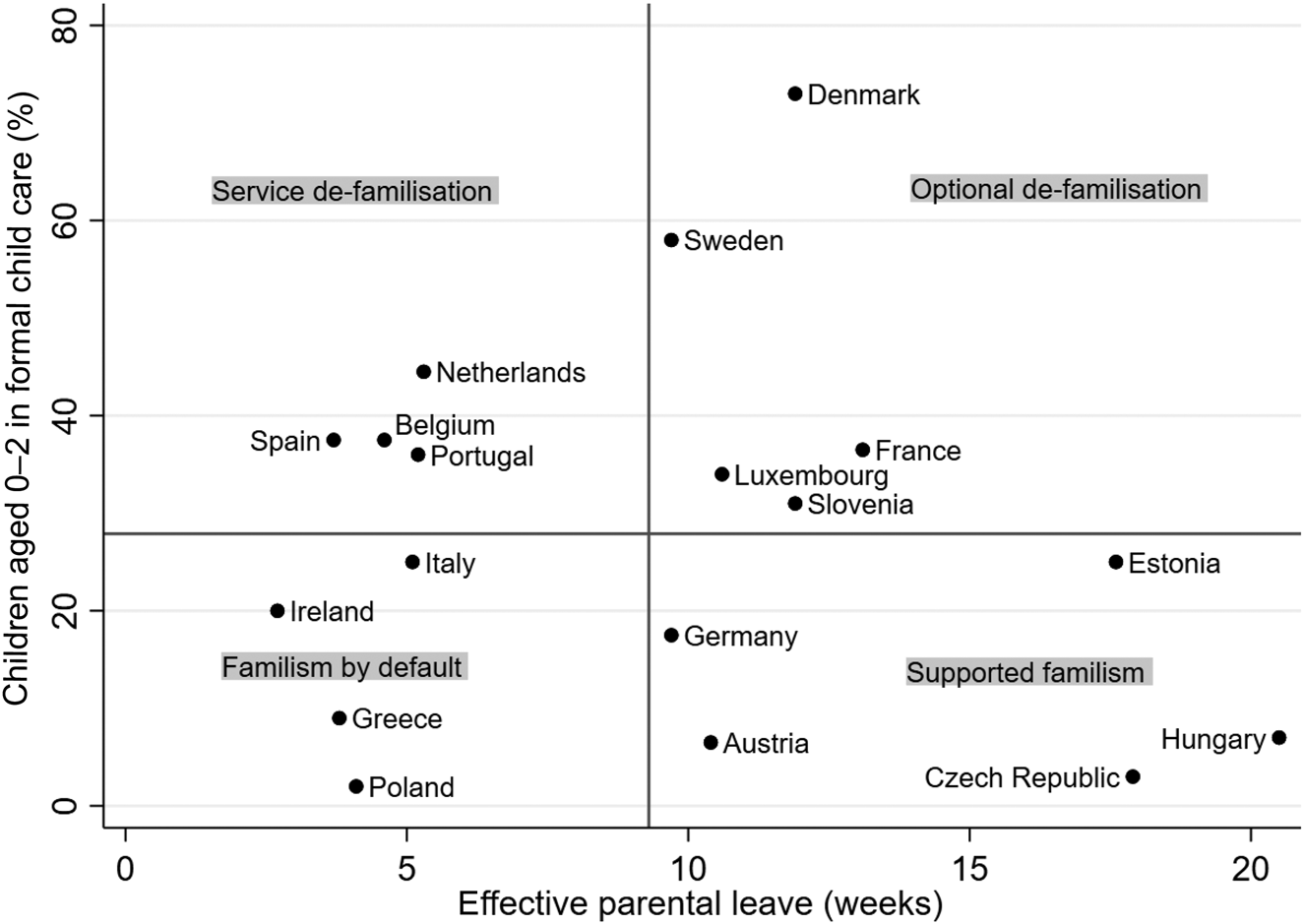
Figure 1 plots the two indicators against each other to show how countries fare with respect to their child-care policies. The horizontal line indicates the mean percentage of children in formal child care across the 18 countries (27.9), while the vertical line marks the cross-country average length of effective parental leave in weeks (9.3). The quadrant plot delineates four country groups that, despite some heterogeneity, share similar characteristics:
(1) Optional de-familisation: Denmark, France, Luxembourg, Slovenia and Sweden.
(2) Service de-familisation: Belgium, The Netherlands, Portugal and Spain.
(3) Supported familism: Austria, Czech Republic, Estonia, Germany and Hungary.
(4) Familism by default: Greece, Ireland, Italy and Poland.
Classification of Survey of Health, Ageing and Retirement in Europe countries into four groups based on child-care service utilisation and effective parental leave in 2004–2009. The horizontal and vertical lines indicate cross-country average values for child-care utilisation and parental leave, respectively.

Statistical analysis
The analysis is conducted in two stages in order to handle the potential selection of grandparents into daily grandchild care and work. First, single-equation multivariate regression models of each employment outcome ($y_1^\ast$ ) are fitted on a binary indicator for grandchild care provision (y 2) and a set of covariates (X):

Probit regressions are fitted for the probability of being employed/self-employed and, for the sub-samples of grandmothers and grandfathers in paid work, linear regressions are fitted for self-reported weekly working hours. As argued above, the association between grandchild care and employment may be affected by selection even after controlling for the covariates, because of unobserved characteristics associated with both employment and daily grandchild care provision. These include grandparents’ preferences, family characteristics and values, as well as any changes in preferences that occurred in anticipation of having to provide grandchild care. In the presence of unobserved grandparental characteristics that are correlated with participation in both roles, ${\hat{\delta}}_0$ is biased since it does not isolate the difference in employment or working hours that is attributable to daily grandchild care provision from that attributable to such unobserved factors.
Second, to address the fact that employment and grandchild care may be jointly determined, the coefficients on grandchild care from single-equation models are compared to those obtained using a recursive bivariate approach (Heckman, Reference Heckman1978; Maddala, Reference Maddala1983). This is a system of equations in which employment (y 1) and grandchild care (y 2) represent two distinct outcomes regressed on a common set of covariates X. Continuous latent variables $y_1^\ast$ and $y_2^\ast$
 are assumed to be underlying the observed binary outcomes y 1 and y 2. The error terms of the two equations are correlated with each other to account for the potential presence of unobservable characteristics associated with participation in both activities. Within the system, grandchild care is included as an endogenous binary regressor in the equation for employment:


where the error terms ɛ1 and ɛ2 follow a bivariate normal distribution with mean 0 and variance 1, and ρ = cov(ɛ1, ɛ2).
For the analytic samples of grandmothers and grandfathers, a recursive bivariate probit model is fitted for the probabilities of being (self-)employed and providing daily grandchild care, controlling for the common set of covariates and including grandchild care as a binary regressor in the equation for employment. For the sub-samples of grandmothers and grandfathers in paid work, hybrid (linear-probit) models are fitted, with weekly working hours treated as continuous, again including daily grandchild care as a dummy variable in the employment equation alongside the full set of covariates.
The estimated coefficient on grandchild care ${\hat{\delta}}_1\;$ represents the difference in the probability of being employed or in working hours associated with daily grandchild care provision, controlling for the full set of covariates and allowing for covariance in the latent errors. In the absence of an instrument for the endogenous variable, the system of equations does not allow the direction of causality to be discerned. However, it isolates the ‘structural’ (or direct) association between grandchild care and employment from that attributable to selection (Heckman, Reference Heckman1978). Comparing the coefficient on grandchild care from the single equation model (${\hat{\delta}}_0$
 ) to the one from the recursive bivariate model (${\hat{\delta}}_1$
 ) allows assessment of whether unobserved confounders correlated with participation in both activities alter the association between them.
After conducting analyses on the pooled data across countries, I test for heterogeneity in the association across the four country groups described above. This is done by including an interaction term between daily grandchild care and the country group indicator in the equations for the probability of employment (bivariate probit recursive model) and weekly working hours (linear-probit recursive model).
In all sets of models, standard errors are clustered to handle the correlation of observations referring to different dyads within the same grandparent. The calibrated cross-sectional weights provided in SHARE (Börsch-Supan and Jurges, Reference Börsch-Supan and Jurges2005) are used to address differential inclusion probabilities and non-response, dividing the weights by the number of dyads to restore representativeness with respect to individual grandparents. The recursive bivariate models are fitted using the ‘cmp’ package in Stata 15 (Roodman, Reference Roodman2011; StataCorp, 2017).
Results
Descriptive sample characteristics
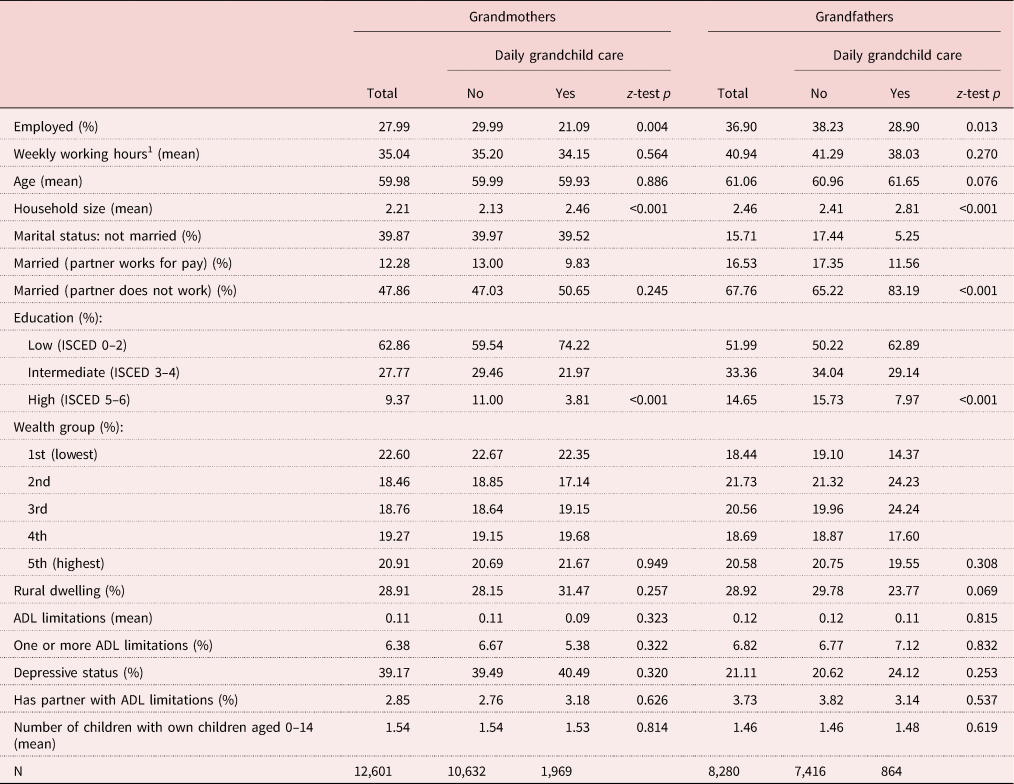
Table 1 presents descriptive characteristics from the analytic samples of grandmothers and grandfathers aged 50–69 at first interview. To ease interpretation, these statistics are based on individual grandparents rather than dyads. On average, 28 per cent of grandmothers and 37 per cent of grandfathers are employed or self-employed as opposed to retired or home-makers. Among those working, the average weekly working time is around 35 hours for grandmothers and 41 for grandfathers. χ2-tests for the probability of working by daily grandparental care provision give an initial suggestion that the association between daily grandchild care and employment at the extensive margin is negative. Grandparents who look after their grandchildren daily are around nine percentage points less likely to be employed than grandparents who do not. However, among employed grandparents, t-tests show that average working hours do not differ significantly by daily grandchild care provision.
Weighted sample characteristics (grandparents aged 50–69 with grandchildren aged 0–14), by sex and grandchild care provision

Notes: Unemployed and permanently sick or disabled grandparents are excluded from the sample. 1. Average weekly working hours are only calculated for the sub-sample of working grandparents. ISCED: International Standard Classification of Education. ADL: activities of daily living.
Looking at the distribution of the covariates, those who provide daily grandchild care have, on average, lower educational attainment than those who do not, and they live in larger households. Grandfathers who look after grandchildren daily are more likely to be married to a partner who does not work for pay and to live in urban areas.
Results across 20 countries
The associations between daily grandchild care and each employment outcome obtained from fully adjusted single-equation regressions are negative and statistically significant for both grandmothers and grandfathers (see Table S1 in the online supplementary material). The estimated average marginal effects (AMEs) represent the difference in the predicted value of the outcome between grandparents who provide daily grandchild care and grandparents who do not. These indicate that grandparents who provide daily grandchild care are seven percentage points less likely to be employed (the coefficients are −0.324 for grandmothers and −0.385 for grandfathers). These results are not surprising given previous evidence (De Preter et al., Reference De Preter, Van Looy and Mortelmans2013; Lakomý and Kreidl, Reference Lakomý and Kreidl2015) and the fact that I am isolating high frequencies of grandchild care provision. Employed grandfathers looking after grandchildren daily work on average nearly four (3.85) hours less per week, while there is no association between daily grandchild care and working hours for grandmothers.
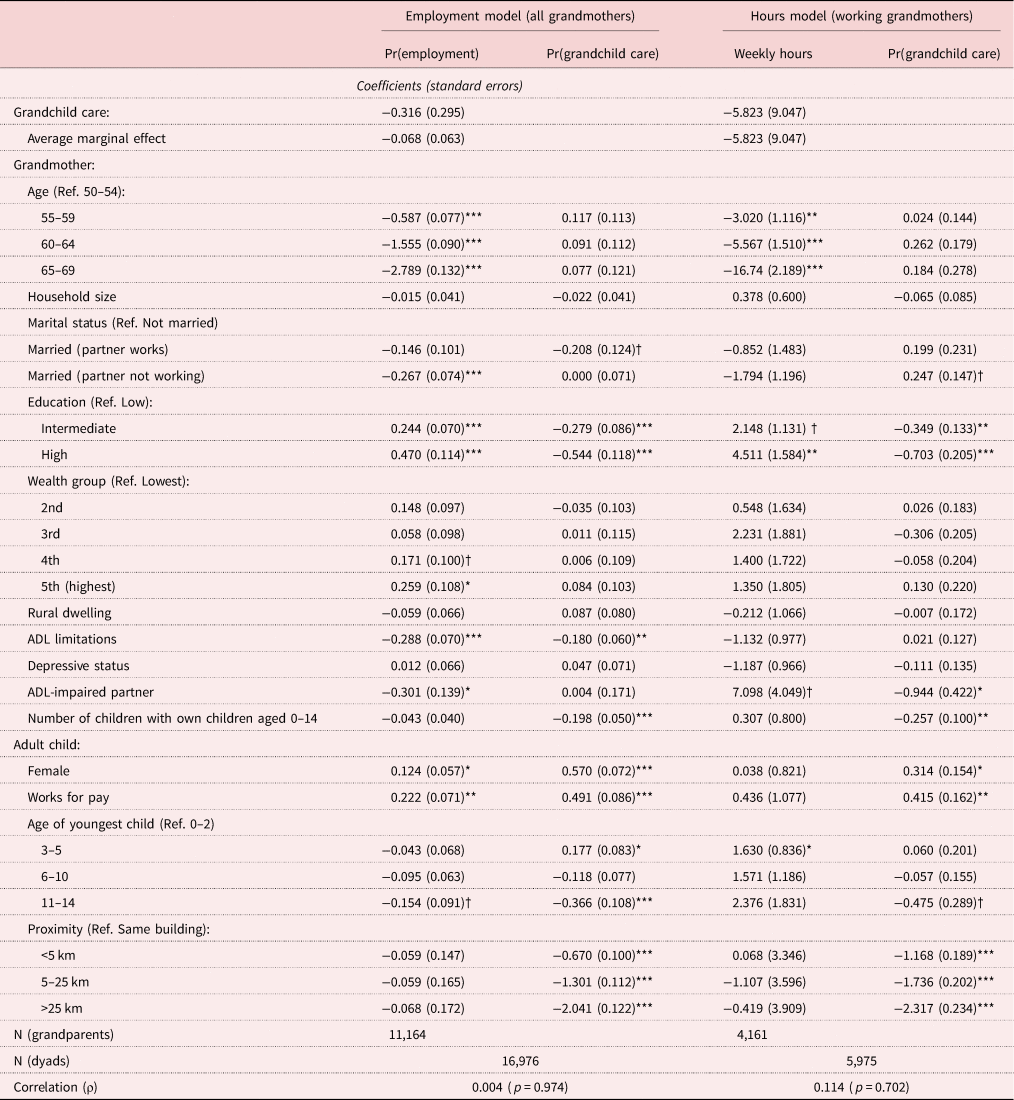
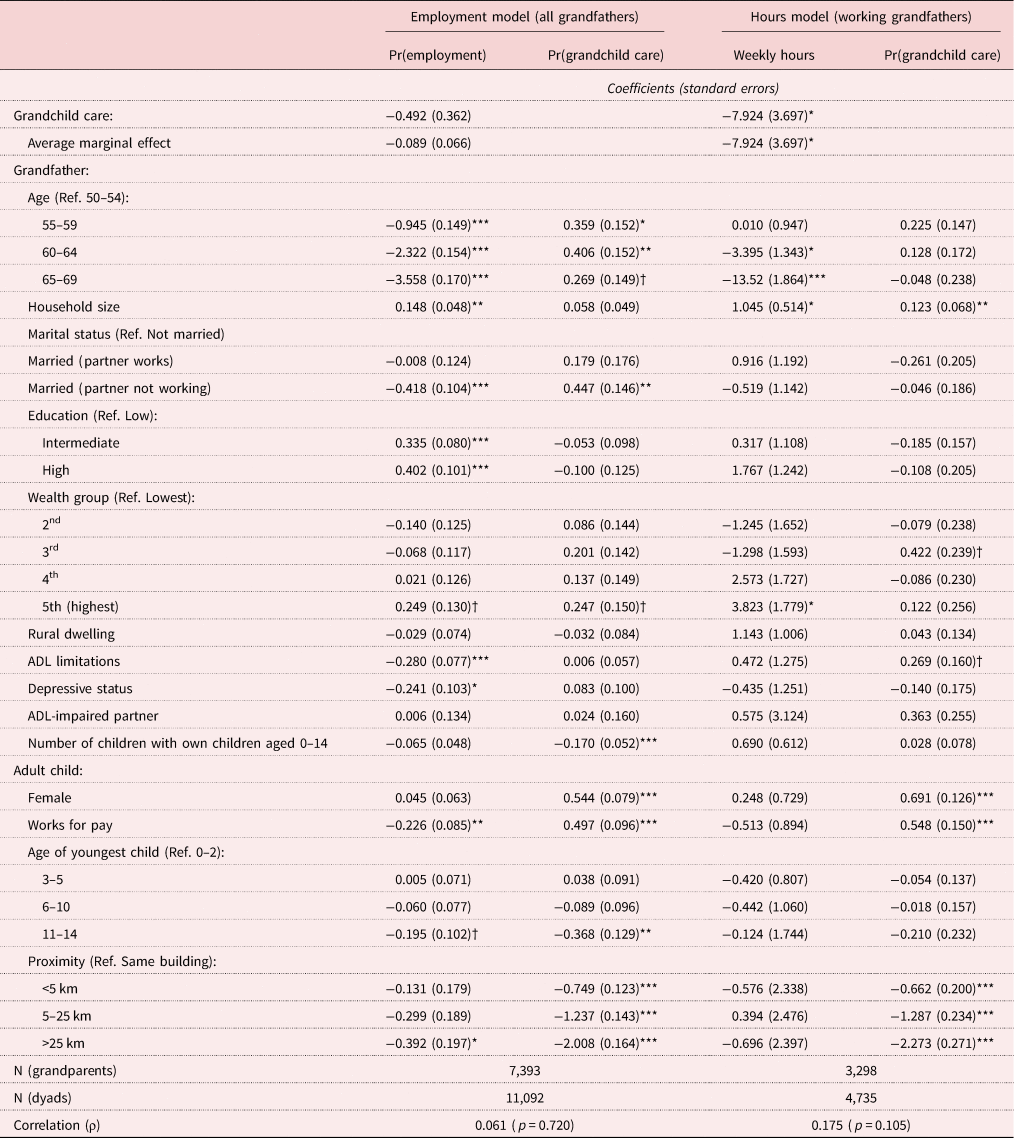
The single-equation estimates may be biased in the presence of selection. Tables 2 and 3 display the coefficients from the recursive bivariate models for grandmothers and grandfathers, respectively (for the coefficients on country and wave fixed effects, see Tables S2 and S3 in the online supplementary material). The results indicate that, addressing the potential selection of grandparents with different unobserved traits into work and grandchild care, there is no evidence of a direct association between daily grandchild care and employment at the extensive margin across the 20 countries considered. For both grandmothers (Table 2) and grandfathers (Table 3), allowing for correlation in the latent errors of the employment and grandchild care equations considerably increases uncertainty in the estimation of the coefficients, with neither reaching conventional levels of statistical significance (the p-values, not reported in the tables, are 0.285 for grandmothers and 0.174 for grandfathers). The results for the intensive margin of employment confirm that, across Europe, there is no association between daily grandchild care and working hours for employed grandmothers. Employed grandfathers who look after grandchildren daily, on the other hand, seem to work on average eight hours less per week. Throughout Europe, men tend to have occupations with longer working hours than women (Eurofund, 2017). This may explain why grandfathers, rather than grandmothers, tend to work fewer hours when providing daily grandchild care.
Grandmothers: coefficients from recursive bivariate models for probability of work and grandchild care (all grandmothers) and weekly hours worked and grandchild care (working grandmothers)

Notes: Country and wave fixed effects not shown. Ref.: reference category. ADL: activities of daily living. km: kilometres.
Significance levels: † p < 0.1, * p < 0.05, ** p < 0.01, *** p < 0.001.
Grandfathers: coefficients from recursive bivariate models for probability of work and grandchild care (all grandfathers) and weekly hours worked and grandchild care (working grandfathers)

Notes: Country and wave fixed effects not shown. Ref.: reference category. ADL: activities of daily living. km: kilometres.
Significance levels: † p < 0.1, * p < 0.05, ** p < 0.01, *** p < 0.001.
The coefficients on the control variables are in line with previous studies on the correlates of later-life employment (Komp et al., Reference Komp, Van Tilburg and Broese Van Groenou2010; De Preter et al., Reference De Preter, Van Looy and Mortelmans2013) and grandchild care (Hank and Buber, Reference Hank and Buber2009; Igel and Szydlik, Reference Igel and Szydlik2011). Older grandparents with more functional limitations are less likely to work, while socio-economically advantaged grandparents (i.e. more highly educated and living in wealthier households) are more likely to be employed (De Preter et al., Reference De Preter, Van Looy and Mortelmans2013). Grandmothers and grandfathers have lower probabilities of working if they have a spouse who is out of the labour force, in line with previous evidence on joint retirement decisions among couples (Riedel et al., Reference Riedel, Hofer and Wogerbauer2015).
For both sexes, the coefficients on the correlates of grandchild care confirm the importance of considering both grandparental and parental characteristics as predictors of this activity (Igel and Szydlik, Reference Igel and Szydlik2011). Controlling for other factors, lower-educated grandmothers with fewer functional limitations and married grandfathers in their early sixties have higher probabilities of providing daily grandchild care. Grandparents are more likely to provide grandchild care daily for parents who are female, who work for pay and who have children aged 0–2 or 3–5 as opposed to 11–14. As it is reasonable to expect (Hank and Buber, Reference Hank and Buber2009), grandparents are more likely to provide care the closer they live to the grandchild.
Results by country groups
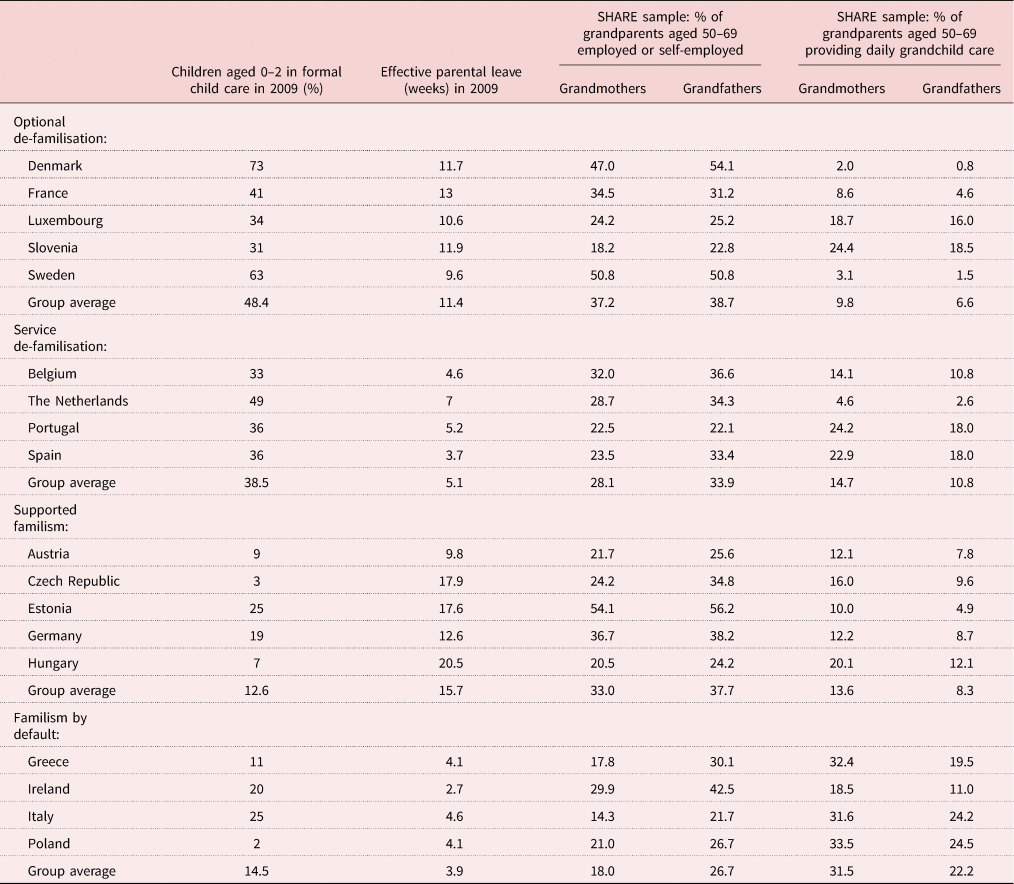
Table 4 compares the two child-care policy indicators, as well as the SHARE sample percentages of grandparents employed and providing daily grandchild care, across countries and groups. Within each group, countries share similar characteristics with respect to grandparents’ participation in daily grandchild care that are in line with previous findings (Bordone et al., Reference Bordone, Arpino and Aassve2017). Descriptive sample characteristics by country group are reported in Table S4 in the online supplementary material.
Child-care policy indicators and sample percentages of grandparents employed/looking after grandchildren daily, by country group

Note: SHARE: Survey of Health, Ageing and Retirement in Europe.
Grandmothers and grandfathers are most likely to be employed (37 and 39%, respectively) and least likely to provide daily grandchild care (10 and 7%) in the optional de-familisation group. As expected, the supported familism and familism by default groups show the largest gender differences in employment and daily grandchild care. However, grandparents in countries characterised by supported familism in child care are much more likely to work than in countries characterised by familism by default (33% of grandmothers and 38% of grandfathers are employed, compared to 18 and 27%, respectively). In turn, in countries characterised by familism by default, grandparents are most likely to provide daily child care (32% of grandmothers and 22% of grandfathers do so, compared with 14 and 8% respectively), which is in line with previous results (Igel and Szydlik, Reference Igel and Szydlik2011; Bordone et al., Reference Bordone, Arpino and Aassve2017). The service de-familisation group performs somewhere in the middle, with average proportions of grandparents working (28% of grandmothers and 34% of grandfathers) and providing daily grandchild care (14% of grandmothers and 10% of grandfathers).
To test for heterogeneity in the association between daily grandchild care and employment across country groups characterised by different child-care regimes, the recursive bivariate models presented in Tables 2 and 3 are fitted again, including an interaction term between daily grandchild care and a categorical variable indicating which country group the observation belongs to (excluding observations from Croatia and Switzerland).
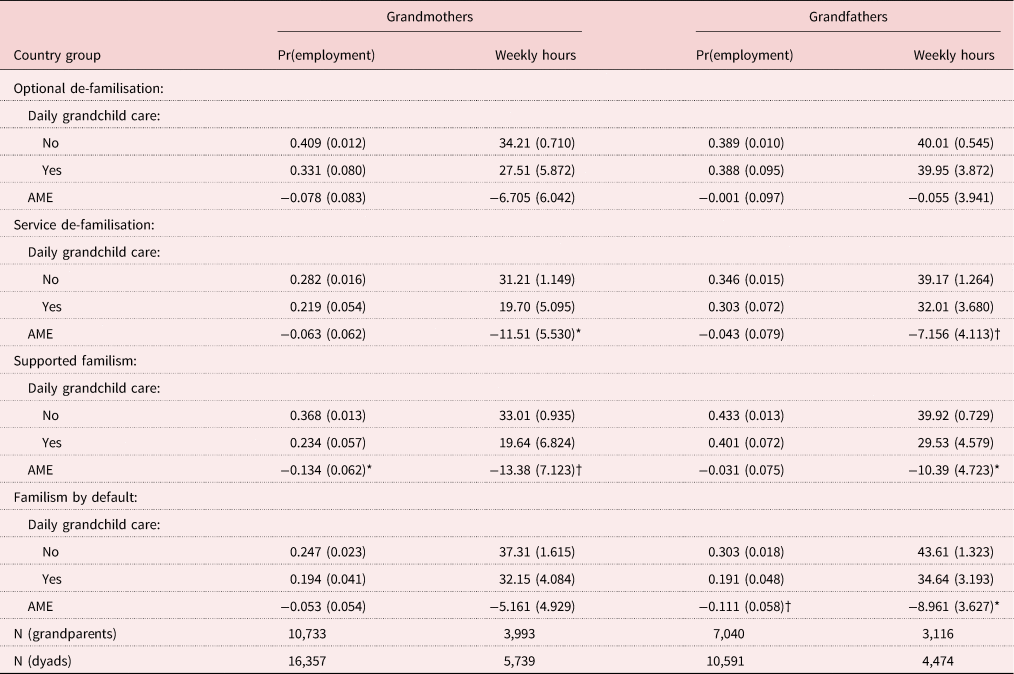
Table 5 reports the marginal probabilities of employment and the average weekly working hours predicted by the recursive bivariate models for grandparents who provide daily grandchild care and grandparents who do not, estimated over country typologies and separately by grandparents’ sex (for the single-equation models, see Table S5 in the online supplementary material). For each country group, the AME is reported with corresponding statistical significance.
Predictive margins from the recursive bivariate model for the probability of being employed and weekly working hours by daily grandchild care provision with corresponding average marginal effects (AME), over country groups and separately by sex

Significance levels: † p < 0.1, * p < 0.05.
As expected, in countries characterised by optional de-familisation, there is no association between daily grandchild care provision and grandparents’ employment at the extensive or intensive margin once selection is taken into account. Also in line with expectations, there is a negative association between daily grandchild care and working time among employed grandmothers (by 12 hours) and grandfathers (by seven hours) in the service de-familisation group. In these countries, daily grandchild care is not associated with the probability of working once selection is accounted for.
Overall, countries characterised by supported familism show the greatest evidence of role conflict between daily grandchild care and employment. Grandmothers in these countries are around 13 percentage points less likely to work, and work on average 13 hours less per week if providing daily grandchild care. Employed grandfathers work on average ten hours less if looking after grandchildren almost daily. This is in line with the expectation that familism creates a high need for daily grandchild care among working mothers (Herlofson and Hagestad, Reference Herlofson, Hagestad, Arber and Timonen2012), and such grandchild care is in conflict with grandmothers’ employment.
Finally, I find evidence that in countries characterised by familism by default, grandfathers are less likely to combine work with daily grandchild care than in other settings. Grandfathers who provide daily grandchild care are 11 percentage points less likely to work, and they work nine hours less per week if employed. Accounting for selection, there is no evidence of a negative association for grandmothers at the extensive or intensive margin.
Sensitivity and additional analysis
I assess the sensitivity of the results to different specifications of the analytic sample. Tables S6 and S7 in the online supplementary material show results from the recursive bivariate models obtained by restricting the sample to grandparents with grandchildren aged 0–10 and 0–5. The results for the 0–10 age bandwidth are unchanged in the direction and relative size of the coefficients. However, the AMEs of daily grandchild care on number of working hours among grandmothers in the service de-familisation and supported familism groups are no longer statistically significant. Similarly, the AME of daily grandchild care on the probability of working among grandfathers in the familism by default group loses statistical significance. Due to small sample sizes, it was not possible to replicate the results by country group for grandparents of children aged 0–5. The pooled results across countries for the 0–5 bandwidth confirm that, across countries, there is no evidence of role conflict at the extensive margin. Moreover, the AME of daily grandchild care on the number of hours for grandfathers decreases in size and loses statistical significance.
Tables S8 and S9 in the online supplementary material show the sensitivity of results to including grandparents with co-resident grandchildren in the sample. The results are very similar except for the fact that grandmothers in the service de-familisation group of countries no longer appear to experience role conflict at the intensive margin.
Lastly, I compare results to those obtained using an alternative country classification and definition of grandchild care. Appendix S1 (in the online supplementary material) shows the results obtained when grouping countries according to child-care service coverage (as opposed to utilisation) as an indicator of de-familisation (Bordone et al., Reference Bordone, Arpino and Aassve2017). While this leads to the reclassification of some of the countries in the study (Figure SA1 in the online supplementary material), the results across country groups are remarkably similar to those obtained above (Table A1). In Appendix S2 (Table SA2 in the online supplementary material), I replicate the analysis using grandchild care performed ‘almost weekly’ or more often instead of ‘almost daily’. The results corroborate the claim that weekly care is unlikely to be in conflict with grandparents’ employment.
Discussion
Recent findings from Backhaus and Barslund (Reference Backhaus and Barslund2019) suggest that, across European countries, having grandchildren reduces participation in employment for women. However, it remains unclear whether daily grandchild care is directly associated with grandparents’ employment. This study contributes to the literature by addressing the question of whether, accounting for the potential selection of grandparents with different traits into work and care, there is evidence of role conflict (Goode, Reference Goode1960) between daily grandchild care and grandparents’ employment.
The results obtained on pooled data from 20 European countries suggest that, once selection is accounted for, there is no evidence of role conflict between daily grandchild care and participation in employment for grandmothers. However, employed grandfathers looking after grandchildren daily appear to work on average eight hours less per week. Together with previous literature these findings suggest that, while grandmothers are less likely to work than non-grandmothers (Backhaus and Barslund, Reference Backhaus and Barslund2019), there is little evidence that grandchild care, even when performed daily, is in conflict with grandmothers’ employment in Europe. The differences in the probability of working between grandparents and non-grandparents found in previous European research (Frimmel et al., Reference Frimmel, Halla, Schmidpeter and Winter-Ebmer2017; Kridahl, Reference Kridahl2017; Backhaus and Barslund, Reference Backhaus and Barslund2019; Zanasi et al., Reference Zanasi, Sieben and Uunk2020) may be explained by the fact that becoming a grandparent marks the acquisition of a new social role, and it is likely to change individuals’ preferences towards work and family care (Mahne and Motel-Klingebiel, Reference Mahne and Motel-Klingebiel2012). It may be such changes, rather than conflict with daily grandchild care, that lead grandparents (and grandmothers in particular) to have lower probabilities of working than non-grandparents. However, results obtained from the pooled SHARE data are hard to interpret, because the estimates assume the association to be the same across countries, concealing substantial variation.
This study is the first to test for heterogeneity in the association between daily grandchild care and employment across groups of countries characterised by different child-care policy regimes. The findings reveal that the combination of generous child-care service provision and extensive paid parental leave (optional de-familisation) is the most conducive to work–family reconciliation, as grandmothers and grandfathers in these settings do not appear to experience role conflict at either the extensive or intensive margin of employment. In child-care regimes characterised by generous service provision but restricted parental leave (service de-familisation), I find some evidence that grandparents experience role conflict at the intensive margin. This may suggest that, in the absence of extensive paid leave for parents, grandparents may need to perform complementary tasks to child-care services, which may in turn lead them to work fewer hours. However, sensitivity analyses conducted on the samples of grandparents with younger (aged 0–10) grandchildren, as well as on the full samples of grandparents including those with co-resident grandchildren, do not confirm this finding. Overall, the results point to the fact that child-care service provision promotes employment by relieving family members of care responsibilities (Lewis, Reference Lewis2006; Saraceno and Keck, Reference Saraceno and Keck2011).
By contrast, in countries characterised by supported familism, I find the greatest evidence of role conflict. In these countries, explicit state support to women's caring roles in the absence of services creates the need for full-time grandparental child care among working mothers (Herlofson and Hagestad, Reference Herlofson, Hagestad, Arber and Timonen2012; Bordone et al., Reference Bordone, Arpino and Aassve2017). This may generate role conflict between daily grandchild care commitments and employment, especially among grandmothers (Di Gessa et al., Reference Di Gessa, Glaser, Price, Ribe Montserrat and Tinker2016). The results suggest that, in countries where neither services nor leave are extensive (familism by default), role conflict is only relevant for grandfathers. In these settings, older men are unlikely to combine work with family care, and this negative association is not completely explained by the selection of grandfathers with different characteristics into work and family care. By contrast, older women are unlikely to work and, if they work, they may be subject to stronger normative expectations to combine work and care (Leitner, Reference Leitner2003). This may explain why, for grandmothers in these countries, I find no evidence of role conflict.
From a policy perspective, the results highlight the importance of child-care services for work–family reconciliation. Accessible services may be especially effective if provided in combination with extensive parental leave, as in the case of optional de-familisation. While previous evidence has stressed the importance of public child care for the labour market participation of mothers (Lewis, Reference Lewis2006; Saraceno and Keck, Reference Saraceno and Keck2011; Thévenon, Reference Thévenon2011), the current study shows that it may also be relevant for work–family reconciliation among grandparents. Reforms aimed at reducing child-care costs by curbing public spending may have unintended negative consequences for older adults’ participation in employment, which is currently a policy priority across Europe (European Commission, 2018; Glaser and Hank, Reference Glaser and Hank2018).
This study has limitations that should be acknowledged. In terms of the methodological approach, the recursive bivariate model is a good way of handling selection in the absence of exogenous variation in the independent variable of interest, daily grandchild care. However, unlike instrumental variable approaches, the method does not allow the direction of causality to be discerned, so I cannot conclude that daily grandchild care affects employment. The estimates represent the difference in the probability of working (or working hours) between grandparents who provide daily child care and grandparents who do not, net of potential self-selection of grandparents into work and family care. Similar to other regression-based methods, the validity of results depends on functional form assumptions, in particular that of bivariate normality in the error terms, which is untestable (Heckman, Reference Heckman1978).
The country classification is based on Multilinks (2011) indicators from the two years in which data are available, 2004 and 2009. However, since SHARE data cover the period 2004–2015, reforms may have caused some countries to change groups in ways not captured in this study. As shown in Figure 1, there is considerable heterogeneity in child-care services and parental leave within country clusters. This reflects the difficulties related to classifying countries into policy regimes (Saraceno and Keck, Reference Saraceno and Keck2010, 2011). Besides child-care policies, many other contextual-level characteristics are likely to influence the association between daily grandchild care and grandparents’ employment. An important one not considered in this study is the pension system. One can hypothesise that grandparents in countries with higher pension replacement rates or fewer disincentives to early labour market exit may be more likely to retire and provide daily grandchild care than grandparents in countries with less-generous pension systems (Saraceno and Keck, Reference Saraceno and Keck2010). Moreover, over the time of the survey, pension reforms may have differently affected retirement timing across countries (Riedel and Hofer, Reference Riedel and Hofer2013).
In this study, the choice of grandparents as the relevant population for inference is substantive and aimed at filling a research gap, as most previous literature on the topic has focused on the effect of grandparenthood for individuals’ labour supply (Rupert and Zanella, Reference Rupert and Zanella2018; Backhaus and Barslund, Reference Backhaus and Barslund2019). However, it worth emphasising that the results are only generalisable to grandparents aged 50–69, who tend to have different characteristics from individuals of the same age without grandchildren (see Table S10 in the online supplementary material). Since grandparenthood potentially changes individuals’ preferences (Mahne and Motel-Klingebiel, Reference Mahne and Motel-Klingebiel2012), grandparents may also differ from non-grandparents in their unobserved propensity to work and provide care. As pointed out above, for sample size reasons I cannot restrict the analyses to grandparents of very young children, who are the most affected by the policies used here to classify countries.
The cross-sectional analyses are carried out on a sample of grandparents born between 1935 and 1965, which refers to a large and heterogenous population group. We know that women's employment changed dramatically across cohorts born in the 1930s to the 1960s (Jaumotte, Reference Jaumotte2003), and this is also reflected in the SHARE sample (see Table S11 in the online supplementary material). Thus, there may be cohort differences in grandmothers’ participation in employment and, relatedly, family care that are not fully addressed by including controls for age group and year of interview in the models.
Finally, this study does not distinguish between part-time and full-time employment and between different types of grandparents’ occupations. I do not have information on how many hours grandparents spend with their grandchildren per day, nor on what activities they perform together. Integrating this information would contribute to giving a clearer picture of the association between daily grandchild care and employment (Hank et al., Reference Hank, Cavrini, Di Gessa and Tomassini2018).
Across Europe, pension reforms are leading to longer working lives (European Commission, 2018), which implies that many grandparents will remain in the labour force until advanced ages. The shrinking of European welfare states suggests that grandparents may increasingly have to juggle care responsibilities with work. While non-intensive grandchild care provision is usually associated with positive health outcomes (Di Gessa et al., Reference Di Gessa, Glaser, Price, Ribe Montserrat and Tinker2016), having to combine work with daily child care may result in role strain (Goode, Reference Goode1960), with potential negative implications for grandparents’ health and wellbeing. Across Europe, policy reforms should acknowledge grandparents’ role as intensive child-care providers and aim to minimise role conflict by promoting flexible working arrangements and by engaging in de-familisation through the provision of affordable child-care services.
Supplementary material
The supplementary material for this article can be found at https://doi.org/10.1017/S0144686X20000987
Acknowledgements
I gratefully acknowledge the helpful comments and feedback on earlier versions of this article from Stephen Jenkins, Fiona Steele, Marco Albertini and Victoria Donnaloja; from the participants to the GHSM GROW seminars at King's College London; and from the two anonymous reviewers.
Financial support
This work was supported by an Economic and Social Research Council (ESRC) 1 + 3 Scholarship as part of the author's PhD.
Conflict of interest
The author declares no conflicts of interest.
Ethical standards
No ethical approval was required for this study, as it makes use of pre-anonymised secondary data for analysis.