INTRODUCTION
Windridge Farm lies approximately one kilometre southwest of the Roman town of VerulamiumFootnote 1 and immediately south of the gently rising gradient of Prae Wood. More than one hundred Roman lead sling bullets (glandes)Footnote 2 have been recovered from its fields by metal detectorists and fieldwalkers since the 1970s. The finds were made by several individuals over a considerable period, rendering the exact findspots of the missiles uncertain, although most appear to have originated from the land east of the farmhouse where bullets continue to be located to the present day.
Stephen Greep described the sling bullets from Windridge Farm in a previous edition of this journal.Footnote 3 His comprehensive publication illustrated the morphological features of fifty-two glandes that were available for assessment and compared them with Roman sling bullets from the rest of Britain.Footnote 4 He also offered a simplified typology of sling bullets and a wide-ranging review of the role of the sling in the Roman army. Since his paper, numerous other bullets have been found in Britain, adding significantly to the morphological spectrum, notably the large number (>500) recovered in recent excavations at Burnswark Hill in Dumfriesshire.Footnote 5 The Portable Antiquities Scheme (PAS) database has also been a key resource for recording sporadic metal detector finds of glandes over the last two decades.Footnote 6
The aim of this paper is to review the nature of deposition of the Windridge bullets, refine their morphological assessment in the light of recent discoveries and report the results of lead isotope analysis using mass spectroscopy.Footnote 7 The latter allows metallurgical comparison of the Windridge group with other groups from a large database of glandes and known Roman sources which provided the Western Empire with lead.Footnote 8 The results of all three elements of the study have allowed possible contexts to be tentatively explored.
BACKGROUND
The sling has a long and venerable history and has been employed by many diverse cultures ranging from the Sioux of North America to Micronesian Islanders in the Pacific.Footnote 9 It has been used for hunting and as a weapon for at least 5,000 years and is still in use today. It is simple, inexpensive, has a potentially longer range than the bow and in expert hands shares some of the latter's directional accuracy and stopping power.Footnote 10
Use of the sling among the indigenous peoples of Iron Age Britain appears to have been limited mainly to the south of the country, where evidence is found in the form of caches of sling stones or clay bullets.Footnote 11 However, by far the commonest archaeological association of manufactured slingshot in Britain is with the Roman army, where projectiles were made from baked clay or, more commonly, cast lead.Footnote 12
Although there have been suggestions that most legionaries used the sling, it is generally accepted that the Roman Republican army specifically employed specialist detachments of auxiliary slingers as skirmishers, notably, but by no means exclusively, recruited from areas with a slinging tradition such as the Balearic Islands and Rhodes.Footnote 13 Writers such as Caesar and Livy often mention slingers (funditores) when describing military activity.Footnote 14 It would seem that the Roman army's use of the sling declined after the Republican period and some authors have suggested it had all but disappeared from regular use by the end of the first century.Footnote 15 However, there is growing evidence for its continued use in Britain well into the second century and possibly even later.Footnote 16
Since the advent of the PAS, there have been regular reports of single lead sling bullets found by detectorists across wide areas of England south of Hadrian's Wall. Most of these appear to be dateable to the Roman period.Footnote 17 As a solitary find from a non-Roman site, however, it is usually impossible to discern if a lead bullet has been used by civilians for hunting or lost by military personnel.Footnote 18 However, the finding of groups of glandes is strongly associated with the presence of elements of the Roman military.Footnote 19 Importantly, recent experience from the field of conflict archaeology suggests that two further observations can be made: a) when several morphologically similar bullets are found in a reasonably tight grouping, they usually originate from a storage context such as a Roman military building, a container or a cache; and b) when found scattered over a very wide area (usually more than several hundred square metres) they are likely to represent ballistic activity, usually as a result of conflict.Footnote 20
Identifying the actions of ancient armies is difficult due to the relatively poor survival and sparse distribution of their residue, particularly when those forces were active before the invention of gunpowder and metal projectiles. However, some Roman-period conflict sites have become considerably more visible due to the advent of large-scale metal detecting surveys. These surveys have been particularly fruitful when lead missiles have been used by one or both of the opposing forces. Notable examples of this are Baecula,Footnote 21 Andagoste,Footnote 22 and Monte BernorioFootnote 23 in Spain, VelsenFootnote 24 in the Netherlands, ThuinFootnote 25 in Belgium, Grad near Šmihel pod NanosomFootnote 26 in Slovenia and Burnswark in Scotland.Footnote 27 In all these scenarios, attempts have been made to reconstruct the choreography of warfare from the distribution of lead ammunition.Footnote 28
PATTERN OF DEPOSITION
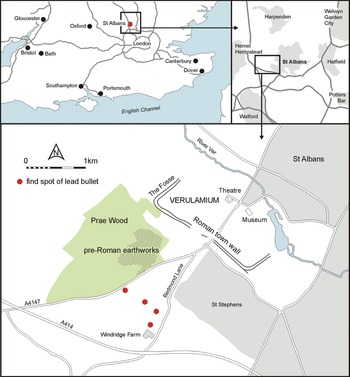
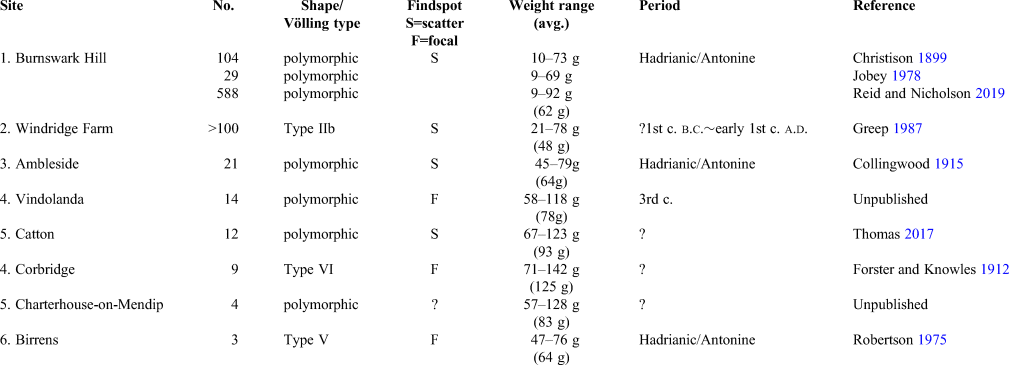
The group of glandes at Windridge Farm represents the second-largest scatter of Roman sling-bullets in Britain after Burnswark (table 1). Due to the passage of time and incomplete recording, the exact findspots of the many bullets from Windridge are now lost. Greep indicated that, as far as he could ascertain, some bullets were found in small groups rather than singly, although no hoard with a characteristic ‘halo’ was identified. Greep suggested that plough-scattering of a lead hoard(s) could have been the cause of the observed patchy distribution pattern.Footnote 29, Footnote 30 However, a ‘pseudo-clumping’ phenomenon can be seen in the scatter of ammunition from many other well-attested conflict sites such as the patterning of musket balls at the English Civil War site of Edgehill.Footnote 31 The phenomenon is probably due to the inherent heterogeneity of random ballistic data and a by-product of the detecting process itself which can lead to uneven retrieval. Fortunately, four relatively recent glandes discoveries from Windridge Farm, which correspond in morphology to the bullets first described by Greep, have been recorded accurately on the PAS database (fig. 1.).Footnote 32 It can be seen that the spread of these missiles is over half a kilometre.
The relationship of the fields of Windridge Farm to Roman Verulamium. The red dots represent the findspots of four bullets recorded on PAS database.

GROUPS OF ROMAN LEAD SLING BULLETS FROM BRITAIN (SHAPES WHICH DO NOT CONFORM TO VÖLLING'S TYPOLOGY ARE LABELLED ‘POLYMORPHIC’)

Other lead items of a more domestic nature (lead-casting debris, lead weights and beads) were also recovered by detectorists from the same fields at Windridge Farm. In addition, Greep states a small number of copper alloy items, said to be derived from Roman military equipment, were retrieved although no positional data were available. One of these has been dated to the mid first century a.d.Footnote 33
MORPHOLOGY
The shape and weight of Roman sling bullets can provide useful diagnostic information and familiarity with the sub-types is helpful in determining if they could be linked to a single event. Arguably, Völling has produced the most comprehensive review of glandes to date, in which he sub-divided bullets into six main types, most of which are derivatives of the common almond shape, Type II.Footnote 34 The main departures from this shape included spindle (Type IIa), spherical (Type VI) and acorn (Type V) sub-types. Völling included the Windridge Farm bullets in his gazetteer of glandes and classified them all as Type IIb, a symmetrical almond shape.
Greep offered his own simplified typology of Roman bullets from Britain by sub-dividing them into Type One (symmetrical biconical) and Type Two (asymmetric acorn-shaped).Footnote 35 This typology appeared to reflect his observation that all of the intact Windridge bullets were approximately almond-shaped while making an allowance for the striking acorn-shaped bullets that had been recovered by that time from Burnswark, which he designated as Type Two.
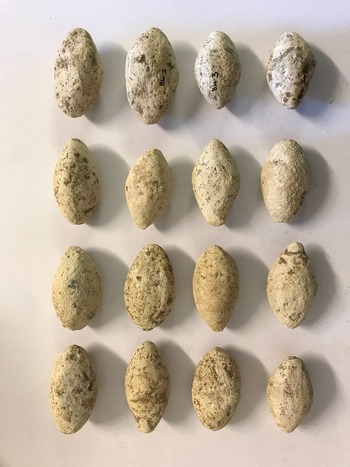
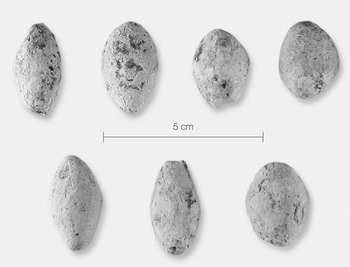
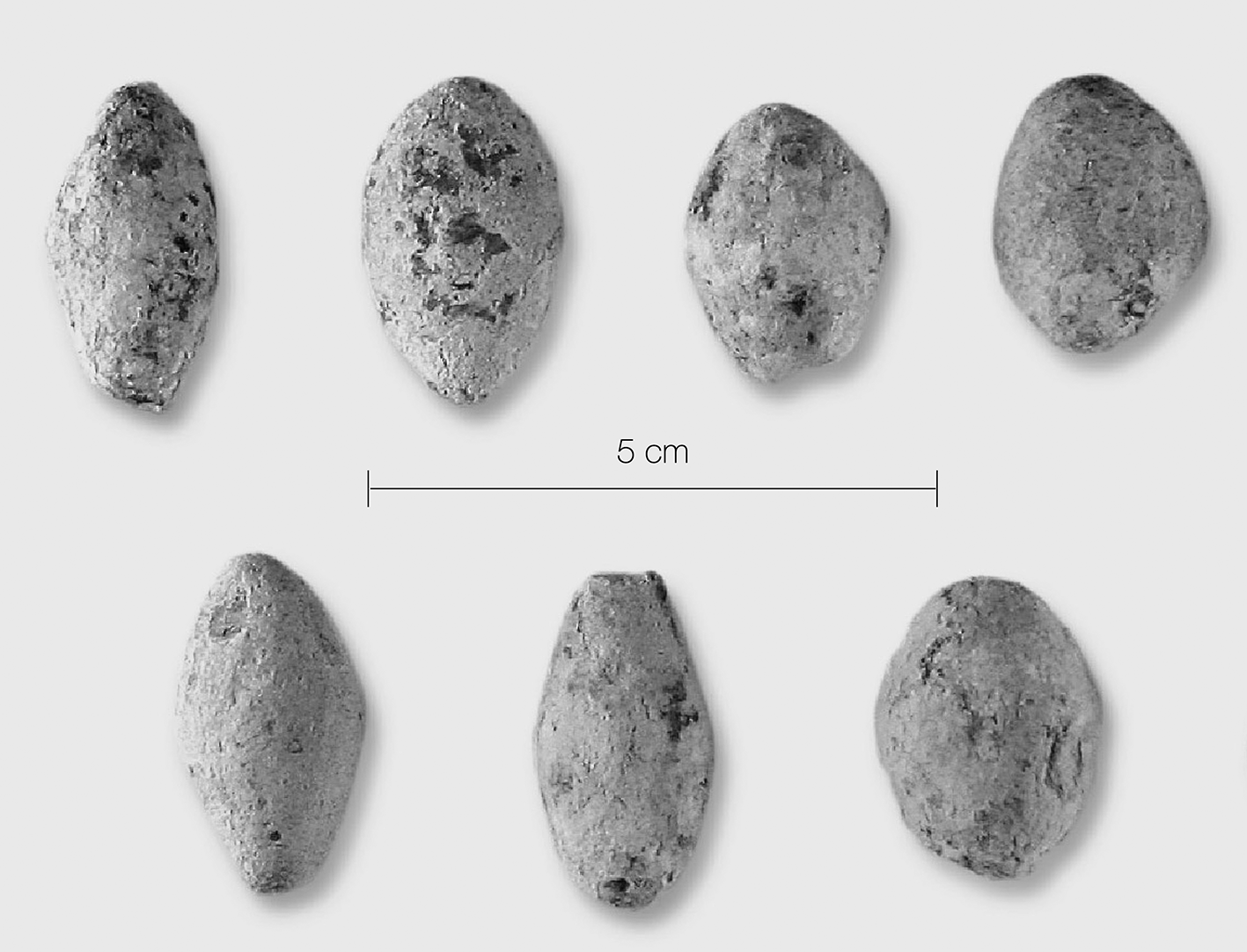
However, a review of the morphology of all lead bullets available for assessment from Britain, as part of the Burnswark Project, proved that the situation is significantly more complex.Footnote 36 In fact, the specific exemplars of both Greep's types (Windridge almond and Burnswark acorn) are actually uncommon morphologies in a wider British context. The lighter-weight symmetrical almond shape is virtually unique to Windridge Farm and the unusual acorn shape is restricted to sites within 50 km of Burnswark Hill in Dumfriesshire. The Burnswark survey also revealed that bullets from other British sites were heavier, more asymmetric, plumper and much less uniform than the smaller ‘refined’ bullets from Windridge Farm (see table 1.). This prompted a re-examination of the physical characteristics of the bullets stored at St Albans’ Verulamium Museum. The most intact bullets from Windridge Farm are shown in figure 2.
The Windridge bullets are a slightly flattened symmetrical biconical (almond-shaped) ovoid which have approximately the same mass. The average weight is 48 g (although there are a couple of heavier examples weighing over 60 g which skew the average). Several have long axis ‘seams’ and three have the remains of ‘flashes’ which are due to the casting lines from bivalve moulds. None have holes or defects, and all are of the same uniform pale patina of lead oxide. (Image courtesy of David Thorold, Verulamium Museum.)

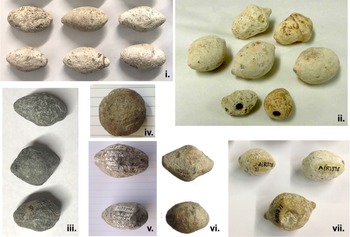
The Windridge bullets differ substantially from the heavier, more bulbous bullets from Burnswark, which are 62 g on average and which take several sub-forms, mostly with ‘nipples’ at either end. The Burnswark bullets are also cast equatorially rather than the longitudinal orientation of the Windridge moulds. The Windridge bullets are also noticeably smaller, and more uniform compared with all other groups from Britain: those from Charterhouse (avg. 83 g) are irregular in shape and also the Vindolanda group (avg. 78 g), which are significantly larger, are irregular and coarser in texture. The most recently discovered group of bullets from Catton in Derbyshire are heterogeneous in shape and significantly heavier at an average of 93 g.Footnote 37 The bullets from Corbridge are virtually spherical and heavier still (avg. 125 g). To illustrate the striking uniformity of the Windridge Farm bullets, and their dissimilarity to other British finds, figure 3 places them in a matrix with all the other significant groupings of bullets from Britain.
Sample specimens from all UK sites which have produced multiple bullets: (i) Windridge Farm; (ii) Burnswark Hill; (iii) Vindolanda; (iv) Corbridge; (v) Charterhouse; (vi) Catton; (vii) Ambleside. Not to scale.

While assigning the Windridge bullets to his catch-all Type One category, Greep acknowledged that the bullets from St Albans were unusual and he suggested they may be dated to the mid first century a.d.Footnote 38 There are, unfortunately, no other bullets from Britain confidently dated to this period with which to compare, most others (such as Burnswark, Ambleside or Vindolanda) being apportioned to the second century or later. One must look to mainland Europe for glandes from the late Republic or early Principate, which are more closely aligned in shape and weight. The authors have found the morphology of the Windridge bullets has greater resonance with groups of missiles from sites such as those at Sanisera in Menorca,Footnote 39 Dünsberg in GermanyFootnote 40 and the group of bullets from the hillfort of Thuin in Belgium (fig. 4.).Footnote 41 The bullets from Dünsberg have been dated to the early PrincipateFootnote 42 and those from Thuin have been ascribed to Caesar's assault on the Atuatuci.Footnote 43 The Thuin bullets were sampled in 2017 for lead isotope analysis (LIA) which suggested that their ore originated in Spain. Even if the Thuin ammunition was not specifically associated with the siege sanctioned by Caesar, it still illustrates the long-distance nature of Roman military lead supply.Footnote 44
Bullets from Thuin in Belgium. These bullets have a similar morphology to the Windridge examples. They have been subject to lead isotope analysis which shows the lead probably originated from mines in Spain. (Courtesy N. Roymans.)
It is interesting to note that when Völling tabulated the glandes from Europe that were available for assessment for his 1990 paper, he ascribed all of the Windridge bullets to type IIb, the only bullets definitely of that shape from Britain.Footnote 45 In further confirmation of the earlier fashion for this particular shape, Völling's database shows that IIb is a common sub-type among bullets recovered from a diversity of sites such as Haltern (5 b.c.–a.d. 9), Dünsberg (late first century b.c.), Perusia (41/40 b.c.) and Asculum (90–89 b.c.).
LEAD ISOTOPE ANALYSIS
Although there is a striking morphological consistency to the Windridge Farm glandes, it was considered prudent to sample five randomly selected bullets for lead isotope analysis in an attempt to corroborate the morphological similarity and potentially to give some indication of origin.
The bullets were sampled at Verulamium Museum using the same technique established for the Burnswark specimens: drilling with a 0.8 mm twist drill to obtain cores while ensuring new drill bits were used for each sample to avoid cross-contamination; samples were then transferred in sterile containers to the geochemical laboratories of the Institute of Geosciences, at the Frankfurt Isotope and Element Research Centre (FIERCE) at Goethe University.
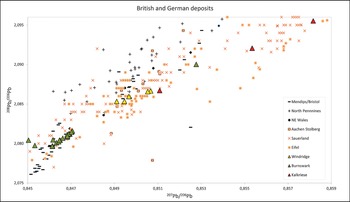
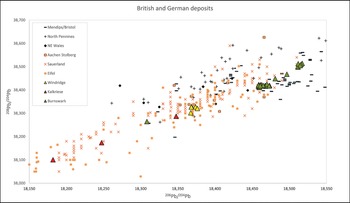
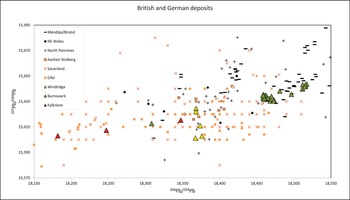
The samples were prepared and measured in an ultra-clean laboratory as described by Müller et al. Reference Müller, Brey, Seitz and Klein2014.Footnote 46 The results (table 2) were plotted within three varying binary diagrams (207Pb/206Pb vs 208Pb/206Pb, fig. 5; 206Pb/204Pb vs 208Pb/204Pb, fig. 6; and 206Pb/204Pb vs 207Pb/204Pb, fig. 7) commonly used in archaeometallurgy and geochemistry. To identify potential lead occurrences exploited for the production of the bullets, the lead isotope results of the bullets were superimposed upon the isotope data of different ore deposits.
Binary diagram with isotope ratios 207Pb/206Pb vs 208Pb/206Pb for the lead projectiles within the established isotope fields of ancient mining districts. Error smaller than symbols used in diagrams (Rohl Reference Rohl1996; Durali-Müller Reference Durali-Müller2005; Bode Reference Bode2008).

Binary diagram with isotope ratios 206Pb/204Pb vs 208Pb/204Pb for the lead projectiles within the established isotope fields of ancient mining districts. Error smaller than symbols used in diagrams (Rohl Reference Rohl1996; Durali-Müller Reference Durali-Müller2005; Bode Reference Bode2008).

Binary diagram with isotope ratios 206Pb/204Pb vs 207Pb/204Pb for the lead projectiles within the established isotope fields of ancient mining districts. Error smaller than symbols used in diagrams (Rohl Reference Rohl1996; Durali-Müller Reference Durali-Müller2005; Bode Reference Bode2008).

ANALYSIS OF LEAD SAMPLES (FIERCE, FRANKFURT)

The isotopic variation of the samples instantly excludes Mediterranean ore deposits, such as those from the Iberian Peninsula, Italy, France and the Aegean. More likely are the lead-rich deposits of Germany and Britain, although these ore deposits partly overlap within the binary diagrams due to their similar geochronological history. For this reason, the data at the moment do not provide an unequivocal solution but point to a hierarchy of probabilities for the metal deposits in Germany and Britain. By discussing them as possible origins, they give rise to varying possible historical contexts.
During the first century b.c., British ore deposits would be less relevant to the Roman Army, although pre-Roman lead mining can be documented.Footnote 47 Ore deposits in adjacent continental Europe, such as areas of north-western Germany like Northern Eifel or the Sauerland, may have had a greater importance. Roman lead mining within Northern Eifel is known from Augustan times.Footnote 48 In keeping with Rome's development of other native assets, this may have been based on pre-existing indigenous activity, something which has been considered possible,Footnote 49 although currently unevidenced.Footnote 50 Lead mining within the Sauerland region is also acknowledged for the early Augustan period.Footnote 51
Within the first century a.d., the Mendips Hills region in Somerset, where the earliest Roman mining activities in Britain are known,Footnote 52 can also be considered as a relevant lead resource. Before the end of the first century the areas of Derbyshire, Yorkshire and Flintshire were developed.Footnote 53 To refine this, a comparison with all known data from British ore deposits allows exclusion of many deposits which do not match the Windridge data at all. For this reason, concerning this study, these were removed from the complete British reference data set in order to provide a better visibility within the diagrams. In correlation with archaeological data, this left the deposits of Mendips/Bristol, north Pennines and north-east Wales.
All three diagrams demonstrate that the Windridge bullets broadly cluster together, building two groups (while acknowledging the limitations of a series of five sampled specimens) and that they plot within loosely overlapping isotope fields of German and British ore deposits. However, within the 207Pb/206Pb vs 208Pb/206Pb diagram (fig. 5), the data points coincide better with the German ore deposits, namely those of the Eifel, while acknowledging bordering overlap with deposits from Bristol and North Pennines. The 206Pb/204Pb vs 208Pb/204Pb diagram (fig. 6) shows a similar result. The 206Pb/204Pb vs. 207Pb/204Pb plot (fig. 7) allows no clearer differentiation. Although still potentially German in origin, here a north Pennines (but not Bristol region) source also remains a possibility. Thus, so far, allowing for the varying extent of the ore database for each region, the diagrams indicate a more German than a British origin of the metal.
Taking into account that early lead mining within north-western Germany is a possibility,Footnote 54 and as indicated above, the Windridge bullet morphology also allows a potential dating in late Republican times, the possibility of an origin of the Windridge bullet metal within this area at this time cannot be dismissed. It is possible that bulk metal was requisitioned and taken along on campaign by Roman forces from deposits already known and exploited, such as the Eifel region. This can be seen in other cases, such as those bullets from the Septimer Pass and Crap-Ses Ravine dating into the time of the Drusus campaigns through the Alps where the analysis of the data of the projectiles shows their isotope ratios coinciding with south-eastern Spanish deposits.Footnote 55 A similar result is provided by the analysis of a lead ingot fragment from the alpine region, dating into the first century b.c. which was found in Basel.Footnote 56
The opposite can be seen for the bullets from Kalkriese, Germany, from around a.d. 9, whose isotope data coincide with the German deposits, whereas projectiles from Burnswark, Scotland, dating to about a.d. 140, also plot within overlapping isotope fields of German and British deposits, but they coincide better with the data from the Mendips deposits than with the German ones.Footnote 57
In addition to the LIA results, the Windridge bullet morphology also allows a dating into Late Republican times. Taking this into account, early lead mining within north-western Germany may not be completely dismissed, though firm archaeological evidence is lacking at this time.
POSSIBLE HISTORICAL CONTEXTS
It is a natural temptation to create order from disparate data and, in the case of archaeology, to connect unusual discoveries with particular historical events. Unfortunately, this process is fraught with perceptual problems, particularly illusory association and confirmation bias.Footnote 58
The authors have great sympathy with those who believe that the invocation of historical narratives to explain archaeological data is frequently a fruitless enterprise and as such do not wish to add to poorly evidenced ‘archaeological folklore’. However, the deposition of a comparatively large number of metallurgically and morphologically linked Roman sling bullets over a substantial area of open countryside (possibly as much as 20 hectares) is exceptionally unusual in a British context and we believe the phenomenon merits discussion.Footnote 59 When comparing the Windridge data to continental examples, it is difficult to escape the suggestion that the scatter of glandes at Windridge Farm represents the residue of an episode of conflict early in the Roman occupation, and if so, what scenarios can be considered for discussion and further investigation?Footnote 60
Before approaching this point in detail, it is worth considering if the event window can be narrowed further by refining the morphological assessment. As demonstrated above, the Windridge group has no parallel from Britain, with all other (much smaller) British clusters appearing to derive from later periods of the Roman occupation. By Völling's typology (type IIb), and by visual comparison with other bullets of this type from the Continent, the Windridge examples relate best to ammunition from the early first century a.d. or the Late Republican period. Poux, in his wide-ranging review of Late Republican weaponry, noted that the morphology of glandes changed relatively little from the end of the second century b.c. to about the mid first century a.d.Footnote 61 Symmetrical biconical almond-shaped bullets, in the 35–65 g range, therefore appear to be common on a number of sites across Europe during that period and Poux indicates that this general shape constitutes over 95 per cent of the ammunition used in Caesar's Gallic Wars. Poux suggests this points to some attempt in the late Republic to standardise form.Footnote 62 With respect to Windridge Farm, we thus have a select group of four possible conflicts which may have occurred in the vicinity of St Albans when this bullet type was prevalent, during the last century b.c. to mid first century a.d.
THE BOUDICCAN REVOLT
It may be useful to consider the two more recent events first, for both are linked to the revolt of the Iceni in c. a.d. 60 and historical detail is thin. Tacitus, who is our main literary source, firstly described the devastating assault by Boudicca's forces on the Roman colony at Colchester (Camulodunum), with destruction coming at the end of a two-day siege.Footnote 63 We are told the small civic garrison, supplemented by 200 troops sent by the procurator, and unprotected by any meaningful defences, had taken refuge to make a last stand in the temple of Claudius. An ill-fated relief attempt was made by a seriously outnumbered vexillation of the Ninth Legion under the command of Petillius Cerealis. He, together with the remnants of his cavalry, barely escaped with his life. Although the legate's infantry forces (which were totally annihilated) may have included some auxiliary slingers, it is unlikely that the engagement could have taken place on the outskirts of Verulamium as Cerealis’ forces were likely to have been travelling southwards at speed, possibly from Lincoln, and therefore directly towards Colchester.
Probably a little more relevant is Tacitus's brief mention that Verulamium, at that time the third largest Roman town after London and Colchester, then suffered the same fate as Camulodunum.Footnote 64 Although the nascent Roman settlement, which had been a seat of the Catuvellauni, was by then a municipium, it too appears to have been undefended.Footnote 65 This apparent state of vulnerability is possibly explained by the suggestion that the inhabitants of early Verulamium had been relatively pro-Roman for some time and saw no need for defensive engineering.Footnote 66 Although the township lay a few hundred metres to the east of the Windridge Farm area, and it is not inconceivable there was a show of resistance against the insurgents, it is unlikely that sufficient numbers of appropriately trained slingers could have been mustered to contribute to a major scatter of bullets of this nature to the west of the settlement outskirts.Footnote 67
THE CLAUDIAN INVASION
When Claudius sanctioned the invasion of Britain in a.d. 43, the campaign was entrusted to the leadership of the able senator Aulus Plautius. He is reputed to have had an unopposed landing, relatively late in the season, either in the Richborough area of Kent or on the Sussex coast.Footnote 68 With him were probably four complete legions (and possibly vexillations of others), the Twentieth, the Second, the Fourteenth and the Ninth.Footnote 69 These seasoned troops had been withdrawn from frontier service elsewhere and were likely to have been accompanied by an equal number of auxiliaries. With this large, well-equipped force, he made his way to a major river, where he encountered the first serious resistance of the campaign. Two senior Roman commanders, Flavius Vespasian (later to become emperor) and Hosidius Geta, with a force of auxiliaries, made it across the river and scored a resounding initial success. The British forces thereupon withdrew to the lowest fording point of the Thames, and successfully retreated over marshy ground to temporary safety. They were pursued by Roman forces that engaged them in a number of indecisive confrontations. At this point, Plautius erred on the side of caution and, deciding to consolidate his gains, encamped near the Thames to await the arrival of the emperor. According to Dio, Claudius, after receiving Plautius’ news, took some time to travel to the front, eventually taking command of his forces near the Thames crossing. Supported by additional troops, he then pushed directly north-eastwards from the river to besiege Colchester. It would appear that victory was swift, and Dio tells us that the emperor thereupon won over numerous tribes, some by capitulation, some by force.Footnote 70
When the emperor had received the surrender at Camulodunum and had been accorded the appropriate honors, he prepared to return to Rome, commanding that Plautius subjugate the ‘remaining districts’. Claudius had been in Britain for no more than sixteen days.Footnote 71 No further detail is available from the written record for the subsequent prosecution of the campaign, although it is plausible that the well-equipped force at Plautius’ disposal could have employed slingers during systematic suppression of resistance as his troops fanned out from the primary conquest area.
Interpretation of a burial from Folly Lane in St Albans (judged to date to the a.d. 50s) to be that of a rich local ruler with pro-Roman sympathies, and who possibly served in the Roman army, could indicate that at the time of the Claudian invasion, the inhabitants of the St Albans area were less likely to have put up much resistance to Plautius’ troops.Footnote 72 If on the other hand, the occupant of the Folly Lane grave was a pro-Roman placeman, installed some time after the invasion, Verulamium (or Verlamion),Footnote 73 which had tribal and political links with Camulodunum, could have been a prime objective for immediate post-invasion campaigning.
Apart from the scattered sling bullets and the previously highlighted Roman copper alloy ‘military fittings’ from Windridge Farm, one of which is undoubtedly pre-Flavian, there is no additional evidence to suggest a Plautian intervention at St Albans.Footnote 74
CAESAR AND CASSIVELLAUNUS
One further possibility that merits consideration is that the Windridge bullets represent the residue of a clash between Caesarian troops and forces aligned to Cassivellaunus, the British aristocrat appointed to lead resistance to the Roman invasion.
Caesar's progress in 54 b.c. was decisive, in contrast to his expedition the year before, when his forces barely left the beachhead.Footnote 75 Employing five legions rather than the two he had used in 55, Caesar rapidly advanced into Kent, despite initial storm damage to his transports. After a series of engagements, Cassivellaunus acknowledged he was unlikely to defeat Caesar in pitched battle, and dispersing most of his army, he withdrew northwards with a smaller mobile force.
Once Roman troops had successfully crossed the Thames, Caesar reported that the retreating British forces took refuge in what he called an ‘oppidum’. This he further defined as a fortified site, within a forest and flanked by marshes.Footnote 76 The location did not remain a secret for long, since emissaries from five disaffected British tribes quickly revealed the position of Cassivellaunus’ oppidum. Caesar reported he attacked the stronghold from two directions, overwhelmed enemy resistance, captured many cattle and put to flight those who were not killed.
The location of any potential conflict site(s) is unclear from Caesar's commentary and a variety of contenders have been put forward by modern scholars.Footnote 77 Wheathampstead, 7 km to the northwest, was suggested as Cassivellaunus’ stronghold by the Wheelers in the report of their 1930s excavations (on relatively scanty evidence), while the extensive ‘Belgic’ earthworks on the slopes of Prae Wood were seen by them as the immediate predecessor to the Roman town of Verulamium.Footnote 78 Although there are indications that the St Albans area was a seat of the Catuvellauni, Niblett concludes ‘there is no evidence to suggest that there was a Caesarian stronghold in the immediate vicinity of Verlamion’.Footnote 79
As Saunders said in his 1982 review of the location problem: ‘Such attempts to relate the accounts of Caesar to the observation of archaeologists must, by the very nature of the archaeological evidence, be ever open to doubt’.Footnote 80
DISCUSSION
Tillage-related dispersal of artefacts in ploughsoil, while recognised,Footnote 81 is less pronounced than might be imagined.Footnote 82 In general, a high proportion of even wafer-thin items, such as hammered coins, do not tend to stray much further than 10 m from the mother deposit.Footnote 83 The inertia of lead bullets, for reasons of small size and high density, is even more pronounced, and the majority are likely to remain relatively anchored in the horizontal plane. Foard, from his extensive experience of English Civil War battlefields, asserted that plough-induced movement of lead musket balls in ploughsoil is minimal.Footnote 84 The phenomenon can best be summed up by the finds recording advice from PAS which highlights the significance of groups of lead ammunition: ‘Because lead is relatively stable, and the bullet is such a small object, most bullets that were fired or lost on a battlefield have survived almost exactly where they fell. The bullet is usually the only artefact present in sufficient numbers to allow the recovery of a significant physical record of military action’.Footnote 85 The penetrative effect of bullets adds to their immediate concealment, making them almost impossible to retrieve and redistribute after an episode of conflict.Footnote 86 The pattern of deposition of sling shot from Windridge (a wide scatter of metallurgically similar ammunition with occasional clumping) has closer parallels with that seen at conflict sites such as Andagoste, Baecula, Burnswark and multiple sites in Slovenia.
The theory that a short-lived fort lay below the earliest levels of Roman Verulamium, relating to the immediate post-invasion period, was mooted by Frere but has met with little support.Footnote 87 At this time, there is no structural evidence for a fort at Windridge Farm as a source of stray bullets, and even if there was, the missile distribution is not in keeping with a primary military storage context. When considering the likelihood that other unstratified ‘military’ objects may be associated with the Windridge bullets, it should be emphasised that a considerable number of unrelated artefacts which have no temporal relationship are usually retrieved from any arable field when it is carefully metal-detected.Footnote 88
Serendipitously, the finds record from a metal-detecting rally held at Windridge Farm in 2006 demonstrates this point well: over a single weekend, 86 items were listed by the finds liaison officer (this list does not include the usual large number of incidental ferrous and lead agricultural fragments).Footnote 89 Artefacts included: 13 gold, silver and bronze Belgic pre-Roman coins, 3 Republican denarii, 25 other Roman coins spanning from Augustus to Magnentius, 4 Roman brooches, a Roman key, a Roman earring and two Roman lead sling bullets.Footnote 90 There were also 20 assorted medieval silver coins and 11 medieval horse pendants or harness mounts. This mixed assemblage strikingly illustrates that, in the absence of specific physical or metallurgical association, none of these items can be directly linked. They represent the rich ploughsoil detritus of two thousand years of intensive human occupation. The finding of Roman ‘military’ horse trappings from non-military sites in England and elsewhere is not an excessively rare event,Footnote 91 and the proximity to Verulamium, a settlement which may have attracted Roman veterans, would also not be unusual. Therefore, the relevance of this unpublished additional material to the dating of the Windridge bullets, while tantalising, remains uncertain.
With regard to synchronicity of manufacture of the Windridge bullets, a large group of morphologically and metallurgically similar ammunition indicates premeditated mass production over a short timescale rather than piecemeal fabrication over a long time period when results would be considerably more heterogenous. The combination of typology, fabric and distribution makes it likely, therefore, that these glandes were employed in a brief interlude by a force of Roman skirmishers and is suggestive of a significant assault, rather than a chance event or small-scale encounter. The topography of Windridge Farm and Prae Wood, with rising ground to the north-east, and the marshy ground of the Ver to the south-east would tend to suggest this assault was made from a south-westerly direction.
On review of the temporal information provided by Tacitus, it is argued that a Cerialan/Boudiccan aetiology is improbable on the grounds of location and the sequence of reported events. It is also highly unlikely that Verulamium, being at that time a lesser settlement than Camulodunum, would have been defended by any regular troops at all. The ballistic evidence of widely dispersed uniform ammunition suggests instead the use of the sling by a significant force of regulars (such as a detachment of auxiliary slingers), something unlikely to have been mustered at a moment's notice for defence by a small-town militia. We also suggest that in a putative Boudican-period event, the lead ore used for Roman sling bullets would be more conclusively ‘British’ in origin because insular lead sources, such as the Mendips, would have been exploited for at least a decade by that time.
It is our view, then, that the sling-shot scatter is best related to one of the earlier Roman incursions that could have affected the St Albans area. Although no discrete ‘oppidum’ has been confirmed in the immediate vicinity, a settlement aligned with Cassivellaunus could have received collateral damage as part of the culmination of Caesar's campaign and the same territory would have been a possible but unrecorded target for Aulus Plautius, the Claudian commander, as he subdued ‘the rest of the country’. Ros Niblett in her 2001 book offered a broadly similar explanation for the Windridge bullets: ‘a skirmish, or even a battle […] could have involved a group retreating towards Camulodunum after a defeat in the Thames valley, or supporters of Caratacus pushing west after the Roman occupation of Camulodunum.’Footnote 92
Both generals were likely to have had access to detachments of slingers (funditores), with Caesar in particular frequently mentioning these specialists. Both invading armies are likely to have imported their lead from across the Channel as Roman-produced British lead would not yet have been available. The discovery that the lead for the glandes may have originated in the Eifel area could accommodate both scenarios. This factor is, however, slightly more favourable to a Claudian invasion, since three of Plautius’ legions had been based on the Rhine and two of these originated from Neuss (the Twentieth) and Mainz (the Fourteenth), which are only a short distance from the Eifel lead fields.
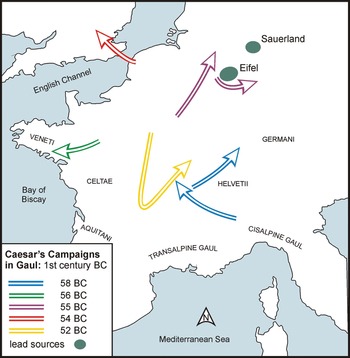
While a Claudian period event appears to be the strongest contender on the grounds of lead source, bullet type, the ‘associated’ early first-century phalera and the possibility of post-invasion campaigning in the vicinity, there are some factors hinting at a Caesarian assault that cannot be completely ignored.Footnote 93 Firstly, relatively lightweight almond-shaped sling bullets of Völling Type IIb are equally well known from the Late Republican period. Secondly, although Cassivellaunus was not specifically recorded by Caesar as the king of the Catuvellauni, he is generally accepted to have been so and it is therefore likely he and his lieutenants retreated northwards to one or more of his larger settlements in the tribal heartlands for a stand-off. Indeed, an engagement with Caesarian forces does not necessarily require proximity to a major earthwork.Footnote 94 Thirdly, while Late Republican-era mining has yet to be confirmed in the Eifel region, lead isotope results suggest that the Windridge ore could have originated in this area — an area which had seen operations by Caesar's forces the year before his second invasion of Britain (fig. 8).Footnote 95
Caesar's movements in the few years leading up to his more successful invasion of Britain in 54 b.c. It can be seen that his forces were active near the Eifel area in 55 b.c. It is possible he may have secured his military lead supplies from the area, simplifying his logistics.

Finally, slingers were certainly part of Caesar's invasion force of 55 b.c.,Footnote 96 and in his commentaries, he makes reference to the deployment of these special skirmishers as many as 20 times.Footnote 97 This statistic lends a little weight to the suggestion he had a predilection for employing slingers to soften up opposition in advance of infantry assault.
In terms of other discoveries that can provide supporting evidence of this previously archaeologically ephemeral interlude, recent work by Andrew Fitzpatrick at Ebbsfleet and elsewhere has shown there are significantly more traces of Caesar in Britain than we have formerly given credit to.Footnote 98
CONCLUSION
On present evidence, we believe Greep's original explanation that the Windridge bullets come from a plough-disturbed hoard of lead now appears unlikely. As a result of more recent studies of lead ammunition dispersal, it is probable they represent the traces of an episode of conflict of some magnitude. The exceptional discovery of battle-scattered glandes of a type that could date to the Republican or Claudian periods in close proximity to a Catuvellaunian settlement is a suggestive juxtaposition.
Although we do not claim to attribute the bullets definitively to the Plautian or Caesarian expeditions to Britain, we consider both these scenarios to be contenders to help explain the extraordinary missile finds at Windridge farm, and useful as a starting point for renewed enquiry into an observation first made by Ros Niblett 20 years ago. On balance, our view is that the evidence favours a Claudian context. Systematic surveys within the find site and surrounding area, and further carefully plotted bullet discoveries, could prove very helpful in understanding the choreography of the conflict.
ACKNOWLEDGEMENTS
We are indebted to Stephen Greep, Lawrence Keppie, Fraser Hunter and Mike Bishop, who read earlier versions of this paper and made many helpful suggestions, and to Andrew Fitzpatrick for thought-provoking conversations about Caesar's activities in Britain. It would also have been impossible to proceed without the unstinting access provided by museum curators around the country, particularly David Thorold at Verulamium Museum, who patiently answered our enquiries and also sampled the glandes from Windridge Farm for lead analysis. Special thanks go to Deborah Walsh at the Armitt Museum, Ambleside, Barbara Birley at Vindolanda, Steve Minnitt at the Museum of Somerset, Siobhan Ratchford of Dumfries Museum and Frances McIntosh at Corbridge Museum. Additional thanks go to Guido Creemers at Tongeren Museum for information and sampling of the Thuin bullets. Roger Thomas kindly provided data on the Catton group of bullets he discovered in 2013. We would also like to thank Andy Nicholson for analysing the Burnswark material and we are also grateful to Jan Dunbar for her illustrations. Finally, we are indebted to our two anonymous reviewers, who gave generously of their time, shared their knowledge and made constructive observations.