In the summer of 1895 American critic Edmund Clarence Stedman sent a letter across the Atlantic to Robert Bridges about a second decisive change that had just occurred in the career of one of the English poet's most widely published compatriots: “the Armytage-Tomson-Watson sequence is interesting. Well, a woman who can write such ballads has a right to be her own mistress” (Stedman and Gould 2: 185).1
In a footnote to this letter, Stedman adds that he thinks that the “short lyrics she [i.e. “Armytage-Tomson-Watson”] wrote from time to time from Scribner's etc, might have been written by others – the ballads, not” (Stedman and Gould 2: 185). As I explain below, “Armytage-Tomson-Watson” published extensively in American magazines, such as Scribner's, which reached a transatlantic audience.
Even though Stedman was based in New York City, he had been keeping a close eye on London's thriving literary scene for at least thirty years, informing readers of well-respected literary monthlies such as Harper's about the most talented poets of England's rising generation. But as he turned to London-based sources like Bridges for help with his potted biographies he learned certain facts that needed to be handled with some tact. Given the manner in which he comments on the “interesting” nature of the “Armytage-Tomson-Watson sequence,” it is more than likely that Stedman discovered that the thirty-four-year-old poet in question had experienced two painful divorces, both of which not only involved the loss of custody of three children but also encouraged her to create yet another authorial identity. It is therefore understandable that Stedman carefully withholds any explanation for the poet's succession of names:
Watson, Rosamund Marriott (“Graham R. Tomson”), b. London 1860. Under the latter designation she gained her repute as the author of “The Bird-Bride, a Volume of Ballads and Sonnets,” published in 1889, “A Summer Night and Other Poems,” 1891; “After Sunset,” 1895. Has edited several anthologies. The poet announces that hereafter her writings will appear with the signature “Rosamund Marriott Watson.” Has contributed to English and American periodicals “R. Armytage.” (708)2
Stedman included five of the poet's works in his anthology.
Yet the turbulent reasons behind this changing “sequence” of names would prove undecipherable to modern readers were it not for Linda K. Hughes's painstaking research.3
Since 1992 Hughes has published numerous essays that focus on “Armytage-Tomson-Watson”; these papers have culminated in Graham R.: Rosamund Marriott Watson, Woman of Letters.
But during the years that followed Stedman's assessment the poet's reputation went into decline with the publication of two, somewhat less impressive collections, After Sunset (1904) and, posthumously, The Lamp and the Lute (1912).4
The poet passed in 1911. The contents of her sixth and final volume, The Lamp and the Lute, appear in The Poems of Rosamund Marriott Watson.
Even though Lang had since 1887 been publishing poems by Tomson in his regular column, “At the Sign of the Ship,” in Longman's Magazine (the name of the column referred to the publisher's sailing-ship logo), he still referred to the writer as “Mr. Graham R. Tomson” when introducing the poet's “Deid Folks' Ferry” (Lang 222).
In his thoughtful review of Tomson's third collection, A Summer Night, and Other Poems (1891), William Watson recalled “reading two or three years ago in one of the American magazines [i.e. Harper's]” the poet's “Ballad of the Bird-Bride (Eskimo),” which I discuss below. Watson comments that at the time “its author's name had no associations whatever”; Watson was left “wondering who ‘he’ was – probably, I thought, a young American singer” (30).
Even if her poetic signature kept transmuting, “Armytage-Tomson-Watson” found considerable continuity in producing a sizeable number of works that belonged to what may be termed the fin-de-siècle poetics of illustration. While scholars have examined the progress of the illustrated periodical during the final quarter of the nineteenth century – whether in the form of a popular transatlantic monthly such as Harper's or in a London-based quarterly like the Yellow Book – comparatively little has been said about the style in which this type of print culture juxtaposed poetic word and visual image in a manner that was on some occasions complementary, while on others dialogic. Certainly, scholarship has looked closely at the characteristic ways in which fin-de-siècle poetry appeared in beautifully decorated volumes whose inspired design announced that the print medium should be recognized as an artwork in itself. In such volumes, the high-quality printing, the finely executed title-pages, and the ornate bindings draw attention to what Nicholas Frankel calls “the interdependence of a book's linguistic text and its bibliographic codes” (130).7
The illuminating research of Nelson has thrown greatest light on the publishing practices of Elkin Mathews and John Lane.
Yet the comparative positions that poetry and visual art occupied in both popular and coterie journals, including those that employed photomechanical processes (collotype, half-tone, line-block, and photogravure) in order to reproduce contemporary paintings, has remained largely neglected. It is in this context that the “Armytage-Tomson-Watson sequence” provides a number of instructive examples about the divergent modes in which fin-de-siècle poetry could interact with modern art. In a range of forms – lyrics, ballads, and monologues – this name-changing poet assimilates, addresses, and on occasion critiques the visual preoccupations of the celebrated British and American periodicals in which she published her accomplished, frequently outspoken work. By focusing on this underrated writer's links with the contemporary art world, we can see how both her chosen styles and types of subject-matter simultaneously complemented and critiqued the editorial scope of the noteworthy journals in which her poems appeared. Moreover, the poet's name-changing career migrated across a range of periodicals whose political affiliations, editorial policies, and aesthetics tastes have frequently been viewed as discrete components of 1880s and 1890s literary culture. In her poetic illustrations, this stigmatized woman had the ingenuity to invent a series of successful authorial identities through which she could create decidedly feminist links between the reactionaries and radicals, imperialists and aesthetes, and men and women writers whose otherwise separate cultural communities thrived in literary London.
I
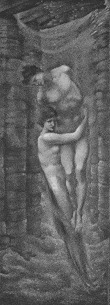
R. Armytage made one of her earliest appearances on 22 May 1886 in The Academy, with “‘The Depths of the Sea,’ after Burne-Jones,” a sonnet which addresses a striking painting which had been reviewed in the journal only two weeks before (Figure 8).8
Figure 8 reproduces the version of The Depths of the Sea held by the Fogg Museum, Harvard University; this is a copy of the original painting that appeared at the Royal Academy in 1886, and is now held in a private collection.
I am grateful to Gowan Dawson for this information.
Among the poems that Levy published in the Academy is “London in July,” later collected in Levy, A London Plane-Tree. Symons published “The Opium Smoker” in the Academy 19 November 1887; the poem was later collected in Days and Nights.
We long in vain for some young England to spring up, to throw itself headlong into any given direction, to do battle with some idea, some principle in art, whether technical or intellectual; however paradoxical, however opposed to all accepted canons, however brutal any such new departure may, on its first advent, appear to us. (333)

Copy of Edward Burne-Jones, The Depths of the Sea, 1887. Watercolor and gouache on wove paper mounted on panel. Courtesy of the Fogg Museum, Harvard University Art Museums.
This is particularly the case with Phillips's muted response to the polemical subject-matter of the only work that Edward Burne-Jones – some thirty years a leading Pre-Raphaelite – ever exhibited at the Royal Academy. As he turns his attention to Burne-Jones's The Depths of the Sea Philips states that it comprises “one of the few piquant incidents which relieve the prevailing dullness of the exhibition” (333). He admires the scene in which a mermaid smiles peculiarly as she takes hold of the sinking body of a naked young man who plummets to the sea-bed. The viewer, meanwhile, enjoys the dramatic irony of knowing that she has failed to grasp the truth about the muscular frame to which she passionately clings – namely, that her would-be lover is in fact deceased. In Phillips's eyes, even if this conceit possesses “ingenuity” it nonetheless appears to him that “the charm, the pathos inherent in a subject so subtly chosen, those very elements which should, indeed, constitute its raison d'être, have evaporated” (333). Ultimately, The Depths of the Sea leaves Phillips “interested, but entirely unmoved” (333). The reason, as he explains, possibly lies in the “dull, suggestive key colour” (grays and whites), which implies “the want of spontaneous passion” – a symptom perhaps of an “undesirable consummation” between, on the one hand, a Burne-Jones that is growing less exuberant with time, and on the other hand, the regrettable staidness of the Royal Academy (333–34).
Phillips's lukewarm commentary compares unfavorably with the observations made in the Athenæum by F. G. Stephens, the critic who originally belonged to the late 1840s regeneration of Pre-Raphaelite painters. The Depths of the Sea, Stephens claimed, represented a “new and difficult subject,” just as it possessed “noble and subtle charms of colour” (“Fine-Art Gossip” 561). Even though Stephens had some misgivings about the relative size of the mermaid's frame to that of her beloved, he delighted in the “wicked triumph gleaming in her eyes” while she “smiles over her victory” (“Fine-Art Gossip” 561).11
On 1 May 1886, Stephens observed: “Her face is a marvel of wicked witchery” (“The Royal Academy [First Notice]).”
But it would be left to R. Armytage to respond to this painting in a manner that partly evoked Walter Pater's extravagant elaboration of the “subtle expression” on La Giaconda's face. This was the haunting countenance upon which, in Pater's words, “[a]ll the thought and experience of the world” have been “etched and moulded” (98).12
I quote from an edition that reproduces the 1893 edition. The text is the same in the first (1873) and second (1877) editions of Pater's volume.
Pater's famous description of La Gioconda aims to capture, among other things, how his idea of the Renaissance is characterized by the deep-layered presence of pagan cultural forms in works produced within the Christian era.
Yea, draw him gently through the strange seaways
Down through the dim, green, water whispering.
Thy cold lips have not kissed so fair a thing
As this young mariner for many days.
So well he sleeps, he will not wake to praise
Thy wan bright loveliness, nor feel thee cling
Around him, neither smile to hear thee sing,
Though thou did'st lure him hither with thy lays.
The bubbles sigh and sparkle overhead,
How white thou art! but he is paler still,
Pale with despair of young days forfeited.
Smiling thou bear'st him to thy chill green bed.
Of brightest, bitterest triumph take thy fill,
Thou hast his body, but the soul has fled.
Similarly, in the sestet Armytage resists the temptation to follow the conventional move that most sonneteers would make when faced with a scene that, no matter how prepossessing aesthetically, is hardly in good taste. Instead of passing moral judgment on The Depths of the Sea her poetic voice expresses awe at the mermaid's overwhelmingly “white” body. Such whiteness not only identifies Burne-Jones's illumination of the mermaid's flesh but also connotes her corpse-like pallor, thus insisting, as Nina Auerbach observes, on this freakish “hybrid” being's “nonhumanity in human form” (94). The deathly whiteness, eerily, is linked to her joyful “Smiling” as she continues to drag the sailor's body downward to her “chill green bed.” But rather than suggest that the “chill” of the sea-creature's intimacy will diminish the pleasure of this tableau, Armytage's speaker insists that the mermaid's love-making will amount, in another paradoxical phrase, to “brightest, bitterest triumph.” Entwined together, the brightness and bitterness suggest that even though the mermaid may well rue the fact that when she “take[s]” her “fill” she is not making love to a live creature (from whom “the soul has fled”), she nonetheless can and should relish the pleasures of “his body.” Ultimately, by commanding the mermaid to show no hesitation in “tak[ing]” her “fill” the poetic voice has transmuted the sonnet from a form that customarily celebrates a man's desire for a living woman into an unorthodox paean to a monstrous female whose yearning amounts to nothing less than necrophilia.
On 12 June 1886 Armytage followed this outspoken sonnet with yet another concise revision of Phillips's commentary on the Royal Academy exhibition. In “Mariage de Convenance. – After! (Orchardson)” she makes a poetic reply to an artwork that was as widely noticed as The Depths of the Sea. From Phillips's perspective, William Quiller Orchardson's second and final painting in the Mariage de Convenance (Figure 9) sequence bore away the “honours” in the sphere of “dramatic and domestic genre” (334). As he points out, this work reveals the painful consequences of a lifeless marriage between an “elderly obsequious bridegroom” and an “exuberant beauty” whose unhappiness was evident in the preceding painting which generated discussion at the Royal Academy in 1884 (334). In the earlier work, the discontented couple sits listlessly at opposite ends of a large, richly laid dining table. Orchardson's 1886 painting, as Phillips observes, shows that the young wife has “fled…leaving as her only trace a portrait on the wall, dimly seen in the background – a true Hogarthian touch” (one that of course evoked William Hogarth's Marriage À-la-Mode series [1743]; 334). Meanwhile, the “husband sits alone, absorbed in bitter musings” (334). Having outlined the scene, Phillips turns to Orchardson's technique, which, given the prevailing “hotness of the general tone,” remains “admirable” because of the “management of the lighting, the remarkable drawing and painting of the accessories…and, above all, the skill with which the central figure is placed” (334). The only reservation that Phillips has about this companion piece, which touches on a “hot” topic, is the “expression of the sorrow-stricken dreamer” (in his view, it is a “shade over emphasised” [334]). (In the Athenæum, Stephens would disagree. He found that the “certain excess” of “shadows and coloration” in the work added “to the force and effectiveness of the figure and expression of the face of the man” [“The Royal Academy (Second Notice)” 621]).14
Another reviewer, writing anonymously, also commended the look on the elderly man's face: “The strength of expression concentrated into this single figure of the man of the world off guard, away from curious eyes, in his torture of regret, is remarkable” (“At Chronicle” 102).

William Quiller Orchardson, Mariage de Convenance, 1886. Oil on Canvas. Courtesy of the Aberdeen Art Gallery and Museum.
In her three eight-line stanzas Armytage refocuses attention on Orchardson's recent work by contemplating the pressing moral questions about mariages de convenances that had preoccupied nineteenth-century artists and writers for decades. Much earlier William Makepeace Thackeray had loudly censured this disreputable phenomenon in his Paris Sketch Book (1840). “In London,” Thackeray remarks in a spirit of nationalistic pride, “as yet there are no blessed Bureaux de Mariage, where an old bachelor may have a charming young maiden – for his money: or a widow of seventy may buy a gay young fellow of twenty, for a certain number of bank-billets…. If mariages de convenances take place here,” he adds, “at least, thank God, such unions are not arranged upon a regular organized system” (Works 7: 82). Thackeray's comments, however, should not be taken as a sign that Orchardson was representing subject-matter that would seem wholly outdated to the 1880s public. If anything, Orchardson's work articulated a matter whose moral complications remained decidedly unresolved. Inspired by Orchardson's works on this topic, John Collier's much-debated “problem painting,” Mariage de Convenance (1907), shows that the urgency of this issue persisted into the twentieth century. Collier represents two women – the one standing erect with hand on hip looking down haughtily on the other crouching beside a bed – who have evidently been disputing a marriage that either has taken place or is about to occur, since a wedding dress has been strewn across a coverlet. The dramatic scene, as Pamela M. Fletcher has revealed, is filled with “narrative ambiguity,” since it remains unclear what the relationship between the two female figures might be (85).
Armytage's short poem on Orchardson's painting contributes to the developing nineteenth-century cultural inquiry into the corrupt economic forces that have led to the marital despair that the painter depicts. Beholding the “man with sparse gray hair” who sits “Brooding on sin and shame,” the poetic voice asks: “Which was the most to blame?/He? or she only?” Instead of coming down on one side or the other, the poet observes that we can hardly be shocked by the fact that the young woman deserted her ageing spouse. It is “Small wonder” that the marriage of “June and Winter” should create such an insuperable burden. At the same time, the poet remarks that the young wife who runs away in search of “Love and laughter” must ultimately suffer “Even a bitterer,/More sordid, ‘after.’” This situation, in which the woman absconds from her loveless marriage only to enter a disreputable life where her questionable sexual history will ostracize her from society, strikes Armytage's speaker not as a matter suited to divisive moralizing but as a “stage-worn play” – a drama that continues to wreak “desolation” for a number of familiar reasons: “A woman rashly bought,/Ambition coldly sought,/Passion and Greed.” The speaker implies that no one can be blamed outright for participating in a set of circumstances where each party has exploited the other. Such an ending makes a clear contrast with the reviewer in the Times who believed that the painting revealed Orchardson as “a moral teacher” (“The Royal Academy” 1 May 1886).15
This reviewer thought the painting implausible, since the kind of man it depicts “is generally clever enough to avoid scandal, and if he avoids scandal he avoids everything that hurts him seriously” (10).
As Hughes has pointed out, this perceptive lyric appeared when Armytage had recently separated from her spouse, and it may well be that its taut lines – like those of its ecphrastic predecessor – articulate the young poet's sense of her right to be, in Stedman's phrase, “her own mistress” (“Rosamund Marriott Watson” 311). But, at the same time, it is also the case that these two brief poems stand as representative illustrations of the metropolitan cultural ethos of the Academy. During the mid-1880s the journal carried a number of lyrics that took issue with its reviews of recent art. In 1886 Emily Pfeiffer contributed several poems that expressed favorable responses to paintings such as G. F. Watts's The Death of Cain. The final sonnet in her “Cain and Abel” sequence, which senses the drama of Cain as a “mere dumb/Sacrifice on Abel's altar-stone” (327), certainly stands in contradistinction to Phillips's negative commentary that appears six pages later in the same issue where he states that the work “should not have appeared on the walls of the Academy” (333).16
Pfeiffer also contributed a sonnet titled “Hope” (in praise of G. F. Watts's painting of that name which recently appeared at the fashionable Grosvenor Gallery), to the Academy on 29 May 1889. Two weeks before Cosmo Monkhouse praised “the wonder of its pitifulness and its opalescence of colour” (“The Grosvenor Gallery” 350). Pfeiffer had good reason to keep her eye on London galleries. A number of reviewers noted Arthur Cope's portrait of her at the Royal Academy's 1886 exhibition.
To be sure, not every poem in the Academy during this period recorded thoughts on a leading cultural event in London which the periodical had already discussed. But since the journal found only a small quantity of space for poetry (a single volume, covering six months and amounting to four hundred and sixty pages, featured at best forty succinct poems), the fact that a conspicuous number of them were in a sense reviews of the reviews indicates the ways in which this respected weekly was prompting poetry to provide alternative viewpoints among the intelligentsia. In many respects, Armytage's feminist lyrics operated from a critical margin (given the modest space that the journal allocated to poetry) from which she could acknowledge but not undermine Phillips's authority.
II
By the end of 1886 Armytage began to occupy the second of her poetic identities, Graham R. Tomson, and it was with this decisive name-change that the poet devised ways of producing critiques of marriage in journals that enjoyed far wider circulation than the Academy. In January 1889 one of her most fearless poems on this topic, “Ballad of the Bird-Bride (Eskimo),” appeared in Harper's New Monthly Magazine, with two astonishing illustrations by the renowned F. S. Church. In approaching this powerful poem, we need to consider why it should have occasioned William Dean Howells's editorial team to commission such imposing paintings from an artist whose reputation had been lavishly praised in the previous number. In his celebration of Church's capacity for depicting “the beauty of the ideal American woman of the last quarter of the nineteenth century” and for studying the habits of “wild animals at the menagerie at Central Park,” George William Sheldon insists that “no other painter has done so much as F. S. Church toward creating national art” (57, 53). If Church presented an expressly American aesthetic in his artworks, and if (as a well-established professional) he commanded such esteem, then why did he seem to be suited to create two paintings that represented the vivid drama of an emergent English poet whose at times outspoken work came before readers of the Atlantic, the Century, Harper's, and Scribner's in 1887?17
In 1887 Tomson published “Ballade of the Bourne” in Harper's New Monthly Magazine. In this year, when she contributed numerous lyrics to Scribner's, she probably enjoyed greater success than any other English poet in placing work in the transatlantic American literary magazines.
As I have commented elsewhere, the few poets whom Harper's chose to publish in the 1880s at times saw their writings illustrated by such distinguished artists as Edwin Austin Abbey (Bristow, “Reassessing Margaret Veley's Poetry”). In the case of English writer Margaret Veley, who was widely acknowledged as a gifted novelist, Harper's furnished exquisite woodblock engravings of Abbey's work to accompany her poetry. This combination of American illustration and English poetry to a certain degree forms part of the considerable transatlantic success of this periodical, which – like all of its main competitors – issued almost identical American and English editions. Sales were certainly high, with Harper's reaching an audience of 200,000 in the United States and 35,000 in Britain (Exman 19). No other literary periodical achieved such popularity in London. Yet when one looks at Tomson's striking ballad one wonders if it was solely the sexual liberalism of this writer that made her poem so appealing to the largely democratic orientation of her editors in New York City. Perhaps the journal concluded that the plainspoken sexual politics of the poem proved altogether acceptable because it looked as if this highly crafted ballad came from the pen of a man. In “Ballad of the Bird-Bride,” after all, Tomson's speaker petitions for women's sexual freedoms in a manner that related implicitly to pressing late nineteenth-century debates about the grounds upon which wives may rightly desert their husbands, and, in the process, take custody of their children. But, as I show here, there are additional reasons that help to explain why this unapologetic work by an emergent woman poet secured such eminence in Harper's.
To begin with, even if “Ballad of the Bird-Bride” touched on sensitive subject-matter, there was nothing about its form that could cause offense. In this respect, it is worth bearing in mind that Tomson established her name in the American and English periodical press by publishing poems that conformed to, rather than deviated from, noticeable poetic trends of the mid-1880s. On the one hand, she found a niche in Lang's regular column, “At the Sign of the Ship,” in Longman's Magazine by providing, among other things, a steady supply of ballades: the type of witty poetry favored by those writers who followed Austin Dobson's 1870s lead to revive a number of Provençale fixed forms, including the villanelle, as modish vers de société.18
Tomson, together with May Kendall, became one of Lang's favored poets in the late 1880s. One of the wittiest poems that she placed in “At the Sign of the Ship” was “Ballade of Betty Barnes, the Book-Burner.” Not all of Tomson's contributions to Longman's appeared in Lang's column; see, for example, “Ballade of the Flight of Nicolette.”
In “Ballad of the Bird-Bride,” Tomson radically reworks an Eskimo folktale which Henry Rink brought before the English-language public in 1875.19
Rink 145–48. Hughes suggests that a possible source for the poem is Sabine Baring-Gould, Myths of Middle Ages (1866); in addition, Hughes speculates that Tomson's poem revises William Morris's “Land East of the Sun and West of the Moon” in The Earthly Paradise (1868–70) (“‘Fair Hymen Holdeth Hid a World of Woes’”166–67).
Tomson's distinct modernization of this supernatural story features a native man who recalls how he won his “bird-bride” when a group of gulls that were perched upon an ice-floe transformed before his eyes into beautiful women. “Swift I sprang from my hiding-place,” he reminisces, “And held the fairest fast.” “Her comrades skirled,” he observes, “but they all took wing,/And smote me as they passed”: a sentiment that plainly shows the wrongfulness of this abduction. Once the “sweet, strange thing” has been whisked off to his “warm snow house” (226), she tells the man that she will live with him and bear his children so long as he never hunts any gulls. But when famine strikes he releases his bow and shoots four of the sea-birds. As a consequence, his bird-bride and their “bairnies three” transmute into gulls and take to the skies, leaving the hunter asking whether they will ever return. “Dear, will you never relent, come back?/I loved you long and true,” he laments (227), in a style whose artificiality links this violent tale with those Scottish border ballads, such as “Fair Helen” and “Clerk Saunders,” that recollect lost love.
Yet the Scottish idiom that the mythic “bird-bride” uses when she decides to depart from her spouse does more than connect this legend with the famous minstrelsy of the Scottish border:
She beat her arms, and she cried full fain
As she swayed and wavered there,
“Fetch me the feathers, my bairnies three,
Feathers and plumes for ye and me,
Bonny gray wings to wear!” (227)
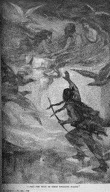
The first of Church's remarkable illustrations assuredly conjures the sensuality that Tomson depicts when the native hunter first descries the naked bird-women (Figure 10). Positioned as if they were flying aloft, the three female figures – which no doubt exemplify Church's skill in representing American women's beauty – appear as if they occupy the calm center of a storm-cloud. As gulls with outspread wings whirl around the three female figures, the women seem to enjoy relaxed conversation, with one of them propping herself at ease upon her elbows, while another lies reclined on a mass of cloud. All three of them are nude, with the third figure raising her left arm in a gesture that obscures her breasts. Similarly, all of the female figures have extremely long flowing hair – a feature, as Elisabeth G. Gitter has explained, which hints at women's sexual abandon. Meanwhile, in the lower portion of the illustration, as he leans his body into the wind, the hunter in his native garb reaches up toward the women, as if trying to grasp the loose strands of their hair. By comparison, when readers turn the page they see the terrible consequences of the hunter's cruel actions. In a smaller image that comes after Tomson's final stanza, the muscular body of the hunter is crestfallen: his body is crumpled in a despairing posture that evokes the work of such famous predecessors as Albrecht Dürer and William Blake (Figure 11). Taken together, the two illustrations therefore capture the male speaker's dramatic transition from activity to passivity, in the end making it plain that he has sorely suffered for his offense.

F. S. Church, full-page illustration for Graham R. Tomson, “The Bird-Bride,” Harper's New Monthly Magazine, 1889.

F. S. Church, quarter-page illustration for Graham R. Tomson, “The Bird-Bride,” Harper's New Monthly Magazine, 1889.
But it would be mistaken to assume that there was sexual-political congruence between Tomson's ballad and Church's illustrations. Similarly, it does not make complete sense to conclude that Howells and his liberal-minded editors saw Harper's as an organ that advocated women's desertion of reckless spouses. No other contribution to its hefty 992-page volume for December 1888 to May 1889 touches on this sensitive topic. And when we look at the scant amount of poetry that Harper's included in its pages the content is far from polemical. In “A Snow Sonnet,” to take a representative example, Nina F. Layard begins by stating that her “ear can find no rest” because the “city's commerce” is restless and noisy. Demanding peace, her speaker moans aloud: “Who chid primeval waters, can He so/Bind this wild flood with His great ‘Hitherto’?” In the sestet, the “fever-stricken” speaker's melodrama increases when she experiences the “blessed Silence” of the “feathered flakes” which “brush” against her “window.” This predictable sonnet reaches the following uneventful conclusion: “God came into His nursery and found/The children noisy, so He whispered ‘Hush.’”
The juxtaposition of Tomson's thought-provoking ballad and Layard's uninteresting sonnet alerts us to a broader preoccupation within Harper's that helps to account for why “Ballad of the Bird-Bride” received such attention. Like Layard's weak sonnet, and like countless other contributions to the journal, Tomson's outstanding ballad features a cold clime. Once we turn the page after “Ballad of Bird-Bride” we encounter a long article on the habits of the beaver, furnished with an exquisite upriver depiction of the creature's North American haunts (see Wells). While it is understandable that in the ensuing pages this American-originated journal contains numerous articles on such locations as Kentucky and Dakota, it remains the case that a conspicuously large proportion of the contributions relate to some area of the Northern Hemisphere (see the items by Björnson, Cook, Scott, W. W. Thomas, and Warner). There is a plethora of contributions that stress the journal's distinctly Northern hemispheric orientation – such as the discussion titled “Midnight Rambles” that examines plants that close their petals at night.20
See Gibson.
III
The great success of the handsomely illustrated transatlantic journals like Harper's to some extent helped to foster the appeal of the skillfully decorated magazines – such as the Butterfly (1893–94, 1899–1900), the Yellow Book (1894–97), the Pageant (1896–97), the Savoy (1896), and the Dome (1897–1900) – which would become closely associated with the distinguishing characteristics of London's fin-de-siècle literary scene. Moreover, an important precedent for these 1890s publications had been set by the Century Guild Hobby Horse (1886–92), a finely printed coterie journal that, under the editorship of architect and poet Herbert Horne, created a forum which recognized the interconnectedness of the arts. With its distinctive Caslon typeface, its respect for decoration, and its beautiful wood-cuts, the journal – later known simply as the Hobby Horse (1893–94) – as Simon Houfe acknowledges, “in so many ways…led the field in the design and form of the book in the 1880s” (15).21
Horne's achievements are detailed in Fletcher, Rediscovering Herbert Horne.
In many respects, these journals' style of presentation, which suggests that both the elaborate typography and decorative borders (all printed on hand-laid paper) command as much attention as the contributions themselves, obviously marked a decisive break with copiously illustrated forerunners such as the popular weekly Graphic (1869–1932). Even though the Graphic made its mark by elevating illustration as one of the highest arts (it gave pride of place to many painters who subsequently enjoyed distinguished careers), it nevertheless printed its reports in an unadventurous typeface. In his 1888 memoir about “The Making of the ‘Graphic,’” the magazine's editor, W. L. Thomas recalled that his original scheme was to “establish…a weekly illustrated journal open to all artists, whatever their method,” while at the same time “enlist[ing] the services of writers of some literary distinction” (81). Thomas acknowledged that it “is pretty widely known that most of our successful painters have gone through a course of drawing” (81), and he added a roll-call of artists (including Luke Fildes, Hubert von Herkomer, and John Millais) whose work, in high-quality engravings, graced the Graphic's large pages. His memoir remains significant because it appeared in a magazine that wished not only to capitalize on the esteem that the Graphic conferred on illustration some twenty years before but also to attempt to bring the avant-garde approach to uniting the arts that absorbed Horne in the Hobby Horse to a wider audience. The periodical in question was the ambitious, though short-lived, Universal Review (1888–90), and it was in this journal that Graham R. Tomson published five of her finest poems, all of which were expertly illustrated.
The publication of the Universal Review was heralded by an unprecedented full-page advertisement that appeared in the Times on 16 May 1888. There is no doubt as to why the editor, Harry Quilter, who had for many years reviewed the Royal Academy exhibitions in the Spectator, wished to launch the journal with such fanfare: “The point at which I wished to aim was to keep the literature and the illustration on a footing of absolute equality, admitting, for instance, no illustrative work which was not of a certain artistic quality, and no literary matter that was simply intended to elucidate the illustration” (Opinions 387).
As the title page of the first issue made plain, the illustrations by such established artists as Frederic Leighton, William Quiller Orchardson, William Powell Frith, and Albert Moore (to name but a few) were a defining attribute of the magazine. On the facing page, an exceptional etching of a woman's head by Frederick Sandys – whose work had become prominent in the Cornhill Magazine twenty-five years before – emphasized this point. With an ambitious print-run of 5,000 copies, and priced at 2s. 6d. (more than twice the cost of the American Century or Harper's), Quilter's monthly magazine was issued by Swan Sonnenschein, the progressive publishing house that in 1887 published the first English translation of Karl Marx's Capital. Right from the start the periodical sought to establish not just its commitment to the unity of the arts. Strikingly, the Universal also carried some articles in French, including fine assessments of Robert Browning's, Alfred Tennyson's, and Walt Whitman's poetry by Parisian anglophile critic Gabriel Sarrazin. And there were, in addition, a number of essays that paid close attention to London's cultural and literary ties with the Continent. In fact, its opening contributions focus readers' attention on a Franco-Russian military threat (“The State of Europe and the Position of England” by liberal politician Charles W. Dilke) and the disreputable nature of French naturalism (“Zola's Idée Mère” by conservative apologist Eliza Lynn Linton). Later in the same volume, Quilter discusses the cosmopolitanism of the Paris Salon, which – unlike the parochial Royal Academy – attracts artists “from every country of the Continent, from America, and from England also, all the most ambitious and the most energetic of the young painters” (“The Salon” 222). Amid this wide range of political opinions and cultural outlooks readers found Henry James's “The Lesson of the Master,” the journal's first serial. There is no question that with such divergent contents Quilter attempted to reach a worldly, open-minded readership. But, as he was forced to recognize in later years, it was “egregious folly to suppose that the review might be made so cosmopolitan that it would have equal sales in America and on the Continent to that in England” (Opinions 387). In 1890, at the end of its eighth 600-page volume, this distinguished, though loss-making, venture had to fold.
Like Harper's, the Universal was somewhat selective in the poetry it accepted for publication, and it is noticeable that most of the poets whose work it included were established figures with diverse affiliations: William Ernest Henley, Lewis Morris, Algernon Charles Swinburne count among the more prominent names. Building on her mounting presence in the transatlantic monthlies, Graham R. Tomson was the only woman to publish poetry in Quilter's magazine, and, what is more, her contributions were not only greater in number than those of any other poet but also more generously illustrated than theirs. Her substantial, if not unique, presence in this journal warrants special attention because her poetic inquiries into the cultural position of women draws into question some of reactionary, sometimes misogynist claims that other contributors occasionally make elsewhere in the periodical. Before we turn to her writings, it is instructive to examine some instances of the kinds of anti-feminism that surrounded – though by no means engulfed – Tomson's thoughtful poetry.
It is a sign of Quilter's liberal-minded desire to embrace a politically mixed, though urbane, audience that in the opening volume he included “On a Certain Deficiency in Women” by the novelist George Fleming (the pen name of Julia Constance Fletcher). Fleming's essay features a litany of outspoken generalizations about middle-class women, even ones who have benefited from good schooling, who “cannot indulge in direct experience, but are for ever being plucked back or pushed forward in obedience to well-known code and precedent” (400). Much as Fleming acknowledges that higher education will make “the average woman” a more rational, independent-minded thinker, she nonetheless launches an attack on what she sees as the deep conformism that characterizes the limitations of modern womanhood: “To speak plainly,” she declares, “the mind of the average woman appears to be absolutely deficient in the power of coherent impersonal thought” (403). The Universal kept its readers' eyes on such controversy by featuring Grant Allen's polemic which laments the ways in which the failings of modern womanhood have ensured that marriage has been reduced “to the level of blind poker” (54).22
Tomson's two-part “Procris” appears in the same volume, 79–92, 226–37. It is worth noting that Quilter included a series of papers on “The Progress of Woman” by Mary R. Lacey, Florence Fenwick Miller, and Emily Faithfull, respectively. All three contributions are feminist. Miller who wrote an important biography of Harriet Martineau, was a respected educator and journalist, and Faithfull was an established writer and political activist who had written extensively on such topics as women's education and anti-vivisection.
Together, Fleming's, Allen's, and Quilter's comments provide a fair indication of the somewhat vexed sexual-political environment in which Tomson's finely illustrated poetry appeared. All of these works address the social forces that helped to shape, define, and at times exploit femininity, not just in the late nineteenth century but also – as she shows through her adaptation of ancient legends – over thousands of years. In each case, the remarkable illustrations imply that Quilter wished to give prominence to Tomson, since her poems about men's mistreatment of women provided a corrective to the free reign he gave to the likes of Fleming and Allen.
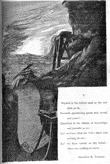
In volume three, after naturalist Guy de Maupassant's French-language story, “Un Soir,” has drawn to a close, we encounter the first of five imposing illustrations that accompany Tomson's “The Smile of All-Wisdom,” a short poem set in ancient Egypt. Each drawing occupies more than three-quarters of each page, and all are signed “C.H.S.” (i.e., Charles Hazelwood Shannon) (Figure 12). Shannon, who trained in wood-engraving, was at this time making his mark as an illustrator and lithographer. Together with his life-partner, Charles Ricketts, he established the Dial, a journal which in many ways followed the lead taken by the Hobby Horse; it appeared intermittently between 1889 and 1897. By 1896, with Ricketts, he established the Vale Press, which rivaled – if not excelled – the fine-quality book designs that gave Elkin Mathews and John Lane's titles such distinction under their joint Bodley Head imprint (1889–94). And in the same year he co-edited the Pageant. Such professional achievements, which include helping to illustrate Oscar Wilde's A House of Pomegranates (1891), shows that by the time he appeared in the Universal Shannon was on the brink of a career which would make a decisive contribution to the fin-de-siècle understanding of both the printed book and the literary magazine as artworks in themselves.

Charles Hazelwood Shannon, full-page illustration for Graham R. Tomson, “The Smile of All-Wisdom,” Universal Magazine, 1889. Courtesy of Charmian O'Neil and Leonie Sturge-Moore.
Since Tomson and Shannon had reached similar stages of their professional lives in 1889, their joint appearance in the Universal in some respects bears witness to Quilter's aim to put poetry and illustration on a “footing of absolute equality.” But the fact that the drawing takes up the larger proportion of space on each page should not suggest that Shannon's work is ultimately more significant than Tomson's. Even though it is the case that Quilter commissioned Shannon to furnish these illustrations, the striking page layout refuses to present the illustrations as supplements to Tomson's twenty-five lines. Certainly, readers at first are likely to look at each of Shannon's highly detailed drawings before they absorb Tomson's stanzas. Moreover, Shannon's initial illustration prepares the viewer for the historical setting of Tomson's poem. But, as we learn in due course, Shannon's images remain entranced by the story of a sculptor who “wandered far” in search of the “Smile of All-Wisdom” which he sought to “fashion” upon the lips of the Sphinx (129).
Tomson's poetic voice explains that no matter which male authorities the sculptor consulted (“Sages,” “heroes,” “lords,” “Magi,” and “Kings”) he could not find a model for the wise smile that he required for this legendarily enigmatic icon. It is only when a “hoary-headed” slave petitioned the “Master” that the artist learned that he should “Sculpture the smile” of his “Sphinx from the lips of the dead” (130). Accordingly, the slave escorted the “Master” to a hovel where they found a female corpse, and the sculptor instantly declared to the servant: “Thou which I sought thou hast found” (131). Thus the artist sculpted “on the stone lips of old” an expression that remains “Tranquil, inscrutable, sweet with quiet disdain” to this day (132). In the final stanza, the poetic voice suggests that if the smile still prompts “questioning spirits” to try to unearth its seemingly deeper meaning, there is little point in modern attempts in doing so. Instead, as Tomson's speaker suggests in the guise of the Sphinx herself, it is best to resign ourselves to our inability to know some underlying truth: “Lo! We have fluted the Veil – there was nothing to see –/Lo! We have looked on the Scroll – there was nothing to learn” (133). Much as anyone might try to resolve the Sphinx's riddle, she resists interpretation, even by the artist who created her.
It should be clear that this ingenious poem celebrates the enduring power of deathly femininity in a manner similar to Armytage's earlier lyric which affirmed the longings of Burne-Jones's smiling sea-creature. Furthermore, in “The Smile of All-Wisdom” Tomson suggests that the Sphinx's presence – like that of the Burne-Jones's mermaid and, indeed, the Eskimo bird-bride – retains a self-preserving power that stems not only from her supernatural qualities but also the fact that she belongs, in part, to another species. Meanwhile, in the final memorable illustration Shannon acknowledges the continuing authority of the Sphinx by depicting the sculptor gazing at his enigmatic creation, while he rests his hands distractedly at the top of an unfurled scroll that contains one of his drawings (Figure 13). As he looks toward his towering female monument in the distance, the sculptor appears mesmerized. Interestingly, Shannon implicitly agrees that the sculptor cannot help but be overwhelmed by the female object of his creation, since Shannon has inserted his own distinctive initials at the bottom of the scroll. In many respects, Shannon's decision to place his signature there hints that his large drawings have also been transfixed not only by a legendary icon but also the poem by Tomson that has told such a compelling tale.

Charles Hazelwood Shannon, full page illustration of the sculptor for Graham R. Tomson, “The Smile of All-Wisdom,” Universal Magazine, 1889. Courtesy of Charmian O'Neil and Leonie Sturge-Moore.
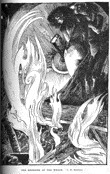
Shannon's illustrations are equally striking in the fourth volume of the Universal. On this occasion, however, his drawings perform a slightly different function in representing episodes in another of Tomson's poems. Where in “The Smile of All-Wisdom” Shannon's work was fully integrated into each printed page, in “The Quern of the Giants” his contributions comprise five plates (separately bound into the issue), an illustrated initial, and a quarter-page image that appears at the end of the poem. Undoubtedly, the five plates demand to be recognized as artworks in their own right. Each of the plates has a title, and each one provides Shannon's name in full. Yet these dramatic full-page drawings also amplify the terrible results of abusive patriarchal authority that are powerfully narrated in Tomson's pounding couplets.
Sharing an interest in the austere Norse folk-tales that absorbed earlier nineteenth-century poets such as Mary Howitt, William Howitt, and William Morris, Tomson's poetic voice adapts a devastating story from the Poetic (or Elder) Edda.23
Hughes mentions this source in “A Woman of the Wilde Side” (104). More specifically, the story of Menja, Fenja, and King Fróthi appears in “Grottasongr” (‘The Lay of Grotti’): see The Poetic Edda (Anonymous 154–58). Hughes also observes that the meter of Tomson's poem is taken from Swinburne's “Song in Time of Revolution, 1860,” which appeared in his explicitly republican volume, Songs before Sunrise (1871).
“Our eyelids wax heavy with sleep, sore awearied are we;
Grant us respite, O King, for a while, from our travail of thee.” (279)
“So long as the pause of a song for the voices that sing,
So long as the call of the cuckoo is silent in spring,
So long shall ye rest and no longer, so long shall ye cease
From the grinding of pleasure and plenty, of treasure and peace.” (279)
Little does King Frodi anticipate the rebellion that is about to take place, since he has a very poor sense of history. He fails to understand that the Quern itself is linked to the House of the Giants from which Menia and Frenia are descended. The women recognize their affiliation with the Quern when they hear the magical stone mutter: “Even so, till the King be content with the thing we shall grind” (280). At that moment, Menia and Frenia know that if this strenuous work is to continue it will hark back to an era when the House of the Giants did not grind for “Peace and Gold.” Instead, they appreciate that the earlier time of their ancestors was one of destruction. “Grind we the wrack and the uttermost woe,” Frenia declares, “The ruin and rapine, year – the red right hand of the foe” (281). Instantly, King Frodi's land suffers annihilation, and when “the heart of King Frodi has been ‘emptied of thought or desire’” the two women leap “in the blood-reek, rejoicing, and redden…the sky” (282). Once silence falls upon the razed kingdom Menia and Frenia place “their arms on their bosoms crossed, passive and stern,” suggesting that they remain defiant to the end (283).
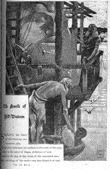
The fourth of Shannon's plates, “The Grinding of the Wrack,” magnifies Menia and Frenia's colossal strength by representing their two naked bodies in a supportive embrace, as they look down upon the puny population that is swallowed up in flames (Figure 14). Meanwhile, the leaping fire not only animates the devastation but also casts intense light on the women's bare flesh. Besides representing indomitable femininity, this remarkable drawing contributes to the late-nineteenth-century recasting of the female nude, which began to transform the female body from a vessel of seamless purity to an agent of sometimes aggressive authority. But it needs to be borne in mind that Menia and Frenia do not conform to the late-nineteenth-century figurations of the femme fatale who lures unsuspecting males toward some terrifying erotic end. Since Shannon places the giantesses next to the grindstone, he reminds readers that Menia and Frenia are working women, ones whose backbreaking industry decides whether the world will reap a harvest or suffer a famine. In many ways, the sight of their towering bodies helps us to recognize an important lesson in Tomson's poem: patriarchal ideals of social order depend not only on women's exploited labor but also arise from an arrogant underestimation of the physical strength that women bring to those fundamental tasks that make the world go round.

Charles Hazelwood Shannon, “The Grinding of the Wrack,” illustration for Graham R. Tomson, “The Queen of the Giants,” Universal Magazine, 1889. Courtesy of Charmian O'Neil and Leonie Sturge-Moore.
Elsewhere in the Universal Tomson contributed three other poetic narratives, each of which extended her enduring interest in myth and legend, this time by focusing on ancient Greek stories about women – Procris, Marpessa, and Helle – who remain at the mercy of the gods. And, as Hughes has shown, the strongest of this particular group of poems, “The Story of Marpessa,” elaborates the punishing critique of marriage that Tomson established in “Ballad of the Bird-Bride” (“‘Fair Hymen Holdeth Hid a World of Woes’” 176–80). Yet at the same time that Tomson's finely crafted poetry occupied large amounts of space in Quilter's magazine, with engraved plates by Walter Duncan and Alan Wright,24
As the list of Tomson's contributions to the Universal Review shows, several of her narrative poems on mythical female figures were substantial. Walter Duncan (1851–1932) was an established artist who exhibited regularly at the Old Watercolour Society. Alan Wright (1864-c.1959) would make his mark as the illustrator of G. E. Farrow's “Wallypug” stories for children. I have been unable to discover any information about A. Sacheverel Coke who illustrated Tomson's “The Story of Marpessa.”
IV
Initially as Graham R. Tomson, and subsequently as Rosamund Marriott Watson, the poet counted among the most regular contributors to the periodical whose notoriety has long been identical with the presumed Decadence of fin-de-siècle London. It is fair to say that the Yellow Book, which caused a stir when Elkin Mathews and John Lane published the first issue in April 1894, remains in cultural memory as the decade's most striking succes du scandale. Priced at 5s (almost the same cost as a single-volume novel), featuring stylish typography (Caslon old-face), and printed in lurid yellow boards, this quarterly journal in some respects integrated Horne's attention to high-quality print with Quilter's interest in presenting art and literature on an equal basis. In the Yellow Book, however, the electrically engraved plates did not illustrate the literary contributions; instead, the notable paintings and drawings it presented were to be appreciated as artworks that remained independent from the rather uneven literary contributions.
This is largely the case with the provocative designs that the journal's first art editor, Aubrey Beardsley, provided for the earliest issues. Each of his audacious cover drawings did not address directly any specific contribution. Instead, each one gave the impression that the journal did indeed seek to indulge in the naughtiness implied by the brash yellowness associated with the covers of sensational French novels. Beardsley, whose insubordinate talent had become the toast of London only a year before, furnished for the debut volume the provocative image of a stout demimondaine reveling at a bal masqué while a lustful male partygoer leers at her ample cleavage. In the Academy, Frederick Wedmore's conservative response to Beardsley's art characterized the generally unfavorable reception: “The cover…might go a long way to damn it as a serious venture; for tasteful people can only suppose that the design was a joke of a third-rate order, sent back as unacceptable from the office of [the comic journal] Pick-me-up” (349). And even John Lane's business partner, Elkin Mathews, withdrew from this publishing venture in large part because the disrepute attached to the magazine far exceeded its sales. In the main, Lane's decision not to admit commercial advertising, besides the lists of new titles from other publishers, created, as Katherine Lyon Mix puts it, “a boot-strap arrangement which netted little cash” (275).25
Harland took pains to apprise Lane of the costs of the payments that he had negotiated with contributors; see Beckson and Lasner.
As a number of scholars have shown, the synonymy that Beardsley's puckish art enjoyed with the Yellow Book is to some extent misleading. While it is true that some of the most widely cited contributions, such as Max Beerbohm's “1880” (an amusing retrospective on the aesthetic movement), have been linked with the journal's mischievousness, the fact that many of its contributors voiced reactionary opinions from the outset – Arthur Waugh's famous call for morality in literature is a case in point – certainly needs to be borne in mind when we consider the position that Watson's lyrics occupied in its pages (see Beerbohm, Waugh).26
Harland, from the first, sought to generate debate among contending viewpoints about art and literature, and thus in the second volume he published Hubert Crackenthorpe's critical response to Waugh's pedestrian essay.
Even though the Yellow Book gave space to progressive women writers (Ella D'Arcy, Ménie Muriel Dowie, Vernon Lee, and Ada Leverson immediately come to mind), it is noticeable that large portions of the magazine are taken up with male narratives that deal with rather dispiriting female stereotypes. Volume 8, in which one of Watson's finest poems appears, opens with George Gissing's naturalist study of a frustrated spinster; his discouraging title, “The Foolish Virgin,” indicates the sexual-political judgment he wishes to make. Altogether less accomplished in its literary execution is the editor Henry Harland's short story, “P'tit Bleu,” which tells the story of a temperamental cigarette-smoking grisette whom the narrator views as “a bright-eyed, red-lipped bacchante” (69). How, then, did Watson's feminist poetry fit into the profile of a journal headed by a man whose undistinguished imagination concentrated on a disreputable icon, based in the bohemian Latin Quarter, which had become a staple of French pornography?27
The grisette absorbs the fin-de-siècle literary imagination most memorably in George Du Maurier's Trilby (1894). I discuss the connection between filth, pornography, and the grisette in Bristow, “Dirty Pleasure.” For a selection of images of the eroticized grisette, see Nazarieff.
A significant aspect in Watson's poetics of illustration had been on the rise since 1887 when she published in the Atlantic a ballade in honor of the pioneering French artist Jean-François Millet (1814–75), who was, in Kenneth McConkey's view, the first painter to take “the peasant's life as a legitimate source of subject matter for art” (23). Millet's legacy inspired the leading members of the New English Art Club, an important grouping which was formed in 1886 partly as a reaction against the complacency that Phillips and many other critics attributed to the Royal Academy. In his informative study of British Impressionism, McConkey observes how an NEAC figurehead such as George Clausen modeled famous works like Hoeing Turnips (1884) on Millet's depictions of rural laborers. The fact that the poet was at the time married to an NEAC member, Arthur Tomson, suggests much about why she chose to write her memorial to Millet: “The sowing seasons turn anew,/And toiling man continueth;/Thy waking years were all too few.”28
Graham R. Tomson, “Jean-François Millet.”
Later, Harland's Yellow Book took a further step in representing drawings and paintings by another emergent group of artists, the Glasgow School, whose work captured attention in London when it exhibited at the fashionable Grosvenor Gallery in 1890. By the mid-1890s this circle of talented painters gained increasing notice in the periodical press. In 1894 Pennell, who knew Watson well, informed her American compatriots reading Harper's that the three most significant advances in modern art were the “Newlyn men” (lately absorbed into the Royal Academy), the NEAC (also known as the “London Impressionists”), and the “Glasgow men” (who in the early 1880s had “lived a life that suggests [bohemian] Paris”) (“Art in Glasgow” 412, 414). In the following year, the 8th volume of the Yellow Book would feature on its cover a thoughtful design by David Young Cameron, a gifted engraver who was closely linked with the early growth of this movement in Scottish art. Cameron's image features the lion and the unicorn first represented on the Royal Coat of Arms when James VI of Scotland succeeded Elizabeth I to the English throne. By reminding readers of the Jacobean union of England and Scotland in 1603, Cameron's image seeks to glorify the link between the Glasgow School and largely London-based literature to be found inside. The volume carries some twenty-six plates by almost every one of the artists documented in David Martin's detailed guide to The Glasgow School of Painting (1897). Between two of these notable artworks there stands Watson's “Aubade.”
The subject-matter of William Kennedy's Stacking Hay, which precedes “Aubade,” reveals an important aspect of the Glasgow School's extension of Millet's unconventional interest in representing the lives of field-hands. By comparison, Harrington Mann's A Girl's Head, which follows Watson's poem, is a portrait of a smiling face wrapped around with a large woolen shawl which he represents with large Impressionist brush-strokes that add movement and texture to the garment. Partly evoking Kennedy's natural setting, Watson's lyric reflects on betrayal in love in language that shares Mann's interest in imaging the indistinctness of certain shapes and forms:
So late last night I watched with you, and yet
You come to wake me while the dews are grey,
Before the sun is forth upon his way,
Almost as though you feared I might forget.
And still you count, unmoved, importunate,
Each pitiful item in my sorrow's freight –
As lovers all their vows before they part
Over and over recapitulate –
Though well you know I have it all by heart.
O Grief, this little while forbear, refrain
Telling your beads so loud, so soon, again,
Turning your summons to the blackbird's song.
Here, where the dawn hangs dark in lawn and tree,
Do but a little longer wait for me,
I, who am mindful of you all day long.29
Rosamund Marriott Watson, “Aubade.”
In this finely executed lyric, Watson's poetic voice questions the literary tradition that readers would associate with an aubade: a celebratory song, made famous by seventeenth-century poets such as John Donne (“The Sun Rising”) and William Davenant (“Song”), which extols the breaking of dawn. Here Watson's speaker recalls, not Davenant's enthusiastic appeal to “draw your curtains, and begin the Dawne” (173), but the early hours when “the dews are grey.” This indefinite landscape not only conjures the dimly lit moments “Before the sun is forth upon his way” but also suggests the speaker's disconsolate mood. As the lines unravel, the lyric “I” discloses why these early hours have become a source of deep despondency. Since Watson's poetic voice has been rudely awoken from a brief night's sleep, it comes as no surprise that the “I” feels wronged by the abstract figure of loss – Grief – that has, in its strangely ill-defined form, disturbed the peace.
By the fourth line, we may infer that this unwelcome event has occurred because the speaker's partner has wished to reiterate precisely those matters that led to their mournful, late-night quarrelling. The subsequent sentence impresses this perception, pointing to what is most probably a former lover's neurotic desire to enumerate, in a coldly calculating way, all of the facts that have led to what threatens to be irreparable damage in their relationship. But rather than submit to the “unmoved, importunate” recapitulation of the problems that have resulted in an early-hours confrontation, Watson's speaker prays that “that dark that hangs in lawn and tree” might remain for a “little while.” In other words, the “I” makes a wholehearted plea not to be subjected to the regular “summons” of an uncontrollable force in which “the blackbird” will break into song once the dawn appears. By the end of the lyric, the poetic voice emphasizes a strong sense of injustice that the personified “Grief” – which could imply the aggravating partner, the disruption caused by this jolting emotion, or the earth making its diurnal rounds – might not permit some reprieve from the merciless telling of its beads. Since the “I” claims to have been “mindful” of this large, abstract, and overwhelming power in ways that remain unappreciated, it only seems fair that the unnamed “you” should not indulge in the countdown that will terminate their intimacy once the dawn has broken. It would be for the best, as the speaker proposes, if they could languish in the dark, even though they know that they will have to face the breach between them in broad daylight. In the meantime, the precise contours of their relationship remains, like everything else in this poem, shrouded from view. It is left to the reader to deduce, through the tactful indirection of these lines, that Watson's speaker is indeed a woman whose male lover has spurned her.
An elusive poem, “Aubade” in all respects resists precise definitions, in ways that characterize it as a lyric that draws on the unorthodox techniques associated with Impressionism. Moreover, its irregularly rhymed lines extend the loosening of formal constraints that Tomson featured in her third collection, A Summer Night (1891). As I have said, this marked transition in the poet's work, which departed from the common meters and fixed forms that established Tomson's reputation,30
On the main shifts that took place in “Armytage-Tomson-Watson's” poetics, see Linda K. Hughes, “Rosamund Marriott Watson.” Vadillo discusses Tomson's use of Impressionism in Women Poets and Urban Aestheticism 149–50.
But, given Watson's numerous connections with London's artistic and literary cultures, her prominence in this journal, like the others that I have discussed, was necessarily overdetermined. Among the many other reasons that account for her distinction in the Yellow Book there is one that is highly suggestive. It could have been that Harland, an American based in London, had been following the counsel of the man who had in many ways served as his attentive literary adviser for more than a decade. It turns out that Harland's mentor was his godfather. And the godfather, in this not entirely accidental series of links, happened to be Edmund Clarence Stedman. This is not to say, however, that Stedman, in the end, proved responsible for the success of a virtuoso English poet.31
Beckson has traced in detail Stedman's mentoring of Harland (Henry Harland).