Introduction
Identifying domains of neurocognition (e.g. executive functioning, motor performance, and visual and non-visual memory) that influence functional outcome is an important goal in schizophrenia research (Green, Reference Green1996; Green et al., Reference Green, Kern, Braff and Mintz2000; Gold, Reference Gold2004; Buchanan et al., Reference Buchanan, Davis, Goff, Green, Keefe, Leon, Nuechterlein, Laughren, Levin, Stover, Fenton and Marder2005; Bellack et al., Reference Bellack, Green, Cook, Fenton, Harvey, Heaton, Laughren, Leon, Mayo, Patrick, Patterson, Rose, Stover and Wykes2007; Holthausen et al., Reference Holthausen, Wiersma, Cahn, Kahn, Dingemans, Schene and van den Bosch2007; Fett et al., Reference Fett, Viechtbauer, Dominguez, Penn, van Os and Krabbendam2011). Neurocognitive domains represent more specific abilities than global IQ (Reichenberg and Harvey, Reference Reichenberg and Harvey2007), and have the advantage of being largely independent of other symptoms, present before the onset of illness, and relatively stable over time (Carlsson et al., Reference Carlsson, Nyman, Ganse and Cullberg2006; Bellack et al., Reference Bellack, Green, Cook, Fenton, Harvey, Heaton, Laughren, Leon, Mayo, Patrick, Patterson, Rose, Stover and Wykes2007; Dominguez et al., Reference Dominguez, Viechtbauer, Simons, van Os and Krabbendam2009). These domains are therefore considered important components of risk for schizophrenia and potential targets for early interventions that could prevent or reduce poor functional outcomes (Fisher et al., Reference Fisher, Loewy, Hardy, Schlosser and Vinogradov2013; Sommer et al., Reference Sommer, Bearden, van Dellen, Breetvelt, Duijff, Maijer, van Amelsvoort, de Haan, Gur, Arango, Diaz-Caneja, Vinkers and Vorstman2016). This is the case not only for individuals with full expression of schizophrenia but also for individuals deemed to be at high risk for schizophrenia because of observable symptoms (‘clinical high risk’) or positive family history (Carrion et al., Reference Carrion, McLaughlin, Goldberg, Auther, Olsen, Olvet, Correll and Cornblatt2013; Sommer et al., Reference Sommer, Bearden, van Dellen, Breetvelt, Duijff, Maijer, van Amelsvoort, de Haan, Gur, Arango, Diaz-Caneja, Vinkers and Vorstman2016; Glenthoj et al., Reference Glenthoj, Hjorthoj, Kristensen, Davidson and Nordentoft2017). As of yet, however, little is known in this regard about individuals at genetic high risk for schizophrenia because of a 22q11.2 microdeletion.
The 22q11.2 microdeletion is considered both the strongest and most prevalent single genetic risk factor for developing schizophrenia (Insel, Reference Insel2010; McDonald-McGinn et al., Reference McDonald-McGinn, Sullivan, Marino, Philip, Swillen, Vorstman, Zackai, Emanuel, Vermeesch, Morrow, Scambler and Bassett2015); individuals with this deletion have an approximately 25-fold increased risk for developing schizophrenia over that of the general population (Insel, Reference Insel2010; McDonald-McGinn et al., Reference McDonald-McGinn, Sullivan, Marino, Philip, Swillen, Vorstman, Zackai, Emanuel, Vermeesch, Morrow, Scambler and Bassett2015; Van et al., Reference Van, Boot and Bassett2017). Potentially identifiable from the prenatal period to adulthood, the associated 22q11.2 deletion syndrome (22q11DS) is a valuable genetic model to study schizophrenia and high risk for schizophrenia (Insel, Reference Insel2010; Drew et al., Reference Drew, Crabtree, Markx, Stark, Chaverneff, Xu, Mukai, Fenelon, Hsu, Gogos and Karayiorgou2011; Vorstman et al., Reference Vorstman, Breetvelt, Duijff, Eliez, Schneider, Jalbrzikowski, Armando, Vicari, Shashi, Hooper, Chow, Fung, Butcher, Young, McDonald-McGinn, Vogels, van Amelsvoort, Gothelf, Weinberger, Weizman, Klaassen, Koops, Kates, Antshel, Simon, Ousley, Swillen, Gur, Bearden, Kahn and Bassett2015; Sommer et al., Reference Sommer, Bearden, van Dellen, Breetvelt, Duijff, Maijer, van Amelsvoort, de Haan, Gur, Arango, Diaz-Caneja, Vinkers and Vorstman2016).
This study aimed to identify domains of neurocognitive functioning that are associated with functional outcome in individuals with 22q11DS while accounting for the effects of full scale IQ (FSIQ) and the presence or the absence of a psychotic disorder (Butcher et al., Reference Butcher, Chow, Costain, Karas, Ho and Bassett2012). We hypothesized that at least one domain of neurocognitive functioning would contribute to functional outcome in a regression model.
Methods
Subjects and phenotypic assessments
A total of 99 adults (age ⩾17 years; 43 males) with 22q11.2DS were included in this study. Inclusion criteria were (1) molecularly confirmed 22q11.2 deletion using standard methods (Bassett et al., Reference Bassett, Chow, Husted, Weksberg, Caluseriu, Webb and Gatzoulis2005; Bassett et al., Reference Bassett, Caluseriu, Weksberg, Young and Chow2007; Van et al., Reference Van, Butcher, Costain, Ogura, Chow and Bassett2016), (2) completion of a comprehensive battery of neurocognitive tests (Chow et al., Reference Chow, Watson, Young and Bassett2006) (described below), and (3) the absence of moderate or more severe intellectual disability (i.e. FSIQ <54) and/or clinical history of, Parkinson's disease (PD) or other major neurological disorder (e.g. stroke, head injury associated with persistent neurological loss of function). The majority of participants were ascertained through genetic, psychiatric, or adult congenital cardiac services by active screening and/or clinical referrals (Bassett et al., Reference Bassett, Chow, Husted, Weksberg, Caluseriu, Webb and Gatzoulis2005; Chow et al., Reference Chow, Watson, Young and Bassett2006; Fung et al., Reference Fung, McEvilly, Fong, Silversides, Chow and Bassett2010; Butcher et al., Reference Butcher, Chow, Costain, Karas, Ho and Bassett2012). Written informed consent was obtained for all study participants and/or their guardians and the study was approved by the local research ethics board.
Psychiatric diagnoses were determined by a psychiatrist (A.S.B., E.W.C.C) according to the Diagnostic and Statistical Manual of Mental Disorders, fourth edition (DSM-IV), based on the results from the Structured Clinical Interview for Diagnostic and Statistical Manual of Mental Disorders, 4th Edition (SCID-IV), in addition to all information obtained from direct observation, collateral history from family members, and available information from lifetime medical records, as previously described (Bassett et al., Reference Bassett, Caluseriu, Weksberg, Young and Chow2007; Fung et al., Reference Fung, McEvilly, Fong, Silversides, Chow and Bassett2010; Butcher et al., Reference Butcher, Chow, Costain, Karas, Ho and Bassett2012; Cheung et al., Reference Cheung, George, Andrade, Chow, Silversides and Bassett2014). There were 43 individuals (43.4%) who had a lifetime diagnosis of a psychotic disorder (schizophrenia, n = 40; schizoaffective disorder, n = 3; average age at onset 21.2 (s.d. = 5.2) years) and 56 (56.6%) with no history of psychotic illness. Detailed demographic and clinical characteristics of the study participants are presented in online Supplementary material 1.
Neurocognitive assessments
Overall cognitive functioning, operationalized by FSIQ, was assessed using the Wechsler Adult Intelligence Scale-Revised (Wechsler, Reference Wechsler1981) (WAIS-R, n = 41 (41.4%)) or Wechsler Adult Intelligence Scale III (Wechsler, Reference Wechsler1997) (WAIS-III, n = 58 (58.6%)). In addition, a comprehensive battery of 15 neurocognitive tests involving motor, learning, and memory, language, visual spatial, and executive skills (see online Supplementary material 2) was administered (Chow et al., Reference Chow, Watson, Young and Bassett2006). All subjects were assessed during a stable or remitted phase of their psychiatric illness. Neurocognitive test scores were converted to Z-scores using standardized norms. All psychometric tests were administered by a trained psychometrist (Chow et al., Reference Chow, Watson, Young and Bassett2006). The average age at neurocognitive assessment was 26.6 years (s.d. = 8.6).
Assessment of functional outcome
To assess functional outcomes, a direct caregiver, spouse, or other close relative was interviewed using the Vineland Adaptive Behavior Scales (VABS): Interview Edition, Expanded Form (Sparrow et al., Reference Sparrow, Balla and Cichetti1984). The VABS includes three main domains: Daily Living Skills (practical skills necessary for self-care, domestic tasks, and community functioning), Socialization (skills needed to get along with others, engage in leisure activities, and regulate emotions and behavior), and Communication (skills required for receptive, expressive, and written language). The Adaptive Behavior Composite (ABC) score, a measure of the global adaptive functioning of the individual, is calculated from these three domains. The VABS provides standard scores (mean = 100, s.d. = 15), with higher scores indicating better functioning and scores below 78 indicating functional difficulty (Limperopoulos et al., Reference Limperopoulos, Majnemer, Shevell, Rosenblatt, Rohlicek, Tchervenkov and Darwish2001). Due to incomplete or missing VABS assessments, analyses regarding functional outcome included a total of 84 individuals at average age 27.5 (s.d. = 8.3) years; on average 1.7 (s.d. = 1.9) years after the neurocognitive assessment. We have reported previously on VABS data for 76 of these 84 individuals (Butcher et al., Reference Butcher, Chow, Costain, Karas, Ho and Bassett2012).
Statistical analyses
All statistical analyses were performed using SPSS 22 (IBM SPSS Statistics). We obtained sample characteristics and data regarding the neurocognitive functioning and functional outcome using descriptive statistics, using t tests, χ2, or ANOVAs including Bonferroni correction, as appropriate.
To derive domains of neurocognitive functioning from the 15 tests we conducted a data-driven principal component analysis (PCA). An oblique promax rotation with Kaiser normalization was performed on each solution to facilitate the interpretation of results. Components meeting the Kaiser criterion (eigenvalues >1) were considered significant. We identified four significant components that, based upon the distribution of loadings of the individual neurocognitive tests, were named ‘Visual and Logical Memory’, ‘Verbal Memory’, ‘Motor Performance’, and ‘Executive Performance’ (see the Results section).
To investigate the association between the PCA derived domains of neurocognitive functioning and the functional outcome we conducted a regression analysis. As we were interested in examining the added explanatory power of these domains while accounting for the effects of psychotic illness and FSIQ, these variables were included in the regression model, together with age at VABS assessment and sex. The primary outcome variable was the total VABS ABC score. We also investigated the same model using the three subdomains of the VABS as outcome variables.
Post-hoc, we investigated whether the effects of neurocognitive functioning on adaptive functioning were different for those with and without a psychotic disorder. To this end, we added an interaction variable (neurocognitive functioning on the relevant domain × psychotic disorder) to a univariate analysis of variance that also included the relevant neurocognitive domain, psychotic disorder, and FSIQ, age at VABS assessment and sex as covariates.
The number of neuropsychological tests is fairly large given the number of participants (Everitt, Reference Everitt1975; Cattell, Reference Cattell1978; Kline, Reference Kline1979; Gorsuch, Reference Gorsuch1983; Hair et al., Reference Hair, Anderson, Tatham and Black1995), thus risking the possibility that the PCA results could be artifactual if any of the components thus derived were as they related to adaptive functioning. Therefore, in post-hoc analyses, we forced the model to derive a single principal component of all 15 neuropsychological tests and then performed a linear regression analysis using the same factors as above but with this single component in place of the original four PCA-derived components. This allowed us to assess whether this unifactorial model could better explain variance in functional outcome than the original four-factor model.
As a final post-hoc step, we conducted a stepwise linear regression analysis including the four PCA-derived factors, psychotic illness expression, FSIQ, age, and sex to assess whether this alternative statistical approach would support the results of our main regression model.
Results
Neurocognitive performance
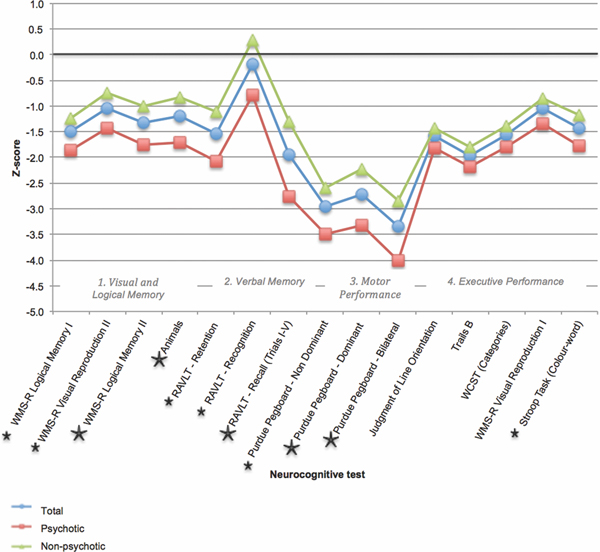
The mean FSIQ was 71.8 (s.d. = 8.6) for the 99 individuals with 22q11DS studied. As expected, (Insel, Reference Insel2010; McDonald-McGinn et al., Reference McDonald-McGinn, Sullivan, Marino, Philip, Swillen, Vorstman, Zackai, Emanuel, Vermeesch, Morrow, Scambler and Bassett2015; Van et al., Reference Van, Boot and Bassett2017) on average the FSIQ was lower in the psychotic group (mean = 68.7, s.d. = 6.5) than in the non-psychotic group (mean = 74.2, s.d. = 9.3; p = 0.001). Although mean Z-scores were below zero on all 15 neurocognitive tests, indicating lower than average performance (compared to population-based norms) in individuals with 22q11DS, there was substantial variability among the tests and between those with and without a psychotic illness (see online Supplementary material 3, Fig. 1). Overall, participants obtained highest mean Z-scores on the Rey Auditory Verbal Learning Test (RAVLT)–Recognition test (Z = −0.19, s.d. = 1.37) with those in the non-psychotic group showing mean performance slightly above norms. Performance on average was otherwise relatively better on tasks related to visual than verbal memory (see online Supplementary material 3). As expected (Hoff and Kremen, Reference Hoff and Kremen2003; van Amelsvoort et al., Reference van Amelsvoort, Henry, Morris, Owen, Linszen, Murphy and Murphy2004; Chow et al., Reference Chow, Watson, Young and Bassett2006; Boot et al., Reference Boot, Butcher, van Amelsvoort, Lang, Marras, Pondal, Andrade, Fung and Bassett2015), performance was worst on motor tasks (see online Supplementary material 3).
Mean Z-scores on 15 neurocognitive tests for 99 adults with 22q11DS, ordered by the magnitude of the difference between those with (n = 43) and (n = 56) without psychotic illness within each of the four neurocognitive domains. ⋆: Difference between those with and without psychotic illness significant at the <0.01 level, ⋆: Difference between those with and without psychotic illness significant at the <0.0001 level.

PCA of neurocognitive tests
The PCA indicated four components with eigenvalues >1 that together explained 65.4% of the variance of the 15 neurocognitive tests. Table 1 shows the factor loadings and the corresponding coefficients after rotation and Kaiser normalization. Investigating which neurocognitive tests loaded most strongly on each individual component allowed us to recognize common themes representing four domains of neurocognitive functioning. We named the components accordingly: Visual and Logical Memory, Verbal Memory, Motor Performance, and Executive Performance. Figure 1 shows the relative mean performance profile overall and for subjects with schizophrenia and with no psychotic illness for the component tests within these cognitive domains. Differences were greatest (p = 0.0004 to <0.0001) between these clinical subgroups of 22q11DS on individual motor (Purdue Pegboard) tests, RAVLT-Recognition and Recall, WMS-R Logical Memory II, and Animals (online Supplementary material 3; Fig. 1).
Rotated factor solutions for the principal component analysis using 15 neurocognitive tests for 99 individuals with 22q11DS

a PCA with Promax rotation using Kaiser normalization. Rotated components with eigenvalues >1 were considered significant. Together these four components accounted for 65.4% of the variance of the total 15 neurocognitive tests.
Adaptive functioning
As expected (Butcher et al., Reference Butcher, Chow, Costain, Karas, Ho and Bassett2012), the majority of participants scored in the functional difficulty range on overall functioning (n = 66; 78.6%), with mean VABS scores of 63.0 (s.d. = 19.6) for the composite (ABC) score, representing the overall adaptive functioning (where population norm = 100), and 78.0 (s.d. = 23.5), 64.8 (s.d. = 18.2), and 58.6 (s.d. = 22.8) for the Daily Living Skills, Socialization, and Communication subdomains, respectively. The psychotic group had significantly lower mean scores than the non-psychotic group on global adaptive functioning and the three subdomains of the VABS (see online Supplementary material 4).
Regression analyses
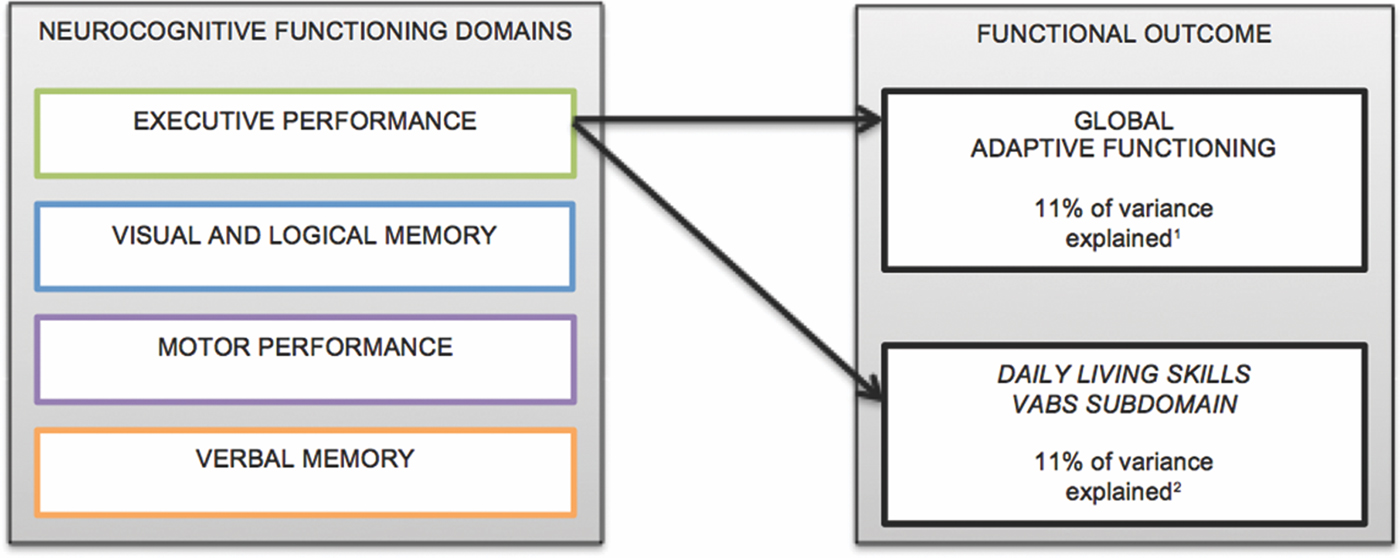
Consistent with our hypothesis, the regression model was significant, explaining 46.8% of the variance in global functional outcome (p < 0.0001), and the neurocognitive domain Executive Performance was significantly associated with overall functional outcome (B = 4.849, t = 2.014, p = 0.048), while accounting for other factors (Table 2). Psychotic illness status and age were also significant factors in the model (Table 2). The other three neurocognitive domains, FSIQ, and sex were non-significant factors. VABS adaptive functioning scale scores were higher in those with better performance on Executive domain tests, no psychotic illness, and older age. Figure 2 offers a visual representation of the main results related to the neurocognitive domains.
Visual representation of main findings related to neurocognitive domains. 1The full regression model (see regression results and Table 2) explains 46.8% of the variance in global adaptive functioning. In addition to the 11% explained by EP, 16% is explained by age (at Vineland assessment), 10% by psychotic illness status, 5% by FSIQ (p > 0.05), and 4% by the domain Motor Performance (p > 0.05). 2The full regression model (see regression results) explains 47.7% of the variance in the daily living skill VABS subdomain. In addition to the 11% explained by EP, 15% is explained by age (at Vineland assessment), 6% by psychotic illness status, 3% by FSIQ (p > 0.05), and 11% by the three remaining neurocognitive domains combined (p > 0.05).

Relationship between neurocognitive domains and other factors to global adaptive functioning (Vineland Adaptive Behavior Scales, VABS) in 84 adults with 22q11DS

Linear regression model, dependent = VABS.
s.e. = standard error.
*Indicates significance at the <0.05 level (factors shown in bold font). Better functioning is associated with better Executive Performance, the absence of schizophrenia, and older age in this 22q11DS sample.
The regression model for the VABS daily living skills subdomain was similarly significant (explained 47.7% of the variance; p < 0.0001), with Executive Performance (B = 6.473, t = 2.264, p = 0.026) and age (B = 0.918, t = 3.593, p = 0.001) the only significant factors. Although the regression models for VABS Socialization and VABS Communication scores were also significant (p < 0.0001, explaining 38.3% and 37.7% of the variance, respectively), only age remained a significant factor in these models.
Post-hoc analyses
Post-hoc analyses showed that, for the main outcome VABS overall functioning scores, the interaction term Executive Performance × psychotic disorder had no significant effect (F = 0.151 (1), p = 0.699), indicating that the effect of the neurocognitive domain Executive Performance on global functional outcome was similar for those with and without a psychotic disorder (see Fig. 3). Comparable interaction analysis showed similar results for the VABS daily living skills scores (F = 0.541 (1), p = 0.464).
Correlation of executive performance and Global Adaptive Functioning (VABS ABC score) by psychotic disorder expression.

Post-hoc, after forcing the PCA to create a single factor from the neurocognitive tests, we found that this single component accounted for 39.3% of the variance in the 15 individual tests, in contrast to 65.4% for the original four-component model (Table 1). The significant regression model using this single neurocognitive factor explained 44.4% of the variance in adaptive functioning, just less than the 46.8% of the variance explained in the model using the original four neurocognitive components. In contrast to the modestly significant effect found for Executive Performance and non-significant effects of the other three neurocognitive factors (Table 2), the association between the single neurocognitive factor and adaptive functioning was at the trend level of significance (B = 4.854, t = 1.922, p = 0.058). Results for other significant factors (age (p = 0.002) and schizophrenia expression (p = 0.008)) were at similar levels to those in the original model (Table 2). Collectively, these post-hoc results suggest that the Executive Performance component was not artifactually selected as related to functioning and that the four-component solution appears somewhat better suited than a global deficit model to account for the variability in the individual neurocognitive tests, and the variability in adaptive functioning.
Finally, the post-hoc stepwise linear regression model confirmed the added predictive value of the domain Executive Performance on adaptive functioning. A regression model including psychotic illness status, FSIQ, age at VABS assessment, and Executive Performance provided the best fit (F = 16.140 (79), p < 0.000).
Discussion
In this study, we investigated the relationship between domains of neurocognitive functioning and functional outcome in individuals with high risk of schizophrenia conveyed by a 22q11.2 deletion. We found that higher performance on the neurocognitive domain Executive Performance was significantly associated with better adaptive functioning, after accounting for the effects of FSIQ and expression of schizophrenia. The results indicate that Executive Performance contributes significantly to the variability in adaptive functioning in individuals with 22q11DS, both those who express schizophrenia and in those who do not. Consistent with studies of other high risk and schizophrenia samples (Carrion et al., Reference Carrion, McLaughlin, Goldberg, Auther, Olsen, Olvet, Correll and Cornblatt2013; Fisher et al., Reference Fisher, Loewy, Hardy, Schlosser and Vinogradov2013; Glenthoj et al., Reference Glenthoj, Hjorthoj, Kristensen, Davidson and Nordentoft2017), the findings support the potential for early interventions that target neurocognitive performance to improve functional outcome.
Schizophrenia risk and functional outcome
Individuals with 22q11DS showed impaired performance on the tests that comprise the domain Executive Performance, regardless of whether or not they suffered from psychotic illness. This is consistent with findings from studies of other high-risk groups, including clinical high risk (Carrion et al., Reference Carrion, McLaughlin, Goldberg, Auther, Olsen, Olvet, Correll and Cornblatt2013; Sommer et al., Reference Sommer, Bearden, van Dellen, Breetvelt, Duijff, Maijer, van Amelsvoort, de Haan, Gur, Arango, Diaz-Caneja, Vinkers and Vorstman2016). The results for 22q11DS not only indicate a relationship of neurocognitive performance to functional outcome, but also suggest that Executive Performance in 22q11DS may be a core expression of the underlying genetic risk of schizophrenia, as for other genetic high-risk groups (positive family history of schizophrenia) (Sitskoorn et al., Reference Sitskoorn, Aleman, Ebisch, Appels and Kahn2004; Snitz et al., Reference Snitz, Macdonald and Carter2006; Reichenberg and Harvey, Reference Reichenberg and Harvey2007; Harave et al., Reference Harave, Shivakumar, Kalmady, Narayanaswamy, Varambally and Venkatasubramanian2017). The comparability of results is notable given differences for the various high-risk groups in the specific neurocognitive tests and functioning outcome measurements used.
Strengths and limitations
Domains of neurocognitive functioning are more resilient to ‘noisy fluctuations’ and clinically more useful than performance on individual neurocognitive tests (Lattin et al., Reference Lattin, Carroll and Green2003; Costa et al., Reference Costa, Santos, Cunha, Palha and Sousa2013; St-Laurent et al., Reference St-Laurent, McCormick, Cohn, Misic, Giannoylis and McAndrews2014) and the data-driven approach to derive these domains was an advantage of this study. To take into account the suboptimal participant to the variable ratio in our PCA we conducted post-hoc analyses. Although these revealed that the four-factor model performed only marginally better compared to a global deficit model, this model has the advantage of providing more insight into the contributions of the different factors than a global deficit model. Our analyses suggested that the four components and the association of Executive Performance with adaptive functioning were not artifactually identified. The post-hoc analyses, together with literature indicating the potential clinical utility of individual neurocognitive factors over a global deficit factor (Reichenberg and Harvey, Reference Reichenberg and Harvey2007; Fisher et al., Reference Fisher, Loewy, Hardy, Schlosser and Vinogradov2013), provide some support for the added explanatory value of Executive Performance, to previously identified factors such as FSIQ and psychotic illness status (Butcher et al., Reference Butcher, Chow, Costain, Karas, Ho and Bassett2012). Indeed, stable and reproducible PCA results can be obtained with small samples provided that the data used are qualitatively strong (Preacher and MacCallum, Reference Preacher and MacCallum2002; Winter et al., Reference Winter, Dodou and Wieringa2009; St-Laurent et al., Reference St-Laurent, McCormick, Cohn, Misic, Giannoylis and McAndrews2014). Nonetheless, we acknowledge that the stability and replicability of our results may be limited by the low participant to variable ratio. Replication studies that aim for larger sample sizes of well-characterized adults with 22q11.2DS with and without schizophrenia, and/or include fewer neurocognitive tests, would be optimal.
Although a data-driven approach creating unbiased domains may be considered an advantage, a possible disadvantage of this approach is that the derived domains may be inconsistent and may not fully coincide with a priori theoretically derived expectations. While most of the neurocognitive tests loaded most strongly on domains consistent with expected, theoretical constructs, some (e.g. ‘animal naming’) did not. Also, PCA results, in general, may reveal principal components that include individual tests that do not load clearly on just one domain (e.g. WMS–VR I), in which case the domain with the higher loading is selected in the data-driven approach. Such results are relatively common in the field of neurocognition (Testa et al., Reference Testa, Bennett and Ponsford2012; Santos et al., Reference Santos, Costa, Amorim, Moreira, Cunha, Cotter and Sousa2015). Methodological differences such as these may contribute to the lack of similar results reported in a previous study that used a 22q11DS sample comprising mostly adolescents and few (n = 8) individuals with psychotic illness and where different executive functioning tasks were selected in a non-data-driven method (Maeder et al., Reference Maeder, Schneider, Bostelmann, Debbane, Glaser, Menghetti, Schaer and Eliez2016).
Multiple indices selected from global single tests are likely to be more highly correlated with one another than variables between tests, thereby potentially artificially distorting the PCA factor loadings (e.g. the three variables from the Purdue pegboard test that formed the Motor domain). However, the Executive Performance domain would have been the least of the four domains to be affected by this limitation.
The potential directionality of the association between Executive Performance and subsequent adaptive functioning is tentatively supported by the observation that in all but three cases, the neurocognitive assessments were conducted before the VABS assessment. Further prospective follow-up would allow the assessment of longer-term effects on adaptive functioning. The regression model used in is study explained a greater proportion of the variance in overall adaptive functioning than a previous model that did not include neurocognitive domains (Butcher et al., Reference Butcher, Chow, Costain, Karas, Ho and Bassett2012). Nonetheless, a substantial proportion of the variance remains unaccounted for and a larger sample may have allowed us to detect additional significant associations with other neurocognitive domains such as verbal memory (Carrion et al., Reference Carrion, McLaughlin, Goldberg, Auther, Olsen, Olvet, Correll and Cornblatt2013).
Potential implications
The results of this study further support 22q11DS as a genetic model of schizophrenia and schizophrenia high risk (Insel, Reference Insel2010; Drew et al., Reference Drew, Crabtree, Markx, Stark, Chaverneff, Xu, Mukai, Fenelon, Hsu, Gogos and Karayiorgou2011; Vorstman et al., Reference Vorstman, Breetvelt, Duijff, Eliez, Schneider, Jalbrzikowski, Armando, Vicari, Shashi, Hooper, Chow, Fung, Butcher, Young, McDonald-McGinn, Vogels, van Amelsvoort, Gothelf, Weinberger, Weizman, Klaassen, Koops, Kates, Antshel, Simon, Ousley, Swillen, Gur, Bearden, Kahn and Bassett2015; Sommer et al., Reference Sommer, Bearden, van Dellen, Breetvelt, Duijff, Maijer, van Amelsvoort, de Haan, Gur, Arango, Diaz-Caneja, Vinkers and Vorstman2016) that provides an appealing opportunity to study the developmental trajectory and the potential of early-life interventions (Insel, Reference Insel2010; McDonald-McGinn et al., Reference McDonald-McGinn, Sullivan, Marino, Philip, Swillen, Vorstman, Zackai, Emanuel, Vermeesch, Morrow, Scambler and Bassett2015; Sommer et al., Reference Sommer, Bearden, van Dellen, Breetvelt, Duijff, Maijer, van Amelsvoort, de Haan, Gur, Arango, Diaz-Caneja, Vinkers and Vorstman2016; Van et al., Reference Van, Boot and Bassett2017). Several studies have shown positive impact on neurocognitive and functional outcomes in trials of cognitive remediation strategies targeting various domains of cognitive functioning in individuals with, and those at high risk for, other forms of schizophrenia (Kurtz and Mueser, Reference Kurtz and Mueser2008; Wykes et al., Reference Wykes, Huddy, Cellard, McGurk and Czobor2011; Carrion et al., Reference Carrion, McLaughlin, Goldberg, Auther, Olsen, Olvet, Correll and Cornblatt2013; Mariano et al., Reference Mariano, Tang, Kurtz and Kates2015; Sommer et al., Reference Sommer, Bearden, van Dellen, Breetvelt, Duijff, Maijer, van Amelsvoort, de Haan, Gur, Arango, Diaz-Caneja, Vinkers and Vorstman2016) (Bosia et al., Reference Bosia, Buonocore, Bechi, Spangaro, Pigoni, Croci, Cocchi, Guglielmino, Bianchi, Smeraldi and Cavallaro2017; Glenthoj et al., Reference Glenthoj, Hjorthoj, Kristensen, Davidson and Nordentoft2017). These initial findings provide impetus to potentially extend such research to 22q11DS.
In addition, to our knowledge, this is the largest study of adults with 22q11.2DS and schizophrenia comparing neurocognitive profiles between those with and without psychotic illness. Our findings for these profiles are globally similar to those for general population forms of schizophrenia (Heinrichs and Zakzanis, Reference Heinrichs and Zakzanis1998; Hoff and Kremen, Reference Hoff and Kremen2003), and in some respects to a recent study of 22q11DS using a different testing battery and domain composition that reported those with and without psychotic illness to be most similar on ‘complex cognition’ (Weinberger et al., Reference Weinberger, Yi, Calkins, Guri, McDonald-McGinn, Emanuel, Zackai, Ruparel, Carmel, Michaelovsky, Weizman, Gur, Gur and Gothelf2016). The profiles may be helpful for genetic counseling of individuals with 22q11DS and their families, emphasizing average relative strengths and weaknesses yet the substantial variability between individuals and the necessity to balance individual capabilities and environmental demands in day-to-day situations (McDonald-McGinn et al., Reference McDonald-McGinn, Sullivan, Marino, Philip, Swillen, Vorstman, Zackai, Emanuel, Vermeesch, Morrow, Scambler and Bassett2015; Swillen and McDonald-McGinn, Reference Swillen and McDonald-McGinn2015). Notably, neither the tasks nor domains showing the best or worst performance on average or the greatest difference between those with and without schizophrenia were those found to be most related to functional outcome. Other findings of possible clinical relevance include the fact that best performance for adults with 22q11DS was on the Daily Living Skills subdomain of the VABS (Butcher et al., Reference Butcher, Chow, Costain, Karas, Ho and Bassett2012), and that older age was significantly associated with better functional outcomes. The latter would be in accordance with the overall slower pace of development often observed in 22q11DS (Antshel et al., Reference Antshel, Shprintzen, Fremont, Higgins, Faraone and Kates2010; Butcher et al., Reference Butcher, Chow, Costain, Karas, Ho and Bassett2012) and other individuals at high risk for schizophrenia (Velthorst et al., Reference Velthorst, Zinberg, Addington, Cadenhead, Cannon, Carrion, Auther, Cornblatt, McGlashan, Mathalon, Perkins, Seidman, Tsuang, Walker, Woods, Reichenberg and Bearden2018).
Conclusion
In this study, we report that the neurocognitive domain Executive Performance was significantly associated with overall adaptive functioning as well as daily living skills in 22q11DS, a high-risk model of schizophrenia. For the 22q11DS population, as for the general schizophrenia (high risk) population, these findings provide a rationale for further studies to examine the potential of directed (early) interventions targeting Executive Performance to improve long-term adaptive functional outcome in individuals with, or at high-risk for, schizophrenia. Caregivers, clinicians, and researchers may benefit from further insights into the pattern of relative neurocognitive strengths and weaknesses of adults with 22q11DS.
Supplementary material
The supplementary material for this article can be found at https://doi.org/10.1017/S0033291718001824.
Acknowledgements
The authors thank the participants and their families for their participation in this study.
Financial support
Funded in part by the Ter Meulen Grant of the Royal Netherlands Academy of Arts and Sciences (AMF), Canadian Institutes of Health Research (grant no. MOP-38099), W. Garfield Weston Foundation, Ontario Mental Health Foundation, Scottish Rite Schizophrenia Research Program, Canada Research Chair in Schizophrenia Genetics (ASB) and a National Alliance for Research on Schizophrenia and Depression Young Investigator Award (EWCC).
Conflict of interest
None.