Introduction
Malignant tumour promotion and progression involve uncontrolled cellular transformation, invasion, angiogenesis and metastasis, and result at least partly from a deregulated or inadequate immune response. Clinical and experimental studies suggest that malignant tumour development results from altered immunity and inflammatory reactions. As part of the human adaptive immune system, helper cells play a key role in the immune response. Differentiated helper cells secrete characteristic panels of cytokines. Interleukins (ILs) 2 and 12 induce the differentiation of type 1 helper cells, which secrete interferon-gamma and proinflammatory cytokines such as tumour necrosis factor-alpha (TNF-α) and TNF-β.Reference Wan 1 Type 2 helper cells produce ILs 4, 5, 9, 10 and 13. Type 17 helper cells are a class of effector T cells which produce ILs 17 and 21. Definitive data on the role of IL-17 in carcinogenesis are lacking: although it is widely accepted that IL-17 stimulates tumour proliferation, angiogenesis and metastasis, some studies have reported contradictory data. In a recent study, high IL-17 expression was found to be associated with poor overall survival rates for some cancers.Reference Yang, Kang, Fung, Zhao, Wang and Ma 2 , Reference Zhang, Weng, Xu, Wang, Yu and Tang 3
Cytokines mediate communication between tumour and host immune cells, and have therefore been linked to malignant transformation.Reference Candido and Hagemann 4 Lin et al. reported that most proinflammatory cytokines promote tumour development, while proapoptotic and anti-inflammatory cytokines usually interfere with tumour development.Reference Lin and Karin 5 Recent reports suggest that the balance of type 1 to type 2 helper cell cytokines is skewed towards type 2 helper cell cytokines in cancer patients.Reference Becker 6
Laryngeal squamous cell carcinoma (SCC) is associated with tobacco consumption and alcohol misuse. Supraglottic and glottic subtypes have distinct presentations, pathophysiology and prognoses. Laryngeal SCC patients with the advanced tumour–node–metastasis (TNM) stage disease (T3–4, with involvement of regional lymph nodes) have a considerably worse clinical outcome. Identifying reliable biomarkers could enable early diagnosis and adequate staging, and provide new therapeutic opportunities. Similarly, helper and cytotoxic T cell regulation is an attractive goal of immunotherapy.Reference Albers, Strauss, Liao, Hoffmann and Kaufmann 7
Recent studies have reported imbalance in the serum levels of type 1 to type 2 helper cell cytokines in laryngeal SCC patients.Reference Bleotu, Chifiriuc, Grigore, Grancea, Popescu and Anton 8 – Reference Günaydin, Kesikli, Kansu and Hoşal 10 However, there have been few reports on IL-17 serum levels in laryngeal SCC patients. Therefore, this study aimed to measure serum levels of nine different cytokines (ILs 2, 4, 5, 6, 10, 12, 13 and 17, and interferon-gamma) in laryngeal SCC patients to identify potential biomarkers of the presence and progression of tumours. It is possible that laryngeal SCC development and progression are followed by a decreased type 1 helper cell immune response (mediated by IL-2, IL-12 and interferon-gamma) and increased type 2 (mediated by ILs 4, 5, 6, 10 and 13) and type 17 (mediated by IL-17) helper cell responses.
Materials and methods
This study included 59 laryngeal SCC patients (51 men and 8 women; median age 64 years, range 41–90 years). All patients had clinical, histopathological and radiological confirmation of a laryngeal SCC diagnosis at the Military Medical Academy, Belgrade, Serbia, between January and December 2015. Clinical and/or pathological TNM stage were defined according to American Joint Committee on Cancer staging criteria.Reference Edge, Byrd, Compton, Fritz, Greene and Trotti 11 Patients were stratified into two groups according to tumour stage (early, T1–2; late, T3–4), and then according to nodal status (no regional lymph node involvement, N0; regional lymph nodes metastasis, N1–2). Patients were further classified according to laryngeal subsite.
The control group included 44 healthy volunteers (41 men and 3 women; median age 51.5 years, range 44–78 years) with normal fibre-optic laryngoscopy results.
Written informed consent was obtained from all participants according to the approved protocol of the Military Medical Academy Ethics Committee. Exclusion criteria were any other previous or present malignant or autoimmune disease, co-existing infectious disease, and systemic corticosteroid or any immunomodulatory therapy.
Blood sample collection and cytokine detection
Peripheral blood samples (5 ml) from all participants were allowed to clot for 30 minutes and then centrifuged for 15 minutes at 1000 g. The serum was collected, aliquoted and stored at −80 °C for cytokine measurement. Interleukin (IL) 2, 4, 5, 6, 10, 12, 13 and 17, and interferon-gamma concentrations were measured using a FlowCytomix Multiple Analyte Detection System with a Human FlowCytomix Inflammation Panel (Thermo Fisher Scientific, Waltham, Massachusetts, USA) on a Coulter XL-MCL flow cytofluorimeter (Beckman Coulter, Brea, California, USA) with BMS FlowCytomix Pro 2.2 software according to the manufacturer's instructions. According to the manufacturer, standard ranges were 27–20 000 pg/ml for ILs 2, 4, 5, 6, 10, 12 and 13, and interferon-gamma and 13.7–10 000 pg/ml for IL-17.
Statistical analysis
Statistical analysis was performed using Prism 5 software (GraphPad, San Diego, California, USA). Between-group comparisons were made using non-parametric Mann–Whitney U tests. Data were expressed as means ± standard deviation. A p value of less than 0.05 was considered statistically significant.
Results
Of the 59 laryngeal SCC patients, 40 (68 per cent) had glottic and 19 (32 per cent) had supraglottic tumours. Of the 40 glottic laryngeal SCC patients, 21 had T1–2 stage and 19 had T3–4 stage disease; 36 had N0 and 4 had an N1–2 nodal status. Of the 19 supraglottic laryngeal SCC patients 12 had T1–2 stage and 7 had T3–4 stage disease; 12 had no nodal involvement and 7 had an N1–2 nodal status. None of the participants had distant metastasis.
Serum cytokine levels in laryngeal squamous cell carcinoma patients vs healthy controls
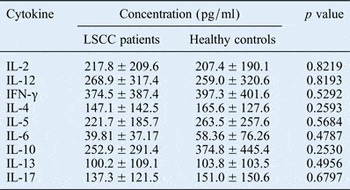
There was no significant difference in serum interleukin (IL) 2, 4, 5, 6, 10, 12, 13 and 17 and interferon-gamma levels between laryngeal SCC patients and healthy individuals (Table I).
Cytokine levels in laryngeal squamous cell carcinoma patients and healthy controls

Data are means ± standard deviation. LSCC = laryngeal squamous cell carcinoma; IL = interleukin; IFN-γ = interferon-gamma
Serum cytokine levels by tumour size
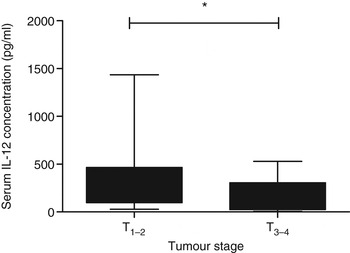
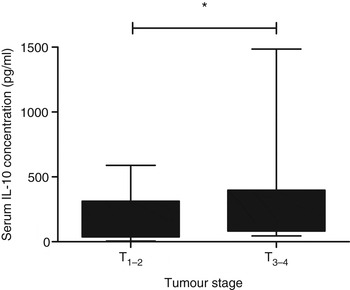
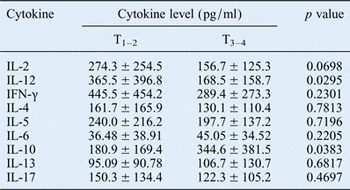
Serum cytokine concentrations in T1–2 and T3–4 stage laryngeal SCC patients are shown in Table II. Statistical analysis revealed significantly higher IL-12 concentrations (p < 0.05) in patients with T1–2 stage disease. Higher IL 2, 4, 5, 6 and 17 and interferon-gamma concentrations were also observed in this patient group, although the difference was not significant. Serum IL-10 levels were significantly higher in patients with T3–4 stage than in those with T1–2 stage disease (p < 0.05). Serum IL-13 levels also differed between these two patient groups, but not significantly so. Serum IL 10 and 12 levels in T1–2 and T3–4 stage laryngeal SCC patients are shown in Figures 1 and 2, respectively.
Box and whisker plot showing serum interleukin-12 (IL-12) levels in T1–2 and T3–4 stage laryngeal squamous cell carcinoma patients. *p < 0.05.

Box and whisker plot showing serum interleukin-10 (IL-10) levels in T1–2 and T3–4 stage laryngeal squamous cell carcinoma patients. *p < 0.05.

Cytokine levels in laryngeal squamous cell carcinoma patients by tumour stage

Data are means ± standard deviation. IL = interleukin; IFN-γ = interferon-gamma
Serum cytokine levels by nodal status
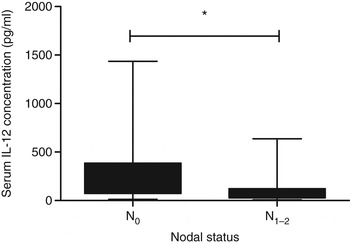
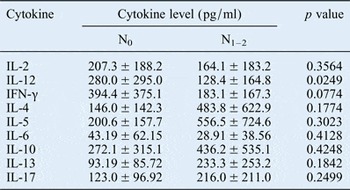
The mean serum IL-12 concentration was significantly higher in patients without regional lymph node involvement (N0) than in those with N1–2 nodal status (p < 0.05; Figure 3). Serum IL-2, IL-6 and interferon-gamma concentrations were also higher in patients with node involvement, but the difference was not significant. Mean serum IL 4, 5, 10, 13 and 17 concentrations were higher in patients with N1–2 disease than in those with N0 status, but the difference was not significant. Table III summarises cytokine concentrations by nodal status.
Box and whisker plot showing serum interleukin-12 (IL-12) levels in N0 and N1–2 stage laryngeal squamous cell carcinoma patients. *p < 0.05.

Cytokine levels in laryngeal squamous cell carcinoma patients by nodal status

Data are means ± standard deviation. IL = interleukin; IFN-γ = interferon-gamma
Associations of cytokine concentration with tumour stage and anatomical location
When patients were stratified according to tumour subsite and then by tumour size before statistical analysis, results were completely different than those obtained in the pooled analysis.
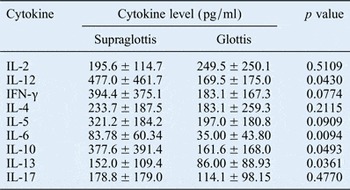
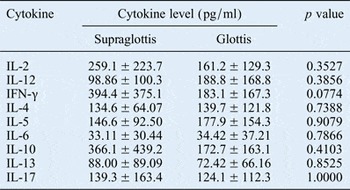
For patients with T1–2 stage disease, serum IL 10, 12 and 13 concentrations (p < 0.05) and IL-6 concentrations (p < 0.01) were significantly higher in supraglottic vs glottic tumours. In these patients, serum interferon-gamma and ILs 4, 5 and 17 concentrations were also elevated in those with supraglottic carcinomas, but the difference was not significant. Conversely, serum IL-2 levels were higher in patients with glottic than in those with supraglottic carcinomas (Table IV). No differences in serum cytokine levels between laryngeal subsites were observed in patients with T3–4 stage disease (Table V).
Cytokine levels in T1–2 stage laryngeal squamous cell carcinoma patients by tumour subsite

Data are means ± standard deviation. *T1–2. IL = interleukin; IFN-γ = interferon-gamma
Cytokine levels in T3–4 stage laryngeal squamous cell carcinoma patients by tumour subsite

Data are means ± standard deviation. *T3–4. IL = interleukin; IFN-γ = interferon-gamma
Discussion
Early diagnosis and reliable disease staging may be the most important factors for improving cancer patient outcomes. No biomarker identified so far has sufficient sensitivity and specificity to be used as a diagnostic or prognostic tool in laryngeal SCC patients. This is probably due to the complex biology of these tumours and their interactions with the host antitumour immune response. Novel head and neck SCC therapeutics, such as Iroquois-class homeodomain protein IRX-2, highlight the need for further investigations into enhancing antitumour immune responses via cytokine delivery.Reference Schilling, Halstead, Schuler, Harasymczuk, Eqan and Whiteside 12 This study aimed to identify the serum cytokine profile representing the activation of systemic immunity in laryngeal SCC patients.
Both type 1 and type 2 helper cells mediate antitumour immunity. Previous studies suggested that the type 1 helper cell response is an important component of the antitumour response that assists in cell-mediated immunity against cancer cells.Reference Vesely, Kershaw, Schreiber and Smyth 13 , Reference Kim and Cantor 14 The antitumour effects of type 1 helper cells may be based on their production of large amounts of interferon-gamma, interleukin-2 (IL-2) and tumour necrosis factor-alpha (TNF-α). Evidence that type 2 helper cells contribute to antitumour immunity is somewhat contradictory; therefore, their action may be context dependent.Reference Kim and Cantor 14
Previous studies have tested the hypothesis that malignant tumour development causes a shift towards the type 2 helper cell response, followed by a reduced type 1 helper cell response.Reference Becker 6 , Reference Young 15 Intra-tumoural antigen-presenting cells show type 2 helper cell polarisation by producing cytokines such as IL-5 and IL-10, thus supporting immunotolerance and limiting the development of a type 1 helper cell response. In contrast, type 1 helper cell cytokines support antigen-specific cytotoxic immunity. The type 1 helper cell cytokine, interferon-gamma, inhibits type 2 helper cell differentiation and prevents immunotolerance.Reference Müller-Hübenthal, Azemar, Lorenzen, Huber, Freudenberg and Galanos 16 Antitumour immunotherapies might therefore induce an effective immune response by optimising the type 1 helper cell response and overcoming tumour-associated immunotolerance.
Head and neck SCC cells have developed numerous ways to evade immune detection and elimination.Reference Allen, Judd, Bui and Uppaluri 17 Many studies have reported cytokines serum concentrations in head and neck SCC patients regardless of the tumour subsite.Reference Millrud, Hylander, Kumlien Georen, Kågedal, Winqvist and Cardell 18 – Reference Kaskas, Moore-Medlin, McClure, Ekshyyan, Vanchiere and Nathan 23 More recently, different sets of immune mediators were reported to be detectable in the serum of head and neck SCC patients.Reference Bleotu, Chifiriuc, Grigore, Grancea, Popescu and Anton 8 Higher IL 1β, 2, 4, 5, 6, 10 and 17 and TNF-α concentrations and decreased interferon-gamma and IL 2, 12 and 13 concentrations were found in head and neck SCC patients compared with healthy individuals, thus highlighting a type 2 helper cell bias in head and neck SCC patients. However, a decrease in type 1 helper cell cytokine levels was not uniformly observed.
Although head and neck SCCs have long been regarded a uniform group of tumours that differ only according to their anatomical subsite, recent studies indicate that the risk factors, pathogenesis and clinical behaviour of these tumours vary greatly.Reference Pai and Westra 24 , Reference Westra 25 Only a few studies into serum cytokines levels in laryngeal SCC patients have been published. For example, Günaydin et al. reported significantly higher serum IL-10 levels and Melinceanu et al. reported higher serum IL-6 and IL-10 levels in laryngeal SCC patients than in controls.Reference Günaydin, Kesikli, Kansu and Hoşal 10 , Reference Westra 25 According to Eyigor et al., elevated serum IL-6 and IL-10 concentrations are detectable in both laryngeal SCC and laryngeal dysplasia patients.Reference Eyigor, Eyigor, Osma, Yilmaz, Erin and Selcuk 9 In contrast, the present study found no difference in the serum concentrations of nine cytokines between laryngeal SCC patients and healthy individuals, suggesting that serum cytokine levels cannot be used as biomarkers of laryngeal SCC.
Lathers et al. concluded that a shift in cytokine levels primarily indicates the presence of a head and neck SCC tumour but not its extent or metastasis; however, the present study showed decreased serum IL-12 levels (p < 0.05) in patients with larger primary tumours (T3–4).Reference Jebreel, Mistry, Loke, Dunn, Hough and Oliver 21 Serum interferon-gamma and IL-2 levels were also decreased in patients with advanced disease, although the difference was not significant. These results demonstrate that laryngeal SCC progression is followed by a decreased type 1 helper cell response. There was also a significant increase in serum IL-10 levels in patients with T3–4 stage disease (p < 0.05). This finding is in accordance with Günaydin et al., who showed increasing IL-10 detection in laryngeal SCC patients with advanced stage tumours, although the IL-12 level was unaffected by tumour progression.Reference Günaydin, Kesikli, Kansu and Hoşal 10 According to Jebreel et al., serum IL-10 is also more likely to be detected in patients with T3–4 stage head and neck SCCs.Reference Hathaway, Landsittel, Gooding, Whiteside, Grandis and Siegfried 20
As nodal involvement usually means a worse prognosis, the identification of potential biomarkers of nodal progression would be an important finding. The present study found that patients with nodal involvement had significantly decreased serum IL-12 levels (p < 0.05) compared with patients with N0 neck disease. Similar results were obtained for IL-2 and interferon-gamma, but they did not reach statistical significance. Moreover, serum IL 4, 5, 10, 13 and 17 levels, indicating a type 2 helper cell immune response, were also higher in patients with regional lymph node metastasis, although the difference was not significant. These data suggest that the immune response is skewed towards a type 2 helper cell response in laryngeal SCC patients with locoregional metastasis, as previously reported for head and neck cancer patients with nodal involvement.Reference Bleotu, Chifiriuc, Grigore, Grancea, Popescu and Anton 8 , Reference Hathaway, Landsittel, Gooding, Whiteside, Grandis and Siegfried 20 , Reference Melinceanu, Lerescu, Tucureanu, Caras, Pitica and Sarafoleanu 26 , Reference Green, Michno, Green and Stafford 27
The potential functions of IL-10 and IL-12 in cancer have been extensively investigated. The potential anti-tumorigenic effect of IL-12 is reflected by its activation of cytotoxic cells such as natural killer cells and cytotoxic T lymphocytes, inhibition of neo-angiogenesis, reduction in tumour vascularisation (leading to tumour necrosis) and macrophage activation.Reference Zundler and Neurath 28 , Reference Sorensen, Gerber, Frelinger and Lord 29 Experimental models of colorectal carcinoma, melanoma and glioblastoma showed that IL-12 has marked anti-tumorigenic potential, although the precise mechanism varies depending on the tumour type.Reference Zundler and Neurath 28 These findings have been followed by vivo and in vitro trials of the antitumour effect of IL-12 against solid tumours such as neck SCC, cutaneous lymphoma and malignant lymphoma.Reference Zundler and Neurath 28 , Reference Liang and Wang 30 , Reference Tian, Chen, Sun, Liu, Zhu and Ren 31
In contrast, data on the IL-10 antitumour immune response are contradictory, depending on the cellular source and targets of IL-10. Although IL-10 is secreted by tumours such as B-cell lymphoma and melanoma (where it acts as an autocrine growth factor), in inflammation-driven cancer, such as colon cancer, IL-10 neutralisation might be inefficient or even detrimental.Reference Geginat, Larghi, Paroni, Nizzoli, Penatti and Pagani 32 Zhou et al. reported that variations in genotype and plasma IL-10 concentration may be associated with laryngeal SCC stage and lymph node metastasis status.Reference Geginat, Larghi, Paroni, Nizzoli, Penatti and Pagani 32
In recent decades, type 17 helper cells have been reported to secrete IL-17, which has a strong proinflammatory effect. However, the exact biological role of IL-17 in malignant tumour development remains controversial. IL-17 seems to have both oncogenic and tumour suppressor effects on tumour initiation, development and metastasis.Reference Yang, Kang, Fung, Zhao, Wang and Ma 2 , Reference Qian, Chen, Wu, Hu, Huang and Jin 34 Whether IL-17 promotes or inhibits tumorigenesis probably depends on the tumour type and on which cytokines are present at the tumour site.Reference Qian, Chen, Wu, Hu, Huang and Jin 34 Immunohistochemical staining of laryngeal SCC specimens revealed a significant correlation between IL-17 levels and tumour differentiation and angiogenesis.Reference Meng, Zhu, Jiang, Li, Sha and Dong 35 Data on the effect of IL-17 on overall prognosis are also contradictory.Reference Zhang, Weng, Xu, Wang, Yu and Tang 3 In the present study, serum IL-17 levels did not correlate significantly with the presence of laryngeal SCC, tumour size or nodal involvement. Similar results were reported in a recent study in laryngeal SCC patients, although slightly higher IL-17 concentrations were noted in the control group.Reference Kopta, Mochocki, Morawski, Brzezińska-Blaszczyk and Lewy-Trenda 36
Differences in the prognosis and clinical outcomes for patients with various laryngeal SCCs are largely related to subsite anatomy. The supraglottic and glottic larynx have different embryonic origins and distinct lymphatic drainage patterns; thus, the larynx is a compartmentalised structure, which restricts malignant spread within that organ.Reference Mor and Blitzer 37 , Reference Ozdek, Sarac, Akyol, Unal and Sungur 38 In the present study, subgroup analysis including larynx subsite and tumour stage showed that in patients with T1–2 stage tumours, serum concentrations of ILs 10, 12 and 13 are significantly higher in those with supraglottic vs glottic tumours (p < 0.05). Serum levels of IL-6, which is frequently associated with tumour progression and aggressiveness, were also higher in patients with T1–2 supraglottic vs glottic carcinomas (p < 0.01).Reference Bleotu, Chifiriuc, Grigore, Grancea, Popescu and Anton 8 , Reference Nikakhlagh, Ranjbari, Khorami and Saki 39 – Reference Shkeir, Athanassiou-Papaefthymiou, Lapadatescu, Papagerakis, Czerwinski and Bradford 42 These results may represent incomplete skewing towards the type 2 helper cell response in patients with supraglottic compared with glottic tumours, which might help explain differences in the natural history of these two tumour subtypes. Similar differences in T3–4 stage laryngeal SCCs were not observed. A possible explanation is that T3 and T4 tumours are usually not limited to distinct laryngeal subsites.
The important thing to consider is that serum cytokines levels may not adequately represent tumour–host cellular and molecular interactions. The tumour microenvironment, comprising tumour cells, immune cells, tumour stroma and blood vessels, represents an effective barrier to immune cell function and is therefore crucially important for tumour progression.Reference Whiteside 43
Further studies will aim to identify objective parameters for use as reliable biomarkers for laryngeal SCC and its progression.
-
• Recent reports indicate an imbalance towards type 2 helper cell cytokines in cancer patients
-
• This imbalance occurs in head and neck squamous cell carcinoma patients, regardless of tumour subsite
-
• Serum cytokine levels are not useful laryngeal squamous cell carcinoma biomarkers
-
• Advanced tumour stage and nodal involvement were associated with incomplete skewing towards a type 2 helper cell immune response
-
• Serum IL-17 levels are unaffected by the presence or progression of laryngeal squamous cell carcinoma
-
• In patients with T1–2 stage disease, the type 2 helper cell response was stronger in patients with supraglottic tumours
Conclusion
The present study showed that serum levels of the investigated cytokines are not useful biomarkers for laryngeal SCC. Advanced tumour stage and nodal involvement lead to incomplete skewing towards a type 2 helper cell immune response. The serum interleukin-17 concentration is unaffected by the presence and progression of laryngeal SCC. Of all cytokines investigated, IL-12 had the most prominent differences in serum levels, making it a potential biomarker for tumour progression and a target for cancer therapy. Furthermore, a stronger type 2 helper cell response was observed in patients with T1–2 stage supraglottic compared with glottic tumours.
Acknowledgements
Sincere thanks go to J Tadić, Department of Global Ecology, Carnegie Institution for Science, Stanford, California, USA, and J Predić Atkinson, whose comments and suggestions greatly improved the manuscript.