


Introduction
Language is creative or productive (Chomsky, Reference Chomsky1957; Hockett, Reference Hockett1960; Humboldt, Reference Humboldt1836). This ability enables individuals to generate and comprehend an infinite number of sentences, despite working within constraints of a limited set of words and rules. However, language patterns “are partially but not fully productive” (Goldberg, Reference Goldberg2013, p.459) under certain circumstances. Take the English dative alternation, illustrated in (1), as an example. There are limitations on the generalization of the dative verbs. While some dative verbs such as give and send can be used in both double object (DO) construction (e.g., 1a) and prepositional object (PO) construction (e.g., 1b), some others such as ask or donate can only be used in either DO or PO.
-
(1)
-
a. Double Object Construction
The professor sent the student a book.
-
b. Prepositional Object Construction
The professor sent a book to the student.
-
Facing these constraints, learners encounter challenges related to overgeneralization errors caused by dative verbs. That is, the dative verbs which can only be used in either DO or PO construction are nevertheless erroneously employed in both constructions. For instance, the verb donate can only be used in PO (e.g., John donated a book to the poor girl), but it might be mistakenly used in DO (e.g., *John donated the poor girl a book). Previous research showed that language learners are likely to make such mistakes regardless of whether they are English native (L1) speakers (e.g., Ambridge et al., Reference Ambridge, Pine and Rowland2012, Reference Ambridge, Pine, Rowland, Freudenthal and Chang2014, Reference Ambridge, Barak, Wonnacott, Bannard and Sala2018; Pinker, Reference Pinker1989) or second language (L2) learners (e.g., Han & Xue, Reference Han and Xue2014; Lau et al., Reference Lau, Momma and Ferreira2021; Qi & Wang, Reference Qi and Wang2020).
How can learners overcome the overgeneralization errors while using language creatively? This inquiry is at the heart of the well-known “Baker’s Paradox,” long recognized as a classic conundrum in the sphere of language acquisition research (Pinker, Reference Pinker1989). To avoid the overgeneralization errors of the dative alternation, language learners have to face the challenge of bearing in mind what structures are permitted under what context or situation, which has been claimed to be particularly central to the acquisition research (Agirre, Reference Agirre2015; Ambridge & Brandt, Reference Ambridge and Brandt2013; Ambridge et al., Reference Ambridge, Pine, Rowland, Freudenthal and Chang2014, Reference Ambridge, Maitreyeea, Tatsumij, Dohertya, Zichermand, Pedrom, Bannarda, Samanta, McCauleyc, Arnond, Bekmand, Efratid, Bermane, Narasimhanf, Sharmag, Nairh, Fukumurai, Campbellk and Pyel2020, Reference Ambridge, Doherty and Maitreyee2022; Bidgood, et al., Reference Bidgood, Pine, Rowland, Sala, Freudenthal and Ambridge2021; Lau, et al., Reference Lau, Momma and Ferreira2021; Qi & Wang, Reference Qi and Wang2020). Previous studies (e.g., Ambridge et al., Reference Ambridge, Pine, Rowland, Freudenthal and Chang2014, Reference Ambridge, Barak, Wonnacott, Bannard and Sala2018; Han & Xue, Reference Han and Xue2014) showed that input frequency and semantic features are crucial to overcome the overgeneralization errors of the dative alternation. Drawing on these constraints, scholars have proposed two approaches for mitigating overgeneralization errors of the dative alternation: semantics-based approaches and statistics-based approaches (e.g., Ambridge et al., Reference Ambridge, Pine, Rowland, Freudenthal and Chang2014; Pinker, Reference Pinker1989, Reference Pinker2013; Stefanowitsch, Reference Stefanowitsch2008). We will elaborate on both approaches in the following.
Semantics-based approaches: the semantic verb hypothesis
The semantics-based approaches hold that language learners overcome the overgeneralizations errors of constructions by acquiring the semantic restrictions of specific constructions (Ambridge et al., Reference Ambridge, Pine, Rowland, Freudenthal and Chang2014; Gropen, et al., Reference Gropen, Pinker, Hollander, Goldberg and Wilson1989; Pinker, Reference Pinker1989). As one of the representative of the semantics-based approaches, the Semantic Verb Hypothesis (SVH) proposed by Pinker and colleagues (e.g., Gropen, et al., Reference Gropen, Pinker, Hollander, Goldberg and Wilson1989; Pinker, Reference Pinker1989) assumes that semantic primitives of verbs are crucial constraints on the alternation of DO and PO. Thus, learning how to use the dative alternation is a process to learn the usage of semantic rules that constrain the alternation (Reali, 2014).
Pinker (Reference Pinker1989) divides the dative verbs into two sub-classes: broad verb classes and narrow verb classes. According to Pinker (Reference Pinker1989), the dative alternation construction contains two parts, the syntactic argument part and the semantic part. The syntactic argument part specifies the grammatical relationships between arguments such as subject, direct object, indirect object, or oblique object. The semantic part denotes the meanings of constructions (i.e., “thematic cores”). The thematic core of DO is “X causes Z to have Y” while that of PO is “X causes Y to go to Z.” The linking between the syntactic argument part and the semantic part must follow the universal “linking rules” (see Figure 1 for schematization), which are used as regular ways for the mapping between grammatical functions and arguments as well as the mapping between thematic roles and underlying syntactic configurations (Pinker, Reference Pinker1989, p74). To be specific, a subject links to the causal Agent in both DO and PO. However, for both objects, the linking is diverse for both PO and DO, with a cause or patient argument linked to the object in PO but the possessor in DO, and an argument of a path-function or place-function linking to an oblique object in PO but the possession onto the second-object role in DO (Pinker, Reference Pinker1989, pp240–241).
The linking rules between the syntactic argument part and the semantic part (adapted from Pinker, Reference Pinker2013, p74).

In Figure 1, the rules that change semantic structure#1(i.e., X causes Y to go to Z) into semantic structure#2 (i.e., X causes Z to have Y) are called broad-range rules (BRRs) (Pinker, Reference Pinker1989, Reference Pinker2013). Based on incomplete statistics, there are approximately eighteen broad-range rules (see Appendix A in the Supporting Information online) for the dative alternation, comprising of seven rules for PO and eleven rules for DO (Ambridge et al., Reference Ambridge, Pine, Rowland, Freudenthal and Chang2014; Pinker, Reference Pinker1989).
However, the broad-range rules are necessary but not sufficient to handle the asymmetries between DO and PO, as in (2–3). In these examples, the verbs of types of communication messages such as tell and read permit both DO and PO. In contrast, verbs of manner of speaking such as whisper, mumble, and yell can be only used in PO but not in DO.
-
(2)
-
a. Hal told a story to Sue.
-
b. Hal told Sue a story.
-
-
(3)
-
a. John whispered a secret to Sue.
-
b. *John whispered Sue a secret.
(Gropen et al., Reference Gropen, Pinker, Hollander, Goldberg and Wilson1989:204)
-
For the exceptions, Pinker (Reference Pinker1989) further proposes the “narrow-range rules,” in which verbs are classified into sub-classes that share closely related semantic structures. Approximately, fourteen narrow sub-classes of verb conflations (see Appendix B in the Supporting Information online) are used to explain the restricted use of the dative alternation (see Gropen, et al., Reference Gropen, Pinker, Hollander, Goldberg and Wilson1989, pp243–244 for a comprehensive summary).
Moreover, the Latinate morphological constraints, which claim that verbs of Latinate origin can be only used in PO but not in DO, are also discussed under the narrow-range rules (e.g., Ambridge et al., Reference Ambridge, Pine and Rowland2012; Green, Reference Green1974; Pinker, Reference Pinker1989, Reference Pinker2013). It is proposed that Latinate verbs borrowed from Latinate French words inherit their argument structure from the source language, which restricts the use of ditransitive verbs in DO (Green, Reference Green1974; Oehrle, Reference Oehrle1976).
Since the introduction of both broad- and narrow-range rules, numerous studies have sought to validate the existence of these constraints in L1 acquisition (e.g., Ambridge et al., Reference Ambridge, Pine and Rowland2012, Reference Ambridge, Pine, Rowland, Freudenthal and Chang2014, Reference Ambridge, Barak, Wonnacott, Bannard and Sala2018; Gropen et al., Reference Gropen, Pinker, Hollander, Goldberg and Wilson1989). For instance, Gropen et al. (Reference Gropen, Pinker, Hollander, Goldberg and Wilson1989) conducted experiments involving English native speakers, where they presented novel motion verbs (e.g., pell, moop, tonk) and Latinate verbs (e.g., repetrine, orgulate, dorfinize) in two elicitation experiments and a sentence rating task to assess the psychological validity of both semantic and morphological constraints within the English dative alternation. Gropen and colleagues observed that native speakers exhibited sensitivity to both semantic and morphophonological constraints regarding dativizability in English, indicating the psychological reality of both types of constraints for native speakers. Similarly, in a series of studies conducted by Ambridge and colleagues, the psychological reality of both semantic and morphological constraints for native speakers was confirmed (e.g., Ambridge et al. Reference Ambridge, Pine and Rowland2012, Reference Ambridge, Pine, Rowland, Freudenthal and Chang2014, Reference Ambridge, Barak, Wonnacott, Bannard and Sala2018).
While L1 speakers often show sensitivity to broad- and narrow-range semantic constraints and Latinate morphological constraints in the dative alternation, fewer studies have examined this among L2 learners, and the findings are inconclusive. Bley-Vroman and Yoshinaga (Reference Bley-Vroman and Yoshinaga1992) investigated whether Japanese adult EFL learners possessed the knowledge of the broad- and narrow-range rules. Two grammaticality judgment experiments were assigned to 64 English native speakers and 66 Japanese EFL learners. The results showed that both native speakers and L2 learners rated the possessive DO as more grammatical than the nonpossessive DO, demonstrating that, similar to native speakers, L2 learners were proficient in mastering the broad-range rules. Additionally, both native speakers and L2 learners were able to differentiate between real dativizable and non-dativizable verbs. However, L2 learners struggled to distinguish between the made-up dativizable and non-dativizable verbs, suggesting a diminished ability of L2 learners to acquire the narrow-range rules constraints.
Differing from Bley-Vroman and Yoshinaga (Reference Bley-Vroman and Yoshinaga1992), Sawyer (Reference Sawyer1995) detected significant effects of both broad-range and narrow-range rules in the assessment of the dative alternation by Japanese EFL learners. This suggests that the ability of L2 learners to acquire the narrow-range rules constraints was not diminished. Sawyer’s findings received partial support from Inagaki (1997) and Qi and Huang (2020). Inagaki (1997) conducted research on the acquisition of narrow-range grammatical rules by Japanese EFL learners and Chinese EFL learners. Inagaki’s findings revealed that both groups of learners demonstrated the ability to differentiate between certain verb classes within this narrow range. Specifically, they were successful in distinguishing between Tell-class verbs and Whisper-class verbs in DO. However, they encountered difficulty when trying to differentiate between Throw-class verbs and Push-class verbs in DO. Notably, a potential limitation of Inagaki’s study was its susceptibility to the influence of syntactic priming (McDonough, 2006). This susceptibility arose from the presence of an introductory text passage that contained the very structures under investigation, possibly affecting the subjects’ judgments. Similarly, Qi and Huang (2020) also observed a significant effect of narrow-range rules but not broad-range rules when Chinese EFL learners rated the acceptability of the dative alternation, suggesting a diminished ability of Chinese EFL learners to acquire the broad-range rules constraints.
Agirre (Reference Agirre2015) conducted an investigation into the morphological (Latinate) and semantic (pertaining to possession) constraints on the processing of the dative alternation by Spanish EFL learners of varying English proficiency, employing two online acceptability judgment tasks. The findings revealed that participants were consistently more accurate in accepting control conditions compared to rejecting illicit constraint conditions. Furthermore, they demonstrated a tendency to accept illicit Latinate structures. These results are consistent with prior research utilizing offline measures and provide further validation for the existence of both semantic and Latinate constraints in the dative alternation.
Some other studies (e.g., Oh, Reference Oh2006; Oh & Zubizarreta, Reference Oh, Zubizarreta, Burgos, Micciulla and Smith2003, Reference Oh, Zubizarreta, Deen, Nomura, Schulz and Schwartz2006; Whong-Barr & Schwartz, Reference Whong-Barr and Schwartz2002) have observed that L2 learners from various L1 backgrounds, including Chinese, Japanese, and Korean, exhibited asymmetrical acceptance rates toward dative constructions in narrow verb classes, such as goal and benefactive verbs. However, these asymmetries tended to decrease as L2 proficiency increased. For example, Oh and Zubizarreta (Reference Oh, Zubizarreta, Burgos, Micciulla and Smith2003) utilized a written grammaticality judgment task to assess the acceptability of English benefactive double objects (DOs) and goal DOs among 65 Korean EFL learners. The findings revealed that Korean learners not only tended to reject illicit benefactive DOs more than illicit goal DOs but also exhibited a tendency to accept licit benefactive DOs less than licit goal DOs. Oh and Zubizarreta attributed these results to negative transfer from Korean, as English lacks an equivalent overt morphological marker required for licensing benefactive DOs in Korean.
In a subsequent investigation, Oh and Zubizarreta (Reference Oh, Zubizarreta, Deen, Nomura, Schulz and Schwartz2006) delved into this negative transfer tendency with Chinese EFL learners. They tested 73 EFL learners using the same grammaticality judgment task in Oh and Zubizarreta (Reference Oh, Zubizarreta, Burgos, Micciulla and Smith2003). Unexpectedly, the findings revealed that Chinese EFL learners exhibited parallel preference patterns to Korean EFL learners, showing a preference for goal DOs over benefactive DOs. This observation implies that language transfer may not be the exclusive explanation for the observed patterns, particularly considering the morphological differences between goal DOs in Chinese and Korean.
Pinker’s broad- and narrow-range rules aim to explain how verb semantics constrain the dative alternation. However, the findings from empirical investigations of Pinker’s rules in L2 acquisition have been mixed and inconsistent. This prompts consideration of other factors, such as statistical verb-bias information, that might also contribute to the assessment of the dative alternation.
Statistics-based approaches: entrenchment and preemption
Dative verbs exhibit a statistical bias towards either DO or PO (Ambridge, et al., Reference Ambridge, Pine, Rowland, Freudenthal and Chang2014; Bresnan & Ford, Reference Bresnan and Ford2010; Levin, Reference Levin1993). Such bias is typically seen as probabilistic constraints that encompass knowledge about the frequency and probability of categorical components (Ambridge et al., Reference Ambridge, Pine, Rowland, Freudenthal and Chang2014; Bybee, Reference Bybee2010). Two frequently mentioned probabilistic constraints in the dative alternation are entrenchment and preemption (e.g., Ambridge et al., Reference Ambridge, Pine, Rowland, Freudenthal and Chang2014, Reference Ambridge, Barak, Wonnacott, Bannard and Sala2018; Boyd & Goldberg, Reference Boyd and Goldberg2011; Braine & Brooks, Reference Braine, Brooks, Tomasello and Merriman1995; Goldberg, Reference Goldberg2019).
Entrenchment refers to the probabilistic inference made by speakers after encountering a particular linguistic unit, such as a verb being frequently used in specific constructions, leading them to believe that using the verb in unattested constructions is unacceptable (Ambridge et al., Reference Ambridge, Barak, Wonnacott, Bannard and Sala2018, p.2; Zhang & Mai, Reference Zhang and Mai2018). For example, the frequent exposure to the dative verb send being used as PO (e.g., The teacher sent a pen to the student) and DO (e.g., The teacher sent the student a pen) might make learners infer that the use of the verb send as an intransitive (e.g., *The teacher sent) or transitive (e.g., *The teacher sent the student) is unacceptable.
Preemption is a statistical learning process, which blocks the overgeneralization of verbs by constructions that are semantically equivalent to the alternative ones (Ambridge et al., Reference Ambridge, Barak, Wonnacott, Bannard and Sala2018; Goldberg, Reference Goldberg2019; Robenalt & Goldberg, Reference Robenalt and Goldberg2016). Preemption theory holds that the strength of a verb’s association with competing alternatives of the target construction is inversely proportional to the acceptability of the said target construction. Take the verb ask as an example. A frequent exposure to the use of ask in a DO construction might make learners infer that the use of the verb ask as a PO is not permitted. In this example, the speaker infers solely from the construction that is nearly semantically equivalent to DO, rather than in any other construction where the verb “ask” is employed.
Both entrenchment and preemption have been supported by evidence from L1 acquisition (e.g., Ambridge et al., Reference Ambridge, Pine, Rowland and Young2008, Reference Ambridge, Pine, Rowland, Jones and Clark2009, Reference Ambridge, Pine and Rowland2012, Reference Ambridge, Pine, Rowland, Freudenthal and Chang2014, Reference Ambridge, Barak, Wonnacott, Bannard and Sala2018; Blumenthal-Dramé, Reference Blumenthal-Dramé2012; Brooks et al., Reference Brooks, Tomasello, Dodson and Lewis1999; Goldberg, Reference Goldberg1995; Stefanowitsch, Reference Stefanowitsch2008; Tily et al., Reference Tily, Gahlr, Arnon, Snider, Kothari and Bresnan2009) and even artificial language learning (e.g., Wonnacott et al., 2008). With regard to the impact of verb-bias information (i.e., entrenchment and preemption) on L2 processing of the English dative alternation, it is noteworthy that few empirical studies in L2 research have accounted for this information, and the findings have yielded inconsistent results.
Earlier investigations into the impact of verb-bias information predominantly centered on offline tasks. As an illustration, in a grammatical acceptability judgment experiment, Xu (Reference Xu2012) found that Chinese EFL learners were notably affected by preemption when assessing grammatical dative alternations. It is noteworthy that the influence of preemption did not extend to their evaluation of ungrammatical dative sentences. Similarly, Han and Xue (Reference Han and Xue2014) identified the significant influence of preemption when Chinese EFL learners evaluated the acceptability of PO. However, they only detected a weak effect of preemption when learners rated DO. Qi and Wang (Reference Qi and Wang2020) found a significant effect of preemption but not entrenchment when Chinese EFL learners rated the acceptability of dative sentences. Similar results were obtained by Xiang and Chang (Reference Xiang and Chang2023), which investigated the combined constraints of verb-bias information and argument structure on the dative alternation.
The impact of verb-bias information has also been explored through a limited number of online experiments. For instance, in a self-paced reading experiment, Kim, et al. (2020) investigated Korean EFL learners’ verb–construction integration in online processing of the dative alternation by manipulating the verb’s association strength within DO and PO (i.e., entrenchment). Note that Kim and colleagues treated the associated strength of the ditransitive verbs as binary variable (i.e., stronger, weaker) rather than as numerical variable in this study. The self-paced reading experiment showed no significant effect of entrenchment in the critical region, indicating that the learners failed to integrate the entrenchment into the processing of sentence in this region. In contrast, in two eye-tracking studies, Wolk et al. (Reference Wolk, Wolfer, Baumann, Hemforth, Konieczny, Carlson, Hölscher and Shipley2011) found that German EFL learners were significantly influenced by the verb-bias information in processing the English dative alternation with the advanced learners being more sensitive to the verb-bias information than the intermediate learners.
Previous studies on entrenchment and preemption in L2 acquisition and processing have produced inconsistent findings, possibly due to variations in construction types, learners’ English proficiency, and measurement methods. Some studies, like Han and Xue (Reference Han and Xue2014) and Qi and Wang (Reference Qi and Wang2020), simply calculated raw word frequencies in corpora as entrenchment or preemption indicators. Nevertheless, raw word frequencies may not adequately address the collinearity issue related to entrenchment and preemption (Ambridge et al., Reference Ambridge, Barak, Wonnacott, Bannard and Sala2018). Additionally, many of these studies frequently depended on small-scale corpora, which raises concerns about their representativeness. Furthermore, the binary categorizations of entrenchment, such as ‘strong’ and ‘low’ (as utilized in Kim et al., 2020), may oversimplify the continuous and gradient nature of entrenchment. Therefore, alternative measures like Ambridge et al.’s (Reference Ambridge, Barak, Wonnacott, Bannard and Sala2018) chi-square method may provide better insights.
The roles of L2 proficiency in mediating L2 learners’ sensitivity to statistical and semantic constraints
L2 proficiency can significantly impact L2 learners’ sensitivity to both statistical and semantic constraints. Oh (Reference Oh2006) and Oh and Zubizarreta (Reference Oh, Zubizarreta, Deen, Nomura, Schulz and Schwartz2006) observed that Korean and Mandarin L2 learners of English exhibited differences in accuracy when acquiring goal and benefactive verbs in DO. However, as their L2 proficiency increased, these accuracy differences decreased. Higher proficiency levels enabled learners to become more sensitive to the semantic distinctions within DO. These findings were corroborated by Oh (Reference Oh2010), which found that advanced Korean EFL learners achieved native-like accuracy in certain semantic properties of English DO. Han and Xue (Reference Han and Xue2014) found that as Chinese EFL learners’ English proficiency improved, their sensitivity to specific semantic and morphophonemic constraints of the English dative alternation increased gradually.
Agirre (Reference Agirre2015) discovered that Spanish EFL learners demonstrated changes in their sensitivity to semantic constraints as proficiency increased. Intermediate and advanced learners tended to exhibit overgeneralization effects reminiscent of those in L1 acquisition. They accepted illicit DO and displayed negative transfer effects, including the acceptance of improper Latinate structures. This paradoxically suggests that, as proficiency levels increased, some learners showed reduced sensitivity to semantic constraints. In a similar vein, Mazurkewich (Reference Mazurkewich1984) studied French learners of English with varying L2 proficiency, revealing their initial struggles with the Latinate constraint in DO. These challenges led them to accept incorrect alternation constructions, highlighting how lower proficiency limited their sensitivity to this semantic constraint. Qi and Wang (Reference Qi and Wang2020) also found that Chinese EFL learners’ sensitivity to the semantic constraints of the dative alternation varied based on their English proficiency. Collectively, this evidence underscores the multifaceted role of L2 proficiency in learners’ sensitivity to semantic constraints in the acquisition of the dative alternation. While higher proficiency generally enhances sensitivity and accuracy, it’s notable that advanced learners may occasionally exhibit overgeneralization effects in their pursuit of native-like competence.
Regarding the role of proficiency in mediating the effects of verb-bias information, the findings are mixed. For instance, Han and Xue (Reference Han and Xue2014) observed that verb-bias information has a more pronounced influence on less proficient learners than on highly proficient learners. In contrast, Xiang and Chang (Reference Xiang and Chang2023) discovered that advanced L2 learners exhibited sensitivity to preemption, while intermediate learners did not. Differing from the above two studies, Qi and Wang (Reference Qi and Wang2020) found that L2 learners across various levels of English proficiency were sensitive to preemption.
Interim summary
When addressing the challenge of overgeneralization in the dative alternation, semantics-based and statistics-based approaches emphasize distinct aspects. Semantics-based approaches focus on verb-semantic constraints, encompassing both broad- and narrow-range semantic rules, as well as Latinate morphophonological constraints, to restrict the dative generalization. Conversely, statistics-based approaches prioritize the role of verb-bias information constraints, particularly entrenchment and preemption. However, these approaches may not be mutually exclusive, as the semantic salience of a particular dative verb could simultaneously indicate both categorical and gradient probabilistic selectional information within the dative construction (Şafak & Hopp, 2023). To be specific, when certain dative verbs have a higher semantic salience, it means that they may be more distinct or memorable to language learners due to their specific meanings or contexts. The connection between entrenchment and preemption comes from how frequently learners encounter these highly salient verbs. When learners repeatedly encounter and use specific dative verbs with distinct meanings, it can lead to entrenchment. This means that these verbs become strongly entrenched in the learners’ minds, and they might default to using them in specific contexts. In a similar vein, preemption occurs when learners encounter highly salient verbs in specific semantic contexts, and as a result, they may struggle to accept or incorporate alternative verbs or structures in those contexts. This is because the salient verbs, especially in certain semantic contexts, can preempt or block the incorporation of alternatives, ultimately reinforcing the dominance of specific verb patterns.
In this regard, the statistics-based approach might account for phenomena not fully addressed by the semantics-based approach and vice versa. Therefore, it is crucial to explore the synergistic effects of factors from both approaches. Unfortunately, the role of such factors in constraining the generalization of the dative alternation is not yet clear when these potential factors are simultaneously considered. This matter carries significant theoretical and practical implications, as the fundamental goal of L2 learning studies is to conduct a thorough examination of all factors that impact the L2 learning process (Zhang & Wen, Reference Zhang and Wen2019). Such research endeavors to provide educators with valuable insights to employ effective strategies for maximizing individuals’ learning potential.
Therefore, in this paper, we turn to address these issues by obtaining data from L2 learners’ evaluations of well-formed and ill-formed datives involving 66 different dative verbs. To be specific, this paper is devoted to investigating the multiple constraints from verb-bias information (entrenchment and preemption), verbs’ semantic properties (broad-vs. narrow-range semantic properties) as well as the Latinate morphophonological information on the restriction of the overgeneralization of the dative verbs.
The present study
By including a wider range of semantic and statistical factors, the present study investigated how Chinese EFL learners restricted their generalization of the dative alternation, while maintaining a productive generalization of the dative verbs. Two questions will be addressed by conducting a multifactorial analysis of Chinese EFL learners’ rating of well-formed and ill-formed dative alternations.
-
(i) How do the semantic features and the verb-bias information of the dative verbs restrict Chinese EFL learners’ generalization of the dative alternation?
-
(ii) How does Chinese EFL learners’ English proficiency mediate their sensitivity toward semantic and statistical constraints?
Method
Participants
In total, 83 Chinese EFL learners from three universities in China voluntarily participated in the current experiment. They were all native Mandarin speakers. The advanced learner group was composed of 40 English-major postgraduate students between 22 and 38 years old (31 females; Mage = 28.28 years, SD = 4.22). The average English AoA for the advanced learners was 8.9 years (SD=2.9). They had learned English for 10 to 25 years (M = 17.05 years, SD = 3.65). All of them had passed the TEM 8Footnote 1 (M= 75 (100), SD = 4.25), and nine of them held a certificate of IELTS (M = 7.2 (9), SD = 0.34). Among them, 11 participants had an experience of staying in English-speaking countries for more than 3 months (M = 7.2 months, SD = 4.15). Based on the above information, we presumed that all participants were advanced EFL learners with a relatively higher level of English proficiency than the intermediate learners to be mentioned.
The intermediate learners were composed of 43 non-English-major undergraduate students between 17 and 20 years old (20 females; Mage = 18.07 years, SD = 0.5). The average English AoA for the intermediate learners was 8.6 years (SD=2.2). They had learned English for 7 to 14 years (M = 11.19 years, SD = 2.14). All of them had passed the CET 4Footnote 2 (M = 509.4 (710), SD = 36.19), but they have not taken any other English tests other than the CET-4, such as IELTS or CET-6. None of them had an experience of staying in English-speaking countries for more than 3 months. Based on the above information, we presumed that all participants in this group were intermediate EFL learners with a relatively lower level of English proficiency compared with the advanced learners.
In addition, all participants were asked to self-evaluate their English proficiency in terms of listening, speaking, reading, and writing on a 10-point scale (1 = none, 10 = native-like). A t-test on the self-rating scores revealed that the advanced learners significantly achieved higher scores than the intermediate learners (listening: t (81) = 7.55, p < 0.001; speaking: t (81) = 5.90, p < 0.001; reading: t (81) = 5.10, p < 0.001; writing: t (81) = 5.44, p < 0.001). Table 1 presents the participants’ self-evaluating English proficiency.
Participants’ self-evaluating English proficiency: Means (standard deviations)

Materials
The target verbs were chosen from Ambridge et al. (Reference Ambridge, Pine, Rowland, Freudenthal and Chang2014, Reference Ambridge, Barak, Wonnacott, Bannard and Sala2018), which examined dative overgeneralization errors in both child and adult L1 speakers using a set of 301 dative verbs sourced from Pinker (Reference Pinker1989) and Levin (Reference Levin1993). For the target verbs, we first selected 80 dative verbs (25 DO-only verbs, 25 PO-only verbs, and 30 alternative verbs, respectively) from the verbs listed in Ambridge et al. (Reference Ambridge, Pine, Rowland, Freudenthal and Chang2014, Reference Ambridge, Barak, Wonnacott, Bannard and Sala2018), and then, we conducted a familiarity judgment task with a sample of 30 non-English-major undergraduate students, using a 5-point scale (Zhang & Mai, Reference Zhang and Mai2018), with the following range: 1 = not at all familiar (I don’t think most of us have seen this word before), 2 = not likely familiar (I think many of us are not familiar with this word), 3 = familiar (I think many of us are familiar with this word), 4 = very familiar (I think most of us are familiar with this word), and 5 = known (I think each of us knows this word and can use it productively). These students were between 17 and 20 years old (15 females; Mage = 18.02 years, SD = 0.46). They attended the same university as the intermediate learners in our current study, studying the same major and at the same grade level. All of them had passed the CET 4 (M = 507.7 (710), SD = 34.22). However, none of them had undertaken additional English tests, including CET-6 and IELTS. Thus, we categorized them as intermediate learners of English. They did not participate in the rating experiment of the dative alternation.
The scores obtained from this familiarity judgment task for each target verb were averaged by participants. If the final averaged score for a target verb was below 3.5, then this verb would be excluded. Altogether 14 verbs, which did not match this criterion, were deleted. Finally, 66 verbs (with 22 PO-only verbs, 22 DO-only verbs, and 22 alternating verbs) that met the selection criteria were incorporated in the current experiment. These verbs all obtained a quite high score of familiarity (alternative verbs (M = 4.68, SD = 0.72), PO-only verbs (M = 4.43, SD = 0.68), and DO-only verbs (M = 4.41, SD = 0.75)). Note that the classifications of verbs were used solely to select the target verbs, and all analyses would use the chi-square statistic information of verb bias.
For each verb, a DO and a paired PO-dative sentence were created. For the verbs used only for DO or PO, a false paired DO or PO was also created. Hence, two complete sets of DO-/PO-sentence pairs for each of the 66 verbs were created (see Appendix C in the Supporting Information online). Within a given set, each DO-/PO-pair used the same NPs and the same verb. To illustrate, verbs such as give, donate, and ask (e.g., 4–6) were employed as examples. In addition, we also created 45 filler sentences with nondative verbs in different syntactic structures.
-
(4) Alternative
-
a. John gave Mike a book. (DO)
-
b. John gave a book to Mike. (PO)
-
-
(5) PO only
-
a. *The boss donated the Red Cross a large sum of money. (DO)
-
b. The boss donated a large sum of money to the Red Cross. (PO)
-
-
(6) DO only
-
a. The student asked the teacher a question. (DO)
-
b. *The student asked a question to the teacher. (PO)
-
To investigate the impacts of multiple factors, that is, verb-bias information (entrenchment and preemption), semantic properties (broad- and narrow-range semantic rules), as well as Latinate morphophonological constraints arising from the dative verbs and to facilitate comparison with existing data from English native speakers (as in Ambridge et al., Reference Ambridge, Pine, Rowland, Freudenthal and Chang2014, Reference Ambridge, Barak, Wonnacott, Bannard and Sala2018), we extracted basic statistical information associated with each of the 66 dative verbs from Ambridge et al. (Reference Ambridge, Barak, Wonnacott, Bannard and Sala2018) (see Appendix D in the Supporting Information online for the details).
Ambridge et al. (Reference Ambridge, Barak, Wonnacott, Bannard and Sala2018) obtained the verb-bias information (entrenchment and preemption) of “each of 301 dative verbs” in their experiment from that of the British National Corpus (BNC). They treated both preemption and entrenchment as indicators of contingency, moving away from relying solely on raw frequency. To operationalize both preemption and entrenchment, they employed the chi-square statistic as a gauge of relative bias (for further information, please consult Ambridge et al., Reference Ambridge, Barak, Wonnacott, Bannard and Sala2018; Bidgood et al., Reference Bidgood, Pine, Rowland, Sala, Freudenthal and Ambridge2021; and Stefanowitsch, Reference Stefanowitsch2008).
For the semantic predictors, Ambridge et al. (Reference Ambridge, Pine, Rowland, Freudenthal and Chang2014) asked 15 adult native speakers to rate the semantic characteristics of each verb exhibiting each of the 18 semantic predictors in Pinker’s broad-range rules and each of 14 semantic predictors in Pinker’s narrow-range classes (Ambridge et al., Reference Ambridge, Pine, Rowland, Freudenthal and Chang2014: 224). These ratings were subsequently condensed using principle component analysis to create seven composite semantic predictors: three related to Pinker’s broad-range semantic rules (one to the PO-dative (i.e., Broad PO), two to the DO-dative (i.e., Broad DO-1 and Broad DO-2)) and four related to narrow-range semantic classes (i.e., Speech, Mailing, Bequeathing, and Motion). More detailed information and discussion are available in Ambridge et al. (Reference Ambridge, Pine, Rowland, Freudenthal and Chang2014, Reference Ambridge, Barak, Wonnacott, Bannard and Sala2018).
The reasons for adopting the basic verb-bias information from those of Ambridge et al. (Reference Ambridge, Barak, Wonnacott, Bannard and Sala2018) are as follows: First, although BNC is not representative of speech to L2 learners, it is much larger (100 million words) than available corpora of L2-directed speech which are mixed with L2 learners in different English proficiency and in a small scale. Due to its large scale, the verb-bias information obtained from BNC was considered to be reliable (Ambridge et al., Reference Ambridge, Barak, Wonnacott, Bannard and Sala2018). Second, it is a common practice in L2 acquisition study to make use of the verb-bias information from L1 corpora (e.g., Ellis, Reference Ellis2002; Ellis, Reference Ellis and Robinson2012, Ellis et al., Reference Ellis, Romer and O’Donnell2016; Ellis & Wulff, Reference Ellis, Wulff, Vanpatten, Keating and Wulff2020; Zhang, Reference Zhang2017; Zhang & Mai, Reference Zhang and Mai2018). Finally, using the verb-bias information as well as the semantic information of the dative verbs from Ambridge et al. (Reference Ambridge, Pine, Rowland, Freudenthal and Chang2014) directly makes it possible for us to compare our results with those of L1 speakers. Thus, we consider the verb-bias information from the BNC, and the semantic information as well as Latinate morphophonological information obtained from Ambridge et al. (Reference Ambridge, Pine, Rowland, Freudenthal and Chang2014) were appropriate to be used here.
Procedure
The questionnaire was completed based on the professional questionnaire platform “Tencent Questionnaire” (https//wj.qq.com). The participants were asked to log onto the online platform of the “Tencent Questionnaire” and rate the grammatical acceptability of target sentences on a 5-point Likert-type scale (Zhang, Reference Zhang2017). The instructions were as follows: “To successfully complete the task, we kindly request that you evaluate each sentence using a scale ranging from 1 to 5. Please consider the following criteria: 1 = The sentence is entirely unacceptable, 2 = The sentence reflects very poor English, 3 = The sentence exhibits poor English, 4 = The sentence is nearly correct in English, and 5 = The sentence is entirely acceptable in English. Your role is to assess the grammatical acceptability of each sentence based on these criteria. After your evaluation, please select the corresponding number that best represents your judgment and clearly mark it as your response.”
The complete sets of DO-/PO-sentence pairs for each of the 66 verbs were counterbalanced into two lists using Latin Square. In this configuration, each participant could only view one of the two lists. For each list, the experimental trials were intermixed with the 45 filler trials mentioned above and then were pseudo-randomized using computer-generated randomization algorithms in Excel. The process involved entering the RAND formula, filling it into other cells, and sorting the results to shuffle the list. This ensured a consistent order of randomized items for all participants and contributed to a balanced and controlled experimental design. The approach aimed to minimize potential systematic biases arising from a predetermined trial order, guaranteeing a pseudo-randomized presentation order of experimental and filler trials, thus reducing potential order effects or biases in the study. Each sentence was presented on a single page. Participants could only move forward, and they could not retreat to the previous trial. Before the actual testing began, participants completed five practice sentences. These practice sentences were either creative with dative verbs or nondative verbs.
After all participants had completed the questionnaire, follow-up interviews were conducted with them to assess whether they had encountered any difficulties or confusion in comprehending the target items during the test. The results of these follow-up interviews indicated that the participants encountered no challenges in understanding the target items nor did they report any confusion during the test. This suggests that the testing items were appropriate for use in the current study.
Results
In total, there were 2,640 and 2,838 target observations in the datasets of the advanced learners and intermediate learners, respectively.
Relationship between predictors and ratings
The relationship between verb-bias predictors (i.e., Entrenchment, Preemption) and ratings for DO and PO are plotted in Figures 2 and 3 with each predictor whose 95% credible intervals (CI) do not include zero. The X axis in these figures shows predictors such as Entrenchment and Preemption, etc. Take Figures 2 and 3 as examples. Basically, they reflect how often each verb occurs in the shown construction (e.g., DO) versus (for entrenchment) overall—regardless of construction and (for preemption) the other construction (PO). To be specific, at the top 2 panels of Figure 2, Tell and Give occur very far to the right, illustrating that these verbs are much more frequent in the DO-dative than one would expect given their frequency in the language in general (i.e., they almost never occur in nondative sentences). Similarly, at the bottom 3 panels of Figure 2 Say occurs very far to the right, illustrating that this verb is much more frequent in the PO-dative than one would expect given its frequency in the language in general (i.e., they almost never occur in nondative sentences). For the bottom 3 panels of Figure 3, Say and Present occur very far to the right, illustrating that these verbs are extremely more frequent in the PO than in the DO-dative. The Y axis shows the acceptability ratings of the relevant verb in the relevant sentence on a 5-point scale. For example, the top left panel of Figure 2 shows that participants give a mean acceptability rating of almost exactly 5/5 to Give or Tell in the DO-dative.
Relationship between entrenchment and participants’ raw sentence ratings on the 5-point scale.

Relationship between preemption and participants’ raw sentence ratings on the 5-point scale.
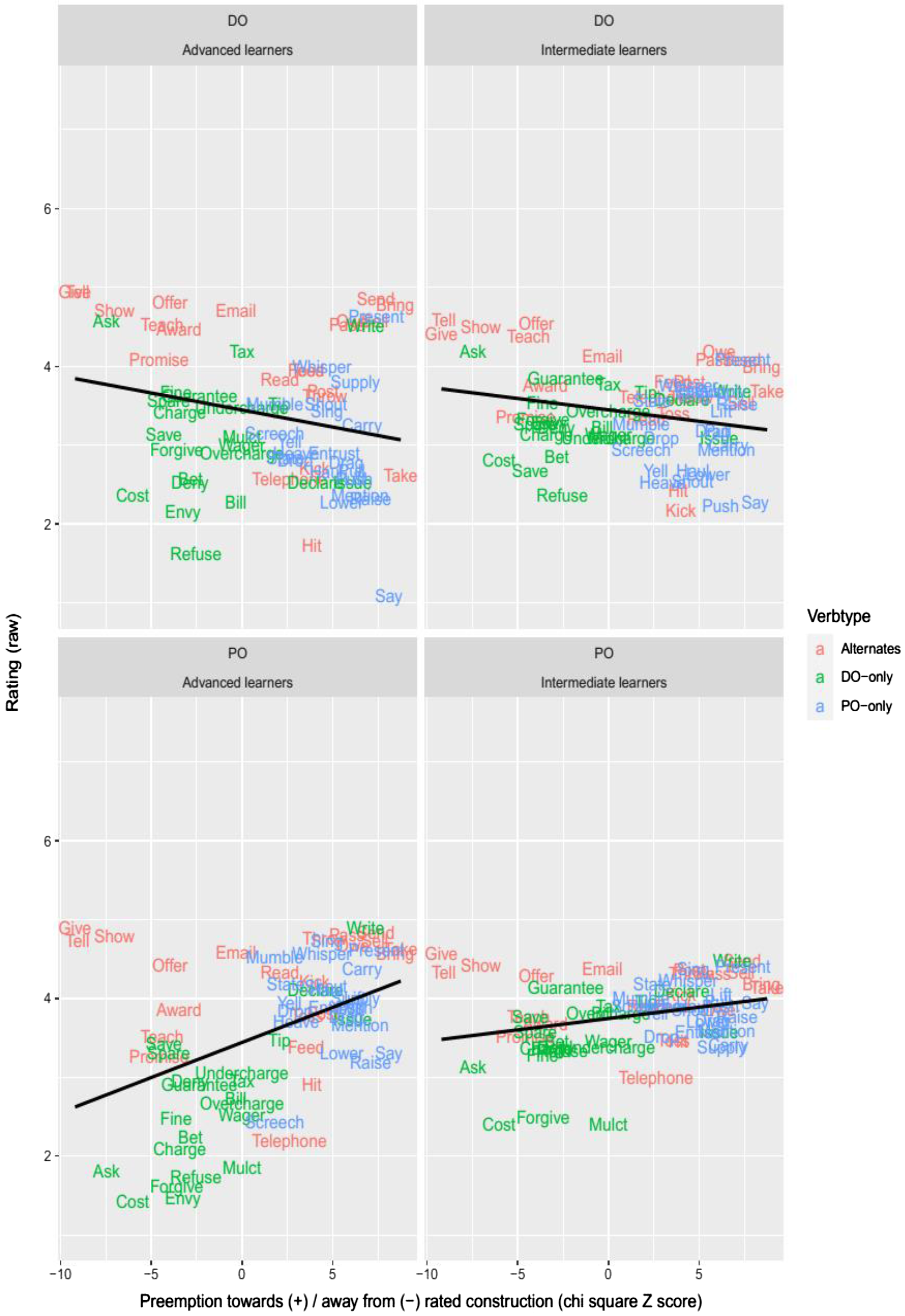
For the document overgeneralizations, an “overgeneralization” occurs when participants rate as acceptable a form that native linguists deem to be unacceptable. For example, L2 learners rated present as quite acceptable in the DO-dative (above 4/5, see the leftmost panel of Figure 2), whereas researchers such as Levin and Pinker regarded this verb as PO-dative-only. For figures depicting the relationship between other predictors (e.g., Broad PO, Broad DO-1, Speech, Mailing, Motion, Latinate, etc.) and DO and PO ratings, please consult Appendix E in the online Supporting Information.
A maximal analysis for all participants
In this study, similar to Ambridge et al. (Reference Ambridge, Barak, Wonnacott, Bannard and Sala2018), we conducted statistical analyses on construction ratings. We employed linear mixed-effects regression models for data analysis, utilizing the lme4 package in R (Version 3.2.2). We estimated and reported p-values for the effects using the summary function from the lmerTest package (Kuznetsova et al., Reference Kuznetsova, Brockhoff and Christensen2017), applying the Satterthwaite approximation method (Satterthwaite, Reference Satterthwaite1946). In the multifactorial analyses, to diagnose the potential multicollinearity problem, we turned to the variance inflation factor (VIFFootnote 3 ) function by loading the car package in R. To examine the combined influences of verb-semantic, Latinate morphophonological, and verb-bias constraints, we initially conducted the analysis for all participants. Subsequently, we conducted follow-up analyses on the significant interactions within specific participant groups.
Prior to conducting the data analysis, in accordance with a reviewer’s recommendation, one participant from the advanced groupFootnote 4 , aged over 35, was excluded from our dataset. Additionally, we eliminated two infrequently used verbs (mulct and wager) and seven sentence pairs involving verbs such as ask, save, say, cost, forgive, undercharge, and overcharge, which displayed semantic and/or syntactic issues. As a consequence, a total of 351 target observations were excluded from the advanced learners’ datasets, while 387 were excluded from the intermediate learners’ datasets, leaving 2,223 and 2,451 target observations remaining in the datasets of advanced learners and intermediate learners, respectively.
For the remaining data, we began by constructing the full model with the maximum random-effects structure, as recommended (Bates et al., Reference Bates, Kliegl, Vasishth and Baayen2015; Barr et al., Reference Barr, Levy, Scheepers and Tily2013). However, due to issues with model convergence, we simplified the random-effects structure in a step-wise fashion while retaining the fixed-effects structure intact (Huang & Li, Reference Huang and Li2020). Ultimately, we achieved successful convergence with a model comprising random intercepts for both participants and verbs, along with fixed effects for 10 predictors derived from verb-semantic, Latinate morphophonological, and verb-bias constraints. Furthermore, we introduced interactions between each of these predictors and the L2 group (advanced vs. intermediate). The dependent variable in our analysis was the rating scores for DO and PO. The final best-fit model formula is detailed in (7). All analysis code and data reported in this study can be accessed at https://osf.io/rve6g/.
-
(7) Rating∼ (1|Participant) + (1|Verb) + PRE_CHI + ENT_CHI + BROAD_PO + BROAD_DO_1 + BROAD_DO_2 + SPEECH + MAILING + BEQUEATHING + MOTION + LATINATE + PRE_CHI*Group + ENT_CHI*Group + BROAD_PO*Group + BROAD_DO_1*Group + BROAD_DO_2*Group + SPEECH*Group + MAILING*Group + BEQUEATHING*Group + MOTION*Group + LATINATE*Group
The results of the final best-fit model, as well as the VIFs of the predictors, were presented in Table 2. As shown in Table 2, the VIFs for all predictors were under 10, indicating that multicollinearity was not a problem in the current study.
Results of the best-fit model of multifactorial analyses (combine all learners)
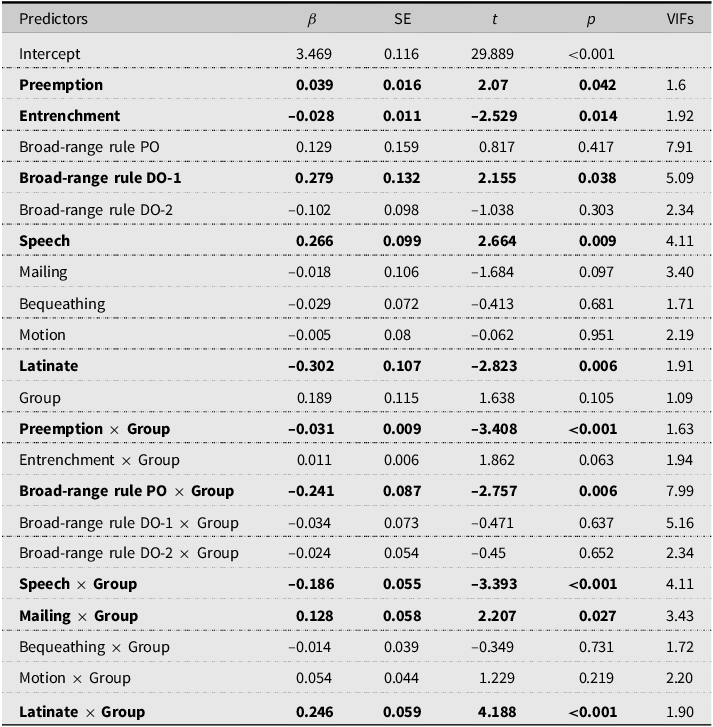
As shown in Table 2, the linear mixed-effects model yielded significant effects for Preemption, Entrenchment, Broad-range rule DO-1, Speech, and Latinate. The Group variable exhibited significant interactions with Preemption, Broad-range rule PO, Mailing, Speech, and Latinate. These interactions suggest that the aforementioned predictors may have distinct roles in the assessment of the dative alternation for each group of learners. In order to delve deeper into how these factors precisely shape the learners’ judgments of the dative alternation, we subsequently conducted by-group analyses. The aim of running the by-group analyses was to elucidate or unpack the interactions observed in the analyses involving all participants (Xiang & Chang, Reference Xiang and Chang2023). Consequently, the models utilized in the by-group analyses only incorporated the factors that exhibited interactions with the Group variable in the all-participant model (i.e., Preemption, Broad-range rule PO, Mailing, Speech, and Latinate).
By-group analyses: advanced learners vs. intermediate learners
The linear mixed-effects regression models were employed to analyze the data, following identical procedures for both groups. In alignment with the approach used in constructing the maximal model for all participants, we initially established the maximum model with the maximal random-effects structure. As the model struggled to converge, we simplified the random-effects structure. Ultimately, we achieved successful convergence with a model that included random intercepts for participants and verbs, in addition to fixed effects for Preemption, Broad-range rule PO, Mailing, Speech, and Latinate. The best-fit model formula for both advanced and intermediate learners is presented in (8).
-
(8) Rating∼ (1|Participant) + (1|Verb) + PRE_CHI + Broad-range rule PO + Mailing + SPEECH + Latinate
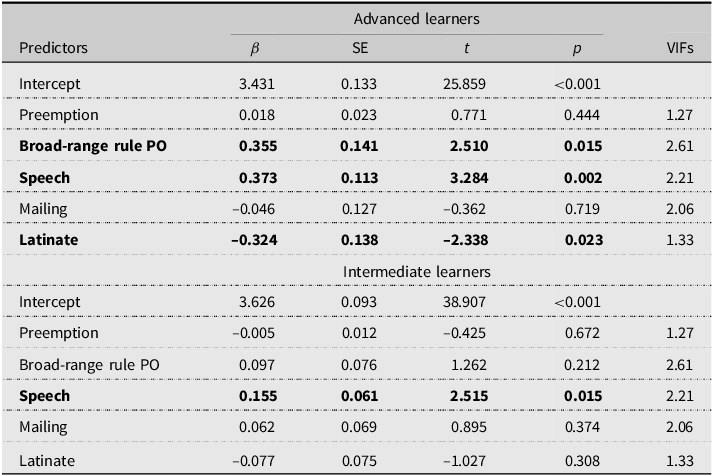
The results of the final best-fit model for both groups are presented in Table 3. The VIFs for predictors in both groups were under 10, indicating that multicollinearity was not a problem in the current models. As indicated in Table 3, both groups of learners exhibited distinct behavioral patterns when assessing the dative alternation. Specifically, the advanced learners demonstrated sensitivity to the Broad-range rule PO, Speech, and Latinate constraints, whereas the intermediate learners were only sensitive to the Speech constraint. This result suggests that L2 learners’ sensitivity to the constraints increases as their proficiency in English improves.
Results of the best-fit model of multifactorial analyses (by group)
Discussion
The current study investigated how Chinese EFL learners retreated from the argument-structure overgeneralization of the dative alternation. Two groups of learners with different English proficiency were asked to rate the acceptability of DO and PO constructions in their well and ill forms. The effects of verb-bias information (i.e., entrenchment, preemption), verb-semantic constraints (i.e., broad- and narrow-range semantic rules), and the Latinate morphophonological constraints were examined. The linear mixed-effects model revealed significant main effects for Preemption, Entrenchment, Broad-range rule DO-1, Speech, and Latinate. Additionally, the Group variable displayed significant interactions with Preemption, Broad-range rule PO, Mailing, Speech, and Latinate. Furthermore, upon examining these interactions using the linear mixed-effects model, it became evident that the advanced learners were sensitive to a greater number of constraints. In other words, the sensitivity of L2 learners to various constraints in the dative alternation shows a significant increase in tandem with their enhanced proficiency in English.
Based on the results of the current study, it seems that neither statistics-only nor semantics-only approaches can fully account for the findings in the current study, because L2 learners in the current study were sensitive to the predictors from verb-bias information (Entrenchment and Preemption), semantic properties of the dative verbs (Broad-range rule DO-1 and Speech), and Latinate morphophonological constraints. These results indicated that L2 learners could simultaneously make use of the statistical and semantic properties of the dative verbs to restrict the generalization of the dative alternation. These findings were similar to the findings of English native speakers in Ambridge et al (Reference Ambridge, Pine, Rowland, Freudenthal and Chang2014, Reference Ambridge, Barak, Wonnacott, Bannard and Sala2018). That was, both semantics- and statistics-based predictors were needed in restricting the overgeneralization errors of the dative alternation.
Below, we delve into further detail to elucidate how the semantics- and statistics-based predictors operate in constraining the generalization of the dative alternation.
Effects of verb-bias constraints: entrenchment and preemption
Entrenchment
In the current study, the significant effect of entrenchment was observed for L2 learners. To be specific, when the entrenchment toward the dative alternation increased the preference for the dative alternation also increased, indicating that L2 learners sensitively detected the verb-bias information and took it into account in the rating of the dative alternation. Such a result was consistent with the findings from the dative alternation of L1 speakers (e.g., Ambridge et al., Reference Ambridge, Pine and Rowland2012, Reference Ambridge, Pine, Rowland, Freudenthal and Chang2014, Reference Ambridge, Barak, Wonnacott, Bannard and Sala2018) and L2 learners (e.g., Wolk et al., Reference Wolk, Wolfer, Baumann, Hemforth, Konieczny, Carlson, Hölscher and Shipley2011).
However, these findings contrast with those of Qi and Wang (Reference Qi and Wang2020) and Xiang and Chang (Reference Xiang and Chang2023), who did not observe a significant effect of entrenchment when Chinese EFL learners evaluated the acceptability of the dative alternation. Xiang and Chang (Reference Xiang and Chang2023) attributed the absence of an entrenchment effect in their study to their selection of dative verbs in their questionnaire. These verbs were high-frequency and well-established in the dative alternation usage in their questionnaire. Such verbs might have resulted in ceiling effects, thereby minimizing the impact of entrenchment. To substantiate their assumption, Xiang and Chang left room for future research. In contrast to Xiang and Chang’s (Reference Xiang and Chang2023) study, our study incorporated both grammatical and ungrammatical sentences in the questionnaire. This allowed us to better investigate the impact of entrenchment by comparing the acceptability of grammatical and ungrammatical constructions. Our results appear to offer a response to Xiang and Chang’s (Reference Xiang and Chang2023) study.
Preemption
The competing mechanism of preemption prohibits learners from overgeneralizing DO-only verbs into PO constructions and vice versa. Effects of preemption have been observed in L1 dative alternation acquisition (e.g., Ambridge et al., Reference Ambridge, Pine and Rowland2012, Reference Ambridge, Pine, Rowland, Freudenthal and Chang2014, Reference Ambridge, Barak, Wonnacott, Bannard and Sala2018; Robenalt & Goldberg, Reference Robenalt and Goldberg2016) as well as L2 acquisition of the dative alternation (e.g., Han & Xue, Reference Han and Xue2014; Qi & Wang, Reference Qi and Wang2020; Xiang & Chang, Reference Xiang and Chang2023; Xu, Reference Xu2012). The findings of the current study echoed previous research and detected a significant preemption effect among L2 learners. To be precise, as the preemption of the dative verb towards PO increased, they became less likely to overgeneralize DO and vice versa. This suggests that L2 learners adeptly detected verb-bias information and factored it into their processing of the dative alternation.
Effects of verb-semantic constraints: the broad- and narrow-range semantic rules
Broad-range semantic rules
The present study found that one predictor (i.e., the Broad-range rule DO-1, associated with possession transfer) from the broad-range semantics was constantly significant in restricting the overgeneralization of the dative alternation. This was consistent with previous findings in L1 research (e.g., Ambridge & Brandt, Reference Ambridge and Brandt2013; Ambridge, et al., Reference Ambridge, Pine and Rowland2012, Reference Ambridge, Pine, Rowland, Freudenthal and Chang2014, Reference Ambridge, Barak, Wonnacott, Bannard and Sala2018; Pinker, Reference Pinker1989). The significant effect of Broad-range rule DO-1 can be attributed to its usage rate in the dative verbs. The Broad-range rule DO-1 is associated with the meaning of possession transfer, which represents the most typical meaning of dative events and is very common amongst the dative verbs (Pinker, Reference Pinker1989, Reference Pinker2013). Hence, just as L1 native speakers, L2 learners have more chances to use it, which make it possible to be a significant predictor in learners’ ratings.
Narrow-range semantic rules
For the narrow-range semantic rules, Speech played a significant role. This finding aligns with previous research in L1 (e.g., Ambridge et al., Reference Ambridge, Pine and Rowland2012, Reference Ambridge, Barak, Wonnacott, Bannard and Sala2018; Pinker, Reference Pinker1989), indicating that L2 learners were proficient in utilizing cues from these narrow-range semantic rules when evaluating the acceptability of DO and PO. It is noteworthy that the verbs falling within the narrow-range classes were originally motivated by the broader-range semantic rules (Ambridge et al., Reference Ambridge, Pine, Rowland, Freudenthal and Chang2014; Pinker, Reference Pinker1989). Narrow-range rules help learners differentiate between various semantic scenarios where the dative alternation can or cannot be applied accurately and they are specific to particular semantic contexts or verb types. As L2 learners gain more exposure to the language and refine their understanding, they begin to incorporate these specific rules into their language production to produce more contextually appropriate sentences. In the present study, L2 learners demonstrated a strong command of these broad-range semantic rules, which, in turn, provided the foundation for their mastery of the narrow-range classes. Consequently, owing to their grasp of the broad-range semantic rules, L2 learners also exhibited competence in applying the narrow-range rules associated with the dative verb class.
Latinate morphophonological constraints
The present study found that the Latinate morphophonological constraints helped the L2 learners restrict the overgeneralization of the dative alternation. This was in conformity with the findings in L1 research (e.g., Ambridge et al., Reference Ambridge, Pine and Rowland2012, Reference Ambridge, Pine, Rowland, Freudenthal and Chang2014, Reference Ambridge, Barak, Wonnacott, Bannard and Sala2018; Gropen, et al., Reference Gropen, Pinker, Hollander, Goldberg and Wilson1989; Pinker, Reference Pinker1989) and indicated that the Latinate constraint was psychologically real for L2 learners. Verbs of Latinate origin can be only used in PO but not in DO. When L2 learners frequently come across Latinate origin dative verbs used exclusively with PO, they might unintentionally form the belief that these verbs are exclusively appropriate for PO rather than DO. This phenomenon can be viewed as a manifestation of preemption. Considering the substantial role that preemption plays in the current study, it is not unexpected that Latinate morphophonological constraints also emerge as significant factors.
Effect of L2 proficiency
In this study, L2 learners demonstrated increased sensitivity to statistical verb-bias information, semantic constraints, and Latinate morphological constraints in the dative alternation, corresponding with their improved English proficiency. The observed increase in L2 learners’ sensitivity to these multiple constraints in the dative alternation can be attributed to several factors. Firstly, increased exposure and practice play a pivotal role in this enhancement. As learners progress in their English proficiency, they are likely to encounter a greater variety of language inputs and engage in more extensive language practice. This heightened exposure contributes to a more nuanced understanding of statistical verb-bias information, semantic properties, and morphological constraints associated with the dative alternation. Secondly, the development of linguistic competence is a key factor. Improved English proficiency may indicate an overall enhancement in linguistic competence. Learners may become more adept at recognizing and applying various linguistic constraints, benefiting from a more comprehensive grasp of the language’s rules and patterns. Thirdly, cognitive development is influential in the observed increase. With heightened language proficiency, learners may undergo cognitive development that enables a more sophisticated understanding of complex linguistic structures. This cognitive growth equips learners with the ability to better discern and apply the constraints associated with the dative alternation.
In summary, the multifaceted increase in sensitivity among L2 learners can be traced back to factors such as increased exposure and practice, developing linguistic competence, and cognitive development, all of which contribute to a more refined understanding and application of constraints of the dative alternation.
Evaluations of usage-based approaches to language acquisition
The sensitivity towards both entrenchment and preemption indicated that L2 learners in the current study could effectively employ frequency information when processing L2 sentences. This was consistent with the basic tenet of usage-based approaches to language acquisition which hold that L2 acquisition and processing are driven by statistical information such as frequency (Ambridge et al. Reference Ambridge, Pine, Rowland, Freudenthal and Chang2014, Reference Ambridge, Barak, Wonnacott, Bannard and Sala2018; Ellis Reference Ellis2002, Reference Ellis and Robinson2012; Kim et al. Reference Kim, Shin and Hwang2020; Zhang & Mai, Reference Zhang and Mai2018). To elaborate further, in accordance with usage-based theories, when a verb is consistently employed in a specific construction, it inherently creates an implicit form of negative evidence against its use in other constructions (Ambridge et al., Reference Ambridge, Pine and Rowland2012; Braine & Brooks, Reference Braine, Brooks, Tomasello and Merriman1995; Pinker, Reference Pinker1989; Zhang, Reference Zhang2017; Zhang & Mai, Reference Zhang and Mai2018). In essence, the repetitive use of a verb in particular constructions tends to restrict its applicability in alternative constructions (Ambridge et al., Reference Ambridge, Barak, Wonnacott, Bannard and Sala2018). In terms of entrenchment, repeated usage of dative verbs in the dative alternation enhances their salience and strengthens their competition in expressing themselves (Bybee, Reference Bybee2010), implicitly blocking their usage in other constructions, such as transitive or intransitive constructions. In terms of preemption, frequent use of dative verbs in DO will limit its availability for use in PO and vice versa.
Moreover, constraints stemming from semantic cues, such as broad-range semantic rules, can also represent an additional form of frequency effect in constraining the generalization of the dative alternation. This is because these factors demonstrate a tendency where verbs associated with more salient semantics tend to preempt those with less salient semantics. To illustrate, let us consider the Broad-range rule DO-1, as discussed previously. This rule encapsulates the most common meaning of dative events and is widely prevalent among dative verbs. This prevalence creates a frequency effect within the dative alternation. Ultimately, such a frequency effect shapes the assessment of the dative alternation.
Limitations
Admittedly, the current study has several limitations. First, the current study is limited to an offline grammatical acceptability judgment task. Although offline tasks have traditionally been commonly used to investigate the overgeneralization of the dative alternation, online experiments, such as self-paced reading or eye-tracking experiments, might hold the potential to provide further insights into these issues. Second, the English proficiency of participants was not rigorously assessed using a high-standard proficiency test in the current study. In the future, the grouping of participants with varying language proficiency levels could be enhanced by utilizing tests like the Oxford Placement Test.
Summary
In conclusion, the current experiment investigated the roles of verb-bias, verb semantics, and Latinate morphophonological constraints in restricting the overgeneralization errors of the dative alternation. The results demonstrated that Chinese EFL learners were simultaneously sensitive to the multiple cues from verb-bias, semantic, and morphophonological constraints, indicating that L2 learners restricted the generalization of the dative alternation by using both the statistical verb-bias information and semantic properties of the dative verbs.
The current study may shed light on the understanding of how Chinese EFL learners restricted their generalization of the English dative alternation by cues of verb-bias information, verb semantics, and morphophonological constraints and how the usage of such constraints develops as L2 learners become more proficient in English. The results also validated the usage-based approaches to second language acquisition and provided an answer to the “Baker’s Paradox.”
Replication package
The materials, the data, and the analysis codes are available on Open Science Framework (OSF): https://osf.io/rve6g/.
Supplementary material
The supplementary material for this article can be found at https://doi.org/10.1017/S0142716424000110
Acknowledgements
We extend our gratitude to Associate Editor Prof. Peng Zhou and the three anonymous reviewers for their valuable comments and feedback, which greatly contributed to the improvement of this work.
Funding statement
This research is supported by the Guangxi Philosophy and Social Science Research Project (grant: 23FYY021)



