Coronavirus disease 2019 (COVID-19) is a global public health problem as declared by the World Health Organization (WHO) on March 11, 2020. Reference Hageman1 Globally, more than 84 million people have contracted the virus and around 1.9 million have died after 1 y of its occurrence. 2 Soon after the first case of COVID-19 was confirmed in Ethiopia in March 2020, the government announced measures such as mandatory quarantine periods for all travelers, restrictions on public gatherings, school closures, mandatory wearing of face masks in public places, and fewer passengers on public transport to contain the spread of the virus. Reference Deribe3 Despite the deployment of the above-mentioned prevention measures, a total of 123,388 confirmed cases and 1923 deaths had been reported by December 30, 2020, in Ethiopia. 2,Reference Cao4
The success of preventive measures against the COVID-19 pandemic is highly dependent on public knowledge and the beliefs of the communities. Reference Al-Hanawi, Angawi and Alshareef5,Reference Singh, Purohit and Bhambal6 Various theories and models describe the potential influences of an individual’s perceptions, beliefs, and attitudes toward behaviors, which are also applicable to COVID-19 control and prevention. For instance, both socio-cultural theory Reference Kasperson and Kasperson7 and cognitive theorists Reference Choudhry, Mani and Ming8 place a strong emphasis on how beliefs and attitudes influence the acquisition of behavior. Similarly, The Health Belief Model Reference Champion and Skinner9 shows individuals’ perception of health problems influences their likelihood of practicing healthy behavior. Thus, people may disregard the prescribed preventive measures, such as the compulsory wearing of face masks in public places, maintaining physical distance, regular hand washing with soap or alcoholic-based agents, and so on, due to their misconceptions about the virus.
Since the inception of the pandemic of COVID-19, various misconceptions regarding the virus have been conveyed through the media and word of mouth. Reference Aminu10,11 The COVID-19–related misconceptions spread quicker than evidence-based information from numerous sources, which the WHO describes as “myth busters.” 12 The COVID-19–related misconceptions have multiple dimensions, including the virus’s true presence, its geographical distribution, susceptible population, and prevention and treatment options, particularly in Africa, including Ethiopia. Reference Aminu10,Reference Wang, Cheng and Yue13,Reference Tabong and Misconceptions14 Among those misconceptions, “exposure to the sun or high temperatures prevents the virus, Reference Mekonnen, Azagew and Wubneh15 ” “drinking alcohol protects you against the COVID-19 pandemic, Reference Tabong and Misconceptions14 ” “the virus cannot be spread in places with hot and humid weather, Reference Tabong and Misconceptions14 ” “the virus can be killed by religious hymns, Reference Bakebillah Md and Wubishet16 ” and “ young and healthy people do not need to take precautions against the virus Reference Aminu10,Reference Wang, Cheng and Yue13 ” are common.
The myths and incorrect information that have been conveyed in society could lead to malpractices regarding the COVID-19 pandemic, Reference Tabish17 which could have consequences for health problems, economic problems, and social problems. Obviously, failing to take COVID-19 prevention measures creates enormous threats to virtually all sectors, including health, the economy, transportation, education, agriculture, religion, politics, security, etc. Reference Wang, Cheng and Yue13 As a result, misconceptions have an impact on both short- and long-term COVID-19 prevention and control efforts. 18 To prevent the spread of the virus, it is critical to focus on measures such as awareness creation to debunk COVID-19–related misperceptions and incorrect belief misinformation. 18,Reference Sabah19 There are limited community-based investigations regarding COVID-19–related misconceptions in Ethiopia. Hence, assessing the level of residents’ COVID-19–related misconceptions and associated factors is crucial to halting COVID-19 transmission and its consequences.
Methods
Study Area and Period
A community-based cross-sectional study design was done from December 1 to 30, 2020. The survey was conducted at 4 randomly selected kebeles (smallest administrative unit) out of 9 kebeles in Dilla Town, southern Ethiopia. Dilla Town is 1 of the 2 city administrations in the Gedeo zone, which is at a distance of 365 km from the capital city, Addis Ababa. The total population of the town is 99,067, of which 52,034 are females and the rest, 47,033, are males. 20 Until during data collection (December 30, 2020), there were more than 116 confirmed cases of COVID-19 with a 100% cure rate, and there was 1 COVID-19 center and 1 quarantine and treatment center.
Population
The study was conducted on the individuals who were selected from all the populations found in the selected kebeles. Randomly selected individuals who were family members of systematically selected households were included in the study. Individuals who lived in the selected kebeles for more than 6 months and individuals over the age of 18 y were included in the study. Individuals who were seriously ill and who were not available during the time of data collection after 2 visits were excluded from the study.
Sample Size Determination
The sample size was determined by using a single population proportion formula by considering the following statistical assumptions: Z = 95% confidence interval (CI); P = proportion of community misconception about COVID-19, which is 56.9% in Gondar Town Reference Mekonnen, Azagew and Wubneh15 ; d = 5% margin of error. Using the following single proportion formula:
 $$n = {{{{{{(z\dot \alpha /2)}^2}{\rm{P}} \times (1 - {\rm{P}})}}}, \over {{{\rm{d}}^2}}}$$
Where: n = initial sample size,
 $n = {{{{(1.96)}^2} \times 0.569(1 - {\rm{0}}{\rm{.569}})} \over {{{(0.05)}^2}}} = 377$
, by considering a 10% nonresponse rate;
The total sample size was calculated as: n = 377 + 377*10/100 = 415.
Sampling Technique
Four of 9 kebeles in Dilla Town were randomly selected, and then the sample size was distributed to the selected kebeles based on their respective number of households. After the sample size was distributed, a systematic random sampling technique using sampling fraction (K) was used to select the households from the selected kebeles. The sampling interval K was determined by dividing the number of households in all selected kebeles (n = 10337) by the sample size (n = 415), which was 10337/415 = 25. Therefore, households were selected at an interval of every 25 houses. Finally, 1 individual older than 18 y old who was selected using simple random sampling by the lottery method was interviewed from each selected household.
Study Variables
The dependent variable of this study is misconception about COVID-19, whereas the independent variables are socio-demographic variables (age, gender, religion, educational level, marital status, occupational status, and income), knowledge questions, information exposure, self-perceived health status (health condition), and confirmed COVID-19 history.
Data Collection Tools and Measures
The data were collected using a structured questionnaire, which was prepared from a WHO document on myths about COVID-19 12,21 and similar previous studies. Reference Mekonnen, Azagew and Wubneh15,Reference Lee, Moon and Ndombi22–Reference Kebede, Yitayih and Birhanu24 The questionnaire comprised 33 items that fell into the following 6 sections: socio-demographic characteristics (9 items), information access (3 items), perceived health condition (2 items), confirmed COVID-19 history (2 items), knowledge about COVID-19 (7 items), and COVID-19 related misconceptions (10 items). The respondent’s knowledge, which focuses on the cause, mode of transmission, main clinical symptoms, and preventive measures, was assessed using “yes/no” and “list-answer” questions. Each correct response gets a score of 1, and each incorrect response receives a score of 0. The items were summed up to form a total knowledge score ranging from 0 to 7, with higher scores indicating greater knowledge.
A dependent variable (the respondents’ COVID-19 misconceptions) was assessed using a 3-point scale, ranging from agree (1), no opinion (2), and disagree (3). The consistency between the items of misconception about COVID-19 was tested by using Cronbach’s alpha test, which resulted in an acceptable range (0.729). Before recoding and summing up, the responses to the first question, which is an affirmative question, were reversed. Respondents’ level of misconception was assessed using dichotomizing of the responses by recoding “agree” and “no opinion” to “1” and “disagree” to “0”. The “Agree and No opinion” responses were categorized into the same category because respondents who did not disagree with incorrect questions about COVID-19 obviously had misconceptions about COVID-19. The items were summed up to form a total misconception score ranging from 0 to 10, with higher scores indicating higher misconception. Finally, respondents who scored greater than or equal to 8 were categorized as having high misconceptions, whereas those who answered below 8 were categorized as having low misconceptions.
Operational Definitions
Misconception
A widely held view or opinion on COVID-19 that lacks scientific foundation due to a flaw in thinking or understanding about the disease. Reference McCormick25 Participants who scored 8 or above on misconception questions were coded as having high misconceptions based on adapted and modified Bloom’s cutoff points. Reference Baig, Jameel and Alzahrani26
Knowledge
Participants who scored 4 or more knowledge questions correctly were coded as having “good knowledge”, while those who scored below 4 were considered to have “poor knowledge”.
Data Collection Procedures and Quality Management
The prepared questionnaire was translated into the Amharic language and back to English by the selected Amharic and English language experts. For the data quality control, the questionnaire was checked and pretested on 21 (5% of the total sample size) individuals before the actual data collection. A total of 20 data collectors with health backgrounds were involved in data collection. Intensive training was given on the objective of the study, the data collection instruments, and data collection procedures for data collectors. The data collectors followed recommended COVID-19 prevention measures like wearing a face mask, avoiding hand shaking, and keeping a distance from respondents during face-to-face interviews. The overall data collection process was strictly followed by the supervisors and principal investigators. The data were checked for completeness and consistency of the collected information on a daily basis by supervisors and principal investigators.
Data Processing and Analysis
Data entry, cleaning, and analysis were carried out by using SPSS version 20 software. Before the analysis, data cleaning was conducted by replacing missing values and removing and/or correcting irrelevant and outlier data accordingly. The data were checked for autocorrelation using the Durbin Watson value, which is 1.902, and analysis of variance (ANOVA) (F = 4.38, p < 0.001), which shows almost no autocorrelation among variables. The assumptions of logistic regression (model adequacy and multicollinearity of the independent variables) were checked using appropriate methods. The absence of multi-collinearity was checked by the variance inflation factor (VIF). Model adequacy was checked by using the Hosmer and Lemeshow goodness of fit test. The data were summarized and presented using frequency, percentage, median, mean, and standard deviation in the form of text, tables, and figures. A chi-squared test was done to assess the difference between multidimensional COVID-19–related misconceptions (using 10 items) by socio-demographic variables. Bivariable and multivariable logistic regression was used to test for associations between dependent and independent variables. A candidate variable with a P-value <0.25 at 95% CI in bivariable logistic regression was selected for multivariable analysis. In multivariable analysis, a P-value of less than 0.05 was considered statistically significant.
Results
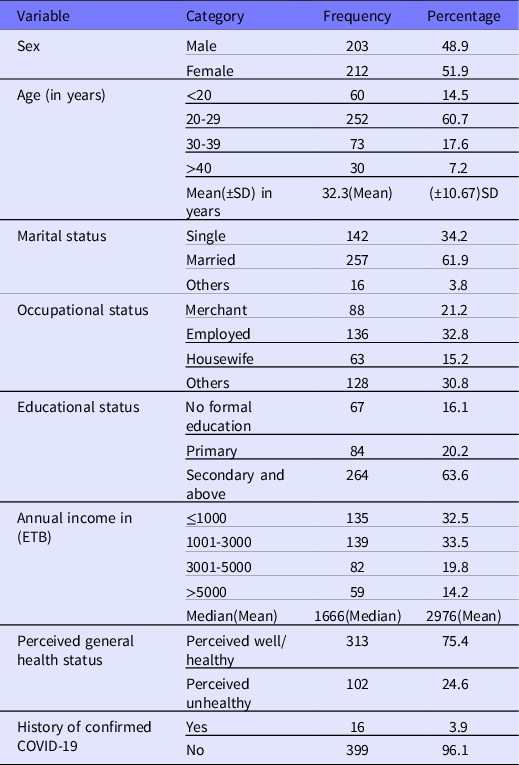
A total of 415 respondents participated in the study, with a 100% response rate. The respondents’ average age was 32.3 (±10.67) y, and 252 (60.7%) were in the age group of 20-29 y. Of the total, 212 (51.9%) were females, 257 (61.9%) were married, 136 (32.8%) were government employees, and 264 (63.6%) of the respondents had learned secondary and above (Table 1).
Socio-demographic characteristics of the respondents in Dilla Town, southern Ethiopia (n = 415)

Knowledge of Respondents About COVID-19
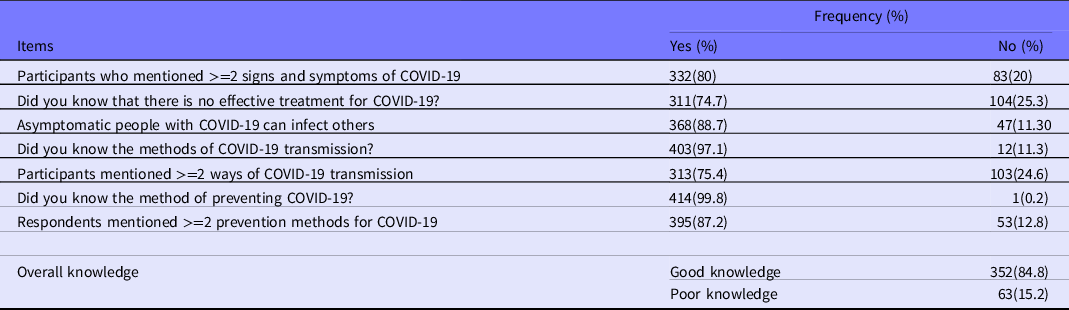
Among the total number of respondents, 352 (84.8%) had good knowledge of COVID-19 and 63 (15.2%) had poor knowledge of COVID-19. More than three-fourths of the respondents mentioned the typical symptoms of COVID-19 like fever, dry cough, shortness of breath, and fatigue. The majority (89.2%) of respondents say the main mode of transmission is by means of air droplets (Table 2).
Knowledge of respondents on COVID-19 in Dilla Town, southern Ethiopia (n = 415)

Information Exposure of Respondents About Covid-19
The majority (99.5%) of the respondents had access to information about COVID-19 and its preventive measures from different sources of information. Of them, 386 (93%) of the respondents had access to COVID-19 information from more than 2 sources of information. Almost three-fourths of the study participants have access to information from television, followed by one-fifth from radio (Figure 1).
Respondents COVID-19–related information access in Dilla Town, southern Ethiopia (n = 415).

Respondents’ Misconceptions About COVID-19
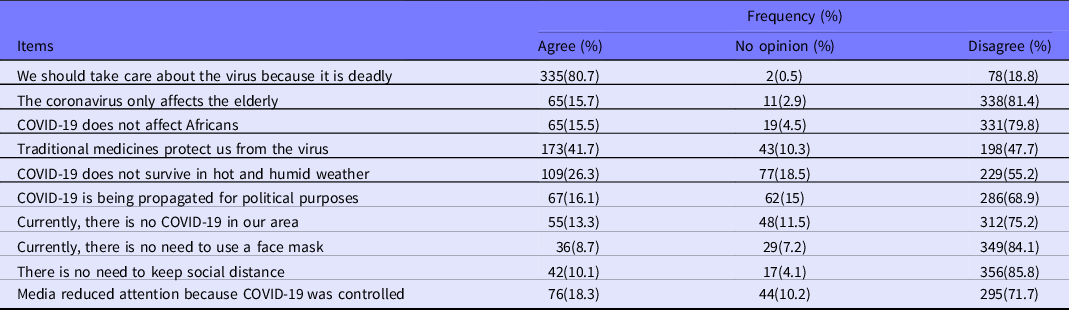
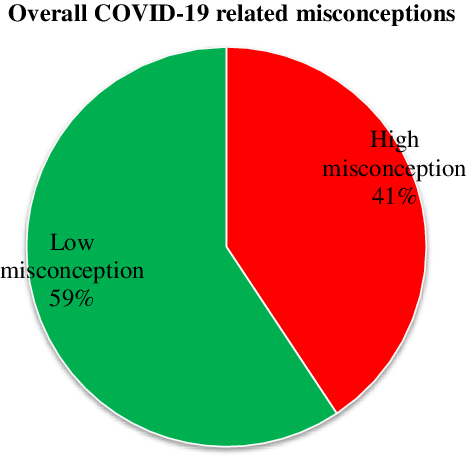
Among the study participants, 65 (15.7%) agreed that COVID-19 only affects the elderly, and 55.3 (13.3%) agreed on the issue that there is no need to wear a face mask because there is no COVID-19. In this study, the overall magnitude of the community’s misconception about COVID-19 was found to be 41.1%, with a 95% CI (36.9-46.2) (Table 3; Figure 2).
COVID-19–related misconceptions among residents of Dilla Town, southern Ethiopia (n = 415)

The overall level of COVID-19–related misconceptions among residents of Dilla Town, southern Ethiopia. (n = 415).

Multidimensional COVID-19 Misconceptions by Socio-Demographic Characteristics
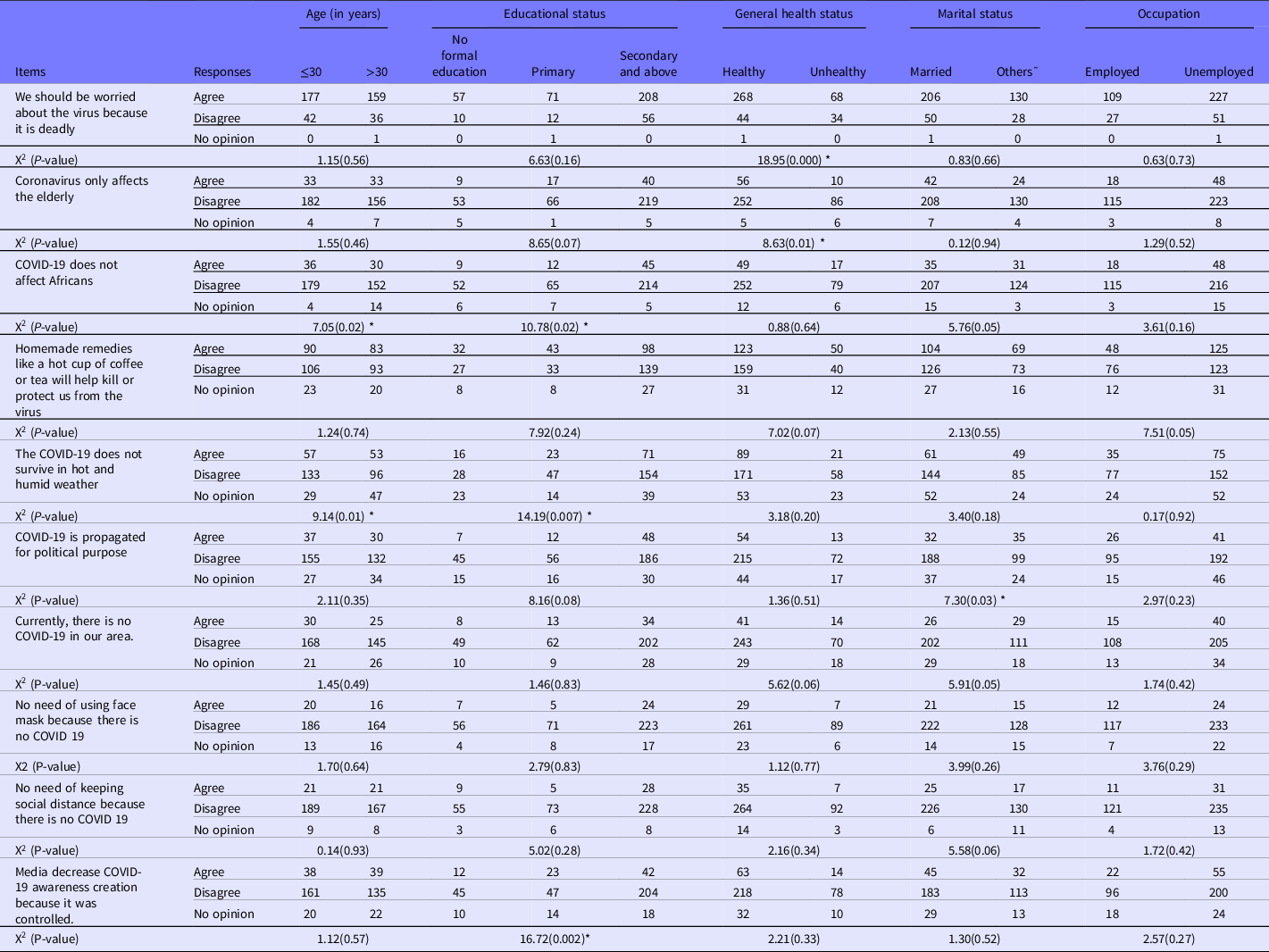
The respondents’ perception toward “taking care of the virus because it is deadly” and “coronavirus only affects the elderly” significantly differed based on respondents’ general health status (P < 0.05). Respondents who perceive they have a good health status have low misconceptions about the severity of COVID-19. This could be due to their accurate information seeking from health professionals and other sources, as they have a higher risk perception for COVID-19 than others. The chi-squared test indicated that believing “COVID-19 does not affect Africans” was significantly different by respondents’ educational status and age (P < 0.05). Respondents whose educational status was secondary school and above had a lower misconception of Africans’ susceptibility to the virus (χ2 = 10.78; P < 0.05) compared with lower graders and nonattendants of formal education. Additionally, respondents whose age was above 30 y had low misconceptions about African susceptibility to the virus compared with younger respondents (χ2 = 7.05; P < 0.05). Regarding their perception of the presence of COVID-19 in the study area and home remedies’ effectiveness for COVID-19 prevention, there is no significant difference by respondents’ socio-demographic characteristics (Table 4).
Multidimensional COVID-19–related misconceptions by socio-demographic variables

* p-value <0.05, ˜Others=single, widowed, and divorced.
Factors Associated With Respondents COVID-19–Related Misconceptions
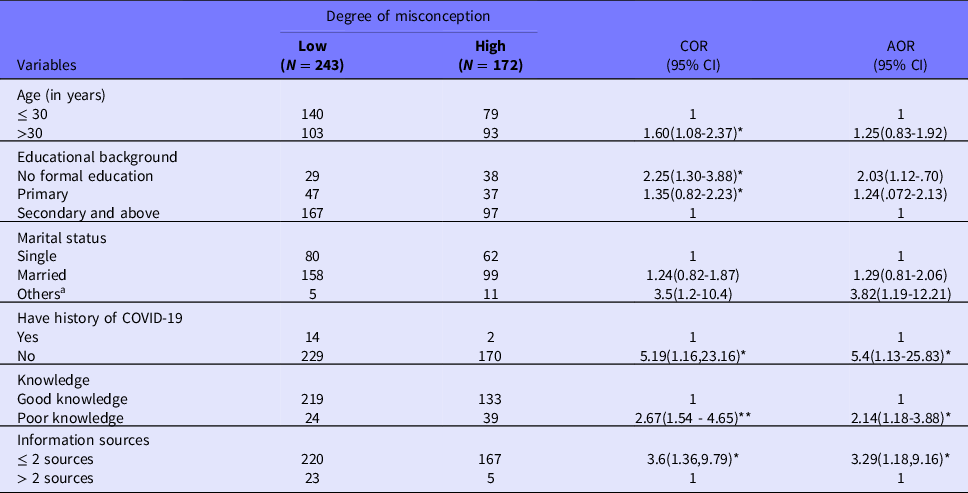
In the bivariable logistic regression analysis, age, marital status, educational status, knowledge, having a history of confirmed COVID-19 and the number of information sources about COVID-19 were significantly associated factors with the respondents’ misconception of COVID-19. In the multivariable logistic regression, knowledge, having a history of confirmed COVID-19 and the number of information sources about COVID-19 remained significantly associated with the respondents’ misconception of COVID-19. Participants who had poor knowledge were 2.14 times (adjusted odds ratio [AOR] = 2.14; 95% CI 1.18-3.88) more likely to have a COVID-19–related misconception when compared with those who had good knowledge (Table 5).
Factors associated with respondents’ misconceptions toward COVID-19 in Dilla Town, southern Ethiopia (n = 415)

Abbreviations: AOR, adjusted odds ratio; COR, crude odds ratio; CI, confidence interval, ETB, Ethiopian Birr.
aOthers, widowed and divorced.
* P-value < 0.05.
** P-value < 0.001.
Discussion
COVID-19 is now a topic of discussion in the media and among the general public. People’s understanding of COVID-19 differs depending on the situation in low-income countries like Ethiopia. Because of this, we have investigated COVID-19–related misconceptions and associated factors among residents of Dilla Town. The proportion of Dilla Town residents who have high misconceptions about COVID-19 was found to be 41.1% (95% CI, 36.9-46.2). The most common misconceptions were: “Traditional medicines can protect against the virus,” (41.7%), “COVID-19 does not survive in hot and humid weather conditions,” (26.3%), and “COVID-19’s news is propagated for political reasons,”(16.1%). The current COVID-19–related misconceptions finding is lower than the study conducted in south-west Ethiopia and Gondar City, which showed 54.6% and 56.9% of respondents have perceived myths and unhealthy beliefs about COVID-19, respectively. Reference Mekonnen, Azagew and Wubneh15,Reference Kebede, Yitayih and Birhanu24
The finding of this study shows, 352(84.8%) of respondents had good knowledge of COVID-19. The finding is similar to the study conducted in sub-Saharan African countries, which shows 89.9% of respondents have good knowledge. Reference Obi, Fozeu and Ezaka27 In contrast, the finding is higher than the studies done in Saudi Arabia and eastern Ethiopia, where the overall correct rate of knowledge was 68% and 45.4%, respectively. Reference Baig, Jameel and Alzahrani26,Reference Eyeberu, Mengistu and Negash28 The disparity with the Saudi Arabia finding could be explained by the fact that the previous study used the Internet for data collection, whereas the current study used face-to-face interviews. In the case of the study from eastern Ethiopia, the difference could be explained by the way knowledge is measured, which the previous study used mean as a cutoff point, while the current study used half the score of knowledge questions as a cutoff point.
Regarding factors influencing respondents’ misconceptions, previous history of COVID-19, knowledge, and information access were potential factors. The results of the study show that respondents who had no previous history of COVID-19 were 5.4 (with 95% CI: 1.1-25.8) times more likely to have a misconception than their counterparts. The previous history of COVID-19 may indicate that individuals may get accurate information from health professionals, which reduces misconceptions and misunderstandings about COVID-19. We could not compare the finding with previous studies because there is limited available data about the association of misconceptions with having a previous history of COVID-19. Respondents with poor knowledge were 2.1 (with 95% CI: 1.1-3.8) times more likely to have high misconceptions about COVID-19 than those with good knowledge. The current study’s findings agreed with those of a previous study conducted in Gondar, which found that respondents with poor knowledge were 1.1 times more likely than their counterparts to have a misconception about COVID-19. Reference Mekonnen, Azagew and Wubneh15 Information access is another significant factor that affects respondents’ misconceptions. The study participants who had received COVID-19 information from more than 2 sources were 3.2 (with 95% CI: 1.2-9.2) times less likely to have had a misconception about COVID-19. The finding is similar to the study conducted in Dessie and Gondar, which shows respondents who had heard about the number of COVID-19–infected people were less likely to have misconceptions about COVID-19 than their counterparts. Reference Cao4,Reference Feleke, Adane and Embrandiri29 The finding is also supported by the WHO’s perspective on the effect of information access on disease surveillance, outbreak investigation, and prevention by refuting misconceptions. 30
The study’s finding shows that age, marital status, and educational status were not significantly associated with respondents’ misconceptions. The possible explanation of the insignificant association of the variables with misconceptions could be due to the novelty of COVID-19, in which all people have similar exposure to information from different sources in the town. The finding is supported by the study from sub-Saharan Africa, Bangladesh, and Gondar, which shows both marital status and educational status were not significantly associated with study participants’ misconceptions about COVID-19. Reference Mekonnen, Azagew and Wubneh15,Reference Bakebillah Md and Wubishet16,Reference Obi, Fozeu and Ezaka27
Limitations
This study was cross-sectional, so it cannot demonstrate a cause-and-effect relationship. In addition, the findings of this study may not be generalizable to the whole population of Ethiopia because our study does not incorporate a wide study area in which the information was collected from 1 town. Moreover, the findings of this study may not be consistent in future years as the data were collected during the first year of COVID-19 progression.
Conclusions
The proportion of respondents who have high misconceptions about COVID-19 was high (41.1%). Misconceptions about COVID-19 were significantly influenced by knowledge of COVID-19 and access to information. To resolve misconceptions related to COVID-19, health education programs that can change communities’ beliefs should be taken into consideration. Hence, public health agencies and organizations should address these misconceptions by delivering accurate, repeatable, and sufficient information through credible and reliable sources. Moreover, incorporating a misconceptions monitoring system into other systems like surveillance and management of COVID-19 is needed.
Acknowledgments
First and foremost, we express our gratitude and appreciation to Dilla University College of Health and Medicine for supporting this study. We are thankful to our data collectors and study participants.
Authors’ contributions
B.G.D. conceived the study, developed data collection tools, performed the analysis and interpretation of data, and drafted the study. B.G.D., H.E.H., G.A., and A.K.W. were involved in the development, approval of the proposal, and revision of drafts of the study and reviewed manuscripts. The final manuscript was read and approved by all authors.
Funding
This study was not supported by any special funding agency.
Ethical standards
Before the data collection procedure, written consent was obtained from the Dilla University institutional review board. The respondent’s right to dignity was respected, and verbal consent was obtained from respondents before data collection. To keep the confidentiality of each respondent, their names were not included. Data collectors wore protective face masks and kept their physical distance from study participants.