Introduction
There is a growing body of evidence exploring the ways in which public policies encourage communities to participate in the design and delivery of public services, and to respond directly to local problems. Community participation policies cut across diverse areas of government, from social services to planning to water management, and are now commonplace across states at different levels of economic development and with different forms of government (Rivas, Reference Rivas2014; Stewart and Lithgow, Reference Stewart and Lithgow2015; Huxley et al., Reference Huxley, Andrews, Downe and Guarneros-Meza2016; Xiaojun and Ge, Reference Xiaojun and Ge2016). Indeed, the idea of community participation as a mechanism for tackling complex problems is now reflected at a global level in the UN Sustainable Development Goals (United Nations, 2016).
This turn towards community participation is often interpreted through governance theory, which suggests that states increasingly need to engage actors ‘beyond the state’ to address complex social problems in the context of globalisation (Rhodes, Reference Rhodes1997; Stoker, Reference Stoker1998; Kooiman, Reference Kooiman2003). Thus communities become activation targets for governments needing local partners to tackle issues not thought amenable to top-down intervention.
More critically, the Foucauldian idea of governmentality has formed the basis for notions of ‘government through community’ (Rose, Reference Rose1996; Rose and Miller, Reference Rose and Miller2010). Whereas governance theory may suggest new opportunities for communities to gain power and influence, albeit opportunities that are problematic in practice (Cooke and Kothari, Reference Cooke and Kothari2001), governmentality analysis emphasises routes through which governments are ‘responsibilising’ communities (as well as individuals), shifting responsibility for tackling social issues away from the state (Raco and Imrie, Reference Raco and Imrie2000; Imrie and Raco, Reference Imrie, Raco, Imrie and Raco2003). Thus, whilst austerity policies may be cutting public expenditure and shrinking the formal apparatus of government, governmentality theory suggests that policies which ostensibly liberate individuals and communities from state control are actually:
smuggling in more government, greater social control, under a guise of empowerment, freedom and less government. (Bulley and Sokhi-Bulley, Reference Bulley and Sokhi-Bulley2014: 466, emphasis in original)
This article examines evidence from case studies conducted in Scotland and England, generating important new perspectives on the theorisation of community participation, which also contribute to wider debates regarding governance and governmentality. Firstly, the study highlights the importance of considering risk alongside notions of responsibility and power. Secondly, the article demonstrates the centrality of community agency, beyond previously evidenced ideas of resistance to responsibilisation (McKee, Reference McKee2011), as well as the challenges faced by disadvantaged communities in exercising such agency. And lastly, the article explores the complex role of the state in the implementation of community participation policy, examining the ways in which austerity and retrenchment may be constraining community action, even as the rhetoric of Localism and Community Empowerment trumpets devolution to communities.
The next section provides a brief overview of governance and governmentality theories and their application to community participation. The subsequent sections set out the policy context and the study's methodology, and outline the findings regarding power and the role of the local state. Finally, the article draws together the implications of these findings for governance and governmentality theories, and in relation to policy outcomes for communities.
Examining power through governance and governmentality
The contention that there has been a shift from government to governance rests on the idea that the problems of late twentieth and early twenty-first century societies cannot be resolved through hierarchical bureaucratic instruments and institutions of government. Thus states have shifted from direct control by ‘government’ to collaborative, multi-level ‘governance’ involving a range of actors across sectors (Newman et al., Reference Newman, Barnes, Sullivan and Knops2004). The challenges which are posited as having driven this move include: reductions in nation-states’ economic control as a consequence of globalisation (Taylor, Reference Taylor2007), fragmentation and differentiation of interests and identities (Daly, Reference Daly2003) and the notion that public services themselves have become too complex to manage in a traditional Fordist fashion (Osborne, Reference Osborne2010). This rather diverse bag of reasons leads to a somewhat loose set of conceptual definitions (Kooiman, Reference Kooiman1999; Pollitt and Hupe, Reference Pollitt and Hupe2011), but the various versions of governance all share the basic ideas of states governing through multi-level, multi-partner negotiation, rather than direct control, perhaps best captured in the notion of the ‘enabling state’, which is ‘steering’ not ‘rowing’ (Gilbert and Gilbert, Reference Gilbert and Gilbert1989).
Importantly, governance theories necessitate a revised conception of power. As states move from institutionally-controlled processes of ‘doing to’ towards negotiated processes of ‘doing with’, power becomes conceived of:
not as ‘social control’ but as ‘social production’. It moves away from fixed ideas about power as a commodity rooted in particular institutions to more fluid ideas of power developed and negotiated between partners (Taylor, Reference Taylor2007: 299–300)
Thus from the perspective of communities, the shift from government to governance can be viewed as an opportunity to gain power in new participation spaces which offer chances to influence public services and address local issues. Perhaps unsurprisingly, this idea of harmonious negotiations has been repeatedly critiqued for ignoring structural, institutional and historically-determined inequalities in power between different partners (Newman et al., Reference Newman, Barnes, Sullivan and Knops2004; Beetham et al., Reference Beetham, Blick and Margetts2008) and thus creating little change in power structures or dynamics (Cooke and Kothari, Reference Cooke and Kothari2001). Such critiques also highlight the ambivalent conceptualisation of power within governance theories, treading an uncertain path between ‘zero-sum’ ideas, where individuals or communities can only gain power by taking it away from the state, and ‘positive-sum’ notions, where power is generated through partnership (Gilchrist and Taylor, Reference Gilchrist and Taylor2011).
Governmentality theory, originating in the work of Foucault (Reference Foucault, Burchell, Gordon and Miller1991), extends the idea of ‘governing at a distance’, by examining the ways in which the ‘technologies’ of government are employed to shape the boundaries of behaviour, focusing on the ‘conduct of conduct’ (Gordon, Reference Gordon, Burchell, Gordon and Miller1991: 2). Thus the contention is that governmentality shapes the worldview of individuals such that they control their own behaviour and those of others around them, without the necessity for direct state intervention (Rose and Miller, Reference Rose and Miller2010).
From this perspective, power operates not through direct control or coercion, but through the pervasive effects of techniques, approaches and forms of knowledge which shape understanding and enrol people as willing actors in processes of control. Thus the conception of power within governmentality theory is distinct from that in governance theory, although not necessarily contradictory – the focus is on the processes whereby power operates, rather than power as a commodity to be built or exchanged. For Rose (Reference Rose1996, Reference Rose1999), governmentality applies as much to communities as to individuals, such that community participation and other techniques become a form of ‘government through community’. Thus communities become ‘responsibilised’ as governments withdraw from responsibilities which were formerly part of the welfare state, and communities come to believe that such responsibilities rightly lie with them (Imrie and Raco, Reference Imrie, Raco, Imrie and Raco2003). As with governance theory, ideas of pervasive governmentality have been critiqued, particularly through evidence that communities often resist attempts to responsibilise them (McKee, Reference McKee2011) and that processes of responsibilisation are often ambiguous and inconsistent (Flint, Reference Flint2004).
Governmentality can be understood as providing a political perspective within the wider field of governance theory, where the shift from government to governance is often represented as a benign and inevitable managerial decision, recognising the limitations of top-down government (Peeters, Reference Peeters2013). Whilst governance implies a process of the state ‘stepping back’, governmentality suggests that such an ostensible withdrawal may conceal a degree of ‘stepping into’ society in order to control behaviour and surreptitiously responsibilise citizens. This distinction is of particular relevance in the field of community participation policy, which tends to emphasise the devolution of power to communities, though with occasional subtexts of responsibility, as the next section will illustrate. Hence, examining the interactions between national policy, the local state and communities can help to elucidate the ways in which participation spaces may be opportunities for power, or subtle arenas of responsibilisation.
The UK policy context provides a useful natural experiment in this regard, since both the UK and Scottish Governments have strongly emphasised community participation in recent years, but with different assumptions regarding power and the role of the local state. These differences provide a starting point to examine implementation, providing structured empirical data to explore the ideas of governance and governmentality in relation to community participation. Importantly, whereas community participation policy had previously been focused primarily on area-based regeneration initiatives, from the Community Development Projects and the Urban Programme in the 1960s and 70s through to the New Deal for Communities and Health Action Zones in the early 2000s, the development of Localism and Community Empowerment represents an expansion in terms of policy areas and sections of society. Hence examining their implementation and impacts is valuable to augment the existing research (e.g. Batley and Edwards, Reference Batley and Edwards1974; Green and Chapman, Reference Green and Chapman1992; Barnes et al., Reference Barnes, Bauld, Benzeval, Judge, Lawson, Mackenzie, Mackinnon, Matka, Meth, Sullivan and Truman2003; Batty et al., Reference Batty, Beatty, Foden, Lawless, Pearson and Wilson2010), particularly in relation to issues of inequality, as these policy agendas draw in communities beyond the disadvantaged areas which were the targets of regeneration programmes.
Policy context: Community Empowerment and Localism
In Scotland, the Community Empowerment agenda has been developed since the Scottish National Party (SNP) entered governmentFootnote 1 in 2007, culminating in the Community Empowerment Act 2015, which created new powers giving communities rights to participate in service improvement, and extended rights relating to control and ownership of land and assets. The legislation also strengthens duties on public sector agencies to involve communities in service planning and delivery, whilst taking account of inequalities. This builds on earlier strategic guidance which emphasised the importance of community empowerment as a means to tackle a wide range of issues faced by communities (Scottish Government and COSLA, 2009) and aligns closely with the focus on community assets and co-production in the Christie Commission's review of public services in Scotland (Public Services Commission, 2011) and the much talked about ‘Scottish Approach to Government’ (Ferguson, Reference Ferguson2015).
In England, the UK Government's Big Society and Localism agenda was developed from a Conservative Party critique of state centralisation, presented as creating ‘the crisis of our broken society' (Conservative Party, Reference Party2009: 2). The Localism Act 2011 introduced a number of ‘community rights’, including: the Community Right to Challenge, enabling communities to challenge and take over public services; Community Asset Transfer and the Community Right to Bid, enabling communities to bid for local assets; Neighbourhood Planning, enabling communities to control planning for their own area; the Community Right to Build, enabling communities to lead and benefit from local house building; and Our Place, enabling communities and public agencies to develop joint action plans to tackle specific local issues (DCLG, 2010, 2013). As with many domestic policies, the Localism agenda has become somewhat overshadowed by the EU referendum and Brexit, but the UK Government continues to promote the rights created by the Act, regularly trumpeting the number of communities utilising them (DCLG, 2017).
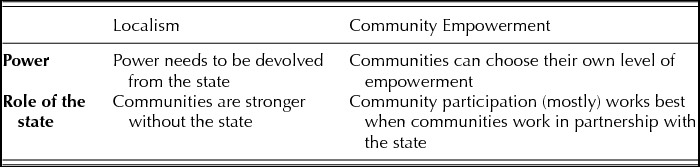
In examining these policies from the perspectives of governance and governmentality theory, it is notable that both agendas make clear statements about power and the role of the state. Whilst there are substantial similarities, a more detailed analysis (Rolfe, Reference Rolfe2016) highlights significant differences in these areas.
In relation to power, the critique of state centralisation at the heart of Localism creates a drive towards decentralisation in ‘a determined programme to ensure that that power is given away to the lowest level’ (DCLG, 2010: 2). The Scottish Government also emphasises the importance of communities gaining more power, but in contrast to Localism, there is a repeated emphasis that communities should be able to choose their own level of empowerment and that the approach to empowerment will vary between communities (Scottish Government, 2014). Although this notion of ‘level of empowerment’ is not spelled out, the surrounding rhetoric suggests a range of options from more consultative forms of involvement to ownership and control of assets or services, echoing Arnstein's (Reference Arnstein1969) seminal ladder of citizen participation.
The UK Government's critique of state centralisation also has implications for the role of the state, leading to the assumption that communities are stronger when the state withdraws to leave space for community action (DCLG, 2010). By contrast, the Scottish Government's approach emphasises the importance of partnership between communities and the local state (Scottish Government, 2011). Table 1 summarises these core assumptions.
Key assumptions of Localism and Community Empowerment
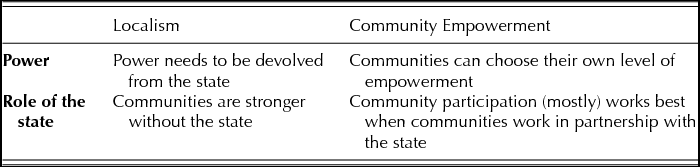
Importantly, these differences are central to the question of whether Localism and Community Empowerment imply a shift towards governance through local partnerships with communities in which the balance of power and responsibility is openly negotiated, or processes which manipulate communities into accepting additional responsibilities. On the surface, both policy agendas can be seen as manifestations of the shift from government to governance, recognising the limitations of top-down intervention and attempting to draw on the resources of communities. However, it is also possible to argue that the language of devolving power is a governmental technique, a false carrot tempting communities to take on greater responsibilities. Indeed, early policy rhetoric surrounding both agendas explicitly referred to communities taking on more responsibility (Conservative Party, Reference Party2009: 2; Scottish Government and COSLA, 2009: 5). Although the emphasis has shifted towards communities gaining power, arguably there are differing conceptions of power underlying these policy assumptions. Whilst the Scottish Government emphasis on partnership suggests a positive-sum conception of power, whereby communities and the state can generate collective power by working together, Localism implies a zero-sum view, whereby communities can only gain power if it is taken away from the state (Lowndes and Pratchett, Reference Lowndes and Pratchett2012; Rolfe, Reference Rolfe2016).
This study therefore examines the implementation of Localism and Community Empowerment at a local level, exploring the ways in which these inbuilt assumptions play out on the ground, to assess what community participation policy and practice have to say about ideas of governance and responsibilisation.
Methods
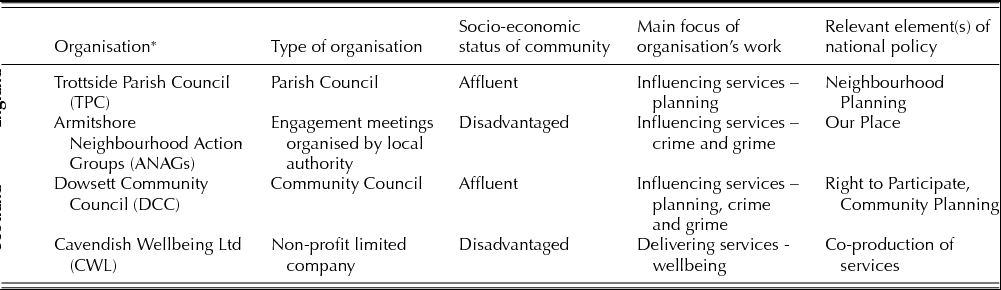
The research involved six case studies of community participation processes, three in each country, examining implementation and impacts of Community Empowerment and Localism. The cases were selected to examine different types of community participation, particularly the use of different aspects of Community Empowerment and Localism. Thus, participating organisations in England were selected to include the explicit or implicit application of three different ‘Community Rights’ from the Localism Act; whilst organisations in Scotland were chosen to represent a range of community action within the Community Empowerment agenda, since the Act itself was yet to be enacted at the time of the fieldwork. Alongside this, the participating organisations were selected to include communities with different socio-economic status (SES) within each national context. The SES of each community was assessed primarily using the relevant Index of Multiple Deprivation for each country, with unemployment level and average income employed as secondary measures to confirm the initial categorisation. Within each country, one organisation was selected within each of three types of area: an ‘affluent’ community, lying within the 40 per cent least deprived areas, with lower than (national) average unemployment and higher than average incomes; a ‘disadvantaged’ community, lying within the 40 per cent most deprived areas, with higher than average unemployment and lower than average incomes; and a ‘middling/mixed’ community, with parts above and below the 50th percentile of the multiple deprivation index, and roughly average unemployment and incomes. Inevitably six in-depth case studies produce large amounts of complex data, so for reasons of space and clarity, this article focuses only on the affluent and disadvantaged case studies in each country, set out in Table 2. Focusing on these two pairs of case studies enables specific analysis of the role of socio-economic status in community participation processes.
Participant community organisations

*The names of the organisations have been anonymised, to preserve confidentiality for individual activists.
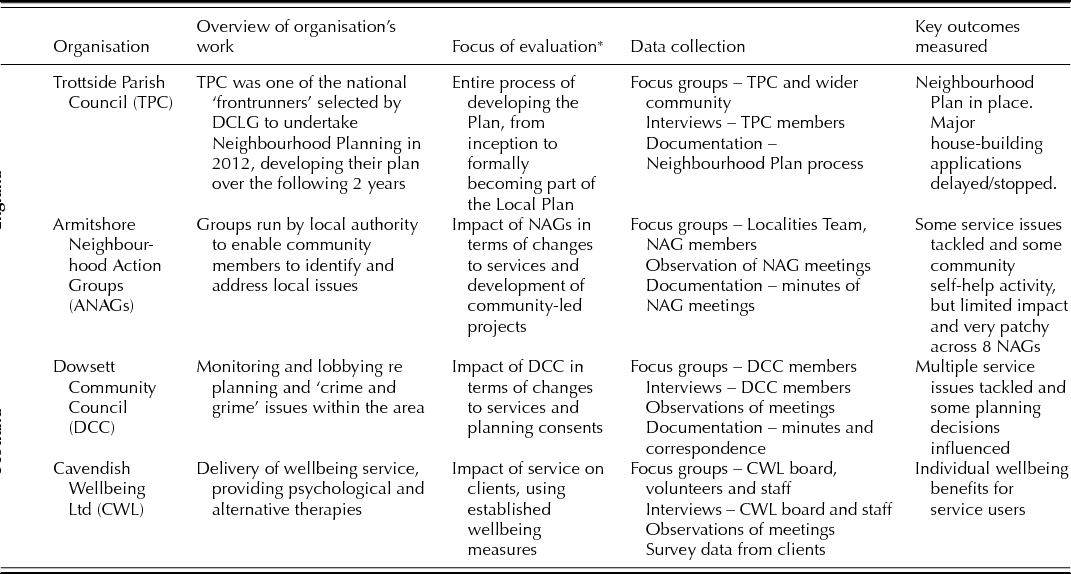
In each case the work of the participant community organisation was evaluated collaboratively, to examine impact, processes and causality. Discussion with each organisation at the outset of the research determined whether their evaluation looked at the work of the organisation overall, or focused on a particular project. Data was collected collaboratively over a two-year period (2013-15). The forms of data and methods of collection varied between case studies (because the relevant processes, outputs and outcomes varied), but involved a mix of focus groups and interviews with organisation members, observations of meetings and events, documentation from the organisations and surveys of service users. Table 3 provides a brief overview of the work of each organisation, together with the focus of the evaluation undertaken through the fieldwork, data collected and the key outcomes measured.
Summary of processes examined through evaluation work with participant organisations

* The level and type of community engagement with each organisation was also examined in all the evaluations
Interviews were also conducted with relevant Council officers in each case, to ‘triangulate’ the data (Alexander et al., Reference Alexander, Thomas, Cronin, Fielding, Moran-Ellis and Gilbert2008). The combination of a collaborative approach, detailed observations and triangulation data was particularly valuable in exploring the ‘forms of knowledge’ which are posited by governmentality theory, enabling an examination of each organisations’ work from ‘inside’ and ‘outside’.
The data was employed to develop an assessment of impact and causation, for discussion and reflection with the participant organisation within each case study and, in agreement with the organisations, analysed separately for the broader research project. This analysis focused on the key policy assumptions of Community Empowerment and Localism relating to power and the role of the state laid out in Table 1. Data from interviews, focus groups and observation notes was coded using a framework to identify evidence supporting, contradicting or adding complexity to each key assumption, primarily focusing on the processes of community participation. Additional analysis of documentation was also undertaken to examine outcomes. Thus the English case study data was examined to identify the extent to which Localism is leading to devolution of state power and state withdrawal from areas of community action, whilst the Scottish case studies were analysed to explore the forms of choice over ‘level of empowerment’ exercised by communities and the nature of partnership working between state and communities.
Power and responsibility
The English case studies each provide some evidence that Localism is devolving power from the state to communities since the community organisations each gained some influence and generated local impacts (as Table 3 indicates). For Trottside Parish Council (TPC), devolution of planning authority through the Neighbourhood Plan enabled TPC to control development scale and pace by restricting developments to no more than thirty houses – a position eventually reinforced by the Secretary of State's refusal of longstanding planning appeals in 2017. And although the Armitshore Neighbourhood Action Groups (ANAGs) generated smaller impacts, their role in identifying and monitoring local issues led to some minor service issues being addressed, plus isolated examples of community-led action producing new facilities, such as a community garden. The detailed evidence from the case studies, however, provides a more nuanced picture of how power operates in practice within the Localism framework.
TPC explicitly accepted the additional responsibility of developing local planning policy with their community in order to acquire new powers to manage development pressure:
to give us a balance to accommodate all those in the community. . . rather than relying on the business model of large-scale developers, who want the biggest profit regardless of whether the housing is appropriate (TPC member)
Notably, this decision to engage in Neighbourhood Planning was underpinned by the depth of professional expertise at their disposal:
at that first meeting we had an architect, a lawyer and. . . the head of transport planning who's now retired, all volunteering to get involved. . . it was brilliant to see them come through. (Community member)
However, having successfully produced their Plan and steered it through the legally required referendum, final approval was significantly delayed by legal challenges from developers. Although the High Court challenges were defeated, activists described a sense of being ‘bullied’ by the developers’ legal team during the examination and court case:
This is a game for the lawyers at the end of the day. They interpret every single word, every single syllable, in a way that meets their clients needs. . . You got the impression that these barristers felt that planning law belonged to the developers – that it was their game and anyone else who got involved were just little kids. (Community member)
Moreover, community members expressed considerable concern that the legal and financial power of the developers would affect the implementation of the Plan, since the local authority may be wary of potential litigation:
There seems to be a split between the strategic planners who seem to be involved in the Neighbourhood Plan and the people who are involved in all the applications, who seem to be fighting against the Neighbourhood Plan wherever possible and only take it into account as and when they felt they had to. . . The Planning Department is terrified of being sued by the developers. (Community member)
Thus, the influence of private sector developers left TPC members with a sense of significantly constrained power, accompanied by far greater responsibility and personal stress than they had anticipated.
Unlike TPC, community members in Armitshore explicitly resisted taking on responsibility through the NAGs – when the NAGs were offered a budget of £2000, only two of the eight accepted:
People want to take part and want to engage, but don't want to take responsibility. . .they don't want the responsibility for money. (Localities Manager).
Notably, this reluctance was understood by the Localities Team as being partly driven by concerns about responsibilities for which NAG members did not have the necessary skills, but also by fear about the social risks involved in managing money and the possibility of ‘getting it wrong’ (Locality Officer).
The Armitshore case study also raises questions about constraints on community power, primarily resulting from the context of austerity. The Our Place notion that communities will be able to shape services to meet local needs was undermined in the NAGs by public sector cuts:
Nine out of ten things being raised at a meeting are because of the impact those cuts have had in the community. Whether it's because the bins aren't being emptied, because the grass isn't being cut or it's not good enough. . . There's a whole host of things that are now landing on our table. (Locality Officer)
This perspective was confirmed through observations of NAG meetings, during which the majority of issues raised by residents were about reduced service levels, rather than ‘normal’ service failures. Moreover, analysis of NAG minutes for all meetings in 2014 indicated that at least half the service-related issues were at best partially resolved, with Council officers frequently citing budget cuts as a barrier to improvement. Thus austerity acted to significantly constrain the devolved decision-making power available to Armitshore communities.
The English case studies therefore suggest that, whilst the ‘new community rights’ offered by Localism may create opportunities for communities to gain power, such opportunities may come with not just responsibility, but also risk: such as TPC's experience of stress induced by the High Court challenge or financial/social risk in the Armitshore NAGs. Moreover, different communities may take very different approaches to such opportunities, depending on their view of responsibility and risk. Whereas NAG members avoided risk and responsibility, TPC's approach was that a degree of risk and considerable extra responsibility was a price worth paying for power, albeit that they encountered more risk and responsibility than anticipated. The evidence suggests that differences in skills, experience and confidence played a significant role in such decisions, with a more affluent community such as Trottside being in a stronger position to take on risk and responsibility in return for power than more disadvantaged communities such as those in Armitshore.
These cases also highlight the ways in which community power can be significantly constrained by other actors and factors, such as the influence of private sector developers in the planning system and the impacts of austerity on local government services.
The Scottish case studies also provide some apparent support for the Scottish Government assumption that communities should be able to choose their own level of empowerment. In particular, Dowsett Community Council (DCC) made explicit choices regarding their approach to crime and grime issues. Observations of DCC meetings and analysis of minutes evidenced their lobbying approach to litter, maintaining a clear position that such issues are a local authority responsibility, and their resistance to Council attempts to engage volunteers in litter picks, even overtly criticising two members who cleared litter from their street. By contrast, they engaged proactively with the local police on a crime prevention programme, taking responsibility for local sales of property marking products and taking ownership of the programme, willingly accepting the responsibility and financial risk of purchasing products for sale.
These strategic choices had variable outcomes, but the evidence from DCC shows a much higher success rate than the Armitshore NAGs in terms of service issues being addressed. Whereas Armitshore residents were not collectively self-organised and therefore often failed to follow through on challenging, long-term issues, DCC demonstrated a dogged determination in raising issues with local agencies, employing ‘eternal vigilance’ (DCC member) in tackling issues.
The Cavendish Wellbeing (CWL) case study illustrates more constrained choices in terms of level of empowerment. The internal ethos of CWL is very much about empowerment, offering service users choices around participation, from basic consultation in service design, to voluntary involvement in delivering services as part of their approach to individual empowerment:
It's more about, ‘you can do this too – you can help other people’. Which means people have confidence in themselves beyond just receiving help. (CWL service user)
However, this contrasts with the experience of CWL Board members, many of whom reported feeling that they needed to take on excessive responsibility to ensure CWL's continued existence. Moreover, observations of meetings highlighted the extent to which Board members were not only unaware of their personal liability prior to CWL's incorporation, but also entirely reliant on the organisation's Manager for expertise, particularly in relation to funding opportunities, creating significant risks for the organisation's sustainability:
I don't know what we'd do without [CWL Manager]. She gets all the money in and keeps on top of everything. She's kind of. . . it's like she's the heart of the organisation and the brains too. (CWL Board member)
This constrained choice and potentially risky reliance on one staff member was accentuated during the period of the research by local authority funding cuts and the ending of multi-year grants, creating additional anxiety amongst Board members.
Thus, whilst there is evidence of situations in which community organisations are able to make relatively free choices about their level of empowerment, the Scottish case studies also illustrate constraints on choice arising from wider factors, including austerity and unequal community capacity. Moreover, as with the English case studies, the evidence suggests that communities are not merely choosing their ‘level of empowerment’, but making constrained choices about the responsibilities and risks they are prepared to accept in exchange for power.
The role of the state
The English case studies provide mixed evidence regarding Localism's assumption that communities are stronger without the state, in part because the local state seems reluctant to withdraw from involvement in communities, regardless of national policy. In Trottside and Armitshore, the local authority provided substantial officer support for Neighbourhood Planning and managing the NAGs, as well as direct involvement of Ward Councillors.
However, these cases also raise questions about the role of the state in the context of austerity, since both the Spatial Planning and Localities Teams faced 50 per cent staffing reductions towards the end of the research period, leading to changes in approach. Whilst officers believed that Neighbourhood Planning and the NAGs would continue to be supported, there was considerable concern that the reduction in hands-on support would create unequal outcomes:
[some communities] have the professionals within their area. And I think not all communities have the technical and professional expertise to call on, and I think that's a difficulty with the system – that, if it's not there, it's very difficult to be able to bring forward [Neighbourhood] Plans. (Council Spatial Planning Officer)
Thus the suggestion is that staffing reductions arising from budget cuts could mean that Localism exacerbates inequalities, with disadvantaged communities far less able to take advantage of its ‘opportunities’.
The Scottish case studies provide relatively strong support for the Scottish Government assumption that community participation works most effectively when communities work in partnership with the local state. In both Dowsett and Cavendish, the community organisations highlighted the importance of these supportive working relationships with officers and Councillors in achieving their aims, providing direct conduits to influence services (DCC) or financial support and referrals (CWL). Interestingly, however, in both cases these positive relationships coexisted with more conflictual or problematic relationships with other parts of the local state, sometimes within the same agency. Thus, CWL had a very problematic relationship with the local Health Board, even as they worked closely with local GPs, whilst DCC's Chair characterised the local authority as ‘corruption cloaked in incompetence’, despite cordial and constructive relationships with local Councillors and some officers. Unlike the situation in England, the Scottish case studies were not affected by staffing reductions, reflecting the later imposition of local government cuts in Scotland.
Looking across all four case studies, the evidence demonstrates the extent to which communities and local public sector agencies (particularly local government) have complex, intertwined relationships which are not easily unwound. Whilst it is difficult to be conclusive about the effectiveness of these partnerships, they are clearly sought by community organisations and supported by agencies. The impacts of austerity on these relationships were only beginning to emerge during this study, but there are obvious concerns about the potential effects of budget cuts, not least in terms of the differential ability of community organisations to manage independently.
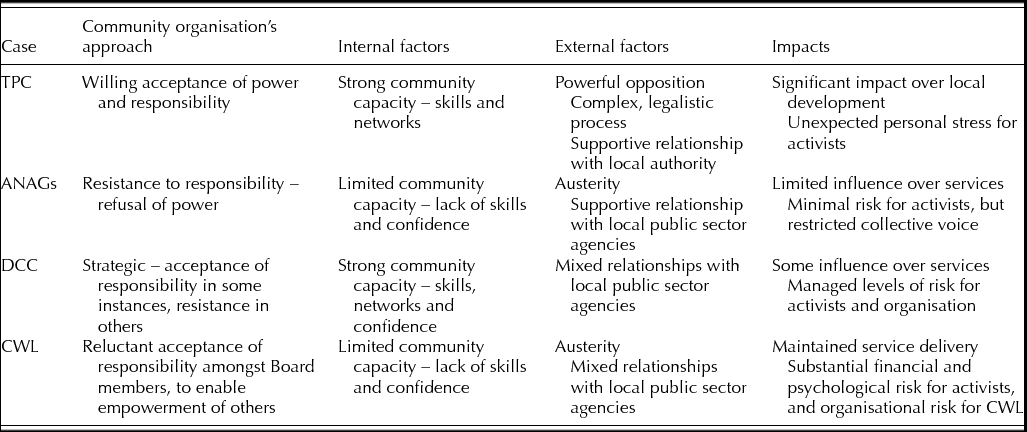
This evidence also illustrates the overlaps between the two sets of assumptions, since relationships with local state agencies are clearly a key contextual factor affecting the balance of power and responsibility. Table 4 summarises the findings for each case, setting out the interplay between different internal and external factors that shaped the organisation's approach and the impacts in each situation.
Summary of findings

Discussion
These case studies provide significant empirical evidence to examine governance and governmentality theories in the field of community participation. At a surface level, there is support for the notion of a shift from government to governance, with communities being encouraged to address issues not readily amenable to top-down state intervention. Although the process is far from straightforward or unproblematic, there is some evidence that communities can gain power through opportunities presented by both Localism and Community Empowerment, influencing local developments and public services, or taking direct control of services/facilities. Indeed, instances such as CWL's provision of wellbeing services suggest that a ‘steering’ state can enable communities to generate outcomes beyond the reach of government. Alongside this, however, all of the case studies provide evidence that these new opportunities also involve responsibilities being shifted from the state onto communities, suggesting that the governmentality thesis of responsibilisation may also have some traction.
However, this study also suggests that neither governance nor governmentality theories in their standard form are sufficient to explain the complex processes of community participation, for three main reasons.
Firstly, key points in the experience of all the participant community organisations point to the importance of considering risk, alongside issues of responsibility and power. Governmentality theorists have tended to focus purely on responsibilisation (Rose, Reference Rose1996; Raco and Imrie, Reference Raco and Imrie2000), whilst the rhetoric surrounding both Localism and Community Empowerment focuses largely on the devolution of power, with less frequent mentions of responsibility (DCLG, 2010, 2011; Scottish Government and COSLA, 2009; Scottish Government, 2014). Neither theorists nor policy-makers explicitly consider the relevance of risk, in the sense of unpredictable outcomes involving physical, social, psychological or financial harm (Tulloch and Lupton, Reference Tulloch and Lupton2003). The evidence from this study highlights the significant personal and organisational risks which can arise from community participation processes, including unexpected stress (TPC), damage to social relationships (ANAGs) and financial liability (CWL), and also demonstrates the unpredictability of many such negative outcomes.
Moreover, it is evident that the relationships between power, responsibility and risk are not symmetrical. Whilst power inevitably leads to additional responsibility and potential risk for communities, the reverse is not necessarily true, since communities may adopt substantial responsibility and face considerable risks, with no guarantee of increased power. Thus, for example, CWL remain in a relatively fragile financial position and therefore have significant constraints on their power to deliver services and meet needs, despite the responsibility and risk taken on by the board. Indeed, the evidence from this study suggests that the state may be deliberately devolving risk alongside responsibility in some instances, outsourcing a degree of blame for decisions around planning (TPC and DCC) and service design/delivery (ANAGs). In this respect the processes of power theorised within governmentality influence the mathematics of zero-sum or positive-sum conceptions of power, and also the level of responsibility or risk involved. Hence this asymmetry not only provides an important lens to understand both governance and governmentality in practice, but also creates an intriguing conceptual bridge between the Foucauldian notion of responsibilisation and the notion of a ‘risk society’ (Beck, Reference Beck1992; Adam et al., Reference Adam, Beck and Van Loon2000), where risk is pervasive, certainty and control are impossible and the state is unable or unwilling to offer sufficient insurance or reassurance.
Secondly, the evidence from across the case studies highlights the agency of community organisations, opening the possibility of resistance to responsibilisation by communities, as others have previously suggested (McKee and Cooper, Reference McKee and Cooper2008; McKee, Reference McKee2011). Crucially, such agency operates not merely to resist responsibility, but enables communities to make explicit decisions about which risks and responsibilities they are prepared to accept in exchange for increased power. However, the level of agency and the opportunities that it accords appears to be significantly shaped by the nature of each community and, in particular, the socio-economic gradient in community capacity (McCulloch et al., Reference McCulloch, Mohan and Smith2013; Moore and McKee, Reference Moore and McKee2014). Although a handful of case studies in varied contexts can only provide tentative evidence for the interactions between socio-economic status, community capacity and community agency, it is notable that the same pattern of inequality seems to operate in both nations (reinforced by the evidence from the two case studies not reported here). Thus, organisations in more advantaged areas such as TPC can deliberately adopt responsibility in order to gain power and manage the consequent risks, whilst those in more disadvantaged areas such as Armitshore may refuse the opportunity of additional control to avoid the accompanying risks and responsibilities.
Lastly, it is apparent that the state plays a complex role in relation to communities and community participation at a national and local level. Whilst Localism and Community Empowerment have been instigated by national governments, this study highlights the role of the local state in shaping the political opportunity structure (Tarrow, Reference Tarrow1994; Maloney et al., Reference Maloney, Smith and Stoker2000). Existing evidence indicates the ways in which local state agencies can constrain community agency and hold on to power (Dillon and Fanning, Reference Dillon and Fanning2011), or share power and help to build community capacity (de Graaf et al., Reference de Graaf, van Hulst and Michels2014). This study demonstrates the complexity of situations in which the local state may do both of these things at once, supporting and undermining community participation simultaneously, with unpredictable implications for the balance between power, responsibility and risk, particularly where the boundaries between communities and local authorities are blurred.
Crucially, however, the evidence from this study suggests that the agency of communities and the local state may be outweighed by the impacts of austerity (Hastings et al., Reference Hastings, Bailey, Gannon, Besemer and Bramley2015b). Although the timing of the research means that the impacts of austerity at a local level were still emerging during the fieldwork, there is notable evidence of impact and clear indications of future effects. Thus communities, particularly where they have limited capacity in terms of skills, experience and confidence, may struggle to benefit from the ‘opportunities’ presented by national community participation policy, either because they lack support to develop organisational capacity, or because they are forced into a defensive mode as essential services are cut.
Conclusion
This study presents evidence of a shift from government to governance as the state ‘steps back’ and seeks the involvement of communities in a range of areas, potentially offering opportunities for them to gain new powers. Alongside this, the apparent willingness of community organisations to take on new tasks provides evidence for the governmentality notion of responsibilisation, suggesting that communities have internalised the rhetoric that precludes alternatives to public austerity and local responsibility.
However, the study also demonstrates clearly that the practical implementation of community participation policy is more complex than governance theory or ideas of governmentality might suggest. Rather, community participation processes need to be analysed as dynamic interactions between communities and the local state, within which the key questions relate not just to responsibility, but also to risk and power, and the balance between these three elements. Crucially, communities can have significant agency in making decisions about responsibility, risk and power, as ‘active subjects’ (Taylor, Reference Taylor2007). The level of agency in each situation is shaped by community capacity, in terms of communities’ ability to assess and manage the risks, responsibilities and power involved. Such collective capacity seems to demonstrate a distinct socio-economic gradient (McCulloch et al., Reference McCulloch, Mohan and Smith2013), reinforcing concerns that community participation policies can become regressive, imposing greater risks and responsibilities upon more disadvantaged communities in return for lower levels of power (Hastings et al., Reference Hastings, Bailey, Bramley, Gannon and Watkins2015a; Kennett et al., Reference Kennett, Jones, Meegan and Croft2015).
These inequalities between communities are also affected by the complex role of different parts of the state. At a local level, public sector agencies retain institutional and bureaucratic power despite some degree of movement from government to governance and therefore can either support or constrain the agency of communities. Perhaps more importantly, this study suggests that austerity and the consequent cuts to local government budgets may be undermining the possibility of tackling inequalities between communities at a local level. Rather, the constraints of austerity may mean that Localism and Community Empowerment are in danger not merely of ‘empowering the powerful’ (Hastings and Matthews, Reference Hastings and Matthews2014), but also disempowering the powerless. Indeed, even though the rhetoric of Community Empowerment takes much more cognisance of inequalities, the apparent policy divergence between Localism and Community Empowerment (Keating, Reference Keating2005, Rolfe, Reference Rolfe2016), may be evened out in practice by the fiscal bulldozer of austerity.
Such issues are also important in examining the turn towards community participation outside the UK, particularly in the context of widespread state retrenchment and anaemic economic growth over the past decade. Research which aims to understand the impacts of community participation policy needs to move beyond notions of power sharing or responsibilisation to consider the dynamic interplay between active communities and states at a local level, whilst taking into account the effects of this broader context. Further research on a larger scale, particularly with a longitudinal element, would be of considerable value in exploring the longer-term implications for communities of accepting or resisting risk and responsibility. These additions to the ideas of governance and governmentality in the context of austerity may also have relevance for international debates regarding changes in the nature of government which stretch well beyond community participation policy.
Acknowledgements
The author would like to acknowledge the support of Prof. Mhairi Mackenzie and Prof. Annette Hastings in developing this article.
The original research was funded by the Urban Studies Foundation.