




No CrossRef data available.
THE VARIANCE RATIO STATISTIC AT LARGE HORIZONS
Published online by Cambridge University Press: 09 February 2006
Abstract
We make three contributions to using the variance ratio statistic at large horizons. Allowing for general heteroskedasticity in the data, we obtain the asymptotic distribution of the statistic when the horizon k is increasing with the sample size n but at a slower rate so that k/n → 0. The test is shown to be consistent against a variety of relevant mean reverting alternatives when k/n → 0. This is in contrast to the case when k/n → δ > 0, where the statistic has been recently shown to be inconsistent against such alternatives. Second, we provide and justify a simple power transformation of the statistic that yields almost perfectly normally distributed statistics in finite samples, solving the well-known right skewness problem. Third, we provide a more powerful way of pooling information from different horizons to test for mean reverting alternatives. Monte Carlo simulations illustrate the theoretical improvements provided.The authors thank Bruce Hansen and the referees for useful suggestions and comments that greatly improved the paper. The first author's research was supported by NSF grant DMS-0306726.
Information
- Type
- Research Article
- Information
- Copyright
- © 2006 Cambridge University Press
1. INTRODUCTION
The variance ratio (VR) statistic is one of the popular tests that has been employed in the literature to test the random walk hypothesis for financial and economic data. The statistic is obtained as the sample variance of k-period differences, xt − xt−k, of the time series xt, divided by k times the sample variance of the first difference, xt − xt−1, for some integer k. The VR statistic has been found by several authors (see, e.g., Faust, 1992) to be particularly powerful when testing against mean reverting alternatives to the random walk model, particularly when k is large. However, the practical use of the statistic has been impeded by the fact that the asymptotic theory provides a poor approximation to the small-sample distribution of the VR statistic. More specifically, rather than being normally distributed as the theory states, the statistics are severely biased and right skewed for large k (see Lo and MacKinlay, 1989), which makes application of the statistic problematic. To circumvent this problem, Richardson and Stock (1989) derived the asymptotic distribution of the VR statistic under the random walk null, assuming that both k and n increase to infinity but in such a way that k/n converges to a positive constant δ that is strictly less than 1. They showed that the VR statistic, without any normalization, converges to a functional of Brownian motion. Through Monte Carlo simulations, they demonstrated that this new distribution provides a far more robust approximation to the small-sample distribution of the VR statistic. However, Deo and Richardson (2003) have recently shown that the VR statistic is inconsistent against an important class of mean reverting alternatives under this framework. Thus, though the VR statistic would have vastly improved size properties under the null hypothesis of a random walk if k were chosen to be a fraction of the sample size n, it would fail to detect such alternatives with probability approaching 1 as the sample size increased. Currently there is no proposal in the literature that provides a way of using the VR statistic without compromising either its finite-sample size properties or its large-sample power properties.
With this backdrop, we provide several contributions to the literature. First, it is intuitively appealing to maintain the assumption that the multiperiod horizon k is large, not least because longer horizons have a better chance of capturing mean reversion in the series. Thus, under general conditions that allow for conditional heteroskedasticity in the innovations, we study the limiting behavior of the VR statistic for large k but now under the restriction that k/n → 0. Specifically, we show that when k → ∞, n → ∞, but k/n → 0, then under the null of a random walk, the VR statistic is asymptotically normal with a mean of 1. The requirement that k is large is important because as stated before, previous authors have shown that large values of k are to be preferred when testing for mean reversion. Furthermore, we prove that under this alternative distribution theory, the test is consistent, in that the probability of it detecting a wide variety of mean reversion alternatives approaches 1 as the sample size n increases.
Unfortunately, this new distribution does not solve the well-documented skewness problem of the VR statistic's sampling distribution. The second contribution of this paper is to propose a method that is shown to improve the asymptotic normal approximation to the distribution of the statistic by an order of magnitude in finite samples, via a simple power transformation of the VR statistic. Monte Carlo simulations confirm the theoretical assertion of the vast improvement of the normal approximation afforded by the power transformation. Our Monte Carlo simulations also show that this improvement in the normal approximation leads to significant gains in power against mean reverting alternatives. Our simulations also show that the performance of the test based on using the Richardson and Stock asymptotics is sensitive to both sample size and conditional heteroskedasticity. Furthermore, using the Richardson and Stock asymptotics also results in uniformly lower power when compared to the new asymptotic approach that we present. Thus, our new approach uniformly dominates the Richardson and Stock asymptotic approach.
The third contribution of this paper is to implement a new joint test that uses VR statistics computed at different differencing periods to test the random walk null hypothesis. The joint test statistic that has been studied so far in the literature is the Wald type chi-square test statistic that jointly tests whether a sequence of population variance ratios at several differencing periods all equal 1. However, this test is blind to the inherent one-sided nature of a mean reverting alternative hypothesis, because under such an alternative all the population variance ratios should be less than 1. See Lo and MacKinlay (1989). In this paper, we adapt a test procedure proposed by Follmann (1996) for testing against one-sided alternatives for the mean vector of a multivariate normal distribution. Our Monte Carlo simulations show that this adapted test in combination with the power transformation results in significant power gains over the usual chi-square test when testing for mean reverting alternatives, while retaining the appropriate size.
The paper is organized as follows. In Section 2, we define the VR statistic and provide its asymptotic distribution under conditional heteroskedasticity for large k such that k−1 + k/n → 0. We also demonstrate in that section that in this framework the VR statistic is consistent against a wide range of alternatives. In Section 3, we provide an alternative equivalent representation of the VR statistic that motivates the power transformation that provides a better approximation to the normal distribution. A new joint test that combines information from several differencing periods and is useful against one-sided alternatives is also introduced. Section 4 presents Monte Carlo results for the various statistics that we have proposed under two different null hypotheses and three alternative hypotheses. All technical proofs are relegated to the Appendix.
2. ASYMPTOTIC THEORY FOR THE VARIANCE RATIO STATISTIC
Given n + 1 observations x0,x1,…,xn of a time series, the VR statistic with a positive integer k(< n) as differencing period is defined as

where

In the usual fixed k asymptotic treatment, under the null hypothesis that the {xt} follow a random walk with possible drift, given by

where μ is a real number and {εt} is a sequence of zero mean independent random variables, it is possible to show (see, e.g., Lo and MacKinlay, 1988) that

where σk2 is some simple function of k. This result extends to the case where the {εt} are a martingale difference series with conditional heteroskedasticity (see, e.g., Campbell, Lo, and MacKinlay, 1997), though the variance σk2 has to be adjusted to account for the conditional heteroskedasticity. However, the asymptotic behavior of the VR statistic for large values of k, such that k−1 + k/n → 0, is not known when the innovations εt are conditionally heteroskedastic. In this section, we provide precisely this asymptotic distribution, in obtaining which the following assumptions on the series of innovations {εt} are made.
(A1) {εt} is ergodic and

for all t, where

is a sigma field, εt is

measurable, and

for all t.
(A2) E(εt2) = σ2 < ∞.
(A3) For any integer q, 2 ≤ q ≤ 8, and for q nonnegative integers si,

when at least one si is exactly one and

.
(A4) For any integer r, 2 ≤ r ≤ 4, and for r nonnegative integers si,

when at least one si is exactly one and

, for all t < ti, i = 1,2,3,4.
(A5)

uniformly in j for every j > 0.
(A6)

.
Conditions (A1)–(A6) allow the innovations εt to be a martingale difference sequence with conditional heteroskedasticity. As a matter of fact, Lemmas 1 and 2, which follow, show that the stochastic volatility model (see Shephard, 1996) and the GARCH model (Bollerslev, 1986), which are two of the most popular models in the literature for conditional heteroskedastic martingale differences, satisfy conditions (A1)–(A6). Conditions (A3)–(A4) state that the series {εt} shows product moment behavior similar to that of an independent white noise process. Conditions (A5)–(A6) state that εt and εt−n are roughly independent for large lags n.
The following two lemmas assert that two major models of conditionally heteroskedastic martingale differences, namely, the stochastic volatility model and the generalized autoregressive conditionally heteroskedastic (GARCH) model, satisfy the assumptions (A1)–(A6). The proofs of the lemmas are in the Appendix.
LEMMA 1. Let the series {εt} be generated by the stochastic volatility model

where {vt} is an independent (0,σv2) stationary series, {ht} is a stationary zero mean Gaussian series, and {vt} and {ht} are independent. Assume that E(vt8) < ∞. Then {εt} satisfies the assumptions (A1)–(A6).
See Shephard (1996) for a discussion of model (3) and its applications.
Our next lemma asserts that under some conditions the GARCH(1,1) family of models also satisfies conditions (A1)–(A6). We have restricted attention to the GARCH(1,1) case for simplicity of exposition. We conjecture that conditions (A1)–(A6) will continue to hold for a general GARCH(p,q) model, the proof following along similar lines by referring to the work of Bougerol and Picard (1992).
LEMMA 2. Let the series {εt} be a GARCH(1,1) process given by

where σt2 = ω + βσt−12 + αεt−12 and {vt} is a sequence of independent standard normal variables. Let ω > 0, β ≥ 0, and α > 0. Furthermore, let α and β be such that E {loge(β + αvt2)} < 0 and E {(β + αvt2)4} < 1. Then {εt} satisfies the assumptions (A1)–(A6).
The condition E {loge(β + αvt2)} < 0 in Lemma 2 is satisfied by any pair (α,β) in the set S = {(α,β) : α + β < 1} (see Nelson, 1990), whereas the condition E {(β + αvt2)4} < 1 will be satisfied by a nonempty subset of S (see Bollerslev, 1986).
We now state our result on the limiting distribution of the VR statistic in the following theorem.
THEOREM 3. Let the series {xt} satisfy equation (2) and assume that conditions (A1)–(A6) hold. For a fixed positive integer s, let k1 < k2 < ··· < ks < n be positive integers such that k1 → ∞, ksn−1 → 0, and ki kj−1 → aij for 1 ≤ i ≤ j ≤ s. Let Dn be an s × s diagonal matrix with diagonal elements

. Then

where Vn = (VR(k1),VR(k2),…,VR(ks))′, 1 is an s × 1 vector of ones and Σ = (σij) is an s × s matrix such that σij = 4aij1/2(3 − aij)/6.
Note that the limiting distribution of the VR statistic is free of nuisance parameters and is identical to that obtained when the εt are assumed to be independent. See Theorem 9.4.1 of Anderson (1994). Furthermore, the VR statistics computed at different differencing periods ki are asymptotically independent when ki kj−1 → 0 for i < j. Both of these results are in contrast to those obtained when the differencing periods are fixed and not allowed to increase to infinity with the sample size. See Lo and MacKinlay (1989). It is interesting to note that the limiting distribution of the VR statistic is free of nuisance parameters depending on higher moments that might arise as a result of conditional heteroskedasticity. This is quite different from the behavior of other tests of the random walk hypothesis in the presence of conditional heteroskedasticity. See Deo (2000).
We have established the asymptotic distribution of the VR statistic under the null hypothesis of a random walk with conditional heteroskedasticity when k → ∞, n → ∞, and k/n → 0. The next theorem states that under this framework, the VR statistic also provides a consistent test against a large class of mean reverting alternatives.
THEOREM 4. Let {et} and {ut} be two series of zero mean independent processes with finite fourth moments and which are independent of each other. Define the processes {yt} and {zt} by

, where |aj| ≤ Cλj and |bj| ≤ Cλj for some constant C and 0 < λ < 1. Let rt = μ + rt−1 + zt and xt = rt + yt. If k → ∞, n → ∞, and k/n → 0, then
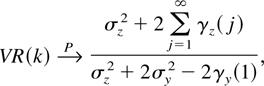
where σz2 and σy2 are the variances of zt and yt, respectively, whereas γz(j) and γy(j) are the respective autocovariances at lag j.
Theorem 4 shows that the power properties of the VR statistic under the k/n → 0 framework are markedly different from those when k/n → δ > 0, in which case Deo and Richardson (2003) have shown the VR statistic to be inconsistent against the alternatives considered in Theorem 4.
Though the VR statistic has an asymptotic normal distribution when k/n → 0, it is obvious that in finite samples the normal distribution may not provide a good approximation because the statistic is a quadratic form and hence must be right skewed. A common method that has a long history in statistics to reduce skewness and induce normality in such random variables is to consider power transformations. The obvious question, naturally, is which power one should use, and we address this question for the VR statistic in the next section.
3. POWER TRANSFORMATIONS OF THE VARIANCE RATIO STATISTIC
In attempting to address the skewness of the finite-sample distribution of the VR statistic, it helps to express the VR statistic in an alternative form, which lends more insight into how the normal distribution approximation can be improved. Inspection of the proof of Theorem 3 in the Appendix shows that

where

and

Now, using the fact that

where

is the periodogram, we get from (5)

where

As shown in part (i) of Lemma 7 in the Appendix, the integral in (6) can be approximated by a discrete sum over the Fourier frequencies λj = 2πj/n with error

, and hence we get

The behavior of VR(k) is thus dictated by the behavior of the periodogram values I(λj) at the Fourier frequencies. If the εt series is Gaussian, then it is well known (Brockwell and Davis, 1996) that the variables 2πI(λj)/σ2 are exactly independent and identically distributed (i.i.d.) standard exponential random variables for all sample sizes. This behavior of the variables 2πI(λj)/σ2 can be shown to continue to hold asymptotically if the εt are a martingale difference sequence with finite fourth moment, by applying the central limit theorem for martingale differences to

. These observations in conjunction with (7) and the fact that

imply that, in general, we may think of the VR statistic as being of the form

where the Vj are independent standard exponential random variables. As we next show, this approximate expression for the VR statistic as a weighted linear combination of independent standard exponential random variables helps us both to understand why the normal distribution provides a bad approximation for large k and also to obtain an appropriate power transformation that improves the normal approximation.
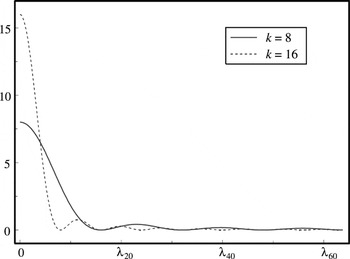
It is known (see, e.g., Anderson, 1994, p. 509) that Wk(λ) has a peak at the origin and then damps down to zero for values of λ further from the origin. Furthermore, the larger k is, the more quickly Wk(λ) damps down to zero, which can be seen in Figure 1, where we plot Wk(λ) for n = 128 and k = 8 and 16. Thus, for large values of k, we see from (8) that VR(k) will essentially be a sum of too few independent standard exponential random variables for the central limit theorem to properly take effect, resulting in right skewed distributions. However, Chen and Deo (2004) have recently shown that power transformations may be gainfully applied to random variables that have approximate linear representations of the form in (8), yielding much better normal approximations. Using their results (see Chen and Deo, 2004, eqn. (9)), it follows that if one sets

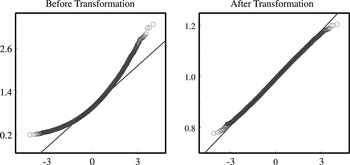
then the Gaussian distribution provides a better approximation to the distribution of VRβ(k) than to that of VR(k). Indeed, from the results of Chen and Deo (2004), the Gaussian distribution approximation to the distribution of VRβ(k) is an entire order of magnitude better than the Gaussian approximation to the distribution of VR(k). A dramatic visual display of this improvement is shown in Figure 2. The plot on the left is a QQ plot of 20,000 replications of the VR(k) statistic, based on a sample size of n = 128 and k = 16 where the εt are i.i.d. standard normal. The extreme curvature is indicative of the right skewness of the distribution of VR(k). The plot on the right is a QQ plot of VRβ(k), where β was computed using (9). The plot now shows a straight line as would be expected for observations from a normal distribution. The power transformation thus provides a very simple method of getting almost near perfect normality for the finite-sample distribution of the VR statistic. A standard Taylor series argument applied to the result of Theorem 3 yields the asymptotic distribution of VRβ(k), which can then be used for inference. However, we feel that because the power transformation is motivated by the representation (7), it might be preferable to redefine the VR statistic and also its power transformation directly in terms of the leading term of that expression, thus avoiding any effects of the remainder term on its finite-sample distribution. Toward that end, we now define the VR statistic based on the periodogram, for differencing period k, as

where

. Because the periodogram is shift invariant at nonzero Fourier frequencies, we have I[utri ]X(λj) = I(λj), and hence the VRp(k) statistic as defined in (10) based on the observed data

is identical to the first term in (7), which is based on the unobserved εt. It should be noted that this expression for the VR statistic, apart from the normalization of (1 − k/n)−1, which is just a finite-sample correction ensuring a unit mean, is precisely the normalized discrete periodogram average estimate of the spectral density of a stationary process at the origin and has a long tradition in time series analysis. See Brockwell and Davis (1996). From (7) it follows that VRp(k) will have the same asymptotic distribution as that of VR(k) given in Theorem 3 and hence, by the usual Taylor series argument, the asymptotic distribution of VRpβ(k) may be obtained. It is however preferable to have an expression for the variance of VRp(k), and thus for that of VRpβ(k), that is accurate in finite samples and accounts for the finite-sample effects of conditional heteroskedasticity. Toward this end, we first define the quantities Cn,k = n(n − k)−1 and

where

is an estimator of σ−4E(εt2εt−j2). In part (ii) of Lemma 7, we show that the finite-sample variance covariance matrix of Vp = (VRp(k1),VRp(k2),…, VRp(ks))′ with remainder terms of order o(ks2/n2) is consistently estimated by
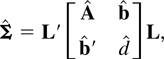
where L = (lk1,…,lks),


is a ks × 1 vector such that its jth element is given by

. We are now in a position to state the following theorem.

Wk(λ) for n = 128 and k = 8 and 16.

QQ plots of VR(k) and VRβ(k) on 20,000 replications with n = 128, k = 16 and εt ∼ N(0,1).
THEOREM 5. Let the series {xt} satisfy equation (2) and assume that conditions (A1)–(A6) hold. For a fixed positive integer s, let k1 < k2 < ··· < ks < n be positive integers such that k1 → ∞, ks n−1 → 0, and ki kj−1 → aij for 1 ≤ i ≤ j ≤ s. For each ki, let βi be given by (9) and define Vp,β = (VRpβ1(k1),VRpβ2(k2),…,VRpβs(ks))′. Then

where the (i,j)th element of Σβ is

and the ith element of μβ is

where

is the (i,j)th entry of

given in (11).
It is trivially seen that both

under conditions (A1)–(A6). Our next theorem shows that both VRp and VRpβ also retain the consistency of the VR statistic with regard to detecting the alternative hypotheses assumed in Theorem 4.
THEOREM 6. Let the assumptions of Theorem 4 hold. Then

where σz2 and σy2 are the variances of zt and yt, respectively, whereas γz(j) and γy(j) are the respective autocovariances at lag j.
We have, so far, obtained the joint distribution of the VRp statistic computed at various differencing periods. These VR statistics can be combined into a single statistic by computing the quadratic form

where Vp = (VRp(k1),…,VRp(ks))′. Because of the asymptotic normality of Vp, this quadratic form will have an asymptotic chi-squared distribution with s degrees of freedom under the null hypothesis of a random walk. The test statistic Qn can then be used to test whether the sequence of population variance ratios all equal one for i = 1,2,…,s. Because the quadratic form Qn is always positive, rejection of the null hypothesis of a random walk occurs only in the upper tail of the distribution of Qn. However, under the important alternative of mean reverting processes of the kind imposed in finance applications, the population variance ratios, given by

, are generally expected to be less than 1 for large k. For example, it can be easily shown that for the alternative models that are the sum of permanent and transitory components (see Poterba and Summers, 1988; Fama and French, 1988), VRP(k) is less than 1 for all values of k. Hence, under such mean reverting processes, the alternative hypothesis actually has the one-sided form Ha : VRP(k) < 1 for i = 1,…,s. In such circumstances, ignoring the one-sided nature of the alternative can lead to a loss of power of the test. However, Follmann (1996) has proposed a test for the null hypothesis that the mean vector of a multivariate normal random variable is zero, which has good power for alternatives where all the elements of the mean vector are negative. Thus, Follmann's procedure would be directly applicable in the setting where the alternative of interest is a mean reverting process. We now adapt Follmann's procedure to test for mean reverting alternatives using VRp statistics as follows. In testing the null hypothesis of a random walk

versus the one-sided alternative

at the α level of significance, reject the null hypothesis if

where χs,2α2 is the upper 2α critical value of a chi-square distribution with s degrees of freedom. From the asymptotic normality of VRp and Theorem 2.1 of Follmann (1996), it follows that the procedure given previously has an asymptotic level of significance equal to α. An analogous procedure can be developed using the power transformation as follows. Reject the null hypothesis if

where

and μβ, Σβ are as in Theorem 5. The test procedure based on the power transformation would be expected to have better size and power properties compared to the one based on the original VRp statistics because the quadratic form QPn should be expected to have a distribution closer to the expected chi-square distribution. In the next section, we report the results from a Monte Carlo study, which evaluates the effectiveness of the new proposals we have made.
4. SIMULATION RESULTS
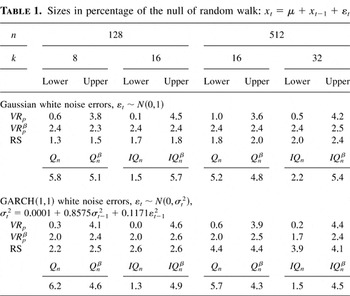
We carried out Monte Carlo simulations to evaluate the finite-sample performance of tests based on our modified VR statistic. The size properties under the null hypothesis were evaluated using the following two models: (i) xt = xt−1 + εt, where εt ∼ i.i.d. N(0,1), (ii) xt = xt−1 + εt, where εt = σt vt, vt ∼ i.i.d. N(0,1), and σt2 = 0.0001 + 0.8575σt−12 + 0.1171εt−12. The parameter values for the GARCH(1,1) model in (ii) were chosen to reflect values obtained when fitting such models to real data. The sample sizes we considered were n = 128 and 512, and the number of replications was 20,000. For n = 128, we used k1 = 8 and k2 = 16, whereas for n = 512 we used k1 = 16 and k2 = 32. The first part of Table 1 reports the Monte Carlo sizes of the test statistics under the Gaussian white noise case, whereas the second part of the table is for the GARCH(1,1) model. In both parts the nominal level of significance is 5% and the test is two tailed. The sizes are reported for the statistics VRp and VRpβ for each combination of sample size and k, where β was computed for each case using (9). The sizes are reported for both the left and right tail to demonstrate the skewness and the effect of the power transformation on it. We also report the sizes of the quadratic tests (13), denoted in the table by Qn, based upon both the untransformed and transformed VR statistics. Sizes for the modified intersection tests given in (14) and (15), denoted in the table by IQn, are also shown.
Sizes in percentage of the null of random walk: xt = μ + xt−1 + εt

It is also of interest to study the finite-sample performance of the VR statistic under the k/n → δ > 0 asymptotics as proposed by Richardson and Stock (1989). We therefore also present empirical sizes and power of the VR statistics for our configuration of (k,n) values based on asymptotic critical values of the Richardson–Stock distribution that were computed as follows. For each combination of (k,n), we generated 20,000 replications of the VR statistic based on Gaussian noise with n∞ = 12,000 and k∞ = (k/n)n∞ = (k/n)12,000 and the percentiles of these 20,000 values were used to obtain the asymptotic critical values. The empirical sizes and powers based on these critical values are presented in Tables 1, 2, and 3 in the row labeled RS.
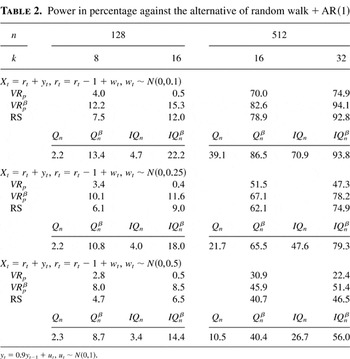
Power in percentage against the alternative of random walk + AR(1)

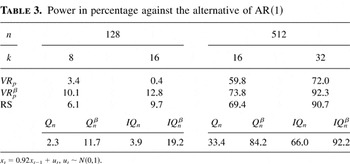
Power in percentage against the alternative of AR(1)

It is immediately apparent from Table 1 that whereas the distribution of VRp is very right skewed, as is well known, the power transformation is able to correct it and provide near perfect normality with sizes in each tail that are very close to nominal. One can also see that the power transformed statistic VRpβ is able to retain the size close to the nominal even in the presence of GARCH innovations. On the other hand, it is seen from these tables that the finite-sample performance of the VR statistic when compared to the critical values of the Richardson–Stock distribution is not as good. In the case of Gaussian noise, the test is undersized, particularly for n = 128, whereas in the case of GARCH innovations, the test is oversized for n = 512. Note that for our configuration of (k,n) values, the ratio k/n takes values 0.03125, 0.0625, and 0.125. This clearly indicates that the k/n → δ > 0 asymptotic distribution cannot approximate the finite-sample distribution of the VR statistic when k/n is small and is sensitive to the presence of conditional heteroskedasticity.
Table 1 also demonstrates that the quadratic and the modified intersection tests based on the transformed VR statistics have much better size properties than those using their untransformed counterparts.
To evaluate the power properties of our tests, we generated data from the mean reverting process given by xt = rt + yt, where rt = rt−1 + wt, yt = 0.9yt−1 + ut, and ut ∼ i.i.d. N(0,1) and also independent of {wt}. The errors wt were assumed to be i.i.d. N(0,σw2) where σw2 = 0.1, 0.25, and 0.5. This model with similar parameter configurations was considered in Lo and MacKinlay (1989) and Richardson and Smith (1991). Table 2 reports the Monte Carlo power values at 5% level of significance for this alternative model for the three different values of σw2. As the value of σw2 increases, the permanent component dominates the process and the power of all tests decreases, as is to be expected. However, similar behavior of the tests is seen across the table. It is clear that the individual tests based on the transformed VR statistics provide power that is significantly superior to that of the untransformed ones, in some cases increasing the power by as much as 10%. Furthermore, the test based on the transformed VR statistic provides power that is uniformly higher than the power of the VR statistics under the Richardson–Stock asymptotic distribution.
The quadratic test based on the transformed statistics also provides significant power gain over that based on the untransformed statistics. Furthermore, it is seen that the modified intersection test, which is specially geared to take into account the unidirectional nature of mean reverting alternatives, is able to provide a significant advantage over the quadratic test, when based on the transformed VR statistics.
We also generated data from the alternative mean reverting process given by xt = 0.92xt−1 + ut where ut ∼ i.i.d. N(0,1). This process is also considered in Lo and MacKinlay (1989). The simulation results are presented in Table 3. It is seen that the test based on the transformed VR statistics once again provides significantly higher power than that based on the untransformed statistics as well as that based on the Richardson–Stock distribution.
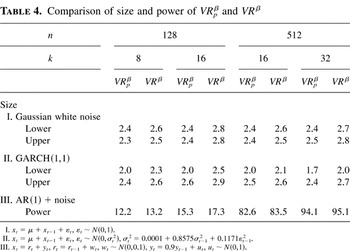
The simulations we present here are for the modified variance ratio statistic, VRp, which is defined in the frequency domain as given in equation (10). It is of interest to see how good an approximation this statistic is to the variance ratio statistic, VR, defined in the time domain in equation (1). In Table 4, we present the empirical size and power of the transformed statistics VRβ and VRpβ. It is seen that the size and power are very similar, indicating that the approximation is good, though as the theory suggests, this approximation will worsen as k gets larger relative to n.
Comparison of size and power of VRpβ and VRβ

It should also be noted that according to our theory the normal approximation to the transformed statistics will be good only when k is not too large relative to n. In the simulations we present here, the largest value of the ratio k/n we consider is 0.125, and the normal approximation works well in this case. We also did a simulation study, not presented here, in which k/n was set to be 0.25. In this case, the normal approximation to even the transformed ratio statistic was poor. This is not surprising because k is now very large relative to n and thus violates the assumption. Furthermore, in practice, one should not be using such large values of k because, as Deo and Richardson (2003) have shown, the test would then be inconsistent against a wide class of alternatives.
5. CONCLUSION
From Deo and Richardson (2003), it is clear that large values of k should not be used when testing for the mean revision using the VR statistic. From our theoretical results and Monte Carlo study, we conclude that when k is not too large, the transformed VR statistic proposed in the paper is able to solve the problem of skewness and is thus well approximated by the normal distribution in finite samples. This provides good size properties in addition to significant power gains. Furthermore, the distribution of the transformed VR statistic is shown, both theoretically and through simulations, to be robust to conditional heteroskedasticity.
Our simulation study also shows that the k/n → δ > 0 asymptotic distribution cannot approximate the finite-sample distribution of the VR statistic when k/n is small and is sensitive to conditional heteroskedasticity. Furthermore, our transformed VR statistic provides power that is uniformly higher than that of the VR statistic based on the k/n → δ > 0 asymptotic distribution.
Finally, the modified intersection test is also able to incorporate information from various differencing periods and yet maintain good power.
APPENDIX
Proof of Lemma 1. Because {ht} is a Gaussian stationary series with zero mean, it can be expressed as

, where

and {ut} is a sequence of independent standard normal variables. Furthermore, {ut} and {vt} will also be independent. Let

. By Lemma 3.5.8 and Theorem 3.5.8 of Stout (1974), {εt} is an ergodic sequence. Furthermore, Lemma 1 in Deo (2000) shows that εt satisfies (A1)–(A3). Because {vt} is an independent zero mean sequence, (A4) is trivially true. Also,

Because

, to prove (A5) it suffices to show that

uniformly in j. But

Because

converges to 0 uniformly in j, (A.1) is established. The proof of (A6) follows along similar lines. █
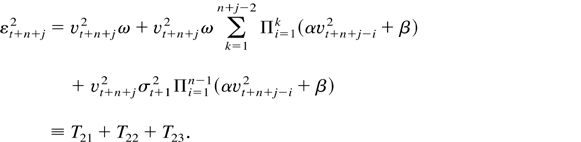
Proof of Lemma 2. Lemma 2 in Deo (2000) proves (A1)–(A3). An argument similar to the one provided on page 309 in the proof of Lemma 2 of Deo (2000) also establishes (A4). We now turn to proving (A5). Iterating the expression for εt, we have

and
Thus,

Consider the term T12T23. Then we can easily see that we can express T12T23 as the product T12T23 = AB, where

Letting θ1 = E(αvt2 + β) and θ2 = E(αvt2 + β)2 and noting that Evt+n4 = 3, we get

Because γ = max(θ1,θ2) < 1, it follows that for all j ≥ 1 there exists some finite constant C such that

and hence

uniformly in j. Thus,

uniformly in j. Similar arguments yield

uniformly in j. Thus, (A5) follows from (A.3), (A.4), and the Cauchy–Schwarz inequality. To prove (A6), we first note that using (A.2),

Thus,

, and so

Proof of Theorem 3. By simple but tedious algebraic manipulation, it can be shown that

where

Because E(Bi) = O(ki2) trivially, it follows that [ki(n − ki + 1)(n − ki)]−1nBi = op([n−1ki]1/2). By condition (A1), we have E(Ai) = 0. Furthermore, by using condition (A3), it can be easily seen that E(Ai12) = E(Ai22) = O(ki4). By the Cauchy–Schwarz inequality, it follows that Var(Ai) = O(ki4) and hence [ki(n − ki + 1)(n − ki)]−1nAi = op([n−1ki]1/2). Because

, we have

Now consider

By conditions (A1) and (A3), respectively, it follows that E(Ri2) = 0 and E(Ri22) = o(1), and hence

Now define

. Then, M → ∞, N → ∞, n−1N → 0, and N−1ki → 0 for i = 1,2,…,s. Also, define

Then we can decompose Ri1 as
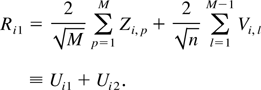
By condition (A3), it follows that E(Wi,aWi,b) = 0 for a < b and hence E(Vi,aVi,b) = 0 for a < b. Thus,
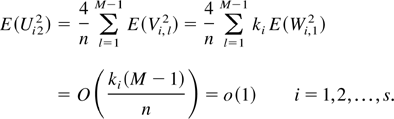
From equations (A.6)–(A.8) it follows that

and hence, from equation (A.5),

Because

, the theorem will be proved if we show that the vector (U11,U21,…,Us1)′ converges in distribution to a multivariate normal distribution with mean zero and variance covariance matrix σ4Σ. To do this, it is sufficient to show that for any set of s real numbers ci,

which we now proceed to demonstrate.
Let

be the sigma algebra generated by {εpN,εpN−1, εpN−2,…}. Then, for any set of s real numbers ci, the sequence
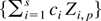
forms a martingale difference with respect to

. To show (A.9), we first need to establish that

Now, by condition (A3)

By conditions (A3) and (A6),

for i < u. Hence, we have

We now show that

which along with (A.11) will prove (A.10). We have

Letting

and using condition (A4), we get for i ≤ u,

By condition (A6), there exists C < ∞ such that

for all p, a, and b. Furthermore, given any δ > 0, by condition (A5) and Jensen's inequality there exists an integer N0 such that

for all a > N0. Hence, letting

, we have for any ε > 0

where the last inequality follows from equations (A.13) and (A.14). Because δ can be chosen to be arbitrarily small and N large enough that N−1N0 → 0, it follows from equation (A.15) that

Because, by condition (A6) we also have

we obtain

A similar argument as before in conjunction with the fact that ku−1ki → aiu for i < u yields

Thus, (A.12) is established giving equation (A.10).
By using condition (A3), one can employ the same argument given on page 539 of Anderson (1994) to show that E(Zi,p4) is uniformly bounded in n for i = 1,2,…,s. This implies that
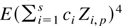
is also uniformly bounded in n, from whence we get

for every ε > 0. By Chebyshev's inequality, equation (A.16) implies that

Hence, equation (A.9) follows from equations (A.10) and (A.17) and Theorem 5.3.4 of Fuller (1996). █
Proof of Theorem 4. We first note that by the weak law of large numbers,

. Now, letting

, we get

It is trivial to show that

Now

From (A.20), we get

Letting

, some tedious algebra yields

where

and

Now

From equation (6.2.5) on page 315 of Fuller (1996), we have |E(zv zv+p zj zj+s)| = O(λ|v|+|p|+| j|+|s|), and hence

A similar argument shows that E(A22) = O(k4), and hence, by the Cauchy–Schwarz and Chebyshev inequalities, we get

Because E(B) = O(k2) trivially, it follows from (A.23), (A.22), and (A.21) that

From Theorem 9.3.3 and Theorem 9.4.1 of Anderson (1994), it follows that

and hence

From (A.18), (A.19), (A.24), and the Cauchy–Schwarz inequality, we get

LEMMA 7.

Proof of (i). Using the fact that

and that
we get

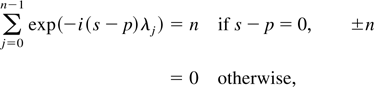
where the last step follows from the identity

. We now note that because

, it follows that

. Furthermore,

, whereas

, which implies that

. Part (i) of the lemma now follows by noting that

where δ is the indicator function due to the periodicity of the sine and cosine functions on [0,2π]. █
Proof of (ii). Using a Taylor series expansion and equation (A.25) in the proof of part (i), we get

Now define the random vector

. Because

, it is seen that

where lk is as defined in (12). Letting τj = σ−4E(εt2εt−j2), tedious but elementary calculation shows that
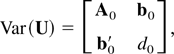
where A0 = diag(((n − j)/n2)τj + (j/n2)τn−j) for j = 1,…,ks, b0 is a ks × 1 vector such that its jth element is given by

. Using the fact that by assumption (A6) τj → 1 as j → ∞, it is easily seen that

and using these facts in conjunction with substituting (A.27) in (A.26), we get

where A = diag(((n − j)/n2)τj + (j/n2)) for j = 1,…,ks, b is a ks × 1 vector such that its jth element is given by (2(n − j)n−3τj + 2jn−3), and d = 2n−2. The estimated variance covariance matrix is now obtained by replacing τj in the entries of A and b by

, and standard arguments from smoothing theory establish consistency of the resulting estimated covariance matrix. █
Proof of Theorem 6. In the proof of Lemma 7, we noted that

It is trivially true that under the assumptions of Theorem 6,

. The results for VRp(k) now follows by noting that

, that

, and that by Theorem 9.3.3 and Theorem 9.4.1 of Anderson (1994),

The result for VRpβ(k) follows by continuity. █
References
REFERENCES
Anderson, T.W.
(1994)
The Statistical Analysis of Time Series,
Wiley Classics edition.
Wiley.
Bollerslev, T.
(1986)
Generalized autoregressive conditional heteroscedasticity.
Journal of Econometrics
31,
307–327.CrossRefGoogle Scholar
Bougerol, P. &
N. Picard
(1992)
Stationarity of GARCH processes and of some non-negative time
series.
Journal of Econometrics
52,
115–127.CrossRefGoogle Scholar
Brockwell, P. &
R. Davis
(1996)
Time Series: Theory and Methods,
2nd ed.
Springer.
Campbell, J.,
A. Lo, &
A. MacKinlay
(1997)
The Econometrics of Financial Markets.
Princeton University Press.
Chen, W. &
R. Deo
(2004)
Power transformations to induce normality and their
applications.
Journal of the Royal Statistical Society, Series B
66,
117–130.CrossRefGoogle Scholar
Deo, R.
(2000)
Spectral tests of the martingale hypothesis under conditional
heteroscedasticity.
Journal of Econometrics
99,
291–315.CrossRefGoogle Scholar
Deo, R. &
M. Richardson
(2003)
On the asymptotic power of the variance ratio test.
Econometric Theory
19,
231–239.CrossRefGoogle Scholar
Fama, E. &
K. French
(1988)
Permanent and temporary components of stock prices.
Journal of Political Economy
96,
246–273.CrossRefGoogle Scholar
Faust, J.
(1992)
When are variance ratio tests for serial dependence optimal?
Econometrica
60,
1215–1226.Google Scholar
Follmann, D.
(1996)
A simple multivariate test for one-sided alternatives.
Journal of the American Statistical Association
91,
854–861.CrossRefGoogle Scholar
Fuller, W.
(1996)
Introduction to Time Series Analysis,
2nd ed.
Wiley.
Lo, A. &
A.C. MacKinlay
(1988)
Stock market prices do not follow random walks: Evidence from a
simple specification test.
Review of Financial Studies
1,
41–66.CrossRefGoogle Scholar
Lo, A. &
A.C. MacKinlay
(1989)
The size and power of the variance ratio test in finite samples: A
Monte Carlo investigation.
Journal of Econometrics
40,
203–238.CrossRefGoogle Scholar
Nelson, D.
(1990)
Stationarity and persistence in the GARCH(1,1) model.
Econometric Theory
6,
318–334.CrossRefGoogle Scholar
Poterba, J. &
L. Summers
(1988)
Mean reversion in stock returns: Evidence and implications.
Journal of Financial Economics
22,
27–60.CrossRefGoogle Scholar
Richardson, M. &
T. Smith
(1991)
Tests of financial models with the presence of overlapping
observations.
Review of Financial Studies
4,
227–254.CrossRefGoogle Scholar
Richardson, M. &
J. Stock
(1989)
Drawing inferences from statistics based on multi-year asset
returns.
Journal of Financial Economics
25,
323–348.CrossRefGoogle Scholar
Shephard, N.
(1996)
Statistical aspects of ARCH and stochastic volatility. In
D.R. Cox,
D.V. Hinkley, &
O.E. Barndorff-Nielsen (eds.),
Time Series Models in Econometrics, Finance and Other Fields.
Chapman and Hall.
Stout, W.
(1974)
Almost Sure Convergence.
Academic Press.
Wk(λ) for n = 128 and k = 8 and 16.
QQ plots of VR(k) and VRβ(k) on 20,000 replications with n = 128, k = 16 and εt ∼ N(0,1).
Sizes in percentage of the null of random walk: xt = μ + xt−1 + εt
Power in percentage against the alternative of random walk + AR(1)
Power in percentage against the alternative of AR(1)
Comparison of size and power of VRpβ and VRβ
 You have
Access
- 42
- Cited by