Introduction
Ecological succession in post-industrial ecosystems is one of the essential forces that form species communities (Walker & Moral, Reference Walker and Moral2003; Walker, Reference Walker2012). Succession regulates species richness through the generation of biotic and abiotic environments that select species based on life-history traits and survival strategies (Hutchinson, Reference Hutchinson1957; Southwood, Reference Southwood1977). Changes of species richness during ecological succession are relatively well documented, although there is a paucity of studies that fully reflect the linkages between environmental fluctuation and species occurrence (Lavorel et al., Reference Lavorel, Grigulis, Lamarque, Colace, Garden, Girel, Pellet and Douzet2010; Gerisch et al., Reference Gerisch, Agostinelli, Henle and Dziock2012). Thus, it is not possible to fully explain the successional changes in communities and to define mechanisms through which environmental changes influence biodiversity (Mouchet et al., Reference Mouchet, Villeger, Mason and Mouillot2010; Gibb et al., Reference Gibb, Johansson, Stenbacka and Hjätlén2013). Functional diversity offers a valuable concept to identify and interpret interactions between ecosystem changes and biodiversity (Lavorel et al., Reference Lavorel, Grigulis, McIntyre, Williams, Garden, Dorrough, Berman, Quétier, Thébault and Bonis2008).
The relationship between species richness and habitat succession depends on functional groups of organisms and their ecological traits (Gibb et al., Reference Gibb, Johansson, Stenbacka and Hjätlén2013). The distribution of functional characteristics among species in the community can be used to calculate functional diversity parameters (Mason et al., Reference Mason, Mouillot, Lee and Wilson2005). Characteristics such as diversity of diet width, morphological traits, and species trophic level can summarize the responses of organisms during ecosystem succession (Tilman et al., Reference Tilman, Knops, Wedin, Reich, Ritchie and Siemann1997; Díaz & Cabido, Reference Díaz and Cabido2001). Community assemblies are influenced by local conditions, which may act as environmental filters and thus generate non-random distribution of species in particular communities (Shibuya et al., Reference Shibuya, Kubota, Ohsawa and Kikvidze2011). Hence, community structure is influenced by biogeographic factors and filtered by biotic interactions (e.g. interspecific competition, demographic features) or by abiotic conditions (e.g. disturbance and other stochastic factors, forest succession), or by a combination of both (Lortie et al., Reference Lortie, Brooker, Choler, Kikvidze, Michalet, Pugnaire and Callaway2004). An important way to detect whether environmental conditions affect the species occurrence in the assemblages is through examining the relationship between species richness and functional diversity. This relationship is used to determine how traits are complementary or redundant among species and reflects the degree to which species perform similar ecological functions in the community (Lavorel & Garnier, Reference Lavorel and Garnier2002; Laliberté & Legendre, Reference Laliberté and Legendre2010). In particular, environmental conditions are considered to ‘filter’ the species, with the outcome that functionally similar species occur more often than expected by chance. This leads to flatten or reduce the slope of the relationship between species richness and functional diversity, because, species with similar ecological traits display similar responses to changes in habitat conditions (Farias & Jaksic, Reference Farias and Jaksic2011). This relationship might reveal whether functional redundancy in species’ traits occurs in response to particular types of ecological processes (e.g., forest succession or disturbance).
Here we applied multi-trait-based functional diversity analysis and community-weighted means (CWM) to describe how ecological traits change across a succession gradient. Functional diversity and CWM represent different approaches to studying the mechanisms of how environmental changes affect biodiversity (Roscher et al., Reference Roscher, Schumacher, Gubsch, Lipowsky, Weigelt, Buchmann, Schmid and Schulze2012). Functional diversity indicates the number, evenness, and distribution of particular functional traits among individuals in the community, while CWM describes mean changes of traits in the community (Mason et al., Reference Mason, Mouillot, Lee and Wilson2005; Ricotta & Moretti, Reference Ricotta and Moretti2011). CWM give more weight to highly abundant species and therefore favours the functional traits of species with the highest effect at the community level. In contrast, functional diversity describes the diversity of traits in the community. Recent studies have suggested that functional diversity and CWM can adequately describe trait changes within a community during succession (Purschke et al., Reference Purschke, Schmid, Sykes, Poschlod, Michalski, Durka, Kühn, Winter and Prentice2013; Fournier et al., Reference Fournier, Gillet, Le Bayon, Mitchell and Moretti2015).
Post-industrial areas provide opportunities for studying succession in communities as they potentially provide all the stages of forest succession from bare ground to maturity. Previous studies showed a decreasing pattern or U-shaped pattern in species richness during successional changes following anthropogenic disturbance (Niemelä et al., Reference Niemelä, Langor and Spence1993; Niemelä, Reference Niemelä1999; Paquin, Reference Paquin2008). Paquin (Reference Paquin2008) suggested that the low species richness following anthropogenic or natural disturbance might be due to a failure to identify the full diversity of species at the initial point of the succession. A few comparable studies address the same topic using functional diversity (Fournier et al., Reference Fournier, Gillet, Le Bayon, Mitchell and Moretti2015; Hodecek et al., Reference Hodecek, Kuras, Sipos and Dolny2015). However, there is still no evidence that functional diversity shows the same trend as species richness during forest succession.
We investigate successional changes in ground beetles in relation to variations in species richness and functional diversity due to changes in both habitat heterogeneity and forest cover. In general, we hypothesized that functionally similar species would co-occur more often than expected by chance and flatten the dependencies between species richness and functional diversity. We proposed this because abiotic or biotic conditions on post-industrial habitats might determine the ground beetle assemblages that can cope with disturbance and stress. Additionally, environmental conditions occurring during particular successional stages might act to sort species based on their functional traits and cause a reduction in the overall functional heterogeneity among species (Farias & Jaksic, Reference Farias and Jaksic2011). If these expectations prove true, then we predict that the assemblages will be a non-random sample of the potential species pool. We also hypothesized that conditions in the early phase of succession might favour ground beetle assemblages that can tolerate stress and disturbance through a reduction in the abundance of large, poorly mobile, and habitat specialist species. We further proposed that abiotic conditions associated with forest habitat (occurring mainly in the late phase of succession) might favour assemblages of carnivorous ground beetles that are relatively large and flightless, because late successional stages are dominated by woody vegetation that are stable sources of prey for predatory arthropods (Southwood, Reference Southwood1977; Kruess & Tscharntke, Reference Kruess and Tscharntke1994). This is in concordance with ‘mean individual biomass concept’ which states that in mature stages of succession species with large individuals become dominant (Schwerk & Szyszko, Reference Schwerk and Szyszko2011).
Our study examined a succession of post-industrial habitats that spanned the majority of maturation stages (from open habitat to mature forest). Therefore, we were able to detect carabid specialists at initial and matured stages of the forest successional gradient. In the early successional stages, species richness and functional diversity are mainly influenced by immigration of species that specialize on open habitats. By contrast, in later phases of succession, the functional characteristics of the species will be determined by immigration of species dependent on forest cover characteristics. Therefore, we anticipated changes in species richness and functional diversity during forest succession. We also address the questions: (i) to what extent does functional redundancy among species exist?; (ii) what is the relationship between species richness and functional diversity?; and (iii) are species richness and functional diversity correlated with habitat heterogeneity?
Material and methods
Study area
The study was conducted in the north-eastern part of the Czech Republic in the Upper Silesian industrial region and focussed on three spoil heaps (Ema, Bezruc, and Zarubek) in the city of Ostrava (table 1). These spoil heaps were produced by the accumulation of spoil during deep underground mining of coal. The deposition of spoil was ended in the late 1950s and early 1960s. During succession, the spoil heaps were spontaneously colonized by herbs and woody pioneer species. Currently, the dominant trees on the spoil heaps are Populus x canadensis, Betula pendula, and Fraxinus excelsior.
Localization, altitude, area, elevation above the terrain and year of origin of the studied spoil heaps.

Study group and sampling
We selected ground beetles as a model group because they represent a taxon with important ecological functions in the ecosystem. Carabids are effective indicators in the ground layer because they are sensitive to landscape changes with a large range of responses, and their taxonomy and ecology are well-known (Rainio & Niemelä, Reference Rainio and Niemelä2003; Gerlach et al., Reference Gerlach, Samways and Pryke2013). We used an identification key from Hurka (Reference Hurka1996) to identify ground beetles.
We used pitfall traps to capture the beetles. Each trap was made of a 0.3 l plastic cup with a diameter of 8 cm. Pitfall traps were covered with small tin roofs and filled with 2% formaldehyde. They were installed at the end of April and removed in October in each sample year. The traps were located within a transect line (10 m intervals between each trap). Each transect line went through a representative spectrum of vegetation types. The beetle populations were sampled during 1975–1976 (eight pitfall traps on each of the Zarubek and Bezruc spoil heaps), 1993–1995 (five pitfall traps on each of the three spoil heaps), and 2006–2007 (five pitfall traps on each of the three spoil heaps, as in the previous period). In total, we obtained data for 7 years (1975, 1976, 1993, 1994, 1995, 2006, and 2007). The first collection of beetles was initiated approximately 15 years after the end of spoil deposition and the start of the succession. A restricted number of traps were used to minimize the impact of the sampling on the structure of the assemblages (Slezak et al., Reference Slezak, Hora and Tuff2010). We sought to obtain a representative sample of the beetle assemblages in a way that would not influence sampling in the subsequent years. An initial analysis of similarities (ANOSIM) indicated that the species captured within each spoil heap were highly mixed among the traps: for Zarubek, R = 0.013; for Ema, R = 0.010; and for Bezruc, R = 0.029, respectively. A value of R close to 0 indicates no differences between the traps. Therefore, we assumed that the number of traps was sufficient for sampling the spoil heap habitats. As different numbers of pitfall traps were used on the Zarubek and Bezruc spoil heaps in the 1970s, the data were standardized by dividing the species abundance by the number of traps in those years. Traps were visited approximately every 14 days from April to November.
Data management
Habitat heterogeneity was recorded by categorization using four habitat types (forest cover, shrub cover, herb cover, and bare ground) and extent measured as area (square meters). These variables were calculated for 1975–76, 1993–95, and for 2006–07, separately. Additionally, we also used Simpson's index of diversity (Katayama et al., Reference Katayama, Amano, Naoe, Yamakita, Komatsu, Takagawa, Sato, Ueta and Miyashita2014) based on data related to each individual habitat. The abundances of species between samples of each year were summed to prevent autocorrelation with time during the season. We summed samples from all traps of each year to prevent spatial pseudo-replication. The type of vegetation cover was recorded within a circle of 100 m in diameter that had as its midpoint the central part of each research area. We assumed that this 100 m distance was sufficient to adequately represent the mosaic of habitats occurring on the spoil-heap. Habitat areas were calculated using ArcGIS Desktop (ArcView) v10 [http://www.esri.com/software/arcgis/arcview]. Succession (spoil heap age) was individually coded for each year of sampling. This factor was calculated as the number of years that had passed since spoil deposition had ceased (see table XX in Supporting Information). Species data for both ordination models were coded as the number of individuals in a particular sampling year.
Functional traits
Based on an assessment of the literature, we selected the following species traits to calculate carabid functional diversity: (i) food specialization; (ii) wing morphology, an important trait that determines dispersal and recolonization ability (Gerisch et al., Reference Gerisch, Agostinelli, Henle and Dziock2012; Gerisch, Reference Gerisch2014); (iii) trophic level; and (iv) bio-indication value. These traits are considered to be important for understanding how species respond to habitat change during succession. We therefore classified carabid species into three categories: macropterous (winged), brachypterous (wingless), and dimorphic (both forms) following Hurka et al. (Reference Hurka, Vesely and Farkac1996) and Stanovsky & Pulpan (Reference Stanovsky and Pulpan2006). For trophic level, we classified the species as herbivores, omnivores, or carnivores (Lindroth, Reference Lindroth1992; Hurka et al., Reference Hurka, Vesely and Farkac1996; Stanovsky & Pulpan, Reference Stanovsky and Pulpan2006). Species were classified as food specialized (preferring a particular type of food) or not specialized (Stanovsky & Pulpan, Reference Stanovsky and Pulpan2006). The bio-indication divides species on the basis of the range of their ecological tolerance, niche breadth, and sensitivity to human-induced changes. Ground beetle species were divided into three groups according to their ecological valence and their association with habitat using the original terminology for the species groups according to Hurka et al. (Reference Hurka, Vesely and Farkac1996):
Group E (eurytopic) – species without peculiar requirements on type and quality of habitat, including expansive species that successfully occupy habitats strongly modified by humans;
Group A (adaptable) – more specialized species than generalists, and less tolerant of human activities and disturbance; they are found in semi-natural habitats and in both natural and managed habitats (forests);
Group R (relic) – habitat specialists, especially old-forest specialists and climax-specialist species; often rare and endangered species, although widespread in undisturbed ecosystems.
Data analysis
Community assembly principles
In order to detect the action of environmental factors that influence the functional structure of ground beetle assemblages, the relationship between species richness and functional diversity was compared with data predicted by a null model. The null model was obtained by randomly shuffling row names on the trait matrix and then calculating functional diversity. This manipulation maintained the observed patterns of trait co-variance and overall phenotypes. We also randomized the species data matrix to investigate the expected species richness for particular years. To calculate a null model for species richness, one iteration of the ‘randomizeMatrix ()’ function was used. We then used the ‘replicate ()’ function to repeat the calculation of species richness. The number of iterations was set to 1000 for each part of the spoil heap. We randomized the community data matrix by using the ‘randomizeMatrix ()’ function. Randomization was constrained by the method ‘frequency’, which maintains species occurrence frequency. All functions that were used are included in the statistical program R (R Development Core Team, 2013).
Species – environmental relations
We used canonical correspondence analysis (CCA) and redundancy analysis (RDA) to test the effect of environmental variables on species composition and abundances. Each spoil heap was used as a co-variable in the CCA and RDA model to eliminate variability caused by the characteristics of the particular spoil heap. As explanatory variables, we selected habitat heterogeneity, succession time, and proportion of forest. Automatic forward selection was used to select significant explanatory variables. Data on species abundance (ground beetles) was subjected to decimal logarithm transformation. In the CCA and RDA models the effect of rare species was downweighted by their total abundances. Calculated P-values were adjusted for multiple testing using the Bonferroni correction. And the significance of the canonical axis was tested by a Monte-Carlo permutation test (5000 permutations). To achieve correct Type I error estimates, we performed a permutation test that was restricted by the blocks, which were defined by covariables (ter Braak & Smilauer, Reference ter Braak and Smilauer2012). The covariables used in the models were defined by the characteristics of the individual spoil heap. Permutation tests were also restricted for a time series because of time autocorrelation between individual observations. Individuals were sampled along a succession gradient. Therefore, during permutations we included a time interval that banded the explanatory and response data (ter Braak & Smilauer, Reference ter Braak and Smilauer2012).
Functional traits – environmental relations
CWM for each trait value was calculated for the beetle community and was passively projected as functional traits in the ordination diagrams. CWMs were calculated as the mean trait value divided by the species relative abundance, and indicated the dominant trait values in the community (Roscher et al., Reference Roscher, Schumacher, Gubsch, Lipowsky, Weigelt, Buchmann, Schmid and Schulze2012). To identify the functional traits that explained significant variability in the species data we used each trait as an explanatory variable. Forward selection was then applied to select significant traits. In addition, functional diversity was calculated as Rao's quadratic entropy index (RaoQ) and passively projected to the ordination space. RaoQ is defined as the sum of the pairwise distances between species divided by relative abundance; it is largest when species with large trait differences reach similarly high abundances (Mouchet et al., Reference Mouchet, Villeger, Mason and Mouillot2010). Forward selection was also used to test the optimal power transformation of environmental variables and functional diversity indices. All analyses were conducted using CANOCO 5 (ter Braak & Smilauer, Reference ter Braak and Smilauer2012).
Trends in the functional and species diversity
We calculated four fundamental categories of functional diversity: (i) functional richness indicating the amount of niche space occupied by the species; (ii) functional divergence indicating how far the most abundant species were from the centre of the niche space; (iii) functional evenness indicating how species abundances were distributed in the niche space; and (iv) functional distance defined as the mean distance in trait space from the centroid of all species (Mason et al., Reference Mason, Mouillot, Lee and Wilson2005; Mouchet et al., Reference Mouchet, Villeger, Mason and Mouillot2010) The relationship between diversity indices and succession time was tested by analysis of deviance in a generalized linear model (GLM) with ‘Gamma’ error distribution and log link function. Data were analyzed using R software (R Development Core Team, 2013).
Results
In total, we trapped 1657 ground beetles that belonged to 61 species (table 1, Supplementary material). The most frequent species were Harpalus rubripes (16.35%), Carabus violaceus (13.46%), and Carabus coriaceus (13.22%). Overall, the assemblage from the spoil heaps was dominated by the genera Harpalus, Amara, and Carabus. The assemblage also contained rare forest carabids such as Abax schueppeli rendschmidti and Leistus rufomarginatus.
Assembly process
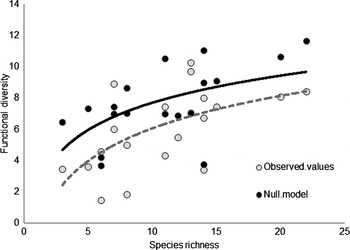
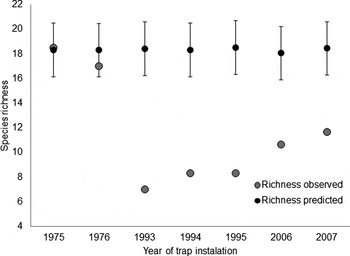
Based on the null-models we detected a logarithmical relationship between species richness and functional diversity computed as RaoQ from the observed data (F 1,16 = 4.02, P = 0.039) and also for the data predicted by the null model (F 1,16 = 11.46, P < 0.01; fig. 1). Comparison of species richness predicted by the null model with the observed species richness during succession was conducted. The predicted values of the species richness for particular successional stage created by the null model indicated that two successional stages (1975 and 1976) lied inside the 95% CI (fig. 2).
Relationship between species richness and functional diversity depicted for the observed data (grey dots) and for the values predicted by the null model (black dots). Functional diversity was computed as Rao's quadratic entropy index. The traits used for the calculation of functional richness were food specialization, wing morphology, trophic level, and bioindication value. Each point represents the functional diversity and species richness for ground beetles assemblage in the combination of a particular spoil-heap and year. The line was fitted by the least sum of squares explaining the lowest Akaike information criterion value.

Changes in species richness during ecological succession on spoil heaps. The observed data (grey dots) and the values predicted by the null model (black dots) are shown. Species richness predicted by the null model was created by randomly resampling the pool of samples many times. Each point shows the mean and the error bars represent 95% confidence intervals.

Functional traits in relation to forest succession
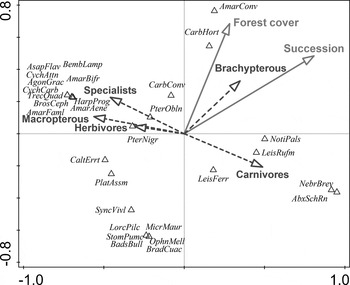
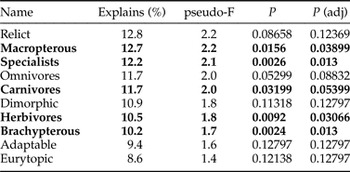
The CCA of the relationship between the ground beetles and the forest succession gradient (described by the variables time since deposition of spoil was ended, and forest cover) explained 33% of the variability in the species data (pseudoF = 3.4, P < 0.01, for all canonical axes). The effect of succession time and proportion of forest was significant (succession time, pseudoF = 3.4, P < 0.01; proportion of forest pseudoF = 2.3, P < 0.01). The CCA model showed that CWM explained 61.5% of the variability in the species data (pseudoF = 2.1, P < 0.001, for all canonical axes; fig. 3). Traits that were passively projected in the ordination diagram were selected by automatic forward selection (table 2). CWM pattern showed that the abundance of carnivorous and brachypterous ground beetles were positively correlated with succession time (fig. 3). The CWM of species with high dispersal ability (macropterous), herbivores, and food specialists were negatively correlated with succession time (fig. 3).
Canonical correspondence analysis of ground beetles with ‘succession’ (represents year of sampling on a particular spoil heap) and ‘forest cover’ (area which is covered by forest for a particular spoil heap and year) used as an explanatory variable and with passively projected functional traits calculated as community weighted-means (CWM). Co-variables were defined by individual spoil heap. Only 27 species with the best fit are displayed. Ordination diagram shows only significant functional traits: (a) specialists (species preferring a particular type of food); (b) herbivores (species associated with trophic level of primary consumers); (c) macropterous (winged species) and (d) brachypterous (species without functional wings). Species names are abbreviated as follows: AbxSchRn – Abax schueppeli rendschmidti, AmarConv – Amara convexior, AmarCurt – Amara curta, AmarPrae – Amara praetermissa, AmarSiml – Amara similata, BadsBull – Badister bipustulatus, BradCuac – Bradycellus cuacasicus, BrosCeph – Broscus cephalotes, CaltErrt – Calathus erratus, CarbConv – Carabus convexus, CarbCori – Carabus coriaceus, CarbHort – Carabus hortensis, CychCarb – Cychrus caraboides, HarpMods – Harpalus modestus, HarpProg – Harpalus progrediens, HarpRubr – Harpalus rubripes, LeisRufm – Leistus rufomarginatus, LorcPilc – Loricera pilicornis, MicrMaur – Microlestes maurus, NotiBigt – Notiophilus biguttatus, NotiPals – Notiophilus palustris, OphnMell – Ophonus melleti, OphnPunc – Ophonus puncticollis, PlatAssm – Platynus assimilis, PterNigr – Pterostichus niger, StomPumc – Stomis pumicatus, SyncVivl – Synuchus vivalis.

Forward selection results of the canonical correspondence analysis for the community weighted-means (CWM) functional traits of the ground beetles.

Trends in the functional and species diversity
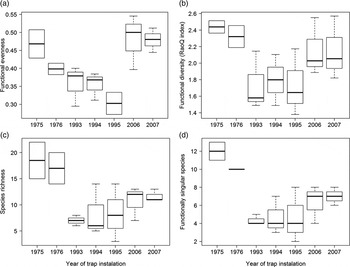
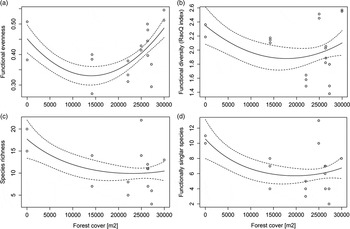
In order to specify the functional characteristics of the species assemblage we used common analytical methods: functional richness, divergence, distance, and RaoQ indices. Based on the GLM analysis, we identified a non-significant relationship between functional divergence, functional distance, and succession time (divergence, P = 0.14; distance, P = 0.54). The index of functional evenness and RaoQ significantly changed between sampling years (evenness, F 2,15 = 13.4, P < 0.001; RaoQ, F 2,15 = 6.48, P = 0.008; fig. 4a, b). Species richness and number of functionally unique species also significantly changed between sampling years (species richness, F 2,15 = 8.94, P = 0.002; functionally unique species, F 1,16 = 6.49, P = 0.02; fig. 4c, d). Individual boxplots showed U-shaped patterns between species richness and diversity indices along succession stages (fig. 4). A U-shaped pattern was also evident between functional characteristics and the proportion of forest coverage (fig. 5). Based on the GLM analysis, we found a significant relationship only between functional evenness and forest coverage (F 2,15 = 4.8, P = 0.024; fig. 5a).
Boxplots showing the changes in functional diversity and species richness of ground beetles under succession on spoil heaps. Each box represents data from the combination of the particular spoil heaps and particular year. (a) Trend in functional evenness (indicating how species abundances are distributed in the niche space); (b) trend in Rao's quadratic entropy index (a measure of trait dispersion or divergence); (c) trend in species richness; (d) trend in functionally singular species (functionally singular species are represented by the number of species sharing a unique combination of functional characteristics). Median values, interquartile ranges and total ranges are shown.

Changes in functional diversity and species richness of ground beetles in relation to the forest coverage on spoil heaps. Each point represents data from the combination of the particular spoil heaps and particular year. (a) Trend in functional evenness (indicating how species abundances are distributed in the niche space); (b) trend in Rao's quadratic entropy index (a measure of trait dispersion or divergence); (c) trend in species richness; (d) trend in functionally singular species (functionally singular species are represented by the number of species sharing a unique combination of functional characteristics). The error bars represent standard errors.

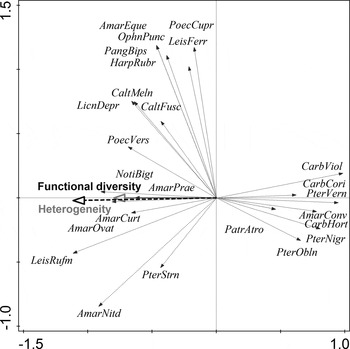
The trend in functional diversity in relation to habitat heterogeneity was analyzed by the RDA. The RDA related functional diversity and habitat heterogeneity, and explained 26% of the species variability (pseudoF = 2.1, P = 0.02, for all canonical axes). Habitat heterogeneity, calculated using Simpson's index of diversity, significantly explained species abundance distributions and was positively correlated with passively projected functional diversity (pseudoF = 2.1, P = 0.02) (fig. 6). The abundance of large flightless ground beetles belonging to the genus Carabus (Carabus convexus and Carabus hortensis) increased along the succession gradient (fig. 3).
Redundancy analysis of ground beetles with ‘habitat heterogeneity’ used as an explanatory variable. Habitat heterogeneity was calculated by the Simpson's index of diversity. Co-variables were defined by individual ‘spoil heap’ and ‘succession’ (represents year of sampling on a particular spoil heap). Functional diversity, computed as Rao's quadratic entropy index (RaoQ), was passively projected to the ordination diagram. Only 25 species with the best fit are displayed. Species names are abbreviated as follows: AmarConv – Amara convexior, AmarCurt – Amara curta, AmarEque – Amara equestris, AmarNitd – Amara nitida, AmarOvat – Amara ovata, AmarPrae – Amara praetermissa, CaltFusc – Calathus fuscipes, CaltMeln – Calathus melanocephalus, CarbCori – Carabus coriaceus, CarbHort – Carabus hortensis, CarbViol – Carabus violaceus, HarpRubr – Harpalus rubripes, LeisFerr – Leistus ferrugineus, LesiRufm – Leistus rufomarginatus, LicnDepr – Licinus depressus, NotiBigt – Notiophilus biguttatus, OphnPunc – Ophonus puncticollis, PangBips – Panagaeus bipustulatus, PatrAtro – Patrobus atrorufus, PoecCupr – Poecilus cupreus, PoecVers – Poecilus versicolor, PterNigr – Pterostichus niger, PterObln – Pterostichus oblongopunctatus, PterStrn – Pterostichus strenuus, PterVern – Pterostichus vernalis.

Discussion
Comparing species richness predicted by the null model with observed values of species richness, we observed that at the beginning of the succession species richness was influenced by random processes. This comparison indicated that abiotic processes might be more important in late successional phases. The ordination analysis showed that habitat structure and heterogeneity significantly influenced the distribution of species based on their functional traits. Based on CWM, several functional traits explained the response of the ground beetles to the succession on the spoil heaps. Late phases of forest succession favoured relatively larger carnivorous ground beetles with low dispersion ability. Forest succession with habitat heterogeneity thus affected species richness and dispersion characteristics of the species of the spoil heap assemblages.
Factors affecting species composition
Comparison of the relationship of species richness and functional diversity with that predicted by the null model allowed us to examine possible factors that influence the species assembly process during succession (Farias & Jaksic, Reference Farias and Jaksic2011). However, it should be noted that a significant trend in the functional diversity of ground beetles does not necessarily mean consequences for the processes by which assembly occurred as this was also strongly influenced by the selected traits that were used for the analysis (Bihn et al., Reference Bihn, Gebauer and Brandl2010). We propose that the functional classification of species based on food specialization, wing morphology, trophic level, and bioindication value was related to habitat structure and stability during succession (e.g., Ribera et al., Reference Ribera, Dolédec, Downie and Foster2001; Shibuya et al., Reference Shibuya, Kikvidze, Toki, Kanazawa, Suizu, Yajima, Fujimori, Mansournia, Sule, Kubota and Fukuda2014). To support this contention, Shibuya et al. (Reference Shibuya, Kikvidze, Toki, Kanazawa, Suizu, Yajima, Fujimori, Mansournia, Sule, Kubota and Fukuda2014) reported that brachypterous beetles dominate forest habitats and that macropterous beetles are associated with grassland habitats. Similarly, Jocque et al. (Reference Jocque, Field, Brendonck and De Meester2010) suggested that a trade-off between dispersal ability and ecological specialization to local conditions is an important driver of diversity patterns and Kusch (Reference Kusch2005) noted that food specialization is an important ecological trait that influences the responses of the organism to the particular habitat area. Therefore, these traits can serve as proxies for small and highly mobile specialist species associated with the initial stages of succession. They can also determine the behaviour of less mobile predatory species specialized for forest habitats.
We compared the relationship of species richness and functional diversity with that predicted by the null model to determine whether species-specific filters could be inferred at the studied localities. Functional diversity depends on species richness and also accounts for processes during succession (Mason et al., Reference Mason, Mouillot, Lee and Wilson2005). Functional diversity thus responds to some biotic or abiotic factors, which sort species based on their functional characteristics (Shibuya et al., Reference Shibuya, Kikvidze, Toki, Kanazawa, Suizu, Yajima, Fujimori, Mansournia, Sule, Kubota and Fukuda2014). The predicted functional diversity in the null model was greater than that computed from the observed data, implying that some biotic or abiotic filtering processes influenced the ground beetle assembly (Gotelli & Colwell, Reference Gotelli and Colwell2001). This was consistent with previous studies that showed specific environmental conditions could filter species based on their functional traits (habitat fragmentation, Farias & Jaksic, Reference Farias and Jaksic2011; flooding, Fournier et al., Reference Fournier, Gillet, Le Bayon, Mitchell and Moretti2015; landscape heterogeneity, Duflot et al., Reference Duflot, Georges, Ernoult, Aviron and Burel2014).
We also compared species richness predicted by the null model with the observed species richness during succession. The comparison showed that the observed species richness differed from that expected, except in the early stages of succession. This suggested that as the forest succession progresses, filtering processes play more important roles in determining the species assemblages than in the early stages of succession. The CCA model revealed that abiotic factors were linked with forest succession which favoured ground beetles that preferred forest-like habitats (e.g., C. hortensis, L. rufomarginatus, A. schueppeli rendschmidti). In general, ground beetles are considered sensitive to the microclimatic conditions of the habitat (Shibuya et al., Reference Shibuya, Kubota, Ohsawa and Kikvidze2011). As ground beetles forage in topsoil, understory vegetation, and litter, these environmental characteristics play an important role in their distribution (De Vasconcelos, Reference De Vasconcelos1990). Thus, canopy closure is an important factor in the formation of spatial heterogeneity and microclimate stability in leaf litter (e.g., Franklin & Van Pelt, Reference Franklin and Van Pelt2004; Kara et al., Reference Kara, Bolat, Çakiroğlu and Öztürk2008) and should positively influence ground dwelling insects.
Species–environmental relations
How important are abiotic conditions in filtering ground beetles assemblages? We anticipated that species richness and functional diversity would change during forest succession. The CCA model showed that increases in the proportion of forest during succession time were non-linearly related to functional diversity and species richness. This pattern could result from a negative effect of forest succession on species richness and CWM of functional traits of carabids that specialize on open habitat conditions and from positive effects on carabids that specialize in forest ecosystems (Niemelä, Reference Niemelä2001; Bartemucci et al., Reference Bartemucci, Messier and Canham2006; Wayman & North, Reference Wayman and North2007). Late successional stages in temperate ecosystems lead to uniform forest-like habitats with relatively homogeneous physical and spatial conditions (Parker, Reference Parker, Lowman and Nadkarni1995; Walker & Moral, Reference Walker and Moral2003; Duflot et al., Reference Duflot, Georges, Ernoult, Aviron and Burel2014). In addition, canopy openness is an important factor affecting the diversity of species that prefer open habitat types (Bartemucci et al., Reference Bartemucci, Messier and Canham2006). Canopy thinning experiments that mostly increased habitat heterogeneity and light availability positively influenced biodiversity (Bartemucci et al., Reference Bartemucci, Messier and Canham2006; Wayman & North, Reference Wayman and North2007). These reports are consistent with our results showing a positive correlation between functional richness and habitat heterogeneity. The GLM also revealed that functionally dissimilar species were clustered in the early successional stages. We can explain this phenomenon as resulting from the high number of newly recruited individuals from surrounding habitats with unique combinations of functional traits (Hodecek et al., Reference Hodecek, Kuras, Sipos and Dolny2015; Kašák et al., Reference Kašák, Mazalová, Šipoš and Kuras2015). Regarding our null-model, the recruitment processes of the ground beetles in the early successional phases was governed in the random manner. A high degree of colonization is specific for de novo created habitats, because, of the low number of species already present in the community and low level of interspecific competition (Southwood, Reference Southwood1977).
Boxplots of the functional diversity and species richness along successional stages showed a U-shaped pattern. A U-shaped response for species richness in the gradient of succession was also reported by Niemelä (Reference Niemelä1999) and Paquin (Reference Paquin2008). Fournier et al. (Reference Fournier, Gillet, Le Bayon, Mitchell and Moretti2015) also found a U-shaped pattern for functional diversity in the response to flood disturbance; the authors suggested that it was a consequence of the presence of species specialized for highly disturbed habitats. High species richness in early successional stages shows that ground beetles rapidly colonize the open habitats that emerge (Paquin, Reference Paquin2008). We found the same trend for functional diversity; this result might indicate that high richness in early successional stages is attributable to the presence of specialists in addition to generalists that are highly abundant in this phase of succession (Fournier et al., Reference Fournier, Gillet, Le Bayon, Mitchell and Moretti2015; Hodecek et al., Reference Hodecek, Kuras, Sipos and Dolny2015). Additionally, it confirms the outcomes of studies on beetle succession after clear-cuts and forest fires, and explains the high diversity in the initial phases of succession as immigration by carabids that are open habitat specialists or pioneer species (Niemelä et al., Reference Niemelä, Langor and Spence1993, Reference Niemelä, Spence, Langor, Haila, Tukia, Gaston, Samways and New1994; Niemelä, Reference Niemelä1999). A decline in carabid beetle richness from early to later successional stages was reported by both Niemelä (Reference Niemelä1999) and Paquin (Reference Paquin2008). This decrease is attributed to the high rate of immigration of generalist species in the absence of specialists (Paquin, Reference Paquin2008). We report low values for functional diversity and evenness in mid-successional habitats. The low values of functional diversity and evenness show that mid-successional habitats were colonized by a few highly abundant and functionally similar species (Mason et al., Reference Mason, Mouillot, Lee and Wilson2005; Gerisch et al., Reference Gerlach, Samways and Pryke2012). The second maximum of the U-shaped curve occurred at the late successional stage. We suggest that the forest habitats are more complex and heterogeneous compared with those in the initial phases of succession (Southwood, Reference Southwood1977) and thus can support forest specialists (Niemelä, Reference Niemelä1999). In our study, ground beetles typical of forest ecosystems (e.g., C. hortensis, L. rufomarginatus, A. schueppeli rendschmidti) were associated with late successional stages. From the literature, however, it is still not clear whether the response of species richness and functional diversity along a succession gradient can be explained by a general rule. For example, Hodecek et al. (Reference Hodecek, Kuras, Sipos and Dolny2015) found a decreasing pattern in functional diversity of beetles along a successional gradient, while Bihn et al. (Reference Bihn, Gebauer and Brandl2010) and Lohbeck et al. (Reference Lohbeck, Poorter, Paz, Pla, van Breugel, Ramos and Bongers2012) showed the highest functional diversity in the late successional stage. Our study is the first to indicate a U-shaped relationship between succession time and functional diversity and also species richness.
In our analyses, the early successional stages, which were affected by spoil deposition and dominated by open habitats, favoured mobile species with high dispersion abilities (small macropterous species). Purschke et al. (Reference Purschke, Schmid, Sykes, Poschlod, Michalski, Durka, Kühn, Winter and Prentice2013) suggested that species with a high ability to disperse are favoured during early and early-mid succession. However, less mobile and large brachypterous species are associated with late successional stages as they benefit from the more stable environment of woody habitats (Kromp, Reference Kromp1999). We predicted that succession would positively favour larger and flightless ground beetles but reduce the proportion of small and highly mobile species. Based on the ordination analysis, we found a positive relationship between larger carnivorous carabids (C. hortensis, C. coriaceus, C. convexus) and forest succession. This finding is consistent with the observation that predation becomes a more important factor in mature communities (Menge & Sutherland, Reference Menge and Sutherland1976). Predatory species are also more prone to habitat fragmentation than herbivores (Kruess & Tscharntke, Reference Kruess and Tscharntke1994). The highest value of functional divergence occurred in the late successional stage, indicating the diversification of functional traits along the succession gradient.
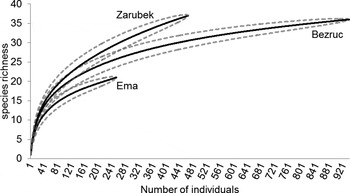
Finally, we must point out caveats related to these data. The main limitation was caused by the low number of caught specimens. This was probably caused by conditions forming the specific biotope, which limits number of species and its abundance. This was reflected by the relatively high frequency of species with low abundance (i.e. a high proportion of singletons). In addition, rarefaction curves show that an increasing number of individuals did not substantially change the richness (fig. 7). Another limitation is the low number of sampling years (two to three occasions within the 32 year period). Nevertheless, we detected significant change in the proportion of the forest habitat and variability in species assemblages.
Total number of species of ground beetles recorded on the individual spoil heap. The error bars depicted for each rarefaction curve represent standard errors.

Conclusion
Comparison of the expected and observed species richness showed significant differences during succession, except in the early successional stages. This suggests that ground beetle species were distributed non-randomly in the assemblage at the late phases of succession. Our study indicates that succession led to forest-like habitats that filter the species from a regional pool based on their functional characteristics. This conclusion was derived from our data that shows CWMs associated with forest ground beetles were positively correlated with succession. Specifically, early successional stages were dominated by open habitats and favoured highly mobile species that could immediately colonize the sites. In contrast, forest habitats with stable physical conditions support brachypterous and carnivorous species of carabids. In addition, we identified a U-shape trend in functional diversity along the succession gradient. The decline in species and functional diversity in the middle phases of the succession indicated assemblage replacement between open and closed habitats (i.e. that carabid assemblage associated with grasslands and bedrock were replaced by the species typical of forest ecosystems).
Supplementary Material
The supplementary material for this article can be found at https://doi.org/10.1017/S0007485316001085
Acknowledgements
The authors would like to thank Jiri Stanovsky and Jiri Vavra for their kind help concerning epigeic beetle ecology and determination. They are also grateful to Monika Mulkova and Oto Kalab, who helped us calculate the areas of the spoil heaps using ArcGIS software. The authors are also grateful to Editage company, which assisted with corrections related to the use of the english language.