Introduction
Microalgae are considered as potential biomass resources in the food industry for production of useful compounds, in agriculture as biobased-filters to remove pollutants from wastewaters, and also in the cosmetics and pharmaceutical industries (Nakanishi et al., Reference Nakanishi, Deuchi and Kuwano2012). Novel bioproducts from microalgal sources have also been developed as these biomolecules were found to have anticancer, antioxidant and anti-inflammatory activities (Apt & Behrens, Reference Apt and Behrens1999). Thus, large-scale production of microalgae is very important due to their characteristics and their advantages over conventional resources. These advantages can be described as not competing for cultivable terrain with feed or food sources, high efficiency in absorbing solar energy, and decreasing CO2 emissions compared with agricultural plants.
Chlorella vulgaris is a well-known microalgal strain and has been used in research for centuries (Xie et al., Reference Xie, Ji, Zhou, Dai, He, Sun, Guo, Yang, Zheng and Chen2022). Strains of the species and their extracts are used as edible healthy foods due to their high chlorophyll content (Konar et al., Reference Konar, Durmaz, Genc Polat and Mert2022). Additionally, with its capacity for accumulating high amounts of lipids, C. vulgaris has proved to be an appropriate candidate for biodiesel production (Xie et al., Reference Xie, Ji, Zhou, Dai, He, Sun, Guo, Yang, Zheng and Chen2022). Chlorella vulgaris is also used as a bio-fertilization agent due to its biochemical profile rich in nitrogenase, nitrate reductase and minerals, which are essential nutrients for plant growth (Ammar et al., Reference Ammar, Aioub, Elesawy, Karkour, Mouhamed, Amer and El-Shershaby2022).
Another important alga, Neochloris texensis (Ettlia texensis), is known to have high lipid content compared with other freshwater species (Isleten-Hosoglu et al., Reference Isleten-Hosoglu, Ayyıldız-Tamis, Zengin and Elibol2013). It yields high specific growth rates at optimal growth conditions with high fatty acid contents. Thus, N. texensis is also evaluated as a very promising candidate for biodiesel production (Kim et al., Reference Kim, Kim, Cho, Nam, Lee, Nayak, Han, Oh and Chang2021).
Maintenance of microalgae is crucial in respect to their increasing potential in commercial applications (Apt & Behrens, Reference Apt and Behrens1999). Preservation of microalgae is a challenge for long-term storage in microalgal culture collections in laboratory scale (Grima et al., Reference Grima, Pérez, Camacho, Fernández, Alonso and Del Castillo1994). Several methods, such as lyophilization (Day, Reference Day2007) and serial sub-culturing, are used for the maintenance of both the commercial species mentioned above and all endemic species. Drying and freeze-drying have been used with a limited degree of success to preserve some algae and there are limited quantitative data about drying and freeze-drying factors that have an effect on long-term storage (McLellan et al., Reference McLellan, Cowling, Turner, Day, Kirsop and Doyle1991; Day et al., Reference Day, Watanabe, Morris, Fleck and McLellan1997). However, these techniques cannot guarantee the long-term maintenance of viable, healthy and stable cultures. Serial sub-culturing techniques can overcome the concerns of contamination, however, they are time consuming, genetic stability of the strain is generally not preserved and the risk of genetic modification increases with the increase in serial transfers (Apt & Behrens, Reference Apt and Behrens1999).
Cryopreservation at extremely low temperatures is extremely efficient for long-term conservation of microalgae in laboratory scale (Tzovenis et al., Reference Tzovenis, Triantaphyllidis, Naihong, Chatzinikolaou, Papadopoulou, Xouri and Tafas2004; Rhodes et al., Reference Rhodes, Smith, Tervit, Roberts, Adamson, Adams and Decker2006). Cryopreservation involves a number of steps, such as incubation with cryoprotectants, slow freezing and rapid freezing, storage in liquid nitrogen and thawing (Harding, Reference Harding2010). There are several parameters that may affect the success of cryogenic storage, including the phase and amount of the cells, the type and density of the cryoprotectant, the duration of cryopreservation, the ingredients of the culture medium, the speed of freezing and thawing methods (Day et al., Reference Day, Watanabe, Morris, Fleck and McLellan1997; Taylor & Fletcher, Reference Taylor and Fletcher1998; Poncet, Reference Poncet2003). The most important factors that affect cellular viability are considered to be cryoprotectant type and concentration, pretreatment with cryoprotectant and the duration of cryopreservation (Day et al., Reference Day, Watanabe, Morris, Fleck and McLellan1997). In order to obtain optimum cell viability, it is necessary to optimize these factors using multivariate statistical techniques (Bezerra et al., Reference Bezerra, Santelli, Oliveira, Villar and Escaleira2008). Among others, response surface methodology (RSM) is generally preferred to determine and evaluate the interactions statistically among the parameters affecting the process (Imamoglu et al., Reference Imamoglu, Demirel and Conk Dalay2015). In this study, optimization of cryopreservation conditions was performed by central composite design (CCD) using response surface methodology with parameters of cryoprotectant concentration (0–25%), pretreatment duration (1–15 min) and the duration of cryopreservation (7–180 days) for C. vulgaris and N. texensis.
Materials and methods
Culture conditions
Two native strains, C. vulgaris (EGEMACC 53) and N. texensis (EGEMACC 68) were obtained from Ege University Microalgae Culture Collection (EGEMACC). The strains were cultured in 100 ml of Bold Basal Medium (BBM), at 22 ± 2°C, under white LED lamps (20 μmol photons m−2 s−1). Cultures were harvested after cultivation for 14 days, at the end of the logarithmic growth phase and after that period the cells were resuspended using 1 ml of fresh BBM and counted using a Neubauer hemocytometer.
Cryopreservation process
Dimethyl sulphoxide (DMSO, Merck) was used as the cryoprotectant in this study. The cryoprotectant in different concentrations, fresh medium and cell suspension were added into cryogenic vials, cultivated at room temperature and cryopreserved according to the experimental protocol. Cryogenic vials were first incubated at −20°C for 30 min, then −80°C overnight and put into liquid nitrogen (−196°C). Thawing was performed using a 40°C water bath. In order to remove the cryoprotectant, the suspensions were centrifuged at 5000 rpm for 5 min and supernatant was removed. Then, cells were resuspended with 5 ml of fresh BBM and incubated under 20 μmol photons m−2 s−1 at 22 ± 2°C for 1 week, subsequently incubated in the dark for 24 h. DMSO concentration (% w/v), incubation time (min) and cryopreservation duration (days) optimized in this study were between 0–25, 1–15 and 7–180, respectively.
Experimental design analysis
The optimization of cryopreservation conditions for both strains was carried out using response surface methodology (RSM) Central Composite Design (CCD) using Design Expert software (version 7.0.0, Stat-Ease Inc., Minneapolis, MN). The experimental design was constituted using 19 runs with 3 factors. The variables are given in Table 1 where DMSO concentration (% w/v), incubation time (min) and cryopreservation duration (days) were defined as X 1, X 2 and X 3, respectively. The biomass concentration at 665 nm for both C. vulgaris (Y 1) and N. texensis (Y 2) were chosen to be the response functions. All experiments were accomplished in triplicate and the average values were reported.
Experimental factors and levels for cryopreservation of microalgae strains of Chlorella vulgaris and Neochloris texensis

The mathematical description of the responses of these variables is generally approximated by quadratic polynomial equation;

where Y stands for the response, β 0 for model constant, β 1, β 2 and β 3 for linear coefficients, β 12, β 23 and β 13 for interaction effect coefficient and β 11, β 22 and β 33 for quadratic coefficients, X 1, X 2 and X3 for the coded levels of independent variables.
Viability assay
Cell viability was quantified using fluorescein diacetate (FDA) staining one day after thawing (Day & Stacey, Reference Day and Stacey2007). FDA stock solution was prepared by suspending FDA in methanol on an equal basis (mg ml−1). 50 μl of that stock solution was added to 1 ml of culture, incubated at room temperature for 5 min. Then, the cells were observed by blue-light fluorescence microscopy. The images of living cells were taken under 485/535 excitation/emission nm with fluorescein microscope at 63× and 40× magnification for C. vulgaris and N. texensis, respectively. Viable cells fluoresced green and non-viable cells appear to be red or colourless. Cell viability was calculated using equation (2):

Measurement of microalgal growth
Microalgal cell growth was monitored by optical density measurement, determination of protein amount and oil content.
Optical density was measured at 665 nm using a UV/VIS spectrophotometer (GE Healthcare Ultrospec 1100 pro, London, UK).
Protein amounts were determined using Brilliant Blue G 250 dye by the Bradford method (Bradford, Reference Bradford1976). Samples were centrifuged at 3500 g for 5 min, and 0.5 ml of the supernatant was mixed with 1.5 ml of threefold Brilliant Blue G 250. The mixture was kept for 5 min at 25°C. Absorbance was measured at 595 nm.
Oil content was determined using the Bligh and Dyer method (Bligh & Dyer, Reference Bligh and Dyer1959). Briefly, 100 mg of lyophilized cells were resuspended with 3 ml of chloroform/methanol (2:1 v/v) and 0.5 mg ml−1 of butylated hydroxytoluene (BHT) and sonicated at 20 kHz for 5 min using a sonicator (Bandelin Sonoplus UW 2070, Germany). After incubation overnight, the solution was centrifuged at 15,000 g for 5 min and the supernatant was diluted with water to get rid of chloroform using a rotary evaporator. Oil content was measured gravimetrically.
Specific growth rate and doubling time were calculated using equations (3) and (4), respectively (Guler et al., Reference Guler, Deniz, Demirel, Oncel and Imamoglu2020).


where μ stands for specific growth rate, x 2 and x 1 are the biomass concentrations over the time interval and Δt and t d represent doubling time.
Results and discussion
Optimization of cryopreservation for Chlorella vulgaris
Rapid freezing of cells may cause physicochemical stresses and loss in viability due to the alteration of metabolic behaviour and enzymatic reactions as a result of instantaneous decrease in temperature. In this study, a two-step freezing method and a controlled thawing method were selected in order to prevent that damage.
The optimization of DMSO concentration (0–25% w/v), incubation time (1–15 min) and cryopreservation duration (7–180 days) were varied in this study. CCD consisted of 19 runs and was used to interpret the effect and interactions of different cryopreservation factors on microalgal growth. The effect of these factors and responses can be seen in Table 2 where the absorbance of C. vulgaris strain was coded as Y 1. The growth of the algae was in the range of 0.01 and 0.04 depending on the values of the factors. The model was analysed statistically using Fisher's F-test for ANOVA as presented in Table 3. The model showed that the first or second order of the factors had a significant impact on the growth of C. vulgaris (P < 0.01). The correlation factor (R 2) of 0.934 suggested that the model fit to the experimental results with a high correlation and only 6.6% of the total varieties were not corresponded by the model. The adjusted correlation coefficient (Adj. R 2) of 0.901 also sustained that the model was good enough to represent the experimental studies. The insignificance of the lack of fit value implied that the differences among the response of the factors were adequate. For the cryopreservation of C. vulgaris, a second-order polynomial equation in terms of actual factors was found to be:

where Y 1 is the predicted value for the absorbance of the strain at the cryopreservation conditions in which the tested factors were shown as X 1 (DMSO concentration), X 2 (incubation time) and X 3 (cryopreservation duration).
Experimental design for cryopreservation of microalgae strains

*X 1; DMSO concentration (% w/v), X 2; incubation time (min), X 3; cryopreservation duration (days). Absorbance values at 665 nm for Y 1; C. vulgaris and Y 2; N. texensis.
ANOVA results of the model for the cryopreservation of Chlorella vulgaris.

According to the regression plot of the cryopreservation of C. vulgaris, experimental results against those predicted by Eq. 4 revealed linear correlational statistics (Figure 1A). The correlation between the experimental results and the predicted values demonstrated that the model represented the experimental range of the study sufficiently.
The predicted and actual values for the models of the cryopreservation of (A) Chlorella vulgaris, (B) Neochloris texensis using Response Surface Methodology.

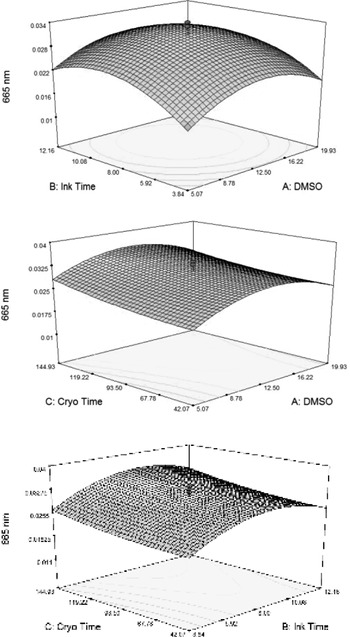
Three-dimensional surface responses of C. vulgaris microalga are given in Figure 2. The effect of incubation time and DMSO concentration on cell viability was a concave curve where the incubation time and DMSO concentration yielded the highest cell viability at a single point (Figure 2A). It is possible to hypothesize that the effect of DMSO was due to the prevention of formation of intracellular ice crystals and cell dehydration (Bui et al., Reference Bui, Ross, Jakob and Hankamer2013; Fernandes et al., Reference Fernandes, Calsing, Nascimento, Santana, Morais, de Capdeville and Brasil2019). However, the cryopreservation duration in Figure 2B & C was quite linear, and the change in this parameter did not appear to affect cell viability; whereas incubation time and cryoprotectant concentration had a similar effect. This may be due to the effect of DMSO which was higher than cryopreservation duration for the microalga. This result is in agreement with the report by Morris (Reference Morris1976), where the type and amount of the cryoprotectant had the most effect on cell viability for Chlorella.
Three-dimensional surface response graph showing the effects of cryopreservation duration, DMSO concentration and cultivation time on cell viability of Chlorella vulgaris cells. Ink time: incubation period; Cryo time: cryopreservation period; DMSO: Dimethyl sulphoxide concentration.

According to the numerical optimization analysis of the model, the DMSO concentration of 8.31%, the incubation period of 9.42 min and the cryopreservation period of 123.17 days were calculated as the optimum conditions which yielded the maximum cell viability with a desirability value of 1.0.
Optimization of cryopreservation for N. texensis
According to the results of the optimization study of N. texensis, the optical density value measured at 665 nm varied between 0.01 and 0.034 where the absorbance of N. texensis strain was coded as Y 2 (Table 2). The results of the experimental design analysis of the created model which examines the effect of cryopreservation duration, incubation time and cryoprotectant concentration in this study are given in Table 4. Since the P > F value of the model was <0001, the model was considered to be meaningful and fit to the design analysis studies. The lack of fit value was calculated to be 0.2495 indicating that there was no experimental error between the repetitions at the central point. The regression value of the model (R 2) was found to be 0.9868 which proved that the results of the study were 98.68% correct and significant. The second-order polynomial model obtained from those results was as follows:

ANOVA results of the model for the cryopreservation of Neochloris texensis

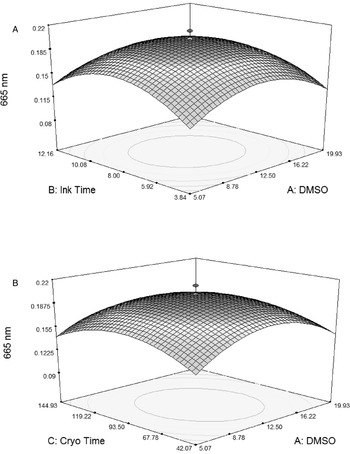
Three-dimensional surface response graphs of N. texensis showed the effect between the interaction of incubation time and DMSO concentration and also the interaction of cryopreservation duration and DMSO concentration on cell viability (Figure 3). The concave-shaped graphs showed the response at a single point. The highest cell viability was obtained in the interval in which the incubation time was 8 min and the DMSO concentration was 12.50% (Figure 3A & B). According to the numerical optimization analysis of the model, the DMSO concentration of 12.95%, the incubation time of 10.91 min and the cryopreservation duration of 111.44 days were determined as the optimum conditions which yielded the maximum cell viability with a desirability value of 0.97. Several studies showed higher viability using DMSO in a range of 5–15% for microalgal cryopreservation (Day et al., Reference Day, Benson, Harding, Knowles, Idowu, Bremner, Santos, Friedl, Lorenz, Lukesova, Elster, Lukavsky, Herdman, Rippka and Hall2005; Ernst et al., Reference Ernst, Deicher, Herman and Wollenzien2005; Day, Reference Day2007; Gaget et al., Reference Gaget, Chiu, Lau and Humpage2017).
Three-dimensional surface response graph showing the effects of cryopreservation duration, DMSO concentration and cultivation time on cell viability of Neochloris texensis cells. Ink time: incubation period; Cryo time: cryopreservation period; DMSO: Dimethyl sulphoxide concentration.

Verification of optimized conditions
Unlike cryopreservation of other types of organism, it is quite apparent that there is no universally standard pertinent protocol for microalgae. The main aim was to design a cryopreservation process for two microalgal strains to obtain the maximum viability for the independent variables in the design. These variables, including DMSO per cent, incubation time and cryopreservation term, were set within the range of the runs while the absorbances at 665 nm was set to maximum value. The optimum conditions and verification results are given in Table 5. The optimized DMSO concentration, incubation time and cryopreservation duration for C. vulgaris were 8.31 (%w/v), 9.42 min and 123.17 days, respectively. For the cryopreservation of C. vulgaris, the average optimal absorbance value was in agreement with the predicted results which was proven with a desirability of 1. The optimized cryopreservation result for N. texensis was 12.95% (w/v) of DMSO concentration, 10.91 min of incubation and 111.44 days of cryopreservation duration corresponding to a high desirability. In order to validate the predicted results according to the model and to estimate the effect of those variables on microalgal viability and morphology, validation experiments were performed in triplicate. The actual values for C. vulgaris and N. texensis were found to be 0.033 and 0.221, respectively, which were closer to the predicted values (0.031 and 0.207, respectively), designating the accuracy of the optimization results. Nevertheless, it is worth emphasizing that storage in liquid nitrogen (−196°C) is recommended for increased viability and longer storage durations. Previous studies support the decreased viability and lower storage periods at −80°C for microalgae (Nakanishi et al., Reference Nakanishi, Deuchi and Kuwano2012; Odintsova & Boroda, Reference Odintsova and Boroda2012; Tanniou et al., Reference Tanniou, Turpin and Lebeau2012; Day & Fleck, Reference Day and Fleck2015).
Validation results of microalgal strains according to the model

Cell viabilities after thawing of cryopreserved microalgae
In this study, cell viabilities were measured after thawing the cultures using FDA one day after thawing to compare with previous studies. Cryopreservation conditions were chosen according to the optimization models for both strains. The viability of microalgae strongly depends on the incubation duration, concentration and type of the cryoprotectant. DMSO has higher penetration capacity than other well-known cryoprotectants such as glycerol or methanol and that situation leads to reduced incubation durations. It was reported that the optimum concentration of DMSO has been found to give more successful results in green algae than cyanobacteria (Mori et al., Reference Mori, Erata and Watanabe2002). However, penetration of DMSO depends on the size and type of microalgal strain, semi-permeability and lipid concentration of cell membrane (Salas-Leiva & Dupré, Reference Salas-Leiva and Dupré2011). In this study, C. vulgaris and N. texensis showed high viability with the optimum concentration of DMSO of 8.31% and 12.95%, respectively (Figure 4A & B).
Viable cell images after thawing of (A) Chlorella vulgaris (63×) and (B) Neochloris texensis (40×).

Generally, a viability above 60% for a post-thawing culture is appropriate for a successful cryopreservation (Morris, Reference Morris1981). Cell viabilities were up to 81% for C. vulgaris and 72% for N. texensis with higher remaining protein content (Table 6). It can be assumed that the decrease in cell viability may be a result of cell damage associated with ice crystal development in the cytoplasm at this high sub-zero storage temperature for more than 4 months. Similar results were published previously where cryopreserved cells were damaged and lost their viability after 4-month storage due to intracellular ice formation and salt-induced injuries (Kapoore et al., Reference Kapoore, Huete-Ortega, Day, Okurowska, Slocombe, Stanley and Vaidyanathan2019). In a previous study, Dunaliella salina had a viability of 70.6% when it was cryopreserved with 10% of DMSO and frozen at −196°C (Guermazi et al., Reference Guermazi, Sellami-Kammoun, Elloumi, Drira, Aleya, Marangoni, Ayadi and Maalej2010).
Vital activity of cryopreserved and non-cryopreserved microalgae

Viability after cryopreservation is challenging and requires optimization. In spite of that, it is not the only issue as the success of the process also depends on the continued ability of microalgae to produce metabolites of interest. Thus, other than viability, the maintenance of cell composition is crucial for the success of cryopreservation. In this study, it can be seen from Table 6 that protein and fatty acid contents were similar compared with the non-cryopreserved microalgae for both C. vulgaris and N. texensis. This finding conflicts with Saadaoui et al. (Reference Saadaoui, Al Emadi, Bounnit, Schipper and Al Jabri2016) where the fatty acid profiles were not significantly affected after cryopreservation of Chlorella isolates. Our results are also in accordance with previous reports for other microalgae strains of Chlorella (Kapoore et al., Reference Kapoore, Huete-Ortega, Day, Okurowska, Slocombe, Stanley and Vaidyanathan2019), Phaeodactylum (Longworth et al., Reference Longworth, Wu, Huete-Ortega, Wright and Vaidyanathan2016) and Chlamydomonas (Schmollinger et al., Reference Schmollinger, Mühlhaus, Boyle, Blaby, Casero, Mettler, Moseley, Sommer, Strenkert, Hemme, Pellegrini, Grossman, Stitt, Schroda and Merchant2014).
In this study, the specific growth rates of the microalgae were increased by 37.5% and 17% compared with the non-cryopreserved controls of C. vulgaris and N. texensis, respectively. The higher specific growth rates compared with the non-cryopreserved controls might be due to the inherent variability in microalgal systems and the cryopreservation protocol. In a recent study, these kinds of enhancements were reported to be related with the differences in viabilities of the microorganism in different cryovials (Racharaks & Peccia, Reference Racharaks and Peccia2019). Moreover, the specific growth rate of Prasiola sp. was increased by 19% when it was cryopreserved using 5% DMSO compared with the non-cryopreserved cells (Kruus, Reference Kruus2017).
Conclusion
In this study, the optimum cryopreservation conditions were verified as 12.95% of DMSO, 10.91 min of incubation time and 111.44 days of cryopreservation duration for C. vulgaris, whereas DMSO concentration of 8.31%, incubation period of 9.42 min and cryopreservation period of 123.17 days were found to be optimum for N. texensis. Microalgal viabilities of 81% for C. vulgaris and 72% for N. texensis were achieved after cryopreservation and thawing using FDA for the determination of viable cells. In conclusion, these results endorse cryopreservation and storage at −196°C for the long-term maintenance of C. vulgaris and N. texensis without compromising their functionality.
Author contribution
ID was in charge of conceptualization, data curation, formal analysis, investigation, software, validation, writing, editing; ZD and EI had roles in methodology, project administration, resources, visualization; and MCD handled data curation, writing and editing, and supervision.
Financial support
This work was supported by the Scientific and Technological Research Council of Turkey (TUBITAK), Grant number 113Z202.
Conflict of interest
The authors declare that they have no known competing financial interests or personal relationships that could have appeared to influence the work reported in this paper.
Credit author statement
All persons who meet authorship criteria are listed as authors, and all authors certify that they have participated sufficiently in the concept, design, analysis, writing, or revision of the manuscript. In addition, the descriptions are accurate and agreed by all authors.