Although the self-concept has a prominent and enduring place in theory about development and well-being (Harter, Reference Harter, Mussen and Mavis Hetherington1983, Reference Harter, Damon and Eisenberg1998, Reference Hotelling2006), its value in processes underlying adjustment has been contested. The long-standing view of the self-concept is that it is the desired objective of development because it promotes competent affective and behavioral functioning (see Wylie, Reference Wylie1979). Seeing oneself as competent and feeling satisfied with one's functioning are presumed to be positive developmental outcomes that can serve as protective factors against risks (Markus & Wurf, Reference Markus and Wurf1987). Typically, a positive self-concept has been regarded as an index of adjustment and psychosocial heath (Harter, Reference Harter, Damon and Eisenberg2006). It is known also, however, that distortions in the self can be problematic. Seeing oneself as competent and well functioning when one is not has been recognized as a basic correlate of several maladaptive outcomes such as antisocial behavior (Menon et al., Reference Menon, Tobin, Corby, Menon, Hodges and Perry2007). In extreme forms, distortions in the self serve as the central and defining features of the personality disorder known as the narcissistic personality. Two fundamental features are central to narcissism. One is the presence of an inflated sense of self. Narcissistic individuals see themselves more positively than is warranted by objective criteria. The other is that narcissistic individuals are heavily invested in maintaining these positive views. Accordingly, they are motivated to defend themselves against threats to their beliefs about their very positive functioning.
Our goal in this paper is to use the basic principles of the approach known as developmental psychopathology (Cicchetti, Reference Cicchetti1984, Reference Cicchetti1993; Rutter & Sroufe, Reference Rutter and Sroufe2000) to examine a set of processes linked to a normal distribution variant of this form of psychopathology. We examine three sets of questions. The first was concerned with whether individual differences in a measure of narcissism used with community-based samples of early adolescents would show the same features that are characteristic of the narcissistic personality disorder. The second set of questions concerned the association between narcissism and aggression. Two questions were addressed. One concerned the association between narcissism and the stability of aggression; the other asked whether narcissism was more strongly related to types of aggression indicating a heightened reactivity to threats and a need to portray the self in a positive way. The third set of questions asked whether distortions in the self are associated with particular patterns of psychophysiological responses to stress (i.e., activity of the hypothalamic–pituitary–adrenal [HPA] axis). We examine these issues in a multisample and multistudy investigation.
Narcissism Within a Community Sample of Early Adolescents
The phenomenon we are studying is a “normal” variant of the personality disorder known as narcissistic personality disorder. According to the Diagnostic and Statistical Manual of Mental Disorders—Fourth Edition (DSM-IV; American Psychiatric Association, 1994), personality disorders are “enduring patterns of inner experience and behavior that deviate markedly from the expectations of the individual's culture” (p. 633). It is believed that the relatively enduring nature of these disorders is because of the basic processes of the disorders themselves. Specifically, it is believed that at the center of the disorder is a crucial organizational component that serves to support or maintain the disorders fundamental characteristics. In the case of the narcissistic personality, the fundamental characteristic is an all encompassing pattern of overly positive views of the self. The description of this disorder in the DSM-IV defines the central features of narcissistic personality as the presence of a uniformly positive view of self in conjunction with a high level of self-involvement and self-centeredness. These core beliefs are supported and maintained by a strong inclination to protect the self against external evaluations and threats. These reactive tendencies are believed to be a way that narcissistic persons defend themselves against real or imagined attacks from external sources.
Typically, the diagnosis of the narcissistic personality disorder is made via clinical interviews and assessments. In our study of early adolescents drawn from nonclinical samples, we used traditional forms of peer assessment to measure the central features of this disorder, specifically a sense of superiority and self-involvement that can be manifested in a very positive view of self, regardless of whether there is objective evidence to warrant it. We also used well-known self-report measures of social competence and self-worth in conjunction with objective indices of social functioning as a further means of assessing self-distortions.
These measures were used to assess the first set of hypotheses in our study. The specific hypotheses were as follows. First, consistent with the claim that personality disorders are relatively enduring phenomena we expected that our measures of narcissism would be highly stable as well. That is, we expected strong correlations between assessments of narcissism conducted at different times. Second, we expected that early adolescents who were assessed as being narcissistic would show discrepancies between their self-concept and their actual functioning.
Aggression and the self
A second issue related to narcissism concerns aggression. The traditional view in psychology that self-esteem and aggression are independent of each other or are negatively interrelated has been challenged by theory and empirical evidence. Baumeister, Smart, and Boden (Reference Baumeister, Smart and Boden1996) proposed that an inflated sense of self is fragile and can be threatened easily. They used a concept known as “threatened egotism” to explain that aggression can be the result of the need to defend one's illusory self from threats. They argued that when there is a discrepancy between one's view of the self and the feedback one receives about one's functioning, an individual will act aggressively against the source of this information so as to defend his/her sense of self and to protect it from attack, even when the attack is predicated on accurate information. As seen in other models that invoke the notion of self discrepancy (e.g., Kupersmidt, Sigda, Sedikides, & Voelger, Reference Kupersmidt, Sigda, Sedikides, Voegler, Rotenberg and Hymel1999), Baumeister and his colleagues are careful to point out that it is not high self-esteem per se that leads to aggression. Instead, they argue that aggression results when persons are called upon to defend their self-esteem from evidence that they are not functioning as well as their level of esteem would imply. In this way, it is (a) high self-esteem, not low self-esteem, that is antecedent to aggressive behavior, and (b) more importantly, it is not high self-esteem per se that matters but it is high self-esteem that is discrepant from actual experience.
Akin to the ideas proposed by Baumeister, Raskin, Novacek, and Hogan (1991a, 1991b) argue that hostility, grandiosity, and dominance are interrelated constructs and are strongly related to narcissism. Raskin et al. propose that narcissistic persons have high needs for dominance, have a fragile sense of self, and are deeply invested in maintaining a highly positive view of the self. Despite the similarities between the perspectives of Baumeister et al. and Raskin et al. there are some notable differences between their models. Whereas Baumeister et al. specify a particular mechanism by which the self and aggression are linked (i.e., the discrepancy-based process discussed above), Raskin et al. treat this association as a core feature of the personality and do not tie it to a particular process. They argue that dominance, grandiosity, and the narcissistic style serve to manage hostile feelings and to maintain a sense of well-being. In this way, their model implies a more general or pervasive personality type that involves specific generalized motives (e.g., dominance, self-enhancement) rather than being a phenomenon that derives from a particular process.
Although there have been empirical tests of the general claim that aggression is positively associated with positive views of the self (Bushman & Baumeister, Reference Bushman and Baumeister1998; Patterson, Kupersmidt, & Griesler Reference Patterson, Kupersmidt and Griesler1990; Raskin et al., 1999b), many of the central tenets of the Baumeister's and Raskin's ideas have been ignored or poorly specified. Two particular problems are most frequent. The first is the use of measures of self-esteem per se, rather than indices of distortions in the self. There are, of course some exceptions (Salmivalli, Kaukianinen, Kaitaniemi, & Lagerspetz, Reference Salmivalli, Kaukiainen, Kaitaniemi and Lagerspetz1999), but they have been rare. As a result, one of the central ideas of these models has not been tested.
More importantly, the current literature is limited by the use of an overly broad conceptualization of aggression. It is known that aggression is not a unidimensional phenomenon, but instead, has many manifestations (Card & Little, Reference Card and Little2006; Card, Stucky, Sawalani, & Little, Reference Card, Stucky, Sawalani and Little2008; Dodge, Coie, & Lynam, Reference Dodge, Coie, Lynam, Damon and Eisenberg2006). For example, aggressive acts differ in their functions and forms. Some aggressive acts follow provocation (i.e., reactive aggression), whereas others do not (i.e., proactive aggression). The function of reactive aggression is defensive, whereas the function of proactive is offensive (Pulkkinen, Reference Pulkkinen1986). Aggressive acts differ also in whether their form is physical and direct or relational and indirect.
This distinction between reactive and proactive aggression is implicit in the ideas of Baumeister and colleagues. Specifically, Baumeister et al. describe a process implicating reactivity rather than proactiveness. Accordingly, one would expect that measures of threatened egotism should be more highly related to reactive aggression than to proactive aggression. The distinction between direct and indirect aggression may also be relevant to Baumesiter's model. In so far as narcissistic persons may be motivated to present themselves in a positive manner, they may be more inclined to avoid the use of overt and direct forms of aggression that might portray them in a negative way. Distinctions between reactive and proactive aggression and between physical/direct and relational/indirect aggression may not be as relevant for the ideas of Raskin et al. (Reference Raskin, Novacek and Hogan1991a, Reference Raskin, Novacek and Hogan1991b). If, as they may imply, narcissism is associated with a general hostility, then one would not expect measures of this construct to be more strongly related to one form of aggression than another.
These ideas lead to the third and fourth hypotheses of this study. The third hypothesis is that narcissism will be concurrently associated with aggression and that it will promote its stability over time. That is, we expected that narcissism will be correlated with a measure of aggression, and that it will promote the stability of this measure over time. Aggression was expected to be more stable among persons who show high levels of narcissism than among those who present low levels of narcissism. In so far as narcissism was expected to be a fundamentally stable phenomenon (see Hypothesis 1), it was not expected that aggression would affect the stability of narcissism. The fourth hypothesis is that narcissism will be differentially associated with different functions and forms of aggression. Specifically, it was expected that narcissism will be more strongly related to reactive aggression than to proactive aggression and to relational/indirect aggression more than to physical/direct aggression.
Distortions in the self and psychophysiology
The personality dynamics associated with narcissism and distortions in the self do not function in isolation, but instead operate in the presence of other defensive systems that are also presumed to protect individuals from experiences that are perceived to be psychological threats. Another defensive system is rooted in the activity of the body's primary stress response system, specifically the HPA axis (Klimes-Dougan, Hastings, Granger, Usher, & Zahn-Waxler, Reference Klimes-Dougan, Hastings, Granger, Usher and Zahn-Waxler2001; Lupien et al., Reference Lupien, Ouellet-Morin, Hupbach, Walker, Tu, Buss, Cicchetti and Cohen2006). Starting with Selye's research (Reference Selye1950), it has been known that following stress or arousal, the HPA axis typically becomes activated and increases the production of cortisol; when the stress has been alleviated the production of cortisol is reduced. The activity of the HPA axis can be seen as a resource-based form of defense. When functioning in its idealized form, the HPA axis provides a resource (i.e., cortisol) that facilitates adaptation following stress. It is known, however, that the functioning of the HPA axis varies across individuals, approximating its idealized form more so for some persons than others. For some persons the reactivity of the HPA axis will be weaker than it is for others. Moreover, given that arousal can be either positive or negative, it is conceivable that the system for any particular person may be differentially sensitive to positive or negative experiences (Gunnar & Vazquez, Reference Gunnar, Vasquez, Cicchetti and Cohen2006).
Despite many differences between them there appear to be some functional parallels between the activity of the HPA axis and the purported goals and dynamics linked to narcissism and distortions in the self. Each system has a defensive purpose that facilitates responses to threat. Typically these systems have been studied as independent processes. In the present study we study them together to assess how their functioning is interrelated. Of the many ways in which these systems can be related, one of the most plausible is that narcissism and self-distortions will arise when basic defense systems such as the functioning of the HPA axis does not provide the support needed to deal with threats. The basis of this hypothesis is that the need to develop self-protective strategies will occur when more fundamental and typical forms of defense do not function properly. The hypothesis is predicated on a compensatory model of functioning in which the protective significance of any particular system is highest when the protective functioning of another system is weak. In this case, the “protective” of self-distortions is necessitated by the maladaptive functioning of the HPA axis. According to this hypothesis HPA axis reactivity to arousal would be expected for children whose “self” is coherent with their experiences; alternatively, reactivity to arousal would be substantially weaker for early adolescents whose self is inflated and discrepant from experience. This expectation serves as the fifth hypothesis of the study.
Summary
Five hypotheses are proposed as means of understanding narcissism and distortions in the self during early adolescence. These hypotheses were examined in a multisample, multistudy investigation. We conceptualized narcissism as a personality dimension that varies across a broadly defined normal range. As a form of disordered personality we expected that it would be stable over time, and that early adolescents who were high in narcissism would, almost by definition, have an inflated sense of self that is inconsistent with objective indices of functioning. It was predicted also that narcissism would promote the stability of aggression, and that it would be especially strongly associated with reactive and, perhaps, relational aggression. Finally, the interface between distortions in the self and the functioning of the HPA axis was examined to test an hypothesis that the defensive features of an inflated self may derive from inadequacies in HPA axis reactivity to arousal.
Method
Participants and procedures
Sample 1
The participants in Sample 1 were students in the single middle school located in a community that included lower middle and upper middle-class families. The participants were met at three times. Time 1 (T1) took place at the beginning of Grade 6 just after the students had made the transition to a single middle school (N = 292; 153 boys, 139 girls); Time 2 (T2) took place 6 months after Time 1 toward the end of the sixth-grade school year (N = 321; 165 boys, 156 girls); Time 3 (T3) took place 12 months after T2 (N = 301; 150 boys, 151 girls). At each time more than 90% of the potential pool of participants was in the sample. The overlap between the participants at T1 and T2 was 91%, between T1 and T3 it was 86%, and between T2 and T3 it was 87%. The average age of the subjects was approximately 11.5 years old at T1.
At each of the three times the participants completed a nomination-based peer assessment questionnaire and a positive and negative nomination sociometric questionnaire. In the peer assessment procedure the participants chose participating same-sex peers for “roles” in a hypothetical class play. Two roles referred to narcissism (“Stuck up and thinks they are better than others” and “Selfish and too concerned with him/herself”); three referred to aggression (“Mean cruel boss,” “Causes trouble,” and “Picks on others”). Each participant was given a score on each role according to how often he/she had been chosen for this role by participating peers. These scores were standardized within sex to eliminate any variations that might result from differences in the number of boys and girls in the sample. A further advantage of standardizing these scores is that differences between groups on any particular score can be understood immediately in terms of standard deviation units. The standardized acceptance and rejection scores were used to create a measure of sociometric preference by subtracting the rejection score from the acceptance score. The standardized scores for the three aggression items were combined to form an aggression score (Cronbach αs = .78, .86, and .79 at T1, T2, and T3, respectively). The two narcissism items were also combined to form a single value at each of the three times (Cronbach αs = .72, .68, and .74 at T1, T2, and T3, respectively).
At T2 and T3, the participants also completed the Perceived Competence Scale for Chidren (PCSC; Harter, 1983). In the present study two (social and general self-worth) of the four PCSC subscales were used. On each of these scales the scores could range from 1 to 4, with high scores indication higher levels of perceived competence or self-worth.
Sample 2
The second sample included 430 fifth- and sixth-grade boys (N = 222 boys, 208 girls) from three schools. Again, the sample included lower and upper middle-class participants, and over 90% of the potential sample took part in the study. As part of a larger study, the participants completed a peer assessment procedure similar to that used in Sample 1 except that an unlimited nomination procedure was used. Three items in the peer assessment procedure were used to measure narcissism (Someone who thinks too much of themselves, Someone who thinks they're better than they really are, Someone who is stuck up and thinks he/she is better than others, α = .92), three were used to measure physical/direct aggression (Someone who hits, pushes, or shoves people, Someone who hurts others physically, and Someone who gets involved in physical fights, α = .97), and two were used to measure relational/indirect aggression (Someone who talks bad about others behind their backs to hurt them, Someone who tries to keep others out of the group when it's time to play, α = .80).
The participants were also evaluated by their teachers. Using a 3-point scale, the teacher indicated whether particular items fit each child (0 = does not fit, 1 = sort of fits, 2 = fits really well). Three items rated by the teacher were used to measure narcissism (Thinks too much of him/herself, Is stuck up and thinks he/she is better than others, Thinks they're better than they really are, α = .83), three were used to measure proactive aggression (Threatens and bullies others, Will try to hurt others even when no one has bothered him/her, Will be mean to others even when no one has bothered him/her, α = .82), and three were used to measure reactive aggression (Can get in fights with others but only when someone has bothered him/her, If someone bothers or hurts him/her, he/she will try to get back at them, Will bug others but only if others have bugged him/her first, α = .80).
Sample 3
The third sample included 103 girls (N = 48) and boys (N = 55) from five classrooms in Grades 5 and 6 of a primary school. Initially 111 children, constituting more than 90% of the potential pool of participants, were in the sample. Eight children from this initial sample were excluded because of health conditions or the use of medications that may have affected our measurements of salivary cortisol. These medications included any form of treatment for a respiratory problem and methylphenidate. A two-phase data collection was conducted. In the first phase the participants completed a sociometric procedure like the one used with Sample 1 except that an unlimited choice format was used, and again like the participants in Sample 1 they completed the PCSC (Harter, 1983). The second phase of the study consisted of an event sampling procedure in which the participants were assessed at five times on each of 4 consecutive days, specifically a Tuesday through a Friday. These days were coded as 0 through 3 to create a measure of “day.” During each day, assessments were made at (a) 30 min after the child woke up, (b) 10 min after the beginning of the homeroom period following the children's arrival at school (i.e., at 8:10 a.m.), (c) 10 min after the end of the midmorning recess period (10:10 a.m.), (d) 10 min after the end of free play period following lunch and 40 min after the end of the lunch period (12:20 p.m.), and (e) at the end of the school day (2:10 p.m.). The children recorded the exact time at which the postwaking assessment occurred. For each child on each day the time of the subsequent four assessments was measured according to its distance in minutes from the postwaking assessment.
At each assessment, the participants used a passive drool procedure to expel at last 5 ml of saliva into a plastic vial. No materials were used to stimulate saliva production. When a participant had trouble producing saliva they were instructed to imagine the experience of biting into a fresh lemon. Each participant provided up to five samples of saliva on the 4 days of the study. The children brought the vials of saliva from the postwaking assessment with them to school. These were immediately placed in ice-filled containers like those that persons often bring on picnics. These ice-filled coolers were stored outside in a car. As the study was conducted in Quebec during the winter the ambient temperature was below the freezing point. The vials of saliva collected at the four remaining assessments were stored in this same manner until the research team returned to the university and placed them in a freezer where they were stored at −80°C until they were assayed.
At each of the times when the saliva samples were collected the participants also completed a set of questions included in a small booklet. Two questions in this booklet referred to the negative/positive arousal of the child's social experiences 15 min prior to this assessment. Specifically, each participant rated her/his the experience she/he had 15 min earlier according to how positive or negative it was. These ratings were made with a scale in which low scores indicated that the prior experience had been negative (scored as a “1” on the scale), whereas high scores indicated that the experience had been positive (these were scored as “7”). The two sets of ratings were standardized and then the standardized scores were added together to create a composite negative/positive arousal score. This measure was observed to have an acceptable level of reliability (α = .77).
The saliva samples were analyzed with a high-sensitive enzyme radioimmunoassay technique at a university-based research laboratory in Montreal. The results of the assessment were as a ratio milligrams to decilitres. Data screening was conducted to identify “outliers” (i.e., scores that were more than 2.5 SD from the mean). In these assessments the data from each of the 20 assessments were treated as separate distributions. These inspections revealed only six instances (out of over 2,000 values) of scores that were more than 2.5 SD from the mean for a particular distribution. These “outliers” were drawn in so that all scores were within a reasonable perimeter around the mean.
Results
Stability of narcissism
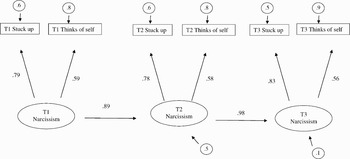
The first set of analyses assessed the first hypothesis, specifically that individual differences in narcissism would be stable over time. Using data from Sample 1, the structural equation modeling program known as EQS (Bentler, Reference Bentler1995) was used to evaluate a model in which a latent factor representing narcissism was created at each of the three assessment times. As shown in Figure 1, at each time the latent variable was defined as having two manifest or observed variables, specifically the peer assessment scores for the items Stuck up and thinks they are better than others and Selfish and too concerned with him/herself. The latent trait at T1 was represented as an antecedent to the latent score at T2, which represented an antecedent to the score at T3. As shown in Figure 1, the correlations between the time points were extraordinarily strong (.89 from T1 to T2 and .98 from T2 to T3) and the overall fit of the model was nearly perfect. It should be noted that at each of the three time points the coefficient for the association between the latent trait and the item “Stuck up” was substantially stronger than for the item “Selfish,” indicating that it is a more central feature of narcissism than is being selfish. These findings show clearly that narcissism is a highly stable and enduring trait. This evidence is consistent with fundamental concepts regarding the nature of personality disorders.
The path model showing the associations over times for a latent factor for narcissism. “Stuck up” refers to the score on the peer assessment item “Stuck up and thinks he/she is better than others.” “Thinks of self” refers to the score on the item “Thinks too much about himself/herself.” All coefficients are standardized values. χ 2 (5) = 10.36, p > .05; comparative fit index = .99; root mean square error of approximation = .04.

Narcissism and distortions in the self
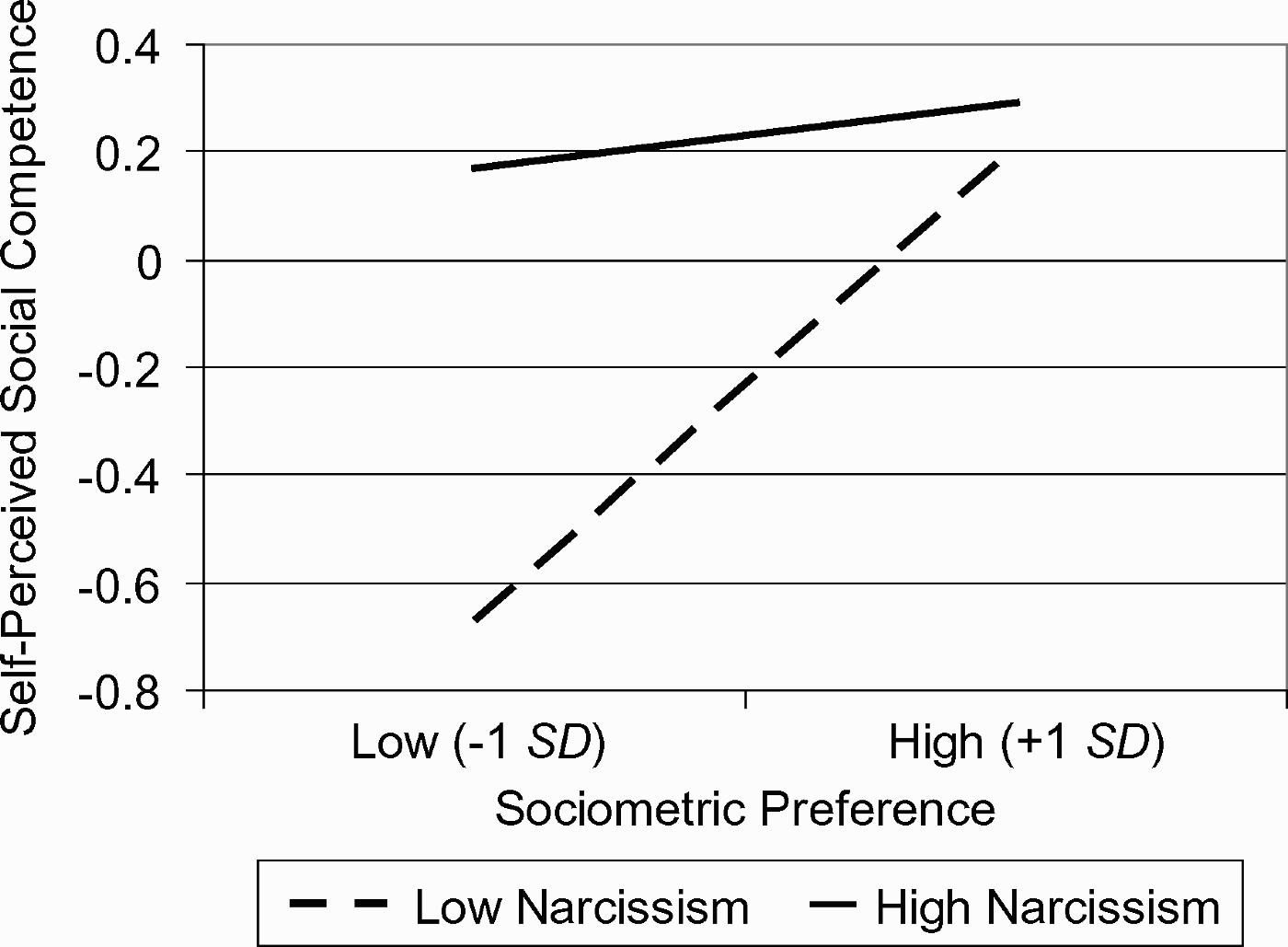
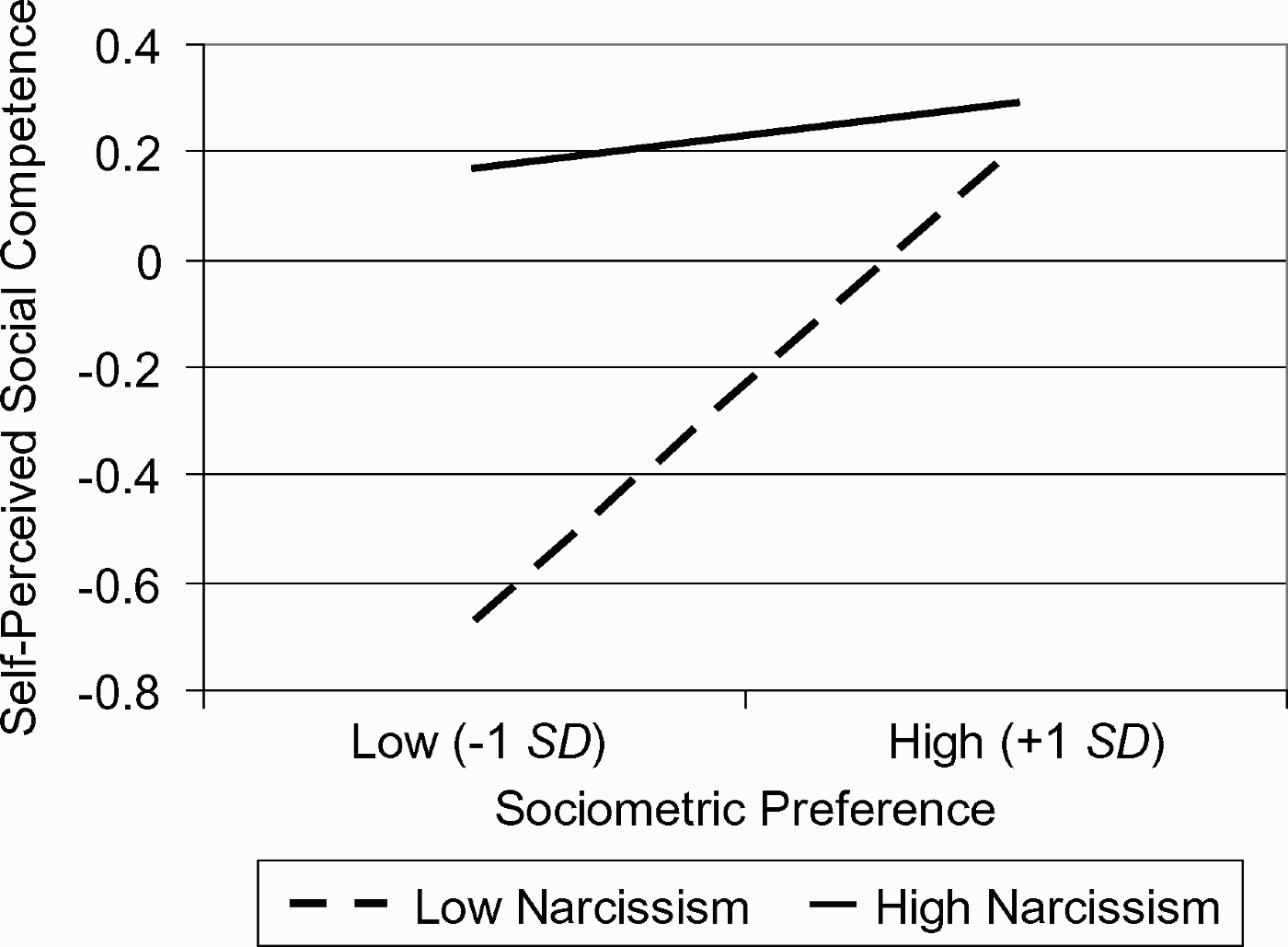
Again, using data from Sample 1, multiple regression analyses were conducted to examine the second hypothesis, specifically that early adolescents who were assessed as being narcissistic would also show discrepancies between their self-concept and their actual functioning. Data from T2 and T3 were used to examined whether the association between one's sense of well-being, as indicated by the score on the social competence subscale of the PCSC, and an objective indicator of their social functioning (i.e., the measure of sociometric preference) would vary as a function of the measure of narcissism. It was expected that early adolescents who are high in narcissism would report very positive levels of social competence regardless of whether or not they were liked by their peers. Two sets of analyses were performed: one with the T2 data and one with the T3 data. In each analysis the dependent variable was the measure of social competence and the measure of sociometric preference, the measure of narcissism, and the interaction between them were used as the predictors that were entered into the equations on Steps 1, 2, and 3, respectively. As both analyses produced the same results, only the findings from T2 will be reported. Each of the three predictors added significantly to the equation (all ts > 2.13, ps < .025). The beta coefficients for the two univariate predictors were positive (.25 and .23 for preference and narcissism, respectively); as expected, the beta coefficient for the interaction was negative (−.31). A clarification of the effects of the interaction between sociometric preference and narcissism (see Figure 2) shows that the predicted pattern of findings was observed. Specifically, high scores on the measure of self-perceived social competence were observed for early adolescents who had high scores on the measure of narcissism regardless of whether there was objective evidence of their competence with peers. For participants with these characteristics, the association between perceived social competence and preference was nearly flat. For early adolescents with low scores on narcissism, however, there was a clear association between one's actual functioning and one's beliefs about it. This evidence of a distortion in the self shows that early adolescents who are high in narcissism see themselves are well-adjusted regardless of whether or not they are.
The slopes for the association between the measure of sociometric preference and the measure of perceived social competence at high and low levels of narcissism. For the measure of sociometric preference and on the measure of narcissism “high” was defined as 1 SD above the mean and “low” was defined as 1 SD below the mean.
Narcissism and the stability of aggression
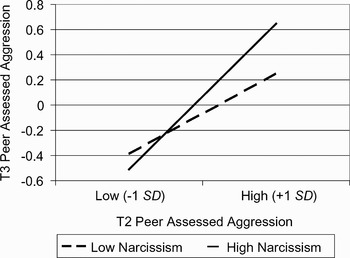
Multiple regression was also used to assess Hypothesis 3. According to this hypothesis, narcissism is associated with aggression and, more importantly, it promotes the stability of aggression over time. Using data from Sample 1, two analyses were conducted to assess whether narcissism at one time was associated with the stability of aggression from that time to a later moment. One analysis covered the 6-month period from T1 to T2, whereas the second covered the 1-year period from T2 to T3. In each, the measure of aggression at the second time was used as the dependent variable and three variables from the first time were used as the predictors. They were the measures of aggression and narcissism and the interaction between these two measures. This latter measure was used to assess whether narcissism moderated the stability of aggression across the time interval. Because both analyses produced the same results, only the results of the T2–T3 covering the longer time period will be specifically reported. In this analysis, each predictor was entered on a separate step (T2 aggression was entered on step 1, T2 narcissism on Step 2, and the interaction on Step 3). Each of the predictors was observed to significantly add to the equation (all ts > 2.15, ps < .025) and the beta coefficients for each were positive (.65, .11, and .28 for aggression, narcissism, and the interaction term, respectively. Consistent with our hypothesis, a clarification of the effect of the interaction between aggression and narcissism (see Figure 3) shows that aggression is more stable among early adolescents who are high in narcissism than among those who are low in it. Despite their beliefs in their positive social functioning narcissistic early adolescents show elevated levels of aggression.
The slopes for the association between the Time 1 and Time 2 measures of peer assessed at high and low levels of narcissism. For the Time 1 measure of aggression and the measure of narcissism “high” was defined as 1 SD above the mean and “low” was defined as 1 SD below the mean.

Narcissism and different types of aggression
The fourth hypothesis asks whether the association between narcissism and aggression varies across different types of aggression. According to the hypothesis it was expected that narcissism would be more strongly related to reactive aggression than to proactive aggression and more strongly to relational/indirect aggression than to physical/direct aggression. This hypothesis was tested with data from Sample 2. With this sample, measures of narcissism were available from both peer and teacher assessments, whereas measures of physical and relational aggression were available from peer assessments and measures of reactive proactive aggression are available from teacher assessments. The hypothesis was tested with the correlation comparison technique developed by Meng, Rosenthal, and Rubin (Reference Meng, Rosenthal and Rubin1992). This technique is superior to the Hotelling's method (1940), and to Dunn and Clark's (Reference Dunn and Clark1971) Fisher's r to z comparison method as its predecessors are unnecessarily conservative. In this comparison technique, bivariate correlations that share a common variable and are based on the same participants are compared with each other. The technique produces a z score statistic whose significance can be assessed with the values found in a z score distribution.
Comparisons were made separately for the two functions (i.e., proactive and reactive) and the two forms of aggression (i.e., relational and physical). With the teacher measure of narcissism and the peer measure of narcissism, comparisons showed that narcissism was more strongly correlated with the measure of reactive aggression (rs = .47 and .56, the teacher and peer measures of narcissism) than to the measure of proactive aggression, rs = .38 (z = 2.41, p < .001) and .42 (z = 3.93, p < .001), for the teacher and peer measures of narcissism. Comparisons also showed that both the teacher measure of narcissism and the peer measure were more strongly correlated with the measure of relational aggression (rs = .38 and .83, for teacher and peer, respectively) than with the measure of physical aggression, rs = .23 (z = 4.93, p < .001) for the teacher measure of narcissism and .45 (z = 13.41, p < .001) with the peer measure.
These findings show that narcissism is more strongly related to some forms of aggression than to others. Consistent with our hypotheses the measures of narcissism were most strongly related to the measures of reactive and relational aggression.
Distortions and the self and reactivity of the HPA axis
Multilevel modeling, conducted with HLM (Raudenbush, Bryk, Cheong, & Congdon, Reference Raudenbush, Bryk, Cheong and Congdon2000) was used to assess the data collected with Sample 3. The basic plan of analysis consisted of a two level model in which Level 1 used measures of day, time of day, and the measures of negative/positive arousal as predictors of the measures of cortisol. The Level 2 model assessed whether “random” (i.e., nonfixed) variations in these effects were associated with distortions in the self. The variables used in the Level 2 model were the measures of perceived social competence, sociometric preference, and the interaction between these measures. (These are the same three variables used in the multiple regression analyses conducted to assess Hypothesis 2.)
In the Level 1 model, the measures of cortisol collected with the event sampling procedure were used as the dependent or outcome measure, and the linear and curvilinear effects of three predictors were assessed. These predictors were the two temporal measures (i.e., time and day) and the negative/positive arousal score. At Level 1, the first analysis was a so-called “unconditional” model in which only the intercept was assessed. In this analysis the intercept score was an index of the grand mean for the cortisol scores in the entire sample. This analysis also produced an index of how much variance in the cortisol scores was because of within person variance and how much was because of between person variation. In this analysis 14% of the total variance was because of between-person variation.
The next Level 1 model assessed the effects of five variables. They were (a) the effect of intercept (i.e., the level of cortisol at the postwaking assessment [Time 0] on Tuesday) (coefficient = .37, χ 2 for randomness = 3342.95, p < .001); (b) a linear effect of time (coefficient = −.11, t = −2.19, p < .03, χ 2 for randomness = 2169.88, p < .001); (c) the curvilinear effect of time (coefficient = .006, t = 10.19, p < .001); (d) the linear effect of the negative/positive experience measure (coefficient = .002, t = 1.02, ns, χ 2 for randomness = 132.17, p < .001); and (e) the curvilinear effect of the negative/positive experience measure (coefficient = .001, t = 0.98, ns, χ 2 for randomness = 170.56, p < .001). These findings show that within-person levels of cortisol varied as a function of day and time of day (in linear and curvilinear manners). Each of these effects was random (i.e., it varied across the participants). The linear and curvilinear effects of the negativity/positivity measure were not significant overall, but they were observed to be random (i.e., not fixed). That is, within-person levels of cortisol did not fluctuate as a function of whether the events preceding the collection of the saliva had been negative or positive. The effect of the negativity/positivity of the prior events, however, varied considerably across the participants. Overall, the Level 1 effects accounted for 72% of the within-person variance and 62% of the total variance.
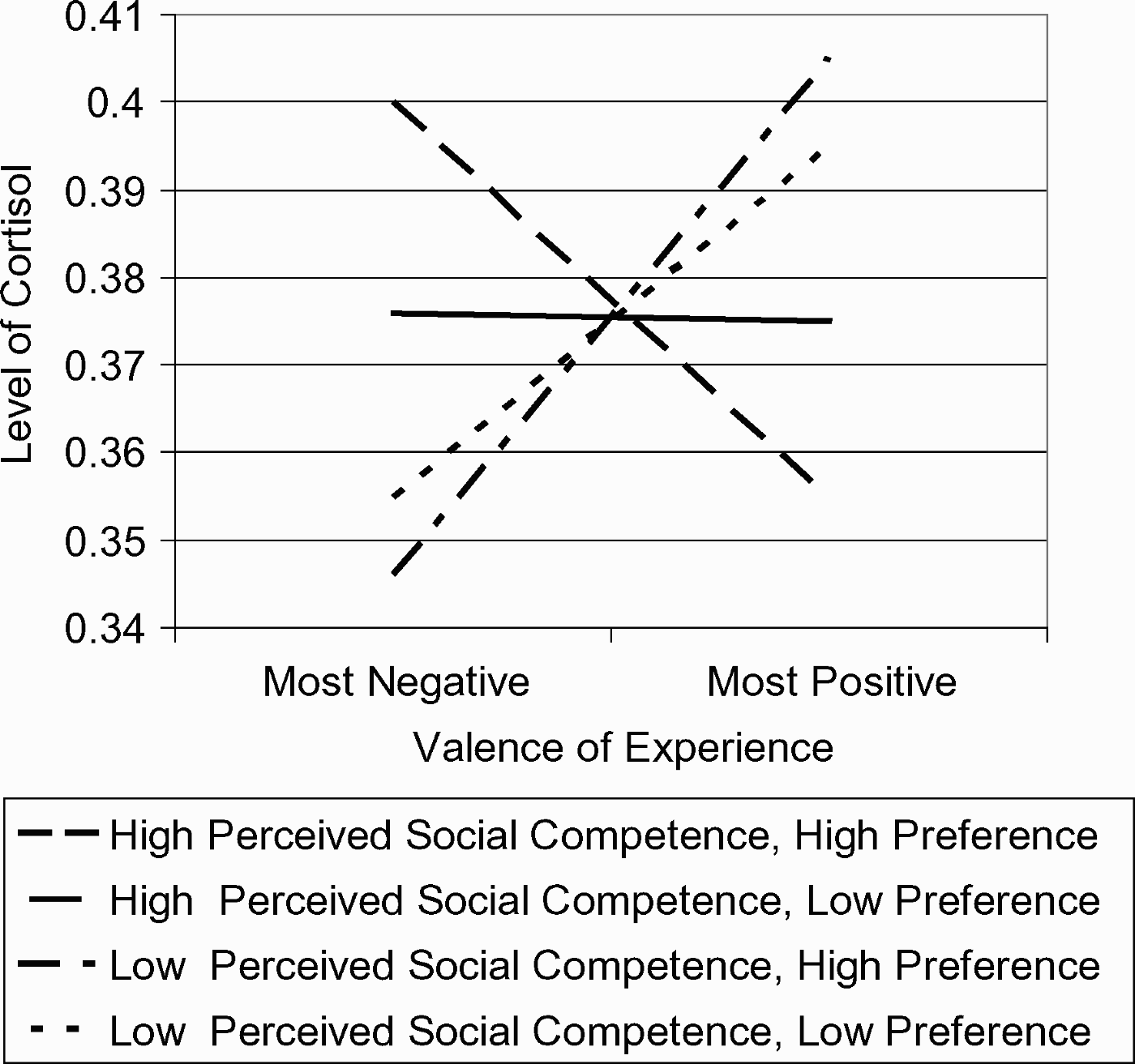
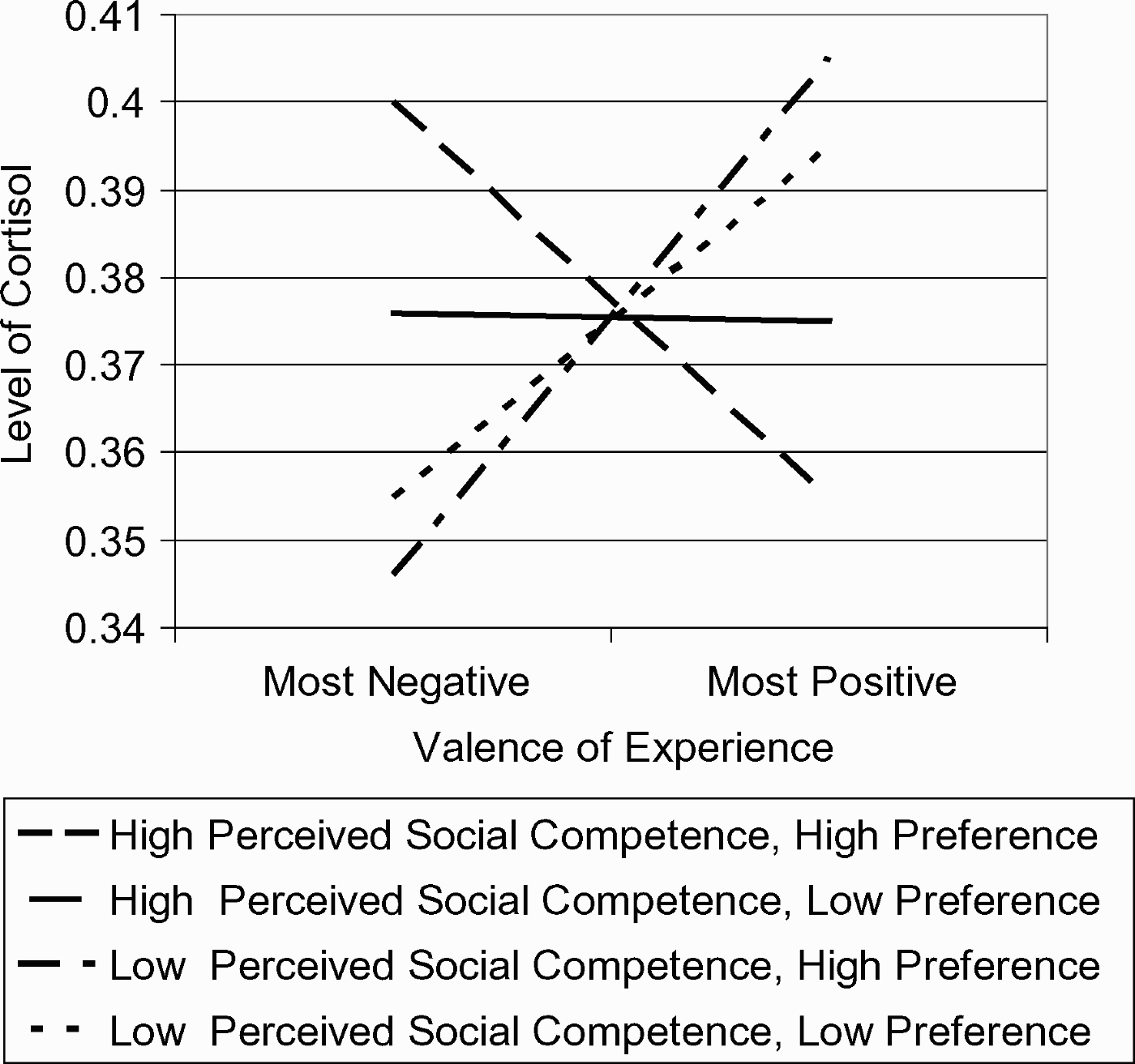
Next, the three Level 2 variables were used to explain the “randomness” in the Level 1 effects. Our primary concern was with the associations between the Level 2 measures (i.e., general self-worth, sociometric preference, and the interaction between them) and the Level 1 linear and curvilinear effects negativity/positivity measures. Our analyses revealed that variation in the linear effect of the Level 1 negativity/positivity measure was significantly associated with the interaction between the measure of perceived social competence and sociometric preference (coefficient = −.002, t = −1.98, p < .025). (This measure had been entered into the analysis centered around its grand mean.) As shown in Figure 4, for the participants whose self-concept was disassociated with an objective measure of their functioning with peers, the activity of the HPA axis was unrelated to whether a prior experience had been negative or positive. In contrast, for participants who were high in perceived social competence and high in preference the HPA axis showed increased levels of activation when an experience was negative rather than positive. For the participants who were low in perceived social competence, the HPA axis showed increased levels of activation when an experience was positive rather than negative. The findings regarding the participants who are high in perceived competence and low in actual competence confirm our fifth hypothesis.
The association between the negativity/positivity of experience and cortisol levels as a function of scores on general self-worth and sociometric acceptance. The four slopes are four participants who were high on both scores, high on general self-worth and low on acceptance, low on general self-worth and low on acceptance, and low on both. For each score “high” and “low” were defined at 1 SD above or below the mean.
Discussion
The project described in this paper examined hypotheses regarding individual differences in narcissism or distortions in the self-measure across a set of community-based samples. Taken together, the present findings show that distortions in the self—that is, an inflated sense of self that is discrepant from objective indices of competent functioning—are stable during early adolescence, are related to defensive forms of aggressive behaviors and are associated with a pattern of HPA axis reactivity, indicating a lack of defensive support from one of the body's basic stress response systems. These findings provide evidence that distortions in the self are related to complex patterns associated with defensive needs during early adolescence.
The project was organized around a set of five hypotheses. The first set of hypotheses was concerned with whether our efforts to measure narcissism with a peer assessment procedure would show the features that are characteristics of the narcissistic personality disorder. Our goals were to assess whether we could create a measure of narcissism that would be stable over time and that would be associated with distortions in self-perceptions. Structural equation modeling showed that our measure of narcissism was nearly perfectly stable across a 12-month period during early adolescence. The correlation between the measures at these two times was .98. Across a shorter period the correlation was .86, perhaps because of the fact that the initial assessment was made at a time when the peer group was in a period of reorganization following the transition into a middle-school context from separate primary schools. At least during a period of contextual stability narcissism is a stable person-related characteristic.
These analyses showed also that the central feature of narcissism is an inflated assessment of one's well-being. This is indicated by the stronger coefficient for the item “Stuck up and thinks they are better than others” than for the item about self-involvement. Consistent with theory about the defining features of narcissism, the item regarding an inflated self-concept appears to be the stronger indicator than the item about self-involvement.
The analyses regarding Hypothesis 2 also showed the pattern of distortion assumed to be at the center of the narcissistic pattern. Early adolescents who have high scores on our measure of narcissism were seen to have a perception of their self-worth that was most discrepant from their actual functioning. The “self” of narcissistic early adolescents is a construction that bears little association with their actual experience. This pattern of findings adds to the claim that the healthy self is not one that is very positive, but instead, it is one that represents an accurate assessment of one's actual competence.
This perspective is highlighted in the findings regarding Hypothesis 3, specifically that narcissism promotes the stability of aggression. Most research on aggression has been aimed at explaining its origins or the factors that lead to increases or decreases over time (Dodge et al., 2006). The present analyses addressed the issue of what promotes the stability of aggression. We reasoned that the enduring defensive distortions related to narcissism would lead to the enhanced continuity in aggression. These findings can be interpreted as indicating that distortions in self and the purported defensiveness associated with them provide a continuous motive for aggressive behavior. In this way the present findings confirm a central point of the arguments made by Raskin and his colleagues; specifically, that narcissism promotes stability in aggression. An important repercussion of these findings is that clinical interventions aimed at reducing aggression need to go beyond the use of behavioral practices and instead need to resolve the internal dynamics that account for aggressive behavior.
Beyond the demonstration that narcissism promotes the stability of aggression, the assessment of the fourth hypothesis shows that narcissism is more strongly associated with some types of aggression than with others. Specifically, as predicted based on the ideas of Baumeister et al. (Reference Baumeister, Smart and Boden1996), narcissism was shown to be more strongly associated with reactive aggression than with proactive aggression, and more strongly with relational aggression than with physical aggression. These findings are consistent with two of the central aspects of the construct of narcissism. One is that the defensive feature of narcissism leads to a hypersensitivity to threats. This increased tendency to respond when attacked may account for the association between narcissism and reactive aggression than with proactive aggression. These findings show that narcissistic early adolescents are especially motivated to retaliate when provoked by their peers. A second aspect of narcissism that is confirmed by these findings is the need to present a positive image. In so far as relational aggression tends to be covert or indirect, it is not as easily observed by one's peers than are more direct or physical forms. In this way, relational aggression provides a means of acting against others without appearing to do so. This presumably clandestine form of negative behavior may give the narcissistic person the illusion that they are seen positively by others despite their injurious behavior.
All of the findings discussed so far refer to either the features or the consequences of narcissism. In the final section of our results we present findings regarding the interface between the distortions in the self-system and the body's stress response system. From our point of view these systems need to be studied together because of their shared defensive functions and significance for dealing with threats. Despite a lack of explicit theory regarding the interface between the HPA axis and personal or social processes related to defensive mechanisms, we hypothesized that the need for the defensive strategies inherent in narcissism may arise when other defensive systems are not functioning adequately. Our primary concern was with the responsive dynamics of the HPA axis. It is believed that when the HPA axis is functioning in a healthy way that it will produce extra amounts of cortisol at times of arousal (Lupien et al. Reference Lupien, Ouellet-Morin, Hupbach, Walker, Tu, Buss, Cicchetti and Cohen2006). In this way HPA axis reactivity promotes a healthy response to stress. Our hypothesis was predicated on the idea that other systems of defense, such as narcissism, will emerge when the fundamental protective functions, such as those of the HPA axis, do not function properly.
The current findings are consistent with this hypothesis. Early adolescents who show the defensive profile of a self-concept that is discrepant from objective indicators of competent functioning are also the ones whose HPA axis shows no activation at times of positive or negative arousal. It is conceivable that this lack of “defense” from the HPA axis may account for the emergence of a defensive strategy from within the self system. In other words, it may be that functional defense significance of narcissism is to make up for deficiencies in more basic processes of stress response. There may, of course, be other explanations of these findings. For example, the association between them may be spurious because of their mutual origins in the same negative experience (e.g., abuse within their families; Cicchetti & Rogosch, Reference Cicchetti and Rogosch2001).
It is tempting to interpret the other findings observed with the cortisol data. Although these interpretations may be little more than treacherous speculations, it is interesting to note that low levels of perceived well-being, regardless of whether they are concordant or discrepant from experience, are associated with a pattern of HPA axis activity that provides more cortisol following positive experiences than negative experiences. This lack of hormonal support may leave these individuals exposed to the effects of negative experiences. This pattern may account for their negative impression of their functioning. In contrast, early adolescents who appear to have a deservedly positive view of themselves show more activation following negative experiences than following positive experiences. This pattern of hormonal activation may help them minimize the effects of a negative event.
The findings presented here need to be understood from a wholistic perspective. As a group they reveal the basic processes of distortion and defense associated with narcissism. They show narcissism to be an enduring characteristic of individuals that is related to an inflated view of the self that is not warranted by objective indices of social functioning. We have claimed that this defensiveness promotes the stability of aggression, and that it is manifested more strongly in some types of aggression than in others. Finally, there is evidence that distortions in the self may derive from the inadequate functioning of the HPA axis, one of the body's main response system for dealing with stress. These findings point to the value of taking a systems perspective for understanding how the self is related to aggression, psychophysiology, and psychopathology.