


The positive evils and dangers of the representative, as of every other form of government, may be reduced to two heads: first, general ignorance and incapacity, or, to speak more moderately, insufficient mental qualifications, in the controlling body; secondly, the danger of its being under the influence of interests not identical with the general welfare of the community.
—John Stuart Mill
During their first week in office, Colombian judges and other public officials involved in the antidrug war often receive a message asking: “Plata o plomo?” The message originates from the drug cartels and is Spanish for “Silver or lead?” It reminds public officials that there is an alternative to fighting drugs and receiving plomo (Spanish for lead, as in bullets) which is to not fight drugs and receive plata (Spanish for silver or money, as in a bribe). Bowden (2001) writes about the ways of the former head of the Medellin Cartel, Pablo Escobar Gaviría: “Pablo was establishing a pattern of dealing with the authorities … It soon became known simply as plata o plomo. One either accepted Pablo's plata (silver) or his plomo (lead). Death was his strategy against extradition, that and money. His policy of plata o plomo became so notoriously effective that it would ultimately threaten to undermine Colombia's democracy. Pablo's primary target … was the country's judicial system, to which he offered plata o plomo … Plata o plomo had every official in Bogotá living in fear or under suspicion.”1
Plata o Plomo has been observed in other countries: “Plata o plomo. Silver or lead. That is the choice drug traffickers in Mexico have given their allies and enemies for years: the bribe or the bullet” (Los Angeles Times, December 12, 1999).
More generally, rewards and threats of punishment have long been part of political life. Bentham (1843), for example, argued that political influence proceeds through “seductive” incentives, belonging to two categories: those causing pleasure and those causing pain. In the chapter “Bribery and terrorism compared,” he called the first “pleasurable or alluring,” or “bribery,” and the second “painfully operating,” “coercive,” or “terrorism.” This distinction, however, has been blurred in modern work on political influence (see, e.g., Becker 1983; Peltzman 1976; and Stigler 1971). Recent work in this tradition considers the policymaker as an auctioneer who receives “bids” from various interest groups, but always in the form of bribes, campaign contributions, or other “alluring” elements (see, e.g., Baron 1994; Grossman and Helpman 1994; Groseclose and Snyder 1996). Politics is then reduced to a set of transactions taking place in markets where property rights are well defined, voluntary contracts are the norm, and the state monopolizes violence.2
Work in international politics has studied coercion among nations (see, e.g., Alt, Calvert, and Humes 1988; and also Powell 1999, inter alia). It is worth pointing out that coercive methods in domestic politics were already observed to be in use by Adam Smith. “The member of parliament who supports every proposal for strengthening this monopoly, is sure to acquire not only the reputation of understanding trade, but great popularity and influence (…). If he opposes them, on the contrary, and still more if he has authority enough to be able to thwart them, neither the most acknowledged probity, nor the highest rank, nor the greatest public services can protect him from the most infamous abuse and detraction, from personal insults, nor sometimes from real danger, arising from the insolent outrage of furious and disappointed monopolists” (Smith 1981; [1776], IV.ii, 471).
Our model offers—to the best of our knowledge—the first formal result on the connection between violence and corruption, and the joint link between those two forces and the quality of rulers. Note that violence variations may respond to exogenous elements—such as ethnic divisions, that originate or amplify a given violent potential. See Beissinger 2002 for an account of how ethnonationalist factors played out in the collapse of the Soviet Union.
Introducing private coercion into political influence not only alters our understanding of how influence affects political outcomes. It also helps rationalize political institutions that would be hard to explain in a model where only bribes exist. To illustrate, consider the granting of immunity from legal prosecution to France's President, Jacques Chirac, in 2000.4
A French court ruled that President Jacques Chirac cannot be investigated while in office in connection with a corruption scandal. See, for example, “Court upholds Chirac's immunity,” BBC News, Tuesday, January 11, 2000. Immunity is also often granted to bureaucrats (see following for examples involving Central Bank officials). Using the representative democracy setup of Osborne and Slivinski (1996) and Besley and Coate (1997), it can be shown that our model can be applied to both elected officials (politicians) and bureaucrats. Thus, except when otherwise noted, we use the two categories interchangeably.
The use of threats in this paper is related to work on mafia organizations (see, e.g., Gambetta 1993; Konrad and Skaperdas 1997; Varese 1994, inter alia) and on conflict (see, e.g., Garfinkel and Skaperdas 1996, and the references therein). In particular, our approach to modelling threats is related to that in Dal Bó and Di Tella 2003. However, in that paper groups can only use threats, politicians are all honest and there is no model of entry into public life. Baron (2001) develops a related idea in his model of private politics and corporate social responsibility. He considers an activist who has access to a class of threats (including boycotts and filing lawsuits) when attempting to influence the firm's strategy. The extension to a prior entry stage along the lines of our model could be empirically important, particularly when the media plays a role in developing threats.5
The possibility that talented CEOs would not apply for the top jobs when activism—and media scrutiny—are intense, is discussed in “No Thanks: Fearing Scandals, Executives Spurn CEO Job Offers,” page 1, The Wall Street Journal, June 27, 2002. See also Dyck and Zingales 2002.
See also Caselli and Morelli (2004), who argue that low-ability officials can still occur in a model where groups only use bribes if bad politicians keep their own wages low. An existing literature studies how bad policies can emerge, with politicians of fixed quality (see, e.g., Alesina and Drazen 1991; Fernandez and Rodrik 1991; Weingast, Shepsle, and Johnsen 1981, inter alia).
DISCUSSION AND SOME EXAMPLES
The violent aspect of the “Plata o plomo?” quote may suggest that we are referring to a (big) problem in a small number of countries.7
Note that violence is the norm rather than the exception. There are 30 OECD countries with relatively secure environments (but see Mexico, Turkey, and Italy's south) and 189 member states in the United Nations.
The reason why threats occur in our model—as well as in Dal Bó and Di Tella 2003—is to induce the policymaker to change his action from that preferred by society to that preferred by the group (this might involve the decision to resign). This includes situations where the official yields to threats because he fears political damage, and not personal harm. The official may choose a bad decision in fear that the realization of punishment, discrediting him or his cause, may lead to his replacement with other candidates pursuing alternate agendas thereafter. Groups could have at least two more reasons to use threats. First, when the official denies the group a favor, the announced punishment might effectively eliminate him, perhaps allowing a new “better disposed” official to take his place. This is explicit in the case of direct violence—see the case of the Colombian guerrilla discussed next. In the case of a smear campaign, or legal harassment, the policymaker may resign or be sacked as a result of the actions of the group. Second, one could imagine that the actions of the group make the policymaker less effective. Maybe policymakers have a stock of political capital that is eroded when smear campaigns force them to waste time explaining themselves. The results of our model are valid when groups have these other reasons to use threats, as long as the official's payoff suffers when punishment is inflicted.
Physical Violence
In June 2002 the main narco-guerrilla group in Colombia, the FARC (Fuerzas Armadas Revolucionarias de Colombia), launched a campaign to replace politicians who were unsympathetic to its cause. The campaign, which included threats of kidnapping and assassination, explicitly requested the resignation of 463 out of 1,098 city mayors in a region of the country. Two months later, two city mayors had been killed and a total of 222 out of the 463 city mayors had resigned. Former guerrilla fighter turned political analyst, León Valencia, reflected “It is a tremendously cheap and efficient tactic” (see “Un plan diabólicamente eficaz,” La Nación, July 15, 2002.) Officials in the judiciary have also been targets of physical violence. Prillaman (2000) reports data compiled by the International Commission of Jurists indicate that 1,600 of Colombia's 4,500 judges had received death threats. Colombia's National Association of Judicial Employees puts the figure closer to 50%. It was also reported that when judicial employees went on a nationwide strike in 1989 they did not request better pay but bulletproof vests, armored cars, escort motorcycles, and metal detectors for court entrances.

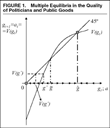
Multiple Equilibria in the Quality of Politicians and Public Goods
Legal Harassment
In many cases public officials have been subject to lengthy judicial processes, and in some cases these have been attributed to pressure by some interest group. In Latin America, the practice is so frequent that it has been given a name: the judicialization of politics.8
See La Nación, November 8, 1998. A similar process is described in the editorial “Leave the Judiciary out of it,” The Taipei Times, March 3, 2000. This is an extreme version of the process by which courts and judges come to decide on policies that had previously been selected by legislatures and the executive (see, e.g., Tate and Vallinder 1995).
Biased Media Coverage
The utility of policymakers is reduced by a third type of action by pressure groups: attacks in the press. In a number of occasions the potential for such actions has led politicians to be less willing to enter political races. An example of this in the UK is the problems faced by Michael Portillo, a candidate to lead the Conservative Party who admitted to a homosexual past and who in 2001 was hesitant about running because he feared that right-wing critics would mount an anti-gay smear campaign (see The Independent, Sunday June 10, 2001.) Such problems are even more severe when pressure groups heavily sponsor or directly own media outlets because of the possibility of biased coverage, which can have ramifications for the set of feasible political candidates. One example is Russia in the 1990s, where seven of the top eight largest industrial groups had significant media interests. This predominance has been linked to nothing less than Kiriyenko's appointment as prime minister in March 1998. “His industry pedigree may have recommended him to the leaders of Russian big business, […]. The approval of these tycoons is well worth having. They own most of the national mass media and much of the banking industry too. They can twist the arm or stain the reputation of any minister they choose” (see The Economist, April 4, 1998).
THE MODEL
The model has two stages. In the first stage, citizens with different abilities decide whether to apply for public office or to enter the private sector. In the second stage, the pressure group has the opportunity to bribe and threaten the official to obtain a given resource.
First Stage: Entry Calculus by Prospective Officials
We assume that the economy is populated by agents indexed with an ability parameter
, which we also call quality. Ability is distributed according to the function F(a), with associated density f(a). In the first stage of the game, individuals decide whether to apply for public office or to enter the private sector. The wage they can earn in the private sector equals their ability. Their earnings in the public sector depend both on the wage of the public sector and the behavior of the pressure group. Those whose private earnings a are lower than or equal to what they expect to get in public office, apply. Therefore, if individuals expect public office to yield a payoff of value V, all types a≤V will apply.9
For simplicity, we assume that payoffs in the private sector do not depend on the quality of the official. In a more general model we would have that a citizen's wage in the private sector is w(a, a*), where a is the ability of the citizen and a* is the ability of the politician in power; the value w(a, a*) is increasing in both arguments, and for any V there is an a* that makes w(a*, a*)=V. In that case we have that given the public payoff V, the equilibrium quality will be w(a*, a*)=V. The lower is V, the lower is a*, yielding the same results as our simpler model.
We emphasize that we might get bad politicians even under faultless recruitment screening. Our results hold under any selection process where the expected ability of the selected politician depends positively on the highest ability among applicants.
We assume the official earns a fixed wage w.11
This might be because of cultural or legal constraints on the public wage or because officials set their own wages as high as they can. The important assumption is that wages are fixed. A rational planner may want to manipulate w to attract better candidates to public office. But the effects we analyze hold for any wage level that society might choose. In fact, all the results are robust to the government optimally choosing w, even if it is possible to make the wage level conditional on characteristics of the successful candidate. See Besley and McLaren (1993), where the planner can (although not necessarily does) raise wages to attract better candidates.
Note that we assume that only in the public sector is there room for the use of bribes and threats. This is done to capture simply a difference of degrees: we want to represent a world in which there is more outside influence in the public sector than in the private sector. This can be justified by the fact that influencing the decisions of a private manager may be more difficult than influencing the decisions of a public official. This may follow from free riding problems undermining monitoring to a larger extent in the public sector.
Second Stage: Interaction between the Pressure Group and the Public Official
In the second stage, the appointed official performs his duties while interacting with the pressure group. For concreteness, we can think of the official's output as a public good, and the level of this public good depends positively on the official's ability level. Because the overall income of society can be expected to depend on the amount of public good provided, it follows that society will care about the ability level of the official appointed in equilibrium. The official is also assumed to have discretion on the allocation of an amount π of resources that he can redirect toward the pressure group. This action is modeled as a lump sum transfer. The fact that the official might yield to the group's request is just distributively bad for the vast majority of society. We abstract from any efficiency considerations such as when the transfer is done through a tariff or another distortive instrument.
The pressure group has two instruments to influence the decisions of the official: bribes, b, and a threat of punishment of variable size p, which we assume to be credible (on reputation and extortion, see Konrad and Skaperdas 1997 and Smith and Varese 2000. See also Chwe 1990 on the use of credible physical punishment to incentivize workers).12
For concreteness, threats can be viewed as physical violence against the politician. An important difference between violence and media or legal attacks is that the latter may not only create a direct disutility but also affect expected payoffs by altering reelection chances. Also in principle, a legal or media attack could backfire because it may indicate that the target is honest. However, if there is another, potentially legitimate, source of accusations, such attacks retain their power as long as the public does not know the origin of the report or accusation. In our section on immunity the judiciary generates legitimate corruption accusations.
We assume that with probability 1−γ it is impossible for the official to accept the corrupt proposal and his only choice is to reject the offer and face the punishment.13
This might be due to a circumstantial impossibility to strike a deal, say because of technical reasons unknown to the group, or because of the chance event that the official is under the scrutiny of a third party (e.g., a superior, the media, or a nongovernmental organization). Another interpretation is that 1−γ is a fraction of infinitely honest individuals in the population, who are incorruptible. Self-selection across “honesty types” does not arise in equilibrium; note that the group has all bargaining power, causing the two types to get identical payoffs. Our results are also compatible with extending the model to include a continuum of honesty types.
An alternative formulation has the politician obtaining
. This captures cases where politicians enjoy a degree of strength s (popularity, for example), and where more popular politicians are less vulnerable to punishment. In equilibrium threats against stronger politicians are less virulent but still positive. We stick with the simplest formulation as all our results are unchanged.

This condition implies that every official will accept if b≥c−p. The pressure group sets bribes b and punishment p to maximize its expected profits Π according to the program,

Denote with b* and p* the quantities maximizing Π(b, p) for an active pressure group. If Π(b*, p*) is nonnegative, we say the group does indeed want to engage in influence activities. If it is negative, we say the group prefers to stay inactive earning no profits. When characterizing equilibrium, we will look at the threshold level
that allows the group to make money by becoming active—that is, the level of π satisfying Π(b*, p*)=0, given the parameter values γ, β, and ρ. An important element in this paper will be what we denote degree of state capture.
Definition 1
The magnitude
is an inverse measure of the degree of state capture.
One important feature of a society is how often corruption takes place. The value
denotes the size of the set of possible values of π for which the group cannot engage in influence activities. One way of interpreting the measure
is as the chance that a group will not be able to afford to corrupt the official.15
The model can be extended so that π is drawn from a distribution Z(·) with support in [0, ∞). We then have a measure
representing the probability that the group (or the fraction of groups who) will not be able to offer “plata o plomo.” Of course, capture will be successful only a fraction γ of these cases and
is an inverse measure of the pervasiveness of capture given γ and Z(·).
In the following sections, when formal results do not follow from previous statements, the proof is relegated to the Appendix.
RESULTS WITH BRIBES ONLY
The Equilibrium
As a benchmark, we start our analysis by setting p=0. Thus, we start with a standard model where only bribes can be used as an instrument of political influence. If active, the pressure group will decide on an optimal bribe level b° by solving Maxb{Π(b, 0)=γ[π−βΦ(b)]} s.t. b≥c.
Because all the bargaining power is on the group's side, there is no point in paying a bribe higher than c. A group will set b°=c when the gain π covers the cost βΦ(c), whereas a group with π smaller than the threshold value
remains inactive. It follows that,
Lemma 1
(a) An active group offers a bribe equal to the cost the corrupt action has for the official (b°=c).
(b) The group only becomes active if the value of a favor π is larger than the cost of the bribe (
)).
The bribe level and the fact that the group may or may not afford to be active fully determine the payoff for prospective applicants to public office. If
, the group is active and the payoff for the official is w+b°−c=w. If
, the group stays inactive and the payoff for the official is again w. This implies that, in a world without threats, individuals whose ability type a satisfies a≤w will apply, and the recruiter will appoint an official of type w. It follows that,
Lemma 2
In a world with only bribes, the quality of the official is w regardless of whether the group is active or not.
ROOM FOR INFLUENCE AND THE QUALITY OF OFFICIALS IN A WORLD WITH ONLY BRIBES
A lower value of the parameter β captures improvements in the bribing technology. This could reflect worse financial monitoring, as when accounting standards are less stringent or auditing firms are less reliable.
Proposition 1
More room for influence through bribes (a lower β) implies a higher degree of state capture but it does not decrease the quality of politicians.
The intuition for this result is simple. A reduction in the cost of paying bribes allows pressure groups with lower stakes to enter the business of bribing officials, increasing the degree of state capture. However, variations in the cost of bribes do not affect the quality of politicians. This is a result of the extreme assumption that the group has all bargaining power. Hence, a lower cost of bribes means the group will pay the same bribe as before (thus, leaving officials' payoffs unchanged), only at a lower cost. Note, however, that were the official to have even minimal bargaining power, his payoff would improve when paying bribes becomes easier for the group. Hence, in this benchmark case, the ability of politicians tends to improve when bribes become cheaper to use.
RESULTS WITH BRIBES AND THREATS
The Equilibrium
We now allow the group to combine bribes with threats. We characterize first the behavior of the pressure group and we study its effect on the entry decision of officials. Then we compare the degree of state capture and the quality of politicians with the values obtained in a world without threats. We start by studying the optimal bribes and threats “offered” by an active pressure group. From expression (1) we know that, given some p, the most convenient bribe is b=c−p. Paying more will not convince an incorruptible official, and paying just that is enough to make the other type accept doing favors to the group. In addition, given that the marginal cost of starting to use any of the two instruments is zero, an active pressure group must use both bribes and threats (if bribes had a positive marginal cost at zero, making punishments costly enough at the margin would guarantee an interior solution).
We study now the conditions under which a pressure group will decide to be active. The pressure group would like to be active if the optimal bribes and threats (b*, p*) result in positive profits. Then, the pressure group makes the “plata o plomo ” offer (b*, p*) if Π(b*, p*)≥0, and chooses to stay inactive otherwise. Given that the profits of the active pressure group are increasing in π and there is a positive cost to influence the official, there exists a critical value
under which the pressure group would rather not exert pressure. By setting the group's expected payoff to zero, we find that this critical value is
. More formally,
Lemma 3
(a) An active group uses both bribes and threats and the total amount of pressure equals the cost to the official of a corrupt action (b*>0, p*>0, b*+p*=c).
(b) The group only becomes active if the expected benefit γπ is larger or equal than the total cost (1−γ)ρΨ(p*)+γβΦ(c−p*) of the exerted pressure (i.e., if the value of a favor π is not smaller than the threshold value

If π is above the critical level
, the pressure group uses both bribes and threats to influence the official. The threat allows the pressure group to influence the official without paying the full cost of changing the decision. It needs to pay only c−p* (Lemma 3-a) when threats are available, whereas it needs to pay c in a world without threats.
Proposition 2
(comparison of Lemmas 1-a and 3-a) Bribe offers are lower in a world with bribes and threats.
This result captures a simple fact: if politicians are being coerced by groups they will tend to sell their favors relatively cheaply. Tullock (1997) has pointed out that lobbying activities seem to involve too little money relative to the amount of resources that special interests can obtain from the political process. See also Ramseyer and Rasmusen 1992 and Ansolabehere, de Figueiredo, Snyder 2003 on why there is so little money in U.S. politics.
We now derive implications for the equilibrium quality of the official, but before we can do this we need to determine the equilibrium payoffs for the official. First note that in a world with bribes and threats and an active group, the official obtains w−p* regardless of his action. The reason is that if the official refuses to do favors for the group, punishment is inflicted and the ensuing payoff is w−p*. If the official yields, he faces a moral cost and receives a bribe, and the payoff is w+b*−c=w+c−p*−c=w−p*. When the group is inactive the payoff is simply w. Thus, official payoffs are either w−p* when the group is active and w when the group is inactive. Because citizens with ability higher than the payoff from public office do not even apply, we directly obtain,
Lemma 4
In a world with bribes and threats, the quality of officials is w−p* if the group is active and w if it is not.
This last result immediately allows us to establish that,
Proposition 3
(comparison of Lemmas 2 and 4) The quality of the official is lower in a world with threats.
A fundamental feature of our model is that the availability of threats lowers the entry barrier to the influence activity. Active pressure groups use threats and enjoy profit levels that are higher than those in a world with only bribes. Therefore, the set of values of π for which the group is active is larger in a world with threats than in a world without them.
Proposition 4
(comparison of Lemmas 1-b and 3-b) The degree of state capture is higher when threats are available (i.e.,
.
If
is interpreted as the inverse of a measure of the number of active groups dealing with officials across society (since only groups with
are active), the message of our last proposition is that a world with threats features more frequent corruption. We turn now to studying the effects of parameter changes affecting the scope for political influence.
Cheaper Influence and the Quality of Officials in a World with Bribes and Threats
We establish our main results in this subsection. We study the effect of changes in the cost of bribes and threats on the behavior of the pressure group, the degree of state capture, and the quality of politicians. A decrease in the cost of bribes makes bribes more attractive for an active group, who then substitutes bribes for threats. In the same way, after a decrease in the cost of threats an active group substitutes threats for bribes. Formally,
Lemma 5
(a) More room for influence through bribes (i.e., a lower β) implies weaker threats and higher bribes by an active group
, whereas
(b) More room for influence through threats (i.e., a lower ρ) implies stronger threats and lower bribes
by an active group.
It is important to characterize how changes in β and ρ affect our measure of state capture. A decrease in any of the two cost parameters will necessarily increase the profits of an active pressure group, resulting in an increase in the set of values of π that allow the pressure group to be active. When influence—either through bribes or through threats—becomes less costly, the threshold
goes down, implying that groups with lower stakes will be able to afford influencing officials through the “plata o plomo” mechanism. This amounts to saying that societies where groups have easier access to bribing and punishment technologies can expect to have more pervasive corruption. In other words,
Proposition 5
More room for influence through either bribes (a lower β) or threats (a lower ρ) increases the degree of state capture.
We can now establish results relating changes in the costs of bribes and threats to changes in the quality of politicians.
Proposition 6
(a) More room for influence through bribes (a lower β) has an ambiguous effect on the payoff of officials and their quality.
(b) More room for influence through threats (a lower ρ) decreases the payoff of officials, lowering their quality.
The intuition for part (a) is as follows. Consider an official facing a group that is active both before and after β goes down. This official's payoff must increase because a lower β implies lower threats and higher bribes (Lemma 5-a). This would go in the “traditional” direction: more influence through bribes tends to improve the official's payoff, and hence, the quality of politicians. However, from Proposition 5 we know that a lower β will cause some groups with π slightly below
to become active. These groups will optimally use both bribes and threats, so the officials facing such groups will see their payoffs decrease from w to w−p*. In a world with threats, the fact that paying bribes gets easier implies a lower barrier to entry to the plata o plomo influence business. And this business lowers the payoffs of officials. If enough groups lie in the range where a decrease in β switches them into activity, the overall effect of cheaper bribes on expected official payoffs will be negative. This could never happen in a model with only bribes (Proposition 1). In our model, higher levels of capture following from groups finding it easier to pay bribes may be associated with worse politicians, and not merely with more frequent wrongdoing. This is an example of how the simultaneous availability of both instruments of influence alters the nature of the influence game.
We turn now to part (b). A lower ρ would reflect a world where it is cheaper to hire thugs, influence the media, or manipulate the judicial system. A lower cost of threats can have two effects. First, if the group was active before, a lower ρ will result in a more intensive use of threats (Lemma 5-b), lowering the payoff of the official and her equilibrium quality. Second, if the group was not active before, a lower ρ may result in the group becoming active (Proposition 5), again lowering the official's payoff. Therefore, cheaper punishments can only result in officials that obtain lower payoffs and are of lower quality (yielding Proposition 6b). This suggests that societies where groups have easier access to punishment technologies will tend to have more frequent corruption and worse politicians.
One might think that if society is governed by politicians of low ability because threats are high, someone will want to raise public wages in order to attract better candidates. This might indeed be the case. But for any level of wages chosen by the public, the quality of politicians will be worse when threats exist and groups find it easier to exert influence, relative to when threats are more expensive to use or are simply not available. Furthermore, the public may need to pay very large wages if the threats involve physical violence, so it may be more cost-effective to direct resources to limiting the scope for political influence.
Discretion, Corruption, and the Quality of Politicians
Economists associate bureaucratic discretion with wasteful rent-seeking (see Krueger 1974, and Murphy, Shleifer, and Vishny 1991, inter alia; Ades and Di Tella 1999, present evidence consistent with the hypothesis that rents cause corruption). But even if state intervention generates opportunities for corruption, there will still be occasions when some intervention is justified. Thus, we ask how levels of state capture and the quality of politicians would evolve if we enlarge the size of resources under official discretion.
From previous sections, we know that in a world with threats the quality of politicians is lower when the pressure group is active and that the pressure group will be active only if the amount of resources it can get covers bribing and threatening costs (
). Therefore, a decrease in the amount of resources subject to official discretion π to a value below
results in the pressure group becoming inactive and, hence, in an increase in the payoff and quality of politicians. Summarizing,
Proposition 7
A decrease in the amount of resources subject to official discretion has a positive effect on the quality of politicians.
Thus, more political discretion may not only lead to more waste through rent seeking, but it will also lead to a higher fraction of corrupt decisions and politicians of lower quality. Note that this result abstracts from the possibility that greater official discretion may directly appeal to high quality citizens, because it allows them more freedom to use their skills. Traditional models of corruption in which the official has some bargaining power would also result in a positive relation between discretion and quality. Although the baseline hypothesis is that discretion has a positive effect on the quality of politicians, Proposition 7 isolates a force working in the opposite direction, due to the effect of punishments.
EXTENSIONS: IMMUNITY AND MULTIPLE EQUILIBRIA
Immunity
Our model can be applied to what we believe is the first formal analysis of the institution of official immunity. A number of countries have some form of legal protection for policymakers, ranging from immunity from libel for statements made during parliamentary debates, to protection against criminal charges. Immunity has been debated around the figure of elected politicians, as in the case of former U.S. President Clinton, as well as in relation to appointed bureaucrats, such as central bankers. Indeed, the granting of immunity to the president and board of directors of the Central Bank of Argentina (BCRA) was the key request of the IMF during negotiations in 2002 in the context of the economy's collapse. Given the weakness of the country's judicial institutions, banks affected by the decisions of the Central Bank found it easy to initiate legal actions against bank regulators (Bernhard [1998] discusses political determinants of central bank independence). With two unfulfilled vacancies in the directorate and the banking system in a severe crisis, the new president of the BCRA, Mario Blejer, publicly asked that legal immunity be granted, partly because of difficulties with attracting distinguished professionals to the bank's directorate. Blejer resigned after Congress rejected the immunity proposal. The general problem has been described in the recent banking literature, by Gale and Vives (2002): “A related problem (in Argentina, for example) is the lack of legal protection that a supervisor has when attempting to discipline a bank in trouble. Then even if the perceived problem is serious the bank may be allowed to continue or even granted help.”
In terms of our model, immunity has two effects. On the one hand, it benefits honest officials by insulating them from judicial actions manipulated by a pressure group. On the other hand, it makes corrupt officials less accountable to an independent judiciary. Clearly the impact of the threats will depend on the quality of the judiciary. To investigate these effects further, we now modify the model to include the effect of immunity and the quality of the judiciary. Assume that accepting the group's offer implies a gamble. A fraction
of officials accepting bribes are detected. This parameter θ also summarizes another dimension of judicial efficacy: a fraction θ of politically motivated accusations are discarded (the two aspects of judicial effectiveness in the model could be captured by two different parameters, but for simplicity we stick with the simplest specification here). When caught, bribed officials lose their wage, the bribe received, and they pay a moral cost m. When not caught, corrupt officials keep both wages and bribes, and only pay the moral cost m associated with wrongdoing (the reader may want to think we have decomposed the cost c of the basic model into two parts: one part associated with the probability of detection, and a straight moral cost). Immunity is parameterized with
. A simple way to study immunity is to postulate that a degree of immunity i does two things. First, it reduces the probability of detection by independent judges to θ(1−i); complete immunity (i.e., i=1), then, makes corrupt officials undetectable, whereas no immunity (i=0) makes them fully detectable (at the usual rate of discovery by the judicial system, θ). The other effect of immunity is to mitigate the impact of false accusations that are not discarded by the judiciary, so that a threat of punishment p through legal harassment becomes (1−i)(1−θ)p. As a result, an official accepting bribes makes

whereas one rejecting them receives

Note that in this model a politically motivated legal attack does not reveal that the official is in fact honest, because the legal action could stem from the autonomous action of the judiciary. (A similar mechanism can make smears effective: they could be the result of honest reporting by independent media.) Hence, although a legal attack will not fully convince the public that the accused person is guilty, it will increase the perception that he is, relative to the no accusation scenario. Thus, a legal attack can still be painful for example by lowering reelection chances. Rundquist, Strom, and Peters (1977) present an early study of politically motivated accusations; Golden and Chang (2004) show that judicial investigations in Italy can indeed lower the reelection chances of accused legislators.
To understand the role of immunity, note that changes in immunity affect both the utility that a politician derives from accepting the corrupt deal and the utility from rejecting it—see expressions (3) and (4) earlier. These expressions tell us that when justice is relatively ineffective (θ is low), immunity has a greater effect on protecting the honest politician from false accusations than on sheltering the corrupt politician from true justice. Then, when the judiciary is relatively ineffective, increases in immunity will result in the interest group having to incur higher pressure costs in order to affect the behavior of the politician. In this case higher immunity makes corruption more expensive to groups, and thus fewer groups should be able to afford it. On the contrary, when justice is relatively effective, an increase in immunity has a higher effect on sheltering the corrupt politician than on protecting the honest one, reducing the costs of pressure and increasing state capture.
Proposition 8
If justice is relatively ineffective, higher immunity reduces state capture, whereas if justice is relatively effective higher immunity increases state capture.
The importance of this proposition is that it shows that the paradoxical beneficial effect of immunity exists, providing a counterpoint to standard crime deterrence theory (see Shavell 2004, Section V, and references therein). But the result is nuanced: the beneficial effect of immunity is only present if justice is ineffective enough. (Note that the presence of both bribes and threats is key for this subtlety. In a world with only bribes, more immunity always increases capture, whereas in a world with only threats, more immunity always reduces capture.) Therefore, debates regarding whether certain officials should receive immunity in order to act more independently cannot take place without considering the general situation of justice in the country. Countries that have a good judiciary may not benefit from this institution. In a country like Argentina, however, where the judicial system is relatively corrupt and ineffective, various institutions granting legal immunity to policymakers may play a useful role and diminish corruption, even when lowering the (already low) probability that bribe takers get caught.
We now analyze the link between immunity and the quality of officials. Immunity may act in two ways. It may affect the proportion of active groups and also the relative use of bribes and threats by active groups. To isolate the impact of the second channel, we now abstract from the first force and take it as given that variations in immunity will not drive the group out of the pressure game. The impact of immunity on the ability of politicians can be studied by looking at the equilibrium utility of officials: w−(1−i)(1−θ)p*(i). Differentiating this expression with respect to i we get
. The first term in this expression is the increase in protection that arises from an increase in immunity, whereas the second term is the impact from changes in the harshness of threats. Hence, with an active pressure group, a sufficient condition for higher immunity to improve the quality of politicians is that higher immunity decrease the size of equilibrium threats (
). In fact, if justice is relatively effective, it can be shown that an increase in immunity will result in a reduction in the use of threats by active pressure groups, thus raising the quality of politicians.
Proposition 9
With an active pressure group and a relatively effective judicial system, an increase in immunity improves the quality of politicians.
Note that Proposition 9 provides a sufficient but not necessary condition for an increase in immunity to improve the quality of politicians. There are cases where increases in immunity result in an increase in politicians' payoffs and quality even with an ineffective justice. As said earlier, changes in immunity may also affect the quality of politicians through changes in the degree of state capture. Our working paper elaborates on the interaction of the two channels through which immunity may affect the quality of politicians. There we explain how a society with a good judiciary may face a trade off when deciding on the optimal amount of immunity: whereas more immunity may improve the quality of politicians, it will do so at the cost of more frequent corruption.
Multiple Equilibria
Our basic model features a unique equilibrium where the parametric costs of influence determine the degree of capture, the payoff of officials, and the quality of politicians. Thus, one can think of countries with lots of corruption and bad bureaucracies as suffering the consequences of cheap plomo. Another way to explain varying levels in the quality of politicians is that different countries “live” in different equilibria. In our model, multiplicity of equilibria arises naturally if the quality of politicians affects the scope of threats being used. One possibility is that if politicians are generally expected to be of low quality, a smear campaign may be easier to organize. Another plausible channel is that bad politicians may provide fewer public goods of which law enforcement may be one example. This may enhance the ability of groups to threaten officials, thus lowering the expected payoff of the latter, and therefore their equilibrium quality. On the contrary, high-quality politicians will provide tight law enforcement, thus reducing the chances of punishments being used. This should raise the expected payoff of officials and, consequently, their quality in equilibrium.
Denote with gt the level of the public good available in period t. This represents the quality of law enforcement, or the amount of antilibel regulation in the media industry, prevailing in period t. Assume also that gt depends simply on the quality of officials during period t−1: gt=at−1, denoting a world where the quality of law enforcement today depends on the quality of the people that have been responsible for it in the immediate past. A higher level of g will typically imply a higher value of ρ: the total and marginal costs of exerting pressure through threats go up with tighter law enforcement or stricter antilibel regulations. So we will write ρ(g), where ρ′>0. For simplicity, suppose that g does not affect β. We showed in the previous section that the payoff of politicians (call it V(b*, p*)) was increasing in ρ: if the group stays active after an increase in ρ, the lower threats and higher bribes imply a higher payoff for the official. If an increase in ρ brings about the group switching to inactivity, this raises the payoff of the official discretely from w−p* to w. Let us for simplicity focus on a range of variation of ρ such that the group is always active and increases in ρ bring about improvements in the payoff of politicians in a continuous way. As in this case the payoff V(b*, p*)=w−p*(ρ) is increasing in ρ, then it is also increasing in g. We can then write V′(g)>0.
We now show how multiple equilibria can arise (not that they definitely will), and that some of them could be “bad,” in the sense that appointing bad politicians reinforces the conditions that make bad politicians the only ones to be available. A reasonable assumption is that higher levels of the public good have diminishing marginal returns in terms of the improvements they produce on the payoff of politicians. Hence,
. Moreover, if the prevailing level of g is zero, we can assume that ρ attains some lower bound, threats are very high, and hence the payoff of politicians is very low. Note, nothing prevents V(b*, p*) from being negative for some very low ρ. In this case no citizen would apply for public office, g would be zero and the group would presumably obtain π without having to deal with any official.
The horizontal axis in the figure above measures two variables. On the one hand it measures gt, the prevailing level of the public good in the economy at period t. On the other, it measures at, the ability of an individual considering applying for public office in period t. The vertical axis measures payoffs from being in the private and public sector in period t. The former are given by the ability of each individual (through the 45 degree line), whereas the latter are given by V(gt). Note that, in any period t, Vt=V(gt)=V(at−1)=V[V(gt−1)]=V(Vt−1), and equilibrium is characterized by Vt=Vt−1, or gt=gt−1 (i.e. by the intersections of the 45 degree line and V(gt)).
To see how we can get multiple equilibria, suppose that, being concave, V(gt) cuts the 45 degree line twice: first at a level
and then at a higher level
. Start with a public good level
. This generates an anticipated reward from entering public service of V(g′). Now finding the reflection of V(g′) in the horizontal axis we see that an individual with type a′=g′ would earn precisely a′=g′>V(g′) in the private sector. Thus, no individual with a type higher than or equal to V(g′) would enter the public sector. So if the officials producing the public good in t−1 were of type a′=g′ (they must have been if the public good level was g′) they would quit and leave their posts to people with lower types. This process would go on for any public good level
. So if a society starts anywhere below
it would converge to a bad equilibrium in which g=0. This is a situation in which there is no law enforcement and groups can reduce the utility of officials with great ease. Thus, any individual with the ability to earn positive amounts in the private sector will stay out of public life. In this situation, the pressure group appropriates π without having to deal with any official. For
, we have an unstable equilibrium. And for
, a similar argument to that one just made for
ensures society will tend to enjoy a public good of size
. This will allow higher rewards from public life and attract people of type
to the public sector. This is a stable equilibrium with high-quality politicians and little room for the pressure group to threaten them.
CONCLUSION
We develop a model where pressure groups use both plata (carrots) and plomo (sticks) when influencing policy. Standard models only consider carrots, but there is overwhelming evidence on the use of positive and negative incentives (including violence, legal harassment, and smear campaigns). We show that allowing for a more realistic model yields different testable predictions.
Our model has two stages. In the first, citizens decide to enter public life depending on the total expected payoff received by public officials. In the second stage, the official is influenced by a pressure group that has access to both a bribe and a threat technology. Both instruments are used in equilibrium, explaining the nonrhetorical nature of the “Plata o Plomo?” question. This is unfortunate because punishments introduce an element of inefficiency. Although bribes are mainly transfers, punishment typically entails the destruction of resources. The reason inefficient actions are used is because they allow the group to save on bribes. Indeed, in equilibrium political favors are exchanged for relatively small sums of money, a result that can help rationalize—at least in part—Tullock's (1997) observation that there seems to be too little money devoted to political influence in the United States.
Another element of inefficiency introduced by the “Plata o Plomo?” influence game is that the equilibrium payoff to—and hence quality of—public officials falls relative to influence games with only bribes. In contrast to previous work, state capture—and the factors that facilitate it, such as violence, discretion and a weak judiciary—tends to be associated in our model with officials of low ability. Interestingly, when threats are present, more scope for influence through bribes may also lead to public officials of lower quality. This counterintuitive result shows that the use of threats changes the nature of the influence game. Another testable prediction from our model is that more violent countries—where threats are cheaper—will have more corruption and worse politicians. We discuss two extensions: how countries may want to grant immunity from legal prosecution to some officials that can be (falsely) accused of corruption and other crimes; and how multiple equilibria can arise when a bad environment (e.g., violence) leads to low-ability people in office, who are then incapable of altering the conditions that make good candidates stay away from politics.
An important question is how does a country with high corruption and bad officials change for the better. Our basic model emphasizes that gradual restrictions of the scope for private coercion (for instance, through better judiciary and independent media) will gradually reduce corruption and improve the quality of politicians. Our multiple equilibria extension suggests the possibility that temporary crackdowns may take the system from a bad equilibrium to a good one, permanently improving matters. A full analysis of transitions away from regimes displaying high corruption and low-quality officials is left for future research.
This paper has concerned itself with showing that the two evils of representative government identified by John Stuart Mill—it being under the influence of special interests, and it being constituted by men of insufficient quality—are connected. Thus, and in contrast to the traditional literature, it is possible to argue that the government being under the influence of special interests will lead to “general ignorance and incapacity, or, to speak more moderately, insufficient mental qualifications, in the controlling body.”
APPENDIX
Proof of Proposition 1
Since
, a lower β increases state capture. And from Lemma 2 the quality of the official is always w, so changes in β do not affect quality.
Proof of Lemma 3
(a) The official will accept the bribe if w+b−c≥w−p. Therefore, given p, an active pressure group would choose to pay b=c−p. The problem of the active pressure group then becomes

which has the following first-order condition for an interior maximum:

Because γβΦ′(c)−(1−γ)ρΨ′(0)>0, γβΦ′(0)−(1−γ)ρΨ′(c)<0 and both Φ′ and Ψ′ are continuous, by the intermediate value theorem, there exists p*∈(0, c) that satisfies (5). (If we treat bribes as straight transfers so that βΦ(b)=b, ensuring an interior solution requires the assumption that increasing threats is costly enough at p=c: i.e.,
).
The second order condition for a maximum is also satisfied:

From b=c−p, we also have that b*∈(0, c) and both p* and b* are strictly positive.
Proof of Proposition 4
Given that by Lemma 3 p*>0, then p=0 is a binding restriction in the no threat case and Π(b*, p*)>Π(b°, p=0). Then, γβΦ(c)>γβΦ(c−p*)+(1−γ)ρΨ(p*), and

Proof of Lemma 5
(a) Evaluate (5) at p*(β), differentiate with respect to β, and solve for
, which is positive given (6) and Φ′(c−p*)>0:

(b) Evaluate (5) at p*(ρ), differentiate with respect to ρ, and solve for
, which is negative given (6) and Ψ′(p*)>0:

Because b*=c−p*,
implies
, and
implies
.
Proof of Proposition 5
This follows from differentiating the threshold
with respect to β and ρ, respectively, taking into account (5) and that p* is a function of (β, ρ). We then get the result
Φ(c–p*)>0, and
.
Proof of Proposition 6
(a) Let β>β′. From Proposition 4 we have that
and there are three cases to consider. First, the group is active under both β and β′. From Lemma 4, the payoff of the official is w−p* if the group is active and from Lemma 5
, so V(β′)>V(β). Second, the group is inactive under both β and β′. From Lemma 4 the payoff of the official is w in both cases. Third, the group is inactive under β but active under β′. From Lemmas 2 and 4 the payoff of the official is w under β and w−p* under β′. Since p*>0 by Lemma 3, V(β′)<V(β). Thus, changes in the cost of bribes have ambiguous effects on the payoff and quality of the official.
(b) Let ρ>ρ′. From Proposition 4 we have that
and there are three cases to consider. First, the group is active under both ρ and ρ′. From Lemma 4, the payoff of the official is w−p* if the group is active, and from Lemma 5
, so V(ρ)>V(ρ′). Second, the group is inactive under both ρ and ρ′. From Lemma 2 the payoff of the official is w in both cases. Third, the group is inactive under ρ but active under ρ′. From Lemmas 2 and 4 the payoff of the official is w under β and w−p* under β′. Since p*>0 by Lemma 3, V(ρ)>V(ρ′). Therefore, lower costs of threats reduce the payoff and quality of the official.
Proof of Proposition 8
An active group will pay the lowest bribe possible given p:

Because b≥0, we have that
, where
. The first-order condition for an interior level of threats that maximizes profits is

The left-hand side in (8) is positive for p=0 and negative for
, and both Φ′ and Ψ′ are continuous, so by the intermediate value theorem there exists
that satisfies (8). In addition, it is easy to show that p* is continuous in the parameters of the model. (The second-order condition for a maximum is also easy to check). State capture is given by our measure
, now reading
. Differentiating this with respect to i and using the envelope theorem one gets
where
is the direct effect of i on b. Obviously,
. Differentiating (7) and rearranging we get
iff
. But remember that p* depends on θ. Since p*>0 when θ=0,
. Since p* does not converge to infinity as θ→1 (this argument holds for i>0, but it is easy to alter the model slightly so that the proof is also valid when i=0),
is strictly lower than θ for θ close enough to 1. Then, given that p* is continuous in θ, there exist
and
such that
,
for
and
for
. Therefore
if
and
if
.
Proof of Proposition 9
A sufficient condition for higher immunity to improve the payoff (hence, the ability) of politicians is that
. The term
can be obtained as the first order comparative static effect of i on p: evaluate (8) at p*(i), differentiate with respect to i, and solve for
,

where the denominator is clearly negative. Thus, the sign of
depends on the sign of the numerator, and
will be negative whenever
holds. This last inequality holds if
(as this implies that
, and we have that
and
. This is, from the proof of Proposition 7,
if
.
We thank Anna Aizer, Mark Armstrong, Hongbin Cai, Francesco Caselli, Juan Carlos Hallak, Robert Powell, Julio Rotemberg and participants in various seminars and conferences for helpful comments.



Comments
No Comments have been published for this article.