In The Pecking Order, Dalton Conley controversially claims that inequalities within the family are larger than inequalities within society. More precisely, inequality between siblings is larger than between members of different socioeconomic categories.Footnote 2 There is a normative issue here, which Conley does not address, but which is paramount for the understanding of the implications of his work: what should the attitude of public institutions be concerning intra-family inequality? His sociological take on the problem may be accurate or flawed. Nevertheless, the question of the attitude that institutions should adopt as concerns intra-family inequalities remains relevant whether Conley’s sociological points are mandated or not.
This article contributes to the literature by discussing the issue of distributional inequality in the family, as well as family-generated inequality for individuals throughout their lives. The fact that large inequalities may exist between siblings raises questions of distributive justice, but also invites other fundamental questions in political thought. A pertinent cluster of problems is whether or not, and to which extent, normative concerns apart from redistributive equality or fairness should play a role in an overall assessment of justice insofar as the family is concerned. Should, for instance, tolerance (or “respect”) for families and their “ways of life” be taken into consideration (in the sense that it would be intolerant or disrespectful to impose on families that welcome or generate inequality that they change their ways)? When (or to what extent) would it be unduly intrusive to try to rectify inequalities within the family?
However, reflections on these topics are scarce in political theory. Except for important contributions from feminist philosophers like Martha Nussbaum or Susan Moller Okin who focus on gender inequalities, the family is still a “black box” for mainstream political philosophy: under-analyzed and under-theorized.Footnote 3 Fifteen years ago, Samantha Brennan and Robert Noggle made an observation that is still valid:Footnote 4
Mainstream ethical philosophy has had little to say about issues of family justice. Even feminist moral theories often focus more on questions of justice for families than on questions of justice within them. In contrast, there is a large body of literature on children’s rights in sociology and legal theory.Footnote 5
Likewise, Adam Swift noted that philosophers should do the same as social scientists, namely “...[open] the black box that is the family” to investigate in detail—and with proper attention to their variety and specificity—the moral issues raised by the things that parents do to, with, or for their children.”Footnote 6 Conley makes a similar point. According to him, while socioeconomic inequalities have attracted a lot of attention, those taking place within the family have mostly gone unnoticed:
…while race, gender, and citizenship are the subjects of fierce political battles in government, in the market-place, and in daily life, the status we occupy through chance of birth to a given family is the most depoliticized identity at all.Footnote 7
Indeed, the family is commonly understood as a haven, at least relatively speaking.Footnote 8 “Outside,” socio-economic forces, for example, inevitably affect lifetime opportunities, achievements, and so on, but they are implicitly supposed to affect members of the same families (roughly) equally. But this perception is inaccurate if Conley’s findings are true. In most of the philosophical literature concerning the family and justice, effects on families are presumed to have a similar impact on their members (if gender issues are set aside). For that reason alone, a normative discussion of the differential impact of the family on its members is relevant.
When considering these questions, we assume a broadly egalitarian view: one of the key functions of the state is to address at least some inequalities. A familiar way of specifying this is to say that being relatively worse off is prima facie unjust if the inequality in question is not traceable to any uncoerced choice made by the individual who is relatively worse off.Footnote 9 Luck egalitarianism is a relevant candidate for considering justice and equality vis-à-vis the skein of problems implied by Conley’s findings, not the least because children do not choose their own family. Inequalities stemming from the family are rarely, if ever, the product of the choices of the children, and hence, they are at least prima facie unjust.Footnote 10 Furthermore, the sort of egalitarian intuitions mobilized here are part of a liberal outlook, albeit other political frameworks, like republicanism or participatory theories of democracy, have the conceptual tools for addressing this kind of inequality as well.
We focus on liberalism because family-situated inequality poses a particularly acute challenge to that cluster of theories, which tries generally to incorporate the notions of liberty and hence respect for (family) choice with equality. But Conley’s work gives a good reason for believing that many family choices (and not just their circumstances) generate, or at least are a part of the causes of, inequality. More importantly, it gives a good reason for considering the role of the institutions in that respect since it raises important normative questions, most of which he does not explicitly identify. In addition, the sort of philosophical reflections he stimulates reveals an internal tension to liberalism. In broad terms, should tolerance for the family take precedence over concerns of family-generated/situated inequalities or vice versa?
The general purpose of this article is to show that, when dealing with intra-family inequality, liberals have to balance their commitment to equality with other considerations, expressed in terms of autonomy or toleration. Furthermore, a concern for autonomy is more compatible with policies devoted to address this sort of inequality than a concern for toleration. For reaching these normative implications for liberal theory and, ultimately, for public policy, of intra-family inequalities, the article is divided into three sections before ending with a brief discussion that underlines the high degree of compatibility, within the liberal tradition, between egalitarian commitments and a concern for autonomy.
The first section introduces Conley’s findings and discusses some egalitarian and liberal considerations. The second presents the division within liberalism that intra-family inequality highlights. Jacob Levy’sFootnote 11 distinction between autonomy- and toleration-based liberalisms is presented, followed by an exposition of Okin’s critique of Rawls, a critique which is taken as emblematic of the liberal challenge in the face of family inequality. The third section briefly outlines forms of intervention and policies vis-à-vis family inequality. It discusses how autonomy- and toleration-based liberalisms relate to the question of intervention. The article ends with a more principled discussion of the virtues and drawbacks of the two forms of liberalism as regards the question of inequality in the family. We conclude that the liberal tradition centred on autonomy faces fewer difficulties for justifying the intervention of the institutions within the domestic sphere. It seems to us that liberals who belong to the autonomy-based tradition are theoretically better equipped for dealing with intra-family inequality than those who prioritize toleration.
1 Family and Inequality: Conley’s Thesis and Egalitarianism
This first section exposes the main aspects of Conley’s thesis and situates the issue of intra-family inequalities within a broader egalitarian framework. He argues that the dynamics that take place within the family need to be a concern for institutions. In that respect, the issue at stake here reveals an internal tension between liberal approaches based on toleration and those based on individual autonomy.
1a ”Inequality Starts at Home”
As previously stated, Conley advances the provocative idea that inequalities within, or produced by, the family are larger than inequalities between families. “In fact, in explaining economic inequality in America, sibling differences represent about three-quarters of all the differences between individuals. In other words, over half of all inequality is within families, not between them.”Footnote 12 Conley reports other interesting aspects, such as “…if you attended college there is almost a 50 percent chance that one of your siblings did not.”Footnote 13 This challenges the widespread view that family background has a (roughly) similar effect on all siblings and that, consequently, any notable difference in achievements (between siblings) is due to some personal characteristics (genetics and personality) or individual effort. Conley demonstrates that family is not a “neutral” environment that ensures equal footing. On the contrary, it produces larger inequalities than society as a whole, which is quite a radical assertion.
Conley distinguishes between factors that may be classified as endogenous and exogenous. On the one hand, some factors are mainly endogenous to families (Chapters 3 and 4) in the sense that it is families that directly create inequalities. In this category falls, for instance, the strategy of some parents to invest massively in one child in order to maximize the expected return on that child to the detriment of other siblings. Another example is the reciprocal influence of siblings on each other (e.g., the role of quasi-parents occupied by elder siblings in large families). However, Conley posits a primary factor, family composition, which encompasses two variables: the size of the family and the time spacing between children (chapter 3). A last endogenous source of inequalities is family rearrangements, such as divorce, death, or parental desertion, which usually has a disparate effect on the members of the same cohort.
Other factors are predominantly exogenous to a given family (Chapters 5, 6 and 7). In these cases, the family echoes some overall social norms or institutional patterns. Inequalities do not stem from the family per se, but from the interaction between the domestic environment and the “outside world.”Footnote 14 For instance, Conley mentions the impact of upward mobility (remarriage, parent’s career taking off or not, change of location, and ‘cohort effects’ i.e. structural social changes), which is, of course, partly related to one’s choices and merit, but also to the economic situation, the structural changes within the society, the evolution of the socioeconomic stratification, and so forth.Footnote 15 But the point here is the manner in which families (i.e., parents) handle those external factors, nurture large inequalities, or allow them to flourish. In short, these external factors cannot simply be posited as “circumstances.”Footnote 16
In spite of its challenging dimension, Conley’s approach suffers from an unfortunate lacuna, which this article tackles. Institutions—schools, health care, social security etc.—are largely absent from the picture despite the fact that, as we mentioned in the introduction, Conley explicitly deplores the lack of politicization (i.e., institutional concern) of the role of the family in the rise and reinforcement of inequalities. Hence, he is not able to address the question whether families will generate the same amount (relatively or absolutely) of inequalities in societies with wider and more fine-tuned nets of social security, i.e. in societies that have both more egalitarian institutions (e.g., a public schooling system with only marginal advantage to be gained from paying for extra services) or larger measures of compensation in the form of, e.g., social security.Footnote 17 At least, it is difficult to extrapolate from Conley’s findings to the social context of, for instance, Scandinavian welfare states, because it could be conjectured that relatively more egalitarian institutions could moderate the causal explanations offered by Conley.Footnote 18
1b Egalitarian Intuitions and the Liberal Tradition
As mentioned in the above, our starting point is the general intuition that egalitarian concerns are part of the overall assessment of the legitimacy of institutions, and the relative “distributive fate” of persons over their lifetime need to mirror their choices rather than their circumstances, or at least this is one important concern of justice.Footnote 19 The egalitarian intuition expressed in this article is global in scope since it does not distinguish between different contingencies, or factors beyond person’s control. Hence, it does not presuppose a relevant difference between contingent factors (which are sources of inequalities) arising within the family and other factors, such as institutional or societal ones.
The invocation of equality stirs up questions concerning the form and extent of respect institutions ought to display towards families and their ways of life. In other words, is there an obligation of toleration that would prohibit institutions to interfere within the domestic sphere? Where to situate the boundaries between intrusive and non-intrusive, respectful and disrespectful intervention?
These questions reveal a fissure in the liberal tradition. On the one hand, something might seem wrong, or at least debatable, in having institutions that scrutinize in details what is going on within families (which would be intrusive), not to mention interventions based on such scrutiny (which could be paternalistic or moralistic). Moral scruples may come from the conviction that there is something “sacred” about the family or that there is something suspicious about a state intervention into the private sphere. On the other hand, if liberalism is concerned about (egalitarian) justiceFootnote 20, then injustices created by or that take place within families cannot be ignored. This naturally raises the question of the proper means to carry out such a concern.
Given that families generate inequalities, what are the moral obligations of public institutions? Should they 1) ignore them; 2) address them only ex post in the forms of compensation for unlucky members of inequality-generating families; or 3) intervene directly in the family, addressing inequalities ex ante?
We assume here a rough and ready distinction between “ex ante” and “ex post” ways of dealing with inequality. On the one hand, some interventions and policies directly tackle inequalities or inequality generating practices, values and so forth, in the family (by enforcing egalitarian norms in family life as concerns allocation of resources, for instance) or which tangibly affect familial choices and opportunities (by altering structural frameworks such as schooling systems so family choices will be more likely to track equality). These are ex ante because they try to curb inequalities before they happen.
On the other hand, various means of compensation, such as welfare subsidies, affirmative action programs, and so on, constitute ex post ways of addressing inequalities. Ex post interventions may be seen as largely neutral regarding how families ought to conduct their lives from the point of view of equality. Hence, the ex post way can be seen as much less intrusive, “meliorist” or “perfectionist” than the ex ante way.
Obviously, given such an egalitarian starting point, ignoring the inequalities is not an option unless a very strong argument in favour of “the sanctity” or “immunity” of the family and the long-term consequences of its actions is produced. As we believe that no such argument can be given, at least as concerns the second half of the conjunction, we eschew discussion of this first strategy. Addressing the inequalities ex post could make it seem that liberals here have a neat way out of the implied dilemma between tolerance of inequality and intrusion into family life, exactly because ex post compensation seem to bypass all the problems of intrusion or disrespect that the ex ante-way faces. Later in the discussion, we return to this point. For now, we focus mainly on the question of whether or not family-generated inequality constitutes a legitimacy-conferring reason for ex ante interventions in the family.
2 The Liberal Dilemma
Liberalism implies a series of diverse commitments, such as liberty and equality, pluralism and the rule of law, toleration and autonomy. As implied in the above, these commitments are not always fully compatible. In the real world, choices that benefit some of them and downplay others have to be made. What is then important is to be aware of these choices and their main normative implications.
2a Toleration and Autonomy
Liberals face a dilemma concerning which principles to follow, and their mutual compatibility, especially with respect to the role of institutions. On the one hand, there are liberal commitments to tolerance, respect for the private sphere, and choice, viz. the choices of families to pursue their own conception of the good. All these point away from interventionist policies that might be construed as interferences. On the other hand, there are liberal commitments to equality, autonomy, enlightenment, and individual self-determination, which might be undermined by certain traditionalist or religious family ideals, for example.
The pluralist and tolerance side of liberalism is expressed in Chandran Kukathas’ insistence on a near-complete immunity held by groups against state interference under the constraint that a right of dissociation (a right to exit) should be secured for individuals.Footnote 21 According to this line of thought, the point of liberal freedom is to maximize the liberty of non-state institutions, if they are grounded on an individual right of association or exit. Or it could be said that toleration liberalism demands respect for every individual act as an expression of unconstrained freedom, even in cases where the freedom in question remains dubious from an external perspective. In contrast, the point of rationalist and autonomy-based liberalism is to maximize individual self-determination. Taken to an extreme, this could mean that there are no intrinsic barriers to state intervention in the family, if the goal or result is to maximize or promote individual autonomy.
2b Divided Liberalism and Intra-Family Inequalities: Okin vs. Rawls
The issue of intra-family inequalities, while not having been subjected to lengthy debates, is at the heart of Okin’s objection to Rawls’ justice as fairness doctrine, as it is conveyed in A Theory of Justice.Footnote 22 The thrust of the objection was that justice as fairness ignored the inequality-generating effects of families (Okin 1989). Okin was preoccupied with gender inequalities, but her arguments are easy to expand to other inequality-generating dynamics traceable to the family.
In essence, Okin criticizes Rawls for ambiguity about whether or not the family should be held to be an arena inside or outside the sphere of justice, i.e., if the family belongs to the ‘basic structure’ of the society.Footnote 23 She argues that this ambiguity amounts to a de facto immunization of the family against claims of justice, which is unjustifiable given the aims of liberal egalitarianism. Nevertheless, she agreed with the general Rawlsian framework and believed that Rawls’ justice as fairness could accommodate her criticism once the theory concentrated on individuals rather than “head of families.”Footnote 24
Okin has a point. Throughout this debate, Rawls wavered between the views that families are exempt from the demands of justice and families are part of the basic structure and hence subjects to the demands of justice on the same terms as any other basic institution.Footnote 25 In the final version of his theory,Footnote 26 Rawls insists that “the family [is] bound by constraints arising from the principles of justice,” but immediately makes clear that such constraints “arise indirectly from just background institutions within which associations and groups exist.”Footnote 27 Moreover, whereas Rawls in this final statement of “justice as fairness” seems more explicitly concerned with defending the equality of women—including women in their role as private persons, not public citizensFootnote 28—he does not explicitly address such inequalities that might arise more indirectly from, e.g., culturally or family-specific conceptions of gender roles.Footnote 29
One plausible reason is that Rawls is adamant that “[o]ne should not assume in advance that principles that are reasonable and just for the basic structure are also reasonable and just for institutions, associations, and social practice generally.” Rather, “social forms within it [the basic structure] are […] governed by distinct principles in view of their different aims and purposes and their peculiar nature and special requirements.”Footnote 30 So, whereas “[w]e wouldn’t want political principles of justice to apply directly to the internal life of the family” we still expect of parents that they “follow some conception of justice (or fairness) and due respect in regard to each of their children.”Footnote 31
For the problem at stake, it is illustrative to see how Rawls struggles with two different impulses. On the one hand, the family can be seen as a part of the private sphere, in much the same spirit as a voluntary association (like, e.g., a church) where the demands of (social) justice are irrelevant, or at least the claims have much less force. This reflects the “toleration” or “pluralist” face of liberalism.Footnote 32 On the other hand, Rawls’ individualism and egalitarianism pull him in the opposite direction and he admits the inequality generating dynamics of families, at least as concerns gender. This may be interpreted as a concession to the “rationalist” or “autonomy” side of liberalism.Footnote 33
The discussion of the “pull” of tolerance and the “push” of egalitarian concerns within political liberalismFootnote 34 is highly instructive for our purposes. Okin asks us to imagine a boy and a girl being brought up in a religious family and religious schools emphasizing patriarchal norms that “inculcate and reinforce in them the belief that there is a natural, God-given hierarchy of the sexes, each with its own proper sphere—the female’s being narrow, circumscribed, and without authority, and the male’s the opposite.”Footnote 35
Now, Rawls on the one hand insists on religious (and familial) tolerance. Otherwise, the prospects of achieving a stable overlapping consensus would be slim. On the other hand, he presupposes that the “voluntary” associations that can veer away from the demands of justice may only be joined by citizens who already view themselves as free and equal (a “political” requirement of justice). Furthermore, only “reasonable” doctrines are part of the political arrangements and hence enjoy whatever liberties granted under the Rawlsian regime.
Rawls admits that “unreasonable” doctrines, such as those advocating for serfdom or slavery, are not protected. Moreover, he also (reluctantly, one might add) holds the view that all individuals should receive at least a modicum of liberal education, i.e., that they should be familiar with their basic political rights and liberties, etc. (the “reasonable requirements for children’s education”). Okin’s point is simple, yet highly important: in what sense can children be said to enter “voluntarily” into families? It may be responded: “in no sense at all,” which undermines the case for tolerating intra-family inequalities since they cannot be based on individual consent. Insofar we—with Rawls, or from any other liberal egalitarian point of viewFootnote 36—believe that equality or at least equal status among citizens is important, we need therefore to address the inequalities generated by families.
This brings back the question of ex ante versus ex post ways of dealing with intra-family inequality. Rawlsians generally favour the second option because it seemingly makes possible an attractive compromise between tolerance (regarding the ways of life of different families) and egalitarian concerns. Now, almost three decades of discussion of “liberal/democratic/civic education”Footnote 37 have left liberals with at least one conclusion: ex post compensation is not always enough to secure equal citizenship, civic participation or self-flourishing. Citizens need at least a modicum of liberal education, such as knowledge about their rights as citizens.Footnote 38
But here Okin steps in and wonders about the sociologically naiveness of believing that liberal education could overcome the anti-egalitarian and unjust sentiments inculcated in children such as mentioned in the example. Her own conclusion is clear. “Whether [liberal education] would suffice […] to enable children whose primary environment taught them basic inequalities to question these inequalities deeply and successfully seems highly dubious.”Footnote 39 This leads Okin to the further conclusion that “Political Liberalism seems unable to be as widely tolerant of different religious conceptions of the good as Rawls would like it to be” (Okin 1994, p. 32). Our contention is that this point can be expanded to cover other forms of family-generated inequalities, which (again) foist upon us a difficult choice between toleration and equality.
The point of the preceding excursion has not been to establish that, ultima facie, equality calls for intervention within the family. Rather, the point is to make clear that liberalism is not necessarily incompatible with such interventions. But an important issue remains: which interventions, and with which justifications?Footnote 40
3 Forms of Intervention
The fecundity of The Pecking Order is to add more flesh to this debate about intra-family inequalities, most notably through the insights given on particular siblings’ stories and individual experience provided by interviews. By its concrete tone and collection of personal experiences, it makes such inequalities more vivid, but it also highlights the tension between the two branches of liberalism. It is then crucial to delineate some normative implications of this tension by mapping out the choices and trade-offs anyone who takes seriously family inequalities might have to consider.
3a Decision-Making, Normative Issues, and Equality in the Family
If the principle of state intervention within the family or redistribution aimed at compensating for intra-family inequalities is to be admitted, we need to figure out which normative issues it gives rise to and which kind of public policies it justifies. Naturally, the practical implications, permissions and limitations of the two brands of liberalism will diverge. In any event, it is probably fruitful to give a sketch—by no means exhaustive, but hopefully suggestive—of possible state interventions, their scope and form, and an indication of the kind of moral issues they incur.
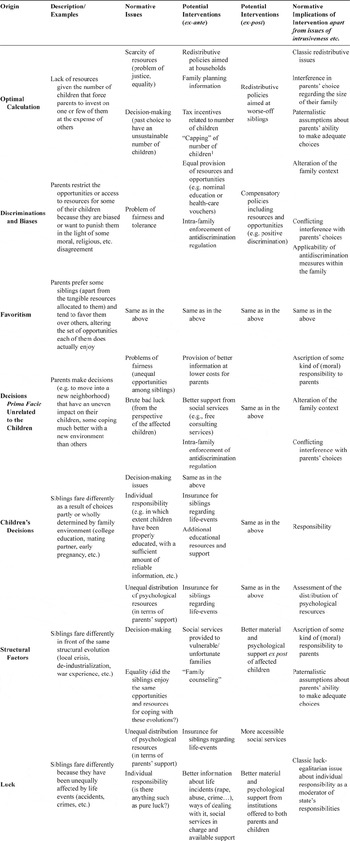
In the table below, we break down the factors according to the core element that generates inequalities. The objective is to sort out the factors spelled out by Conley and reorganize them into usable categories. The second step is to identify the moral issues at stake. In other words, for each category of inequality-generating factors, we ask the questions “from which mechanism does inequality stem?” and “which ethical issues does it present?”
Intra-family inequalities involve two main sets of issues. The first has primarily to do with the ability of people to make sound or maximizing decisions (in regard to their utility, preferences, well-being or, more simply, interests). The second relates primarily to the allocation of resources and opportunities. The former highlights situations where people make decisions that undermine their own interests or the interests of people whom they are in charge of. For instance, having too many children is usually detrimental to most of them, especially if parents concentrate their resources on some.Footnote 41 The second set of issues concerns, generally formulated, equality and justice. When parents shun one of their kids, refuse to support him due to his sexual orientation or religious inclination for instance, a problem of justice and equality arises. The same goes when they make the strategic choice of supporting one of their children at the expense of others.Footnote 42
Decision-making and redistributive justice draws the contours of the different interventions open to institutions and the normative issues they carry with them. It is important then to proceed to a more detailed discussion of the implications of the relative weight of the various liberal commitments—equality, autonomy, and toleration—in regard to any public policy that aims at influencing the decisions parents and children make or the way resources are distributed among siblings.
3b Autonomy and Toleration
As mentioned before, liberalism is stretched between two traditions: one centered on autonomy, the other on toleration. The former interprets liberalism as grounded in the idea that the role of institutions is to promote the individual’s capacity for choiceFootnote 43 or, as put by William Galston, “individual self-direction,” which is linked to the “sustained rational examination of self, others, and social practices.”Footnote 44 For the latter, the proper understanding of liberalism lies in a “live and let live” attitude where even illiberal arrangements that could go against equality of rights or autonomy are justified as long as they result from freedom of association (or dissociation) in one way or another.Footnote 45 So, what do the two brands of liberalism imply as concerns family-generated inequality and the various means of addressing it?
Dimensions of Intra-Family Inequalities

1 E.g., as in China’s “one/two – child policy”
Autonomy Liberalism (AL). AL connects with egalitarian concerns most clearly in the aspiration of guaranteeing individuals sufficient resources or opportunities to enable them to pursue their conception of the good. Moreover, putting at least the most elitist versions of autonomy liberalism aside, there is no reason to believe that AL should not in itself aim at promoting equal or at least generally sufficient levels of autonomy.
Since the argument is based on the promotion of individual autonomy, AL should be inclined to take decision-making issues and defects seriously. The reason is that they are, or indicate, handicaps in turning opportunities into concrete achievements. If the objective is to secure individuals’ ability to clearly see, evaluate and pursue their interests, judgmental biases constitute a good reason for intervening within families.
Considering that these defects may have three main causes—lack of information, cognitive biases (that impair processing this information) and breakdown of will (or Akrasia)—non-intrusive interventions for enhancing individual decision-making are conceivable. Better information could be made available at lower costs, by, for instance, informing parents about the economic situation and their future prospects if they decide to have a large(r) family or to move into another region; the different types of education and the return on investment that they offer, and so on. Institutions could also reshape the context in which individuals make their decisions.Footnote 46 An example would be to correlate family social aid, not strictly to the number of children, but to design it according to a bell curve by offering progressive benefits up to a fixed number of children and, then, diminishing marginal ones.
When intervention in the family is grounded on defective decision-making, parental actions that produce inequalities can be equated to brute bad luck (negative consequences borne by an individual but that do not stem from his precedent choices), not bad option luck (negative consequences borne by an individual that stem from his precedent choices), when seen from the perspective of the children who suffer from inequalities. This is so because the decisions that parents make for them before their birth and during their childhood are part of children’s circumstances, not their choices. From their perspective then, it is similar to a handicap.Footnote 47
Naturally, even if institutions try their best to convey information as neutrally and non-intrusively as possible, there will always linger a potential conflict with individual autonomy, in particular because autonomy might be understood as a right to make bad decisions (e.g., having “too many” children). The fact that an agent makes suboptimal choice (i.e., a choice that generates lower benefits or higher costs than at least one alternative available to the decision-maker at the time of the choice) is not enough to entitle institutions to intervene. The same could even be argued for choices that are obviously detrimental to decision makers’ true interests. It is a basic notion, tied to an ideal of respect for persons, to allow people to make bad, unsound, unwise choices, at least up to a certain, hard to specify, point. In that regard, part of the respect due to individuals as moral agents is justified by the recognition of the faculty of endorsing a conception of the good life, and the consequences that come with it.Footnote 48 The responsibility of public institutions then is limited to guarantee the material conditions for procedural autonomy, not to direct it in any specific way.Footnote 49
Considerations of fairness and equality lead to more radical suggestions and options. One possibility is to transpose part of the anti-discriminatory apparatus, or the justifications for it, that exists in the society to the inside of the family, and compel parents to distribute goods and opportunities more evenly insofar that the unequal distribution undermines the autonomy of some siblings. According to this view, the family becomes the first of the egalitarian institutions (in the sense that principles of justice ought to apply directly at home), and parents, because they exercise authority over children, are made responsible for the egalitarian performance of their decisions affecting family members.
How far and with what means this is to be done in practice, however, is not entirely clear. In addition, AL does not automatically instruct one to “bring out the big stick” and enforce a comprehensive regime of egalitarian justice, come what may. As we have implied in the above, and as we shall discuss in more detail below, AL itself provides certain barriers to state intervention for reasons of respecting autonomy. Finally, there are of course also cases where intervention might make children worse off by comparison with an absence of intervention, e.g., child custody cases that go awry. Even if this argument does not strictly rely on autonomy, it is almost certain that it should play a role in the justification for the intervention of institutions within families.
Toleration Liberalism (TL). The normative implications of toleration liberalism diverge from those of AL. The commitment to toleration over autonomy and a hands-off posture come into conflict with the promotion of individual autonomy. The discontent is not only practical (the kind of public policies that should be conducted), but also foundational (the kind of justification for such intervention). From TL’s point of view, the main contention is that intervention within the family in the name of autonomy equates a de facto promotion of a full-blooded comprehensive doctrine.
From TL’s perspective, the identification of possibly unwise or suboptimal choices made by parents or children is problematic. It introduces a top-down approach where institutions scrutinize people’s choices and weigh them against some standards that they have chosen. It might be contended that institutions have no legitimacy to set up the standards of wise choice and to judge individuals (or families) accordingly. Appeals to autonomy and choice-making ability sound like propaganda in favour of a particular conception of the good life. This would exacerbate the conflict with the commitment to tolerance considering that respect for people’s choices is one of the pillars of the liberal heritage. Arguments based on TL share this extreme cautiousness regarding any kind of moral valuation of individual capacity for decision-making that could lead to interference. They point to a conflict between intervention and toleration.
This critique is not fully convincing. There are ways to guarantee a fair level of toleration for families and the choices that are made by their members, even if institutions intervene in order to promote goals such as equality or autonomy. Furthermore, institutions do not necessarily promote a comprehensive doctrine by intervening. There are options that do not imply relying on a substantial characterization of a good, wise, autonomous or optimal decision. The criterion can be the existence of inequalities and the fact that such inequalities can be tracked down to specific defects in decision-making. If it is the case that in some families, children suffer from their parents’ bad choices, intervention for enhancing the decision capacity of the parents does not seem so much objectionable as long as it does not make, overall, the children worse off.Footnote 50 Without appealing to the controversial idea of “libertarian paternalism,”Footnote 51 it is still possible to carve out a niche between full-fledged paternalism on one side and complete laissez faire on the other.
Take, for instance, the provision of data about some foreseeable consequences of the size of the family. The mere fact of making such data available can of course be judged “intolerant” if it happens that it spells out some likely bad consequences for members of given families. However, providing data is not the same as “enforcing” any conception of the good (or justice, for that matter) and if data are true (according to some reasonable standards of social science), it is difficult to see the reason why tolerance should outweigh truth.Footnote 52
The point on which TL could collide more violently with AL is intra-family discrimination and conscious unequal allocation of resources. Three sorts of arguments might be raised for opposing to any restriction of the capacity of parents to discriminate among their children. Each of them invokes a lack of respect of some sort.
(a) Lack of respect for the special status of the family as an institution. This argument relies on the idea that family constitutes an institution with authority of its own.Footnote 53 At the extreme, it could lead to defend the view that the family is a separate (quasi-political) order with unique norms that should be respected as such by other institutions. This argument is difficult to defend for several reasons. Among them, this flies in face of the widespread acceptance of morally justified interventions in families on grounds of, e.g., child neglect. Given that such interventions can be justified, it surely is not the case that the family is immune from interference. Thus the pertinent question is: why some forms of moral harm (e.g., those associated with child neglect) justify interventions whereas others (i.e., those associated with inequality) do not?
Appealing to the special status of families in the way mentioned above does not settle that issue. One might imagine a “threshold”-conception of the legitimacy of interventions, where some moral wrongs (e.g., child molesting) pass the threshold whereas others (e.g., inequality-generating allocation of resources) do not. We are not arguing that something along these lines is entirely implausible, we argue that one cannot appeal to the sanctity of the family as an institution in order to establish that inequality (or, more generally, distributive concerns) as a moral wrong falls out of the scope of legitimate interventions.
(b) Lack of respect for the conception of the good that prevails within families.Footnote 54 This argument is less radical than the previous one since it does not postulate a strong separation between the family and the rest of the society. It emphasizes the obligation to refrain from interfering into the family’s affairs and their conception of the good life, insofar as institutions express a normative commitment for the development of individual autonomy, equality or some other goal imposed from above.
The premise of this argument is that any conception of the good should be respected by the state no matter which conception is held, which is controversial, at least on liberal grounds. It is difficult to deny that some conceptions of the good, or parts of them, are unreasonable or unjust to an extent unacceptable for the liberal, even for the tolerance-based one. However, it remains unclear what “unreasonable” amounts to, and in any event, there are important gray zone cases. The question, then, becomes one of the relative weight of “respect for families” conceptions of the good vis-à-vis other moral concerns.
As previously stated, the ideals inspiring state intervention are not necessarily comprehensive or “thick.” Relying on equality alone could be sufficient.Footnote 55 So, in order to be fully convincing the argument should present a strong case for why we must not pursue equality in this sphere, i.e. a set of reasons for why the conception of the good expressed by a family should lead to disregarding obligations to ensure equality.
This brings into view the highly complex discussion of “why equality?”, a question too broad to be dealt with in this article. Nevertheless, consider one argument. Equality carries weight in the normative landscape in part, at least, because we care about persons being able to form, revise and reject conceptions of the good.Footnote 56 This entails a sort of respect for conceptions of the good (it would seem illogical to insist that we should care about the capacity for forming or endorsing a conception of the good, but not about actual conceptions of the good as they are “lived out”). However, we should care equally for all persons and their capacity for forming and endorsing conceptions of the good (as well as for their present or future exercise of such conceptions). In some situations, this entails violating or infringing the “right to exercising a conception of the good,” such as it might be expressed in a family, if or insofar as such a violation promotes overall capacity or exercise of freely chosen conceptions of the good. A “presentism” concerning conceptions of the good seems untenable.
(c) A last objection is to affirm that interference into family’s affairs represents a lack of respect for individuals as decision-makers, or for individual agency.Footnote 57 As mentioned by Stephen De Wijze:
If a citizen freely chooses to live in a family where there is an unequal division of labour on gender lines, but does so because it fits with her values and beliefs, a political liberal state must respect and protect this personal choice because they are intimately connected to a citizen’s basic civil rights and liberties. What is crucially important from a political liberal perspective is that any unequal division of labour must be fully voluntary and not the result of (nor lead to) injustices in the society.Footnote 58
For some liberals like De Wijze, the fundamental commitment of political liberalism, as initiated by Rawls, lies in the respect for individual freedom, including in the family. Within reason, individuals must be able to freely choose which rules they are subjected to and what kind of social arrangements they are ready to endorse, at least given a similar right for everyone else.
From this perspective, the state must abstain from bypassing individual’s choices (within reason). One test is to consider that if they have not decided yet to exercise their right to exit from a given family, individuals, which include children, can be considered as consenting at least in principle to the internal organization of the family and the choices that are made within.Footnote 59 This argument has a more individualistic tone than the previous ones. Respect is ultimately paid to individuals who compose the family. It carries some argumentative strength if one considers that interventions in the family for guaranteeing individual autonomy could be apprehended as a sign of disrespect for individuals’ capacity for agency or one of their most basic freedoms: the freedom of association.
However, the argument is not convincing because the inequalities under examination are borne by children. It is fallacious to view them as free agents who enjoy a full right to exit that could be concretely exercised at a bearable cost. They are not complete moral agents who would autonomously be subjected to parents’ decisions in virtue of their consent to the rules that regulate the family. Only in exceptional times children can exercise their right to exit, either because they do not have the full capacity to do so or because the cost for disagreeing and opting out of the family would be too high.
4 Discussion and Conclusion
Does toleration-based liberalism provide us with good reasons to the effect that tolerance for the family, its associational nature or its “way of life,” overrides any attempt to intervene in the family for egalitarian reasons? In other words, does “tolerance” trump “equality”? In the previous section, we sketched some arguments that could support that conclusion, and found them wanting. Although it cannot be concluded that a commitment to equality completely overrides all variants of TL, it still puts the argumentative burden on the shoulders of the “toleration-side,” especially when families generate gross inequalities. Why should tolerance “win out” in such cases?Footnote 60
TL needs to provide us with much more compelling arguments for the (complete or nearly overriding) value of toleration, or for the “sanctity” of families, if the values of equality and autonomy should be set aside in the discussion of families and inequality. Naturally, a distinction should be made between different forms of TL, especially between those that have a genuine commitment to equality or (distributive) egalitarianism (in a broad sense) and those that do not, or have only a tangential one. The last combination is a consistent position at least. It might not be palatable for those who are seriously committed to equality or the plight of the worse-off but it is clear-cut and does not necessarily embroil itself in theoretical controversies between redistribution and tolerance.
However, the combination of egalitarianism and tolerance clashes in the case of families that generate inequalities. Upholding strong ideals of tolerance for both individual and familial choice at the same time as one wants to pursue any kind of ambitious redistributive pattern inevitably invites troubling conflicts.
Riding roughshod over a host of distinctions and complications, the most promising way for the “egalitarian tolerance liberal” to balance tolerance and egalitarian concerns is to argue for ex post compensation for those who are worse off through family-generated inequalities. By simply ignoring the source of inequality—the family and its choices—one can uphold an ideal of tolerance and avoid equality-driven interventions in the family that in one way or another threaten to be unduly intrusive, paternalistic, and so forth. By compensating persons ex post one can still pursue an egalitarian agenda while guaranteeing a certain level of tolerance.
However, this kind of response to intra-family inequality faces four problems. First, such a policy seems to commit the error which Mill famously attributed to philanthropists, “to nibble at the consequences of unjust power” rather than addressing the source itself.Footnote 61 This can be understood in various ways. One is simply to claim that the efficiency(in redressing injustices) of this policy is rather low, or that the costs of any efficient way of pursuing justice in that way would be enormously high.Footnote 62
Second, if one burrows into this line of thought and asks, why we should extend tolerance to families that produce unjust inequalities, the answer would probably be that imposing demands of redistributive justice on families is “too burdensome” for them. However, compensating ex post would, potentially at least, be massively burdensome for those who are to produce the resources used to compensate for family-generated inequalities. Hard-core egalitarians might shrug off such a complaint. But it seems at least prima facie weird that it is intolerant to ask of inequality-generating families that they should alter their ways, but not intolerant to ask other families to compensate for the consequences of other persons’ avoidable behaviour.
Third, ex post compensation under the stricture that one should not interfere in the ways of families is by definition ill equipped to address ongoing injustices and inequalities as they are played out. Though it is conceivable that an egalitarian would insist that equality plays a role only over complete life-spans, it seems rather cold-hearted to ignore inequalities just because they hit children that we can later compensate.
Finally, the combination of the last point with the first one raises the worry that ex post compensation sacrifices part of the present and future well-being of some individuals (children) for the sake of some others (parents), which is a trade-off difficult to justify. Since ex post actions are undertaken outside the family and after the rise of inequalities, they permit inequalities with the intention of offering a remedy afterwards, with the alleged justification of the “special” moral status of the family (in fact the parental authority). However, there are cases where inequalities cannot be fully compensated ex post. For instance, if a girl is constantly limited in her life options at home, her opinions devalued and a submissive role model imposed on her, as cases in Conley’s book illustrate, what could be the effective influence of institutions later on? Moreover, there seems to be a sort of moral injustice, or wrong, in letting patterns of inequality or unjustifiable dominance persist throughout especially the formative years of a person’s life, even if we are able to compensate that person later on. In sum, some inequalities may be difficult or impossible to deal with ex post, and, intuitively, at least, sometimes it is wrong in itself to “let inequalities happen,” even if we can compensate persons at some later stage. This constitutes a compelling reason for intervening within the family.
So much for the problems of toleration-based liberalism. Autonomy-based liberalism is no magic bullet either. It leans towards justifying interventions in the family that address inequalities ex ante (and not just ex post through compensation). However, a commitment to autonomy seems hollow if it does not allow individuals, and hence families, to act in ways which are not optimal (prudentially or morally). Autonomy becomes redundant if it is only to be respected in cases where choices are in some sense optimific. After all, autonomy is connected to individual liberty. If only optimific acts are compatible with autonomy, then autonomy is an empty concept. Hence, autonomy seems to cut both ways: valuing individual autonomy might provide a reason for intervention, but also for protecting individual and hence familial choice. So, at the end of the day, to just what extent does autonomy-based liberalism mandate interventions?
This is a complicated issue, but at least autonomy-based considerations provide a starting point: interventions must, at a minimum, protect or enhance individuals’ capacities to form, revise and reject conceptions of the good, ultima facie. Although a particular intervention might hamper the exercise of autonomy of some party—say, the patriarchal head of a family—it does not necessarily obstruct the capacity and, furthermore, it might of course enhance both the capacity and the exercise of autonomy for some other parties. Interventions which one cannot plausibly expect to protect or enhance autonomy are not (or not straightforwardly, at least) legitimate as seen from the point of view of autonomy-based liberalism.Footnote 63
It might here be complained that equality is strangely absent from this picture of autonomy-based liberalism. Naturally, egalitarian resource allocation that promotes autonomy is likely to obtain in many cases, but there is no necessary connection between autonomy and equality ideals in some wider sense. Indeed, the two may come into conflict if autonomy is actually promoted by giving more resources to those who are already well off (although unlikely, it is not an impossible situation).
As was the case with toleration-based liberalism, it is timely to distinguish between those autonomy-based liberalisms that emphasize equality and those that do not. Without putting too fine a point on it, “pure” autonomy-based liberalism (i.e., without any or only a tangential commitment to equality) can be seen as a consistent, but not terribly attractive, position. The combination of autonomy-based liberalism and stronger egalitarian concerns does not necessarily embroil itself in the same problems as egalitarian toleration-based liberalism. It avoids the difficulty of balancing tolerance for inequality-generating families with egalitarian concerns. In this context, it is a major advantage for autonomy-based liberalism: it can address, ex ante as well as ex post, the inequalities generated by families that Conley describes. However, it comes with its own problem, namely: balancing autonomy and equality. Even though a more equal distribution of goods and burdens in many cases will also promote autonomy, it is not necessarily so.
In conclusion, justice in the family is a tremendously complicated problem, beset with difficulties and pitfalls. What we can conclude here, tentatively at least, is that there are no easy ways out for liberal theorists when they are presented with the issue of inequalities in the family. The reason is that they have to accommodate their commitment to equality with another one (namely autonomy or toleration), which is at the basis of their conception of liberalism. Insisting on tolerance amounts to unduly ignoring blatant unjust inequalities; relying on autonomy might enable one to address the injustices head on, but does not in itself equip us with a solid justification for trade-offs between equality and autonomy in cases where the two come into conflict.
Our article has nevertheless shown that there are serious reasons to regard AL to be more consistent than TL with the sort of egalitarian intuitions that most liberals have. However, it seems more fashionable among liberal theorists to insist on tolerance rather than autonomy; probably, most liberal theorists are afraid that their position could compromise the demand for neutrality vis-à-vis “controversial” ideals of the good life, and any comprehensive liberal theory explicitly relying on autonomy soon runs into that risk. This is perhaps especially so if a liberal theory boldly claims that we should adopt a more “activist” policy when it comes to families. Here and in similar difficult areas (e.g., culture and religion), endorsing the value of tolerance over autonomy makes it (superficially, at least) possible for the liberal to avoid addressing patterns of inequality that, if they are to be addressed at all inevitably will invite allegations that one is compromising neutrality. However, from the point of view of social justice, inequalities are not less important just because they are produced within the family. And the merit of Conley’s work is precisely to demonstrate the importance of the question of intra-family inequalities for political philosophers. These issues should occupy theorists for the years to come.