1. INTRODUCTION
The aim of this article is to compare the demographic characteristics of the lodger population with the ‘tenant’ or householder population in two counties within Hungary across the second half of the eighteenth century.Footnote 1
The article is organised into five further sections. It opens with a short discussion of the historical research on households and the theories arising from this in Section 2. The data sources and methods used in the current study are introduced in Section 3. The results are presented in Section 4, which is subdivided into three parts. In the first of these the characteristics of lodgers and tenants at the aggregate level are compared; in the second the possible implications of the differences observed for demographic processes and regimes are examined, while in the third section lodger and tenant households are compared. The findings are placed in a wider context in Section 5 and concluding remarks are presented in Section 6.
2. THEORETICAL PERSPECTIVES
Any historical household analysis which considers lodgers has to confront three sets of problems related to the sources, concepts and methods to be used. It is not that there is a shortage of documentary sources, but for a number of reasons they often remain silent on many aspects of life related to those co-residing with the family of the household head. First of all, the documents tend to reflect the cognitive map of the officials compiling them. Second, the information they contain was usually collected for specific, limited purposes. For example, they might just list the members of a particular church, or denomination, or enumerate those adult males suitable for taxation, work or military service; they were not intended to detail either the structure of households or the characteristics of individuals within them. To interpret such sources for my purposes, classical historical criticism is not enough; additional cultural analysis of the content is required.
A typical ‘lists of inhabitants’, the source most suited to household analysis, was compiled household by household, and this may have given the impression that this unit held greater importance in the social landscape than was actually the case in pre-industrial society.Footnote 2 The household was not an isolated unit; its members had ties in many directions: to their neighbours, to the wider village community, and, of course, to a network of kin which usually extended well beyond the village. The life and internal structure of each household were also influenced by the orders and regulations laid down by the Church, the landlord and local customs. The impression given by contemporary pre-industrial sources is that households, rather than families, were the primary unit of society at the local level. In reality these units were frequently identical but in a significant number of households the family of the head lived together with kin and non-kin. A list of inhabitants will usually enumerate all the individuals living together in a dwelling, the group which Peter Laslett referred to as a ‘houseful’. Although kinship networks were very important within pre-industrial society, it would be a mistake to conceptualise any given population solely in terms of family or kin groups. Non-kin members of the household, and other people living in the same dwelling should not be neglected. It is also a mistake to consider the family and those of their relatives living under the same roof as one co-resident group. Relatives may have been living as members of the head's household, but sometimes they formed a separate unit within the houseful. To omit these elements of the population because they cannot be easily classified, or to amalgamate them with the family of the household head, is misleading.
Half a century ago it was believed by those conducting household and family research that in the past the size of domestic groups was relatively large, their composition complicated, and much the same all over Europe. These scholars confidently asserted that social and economic transformations had led to a gradual rise in the proportion of nuclear families. This master narrative began to change in the late 1960s thanks to the work of Laslett and the Cambridge Group and to John Hajnal's two famous papers on marriage and household formation. Together they opened up new avenues for historical household and family research. The ensuing search for new sources and methods expanded this type of research across Western Europe. As studies multiplied, the results generated serious debates which led to a permanent revision of the earlier theories.
Three important new strands of thought have recently emerged. First of all it was recognised that the new forms of analysis, which were predominantly based on case studies of single communities, were not always able to take dynamic demographic processes into account. Second, as the studies grew in number and widened in scope, it became clear that all forms of co-residence in societies elsewhere in the world could not be explained from a Western European perspective. Even within Europe the forms of co-residence, both past and present, proved to be different, and sometimes historians found it difficult to harmonise their results with those of anthropologists, sociologists and those scholars analysing non-Western European societies. It became evident that scholars needed to formulate their theories using a more rigorous concept of co-resident domestic groups, in order to compare across different fields and diverse regions. They would also have to grapple with the problems caused by the cultural translation of the words ‘family’, ‘household’ and ‘lodger’, both in sources compiled centuries ago and those drawn from different present-day societies.Footnote 3
In the early days of modern household research, during the early 1970s, it was recognised that studies based on a longitudinal, rather than a static, perspective were desirable. However, it was difficult to apply such methods to the pre-industrial period. The family-cycle models formulated by those working on modern populations appeared unsuitable for use in historical analysis because the models failed to fit the forms of co-residence observed in the past. In addition, these models also failed to consider those members of the population who were definitely not members of the head of the household's immediate family.
The life-course approach developed by demographers and sociologists, which defined the sequence of events experienced by a particular person over the course of time, offered one solution for the analysis of households, but unfortunately the type and quantity of data needed to create life histories are seldom available for the pre-industrial period. Apart from a few exceptional sources, preserved mainly in certain west European archives and particularly in the Scandinavia region, it is only possible to study household dynamics by considering cross-sectional data from two or more successive lists of inhabitants from the same community. Sadly in Eastern Europe, and elsewhere, even this is seldom possible. Researchers in these regions have little option other than to use the age structure of the parents, children and the non-kin population listed at single points in time when trying to understand the dynamic processes at work in communities under study.Footnote 4
In recent decades statistical methods and demographic analyses have strengthened research into historical households. Increasing efforts have been expended on controlling for the impact of demographic structures on the formation of the co-resident groups. The increasing number of large demographic databases has opened up research possibilities, but has also put pressure on scholars to perform more precise analyses of the role of demographic factors in the course of their research. This work has the shortcoming that the databases predominantly relate to the nineteenth and early twentieth centuries, and are drawn almost exclusively from North America and Western Europe.Footnote 5
Last, but not least, in this section some discussion should be devoted to the main topic: lodgers. First of all it should be made clear that, for the purposes of the present study, lodgers were defined as living as separate households, no matter whether they were living as single individuals or in a family group. Even in the pre-industrial era the position of ‘lodgers’ was totally different from that of ‘servants’. The latter were temporary residents within the household headed by an owner occupier or by a tenant householder. Servants were linked to their household through a yearly contract, and were under the authority of the household head who, as their master, had the right to discipline them. When listed in a tax list, servants only appeared as a number, much like the cattle belonging to a household. In contrast, lodgers were quasi-independent residents within a dwelling; they were tied to the head of the household only by the rent they paid, either in cash, in kind, or with their labour. Lodgers in the serf system of the pre-industrial era were answerable to the lord of the settlement in which they resided as independent tax payers, and were therefore recorded in tax lists on a separate line from the other members. Their names were given, and their status given as ‘subinquilinus’, indicating that although they were not householders in their own right, they did not belong to the tenants' household. They were, in contrast to servants, independent members of the community.
The literature on the historical demography and social history of the pre-industrial era seldom refers to lodgers. Although, as a group, they are mentioned occasionally by researchers making international comparisons, they appear mainly as a sub-theme in discussions of poverty or widowhood, or as participants in the process of protoindustrialisation or as old, retired parents. In other words, they are viewed mainly through the lens of social history; they seldom appear in any demographic analysis. In the literature greater amounts of detail about lodgers are only available for three regions: Scandinavia and the Baltic; Austria and the Czech Republic, in the West of the former Habsburg Empire; and north Germany and the Netherlands. While the authors of these publications deal with the topics already mentioned, they also considered lodgers in relation to the question of inheritance and the custom of ‘retirement’ in central and North-Western Europe, although they tend to avoid referring to the people they are discussing as ‘lodgers’.Footnote 6
On searching the literature on Hungary, no work could be found relating to persons who could be identified as lodgers. Individuals listed using the legal term ‘subinquilinus’, or ‘crofter without a house’, in the tax registers of the era, lay at the bottom of the social hierarchy, and no demographic analysis which included them could be found. Furthermore, because the custom of ‘retirement’ was seldom seem in Hungary it would appear that issues concerning lodgers had simply not been recognised as suitable topics for research.
Compared with the great mass of writings published in the field of family and household history during the past half century, the literature on lodgers is remarkably small. There are many dozens of works which mention lodgers, and some even tabulate their numbers, but the group seldom forms the focus of a formal analysis. The lack of interest shown by researchers toward the lodger population can be ascribed to several factors. First, lodgers mostly belonged to the poorest strata of pre-industrial populations. It is difficult to associate them with a particular social movement or historical process and therefore they do not seem to have been significant to topics of researchers' interests. In addition, few sources deal with lodgers separately from the population in general. In many cases the group is often absent from the records as its members had no land to transfer and failed to leave behind detailed inheritance inventories, and they seldom feature in litigation settlements or inheritance disputes. Few, if any, diaries or autobiographies were written by lodgers. As a result, very little direct information can be found on this group within the archives. With their ambiguous position in the household and the lack of information, scholars had little stimulus to consider lodgers as a topic of research.
3. SOURCES AND METHODS
I must confess to falling on the topic of lodgers accidentally. I had previously been working on half a dozen villages and was amongst those who considered that lodgers were an insignificant group because they were small in number, forming less than 10 per cent of the population in most instances. However, as an historical–demographic database was constructed, my opinion gradually changed as the number of lodgers that were encountered swelled to several thousands, even before the data entry had been completed. It became apparent that this group could not, and indeed should not, be ignored and it was decided to undertake a separate analysis in order to reach a better understanding of them.
The database, under the temporary name ‘Hungary 1760’, is still being constructed. It was inspired by the increased international interest in the creation of databases containing a large number of cases and constructed in a standard form, which would allow more precise and much more content-rich demographic analyses to be performed.
Another impetus to the construction of the ‘Hungary 1760’ database was the special character of research on Hungary and the sources available. Parish registration of demographic events started earlier in the Carpathian Basin than elsewhere in the Orthodox World; nevertheless, its commencement was still much later than in those societies leading historical demographic research. With a few, mostly urban, exceptions, Hungarian registers only achieved a quality suitable for successful demographic analysis at the end of the eighteenth century. Apart from some individual, scattered and unrepresentative examples, it is not possible to construct large-scale data on age at marriage, the exact timing of attaining the status of household head, or accurate measures of fertility and mortality from Hungarian parish registers before 1800.
The eighteenth century was an important period in the history of the Carpathian Basin; it saw the reorganisation both of society and of the settlement structure as 150 years of Turkish rule came to an end. If the demographic conditions during this time wish to be known, however, efforts must be concentrated on the census-like sources that are available. From the mid-eighteenth century onwards a series of ‘lists of inhabitants’, otherwise called status animarum, was created in Hungary.Footnote 7 To date, these lists have been less well researched than parish registers. They arose as part of the counter-reformation movement taking place throughout Europe, and were created through visits to local communities by officials of the Roman Catholic Church. Where they exist it may be possible, by making them machine-readable, to construct national demographic databases which cover the era before the first official censuses.Footnote 8 In the case of Hungary the status animarum are very important as they give basic personal demographic data for thousands of people, whereas few of the sheets on which families were enumerated as part of the first Hungarian census of 1785 survive.Footnote 9 The census had been ordered by Emperor Josef II, and after his death certain nobles, who were exempt from tax and wanted to keep their personal details hidden from the state administration, had the schedules almost completely destroyed. Moreover, those census enumeration sheets which do survive contain detailed demographic data for males alone; only the number of females living in a household is recorded, and their age and marital status is not given. Thus the status animarum are the only source which allows demographic analyses to be performed on the late-eighteenth-century Hungarian population as a whole. The next dates for which similar nominal, census-like records exist are the census enumerations of the mid-nineteenth century, conducted between 1850 and 1869, but here too the survival of the sheets containing the nominal data from these censuses is no more than fragmentary.Footnote 10
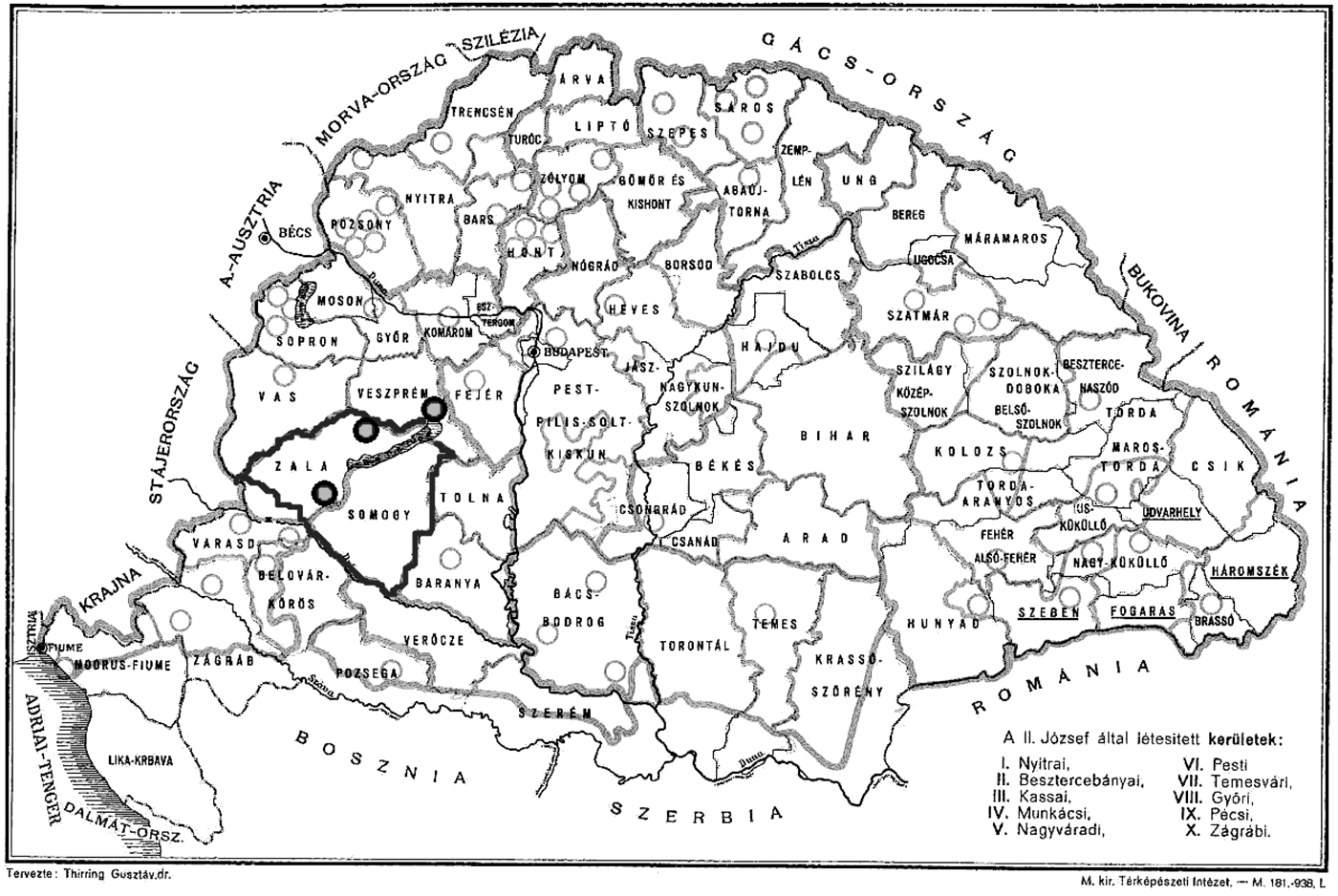
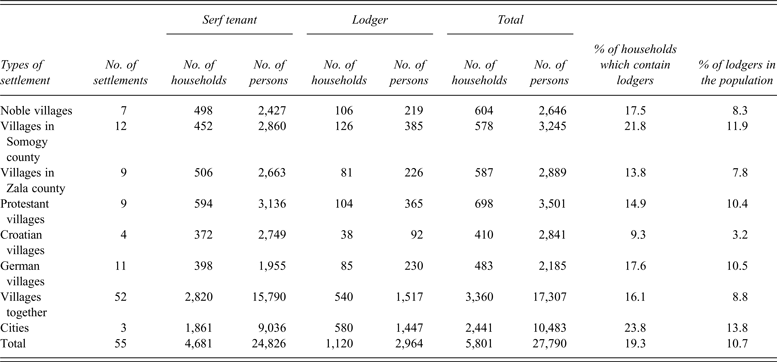
At present the database includes information on 94 settlements, 11,600 households and approximately 56,000 persons.Footnote 11 For the purposes of the study reported here data were used from 52 villages, and 3 cities, situated in Zala and Somogy counties in the southwest part of Transdanubia (Figure 1). These villages contained 5,800 households and slightly fewer than 28,000 people (Table 1).Footnote 12 Of these, 1,120 households and 2,964 persons were enumerated as lodgers.
The counties of the Hungarian Kingdom (1760), showing the counties of Zala and Somogy. Source: prepared after G. Thirring, Magyarország népessége II. József korában [The population of Hungary in the age of Josef II] (Budapest, 1938), 16.

Descriptive statistics derived from the study dataset
Source: Calculations by the author based on the ‘Hungary 1760’ database.
The nature of the sources meant that methods of investigation had to be relatively simple and limited. Apart from a few scattered exceptions, it was not possible to find later listings of inhabitants, so data recorded at a single point in time had to be used. Only age structure could be used to reconstruct or, more accurately, estimate the prevailing demographic and social processes. Unfortunately, occupations were only recorded occasionally, and there was no record of the total land that individuals or families held or of the sums they had to pay in tax. The character of the source documents was such that it was impossible to carry out any detailed social analysis, apart from a consideration of the household position of the inhabitants of each house.
In Table 1, the 52 villages in the study are divided into six groups based on partly legal, partly cultural, and partly migration patterns. The noble and non-noble villages, the Catholic and Protestant villages, as well as the Croatian and German, and the Hungarian villages, were separated. The inhabitants of the nine ‘Protestant’ settlements were predominantly Calvinist Hungarians; in the remaining villages the majority of the population belonged to the Roman Catholic Church. The latter were divided into two groups: those situated to the south of Lake Balaton, in the middle part of Somogy county, and those lying to the north-west of the lake, in Zala county. With one exception, all the ‘minor noble’ villagesFootnote 13 were in Zala, while the German villages were dispersed in the study area. Although the home territory of the latter was distant they were more numerous in Transdanubia than the Croats. The four Croatian settlements were all situated in Somogy, which was the neighbouring county to the settling area of the Croatian population body. The Croats and the Germans belonged to two separate immigration waves following each other from the 1680s on. They also brought to Hungary different customs and timing in marriage and co-residence, not to mention the labour organisation of agricultural work which is not relevant to the current topic.
In 80 per cent of the villages contributing to the study, the population numbered fewer than 500 inhabitants. The rest had between 500 and 1,000 inhabitants. Only one of the four Croatian settlements held more than 1,000 people. In the mid-eighteenth century Roman Catholic Hungarian peasants and minor noblemen lived exclusively in small villages of no more than 200 people on average. In contrast, cities had considerably larger populations; with between 2,000 and 5,000 inhabitants they were several times the size of a village. The settlements were classified into the groups listed in Table 1 to make it possible to assess the impact of cultural characteristics on the forms of co-residence and the demographic behaviour observed. In this paper, the focus will be on lodgers and therefore no space is available to discuss the impact of cultural background on demographic and familial processes within the study area. In fact, cultural background does not seem to have been a crucial factor in the behaviour of lodgers; at least their characteristics do not show such great variability by culture as that which can be observed in other forms of household. As there were 1,500 lodgers living in 540 households in the rural areas it did not seem to make sense to disaggregate them further as this would probably have produced results which were less than robust.
Before moving on to discuss the central topic, the demographic characteristics of lodgers in the study area, a brief summary needs to be offered of how the group of households and individuals in the sources considered to be lodgers were identified. The lists of inhabitants used clearly reflect the hierarchy of the co-resident persons living in any particular house until the mid-nineteenth century.Footnote 14 The lists used individual houses as their basic unit of enumeration. Each household was listed starting with the head of the household, who was usually a married man, followed by his wife, children, other relatives and servants. With a few exceptions, the head, whether male or female, would be a life-long tenant.
Any lodgers can be found listed at the end of the record of the house in which they dwelt. The head of the lodger household would be enumerated first. In some 78 per cent of cases in the villages, and in 98 per cent of cases in the towns, the head would be clearly identified by the words ‘inquilinus’ or ‘inwohner’; sometimes the word ‘incola’ was used (Latin and German terms for lodgers in the household). An additional 2–3 per cent of lodgers were identified on the basis of their occupation (pastor, ludimagister, obstetrix; shepherd or herdsman, schoolmaster, midwife) or by the presence of words such as ‘item’ or ‘ibid’, which refer to the fact that an individual led a separate existence, apart from the head's household.Footnote 15 In the rural villages some 19 per cent of lodgers could be identified without any of the clear indications just listed, but in the cities only 0.7 per cent could be accounted for in this way. Lodgers were identified as those individuals, listed after the servants living in a house, whose relationship to the head could not be verified. This is obviously not a perfect classification, but it is much better than the usual practice of assigning such individuals to the household of the head. In fact, in only a minority of cases was an individual's classification as a lodger in any way uncertain. As shall be seen later, lodgers had particular demographic characteristics, and this reinforces their identity as a distinctive group. Had this group been treated in a conventional manner, then all residents within a particular dwelling would have been identified as a ‘houseful’. In this case, the household structures observed would have been unrealistic and would not have been comparable with the data on the numbers of households and their average size which can be derived from the first official census of 1785, roughly a generation later. The census authorities in the 1780s laid out how the composition of a household was to be defined, and gave instructions for the population to follow, making this census the only late eighteenth-century source which provides quantitative measures of household structure.Footnote 16
Of course, the fact that lodger and tenant households co-existed in the traditional world did not – and, given the housing conditions of the time, could not – mean that the two units were completely separate entities. The lodgers probably only occupied a separate room, not a separate dwelling equivalent to a modern flat, and in return for their housing, they probably ‘helped out’ with the economic activities of the head and his family, rather than paying their rent in cash. It is probable that the situation was even more complicated: the data suggest that about one-fifth of the lodger households were related to the family with whom they lodged.Footnote 17
The basic data suggest the following conclusions about lodgers. Lodgers should not be dismissed as an insubstantial portion of the Hungarian population; they were present in 16 per cent of the housing stock in rural villages, and in 24 per cent of houses in the cities. It is true that they formed only 9 and 14 per cent of the urban and rural populations, respectively, mainly because their households were smaller than average, but it would be inappropriate to ignore them, particularly as Hungarian law viewed them as independent members of the community.
4. DEMOGRAPHIC STRUCTURES WITHIN THE POPULATION
4.1. Demographic characteristics of lodgers
In the discussions which follow, focus is on the demographic characteristics of lodgers within the study population; however, for the most part the tables and figures also include data on tenant households, in order to highlight the contrasts between the two groups. Let us first consider the demographic structure of the two groups, as measured by three factors: the gender ratio, age, and marital status.
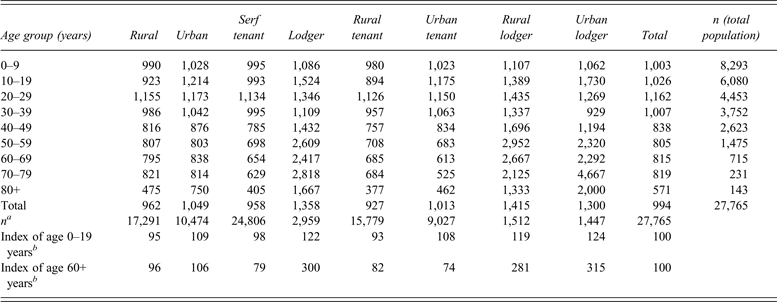
The gender ratio, measured as the number of women per 1,000 men and shown in Table 2, exhibits noticeable small differences although these are not always significant. The ‘total’ line in Table 2 indicates that overall there was a slight male surplus in the ‘rural’ villages and a slight female one in the ‘urban’ cities. However, moving beyond the urban–rural contrast, comparing the serf ‘tenants’ with lodgers in both urban and rural areas reveals a more diverse picture, and urban–rural differences are magnified. Amongst tenants there was, on the whole, a considerable male surplus, and while there was a small female surplus in the urban areas this was restricted to those aged less than 40 years. In contrast, although lodgers represented a smaller share of the overall population, a surprisingly large female surplus can be observed in virtually every age group. The total number of women per 1,000 men indicates that both in rural villages and in urban areas the proportion of women living as lodgers was roughly 15–30 per cent higher than that of men. Before attempting to account for this gender imbalance, and its dimensions, it is appropriate to examine further characteristics of the sample populations.
Gender ratio (women per 1,000 men) by age and type of household: Zala and Somogy counties, Hungary, c. 1760
a Known ages,only.
b Related to the total population (proportion of age 0–19 and 60+ years in the total population is 100).
Source: as in Table 1.
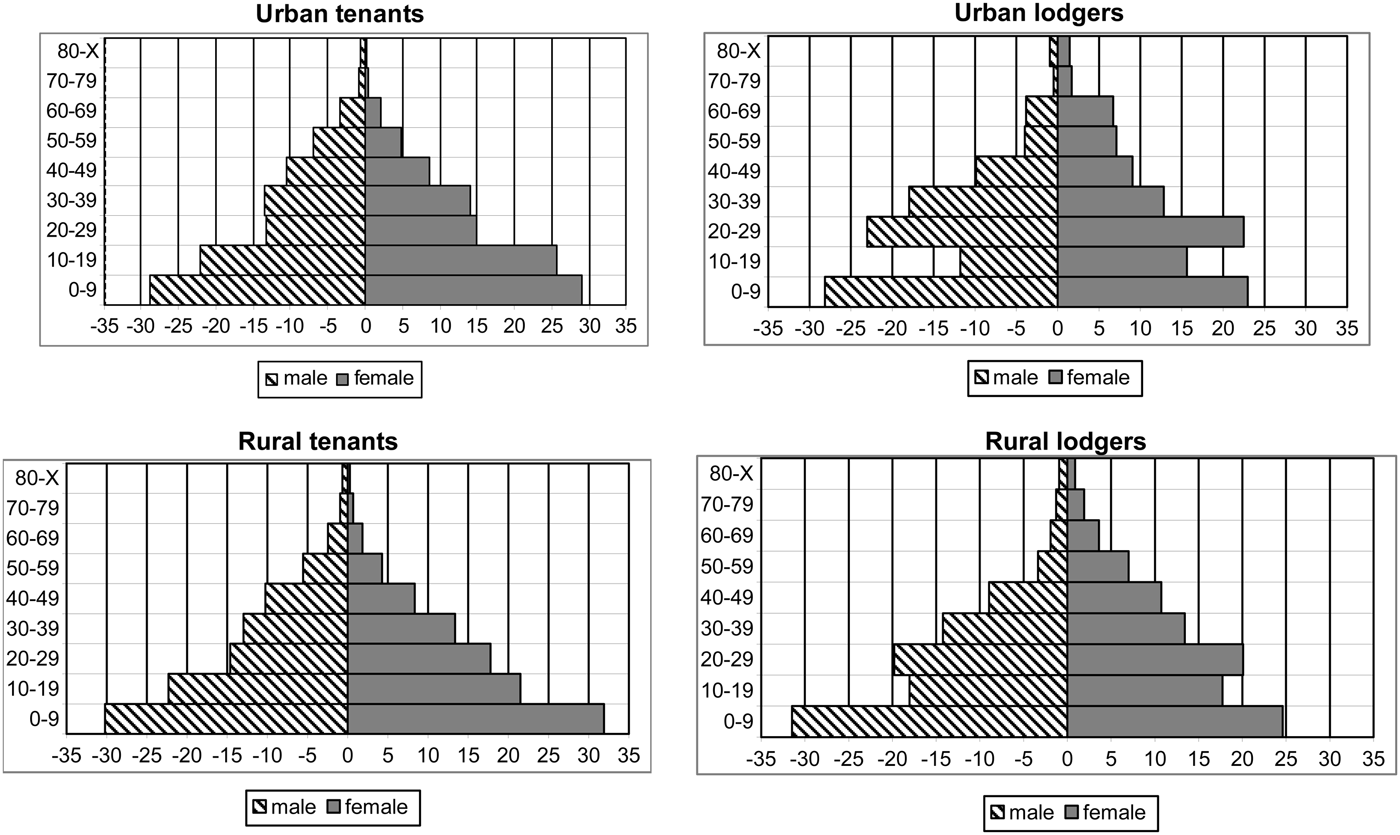
When the age composition of tenants and lodgers is compared, it can be seen from Figure 2 that, despite the variation in the values for each age group, the age composition of the tenants takes on a pyramid form. This is a typical finding for a population living under a traditional demographic system before the early twentieth century. In contrast, the age distribution of lodgers in Figure 2 is clearly distorted: the proportion of the population formed by those in the 10–19 years age group is lower and that formed by those over the age of 60 years higher than expected.Footnote 18 In other words, age distribution is like gender distribution; in order to compare the tenant population and the lodger population different models are required. The age distribution of lodgers living in urban areas was particularly skewed: the figures indicate an unexpectedly small group of young people, and a relative abundance of middle-aged and elderly persons, a form of age distribution not seen amongst tenants.
Age compositions of the tenant and lodger populations in the urban and rural communities of Zala and Somogy counties, Hungary, c.1760. Source: ‘The Hungary 1760’ database. Note: the x axes show the percentage of the males and females in each age group.
When the proportions of the two populations in the different types of settlement by age and gender are considered (Table 2), the situation appears to be rather more complex. In the rural population overall, there was a slight male surplus in all the younger age groups, apart from the 20- to 29-year-olds; amongst those over 40 years the male surplus was more pronounced. In contrast, there was a relatively strong female surplus in the four youngest age groups in the urban population, where a male surplus similar to that in the rural areas only becomes evident amongst those over the age of 40 years. These figures suggest that two intersecting processes are at work: migration and mortality. The majority of the study area had been under Turkish rule until the end of the seventeenth century, and frequent warfare and recurrent epidemics closely related to the movement of troops had depopulated the whole region, making it attractive to migrants. The male surplus in the rural villages can be attributed to the fact that in-migration, both from German-speaking territories, and from neighbouring Southern Slav regions, was still continuing, even in the mid-eighteenth century.Footnote 19 The male surplus also reflects the fact that the migrants were more likely to be male.
In the cities, the female surplus in the younger age groups, caused by an influx of female servants from rural areas, was typical of early-modern urban societies. In some age groups the number of female migrants into the cities outstripped that of male migrants. As most of the girls arrived in the city from the surrounding rural villages, this undoubtedly contributed to the surplus of males in those villages. The female surplus amongst those in their twenties in the rural areas was probably also a consequence of migration. As well as being the age at which girls entered service, this was also the peak age for marriage and, according to Hungarian custom, brides would move into the home of the groom's family. As a result, the small size of the villages meant that short-distance migration by brides was directed toward those settlements where there was a surplus of males.
An increasing male surplus amongst those aged over 40 years is evident in both the cities and the rural villages in Table 2. This too can be attributed both to migration and mortality. The higher proportion of males amongst older people may indicate, on the one hand, that in-migration had been particularly prevalent at the end of Turkish wars, leading to the increased ratio of men to women in middle-age or above several decades later. On the other hand, according to the research of László Hablicsek, it could be argued that, unlike today, the probability of survival was lower amongst females in every adult age group during the pre-industrial period.Footnote 20 In the cities this was partly counter-balanced in younger age groups by the influx of female servants, but there was no such counter-balance amongst those over the age of 40 years.
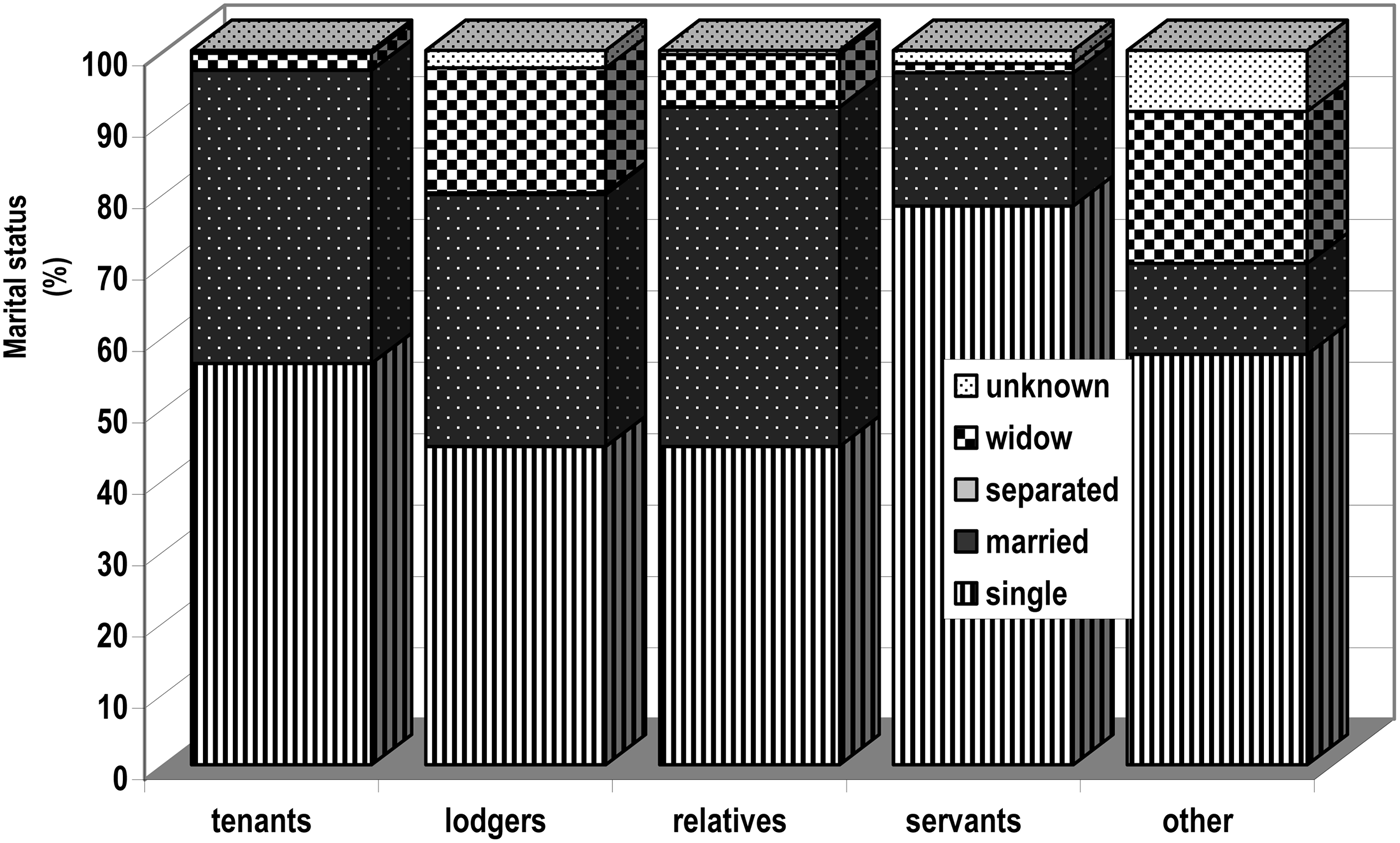
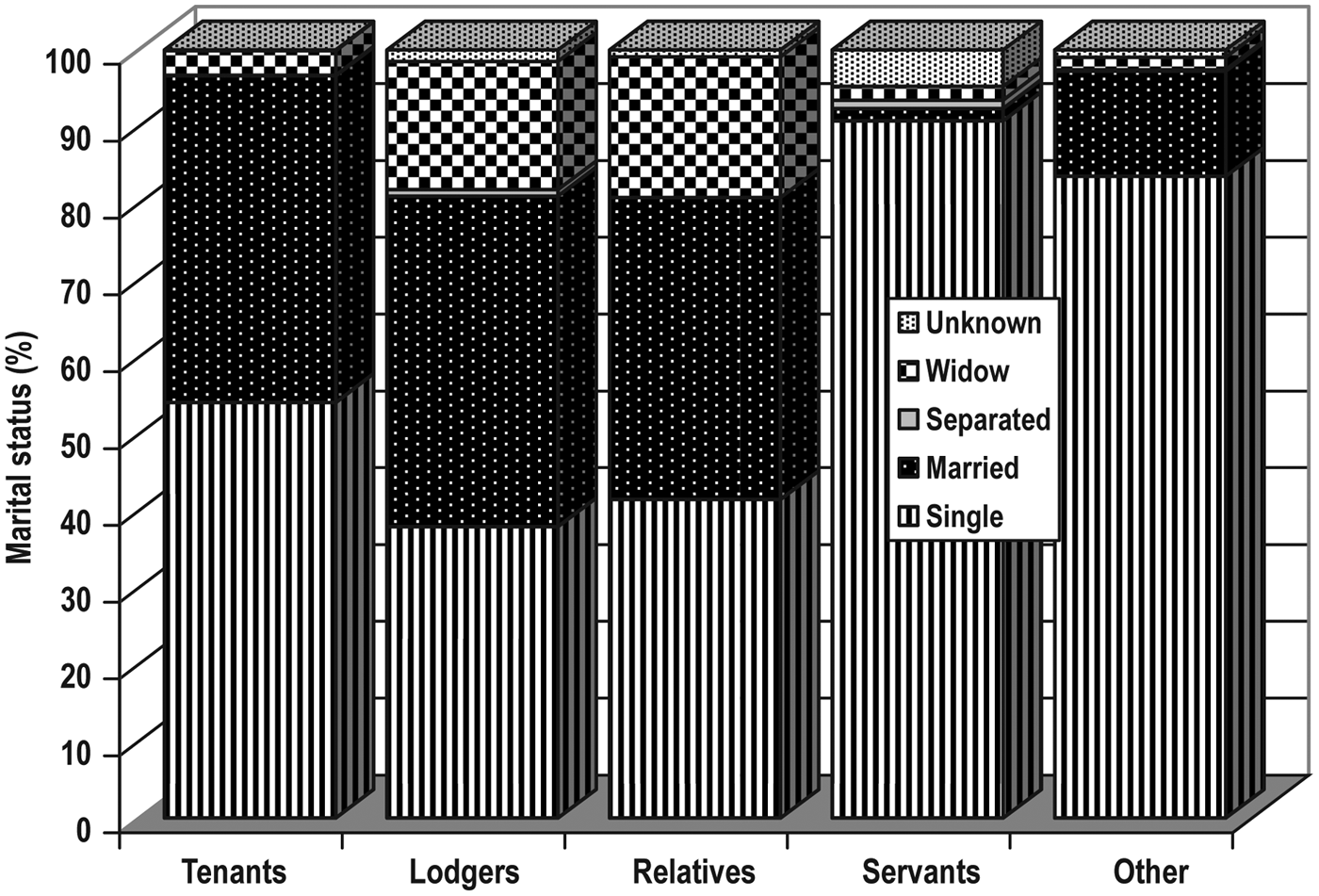
When the population is decomposed into marital status groups interesting variations by age and gender emerge, as shown in Figures 3 and 4. The members of tenant families consisted almost exclusively of either married or unmarried persons; any other type of marital status is very rarely given. In contrast, lodgers and relatives of the head contain a significant proportion of widowed persons, both male and female. While the composition of tenants, lodgers and relatives was similar in the rural and the urban settlements, two further groups – the ‘servants’ and ‘others’ – had sharply different marital status characteristics, depending on where they stayed. Servants in the rural areas were predominantly male and worked in the fields, whereas those working in the urban areas were predominantly female domestics working within the homes of city dwellers. It follows from these differences that a considerable number of married servants in the rural villages can be found, while the urban servants were all unmarried. An insignificant number of persons were classified as ‘other’ in the villages and consisted of persons following unusual service occupations, some unmarried people and those whose status was imperfectly recorded in the source documents. In contrast, the number of those in the ‘others’ category was much higher – nearly nine times higher – in the cities. While in the villages less than 1 per cent of the population belongs to this category, their proportion is over 8 per cent in the cities where the non-agricultural occupations have concentrated. These individuals consisted mostly of journeymen and apprentices. Some of the journeymen were married, but their status within a household was not always easy to determine. If the head of the house was a peasant then the journeyman could be a lodger, but if the householder was an artisan, then a married or an unmarried journeyman would have been viewed as a member of his household. Unfortunately, the sources are not very clear on such cases because their main focus was the rural population which represented approximately 90 per cent of the inhabitants of Hungary during the study period.
Percentage distribution of members by marital status in different types of co-resident groups in rural communities: Zala and Somogy counties, Hungary, c. 1760. Source: ‘The Hungary 1760’ database.
Percentage distribution of members by marital status in different co-resident groups in urban houses c. 1760. Source: ‘The Hungary 1760’ database.
The following conclusions can thus be drawn concerning the demographic structure of the population of lodgers. They were definitely demographically distinct from both tenants and servants. Demographically they were most similar to the ‘relatives’ group, but the latter were more dependent on the tenant and his family and, unlike the lodgers, had no contractual agreement with the latter. The lodgers' different age, gender and marital status compositions cannot be explained solely or primarily by regional, religious, or socio-structural factors; they were much more the result of demographic and economic processes. The high mortality rates prevalent in the pre-industrial era, in addition to differences in the economic background of urban and rural families, shaped the demographic characteristics of the different groups of inhabitants. The disparities are more obvious amongst females although they can be seen amongst males too. Of course, the observed features were not independent from each other: the higher rate of widowhood amongst women may have been associated both with the lower proportion of remarriage, the surplus of females between the lodgers and with the fact that the average age of lodgers was biased upwards by the comparative lack of young people paying to live under someone else's roof.
To sum up: on the basis of all the indicators measured, the demographic profile of the lodger population was different from that of tenants in both in the rural villages and the cities. In essence, two different population subgroups were being observed, each with their own distinctive demographic profile. While the profile of lodgers was undoubtedly influenced by both demographic and social processes it is apparent that the differences between lodgers and non-lodgers were minor among males when compared with those among females. In the next section the demographic processes involved will be analysed.
4.2. Demographic processes at work amongst lodgers
Movements in the rates of vital events are difficult to reconstruct from the information held in the ‘History 1760’ database. It was more accurate in several respects to determine the structure of age, gender and marital status. The available sources did not include parish registers, which would have recorded events as they happened, but cross-sectional, census-like lists, containing indirect information on vital events. These can be used to sketch the processes of marriage and fertility, but provide only the roughest estimates of mortality and migration. To reconstruct the repopulation of the region over the course of the eighteenth century, reliance has to be placed on descriptive sources and local history research, because there is no precise information on this process until Josef II organised the census of 1785.
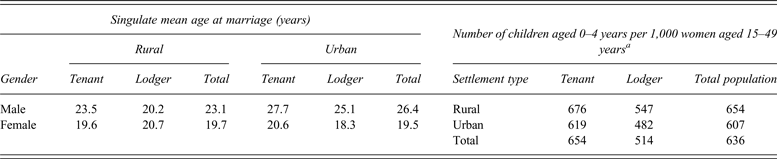
Adopting Hajnal's methodFootnote 21 it was possible to calculate the singulate mean age at marriage (SMAM) for the different groups enumerated in the sources. In the rural villages the SMAM for both men and women was relatively low, at 23.1 and 19.7 years, respectively, clearly lower than the values seen in Western Europe at the same time.Footnote 22 The SMAM for men in the urban population was 26.4 years, rather closer to the west European figure, but the figure for urban women, at 19.5 years, differed little from that seen in the rural villages and was once again much lower than the equivalent figures from the West in the mid-eighteenth century.
The SMAM for male lodgers – especially those living in rural villages – was slightly different from that of tenants living in the same communities. Female tenants and lodgers married at roughly the same age, but male lodgers married rather younger than their tenant counterparts in both rural and urban areas (Table 3). In the rural villages the SMAM for male lodgers lay below that for female lodgers. As male lodgers had no land of their own, their means of livelihood were precarious; they therefore had no motivation to attain a better start in life by postponing marriage, and their low average age of marriage reflects this. The influence of living in a city can be seen in the SMAMs, however. Although the age at marriage of male lodgers living in the urban areas was, at exactly 25 years, more than 2.5 years lower than those of tenants in the cities; this was nevertheless a significantly higher value than that calculated for lodgers in the rural villages.
Basic measures of marriage and fertility: Zala and Somogy counties, Hungary, mid-eighteenth century
a Births out of wedlock were rare and marriage was virtually universal, so women have not been differentiated by marital status.
Source: as in Table 1.
The variation in the male SMAMs in Table 3 is very obvious. The lowest male value is slightly more than 20 years, and the highest almost 28 years, a difference of over 7 years. This contrasts with the female SMAMs which diverge to a much lesser degree; by just under 2.5 years (20.7 vs. 18.3 years). The relatively young female age at marriage shown in the table suggests that all sectors of society were attempting to maximise their fertility. The greater difference in age at marriage between the tenants and lodgers in the rural villages may be due partly to economic factors and partly to prevailing customs. As the inheritance of property and the management of households were clearly male concerns in this era, the optimal age for members of each group to marry could best be achieved by the regulation of the age at which men took a wife.
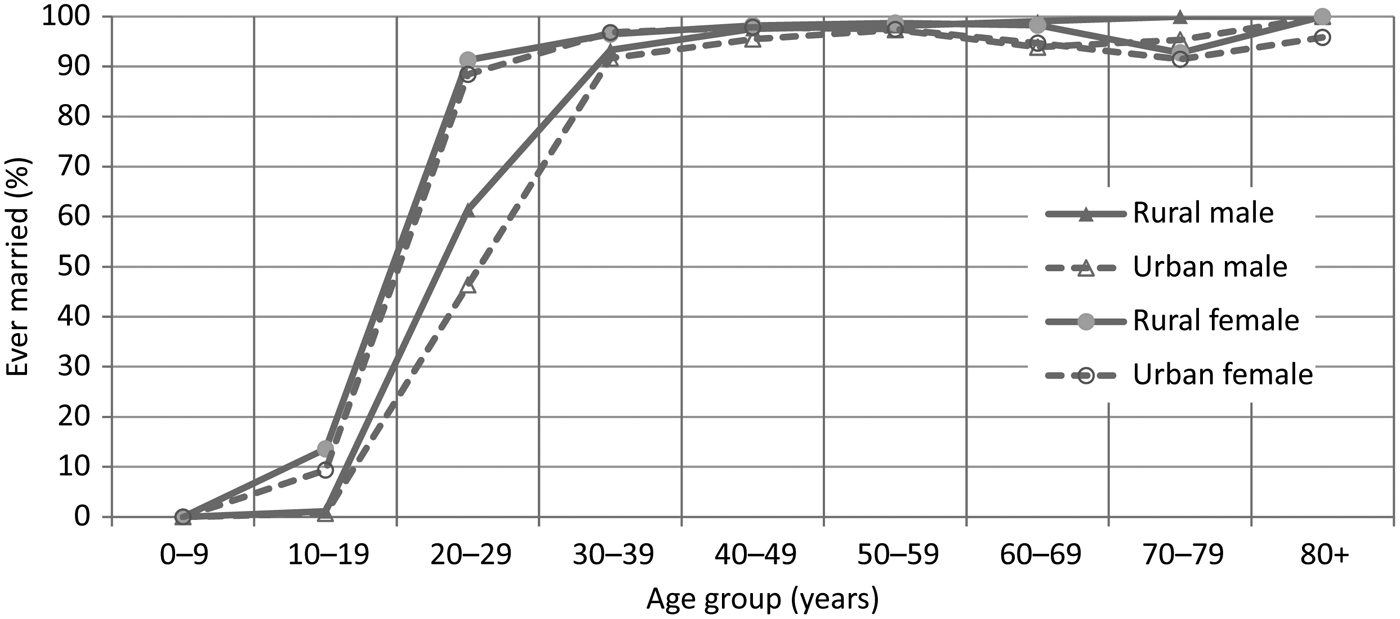
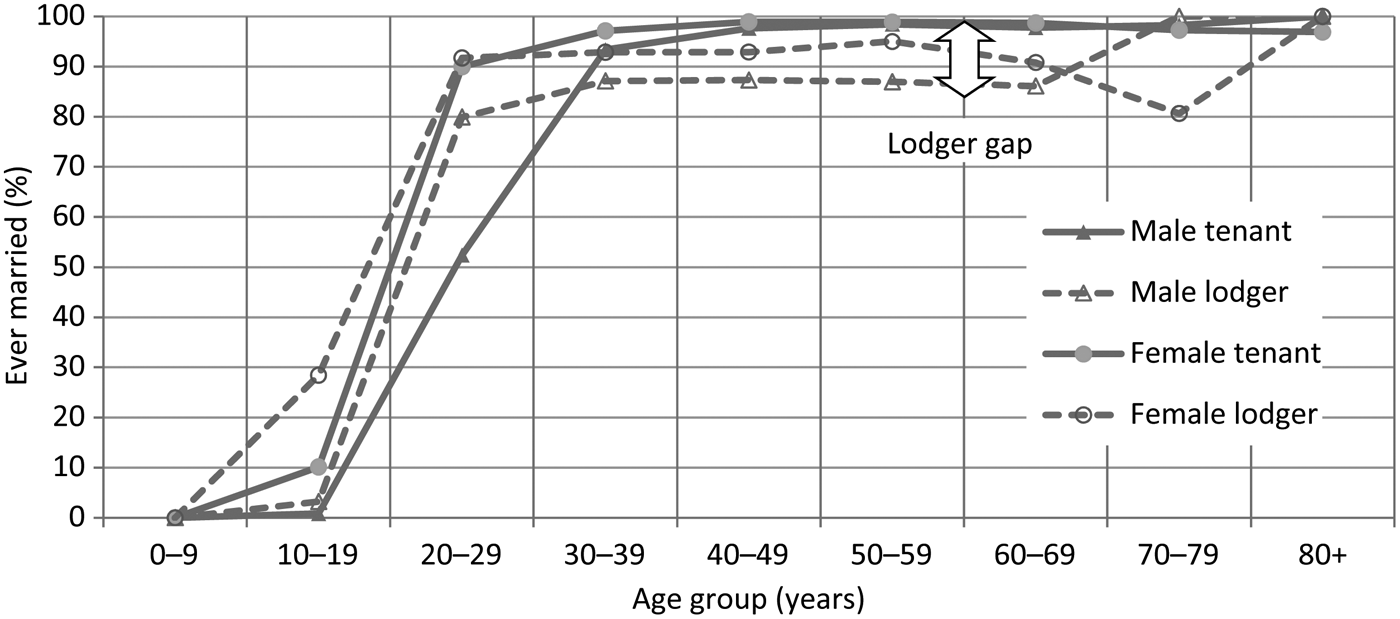
Figures 5 and 6 show that, as well as being early, marriage for women in the counties of Zala and Somogy was also virtually universal, a pattern seen throughout Eastern Europe – to the east of the famous Hajnal line – apart from in a few particular enclaves, before the twentieth century. The high fertility which could be attained as a result of such marriage patterns was important in an area such as the one being studied, which was undergoing repopulation, as much labour was needed to clear fields which had run wild or become reforested. The memory of the region's last outbreak of plague, which had resulted in mass mortality between 1738 and 1742, probably still remained in the memories of many people in the region. In addition, the so-called ‘seasoning’ effect probably meant that the in-migrants had experienced higher mortality for some time after their arrival.
Proportion of ever-married individuals in selected population groups, by age: Zala and Somogy counties, Hungary, c. 1760. Source: ‘The Hungary 1760’ database.
Differences between tenants and lodgers in proportions ever married, by age and gender: Zala and Sonogy counties, Hungary, c. 1760. Source: ‘The Hungary 1760’ database.
Figures 5 and 6 indicate that marriage was also early and nearly universal for males in the study population. Slight differences can be seen between the genders, depending on their position in society and where they lived. Females began to marry as teenagers and virtually all would have been married before they reached their fortieth birthday. Men were a little older when they began to marry – it was customary for men to take younger brides – but they too would almost all eventually marry. There were few differences in the age and extent of marriage between tenants in urban and rural areas. When lodgers are compared with tenants, on the other hand, an interesting difference can be seen in Figure 6: a larger proportion of the lodgers remained unmarried across their life course. Perhaps their lack of success in the marriage market was due to their low social status, their uncertain economic position, or to physical weakness or disability, although it should be noted that the values shown for those over the age 70 years must be treated with caution owing to the small number of cases.
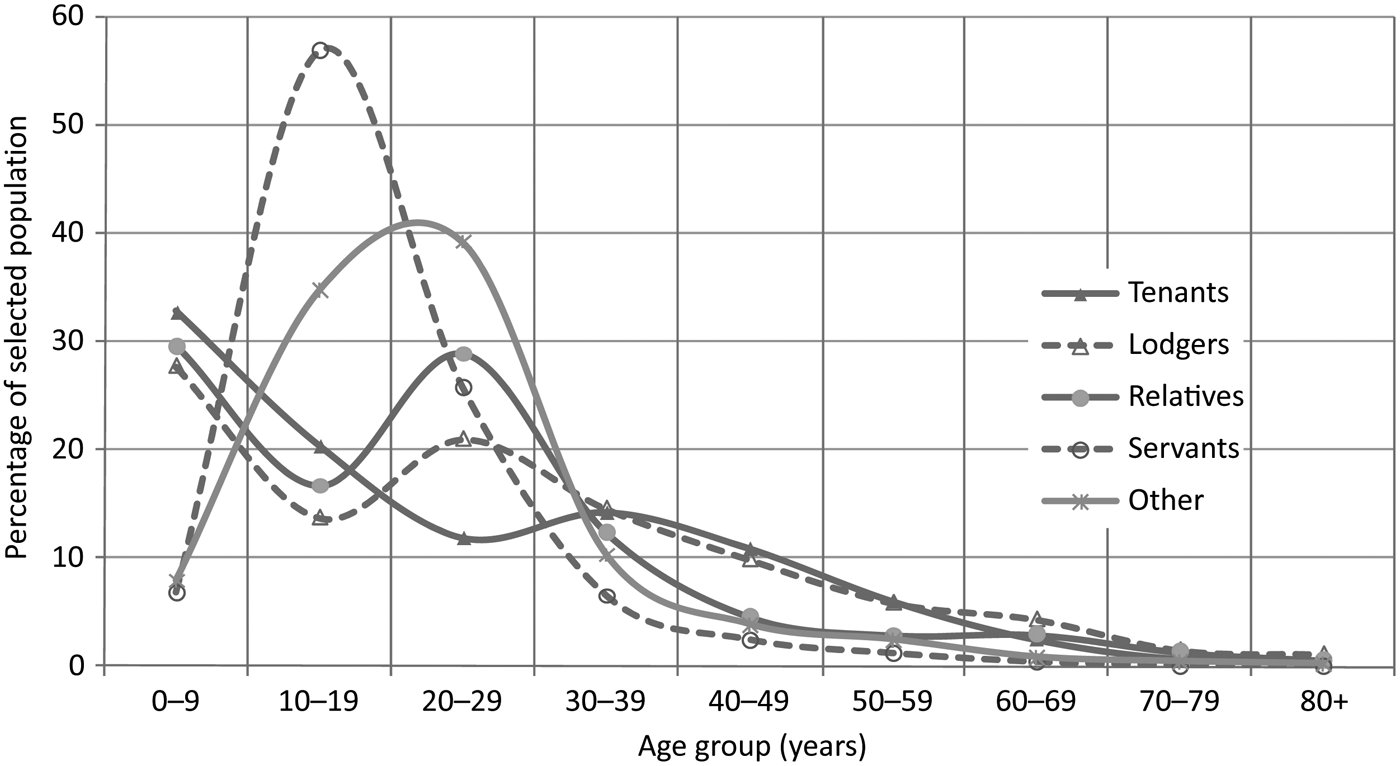
Figure 7 presents the age distributions of the types of people residing in the households enumerated in the lists of inhabitants for Zala and Somogy. Once again there was a relatively strong similarity between ‘relatives’ and ‘lodgers’. The numbers in both these groups peak in the 20–29 years age range and above the age of 30 years the curves gradually come to lie alongside the largest group, the ‘tenants’. This suggests that the status of ‘relative’ or ‘lodger’ is partly age dependent although not as strongly as in the case of servants. A peak in numbers in the early age groups is an even stronger feature amongst ‘servants’ and the group of ‘others’ – who were predominantly urban journeymen artisans – indicating that both were transitional statuses within the life course. As they aged, members of these groups would become tenants or lodgers.
Age distribution of different status groups within the household: Zala and Somogy counties, Hungary, c. 1760. Source: ‘The Hungary 1760’ database.
Fertility was estimated using the ratio of the number of children aged 0–4 years to the number of women in the reproductive age group, which was taken to be the ages of 15–49 years (Table 3). The figures calculated suggest very high levels of fertility, typical of a traditional demographic system. The right panel of Table 3 once again shows the differences that have come to be expected. In the rural villages the number of children per 1,000 women aged 15–49 years (676) was about 8 per cent higher than in the cities (619). Overall lodgers had nearly 20 per cent fewer children living with them (514) than tenants did (654). Urban lodgers had the lowest number of children (482).
In order to obtain a more accurate picture of how the course of fertility developed over time in the study area, many micro studies would be needed. However, it is possible to say something concerning the changes which took place between the mid-eighteenth and the mid-nineteenth centuries, if the fertility figures calculated from the ‘Hungary 1760’ database and the values calculated in the same way from data collected by the census taken in 1869 are compared. There were around 550 children under the age of 5 years for every 1,000 women aged 15–49 years in Zala and Somogy in 1869, which suggests, ceteris paribus, that over the previous 100 years fertility had decreased by about 16 per cent. Estimates for the urban population suggest that their decline was even greater; figures from the 1869 census suggests that urban fertility had fallen by almost a third since the mid-eighteenth century. These findings reinforce Rudolf Andorka's conclusions concerning the early origins of fertility decline in Hungary.Footnote 23 It is possible that in the population that is being studied, a population sample is being observed at the very end of the period when fertility went uncontrolled in Hungary.
From the data presented in Figure 6 it may be inferred that lodger couples were, on average, younger than tenant couples, and therefore would not have had the time to accumulate large numbers of children. It is also known that a considerable number of lodgers were widowed women, who would have had their fertility cut short prematurely. It is likely therefore that the low fertility of lodgers (as shown in Table 3) reflected the demographic realities faced by the lodger population, and should not lead to the conclusion that they were displaying any signs of early fertility control.
The number of deaths for which information is available was so sparse that it would have been inappropriate to undertake the usual mortality analyses, even if the problems arising from the different age and marital status compositions of the different groups within the population could have been overcome. Instead, it was decided to use the rates of survival calculated by Hablicsek for the period between 1821 and 1830,Footnote 24 with the age structure of males and females living in the villages of the present study around 1760. From this comparison it can be concluded that the age structures reported in the mid-eighteenth century suggest that both genders experienced better survival chances in the first three decades of their lives, but slightly worse chances from the fourth decade onward, when compared with the individuals recorded in the first quarter of the nineteenth century. This finding could be interpreted in two ways. First, the figure for the 1820s was calculated from a dataset slightly more than twice the size of the dataset that was used for the present eighteenth-century study. The former used parish register data from the first three decades of the nineteenth century to build up a life table. Hablicsek's results therefore give a far more precise age distribution than was possible using the eighteenth-century data. A second explanation for the estimated mortality differentials between the eighteenth- and nineteenth-century data is also possible: namely that conditions affecting infant and child mortality had deteriorated by the first half of the nineteenth century, compared with the mid-eighteenth century, while the survival chances of the middle-aged and the elderly had improved slightly over the same decades.Footnote 25 Unfortunately, it is not possible to interpret the mortality data for lodgers as a separate group due to their atypical age structure and the very small number of cases which could be used in the calculations.Footnote 26
Overall, it is possible to say the following about the demographic processes amongst mid-eighteenth century lodgers in the Hungarian counties of Zala and Somogy. Female age at marriage was very similar amongst both lodgers and tenants, but while male lodgers in the rural communities married around the same age as their female counterparts, amongst the tenant population there was a four-year difference in the age at marriage between the two genders, with the men marrying later in the rural areas. This later age at marriage amongst male tenants was influenced by conditions of land ownership and inheritance, factors which had no detectable delaying effect on the marriage of lodgers, who seldom had much to inherit. The lack of a major difference in the age at marriage of female tenants and lodgers was presumably connected to the fact that both groups sought to maximise the number of their births, following the social expectations of the era, and the need to offset the impact of the rates of high infant and child mortality prevalent at the time. As the children grew up they were needed in the labour force, but the people of the time also believed it was important to have an heir, particularly a male one. The aspiration that ‘the family must not die out’ carried much greater weight in the eighteenth century than it does today.
According to the present findings, tenants in the mid-eighteenth century had high rates of fertility; rates that were one-sixth higher than that calculated for 1869. Lodgers, however, showed evidence of much lower fertility rates than tenants, reflecting the fact that few lodgers had completed the process of family building. It was unfortunate that because of the lack of adequate research on lodgers, the findings could not be compared with an equivalent population in the mid-nineteenth century.
With reference to mortality, the eighteenth-century data on age structure gave similar results to the data drawn from a national sample from the earliest decades of the nineteenth century, suggesting that there were no large differences between the death rates prevalent in the two populations. It was felt justifiable to compare data from the two eras because the earlier population was no longer affected by plague, while the later one had not yet succumbed to cholera. No group in the eighteenth-century population was able to prevent mortality amongst their children, so it would be perverse to assume that a separate mortality model operated amongst lodgers.
4.3. Lodger and tenant households compared
In order to characterise household structure, it is necessary to identify an appropriate way of classifying the data drawn from original sources. In view of the fact that the households of lodgers and tenants in the study population were of quite different sizes and structures, it was decided not to use the classic Eugene Hammel–Laslett household classification system. Instead, those individuals living in three types of ‘non-family’ group were collected together,Footnote 27 in addition to those individuals living as members of nuclear or complex families. It was hoped that by classifying the entire population into these groups the analysis would be more flexible when it came to differentiating various forms of co-residence forms than would have been the case had heads of household been considered on their own.
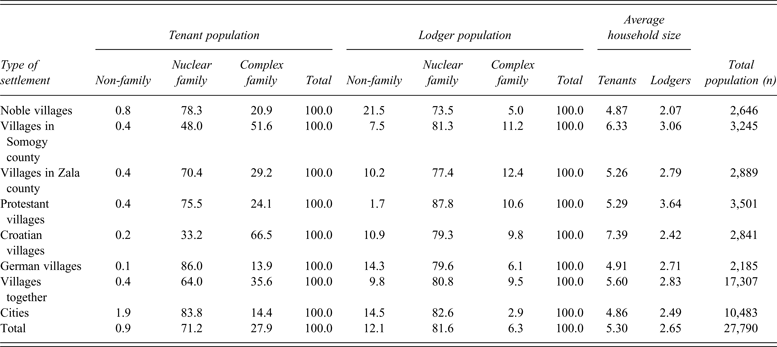
Overall, as Table 4 shows, nuclear families were the dominant family structure amongst the tenants in the study population, but they were in a minority amongst tenants in the rural villages of Somogy county and in the villages inhabited by the Croatian community. Slightly more than 50 per cent of the tenant population residing in the rural villages of Somogy county lived in complex family households, and in the Croatian villages some two-thirds of tenant families lived in such households, while only 14–30 per cent of families in other types of rural communities did so. In contrast, the proportion of the tenant population living as non-family in villages was less than 1 per cent. Even in the cities the figure was only 1.9 per cent, hardly a significant value. So the forms of co-residence displayed by the tenant population in different settlement groups were clearly demarcated along cultural, social and regional lines.
Distribution (%) of family types within the tenant, lodger and total populations by type of settlement: Zala and Somogy counties, Hungary, c. 1760
Source: as in Table 1.
Did lodgers show contrasting patterns? Table 4 indicates that they did indeed display markedly different characteristics. The marked differences in the proportion of complex family groups seen amongst the tenant populations are not evident at all amongst lodgers. Approximately 80 per cent of lodgers lived in simple families, and a further 10 per cent or so did not live in a family group at all. Lodgers are only occasionally observed living in a complex family group. With respect to their forms of co-residence they were very uniform in their behaviour: the family and household system of lodgers, along with their demographic characteristics, were not so much determined by local, denominational or ethno-cultural factors as by living a ‘lodger life’.
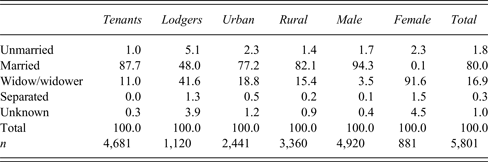
If the heads of lodger and tenant households by their marital status, gender, and the type of settlement in which they lived are considered, sharp differences can once again be seen. The vast majority of the heads of tenant families were married, while fewer than half of lodger heads had a spouse, although those that did were the most numerous portion of the latter group. While 94 per cent of all male heads were married, almost the same proportions of female heads were widows. There is only a slight difference to be seen between heads living in urban areas compared with those living in rural villages: the proportion of widows was slightly higher and the proportion of married persons was lower amongst urban household heads. Proportionately there were slightly fewer male heads of household in the urban areas. From Table 5 it would seem that widowed persons were better able to survive as heads of household in the town than in the country. This follows from the different characters of the rural and urban economy. In rural areas a widow without a large family would have been unable to run a farm, and if she lived in a larger co-resident group, the chance that she would be named as the head of the household would have been very small. Once a married man had died, it was likely that one of his adult sons would be considered to be the family head rather than his widow. From the evidence contained in the ‘Hungary 1760’ database, a woman would only be recorded as the head of her household if she was a widow, her children had not yet reached adulthood and she had not remarried. This was rare among the tenant class as a widow often lost the right to tenant status and her hold on the family plot. On the contrary, in the cities the importance of agriculture was much smaller and even concentrated on wine-growing where the role of family labour was less important. This gave more possibility in labour organisation for the widowed household heads.
Distribution (%) of household heads by marital status by status, place of settlement and gender: Zala and Somogy counties, Hungary, mid-eighteenth century
Source: as in Table 1.
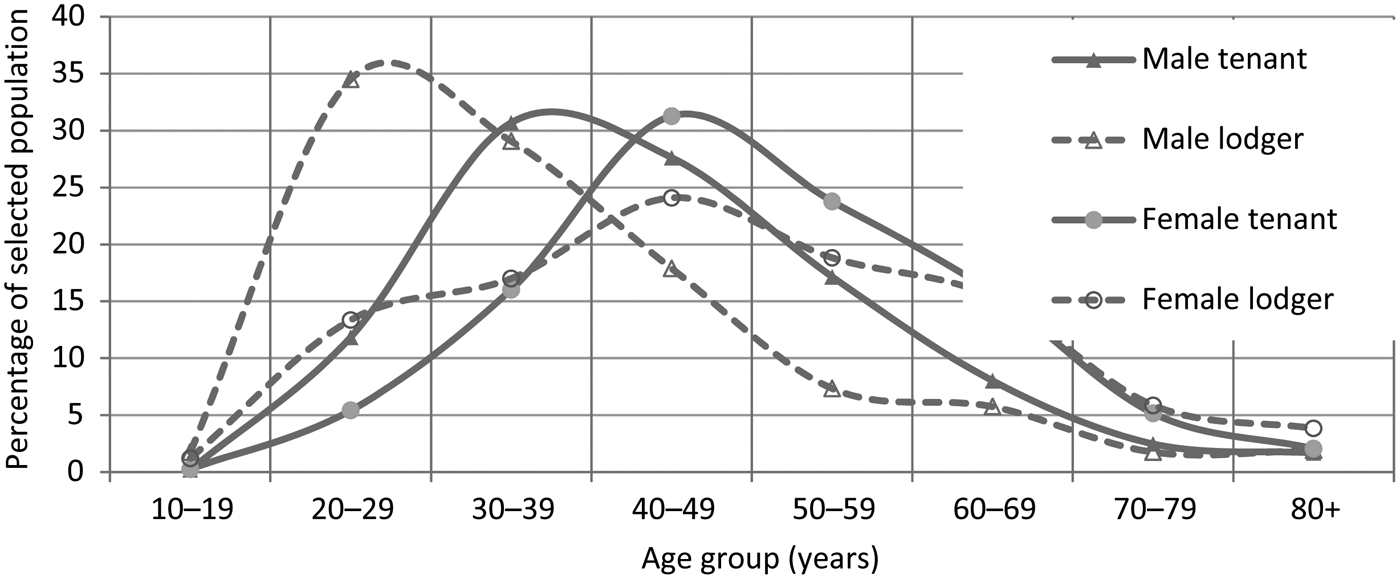
If the gender and age of the household heads are considered together, as in Figure 8, it can be seen that the age distribution curves for female heads of lodger and tenant households are similar. In the case of male heads, on the other hand, a difference in age distribution can be seen between lodgers and tenants. Among lodger heads the greatest number was found in the 20–29 years age group, with a steep decline thereafter. In contrast, the tenant heads display a near normal distribution, with the apex of the curve lying somewhere in the 30–39 years age group. These two male curves suggest that the son of a tenant faced a slow, gradual process before he became a household head in his own right. A man did not have to wait long to become the head of a lodger household, once he had reached adulthood. The power and wealth held by the heads of tenant and lodger households were undoubtedly quite different, but that is a line of research to be pursued at some other time.
Distribution of household heads by age and gender, selected groups: Zala and Somogy counties, Hungary, c. 1760. Source: ‘The Hungary 1760’ database.
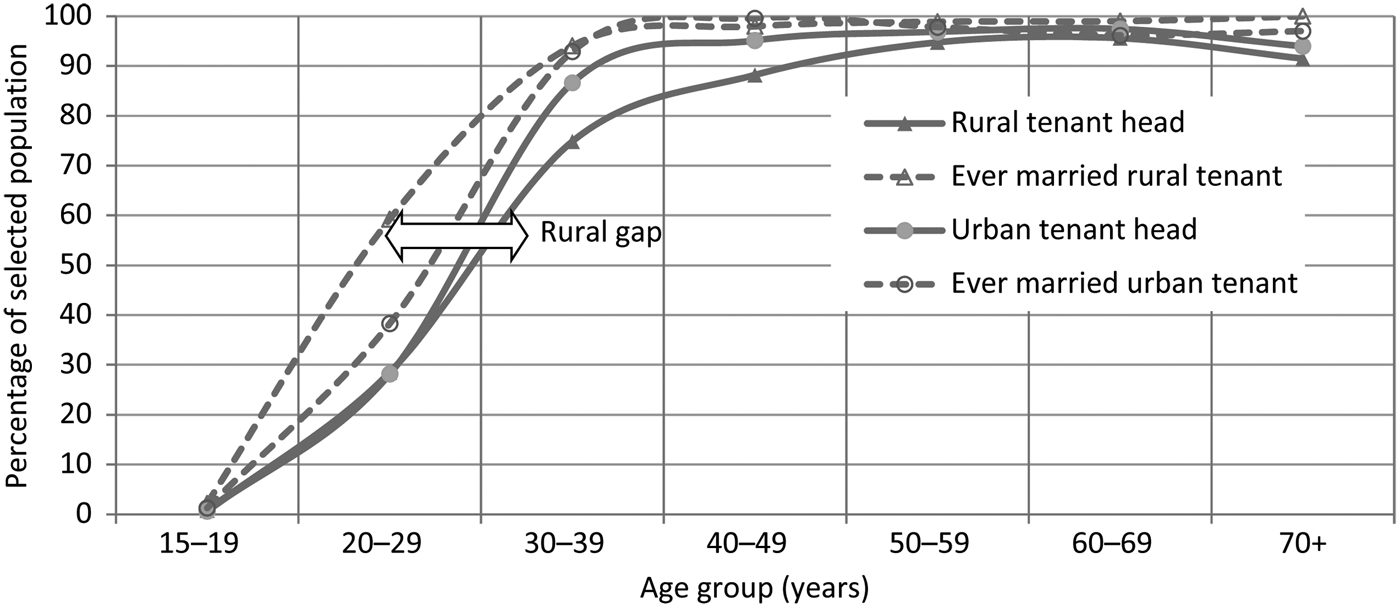
There are no written sources from the mid-eighteenth century which detail the transfer of headship of a household between generations. Although the marriage registers were also still incomplete at that time, i.e. a large part of the parishes started the register only at the end of that century, it is known from the lists of inhabitants that marriage was almost universal, and another way has been found to investigate the connections between marriage and the process of becoming a household head. By looking at how the age structure of ever-married persons parallels the age structure of household heads, a tentative understanding can be gained of how an individual became a household head. In general, in the case of tenants, the two age-distribution curves in Figure 9 lie close to one another, although there is a larger gap between the curves of rural tenants than there is for those of urban tenants. In urban areas marriage and becoming the head of a household were essentially the same process, although, as has been seen, weddings usually took place some years later than they did in the countryside, particularly amongst men. For rural tenants it would seem that there was a delay of about a decade between marriage and becoming a household head, although they found it easier to marry at a younger age than their urban counterparts. Young peasants then had several years to wait until they could take up the position of head of household. These differences can probably be ascribed to the very different economies of the rural and the urban areas. In the cities, most families earned their livelihood through activities outside agriculture, such as an artisan industry or commerce, or through hired work with daily pay, so a newly married man could set up his own household immediately; he did not have to wait to inherit land to farm, as the peasants in the rural villages, who made their living by farming, had to do.
Interdependence between marriage and household headship amongst tenants, by age and place of residence: Zala and Somogy counties, Hungary, c. 1760. Source: ‘The Hungary 1760’ database.
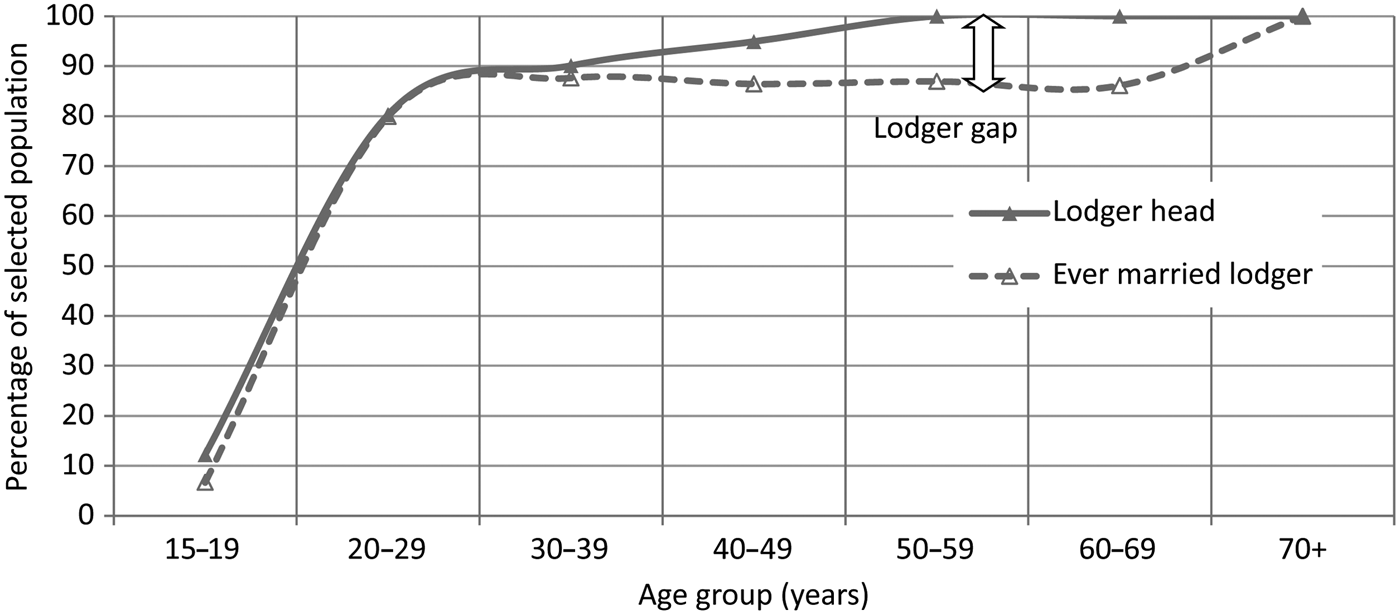
The ‘marriage’ and ‘head of household’ lines for lodgers, shown in Figure 10, take a quite different path. Until they reached their thirties, lodgers married and became heads of household at virtually the same rate. Once they were aged over 30 years, however, the two processes begin to diverge. Lodgers did not follow the life-path model of tenants. Figure 10 suggests that initially lodgers, having no land, were also able to marry early, but their chances of building up a family were limited. The curves in Figure 10 suggest that 10–15 per cent of lodgers, both male and female, had been unable to marry. They either had to move away from the community or live out their lives alone in a one-person household. For this reason some of them went to the cities where surviving alone was much easier, being able to find some work as a servant or day labourer outside of agriculture. Possibly this is the reason for the higher urban lodger proportions (Fig. 4).
Interdependence between marriage and household headship amongst lodgers, by age: Zala and Somogy counties, Hungary, c. 1760. Source: ‘The Hungary 1760’ database.
Essentially, after analysing household structure within the study population, the same conclusions have been reached as when examining their demographic structures. Co-habitation took significantly different forms amongst tenants and lodgers, whether this is measured by the gender or age of the household head, or the simplicity or complexity of the co-resident group. This suggests that there was a close link between demographic processes and the structure of households. Demographic processes, particularly marriage or the death of the household head or his wife, had a fundamental effect on family status, gender proportion and age structure of the population, as well as driving the formation or termination of households, or a change in their composition.
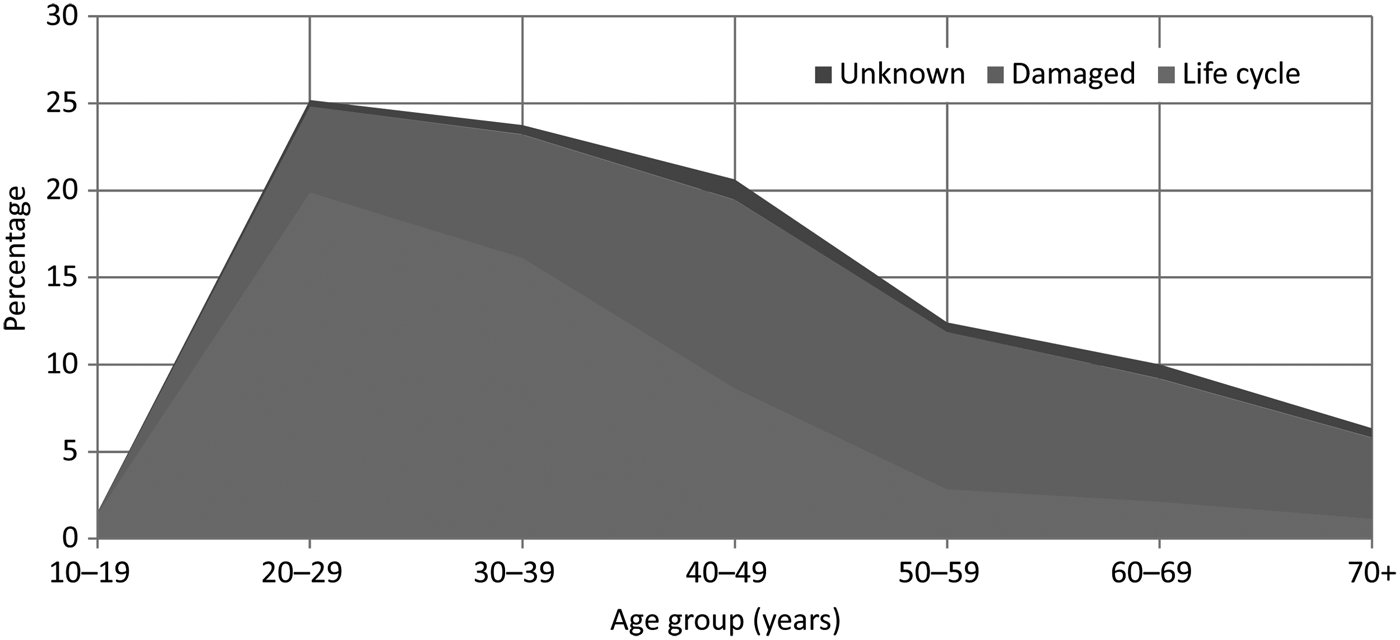
Based on observations so far in Figure 11 attempts have been made to formally characterise different forms of lodger households by the marital status and age of their head of household, separating those heads who were married, referred to as ‘life-cycle’ household heads, from those who were widowed or separated from their spouse – an early form of divorce, acceptable to the Roman Catholic Church – dubbed here as ‘damaged’ household heads. Unmarried persons below the age of 50 years were allocated to the ‘life-cycle’ group, as they might still have married and had a family. Unmarried persons over the age of 50 years were placed in the ‘damaged’ group. Even if such persons were to marry they were unlikely to have had children. While virtually 90 per cent of tenant heads were ‘life-cycle’ heads, Figure 11 indicates that amongst lodger heads there were nearly equal numbers of ‘damaged’ and ‘life-cycle’ heads. What the figure does not show is that only 4 per cent of male lodger heads were ‘damaged’, whereas 95 per cent of the female heads were in this category.
Distribution of household types amongst the heads of lodger households, by age, Zala and Somogy counties, Hungary, c. 1760. Source: ‘The Hungary 1760’ database.
At younger ages the great majority of lodger heads were ‘life-cycle’ heads, but even by the 30–39 years age group, they were decreasing in proportion (Figure 11). It is, of course, to be expected that the proportion of ‘damaged’ heads would increase with age, but the distributions shown in Figure 11 reinforce the point that demographic processes had a serious impact on the genesis, and shape, of lodger households. Even so, it was a surprise that 44 per cent of lodger heads headed ‘damaged’ households, while only 52 per cent headed ‘life-cycle’ households. The status of the remaining 4 per cent could not be determined as their marital status was missing. It must therefore be concluded that the lodger population actually consisted of two groups of nearly equal size, each containing a distinct form of household. One group contained households headed by a young, and probably penniless, male head just embarking on his working life, while the other group was made up of fragmented families headed by middle-aged or elderly heads who were living on their own without a spouse. The life cycles of this substantial segment of the lodger population had thus followed a somewhat irregular trajectory; the atypical composition of their households was often the consequence of a family tragedy. Most importantly, the majority of the household heads in this group were women. Neither group of lodgers behaved in the same way as tenants, nor did they conform to the characteristics of the ‘average’ rural or urban dweller.
5. A WIDER PERSPECTIVE ON THE FINDINGS
Before discussing the conclusions, it is helpful to situate the results of the study in their wider temporal and spatial contexts. The results will be compared across time with those of Hungary's first census, taken in 1785–1787, and spatial comparisons will be made between the counties of Zala and Somogy and the Kingdom of Hungary or the Carpathian Basin.
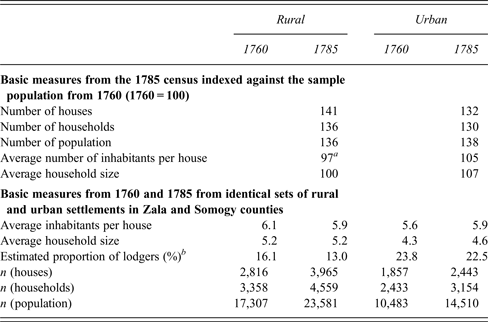
In a certain sense the comparison over time between the mid- and late eighteenth-century conditions does not work particularly well, because the data preserved from the census only summarise the population in each settlement, and no nominal data have survived. Nevertheless, the indexes and average figures which can be calculated suggest two important facts. The first is that when the household data from the two different sources, the status animarum and the census, are classified in the same way they tell the same story. The second is that both sources suggest that the population grew dynamically, by some 30 to 40 per cent, over the 25 years separating the two sources. This is quite a normal pace for a society where marriage was early and universal, fertility was high and uncontrolled and migrants from elsewhere were still pouring into those areas which were underpopulated. The arrival of settlers in large numbers made a shortage of living places for a while, so the building of new houses in the rural areas had to speed up. The slight decrease in the proportion of lodger households over time may have been a result of this process; many in-migrants, who had had to live as lodgers when they first arrived, had managed to acquire farmland and build their own houses by the end of the century. Importantly, it has not been possible to validate and compare the contents of the ‘Hungary 1760’ database against Hungary's most important demographic source of the eighteenth century, the country's first census.
Unfortunately, comparison with the following census did not prove possible. The latter was not taken until 1851; nearly 90 years after the status animarum and 65 years after the first census was compiled. It was also based on a different concept of household, using the modern ‘apartment’ or ‘flat’ as the unit on which to measure co-residence. The 1851 Hungarian census was conducted using regulations set out for use in mid-nineteenth-century Austria, a more urbanised and industrialised society than Hungary at that time. Unfortunately, these regulations were not suited to the recording of traditional rural households, or to living conditions in Hungary, where houses typically contained just one room and a kitchen but were surrounded by several separated economic buildings (barns, stables, pigsty, etc.) on the farm.
The average household size appears to have stagnated in the Hungarian countryside between 1760 and 1785, as the number of houses increased at a quicker pace than the population, and the proportion of lodgers fell. In the cities, on the other hand, households grew slightly in size, probably as the number of live-in servants increased (Table 6).
Measures of change between 1760 and 1785 in Zala and Somogy counties, Hungary
a In four villages the census values for the number of houses look incomplete in 1785.
b An identical number of lodger families was taken with the observable difference existing between the number of houses and households in 1785.
Source: calculations by the author based on the ‘Hungary 1760’ database and the census of 1785. Corrected values from D. Dányi, Z. Dávid, Az első magyarországi népszámlálás (1784–1787) [The first census in Hungary, 1784–1787] (Budapest, 1960).
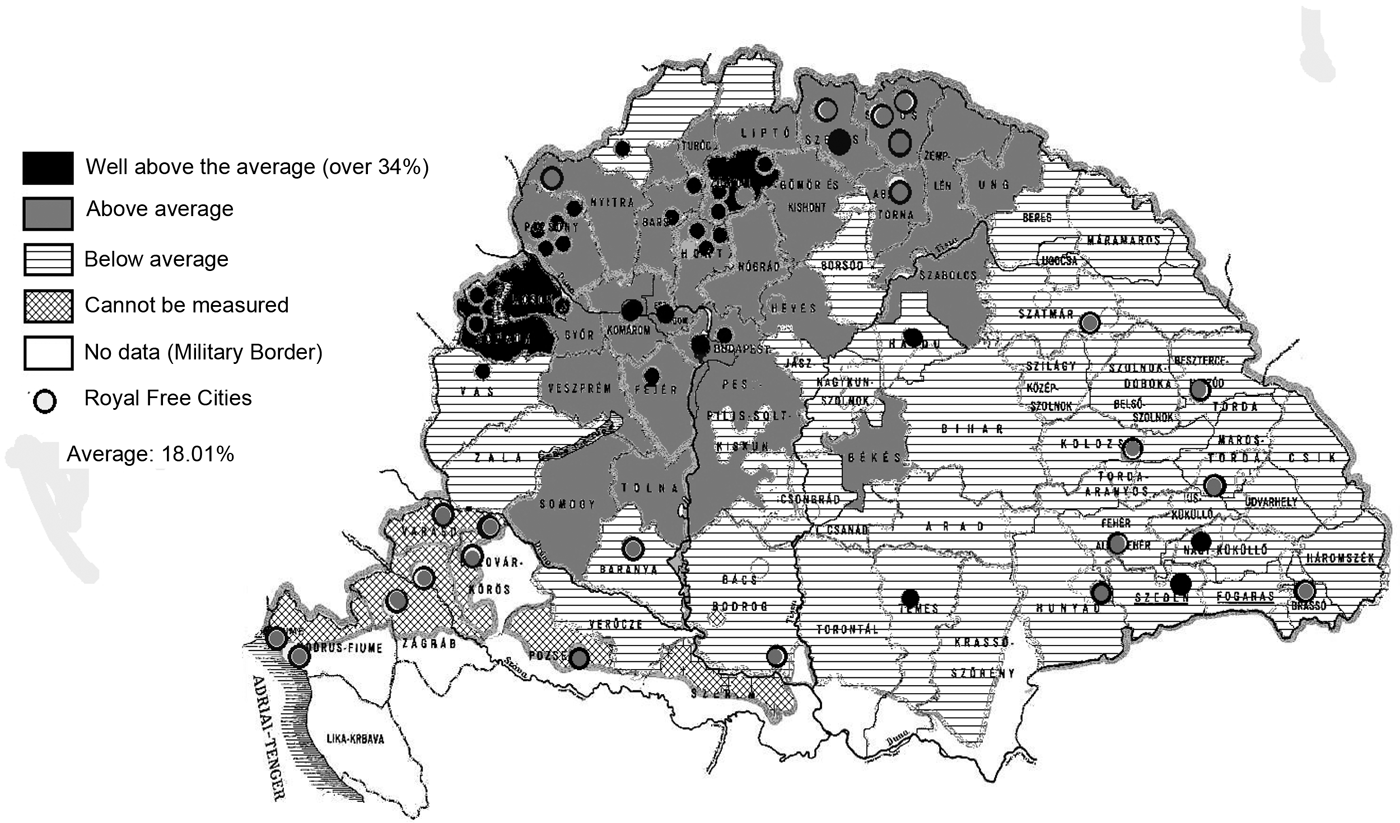
By using data from the census taken in 1785–1787 it was possible to identify the proportion of lodgers in the population across the whole of the Carpathian Basin and show how much weight this layer carried in society, and how important it is to undertake a separate investigation on them. The number of houses recorded in the census was compared with the number of families enumerated, which allowed estimation of the proportion of lodger households at the county and city levels across the regions of Hungary. Figure 12 shows for each of Hungary's municipalities whether the proportion of lodger households was above or below the national average figure of 18 per cent. Values of more than 34 per cent, which is more than one standard deviation above the average figure, were to be found in areas close to the country's western border, where a substantial proportion of the population was German; in the Upland mining district in present day Slovakia, which was again inhabited by Germans; and in the majority of the royal free cities.Footnote 28 The other ‘higher than average’ values lay in Hungary's northern and central counties, which today lie within Slovakia. The remaining cities also fell into this category. On the other hand, the sparsely populated eastern regions of the Carpathian Basin, such as the Great Plain, Transylvania, Banat and the border regions, along with certain peripheral municipalities, show below-average proportions of lodger households. Very few cities had such low proportions of lodgers, and those that did were mostly so-called ‘peasant towns’, which had been awarded municipal privileges, lying in the Plain region. Finally, in Croatia, to the south west, it was not really possible to use this method to determine the proportion of lodgers, as the vast majority of the rural population in this region lived in large joint families, which sometimes occupied even more than one house on the family plot in order to accommodate the several families making up the co-resident group.
Proportion of all households which were lodger households in the cities and counties of the Kingdom of Hungary (1785). Source: T. Faragó, ‘Lakók a Kárpát-medence hagyományos világában a 18. század közepén’ [Lodgers in the traditional world of the Carpathian Basin in the middle of the 18th century], Demográfia 56 (2013), 231–80.
Overall, both the geographical distribution of lodgers and the extent of their presence within a particular municipality were influenced by several factors, including local culture and the distance of the region from Western European influences. In many ways Figure 12 reflects the relative development of the regions and settlements in the Carpathian Basin at the end of the eighteenth century. The more developed a region, a county or a city was in terms of its economy, social structure or degree of urbanisation, the higher the proportion of lodger households it contained. The patterns shown largely coincide with the differences in household structure and the proportion of households employing servants previously identified.Footnote 29 The percentage of lodger households was higher where the employment of paid servants was more common and simple family households were the dominant household form; that is, in areas where social and co-residence patterns were closer to those prevailing in Western Europe, and further away from the patterns seen in Eastern Europe and the Balkans. The distribution of lodgers across the Carpathian Basin thus strengthens the view that the region acted as a transition zone between East and West.Footnote 30 Finally, it should be noted that between them the two study counties represent a near-average view of conditions in the Carpathian Basin as Somogy county has a higher than average rate of lodger households in Figure 12, while Zala county was among the municipalities with a below-average rate.
6. CONCLUSIONS
To sum up: whether data from rural or urban areas within the sample population are considered, the demographic profile of lodgers was different from that of tenants according to all the relevant structural indicators that could be measured. Indicators of nuptiality and fertility showed significant differences between the two groups, as did measures of the forms of co-residence. The lodger population could, however, be further divided into two equally sized subgroups: those in ‘beginner’ households and those in ‘damaged’ ones.
In conclusion, the present analyses have demonstrated that individuals did not always become lodgers just as a result of downward social or economic mobility. Nor were lodgers simply an element within a tenant's household; they were separate entities with their own identity and character. Many family groups ended up as lodgers following a family disaster, such as the sudden death or crippling of the breadwinner. Often, however, being a lodger could be seen as a first step towards becoming independent, climbing or re-climbing the social ladder. Lodgers may also be looked on as people who were able to maintain an independent life. It is perhaps not accidental that their proportions were highest in the more developed regions of Hungary and the wider Austrian Empire, and were least represented in underdeveloped areas such as the eastern parts of the Carpathian Basin, or in Galicia, Krain and Gradiska in Austria,Footnote 31 where traditions and kinship networks were much stronger.
To date it has proven difficult to accurately describe, and even more difficult to categorise, lodgers as a group. To achieve a better understanding of the types of lodgers and their characteristics, much more information on their life paths is needed, requiring further research with analysis of more detailed sources and new paths of enquiry. Family reconstitution, as practised by historical demographers, relies on stable, sedentary populations who successfully survived through their entire reproductive period. Individuals and families who moved spatially, or lived outside the mainstream of society, do not fit well into this method. There were historical periods when a significant portion of certain populations became mobile in both physical and social space, and also periods when populations were touched, or struck, by disaster. Hungary saw such periods in the first half of the eighteenth century, when plague hit twice and the parts of the country depopulated during the Turkish wars were resettled; in the mid-nineteenth century, when urbanisation accelerated and cholera devastated the population; and in the twentieth century with its demographic, economic and political upheavals. Looking at such events over the long term reveals the importance of analysing lodgers as a distinct social and demographic stratum within society.
ACKNOWLEDGEMENTS
The preliminary version of this article was presented to the European Social Science History Conference (Vienna, 2014). I am grateful to Beatrice Moring, Peter Őri and the anonymous referees of this journal for useful comments on an earlier draft.