Introduction
Mild traumatic brain injuries (mTBIs) are common in children, they are a substantial societal concern, and they place a large demand on healthcare resources each year. With an annual incidence rate at least 600 per 100,000 (Cassidy et al., Reference Cassidy, Carroll, Peloso, Borg, von Holst, Holm and Coronado2004; Macpherson, Fridman, Scolink, Corallo, & Guttman, Reference Macpherson, Fridman, Scolink, Corallo and Guttman2014), it is estimated that more than 500,000 children and adolescents in North America will sustain a mTBI annually. Although there is a minority that may not seek medical advice following an injury, there is a large number of youth with mTBI who do present for medical care. Estimates have suggested that 1 of every 220 emergency department (ED) visits by children and adolescents are for a concussion (Meehan & Mannix, Reference Meehan and Mannix2010), with the rates of ED visits for mTBIs increasing every year (Centers for Disease Control and Prevention, 2011; Haring et al., Reference Haring, Canner, Asemota, George, Selvarajah, Haider and Schneider2015; Macpherson et al., Reference Macpherson, Fridman, Scolink, Corallo and Guttman2014).
Increasing evidence suggests that the majority of youth will recover symptomatically from mTBI within a few months (Barlow et al., Reference Barlow, Crawford, Stevenson, Sandhu, Belanger and Dewey2010; Barlow, Crawford, Brooks, Turley, & Mikrogianakis, Reference Barlow, Crawford, Brooks, Turley and Mikrogianakis2015), and there should not be long-term cognitive sequelae from these injuries (Belanger, Spiegel, & Vanderploeg, Reference Belanger, Spiegel and Vanderploeg2010; Brooks et al., Reference Brooks, McKay, Mrazik, Barlow, Meeuwisse and Emery2013; Brooks, Mrazik, et al., Reference Brooks, Mrazik, Barlow, McKay, Meeuwisse and Emery2014; Mannix et al., Reference Mannix, Iverson, Maxwell, Atkins, Zafonte and Berkner2014); however, early assessment and intervention remains an important aspect of care. The rise in early medical care following these injuries results in increasing pressure on emergency physicians and primary care physicians to assess, manage, and prognosticate mTBI outcome. High symptom burden, adolescence, female sex, and pre-injury factors (e.g., prior injuries, pre-injury symptom levels, learning problems, or behavior problems) are predictors of poor outcome following mTBI in youth (i.e., outcome being most commonly based on symptom burden), although their predictive utility remains less than optimal (Babcock et al., Reference Babcock, Byczkowski, Wade, Ho, Mookerjee and Bazarian2013; Barlow et al., Reference Barlow, Crawford, Brooks, Turley and Mikrogianakis2015; Grubenhoff et al., Reference Grubenhoff, Deakyne, Brou, Bajaj, Comstock and Kirkwood2014; Kontos et al., Reference Kontos, Elbin, Lau, Simensky, Freund, French and Collins2013; McNally et al., Reference McNally, Bangert, Dietrich, Nuss, Rusin, Wright and Yeates2013; Meehan, Mannix, Monuteaux, Stein, & Bachur, Reference Meehan, Mannix, Monuteaux, Stein and Bachur2014; Morgan et al., Reference Morgan, Zuckerman, Lee, King, Beaird, Sills and Solomon2015; Scopaz & Hatzenbuehler, Reference Scopaz and Hatzenbuehler2013; Zemek, Farion, Sampson, & McGahern, Reference Zemek, Farion, Sampson and McGahern2013).
There is evidence that (1) there are objectively measured cognitive problems early after the injury, which (2) may have the potential to prognosticate outcome. Brooks and colleagues (Brooks, Khan, Daya, Mikrogianakis, & Barlow, Reference Brooks, Khan, Daya, Mikrogianakis and Barlow2014) reported that children and adolescents who present to the emergency department after mTBI demonstrate significantly worse reaction time/processing speed than their orthopedically injured counterparts. However, this study did not examine these early alterations in cognition as predictors of recovery (i.e., recovery defined as symptom ratings returning back to pre-injury levels). Iverson (Reference Iverson2007) reported that high school football players with slow symptom recovery after their sport concussion had worse sub-acute cognitive functioning and higher symptoms compared to those athletes who recover more quickly. Lau, Collins, and Lovell (Reference Lau, Collins and Lovell2011, Reference Lau, Collins and Lovell2012) reported that sub-acute cognitive performance in high school football players with a sport concussion improved the sensitivity for predicting poor outcome over and above symptom burden by 24% (symptom clusters plus cognition, sensitivity=.652, specificity=.804). Although the research is limited, it is possible that acute or sub-acute cognitive functioning may be able to facilitate the prognostication of outcome from mTBI in all youth.
The objective of this study was to examine whether cognitive performance in the ED following mTBI can help prognosticate recovery at follow-up. It was hypothesized that those who have worse cognitive performance (i.e., verbal memory, reaction time/processing speed, cognitive flexibility) in the ED following their mTBI (1) would remain symptomatic at follow-up and (2) this performance would be would be able to predict recovery (based on symptom presentation returning to baseline level).
Methods
Participants
Participants included children and adolescents who presented to the ED following either a mTBI or an orthopedic injury. Inclusion criteria for the youth with mTBI were 8–17 years of age, sustained an external force to head or body leading to neurological symptoms, at least one reported symptom attributed to the injury (e.g., dizziness, headache, balance issues), and a diagnosis of a mTBI or concussion by the emergency physician based on clinical factors (e.g., loss of consciousness less than 30 min, Glasgow Coma Scale (GCS) score or 13–15 of 15, post-traumatic amnesia less than 24 hr). Exclusion criteria were loss of consciousness exceeding 30 min, GCS score <13/15, abnormal neuroimaging attributed to the traumatic injury, suspected child abuse, alcohol or drug use at the time of injury, the administration of analgesics that can potentially alter cognition (e.g., codeine, morphine, ketamine), English as a second language, and an upper extremity injury that would have prevented responding on the computerized tests. Learning or attention disorders were not exclusionary.
The inclusion criteria for the orthopedic injury control (OIC) group were 8–17 years of age and a minor injury to the trunk or lower extremity consistent with an Abbreviated Injury Scale (AIS; American Association for Automotive Medicine, 1990) score of 2 or less (classified as a mild or moderate orthopedic injury). Exclusion criterion were an injury to the head (suspected mTBI), suspected child abuse, alcohol or drug use at the time of injury, the administration of analgesics that can potentially alter cognition, English as a second language, or an injury to the upper extremities that would have prevented responding on the computerized tests. Children with learning or attention disorders were not excluded from either group. Data collection was granted ethical clearance by the University of Calgary Conjoint Health Research Ethics Board.
Measures
Parents completed the Post-Concussion Symptom Inventory (PCSI; Gioia, Collins, & Isquith, Reference Gioia, Collins and Isquith2008; Sady, Vaughan, & Gioia, Reference Sady, Vaughan and Gioia2014) as part of their visit to the ED (to provide baseline/pre-injury ratings), as well as at 7–10 days, 1 month, 2 months, and 3 months post-injury. The PCSI is a 26-item scale with somatic, cognitive, and emotional symptoms that takes approximately 5 min to complete. For the parent version, each symptom is rated on a five-point scale of severity, ranging from “never” (0) to “almost always” (4) (total severity score range=0–104). Psychometric properties of the PCSI have been reported as adequate to strong (Sady et al., Reference Sady, Vaughan and Gioia2014), including the correlations between parent and youth total symptom ratings following a mTBI (for youth ages 8–12 years, r=.56; for youth ages 13–18, r=.65). The PCSI has also been recommended as a supplemental measure for the common data elements in pediatric TBI research (McCauley et al., Reference McCauley, Wilde, Anderson, Bedell, Beers, Campbell and Yeates2012).
Computerized cognitive testing included the CNS Vital Signs, which is designed to rapidly screen cognition, has been normed for use in children and adults between 7 and 90 years, has adequate to high test–retest reliability in children and adolescents (Pearson r’s=.63–.82), has adequate concurrent validity with traditional paper-and-pencil measures (Gualtieri & Johnson, Reference Gualtieri and Johnson2006), and there is previous research supporting the validity of this battery in children and adolescents with psychological disorders (Brooks, Iverson, Sherman, & Roberge, Reference Brooks, Iverson, Sherman and Roberge2010), neurological disorders (Brooks & Barlow, Reference Brooks and Barlow2011; Brooks & Sherman, Reference Brooks and Sherman2012), and sub-acute mTBIs (Brooks, Khan, et al., Reference Brooks, Khan, Daya, Mikrogianakis and Barlow2014). In the present study, four subtests were selected (verbal memory, finger tapping, stroop, and shifting attention), which yield three domain scores (Verbal Memory, Cognitive Flexibility, and Reaction Time) that are standardized and age-adjusted (mean=100 and standard deviation=15).
Procedures
Participants were recruited and tested within the ED. After presenting to triage, eligible study participants were identified by research assistants who completed informed consent/assent. Parents completed the PCSI in the ED to indicate their child’s baseline (pre-injury) level of functioning. Youth completed computerized cognitive testing with a research assistant in a designated room in the ED (note: all research assistants were under the supervision of a neuropsychologist). Due to the relatively higher level of noise within an ED environment compared to a typical neuropsychological testing laboratory, all participants wore noise-dampening ear muffs while being tested (3M Optime 105 Earmuff, Model H10B, Noise reduction rating: 29 decibels). Follow-up ratings on the PCSI were completed over the phone as a structured interview with parents at 7–10 days, 1 month, 2 months, and 3 months post-injury.
Statistical Analyses
For this study, recovery was defined as resolution of symptoms to a level that would be considered comparable to pre-injury. Recovery was operationalized by calculating a difference score between each follow-up and the baseline PCSI total scores (provided in the ED), which means that baseline levels of symptoms are accounted for in this process. Furthermore, recovery was determined independently for each time period and was not carried over from a prior follow-up. Interpretation of a meaningful difference between follow-up and baseline PCSI total scores was determined using a reliable change index (RCI; Jacobson & Truax, Reference Jacobson and Truax1991) with 80% confidence intervals. RCIs were calculated using the OIC data from each follow-up time point (i.e., standard deviations and Pearson’s correlations for both baseline and the specific follow-up) and were as follows: ±11 for 7–10 days, ±7 for 1 month, ±8 for 2 months, and ±9 for 3 months. When the difference between follow-up and baseline PCSI total scores for a mTBI participant exceeded the upper end of the RCI (e.g., if PCSI at 1 month minus baseline is +7 or greater), then that participant was deemed to have not recovered (“mTBI not recovered”). When the difference between baseline and follow-up PCSI total score for a mTBI participant was less than the RCI (e.g., if PCSI at 3 months minus baseline is less than +9), then that participant was deemed to have recovered (“mTBI recovered”).
Alpha was set a priori at p<.05 for analyses and Cohen’s d was used to examine the effect sizes (e.g., d=.2 being small, d=.5 as medium, and d=.8 being considered large). Analyses were completed with the IBM Statistical Package for the Social Sciences (SPSS) version 19.0 (IBM Corporation, 2010) and the statistical package R (R Core Team, 2012).
Comparisons of demographic, pre-injury, and injury data were completed using chi square (χ2) tests for categorical variables and analyses of variance (ANOVA) for continuous variables. Group comparisons (“mTBI recovered” vs. “mTBI not recovered”) for the three dependent variables (CNS Vital Signs Verbal Memory, Cognitive Flexibility, and Reaction Time domain scores) were completed for each follow-up time point using ANOVA (or Mann-Whitney U tests if there was a significant result for Levene’s test for homogeneity of variance).
Using the statistical package R (R Core Team, 2012), the three CNS Vital Signs domain scores (Verbal Memory, Cognitive Flexibility, and Reaction Time) were used as independent variables in a subsequent classification and regression tree analysis (CART; Breiman, Friedman, Olshen, & Stone, Reference Breiman, Friedman, Olshen and Stone1984; Lemon, Roy, Clark, Friedmann, & Rakowski, Reference Lemon, Roy, Clark, Friedmann and Rakowski2003) to explore their relative importance in explaining recovery from mTBI (i.e., dichotomized as recovered vs. not recovered using RCI). CART was only done for those follow-up periods that had significant univariate effects from the ANOVAs. CART uses recursive partitioning to determine which variable maximizes the homogeneity (and minimizes the heterogeneity) within a given node for the dependent variable. Subsequent splits increase the model’s ability to accurately classify data. The CART analysis was chosen over logistic regression or discriminant analysis because it is appropriate for relatively small sample sizes, non-normal distributions, and is considered robust (Strobl, Boulesteix, Kneib, Augustin, & Zeileis, Reference Strobl, Boulesteix, Kneib, Augustin and Zeileis2008; Therneau & Atkinson, Reference Therneau and Atkinson2014). The CART analysis incorporates nonlinear effects without requiring additional variables or variable transformations; outliers have limited impact on results, and there is no theoretical constraint concerning the number and type of variables to be considered as potential explanatory variables (Breiman et al., Reference Breiman, Friedman, Olshen and Stone1984).
In the current study, the CART algorithm determined which variable best differentiated between recovered patients and non-recovered patients (i.e., this determination and the establishing cutoff scores for the selected variables were done by the program and were data driven, not author driven). This variable was then set aside as a terminal node and the differentiation of the remaining variables was again examined. This iterative process resulted in a tree structure consisting of branches that illustrate the relative contributions of each variable in explaining recovery. To avoid over-fitting, the analysis was automatically terminated when the addition of any more variables did not add any more significantly explanatory nodes. No further pruning methods were used. The nodes and the nature of the splits in the resulting tree structure were examined to interpret which variables most strongly explain patient recovery.
To augment the CART, a random forest (RF) analysis (Breiman, Reference Breiman2001) was performed (i.e., an iterative bootstrapping procedure that repeatedly performs classification analysis with data sub-samples until it converges on a list of explanatory variables). A total of 10,000 trees were grown and the mean decrease in Gini (a measure of node impurity) and model accuracy (a measure of the decrease in model accuracy when a variable is removed) were used as quantifiers for the role a predictor plays in partitioning the data into the defined classes. Higher values for both Gini and model accuracy indicate a more predictive role in the model.
Results
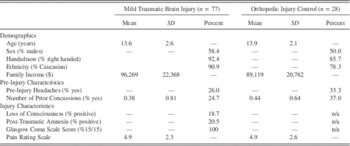
Participants for this study included 77 youth with a mTBI and 28 youth with an OIC (N=105; see Table 1). A feasibility study with a sub-sample of these participants (n=49; Khetani et al., Reference Khetani, Khan, Kadoura, Narous, Brooks and Barlow2014) suggested that we were able to recruit and cognitively test approximately one-third of eligible participants with mTBI, and there were not statistical differences between those who did and did not participate regarding age (p=.788), sex (p=.251), ED wait times (p=.426), and a history of LOC at the time of injury (p=.422). There were no significant differences between the mTBI and OIC groups for demographic, pre-injury, or injury characteristics (all ps>.05). All participants with a mTBI had a Glasgow Coma Scale (GCS) score of 15/15, 18.7% had positive loss of consciousness (55% had fewer than 5 min), 20.5% had post-traumatic amnesia (63% of these had less than 30 min of amnesia), and 50.7% had post-traumatic confusion (74.3% had fewer than 10 min of confusion). Only 10.3% of the mTBI patients were sent for neuroimaging (one participant had positive findings that included a hemorrhage). The mechanisms of injury for the mTBI group consisted of falling from a height (49.3%), being struck by an object (49.3%), and an accident involving a small low-speed motorized vehicle (i.e., rolling a golf cart; 1.3%). For these mechanisms of mTBI, 62.7% occurred in the context of playing a competitive sport. None of the participants with mTBI were involved in a high-speed motor vehicle collision.
Demographic and injury severity information for youth presenting to the emergency department.

Note. SD=standard deviation. n/a=not applicable. Pain Rating Scale ratings ranged from 0 (no pain) to 10 (worst pain). All group comparisons are p>.05.
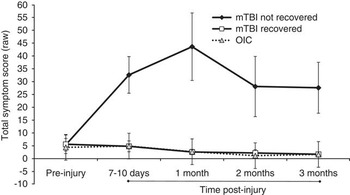
Computerized cognitive testing was completed upon presentation to the ED and within the ED, which was on average 1.5 days (SD=2.5) post-injury for those with a mTBI and 1.1 days (SD=1.8) post-injury for those with an orthopedic injury (p=.385). The 77 youth with mTBI who underwent cognitive testing in the ED were split into two groups post hoc for each follow-up period based on the presence (“mTBI recovered”) or absence (“mTBI not recovered”) of recovery. Mean symptom ratings for the groups are presented in Figure 1. There were significantly higher PCSI total scores and very large effect sizes for the “mTBI not recovered” group compared to both the “mTBI recovered” and OIC groups at each time point. There were not significant differences between the OIC group and the “mTBI recovered” group at any time point. The proportion of the mTBI sample who were deemed symptomatic (not recovered) at each time period were 36.0% (n=27) at 7–10 days, 18.9% (n=14) at 1 month, 11.4% (n=8) at 2 months, and 13.7% (n=10) at 3 months. In comparison, proportions of OIC participants who would be considered symptomatic at each time period were 7.1% (n=2) at 7–10 days, 3.6% (n=1) at 1 month, 0% (n=0) at 2 months, and 7.1% (n=2) at 3 months.
Symptom ratings from pre-injury through follow-up in youth. MTBI=mild traumatic brain injury. OIC=orthopedic injury control. Symptom ratings were obtained from parents. Error bars represent 95% confidence intervals for means. Recovery status for mTBI was based on reliable change scores (with an 80% confidence interval) derived from the OIC. “Not recovered” is based on the difference between follow-up and baseline total symptom scores exceeding the upper end of the reliable change score. “Recovered” is based on the difference between follow-up and baseline not exceeding the upper end of the reliable change score.

For those with mTBI, there was only a small amount of attrition over the study (i.e., 7–10 days, n=75 [97.4% of original mTBI sample]; 1 month, n=74 [96.1% of original mTBI sample]; 2 months, n=70 [90.9% of original mTBI sample]; 3 months, n=73 [94.8% of original sample]). There was also a very small proportion of participants who were deemed recovered at one follow-up evaluation but then deemed not recovered at a later time point (i.e., n=3 were deemed recovered at 7–10 days but not at 1 month; n=1 was deemed recovered at 1 month but not at 2 months; n=1 was deemed recovered at 2 months but not at 3 months).
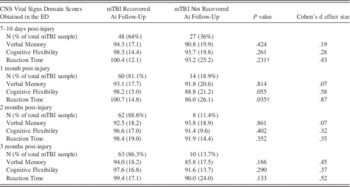
Cognitive scores from the ED are presented in Table 2. When considering those with mTBI who had not recovered at 7–10 days, 2 months, or 3 months post-injury, there were not significant differences for ED-based testing compared to those who have recovered (there was, however, a medium effect size for Reaction Time at three months). At 1-month post-injury, those who had not yet recovered had significantly worse performance and a large effect size in the ED on the Reaction Time domain score compared to those who have recovered (there was also a medium effect size for Cognitive Flexibility).
Comparisons of cognitive test scores from the emergency department in those who are deemed to have recovered or not recovered at various follow-up periods.

Note. MTBI=mild traumatic brain injury. Values represent means, with standard deviations in parentheses. Domain scores are age adjusted standard scores, where the standardization sample mean=100 and standard deviation=15. Recovery status for mTBI was dichotomized using reliable change scores (with an 80% confidence interval) derived from the OIC. “Not recovered” is based on the difference between follow-up and baseline total symptom scores exceeding the upper end of the reliable change score. “Recovered” is based on the difference between follow-up and baseline not exceeding the upper end of the reliable change score. Those p values with a † were based on non-parametric comparisons due to significant results on Levene’s test of homogeneity of variance. Cohen’s d effect sizes interpreted as: d=.2 being small; d=.5 as medium; and d=.8 being considered large.
ED-based cognition as a predictor of recovery at 1-month post-mTBI was used for the subsequent CART analysis. Reaction Time was the most explanatory variable indicating that 81% of the likelihood of recovery was explained by a child having a Reaction Time domain score ≥79 or higher (≥8th percentile) (sensitivity[SN]=0.357, specificity[SP]=0.950). A total of 62.5% of the children with a Reaction Time domain score <79 did not recover by 1 month [odds ratio (OR)=10.6, 95% CI=7.1–70.3]. Of those children with Reaction Time domain scores ≥79, also having a Cognitive Flexibility domain score ≥101 (≥53rd percentile) was predictive of 86.4% of recovery. For those children who had Reaction Time ≥79 but Cognitive Flexibility <101, 88.8% (8/9) did not recover by 1 month and 43.9% (25/57) did recover by 1 month (OR=11.84, 95% CI=1.3–268.4; SN=.89, SP=.60).
When considering the presence of Reaction Time domain score <79 and/or Cognitive Flexibility domain score <101, those youth who remained symptomatic at 1-month post-mTBI were 14.9 times (95% confidence interval=1.8–323.5) more likely to be flagged on the cognitive testing in the ED and there was a 60.8% overall correct classification rate (SN=0.929; SP=0.533). Performance on the Verbal Memory domain score did not appear to be a significant explanatory variable in the CART analysis. When CART was re-run with sex and baseline symptom burden as additional variables, Reaction Time and Cognitive Flexibility remained as most explanatory. RF analysis confirmed the CART results, ranking Reaction Time [Mean Decrease in Gini (MDG)=7.4] and Cognitive Flexibility (MDG=6.89) as variables of importance when classifying predictors of recovery. Of note, Verbal Memory was also identified as a predictor (MDG=6.27) in the RF analysis, although it was not explanatory in the CART analysis. Model accuracy measures confirmed the Gini importance findings (i.e., there was a decrease in model accuracy if a variable was removed: Reaction Time=28.12; Cognitive Flexibility=8.19; Verbal Memory=4.85).
Discussion
Although a relatively quick and complete recovery following a mTBI is the expected outcome for the majority of children and adolescents, a minority are anticipated to have protracted recovery based on the presence of lingering post-concussive symptoms (Barlow et al., Reference Barlow, Crawford, Stevenson, Sandhu, Belanger and Dewey2010; Barlow et al., Reference Barlow, Crawford, Brooks, Turley and Mikrogianakis2015). Understanding the factors that can be used to determine who will or will not have a protracted recovery is central to early prognostication in the ED (Zemek et al., Reference Zemek, Farion, Sampson and McGahern2013). In the present study, youth with a mTBI who have lower cognitive performance in the ED also have worse symptomatic recovery (higher symptom burden). Specifically, those youth with significantly worse Reaction Time scores in the ED were more likely to be not recovered at 1-month post-mTBI.
Performances on Reaction Time and Cognitive Flexibility in the ED were predictive of outcome 1-month post-mTBI and were more explanatory than sex and baseline symptom burden. The Reaction Time domain score was able to correctly classify symptomatic recovery at 1 month in nearly 84% of youth who presented to the ED department, with the addition of Cognitive Flexibility providing correct classification in 86% of the remaining youth. This level of classification for poor recovery based solely on cognitive performance following an injury exceeds the rates presented previously for athletes (Lau et al., Reference Lau, Collins and Lovell2011), where 65% of high school football players were correctly classified for recovery at 14 days post-injury. Compared to the Lau et al. (Reference Lau, Collins and Lovell2011) study where cognitive testing is completed within 2 days of a sports concussion, the current study with youth who present to the ED and undergo cognitive testing had a similar positive predictive value (63% in the current study and 64% in Lau et al.) but a higher negative predictive value (86% in the previous study and 66% in Lau et al.). Adding performance on the Cognitive Flexibility domain score improved the sensitivity for predicting outcome at 1 month to over 90%, which may be highly valuable when trying to identify those who are more likely to have a poor outcome (i.e., most prediction models have high specificity for determining who will not have a poor outcome).
Of interest, ED-based cognitive abilities did not differentiate outcome for the other follow-up periods (7–10 days, 2 months, or 3 months). The lack of a relation for these other time periods using cognition in the ED is not well understood and suggests that further research is needed to determine the various factors that may predict outcome at different times (e.g., demographic, pre-injury, or injury factors, such as in Babcock et al., Reference Babcock, Byczkowski, Wade, Ho, Mookerjee and Bazarian2013; Eisenberg, Andrea, Meehan, & Mannix, Reference Eisenberg, Andrea, Meehan and Mannix2013). In contrast to the present study with youth, adult studies looking at early cognitive functioning and symptomatic outcome have supported the prediction of outcome at both 1- and 3-months post-mTBI (Sheedy, Geffen, Donnelly, & Faux, Reference Sheedy, Geffen, Donnelly and Faux2006; Sheedy, Harvey, Faux, Geffen, & Shores, Reference Sheedy, Harvey, Faux, Geffen and Shores2009). Methodologically there are some key differences across studies. In addition to the obvious difference in developmental level (youth instead of adults), the two studies by Sheedy and colleagues only looked at levels of post-injury symptoms without consideration of pre-injury functioning (Sheedy et al., Reference Sheedy, Geffen, Donnelly and Faux2006, Reference Sheedy, Harvey, Faux, Geffen and Shores2009). The present study used (1) baseline ratings obtained at the time of injury (in the ED) to minimize biased reporting (Brooks, Kadoura, et al., Reference Brooks, Kadoura, Turley, Crawford, Mikrogianakis and Barlow2014) and (2) an RCI methodology that accounted for differences between post-injury and pre-injury level of symptoms. It is also possible that insufficient power was present in the current study to detect the differences at longer follow-up periods where the proportion of those remaining symptomatic (e.g., 11.4% at 2 months and 13.7% at 3 months).
Current research on prediction models for outcome following a mTBI in children and adolescents have demonstrated that high symptom burden (pre- and post-injury) and the presence of various pre-injury factors (e.g., adolescence, being female, prior injuries, learning problems, or behavior problems) can be predictors of poor outcome following mTBI in youth (Babcock et al., Reference Babcock, Byczkowski, Wade, Ho, Mookerjee and Bazarian2013; Eisenberg et al., Reference Eisenberg, Andrea, Meehan and Mannix2013; Grubenhoff et al., Reference Grubenhoff, Deakyne, Brou, Bajaj, Comstock and Kirkwood2014; Kontos et al., Reference Kontos, Elbin, Lau, Simensky, Freund, French and Collins2013; McNally et al., Reference McNally, Bangert, Dietrich, Nuss, Rusin, Wright and Yeates2013; Meehan et al., Reference Meehan, Mannix, Monuteaux, Stein and Bachur2014; Morgan et al., Reference Morgan, Zuckerman, Lee, King, Beaird, Sills and Solomon2015). None of these studies, however, included rapid computerized cognitive testing in their prediction of outcome. In the present study, rapid cognitive testing remained the most explanatory of outcome even when adding previously studied factors, such as sex and pre-injury symptom burden to the prediction model. This highlights the importance of objectively measured cognition in the ED when prognosticating outcome post-mTBI.
In a series of studies with high school football players, it was consistently shown that computerized cognitive testing within approximately 2 days of a concussion/mTBI is able to help predict recovery status (Iverson, Reference Iverson2007; Lau et al., Reference Lau, Collins and Lovell2011, Reference Lau, Collins and Lovell2012). Iverson (Reference Iverson2007) showed that athletes who took longer than 10 days to recover have low scores on three out of four cognitive domains (visual memory, visual-motor speed, reaction time) when tested early after their injury. Lau and colleagues (Reference Lau, Collins and Lovell2011, Reference Lau, Collins and Lovell2012) showed that reaction time from ImPACT is consistently a predictive variable for recovery by 14 days, especially when combined with early post-injury symptom scores. The present study provides additional support that early cognitive problems are predictive of outcome following a mTBI, but expands the information to include a broader age range, those children and adolescents who present to the ED, those youth who are not specifically injured in sports, and longer follow-up periods.
Cognitive functioning in the ED may provide valuable information in the assessment, management, and prognostication following a mTBI. Previous research with this sample showed that cognitive testing in the ED following a mTBI revealed that there was not an impact on the accuracy of cognitive responses but speed of processing was slower than orthopedic controls (Brooks, Khan, et al., Reference Brooks, Khan, Daya, Mikrogianakis and Barlow2014). There is accumulating evidence that computerized cognitive testing in the ED is feasible (Khetani et al., Reference Khetani, Khan, Kadoura, Narous, Brooks and Barlow2014), can detect the early cognitive problems following a mTBI (Brooks, Khan, et al., Reference Brooks, Khan, Daya, Mikrogianakis and Barlow2014; Nance, Polk-Williams, Collins, & Wiebe, Reference Nance, Polk-Williams, Collins and Wiebe2009; Rieger et al., Reference Rieger, Lewandowski, Callahan, Spenceley, Truckenmiller, Gathje and Miller2013), and in fact may be more sensitive than paper and pencil testing (Grubenhoff, Kirkwood, Gao, Deakyne, & Wathen, Reference Grubenhoff, Kirkwood, Gao, Deakyne and Wathen2010). Considering that there are few tools available for assessing the early effects of a mTBI in children and adolescents, the ability for rapid computerized cognitive testing to detect alterations in functioning is promising for the early management of these injuries. The presence of early objectively measured cognitive problems may alter the short-term management provided to children and adolescents.
For example, a child with poor performance on measures of rapid information processing and decision making may benefit from early school-based accommodations. The presence of early cognitive problems, coupled with the knowledge that they can help predict symptomatic outcome at 1 month, can also be helpful with advising the family on return to activity decisions. When early cognitive problems can help predict outcome at follow-up, then clinicians have an additional tool in their repertoire for mTBI management and prognostication.
There are some limitations to this study. First, the sample size is not large, which may question whether the results are stable and generalizable to the larger population. A larger sample size may help with this limitation. Second, this study did not include other variables as prediction of outcome (e.g., age, pre-injury attention and learning problems, history of headaches/migraines, severity of acute symptom presentation, pre-injury mental health, pre-injury family functioning, other measures of socioeconomic status), which again relates to the smaller sample size and will be important factors to consider for future research. This study did, however, include pre-injury level of symptoms by including baseline ratings as part of the determination of recovery through reliable change. Third, this study only considered recovery based on parent-reported symptoms. It is appreciated that there may be other methods for determining recovery, including cognitive testing at follow-up.
However, our design was purposefully selected because it represents a potentially common pathway for clinical care using these data; early presentation in the ED following a mTBI, cognitive testing in the ED to help the physician prognosticate outcome, and subsequent referral for outpatient services at follow-up. Fortunately, the correlations between parent and self-reported symptoms following a mTBI are also quite strong (for youth ages 8–12 years, r=.56; for youth ages 13–18, r=.65), which supports using parent report. Fourth, this study cannot provide causation of the cognitive problems to the mTBI. That is, it is not known whether those children and adolescents with lower cognitive abilities in the ED also had lower cognitive abilities before their injury.
When children and adolescents present to the ED following a mTBI, there are limited tools available to guide clinical care. In this study, cognitive functioning in the ED predicted outcome for youth at 1-month post-mTBI (sensitivity of 93%) and those who remained symptomatic were 15 times more likely to have low scores on Reaction Time and/or Cognitive Flexibility domains. Computerized cognitive testing may be desirable because it can detect early cognitive problems, help guide management, lead to early accommodations and support, help prognosticate outcome, and be rapidly completed without interfering in the clinical flow of the ED. Larger pediatric studies on the ability of ED-based cognitive testing to facilitate prediction of outcome following mTBI are warranted.
Acknowledgments
The authors thank the following people: Brenda Turley, BA (Hons) for coordinating this study, supervising students, and overseeing data collection; Janie Williamson, RN (manager, Pediatric Emergency Research Team, Alberta Children’s Hospital) and the Pediatric Emergency Medicine Research Assistant Program (PEMRAP) students for assistance with recruitment in the emergency department; (alphabetically) Peter Hong (University of Alberta), Basil Kadoura (McGill University), Aneesh Khetani (University of Calgary), Mariam Narous (University of Calgary), and Alex Scurfield (University of Victoria) for help with data collection and data entry; Dr. Anna Mazur-Mosiewicz for assistance with interpreting the CART analysis; Conny Betuzzi for supporting clinician-scientists at ACH; Rob Hrapchak (Sol Supply Ltd) for providing the noise-dampening ear muffs used during the cognitive testing; the staff in the Alberta Children’s Hospital emergency department; and the patients and families who agreed to participate in this study. Funding and Financial Disclosure: Funding for this study was provided by: the Pediatric Brain Injury Research Program (administered by the Alberta Children’s Hospital Research Institute) awarded to Drs. Barlow and Brooks; summer studentships from the Canadian Institutes of Health Research training program (administered by the Alberta Children’s Hospital Research Institute; the McCarthy Tetrault Award (administered by the Alberta Children’s Hospital Research Institute) awarded to Dr. Brooks; in-kind test credits from the computerized test publisher (CNS Vital Signs); and in-kind support from the neurosciences program at Alberta Children’s Hospital (Conny Betuzzi). None of the funding sources were involved in the design and conduct of the study; collection, management, analysis, and interpretation of the data; and preparation, review, or approval of the manuscript. Conflict of Interest. Dr. Brooks receives royalties from Psychological Assessment Resources, Inc. for two neuropsychological tests (Child and Adolescent Memory Profile TM , Sherman and Brooks, 2015; Memory Validity Profile TM , Sherman and Brooks, 2016) and from Oxford University Press for a book (Pediatric Forensic Neuropsychology, Sherman and Brooks, 2012). None of the authors have a financial interest in any of the measures in this study.