Introduction
There is a shortage of doctors specializing in psychogeriatrics or old age psychiatry in many countries (Draper et al., Reference Draper, Melding and Brodaty2005). In addition, research suggests that both university and work-based education and training fail to adequately educate and train medical and other healthcare professionals (Promes et al., Reference Promes2009), particularly in appropriate care for people with dementia (Tullo and Allan, Reference Tullo and Allan2011). This gap is especially problematic in rural and remote areas where healthcare professionals often work in isolation or with little peer support. In Australia in 2012, although most of the aged care health workforce worked in urban areas, a substantial proportion – over one quarter – worked in regional, rural, and remote locations (King et al., Reference King, Mavromaras and Wei2012). Registered nurses, enrolled nurses, and personal care assistants all regard dementia training as a major need (King et al., Reference King, Mavromaras and Wei2012).
While there is considerable evidence for the benefits of professional development using videoconferencing in general (Abrahamian et al., Reference Abrahamian, Schuller, Mauler, Prager and Irsigler2002; Nilsen Reference Nilsen2011; Garzonis et al., Reference Garzonis, Mann, Wyrzykowska and Kanellakis2015), few studies have examined the role of professional development in improving dementia care specifically. There is evidence that staff training interventions aimed at reducing BPSD can improve health professionals’ ability to manage these symptoms and provide improved health outcomes (Tsolaki et al., Reference Tsolaki2010). Studies have suggested that to elicit change to current practice, it is necessary to improve health professionals’ knowledge of dementia care (Perry et al., Reference Perry, Draskovic, Vernooij-dassen, Van Achterberg and Olde Rikkert2011; Tamar and lliffe, Reference Tamar and lliffe2012). Many initiatives have thus aimed to enhance health professionals’ knowledge about dementia to improve case identification and to raise the standards of medical and allied health practice (Tsolaki et al., Reference Tsolaki2010; Spector et al., Reference Spector, Orrell and Goyder2013). A recent review of continuing education and knowledge transfer in dementia established that interactive, multifaceted interventions or those with repeated inputs were more effective in promoting change (Rampatige et al., Reference Rampatige, Dunt, Doyle, Da and Van Dort2009). Important facets of guideline-based quality dementia care have recently been defined as physician education combined with a coordinated system of dementia management, running in parallel and in close collaboration with community-based agencies (Rampatige et al., Reference Rampatige, Dunt, Doyle, Da and Van Dort2009).
Videoconferencing, telementoring, and providing peer support have been shown to be effective ways to improve health professionals’ practice, for example, by linking regional physicians with metropolitan specialists to improve clinician knowledge, confidence, and competence to enhance patient care (Del Prato et al., Reference Del Prato, Bankert, Grust and Joseph2011; Salgia et al., Reference Salgia, Mullan, Mccrdy, Sales, Moseley and Su2014; Frank et al., Reference Frank2015). However, there has been no research to date examining the role of this technology in supporting health professionals caring for people living with dementia. People with dementia often have complex behavioral issues that may not lend themselves readily to description via videoconferencing or telementoring, but these formats have some potential to assist in sharing scarce specialties such as old age psychiatry.
The present pilot project was initiated in order to redress the gap in support for regional, rural, and remote healthcare professionals caring for people with dementia in Victoria and the Northern Territory (NT) in Australia. In Australia, as part of a federal initiative to improve dementia care, services called Dementia Behaviour Management Advisory Services (DBMAS) have been operating in each State to provide expert advice to family carers and aged care service providers in understanding and managing BPSD since 2008 (LAMA, Reference Lama2009).
In most states, the DBMAS has a central multidisciplinary team working in the capital city. This central hub is supported by “spokes,” usually sole clinicians working in rural and regional areas and usually based within a larger general acute hospital or mental health service. However, this model did not always provide medical psychogeriatric coverage sufficient to meet the needs of the local communities. An initial scoping exercise identified geographical areas with limited access to support regarding people with dementia. Four regional dementia clinicians did not have local access to old age psychiatrists or geriatricians. Whilst the DBMAS Victoria ran local education and peer support meetings and provided tertiary consultations with their old age psychiatrists, there was room for improved access to education and peer support for regional DBMAS staff. The NT had the most significant gaps in access to medical supervision and support, with only one geriatrician and one old age psychiatrist for the whole Territory, an area of 522,459 square miles and a population of 235,182.
To address these gaps, a pilot expansion of mentoring and consultation services was established to test a model for improving medical supervision and clinical governance to staff and clients within regional and remote areas. It was hypothesized that the pilot model support would improve medical supervision, improve clinical governance, and lead to improved confidence of staff.
Method
Description of the model
The key elements of the pilot were teleconference and web-based team case presentations and education sessions with staff from Victorian and NT DBMAS services and other key stakeholders involved in mental health services for older people.
The pilot model was supported by extending the Equivalent Full Time (EFT) hours of the old age psychiatrists located at the Victorian DBMAS hub from 0.5 to 0.9 EFT. This extra time enabled the on-call roster to be increased to Monday–Friday 9.00 am–5.00 pm and one of the old age psychiatrists to prepare for and present the weekly remote education and case conferences. The old age psychiatrist was supported by a project coordinator and key contact from the Victorian dementia service hub that coordinated the pilot. Staff from all participating sites in Victoria and NT were encouraged to access this service for case consultation and advice.
Remote case conferences were scheduled in advance and alternated between a Victorian and NT DBMAS site. At least two of the Victorian old age psychiatrists were present at each of these case conferences. Staff scheduled to present, provided a brief case outline, and related BPSD/management issues using a clinical case conference template. This outline was distributed to dementia service staff across Victoria and the NT two days before the scheduled case conference. The session involved the presenter describing the case and discussing the issues, and then management strategies were discussed amongst participants.
Education sessions were 1-hour sessions usually conducted by an old age psychiatrist. Dementia service staff were invited by the project coordinator to suggest topics for education. Some of the education topics included frontotemporal dementia, sleep disturbances in dementia, squalor/hoarding, and an update on psychotropic medications. Participants were emailed a slide presentation prior to the education session. Both case conferences and education sessions were initially planned on an alternating fortnightly basis, which meant there was usually one event each week. Both sessions were reduced to monthly during the pilot because their frequency made it difficult for some clinicians to take part.
Evaluation design
An evaluation framework based on the models of Kirkpatrick (Reference Kirkpatrick2007), Grol et al. (Reference Grol, Bosch, Hulscher, Eccles and Wensing2007), and Polit and Beck (Reference Polit and Beck2013) underpinned the data collection. Data collection was designed to be feasible within the constraints of resources and travel budget and to address four broad levels of effects (Kirkpatrick, Reference Kirkpatrick2007): evaluation of reactions of the participants, learnings received, behavior change, and perceived results or outcomes. The evaluation used a mixed methods design, utilizing both qualitative and quantitative research techniques, combining interviews, questionnaires, and case conference evaluations. The implementation and evaluation of the pilot was described in terms of processes of change, including orientation to the new program, acceptance of the intervention, and the impacts of the program (Grol et al, Reference Grol, Bosch, Hulscher, Eccles and Wensing2007; Polit and Beck, Reference Polit and Beck2013). The evaluation process was interactive and iterative with feedback from participants being used to modify delivery of the pilot and to inform education topics for inclusion in its later phases, to improve its relevance and promote engagement of participants. The evaluation was undertaken by a research team not directly employed by the services involved in the pilot. Participants consisted of a purposive sample of 18 DBMAS staff and staff from other key services linked into the DBMAS service in regional Victoria and the NT.
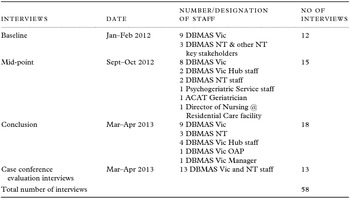
For triangulation of data collection, three methods were used to collect information on participants’ reaction, learnings, behavior change, and outcomes or results (Kirkpatrick, Reference Kirkpatrick2007). First, 45 interviews were undertaken with staff at three time points to explore implementation of the pilot including: expectations, experiences, strategies for improving the pilot, and its perceived impact on work practice and professional development opportunities. Interviews were conducted over the telephone or via email. Both methods are effective means of generating rich qualitative data (Malta, Reference Malta and Leontowisch2012) and the method was practical given the spread of participants over approximately 4,000 km. Table 1 shows the structure and number of key stakeholder interviews.
Structure and number of staff interviews

Second, an evaluation survey template was developed for participants to complete at the end of each education session. The evaluation asked participants to rate five statements on a five-point Likert scale from “Strongly agree” to “Strongly disagree.” Three open-ended questions asked for feedback on the most and least useful parts of the session as well as suggestions for future education topics.
Third, clinicians (n = 13) who presented case conferences were interviewed to capture outcomes from case conferences (see Table 1). The semi-structured interviews included a number of open and closed questions. Clinicians referred to their case notes to provide retrospective feedback. Open-ended questions asked about goals for presenting cases, strategies recommended by the DBMAS service (before and after each case presentation), barriers to implementing strategies, outcomes from strategies, and the benefits of case presentations for dementia service staff and for staff working with clients (for example, in residential aged care facilities). The questions aimed to clarify the impact of case conferences and what new client management strategies were implemented as a consequence, rather than what the clinician had put in place prior to case conferences occurring. Closed questions using a Likert scale and a rating at admission as well as discharge from the service included: how problematic symptoms were, the stress of care staff and family carers, and confidence of the DBMAS staff in managing the case. Other Likert responses were used for goal attainment and success of the recommended strategies. Overall, a total of 58 interviews were conducted. The evaluation methodology was approved by St Vincent's Hospital (Melbourne) Research Governance Unit, Human Research Ethics Committee.
A total of 18 education sessions were conducted remotely (initially by teleconference n = 9; followed by videoconference n = 9). In total, 352 staff attended these sessions (mean 19.6 staff per session) and 186 (52%) evaluation forms were returned. Response rates per session ranged from 30% to 89%. For teleconference sessions, there was an average of 21.8 staff per session and a 54% evaluation response rate, compared with 17.3 staff per video session (with a 52% response rate).
Analysis
Interviewers took notes during baseline, midpoint, conclusion, and case conference interviews. Completed notes were typed and emailed to the interviewee for comment. This process promotes validity of data as participants are given the opportunity to review how the researcher has interpreted key information from the interview and to correct any misinterpretations (Bowen, Reference Bowen2005). Feedback from participants indicated that the completed notes were accurate interpretations and only very minor changes were suggested. Final versions were combined with open responses on evaluation sheets for a thematic and descriptive analysis (Braun and Clarke, Reference Braun and Clarke2006). Interview notes were read through several times and two researchers (KM, SM) independently identified key themes. These researchers then compared themes and any discrepancies identified were discussed until consensus was reached. As notes were used rather than transcripts, quotes were not available to illustrate the themes. Analysis followed the methodology recommended by Mayring (Reference Mayring2000) and involved both inductive and deductive development and application of categories. Quantitative data from evaluation forms and case conference evaluations were entered into SPSS (Version 21) to generate descriptive statistics.
Results
Feedback from education sessions
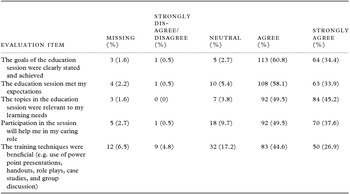
Table 2 shows the combined responses to the closed evaluation questions of the 18 video/teleconference education sessions. The findings showed that participants most commonly “agreed” or “strongly agreed” to each of the five statements indicating acceptance and satisfaction with the program. The relevancy of the topics to learning needs rated the highest satisfaction. Training techniques rated the lowest satisfaction. Responses to the open-ended questions suggested this was mainly related to dissatisfaction with the quality of audio and video-conferencing facilities.
Combined education evaluation outcomes (n = 186)

Case conference outcomes
In response to the closed questions from the case conference interviews, 59% of clinicians’ felt the case conference process was both acceptable and improved impacts for clients through their increased confidence in managing clients with BPSD. Overall, the findings from the interviews demonstrated that only two of the 18 clients (11%) had BPSD that remained a significant problem after discharge; and most clinicians’ ratings of BPSD improved from referral to discharge (72%). Clinicians’ also noted reduced family carer and staff carer stress from time of referral to time of discharge (87.5% and 76.9%, respectively). Overall, clinicians reported that the case conference process contributed to improved outcomes for clients, family, and staff. Case conference reports showed that clinicians reported reduced family carer stress.
Thematic findings
Eight key themes were identified through the thematic analysis that drew on baseline, midpoint, conclusion, and case conference interviews and open-ended responses from education evaluations and indicate acceptance and impact of the pilot. These themes are summarized below.
Enhanced professional development
Almost all staff considered the pilot increased their access to professional development opportunities. Although the initial intention was to improve access to expertise from old age psychiatrists, participants found access to a multidisciplinary team most beneficial in terms of peer support, opportunities to debrief, and to share strategies. This was especially so for sole clinicians in the NT area, who were more professionally isolated than their Victorian counterparts, due to the limited number of professional development opportunities available in remote areas, as well as the lack of available relief staff. In this respect, integrating the project into work environments was particularly beneficial. In addition, both NT and Victorian staff noted:
-
1. BPSD management strategies recommended by DBMAS clinicians held more weight with other external health professionals because of the input from old age psychiatrists;
-
2. Case conferences confirmed existing practice and identified new strategies;
-
3. Handouts were valued as preparation tools before education sessions and as an ongoing reference.
Participants’ capacity to inform education topics
On each evaluation sheet, clinicians were asked what education topics they would like to receive in future. The data indicated they were interested in all education topics, confirming the strong need for education in this area. Interviews also highlighted that participants appreciated being consulted about future topics.
Reduction in travel time
Delivery of education and case conference sessions via electronic means was considered a major benefit, related to reductions in travel times across the large geographical area for service coverage.
Improved collaboration and feeling part of a team
The increased peer support and team building derived from the pilot was considered as important as the professional development and education. This “enhanced collegiality” as one staff member put it, meant that those who worked as sole clinicians felt they no longer worked in isolation and now belonged to a “team.” Getting to know staff from other sites and learning about their areas of expertise also enabled staff to feel more knowledgeable and confident about where to go for support and advice.
Difficulties with information technology (IT)
The biggest challenge to implementation of the pilot was the use of the technology to deliver case conferences and education sessions. IT difficulties centered on audio feedback and sound quality issues (latency). Problems stemmed from overloaded hospital-based servers, resulting in intermittent outages, and delays. Slow internet speeds were of particular concern in regional Victoria. Some clinicians’ noted they preferred face-to-face discussions if possible and others suggested presenters consider modifying presentation skills when communicating via the internet.
Barriers implementing changes within aged care
Strategies recommended at case conferences were sometimes stymied at the implementation phase by factors operating within aged care environments, such as:
-
1. the low level of staff training and high turnover of residential aged care staff;
-
2. using medication as a “quick fix” solution – which was not necessarily appropriate;
-
3. staff and/or family not supporting the strategies.
Timing and frequency of sessions
Time of day and frequency of education and conference sessions was found to be a critical factor for clinician attendance. Initial sessions were scheduled at midday and early afternoon. However, this proved problematic for many staff in rural areas who spent the bulk of their day on the road visiting clients and residential aged care facilities. Timing and frequency of sessions was modified during the latter stages of the pilot to address these difficulties.
Cultural differences relevant to location
At the commencement of the pilot, some staff were concerned whether sessions covering such diverse cultural and geographic services would be relevant and suitable for all involved. Some staff indicated that particular recommendations were not relevant for very remote and/or Aboriginal and Torres Strait Island clients. Overall, however, staff reported that sessions were relevant to their clients. Some staff in regional Victoria reported that it was beneficial learning from NT staff about strategies for working with indigenous clients.
Discussion
Previous research has shown that providing peer support and networks not only assists others in becoming more knowledgeable, but can also impact on their confidence, competence, and self-esteem (Del Prato et al., Reference Del Prato, Bankert, Grust and Joseph2011). Telementoring has previously been shown to provide support for rural and remote clinicians in various medical specialty areas (Frank et al., Reference Frank2015). The present results have expanded this evidence to show that telementoring can be successful when supporting health professionals who are caring for people with dementia as well. With the previously documented failure of university-based education to provide adequate training in dementia care, this study drew together previous research findings and has demonstrated that metropolitan-based specialist services have the capacity to transfer guideline-based knowledge and skills to rural, regional, and remote health services using videoconferencing.
The results enhance the evidence base demonstrating that an innovative multi-faceted program including education, peer support, and additional specialist old age psychiatry support has the capacity to deliver a broad range of benefits to services working in remote and rural health settings. A reduction in isolation, confirmation of clinical strategies, improved confidence, and collegiate collaboration were all seen as positive, advantageous outcomes of the project. Furthermore, the coordination and extension of the program to community-based health agencies (including community and residential aged care service providers) generated benefits, including improved knowledge of dementia and BPSD, an ability to be pro-active in managing BPSD, and in feeling more supported and having improved confidence.
The study also demonstrated the potential benefits of alternative approaches to support and educate clinicians working in isolated locations. While videoconferencing may save resources in the longer term via reducing staff travel time and costs, it does require adequate infrastructure and technical expertise to establish an adequate system. The observations such as IT problems, and reduction in travel time have been found elsewhere (Moffatt and Eley, Reference Moffatt and Eley2011) but are reported here again as they were raised by participants in our study.
Having a more knowledgeable, confident, and supported team of clinicians with more opportunities to reflect on practice within a multidisciplinary team appears likely to lead to positive outcomes for both clients and carers. While the nature of the services involved meant that there were only a small number of staff available to respond to the evaluation, the qualitative in-depth analysis provided solid findings over a number of time points. The interactive nature of the evaluation also meant that findings during the earlier phases could be used iteratively to refine the pilot program during the latter phases to improve acceptability and relevance of the pilot to key stakeholders. Future research could examine outcomes of this improved staff mentoring for people living with dementia in terms of morbidity, mortality, or quality of life. Extending this program of mentorship to acute and sub-acute multi-disciplinary teams in remote and regional centers also has the potential to draw together teams across the care continuum in a coordinated system of dementia management.
A limitation of this study was the lack of direct input from family carers or people living with dementia. The nature of the DBMAS service meant that often the clinicians in the DBMAS were working to train and support other staff and did not always have direct contact with family carers. Nevertheless, this stakeholder group would be an important addition in future evaluations. Another limitation was the inability to analyze full recordings of interviews. This may have led to crucial pieces of information being missed although participants did not raise this when reviewing notes from their interviews. Finally, we were unable to directly link changes in BPSD in clients to changes in the program evaluated here, without a randomized controlled trial design which was not feasible under the circumstances of the evaluation.
Given the growth in people living with dementia in regional, rural, and remote areas and the lack of services available, particularly in old age psychiatry, initiatives such as this project are promising for promoting a confident and skilled workforce that has the capacity to respond to the needs of carers, families, and care staff into the future.
Videoconferencing is only one option for sharing scarce healthcare and medical resources. In Australia, mobile apps will become more feasible as broadband networks and mobile phone coverage to remote areas becomes more reliable. This will change the possibilities for future telementoring and videoconferencing initiatives.
Future directions
As Dole and Sinatra (Reference Dole and Sinatra1998) attest, embedding knowledge change is subject to a number of optimal conditions, not least of which is motivation on the part of the receiver to process and assimilate new knowledge. Whilst the workplace culture and practice changes outlined in this educational support, pilot are positive and encouraging, the degree of sustainable knowledge change has yet to be assessed. Future research could incorporate an assessment of long-term change.
Conflict of interest
None.
Description of authors’ roles
Colleen Doyle directed and assisted with design of the evaluation, oversaw the project, and wrote sections of this paper. Kirsten Moore assisted with design, conducted interviews, analyzed data, managed the project, and wrote sections of this paper. Sue Malta conducted interviews, analyzed data, and wrote sections of this paper. Samantha Loi conducted some education sessions and wrote sections of this paper describing the model. David Jackson wrote sections of this paper.
Acknowledgments
This evaluation was funded by the Dementia Behaviour Management Advisory Service Victoria. Melissa Kettle and Lynette Robb facilitated conduct of the evaluation.