Introduction
‘Bullion for goods’ has often been used as a convenient shorthand description for early modern commercial exchanges between Europe and Asia because, as is well known, the East India companies that traded with India and China exported considerable amounts of ‘treasure’ in order to aid their purchasing of textiles, groceries, and other commodities.Footnote 1 The monopolistic companies were unable greatly to expand their export of domestic manufactured goods or raw materials to the East and, as a result, they were obliged to balance their trading accounts through the shipment of large amounts of bullion, mainly in the form of South American silver. Indeed, on many occasions bullion accounted for up to 80 or 90 per cent of the value of export cargoes. The English East India Company was no exception, and in 1747 Richard Campbell noted in his guide to London commerce that,
The East-India Company generally export Silver Bullion, [and] some Woollen Goods, and bring us in return all the rich Spices of the East, Drugs, Silks, Cottons, some Diamonds, Salt-Petre, Tea and China; Part of which is consumed at home, and Part of it sent Abroad, to answer our Balance with other Countries.’Footnote 2
This mode of commercial operation greatly troubled many contemporaries of a mercantilist outlook in Britain who feared that precious metals were being exchanged for luxury goods of dubious worth, and Campbell went on to observe that ‘It is much disputed how far this Company is beneficial to the Nation, since they carry out mostly Bullion, and bring us in return, for the most part, only Superfluities.’Footnote 3 Campbell himself was not especially critical of the Company's commercial modus operandi, but neither he nor anyone else could deny that it was seemingly unable to increase the proportion of its annual export cargoes represented by commodities. Indeed, as K. N. Chaudhuri has shown, the average annual value of the treasure exported to Asia rose steadily during the century and a half following the Company's foundation in 1600, and, despite some fluctuations, it reached almost £750,000 a year during the 1750s.Footnote 4 By that decade, treasure represented just less than 65 per cent of the Company's total exports, although prior to the commercial dislocation caused by the outbreak of the Seven Years’ War in 1756 it had been quite usual for bullion to account for between 70 and 85 per cent of the value of the Company's export cargoes. Needless to say, these substantial exports of silver, and most especially those to India, have attracted considerable attention from historians, even though opinions have often been sharply divided over the effects that inward-flows from Europe had on local-receiving economies in South Asia during the first half of the eighteenth century.Footnote 5
Chaudhuri's ground-breaking study provides students of British commercial relations with Asia with easy access to a robust set of commercial figures derived from the East India Company's own records. In particular, his trade dataset details the annual total value of treasure exported from London to Asia on the Company's account between 1660 and 1760, even though no distinction is made between shipments dispatched to India, China, and elsewhere.Footnote 6 But, as Om Prakash has correctly pointed out, no such information is readily available for the decades after 1760.Footnote 7 This represents a considerable and perhaps rather surprising gap in our knowledge of Anglo-Asian economic relationships, not least because it exists for a most important period when, as is well known, the Company first embarked on the process of territorial expansion in Bengal and then proceeded to assert military and political control over other parts of the subcontinent. It is generally believed and often asserted that, having gained control over territorial revenues and other forms of tax income in north-east India between 1757 and 1765, the directors of the Company sought to reduce sharply, if not eliminate altogether, exports of silver from Britain as they endeavoured instead to use surplus revenues to fund the Company's annual commercial ‘investment’ or procurement of Indian textiles and other commodities for export to Britain and China. But what actually happened to the value, volume, and distribution of Company silver exports over the longer run remains unclear;Footnote 8 and, moreover, very little attention has been paid (even by Chaudhuri) to the private exports of silver that passed through different channels from Britain to India and China. The importance of subsidiary outward private silver-flows alongside those of the Company has been acknowledged recently by Javier Cuenca Esteban in his painstaking and methodical attempts to calculate Britain's balance of payments with India between 1750 and 1820, but his estimates of total transfers to the subcontinent find expression as period averages and single lines of figures, embedded within a much larger framework of account.Footnote 9 These figures are very important, as are the broader studies of which they form a part, but Esteban's aim was not to provide the disaggregated forms of annual data that are necessary for detailed analysis of British movements of silver to different parts of Asia. Without such evidence, few historians have been able to advance much beyond 1750 in their analyses of bullion flows between Britain and Asia within the early modern global economy, and those who have done so have invariably had to rely upon general estimates and guesswork.Footnote 10
One important consequence of the absence of a long run of detailed statistics on British transfers of silver to different parts of Asia has been considerable uncertainty among historians about the volume, value, and patterns of movement after 1760, and, as a result, some notable errors have found their way into studies of British imperial and commercial activity in different parts of Asia. For example, the lack of reliable and accepted figures has hindered attempts to examine the economic consequences arising from the East India Company's seizure of control over Bengal and its neighbouring provinces during the 1750s and 1760s. Indeed, recent sharp differences of opinion between Irfan Habib and Rajat Datta on the vexed matter of the course taken by the economy of north-east India under early colonial rule, arise, in part, from quite different understandings of what actually happened to inward bullion flows from Britain, once the Company had embarked fully on the process of territorial expansion. Habib states most emphatically that British shipments of silver into India ceased altogether after 1760, and he argues that this served to remove the major inflationary factor from the regional economy.Footnote 11 Datta, on the other hand, has used summary figures generated by the Company to paint a markedly different picture of bullion exports from Britain. He not only suggests that Company shipments to India continued after 1757, increasing sharply after 1785, but also gives due notice to private consignments; and this has enabled him to develop two much more favourable assessments of economic conditions in Bengal during the late eighteenth century.Footnote 12 Datta is certainly correct to point out that British exports of silver to India continued well beyond 1760 but, for reasons explained below, the figures he deploys are themselves flawed and in need of some correction.Footnote 13
Other historians have also made significant errors in their assessments of exports of silver from Britain to Asia. In his classic study of British trade with China during the early nineteenth century, Michael Greenberg took the view that ‘After 1804 very little or no silver had to be sent from Europe to China by the Company’; and, echoing these sentiments, Ralph Davis made a similar observation on exports to Asia as a whole in his general study of Britain's overseas trade between 1784 and 1856.Footnote 14 But both historians overlooked substantial Company exports of silver made between 1814 and 1820, and they failed to acknowledge private exports, which is potentially misleading to those considering the effects of injections of foreign specie into the Chinese economy or assessing the balance of trade or payments between Britain and Asia.
These considerable uncertainties and confusions among historians have arisen in large part from the use of source materials whose shortcomings do not allow changing long-term patterns of silver exports to different parts of Asia to be traced with any great degree of accuracy. The export ledgers of the British customs service can certainly be used to establish the overall volume and official value of treasure shipped to Asia as a whole for most years between 1760 and 1833,Footnote 15 but they do not allow finely detailed studies of British transfers of silver to be undertaken. In part, this is because some of the ledgers were destroyed in a fire at the Custom House,Footnote 16 but a much greater limitation is imposed upon the historian by the fact that before 1834 officials recorded all trade with Asia under one general category denoted as ‘East Indies’. The use of such a broad scheme of accounting classification means that it is impossible to distinguish between flows of commodities and bullion to India and China, or indeed to Bombay, Calcutta, and Madras, which were the ports of entry to the East India Company's three Indian Presidencies.
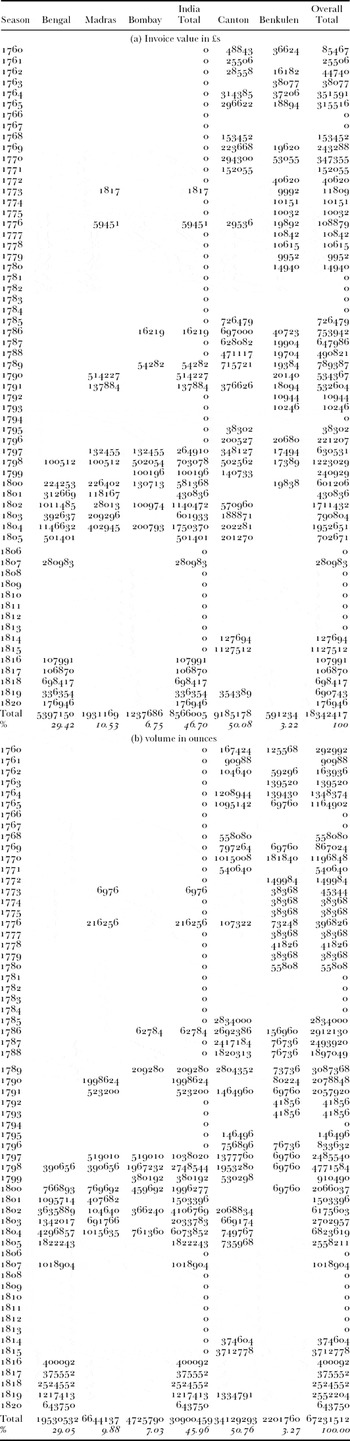
Of course, the East India Company itself often extracted figures from its own account ledgers in order to inform analysis of British trade with Asia, and this information found its way into parliamentary papers and official briefing documents prepared for the government's Board of Control for India established in 1784.Footnote 17 Such information is rather more useful than that created by the state's customs officials because it contains long runs of figures distinguishing between Company exports of ‘treasure’ to ‘India’ and to ‘China’. Accordingly, as noted above, a number of historians, including Datta and Esteban, have used it extensively for a wide range of purposes. But these figures have to be treated with some degree of caution because, as was customary Company practice, exports to places such as Mocha, Benkulen, and Balambanagan were routinely recorded under the heading of ‘India’, and this has led to an inadvertent inflation of the value and volume of silver shipped by the Company to the subcontinent.Footnote 18 In fact, as can be seen in Table 1 below, the consignments actually sent by the Company to Balambangan, Benkulen, and Mocha were always modest, but the mistaken representation of them as ‘exports to India’ can make it appear that transfers to the subcontinent took place in years when in fact this was not the case, such as between 1760 and 1765 or between 1777 and 1780.
East India Company exports of silver to Asia, 1760–1820

Source: BL, IOR, Commerce Journals, L/AG/1/6/14–29. An electronic version of this data can be found in H.V. Bowen, ‘The East India Company: Trade and Domestic Financial Statistics, 1755–1838’, UK Data Archive, [Dataset] Study No 5690 (Sept. 2007): http://www.dataarchive.ac.uk/findingData/snDescription.asp?sn=5690.Footnote 20
It is against this general background that the remainder of the paper seeks primarily to provide much firmer evidence relating to the value, volume, and distribution of the silver despatched from Britain to Asia between 1760 and 1833—a period when gold represented only a tiny and insignificant proportion of the exports often described generically as ‘treasure’. It must be stressed that this paper does not aim to analyse the effects of silver imports on circulation, conditions, and price movements in local receiving economies (a large and complex issue which lies beyond the scope of this study) but instead focuses on the different types of transfers facilitated by the British during an era of rapid commercial and imperial expansion in Asia. In order to achieve this, extensive use has been made of primary data contained in the East India Company's own Commerce Journals which record in great detail all the cargoes carried on board Company ships sailing each year between Britain and Asia. Unfortunately, however, the Company clerks who laboriously compiled the Journals at East India House did not see fit to generate any annual total export or import figures before 1796, so for the purposes of this study, values and volumes have had to be extracted systematically from the detailed export cargo invoices that were routinely copied into the Journals. This statistical information has then been aggregated to produce overall totals for the consignments dispatched to different destinations in Asia during each accounting period, and as a result it is now possible for the first time to present an accurate and finely detailed picture of silver exports made by the Company on its own account after 1760.
But this paper also stresses that exports of silver to Asia from Britain were not restricted to the East India Company alone, and thus other forms of scattered evidence are used to identify and quantify some of the silver carried eastwards by private individuals. Also, by acknowledging that the British did much more than simply effect direct transfers of silver to India, China, and the East Indies, it considers ways by which interlinked commercial and imperial activities facilitated movements of silver around the wider trading world of Asia after 1760. The paper concludes with a brief discussion of reverse flows of bullion from Asia to Britain that were established during the early nineteenth century.
As will be seen, the inconsistent and incomplete nature of some of the quantitative evidence relating to non-Company transfers of silver to Asia means that it is simply not possible to bring high degrees of statistical accuracy to all areas of the study. Nonetheless, the picture which does emerge is sufficiently clear to demonstrate that after 1760 the straightforward exchange of bullion for goods by the East India Company gave way to a more complex series of multilateral transfers by the British which saw silver moved to, around, and from Asia for a significantly wider variety of reasons than hitherto had been the case.
Exports to Asia (I): the East India Company
It is beyond doubt that the East India Company's acquisition of a territorial empire in India was accompanied by a sharp reduction in its exports of silver to Asia, and, for a quarter of a century after 1760, virtually no consignments were sent to the subcontinent. This is evident from Table 1 which shows that between 1760 and 1784 silver valued at just less than £2 millions was exported by the Company to Asia.Footnote 19 Most of that silver was sent to Canton, with regular small amounts going to Benkulen, where the Company retained a minor trading station at Fort Marlborough until 1825; but only two consignments were sent to India—to Madras in 1773 and in 1776. This marked a very sharp break with previous practice, and as early as 1763 it occasioned comment from the British government's Board of Trade, which noted recent ‘significant changes in the composition of Company cargoes sent to Asia’. In response, the directors of the Company pointed to the disruptions to trade that had been caused by recent war in India and elsewhere, and explained that reductions in shipments of bullion were due:
‘in part to the sending out larger proportions of the produce of Great Britain. . ., partly to the sums paid into the Company's treasuries in India by the country powers in satisfaction of the Company's losses pursuant to treaties, but principally for the large sums which have been paid into their said treasuries by individuals to remit home the riches they have acquired by bills of exchange upon the Company in England.’
The directors concluded that ‘From these resources the Company have been principally enabled to provide cargoes in India for their homeward bound shipping; and this accounts for the small quantities of bullion and gold exported.’Footnote 21
The directors evidently believed that the Company's annual ‘investment’ in goods in India could now be funded from local resources, and accordingly they began to reduce silver exports, even before 1765 when Lord Clive gained control of the considerable revenues of Bengal, Bihar, and Orissa.Footnote 22 Then, immediately after the acquisition of the diwani, they went further by instructing that specie now be shipped from India to Canton in order to fund the Company's purchases of tea, and this caused a temporary cessation of direct exports of silver from Britain to China between 1766 and 1768. An acute scarcity of specie in Bengal saw a resumption of direct shipments of Company bullion from London to Canton until 1772.Footnote 23 Thereafter a remodelled Company commercial strategy saw increased investment in Indian commodities for sale in China, together with deposits of silver made by private traders, provide the funds that were necessary for the purchase of tea by the Company's supercargoes. This so-called ‘country supply’ of the Canton Treasury was such that between 1771 and 1785 silver was only exported by the Company from London to China in the year 1776. This, taken together with the ongoing situation in India, meant that for most of the time only Benkulen was in receipt of Company silver from London. Indeed, between 1780 and 1784 hardly any silver was sent by the Company to Asia, thus enabling the directors to confound domestic critics who had long charged them with exporting precious metals in exchange for useless luxuries.
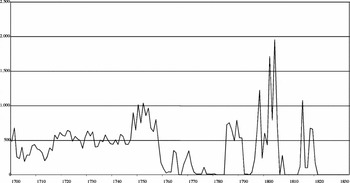
Unfortunately for the directors, they were not able to confound their critics for very long, as is evident in Figure 1 which presents a ‘long-run’ view of the value of Company consignments and indicates that there were several short-term, but very sharp, increases in exports of silver from the mid-1780s onwards. This resulted in silver valued at over £16 millions being exported to Asia between 1785 and 1820, and it is noteworthy that there was a resumption of substantial shipments to India, especially after 1800 when considerable quantities were sent to Bengal. Indeed, between 1785 and the end of the period under review, the Company dispatched rather more silver to India (£8,504,738) than it did to China (£7,618,253).
East India Company exports of treasure/silver to Asia, 1700–1833 (value in £ 000s). Source: For 1700–59, Chaudhuri, Trading World of Asia, p. 512; for 1760–1833 see Table 1.Footnote 24

In the first instance, the resumption of silver exports was caused by the need rapidly to increase purchases of tea at Canton in order to meet the greatly expanded domestic demand created when, in a bid to defeat large-scale smuggling from Europe, William Pitt's Commutation Act of 1784 slashed duties from 119 per cent to 12 ½ per cent. As a result, large consignments of Company silver were sent to China from London between 1785 and 1791, with a smaller amount being sent to Bombay in order to provide hard-pressed local officials with the funds needed for the purchase of raw cotton for export to Canton. By 1793 the directors of the Company stated that the ‘treasury in China was so abundant as to have rendered the export of bullion for commercial purposes, during the last season, totally unnecessary.’Footnote 25 Nonetheless, exports of silver to China did later prove to be necessary for commercial purposes,Footnote 26 and as well as Spanish and Mexican dollars the Company's consignments contained sycee—lumps of fine un-coined silver, required in large quantities by Chinese merchants, in order to make duty payments into the imperial treasury at Canton.Footnote 27
Some of the silver dispatched to India after 1785 was certainly intended for commercial purposes, for instance in 1786, 1803, and 1804, when the directors ordered that shipments sent to Bombay be directed towards the purchase of raw cotton for export to Canton.Footnote 28 But consignments were now also sent to the subcontinent for other reasons. This was because war in India had served increasingly to dislocate the Company's finances, so much so that in 1793 it was reported that there was no silver at all in the general treasury at Calcutta.Footnote 29 Indeed, twelve months later the problem was so acute that the Company's commercial agents were unable to make advance payments to textile manufacturers and salt producers in the usual manner.Footnote 30 The aggressively expansionist strategy of Governor-General Richard Wellesley (1798–1805) then greatly exacerbated the Company's financial difficulties, and the directors were left with little choice other than to resume large-scale transfers of silver from London. Hence, in June 1799 they reported that, although £200,000 of silver had been divided between Madras and Bombay for commercial investment purposes during the course of the previous year, a further £700,000 had also been sent to India for ‘general purposes’, namely ‘to remove the general distress for specie, arising from various causes but principally we have reason to apprehend from the very extensive speculations of merchants. . .’.Footnote 31 Moreover, several large consignments earmarked for investment in commercial activity were appropriated by the Company's senior officials in India and used to shore up fragile military finances. This happened most notably between 1802 and 1805 when, as the Chairman and Deputy Chairman later noted, ‘All the bullion thus exported [for an ‘augmented investment’ in goods] was on its arrival diverted from its original destination and applied to the purposes of war.’Footnote 32
In total, the silver sent to India amounted to almost £3.5 millions between 1802 and 1805 and the dramatic effects of this surge can be seen in both Table 1 and Figure 1, with total exports to Asia far exceeding the previous highest peak, and shipments to Bengal alone exceeding £1 million in both 1802 and 1804. Then in 1805 the directors acknowledged that the new Governor-General, Lord Cornwallis, was having considerable difficulty in paying the large number of regular and irregular troops employed during Wellesley's recent campaigns, and they agreed that the scarcity of funds in India was now so acute that there was a need for them to sanction emergency measures. As a result, consignments of silver amounting to some £500,000 were sent to Bengal during the course of the following year.Footnote 33 Although exports to India ceased again in 1808, the legacies of Wellesley's wars, together with new burdens imposed by heavy military expenditure incurred during the third and final Anglo-Maratha War of 1817–1818, contributed to crippling debts which were then partially reduced by the directors through a relief scheme which involved the temporary resumption of bulk shipments of specie from London between 1816 and 1820.Footnote 34 This use of silver to sustain the Company's military machine and stave off financial ruin in India meant that, for the most part, shipments to the subcontinent were no longer taking the traditional form of ‘bullion for goods’. As a result, the entry points of silver into the Indian economy, and the subsequent patterns of circulation, were very different from those of earlier times, when bullion had been minted and then used primarily for the purchase of textiles and other commodities.
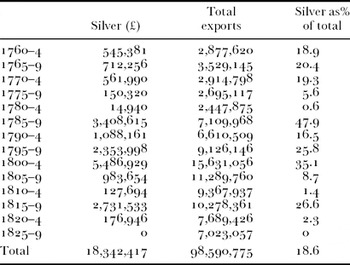
It is especially noteworthy that, although the Company's annual export of silver occasionally far exceeded pre-1760 levels, the value and volume of consignments varied considerably from year to year after 1784. This irregular pattern occurred because the directors now tended to use silver to provide short-term injections of funds into the Company's overseas treasuries as and when local military, commercial, and financial circumstances dictated. Accordingly, bullion no longer provided the foundation stone of the Company's export strategy as it had done during the first half of the eighteenth century, and across the entire period from 1760 to 1829 silver accounted for only 18.6 per cent of the overall invoice value of the cargoes despatched to Asia. As Table 2 illustrates, the proportion of total Company exports represented by silver never returned to the very high levels that had been commonplace before 1760, and only between 1785 and 1789 did silver come close to accounting for half of the value of all exports. Indeed, even when the value of the silver exported by the Company reached an all-time peak between 1800 and 1804 it stood at only just over one-third of total Company exports. This reflects the fact that, under some pressure from government, the directors had been obliged to undertake a succession of commodity export-drives in an attempt to boost the sale of British manufactured goods in Asia.Footnote 35
Silver as a proportion of East India Company exports to Asia, 1760–1829

Source: BL, IOR, Commerce Journals, L/AG/1/6/14–29. An electronic version of this data can be found in H. V. Bowen, ‘The East India Company: Trade and Domestic Financial Statistics, 1755–1838’, UK Data Archive, [Dataset] Study No 5690 (Sept. 2007): http://www.dataarchive.ac.uk/findingData/snDescription.asp?sn=5690.Footnote 36
The movements of Company silver to Asia outlined in the preceding paragraphs are detailed in Table 1 which illustrates the overall distribution of the silver sent to Asia between 1760 and 1833. In terms of both value and volume, almost exactly half the silver was dispatched to Canton, with most of the rest being shipped to the three main Presidencies in India. There is a need for some caution and qualification, however, because the Company's export records noted only the intended destination of consignments, and there were two very good reasons why silver might not have arrived where it had originally been sent. First, of course, some ships and cargoes were lost or captured by enemies, and even when silver was subsequently recovered from wrecked vessels a proportion of it was claimed by the salvagers.Footnote 37 Second, and much more importantly, silver destined for Canton was sometimes appropriated en route by the authorities in India who then used it to ease local financial pressures. This practice appears to have commenced in 1790 when silver valued at £70,000 was removed from the Company's China-bound ships at Madras so that ‘the prosecution of the war [against Tipu Sultan of Mysore] might not be impeded’,Footnote 38 and it happened again in 1805 and 1806 when Cornwallis was seeking an ‘extraordinary resource’ that would enable him to pay his troops.Footnote 39 In 1805 he ordered that 789,768 ounces of silver invoiced at £202,281 and destined for Canton be removed from the Company's ships at Madras; and the following year 505,298 dollars were taken out of the China ships at Penang and sent to Calcutta.Footnote 40 It is certain, therefore, that Table 1 misrepresents the actual flows of Company silver between London and Asia, and the picture would look rather different if it was based instead upon evidence related to the amount of silver that was actually landed at Indian ports and Canton. Unfortunately, exhaustive archival searches conducted over many years have failed to locate such evidence,Footnote 41 but if adjustments could be made with any degree of accuracy they would undoubtedly have the effect of reducing the amount of silver exported from London to China, and there would have been corresponding increases in the amount entering the Indian subcontinent.
Exports to Asia (II): private flows
Without doubt the East India Company was responsible for exporting the largest volume of silver to Asia from London during the period under review, but it was not responsible for all the consignments that found their way from Britain to the east. In 1816, for instance, the British government shipped substantial amounts of silver to India on its own account, in lieu of a domestic debt it owed to the Company.Footnote 42 Far more regularly, however, silver was exported on private account by individuals who used it for a wide range of commercial purposes. The commanders, crew, and passengers on board East Indiamen all had the opportunity to carry silver legally and illegally to Asia for their own use, or on consignment for others; and privately owned silver also found its way to the East on interloping vessels or foreign-registered, British-owned ships that conducted illicit trade with India via Europe. The very nature of such trade means that surviving evidence is very patchy, surviving mainly in collections of private papers, and this does not allow for the generation of aggregate export figures that can be added to those relating to the silver transferred on the account of the East India Company. At times, though, the flow of silver through private channels was quite considerable during the late-eighteenth and early nineteenth centuries, and this appears to have long been the case.
During the first half of the eighteenth century silver had been dispatched legally and illegally to India to provide start-up and working capital for the various forms of private enterprise conducted by Company servants and licensed merchants at Bombay, Calcutta, and Madras; and it was later sometimes sent out by agents in London in order to settle accounts with their trading partners on the subcontinent. The illicit nature of many of these movements means that their overall volume and value are unquantifiable, but a recent study of the English merchant community at Madras between 1660 and 1740 has revealed in detail that funds derived from London were often essential for newcomers embarking on private business careers, and some well-established individuals sought to sustain and expand their ventures through inputs of funds dispatched to them by associates in the metropolis. Much of the capital transferred to Madras for these purposes was in the form of bullion, mainly silver, which was either shipped legally on board Company vessels, subject to the payment of the appropriate duties or, alternatively, it was smuggled out through European ports such as Cadiz.Footnote 43 After 1715, part of this subsidiary flow of silver to India took the form of exports licensed by the Company to enable London diamond merchants to purchase stones in southern India. In the main, coral was used in the diamond trade after 1725 but exports of silver nevertheless still exceeded £100,000 a year during the late 1740s, and, although the use of silver for the purchase of diamonds diminished thereafter as the use of respondentia bonds became more widespread, private exports could still occasionally be of some substance, as was the case in 1764–1765, when silver to the value of £64,000 was shipped to India on individual account.Footnote 44
Later in the century, when the Company's Indian treasuries were hard-pressed for cash, the directors actively encouraged individuals to send out silver on private account.Footnote 45 One of those to respond was Major-General Claude Martin, the remarkable French-born officer in the East India Company who was in the service of the Nawab of Awadh at Lucknow. Among many other commercial activities, Martin exported large quantities of indigo to London and his agents, William and Thomas Raikes & Co, settled his accounts by sending him substantial quantities of silver in return. In 1793, Martin received 31,314 ounces of silver from London and in 1795–1796 he acknowledged receipt of 70,000 silver dollars which were dispatched to him in more than twenty-four chests, commenting that the arrival of this large consignment at Lucknow was very timely indeed in view of the fact that he was now ‘very short of cash’.Footnote 46 It is unlikely that any other individuals took delivery of silver on such a scale, but during the 1790s others in India who traded with London took advantage of the easing of statutory restrictions on private trade and, like Martin, they had their accounts settled in silver because they were unable to procure sufficient commodities suitable for sale on the subcontinent. Making such ‘returns’ in silver as well as goods from Britain, were Indian merchants as well as British traders.Footnote 47
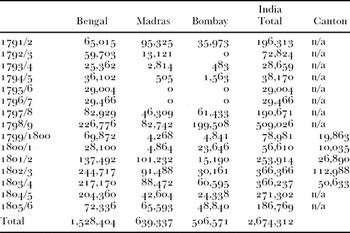
Silver was also shipped (illegally as well as legally) to Asia by the commanders of Company ships in order to fund their own commercial activities.Footnote 48 The price of silver had always been very favourable in China, and during the early 1770s occasional permissions were granted to the commanders of East Indiamen who wished to carry ‘foreign silver’ to Canton for the express purpose of exchanging it for gold.Footnote 49 In addition, during the following decade private silver was shipped there so that it could be loaned to the Company's supercargoes.Footnote 50 Some commanders of East Indiamen were also responsible for taking silver to India on their own account or on behalf of business associates, and on occasions their consignments were quite substantial. In 1803, for example, Archibald Hamilton carried over 37,000 Spanish dollars valued at £8,058 to Bombay; and two years later he shipped out to the same destination nine chests of silver dollars that had been purchased for £10,000. On the first occasion, Charles Forbes & Co paid Hamilton a sum for the dollars that was equivalent to £10,742; and on the second the leading Parsi merchant and shipbuilder, Pestonji Bomanji, paid him a sum equivalent to £12,458.Footnote 52 Such transactions demonstrate that there was a steady flow of private silver from Britain to Asia, and at times these became quite considerable, as is evident from a Company account which quantified annual ‘individual’ exports of silver from London to Bengal, Bombay, Madras, and Canton between 1791 and 1806. This information is presented in Table 3.
British private exports of silver to Asia, 1791–1806 (£s)

Source: BL, IOR, G/12/195, ff. 67, 68.Footnote 51
As noted earlier, aggregating the different flows of Company and private silver from Britain to Asia is simply not possible for most of the period under review, but, in 1813, the Company submitted to Parliament an account of imports of bullion into India and this quantified the different categories of legal shipments that had been made to the subcontinent between 1802/03 and 1810/11. Based upon data collected by the Company's Reporters of External Commerce, who monitored private trade activity at Bombay, Calcutta, and Madras, this information indicates that the Company's bullion imports were valued at £5,551,934 (77.1 per cent of the total); imports by private merchants amounted to £1,425,274 (19.8 per cent); and imports by the commanders and officers of East Indiamen stood at £225,062 (3.1 per cent).Footnote 53 In other words, over one-fifth of British exports of silver to India were being made through non-Company channels. But, since this was a peak period for exports made on the Company's own account, it is highly likely that at other times a rather greater proportion of the whole was being consigned to South Asia by private individuals. Consequently, and this has been acknowledged by Datta, to consider only the bullion shipped by the East India Company is quite significantly to underestimate the overall volume and value of exports of silver made from Britain to Asia during the late-eighteenth and early nineteenth centuries.
British intra-Asian movements and the reverse flow of silver to Britain
So far, this paper has established the volume, value, and distribution of British shipments of silver to Asia, but of course other non-British traders were also adding to the overall stocks held in India, China, and elsewhere. It was calculated, for example, that between 1802 and 1811 imports of silver into India from Britain (£7,202,270) accounted for only 43.8 per cent of the overall total, with imports from ‘foreign Europe’ (£2,626,482) representing 16.0 per cent, and those from America (£6,595,400), 40.2 per cent.Footnote 54 Silver was similarly imported into Canton direct from Europe by the continental trading companies, but it was also transferred to China from Manila, having been shipped across the Pacific from South America by the Spanish.Footnote 55 These flows of silver meant that throughout period the annual external supply of silver to Asia was always considerably greater than the consignments carried eastwards by the British. It also has to be remembered that exports of silver to Asia by the East India Company and British private traders did not always serve necessarily to increase the overall stock of specie held in either India or China to the extent represented by the export figures allocated to those regions in Table 1. As already noted, consignments could be lost or diverted from their intended destinations but in addition, and as with all imported bullion, the silver carried by the British did not always remain in the region it first entered upon arrival in Asia. European private traders had long contributed to intra-Asian flows of silver as they moved resources around and beyond the Indian Ocean, but after 1760 the interlinked commercial, imperial, and military needs of the English East India Company increasingly influenced movements of silver around South Asia, from one Indian Presidency to another, as well as from the subcontinent to China and vice-versa. Moreover, after 1800 the directors of the East India Company broke with almost two hundred years of commercial tradition and customary practice by making shipments of gold and silver to Britain, and this rather desperate attempt to shore up the Company's crumbling domestic finances established a reverse flow of silver which served to reduce the overall stock retained within the Asian economies at that time.
The catalyst to increasingly extensive British involvement in multilateral movement of silver around Asia was provided by the East India Company's conquest of Bengal, which to all intents and purposes was completed in 1765. The Company's subsequent desire to transfer ‘tribute’ from Bengal to Britain via China saw an expanding tea trade used as a remittance mechanism, but this could only function effectively if the Company's Canton supercargoes had sufficient funds with which they could procure large consignments of tea for the London market. As part of an evolving strategy intended to supply liquid funds to the supercargoes, the Company at first attempted to export silver from India on its own account. Thus in 1767, 16 chests of silver were sent from Bombay and 247 chests from Madras, with the latter representing a large part of a consignment of silver worth 24 lakhs of rupees that had been sent down the coast from Bengal.Footnote 56 In total these shipments amounted to around £250,000. Smaller residual amounts were sent from Madras early the following year, but by then the authorities in Calcutta were already complaining that Bengal had been ‘effectually drained of silver’.Footnote 57 Despite an order from London urging that a further shipment worth 24 lakhs of rupees be sent to the supercargoes,Footnote 58 the scarcity of specie eventually brought a halt to consignments to Canton made on the Company's own account, but not before a shipment of silver and rupees was sent from Bombay in 1770 and 30 chests of silver were dispatched from Madras the following year.Footnote 59
With its own finances in disarray, the Company's officials in India turned to private merchants to undertake the transfer of silver to Canton. This was done by offering bills on London to individuals in exchange for money privately shipped to China, and thus in 1776 one such scheme saw bills amounting to £105,129 issued in Calcutta against bullion supplied to the supercargoes in Canton.Footnote 60 It is unclear how regularly this occurred thereafter, although in 1788 Governor-General Cornwallis proposed to remit 12 lakhs of rupees to Canton in this way.Footnote 61 The existence of such evidence points to the fact that there was often a private British channel through which silver could be moved from India to China, and it was later noted that between 1792 and 1809 the ‘supplies’ sent from India to Canton included £700,440 received into the Treasury by the supercargoes, which presumably was silver shipped by private individuals.Footnote 62 Thereafter, silver valued at an annual average of Rs. 4,31,008 (or £43,100 using the standard exchange rate of 1 rupee = 2 shillings) was exported from the three Indian Presidencies to Canton between 1810/11 and 1827/28.Footnote 63
From the end of the eighteenth century the Company created a much larger flow of silver in the opposite direction, from China to India. This occurred when the Canton treasury was deemed to be overstocked with specie and the Company's Presidencies in India were struggling under the burdens of war. As a result, almost £2 millions in bullion was shipped from Canton to India between 1792 and 1809,Footnote 64 a period when the high wartime price of silver made it very difficult for the directors to procure adequate supplies in London.Footnote 65 Since throughout the period silver was a forbidden article of export from China, it is highly likely that the silver shipped out of Canton by the Company had never actually circulated within the inland economy, having been accumulated instead by the supercargoes in their own Treasury in the form of surpluses derived from a variety of external sources; and in fact Company records duly note that this bullion formed part of a supply that was ‘returned’ to India.Footnote 66 In later years even more silver found its way (illicitly) from Canton to India as the burgeoning trade in opium and raw cotton saw British private traders accept a substantial proportion of their payment in dollars. Indeed, the trade in raw cotton from Bombay to Canton had grown so rapidly after 1785 that one commentator wrote of a ‘golden current’ which saw ‘country’ or private ships carry large amounts of bullion (in fact mainly silver rather than gold) from China to the Malabar Coast.Footnote 67 The strength of this intra-Asian bullion flow became such that between 1810/11 and 1827/28 average annual imports of silver from Canton into British India were valued by local Company officials at Rs. 68,15,775 or £681,577.Footnote 68
The British thus moved silver around Asia throughout the period, but eventually they also shipped it back to Britain. This had been discussed as early as 1768, when the Bengal authorities were ordered by the Company's directors to send home £500,000 in the form of specie, by way of a direct remittance of the Company's newly acquired revenue wealth.Footnote 69 Yet nothing seems to have come of this because of the severe shortage of specie that afflicted the Bengal economy during the late-1760s, and the records contain no details of any Company silver imported into London from India at this time. Given the Company's generally parlous financial situation, and the gradually increasing pressures of war, there was never any realistic prospect that silver might be shipped from Asia to Britain during the last quarter of the eighteenth century, but some quite substantial shipments were made later, especially during the 1820s.
The need for the Company to establish a reverse flow of silver (and gold) from Asia after 1810 was caused by a general weakening of its commercial position, which became most obvious in the steep decline in textile imports and coincided with the loss of its Indian trade monopoly in 1813. As a result, the Company in London failed to meet all its domestic, empire-related, financial obligations (the so-called ‘territorial charges’), from surplus profits derived from commercial transactions, so the directors had to resort to direct remittances made in the form of bullion imported from China and India. A small amount of silver from China, originally intended for shipment to Madras, first arrived in London on the Company's account in 1810,Footnote 70 but at much the same time the Council of Bengal decided that remittances to Britain ‘in bullion in aid of the resources of the Treasury at home’ could be ‘most advantageously made thro’ the Hon. Co's Treasury at Canton.’Footnote 71 Accordingly the supercargoes were told that it ‘appears to us therefore necessary only to recommend on the present occasion that the surplus funds of your treasury which you may find it practicable to remit to England be distributed in equal proportions among the Hon. Company's ships which may sail from Canton under convoy.’ As a result, almost 1.5 million dollars arrived in London from Canton in 1811, with a further 100,000 dollars the following year.Footnote 72 Silver imported by the Company from China was sold in London for £597,688 in 1811/12, and consignments from Bengal raised £399,732 during the same financial year.Footnote 73
There were no further shipments from China for almost twenty years, before just over 4.5 million dollars were received in London from Canton between 1830 and 1833,Footnote 74 but Company transfers from India became regular and at times very considerable. In 1817 the Company's Chairman, Thomas Reid, declared it to be a general policy maxim that ‘The consignment of bullion from India to assist the Home Treasury can never be resorted to but as a temporary expedient. . .’,Footnote 75 yet the Company's steadily worsening financial circumstances in Britain dictated that within a few years such consignments did indeed become a regular feature of the directors’ remittance policy. In 1823, for example, when officials were struggling to meet the demand for payments on bills of exchange drawn to facilitate private loans to the Company in India, the directors ordered that an ‘extraordinary remittance’ of £2 millions be made from India, and expressed the hope that as much as possible should be sent in gold because it is ‘a considerably more favourable remittance than silver’.Footnote 76 In the event, silver valued at £602,890 was imported into London from Bengal during 1823/24, together with gold worth £1,142,042 from Madras and Bombay.Footnote 77 Yet despite the directors’ stated preference for gold, which at times was indeed consigned in large quantities, silver loomed large in most invoices because, on the whole, it seems to have been easier to procure in India. Some in London, such as the financier Nathan Rothschild, declared that shipments of bullion now represented the best way of transferring tribute to Britain,Footnote 78 but others recognised that the Company's ‘home charges’ could no longer be met in London without such transfers from Asia. Indeed, the net amount received in the metropolis by the Company for bullion imported from Asia amounted to £8,105,036 between 1811 and 1833, even though the loss on sales of gold and silver between 1823 and 1833 was reported to stand at just over £1 million.Footnote 79 The importance of this was duly acknowledged in 1830 by the Chairman of the Company, William Astell, when he wrote on the subject of bullion shipments from India: ‘I hardly know how we could get on without them.’Footnote 80
Of course, as has become evident elsewhere in this paper, any attempt to establish an aggregate figure for flows of silver from Asia to Britain needs to take into consideration the private movement of bullion, especially in view of the fact that British trade with India was opened to non-Company merchants after 1813. But, again, finding evidence in order to create a statistical overview of private flows of silver is far from straightforward and this leaves a ‘dark figure’ in the analysis. This problem was noted by contemporaries, and in 1840 a parliamentary account noted that although the ‘net produce of specie’ imported into Britain by the Company from India between 1810 and 1834 amounted to £7,976,819, this figure ‘does not bear a large proportion to the whole drainage from India, as the Company had recourse only to that mode of remittance to pay a part of the territorial charges in England, whilst individuals imported specie at the same time as merchandise’.Footnote 81 The compilers of this account could not locate any systematic data relating to private transfers of silver into Britain from India, and it has indeed proved impossible to find such information in the Company's records. Moreover, and rather remarkably, it appears that between 1787 and 1858 the government's customs service did not keep a record of silver and gold imported into Britain.Footnote 82 Yet, despite this lack of evidence, it would be reasonable to suggest that during the period 1810 to 1833 British exports of silver to Asia, which included Company shipments of £11 millions, plus private transfers of an unspecified amount, were more than offset by the imports of bullion from India and China, as noted above. Indeed, as far as India is concerned, and again duly acknowledging the importance of private transfers, it is highly likely that Britain eventually became a net importer of silver from the subcontinent.Footnote 83 This was a far cry from the one-way traffic in bullion for goods that had existed a century or so earlier, and it represented a major reconfiguration of the patterns that had long been evident in global flows of silver.
Conclusion
This paper has endeavoured to paint a clearer picture of British exports of silver to Asia in the decades after 1760, a period when Britain's relationship with India was dramatically recast as a result of territorial conquest, and trade with China underwent a great expansion. To be sure, the gaps, inconsistencies, and weaknesses that exist in the surviving evidence mean that it is simply not possible to generate long runs of figures detailing each and every British flow of silver into, around, and out of Asia. Nonetheless, it has been demonstrated that from time to time—and contrary to the belief of some historians—silver still played a prominent role in British exports to Asia; and emphasis has been placed upon the importance of private consignments, especially those sent to India. It has also shown that silver imported into India was applied to new uses in the imperial world being created by the East India Company on the subcontinent. Silver was especially important for the prosecution of war, and for the relief of debt, these usages differing from earlier times when specie had been used primarily for trading purposes. Furthermore, the paper has emphasized that the British were not simply responsible for the outward shipment of silver, because interlinked commercial and imperial imperatives generated ever-greater movements around the trading world of Asia, and towards the end of the period the East India Company in Britain became heavily dependent on reverse flows of bullion from Asia. This meant that an increasingly tangled web of silver transfers emerged after 1760, and this requires careful consideration in the analysis of Britain's balance of payments with different parts of Asia, as well as in discussions of regional economic conditions in both India and China.