Introduction
Human ageing is a social process. The social meanings of age and ageing shape how people are inscribed with age-specific opportunities and obligations, inform the negotiation of individual and social identities, influence how both individuals and groups experience ‘age’ across the lifecourse, and tie age-specific identities to social action (Phoenix and Sparkes Reference Phoenix and Sparkes2006a; Gilleard and Higgs Reference Gilleard and Higgs2000). In modern western societies, the conflation of chronological age (as an ‘objective’ measure) with the developmental stages (as a normative expectation) has constructed ageing as both an inevitable biological process as well as a series of age-specific social identities. Until the late 20th century, those identities were understood as relatively homogeneous, but with variations by stage or location in the life-course, and defined by their relationship to the capitalist production process and the social contract that underlies the post-1945 welfare state (Gilleard and Higgs Reference Gilleard and Higgs2000). ‘Old age’, for example, implied a life stage that began on reaching ‘retirement age’ and was characterised by progressive physical and cognitive frailty, limited financial resources, disengagement from social roles, and the ascription of an age-specific social identity – a ‘senior citizen’ (Gilleard and Higgs Reference Gilleard and Higgs2000: 90).
Understanding ageing as ascribed (marked by chronological age), as inevitable (marked by biology), and as tied to distinct stages of the lifecourse (marked by the homogeneity of age-specific identities) masks the ways in which the experience of ageing is tied to social and cultural practices (Gullette Reference Gullette2004). Some researchers have argued that the age-specific identities that until recently positioned older people as a homogeneous social group have been destabilised by the social, economic and cultural logic of late modernity (Gilleard and Higgs Reference Gilleard and Higgs2000). Retirement, for example, is no longer chronologically fixed. Appearance, previously understood as a biological marker of age, is increasingly mediated by intricate bodily practices, and the social disengagement and poverty associated with old age has been displaced by material heterogeneity as a consequence of differences in individualised ‘retirement planning’. In this context, older age is better understood as a ‘third age’ during which consumption-based identities are actively and purposively achieved and expressed:
Third-age identities are likely to be elaborated through increasing material consumption, a sense of ‘packing life in’ to an adulthood of uncertain length … and an ambivalent position in relation to providing for ‘old age’. Third-agers, while acknowledging old age, are likely to prefer to live at a considerable physical and psychological distance from it (Gilleard and Higgs Reference Gilleard and Higgs2000: 45).
This paper explores images of ageing and examines whether agentic, ‘third-age’ social identities have displaced the homogenising stereotypes customarily ascribed to older people. Using written accounts collected from 100 young New Zealanders aged between 16 and 18 years, we analysed their ‘images of ageing’ when imagining themselves aged 80 years. We found that young people use imagery that is comparatively free from the classic ageist stereotypes, and that rather than imagining diverse social identities when aged 80 years, they imagined a notably homogeneous conclusion to their lives. We argue that this homogeneity is the outcome of how young people imagine their future lifecourse, for the dominant narrative was of a ‘happy, stable and contented life’. The young people imagined themselves as old through recourse to three themes that constitute a discourse of ‘accomplished ageing’: that ageing is a contingent achievement, that older age is a time for harvest, and that one can ‘be old’ but also ‘stay young’.
Images of ageing
How ageing is understood illustrates the range of meanings about age and ageing that are in circulation at the time. Changing constructions of age and ageing, and variations in the social positioning of older people across different cultural and historical milieu, show how these meanings are both socially situated and discursively reproduced through cultural norms and practices. Images of ageing do not ‘reflect’ the essence of ‘real’ or ‘actual’ ageing. Instead, to constitute age-specific social identities, people reproduce learned meanings of ageing and the ways they are deployed (Featherstone and Wernick Reference Featherstone, Wernick, Featherstone and Wernick1995). Images of ageing tell us little about how individuals experience age-specific identities, but rather provide insights into how ageing is understood in general, which partly explains the material effects of the dominant constructions of ageing. In societies with a history of liberal welfarism, older people have been understood as a homogeneous social group with special social needs. The imagery of older people that informs this construction of old people as physically and cognitively frail, as socially incompetent, and as reliant on both their communities and the State, draws upon classic constructs in gerontology that link notions of decline, deficit and dependence (Featherstone and Wernick Reference Featherstone, Wernick, Featherstone and Wernick1995). Indeed, images of these ‘types of people’ (Hacking Reference Hacking, Heller, Sosna and Wellbery1986) have been and remain widely reproduced in popular culture (Carrigan and Szmigin Reference Carrigan and Szmigin2000; Kessler, Rakoczy and Staudinger Reference Kessler, Rakoczy and Staudinger2004; Lauzen and Dozier Reference Lauzen and Dozier2005; Robinson and Anderson Reference Robinson and Anderson2006; Robinson et al. Reference Robinson, Callister, Magoffin and Moore2007).
Research into how people think about ageing and older people illustrates the potency of ageist stereotypes that homogenise older people as a bounded social identity comprising undifferentiated interests and experiences (Nelson Reference Nelson2005). Many studies have shown that negative attitudes towards older people are pervasive across age groups (Kite and Johnson Reference Kite and Johnson1988; Montepare and Zebrowitz Reference Montepare, Zebrowitz and Nelson2002; Palmore Reference Palmore1982; Phoenix, Smith and Sparkes Reference Phoenix, Smith and Sparkes2007). Indeed, ageism begins at a young age. Even before starting school, children develop negative beliefs about ageing and older people (Blunk and Williams Reference Blunk and Williams1997; Middlecamp and Gross Reference Middlecamp and Gross2002). Schwalbach and Kiernan (Reference Schwalbach and Kiernan2002) found that children associate older age with physical weakness, lack of energy and illness, and expect to feel worried and sad when they themselves become older. Lichtenstein et al. (Reference Lichtenstein, Pruski, Marshall, Blalock, Lee and Plaetke2003) found that children expressed a greater number of negative than positive sentiments towards ageing and older people, and that many referred to physical characteristics and mobility.
When personal attributes were broken down by categories, children assessed older people's appearance, character, health and activity levels more negatively than positively, although their overall assessments were more likely to be neutral (Lichtenstein et al. Reference Lichtenstein, Pruski, Marshall, Blalock, Lee and Plaetke2003). Newman, Faux and Larimer (Reference Newman, Faux and Larimer1997) also found children more likely to address ageing in a neutral manner, but with a greater number of negative than positive responses. Children described being older as ‘scary, weird and lonely’, saw becoming older as predominantly negative, and associated ageing with dying, going to a nursing home, and being unable to ‘do things’ (Newman, Faux and Larimer Reference Newman, Faux and Larimer1997: 414–5). School-aged children have also been found to associate older people with participation in a narrower range of activities than those engaged in by younger people (Middlecamp and Gross Reference Middlecamp and Gross2002).
Relatively few studies have investigated the imagery that young people draw upon in relation to ageing and older people. Researchers have explored how young people view others who are already old, how young people view people they know as old, and how young people imagine themselves as old. These studies show that young people's attitudes towards older people are negative and that young people homogenise the age group on the basis of the negative imagery they use in accounting for older people and the ageing process in general (Kite and Johnson Reference Kite and Johnson1988; Scott, Minichiello and Browning Reference Scott, Minichiello and Browning1998). Young people's perceptions of older people tend to be more homogeneous than their perceptions of their own age group (Liu et al. Reference Liu, Ng, Loong, Gee and Weatherall2003), and more homogeneous than older people's perceptions of their age peers (Hummert et al. Reference Hummert, Garstka, Shaner and Strahm1994). Research into how young people regard others who are already old has found that young people have scant knowledge of older people's diverse experiences (Scott, Minichiello and Browning Reference Scott, Minichiello and Browning1998). Instead, they draw upon a range of negative stereotypes to describe older people, for example that older people are less sexual, physically limited, and have little strength (Kimuna, Knox and Zusman Reference Kimuna, Knox and Zusman2005). In addition to thinking of older people through images that draw on notions of decline, deficit and dependence, researchers have found that young people think of older people as bored, irritable, unreliable, and set in their ways (Mosher-Ashley and Ball Reference Mosher-Ashley and Ball1999; Scott, Minichiello and Browning Reference Scott, Minichiello and Browning1998).
Several studies have found gendered differences in how young people think about ageing. Young women fear age-associated losses more than men (McConatha et al. Reference McConatha, Schnell, Volkwein, Riley and Leach2003), and ageing is considered most negatively by young women because of its impact on appearance (Halliwell and Dittmar Reference Halliwell and Dittmar2003; Phoenix and Sparkes Reference Phoenix and Sparkes2006b). In contrast, young men view ageing as having a neutral or positive impact on appearance, but are more concerned with the negative impacts of ageing on physical ability and personal control (Halliwell and Dittmar Reference Halliwell and Dittmar2003; Phoenix and Sparkes Reference Phoenix and Sparkes2006b). There has been little research into how young people imagine themselves as old (Phoenix and Sparkes Reference Phoenix and Sparkes2006a), but the few published studies show that although young people's expectations about their own ageing are usually more positive than their images of older people in general, when imagining their own old age they nonetheless draw on negative stereotypes (Laditka et al. Reference Laditka, Fischer, Laditka and Segal2004; McConatha et al. Reference McConatha, Schnell, Volkwein, Riley and Leach2003; Mosher-Ashley and Ball Reference Mosher-Ashley and Ball1999). Phoenix and Sparkes's (Reference Phoenix and Sparkes2006a) research into young athletes' perceptions of self-ageing found that their participants envisaged both preferred and feared scenarios of ageing, and that these scenarios were strongly influenced by the experiences of, and contact with, older family members. Extending their analysis to how their participants imagined their own ageing, the young athletes were found to imagine older age as ‘static time’ and drew heavily on a narrative of decline – a ‘dominant story of ageing in western cultures’ that reinforces ageist stereotypes of older bodies as ‘problem bodies’, and of older lives as comparatively ‘empty’ (Phoenix, Smith and Sparkes Reference Phoenix, Smith and Sparkes2007: 246).
The primary research
This paper presents data from a larger research project that explored the imagined futures of young New Zealanders in relation to family life, friendship and personal relationships (Patterson et al. Reference Patterson, Peace, Campbell and Parker2007). One hundred young New Zealanders aged between 16 and 18 years completed a guided writing exercise that asked them to imagine themselves at various stages of the lifecourse.
The analytical framework
Analysing how young people imagine their futures to identify the range of meanings that young people use to make sense of contemporary social life is an established methodology (Bulbeck Reference Bulbeck2005a; Phoenix and Sparkes Reference Phoenix and Sparkes2006b; Pocock Reference Pocock2005). Some studies have explored young people's anticipations of imminent transitions in their lives, particularly from compulsory education into paid-work (Bradley and Devadason Reference Bradley and Devadason2008; Marks Reference Marks2005; Vaughan and Roberts Reference Vaughan and Roberts2007). Others have conducted gender and class analyses of young people's imagined social identities in adulthood (Bulbeck Reference Bulbeck2005b; Gordon et al. Reference Gordon, Holland, Lahelma and Thomson2005; Pocock Reference Pocock2005). Common to these approaches is a research methodology that provides insights into the meaning-making resources available to young people for understanding social norms, the discursive possibilities of these meaning-making resources for the enactment of individual identities, and the implications of meaning-making for social action.
The analytical framework informing such research is social constructionism (Burr Reference Burr2003). From this perspective, language and its constitutive effects are the primary interest. Through language, meanings may be constructed in various ways and used for several purposes, with different consequences depending on the linguistic resources that are available to make sense of situations, phenomena and experiences (Potter and Wetherell Reference Potter and Wetherell1987). The specific construction of meaning is not necessarily ‘conscious’ nor ‘freely produced’, as linguistic resources and the possibilities for their use are themselves inscribed with a history of cultural meaning (Potter and Wetherell Reference Potter and Wetherell1987). Through language, identities are also constructed and shaped by both the language used and its effects in terms of subjectivities produced and their social positioning (Mansfield Reference Mansfield2000). From this position then, ‘biographies of individuals articulate specific historical moments’ (Denzin Reference Denzin1992: 24), and the stories told by individuals are ‘social artifacts, telling us as much about society and culture as they do about a person or group’ (Riessman Reference Riessman2008: 105).
Methods and sample
Our research design drew on narrative analysis, which privileges story telling as a ‘practical activity’ whereby we, as story tellers, ‘piece together fragments from the toolkit of culture that ultimately… cohere into our stories’ (Clegg Reference Clegg and Mumby1993: 36). The narrative analysis approach, however, is generally applied to stories told by social actors that make meaning in relation to past experiences (see Riessman Reference Riessman2008; Plummer Reference Plummer1995). In our research, by contrast, the imagined futures of the participants were analysed. Our aim was to identify, describe and explain similarities and differences in how the participants ‘storied’ their imagined lives.
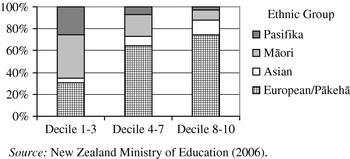
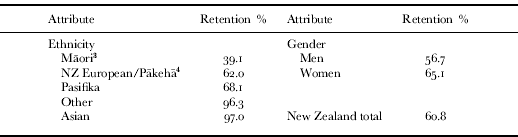
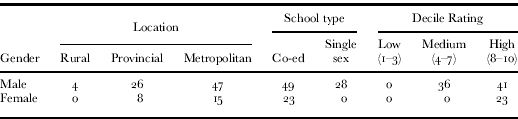
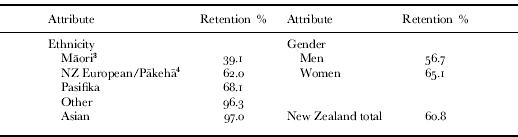
To collect the narratives (that we called ‘lifelines’), a guided writing exercise was designed for young people in their final year of secondary school. All the participants were in Year 13, and aged 16–18 years. Schools were recruited by contacting all secondary schools in the Wellington region (both the city and its provincial surroundings). No inclusion or exclusion criteria were used. In addition, a provincial school from outside the region was enlisted through a personal connection. Although the intention was that schools would be recruited across the socio-economic decile range, in the event all participants attended schools in areas with medium or high decile socio-economic status (SES) ratings, and metropolitan co-educational school pupils were over-represented.Footnote 1 Despite several attempts, no young men from single-sex schools took part in the research. As a result of recruiting from medium- and high-decile SES area schools, the participants were more likely to have come from particular socio-economic and ethnic groups (Figure 1). Recruiting from Year 13 may have raised the likelihood that the participants were from particular social groups (Table 1). Students who stay at school until 17 years of age in New Zealand are more likely to be female and non-Māori. Nonetheless, the participants were drawn from several types and locations of schools (Table 2).
New Zealand secondary school enrolments by school decile and ethnicity, 2006.

Retention rates at secondary school at age 17 years, New Zealand 2007Footnote 2
Participants by school location, type and decile rating
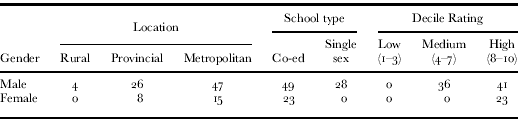
Notes: The overall sample size was 100. Co-ed: co-educational. For details of the decile rating system, see endnote 1.
The school principals were sent information about the research, and asked to nominate a contact person to assist with recruitment. Volunteer participants were drawn from the entire Year 13 population, and were briefed on the guided writing exercise by a member of the research team. They completed the exercise either at school or in their own time, depending on the school's preference. A pilot study was conducted with a few volunteers. They were asked to begin by describing how they imagined themselves at the age of 80 years, and then to write about what they imagined would happen during the intervening years, particularly with reference to family life, friendship and relationships. Following the pilot, the exercise was modified by suggesting age bands that could be used in writing about their futures: 18–25, 25–40, 40–55, and 55–80 years. The variations in the width of the age bands were to enable the participants to write much more about their imminent futures than their later lives.
Even the few pilot study lifelines revealed that the participants imagined a common lifecourse sequenced by similar events. Young adulthood was imagined as a time for self discovery (e.g. going to university, meeting ‘the one’); early adulthood was imagined as a time for family formation (e.g. establishing a household, marriage, birth of children); middle age was imagined as a time for family life to consolidate (e.g. children doing well, grandchildren born); and old age as a time for enjoying past achievements. Following the pilot, the participants were invited to write their lifelines in any form they chose, but all used the suggested time periods.
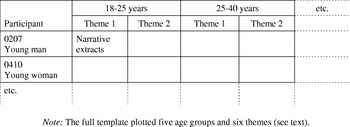
This paper focuses on the participants' imagined selves at age 80 years. These sections of the lifelines were indexed against three themes: material wellbeing, the body (physical ability and physical appearance), and relationships, and were also situated in the context of each individual's lifeline and our initial analysis of the complete data set (Patterson et al. Reference Patterson, Peace, Campbell and Parker2007). The initial analysis began with a series of structured readings of the lifelines by members of the research team. Following Ritchie, Spencer and O'Connor (Reference Ritchie, Spencer, O'Connor, Ritchie and Lewis2003), one researcher read all the lifelines and developed an index of the imagined life events (e.g. ‘marriage’) and of the themes (e.g. ‘family life’) for each imagined time period. To complete the analysis of each lifeline, and to relate each one to the entire set, a thematic chart was developed. Extracts from each lifeline occupied a separate row on the chart and could be compared to others in each age band by reading down the columns (Figure 2).
A portion of the thematic chart template.

Once the lifelines were charted, the research team collectively identified commonalities and differences in the temporal ordering of imagined key life events. Reading down the columns enabled us to identify that almost all participants structured the lifelines through a shared ordering of imagined events that occurred at similar biographical moments and with similar imagined effects. As in the pilot study lifelines, these life events included going to university, travelling overseas, meeting ‘the one’, getting married and having children. By reading across each row, we could see where and how these events were situated in each lifeline, and if not present, we read the particular narrative and discussed how that imagined future differed from the others. The lifelines of the 100 participants were remarkably similar in terms of the inclusion and timing of imagined biographical events. This shared temporality, however, gave only limited insight into the meanings that the young people drew on in imagining their future selves. To explore the underlying meaning, we re-read the charts and explicitly examined how events in each lifeline were ‘enlivened’ through tropes and imagery, and if such language use coalesced into shared meanings. This process found that one narrative in particular was present in almost all of the lifelines, that of a ‘happy, stable and contented life’, and that the participants fashioned it by the use of similar tropes and imagery.
This account of how we identified the narratives in the lifelines, and of our analysis of the significance of the discursive possibilities of the included themes, conceals what was inevitably a socially-situated process. Just as we were interested in the participants' meaning-making, as researchers we were also making meaning, both individually and collectively. Making epistemological claims required us to ‘judge’ our data and be reflexive about how we constructed knowledge (Smith and Deemer Reference Smith, Deemer, Denzin and Lincoln2000). On the surface, we judged the data by explicitly considering meaning. How we judged each narrative, however, and how each narrative (or part thereof) was similar or different from others, inevitably reflected our various identities and social locations. The consensus achieved through the analytic process was therefore dependent both on what was reported in the lifelines and the discursive possibilities open to the researchers for making sense of them.
During the analysis, five lifelines were found to be incomplete or unrelated to the guided writing activity. Although participation in the research was voluntary, these outliers suggested that perhaps a few young people had felt coerced into participating, or had no interest in the research. Following discussion, the five outliers were removed from the data set. Thus, although lifelines were collected from 105 young people, the data set for further analyses had 100 narratives.
Findings: the construction of ‘accomplished ageing’
Individualisation theorists have argued that in late modernity, identity formation has become ‘de-standardised’ and is now much more intimately shaped by individual ‘choices’ compelled by the ‘do-it-yourself’ biography (Beck and Beck-Gernsheim Reference Beck and Beck-Gernsheim2002; Giddens Reference Giddens1992). In relation to ageing, ‘age’ and ‘stage’ have perhaps become uncoupled, and ‘cultures of ageing’ promise multiple consumption-led identities in later life (Gilleard and Higgs Reference Gilleard and Higgs2000). Our analysis of the imagery of ageing and old age used by young people imagining themselves as old found that they drew on three themes that constituted a discourse of ‘accomplished ageing’: ageing is a contingent achievement, old age is a time for harvest, and one can ‘be’ old but ‘stay’ young. The three themes are now explicated in turn.
Ageing as a contingent achievement
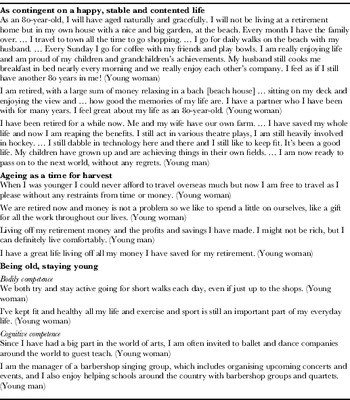
The young participants imagined the details of their future lives in many different ways, but typically constructed a narrative structured by a series of key life events that occurred at broadly similar biographical times. The temporal ordering of imagined events, such as meeting ‘the one’, marrying, having children, caring for children through to adulthood, and the subsequent arrival of grandchildren, drew on an imagery of family life lived in the context of material (and especially financial) security. This security, along with enduring intimate relationships and emotional security across the lifecourse, constituted the foundational plot in the dominant narrative of a ‘happy, stable and contented life’. Young people's descriptions of themselves at 80 years of age were necessarily contextualised by their imagined achievements of identities and lifestyles and the narration of key events that made up a happy, stable and contented life. Thus, imagining ‘being 80’ was set in the context of an imagined life trajectory to that biographical moment. For almost all participants, imagining themselves aged 80 years produced accounts of old age that were not only notably optimistic, but contingent on prior success ‘experienced’ across the life-course (Table 3).
Text extracts illustrative of the three themes of ‘accomplished ageing’

Negative images of ageing were rare in any of the participants' accounts. Loss was typically associated with lack of access to experiences previously narrated in the participants' imagined future, or mediated within the context of the lifecourse. A young woman envisaged that at 80 years of age, ‘my travelling days are over’, and a young man imagined that at that age, ‘I feel content with what I have achieved, but also feel that I have let too many opportunities go past’. In most of the accounts, however, being aged 80 was described as a point in a continuum, and a point where life would be, on balance, positively evaluated. As a young man wrote, ‘after 80 years of life, I look back on my life with its lowlights, mid-lights and highlights, and realise that perhaps I have been successful’.
Ageing as a time for harvest
In imagining being 80 in the context of the lifecourse, many participants used the imagery of ‘harvest’. This imagines that the seeds of success are planted early in adulthood and mature over time to bear fruit. These include financial success over one's working life, as well as success in the making and maintaining of strong family relationships, and in ‘looking after oneself’ (in body and in mind). Importantly, the imagery of harvest combined both the natural and the social worlds. ‘Growing older’ was constructed as both inevitable and unavoidable (that is, a process in nature), while at the same time being contingent and amenable to sound preparation and care over time. Central to the ‘happy, stable and contented life’ was material success and financial security, typically imagined as established early in the lifecourse. In the young men's accounts, material success was typically imagined as an outcome of career success. In the young women's accounts, attachment to paid work was more varied as many also foresaw themselves caring for children, and imagined material security as a familial rather than individual achievement. This was set against a very traditional conception of a stable, continuous family life that drew heavily on an idealised ‘successful’ heterosexual couple with two or three ‘successful’ children.
Given this, imagining oneself at age 80 years typically included references to enjoying the material success and financial security accumulated over a life time, mostly through hard work and prudence (Table 3). Few participants imagined themselves in paid work at 80 (unless they were passionate about their occupation), and poverty in old age rarely featured. A few imagined great and unexplained wealth (one young woman wrote, ‘I'm sitting on my swingy chair on my porch of my mansion overlooking a beautiful lake in the Italian countryside’), but the majority of the accounts described the accumulation of familial wealth over time. Imagined wealth in later life was explicitly linked to personal effort, and financial security as a result of a lifetime of accumulation through work, rather than good luck. Whether success was imagined as comparatively modest or substantial, both presaged the harvest as a later-life experience. The idea of harvest was reflected in imaginings of ‘retirement savings’ and, for some, being 80 was imagined as an age at which one would be ‘rewarded’ by enjoying delayed pleasures.
Wealth and material success were also represented by references to ‘home’ and home ownership. Buying a family home was central to the ‘happy, stable and contented life’, and was typically imagined as occurring after coupling but prior to the birth of children. In imagining being 80, many used living in one's own home as a counterpoint to stereotypical notions of ‘aged care’ and especially institutional care. As one young man wrote, ‘I want to own the house I'm living in and don't exactly want to be thrown into a home’. The prospect of having to move to a smaller house or into a ‘retirement home’ was rarely imagined. When age-specific housing was mentioned, it was as a place that the participants did not envisage in their future, or a setting for agentic engagement rather than refuge or confinement. One young woman put the contrast well, ‘I wouldn't be living in a retirement village, but I might visit every Thursday for Bingo nights’. ‘Home’, when aged 80 years, symbolised independence as well as accomplishment in one's individual preparation for older age.
Being old, staying young
The participants' notably optimistic images of ageing and old age can be partly explained by their contingent imagining of having achieved material and financial success, and having established and maintained affirming and enduring familial relationships across the life-course. Human ageing is, however, an embodied process (Biggs Reference Biggs1997; Laz Reference Laz2003). Physical and cognitive changes associated with growing older ‘happen’ to individuals, and many of the participants imagined being 80 as a particular experience of embodiment. Imagining being aged 80 years was characterised by tropes and images of ageing that attributed meaning on the basis of bodily appearance as well as function. More significantly, however, bodies at 80 were typically described within the context of social (and especially familial) relationships that had structured their imagined lifecourse. As one young woman envisaged
As I sit rocking in my chair, I think of the days when Mark was still around, when I was young and free. My heart breaks when I think of my friends that have gone before me. Life is so precious and I can say I have lived it to the full. I am now 82 with grey hair, defined wrinkles which harshly dent my face and I live alone as a widow. My late husband, Mark, was the kindest of all men, not to mention very handsome.
For some, imagining their own bodies at age 80 drew upon homogenising ageist imagery that pervasively represents old age in western society (Rowe and Kahn Reference Rowe and Kahn1998). Negative images of older bodies were signified by both appearance and function. One young woman wrote, ‘(thankfully) I only started to go grey a few years ago so I don't have white hair!’, and another imagined, ‘I'm sitting on my lazy chair as I am 81, I'm very old and weak’. While stereotypical images of ageing bodies were present in some participants' accounts; in most instances these were mediated by the presence of an agentic self, who both experienced and simultaneously managed the older body. One young woman encapsulated the idea well: ‘I'm now used to the problems of being aged … and while it still frustrates me sometimes, I am dealing with it’.
Loss of physical strength and vitality, and decline in cognitive function, did not dominate most participants' imagery. Many drew upon notions of ‘the harvest’, and imagined a fit and active older body as the result of foresight, planning, self-management and control. Older bodies were imagined as ‘different’ from younger bodies but, for most participants, as contingent and amenable to bodily practices throughout the lifecourse. While there was an absence of references to body aesthetics in the young men's accounts, young women tended to conflate youth and beauty. One young woman wrote, ‘I miss being young and radiant’. Ageing ‘gracefully’ was a recurring trope, as in one young woman's account: ‘old age has treated me kindly and I have aged gracefully inside and out’. The participants also imagined older bodies (on the outside) as separate to a younger self (on the inside). Thus ‘being old’ was imagined in the context of an agentic engagement with ‘staying young’ (Table 3).
Embodiment at age 80 was often described in the context of continuing interests. Images of cognitive decline were largely absent from the participants' accounts, and instead it was imagined that when aged 80 years, there would be more time for the creative interests enjoyed early in life. ‘Being old’ was imagined as ‘staying young’ through activity, interest and engagement. For some, this was imagined as a life-long interest through which a continuous creative identity could be enacted, and age and life experience tied. In addition to continuing engagement in activities enjoyed earlier in the lifecourse, embodiment at 80 was also imagined in the context of enduring intimate and familial relationships. Consequential to establishing a procreative family in early adulthood, many participants imagined the presence of children and grandchildren in later life. Intergenerational relationships were generally imagined as agentic older people engaging with receptive younger family members. One young man idealised this idea: ‘I have seen to it that we see the family several times each year, and have everyone gathered at Christmas’. Intimate relationships were imagined as enduring and emotionally satisfying life-long partnerships. One young woman wrote, ‘my husband is my best friend, soul mate and our love for each other is stronger than ever’.
Finally, for some of the participants, 80 years of age was imagined as near the end of life: as a time when one's own demise was envisaged, and the deaths of contemporaries or life partners experienced. Although some participants imagined earlier deaths (through accidents and tragedies), many of the lifelines recognised that at 80 ‘death stalks life’. Even so, they imagined being old while at the same time staying young. Deaths of significant others featured as ‘events’ to be overcome, while one's own imminent death was a time for active and engaged reflection. One young woman wrote, ‘when it is time for me to leave this world, I will take comfort in the fact that I have lived life to its fullest potential’.
Discussion
Limitations of the research
Because we did not collect personal information about the background of the participants, we have not been able to explore in detail how social location influenced the futures they imagined. However, all the participants were born between 1989 and 1991 and were infants during an unparalleled restructuring of New Zealand's welfare state (Kelsey Reference Kelsey1995; Peters Reference Peters1997). Although the interplay between cohort and lifecourse is complex and socially mediated, the lives of these young people have, to date, been lived in a social context in which neo-liberal discourses of individual responsibility, self reliance and autonomy have been normative (Blaiklock et al. Reference Blaiklock, Kiro, Belgrave, Low, Davenport and Hassall2002). This does not mean that all the participants were ‘the same’, or indeed came from similar backgrounds. On the basis of observations in the schools, and from our reading of the participants' descriptions of their current situations, they had diverse social backgrounds and current interests. In part, this reflects the heterogeneity of the local communities of their schools.
Two other limitations of the research design should be noted. First, as the participants were volunteers, we have no way of knowing if their lifelines differed from those of young people who were uncomfortable with writing. In addition, as a consequence of the consent process, the participants knew in advance what they would be asked to write about. Therefore, the volunteers were not only able and willing to conceive their ‘imagined futures’, but were confident about submitting several pages of writing to someone other than their teacher, and were not deterred by their previous life experiences and current circumstances.
Implications of the findings
This exploration of the imagery used by young people when imagining themselves at 80 years of age has revealed some of the ways in which they understood ageing and older age. Their imagery implied possibilities for the enactment of particular individual and group identities, and provides insights into how young people understand themselves as social actors in relation to their future lifecourse. Their discourse of ‘accomplished ageing’ embraced normative expectations about how young people should live their lives, and was generally optimistic and free of ageist stereotypes, despite its homogeneity. The homogeneous identity imagined at age 80 years is, however, an unlikely outcome. In the following section, we discuss three issues that arise concerning the discourse of accomplished ageing: its utility as a guide for meaning, its identity components, and its potential as a guide for social action.
‘Accomplished ageing’ as a guide to meaning
Previous research has shown that young people generally hold negative views about ageing and old age, and homogenise older people as an undifferentiated social group (Kite and Johnson Reference Kite and Johnson1988; Liu et al. Reference Liu, Ng, Loong, Gee and Weatherall2003). Some researchers have found, however, that when young people imagine themselves as older people, they are more positive about their own old age (Kimuna, Knox and Zusman Reference Kimuna, Knox and Zusman2005). In general, the participants were optimistic about their own old age, and they used three themes to articulate the notion of ageing as an accomplishment. The discourse of ‘accomplished ageing’ attends to the ways in which the experience of older age is understood as contingent on the individual experience of predictable, temporally-ordered biographical events that ensure material (including financial) and familial (including emotional) success. A ‘good life’ as an older person was thus contingent on appropriately sequenced individual achievements, and later life was seen as a time when such achievements would be enjoyed.
Older age was thus understood as a time of harvest, a powerful image that combineed both the natural and social worlds. While plants grow naturally, human planning, planting and cultivation maximise the yield. Importantly, the imagery of harvest in these young people's accounts referred to their personal success in preparing for their own harvest through normative achievements across the lifecourse that provided comfort, contentment and emotional wellbeing in older age. Finally, ‘accomplished ageing’ was imagined as an embodied experience by which an older body houses a younger self. This ‘mask of ageing’ (Featherstone and Hepworth Reference Featherstone, Hepworth, Bytheway, Kiel, Allat and Bryman1989) is not experienced upon reaching older age, but is a consequence of managing one's body over the entire lifecourse. Similarly, the ‘young’ self that stays engaged in creative, social and familial relationships is imagined as a life-long identity. The juxtaposition of a changing body but stable self implies individual agency across the lifecourse, as well as specific bodily practices in older age. While the older body may house a younger self, the embodied experience of older age is imagined with elements of both acceptance of and resistance to the individual experience of ageing.
As a discourse, ‘accomplished ageing’ offers young people a guide to the meaning of ageing and older age. Its three constituent themes construct ageing as an inevitable experience in the context of the lifecourse, and as an experience that can and should be planned, managed and responded to. While ‘accomplished ageing’ does not tell us how young people make sense of the experiences of the currently old, it does give insight into how young people imagine themselves as agentic social actors throughout their future lives.
Accomplished ageing and identity
Tulle-Winton's (Reference Tulle-Winton1999) study of new retirees' experiences of moving into smaller housing also found that older people's attitudes to ageing and old age were contingent on their earlier life experiences. She showed that discourses of ‘successful ageing’ compelled new retirees to keep busy, to keep active, to plan for their future (in spite of the uncertainties of the health of some of the participants), and ‘to age successfully’ by being ‘ageless’ (1999: 297). Similarly, Andrews (Reference Andrews1999) critiqued ‘agelessness’ as a new form of ageism, which placed new demands on older people to live in stipulated ‘age-free’ ways. Both authors argued that the ‘positive’, ‘ageless’ identities that older people are increasingly expected to enact, produce new forms of self-regulation, and that they are as homogenising and ageist as the previously dominant bio-physical and psycho-social discourses that constructed older age as a time of decline, disengagement and dependence.
While the ‘accomplished ageing’ discourse will not determine how the participants experience ageing and old age, like other discourses of ageing, it infers ‘morally-laden messages that shape possibilities for being and acting’ (Rudman Reference Rudman2006: 181). To age successfully, to ‘accomplish ageing’, young people imagine themselves as simultaneously achieving in the present, while also agentically preparing for their future. Thus, a ‘happy, stable and contented life’, the outcome of an ‘appropriate’ lifecourse, requires a moral subject who is both perpetually active and self-governing. Indeed, ‘accomplished ageing’ has parallels with the concept of ‘successful ageing’ that informs the ‘New Gerontology’, in that individuals are discursively exhorted to ‘contribute to their continued good health’ in order to age successfully (Holstein and Minkler Reference Holstein and Minkler2003: 789). As critics have noted, the New Gerontology is premised on individuals making the ‘right’ choices in order to ‘age well’ through a homogeneous imagery of ‘successful ageing’ as a normative moral and physical state (Holstein and Minkler Reference Holstein and Minkler2003). However, through the accomplished ageing discourse, the experience of old age is asserted by imagining the life-long self-management of one's corporeal and cognitive state and one's ‘corporate self’: a prudent, self-reliant citizen who experiences ageing in the context of successful material accumulation and enduring familial relationships across the lifecourse. ‘Accomplished ageing’ puts not only health and wellbeing largely in the hands of individuals, but also creates the responsibility to amass adequate material and emotional resources to live the normative ‘happy, stable and contented life’.
In critiquing the ageist assumptions of successful ageing, as posited by self-help books that encourage older people to be active and ageless subjects, Andrews (Reference Andrews1999: 304) noted that one book's stated purpose, ‘to encourage success in all aspects of later life’, would be considered ‘mission impossible’ if it claimed to ‘encourage success in all aspects of life’. Throughout the young participants' narratives, the normative assumption that individuals should and can be ‘active’ (in the present and in preparing for the future) was imagined. The requirement for perpetual action thus suggests that the expectation of activity itself is not ageist; rather, that ageist imagery is at least partially linked to ‘success’ and ‘failure’ in managing oneself across the lifecourse.
Imagining oneself as perpetually active in the present and in preparing for the future echoes the claim that late modernity is characterised by individualisation (Beck and Beck-Gernsheim Reference Beck and Beck-Gernsheim2002). Accordingly, as the identity-based institutions of modernity disintegrate (as with class structure), the processes of individualisation demand an ‘elective biography’ that requires individuals to ‘lead a life of one's own’ (2002: xxii). The agentic individual mirrors the idealised subject at the heart of neo-liberalism: a resourceful, reflexive, self-governing individual that makes decisions in the context of their current circumstances and future desires (Cheyne, O'Brien and Belgrave Reference Cheyne, O'Brien and Belgrave1997). In imagining themselves as perpetually active individuals, however, the participants' prospects for identity formation are surprisingly homogeneous, and characterised by an almost hegemonic optimism made possible by life-long material and emotional security. This homogeneity also suggests that the various agentic social identities promised in the ‘third age’ may be overdrawn (Gilleard and Higgs Reference Gilleard and Higgs2000).
Accomplished ageing and social action
The dominance of accomplished ageing in the participants' imagined futures does not mean that their lives, or indeed their experiences as older people, will turn out as they imagine. As a cohort, their lives are likely to include disparate experiences and outcomes, as a result of different material opportunities and family experiences, the persistence of prejudice and intolerance, and unexpected life events. In New Zealand, political responses to the interests of older people have been much contested over recent decades. As in other liberal welfare states, concerns about an ageing population have been heightened by the rising costs of state pensions, health and care services, and the impact of ageism on older people's experiences more generally (Davey and Glasgow Reference Davey and Glasgow2006). In the 1990s, concerns about the ageing population dovetailed with neo-liberal welfare reform discourses that envisaged moving all ‘from welfare dependence to self-reliance’ (Davey and Glasgow Reference Davey and Glasgow2006: 21). For older people, the universal state pension was replaced with a means-tested benefit and an asset-testing regime that shifted the cost of institutional care from the state to individuals. These policy changes were unpopular, as elections clearly showed. The universal pension was re-established, and the asset-testing regime made less punitive (St John Reference St John, Dalziel, Boston and St John1999). Thus, while the neo-liberal view that welfare dependency signifies personal moral failure attracted a modicum of public support for welfare reform more generally, the discourse has not greatly eroded state support for older people.
More recently, successive governments have adopted a social development approach to social policy, which focuses on moving individuals from ‘social exclusion to wellbeing and participation’ (Davey and Glasgow Reference Davey and Glasgow2006: 21). A ‘Positive Ageing Strategy’ is now being implemented, with broad goals to support older people's economic participation and contribution, as well as to enhance older people's self-reliance, independence and individual responsibility. Critics of the strategy note that it underplays the experience of frailty and dependence that some older people experience, makes the spectrum of ageing experiences invisible to those who are not old (thus reinforcing negative views of frailty and dependence), and ‘portrays older people as able to counter the effects of ageing through personal effort’ (Davey and Glasgow Reference Davey and Glasgow2006: 25).
In imagining themselves when aged 80 years, many of the participants drew upon images of ageing consistent with the ‘Positive Ageing Strategy’. ‘Failure’ in old age, or indeed failure to ‘succeed’ at any point of the lifecourse, was almost unimaginable. In reality, however, interruptions to ‘accomplishing ageing’ might occur at any time, which raises a number of issues for those who, for whatever reason, do not achieve the ideal. Some of the participants will experience a very different life and old age from those imagined. The social identity promised by ‘accomplished ageing’ can be thwarted at any point by interruptions to the ‘happy, stable and contented life’. Individualised discourses that construct all social actors as ‘equally’ agentic despite persistent and strong structural inequalities, implicitly construct ‘failure’ as the outcome of individual behaviour.
The individualisation of failure also implies that the mitigation of, for example, social inequality, is an individual rather than a collective responsibility. Understanding the social world as comprising individuals ‘free to act’, both in the present and in preparation for their own futures, will impact on their relationships with other cohorts, and with those of their own cohort who fail to age as the ‘accomplished ageing’ discourse prescribes. This is especially significant given that the participants in our study are likely to accumulate more cultural, social and economic capital than many of their contemporaries and may be members of their cohort's ‘political and social elite’ (South, Baumer and Lutz Reference South, Baumer and Lutz2003). Young people may develop negative views towards the universal provision of age-related benefits or age-specific support for older people, and ‘unsuccessful’ individuals may become increasingly responsible for their own ‘personal’ marginalisation. Finally, young people may not have access to alternative identities other than those inferred by the ‘accomplished ageing’ discourse, as for example by remaining childless or eschewing consumption-intense lifestyles. While there may be possibilities for alternative (and optimistic) imagined futures, these may not be socially acceptable within the normative trajectory of the ‘happy, stable and contented life’ or possible within the discursive prescription of ‘accomplished ageing’.
Conclusions
In this paper, the discourse of ‘accomplished ageing’ has been identified as a meaning-making resource used by young people. In imagining themselves at 80 years of age, the participants used images that were generally positive about the experience of ageing, especially in relation to older age as contingent on achievements over their imagined life-course and as a time for harvest. Although some of their images of bodily appearance did reflect stereotypes of ageing, appearance and bodily function were also understood as amenable to life-long self-management. The young people imagined themselves as active and agentic throughout their lives, and through a notably homogeneous imagery of ageing, constructed a homogeneous social identity for older people who ‘accomplish ageing’.
The ‘accomplished ageing’ discourse affirms that ageing is a social process. The meanings of ageing that young people use have implications for how they experience their lifecourse and the identities they may come to enact, and intimate possibilities for social action. For these young people, ageing is accomplished, and the experience of old age is contingent on achievement over the lifecourse to ensure a ‘happy, stable and contented life’. These achievements are imagined as occurring at about the same biographical time and in a consistent chronological order. Although ‘accomplished ageing’ does not ascribe chronological age to life experiences, it does suggest that age-specific norms continue to shape individual and social identities, including homogeneous age-specific social identities. What remains to be explored is how cohort membership influences the ways in which those identities are understood and enacted. The findings suggest that young people understand ageing in relation to their own futures in notably optimistic ways, but in imagining ageing this way, they may find other experiences of ageing and alternative individual or social identities difficult to comprehend and accept.
Acknowledgements
The research on which this article is based, Lifelines: Young New Zealanders Imagine Family, Friends and Relationships Across Their Life-course, was funded by the New Zealand Families Commission ‘Blue Skies Research Fund’ in 2007. The research assistant, Katherine Forbes, is funded by a Building Research Capability in the Social Sciences (BRCSS) Research Grant, 2008.