





1. Introduction
The authority of judicial institutions is peculiar. Though it certainly has a backing of force, what sustains authority at a more fundamental level is a collective belief that the processes courts follow are legitimate. This legitimacy is built partly on trust. The public must be willing to accept decisions as authoritative even when they go against them, because they trust in the process and in those decisions. The question of what maintains such trust has always mattered, and it requires renewed attention now that courts are beginning to incorporate artificial intelligence (AI) into how they reach their decisions.
When judges use AI to help decide cases, what makes people trust the process that leads to that decision? This is no longer an abstract or theoretical consideration. There has been a steady proliferation of AI tools for assisting judges for different judicial decision-making tasks, reflecting a broader trend of AI-decision-making tools playing a significant role in other domains (Jammalamadaka & Itapu, Reference Jammalamadaka and Itapu2023; Pingili, Reference Pingili2024). At the time of writing, the European Commission for the Efficiency of Justice (CEPEJ) under the auspices of the Council of Europe notes the availability of 50 decision-support tools through its Resource Centre on Cyberjustice and AI (CEPEJ, 2025). The latest report of the CEPEJ Advisory Board on AI notes decision-making tools used by judges for, among other things, calculating scales for sentencing and compensation, extracting specific information in applications and summarizing texts (CEPEJ-AIAB, 2025). Other examples include generative AI tools to generate draft judgments in aviation passenger rights cases in Frankfurt (Schindler, Reference Schindler2024), recommender algorithms for measuring recidivism risk in the context of sentencing and parole decisions (Engel et al., Reference Engel, Linhardt and Schubert2025) and in the context of prospective risk of perpetration of intimate partner violence (Valdivia et al., Reference Valdivia, Hyde-vaamonde and García Marcos2025).
The proliferation of AI tools for helping judges decide cases raises a central question for judiciaries: how can courts maintain public trust when decisions are reached with assistance from AI tools? We propose that explanations about AI serve as the critical bridge to trust, and do so via enhancing perceptions of procedural justice. When courts meaningfully explain how AI contributes to the decision-making process, such explanations can serve as a procedural cue or demonstration that can help to satisfy court users’ expectations of procedural justice in judicial encounters, and through this mechanism, generate the trust on which judicial legitimacy depends. Put simply, explanations can lead to higher perceptions of procedural justice, which in turn fuels higher levels of trust. With higher levels of trust, judicial legitimacy is maintained. The theoretical framework set out below parses out each of these constructs – trust, procedural justice, legitimacy and explanations in AI, and speaks to how they are connected to each other. It is important to foreground that, following the lead of others, we treat trust as distinct from and antecedent to judicial legitimacy, particularly relying on Popelier et al. (Reference Popelier, Glavina, Baldan and Van Zimmeren2022). This framework is then used as a basis for the design of the experiments presented in this article.
To situate the contribution of this article in existing research, and to briefly overview related literature, other studies investigating perceptions of AI in judicial and other legal decision-making contexts gravitate toward examining preferences between human vs. AI decision-making in courts. Emerging evidence generally points to a persistent human-AI “fairness gap” in judicial contexts (Chen et al., Reference Chen, Stremitzer and Tobia2022; Sarel & Barysė, Reference Sarel and Barysė2024). When asked to evaluate sentencing, bail and arbitration procedures, participants rate algorithmic processes as less fair than human ones. Superior algorithmic accuracy does little to close this gap. Participants who learn that algorithms perform as well as, or outperform, human judges still perceive them as less fair (Chen et al., Reference Chen, Stremitzer and Tobia2022, Reference Chen, Hermstrüwer, Langenbach, Stremitzer and Tobia2025; Hermstrüwer & Langenbach, Reference Hermstrüwer and Langenbach2023). Individual experimental studies provide preliminary evidence that court users generally place greater trust in human judges than in AI ones, with trust in AI judges especially low in matters of emotional complexity (Yalcin et al., Reference Yalcin, Themeli, Stamhuis, Philipsen and Puntoni2023). People are more willing to trust AI for quantitative analytical activities such as calculating fines or fees than for judgment-driven decisions like drafting legal documents, determining bail eligibility or setting sentence length (Fine et al., Reference Fine, Berthelot and Marsh2025). Another study’s findings suggest perceived fairness of AI involvement depends to some degree on the stage of its use within the judicial process, with AI tools perceived as most fair when assisting in preliminary information gathering, while greater human oversight is preferred for later decision-making stages (Barysė & Sarel, Reference Barysė and Sarel2024). A further study comparing different decision-making processes found that fully automated decision-making was perceived as the least fair. However, purely human decision-making was also not rated the fairest. Rather, hybrid approaches, where humans and automated systems work together, received the highest trust ratings (Hermstrüwer & Langenbach, Reference Hermstrüwer and Langenbach2023).
Recent work has begun identifying what might close this fairness gap. Chen et al. (Reference Chen, Hermstrüwer, Langenbach, Stremitzer and Tobia2025) demonstrate that even minimal human oversight eliminates the perceived difference between human and algorithmic judicial procedures, though they caution this raises concerns about “humanwashing,” nominal oversight legitimizing substantively problematic procedures. Henning and Langenbach (Reference Henning and Langenbach2024) find that providing individualized reasons enhances perceived fairness of automated public decisions, with stronger effects for automated than human decisions. These findings suggest the gap is responsive to how AI-assisted processes are designed and communicated.
Despite these emerging insights, this study takes a different approach: assuming AI-assisted judicial decision-making (AIJDM) will be deployed, then the precise mechanisms through which specific interventions, such as explanations about AI, affect trust, and what psychological mechanisms mediate that, remain incompletely understood. As regards the role of explanations, broadly speaking, scholars argue that requiring explanations is a vital component in addressing the “black box” challenge in high-stakes AI decision-making (Adadi & Berrada, Reference Adadi and Berrada2018; Baselli et al., Reference Baselli, Codari and Sardanelli2020), noting that courts themselves may also help define what counts as an acceptable explanation across legal domains (Deeks, Reference Deeks2019). However, the role of different explanation types in shaping public trust in AIJDM specifically remains underexplored.
Moreover, and quite aside from empirical examination of whether explanations in this context foster trust in AIJDM, investigation into how and whether procedural justice serves as a mediator of trust remains limited. Chen et al.’s (Reference Chen, Hermstrüwer, Langenbach, Stremitzer and Tobia2025) mediation analysis comes close, suggesting that beliefs about accuracy and comprehensiveness explain more of the human-AI fairness gap than beliefs about empathy, but this examines beliefs about system properties rather than perceptions of procedural justice.
The present study (n = 859) aims to address these gaps by exploring the impact of explanations on trust and procedural justice perceptions in AIJDM. We extend prior work by examining not merely whether explanations enhance trust, but through what psychological mechanism they do so. Drawing on procedural justice theory, we propose that explanations affect trust primarily by enhancing perceptions of procedural justice, rather than solely by changing beliefs or educating participants as to the workings of AI systems. This represents a different mediating pathway than that examined by Chen et al. (Reference Chen, Hermstrüwer, Langenbach, Stremitzer and Tobia2025), with potentially different implications for how courts should communicate about AIJDM. In the following sections, we first develop our theoretical arguments for how explanations in AIJDM can enhance people’s trust. We hypothesize that explanations about AIJDM increase trust in judicial processes where they are used, and that this relationship is mediated by perceptions of procedural justice. In other words, and to reiterate, explanations may enhance individuals’ sense that a process is just, which, in turn, increases their trust in judicial processes where AIJDM is used.
We begin the theoretical argument by establishing what trust (a complex, multi-faceted construct in its own right) means in AI-assisted judicial contexts and its relationship with legitimacy. We then examine the role that explanations play in judicial contexts, distinguishing between transparency (the visibility of a process) and explanation (the communication of reasoning) with particular attention given to explainable AI (XAI) as resonating with the principle of open justice (Barry, Reference Barry2024). We then identify three dimensions of procedural justice from Tyler’s work – voice, neutrality and respect – as the mediating mechanism through which explanations generate trust, distinguishing our approach from prior work examining beliefs about system properties. In the sections that follow, we set out our experimental methodology, which manipulates explanation provision and case type. Our results are then presented, including tests of direct effects, mediation through procedural justice perceptions, and tests of whether case type moderated the mediation pathway. Finally, we discuss the theoretical and real-world impact of our findings for the integration of AIJDM into judicial processes.
For the purposes of this paper, we define AIJDM as an AI-based technology that assists a judge in a court (as opposed to other forums of dispute resolution) in arriving at a decision. By “AI,” we rely on the definition of AI systems provided by Article 3(1) of the EU AI Act 2024 (46/144), which states that “AI system” means a machine-based system that is designed to operate with varying levels of autonomy and that may exhibit adaptiveness after deployment, and that, for explicit or implicit objectives, infers, from the input it receives, how to generate outputs such as predictions, content, recommendations or decisions that can influence physical or virtual environments.
2. Theoretical framework
To reiterate, the theoretical framework we develop here is designed to explore the relationship between explanations of AIJDM and trust in processes where it is deployed, and what mediates that relationship. To this end, we conceptualize explanations as procedural cues that signal how judicial authority is exercised, procedural justice as the psychological mechanism through which these cues are interpreted, and trust as the evaluative outcome that sustains judicial legitimacy where AIJDM is deployed. This latter relationship – that trust is antecedent to, and can translate into durable legitimacy – aligns with the work of Popelier et al. (Reference Popelier, Glavina, Baldan and Van Zimmeren2022).
2.1 Trust in AIJDM
Trust has been described as a complex and multi-dimensional construct (Corazzini, Reference Corazzini1977; Lewis & Weigert, Reference Lewis and Weigert1985; McKnight & Chervany, Reference McKnight, Chervany, Falcone, Singh and Tan2001; Rousseau et al., Reference Rousseau, Sitkin, Burt and Camerer1998). Trust in courts receives far less attention than trust in other institutions and organs of government (Popelier et al., Reference Popelier, Glavina, Baldan and Van Zimmeren2022). Yet, when citizens trust courts, they become more willing to bring disputes before them and more likely to comply with the decisions that follow (Tyler & Huo, Reference Tyler and Huo2002). Another dynamic is that there are specific characteristics that elevate the importance of trust in governance systems (Six & Verhoest, Reference Six and Verhoest2017) – asymmetric expertise between the decision-maker and the affected party, opacity in decision processes, and the absence of scrutiny of decision-makers. All three resonate not only in the context of traditional judicial decision-making but also where AIJDM is used.
Across the wider trust literature, influential definitions emphasize openness to vulnerability to the actions of others (Mayer et al., Reference Mayer, Davis and Schoorman1995, p. 712; Rousseau et al., Reference Rousseau, Sitkin, Burt and Camerer1998, p. 395). Möllering (Reference Möllering2001, p. 411) describes trust as a “leap of faith.” However, these conceptualizations rely on interpersonal relations, assuming a trustee with intentions and benevolence. These do not translate straightforwardly to AIJDM contexts. Court users cannot meaningfully assess whether an AI system “wants to do good” or adheres to moral principles in the way they might assess a human judge.
Dual-dimension frameworks of trust comprising cognitive and affective trust provide a better foundation for conceptualizing trust in AIJDM contexts. McAllister’s (Reference McAllister1995) dual-dimension framework, building on earlier literature from Luhmann (Reference Luhmann2017), Simmel (Reference Simmel and Wolff1950) and Lewis and Weigert (Reference Lewis and Weigert1985), empirically established that trust operates through both emotional connections (affective trust) and rational assessments (cognitive trust). Crucially, this dual dimension framework has been applied specifically and successfully to measure trust in AI systems by Castelo et al. (Reference Castelo, Bos and Lehmann2019). They found that while both affective and cognitive dimensions of trust are equally likely to influence a person’s desire to rely upon AI, the relative weight assigned to each dimension varies by use case. They also found that in the case of subjective judgment tasks, people were more influenced by affective considerations rather than cognitive ones, whereas when considering tasks that could be described as objective, people relied on cognitive considerations. This bears resemblance to different types of judicial decision-making: some more objective in nature (e.g., quantifying compensation), others more based on subjectivity and intuition (e.g., evaluating credibility, apportioning fault).
We therefore adopt Castelo et al.’s (Reference Castelo, Bos and Lehmann2019) adaptation of McAllister’s dual-dimension framework as the most appropriate operationalization of trust (and, therefore, measuring trust) for our study. Importantly, in our framework, we suggest that trust is antecedent to, and what translates into durable legitimacy (Popelier et al., Reference Popelier, Glavina, Baldan and Van Zimmeren2022), and through it, voluntary cooperation, such as willingness to accept a decision. Jackson et al. (Reference Jackson, Hough, Bradford and Kuha2014), for example, define legitimacy, in a legal context, as distilled to two interconnected judgments: a felt obligation to obey legal authority, and trust that the authority acts lawfully and shares the moral values of the community. Likewise, Tyler (Reference Tyler2003, p. 306) argued that legitimacy in legal contexts constitutes “the belief that legal authorities are entitled to be obeyed.” For example, research on trust and legitimacy found that “trust in the police was an extremely powerful predictor of perceived legitimacy” (Hough et al., Reference Hough, Jackson, Bradford, Myhill and Quinton2010, p. 4). This finding is in line with Sunshine and Tyler’s (Reference Sunshine and Tyler2003, p. 513) influential study demonstrating that “legitimacy has a strong influence on the public’s reactions to the police, and second, the key antecedent of legitimacy is the fairness of the procedures used by the police.” This positions trust as both a precursor to and practical proxy for legitimacy, especially in experimental contexts where legitimacy’s behavioral manifestations (compliance, cooperation) are challenging to directly observe.
For the present study, we, therefore, focus on trust as our primary outcome measure for two reasons. First, trust captures the immediate evaluative response to AI-assisted judicial processes that necessarily precedes beliefs in the legitimacy of those processes. Second, in experimental vignette designs, trust is also more readily measurable than the downstream behavioral elements found in legitimacy. Next, we discuss the importance of explanations about AIJDM in driving trust in judicial processes where this technology is used.
2.2 Explanations and their role in trust of AIJDM
As AI systems become more common in high-stakes arenas, the need for clear and convincing explanations has grown, precipitating a subfield in the AI literature, XAI. Ali et al. (Reference Ali, Abuhmed, El-sappagh, Muhammad, Alonso-moral, Confalonieri, Guidotti, Del Ser, Díaz-rodríguez and Herrera2023, p. 8) define XAI as: “the process of elucidating or revealing the decision-making mechanisms of [AI] models …. The capacity to make automatic interpretations and describe the inner workings of an AI system in human terms.” An explainable technique gives reasons as to why an AI model made a certain choice and essentially condenses the reasoning behind an AI system’s decision into comprehensible terms for humans.
When courts introduce AI assistance into their decision-making processes, pressure is placed on two long-standing elements of open justice (Barry, Reference Barry2024). The first being the rule that justice must be delivered in public (transparency) and the second being the duty of judges to give reasons for their decisions (explanation). For example, the case of Loomis shows what happens when transparency is theoretically present, but explanations are missing State v. Loomis, 881 N.W.2d 749 (Wis. 2016). Eric Loomis challenged the use of a risk assessment AI tool called COMPAS, which was used to determine a risk recidivism score to assist the judge’s determination of the length of his prison sentence. The Wisconsin Supreme Court specifically noted that neither side could explain how the tool worked (State v. Loomis, 881 N.W.2d 749). Barry (Reference Barry2024) describes this as a failure of open justice. While the court did acknowledge the use of the algorithm so that theoretically, transparency was present, neither the judge nor the defense could meaningfully understand its reasoning.
Sarel and Barysė (Reference Sarel and Barysė2024) differentiate between two types of transparency concerns regarding AI use for judicial decision-making. The first is with respect to the workings of the algorithm itself. A party may not know which data points the system will consider, how each point will be weighted or the logical connection between input data points and the output generated by the system. The second is with respect to judicial use of the algorithm: even if the workings of the system are transparent, a party may not know whether the judge provided the algorithm with complete and/or accurate information regarding the case, whether the judge properly understood or interpreted the output generated by the algorithm, or whether the AI-generated recommendation was given appropriate weight relative to the judge’s own consideration. It is possible for a process to be transparent at one level (e.g., with respect to the workings of the algorithm) but opaque at another (e.g., with regard to judicial use of that algorithm). Our experimental manipulation is intended to address primarily the first type of transparency concern, separately testing an explanation for the process by which the AI system generates its recommendations and an explanation about how the system arrived at a specific recommended outcome in the case at hand.
Barry (Reference Barry2024) also integrates insights from XAI literature, distinguishing macro explanations about how AI systems work in general from micro explanations of how and why an AI system produces a certain output. Hendrickx (Reference Hendrickx2025) develops this further by situating the duty to give reasons as central to accountability, transparency and legitimacy. Her proposal calls for two distinct types of reasoning when AI assistance is in play: pragmatic reasons (disclosing whether an AI was used, why, at what stage, how inputs were incorporated, etc.) and technical reasons (explaining the system design and limitations).
Research has identified numerous factors affecting public perceptions of judicial AI use beyond explanation provision. Sarel and Barysė (Reference Sarel and Barysė2024) have synthesized the emerging literature, finding that perceptions are influenced by a variety of factors. These include whether the case involves emotional complexity (Yalcin et al., Reference Yalcin, Themeli, Stamhuis, Philipsen and Puntoni2023); whether there exists a possibility of a hearing prior to a decision being made by an AI system (Chen et al., Reference Chen, Stremitzer and Tobia2022); whether the individual believes that the algorithm developer is benevolent; and whether the Judge trusts the AI (Fine & Marsh, Reference Fine and Marsh2024). Demographic factors such as age, gender, court experience and general trust in technology also influence perceptions (Barysė & Sarel, Reference Barysė and Sarel2024). Sarel and Barysė (Reference Sarel and Barysė2024) also found that perceptions are influenced by when in the process of decision-making the AI is used – i.e., used to gather data, analyze the data, choose an outcome or implement the decision.
The provision of reasons in adjacent, but not judicial settings, has received increasing empirical attention. Henning and Langenbach (Reference Henning and Langenbach2024) compared five reasoning models, varying in information density, in three public body decision-making contexts with over 4,000 German participants – reallocation of refugees, allocation of daycare places and university admission.
These studies identify interventions that can close the fairness gap but leave open the question of mechanism. Why do explanations enhance perceptions of trust? One possibility is informational: providing explanations helps people understand the decision and assess its quality. Another possibility concerns procedural justice perceptions: explanations signal that the decision-making process followed certain expected procedural norms. This second possibility would indicate that the presence of an explanation matters more than the actual content of the explanation, because the act of explaining, in and of itself, signals procedural justice. These two possibilities may also map onto distinct dimensions of trust. If explanations work informationally, by helping court users assess the quality and logic of a decision, they would be expected to enhance cognitive trust in particular. If, on the other hand, explanations work as procedural signals, communicating a respect from courts for the needs of affected parties to understand how decisions affecting them are reached, they may enhance affective trust by fostering a sense that the process treats individuals with care and dignity. As noted in Section 2.1, Castelo et al. (Reference Castelo, Bos and Lehmann2019) found that the relative weight of cognitive and affective trust varies by context, with subjective judgment tasks drawing more heavily on affective considerations, suggesting that the mechanism through which explanations generate trust may shape which dimension of trust is most affected.
2.2.1. Process vs. outcome explanations
For this research, we distinguish between two explanation types based on whether they describe how case-specific outcomes were generated (why) or general mechanisms of their operations and functionality (how). We designate them as process vs. outcome explanations in our AIJDM experiment, aligned to Barry’s earlier categorization of micro- vs. macro-level explanations.
Process explanations are general and systemic. They describe algorithms, rules and steps of a decision-maker without necessarily connecting these procedures to specific experiences or outcomes for parties involved. If refused a bank loan, a high-level process explanation might state: “the AI system took a comprehensive overview of your finances and assessed your ability to repay the loan.” Outcome explanations respond to the implied “why” question by linking distinct, specified elements of a case to the decision given. For the same loan refusal, an outcome explanation might state: “you were refused a loan because the algorithm detected significant online gambling activity. This makes you unlikely to be able to pay the loan back comfortably.”
We propose that providing either type of explanation will enhance trust in AI-assisted judicial decisions compared to providing no explanation. Explanations reduce suspicion that arbitrariness or bias operates behind opacity, enable engagement with reasoning even if post hoc and signal that the court takes seriously the need of a party to understand. Formally:
H1a: Explanations (vs. no explanations) will positively impact levels of trust in AI-assisted judicial decision-making.
We further propose that outcome explanations may generate greater trust than process explanations. This expectation derives from research on causal cognition. Waldmann (Reference Waldmann2017) notes that causal reasoning constitutes a core competence for evaluating and explaining events. Outcome explanations provide concrete causal links connecting circumstances to conclusions, mapping onto natural reasoning processes. Process explanations are more abstract and less causally related to the decision to be made. Henning and Langenbach’s (Reference Henning and Langenbach2024) finding that individualized explanations outperform abstract ones suggests outcome explanations should prove more effective. Thus:
H1b: Outcome explanations (vs. process explanations) will have a relatively larger positive impact on people’s trust in AI-assisted judicial decision-making.
2.3 Procedural justice as the mediating mechanism
Procedural justice can be understood as a central driver of trust in courts, particularly in contexts where citizens lack the ability to directly evaluate institutional performance (Popelier et al., Reference Popelier, Glavina, Baldan and Van Zimmeren2022). In their review of empirical studies on trust in courts, Popelier et al. caution against operationalizations that collapse trust and its antecedents into a single construct, noting that “this approach is problematic because it equates the concept of trust with the drivers of trust. This way, procedural fairness and performance become parts of the concept of trust, instead of independent variables that may explain trust.” Following this distinction, trust judgments are shaped by evaluations of how authority is exercised and whether procedures are perceived as just rather than by direct assessments of the technical quality of the decision. This perspective is especially relevant for AIJDM, where opacity limits court users’ capacity to evaluate correctness and increases reliance on procedural cues. We therefore treat procedural justice as the mechanism through which explanations of AI-assisted decision-making shape trust in judicial processes.
Procedural justice emerged as a sub-field of social psychology, when Thibaut and Walker (Reference Thibaut and Walker1975) first showed people care deeply about how decisions are made, beyond simply the result the decision yields. If a decision feels like it was made in a fair manner, people are more likely to accept it, even if it has negative outcomes. Building on Leventhal’s (Reference Leventhal, Gergen, Greenberg and Willis1980) influential work, Tyler (Reference Tyler1989) showed that procedural fairness is crucial in citizen evaluations of interactions with legal authorities. Importantly for this study, Tyler empirically identified four dimensions of procedural justice: voice, neutrality, respect and trust. Voice denotes the chance for an impacted party to express their views and participate meaningfully in the decision-making process (Folger, Reference Folger1977; Lind & Tyler, Reference Lind and Tyler1988; Tyler, Reference Tyler1989). This consists of a participant being heard while feeling a sincere consideration of their perspective, and that their input meaningfully influenced the outcome. Neutrality implies an unbiased, consistent application of rules based on established principles and factual information (Lind et al., Reference Lind, Tyler and Huo1997; Tyler, Reference Tyler2006). Decision-making authorities establish neutrality through transparency about their reasoning and adherence to precedent. Respect captures the interpersonal dimension, being that authorities treat individuals with dignity and recognize their rights and standing (Tyler & Huo, Reference Tyler and Huo2002). Finally, trust in this framework refers specifically to belief in the benevolent motives of the decision-making authority and genuine concern for those impacted by their decisions (Tyler & Huo, Reference Tyler and Huo2002). This fourth dimension merits careful treatment in the present study. Tyler’s framework positions it as a component of procedural justice evaluation, capturing assessments formed during an interaction with authority. This is conceptually distinct from system-level trust as an evaluative outcome following an experience with a judicial process. Trust as to “motives” of the human decision-maker/authority figure was the original conceptualization of this trust measure. The distinction parallels McAllister’s (Reference McAllister1995) differentiation between trust as an interpersonal judgment formed through interaction vs. trust toward institutions. This is an important distinction, as our experimental context does not see participants interacting with entirely human authorities whose motives they might assess. They instead evaluate a described judicial process and form judgments about whether to trust the AI-assisted decision-making process more generally.
We therefore operationalize procedural justice through voice, neutrality and respect as perceptual mediators while treating cognitive and affective trust as outcome variables. This approach finds support in Tyler’s own characterization of procedural justice as a mechanism for generating institutional trust. As Tyler (Reference Tyler2007, p. 28) argued, “focusing on procedural justice is a very good way to build trust and encourage compliance irrespective of who the people using the courts are.” Put simply, in his 2007 work on courts, Tyler specifically disaggregates and isolates trust as a separate concept (and does so via an illustration), and removes it from voice, neutrality and respect, the procedural justice tenets we use as our measures. Tyler notes that “procedural justice judgements are the most important factor shaping trust and confidence in the courts” (p. 29). These statements lead us to establishing procedural justice as the mechanism through which trust in legal institutions, particularly courts, is generated. Put another way, higher levels of procedural justice drive higher levels of trust.
Tyler’s framework has proven remarkably enduring and portable. Robust correlation between procedural justice perceptions, trust and legitimacy beliefs is reported across 64 studies (95 samples, 196 effect sizes) (Walters & Bolger, Reference Walters and Bolger2019). The concept endures across disparate political cultures, with procedural fairness of courts outweighing instrumental effectiveness when citizens decide whether authority is trustworthy (Jackson, Reference Jackson2024).
Glavina and van Zimmeren (Reference Glavina and van Zimmeren2025) argue that procedural justice occupies an unusually ambivalent position within the trust literature, insofar as it functions at once as a property of the trustor’s experience and as an attribute of the trustee’s conduct. At the experiential level, procedural justice concerns how individuals feel they have been treated by (judicial) authorities. Our experimental manipulation is designed to intervene at the level of the trustee by altering the nature of the explanations offered about the role of the AI system. However, the outcomes we measure are located firmly on the side of the trustor, operationalized through perceptions of voice, neutrality and respect. In this sense, the act of explaining may matter as much, or more, than the content of the explanation itself.
Unlike human judges, whose reasoning processes are articulated and are presumed to follow professional norms and legal training, AI systems usually operate through a process that often remains opaque to end users (the “black box”). This opacity risks undermining every dimension of contemporary procedural justice in specific ways. Without explanations, participants cannot meaningfully exercise voice as they are unable to engage with or contest reasoning they cannot see. Suspicion falls over the neutrality of the process when the basis for a decision remains hidden, as this opacity runs the risk of breeding suspicion of bias or arbitrariness. Respect could suffer if parties feel their dignity and standing are reduced to a simple AI calculation, as they receive unexplained AI output rather than reasoned, dignified, respectful judgments that acknowledge their arguments and standing as individuals. Therefore, explanations may serve a rehabilitative function in AI-assisted contexts, as they restore the communicative elements that procedural justice requires. By explaining what factors the AI considers and how it weights them, how it processes information or why it reaches a particular conclusion, explanations may help to transform an opaque, potentially dehumanizing process into something that can approach the reasoned, dignified deliberation court users need and anticipate from court processes. Formally, we propose that:
H2a: Explanations (vs. no explanations) will positively impact people’s procedural justice perceptions in AI-assisted judicial decision-making.
H2b: People’s procedural justice perceptions will positively impact trust in AI-assisted judicial decision-making.
H3: People’s procedural justice perceptions will mediate the relationship between explanations and trust in AI-assisted judicial decision-making.
2.4 Decision context as a moderating factor
The design of explanations in AI-assisted legal adjudication cannot be evaluated in isolation from the context of dispute or issue to which they are applied. We propose that the type of decision-making task which the AI assists with fundamentally shapes litigant perceptions of trust and procedural fairness. As such, we distinguish between AIJDM to assist with decisions on liability and to assist with decisions on quantum (amount of compensation). Liability cases involve the allocation of blame and responsibility (Kadish, Reference Kadish1985), while quantum cases concern the calculation of compensation (Marzal, Reference Marzal2021). Processes that assign fault invite greater sensitivity to fairness and legitimacy, in contrast to processes that deal only with binary calculations of amounts, which tend to be viewed in more pragmatic terms. Evidence from the adjacent public health literature shows that procedures are perceived as less fair when they involve fault-finding compared with non-fault contexts (Elbers et al., Reference Elbers, Collie, Hogg-johnson, Lippel, Lockwood and Cameron2016). This suggests that liability cases accentuate the importance of how the process is justified, while less scrutiny of procedural justice norms may exist in compensation cases or contexts.
The literature on algorithm aversion supports this logic. AI aversion increases with the gravity of consequences, with participants being more reluctant to rely on AI in situations where errors could result in imprisonment or death than when errors had relatively trivial consequences such as a poor recipe recommendation (Filiz et al., Reference Filiz, Judek, Lorenz and Spiwoks2023). Comparable evidence appears across nine experiments showing resistance to AI making morally relevant decisions in high-stakes, morally loaded domains, including the military, medicine and, most relevantly, law (Bigman & Gray, Reference Bigman and Gray2018). This aversion is traced to perceptions that AI lacks a full human mind (the capacity to both think and feel), which participants perceived as a prerequisite for moral judgment. Liability disputes are precisely the kind of morally laden domain where this aversion may emerge most strongly. We therefore propose that the explanation → procedural justice → trust pathway depends on case type. Explanations matter because they signal key factors of procedural justice, such as respect and neutrality, and these signals drive trust. In liability contexts where legitimacy and moral standing are implicated more, explanations may carry greater weight in shaping procedural justice perceptions. In quantum contexts, procedural justice perceptions may be less significant because compensation decision-making is made in a more binary, formulaic manner. To note, in our experimental conditions, all litigants receive an unfavorable outcome, even those who are in a compensation case, as the amount awarded does not cover the legal costs associated with the case or the financial outlay to remedy the dispute in question – effectively, the scenario prescribed that the participant was financially worse off for having taken the litigation. We thus posit that:
H4: The indirect effect of explanation type on trust (via procedural justice) is stronger in liability cases than in quantum cases (moderated mediation).
3. Methods
3.1 Study design and participants
To test our focal hypotheses, this study employed a 3 (explanation type: process, outcome, no explanation) × 2 (case type: liability, compensation) between-subjects experimental design. The study was granted ethical approval from Trinity College Dublin and was pre-registered on AsPredicted (#218599). All participants were required to provide explicit informed consent and could withdraw from the study at any time.
Nine hundred eighty participants were recruited via Prolific on March 18, 2025. Sample size was calculated via a priori power analysis, which estimated the necessary n given an alpha level, desired power (1 − b) and effect size. This was considered ideal as it allowed us to control for both Type I and Type II errors (Kang, Reference Kang2021). From an initial sample of 980 UK adults, we applied pre-registered exclusion criteria. Seventeen participants were removed as they did not complete the survey, while a further 14 were removed for failing the attention check question (“This is an attention check, please select ‘Strongly Agree.’”). An additional 90 who incorrectly identified either their issue type or explanation type, or both, were also removed.
3.2 Vignette design
This study employed a vignette format (Steiner et al., Reference Steiner, Atzmüller and Su2016). All participants were asked to read a vignette and imagine themselves as a party in a contractual dispute with a builder that concerned the inadequate renovation of their home. In the scenario, the builder had orally, and somewhat ambiguously, promised the participant that their home would be “as warm as a winter blanket” but a dispute arose over whether the builder sufficiently insulated walls to achieve this, resulting, from the homeowner’s perspective, in the prospect of significantly higher heating costs than anticipated. Participants were informed that courts had begun using an AI tool to assist judges in decisions for cases worth less than £15,000 (STG), with judges always retaining final decision-making authority. Importantly, all participants, in every condition, received an unfavorable outcome. In the liability scenario, the participants were informed that they had lost the case and that the judge had found the builder not liable. In the compensation scenario, the participant received less than the monetary amount they expected and were financially worse off as a result of legal fees.
3.3 Measures
Two key factors were manipulated within the study, case type (2; liability vs. quantum) and explanation type (3; outcome vs. process vs. no explanation). Case type served as the moderator and varied between liability and compensation conditions. In the liability condition, participants read that “the court is deciding if the builder is liable. This means deciding whether the builder is legally responsible for solving the problem.” In the compensation condition, they were told “the court is deciding how much compensation you are entitled to.”
Explanation type served as the independent variable and varied across three levels. In the no explanation condition, participants were informed that “the court does not provide you or the builder with any explanation about how the AI functions or the role it played in helping the judge reach their decision.” The process explanation condition provided detailed information about the AI’s process, describing how it “examines the specific details of your case, drawing from a diverse range of data sources,” conducts “data preprocessing” and “applies an advanced algorithm.” The outcome explanation condition offered case-specific information, stating that “in your case, the AI analysed a broad set of similar cases in which homeowners sued builders over verbal assurances about renovation quality. It identified ten previous court cases with similar circumstances.” The full vignettes and survey instrument are available in the Supplementary Appendix. All other constructs were measured on 7-point Likert scales ranging from strongly disagree (1) to strongly agree (7).
Informational justice scale was used as a manipulation check. The effectiveness of this scale was assessed via three items measuring whether the explanation was clear, helped participants understand the AI tool better and was sufficient (α = .965, ω = .965).Footnote 1
Procedural justice was measured across three dimensions (voice, neutrality, respect) following Tyler’s framework. Voice was evaluated through a three-item scale measuring consideration of participant rights, perceived influence over the outcome and their ability to express views (α = .835, ω = .841). Neutrality was assessed using three items addressing whether decisions would be based on accurate information, free of bias and apply legal rules consistently (α = .860, ω = .860). Respect was assessed via a four-item measure concerning protection of participant rights, dignified and respectful treatment, maintaining professional standards, and whether concerns would be treated seriously (α = .914, ω = .914).
Trust served as our main dependent variable and was assessed using an adapted scale from Castelo et al. (Reference Castelo, Bos and Lehmann2019) specifically relating to trust in AI-assisted decisions. Cognitive trust consisted of three items measuring the trustworthiness of the AI-assisted decision-making process, how beneficial the process was and how well it performed (α = .933, ω = .934). Affective trust included three items exploring perceptions of whether the process was unsettling, went against beliefs about computer use or made participants feel uncomfortable (α = .924, ω = .926).
Past legitimacy measures (Levi et al., Reference Levi, Sacks and Tyler2009) have included people’s “intention to obey” as a component; as such, Intention to appeal was included as an additional variable to evaluate participants’ willingness to accept the judge’s ruling, providing an alternative proxy measure of legitimacy. Appeal intentions were captured with a single item asking participants how likely they would be to appeal the decision, rated on a 7-point scale from 1 “Extremely unlikely” to 7 “Extremely likely.”
3.4 Reliability and validity
Internal reliability was calculated using both Cronbach’s alpha (α) and McDonald’s omega (ω). As McNeish (Reference McNeish2018) notes, omega allows for heterogeneous loadings and offers more robust reliability estimates. Values were almost identical across constructs, with the voice subscale being the one exception, showing only a minor difference, consistent with findings that alpha and omega converge under tau-equivalence (Geldhof et al., Reference Geldhof, Preacher and Zyphur2014). All scales demonstrated either good or excellent internal consistency. Voice (α = .835, ω = .841), Neutrality (α = .860, ω = .860) and the Procedural Justice composite (α = .825, ω = .839) showed good reliability, while Respect (α = .914, ω = .914), Cognitive Trust (α = .933, ω = .934) and Affective Trust (α = .924, ω = .926) confirmed excellent reliability. These values are above the conventional acceptable thresholds and support the internal consistency of the measures.
Face validity was assessed through methodological scrutiny best practices rather than computed statistics, as it is “based on judgment and is not a computed statistic” (Andrade, Reference Andrade2018). The vignette format enhances ecological validity by presenting realistic scenarios while maintaining experimental control (Sheringham et al., Reference Sheringham, Kuhn and Burt2021) and allowing for precise isolation of key variables.
3.5 Data analysis
All data analysis was carried out in RStudio (2025.05.1+513). Manipulation check effectiveness was assessed via Analysis of Variance (ANOVA) with Tukey’s honestly significant difference test (HSD) post hoc comparisons. Hypothesis testing was carried out using two-way ANOVAs examining main effects and interactions. Mediation analyses employed the lavaan package in RStudio (Rosseel, Reference Rosseel2012).
4. Results
4.1 Manipulation check
A one-way ANOVA showed that the manipulation robustly differentiated explanation conditions on perceived informational justice (F(2, 856) = 1374.23, p < .001, η 2 = .763), which served as our manipulation check. As expected, ratings were lowest in the no-explanation condition (M = 1.42, SD = 0.80), higher with a process explanation (M = 5.07, SD = 1.10) and highest with an outcome explanation (M = 5.37, SD = 1.12). Tukey’s HSD confirmed that all pairwise differences were significant (all ps < .001): outcome vs. no explanation (mean difference = 3.95, 95% CI [3.75, 4.15]), process vs. no explanation (mean difference = 3.66, 95% CI [3.46, 3.85]) and a smaller but reliable advantage for outcome over process (mean difference = −0.29, 95% CI [−0.49, −0.09], p = .002), indicating participants clearly distinguished among explanation types as intended.
4.2 Descriptive statistics and intercorrelations
Table 1 presents descriptive statistics and intercorrelations among study variables. To avoid construct redundancy artifacts (Blance et al., Reference Blance, Tu and Gilthorpe2005; Cureton, Reference Cureton1966), correlations are presented among the individual procedural justice facets as opposed to including both the components and their composite. This approach provides clean estimates of discriminant validity while avoiding mathematical coupling that can artificially inflate correlations between composites and their own components.
Descriptive statistics and intercorrelations among study variables

Table 1 Long description
The table presents descriptive statistics and intercorrelations among six study variables measured on a 7-point Likert scale. Respect and cognitive trust exhibit the strongest positive correlation, indicating a close relationship between these variables. Appeal intention, however, shows negative correlations with all other variables, suggesting that higher scores in voice, neutrality, respect, cognitive trust, and affective trust are associated with lower intention to appeal. The mean scores range from 3.02 for voice to 4.70 for appeal intention, with standard deviations indicating variability in responses. All correlations are statistically significant, highlighting consistent relationships across the sample.
Notes. N = 859. All variables measured on 7-point Likert scales (1 = strongly disagree, 7 = strongly agree), except intention to appeal (1 = extremely unlikely, 7 = extremely likely). All correlations significant at p < .001.
4.3 Main hypothesis testing
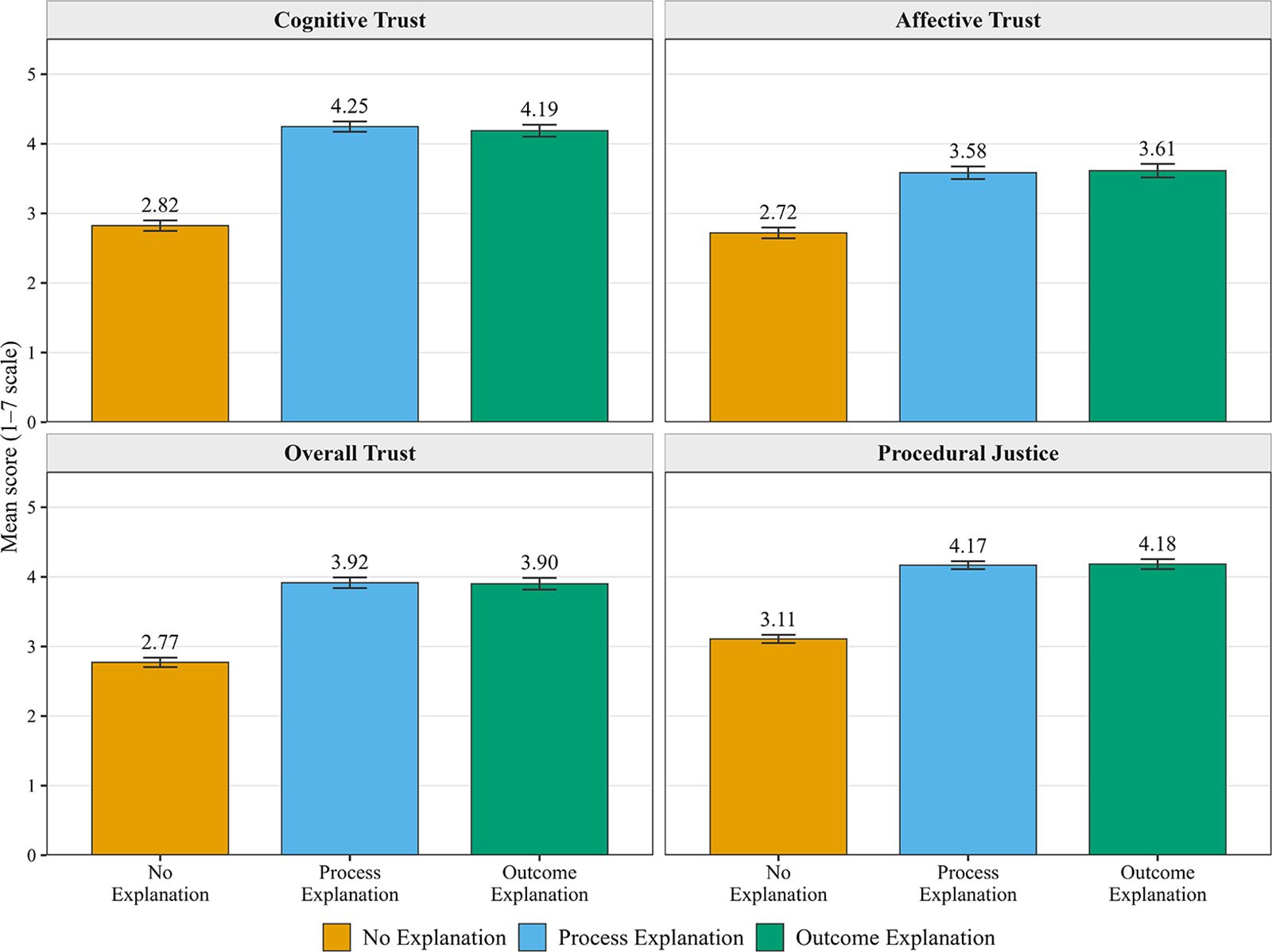
H1a predicted that explanations (vs. no explanations) would positively impact levels of trust in AI-assisted judicial decisions. This hypothesis was strongly supported. One-way ANOVAs comparing any explanation condition against no explanation revealed large, significant effects across all trust measures. First, we find a main effect of explanations on cognitive trust (F(2, 856) = 108.30, p < .001, η 2 = .202), with people reporting higher cognitive trust in the explanation conditions (M = 4.22) compared to when there is no explanation present (M = 2.82), as presented in Figure 1. A similar picture emerges for affective trust (F(2, 856) = 33.64, p < .001, η 2 = .073), with affective trust being significantly greater in the explanation conditions (M = 3.60) compared to when no explanation is present (M = 2.72).
Effects of explanation type on trust and procedural justice.

Figure 1 Long description
The image contains four bar graphs. The top left graph shows 'Cognitive Trust' with mean scores: No Explanation 2.82, Process Explanation 4.25, Outcome Explanation 4.19. The top right graph shows 'Affective Trust' with mean scores: No Explanation 2.72, Process Explanation 3.58, Outcome Explanation 3.61. The bottom left graph shows 'Overall Trust' with mean scores: No Explanation 2.77, Process Explanation 3.92, Outcome Explanation 3.90. The bottom right graph shows 'Procedural Justice' with mean scores: No Explanation 3.11, Process Explanation 4.17, Outcome Explanation 4.18. Each graph compares three explanation types: No Explanation, Process Explanation and Outcome Explanation, with corresponding bars in different colors.
Second, H1b predicted that outcome explanations would have a relatively larger positive impact than process explanations on trust. This hypothesis was not supported. While the manipulation check had shown that outcome explanations elicited greater informational justice perceptions compared to process explanations, we did not find significant differences regarding the impact of explanation type on cognitive trust (t(560) = −0.52, p = .607, Cohen’s d = −0.04) or affective trust (t(560) = 0.22, p = .823, Cohen’s d = 0.02). In other words, both explanation types were equally effective at enhancing trust compared to no explanation but showed no meaningful differences from each other. This finding justified our decision to collapse process and outcome explanations into a single “explanation” (vs. no explanation) condition for subsequent analyses, following established precedent when manipulation factors show equivalent effects (Crawley, Reference Crawley2007; Maxwell et al., Reference Maxwell, Delaney and Kelley2017; Navarro, Reference Navarro2019).
H2a predicted that explanations would positively impact procedural justice perceptions. This hypothesis was strongly supported. One-way ANOVA results revealed large, significant effects of explanations on all procedural justice dimensions, including voice (F(2, 856) = 80.01, p < .001, η 2 = .157), neutrality (F(2, 856) = 60.87, p < .001, η 2 = .125) and respect (F(2, 856) = 69.58, p < .001, η 2 = .140). The results hold when the three individual scales measures were collapsed into a higher-level procedural justice measure (F(2, 856) = 100.20, p < .001, η 2 = .190). Finally, additional post hoc comparisons revealed that both explanation conditions significantly outperformed the no explanation condition across all measures (p < .001), while process and outcome explanations did not differ significantly from each other.
Next, we tested H2b, which predicted that procedural justice perceptions would positively impact trust. This hypothesis was strongly supported. Regression analyses revealed strong positive relationships between procedural justice and all trust measures. Participants’ procedural justice perceptions predicted cognitive trust (β = 1.03, t(857) = 41.01, p < .001, R 2 = .66), representing a large effect with procedural justice explaining 66 percent of variance in cognitive trust. The relationship between procedural justice and affective trust was also significant albeit slightly smaller (β = 0.79, t(857) = 21.54, p < .001, R 2 = .35).
Finally, we tested whether the relationship between explanations (vs. no explanation) and trust was mediated by procedural justice perceptions, and whether this relationship was moderated by the case type.
H3 predicted that procedural justice would mediate the relationship between explanations and trust. This hypothesis was strongly supported. Mediation analyses were carried out via the lavaan package in RStudio (Rosseel, Reference Rosseel2012). This tested voice, neutrality and respect as simultaneous mediators of the relationship between explanations and trust. We used this approach rather than a composite procedural justice score to identify the unique contribution of each procedural justice dimension while accounting for their intercorrelations (rs = .47–.70).
Significant total indirect effects for both trust outcomes were observed with the three procedural justice dimensions showing markedly different patterns of mediation (see Tables 2 and 3). Respect emerged as the dominant mediator, accounting for 62 percent of the indirect effect for cognitive trust and 72 percent for affective trust. Neutrality provided moderate additional mediation (35% for cognitive trust, 19% for affective trust), while voice contributed negligible unique mediation beyond the other dimensions (3% and 9%, respectively, both p > .05).
Parallel mediation analysis: procedural justice dimensions as mediators
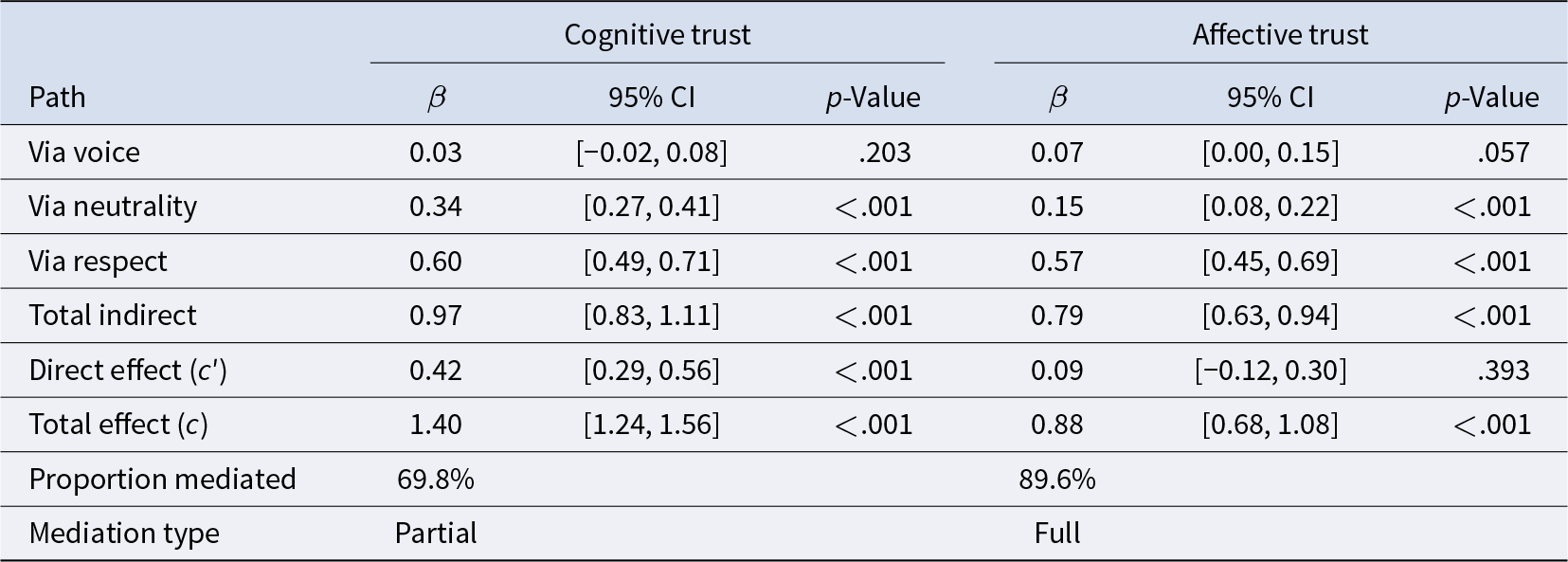
Table 2 Long description
The table examines how procedural justice dimensions mediate cognitive and affective trust. Respect has the strongest mediation effect, with high indirect effects on both trust types. Neutrality also shows significant mediation, particularly for cognitive trust. Voice has a weaker mediation effect, especially for cognitive trust. The total indirect effects are substantial, indicating strong mediation overall. Direct effects are lower, suggesting that mediation plays a significant role in the relationship between procedural justice and trust. Cognitive trust is partially mediated, while affective trust is fully mediated. The analysis controls for intercorrelations between procedural justice dimensions, which range from moderate to high.
Notes. N = 859. β = unstandardized coefficient; CI = 95 percent confidence interval from maximum likelihood estimation. Parallel mediation model controls for intercorrelations between procedural justice dimensions (rs = .47–.70).
Breakdown by mediator

Table 3 Long description
The table examines how different mediators contribute to cognitive and affective trust. Respect is the most significant mediator, accounting for 61.9% of cognitive trust and 72.2% of affective trust. Neutrality follows, mediating 34.9% of cognitive trust and 18.6% of affective trust. Voice has the least impact, mediating only 3.2% of cognitive trust and 9.3% of affective trust. The data suggests that respect plays a crucial role in building both types of trust, while voice has a minimal effect. The confidence intervals indicate variability in the estimates, particularly for voice, which has a wide range for cognitive trust.
Notes. N = 859. Indirect effects representing the product of a-path (explanation to mediator) and b-path (mediator to trust). Percentages show each mediator’s contribution to the total indirect effect.
*** p < .001.
The mediation pathway was particularly strong for affective trust, where the direct effect of explanations became non-significant when all three procedural justice dimensions were included as mediators (b = 0.09, p = .393), indicating full mediation. The total indirect effect accounted for 89.6 percent of the relationship between explanations and affective trust. For cognitive trust, a significant direct effect remained alongside the indirect effects (b = 0.42, p < .001), indicating partial mediation with 69.8 percent of the total effect mediated through procedural justice perceptions.
H4, which proposed that the indirect effect of explanation type on trust (via procedural justice) would be stronger in liability than in quantum cases (moderated mediation), was not supported. We examined whether case type moderated the a-paths (explanation × case type predicting each procedural justice dimension). None of the three interaction terms were significant: voice (b = −0.17, p = .370), neutrality (b = −0.26, p = .140) or respect (b = −0.28, p = .128). We also tested for moderation of the b-paths (procedural justice dimensions to trust) and c-path (direct effect); no significant interactions emerged. These results indicate that the mediation pathway operates similarly across both liability and quantum decisions.
Table 2 presents the results of the parallel mediation analysis, in which we see respect accounting for the majority of the procedural justice effect, followed by neutrality, with voice contributing negligibly. Specifically, the analysis shows whether explanations improve trust directly or whether they do so by first improving perceptions of procedural justice, which then improve trust. In this instance, procedural justice is the mediator, the lever through which the process of improving trust operates. The beta coefficients in each row indicate how much of the explanation effect travels through each procedural justice dimension (voice, neutrality and respect), estimated simultaneously so that each pathway accounts for overlap among the three. Table 3 further disentangles the relative effects reported in Table 2, highlighting the unique contribution (as a percentage of total indirect effect) of each procedural justice dimension.
As an exploratory analysis beyond our registered hypotheses, we also examined whether explanations influenced the intention of a participant to appeal the judicial decision. Results revealed that providing explanations significantly reduced intention to appeal, F(2, 853) = 26.55, p < .001, η 2 = .058. Participants who received no explanation reported higher appeal intentions (M = 5.26, SD = 1.50) compared to those receiving either process (M = 4.46, SD = 1.72) or outcome explanations (M = 4.33, SD = 1.80), both ps < .001; however, intention to appeal was virtually identical for process and outcome explanations. An interaction with case type, which lies close to significance thresholds, emerged, F(2, 853) = 2.99, p = .051, suggesting the explanation effect may be somewhat stronger in liability cases. Adding age and gender as covariates yielded an almost identical result (F(2, 845) = 2.93, p = .054), with neither covariate reaching significance (age: p = .212; gender: p = .638). On one interpretation, this finding could reflect trust and perceived legitimacy, with those who receive explanations feeling the process was fairer and therefore more willing to accept the outcome. On another interpretation, it could capture a strategic dimension, with participants in the no-explanation condition anticipating that an unexplained AI-assisted decision could be particularly amenable to a reversal on appeal, making lodging an appeal seem a more rational course of action.
Parallel mediation analyses indicated that procedural justice mediated 58.2 percent of the explanation effect on appeal intentions (b = −0.503, p < .001), with respect again serving as the dominant mediator (86.0% of indirect effect). Notably, the relatively substantial remaining direct effect (41.8%) contrasts with the much smaller direct effects observed for cognitive trust (30.2%) and affective trust (10.4%), suggesting that explanations reduce appeal intentions through additional mechanisms beyond procedural justice perceptions, which could include enhanced understanding of the decision-making process leading to an increased confidence in the correctness of the decision.
5. Discussion
Our empirical findings highlight the important role of explanations in driving trust in AIJDM. Specifically, our findings indicate that, irrespective of case type, both process and outcome explanations enhance people’s perceptions of procedural justice, which positively impacts their cognitive and affective trust in AI-assisted judicial decisions. At a practical policy-oriented level, these findings suggest that courts and policymakers exploring the design and implementation of AIJDM systems ought to pay close attention to how explanations are communicated to court users.
5.1 Theoretical contributions
Our empirical findings hold several theoretical implications. First, we show that explanations function as a strong mechanism for trust-building in the context of judicial processes using AIJDM (d = 1.02), which supports theoretical arguments about transparency as an essential component of open justice and judicial legitimacy (Barry, Reference Barry2024; Hendrickx, Reference Hendrickx2025).
One particularly important finding comes from the mediation of trust through procedural justice perceptions. Our results indicate that explanations do not necessarily directly build trust, but they enhance perceptions of procedural justice (i.e., that the process is fair), which in turn generates trust. This finding meaningfully extends Tyler’s procedural justice framework into AIJDM contexts, highlighting that even AI-assisted decisions may satisfy expectations of fairness when properly explained. The respect element of procedural justice showing a particularly strong mediation (61–72%) suggests that explanations work by signaling respect to the litigants that the court values their need to understand the process as well as their dignity, a finding with potentially far-reaching implications for future design of AI-assisted decision-making in any context, high-stakes or otherwise. Contrary to our hypothesis, no difference was found between process or outcome explanations in building trust, despite our study data showing that outcome explanations were rated higher than process explanations by the participants on the informational justice scale (mean difference = −0.29, 95% CI [−0.49, −0.09], p = .002), a rating which determines how satisfactory an explanation is. This higher rating did not translate into greater fairness perceptions, however. This finding somewhat challenges the assumptions found in broader XAI literature that suggests outcome-specific explanations outperform general process-based explanations. In judicial settings, these findings suggest that having an explanation matters more than any specific type. More studies ought to be conducted to probe this further.
Furthermore, no support was found for our hypothesis that explanations would matter more in liability cases relative to quantum cases. There are several ways this null finding could be interpreted. It could suggest that as soon as AI enters judicial decision-making in any capacity, concerns of procedural fairness are uniformly heightened, regardless of the nature of the decision. On the other hand, our experimental design where all participants experienced unfavorable outcomes (a deliberate design choice) may have created ceiling effects for fairness concerns across conditions. There was no “winning” group in this study to which results could be compared. This was intentional as our aim was to measure procedural justice perceptions and trust perceptions under the least favorable outcome possible. Our question asking participants to rate their likelihood to appeal the decision did approach significance (p = 0.051) in the direction of liability cases having higher appeal intentions than quantum cases. Nevertheless, the effect was borderline and, as such, is not presented as a main finding or exploratory hypothesis. It does suggest a future avenue of research given its potential significance, however.
6. Limitations and future directions
6.1 Experimental design restrictions
The vignette methodology offers experimental control but cannot capture the experience of actual litigation. Participants imagined disputes rather than experiencing genuine financial loss or the stress of court proceedings. Field experiments with courts implementing AI assistance would provide ecological validation.
Although the deliberately ambiguous contract language (“as warm as a winter blanket”) may have introduced uncontrolled variance in baseline fairness expectations, this was chosen, however, to mirror the interpretive uncertainty that necessarily often characterizes disputes that end up at trial rather than being settled. Additionally, making the absence of explanation salient in the “no explanation” condition may have amplified perceived deficiency to some degree. However, this was a deliberate decision to avoid the prospect that participants would implicitly assume that an explanation would have been provided and, furthermore, there have been contexts in actual courts where litigants have asked for explanations about the role of algorithms, but none have been forthcoming (see, e.g., Loomis discussed above). Finally, as our aim was to measure procedural justice perceptions, which are inherently subjective, we felt that a strong manipulation was warranted. This experiment was an examination of participant responses to varying levels of procedural justice cues, rather than a test of the cognition of participants or their ability to intuit or distinguish between different scenarios.
The outcome-explanation condition did include some procedural detail as to how AI evaluated similar cases, meaning the process-outcome distinction was not completely orthogonal. This was a deliberate design choice because some minimal information on process was needed to clarify how an algorithm reached a particular outcome; the absence of which would risk producing explanations that may be incoherent. In any event, as we collapsed these conditions for our primary analyses, this overlap does not diminish our principal findings. The structure of the vignette, in which the participant was asked to focus primarily upon the completion of the renovation and in which the potential dispute was limited to £15,000, may have diminished the participant’s interest in the quantitative aspect of the dispute, thereby reducing the possibility of observing a statistically significant case-type effect.
6.2 Sample and generalizability
It is possible that our sample of Prolific participants from the United Kingdom may not generalize to other populations with varying levels of institutional trust, legal culture and/or prior exposure to AI. Replication across cultures in jurisdictions where judicial use of AI is being implemented would increase the external validity of our results.
6.3 Unmeasured variables
General AI attitudes, prior court experience, institutional trust prior to participating in the study and personality variables that may influence the perception of explanations were not measured. This prevents us from examining whether our effects occur uniformly across all participants or predominantly within specific subpopulations.
6.4 Analytical limitations
Participants who are disposed to trusting may perceive higher levels of procedural justice irrespective of the condition in which they were placed. Longitudinal designs or studies designed to manipulate participants’ procedural justice perceptions would better support the causal relationships we propose. Approximately 10 percent of participants were excluded for failing manipulation checks. Sensitivity analyses comparing the analytic sample (n = 859) to a minimal-exclusion sample retaining these participants (n = 952) demonstrated stable results across all hypotheses, with nearly identical effect sizes and mediation proportions. The achieved sample of 859 participants approached but did not fully meet the pre-specified target of 158 per cell, though large observed effects suggest adequate power.
6.5 Scope of transparency
As described earlier, transparency can occur at various levels (Sarel & Barysė, Reference Sarel and Barysė2024). In this study, we focused on the effects of explanations to tackle a lack of AI transparency, not judicial use of the AI systems. These are separate dimensions, and future research could examine the latter.
6.6 Outcome valence
All participants experienced unfavorable outcomes, which, as discussed above, was a deliberate experimental design choice. This thereby limited our ability to determine whether the effect of explanation differs based on the valence of the outcome. Manipulating the valence of the outcome in future factorial designs would assist in clarifying the mechanisms underlying these dynamics.
7. Conclusion
This study set out to examine whether and how explanations about AIJDM generate trust in judicial processes. Our findings demonstrate that explanations substantially enhance both cognitive and affective trust, and that this effect operates primarily through procedural justice perceptions.
Providing explanations enhanced both dimensions of trust (cognitive and affective), and it did so by enhancing perceptions of procedural fairness. The degree to which respect mediated the positive relationship between explanations and procedural justice was significant; approximately 61–72% of the total relationship existed via respect.
Thus, our research provides guidance on how courts could potentially incorporate AI in judicial decision-making; in particular, our results support the use of explanatory statements regarding the AI component of the decision-making process in order to build trust in such processes. Furthermore, while prior research has shown that the inclusion of explanations (or human oversight) in AI decision-making processes can increase trust, the current study identified a potential psychological pathway through which this occurs, namely, perceptions of procedural justice. Therefore, the focus should shift from whether or not the user understands how the AI works to whether or not the user perceives the decision-making process as respectful and adhering to empirically validated ideas of procedural fairness.
In light of Möllering’s observation that trust involves a “leap of faith” under conditions of uncertainty, our findings indicate that explanations can facilitate trust in AI-assisted judicial authority and underscore the importance of the entrenched judicial duty to provide reasons, making that leap of faith perhaps a little less daunting.
Supplementary material
The supplementary material for this article can be found at https://doi.org/10.1017/cfl.2026.10052.
Acknowledgements
The authors thank the reviewers for their extremely helpful feedback and the participants who took part in this study. Christopher Greene gratefully acknowledges the support of the Irish Research Council.
Funding statement
This work was supported by Taighde Éireann – Research Ireland (formerly the Irish Research Council) under the Government of Ireland Postgraduate Scholarship awarded to Christopher Greene (project ID: GOIPG/2024/4257).
Competing interests
The authors declare none.
Christopher Greene is a PhD candidate at Trinity College Dublin’s School of Law. His doctoral research, funded by a Taighde Éireann – Research Ireland (formerly the Irish Research Council) Government of Ireland Postgraduate Scholarship, examines AI-assisted judicial decision-making at the intersection of law, artificial intelligence and procedural justice theory.
Brian M. Barry is a Professor in Law at the School of Law at Trinity College Dublin. His research examines the psychology of judicial decision-making, the operation of courts and technologies for judging. He is the author of How Judges Judge: Empirical Insights into Judicial Decision-Making (Informa Law from Routledge, 2021) and of numerous peer-reviewed articles. In 2025, he was awarded an ERC Consolidator Grant of €2 million for JUDGEASSIST, a five-year project investigating principled approaches to AI-assisted judicial decision-making.
Marius Claudy is an Associate Professor in Marketing and Director of the UCD Behavioural Research Lab at University College Dublin. His research sits at the intersection of consumer psychology and technology, advancing understanding of the cognitive, emotional and moral factors that shape how people adopt and engage with innovations – particularly artificial intelligence. His current work examines the role of explanations in building trust and acceptance of AI in high-stakes domains such as legal decision-making and human resources. He publishes in leading journals including the Journal of Consumer Research, the Journal of the Academy of Marketing Science, the Journal of Business Ethics and the International Journal of Human-Computer Studies.




 Open access

