INTRODUCTION
Of the many cognitive deficits associated with traumatic brain injury (TBI), long-lasting memory disturbance is the most disabling impairment reported by survivors and their families (Bond, Reference Bond, Grant and Adams1986; Vakil, Reference Vakil2005). Reports indicate that among patients with uncomplicated mild TBI, 18% continue to complain of persisting memory difficulties when examined one year post-injury (Alves, Reference Alves1992). Despite these ongoing memory complaints in some individuals, cognitive impairments frequently go undetected on standard neuropsychological tests when measured several months to years post-injury (Binder et al., Reference Binder, Rohling and Larrabee1997; Dikmen et al., Reference Dikmen, McLean and Temkin1986; Millis et al., Reference Millis, Rosenthal, Novack, Sherer, Nick and Kreutzer2001; Vanderploeg et al., Reference Vanderploeg, Curtiss and Belanger2005). Consequently, more cognitively demanding laboratory experiments have been implemented in TBI research in an attempt to detect subtle, but persistent, cognitive impairments. This research shows that memory processes are not uniformly affected by TBI. Specifically, implicit memory (Schmitter-Edgecombe, Reference Schmitter-Edgecombe1996; Vakil & Sigal, Reference Vakil and Sigal1997) and priming tasks that require access to semantic memory (Perri et al., Reference Perri, Carlesimo, Loasses and Caltagirone2000; Vakil & Oded, Reference Vakil and Oded2003) are spared following TBI; however, episodic memory (Baddeley et al., Reference Baddeley, Harris, Sunderland, Watts, Wilson, Levin, Grafman and Eisenberg1987; Brooks, Reference Brooks1976; Zec et al., Reference Zec, Zellers, Belman, Miller, Matthews and Femeau-Belman2001) and working memory performance (Bernstein, Reference Bernstein2002; for a review, see McAllister et al., Reference McAllister, Flashman, Sparling and Saykin2004; Seignourel et al., Reference Seignourel, Robins, Larson, Demery, Cole and Perlstein2005) show impairments. Research also suggests that memory processes requiring cognitive control (i.e., working memory, dual-task performance, error monitoring) show the largest deficits following TBI (Levine et al., Reference Levine, Dawson, Boutet, Schwartz and Stuss2000; Seignourel et al., Reference Seignourel, Robins, Larson, Demery, Cole and Perlstein2005).
Healthy older adults also frequently report memory problems as their #1 cognitive complaint (Bassett & Folstein, Reference Bassett and Folstein1993; Reid & Maclullich, Reference Reid and Maclullich2006). As with TBI, not all memory processes are equally affected by aging. Older adults show relatively preserved performance on tests of nondeclarative (Light & Singh, Reference Light and Singh1987) and semantic (Park et al., Reference Park, Polk, Mikels, Taylor and Marshuetz2001) memory, although performance on short-term or episodic memory tasks often show a decline with advancing age (Park et al., Reference Park, Polk, Mikels, Taylor and Marshuetz2001). The memory declines observed with age are more severe when they require controlled processes at encoding or retrieval, for example, when participants are required to self-initiate in elaborative encoding, self-generate retrieval cues (Luo, Hendriks, & Craik, Reference Luo, Hendriks and Craik2007), or store and manipulate information simultaneously (Bopp & Verhaeghen, Reference Bopp and Verhaeghen2007). These later findings point toward an important similarity between TBI and healthy elderly individuals: Both demonstrate relative weaknesses in memory tasks that require the use of cognitive control mechanisms compared to young controls (Luo et al., Reference Luo, Hendriks and Craik2007; Vakil & Tweedy, Reference Vakil and Tweedy1994, respectively). Specific overlaps in memory impairments may be observed between these two populations because the frontal lobes are the region most affected by the natural aging process (for a review, see Prull et al., Reference Prull, Gabrieli, Bunge, Craik and Salthouse2000; Raz et al., Reference Raz, Gunning, Head, Dupuis, McQuain and Briggs1997) and most susceptible to changes following TBI (McDonald et al., Reference McDonald, Flashman and Saykin2002). Thus, we were interested in directly comparing these two groups on a memory test that relies on controlled, consciously mediated, memory processes. Specifically, we directly compared the effects of age and TBI on the ability to use source information to reject highly familiar distracter information on a recognition memory task.
Source memory is the ability to monitor and remember contextual details that are secondary to the studied event, such as the temporal order or the modality in which information was viewed (Hashtroudi et al., 2005). The frontal lobes are believed to be involved in accurately remembering the source of information (Dywan et al., Reference Dywan, Segalowitz, Henderson and Jacoby1993), and impairments in the ability to recollect source information has been observed in both older adult (Craik et al., Reference Craik, Morris, Morris and Loewen1990; Hashtroudi et al., Reference Hashtroudi, Johnson and Chrosniak1989; Park & Puglisi, Reference Park and Puglisi1985) and TBI groups (Cooke & Kausler, Reference Cooke and Kausler1995; Dywan et al., Reference Dywan, Segalowitz, Henderson and Jacoby1993; Vakil, Blachstein, & Hoofien, Reference Vakil, Blachstein and Hoofien1991). Previous studies have directly compared the effect of aging and TBI on memory functioning and found that memory for judging the frequency of word occurrence (Tweedy & Vakil, Reference Tweedy and Vakil1988) and the temporal order of words (Vakil & Tweedy, Reference Vakil and Tweedy1994) were equally disrupted at least one year following severe TBI in young and in healthy older adults compared to young controls.
In addition to source memory deficits, both older adults and TBI participants show an increased susceptibility to falsely endorse misleading information. For example, in the Deese-Roediger-McDermott (DRM) paradigm (Deese, Reference Deese1959; Roediger & McDermott, Reference Roediger and McDermott1995), a list of semantically related words is presented (e.g., sit, table, legs, seat …), such that each word is highly related to a nonpresented word called the critical lure (e.g., chair). Compared to the young controls, both older adults (Kensinger & Schacter, Reference Kensinger and Schacter1999; Norman & Schacter, Reference Norman and Schacter1997; Tun et al., Reference Tun, Wingfield, Rosen and Blanchard1998; Watson et al., Reference Watson, Balota and Sergent-Marshall2001; Watson et al., Reference Watson, McDermott and Balota2004) and individuals with TBI (Ries & Marks, Reference Ries and Marks2006) show an increase in both erroneous recall and in false recognition of the critical lure. Other research shows an increased false alarm rate, as a function of repetition, compared to young controls (Jacoby, Reference Jacoby1999). For example, older adult (Bartlett et al., Reference Bartlett, Strater and Fulton1991) and TBI participants (Dywan et al., Reference Dywan, Segalowitz, Henderson and Jacoby1993) were less able to discriminate between nonfamous and famous faces when the nonfamous faces were repeatedly presented. These results suggest that increased familiarity with distracter items increases memory errors made by older adults and young people with TBI.
The goal of the present study was to directly compare the effects of healthy aging and long-term (> 4 months post-injury) effects of TBI in young adults on the ability to use source information to accurately identify target words, and reject familiar distracters, on a recognition memory test. We administered an exclusion memory test (see Dobbins et al., Reference Dobbins, Kroll, Yonelinas and Liu1998) in which participants first viewed words in a Pre-exposure List (targets + distracters) followed by a Study List (targets). On the recognition test, participants were instructed to respond ‘old’ to target words viewed in the Study List, ‘new’ to distracter words presented in the Pre-exposure List, and ‘new’ to words not previously viewed in either list. Distracter and target words were presented either once or three times to examine whether the ability to reject highly familiar distracting information was especially affected by normal aging and long-term TBI.
We hypothesized that recognition of target words would remain intact for all groups, but that the ability to reject distracting information would be compromised in older adults and TBI young adults, relative to a group of healthy young adult controls. We additionally hypothesized that older adults and TBI young adults would be most susceptible to distracting information that is highly familiar (viewed three times), relative to young controls. To further characterize the cognitive deficits experienced in normal aging and those with TBI, participants also completed a battery of neuropsychological tests designed to measure executive functioning, working memory, short-term memory, verbal fluency, and processing speed.
METHODS
Participants
Fifty-two people participated in the experiment. Thirty-four undergraduate students from the University of Waterloo received course credit (see below for classification); 16 had experienced a TBI (11 female; see classification scheme below) and 18 had no history of head injury (12 female). Eighteen older adults (11 female) were recruited from the Waterloo Research Aging Pool (WRAP) and received token monetary remuneration for their participation. The WRAP pool is a database of healthy seniors in the Kitchener-Waterloo area recruited by means of newspaper ads, flyers in community centers, and through local television segments featuring research at the University of Waterloo. The mean age was 19.83 (SD = 1.34) for young controls, 19.69 (SD = 1.45) for young TBIs, and 71.67 (SD = 5.08) for older adults. The mean number of years of education was 14.44 (SD = 1.10) for young controls, 14.06 (SD = 1.10) for young TBIs and 14.11 (SD = 1.49) for older adults, which did not significantly differ, F (2, 49) = 0.48, p > .05. All participants were fluent English speakers, and had normal or corrected-to-normal hearing and vision. All participants also reported that they were free from any psychological or neurological disorders at the time of testing. Five participants had undergone a prior treatment for psychological disorders: one healthy participant for social anxiety disorder, one mild TBI participant for bipolar disorder, and another such participant for generalized anxiety and post-traumatic stress disorder; one moderate TBI participant was treated for depression and another such participant for anxiety and depression. Older adults completed the Mini-Mental State Exam (MMSE; Folstein et al., Reference Folstein, Folstein and McHugh1975) to screen for gross neurological conditions. All had scores greater than 27/30 (M = 29.44, SD = 0.89), indicating that the older adults in this study were free from gross neurological impairment (Spreen & Strauss, Reference Spreen and Strauss1998).
Classification and Severity of TBI
The 34 undergraduate participants were recruited from the University of Waterloo’s Research Experience Group, which consists of undergraduate students enrolled in psychology courses who receive course credit for participating in research. At the start of the semester, students have the option of completing a short online prescreening questionnaire that contains various questions including demographic and health information. Our research group added specific items to this questionnaire to obtain information regarding head injury history (see Appendix). Participant data for this study were collected during the Fall 2007 and Winter 2008 semesters. In the Fall semester, a total of 2521 students completed the prescreening questionnaire and out of those students, 227 (9%) students reported experiencing a head injury in the past. Of these 227 students, 112 fit the head injury criteria used in this study (must have reported a period of unconsciousness) and 10 signed up to complete our study. In the winter semester, 2156 students completed the questionnaire and 205 (9.5%) of those students reported a head injury. Of those students, 136 fit our head injury criteria and 6 participants signed up and completed this study. All participants were asked to complete another questionnaire during the experiment to confirm the details reported in the prescreening questionnaire (e.g., report of head injury, length of unconsciousness, etc.). If there was a discrepancy between the reports, the questionnaire completed during the experiment was used in data analysis.
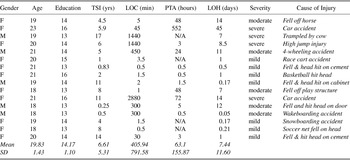
TBI was defined as any strike to the head or any acceleration/deceleration force (i.e., whiplash; Kay et al., Reference Kay, Harrington, Adams, Anderson, Berrol and Cicerone1993) that resulted in a loss of consciousness. Severity of TBI was classified by participants’ self-reported duration of loss of consciousness (LOC), post-traumatic amnesia (PTA), and disorientation and/or confusion (see Table 1 for demographics). The TBI was labeled as “mild” if LOC did not exceed 30 minutes and PTA was no greater than 24 hours (Kay et al., Reference Kay, Harrington, Adams, Anderson, Berrol and Cicerone1993), “moderate” if LOC was between 30 min and 6 hr or PTA between 1 and 7 days (Seignourel et al., Reference Seignourel, Robins, Larson, Demery, Cole and Perlstein2005), and “severe” if LOC was more than 6 hr or PTA of more than 6 days (Seignourel et al., Reference Seignourel, Robins, Larson, Demery, Cole and Perlstein2005). Using these criteria, 7 participants were classified as mild, 5 as moderate, and 4 as severe. Only those participants who reported their head injury occurring at least 4 months prior to testing were included. Time since injury ranged from 4 months to 17 years (M = 6.19, SD = 5.04). All reported that they had only experienced one TBI in their past and sought medical attention following the injury.
Demographic and head injury details for TBI participants

Note
TSI = Time Since Injury; LOC = Length of Unconsciousness; PTA = Post-traumatic Amnesia; LOH = Length of Hospitalization.
Recognition Task Materials
For the recognition task, three lists of 30 words, equated on the number of letters (M = 6.41, SD = 1.57) and word frequency (M = 20.02 occurrences per million, SD = 18.77), were created by randomly choosing words from Celex, a lexical database (Baayen et al., Reference Baayen, Piepenbrock and Gulikers1995). Lists were counterbalanced, such that each word served as a distracter, target, or new word across participants. Half of the distracter words were shown 1 time and half were shown 3 times on the Pre-exposure list. Half of the target words on the Study list were shown twice on the Pre-exposure list and half were absent from the Pre-exposure list. All target words were shown 1 time on the Study list. Thus, both the distracter and target words were shown either 1 time or 3 times prior to the test. The test list contained the 30 distracter words, the 30 target words, and 30 new words (total of 90 words). An additional 15-item word list was created for the practice session, with the same characteristics as those in the experimental session.
Neuropsychological Tests
The following neuropsychological tests were administered to all participants: Digit-Span Forward and Backward (Wechsler, Reference Wechsler1997), Trail-Making Test (Reitan & Wolfson, Reference Reitan and Wolfson1985), Controlled Oral Word Association Test (FAS-Test; Spreen & Strauss, Reference Spreen and Strauss1998), California Verbal Learning Trial (CVLT; Delis et al., Reference Delis, Kramer, Kaplan and Ober1987), Stroop task (Trenerry et al., Reference Trenerry, Crosson, DeBoe and Leber1989), Digit-Symbol task (Wechsler, Reference Wechsler1997), and the North American revision of the National Adult Reading Test (NART-R; Blair & Spreen, Reference Blair and Spreen1989). The Hospital Anxiety and Depression Scale (HADS; Zigmond & Snaith, Reference Zigmond and Snaith1983) was also completed by all participants.
Procedure
Stimulus presentation and data collection were accomplished using E-Prime v.1.2 software (Psychology Software Tools Inc., Pittsburg, PA). Each participant was tested individually and completed the study in approximately 1 hour and 30 minutes. Participants gave written consent for the research protocol, which was approved by the University of Waterloo’s Office of Research Ethics. The MMSE was administered to older adults at the beginning of the experiment. Otherwise, all participants started the study with the computer recognition memory task. The experiment began with a practice study block consisting of 15 words presented visually, in random order, using the same timings and procedure as in the experimental trials (described later). Subsequently, one recognition block, consisting of 9 old and 6 new words, was presented in random order. Participants were instructed to press the key labeled ‘old’ if they believed the word to be from the previous study list, or ‘new’ if the word was deemed to be not from the previous list.
Following the practice phase, participants began the experimental recognition memory task. They were first instructed to silently read 90 words that appeared on the computer screen one at a time (Pre-exposure list). The words were presented in a random order in the center of the computer screen in black, 26 point Arial font on a white background for 1500 ms each. Every word was followed by a fixation cross presented in the center of the screen for 500 ms. The Digit Span forward and backward tasks were administered as filler tasks. Participants were then told that they would see a second set of words (30), which they should read silently and try to memorize for an upcoming memory test (Study list). Words were presented one at a time on the computer monitor with the same timings and procedures as the Pre-exposure list. The Trail Making A and B tests were then administered as filler tasks, prior to the memory test. Participants then completed the Recognition test. They were told that they would see another set of words (90 of them) on the monitor, one at a time, and to press the key labeled ‘old’ if the word had appeared in the second (Study) list. For all other words, they should press the key labeled ‘new.’ Participants were explicitly told that some words on the first (Pre-exposure) list would appear on the Recognition test list, but unless the word also appeared on the second (Study) list, it should be called ‘new.’ The Recognition test was self-paced. Subsequent to the Recognition test, a battery of neuropsychological tests was administered in the following order: FAS-Test, CVLT, Digit-Symbol task, NART-R, and HADS.
RESULTS
Recognition Task
Two 2 × 3 repeated measures analyses of variance (ANOVAs), with Repetition as the within-participant variable (word viewed 1 time or 3 times) and Group as the between-participant variable (young controls, older adults, or young TBIs) were conducted to examine first the probability of responding ‘old’ to target words, and second the probability of responding ‘old’ to distracter words (i.e., in two separate analyses). In addition, a one-way ANOVA was used to compare mean proportion of ‘old’ responses made to new words across groups. Probabilities for responding ‘old’ to target words were calculated by dividing the number of ‘old’ responses made to target words by the actual number of target words. The same probability calculations were made for ‘old’ responses given to distracter words and new words, as well as ‘new’ responses given to target, distracter, and actual new words.
Target words
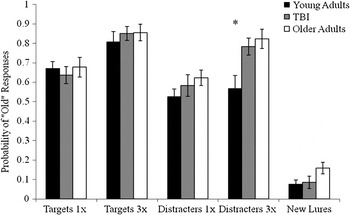
Analysis of Recognition test performance revealed a main effect of Repetition, F (1, 49) = 25.84, p < .001. As expected, target words viewed 3 times had a higher probability of being called ‘old’ than those viewed 1 time (see Figure 1). There was no main effect of Group, F (2, 49) = 0.21, p > .05, or Repetition x Group interaction, F (2, 49) = 0.40, p > .05.
Mean group probabilities of responding ‘old’ to study words repeated once or three times, distracter words repeated once or three times, and to new words in young control, young TBI, and older adult participants. Error bars show the standard error of the mean.

Distracter words
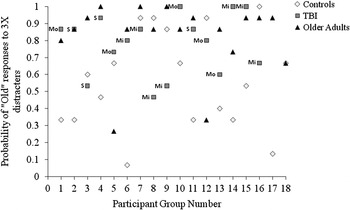
Analysis of distracter word data revealed a Repetition × Group interaction, F (2, 49) = 3.23, p < .05. A significant one-way ANOVA, F (2, 49) = 6.35, p < .005, with planned comparisons revealed that older adults were more likely to respond ‘old’ to distracter words viewed 3 times compared to the young controls, t (49) = –3.32, p < .005. The same pattern was found for young TBIs compared young controls, t (49) = –2.74, p < .01 (see Figure 1), though the young TBIs and older adults did not differ on this measure, t (49) = –0.49, p > .05. A one-way ANOVA examining the proportion of false responding to distracter words viewed 1 time showed no group differences, F (2, 49) = 1.18, p > .05. To ensure that performance in the TBI group was not driven selectively by those with a moderate-severe classification, we re-examined false alarm rate to distracter words in two separate 2 × 3 repeated measures ANOVAs. In the first analysis, false alarm rate to distracter words viewed 1 time and those viewed 3 times was compared across young controls (n = 18), older adult (n = 18), and young mild TBI (n = 7) groups; F (2, 40) = 2.54, p = .091 (Repetition × Group interaction). In the second analysis, false alarm rate to distracter words viewed 1 time and those viewed 3 times were compared across young controls (n = 18), older adult (n = 18), and moderate-severe TBI (n = 9) groups; F (2, 42) = 2.69, p = .08 (Repetition × Group interaction). Thus, separating the TBI group by level of severity did not change the pattern of results (see Figure 2) and furthermore, effect sizes were equivalent for both the mild and moderate-severe analyses (ηp2 = 0.11). The 2 × 3 repeated measures ANOVA used to analyze distracter word data was also repeated with the HADS anxiety measure (F (1, 48) = 0.13, p > .05) and the NART-R scores (F (1, 48) = 0.002, p > .05) added as covariates, and the pattern of results was unaffected.
Scatter plot shows the probability of responding ‘old’ to distracter words repeated three times, for each participant, according to Groups: Controls (n = 18) – diamonds; Older Adults (n = 18) – triangles; mTBI (n = 16) – squares. The mTBI group is further separated into three groups based on severity: mild (Mi); moderate (Mo); severe (S).

New words
There was no significant difference across groups in false alarms made to new words, F (2, 49) = 2.74, p > .05.
Neuropsychological and Questionnaire Scores
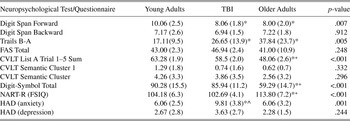
One-way ANOVAs with planned contrasts were used to compare the mean scores of each neuropsychological task across the three groups (see Table 2 for means). Significant differences on the HADS anxiety measure were observed across groups, F (2, 49) = 7.63, p = .001, such that young TBIs had a higher mean anxiety score compared to young controls, t (49) = –3.42, p = .001, and compared to older adults, t (49) = –3.42, p = 0.001. Performance on the Digit Span Forward task also significantly differed across groups, F (2, 51) = 5.49, p < .01. Young controls successfully completed more Digit Forward trials compared to young TBIs, t (49) = 2.76, p <.01, and compared to older adults, t (49) = 2.94, p <.005.
Neuropsychological task and questionnaire results

Note
Values presented are mean group scores (standard deviations in parentheses). p-values are for the one-way ANOVAs used to compare controls, TBI, and older adult participants on each neuropsychological test. Symbols represent mean group scores that are significantly different from the comparison groups: *Young Adults; ^Older Adults; +TBI.
Significant group differences were found on our measure of processing speed, the Digit-Symbol task, F (2, 45) = 21.72, p < .001, such that older adults completed fewer items than young controls, t (45) = 6.23, p < .001, and young TBIs, t (45) = 5.22, p < .001. In order to obtain a measure of cognitive flexibility independent of processing speed (Potter et al., Reference Potter, Jory, Bassett, Barrett and Mychalkiw2002), the difference in reaction time between the Trail Making A and B tasks was calculated. An ANOVA revealed a significant effect of Group, F (2, 49) = 6.84, p < .005, with older adults showing significantly larger difference scores (indicating slower completion times) compared to young controls, t (49) = –3.69, p = .001. There was also a trend towards a larger difference score for young TBIs (with slower completion times), t (49) = –1.65, p < .11, compared to young controls.
Immediate word recall also showed group differences, F (2, 49) = 12.63, p < .001, in that older adults recalled fewer words on list A of the CVLT compared to young controls, t (49) = 4.92, p < .001, and young TBIs, t (49) = 3.28, p < .005. Overall significant group differences were observed on the NART-R, F (2, 49) = 17.33, p < .001, with higher FSIQ scores for older adults compared to control, t (49) = –4.76, p < 0.001, and TBI young adult groups, t (49) = –5.34, p < .001.
Correlations
Correlational analyses were conducted to determine whether performance on the neuropsychological tests that identified differences between both the young TBIs and older adults compared to young controls (Trail B-A difference and Digit Span Forward score) were related to the false alarm rate to distracter words viewed 3 times in the recognition memory task across participants. A positive correlation, trending towards significance, was identified between the proportion of false alarms made to distracter words viewed 3 times and cognitive flexibility performance, measured by the Trail B-A difference scores, r = 0.27, p < .06. Digit Span Forward scores were not correlated with the false alarm rate on the recognition test, r = –.20, p > .05.
Given that the young TBI group consisted of participants ranging from mild to severe head injury, we examined whether various measures of head injury were correlated with false alarm rate to distracter words viewed 3 times. Specifically, four separate correlational analyses revealed that length of unconsciousness (r = 0.01, p > .05), length of post-traumatic amnesia (r = 0.28, p > .05), duration of hospital stay (r = 0.21, p > .05), and time since injury (r = –0.19, p > .05) were not significantly correlated with false alarm rate to distracter words presented 3 times on the pre-exposure list.
DISCUSSION
We investigated the effects of aging and TBI on the ability to reject highly familiar but distracting information on a recognition test. Healthy older adults and young adults with TBI were more likely than young controls to falsely endorse familiar, pre-exposed, distracting words as targets on an exclusion memory task. To our knowledge, this is the first study to directly compare the influence of long-term TBI and healthy aging on susceptibility to false alarm to familiar distracting information. Specifically, healthy older adults and young adults with TBI had higher probabilities (82% and 78%, respectively) of responding ‘old’ to distracter words presented three times in a pre-exposure list, compared to young adult controls (57%). This occurred despite similar memory performance for studied items across the three groups. TBI and age thus more adversely affect memory for source (list) than item (word) information. In addition, incorrect endorsement of distracter information was found only for highly familiar items (3 times but not 1 time pre-exposed words). We suggest that older adults and young adults with TBI have overlapping cognitive profiles, such that their ability to correctly recognize target information is intact, yet their ability to reject familiar distracting information is similarly compromised.
Because memory and attention problems have been reported to persist following TBI regardless of severity (Bublak et al., Reference Bublak, Schubert, Cramon and Cramon2000; Potter et al., Reference Potter, Jory, Bassett, Barrett and Mychalkiw2002), we chose to include individuals who experienced mild, moderate, or severe TBIs in the post-acute phase (> 4 months) of injury. Our results show that, as a group, the TBI participants’ performance was indistinguishable from that of the older adult group, and significantly worse than that of controls, on our recognition memory task. To ensure that this finding was not due simply to the inclusion of severe TBI participants, we correlated measures of TBI severity with false alarms to 3 times presented distracter words. Separate correlational analyses showed that time since injury, length of unconsciousness, length of post-traumatic amnesia, and duration of hospital stay did not correlate significantly with false alarm rates to 3 times presented distracter words. In addition, the effect sizes were equivalent (11%) when false alarm rate to distracter words made by the young adult and older adult groups were compared to those forming a mild TBI group, and to those forming a moderate-severe TBI group, in separate analyses. We suggest that the impaired ability to reject familiar, but distracting, information during recognition may be a memory function that is affected in the long-term following TBI, regardless of severity (see Figure 2).
We acknowledge that relying on self-report measures of head injury may have its limitations, but in this study we show persistent effects of head injury in high-functioning young adults when they report experiencing a TBI in their distant past. The individuals who sustained a moderate to severe TBI in our study may have additional and more pronounced cognitive deficits (that we did not measure) compared to those with a mild TBI. However, our specific exclusion memory task was sensitive enough to detect subtle and long-lasting memory weaknesses not only in moderate to severe participants, but also in mild. Although standard neuropsychological tests most often fail to detect chronic cognitive impairments following mild TBI (for meta-analyses, see Binder et al., Reference Binder, Rohling and Larrabee1997; Vanderploeg et al., Reference Vanderploeg, Curtiss and Belanger2005), other studies, like ours, in which arguably more sensitive computer tasks were used, also revealed persistent attention (Chan, Reference Chan2002; Potter et al., Reference Potter, Jory, Bassett, Barrett and Mychalkiw2002), and information processing deficits in this group (Bernstein, Reference Bernstein2002; Cicerone, Reference Cicerone1996).
Research has shown that when residual cognitive deficits are observed, they are often associated with extraneous variables, such as psychosocial factors (Chan, Reference Chan2002; Dischinger et al., Reference Dischinger, Ryb, Kufera and Auman2009; Fann et al., Reference Fann, Uomoto and Katon2001; Rapoport et al., Reference Rapoport, McCullagh, Shammi and Feinstein2005; and Stulemeijer et al., Reference Stulemeijer, Vos, Bleijenberg and van der Werf2007), and litigation (for review, see Belanger et al., Reference Belanger, Curtiss, Demery, Lebowitz and Vanderploeg2005 and Binder & Rohling, Reference Binder and Rohling1996; Tsanadis et al., Reference Tsanadis, Montoya, Hanks, Millis, Fichtenberg and Axelrod2008). While in this study, we cannot be certain that the memory deficits observed in the TBI group are unrelated to such psychological factors or preexisting conditions, we do not believe they have contributed substantially to the overall pattern of results. All participants reported that they were free from any neurological or psychological disorders at the time of testing, and only a handful (n = 4) of the TBI group participants (and one young control) reported having had a preexisting condition. As well, in the present study, TBI participants reported higher average anxiety scores compared to healthy older and younger adults, but this did not alter the pattern of findings on our memory paradigm when controlled for statistically. Nonetheless, future studies examining cognitive impairment following TBI should continue to screen participants for preexisting conditions, include large psychological test batteries, and validated effort testing.
Previous comparisons of the effects of TBI and aging on source memory have revealed similar deficits in memory for source information. For example, compared to healthy young adults, older adults and young adults with TBI showed decreased memory performance when judging the frequency of word presentations (Tweedy & Vakil, Reference Tweedy and Vakil1988). Additional research shows that memory for the temporal order of word presentation was disrupted in both elderly and young TBI participants compared to healthy young adults (Vakil & Tweedy, Reference Vakil and Tweedy1994). It is believed that such source monitoring deficits underlie heightened false recognition performance observed on exclusion memory tasks (Jacoby, Reference Jacoby1999), such as that used in the current study. For example, young adults with TBI (Dywan et al., Reference Dywan, Segalowitz, Henderson and Jacoby1993) and older adults (Bartlett et al., Reference Bartlett, Strater and Fulton1991) showed intact recognition of famous/nonfamous faces; however, when nonfamous faces were repeatedly presented in an earlier study phase, false recognition of nonfamous faces as famous increased as compared to healthy young adults. These findings are similar to the present results and suggest a common TBI- and age-related deficit in the ability to recollect source information, leading to an increased tendency to attribute familiarity to veridicality. Research suggests that changes in the frontal lobe with age are related to source monitoring deficits (for review, see Burke & Light, Reference Burke and Light1981; Cohen & Faulkner, Reference Cohen and Faulkner1989). For instance, experimental measures of source amnesia in older adults are reliably correlated with measures of frontal functioning including verbal fluency and perseverative errors (Craik et al., Reference Craik, Morris, Morris and Loewen1990). The extent to which memory performance in older adults resembles that of focal lesion patients has helped to identify probable functional systems affected by the natural aging process (Prull et al., Reference Prull, Gabrieli, Bunge, Craik and Salthouse2000). Additional experimental gains may be made by continuing to compare the effects of aging and TBI on cognitive functions mediated by the frontal lobes.
The discrimination of target from nontarget information has been predicted to be an aspect of memory with a strong executive component (McDonald et al., Reference McDonald, Flashman and Saykin2002). Our findings lend support for this hypothesis, such that decreased cognitive flexibility, measured by Trails B-A difference scores, was related to increased difficulties in discriminating distracting information from target information. In both older adults and TBI, there was a trend in that the average Trail B-A difference scores were inversely correlated with false alarm to familiar (3 times pre-exposed) distracter words. We also found that working memory was similarly impaired in the older adult and TBI groups compared to controls, evident by lower Digit-Span Forward scores, though Digit-Span Backward scores did not differ. The older adults also showed additional cognitive impairments compared to young adults with and without TBI. Their performance was impaired on the immediate recall on the CVLT, and they showed typical slowing of processing speed on the Digit Symbol task, compared to both TBI and young adults. These differences indicate that, although individuals with TBI and older adults share overlapping source memory problems, likely related to decreased executive function, older adults may also have additional memory impairments, as well as overall slower processing speeds (for a review, see Salthouse, Reference Salthouse2000). Older adults also showed the typical higher performance on vocabulary measures (NART-R) compared to young adults with and without TBI, though controlling for this variable (using NART-R as a covariate) did not influence the pattern of false alarm results.
Given that the frontal lobes are vulnerable to both aging and head injury, we suggest that there may be similar changes in frontally mediated neuropsychological functions in these two populations that compromise their ability to reject highly familiar, but misleading, information on a recognition task. Our findings suggest that this may be related to a common deficit in executive functioning. Future research should continue to investigate commonalities between older adults and young with TBI to help delineate shared and unshared cognitive dysfunctions. The common findings from these populations may assist in finding optimal treatment and rehabilitation plans for individuals suffering from frontal lobe dysfunction, whether it is due to healthy aging or TBI.
ACKNOWLEDGMENTS
This research was supported by a discovery grant from the National Sciences and Engineering Research Council of Canada (NSERC) awarded to MF, and post-graduate scholarships from NSERC awarded to LO and to ES.
APPENDIX
Pre-Screen Questions for TBI
Please choose one option for each question below.
Have you ever had a concussion (a blow to the head)? If so, did you lose consciousness for:
- 0 seconds (did not experience loss of consciousness)
- 1–59 seconds
- 1–5 minutes
- 5–15 minutes
- 15–30 minutes
- greater than 30 minutes
When did the concussion occur?
- less than 1 month ago
- 1–3 months ago
- 3–6 months ago
- 6 months to 1 year ago
- over 1 year ago
If you have had a concussion, did you experience confusion (inability to focus attention) for:
- 0 seconds (did not experience)
- 1–59 seconds
- 1–60 minutes
- 1–24 hours
- greater than 24 hours
If you have had a concussion, did you experience disorientation (difficulty with regard to direction or position / loss of physical bearings) for:
- 0 seconds (did not experience)
- 1–59 seconds
- 1–60 minutes
- 1–24 hours
- greater than 24 hours
If you have had a concussion, did you experience loss of memory (brief amnesia) for:
- 0 seconds (did not experience)
- 1–59 seconds
- 1–60 minutes
- 1–24 hours
- greater than 24 hours