Introduction
Patulous eustachian tube arises due to an abnormal patency of the eustachian tube.Reference Poe 1 In its physiological resting state, the eustachian tube is closed, and only opens briefly with manoeuvres such as swallowing and yawning. Opening of the eustachian tube is thought to be achieved by a co-ordinated contraction of the peritubal muscles; namely the tensor veli palatini and levator veli palatini.Reference Poe 2 In patulous eustachian tube, the abnormal patency may be due to a loss of volume in the anterolateral wall of the eustachian tube valve associated with loss of thickness of the mucosa, submucosa, Ostmann's (peritubal) fat pad or lateral cartilaginous lamina. The onset of symptoms is commonly seen in association with weight loss (as seen in malignancy) and this would support the theory of loss of peritubal fat pad volume, although this does not explain the association of patulous eustachian tube with pregnancy.
Patients with patulous eustachian tube classically present with autophony to voice and respiration (also termed breath synchronous tinnitus), with or without aural fullness. Although other otological symptoms have been reported, patulous eustachian tube does not typically cause any hearing loss or vertigo. This is in contrast to the main differential diagnosis, superior semicircular canal dehiscence, where mild conductive hearing loss and vertigo are common. Symptoms of patulous eustachian tube may be present for a variable amount of time during the day, but are not usually present when patients are laid flat, presumably because of increased venous congestion. Indeed, temporary occlusion of the jugular vein, preventing drainage and causing resolution of symptoms, has been suggested as a further means of confirming this diagnosis.Reference O'Connor and Shea 3
Diagnosis is confirmed on examination where otomicroscopy shows medial and lateral excursions of the tympanic membrane on inspiration and expiration. This is best done with the patient sat up for the reasons stated above. Nasal endoscopy often shows a scalloped lateral wall of the eustachian tube orifice. Continuous tympanometry can indirectly record movement of the tympanic membrane, and demonstrates a respiratory synchronous compliance pattern which appears as a ‘saw-tooth’ type trace, reflecting changes in compliance in time with inspiration and expiration.Reference McGrath and Michaelides 4
There is no accepted ‘gold standard’ in the management of patulous eustachian tube, but treatment is tailored to each patient depending on the level of distress caused by symptoms. Treatment strategies previously reported can broadly be divided into four main categories: (1) topical nasal medications; (2) augmentation of the eustachian tube via the nasopharynx; (3) augmentation of the eustachian tube via the middle ear; and (4) augmentation of the tympanic membrane mechanics.
When topical nasal preparations are utilised, a solution is instilled into the nasopharynx, with specific aims. For instance, a fluid such as saline can be used to partially obstruct the eustachian tube orifice; potassium iodine drops with boric acid powder insufflation can be used to induce chemical rhinitis in order to cause increased mucous production and swelling; alternatively, oestrogen drops can be used to promote nasal mucosa hypertrophy.Reference Adil and Poe 5 These treatments are mostly ineffective or very temporary, and seem to play a role managing mild patulous eustachian tube when the tube is only just patulous. Despite this, some irritant nasal solutions continue to be marketed and sold as over-the-counter preparations.
Altering tympanic membrane mechanics has also shown benefit in patulous eustachian tube, including mass loading of the tympanic membrane with Blu-Tack®,Reference Bartlett, Pennings, Ho, Kirkpatrick, van Wijhe and Bance 6 or even placement of layers of paper on the tympanic membrane.Reference Boedts 7 This has lead on to attempted surgical manipulation of the tympanic membrane to treat any potentially flaccid segments that might be contributing to patulous eustachian tube.Reference Brace, Horwich, Kirkpatrick and Bance 8 Ventilation tube or grommet insertion has also been used, but most report such methods as ineffective.
Augmentation of the eustachian tube via the middle ear has been performed with placement of a shim or plug into the bony eustachian tube via a myringotomy incision or tympanotomy.Reference Dyer and McElveen 9 , Reference Sato, Kawase, Yano, Suetake and Kobayashi 10
Augmenting the eustachian tube via the nasopharynx is, however, the approach that has been used most over the last 30–40 years, although the different techniques trialled are numerous. These techniques include: cautery to the eustachian tube,Reference O'Connor and Shea 3 ligation of the eustachian tube,Reference Rotenberg, Busato and Agrawal 11 tuboplasty,Reference Yañez, Pirrón and Mora 12 and injection augmentation with soft tissue bulking agents such as Teflon,Reference O'Connor and Shea 3 fat,Reference Doherty and Slattery 13 cartilage,Reference Poe 1 , Reference Kong, Lee, Goh and Park 14 hydroxyapatiteReference Vaezeafshar, Turner, Li and Hwang 15 , Reference Oh, Kang, Goh and Kong 16 and polydimethylsiloxane elastomer (Vox).Reference Schröder, Lehmann, Sudhoff and Ebmeyer 17
As with other soft tissue bulking agents, Vox implants have been used successfully for other indications, including vocal fold medialisation procedures. This product, previously called Bioplastique®, consists of a silicone elastomer implant material (cross-linked polydimethylsiloxane) suspended in an absorbable hydrogel of polyvinylpyrrolidone.
This study aimed to determine the efficacy of eustachian tube augmentation injection with Vox, using previously described patulous eustachian tube specific outcome measures in order to allow more direct comparison with previously published techniques.
Materials and methods
A retrospective review of case notes was combined with telephone follow up using a structured questionnaire for 12 patients who underwent eustachian tube augmentation surgery with Vox injection over a 5-year period. All patients were assessed initially and operated on by the senior author.
The diagnosis of patulous eustachian tube was made based on the presence of at least two criteria – autophony to voice, autophony to respiration and/or aural pressure – combined with visible excursions of the tympanic membrane on respiration. Diagnosis was supported by the cessation of symptoms and tympanic membrane excursions on lying flat or when placing the head down between the legs. Superior semicircular canal dehiscence was excluded using computed tomography of the temporal bones if the diagnosis of patulous eustachian tube was uncertain.
Data were collected relating to the details of the presenting symptoms (such as duration), precipitating or alleviating factors, and previous trialled treatments.
The primary outcome measure used was the patient-reported symptom improvement outcome scoring scale devised by Poe (Table I).Reference Poe 1 This scale (or adapted versions of it) has been the most widely used outcome measure for assessing responses to treatment for patulous eustachian tube, and, in the absence of a validated scoring system, it provides a means for comparison with other studies.
Patient-reported outcome measure of response to patulous eustachian tube treatmentReference Poe 1

Given the significant impact that patulous eustachian tube has on quality of life (QoL), we also chose to utilise the QoL outcome measure adapted for autophony by Rotenberg et al.Reference Rotenberg, Busato and Agrawal 11 , Reference Rotenberg and Davidson 18 to compare pre-operative and post-operative scores (Table II). The data were statistically compared using the Wilcoxon signed-rank test.
Patient-reported outcome measure to determine impact of autophony on quality of lifeReference Rotenberg, Busato and Agrawal 11 , Reference Rotenberg and Davidson 18

Since 2013, the Department of Health has implemented the Family and Friends Test as a measure of patient experience.Reference Sizmur, Graham and Walsh 19 We therefore also asked patients if they would recommend the treatment to friends or family, and whether they would have the treatment again.
Our results were compared with those of previously published treatments for patulous eustachian tube.
Surgical technique
All patients underwent the procedure under general anaesthetic following topical nasal preparation using Moffett's solution (2 ml of 10 per cent cocaine, 2 ml of 8.4 per cent sodium bicarbonate, and 1 ml of 1:1000 adrenaline diluted with 5 ml of normal saline), instilled using a mucosal atomisation device.
The patient was placed supine. Their mouth was held open using a Boyle–Davis gag, and a catheter was passed through the nose and out through the mouth to retract the soft palate on the contralateral side to the eustachian tube being treated.
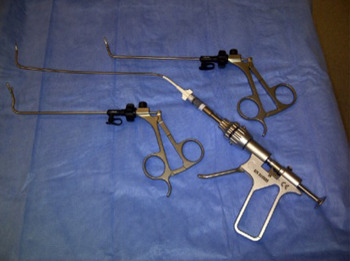
A 30-degree 4 mm Hopkins rod was introduced through the ipsilateral nasal cavity to view the eustachian tube orifice; angled instruments were introduced into the post-nasal space via the mouth. The eustachian tube orifice was opened using Kujawski 80-degree angled instruments (Karl Storz, Tuttlingen, Germany) (Figure 1). This permits an improved view of the eustachian tube lateral wall, facilitating injection into the more superolateral narrower segment of the eustachian tube (as opposed to the eustachian tube cushion).
The Kujawski 80-degree angled instruments (Karl Storz) used for accessing the eustachian tube via the nasopharynx.

Sufficient quantities of Vox (Uroplasty, Minnetonka, Minnesota, USA) were injected until the typically concave lateral wall was filled, thereby becoming convex and occluding the eustachian tube (usually 1–2 ml per side). Bilateral cases were treated at the same sitting.
Patients were followed up to assess for complications such as the development of glue ear and to assess any benefit in symptoms. Patients with temporary improvement were offered a repeat procedure.
Results
Of the 12 patients who had undergone treatment, 11 could be contacted for telephone follow up (1 patient had left the country). The patients’ mean age was 38 years (range, 20–67 years) and the male-to-female ratio was 5:6. There were 7 bilateral cases and 4 unilateral (19 ears were treated in total). The mean follow-up duration was 18.3 months (range, 3–44 months).
All patients reported having previously seen an ENT doctor who did not initially identify the diagnosis of patulous eustachian tube. All 11 patients had autophony to voice and respiration, but only 3 complained of aural fullness. Symptoms had been present for an average of 6.7 years prior to treatment (range, 2–15 years). In 4 of 11 patients, the onset of symptoms was associated with significant weight loss. Exacerbating factors included exercise (n = 6), caffeine (n = 3), prolonged talking (n = 2) and stress (n = 2). Six patients were able to relieve their symptoms by lying down (or performing a headstand). The snorting of saline and hydration were also used for alleviation.
Four patients had undergone previous surgical treatment for patulous eustachian tube symptoms, three of whom had grommets inserted. In two of these patients, this made their symptoms worse. Eustachian tube obliteration via the middle ear had been attempted in one patient, resulting in tympanic membrane injury and conductive hearing loss. Two patients had undergone attempted eustachian tube augmentation via the nasopharynx by another surgeon; in one of these patients, at the time of re-operation, the soft tissue bulking agent was noted to be at the eustachian tube cushion and not near the valve area.
Five out of 11 patients required more than 1 treatment, with 1 patient requiring 4 separate injections. The average volume injected was 1.5 ml (0.5–2.0 ml) per side.
There were no intra-operative complications. One patient developed persistent middle-ear effusion necessitating grommet insertion. Two further patients had temporary effusions, which resolved spontaneously.
The autophony outcome measure devised by PoeReference Poe 1 revealed that 73 per cent of patients (8 out of 11) were satisfied post-treatment, achieving either complete or significant symptom improvement. One patient had improvement but was dissatisfied, and two patients derived no persisting benefit from the procedure. One of these patients experienced initial resolution of symptoms when reviewed at six months post-operatively, but had a late failure with subsequent recurrence of symptoms.
Ten of the 11 patients would recommend the treatment to family and friends (one answered ‘maybe’).
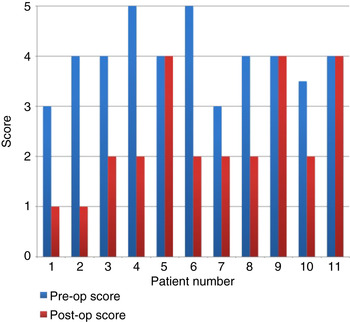
When comparing pre-operative with post-operative QoL outcome scores (attained using the measure devised by Rotenberg et al.Reference Rotenberg, Busato and Agrawal 11 , Reference Rotenberg and Davidson 18 ), the eight satisfied patients reported an improvement, whereas the remaining three patients had no change to their score (Figure 2). This improvement was statistically significant when tested using the Wilcoxon signed-rank test (p < 0.01, W = 0).
Pre-operative (pre-op) and post-operative (post-op) autophony quality-of-life (QoL) impact scores (attained using Rotenberg and colleagues’ measure of the impact of autophony on QoLReference Rotenberg, Busato and Agrawal 11 , Reference Rotenberg and Davidson 18 ).

Discussion
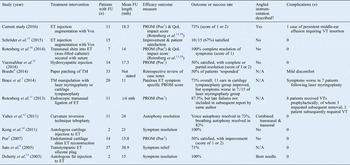
Predictably, no randomised, controlled trials have evaluated treatment options for patulous eustachian tube. In addition, the comparison of different published case series is difficult given the lack of agreed diagnostic criteria and, more importantly, the lack of consensus regarding outcome measures to use to determine success. Table III lists and compares some of the more recently published studies of surgical treatment strategies for patulous eustachian tube.Reference Poe 1 , Reference Boedts 7 , Reference Brace, Horwich, Kirkpatrick and Bance 8 , Reference Sato, Kawase, Yano, Suetake and Kobayashi 10 – Reference Vaezeafshar, Turner, Li and Hwang 15 , Reference Schröder, Lehmann, Sudhoff and Ebmeyer 17 , Reference Rotenberg and Davidson 18 Although this list is by no means exhaustive, it puts our results into context with what is currently being offered in other specialist units. Overall, there is a move towards adopting patient-reported outcome measures, and several reports (including ours) have utilised Poe's scoring system,Reference Poe 1 allowing for more direct comparison of success rates. One can observe a trend of somewhat reduced success rates in larger series with longer follow up, possibly reflecting a more accurate value for long-term results.
Summary of more recently published surgical treatment strategies for patulous eustachian tube

FU = follow up; mth = months; ET = eustachian tube; PROM = patient-reported outcome measure; QoL = quality of life; VT = ventilation tube; TM = tympanic membrane; N/A = not applicable
The total number of patients in this series is not large, but is comparable to other recently published series using similar techniques. There are, however, some interesting observations to be made from our results.
It is noteworthy that all patients had experienced a delay in diagnosis, despite being seen by an ENT doctor. This highlights the fact that patulous eustachian tube may be an under-recognised condition. In some patients, the symptoms are attributed to the more common impairment of dilatory eustachian tube function. In addition, the relatively low mean age of the patient group may not reflect the typical age of symptom onset and may instead reflect the fact that several of these patients turned to the numerous internet forum groups in search for a cure for their symptoms.
In this report, we have described the success rates following the completion of treatment; however, 5 of 11 patients required more than 1 injection (4 injections were required in 1 patient). Clearly the objective is to inject sufficient volume to prevent abnormal patency, whilst avoiding complete obliteration causing loss of middle-ear ventilation and resultant middle-ear effusion. In one of our patients, this complication necessitated ventilation tube insertion. Judging the adequate volume to inject is difficult, as we are injecting into a fat-filled tissue space without clear boundaries, and the leaching out of material occurs in an unpredictable manner. In addition, we are performing a static augmentation of what is a complex dynamic structure. With this in mind, it seems reasonable to titrate the required volume with more than one procedure if necessary, in order to avoid obliteration of the eustachian tube valve.
A further reason to use patient-reported outcome measures in patulous eustachian tube is that there is not a clear correlation between degree of eustachian tube patency (on objective examination and tympanometry) and severity of symptoms.
-
• Patulous eustachian tube presents with autophony to voice and respiration, with or without aural fullness
-
• Treatments include: nasal medications, eustachian tube augmentation via nasopharynx or middle ear, and tympanic membrane mechanics augmentation
-
• Use of previously published patulous eustachian tube specific outcome measures allows for direct comparison of treatments
-
• Eustachian tube augmentation using polydimethylsiloxane elastomer injection is effective and safe for patulous eustachian tube management
The phenomenon of breath synchronous excursion of the tympanic membrane (confirmed with tympanometry) without autophony complaints is long recognised and the reason has remained elusive.Reference O'Connor and Shea 3 This is analogous to semicircular canal dehiscence where patients may have radiological evidence without the classic symptoms. It has been postulated that symptoms of patulous eustachian tube occur in part due to the loss of the middle-ear air cushion, which contributes to the impedance of the tympanic membrane. This in turn will change the natural resonance characteristics of the tympanic membrane. Clearly the structure of the tympanic membrane is also key, and abnormalities such as a flaccid segment will not only affect the natural resonance but also further reduce impedance. Both of these factors are potentially implicated, which explains why some patients develop symptoms with a patent eustachian tube whilst others remain asymptomatic.Reference Boedts 7
We feel that the described technique may have advantages over some previously described techniques because of the approach and instruments used. It is known that the valve area of the eustachian tube is posterior to the torus tubarius and eustachian tube orifice.
In normal anatomy, the resting state of the eustachian tube orifice can impair an adequate view of the valve area, leading to difficulty placing the bulking injection at the critical site. In addition, using a straight instrument to inject down the ipsilateral side of the nose may not provide sufficient reach to the lateral valve wall area. We hypothesise that this may be the reason for failure in some cases of eustachian tube injection augmentation surgery. It is for this reason that the senior author utilises the angled instrumentation described above. The angled forceps allow the orifice to be opened (temporarily medialising the torus tubarius), permitting an improved view of the more posteriorly located lateral wall of the valve. The angled injection instrument, also introduced through the mouth into the post-nasal space, allows the lateral wall of the valve to be injected with the tip of the endoscope, in close proximity to assess adequate volume, without the endoscope shaft clashing with the needle shaft. Performing this procedure with straight instruments is technically difficult and risks injection into the torus tubarius and not the eustachian tube valve area (as was noted in two of our patients in whom previous eustachian tube augmentation had failed). It is interesting that in many of the published reports of injection eustachian tube augmentation, there is no mention of the use of the angled instrumentation specifically designed for this indication (Table III).
Conclusion
This level four evidence study presents an effective treatment option for patients with troublesome patulous eustachian tube symptoms, in which optimised equipment is utilised to maximise the chance of adequate eustachian tube augmentation. We focused on patient-reported outcome measures and used previously reported scales to allow for more direct comparison. There are a wide range of treatments for this condition, in particular eustachian tube augmentation via two main routes (transtympanic vs transnasal). Trials allowing for direct comparison are required to adequately assess efficacy and rates of complications. However, this will be difficult because of the relative infrequency of this type of surgery. Overall, our results show success and complication rates comparable with those of other published techniques.