Multiple sclerosis (MS) is a debilitating neurological disorder affecting 2 million people worldwide (Wallin et al., Reference Wallin, Culpepper, Campbell, Nelson, Langer-Gould, Marrie, Cutter, Kaye, Wagner, Tremlett, Buka, Dilokthornsakul, Topol, Chen and LaRocca2019). Although MS can impact many aspects of life (Crayton & Rossman, Reference Crayton and Rossman2006), decreased lower limb functioning, trouble walking, and increased falls are among the most common and impactful (Cameron & Nilsgard, Reference Cameron, Nilsgard, Day and Lord2018; Heesen et al., Reference Heesen, Bohm, Reich, Kasper, Goebel and Gold2008; Zwibel, Reference Zwibel2009). Indeed, difficulty walking and the resultant loss of independence are among the chief concerns cited by PwMS (Heesen et al., Reference Heesen, Bohm, Reich, Kasper, Goebel and Gold2008; LaRocca, Reference LaRocca2011).
Many PwMS also experience decline in psychological and cognitive functioning, including fear of falling or low falls self-efficacy [FSE; (Comber et al., Reference Comber, Coote, Finlayson, Galvin, Quinn and Peterson2017; Hill et al., Reference Hill, Schwarz, Kalogeropoulos and Gibson1996; Peterson et al., Reference Peterson, Cho and Finlayson2007; Tinetti et al., Reference Tinetti, Richman and Powell1990)], depression and anxiety (Boeschoten et al., Reference Boeschoten, Braamse, Beekman, Cuijpers, van Oppen, Dekker and Uitdehaag2017; Siegert & Abernethy, Reference Siegert and Abernethy2005), and cognitive impairment (Chiaravalloti & DeLuca, Reference Chiaravalloti and DeLuca2008; Rocca et al., Reference Rocca, Amato, De Stefano, Enzinger, Geurts, Penner, Rovira, Sumowski, Valsasina and Filippi2015). These MS-related changes in psychological and cognitive function can affect functional outcomes such as gait, but the intersection between these domains is unclear. Although there are many measures of function or disability in MS, walking is crucial (Heesen et al., Reference Heesen, Bohm, Reich, Kasper, Goebel and Gold2008; LaRocca, Reference LaRocca2011; Zwibel, Reference Zwibel2009). Walking speed, in particular, may be a sensitive, useful measure of function (Albrecht et al., Reference Albrecht, Wotzel, Erasmus, Kleinpeter, Konig and Pollmann2001). Decreased walking speed can occur early in the disease course (Langeskov-Christensen et al., Reference Langeskov-Christensen, Feys, Baert, Riemenschneider, Stenager and Dalgas2017), and factors like FSE (Kalron, Reference Kalron2014; Kalron & Achiron, Reference Kalron and Achiron2014), depression (Briggs et al., Reference Briggs, Thompson and Conway2019), and cognition (D’Orio et al., Reference D’Orio, Foley, Armentano, Picone, Kim and Holtzer2012; Kalron, Reference Kalron2014) are related to walking speed in PwMS. These relationships may be even more meaningfully assessed for real-world function by assessing functional performance in the context of activities that require the intersection of multiple functions at once, such as dual-task walking (DTW). Further, DTW may pose distinct challenges for individuals with different clinical profiles based on the interrelatedness and likely interactions of psychological, cognitive, and motoric symptoms in MS.
Although there are numerous studies evaluating DTW in PwMS [e.g., (Hamilton et al., Reference Hamilton, Rochester, Paul, Rafferty, O’Leary and Evans2009)], most studies have focused on comparing performance of PwMS to healthy controls. Data show that DTW alters gait in MS – albeit evidence is not conclusive that it does so more severely than in controls, and DTW speed is the most sensitive DTW measures (Leone et al., Reference Leone, Patti and Feys2015; Postigo-Alonso et al., Reference Postigo-Alonso, Galvao-Carmona, Benitez, Conde-Gavilan, Jover, Molina, Pena-Toledo and Aguera2018; Wajda & Sosnoff, Reference Wajda and Sosnoff2015). Further, although studies commonly use DTW costs the relative change in gait from single-task walking (STW) to dual-task performance – in MS (Postigo-Alonso et al., Reference Postigo-Alonso, Galvao-Carmona, Benitez, Conde-Gavilan, Jover, Molina, Pena-Toledo and Aguera2018), there is limited understanding of the relationships between DTW measures and other important constructs in PwMS (Leone et al., Reference Leone, Patti and Feys2015; Rooney et al., Reference Rooney, Ozkul and Paul2020). For example, Leone et al. (Reference Leone, Patti and Feys2015) noted that there is a neglect of the “invisible symptoms” of MS in the context of DTW research. Rooney et al. (Reference Rooney, Ozkul and Paul2020) also noted that few studies examined correlations between DTW and other variables of importance in MS. In particular, there is a surprising lack of studies examining relationships with cognition, or physical abilities, and the few studies that do exist have included relatively small samples (Rooney et al., Reference Rooney, Ozkul and Paul2020).
There is a theory of DTW that acknowledges the potential intersection of psychological, cognitive, and physical processes for understanding performance during DTW: self-awareness theory (Wajda et al., Reference Wajda, Roeing, McAuley, Motl and Sosnoff2016; Yogev-Seligmann et al., Reference Yogev-Seligmann, Hausdorff and Giladi2012). Self-awareness theory purports that person-level moderators – including appraisals of self and one’s environment (Yogev-Seligmann et al., Reference Yogev-Seligmann, Hausdorff and Giladi2012) – may be important to understanding prioritization and performance during DTW. This theory would predict that self-efficacy and/or depression moderate the relationship between baseline abilities (e.g., STW speed or cognitive function) and dual-task performance (e.g., DTW speed). Supporting these ideas, self-efficacy and depression have been shown to affect motor (Gunn et al., Reference Gunn, Cameron, Hoang, Lord, Shaw and Freeman2018) and cognitive (Potvin et al., Reference Potvin, Charbonneau, Juster, Purdon and Tourjman2016; Serra-Blasco et al., Reference Serra-Blasco, Torres, Vicent-Gil, Goldberg, Navarra-Ventura, Aguilar, Via, Portella, Figuereo, Palao, Lam and Cardoner2019), processes, respectively, as well as risk evaluation and personal assessments (Bandura, Reference Bandura and Ramachaudran1994; Davey et al., Reference Davey, Breakspear, Pujol and Harrison2017). Finally, this theory emphasizes that not just one’s objective abilities but also one’s subjective appraisals of these abilities can impact DTW performance. Therefore, analyses relating both types of characteristics (subjective and objective) with DTW performance may help to explain the heterogeneity observed in the corpus of DTW correlate literature (Leone et al., Reference Leone, Patti and Feys2015; Rooney et al., Reference Rooney, Ozkul and Paul2020).
Finally, there is heterogeneity in how DTW outcomes are operationalized that may pose important implications for interpreting findings. Although DTW costs are commonly evaluated (Leone et al., Reference Leone, Patti and Feys2015; Postigo-Alonso et al., Reference Postigo-Alonso, Galvao-Carmona, Benitez, Conde-Gavilan, Jover, Molina, Pena-Toledo and Aguera2018; Wajda & Sosnoff, Reference Wajda and Sosnoff2015), the standardization by an individual’s STW speed removes information about one’s gait, conveying only the “percent change” evoked by “concurrent cognitive task performance” – making it a measure of the effect of concurrent cognition. As such, two people with entirely different functional or walking abilities can have identical DTW costs. If the desire is to understand functional performance or walking ability during DTW – and how it relates to other variables in the nexus of MS symptoms, using DTW speed (or other direct measures of gait performance) may be more appropriate than using DTW costs. At minimum, capturing DTW speed and costs together may provide a fuller understanding of the relevant processes enmeshed in DTW paradigms by capturing the basic physical walking ability and dual-tasking effect.
Given the ubiquity of DTW and its relationship to falls (Wajda et al., Reference Wajda, Motl and Sosnoff2013), it is critical to identify factors that relate to DTW ability and potential moderators of these relationships. This study assessed interactions between DTW, cognitive, and self-efficacy outcomes, hypothesizing that FSE and depression moderate the relationships between baseline abilities (e.g., STW speed or cognitive function) and dual-task performance (e.g., DTW speed or cost). Specifically, FSE may alter/moderate the way that the added challenge of dual-tasking affects walking, such that those with better FSE are less affected by the increased difficulty than those with lesser FSE. Similarly, depression may alter/moderate the relationship between cognition and DTW, such that the co-occurrence of cognitive and depressive symptoms could intensify the negative effects of dual tasking on walking.
Method
Participants
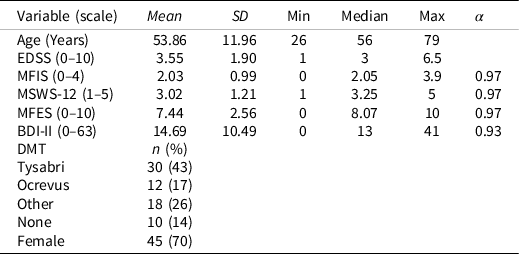
The study used a convenience sample of 73 PwMS seen at a MS care center. There were no explicit inclusion or exclusion criteria. The retrospective, secondary data analysis was approved by an institutional review board. For participant demographics see Table 1.
Demographic and clinical characteristics

Note. α = Cronbach’s α; EDSS = expanded disability status scale step; MFIS = modified fatigue impact scale; MSWS-12 = multiple sclerosis walk scale-12; MFES = modified falls efficacy scale; BDI-II = Beck Depression Inventory-II; DMT = disease-modifying therapy. Scale means are used for summary purposes except for the BDI which is a scale sum.
Materials
Gait parameters
Speed was extracted using a ZenoTM Walkway gait analysis system measuring 2ft (width) by 26ft (length; Protokinetics Inc., Haverton, PA, USA). The ZenoTM Walkway is a valid and reliable tool for evaluating gait characteristics (Vallabhajosula et al., Reference Vallabhajosula, Humphrey, Cook and Freund2019), including gait speed in clinical care settings (Abizanda et al., Reference Abizanda, Venegas, Andersen, Roldan, Utiel and Victor2020), and it has been evaluated for reliability in DTW designs (Montero-Odasso et al., Reference Montero-Odasso, Sarquis-Adamson, Kamkar, Pieruccini-Faria, Bray, Cullen, Mahon, Titus, Camicioli, Borrie, Bherer and Speechley2020). Participants began walking before reaching the mat and continued walking after the mat ended (approximately 5 ft each). Straight, unobstructed, “comfortable speed” walks were performed. STW and DTW included three trials, and the mean of these was calculated. For details on cognitive tasks, see “procedures” below. No individuals used assistive devices during trials. DTW costs were computed and analyzed based on Baddeley et al.’s (Reference Baddeley, Della Sala, Gray, Papagno, Spinnler and Rabbit1997) formula (Baddeley et al., Reference Baddeley, Della Sala, Gray, Papagno, Spinnler and Rabbit1997).
 $$DTW\;costs = \;{{STW\;speed - DTW\;speed} \over {STW\;speed}} \times 100$$
Cognitive measures
Neurotrax, a computerized cognitive test battery measured cognition. Neurotrax measures seven domains: (1) verbal and nonverbal memory; (2) executive function; (3) visual-spatial processing; (4) verbal function; (5) attention; (6) information processing speed; and (7) motor skills (Doniger, Reference Doniger2014a). The test uses computerized adaptive processes to gauge cognitive function effectively for each participant, providing precise (ms) measurements (Doniger, Reference Doniger2014a). It has been used in MS to assess cognitive relationships with self-reported walking, FSE, and gait speed (Kalron, Reference Kalron2014), but not, to-date, with DTW in MS. All measures are standardized and normalized automatically by the Neurotrax program accounting for age and education (M = 100, SD = 15; (Doniger, Reference Doniger2014b)). The domains of information processing and executive functioning were selected due to deficits in PwMS in these areas (Denney & Lynch, Reference Denney and Lynch2009; Denney et al., Reference Denney, Lynch, Parmenter and Horne2004; Denney et al., Reference Denney, Sworowski and Lynch2005), and their putative roles in DTW. The standardized executive functioning score includes contributions from the NeuroTrax Go-NoGo test, the Stroop Interference Task, the “Catch” game, similarities and differences multiple-choice testing, and the Reality Test (Doniger, Reference Doniger2014a). Doniger (Reference Doniger2014a) presents further details about these assessments. Information processing includes NeuroTrax’s Staged Information Processing Speed test which measures information processing speed in an incrementally more challenging rate in three levels of load difficulty (single-digit, two-digit, and three-digit arithmetic problems; Doniger, Reference Doniger2014a). It requires participants to determine whether the final number obtained is less than or greater than a specific target number. This battery has been validated in MS (Golan et al., Reference Golan, Wilken, Doniger, Fratto, Kane, Srinivasan, Zarif, Bumstead, Buhse, Fafard, Topalli and Gudesblatt2019; Wojcik et al., Reference Wojcik, Beier, Costello, DeLuca, Feinstein, Goverover, Gudesblatt, Jaworski, Kalb, Kostich, LaRocca, Rodgers, Benedict and National2019) and associated with neurostructural (Golan et al., Reference Golan, Doniger, Srinivasan, Sima, Zarif, Bumstead, Buhse, Van Hecke, Wilken and Gudesblatt2020) and neurofunctional (Covey et al., Reference Covey, Golan, Doniger, Sergott, Zarif, Srinivasan, Bumstead, Wilken, Buhse, Mebrahtu and Gudesblatt2021) measures. It has also been found to be directly affected by severe depression and fatigue (Golan et al., Reference Golan, Doniger, Wissemann, Zarif, Bumstead, Buhse, Fafard, Lavi, Wilken and Gudesblatt2018).
Walking limitations
Self-reported walking was assessed as the average score on the Multiple Sclerosis Walking Scale-12 [MSWS-12 (Hobart et al., Reference Hobart, Riazi, Lamping, Fitzpatrick and Thompson2003)] in which participants report the degree of limitation experienced across 12 tasks during a 2-week period on 5-point scales (1 = Not at all; 5 = Extremely). The measure is internally consistent (.94 ≤ Cronbach’s α ≤ .97 [Hobart et al., Reference Hobart, Riazi, Lamping, Fitzpatrick and Thompson2003; McGuigan & Hutchinson, Reference McGuigan and Hutchinson2004)] and has criterion validity with established relationships with daily step counts, balance, walking ability, and FSE (Cavanaugh et al., Reference Cavanaugh, Gappmaier, Dibble and Gappmaier2011); EDSS, MS Impact, and quality of life (Hobart et al., Reference Hobart, Riazi, Lamping, Fitzpatrick and Thompson2003); walking speed (Motl et al., Reference Motl, Dlugonski, Suh, Weikert, Agiovlasitis, Fernhall and Goldman2010); and fall risk (Nilsagard et al., Reference Nilsagard, Lundholm, Denison and Gunnarsson2009).
Depression
Depression was measured using the Beck Depression Inventory-II (BDI-II; (Beck et al., Reference Beck, Steer and Brown1996). The BDI-II contains 21 items that ask about depressive symptoms that have been experienced in the past 2 weeks using a 0 to 3 scale with higher scores indicating higher levels of depressive symptoms (Beck et al., Reference Beck, Steer and Brown1996). The BDI-II has demonstrated excellent internal validity [e.g., construct, criterion; (Wang & Gorenstein, Reference Wang and Gorenstein2013a)], and there is evidence that the 21-item measure has two factors, labeled as cognitive-affective and somatic-vegetative (Wang & Gorenstein, Reference Wang and Gorenstein2013b).
Falls self-efficacy
FSE was measured using the average score of the Modified Falls Efficacy Scale (MFES) (Hill et al., Reference Hill, Schwarz, Kalogeropoulos and Gibson1996). The MFES consists of 14 items using an 11-point scale with verbal references provided at 0 (Not confident at all), 5 (Fairly confident), and 10 (Completely confident), and has excellent internal consistency [Cronbach’s α = .95 (Hill et al., Reference Hill, Schwarz, Kalogeropoulos and Gibson1996)]. Significant differences between balance-compromised and healthy older adults provide evidence of discriminant validity (Hill et al., Reference Hill, Schwarz, Kalogeropoulos and Gibson1996).
Procedures
Gait analyses were performed in the same order for all participants (STW then DTW). There were two different DTW paradigms applied – each without any prioritization instructions. Forty-nine participants completed serial 3 subtractions starting at the number 50 and 21 completed serial 7 subtractions. The MSWS-12 and MFES were collected on the same day the gait analysis was performed.
The cognitive testing and the BDI-II data were collected together at a separate visit. Some participants completed cognitive testing before gait analysis, and some participants completed cognitive testing after gait analysis. The distance between measures ranged from the same day to slightly more than 10 months. Participants completing different serial subtractions and with different spans between visits were compared statistically, and the evidence supported aggregating across subtraction type and span for further analysis.
Analytic procedures
Analysis was performed using Stata IC 16. Psychometric evaluations on the scales used for the constructs of FSE, depression, and walking limitations were performed using iterative principal axis factoring. To determine the number of factors measured, parallel analyses were performed by constructing 100 random samples of size n and using the Eigenvalue at the 95th percentile from these analyses as the threshold for a factor being present (Hayton et al., Reference Hayton, Allen and Scarpello2004). This was coupled with visual analysis using scree plots.
Next, we measured the relationships between DTW ability (DTW speed and costs) and physical outcomes [measured objectively (STW speed) and subjectively (MSWS-12)] and cognitive variables (information processing and executive functioning). Given the nascency of this line of research, the decision was made to explore both psychological constructs – depression and FSE – as moderators of physical and cognitive constructs on DTW speed and costs. Specifically, factor scores using regression scoring methods were used along with observed measures for cognition, speed, and costs in multiple linear regression models with interactions between FSE and depression and physical outcomes [measured objectively (STW speed) and subjectively (MSWS-12)] and cognitive variables (information processing and executive functioning) included. All tests were evaluated using a comparison-wise α = 0.05 and should be interpreted as preliminary.
Results
Participant characteristics and outcome factoring
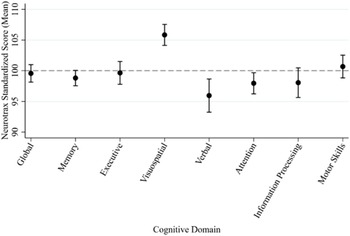
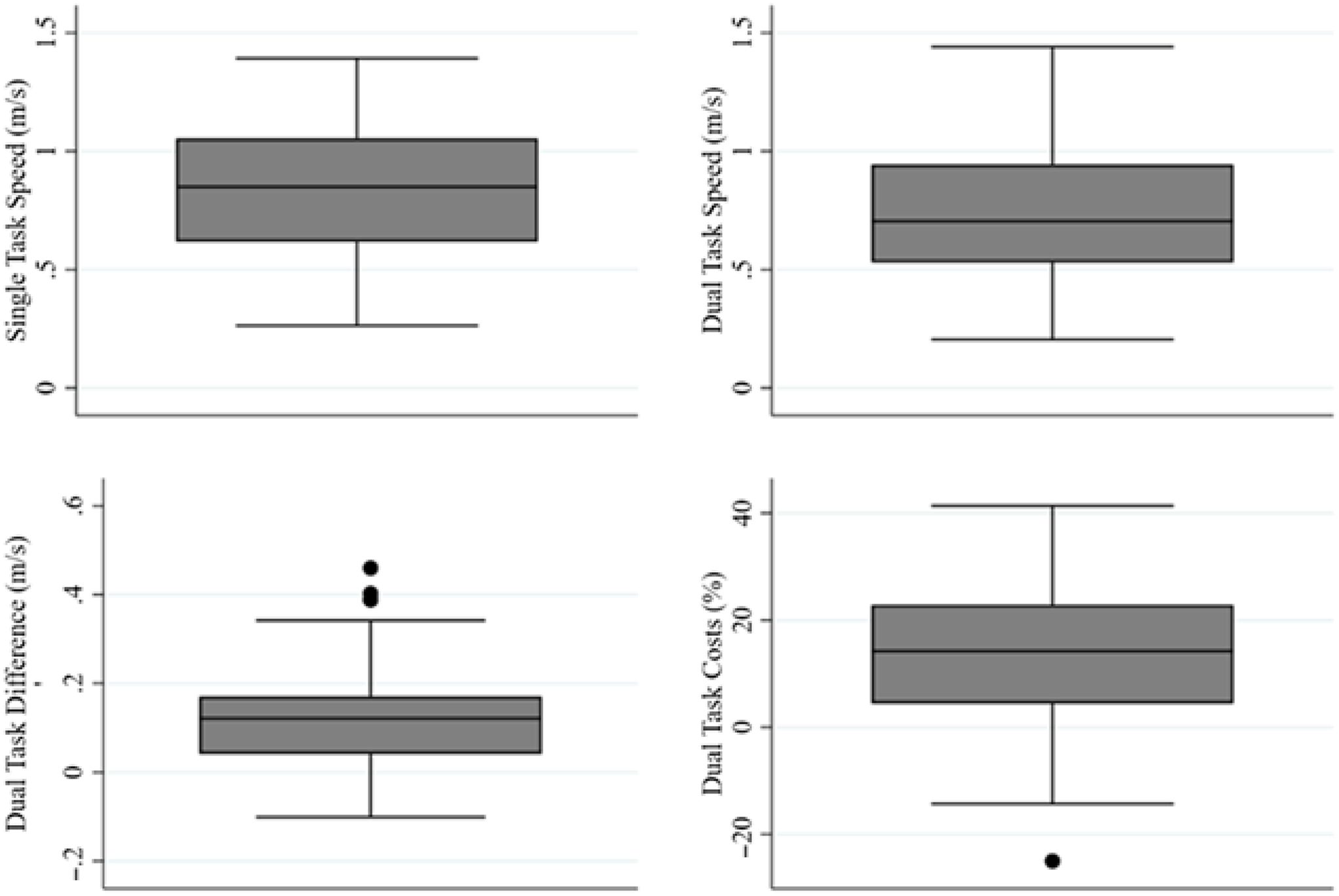
Participants had mostly intact cognitive function with some means deviating from expected norms (see Figure 1). A DTW effect, aggregated across subtraction type given there were no differences between these conditions (see Supplementary material, S1), was present with a mean slowing from the STW and DTW of approximately 0.12 m/s (SD = 0.01) and DTW costs of 13.85% (SD = 13.80%; see Figure 2). Analyses indicated one-factor solutions for the MSWS-12 (0.811 ≤ λ ≤ 0.912) and MFES (0.794 ≤ λ ≤ 0.938), but a two-factor solution for BDI-II – consistent with previous research Affective and Somatic are reasonable monikers for factors 1 and 2, respectively (see supplementary material, S2). Factor scores were predicted using regression scoring (and for the two-factor BDI-II after oblimin rotation to allow for correlated factors, r = 0.403) from analyses to be used as the moderating variables in analyses predicting DTW speed and costs.
Means and standard error bars for cognitive domains on NeurotraxTM cognitive battery. Note. Y-axis reference indicates standardized mean (100).

Boxplots for dual-task and walk measures for participants.

Moderating effects of depression and FSE on the baseline characteristics – DTW relationship
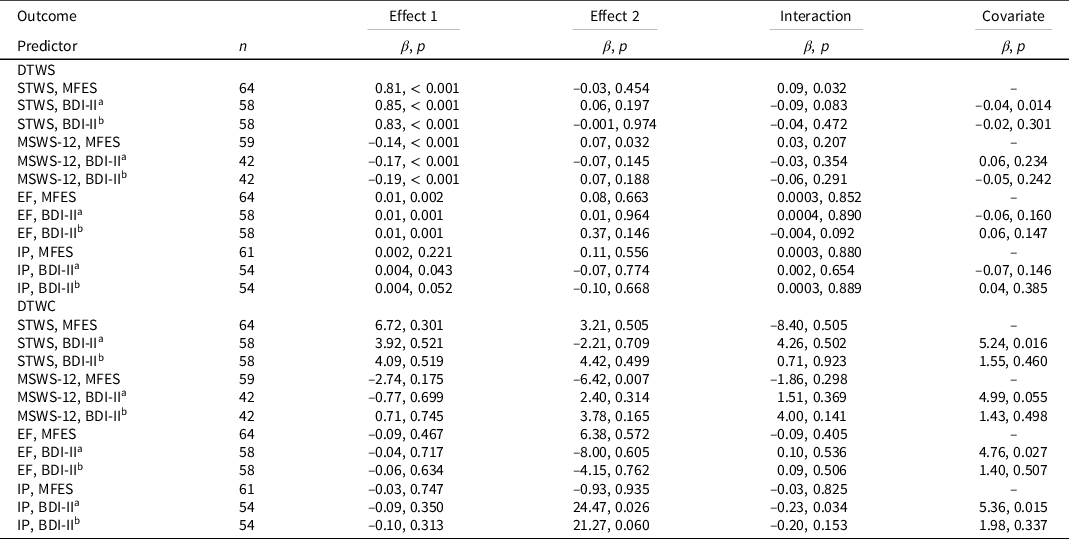
Table 2 contains a summary of the multiple regression models tested. The table lists the motor or cognitive variable first (effect 1 column) followed by the moderating psychological variable (effect 2 column), and, finally, for any model examining depression the non-moderating factor for the model is included as a covariate given the two-factor solution for the construct. So, when BDI-II1 is tested (Affective component) as a moderator, BDI-II2 (Somatic component) is entered as a covariate and vice-versa.
Regression models evaluating falls self-efficacy and depression as moderators of the effects of walking speed and cognition on dual-task walking outcomes

Note. DTWS = dual-task walking speed; DTWC = dual-task walking costs; STWS = single-task walking speed; MFES = modified falls efficacy scale (factor score); BDI-II = Beck Depression Inventory-II (Factor Scores); MSWS-12 = multiple sclerosis walking scale-12; EF = executive function; IP = information processing.
aFactor 1, Affective, is tested as a moderator.
bFactor 2, Somatic, is tested as a moderator.
Cognitive domains are from Neurotrax TM cognitive battery.
Covariates are included for the models using the BDI-II to control for the correlated BDI-II factors.
Effects 1 and 2 are in the order listed in the predictor statement in column 1.
Bold font indicates p ≤ 0.05.
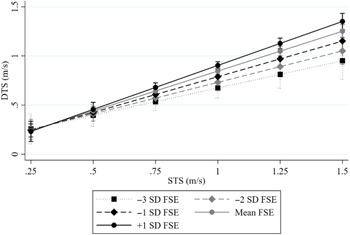
For DTW speed models, STW speed, MSWS-12, executive functioning, and even information processing were predictive of DTW speed with relationships in the expected directions: faster STW speed, fewer walking limitations, and greater cognitive function related to faster DTW speed. The MFES related to DTW speed in both models that included a basic physical ability primary predictor – as an additive main effect in the model with the MSWS-12 and as a moderator in the model with STW speed. Greater FSE predicted faster DTW speed controlling for self-reporting walking limitations, and it moderated STW speed, such that STW speed was a stronger predictor of DTW speed for those with high MFES factor scores. The strength of the relationship between STW speed and DTW speed attenuated as MFES factor scores decreased (see Figure 3). As such, those with greater FSE are more likely to maintain their speed during DTW than those with lesser FSE. This finding is consistent with the hypothesis that FSE would alter the effect of dual tasking on walking performance.
Falls self-efficacy moderates the relationship between single and dual-task walk speeds. Note. FSE = falls self-efficacy measured by the factor score from the modified falls efficacy scale; DTS = dual-task speed; STS = single-task speed.

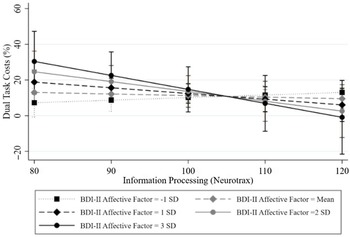
For DTW costs, depression constructs were the most reliable predictors (particularly the Somatic factor of the BDI-II). Greater symptoms of somatic depressiveness predicted greater DTW costs (see covariate column in Table 2 for models with BDI-II1 as the moderator). The MFES was also related to DTW costs when controlling for the MSWS-12 with lesser FSE predicting greater DTW costs. In general, physical and cognitive abilities were not related to DTW costs. However, an interaction occurred between information processing and Affective factor scores from the BDI-II controlling for the Somatic factor from the BDI-II (see Figure 4). The findings indicate that increases in depression (on both factors) predict increases in DTW costs as main effects. However, the effect of the Affective factor is moderated qualitatively by information processing ability such that the effect of the Affective factor on DTW costs inverts around 105 on the information processing domain. As such, those with lower information processing abilities experience greater DTW costs at higher levels of negative affect, but those with greater information processing abilities experience greater DTW costs at lower levels of negative affect. Thus, those experiencing the greatest DTW costs have high negative affect and low information processing according to this model, but those experiencing the least DTW costs are those who have high negative affect and high information processing. Those around the mean of negative affect have similar DTW costs regardless of information processing. This finding is consistent with the hypothesis that depression would moderate the relationship between cognitive ability and DTW costs.
Affective factor from Beck Depression Inventory-II moderates the effect of information processing on dual-task walking costs. Note. The BDI-II = Beck Depression Inventory-II. Dual-task costs are calculated as the difference between single-task and dual-task walk speeds divided by single-task walk speed and multiplied by 100. Higher values indicate greater “costs” associated with dual tasking.

Finally, given the span and variability between collection of cognitive and gait measures, post hoc analyses were run to determine whether this span interacted with any of the cognition-gait relationships. As seen in supplementary material, span was not a reliable moderator of these relationships, only significantly interacting with 1 of 21 relationships (Visuospatial Ability on DTW speed; p = 0.047).
Discussion
There is a lack of research on how “invisible symptoms” (Leone et al., Reference Leone, Patti and Feys2015), p. 128) relate to DTW outcomes in MS. Yet, theories like self-awareness theory (Yogev-Seligmann et al., Reference Yogev-Seligmann, Hausdorff and Giladi2012) posit that investigation of these invisible symptoms can facilitate a better understanding of the manifestation of basic abilities in the context of more complex DTW contexts. Our findings are consistent with general theories of self-efficacy (Bandura, Reference Bandura and Ramachaudran1994) – that subjective beliefs or appraisals about one’s abilities impact objective abilities – particularly in challenging contexts where self-appraisal becomes salient. The current study adds to our understanding of how DTW outcomes relate to key invisible symptoms in MS, and it provides preliminary evidence in support of self-awareness theory as a useful framework for interpreting these relationships.
A major theme of the present study’s findings is that DTW speed relates more robustly to both physical (e.g., STW speed and MSWS-12) and cognitive (e.g., executive functioning) predictors than DTW costs. DTW costs measure the dual-task speed in relation to (e.g., as a percentage change) from STW speed. Measuring dual-task waking as a percentage change is of interest and may have benefit (see below). However, the primacy of DTW speed in relating to physical and cognitive abilities implies this measure may be a more relevant predictor of some outcomes than STW speed. There are innumerable cases in which “walking and” occurs in daily life, so performance in such contexts is reasonable to assess. Similarly, DTW ability may not need to be in reference to STW speed. DTW speed, both theoretically and based on these empirical findings, is a construct that seems valuable to measure in MS. This was not only evidenced by the models that examined predictors of DTW speed and costs, but it is also clear when daily experiences are considered that performance measures (e.g., actual gait parameters) will be critical to understanding the consequences of DTW. That is, whether one slows substantially relative to one’s “normal” walking speed may not be as important as DTW speed when the question is how these measures relate to broader clinical profiles in MS.
Although DTW costs were not a reliable correlate of physical and cognitive variables in MS when considered in isolation, it may still provide relevant information regarding gait or cognition in PwMS. For example, DTW costs exhibited unique relationships with constructs like depression and cognition – especially when considered concurrently and interactively. Only depression and FSE emerged as significant predictors of DTW costs in any of the analyses as main effects – when controlling for cognitive and physical abilities which were not significant predictors themselves. Depressive symptoms were the most robust predictor of DTW costs with Somatic depressive symptoms being a significant predictor in models that controlled for Affective depressive symptoms and STW speed, executive functioning, and information processing abilities. The Somatic factor includes items like lack of energy, problems with concentration, sleep problems, tiredness, etc. It emerged as a significant covariate in the models that examined STW speed, executive functioning, and information processing as primary predictors – despite these primary predictors themselves not relating significantly to DTW costs. This pattern of findings hints at a form of appraisal processing and self-monitoring in which people’s psychological states and self-appraisals are important to how they alter their speed under more complex DTW contexts. Further, Affective aspects of depression moderated the effect of information processing on DTW costs, indicating that considering depression may be important in more basic studies of DTW in MS, as depression levels may affect DTW costs.
Further support for the relevance of self-awareness theory comes from the findings that when modeling information processing as a primary predictor, the effects of both BDI-II factors and the interaction between the Affective factor and information processing were statistically significant predictors of DTW costs. Controlling for both depression factors, higher information processing abilities predict faster DTW speed. These findings are particularly intriguing considering the mixed evidence regarding depression (which hitherto has been treated simply as a total scale score in the literature) and its relationships with DTW measures (Butchard-MacDonald et al., Reference Butchard-MacDonald, Paul and Evans2018; Hamilton et al., Reference Hamilton, Rochester, Paul, Rafferty, O’Leary and Evans2009; Motl et al., Reference Motl, Sosnoff, Dlugonski, Pilutti, Klaren and Sandroff2014; Postigo-Alonso et al., Reference Postigo-Alonso, Galvao-Carmona, Benitez, Conde-Gavilan, Jover, Molina, Pena-Toledo and Aguera2018), as well as the lack of established correlates of DTW costs generally (Leone et al., Reference Leone, Patti and Feys2015; Rooney et al., Reference Rooney, Ozkul and Paul2020). If relationships are moderated, ignoring a moderating variable can result in null findings within studies and mixed findings across studies depending on sample composition related to the moderator. This is important as depression (Boeschoten et al., Reference Boeschoten, Braamse, Beekman, Cuijpers, van Oppen, Dekker and Uitdehaag2017; Siegert & Abernethy, Reference Siegert and Abernethy2005) and information processing (Arnett et al., Reference Arnett, Higginson and Randolph2001; Arnett et al., Reference Arnett, Higginson, Voss, Bender, Wurst and Tippin1999; Diamond et al., Reference Diamond, Johnson, Kaufman and Graves2008) have both been highlighted as important, related constructs in MS symptomatology (Blair et al., Reference Blair, Gill, Gutmanis, Smolewska, Warriner and Morrow2016; Landro et al., Reference Landro, Celius and Sletvold2004). Further, both the main effects of the BDI-II factors were significant and positive – indicating that controlling for information processing and each other, both Affective and Somatic factors of the BDI-II predicted greater DTW costs.
The depression-information processing interaction only existed for the Affective component of the BDI, controlling for the Somatic component, undercutting the notion that depressive symptoms, generally, would result in “less effort” or “worse performance.” This is especially true in the context of a two-factor solution with the latter being the Somatic factor that would capture the minimization of effort while the Affective factor captures negativity about self (see, for example, (Wang & Gorenstein, Reference Wang and Gorenstein2013a) and supplementary material S1). As noted, depression may affect subjective appraisals of cognitive ability more than objective cognition (Potvin et al., Reference Potvin, Charbonneau, Juster, Purdon and Tourjman2016; Serra-Blasco et al., Reference Serra-Blasco, Torres, Vicent-Gil, Goldberg, Navarra-Ventura, Aguilar, Via, Portella, Figuereo, Palao, Lam and Cardoner2019). Further, two meta-analyses (Limburg et al., Reference Limburg, Watson, Hagger and Egan2017; Smith et al., Reference Smith, Sherry, Rnic, Saklofske, Enns and Gralnick2016) noted that perfectionism is positively related to depression. Thus, higher levels of Affective symptoms of depression could be associated with greater effort to demonstrate one’s ability – especially if the task is one which the individual feels is central to their self-concept (e.g., cognition in people with above-average cognitive abilities). However, for those with lower levels of information processing ability, increasing negative affect predicts greater DTW costs, which may reflect a basic cognitive inability to overcome the task complexity during the DTW paradigm leading to both negative affect and low information processing – a sort of collapsing under the confluence of ego-threat and objective inability. It is also possible that those who have greater cognitive function are able to appraise deficits in their performance that could intensify their reporting or experience of depressive symptoms. Whether unidirectional or reciprocal, these possibilities hint at the importance of considering depression and cognition as interacting processes in the context of challenging tasks like DTW.
Regarding FSE, it is notable that the MFES and MSWS-12 uniquely predicted DTW speed when modeled together – despite there being no interaction. Said differently, although both were correlated at the bivariate level (MSWS and DTW speed: r = −0.60, p < 0.001; MFES and DTW speed: r = 0.49, p < 0.001), better walking ability and greater FSE additively predicted greater DTW speed when modeled simultaneously. As such, these findings suggest that past reports regarding walking limitations (MSWS-12) and present beliefs about balance (MFES) provide unique insights into expected performance in DTW. This suggests that FSE may be capturing more than actual deficits in walking or balance, as it explains variance in DTW speed beyond walking limitations predicted by the MSWS-12.
Finally, supporting the idea that self-awareness theory is relevant to walking performance in MS (Yogev-Seligmann et al., Reference Yogev-Seligmann, Hausdorff and Giladi2012), the objective measure of baseline physical ability – STW speed – was significantly moderated by FSE (measured by the MFES factor). Unsurprisingly, there is a strong, positive relationship between STW speed and DTW speed. However, that effect is quantitatively moderated by FSE such that the strength of the relationship is attenuated as FSE decreases. That is, having higher balance confidence makes it such that participants are more likely to maintain more similar walking speed under DTW and STW consistent with the self-awareness theory and general self-efficacy theory (Bandura, Reference Bandura and Ramachaudran1994). Given that PwMS appear likely to have low FSE even when they are at low risk physically (Gunn et al., Reference Gunn, Cameron, Hoang, Lord, Shaw and Freeman2018), this may be an important finding because the greatest predicted disparity is for relatively fast walkers. As such, these findings suggest that low FSE may lead to unnecessary compensatory behavior in the form of slowing under the “threat” of DTW for PwMS who are actually very capable walkers.
Several limitations should be noted. First, this was a clinical sample with no inclusion and exclusion criteria, resulting in a somewhat heterogeneous clinical sample (see Table 1). Although this may increase the generalizability of findings, it also adds considerable variability to the sample which could reduce our ability to identify specific relationships that would be observable in a tightly controlled cohort. Second, cognitive performance during counting (the cognitive dual task) was not collected in this study, impeding our ability to assess prioritization across cognitive motor performance. Third, we used the BDI-II as a measure of depression despite the potential to have the somatic factor of this measure be conflated with other MS-related symptoms (e.g., fatigue). Although this may require consideration when interpreting the substance of this factor, it does not detract from the present findings, and it is notable that the affective factor was the one that manifested in an interaction effect. Future research could seek to determine whether other measures of physical states [e.g., disability (EDSS) or fatigue (MFIS)] are involved in complex or moderated relationships when predicting DTW outcomes, but these questions are beyond the scope of the hypotheses of this analysis. Fourth, some clinical demographics (e.g., time since diagnosis, clinical course, etc.) were not available in this cohort. Finally, and as noted in the methods, there was variability in the timeframe between when cognitive and motor testing took place. Although these timeframes did not vary in a systematic way practically or statistically (see Supplementary Materials), this may have included some additional variability and noise into our models.
Conclusions
Our findings indicate that fundamental, universal attentional capacities or neural limits [as proposed by theories like attentional capacity or bottleneck theories of dual tasking (Bayot et al., Reference Bayot, Dujardin, Tard, Defebvre, Bonnet, Allart and Delval2018)] may not provide a complete picture of DTW deficits, even though these theories are important to understanding the fact that DTW costs exist at all. Further, psychological states, or the mechanistic processes that underlie them, may modify what are presented as universal processes in such theoretical frameworks. Further, to understand DTW, considering the whole person – physically, cognitively, and psychologically – may enhance prediction of DTW abilities, a concept consistent with self-awareness theory (Wajda et al., Reference Wajda, Roeing, McAuley, Motl and Sosnoff2016; Yogev-Seligmann et al., Reference Yogev-Seligmann, Hausdorff and Giladi2012). In our analyses, we found that FSE moderated the relationship between STW and DTW speed and affective aspects of depressive symptoms moderated the relationship between information processing and DTW costs. As such, the effects of DTW paradigms on common outcomes may reflect more than the basic abilities (e.g., mobility and cognition), but also their self-appraisals and psychological states. The evidence indicates that, at minimum, further consideration of how self-awareness theory enhances our understanding of DTW in MS – which has been riddled by notably heterogeneous results (Leone et al., Reference Leone, Patti and Feys2015; Rooney et al., Reference Rooney, Ozkul and Paul2020) consistent with the presence of moderating effects – is warranted. Lastly, it provides support for the use of more complex DTW paradigms to evaluate how the manifold symptomatic processes in MS may interact to affect everyday function.
Supplementary material
The supplementary material for this article can be found at https://doi.org/10.1017/S1355617722000200
Acknowledgements
The authors would like to thank the participants who participated in the study.
Financial support
No funding sources were used to support this study.
Conflicts of interest
Authors have no conflicts of interest to report.