INTRODUCTION
The decline in the autonomy of the state, combined with a rise in power of both the market and citizenship, has led to an increasingly participatory philosophy underpinning natural resource management (NRM). This philosophy emphasizes empowerment, collaboration and a civil society (Rhodes Reference Rhodes1997; Bourgon Reference Bourgon2008). The many empirical case studies of such community-based NRM (CBNRM) have led to the formulation of theoretical models such as Ostrom's (Reference Ostrom1990) institutional design and analysis and Sabatier et al.'s (Reference Sabatier, Focht, Lubell, Trachtenberg, Vedlitz and Matlock2005) advocacy coalition framework. It has also led to the development of more conceptual frameworks based on theory. For example Arnstein's (Reference Arnstein1969) ladder of citizen participation, which uses theories of empowerment, has become widely used by policy makers and facilitators. There are several other conceptual frameworks including those for partnerships (Long & Arnold Reference Long and Arnold1995), access (Ribot & Peluso Reference Ribot and Peluso2003) and collaborative action (Plummer & Fitzgibbon Reference Plummer and FitzGibbon2004). Conceptual frameworks help show how key concepts or variables can be organized under major themes and, as such, help improve our understanding, and implementation of, CBNRM.
Perspectives of justice are now widely invoked in nearly every field of environmental planning and management. For example, when communities make decisions about resource allocations research shows fairness can be a key consideration (Nancarrow & Syme Reference Nancarrow and Syme2001). Many real-world contexts, including conflicts over fisheries, forests, water, pollution and climate change also cite justice as a key concern (Kals & Russell Reference Kals and Russell2001; Mutz et al. Reference Mutz, Bryner and Kenney2002). Indeed the frequency and vehemence of claims that natural resources management decisions have not been fair to a particular group is testimony to the widespread conviction that principles of fairness have power within broader society (Mutz et al. Reference Mutz, Bryner and Kenney2002). As a result, there has been a steady trend of increased interest in, and institutionalization of, justice as a key principle in environmental management and planning (Rawls Reference Rawls1971; Lawrence et al. Reference Lawrence, Daniels and Stankey1997; Slater & Pedersen Reference Slater and Pederson2009). Unfortunately many planners and managers find implementing justice amorphous and aspirational (LaChapelle et al. Reference LaChapelle, McCool and Patterson2003). This means that despite a strong body of evidence suggesting fairness and justice are central considerations in CBNRM, implementing these considerations are a key challenge for many managers. One way to overcome this problem may be to develop a conceptual framework that draws together the existing empirical and theoretical literature on justice into community-based environmental planning and management.
The Australian water reform process provides a good example of this problem because natural resource planners and managers in this country are attempting to manage a transition to sustainable resource use fairly, but have no guidance on how to do so. Until the 1990s, most water planning in Australia encouraged harvesting and infrastructure development in order to meet the existing and projected needs of society (Pigram Reference Pigram2006). However, it then became apparent that this approach was causing significant decline in critical biophysical and ecological processes and would ultimately threaten to future resource availability (Kingsford Reference Kingsford2000). Since then, Australia has devoted considerable resources towards ensuring there is more sustainable water use. This change in management, commonly known as the water reform process, recognizes the importance of water for environmental purposes and vests water rights with individual users (Pigram Reference Pigram2006). As the process involves a change from over allocation to sustainable diversion, it has been mandated that the decision-making process must be participative and achieve fair outcomes (NSW [New South Wales] Department of Land and Water Conservation 2002). Specifically, fairness is mandated at several levels including: (1) as part of the broader national policy of sustainable development, (2) reiterated within the nation's water reform legislation and (3) stated explicitly in the Government's literature about the water reform process. However, there has been no detail as to what fairness means in this context or how to implement it.
In this paper, I outline a conceptual framework of justice that combines the literature on justice and fairness with the literature on the functions of management. I use the terms justice and fairness in a way that corresponds to Adam Smith's impartial spectator (Doomen Reference Doomen2005) or, in this specific case, government-facilitating governance, whose judgement is not biased by any personal stake. Although limiting the scope of this framework, the role of government in bringing together stakeholders who have contested values and views about the allocation of natural resources is becoming increasingly important (Bourgon Reference Bourgon2008). A second, and closely related, goal of this paper is to provide two case studies of community-based water resource planning to illustrate how this framework can be applied and explain why community-based environmental planning can be more difficult when the stakeholders involved have different values and views about a resource, and when perceived injustices occur early in a planning process. Applying the framework to the case studies highlights some the issues associated with justice in CBNRM. I identify eight key variables from the justice literature that should be systematically considered during a planning process, assuming the state is attempting to act as an ‘honest broker’ (that is as a neutral mediator between two parties).
THE FRAMEWORK
Part of the problem for planners and managers is that it is difficult to define justice. Rawls (Reference Rawls1971) developed an off-cited theory of justice for the allocation of resources by a society. This theory creates principles that free and rational persons concerned with furthering their own interest would accept as being an initial position of equality. Rawls argues that people under such circumstances have a veil of ignorance about their place in society and, as personal differences are unknown and everyone is rational and similarly situated, it is possible for there to be unanimous choice about a particular conceptualization of justice. Rawl's theory applies to the general structure of society rather than specific contexts or cases, and it is therefore a useful platform for this particular paper. For Rawls, under such situations, justice is assumed to be the same as fairness.
Justice becomes less amorphous when it is assumed to mean fairness because the literature generally becomes focused to two general criteria for evaluation. One focuses on the outcomes received (called distributive justice); the other focuses on the social interactions leading to these outcomes (called procedural justice). Distributive justice theories generally assume that people achieve fair outcomes when rewards are compatible to a person's inputs (Lind & Tyler Reference Lind and Tyler1988). By contrast, procedural justice theories focus on a large body of research showing that exchange between individuals during the process as important as the outcome, and indeed, in some situations it is more important than the outcome (Lind & Tyler Reference Lind and Tyler1988). A sense of procedural fairness helps people accept the legitimacy of a decision-making process from which they are likely to emerge as losers (Nancarrow & Syme Reference Nancarrow and Syme2001; Smith & McDonough Reference Smith and McDonough2001). The conceptual framework outlined in this paper uses these two distinct dimensions fairness by separating them into two rows (Table 1). The resource dimension concerns itself with the literature on distributive justice, and emphasizes that what a person ends up possessing is important (Lind & Tyler Reference Lind and Tyler1988). The interaction dimension concerns itself with the literature on procedural justice, and demonstrates that people can be satisfied with decisions when they feel they have been treated fairly compared to others (Lind & Tyler Reference Lind and Tyler1988).
A conceptual framework for applying justice in CBNRM.

Increasingly, researchers have concluded that people's conceptualization of justice does not yield to the level of abstraction associated with one overall theory. They argue that perspectives of justice vary with local or specific contexts (Skitka Reference Skitka2009). Sometimes referred to as a contingent or situational theory of justice, these researchers point to the wide variation in results from experiments that focus on people's decisions about the distribution of socially valued goods (Konow Reference Konow2003; Skitka Reference Skitka2009). That is, an individual's view of justice varies not only according to the resource, but also because of a number of other related factors (for example greed, efficiency, interactive justice or self-interest, social inclusion and moral rights) that might also be relevant to any particular decision (Wilke Reference Wilke1991). Therefore, any perspective of justice in CBNRM needs to take into account the specific nature of the decision. Justice in decision-making in this context is better viewed as a multi-stage process in which people may answer a question about what is fair at one particular stage of an overall decision-making process, rather than being asked to come up with some universal standard of ‘right’ and ‘wrong’ or one ‘correct’ response to an overall decision.
The management literature divides the process of management into four functions: planning, organizing, leading and controlling (Davidson et al. Reference Davidson, Wood and Griffin2009; Gomez-Mejia et al. Reference Gomez-Mejia, Balkin and Cardy2008). These four functions provide a way to divide considerations about justice into a multi-stage process when CBNRM is being facilitated by an honest broker. In this paper, I have drawn specifically on literature on community development and programme innovation and apply the terms conceptualization, development, implementation and review to describe what are essentially the equivalent of four management functions within the broader literature (for example see Trickett Reference Trickett2009). This is because these terms are better suited to a community-based planning process. The result being it is possible to group various literature on fairness into eight different clusters according to whether they relate to the four different management functions and whether they focus on distributive or interactive justice (Table 1).
Elements of distributive justice within the four management functions
Theories and research on distributive justice can be grouped into four clusters. The first cluster is largely captured by Young's (Reference Young2000) theory that society is a place of struggle and that a lack of recognition in the first place inflicts damage not only on different communities, but also on the image of these communities within wider community; that is, if you are not recognized you do not exist. In this context, the distribution of acknowledgement is a key element of distributive justice. If the state does not acknowledge a group of people, those people are not only excluded from any distribution, but are also regarded as unimportant by others (Schlosberg Reference Schlosberg2004). When a facilitator or government acknowledges a group or individual they are ‘distributing’ limited spaces about who counts in a decision-making process.
The second cluster of literature is associated with voice. Specifically, the second element of distributive justice means that people who have been included have an opportunity to speak or be represented. Voice in this context is a two-dimensional phenomenon that includes both influence and opportunity. Influence is the interactive element and widely discussed in the literature, however, simply providing opportunity is a distributive element. This opportunity element of fairness is the focus of this cluster. People believe it is important to have a voice even if it results in little influence (Thibaut & Walker Reference Thibaut and Walker1975). That authorities simply canvasing opinions of group members is an important form of distributive fairness (Thibaut & Walker Reference Thibaut and Walker1975). Such distribution of an opportunity to have a voice carries with it more symbolic non-instrumental consequences (Lind & Tyler Reference Lind and Tyler1988).
The third cluster is the widely researched aspect of distributive justice that focuses on how resources are actually shared. The alternate types of distributive justice relevant to this cluster within the literature are generally agreed to be equity, equality, and need (Smith & McDonough Reference Smith and McDonough2001). Equity suggests that allocations are proportional to deservingness; equality suggests that everyone should get an equal part regardless of cost or effort; and need requires that the benefits are distributed according to people's needs. This is distributive justice because it centres on distribution of access or rights to harvest a natural resource.
Finally, there is the literature on distributive justice that focuses on controlling behaviour after a decision has been made. In some cases, when people do not get their own way they go forum shopping or end up disregarding the decision-making process (Nancarrow & Syme Reference Nancarrow and Syme2001; Andrew & Edwards Reference Andrews and Edwards2004). According to Bentham's theory of justice, a legal framework is therefore important at this stage because without law, there is no security and without security, there can be no property or ownership (Tisdell Reference Tisdell2003). Security ensures that owners of property reap the benefits of their sacrifice (Tisdell Reference Tisdell2003). Imposing clear penalties on non-compliance is a form of distributive justice because it clearly allocates burdens to all participants.
Elements of procedural (interactive) justice within the four management functions
Interactive justice theories and research can also be grouped into four different clusters. The first cluster focuses on legitimacy. Rawls (Reference Rawls1971) suggested that a condition of participation is that people view one another as free and equal in a system of cooperation. For a process to be fair, participants must think reasonably of the other people with whom they are interacting. Understanding the needs and expectations of actors, having mutual respect, avoiding stereotyping and building on each participant's strengths are important in this regard (Long & Arnold Reference Long and Arnold1995). This is no easy task because the notion of a community is complex (Harrington et al. Reference Harrington, Curtis and Black2008) and people may disagree on the principles used by government (the honest broker) to identify a community. For example, some stakeholders might believe that only those who have tenure rights to a resource should be included in decision-making. Legitimacy is a component of procedural (interactive) justice because it is focused on how an individual is viewed by other stakeholders within the forum.
A second cluster of interactive justice theory and research focuses on respectful treatment between people during discussions (Habermas Reference Habermas1981; Lind & Tyler Reference Lind and Tyler1988). Unfavourable outcomes can be fair as long as the participants treat the others with courtesy and respect (Skitka & Crosby Reference Skitka and Crosby2003). Indeed, people will remain attached to their group and be satisfied with the honest broker even if a decision affects them negatively provided they think the broker has valued their opinions (Skitka & Crosby Reference Skitka and Crosby2003). This component of voice is understood to be part of procedural (interactive) fairness because it represents the ability of one individual to influence an another's decisions, potentially allowing group members some instrumental control over decisions that affect them.
A third area of interactive justice focuses on people's tendency to make comparisons about natural resource allocations. People engage in mental accounting of their social relationships and tend to make comparisons in determining justice (Berkowitz & Walster Reference Berkowitz and Walster1976). Judgements about fairness are likely to be biased egocentrically: participants tend to justify their assessment of fairness by changing the importance of the attributes affecting what is fair in order to see themselves as deserving more (Wade-Benzoni et al. Reference Wade-Benzoni, Tenbrunsel and Bazerman1996; Konow Reference Konow2005). Such egocentric interpretations of fairness hinder resolution because people are reluctant to accept a settlement if they perceive it to be inequitable (Wade-Benzoni et al. Reference Wade-Benzoni, Tenbrunsel and Bazerman1996). This indicates that, while it may not be an individual's desire to be unfair, they may be unable to interpret information in an unbiased manner. Skitka (Reference Skitka2009) suggests that there may be thresholds in sharing where this phenomenon starts to become more evident. Despite its different forms, it is a form of procedural (interactive) justice because individuals are making comparisons to others about what they possess.
Finally, there is both theory and research on interactive justice that suggests trust rather than the threat of penalty makes resource-sharing work (Ostrom Reference Ostrom1990; Wondelleck & Yaffee Reference Wondelleck and Yaffee2000). A large body of theory and research exists demonstrating that trust is critical in the management of common pool resources (Ostrom Reference Ostrom1990; Sabatier et al. Reference Sabatier, Focht, Lubell, Trachtenberg, Vedlitz and Matlock2005). This literature on trust and justice covers both interpersonal and institutional forms. It shows that interpersonal trust tends to be self-enforcing and needs to be learnt (Ostrom Reference Ostrom1990). By contrast, institutional trust, or conventions, focus on the way things are normally done by a group and focuses on how people's moral concern can play a key role in their behaviour (Kals & Russell Reference Kals and Russell2001). Trust is a procedural (interactive) form of justice because it relies on reciprocity between individuals.
CASE STUDIES OF COMMUNITY-BASED WATER PLANNING IN AUSTRALIA
The Murray-Darling Basin is central to Australia's water reform process because it is one of the nation's largest drainage divisions. It incorporates Australia's three longest rivers (the Murray River, the Darling River and the Murrumbidgee River) and is one of Australia's most ecologically diverse regions. The long-term productivity and sustainability of the Basin is under threat from over-allocated water resources, salinity and climate change (Commonwealth of Australia 2009). Water use in the Basin has increased five-fold in less than a century, resulting in a marked decline in overall ecological health (Kingsford Reference Kingsford2000). To give the Basin the best chance of recovery and to provide a viable future for the people who depend on it, the Australian Government is taking urgent action to better share water between the environment, agriculture and other human needs through the national water reform process (Commonwealth of Australia 2009). The two catchments discussed in these case studies are the Murrumbidgee and Murray. Both these catchments are critical to the overall water reform process because as they are major tributaries within the Basin.
Case study 1: Murray land and water management plans
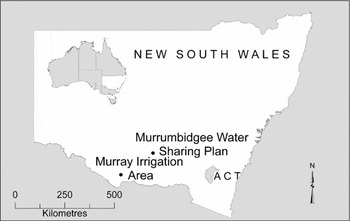
An early part of the water reform process occurred in 1994 with the NSW Government's move to privatize government-owned irrigation structures. In the Murray Irrigation Area (Fig. 1), irrigators had started to band together to address concerns about rising water tables and salinity. This meant that the situation in the Murray Irrigation Area was not a simple sell-off of an asset, but a transfer of ownership and responsibilities from government to the irrigators with associated risks and liabilities (Marshall Reference Marshall2002; Crase Reference Crase2008). A cooperative approach between landholders, other stakeholders and the state government was used to address natural resource degradation and to establish the institutional arrangement for assuming the risks and liabilities associated with owning and managing ageing infrastructure. The process led to development of four ‘land and water management plans’ for each district within the irrigation area. These land and water management plans were community-based plans that had four stages of development, namely conceptualization, development, implementation and review (Martin Reference Martin2005).
Location of the two case studies.

Conceptualization
The conceptualization stage involved large public meetings held initially in each district to gain community support. This led to the election of community working groups that then made themselves available to discuss issues with non-farmer stakeholder groups such as local business associations (Martin Reference Martin2005). Participants reported that such polycentric governance helped overcome initial misgivings by some individuals, tended to be more inclusive that previous efforts, and allowed people to put forward views about how the process should proceed. The number of landholders participating in the process and attending meetings subsequently increased. The two distributive and interactive justice components of legitimacy and acknowledgement during this conceptualization phase were therefore addressed by the attempt to include everyone.
Development
The development stage included drawing on the advice of government and private sector experts while consulting with the community. This consultation occurred in several rounds of meetings in convenient places such as woolsheds, community halls, clubs and pubs. For example, in one district (Berriquin), the initial round comprised 23 locality meetings, followed by other four rounds as the plan developed (Marshall Reference Marshall2002). The typical landholder attendance at each round of meetings was about 300. Feedback from these meetings was collated and analysed, and then disseminated via newsletters, brochures, and mass media (Marshall Reference Marshall2002). The plans ended up being an integrated strategy of farm and district-scale works, education, monitoring, and research and development programmes, with a 30-year community–government implementation agreement. The two justice issues associated with voice (namely opportunity and influence) during this development stage were therefore addressed through a series of one-on-one discussions with landholders as well as extensive feedback mechanisms reporting on the changes resulting from those discussions.
Implementation
The implementation stage formalized the funding arrangements between the community and government. The NSW Government agreed to hand over ownership of the irrigation infrastructure to landholders and to contribute US$ 83.5 million over the first 15 years to implement the land and water management plans (Murray Irrigation Limited 2006; Crase Reference Crase2008). In return, the farmers agreed to contribute US$ 270 million over 30 years to the same plans through ‘in kind’ costs arising from adoption of the on-farm conservation measures included in the plans (Murray Irrigation Limited 2006). The privatization process meant that each irrigator landowner with either land or water entitlements in the region were issued shares in an unlisted public company called Murray Irrigation Limited (McLeod & Warne Reference McLeod, Warne and Crase2008). Murray Irrigation Limited became the largest privately owned irrigation supply company in Australia, with responsibility for managing >10% of the Murray Darling Basin's consumptive water use, supplying irrigation water to 1600 family farm businesses covering 2400 irrigation holdings over 950 000 ha of intensively managed agricultural land (Murray Irrigation Limited 2006; McLeod & Warne Reference McLeod, Warne and Crase2008). The two justice issues associated with this implementation phase (namely actual resource allocations and comparisons of these allocations) were therefore addressed by applying the principles of public versus private benefit for the government/landholder allocation and by allocating shares between landholders based on the amount of land and water they owned. This arrangement was first instance of a contract setting out ongoing obligations between community and governmental partners to address environmental problems in Australia (Marshall Reference Marshall2002).
Review
The outcome from this process of community-based planning has been widely regarded as being successful (Marshall Reference Marshall2002; Crase Reference Crase2008). In terms of the two justice components of compliance and trust, it led to increased management efficiency, better information management and monitoring, improved environmental outcomes, more efficient use of water, fewer prosecutions for pollution or using excess water and a greater sense of community by all landholders in the four districts (McLeod & Warne Reference McLeod, Warne and Crase2008).
Case study 2: NSW water sharing plans
Starting in 1999, the NSW Government started a detailed process to prescribe how water was to be shared between water users and the environment. The government set an initial broad-scale target for recovering 10% of water for the environment and scientific evidence suggested that about two thirds of the flow needed to be recovered to maintain healthy functioning of rivers (Howard Reference Howard2009).
The process for determining water allocations was through valley-based water sharing plans that were to be developed by the community. One particular plan focused on the regulated portion of the Murrumbidgee River that extends from Burrinjuck Dam to Balranald in New South Wales (Fig. 1). There are 14 dams, eight large weirs, and more than 10 000 kilometres of irrigation channels on this river. Half of the Murrumbidgee's average annual flow (4 470 000 megalitres) is diverted for irrigation (Bowmer Reference Bowmer, Wilson and Curtis2003). The Murrumbidgee is the third largest river the Murray–Darling Basin and the most intensively developed for irrigation.
Conceptualization
The conceptualization stage of these water sharing plans by the NSW Government led to the appointment of people who represented specific groups: government agencies, nature conservation interests, landholder interests, indigenous interests and/or scientific interests (Howard Reference Howard2009). Regional facilitators acknowledged that the process did not include some key groups and, in terms of interactive justice, even the participants felt it was unrepresentative and led to people being typecast (Howard Reference Howard2009). This suggests that distributive and interactive justice were not properly addressed during the conceptualization phase because key people, such as urban, recreational or tourism interests were being excluded or unrecognized.
Development
The development process was very conflict ridden. It involved 32 meetings over six years where decisions had to be made about different water allocations. The background science and other contextual information was largely provided by government. Participants stated that the process did not meet their expectations about being able to influence decisions. Some resigned, and others formed coalitions or went forum shopping (Howard Reference Howard2009). The reasons stated for this were that during the development process the specifications about the nature of the plans, what could be decided and how these plans were to be presented were changed by the department in charge of overseeing the process. With each change, the responsible department progressively reduced the participant's opportunity and ability to influence decisions in each region. Even the staff involved in coordinating the process in each region described the process as a joke (Howard Reference Howard2009). The two justice issues associated with voice (namely opportunity and influence) during this developmental stage became restricted were therefore inadequately addressed.
Implementation
The implementation stage consisted of allocating water between types of water users and the environment. The better resourced and more numerous stakeholder groups were able to influence the plan and cement their allocations for usage. Specifically, agricultural stakeholders were able to fight off a concerted push to allocate an extra 100 GL of water for the environment, and they tied minimum environmental flows to general security allocations despite the legislation indicating that environmental flows should be the first priority. They could exert such influence because during the development phase, the rules changed from planning by consensus to planning by majority and irrigators had the numbers within the Committee. When the plan was displayed, a number of the committee members submitted dissenting reports. Moreover, a government review of the plan's compliance with NSW Government policy suggested that there were some key areas of the plan that warranted further consideration (Howard Reference Howard2009). Justice issues associated with the decisions (such as actual resource allocations and comparisons of these allocations) were therefore not apparent because the principles on which allocations were made were not based on science or discussion, but on history and power. Indeed the water planning process across Victoria and NSW largely resulted with allocations predicated on history of use and ineffective allocations of water to the environment (Ladson & Finlayson Reference Ladson and Finlayson2002).
Review
The water allocation process has been widely regarded as an inadequate way to implement CBNRM. Various environmental and agricultural interest groups appealed 12 of the 36 water-sharing plans in the NSW Land and Environment Court, and most participants indicated a general lack of satisfaction with the process. Compliance and trust have been an ongoing issue and some plans in NSW are yet to be activated. In the end, farmers obtained a windfall gain of perpetual water rights, it cost taxpayers over US$ 83 million, it altered water allocations by a mere 0.5% across the state, and the department facilitating the process across the state ceased to exist (Howard Reference Howard2009).
DISCUSSION
To date, a large body of research on CBNRM has focused on the question of the relationship between the state and the community. Fewer studies have focused on the role of the state when its role is that of an impartial spectator or a facilitator attempting to act as an honest broker. Yet governments are increasingly required to coordinate transition processes with communities where the actual decision-making or delivery of outcomes is devolved to members of the community (Bourgon Reference Bourgon2008). The framework outlined in this paper helps push our appreciation of some the issues associated with this emerging role by identifying eight key variables within the justice literature suitable for comparative analysis, or for consideration, when the state acts as an impartial spectator or attempts to act as an honest broker.
The two cases provided here do not cover the diversity of ways CBNRM can be implemented, nor do they provide a definitive analysis of justice when the state acts as a neutral facilitator. However, these two case studies do illustrate how different perspectives of justice might be considered throughout a participatory planning process. The lesson for management being, justice is not something waiting to be assessed when the outcome is decided, but something that must be constructed actively through the entire process of discussion, negotiation and decision making around any proposed change to resource benefits and burdens.
Moreover, the different perspectives of justice within the framework might used to help reduce conflict. For example, the case study on water sharing plans illustrates how early aspects of the planning process were viewed as unjust (such as lack of representation) and then this view cascaded or became amplified later with participants resorting to forum shopping or voting in blocks. Andrew and Edwards (Reference Andrews and Edwards2004) and Sabatier et al. (Reference Sabatier, Focht, Lubell, Trachtenberg, Vedlitz and Matlock2005) outlined examples where once an injustice is done, participants see the motives and actions of their opponents as unreasonable and then initiate actions and behaviours that might otherwise be regarded as unfair. Resolving justice issues as they occur may prevent later claims or participants acting unfairly owing to past injustices later during a planning process.
These two case studies also illustrate how issues associated with scale and complexity can be difficult to manage. For example, it may be difficult to be inclusive of all groups in the conceptualization stage because of the size of the region involved. It may also be a challenge to cope with the complexity associated with multiple values, multiple stakeholders, different interests and multiple functions associated with natural resources such as water (van der Brugge et al. Reference van der Brugge, Rotmans and Loorbach2005). For example, the NSW water-sharing plans may have been harder to implement than the Murray land and water management plans simply because farmers viewed a reduction in water allocations more of a direct threat to their livelihoods that the handing over of irrigation infrastructure. Moreover, when comparing the types of representation used to develop these water sharing plans, the agricultural groups were the only group potentially making a commitment while most of the other groups, such as the environmentalists, were only contributing. Therefore, the scale of interest or, in other words, the salience of the issue varied markedly between stakeholders involved in the water sharing case study and this may explain why the process was more difficult.
CONCLUSION
Fairness and justice continues to be embraced as a widely used concept in the academic, natural resource management and governance literature. Clearly, there are multiple perspectives of justice that a relevant to CBNRM. Existing theory may provide clarity on the application of fairness in community-based environmental planning and management. Here the approach has been to offer an applied understanding of fairness as an organizing framework rather than as a single overall normative theory. Thinking though fairness using this framework and applying possible contingencies and perspectives when facilitating community-based management, may be a more systematic way for facilitators and planners to embed justice into their programmes.