


1. INTRODUCTION
This study examines changes in agricultural labourers' wages and standards of living during the agrarian expansion in Chile's export economy from 1870 to 1930. In that period, the agricultural sector underwent not only unprecedented growth in the main sectors and crops, but also important improvements in land and labour productivity, the introduction of technological innovations and changes in the hacienda system's rural labour regimes. At the same time, the development of the labour market in the Chilean economy expanded to the agricultural sector, where from the early 1870s large estates began facing a gradual reduction in the supply of abundant and cheap labour, and increasing competition from alternative sources of employment for rural labourers (Robles-Ortiz Reference Robles-Ortiz2009b). Thus, one the most relevant consequences of the agrarian expansion was the, until recently unnoticed, expansion of wage labour in the rural economy. In fact, in the 1920s, wage labour would become the main rural labour regime in the hacienda system of Central Chile. This fundamental transformation, itself part of the development of agrarian capitalism in Chile, makes it relevant to study trends in agricultural labourers' wages to assess eventual changes in the standard of living of the incipient rural working class. The main question is, then, how and to what extent the first phase of the development of agrarian capitalism in Central Chile affected one of rural labourers' sources of subsistence (Robles-Ortiz Reference Robles-Ortiz2009a). Indeed, even though most of these workers had to resort to other ways to make a living, and thus the wage earned as a labourer was not necessarily «the only, or even the main, factor determining their living standards», as Lana observes for rural labourers in Navarre, in Central Chile it was «a relevant variable» as was the case in other «regions with a significant agricultural proletariat» (2007, p. 39). Furthermore, although the Chilean large estate was obviously not «a factory», as Petrusewicz (Reference Petrusewicz1989, p. 183) remarked of the Barracco latifondo, the «generalized wage condition» of its workforce would indeed be the increasing result of the process of proletarianisation that began developing from the early 1870s, and took place in the broader context of capitalist development in the Chilean economy.
Therefore, focusing on an understudied country, this paper contributes a case study of the impact of economic expansion on agricultural labourers' wages to a body of research that has dealt primarily with urban workers' living standards in Latin America. In fact, in line with a growing international literature, recent studies have focused on two periods: from the colonial era through to the first half of the 19th century (Gelman and Santilli Reference Gelman and Santilli2014, Reference Gelman and Santilli2015, Reference Gelman and Santilli2018; Llorca-Jaña and Navarrete-Montalvo Reference Llorca-Jaña and Navarrete-Montalvo2015; Moraes and Thul Reference Moraes and Thul2018; Santilli Reference Santilli2020) and from the 1850s to the first decades of the 20th century (Vence and Cuesta Reference Vence and Cuesta2015; Bragoni and Olguín Reference Bragoni and Olguín2016; Djenderedjian Reference Djenderedjian2020). The latter shows different trends for urban workers in Latin America. Thus, the standard of living in Venezuela improved throughout the 19th century, especially from 1870 to 1895 (Arroyo-Abad Reference Arroyo-Abad2013b), while in Peru the living standard reached its peak in 1850, which implies that the «guano boom» did not improve the living standards of low-skilled workers (Arroyo-Abad Reference Arroyo-Abad2014); yet, in Lima «most low-skilled workers earned more than the subsistence basket» in the 1825-1873 period (Zegarra Reference Zegarra2020, p. 3). In addition, a long-term study (1730-1930) for Mexico shows that real wages started out at high levels but then decreased; yet, from the 1860s to the early 20th century, real wages recovered and finally reached 18th-century levels (Challú and Gómez-Galvarriato Reference Challú and Gómez-Galvarriato2015). Finally, the Baring crisis (1890) did not have a major impact on wages for unskilled railroad workers. Indeed, there was no significant decline in real wages in Buenos Aires because they only fell slightly in 1889 and 1890 (Vence and Cuesta Reference Vence and Cuesta2015). In turn, several works have focused on rural workers in the same period of economic expansion in the agricultural sector that we study. That is the case of studies of different areas in Argentina. Thus, Campi (Reference Campi2004) documented the increase in rural wages for rural peons of «recent proletarianization» in sugar production in Tucumán in the 1880s; Richard-Jorba (Reference Richard-Jorba2009) showed that vineyard labourers' wages decreased along with the capitalist modernisation of viticulture in Mendoza (1880-1914); Bragoni and Olguín (Reference Bragoni and Olguín2016) and Olguín and Bragoni (Reference Olguín and Bragoni2020) established that the «Great Expansion» in that province did not cause an increase in the living standard of unskilled vineyard workers and Martirén (Reference Martirén and Santilli2020) showed that rural workers' living standards increased in the agricultural colonies of Santa Fe and Rio Grande do Sul in the second half of the 19th century. As these examples illustrate, there has been increasing interest in analysing how capitalism in the agricultural sector affected workers' living standards. This fundamental question has also been examined in other rural societies, such as those of Andalusia (Florencio-Puntas and López-Martínez Reference Florencio-Puntas and López-Martínez2000), Navarre (Lana Reference Lana2007) and Catalonia (Garrabou et al. Reference Garrabou, Pujol and Colomé1991).
In order to establish trends in rural workers' real wages, we focused on agricultural peons in Central Chile, the least skilled workers and the country's most important agrarian region (Robles-Ortiz Reference Robles-Ortiz2020b). Known as peones, the vast majority of whom were landless peasants, these workers were both those who lived permanently on the estate as well as those who came from the outside to work on a permanent or temporary basis. They earned wages that were called «jornales», that is, daily earnings that were paid weekly. As in other rural societies, in Central Chile agricultural labourers performed a great diversity of generally simple tasks in all the hacienda system's production processes. Above all, however, they were indispensable to carry out the harvests of commercial, large-scale crops, first and foremost wheat, by far the staple of the country's large-estate agriculture. Therefore, we do not consider other rural workers who also earned wages, such as the inquilinos, who received a small wage that supplemented their perquisites, or women and children who performed a number of tasks for which they were paid a piecemeal wage.
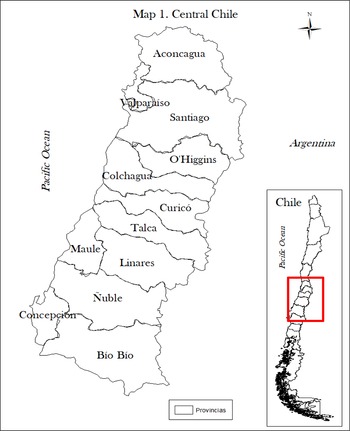
This essay is based primarily on data collected from sources directly pertaining to the agricultural sector and the hacienda system. Our main statistical source is the Agriculture volume of Chile's main Statistical Yearbook (Anuario Estadístico de la República de Chile, AERCh), which extensively recorded agricultural wages for 1874 and 1920-1923. In 1874, it included data on workers and wages for 5,554 agricultural estates from five provinces in south-Central Chile: Concepción, Curicó, Linares, Ñuble and Talca. For 1920-1923, the AERCh reported wages of agricultural workers nationwide, that is, for each of the 311 comunas (local political-administrative units) in the country. It recorded the number of both inquilinos and peons, their earnings, and the current wage for the main agricultural tasks. For Central Chile, we have data for 199 comunas, and the wage for 49,070 agricultural labourers or peons. We also gathered data from the Labor Office's occasional reports for all but one province in Central Chile in 1915; for nine of the region's principal (in terms of the area under cultivation and production) agricultural provinces in 1918; for six of those same provinces in 1922 and a nationwide figure for 1926Footnote 1. Furthermore, for 1935 we have average wages for six comunas in Central Chile: Curicó, Molina, Cauquenes, Itata, San Carlos and Chillán, reported by the Caja de Crédito Agrario, the state agricultural credit bank (Figure 1).
CENTRAL CHILE.

In addition, our series include data from other valuable sources. We consulted a series of «field reports and value assessments of rural estates», produced by graduating agronomists at the Agricultural Institute (1875), Chile's first School of Agronomy. These sources reported the number and types of workers, tasks, wages, food rations and other details such as location, area, soils, crops, machinery and social aspects, among other variables. We gathered information from more than seventy reports on rural estates located in different comunas of the agricultural provinces of Central Chile; the earliest of such sources is from 1910 and the latest is from 1932. Furthermore, we included useful observations on trends in labour and wages from accounts of rural society by foreign observers and knowledgeable members of the National Agricultural Society, which, especially in the 1870s, reported on changes in rural labour systems, the impact of increasing mechanisation and the migration of rural labourers.
As the inclusion of material from these sources suggests, we seek to explain trends in agricultural labourers' wages and living standards from a perspective that combines both agrarian and economic history approaches. Thus, we discuss trends in nominal wages taking into account not only distinctive features and transformations in Central Chile's rural society, but also the economic performance of the agricultural sector. A first decision derived from this perspective was to include in our estimates of nominal wages the value of the food rations that the estate provided to labourers while at work; otherwise, there would be an underestimation that is not consistent with the form of wage labour that prevailed in Central Chile. Likewise, we have also considered wages in the reaping of wheat and other cereals, because this was one of the most distinctive tasks massively performed by peons. Second, we converted nominal wages into real wages by deflating them with the general price index (GPI) from Matus (Reference Matus2012). We preferred this method to the bare bones basket (BBB) suggested by Allen (Reference Allen2001) because the latter is more appropriate for urban areas where workers buy all their goods and services in free markets; indeed, Allen's methodology was proposed for urban construction workers. This was not the case in rural Central Chile, mainly because for many agricultural labourers the only place to buy the goods they needed was the general store (pulpería) owned by the estate where they worked. In addition, we do not have any information about consumer patterns and only scarce data regarding nutrient intakes. Thus, until we know more about local prices and consumer patterns of the items that were relevant for rural workers, the BBB method is not yet the best option. Therefore, we opted for the GPI created by Matus (Reference Matus2012) which uses a base basket for the year 1913. Finally, to provide perspective, we compare agricultural labourers' nominal and real wages with a series of wages of the least skilled urban workers employed in the food industry.
This paper departs from previous studies, as they are limited by scarcity of data from sources related to rural society, and adherence to underlying conventional notions asserting economic backwardness of the agricultural sector. In a comprehensive study of the export-led phase of agrarian expansion (cf. 1850-1880), Bauer (Reference Bauer1975) contended that Central Chile's «traditional» rural society did not modernise despite economic growth in the agricultural sector. Landowners barely introduced machinery and responded to the increasing demand for labour by extending, not abolishing, the labour tenant system known as inquilinaje, while at the same time hiring seasonal peons for the harvests. Using episodic data from notarial records for three provinces, and from account books of five haciendas located in different areas of Central Chile, Bauer (Reference Bauer1975) produced rough estimates of peons' wages for 5-year periods from 1846/50 to 1921/25. In all, this foundational work of Chilean agrarian historiography sought to identify the main trends, rather than carrying out a detailed analysis of rural wages. More recently, in a general study of wages and prices, Matus (Reference Matus2012) estimated agricultural wages for «rural peons» in Chile from 1885 to 1926. Except for data borrowed from Bauer's series, and those reported in AERCh for 1919-1921 and 1923-1926, this study is not based on «observed wages» from sources related to rural society. Data from other sources are occasional observations for certain areas, and thus hardly representative of the whole countryFootnote 2. In addition, the author's estimates of nominal wages did not take into account the monetary value of peons' food rations, thus missing an important part of workers' earnings.
On balance, previous studies did not consider elements of the «natural wage», primarily, food rations. As a result, nominal wages have been underestimated by a significant percentage, as we will further explain. It must be noted that, in fact, Allen himself recommends including the value of food rations whenever possible. In addition, the existing studies presented rather similar results for nominal wages, but very different trends for real wages. Finally, previous estimates did not examine the impact of the Great Depression on agricultural labourers' wages and living standards. According to Bauer (Reference Bauer1975), nominal wages increased moderately from 20-25c in 1846-1850 to 40-45c in 1896-1900; they subsequently rose dramatically, peaking at $2.50 in 1921-1925. Although nominal wages grew tenfold over this long period, real wages decreased in the long term, as the food price index had risen faster than nominal wages since 1900, a conclusion Bauer reached by establishing trends in wholesale prices in Santiago for three food items (flour, beans and meat) that were relevant in the rural peons' diet. For Matus, nominal wages barely increased until 1901, grew significantly between 1906 and 1916, and even more so in the following decade. Real wages, in turn, increased slightly in the period under study, showing only a couple of short-term, minor fluctuations (Matus Reference Matus2012, pp. 246, 264-265).
In all, our findings contribute to expand our understanding of the impact of the agrarian expansion on workers' living conditions. We found that nominal wages increased earlier and more significantly than indicated by previous studies, and that this was so because of growing competition between alternative sources of employment for rural workers, both in the rural economy and other economic sectors. We also show that real wages were higher than previous estimates, and that at certain points were close or even above those of the least skilled urban workers. Yet, in the long term the structural gap between the earnings of agricultural labourers and urban workers persisted, and it was one of the causal factors of the rural outmigration that characterised the agrarian expansion. Finally, we document the dramatic fall in agricultural wages caused by the Great Depression.
This paper is organised as follows. In the next section, we discuss the economic performance of the agricultural sector in the period of agrarian expansion in Chile's export economy, and its impact on labour regimes, thus documenting the growth of wage labour in the rural economy, and in the hacienda system in particular. We then estimate agricultural labourers' nominal wages, compare them with wages for the least skilled urban workers in the food industry and estimate real agricultural wages for both groups of workers.
2. AGRARIAN EXPANSION AND RURAL LABOUR
The growth and modernisation of Chile's export economy decisively transformed the development of agriculture. The demand for agricultural products expanded because of the growth of the population, urbanisation and industrialisation, while the development of the transportation infrastructure allowed a growing integration between the agricultural areas of central and southern Chile and other economic sectors and regions, especially manufacturing. The export sector also stimulated agricultural growth, particularly between 1880 and 1920 when «the contribution of the exports to the Chilean economic growth surpassed levels of 20 percent» (Badia-Miró and Díaz-Bahamonde Reference Badia-Miró, Díaz-Bahamonde and Kuntz-Ficker2017, p. 169). In addition, the value of agricultural exports grew from US$10.86 million in 1908 to US$26.63 million in 1928 (Díaz et al. Reference Díaz, Lüders and Wagner2016, p. 466). Moreover, the regional economy constituted around the nitrate industry in the northern provinces of Tarapacá and Antofagasta also stimulated agricultural growth (Cariola and Sunkel Reference Cariola and Sunkel1991). At the same time, the size of the agricultural sector increased dramatically. This expansion resulted from such diverse processes as the colonisation of the Llanquihue territory in southern Chile, the occupation of the Frontier region and subsequent development of capitalist agriculture (Robles-Ortiz Reference Robles-Ortiz2020a), and the «internal expansion» of Central Chile's hacienda system (Bauer Reference Bauer1972). In sum, the rapid modernisation of the Chilean economy brought new stimuli to an agricultural sector whose growth had been hindered by the slow development of internal markets.
In response, Chilean agriculture underwent unprecedented growth in all sectors and crops. The area under cultivation with basic food crops (cereals and legumes) more than doubled, from an average of 559,317 hectares in 1880/85 to 1,155,336 hectares in 1935. The output of cereals grew from 0.5 to 1.2 million metric tonnes from 1880 to 1935, while that of legumes increased from 38,371 to 113,869 metric tonnes in the same period. At the same time, the production of the main fodder crops (alfalfa and clover) quadrupled, going from 85,619 to 344,587 tonnes between 1900 and 1930. Most significantly, the real value of the agricultural output in basic food crops increased from $119 million in 1880/84 to $289 in 1930, and doubled in the 25 years between 1905/09 and the Great Depression (Robles-Ortiz Reference Robles-Ortiz2010). Furthermore, the output per capita of most crops increased in the 1880-1930 period, during which the population grew from 2.5 to 4.2 million inhabitants; in the case of wheat, output per capita rose from 169 to 213 kg. Finally, it must be noted that the extension of the area under cultivation and output growth took place in a period of massive rural–urban migration, which reduced the size of the agricultural labour force from 412,568 workers in 1885 to 339,072 in 1935. In addition, it must be noted that most of the wheat output was absorbed by the domestic market; indeed, wheat exports declined steadily from 1,310 metric quintals (qqm) in 1890 to merely 257 qqm in 1919 (Robles-Ortiz Reference Robles-Ortiz2002, p. 84).
The extraordinary growth of the agricultural output was based on the gradual diffusion of technological innovations, mainly irrigation and mechanisation. The extension of irrigation was significant in the 1850-1930 period, and the result was the extensive system of canals that crisscrossed Central Chile's longitudinal valley from Aconcagua province to the Frontier region. The irrigated area increased from 440,000 hectares in 1875 to 1.1 million hectares in 1930 (Bauer Reference Bauer1975). Most canals were costly projects undertaken by individual landowners or irrigation associations, and the large areas that they irrigated reflect the extent to which haciendas intensified. Irrigation was instrumental in the diversification of hacienda system production, allowing landowners to expand activities that gradually gained in commercial importance, such as livestock-raising, viticulture and fruit growing (Robles-Ortiz Reference Robles-Ortiz2009a).
In turn, mechanisation was a crucial transformation in the agricultural sector in Central Chile. It began developing as landowners' response to labour-supply issues and the rise of agricultural wages during the series of wheat export booms in the 1850-1890 period. By 1870 reapers and steam-powered threshers were widely used in the harvest of cereals, while mowers, choppers and balers became the standard equipment for harvesting alfalfa and clover. In 1878, there were 1,076 reapers and 976 threshers in use; thus, 156,160 hectares or nearly 40 per cent of the area cultivated with wheat could have been mechanically threshed (Robles-Ortiz Reference Robles-Ortiz2018, p. 209). After 1890, mechanisation proceeded along with the increasing orientation of the agricultural sector to the internal market. The quality of mechanisation also improved, with the wide diffusion of metal tilling instruments and, above all, the introduction of tractors. The first tractors, tested in 1907, were cumbersome steam models that proved inadequate, but after World War I the importing companies introduced a variety of petroleum, gasoline and kerosene models. These tractors were small and light, simple in construction and easy to operate and more economical than plowing with oxen. The 1920s witnessed a rapid diffusion of tractors: the 299 units recorded in 1920 increased to 1,557 in 1935; this figure implies that 30 per cent of the 5,098 farms of more than 500 hectares would have a tractor (Robles-Ortiz Reference Robles-Ortiz2020b).
Chilean landowners also adjusted the rural labour regimes to the needs of the expanding agrarian economy. As a result, wage labour became the main labour regime in the hacienda system. The growth of wage labour resulted, in the first place, from the proletarianisation of labour tenants (inquilinos). Central Chile's hacendados did not expel inquilinos from the large estate, but they reduced their land allotments. Thus, inquilinos' «raciones de tierras» could be sufficient for the cultivation of vegetables for the household, but not for producing a surplus of marketable crops that required a large area, such as wheat. As early as the 1870s, as wheat exports reached their highest level, authoritative observers commented that inquilinaje was losing its economic capacity as a form of precarious peasantry. In a detailed report, the British consul in Santiago observed in 1875 that the poorer inquilinos were «hardly to be distinguished from the mass of day-labourers», that is, the peons; further, he concluded that the inquilino was «being thus gradually transformed into a salaried labourer, for whom a cottage and patch of garden are provided, as on many English estates» (Rumbold Reference Rumbold1876, p. 390). This trend intensified in the latter decades of the 19th century. As the increasing use of the denomination «ración de tierra para chacras» indicates, these plots were assigned only for the cultivation of vegetables, crops that did not compete with the landowner's production. In other cases, landowners converted land allotments into nominal rations, giving no land at all but compensating the worker with a payment in money or kind. Furthermore, reports written by agronomy students at the Agricultural Institute show that a typical ración was merely ½ cuadra or ¾ hectare. In sum, in the 1920s, under this rather proletarianised inquilinaje system, inquilinos were resident workers who earned a combination of wages and perquisites calculated in monetary terms (Robles-Ortiz Reference Robles-Ortiz2009a).
The decades-long process of proletarianisation that would transform inquilinos from service tenants into resident wage labourers also involved their family members, as Kay (Reference Kay1977) first noted, in what constitutes a fundamental observation of the extent of that process. Women and children increasingly became a source of permanent wage labour from within the estate. Women worked not only doing chores and tending their households' vegetable plots, but also performed a number of tasks in the different productive activities of the hacienda system, earning a wage per unit of output. Typically, women were milkmaids, hand-sewed sacks of grain at the harvest place, picked and shelled corn, cut grapes at the vintage and harvested fruit at orchards. Indeed, the fruit harvest was carried out by a labour force made up primarily of women and children who were paid a wage calculated by the number of baskets or boxes they filled up in a workday (Robles-Ortiz Reference Robles-Ortiz2010). Often, the inquilino household had the obligation of providing female workers for certain tasks, one of the most important of which was cooking all the daily meals that were part of the wage earned by the peons. For instance, at Santa Berta, a fundo in Colchagua province, where, in addition to «milkmaids and women for servicing the houses», women made the «meals and galletas [rustic bread loaves] for the workers» (Blanco Reference Blanco1922, p. 21). Women and children worked at simple tasks that did not require specialised knowledge or skills, and they earned lower wages than male workers. In 1925, at a vineyard in Cachapoal, for instance, «30 women and kids» worked 20 days cutting grapes, for which they earned $2.65 «including food rations», while male peons pressing the grapes with a vintner earned $4.75 a day (De la Rivera Reference De La Rivera1925, p. 12).
The growth of wage labour was also a consequence of the absorption of precarious smallholders (minifundistas) as seasonal labourers on large estates next to which they could hardly subsist. These outside workers increased the ranks of resident peons, usually members of the inquilinos' households, both relatives, especially sons, and acquaintances living under the same roof as allegados, one of which at least had to be available for work at the estate as obligado, while the other wage earners were voluntarios. In the late 19th century, then, the hacienda system's labour structure substantially changed, for inquilinaje became a secondary labour regime in the estate work forceFootnote 3. In the 1920s this trend towards the diffusion of wage labour was even more pronounced. It can be illustrated at Flor del Llano, a fundo of 800 hectares, located in Talca province, some 250 km south of Santiago. In 1925, its main crop, wheat, occupied 120 hectares. There were only thirty-six inquilinos, who made up roughly one-third of the resident labour force; an agronomist surveying the property reported, «in each household there is one man who is the inquilino, but also two or more men who work on the fundo as well». Thus, «the fundo ha[d] the workers it needs for its exploitation in normal times (100 labourers)», but not to carry out the wheat harvest, despite having a tractor and a thresher. The key issue was the fact that the property did not have a single mechanical reaper. Thus, the owners had to hire even more peons, so that «in the harvest season people from the outside come, and complete the labour pool». These «trabajadores forasteros» earned $2.50 a day, and were «twice as many as the inquilinos» (Castillo Reference Castillo1925, pp. 3, 12). Furthermore, the 1935 Censo de Agricultura provided a comprehensive measure of the importance of wage labour. In Central Chile, there were 62,175 rather proletarianised inquilinos, and 68,675 resident peons that the census defined as «workers who are paid exclusively in money and receive either part or all their food from the fundo, but no land, house, or pasture rights at all». In addition, there were 59,109 outside peons (Chile. Dirección General de Estadística 1938, pp. 638-640). Thus, if resident and outside peons are taken together, wage labourers comprised of two-thirds of the agricultural work force.
Agricultural peons worked in all sorts of activities on the large estates. The most important task that they were massively hired for was the harvest of wheat. Being the most commercially relevant crop for large haciendas, wheat needed to be harvested in the least time possible, to reduce the costs of the harvest and to prevent losses that occurred when the grain was too dry and shelled out, to reduce the risks of fires, and to avoid early autumn rains that could make it more difficult or not possible to use mechanical reapers. In addition, from the 1870s, when exports of wheat increased significantly, large haciendas had to compete with alternative sources of employment for peons, such as public works, railroads and the mining districts in the northern provinces. As a result, reaping wheat by hand with the sickle was not only the peon's most distinctive task, but also the job at which they could earn a higher wage, which was paid by the tarea («task») or the area a worker could complete in a workdayFootnote 4. Indeed, in response to rising wages in the wheat harvest, landowners began introducing mechanical reapers. In 1871, Félix Echeverría, a wealthy landowner and member of the National Agricultural Society, estimated that some 200 reapers had been introduced «in the past few years only», and observed that «no other machine will have a more profound impact than the reaper» considering that, on average, each machine saved the work of 11 men per cuadra (1875, p. 345).
Harvesting equipment, including steam engines, threshers, reapers and mowers, became widely used in Chile. In the early 20th century, the use of machines displaced the manual method to small properties, isolated areas, sharecroppers and tenants' crops and, on large estates, to fields that were not suitable for reaping by machine (Robles-Ortiz Reference Robles-Ortiz2018). On estates that did not use machinery, peons still cut, bundled and stacked the cereal, and were paid by the number of «tasks» («tareas») they completed during the day. There was some variation in the average number of tareas a worker did, but usually a tarea was the work of one day. In addition, a cuadra (1.57 hectare) was divided into eight to ten tareas. In 1899, an article on Chilean agriculture prepared for the Northwestern Weekly Miller reported that on hacienda San Joaquín, in Cachapoal province, the owner explained that «Using the sickle, a peon requires from eight to ten days to cut and stack in sheaves a square of wheat» (Danvers Reference Danvers1899, p. 506). In 1910, at fundo Yáquil, in Colchagua province, «the wheatfield is divided among the peons in tareas of 50 varas cuadradas, so that a cuadra has 9 tareas; for cutting and bundling a tarea of wheat a worker is paid $2.50» (Rodríguez Reference Rodríguez1910, p. 33). This implies that a cuadra was an area of 15,625 m2, and a tarea an area of 40 m by 40 m, or roughly 1,600 m2. In 1916, a state agronomist commented on the fact that a cuadra was divided into ten tareas, stating that this demonstrated «the slowness at which the work was done when following this procedure» (Opazo Reference Opazo1916, p. 7).
3. AGRICULTURAL LABOURERS’ WAGES AND LIVING STANDARDS
In order to assess trends in agricultural labourers' living standards, we constructed a series of nominal wages for male peons from 1874 to 1935. This allowed us to examine wages both in the early 1870s, at the peak of the export-led phase of agrarian expansion, and in the aftermath of the Great Depression, a critical juncture during which international agricultural prices plummeted and about which there was no reliable evidence on agricultural wages in the literatureFootnote 5. Yet, the unavailability of data for a number of years is a serious obstacle to the construction of a wage series that comprises the entire period of agrarian expansion. Therefore, we interpolated values for 32 years within the 1874-1935 period, but these estimates concentrate on the late 19th centuryFootnote 6. We do have a large number of observations for 1874, the first year of the seriesFootnote 7, but these data are lower bound figures; they do not pertain to the most important agricultural provinces in north-Central Chile (Aconcagua to Colchagua), where wages were higher than in south-Central Chile (Echeverría Reference Echeverría1871, Rumbold Reference Rumbold1876). In addition, in the 1885-1926 period, we used wages from the field reports and assessments of rural estates for 6 years, 1912-1915, 1918 and 1922, thus replacing values that Matus had obtained by means of interpolation. Furthermore, we have observed wages reported in primary sources for 1910, 1911, 1916 and 1926; years for which Matus (Reference Matus2012) resorted to questionable secondary sources. Finally, in those years for which Matus (Reference Matus2012) used observations that are not representative for Central Chile, we chose our interpolations over such observations from unreliable sourcesFootnote 8. In sum, we constructed the nominal wage series from primary and secondary sources plus interpolationsFootnote 9.
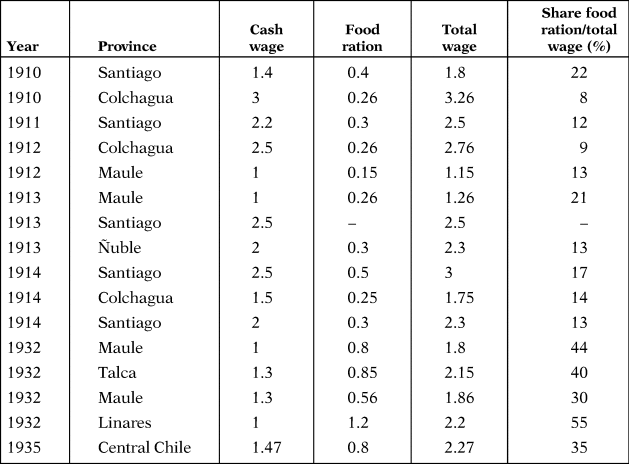
In addition, in our series of the nominal wages for rural peons we included the value of the food rations, one of the perquisites they received as workers in the hacienda system. Typically, hacienda workers' food rations consisted of three meals, composed primarily of flour, beans and wheat. For instance, in 1913 at fundo Santa Amalia, breakfast included a wholewheat bread called galleta and half a pound of ulpo, a thick mix of toasted flour and hot water; lunch and dinner would consist of a half-kilo plate of beans stewed with broken wheat (frangollo) plus a galleta (Moebis Reference Moebis1913, p. 19)Footnote 10. Including the value of food rations allows for a more accurate comparison between agricultural and non-agricultural real wages. As Alston and Hatton observed, «Any comparison of farm and nonfarm wages must take into account the in-kind payments or perquisites received by farm laborers» (1991, p. 84)Footnote 11. The daily food rations that the estate provided to peons while at work were valued in monetary terms as a component of their total earnings. We estimated the value of peons' food rations as a share of the cash wage using as primary sources the field reports by agronomy students at the Agricultural Institute. Thus, we have information on cash wages and food payments for 1910-1914 and 1932. Additionally, we have data from the Caja de Crédito Agrario annual report (1935) for food payments in 1935. The cash wages and the value of the food rations reported in those sources are summarised in Table 1.
CASH AND FOOD PAYMENTS, 1910-1935 (CURRENT PESOS)

Sources: Field Reports (1910-1914, 1932) and Annual Report CCA (1935, Appendix).
There were significant differences in the estimated nominal value of food payments as a share of cash wages, ranging from 8 per cent in 1910 to 55 per cent in 1932, but the average was 23 per centFootnote 12. Therefore, we adopted a conservative figure, 20 per cent, for the value of the food to be added as share of the cash wage. This is a reasonable estimate considering that, for instance, in Santiago de Chile in the early 19th century construction workers' food represented 41 per cent of their income (Llorca-Jaña and Navarrete-Montalvo Reference Llorca-Jaña and Navarrete-Montalvo2015). Thus, the nominal wage series would be the cash wage series multiplied by 1.2 to include food rations. This corrects the problem of underestimation of nominal wages in previous studies (Matus Reference Matus2012).
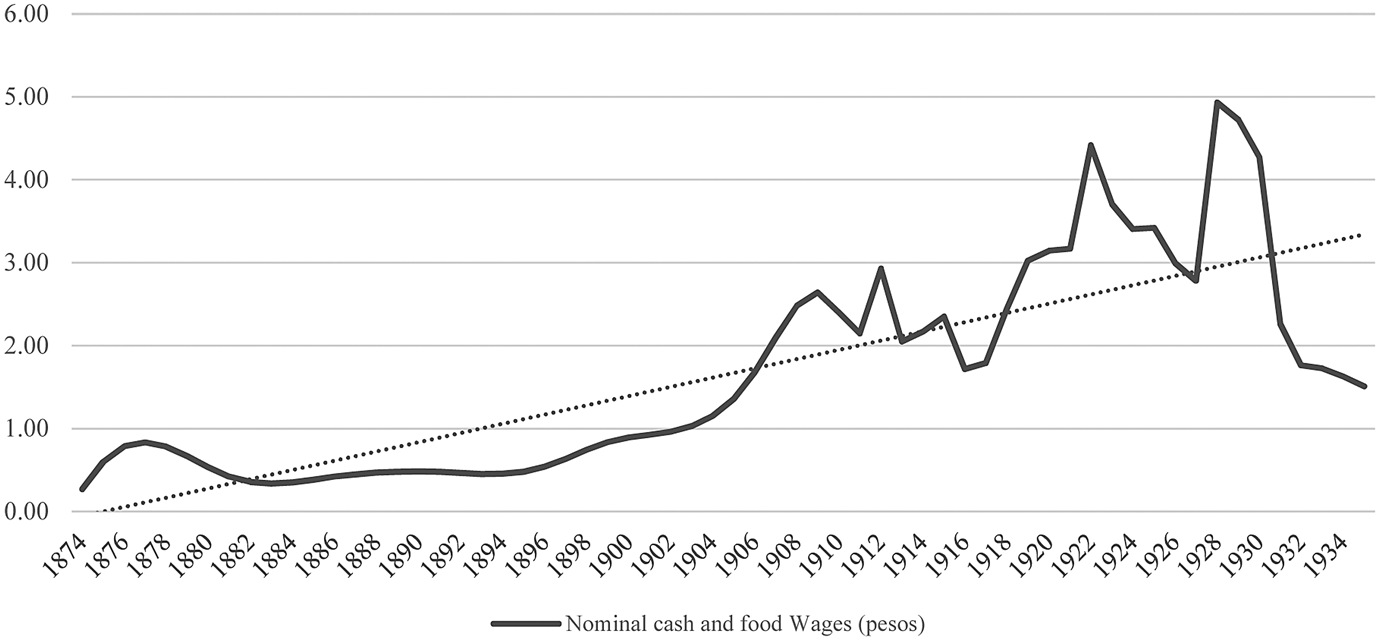
We found that nominal wages for agricultural peons in Central Chile showed an upward trend during the period of agrarian expansion in Chile's export economy, but with important fluctuations (Figure 2). Indeed, our series shows more variations than previous studies' estimates; Bauer's (Reference Bauer1975) is a ladder series of 5-year averages, while the series estimated by Matus (Reference Matus2012) has fewer fluctuations because of scarcity of data from primary sources and reliance on Bauer's series. In contrast, according to our series three phases can be identified over the 1874-1935 period. These are: steady increase (1874-1909), growth with dramatic short-term fluctuations (1910-1928) and decline (1929-1935). In the first phase, although the series shows that wages fell after 1877, and then stagnated until 1894, these trends are unlikely, because for these years our estimates are based on scarce data and at odds with information from contemporary analyses of rural society. In fact, reliable observers indicate that in the early 1870s, wages were much higher than our estimates. In 1873, the SNA's bulletin noted that «as a consequence of the shortage of hands», in «many places» it was necessary to pay a reaper («un segador») «at least 60 cents for each tarea» which was twice as much as what peons earned in the winterFootnote 13. Similarly, in a study submitted to the International Exhibition held in Santiago in 1875, Lauro Barros (Reference Barros1875, p. 21), a prominent landowner and member of the SNA, observed that the «wandering peons» did not work «for less than 50 to 80 cents a day», which he attributed to the «shortage of hands», itself a «logical consequence» of the increase in the area under cultivation. Likewise, at the Primer Congreso Libre de Agricultores, a month-long gathering of landowners' representatives from all provinces, its «Political Economy Committee» estimated that «the peon's daily wage is 75 cents» (Espejo Reference Espejo1876, p. 147). Therefore, our estimates for this period should be understood as being close to the minimum wage for agricultural peons rather than to their average wage in the harvest of wheat. Subsequently, from 1895 to 1909, there was a significant increase in nominal wages, which appear to have tripled in a decade. This trend is consistent with contemporary accounts. For instance, in 1899, the owner of the San Joaquín estate reported that «during the harvest the peons gain[ed] from 50c to 70c a day with breakfast, dinner and supper» (Danvers Reference Danvers1899, p. 506). In sum, agricultural wages actually increased steadily from 1875 to 1909.
PEONS' CASH AND FOOD WAGE PER DAY IN CENTRAL CHILE, 1874-1935 (CURRENT PESOS).
Sources: AERCh, Rumbold, Barros, Espejo Interpolations, Bauer, Danvers, Field Reports, Labor Office, and Annual Report CCA. See the Appendix for details.

Thereafter, from 1910 to 1935, agricultural wages underwent significant fluctuations. This was also the case of wages in other sectors of the economy, as the price level began to grow strongly after 1905 (Matus Reference Matus2012). In the second phase, there were important fluctuations between 1910 and 1916, but by the latter year nominal wages had fallen ostensiblyFootnote 14. This can be attributed to the stagnation of wheat prices, which may have led landowners to hold production and pay lower wages. Indeed, a study of strikes by urban workers found that rising consumer prices were related to landowners' speculation, for «when the international and internal prices fell, producers in the south of Chile held their crops in reserve until prices rose again» (DeShazo Reference Deshazo1983, p. 44).
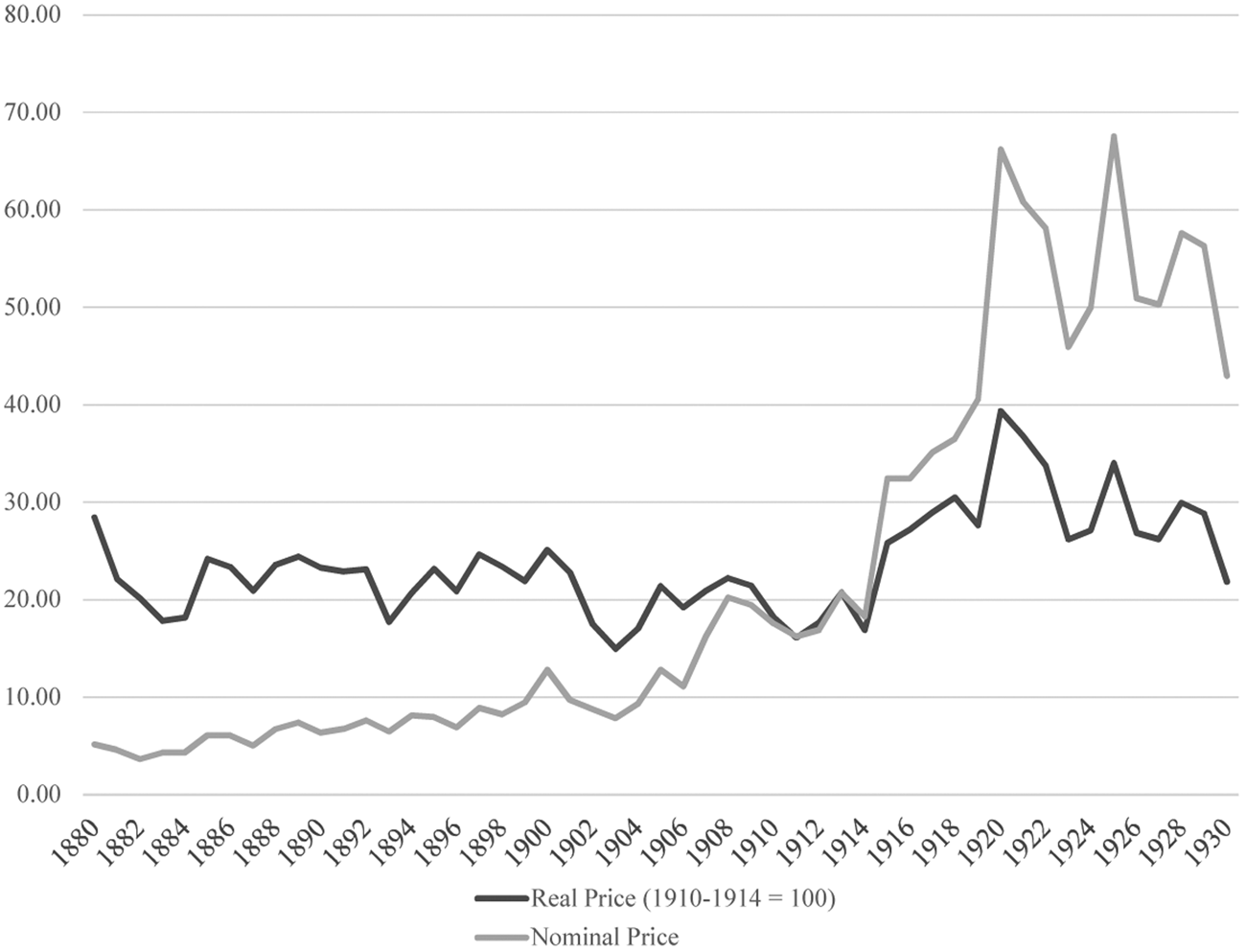
Price trends in the early 20th century might explain why agricultural wages fell during these years (1913-1917), since indeed wheat prices stagnated from 1908 to 1914 compared to their higher rates of growth in previous years (Figure 3)Footnote 15. The stable growth of the nominal price of wheat from 1880 to 1905 allowed the wages of the labourers to rise at a similar pace. Subsequently, between 1903 and 1907 a great increase in the nominal price of wheat was accompanied by a sharp rise in agricultural wages. Furthermore, the instability observed in the wages of agricultural labourers between 1908 and 1913 can be attributed to the stagnation in nominal wheat prices. In fact, the fall in wheat prices on the eve of World War I may have led landowners to retain production and pay lower wages. From 1914 the price of wheat rose abruptly, which allowed landowners to expand their production and pay better wages until 1928. Finally, the stability of the real price of cereals and potatoes, and the steady increment in the real prices of legumes during 1880-1930 (Robles-Ortiz Reference Robles-Ortiz2002), also stimulated the growth of agricultural production.
NOMINAL AND REAL WHEAT PRICES IN CHILE, 1880-1930.
Source: Robles-Ortiz Reference Robles-Ortiz2002 (constructed with data from Sinopsis Estadística (1918) and AERCh)).

Therefore, from 1917 to 1922 wages underwent a strong increase, and again a drastic fall took place until 1927, from $3.68 to $2.32. It must be noted that precisely the 1920s also saw the first wave of rural workers' mobilisation, which included the first labour unions and strikes in the countryside (Loveman Reference Loveman1976). The highest wage in our series is for 1928 as other wages, a year in which Chile experienced strong economic growth. Finally, in the third phase, from 1929 to 1935, wages reflected the strong impact that the Great Depression had on Chilean agriculture; they fell abruptly from 1929 to 1935, when salaries reached a level as low as that of 1906.
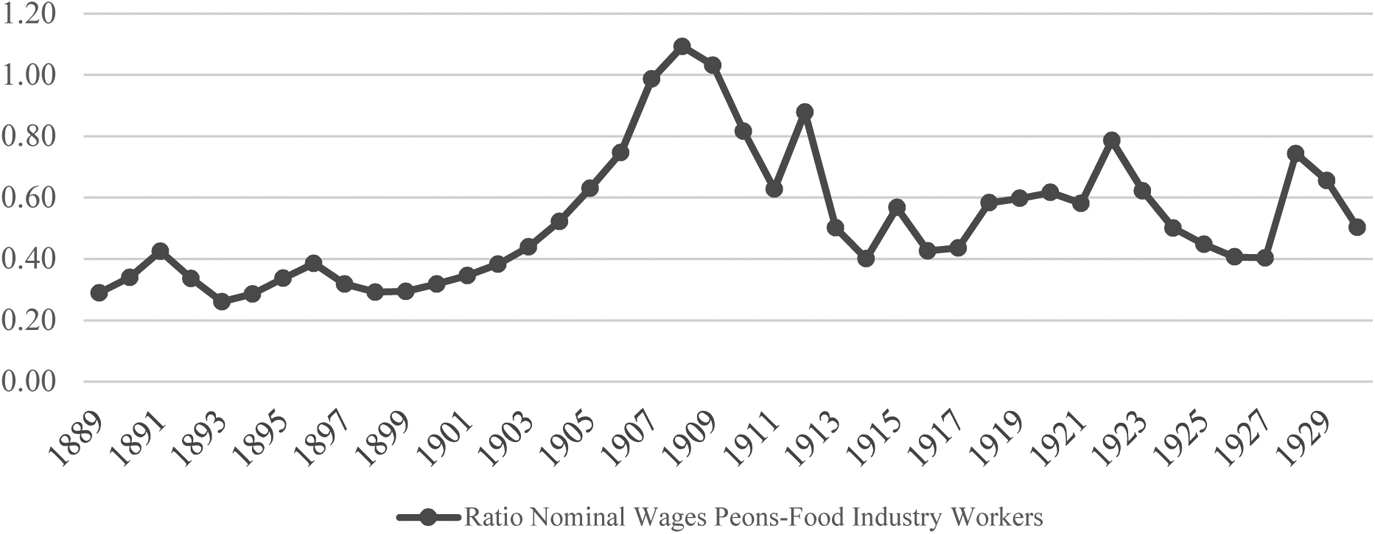
If agricultural peons' nominal wages experienced long-term growth, why did rural labourers migrate from the countryside to the cities and elsewhere, such as mining areas in northern Chile? The sustained rural outmigration during the agrarian expansion was the result of transformations in the hacienda system, especially the proletarianisation of inquilino households and increasing mechanisation. In addition, from an economic perspective, outmigration of rural workers was prompted by higher real wages in urban areas, even for unskilled workers. Thus, it is relevant to compare agricultural labourers' wages with those of urban workers employed in the manufacturing sector, particularly the least skilled workers, such as those employed in the food industry (Figure 4)Footnote 16.
RATIO NOMINAL WAGES PEONS IN CENTRAL CHILE-FOOD INDUSTRY WORKERS.
Source: Calculated with data from AERCh, Rumbold (Reference Rumbold1876), Barros (Reference Barros1875), Espejo (Reference Espejo1876), Interpolations, Bauer (Reference Bauer1975), Danvers (Reference Danvers1899), Field Reports, Labor Office, and Annual Report CCA.

Nominal wages for both food industry workers and agricultural peons experienced the same upward trend in the long term, but the latter remained at a lower level from 1889 to 1929. Thus, if a peon went to a city looking for a better living standard, he could probably have earned higher nominal wages in almost the entire period, except for the first years of the 20th century. There was, to some extent, a convergence process that reduced the wage gap, especially between 1900 and 1908. In fact, around 1910, peons' wages were even higher than the nominal wages of workers in the food manufacturing sector. However, the gap between the low-skilled workers in the city remained in the long term, especially from 1910 onwards. In Central Chile, from 1889 to 1930, rural peon wages (including those received in kind) were on average 53 per cent of the wage of low-skilled urban workers. This result shows that the gap in Chile was higher than that in Argentina or Mexico (Arroyo-Abad Reference Arroyo-Abad2013a). It is possible, however, that if we had been able to include construction workers' wages, this gap would have been smaller, in line with the Argentinian or Mexican cases. In sum, the gap between city and countryside was a causal factor of the migration from rural areas to major cities in the first decades of the 20th century, which, in turn, contributed to the growth of nominal wages for those agricultural workers who stayed in the rural areas of Central Chile. Furthermore, from 1906 to 1930, real wages in mining were on average three times higher than those in agriculture (Matus Reference Matus2012).
As previously indicated, the BBB methodology proposed by Allen (Reference Allen2001) is not presently applicable to estimate Central Chile's agricultural peons' real wages in the period under study. Although rural peons were fully «free workers» and received weekly cash payments, it is likely that they could not spend their wages at «free markets», as the nearest marketplaces were located in towns too distant to be reached on workdays. In addition, there is no such detailed evidence for consumer prices of goods or concerning the range of products sold at local stores in rural villages, where peons and other agricultural workers would have found an alternative to the estate's general store (pulpería). Another issue is that the BBB method assumes families of four members who share a home, which was manifestly not the case in Central Chile's rural society. In fact, it was common for a single household to comprise ten or even more people, often including outside peons who thus found a roof for the harvest season. Nevertheless, previous studies dealt with this type of problem by focusing on the welfare ratio from one salary (Zamberlan Reference Zamberlan2019). In sum, the BBB methodology is not a suitable method to deflate prices in rural Central Chile until we have more data on prices, budgets, nutrient intake and consumption patterns.
The best available option to estimate the living standard of rural labourers in Central Chile is to deflate nominal wages by a GPI. However, some caveats and limitations must be noted when using this option. The available price indexes are based on wholesale prices in Santiago and Valparaíso, not consumer prices; in addition, it is reasonable to assume that local prices for some goods produced in the rural economy, flour, for instance, were lower than those in large cities. In addition, the geographical application of prices from Santiago–Valparaíso to rural areas in Central Chile is highly questionable, due to the difference that existed between the cost of living in the capital vs. rural provinces. Therefore, we chose to deflate peons' wages by the GPI from Matus (Reference Matus2012), which used a basket for 1913 and wholesale prices, instead of deflating nominal wages by the historical consumer price index by Díaz et al. (Reference Díaz, Lüders and Wagner2016), which estimates consumer prices for Chile from 1810 to 2010, using a 2003 basket as the base year (see the Appendix).
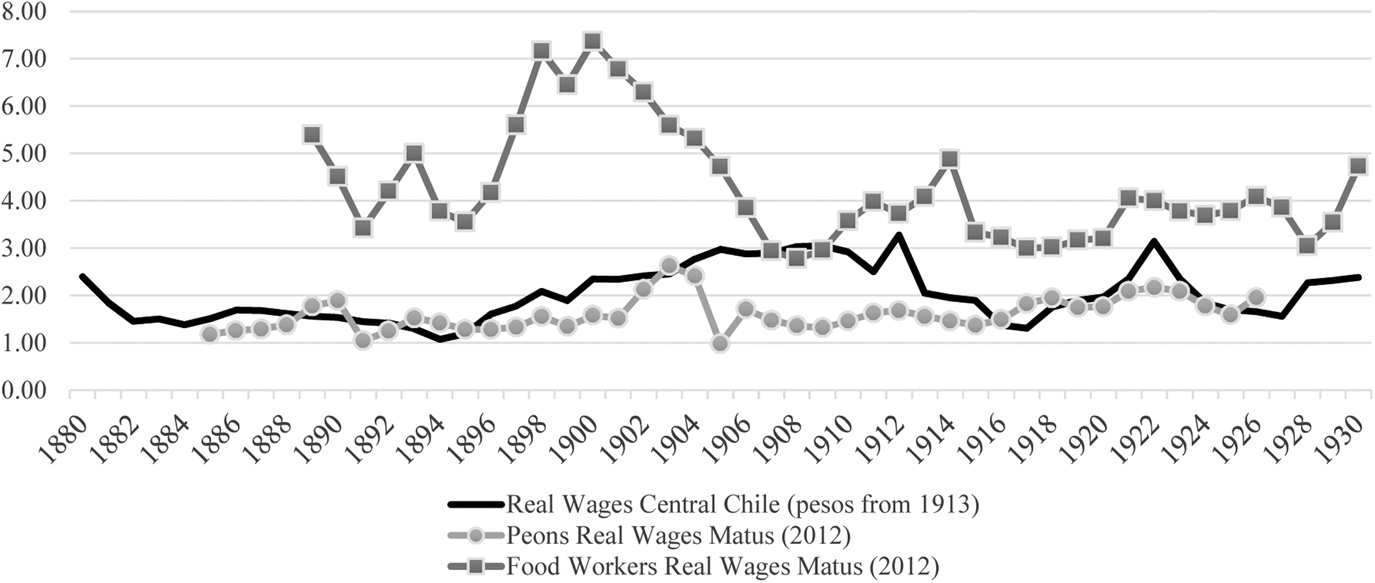
In the long term, judging by real wages, from 1880 to 1930 there was not a deterioration in the living standard of Central Chile's agricultural labourers, even though their nominal wages are deflated with prices in Santiago and Valparaíso (Figure 5). Peons in rural activities coped with the increase in food prices by earning higher wages, especially, during the early 20th century. Moreover, real wages increased in some years, for example 1895-1912, 1918-1923 and 1928-1930. Furthermore, our results show that for 20 years (1895-1915) real wages were higher than those estimated by Matus (Reference Matus2012), which can be explained by the fact that our wages were recorded from primary sources, but also by the inclusion of the value of food rations.
REAL WAGES (1880-1930): PEONS’ WAGES IN CENTRAL CHILE, PEONS’ WAGES AND FOOD INDUSTRY WORKERS’ WAGES.
Sources: Peons' real wages from Matus (Reference Matus2012, p. 331), food workers' real wages from Matus (Reference Matus2012, p. 332) and our data from Central Chile's peons.

It is interesting to contrast the wages of agricultural labourers with those of the lowest industrial wages, to understand the size of the gap between the well-being of low-skilled urban workers and that of workers who stayed in the rural areas of Central Chile. Figure 4 shows that agricultural workers fared no better than lower-paid industrial workers. The gap between the wages of agricultural peons in Central Chile and industrial food workers in general remained, although the income gap narrowed from 1905 to 1912. It is likely that, during the process in which real wages tended to converge, the actual purchasing power of agricultural peons' wages was very close to those of industrial food workers in Santiago. For instance, in some provinces that were not much affected by high prices, and where workers received high wages (such as Aconcagua), peons may have experienced a greater growth in their living standard. However, in Central Chile the gap in real wages persisted in the 1880-1930 period, thus constituting a strong economic factor that caused the outmigration of rural workers to urban areas in search of better living standards.
The slight increase in the living standard of agricultural workers suggested by trends in real wages was the consequence of significant transformations in the rural economy. Yet, before discussing these, it must be noted that the condition of rural workers was not helped by unionism or any other form of collective bargaining, since the first agricultural labour unions affiliated with the Federación Obrera de Chile (FOCh) were organised in the 1920s. Thus, just like in the undoubtedly capitalist British countryside at the time, the «weakness» of the agricultural labourer's position «lay in the fact that, unlike the industrial worker, he was employed either singly or in small groups [so that] if there was any dispute […] it was always for the farmer to find a substitute» (Perren Reference Perren1995, p. 22). This was certainly even more the case in Central Chile, a large-estate rural society presided over by landowners who belonged to the core of the ruling oligarchy, and where the state had a weak presence, if any at all. The main driving force that pushed nominal wages up was outmigration, which resulted in a decreasing supply of rural labour force. Since outmigration of rural workers took place while the area under cultivation increased significantly, the combined effect of these processes was a relative scarcity of agricultural workers, a trend first recorded by the 1907 population census, but which had started earlier. Thus, as the number of rural workers fell from 412,568 in 1885 to 401,664 in 1907, and then to 339,072 in 1935, the area planted with basic crops doubled, from 559,317 in 1880/1885 to 1,155, 336 hectares in 1935; furthermore, the area dedicated to wheat alone increased nearly 40 per cent over this period (Robles-Ortiz Reference Robles-Ortiz2009b, p. 131). In addition, since rural workers also migrated to the mining districts in the north, farther south to the Frontier region, and even abroad, as was the case of those who settled in the Argentinian Patagonia, an increasingly integrated labour market reduced the traditionally abundant supply of labour for haciendas and fundos. As a result, rural estates had to compete to recruit enough, and presumably more efficient, workers for the harvest season, when the demand for labour increased. Furthermore, the need to reduce both costs and risks at harvest time made peons' labour of critical importance. Therefore, for landowners the most effective way to avoid labour supply bottlenecks and hire sufficient «floating peons» was to pay them higher wages. This could be the case even if there was no shortage of hands, as an agronomist reported on fundo Santa Amalia, in Chillán province: it had «always abundant workers that came from the vicinity», but still «competition among the landowners, result[ed] in an increase in wages» (Moebis Reference Moebis1913, p. 17).
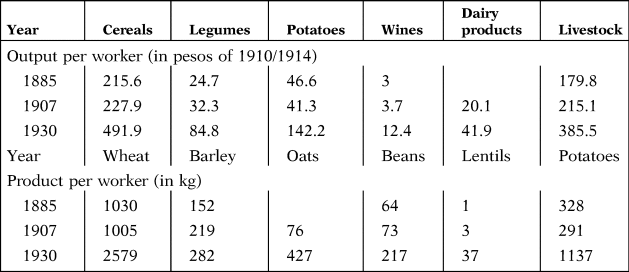
Changes in labour productivity and trends in wheat prices also need to be taken into account to explain trends in agricultural labourers' wages. On the one hand, despite the reduction in the size of the agricultural labour force, labour productivity rose because of technological changes, above all mechanisation. As Table 2 shows, labour productivity barely grew between 1885 and 1907 but then, from 1907 to 1930 it underwent a sharp increase. In fact, the value of the output per worker doubled in cereals, while the physical wheat output per worker grew from 1,005 kg in 1907 to 2,579 kg in 1930. In addition, the real value of important crops such as wheat, barley, oats, beans, lentils and potatoes experienced major growth, particularly after 1907. On the other hand, nominal wheat prices increased slightly from 1880 to 1913, but then grew significantly, although showing important fluctuations. In turn, real prices remained constant until 1913. Thereafter, both nominal and real wheat prices increased sharply until 1929 (Figure 3). As can be seen in Figure 3, the surge in nominal wheat prices was accompanied by an increase in agricultural peons' wages. Thus, higher labour productivity and increasing wheat prices allowed landowners to pay higher wages.

At the same time, fluctuations in real wages were directly related to changes in the general price level. There was a temporary upward shift in the wage series (as with other economic indicators such as GDP, exports, etc.), and the long-term evolution of the price level had an upward trend which also resulted in the increase in wages. Indeed, the evolution of the GPI from Matus (Reference Matus2012) shows that between 1880 and 1905 prices grew slightly at a rate of 2.9 per cent per year; from 1906 to 1918 prices grew strongly at an annual rate of 7.5 per cent and, from 1919 to 1930 prices continued to grow, but with great fluctuations (Matus Reference Matus2012). However, the nominal wages (food included) of rural peons grew a little faster than prices, thus offsetting the increase in the cost of living in rural Central Chile.
Finally, mechanisation significantly affected the wages of agricultural labourers on large estates in Central Chile. They had been increasing from the early 1870s, when contemporary analysts observed an upward trend in wages. Mechanisation developed above all in the harvesting of cereals and fodder crops, and thus was both a response to labour supply bottlenecks and the economic alternative to rising wages. Agricultural mechanisation was neither universal nor equally intensive among production units, but concentrated on large estates where commercial crops were grown on a large scale. Moreover, the steam engine-based mechanisation that progressed through the 19th century culminated in the early introduction of the tractor, the revolutionary innovation which, already before World War I, had made it possible to intensify the growth of the area under cultivation. In short, landowners substituted labour for capital. This, in turn, slowed down the growth of nominal wages for agricultural labourers.
4. CONCLUSIONS
This paper provides new series of nominal and real wages for male agricultural labourers in Central Chile in the 1870-1930 period of agrarian expansion, which have been constructed with more evidence than in previous studies, especially data from sources directly related to rural society and individual estates. Furthermore, we have discussed rural wages in light of transformations in the rural economy, and from a perspective that combines agrarian and economic history. Thus, our analysis places trends in agricultural wages in the formation and expansion of the labour market in the Chilean economy, a fundamental process in the development of agrarian capitalism in Central Chile. In addition, our study improves previous estimates by including the value of food rations in nominal wages and extending the series until 1935. We are thus able to examine the impact of the Great Depression on the living standards of agricultural labourers.
We have also shown that the growth of wage labour in Central Chile's hacienda system and rural society was one the most significant consequences of the agrarian expansion in Chile's export economy. Wage labour was prominent on the few occasions that official statistical sources, such as agricultural yearbooks and censuses, recorded it, and was also discussed in several primary and secondary sources, especially monographs of rural estates by the Agricultural Institute's graduating agronomists. This finding is consistent with revisionist studies of the hacienda system (Robles-Ortiz Reference Robles-Ortiz2009a, Reference Robles-Ortiz2020a), and adds more evidence to depart not only from conventional interpretations according to which inquilinaje was the main labour regime and an archaic social relation, but also from unfounded, simplistic notions holding that peons did not earn cash wages and were paid in kind. In 1935, immediately after the Great Depression had brought an abrupt end to agrarian expansion, the agricultural census showed that two out of three workers were wage earners, and this figure included scores of women and children. Thus, even if we do not count the rather proletarianised inquilinos, the growth of wage labour was a distinctive element in the expansion of the agricultural sector, which makes it significant to study trends in labourers' wages.
Finally, this paper shows that trends in agricultural labourers' wages and living standards were determined by the dynamics of the Chilean economy's expanding labour market, which also affected rural estates. As the migration of rural workers reduced the supply of traditionally cheap labour and haciendas competed for wage labourers in the harvest season, nominal wages increased significantly in a period of unprecedented economic growth in the agricultural sector. Furthermore, another consequence of the development of the labour market was the fact that large numbers of agricultural labourers combined temporary employment during the hacienda system's harvest season with other jobs, both in the countryside and elsewhere. In this dynamic context, despite the growth of the general price level, especially from the beginning of the 20th century, nominal wages increased enough to compensate for the higher cost of living. In sum, during the agrarian expansion, that is, the first phase of the development of agrarian capitalism, agricultural labourers' living standards increased slightly because of rising labour productivity, the scarcity of agricultural workers and favourable wheat prices.
As for future research, we have also found evidence to document and analyse the place and contribution of women and children as wage earners in the hacienda system, that is, the Chilean variant of the Latin American large estate. Although our series include only wages for male agricultural labourers, all the primary sources consulted show that women and children contributed to their household's total income, as recent study has documented for other rural societies (e.g. Jover-Avellà and Pujadas Mora Reference Jover-Avellà and Pujadas-Mora2017, Humphries and Schneider Reference Humphries and Schneider2019). We have thus far established that in Central Chile, women generally performed relatively simple tasks and thus earned lower wages. This observation may be our starting point to examine whether an increasing participation of women in the estate's work force was another response of rural working families to the persistent outmigration by male workers.
SUPPLEMENTARY MATERIAL
The supplementary material for this article can be found at https://doi.org/10.1017/S0212610921000100
ACKNOWLEDGEMENTS
The authors thank the three anonymous referees, Manuel Llorca-Jaña and James Simpson for their useful suggestions. Funding was provided by ANID (Grant No. Anillos-ANID-PIA-SOC180001), and DICYT 2019, project USA 1899, VRIDEI-USACh.