One of the major differences between pediatric and adult age mania is the high prevalence of comorbid attention-deficit/hyperactivity disorder (ADHD) in children with mania (NIMH Roundtable, 2001; Tillman, Geller, Bolhofner, et al., 2003). At this time, it is unknown what the clinical phenotype of bipolar disorder (BP) with comorbid ADHD signifies (Faraone, Biederman, Mennin, Wozniak, & Spencer, 1997; Geller, 1997). Speculations for reasons for this phenomenon include that comorbid ADHD in child BP is developmental, that is, the typical motoric activity of children coupled with BP produces the clinical picture of ADHD. In this scenario, BP across the age span would be the same diathesis with phenotypic differences due to age of onset. Another conjecture is that pediatric BP with ADHD is a specific diathesis, which may differ in etiopathogenesis from non-BP cases of ADHD (Faraone et al., 1997; Geller, 1997; Geller et al., 2000a; Geller & Tillman, 2005). Regardless of the mechanism, questions of the rates and predictors of ADHD children switching to mania are important both for clinicians and researchers.
Predicting switching from ADHD to BP is particularly important for diagnostic evaluations, because Tillman, Geller, Bolhofner, et al. (2003) reported that the onset of ADHD preceded the onset of mania in subjects with a prepubertal and early adolescent bipolar I disorder phenotype (PEA-BP-I). In 93 subjects with PEA-BP-I, the first episode of mania onset was at age 6.8 (SD = 3.4) years, whereas ADHD onset was at age 4.8 (SD = 1.5) years (Tillman, Geller, Bolhofner, et al., 2003). Therefore, it is possible that clinicians are observing symptoms of ADHD before mania develops. But, it is also possible that some preschool age ADHD may be undiagnosed mania, as there are emerging systematic methods for diagnosing mania in preschoolers (Luby & Belden, 2006; Tillman, Geller, Bolhofner, et al., 2003).
An important reason for identifying predictors of switching from ADHD to BP is to better inform treatment decisions. One reason for this is because of the controversy surrounding stimulant use in childhood BP. In a retrospective chart review of adolescents with BP, DelBello et al. (2001) reported an association between stimulant use and earlier age of BP onset. A proviso to this study is that, due to its retrospective nature, it is not possible to ascertain if stimulants were given to ADHD subjects who may have already had undiagnosed BP. Another speculation would be that earlier onset of ADHD may be more likely if a BP course is to develop.
Findings from several other studies suggest that stimulant use in child BP may not have a negative effect on outcome. One study retrospectively observed the effect of stimulant medication on children with ADHD who also had symptoms of mania. A report from the Multimodal Treatment Study of Children with ADHD (MTA) was that ADHD children with some manic symptoms (but insufficient for a mania diagnosis) responded well to stimulants and were no more likely to have adverse effects than ADHD subjects without symptoms of mania (Galanter et al., 2003). Using a paradigm with subjects that were diagnosed with mania, the effect of add-on stimulants was examined. Specifically, a double-blind placebo-controlled study examining the effect of stimulant add-on to mood-stabilizing medication examined subjects with BP I or BP II stabilized on divalproex sodium (age = 9.8 years, SD = 2.5). After stabilization on divalproex, subjects were randomized to receive either mixed amphetamine salts or placebo in a double-blind fashion. At the end of 4 weeks, the group on mixed amphetamine salts had a significantly better ADHD outcome than the placebo group. The mixed amphetamine salts group did not experience significant side effects or worsening of manic symptoms (Scheffer, Kowatch, Carmody, & Rush, 2005). Another approach was to examine the effect of stimulant medications on the prospectively observed natural history of subjects with mania. In a prospective follow-up study of subjects with PEA-BP-I, Geller, Craney, et al. (2002) found that neither stimulant nor antidepressant medications, with or without concomitant mood stabilizing or antipsychotic medications, affected time to recovery or relapse. These studies that used differing paradigms support that stimulants are unlikely to adversely affect the course of BP, but the issue of whether they have an effect on the age of onset of future BP remains unknown.
Knowledge of rates and predictors of switching from ADHD to BP are likely to benefit investigators of offspring of bipolar parents, where issues of the trajectory of ADHD are especially important (DelBello & Geller, 2001).
To our knowledge, this is the first prospective follow-up study of the rate, risk, and predictors of switching from ADHD to PEA-BP-I.
Method
Overall design
Subjects were participants in the National Institutes of Mental Health (NIMH)-funded Phenomenology and Course of Pediatric Bipolar Disorders study that entered participants between 1995 and 1998. There were a total of 268 subjects enrolled in the study: 93 PEA-BP-I, 81 ADHD, and 94 healthy controls (HCs). Results of the follow-up of the PEA-BP-I subjects have been previously published (Geller, Craney, et al., 2001, 2002; Geller, Tillman, Craney, & Bolhofner, 2004). This report will focus on the ADHD and HC subjects, who were evaluated at baseline and at 2-, 4-, and 6-year follow-ups. Raters were blind to subjects' diagnostic status at baseline and new blind raters were folded in again at the 6-year follow-up point. This communication will examine the rate, risk, and predictors of switching from ADHD to PEA-BP-I through the 6-year follow-up assessment.
ADHD and HC subject ascertainment
Details of the ascertainment schema have been published elsewhere (Geller, Zimerman, Williams, DelBello, Bolhofner, et al., 2002; Tillman et al., 2005). In brief, ADHD subjects were obtained from designated outpatient child psychiatric and pediatric sites by consecutive new case ascertainment (Geller, Zimerman, Williams, DelBello, Bolhofner, et al., 2002; Tillman et al., 2005). In the consecutive new case ascertainment schema, all new patients at the participating facilities were assessed. The same assessment was conducted for every new patient (e.g., a patient presenting to a pediatric site with a sore throat was given the same screen as a patient presenting to a psychiatric site with hyperactivity). Outpatient sites were used instead of inpatient sites, because the planned inpatient facilities in St. Louis closed prior to subject enrollment (Tillman et al., 2005). At the time of subject enrollment, there were no pediatric or psychiatric facilities available in the St. Louis area that served families from lower socioeconomic backgrounds. This is because pediatricians from private practices who saw patients of lower socioeconomic status (SES) did not agree to participate in the study, due to the increased workload (e.g., sending letters to all new patients about the study). Therefore, the venues that agreed to participate in the consecutive new case ascertainment were outpatient pediatric and psychiatric private and nonprofit facilities that were essentially only available to families with health insurance (Tillman et al., 2005).
HC subjects were obtained by a random survey. They were matched to the PEA-BP-I subjects by age, gender, school grade, SES, ethnicity, and zip code.
Inclusion and exclusion criteria for ADHD and HC subjects
The study inclusion and exclusion criteria have been reported in detail previously (Geller, Zimerman, Williams, DelBello, Bolhofner, et al., 2002). In brief, inclusion criteria for all subjects in the study were 7–16 years of age, both genders, and good physical health. Subjects in the ADHD group needed current DSM-IV ADHD (with hyperactivity, i.e., combined or hyperactive/impulsive types) with a Children's Global Assessment Scale (CGAS) score of ≤60, signifying definite clinical impairment. ADHD must have onset before age 7, with episode duration of at least 6 months.
Exclusion criteria for all subjects were IQ <70, adopted status, pervasive developmental disorders, schizophrenia, epilepsy, or other major medical or neurological disorder, and baseline substance dependency or pregnancy. There were no family history exclusions. ADHD subjects could not have had a lifetime or current BP or major depressive disorder (MDD) diagnosis. Subjects in the HC group could not have had a lifetime or current BP, MDD, or ADHD diagnosis.
The rationale for these inclusion and exclusion criteria included the following. Because this was a phenomenology study, ADHD subjects were required to be in a current episode. Only the combined or hyperactive/impulsive types of ADHD were included, because the hyperactivity manifestations were the ones that needed to be differentiated from mania. A lower age of 7 was chosen for credibility of the BP interview assessments, and an upper age of 16 was chosen so that subjects would still be teenagers at the 2-year follow-up assessment (Geller, Craney, et al., 2002). Subjects could not have baseline substance dependency or pregnancy to avoid confounding the mental status. Subjects who developed these conditions, however, were retained in the follow-up study. Adoption was an exclusion criterion due to concurrent family (Geller et al., in press) and genetic studies (Geller, Badner, et al., 2004).
Assessment
All subjects were comprehensively assessed at baseline and at each follow-up assessment point. The main diagnostic tool was the Washington University in St. Louis Kiddie Schedule for Affective Disorders and Schizophrenia (WASH-U-K-SADS), a lifetime, semistructured interview that has demonstrated excellent reliability and 6-month stability of mania items (Geller et al., 2000b; Geller, Zimerman, et al., 2001). Kappa statistics (a measure of agreement beyond chance) were 0.82–1.00 for mania items, 0.90 for mania, and 0.85 for hypomania, indicating excellent interrater reliability on the WASH-U-K-SADS mania section. Specifically, the kappa values for grandiosity, elation, and irritability were 0.82, 0.92, and 0.88, respectively (Geller, Zimerman, et al., 2001).
The WASH-U-K-SADS was administered by experienced research nurses with established interrater reliability, who were blind to subjects' diagnostic status. The WASH-U-K-SADS was administered separately to parents about their children and to children about themselves (Tillman et al., 2004). The WASH-U-K-SADS has expanded sections on prepubertal mania and ultrarapid and ultradian cycling, items to assess both current and lifetime episodes, items for specific timing of onsets and offsets for all symptoms and syndromes, and sections for ADHD and other DSM-IV diagnoses (Geller, Zimerman, Williams, DelBello, Bolhofner, et al., 2002). Prepubertal manifestations of mania have been previously published (Geller, Zimerman, Williams, DelBello, Frazier, et al., 2002). Time frames were established for children's ratings using birthdays, holidays (e.g., was the symptom present at Christmas?), beginning and ending of school terms, and comparison to earlier grades (e.g., if the subject is in third grade, was the symptom present in second grade?) as anchor points (Geller, Zimerman, Williams, DelBello, Bolhofner, et al., 2002). In addition, the narrative next to each rating is part of the WASH-U-K-SADS (e.g., part of the narrative next to a suicidal ideation item read “cut her wrists four times with a kitchen knife and wanted to die to escape her sad feelings”). The data collection guideline is that the narrative must justify the item rating with respect to onset, offset, frequency, duration, intensity, and specific examples (Geller, Zimerman, Williams, DelBello, Bolhofner, et al., 2002). On the WASH-U-K-SADS, item ratings of ≥4 indicate significant clinical impairment and count towards definite DSM-IV diagnoses (including mania, MDD, and ADHD) if the CGAS is ≤60. For hypomania, ratings of ≥3 were counted.
Following the methods of Bird, Gould, and Staghezza (1992), responses from the separate parent and child interviews were combined by using the most severe response.
The CGAS (Bird, Canino, Rubio-Stipec, & Ribera, 1987; Shaffer et al., 1983) is a measure of global severity, based on impaired functioning in social, family, school, and work settings. The research nurses who administered the WASH-U-K-SADS derived CGAS scores.
Psychosis was defined as clinically impairing delusions and malignant hallucinations that did not occur only hypnogogically (while falling asleep) or hypnopompically (while waking up). On the WASH-U-K-SADS, both the delusional and the hallucinatory items required the highest severity rating, which indicated definite clinical impairment. In addition, the highest severity rating on the WASH-U-K-SADS items for grandiosity, hopelessness, hypochondriasis, and guilt indicate delusions in these areas (Klages, Geller, Corrigan, Tillman, & Bolhofner, 2005).
Tillman and Geller (2003) proposed definitions of rapid, ultrarapid, and ultradian cycling, based on the work of Kramlinger and Post (1996). Historically in adult BP, rapid cycling was defined as four or more episodes per year. Instead of referring to this phenomenon as “rapid cycling,” it would seem less confusing to refer to this historical adult pattern as simply “rapidly recurring episodes.” This pattern is rare in PEA-BP-I (Geller et al., 2000a; Geller, Zimerman, Williams, DelBello, Bolhofner, et al., 2002). Instead, children with PEA-BP-I most often have ultradian cycling, which is multiple cycles a day, every or almost every day, for the duration of an episode. Tillman and Geller (2003) defined current episode as the time from onset of the current mania diagnosis to the baseline assessment. Cycles are mood changes occurring within the current episode. In this schema, ultrarapid cycling is mood switches occurring every few days, and ultradian cycling is mood switches occurring on a daily or almost daily basis during a current episode. For example, a child had a BP diagnosis with a current episode lasting 2 years. During this current episode, he cycled twice daily every day. He would be said to have a current episode lasting 2 years, characterized by ultradian cycling.
Methods for assessing psychosocial functioning appear in detail in Geller, Bolhofner, et al. (2000). In short, psychosocial functioning was assessed with the Psychosocial Schedule for School-Age Children—Revised (PSS-R; Puig-Antich, Lukens, & Brent, 1986), which has been shown to have good psychometric properties (Lukens et al., 1983). This instrument includes scales for maternal warmth and intactness of biological family, which were significant predictors of PEA-BP-I outcome (Geller, Craney, et al., 2002; Geller, Tillman, et al., 2004). The PSS-R was administered separately to parents about their children and to children about themselves by the research nurses who administered the WASH-U-K-SADS.
Methods for assessing life events were described in Tillman, Geller, Nickelsburg, et al. (2003). In brief, life event data was obtained with the Life Events Checklist, which is embedded in the PSS-R (Puig-Antich et al., 1986). This scale was given separately to parents about their children and to children about themselves by the research nurses who administered the WASH-U-K-SADS. The 57 life events items were rated by two independent research clinicians to establish whether the items were independent of the child (e.g., a parent died), dependent on the child (e.g., failed a school course), or uncertain (e.g., a sibling goes to boarding school, which may or may not be due to the subject's illness; Tillman, Geller, Nickelsburg, et al., 2003).
The Hollingshead Four-Point Index of Social Status (Hollingshead, 1976) was used to determine social status, and the Pubertal Status Questionnaire (Duke, Litt, & Gross, 1980) was given to subjects at least 10 years of age to determine pubertal status.
All diagnoses were confirmed in consensus conferences with a child psychiatrist (B.G.) and the research nurses who administered the instruments (Fennig, Craig, Tanenberg-Karant, & Bromet, 1994; Klein, Ouimette, Kelly, Ferro, & Riso, 1994; Kraemer, 1992). In these meetings, materials including assessment instruments, school reports, agency records, pediatrician charts, medical records, psychiatric records, videotapes of WASH-U-K-SADS interviews with parents, and videotapes of WASH-U-K-SADS interviews with children were reviewed.
After complete description of the study, informed written consent was obtained from parents, and written assent was obtained from subjects.
Definition of PEA-BP-I
PEA-BP-I was defined as DSM-IV mania (BP I manic or mixed phase) for at least 2 weeks. To demonstrate clinical impairment, a CGAS score of ≤60 was required. An additional requirement for PEA-BP-I subjects was the presence of at least one of the two cardinal symptoms of mania (i.e., elated mood and/or grandiosity). This was analogous to the DSM-IV requirement of sad mood and/or anhedonia for a diagnosis of MDD. The cardinal symptom criterion ensured that subjects were not diagnosed with mania only by symptoms (e.g., distractibility, hyperactivity) that overlapped with those for ADHD. For symptoms that occurred in more than one diagnosis, the investigators did not know a way of discerning which diagnosis to count the item toward. Therefore, symptoms that were concurrent to more than one diagnosis were counted toward each, but a PEA-BP-I diagnosis was only given if the subject met DSM-IV BP I (manic or mixed phase) with elation and/or grandiosity as one criterion. Counting dimensions (i.e., symptoms that occur across diagnoses) for co-occurring conditions is widespread across medicine. In this medical context, examples of dimensions are distractibility, hyperactivity, pain, and fever. For example, if a patient had fever with co-occurring streptococcal pharyngitis and appendicitis, fever would be counted for both diagnoses (Geller, 2006).
Switching from ADHD or HC to PEA-BP-I or PEA-BP-II
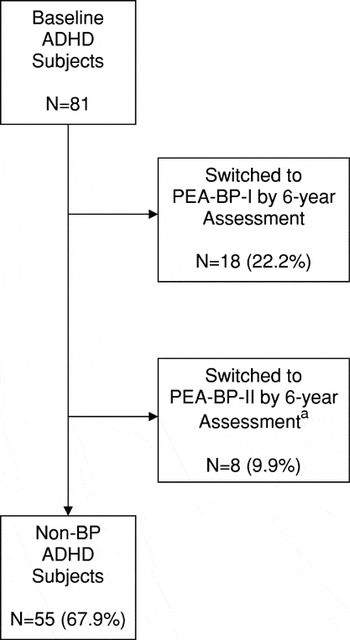
Subjects in the ADHD and HC groups were assessed at baseline and every 2 years after baseline. This report includes all data obtained through the 6-year follow-up assessment. If, at any follow-up point, a subject in the ADHD or HC group fit the PEA-BP-I criteria for mania, they were labeled a PEA-BP-I switcher. In addition, if an ADHD or HC subject had DSM-IV hypomania with elation and/or grandiosity and a CGAS score of ≤60, they were considered a switcher to PEA-BP-II (with or without MDD). The subject flow through the 6-year follow-up assessment for the ADHD group is shown in Figure 1. As noted below, PEA-BP-II switchers were removed from analyses, because at this point BP II is not well characterized in children.

The flow of ADHD subjects through 6-year follow-up assessment. aSubjects who switched to PEA-BP-II were not included in the analyses (see text).
Statistical analyses
Two psychosocial variables, baseline maternal warmth and baseline living situation, were examined for the following reasons. At the 2-year follow-up assessment of the PEA-BP-I subjects, living in an intact biological family predicted earlier recovery from mania (Geller, Craney, et al., 2002). In addition, maternal warmth was a robust predictor of earlier relapse after recovery in the PEA-BP-I subjects at both the 2- and 4-year follow-up assessments (Geller, Craney, et al., 2002; Geller, Tillman, et al., 2004).
Life events were examined, because an earlier report comparing PEA-BP-I, ADHD, and HC subjects found that PEA-BP-I subjects had significantly more independent, dependent, and uncertain life events than both the ADHD and HC subjects (Tillman, Geller, Nickelsburg, et al., 2003).
Family study data from the first-degree relatives of the 268 “Phenomenology” Study subjects found that first-degree relatives of PEA-BP-I subjects had a 34.0% lifetime morbid risk of BP I. This was significantly higher than the morbid risk in first-degree relatives of ADHD (13.8%) and HC subjects (4.7%). Given these data, first-degree relative diagnoses were examined as potential predictors.
Use of stimulant and of antidepressant medication was examined for reasons discussed in the introduction. For the medication analysis, stimulant and antidepressant use were defined in the following way. Nonswitchers who were on any stimulant or antidepressant medication between the baseline and 6-year follow-up assessments were counted as taking stimulants or antidepressants. Switchers were only counted as being on medication if they were taking stimulants or antidepressants between baseline and the time of their switch to PEA-BP-I or PEA-BP-II.
Site of ascertainment for the Phenomenology Study, either pediatric or psychiatric, was examined for the following reasons. A previous report of differences between subjects with PEA-BP-I ascertained at pediatric versus psychiatric sites found that more severe cases of PEA-BP-I, with mixed mania and suicidality, were more often referred to psychiatric facilities (Tillman et al., 2005). In addition, in a seminal study, Zarin, Suarez, Pincus, Kupersanin, and Zito (1998) compared treatment histories of ADHD subjects in psychiatric clinics to the treatment that would be expected in primary care settings. These authors found that 55% of the children in psychiatric clinics were on nonstimulant medications and that 49% were on at least two psychotropic medications (Zarin et al., 1998).
The morbid risks of switching from ADHD to PEA-BP-I and from HC to PEA-BP-I were calculated using the Kaplan–Meier (K-M) method, and were compared using a Cox proportional hazards model. Because the ADHD subjects were significantly younger, more often male, and more often prepubertal than the HC subjects at baseline, these variables were controlled for in the Cox model.
The age of onset of PEA-BP-I in subjects switching to PEA-BP-I was compared by baseline group (ADHD or HC) using a two-tailed t test.
A multivariate Cox model was used to test for predictors of a switch from ADHD to PEA-BP-I. Independent variables included in this multivariate model were significant predictors (p < .05) of switching in univariate Cox models. Hazard ratios with 95% confidence intervals were computed for significant predictors in the univariate models. Baseline ADHD subjects who switched to PEA-BP-II by 6-year follow-up were not included in these analyses.
The following baseline variables were analyzed in the univariate Cox models: age, age of ADHD onset, CGAS score, SES, gender, pubertal status, mania symptoms, rapid cycling, oppositional defiant disorder (ODD), maternal warmth, living situation, life events, recruitment site (pediatric or psychiatric). Of note, subjects in the ADHD group could have manic symptoms that were subthreshold for the diagnosis at baseline. In addition, they could present with a cycling pattern that consisted of cycles of irritability. The following family study variables in first-degree relatives were also examined: BP I, recurrent MDD (rMDD; defined as more than one episode or an episode lasting at least 2 years), BP I or rMDD, and BP I with comorbid ADHD. Stimulant and antidepressant use during follow-up were also analyzed as possible predictors.
Potential predictors of switching from HC to PEA-BP-I were not examined, because only two HC subjects switched to PEA-BP-I by the 6-year follow-up assessment.
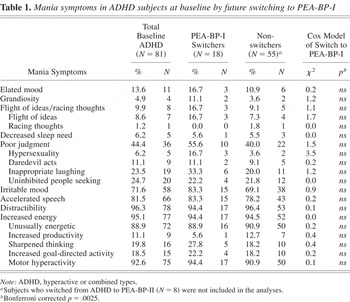
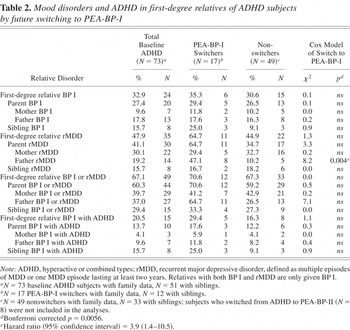
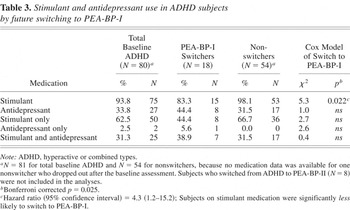
Multiple comparisons were controlled for using the Bonferroni method. In this method, the overall significance level for a group of tests (p = .05) is adjusted by dividing by the number of independent comparisons being made. After Bonferroni correction, the p values indicating statistical significance were .0025 for Table 1, .0056 for Table 2, and .025 for Table 3.
Mania symptoms in ADHD subjects at baseline by future switching to PEA-BP-I

Mood disorders and ADHD in first-degree relatives of ADHD subjects by future switching to PEA-BP-I

Stimulant and antidepressant use in ADHD subjects by future switching to PEA-BP-I

All analyses were conducted using SAS version 8.2 software.
Results
The results for the rate, risk, and predictors of switching from ADHD to PEA-BP-I are presented below. In addition, differences in ADHD subjects obtained at psychiatric versus pediatric sites and rates of rapid cycling and psychosis in switchers after they developed PEA-BP-I are also provided.
Baseline demography and severity
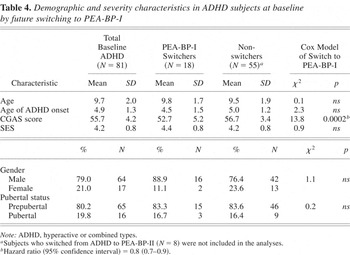
Demographic and severity characteristics of the baseline ADHD subjects are presented in Table 4. Lower baseline CGAS score significantly predicted switching from ADHD to PEA-BP-I.
Demographic and severity characteristics in ADHD subjects at baseline by future switching to PEA-BP-I

Rate, morbid risk, and age of switching to PEA-BP-I
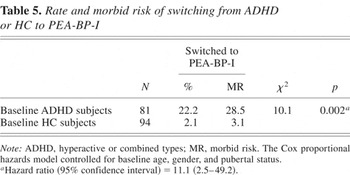
Table 5 shows the rate and morbid risk of switching from ADHD to PEA-BP-I and from HC to PEA-BP-I. The risk of switching to PEA-BP-I was significantly greater for baseline ADHD subjects compared to baseline HC subjects.
Rate and morbid risk of switching from ADHD or HC to PEA-BP-I

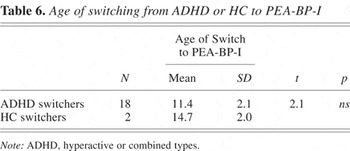
Table 6 compares the ages of switching to PEA-BP-I in the ADHD and HC groups. Notably, the age of onset of PEA-BP-I was earlier in baseline ADHD subjects than in baseline HC subjects, although this difference was not statistically significant.
Age of switching from ADHD or HC to PEA-BP-I

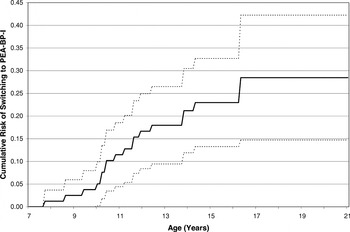
Figure 2 graphically displays the K-M estimate of switching from ADHD to PEA-BP-I, with 95% confidence intervals.

The Kaplan–Meier estimate of switching from ADHD to PEA-BP-I through the 6-year follow-up assessment was 28.5% (95% confidence interval = 14.7–42.2%).
Baseline (preswitching) mania symptoms
Baseline mania symptoms in the baseline ADHD subjects are presented in Table 1. No baseline mania symptoms significantly predicted a switch from ADHD to PEA-BP-I.
Mood disorders and ADHD in first-degree relatives
Table 2 shows the prevalence of BP I, rMDD, BP I or rMDD, and BP I with comorbid ADHD in the first-degree relatives of the baseline ADHD subjects. ADHD subjects with fathers with rMDD were significantly more likely to switch to PEA-BP-I.
Stimulant and antidepressant medication
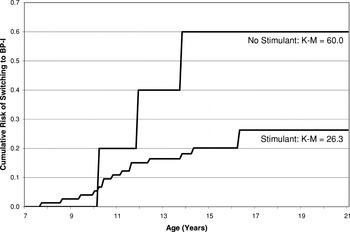
Prevalence of stimulant and antidepressant use among baseline ADHD subjects are shown in Table 3. Lack of stimulant medication use significantly predicted a switch from ADHD to PEA-BP-I. The K-M curves for switching from ADHD to PEA-BP-I by stimulant use during the 6-year follow-up are shown in Figure 3.

The Kaplan–Meier estimate of switching from ADHD to PEA-BP-I by stimulant use during 6-year follow-up. Subjects on stimulant medication were significantly less likely to switch to PEA-BP-I (χ2 = 5.3, p = .022). The hazard ratio for switching on no stimulant versus on stimulant was 4.3 (95% confidence interval = 1.2–15.2).
Ascertainment site
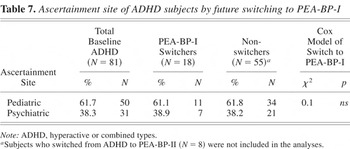
Table 7 shows the percent of baseline ADHD subjects ascertained at pediatric and psychiatric sites by whether they later switched to PEA-BP-I. Additional analyses revealed that ADHD subjects ascertained at pediatric sites were significantly more often Caucasian (96.0 vs. 74.2%, Fisher's exact p = .006) and had significantly higher sharpened thinking (28.0 vs. 6.5%, χ2 = 5.6, p = .018) than ADHD subjects ascertained at psychiatric sites. There were no significant differences in ADHD subjects by ascertainment site in other demographic or severity characteristics, other mania symptoms, rapid cycling, ODD, maternal warmth, living situation, life events, family psychopathology, or stimulant or antidepressant use.
Ascertainment site of ADHD subjects by future switching to PEA-BP-I

Other potential predictors
No other potential predictors (i.e., baseline rapid cycling, ODD, maternal warmth, living situation, life events) significantly predicted a switch from ADHD to PEA-BP-I in univariate Cox models.
Multivariate Cox model
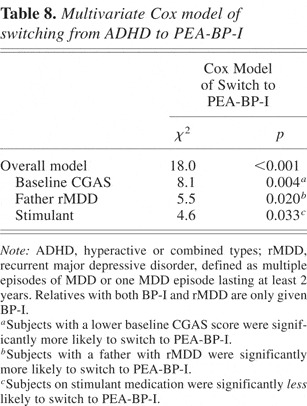
Significant predictors of a switch to PEA-BP-I were analyzed in a multivariate Cox model. Table 8 presents the results of this model.
Multivariate Cox model of switching from ADHD to PEA-BP-I

Characteristics after switching
Among baseline ADHD subjects who switched to PEA-BP-I, psychosis was present in 50.0% after they switched. In addition, ultradian and ultrarapid cycling were present in 72.2 and 11.1% of PEA-BP-I switchers, respectively. These rates of psychosis and ultradian and ultrarapid cycling were not significantly different from rates in the 93 subjects with PEA-BP-I at baseline.
Discussion
The discussion will focus on switching to PEA-BP-I, because this diagnosis has been validated by Robins and Guze (1970) criteria (Geller & Tillman, 2005). Specifically, PEA-BP-I has been validated by (a) unique symptoms that did not overlap with those of other diagnoses (Geller, Zimerman, Williams, DelBello, Bolhofner, et al., 2002); (b) stable longitudinal course, in that subjects continued to have BP diagnoses over 4-year follow-up (Geller, Craney, et al., 2001, 2002; Geller, Tillman, et al., 2004); (c) significantly higher familial aggregation of BP I compared to ADHD and HC subjects (Geller et al., in press); and (d) a replicated molecular genetic finding (Geller, Badner, et al., 2004). By contrast, the reliability and validation of BP II in children have not been reported in a blindly rated, controlled study. Therefore, the discussion will focus primarily on PEA-BP-I.
High rate of switching to PEA-BP-I
It is notable that there was a very high rate of switching from ADHD to PEA-BP-I (22.2%) and PEA-BP-II (9.9%) in this sample. The morbid risk of switching from ADHD to PEA-BP-I was significantly higher than the risk of switching from HC to PEA-BP-I in our sample. The 2.1% rate and 3.1% morbid risk of switching from HC to PEA-BP-I is consistent with the prevalence of child BP I in the general population, according to a recent epidemiological study that found a 5.0% lifetime risk of BP I in 12- to 29-year-olds (Grant et al., 2005). Given the much higher risk of switching from ADHD to PEA-BP-I in this sample compared to the HC group and the population prevalence, it is important to evaluate possible reasons for this elevated risk.
A postulation for the high rate of switching from ADHD to PEA-BP-I in this sample was that the ADHD subjects were more severely ill than those seen by general practitioners. Our data supported this postulation, as there was a significantly lower baseline CGAS score in PEA-BP-I switchers compared to nonswitchers. This raises the question of why our sample of ADHD subjects had such severe psychopathology. A reason for this may be because of changes in health policy in the United States for the treatment of ADHD, as reported in the seminal paper by Zarin et al. (1998). This change to a gatekeeper, health maintenance organization, system may have led to uncomplicated cases of ADHD at family practitioners and general practitioners offices and more complicated cases at psychiatric clinics. In the Zarin et al. (1998) paper, the medication algorithm used in the NIMH Collaborative MTA was examined in regard to treatment strategies of child psychiatrists. Findings showed a marked difference in treatment patterns between gatekeepers and child psychiatrists. Gatekeepers were primarily prescribing stimulants, which would be consistent with uncomplicated ADHD. By contrast, as noted in the introduction, psychiatrists were prescribing multiple psychotropics, which would be consistent with complicated ADHD (Zarin et al., 1998). In this regard, one reason for complicated ADHD can be undiagnosed BP. The ascertainment scheme in the Phenomenology Study included subspecialty child psychiatry and pediatric sites affiliated with a major academic center, and thus did not include gatekeeper sites. These academic affiliated sites may have been more likely to see more severe cases of ADHD (Zarin et al., 1998).
Predictors of switching to PEA-BP-I
Examining possible predictors of switching from ADHD to PEA-BP-I could aid psychiatrists in the early diagnosis of mania in ADHD subjects who will develop PEA-BP-I.
One possibility as a predictor was that ADHD subjects who later developed PEA-BP-I would have more baseline mania symptoms than ADHD subjects who did not develop PEA-BP-I. However, this possibility was not supported by the data. Specifically, comparing baseline mania symptoms of PEA-BP-I switchers and nonswitchers in this sample revealed that no symptoms differed significantly. Reasons for this finding are not known, and at this time, there are insufficient data to make reasonable speculations.
Another speculation for a predictor of switching from ADHD to PEA-BP-I was familial BP I. This was not supported, as family psychopathology for BP I was not significantly different for PEA-BP-I switchers compared to nonswitchers. Unexpectedly, rMDD in fathers was a significant predictor of switching from ADHD to PEA-BP-I. Although reasons for this result are unknown, psychiatrists should be at heightened awareness if a child with ADHD has a father with a history of rMDD. Parenthetically, high rates of MDD have been reported in samples of children with ADHD (Biederman et al., 1987).
As discussed in the introduction, there is controversy surrounding the role of stimulant medication vis-à-vis ADHD and BP. In this sample, ADHD subjects on stimulant medication were significantly less likely to switch to PEA-BP-I than subjects taking stimulants. The rate of stimulant use in both groups, however, was very high (83.3% in switchers and 98.1% in nonswitchers), suggesting that this finding may not be clinically significant. Nevertheless, despite past concerns that prescribing stimulants to ADHD children may increase manic symptoms, this result suggests that clinicians can prescribe stimulants for children with ADHD, even if they suspect a future BP course.
The use of antidepressant medication was also examined. Antidepressant use for treating ADHD raises the question of whether antidepressant medication may impact a switch from ADHD to mania. The data presented here support that antidepressant use was not a predictor of switching from ADHD to PEA-BP-I. As noted in the introduction, this finding is consistent with finding that antidepressant medication did not affect the course of PEA-BP-I during a 2-year prospective follow-up (Geller, Craney, et al., 2002). In addition, antidepressant use was not a significant predictor in a prospective, controlled, blindly rated study of switching from prepubertal MDD to mania at 10-year prospective follow-up (Geller, Zimerman, Williams, Bolhofner, & Craney, 2001).
The significant predictors of switching from ADHD to PEA-BP-I may be of use to clinicians, who can assess for low levels of global functioning and paternal rMDD in clinical cases of ADHD. As stated previously, although less stimulant use was a significant predictor of switching to PEA-BP-I, it may not be of use clinically, as almost all subjects in both the switching and nonswitching groups were taking a stimulant medication. In addition, researchers interested in samples at high risk for BP I might investigate ADHD children with low CGAS scores and fathers with rMDD.
An important area for future research will be to investigate rates and predictors of switching from ADHD to BP in epidemiological samples.
Limitations
Subjects participating in the Phenomenology Study had a mean SES in the second highest of five classes. As previously described, at the time of subject ascertainment, there was no facility or private practice in St. Louis available to obtain consecutive subjects from lower SES backgrounds. Thus, these findings may not generalize to lower SES settings.
The ADHD sample was 87.7% Caucasian. Although this is similar to the ethnicity in the surrounding metropolitan area, it raises the question of the applicability of these findings to populations where Caucasians are in the minority.
The Phenomenology Study investigated the PEA-BP-I phenotype, so these findings may not generalize to other child BP phenotypes.
There has not been a controlled study of BP II in children. Therefore, the data on rates of switching to PEA-BP-II presented here may require reevaluation when such data become available.
Most importantly, the ascertainment scheme used academically affiliated subspecialty child psychiatry and pediatric facilities. Therefore, these results may not generalize to ADHD cases seen in gatekeeper offices.