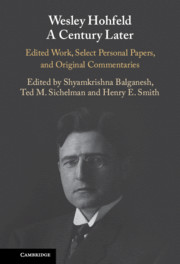


In the century or so after the untimely death of Wesley Newcomb Hohfeld, his ideas have been a source of inspiration for widely divergent streams of legal scholarship. More generally, the nature of his ideas and the circumstances of his life have placed him at the crossroads of many currents of legal and social thought, making him a – somewhat fortuitously – pivotal figure in legal theory. And, after all the many explications and applications of his framework, it is as fresh and in many ways as enigmatic as on the day he left it in its unfinished state.
Hohfeld wrote at a time when the natural rights paradigm was beginning to become hollowed out and increasingly – if not entirely accurately – regarded as empty formalism. Hohfeld himself was a conceptualist, and he meant his scheme of jural relations as a rational reconstruction of concepts on a more articulated basis. Building on predecessors like Ernst Bierling and John Salmond, in his landmark work, “Some Fundamental Legal Conceptions as Applied in Judicial Reasoning,”Footnote 1 Hohfeld pushed the elegance of symmetry further. Specifically, he posited four pairs of jural correlatives (right-duty, privilege-no right, power-liability, and immunity-disability) and opposites across pairs of relations (right-no right, privilege-duty, power-disability, and immunity-liability). Notions like a corporation, a contract, a tort, and property could be broken down into collections of such relations. Further, all such relations would avail between pairs of persons. For instance, what was conventionally thought of as an “in rem” right was not treated as a one-on-one “thing” relative to legal persons, but instead as a group of similar rights availing between the holder of the right and numerous mostly unidentified others – each such right was “multital.”Footnote 2 Hohfeld believed that his scheme was complete: it could capture all the legally relevant relationships holding between members of society, both inside and outside the legal system and its machinery.
Hohfeld’s conceptualism, robust as it was, was not an exercise in pure logic, and, at least, Hohfeld’s stated aim was practical rather than philosophical. In most of his work, Hohfeld does not overtly discuss his motivations or where he stood on moral, social, or political questions. In a famous 1914 speech, Hohfeld laid out his aspirations for legal education and the study of law more generally.Footnote 3 Consistent with a reformist optimism, if not the progressivism, of the era, Hohfeld believed that attaining greater clarity and fit in the deployment of legal concepts and their associated linguistic formulations would lead to better law from a policy point of view. This assumption may be the source of one of the most fascinating and most frustrating aspects of Hohfeld’s applications of his own framework: in deploying his scheme, he treated judges’ and jurists’ use of terminology and existing concepts and doctrines as logical fallacies stemming from improperly failing to conform to what he viewed as a framework of legal relations that partook of necessary truth. To some, this endeavor of Hohfeld was a needed debunking of pervasive legal false consciousness and presumptuous category mistakes. To others, it is the obverse of the “crossroads” that Hohfeld’s work primarily occupies, and, in this regard, perhaps Hohfeld relied too heavily on terminological usage to infer conceptual error. These divergent perspectives are reflected in some of the chapters in this volume. Nevertheless, there may be some common ground between these seemingly disparate views. Perhaps Hohfeld can, in a somewhat timeless fashion, occupy that central position precisely because of the close relation of his conceptual scheme and normative desirability, even if the precise contours of this relation could not be completely delineated at the time (or now, for that matter).
This close relation between normativity and conceptual precision would before long become implausible to the Realists, who were on guard against any reintroduction of “natural rights” such as liberty and property where sound policy should hold sway. Optimism along these lines would soon run into the buzz saw of Legal Realism. Because Hohfeld died right on the eve of the Realist era, and his concepts were orthogonal to those the Realists deconstructed, we can never know whether Hohfeld would have been swept up and carried by the Realist tide or would have charted a different course. Hohfeld’s scheme itself was taken in certain directions by those primarily interested in his conceptualism and in very different directions by those who saw in it a solvent for traditional legal categories, as the first step toward a more policy-oriented overhaul. Hohfeld never had to make these choices, and his scheme hovers out there in between the concerns of many of his successors. And if Hohfeld’s scheme, in the end, is too loose for philosophers and yet too procrustean for many jurists, we might chalk this up to Hohfeld’s assumption – his optimism – that conceptual clarity and good legal policy go hand in hand.
As progressivism and sociological jurisprudence gave way to Legal Realism, some of these tensions in Hohfeld’s work would have called for development by Hohfeld himself. Even without the changing state of the world and legal theory, Hohfeld left hints that he planned to address aspects of his scheme that were left open or ambiguous. Notably, he acknowledged the need for a theory of aggregate relations. What form would that take? Would it be a reductionist one in which the aggregates are a collection of the contributing parts, and the features of aggregate relations are the additive sum of the features of the constituent relations? Or would the theory of aggregates allow for some connections to be more important or tighter than others, and for aggregates of legal relations to be interestingly different from a heap of the “atomic” relations? We cannot know, but there is no question that many – and not just legal realists – have taken Hohfeld in a reductionist direction. And while we, along with some of the authors in this collection, would argue that a less reductionist view is compatible with much of Hohfeld’s thought, we think that the outpouring of new work on Hohfeld, including all of the chapters in this volume, suggests that once again Hohfeld at the crossroads has set up the problems so that those coming after him may tackle them with greater precision and insight.
To shed new light on Hohfeld’s legacy, this volume begins with an annotated and slightly edited version of his most famous article, “Some Fundamental Legal Conceptions as Applied in Judicial Reasoning,” originally published in 1913 in the Yale Law Journal and then later as part of a collection edited by Walter Wheeler Cook. The excerpt offered here presents the bulk of Hohfeld’s theory. Ted Sichelman’s extensive commentary clarifies Hohfeld’s article, illustrates its connections to and implications for legal theory and philosophy, and offers friendly critique, realigning Hohfeld’s landmark typology more with the formalist tradition than the bulk of previous accounts. There follows a brief sketch of Hohfeld’s life with accompanying pictures and documents. These documents were assembled by Hohfeld’s brother, Edward Hohfeld, and have been graciously made available to editor Ted Sichelman by the late Jane Hohfeld Galante. These materials help illuminate the context in which Hohfeld wrote as well as some of his motivations for pursuing his program. Along with the annotation, these papers set the stage for the chapters that form the main body of this volume.
The contributions to this volume reflect the richness of the framework and diversity of the strands emanating from it. There is Hohfeld the legal philosopher, Hohfeld the proto-Realist, Hohfeld the theorist of equity and property, Hohfeld the denier and student of legal complexity, and Hohfeld the inspiration for many applications throughout law and beyond.
Hohfeld focused on the theory of jural relations, and his analysis has captured the attention of philosophers. One place to begin in an examination of Hohfeld’s thought and its influence is legal language itself. Hohfeld was famously interested in legal language and the use of terminology. In Chapter 1, Frederick Schauer examines Hohfeld’s program as addressing the nature of legal language and its relation to everyday language. Hohfeld lamented the loose use of terms like “right” and “property,” and his scheme of jural relations was meant to bring some clarity to legal reasoning by the more precise use of legal language. Even Hohfeld’s insistence on the distinction between legal relations and the facts that give rise to them reflects a concern with how legal language works. In contrast to legal fictions and terms of art, legal language seems to partake simultaneously of ordinary language and a technical code which can then deceive lawyers and judges who miss the distinction. Hohfeld’s worry echoes Oliver Wendell Holmes, Jr.’s earlier concern about moral notions in the law. Both Holmes and Hohfeld were not fully Realist in that they thought that legal concepts were real and operative and could be improved by dispelling the confusion between ordinary and technical legal language. The overlap between these kinds of language would later motivate Edwin Patterson and Lon Fuller to suggest the development of more purely legal language. Being of a more practical bent, Hohfeld eschewed the creation of a legal language in favor of devising a scheme of jural relations that would promote clear thinking and close analysis – and thus better law. The problem of technical language as explored by philosophers such as Charles Caton and Friedrich Waismann provides a lens on why Hohfeld thought clarification of legal language was necessary in the first place, and Hohfeld’s sometimes cryptic writing can serve as a prompt to thinking about this philosophical problem.
A little ironic for a tool aimed to disambiguate legal analysis, in his chapter on rights correlativity (Chapter 2), David Frydrych pulls apart the different senses of correlativity that feature in Hohfeld’s work. To begin with, when legal relations are said to correlate, does this mean that the two “ends” of a legal relation – right and duty, for example – are mirror images of each other? Or can one of the connected normative positions have features the other one does not? And if the positions are mirror images of each other, is it because they are identical or because they mutually entail each other? The former is erroneous and the latter requires elaboration. When it comes to a Hohfeldian claim, is it merely a passive entitlement or a capacity to hold another to account? Frydrych also explores the notion of existential correlativity, which holds that certain normative positions must co-obtain, and justificational correlativity, according to which one normative position justifies the existence of others. These different kinds of correlativity introduce some ambiguities into Hohfeld’s scheme of jural relations in some of its most well-known aspects: strict bilateralism of legal relations as holding between pairs of persons and his reconstruction of in personam/in rem as collections of bilateral rights. Frydrych also questions the credibility of arguing, on Hohfeldian grounds, that others (e.g., judges) are making erroneous moves under the guise of plausible-sounding fallacies. The difficulties in the notion of correlativity call for further elaboration of the framework in terms of the ideas it rests upon, rather than pure application.
Hohfeld’s framework of legal conceptions has generated a good deal of controversy and disagreement among scholars, despite remaining a foundational contribution to conceptual thinking in the law. In his assessment of Hohfeld in this volume (Chapter 3), Andrew Halpin unpacks the possible reasons for this. Halpin readily acknowledges that Hohfeld’s contribution belongs to a small category of scholarly works that have the power to illuminate an entire field of inquiry, even when one disagrees with the details of their core ideas. These works are seen as “opening up a perspective” in the field and Hohfeld’s jural relations did precisely that. All the same, Hohfeld’s untimely death rendered his grand conceptual project incomplete and unfinished in an important sense. This, according to Halpin, interacted with the former attribute of the work to convert it into a rich source of analytical and normative disagreement in the field. The incompleteness is seen to lie in Hohfeld’s failure to offer a fuller explanation of aggregate legal positions and the manner in which individual legal relations can be bundled together to generate rules. Critics of Hohfeld treat a perceived reductivism as antithetical to the very idea of rules in the law. Halpin attempts to refute this criticism, pointing to Hohfeld’s own reliance on rules in his arguments and highlighting the misunderstanding of Hohfeld by his critics. Halpin concludes by noting that a closer (and potentially more charitable) reading of Hohfeld’s work would have been more measured in its criticism of his analysis of legal relations since it was necessarily incomplete; and that a fuller reading incorporating an aggregate level analysis might have enabled his framework to be treated more expansively and envisioned in a less controversial light.
Despite being widely acclaimed as a novel and rigorous mode of legal analysis, Hohfeld’s classification of jural relations is far from being widely adopted by scholars today. Nor, indeed, is it a staple of the legal curriculum. In his contribution to this volume (Chapter 4), Scott Brewer attempts to solve the mystery behind this puzzle by using as an explanatory tool the Logocratic Method he has developed. This method provides an explanation of the nature of argument, including legal argument, and identifies both shared structures of argument and distinctive forms of arguments in different domains, such as in philosophical argument and doctrinal legal argument. According to Brewer, the solution to the puzzle of the combination of Hohfeldian influence and nondeployment of his complex system by legal scholars and professors lies in understanding the precise nature of, and mechanism underlying Hohfeld’s overall project as a distinct type of philosophical argument. Brewer explains Hohfeld’s project as a type of logical inference, familiar to philosophers and argument theorists, known as “abduction” or “inference to the best explanation.” Whereas traditional legal analysis represents a type of legal abduction, in which applicable legal norms are identified and applied to the facts of cases, Hohfeld’s project is a form of unique philosophical abduction that is heavily dependent on a prior legal abduction. Only when one performs and uses a prior legal abduction to identify operative facts can one then apply the Hohfeldian jural relation analysis. Brewer further argues that Hohfeld himself adopted a form of analogical reasoning in constructing his system of jural relations, a process that partakes of the method identified by Nelson Goodman and popularized by John Rawls under the title of “reflective equilibrium.” Brewer maintains that many of the interpretive debates that are today seen in the application of Hohfeld’s jural relations to different problems – reflected by the variety of essays in this volume – were likely encountered by Hohfeld himself and resolved through the process of reflective equilibrium. Brewer concludes that, in light of the basic Logocratic explanations his essay offers, the solution to the puzzle about Hohfeld’s influence is straightforward: since Hohfeld’s analogically abduced axioms are parasitic on standard legal abductions that form the staple of modern legal reasoning, little appears to be gained by going one step further to add an extra layer of Hohfeldian philosophical abduction, and most law professors, even those who have mastered Hohfeldian abductions, choose not to go that extra step.
Hohfeld’s scheme is especially well known to property theorists, both as a precursor of the “bundle of rights” and for his reanalysis of in rem rights. In Chapter 5, Anna di Robilant and Talha Syed take issue with the idea that Hohfeld’s view is best labeled as a “bundle of rights” conception of property, a conception that has generated a good deal of controversy and criticism in the years since. They argue instead that more central to Hohfeld’s theory is an understanding of property as a “social relation,” and hence that the more apt label for his view is that of a “relational” conception of property. Taking on the critics of Hohfeld, who they see as attempting to counter the disintegration of Hohfeld’s conception of property by “rethingifying” it, they argue that the answer to disintegration is a process of reintegration, wherein property takes meaning and shape as a contextual and resource-specific entitlement and through an architectural analysis of the core components of that entitlement. To substantiate their claims on each of these fronts, they draw on conceptual arguments as well as rich and detailed comparative sources, where they see such a reintegration at work. In developing a new approach to the architectural analysis of property, they consciously reject a thick, substantive conception of such an architecture. In its place, they advance what they call a “focal points approach” to it. In this approach, they identify four salient entitlements that they see as essential to the architecture of property: use-privilege, exclusion-right, expropriation-immunity, and transfer-power. These four entitlements integrate together to form the concept of property in this social relations view, which is generative in nature and thus capable of application to different resources.
In their contribution to the volume (Chapter 6), Shyamkrishna Balganesh and Leo Katz focus on the distinction between multital and paucital legal relations that formed the basis of Hohfeld’s framework advanced in the second of his foundational pieces. They argue that Hohfeld’s focus on numerosity and indefiniteness does not adequately capture the nature of the distinction that exists between what the law describes as in rem and in personam relationships, and advance the idea that the distinction instead additionally embodies a feature best described as “persistence.” The persistent right in their framework is a right that the law allows to subsist across context and relationship, for varying normative considerations, and is in contrast to symmetrical rights that are nonpersistent and context/identity dependent. In rem rights, to Balganesh and Katz, embody the idea of persistence thus defined. The chapter then uses the idea of persistent rights to explain why the law embodies a few previously identified paradoxes, such as the paradox of cycling (or Arrovian circularity), which they see as driven by the effort to accord primacy to a persistent right. They see similar machinations at work in the common law doctrines of libel, negligence, and tortious interference – each of which, they argue, embodies features that have been difficult to account for because they miss the notion of persistence and the law’s intuitive preference for partitioning relationships by according priority to persistent rights. While primarily an analytical contribution, the chapter nevertheless ends with a few normative ideas including the recognition that the law’s choice of partitioning approach is not immutable and that future discussions of the in rem/in personam distinction would do well to consider the implicit role of persistence in the framing of the rights and their ordering within a doctrinal setting.
Likewise focusing on the in rem aspect of property rights, Christopher Newman in Chapter 7 seeks to reconcile the traditional and highly persistent use of the concept of an in rem right and the related concept of a “right to a thing” with Hohfeld’s attempted replacement of these notions. Hohfeld thought the notion of an in rem legal relation was not ambiguous but wrong. All legal relations hold between persons, not between persons and things and not running from one person to many persons. Thus, whereas an in rem right is traditionally taken to be a right availing against others generally (the duty holders are people in general), Hohfeld’s scheme posits instead a large set of similar one-to-one right-duty pairs (between the right holder and each of the many and possibly unknown individuals in the set of “people in general”). Newman points out that “in rem right” and “right to a thing” are shorthand for a higher-level normative characterization. In a sense, Hohfeld by fiat rules that talking about extensions – who gets to do what to whom in the normative system – is the only way to talk, thus excluding the more abstract way of talking, including how the rights are set up and experienced. This other way, “intensional” or “conceptual,” picks out these sets in the world but does so in a useful way: we can think about and navigate the world on the basis of such concepts like general rights and duties couched in terms of things (“stay out unless you have permission”). Newman shows that both modes of characterizing interests and relations have their uses and they stand in a productive relationship with each other.
Besides property, the area Hohfeld is most famous for theorizing is equity. James Penner (Chapter 8) places Hohfeld’s treatment of equity within the overall Hohfeldian framework and argues that it exhibits its characteristic limits. Hohfeld was keen to refute Maitland’s thesis that law and equity do not conflict. At the same time, Hohfeld harbored an unorthodox view of what a conflict between equity and law would look like. Unlike equity purists, Hohfeld did not argue that equity reflected a special unique brand of morally grounded substantive law or a peculiar mode of reasoning. Like equity pragmatists, he was inclined to see equity as an outgrowth of history. He adopted the controversial tripartite division of equitable jurisdiction into exclusive, concurrent, and auxiliary. Yet, where conventionally the exclusive jurisdiction is seen as involving no conflict (there is, simply, no corresponding law) and auxiliary jurisdiction is seen as not much in conflict (equity aids the law), Hohfeld saw these areas as conflicting because legal and equitable rules would deliver, on their own, different results, and so, according to him, they therefore conflicted. But with respect to the concurrent jurisdiction, Hohfeld saw no conflict because in his view the concurrent jurisdiction obtains wherever law and equity exist side by side. Here, Hohfeld saw no conflict because to him law that is “overridden” by equity is not “genuine” law but more akin to a repealed statute. Ultimately, Penner argues, Hohfeld’s view of equity’s relation to law is indefensible, yet it interestingly reflects his approach to jural relations while at the same time stands in some tension with it. If, in the concurrent jurisdiction, superseded law does not exist there is no purchase for the substantive rights that equity presupposed. Law as a prerequisite for equity is missing in this approach.
Equity’s most famous innovation is the trust, which like equity has spawned endless analyses of its nature. This problem is the occasion for Ben McFarlane in his chapter (Chapter 9) to demonstrate how Hohfeldian analysis can help clear up some confusion in judicial treatment of equitable interests and, at the same time, show a slight weakness of Hohfeld’s work on the relations between common law and equity. In keeping with Hohfeld’s admonition not to oversimplify legal relations but rather find the “right kind of simplicity,” more recent analyses have transcended the perennial in rem versus in personam debate to emphasize the two-tier structure of equitable rights. The trustee has the full package of legal rights against others but is subject to a further set of legal relations with respect to the beneficiary to use those rights and powers for the latter’s benefit. McFarlane then shows how this distinction matters in the areas of the assignment of claims, standing to sue third party trespassers, and the liability of a third party recipient of trust property. While jurisdictions may differ in their approach in such areas, a Hohfeldian analysis exposes the flaws in some arguments and sharpens the stakes by revealing the consequences of liability, for example, as to information costs. Notwithstanding those important benefits, Hohfeld’s approach to equity contains seeds of later confusion. McFarlane argues that Hohfeld’s insistence on focusing on bottom line results and on regarding law and equity as two complete and parallel systems, even if the former would not be “genuine” in the case of override by the latter, might imply that all relations are pre-carved into legal and equitable aspects. Hence the missing half cheer.
Equity is often associated with exceptions to legal rules. In Chapter 10, Emily Sherwin reconstructs what the Hohfeldian project has to say – or would have had to say if it had been completed – on the subject of legal rules and the exceptions to them. Contrary to his image as a precursor of Legal Realism, Hohfeld apparently believed that legal rules were not hopelessly indeterminate, and his project was a positive rather than a mainly deconstructive one. In Anglo-American legal systems, exceptions to general rules often originated in the courts of equity. Sherwin argues that rules are always in danger of second-guessing, and good rules – those which produce better results on average if followed consistently – can easily unravel through ex post overrides and difficult applications. According to Sherwin, in the days of separate equity, the unraveling might have been prevented by keeping the equitable exceptions relatively obscure to the public. With the rise of Legal Realism, rule skepticism swept aside this bifurcated structure so that judges would be encouraged to use situation sense and particularized analysis, which left little room for equity as exceptional. By contrast, Hohfeld’s take on equity was that both law and equity consisted in part of rules and that their rules did sometimes conflict. And yet, in any given situation, there could be only one genuine rule. When an equitable rule conflicted with a legal rule, it was the dominant rule. However, because both systems are public and the question of when equity should override the law remains a problem, Hohfeld framed –but failed to solve – the central dilemma about rules and how to maintain them in the face of exception-making judges.
Hohfeld’s framework is notable both for the complexities it captures and those it left largely unaddressed. Before his untimely death, Hohfeld left tantalizing hints about his plans to extend his framework to provide a theory of “aggregate” legal relations. Taking up this thread in his chapter (Chapter 11), Ted Sichelman shows how in a Hohfeldian spirit one can isolate complex jural relations consisting of tightly conjoined more basic relations. Extending a common analogy of Hohfeldian legal relations to physics and chemistry, Sichelman points out that certain legal relations might be like atoms, standing in between basic particles like quarks and larger structures like molecules. Among the “compact” complex legal relations that are made up of more basic relations but that function as a unit or module are: common rights and protected privileges, in which a privilege is protected by a right against interference; common liberties and freedoms, in which the performance of some action is protected by a claim right; claim rights that comprise both a (narrow) right and the contingent remedial power to bring an action for the violation of the duty; and constitutional rights, which are clusters of Hohfeldian relations. Some of the supposed logical errors identified by Hohfeld and later the Realists, such as the failure to distinguish privileges and rights, are really the operation of a complex relation like a common right or protected privilege. By recognizing that fundamental legal relations combine tightly in certain ways, we can be reductionists in principle, but we can capture the patterns and the practical value of focusing on those parts of the module of legal relations that are near the boundary, whether inside or outside. By doing so, the bundle picture of property is put in proper perspective.
On its face, Hohfeld’s typology and classification of jural relations focus on their analytical – as opposed to normative content. This has, in turn, allowed critics of its facially anti-normative position to argue that it ignores important questions about the normative connections between different pairs of relations. In Chapter 12, John Goldberg and Benjamin Zipursky explore this theme further, focusing on how certain domains of private law evince a deep normative link between legal rights and powers. They begin by showing the lengths to which Hohfeld went in maintaining the distinction between rights and powers, a distinction deliberately elided by prominent subsequent rights theorists, including Joel Feinberg and H. L. A. Hart. While defending Hohfeld’s insistence on this sharp analytic separation, Goldberg and Zipursky nevertheless criticize Hohfeld for downplaying or overlooking possible normative connections. This they attribute to instrumentalist tendencies in his approach to normative reasoning and, with those, an emphasis on legislation over adjudication. Goldberg and Zipursky then argue that Hohfeld’s focus on analytic separation, combined with his inclination toward instrumentalism, has caused some courts and scholars to take separation to an undesirable extreme. They illustrate this move through an examination of the California Supreme Court’s well-known decision in Rowland v. Christian, which seemingly endorses the idea of granting injury victims a legal power to obtain compensatory damages when doing so would serve societal goals, irrespective of the presence or absence of a duty-right relation between injurer and victim. In this instance and others, they argue, Hohfeld’s insistence on analytic separation, combined with strongly instrumentalist notions of normative reasoning, have obscured substantive connections between rights and powers that Hohfeld himself may well have appreciated.
Many have noticed that the framework of liability rules, property rules, and inalienability rules in Guido Calabresi and A. Douglas Melamed’s 1972 “Cathedral” article is reminiscent of Hohfeld’s scheme of jural relations. In his chapter on immunity rules (Chapter 13), John Harrison employs the Hohfeldian framework to critique Calabresi and Melamed’s notion of liability rules. In Hohfeldian terms, Calabresi and Melamed’s liability rules encompass Hohfeldian duties of compensation and powers to acquire rights. So, when A negligently damages B’s land and the government takes it by eminent domain, in both situations A’s entitlement receives only liability rule protection: B need only pay an officially determined “price.” In contrast, where entitlements are protected by injunctions and other robust remedies, they enjoy property rule protection. Harrison then shows how duties of compensation and powers to acquire title are so different as not to belong together. Duties of compensation in negligence act as sanctions, unlike the prices in eminent domain. Further, in eminent domain the monetary liability is determined at the time of taking with further risk shifted to the taker. By contrast, duties of compensation do not shift risk, and a defendant can be exposed to increased liability for post-tort developments, including lost profits. Further, one with an entitlement protected only by a liability rule typically still enjoys the Hohfeldian privilege of self-help, unlike those on the receiving end of an exercise of eminent domain. Even from a “bottom line” point of view, the position of one protected by a duty of compensation and one protected by an immunity – protection against private and many public attempts to change entitlements – is quite different. In the area of property, what matters is the strength of protection, and it is the Hohfeldian immunity that is the most important and most ubiquitous kind of protection.
The possibility of complex relations and the distinctiveness of relations like powers that are second order point to yet another problem with the “aggregative” interpretation of Hohfeld’s scheme of legal relations. The question of how local legal relations scale up and what properties emerge at higher levels of social organization is the theme of Andrew Gold and Henry Smith’s chapter on the scaling up of legal relations (Chapter 14). Both the jural relations and the analysis of in rem rights have often been taken to support a reductionism that leaves no role for complex interactions between relations to give rise to emergent properties. Whether he fully intended it or not, Hohfeld paved the way for a flat view of the law in which the local elements would combine additively, thereby building a gap between the micro and the macro into subsequent American theorizing about the law. This gap can be better understood by paying attention to how legal relations are delineated and structured. Sometimes, they are grouped into modules that require far less delineation than an extensionally equivalent list of additive relations. Similarly, many aspects of the law may take the form of second-order adjustments; these include pace Hohfeld, much of equity, and the much-derided natural rights style of analysis in nuisance law. Finally, a more articulated (and combinatorially rich) but locally simple set of legal relations has dynamic potential. As in airplane overflights, courts may be called upon to specify what earlier did not need full specification. These analytical, but less reductionist, formulations “scale up” better than the conventional picture and can inspire new theories that explain more of the emergent properties of the legal system.
In Hohfeld’s spirit of addressing the legal system in concrete terms, commentators have found his work to be a source of inspiration and a foil for analysis of problems in the legal system as it is situated in society. In his chapter in this volume, Pierre Schlag examines the various nascent tensions that exist between Hohfeld’s “platform” of conceptual legal relationships and the legal commitments of liberalism (Chapter 15). The first such tension, in Schlag’s account, is between the demands of analytical/conceptual precision and the role of judicial reasoning in adjudication. Adopting an overtly Realist position, Schlag argues that endemic to the judicial function is the need to legitimate and rationalize legal decisions, for which Hohfeld’s conceptual precision becomes an unaffordable luxury or even an annoyance in all but a very limited number of cases. In this respect, and contrary to Hohfeld’s hopes and ambitions, Schlag sees Hohfeld’s platform as more appealing to legal analysts and legal scholars than to contemporary judges. Second, Schlag argues that Hohfeld’s basic taxonomy entailed the identification of symmetrical legal relations, a “double entry bookkeeping” approach to legal analysis. Yet, as Schlag argues, much legal reasoning and adjudication abjure such symmetrical reasoning, often focusing attention (almost) solely on the entitlements of the victim or instead (almost) solely on the responsibility of the perpetrator. For Schlag, a third tension originates in what he calls “Hohfeld’s residuum” – the broad array of legal relations not (or not yet) fully specified by legal officials. Schlag argues that in any legal system, a number of high-order principles or commitments serve as guides or even defaults for identifying the likely Hohfeldian character of this residuum (i.e., privileges in citizens in the case of liberal democracy, duty of citizens to the state in the case of communism and fascism, and so on). Last, Schlag sees a fourth tension, in a Hohfeldian exposition of the failure of liberalism to distinguish cogently between the vertical and horizontal dimensions of the law. Specifically, Schlag sees the erroneous invocation of “law-free zones,” as critical to the character of liberal legalism yet incoherent from a Hohfeldian perspective. Schlag concludes, suggesting that the magisterial indifference of Hohfeldian analysis to existing legal systems is precisely what gives it such power in excavating the political or moral orientations and occasional ambivalences, ambiguities, or outright errors of legal systems.
For reasons that are hard to pinpoint with precision, Hohfeld’s approach to analytical jurisprudence has long been considered to reflect his affinity for the ideas of the early Legal Realists. Some of this is perhaps explained by his friendship with several prominent Legal Realists including Arthur Corbin and Walter Wheeler Cook. In Chapter 16, Aditi Bagchi argues that Hohfeld’s principal contributions in Fundamental Legal Conceptions as Applied in Judicial Reasoning nevertheless undermine the potential for an “egalitarian private law structure.” Much of her argument derives from what she describes as the hyper-individuation which is a central feature of Hohfeld’s scheme: it is at the level of the individual that Hohfeld attempts to disaggregate individual legal relations and then examine and isolate their analytical features. In Bagchi’s account, this introduces three problems. The first is what she calls the absence of lateral references, or the belief that each pair of individual relations is capable of being appreciated without reference to any others. Second, she argues that, by denying imperfect rights and duties any legal status, Hohfeld’s structure does not adequately accommodate private rights and duties that may derive from the demands of distributive justice. Third, Bagchi claims that Hohfeld does not fully allow for the possibility that rights within a legal scheme could conflict, such that recognition of one entitlement precludes recognition of another. His framework thus acknowledges no cause for what she calls “system regret.” Bagchi’s aim is not to offer an alternative framework to Hohfeld’s but to show that Hohfeld’s formalism does not avoid a set of normative commitments as it might have aspired to do.
In his contribution to the volume (Chapter 17), Joseph Singer applies Hohfeld’s conceptual taxonomy to examining the conflict between religious liberty and public accommodations, an issue that has generated a great deal of recent jurisprudence. Singer begins the analysis by identifying three central problems characterizing the conflict: participants’ portrayal of their actions as entirely “self-regarding,” their treatment of their rights as absolute, and their use of a shifting analysis that oscillates between notions of right, privilege, and power – each of which, he argues, Hohfeld implicitly rejected. While Singer sees in Hohfeld’s use of the in rem/in personam distinction a commitment to the idea of property as a bundle of rights, he argues that Hohfeld sought to “undermine” this conception himself by allowing for considerations of “justice and policy” to enable the disaggregation of the bundle contextually. In Singer’s view, this committed Hohfeldian analysis to a mechanism of mediating many of the conflicting claims underlying the claims of religious liberty and public accommodations. A second, important, lesson that Singer sees as relevant to the conflict lies in Hohfeld’s conception of liberty. By revealing that liberties – much like other jural relations – have a correlative, a no-right, Singer sees in Hohfeld’s framework a commitment to a relational conception of liberty, in turn, antithetical to liberties as entirely self-regarding actions. Relatedly, Singer also takes Hohfeld’s efforts to disentangle liberties from rights and extol their independence as being of deep relevance to the religious liberty debate, where the two are routinely conflated. In the end, Singer’s core message is that, while Hohfeld’s framework may not have had direct normative lessons for the debate about religious liberty and public accommodations, adopting its conceptual clarity allows for a more direct focus on the normative issues at stake, without the analytical base of the debate becoming a needless distraction.
In Chapter 18, John Schlegel gives Hohfeld’s work a distinctively human dimension. Schlegel’s contribution traces Hohfeld’s difficulties in acculturating to the life of a law professor, first at Stanford and then at Yale. Using Hohfeld’s correspondence with Roscoe Pound as its focus, the chapter reveals Hohfeld’s own insecurities about his role in the academy and the ways in which he constructed a narrative around them over the course of his career. Constantly worried about the inadequacy of his salary – both objectively and in comparison to his peers at other schools – Hohfeld is portrayed as a thinker distinctly unsure of his place in the legal academy but unwilling to abandon his pretensions about his intellectual abilities. Schlegel portrays Hohfeld’s friendship with Pound as driven by elements of sycophancy, self-interest, and genuine scholarly regard for the latter’s contributions to legal thinking. In so doing, Schlegel reveals Hohfeld to have been significantly less confident about the value of his work during his own lifetime, something that a bare reading of his foundational papers does not reveal. A particularly intriguing theme in Schlegel’s chapter, which captures some of the controversy around Hohfeld’s characterization as part-formalist and part-Realist, is the extent to which Hohfeld saw himself doing something fundamentally different from attempting to develop a legal science of juridical ideas, in the vein of Christopher Columbus Langdell. Schlegel documents how Hohfeld – despite being a graduate of Harvard Law School – never fully embraced the ideas of Ames, Langdell, and Beale but situated himself more in the vein of a scholar attempting to engage the world of lawyers and judges more directly. Schlegel’s narrative captures these ambiguities in Hohfeld’s professional life, best summarized by his characterization of Hohfeld as a “Westerner” attempting to assimilate within the world of the East Coast legal academy.
Hohfeld and his thought occupy a uniquely evocative and provocative place in legal thought. This generative aspect of Hohfeld is on full display in the breadth and depth of the contributions to this volume.
The genesis of this book was a conference at Yale Law School on Wesley Hohfeld graciously hosted by Daniel Markovits and organized by Sadie Blanchard. We are immensely grateful that the coauthors of this volume were able to present and discuss their chapters in the place Hohfeld considered his intellectual home.
As we noted, the release of this volume is the first time Hohfeld’s extant personal papers have been published, and we would not have been able to do so without the gracious cooperation from Wesley Hohfeld’s niece, the late Jane Hohfeld Galante.
Of course, we greatly appreciate the laboring work of our research assistants. Nikta Shahbaz was invaluable on numerous fronts, from coordinating the submission of manuscripts to providing detailed edits to every chapter and section to cataloguing every document in Hohfeld’s personal papers. Madelyn Chen, Casey Corcoran, Connor Haaland, Dylan Hosmer-Quint, Alexander Schwennicke, Millicent Whitemore, and Marianne Xiong also provided superb editing work on the chapters. Jessica McCurdy Crooks painstakingly constructed a valuable index. Josh Kleinfeld and Silva Kleinfeld were gracious in photographing Hohfeld-related material in the special collections at the Yale Law School Library.
We are ever thankful to Cambridge University Press, particularly Matt Gallaway, for their receptivity to the project and especially for allowing us to publish the entirety of every section and chapter that we submitted. Our final thank you is for the final person to read this very line before this book went to print, Benjamin Johnson, for his tireless dedication and outstanding work in editing the volume.
And with that, we very much hope you enjoy and benefit from reading this volume as we have.
