Introduction
Several psychosocial factors have been reported to be related survival time in patients with cancer. A previous study (Satin et al., Reference Satin, Linden and Philips2009) reported that depression predicted mortality in cancer patients; however, the study suggested that depression may play a causal role due to the relatively small but statistically significant risk. Notably, some studies suggested a possible relationship between quality of life (QOL) and survival in palliative care population; however, the prognostic value of the tools for QOL evaluation may vary with the subscales used depending on the physical symptoms (Christakis and Lamont, Reference Christakis and Lamont2000; Glare et al., Reference Glare, Erychmueller and Mcmahon2004). However, early palliative care designed to improve QOL and mood prolonged survival time in patients with metastatic lung cancer (Temel et al., Reference Temel, Greer and Muzikansky2010). Until now, the results are inconsistent, suggesting that psychosocial interventions may prolong survival time (Fu et al., Reference Fu, Popovic and Agarwal2016).
Spiritual well-being (SWB) is defined as a multidimensional concept including peace of mind, faith, and meaning of life (Frost et al., Reference Frost, Novotny and Johnson2013). SWB is one of the important components of QOL, which is related to perception of patients’ physical health (Ellison, Reference Ellison1983). Low SWB is associated with hopelessness (Rodin et al., Reference Rodin, Lo and Mikulincer2009), depression (Lo et al., Reference Lo, Zimmermann and Rydall2010), poor QOL (Winkelman et al., Reference Winkelman, Lauderdale and Balboni2011), anxiety (Lee et al., Reference Lee, Kim and Linton2013), and even expressed wish for hastened death (Hiratsuka et al., Reference Hiratsuka, Suh and Maeda2021). High SWB is related to less depression, stronger religious belief (Lee et al., Reference Lee, Kim and Linton2013; Yoon et al., Reference Yoon, Suh and Kim2018), better self-reported physical health of patients (Jim et al., Reference Jim, Pustejovsky and Park2015; Riklikienė et al., Reference Riklikienė, Kaselienė and Spirgienė2020) and less anxiety (Delgado-Guay et al., Reference Delgado-Guay, Hui and Parsons2011; Johnson et al., Reference Johnson, Tulsky and Hays2011; Lee et al., Reference Lee, Kim and Linton2013). Thus, SWB may have a close relationship with QOL and psychosocial factors. Additionally, SWB is closely related to psychological rather than physical well-being (Frost et al., Reference Frost, Novotny and Johnson2013). Therefore, we hypothesized that SWB is related to survival in patients with advanced cancer. However, few studies have reported the possibility of SWB with survival time in such patients.
As far as we know, there was no cross-cultural study investigating the relationship between SWB and survival time of patients in different countries. East Asian countries have many things in common, such as family-based decision-making and respect for the elderly. Nevertheless, religious and traditional beliefs as well as cultural background differ among the three East Asian countries. The various factors are related to SWB, and thus the effect on survival time may differ among countries. Therefore, this study investigated the relationship between SWB and survival time among patients in three East Asian countries.
Methods
Participants
This study was conducted as a secondary analysis of an international multicenter prospective cohort study involving inpatients with advanced cancer in Japan, South Korea, and Taiwan. It was a sub-study of the East-Asian collaborative cross-cultural Study to Elucidate the Dying Process (EASED), which investigated the dying process and end-of-life care of inpatients with advanced cancer admitted to palliative care units (PCUs) nationwide in the three countries. Newly admitted inpatients at the participating PCUs during the study period were enrolled consecutively. All observations were performed under routine clinical practice. The inclusion criteria for patients in this study were: (1) adult (≥18 years in Japan and Korea and ≥20 years in Taiwan), (2) diagnosed with locally extensive or metastatic cancer, and (3) admitted to participating PCUs. The exclusion criteria were: (1) scheduled discharge within one week and (2) refusal of patients or their families to be enrolled.
Data collection
The physicians and/or nurses attending PCUs recorded all variables prospectively on a structured data-collecting sheet designed for the study on the first day of admission and follow-up data. We collected and analyzed the following study parameters: patient background, psychosocial aspects, preferred place of death, clinical symptoms, signs, and survival time. Survival time was observed from admission to PCUs until death or discharge. We followed up discharged patients for 6 months from admission to PCUs in Japan and Taiwan, and discharge from PCUs in Korea. Therefore, we defined survival time as mortality in and outside of hospitals and calculated by subtracting the cases on the admission date from those on death date. Other live cases at follow-up were considered as censored cases.
We determined the measurement outcomes associated with SWB and survival time and related demographic data based on a literature review. First, we collected variables, which were associated with survival time (Pirovano et al., Reference Pirovano, Maltoni and Nanni1999): oral intake, dyspnea, and Karnofsky Performance Scale (KPS). Regarding KPS, participants were divided into two groups using the cutoff of 30 because it is significantly related to shortened survival (Ma et al., Reference Ma, Bandukwala and Burman2010). Second, we collected the variables, which are potential confounders related to both SWB and survival time (Neimeyer et al., Reference Neimeyer, Currier and Coleman2011; Lee et al., Reference Lee, Kim and Linton2013; Yoon et al., Reference Yoon, Suh and Kim2018; Hiratsuka et al., Reference Hiratsuka, Suh and Maeda2021): age, highest level of education, living with family, religion, preferred place of death, and marital status.
Measurement of SWB
Physicians and/or nurses asked patients about SWB using one item of the Integrated Palliative Outcome Scale (IPOS) in staff version. The selection of this instrument was based on discussions among palliative care experts in three participating countries (TY, MM, TM, and ST from Japan, SS, and SK from South Korea, and SC and PC from Taiwan). This item assesses “at peace” as a representative assessment of spirituality: 0, always; 1, most of the time; 2, sometimes; 3, occasionally; 4, not at all; and 5, cannot assess because of unconsciousness. The Japanese version of IPOS has been reported as a valid and reliable tool for assessing physical, psychological, social, and spiritual symptoms and to measure outcomes of adult patients with cancer in Japan (Sakurai et al., Reference Sakurai, Miyashita and Imai2019). The IPOS is undergoing validation in Korea. The validation process of the IPOS in Taiwan has been completed and the results were reported at an international symposium (Tohoku Forum for Creativity, 2020). We have divided the response into two groups based on our previous study (Hiratsuka et al., Reference Hiratsuka, Suh and Maeda2021). The Better SWB group had 0–1 points (always/most of the time) and the Worse SWB group had 2–4 points (occasionally/not at all/sometimes). Unconscious patients with scores of 5 (cannot assess) were dealt with missing values.
Statistical analysis
Descriptive analyses were performed to summarize baseline characteristics. Survival was calculated using the Kaplan-Meier method. Univariate survival analyses were used to compare survival times according to each variable using the log-rank test. We selected the variables with a p-value less than 0.1 based on univariate analyses and SWB, and entered into multivariate analysis. A stepwise regression analysis was performed using the Cox proportional hazards model to identify independent prognostic factors. All analyses were performed using IBM Statistical Package for Social Science (SPSS) Statistics for Windows, version 24.0 (IBM Corp., Armonk, NY, USA).
Ethics
In accordance with the ethical guidelines for human research stipulated by the Ministry of Health, Labor, and Welfare in Japan, patients’ informed consent was waived because of the completely observational nature of the study and patients were provided the opportunity to opt out. In South Korea and Taiwan, informed consent was obtained from patients or their families in case the patients lacked the capacity to decide. This study was approved by the local Institutional Review Boards of all participating institutions. The independent ethics committee of Tohoku University School of Medicine (approval no. 2016-1-689) also approved this study.
Results
Patients’ characteristics
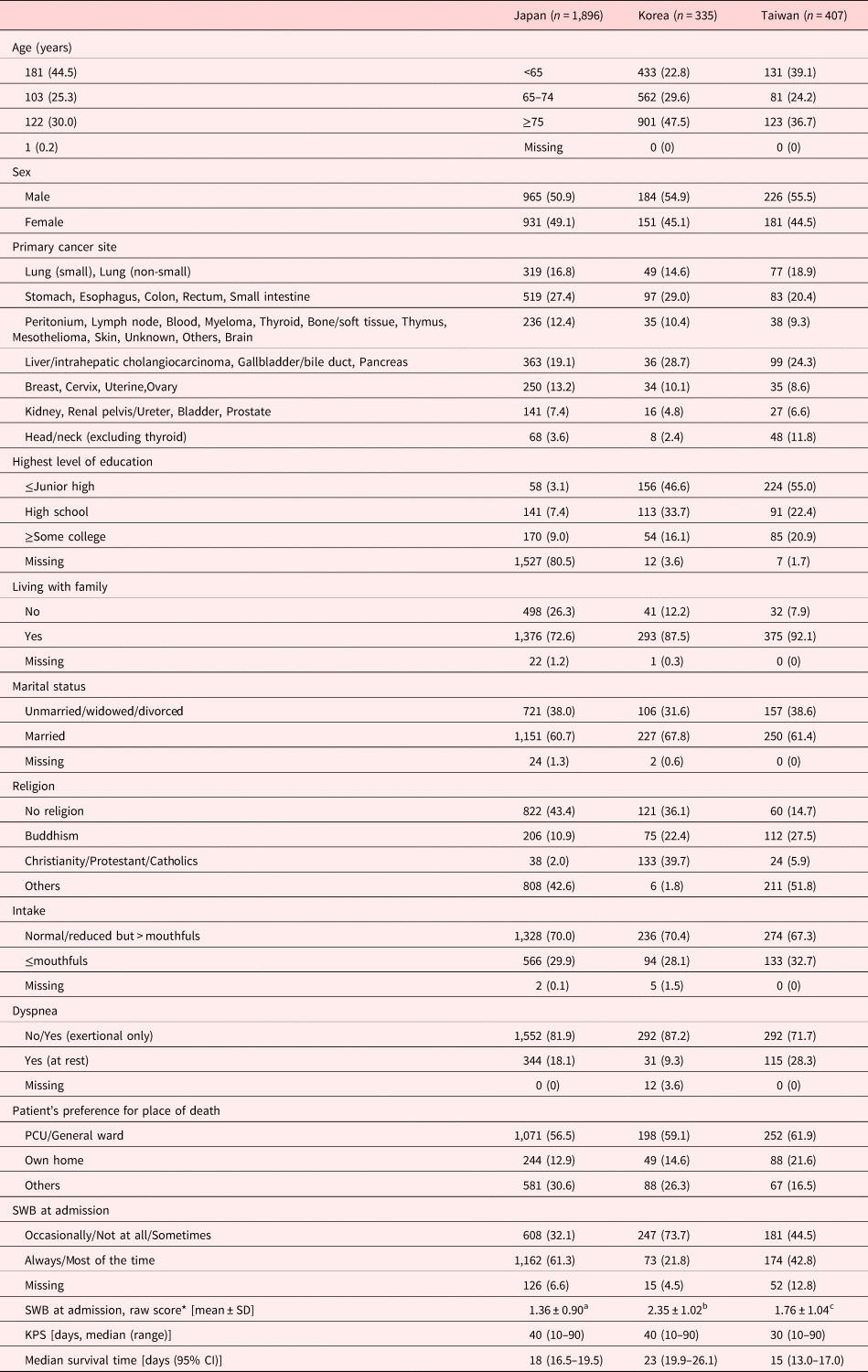
We analyzed data of 2,638 patients across 37 PCUs (22 in Japan, 11 in South Korea, and 4 in Taiwan) in this study from January 2017 to September 2018. A total of 2,638 patients comprised 1,375 men (52.1%) [Japan: 965 (50.9%), Korea: 184 (54.9%), Taiwan: 226 (55.5%)]. The mean ± standard deviation of age was 72.4 ± 12.3 years in Japan, 68.3 ± 12.2 years in Korea, and 66.6 ± 13.8 years in Taiwan. Raw score of SWB showed distribution in each country as follows. The mean ± standard deviation values were 1.36 ± 0.90 in Japan, 2.35 ± 1.02 in Korea, and 1.76 ± 1.04 in Taiwan. The median survival time was 18.0 days (95% confidence interval [CI] 16.5–19.5) in Japan, 23.0 days (95% CI 19.9–26.1) in Korea, and 15.0 days (95% CI 13.0–17.0) in Taiwan. The characteristics of patients are listed in Table 1.
Participants’ baseline characteristics (n = 2,638)

Frequencies are expressed as numbers of patients (%). Regarding SWB raw score, the score was defined as follows; 0, always; 1, most of the time; 2, sometimes; 3, occasionally; 4, not at all. Differing superscripts in three cells (e.g., a vs. b vs. c) indicate that the values in those three cells are significantly different.
Abbreviations: PCU, Palliative Care Unit; SWB, Spiritual Well-being; SD, Standard Deviation; KPS, Karnofsky Performance Scale; CI, Confidence Interval.
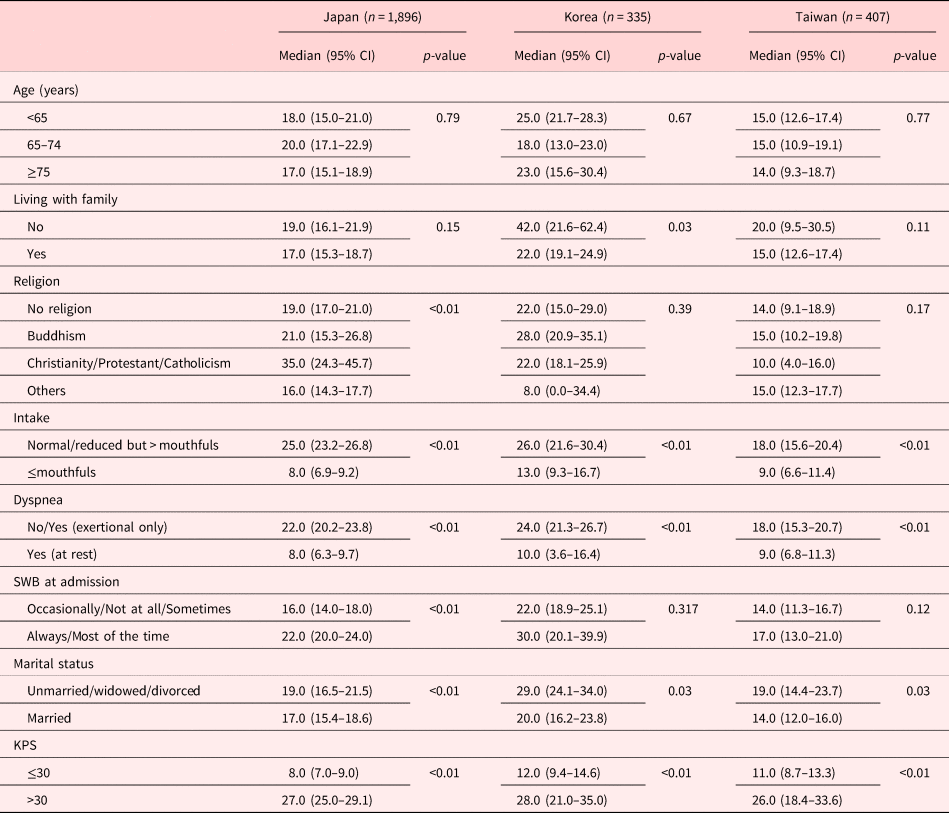
Table 2 lists the results of univariate analysis to identify factors associated with survival time. In Japan, six variables were significantly associated with survival time: religion (p < 0.01), oral intake (p < 0.01), dyspnea (p < 0.01), SWB at admission (p < 0.01), marital status (p < 0.01), and KPS (p < 0.001). In Korea, five variables were significantly associated with survival time: living with family (p = 0.03), oral intake (p < 0.01), dyspnea (p < 0.01), marital status (p = 0.03), and KPS (p < 0.01). Due to high collinearity with marital status, living with family was excluded from the final multivariate analysis in Korea. In Taiwan, four variables were significantly correlated with survival time: oral intake (p < 0.01), dyspnea (p < 0.001), marital status (p = 0.03), and KPS (p < 0.001). Thus, SWB was significant in Japanese patients only in univariate analysis.
Results of univariate analysis to identify factors associated with survival time (n = 2,638)

Abbreviations: CI, Confidence interval; PCU, Palliative Care Unit; SWB, Spiritual Well-being; KPS, Karnofsky Performance Scale.
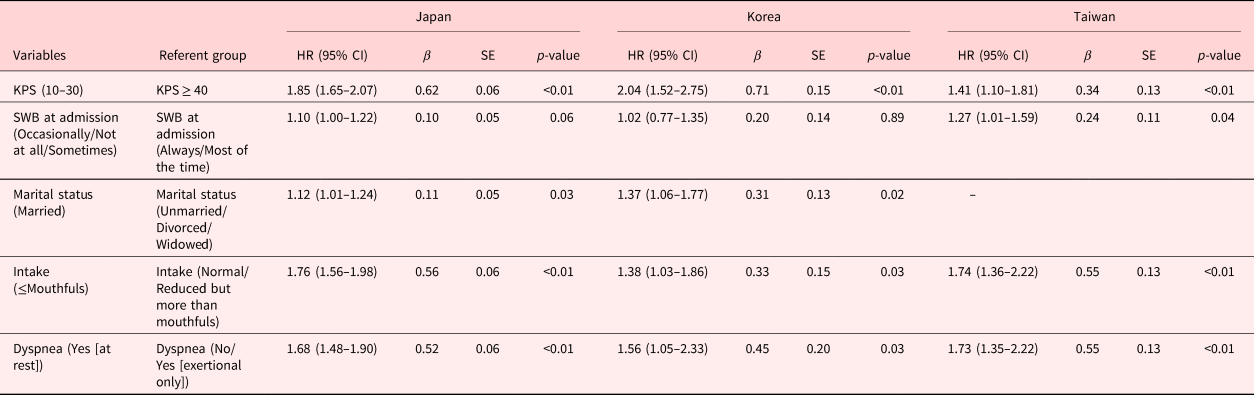
Table 3 lists the result of multivariate analysis to identify factors associated with survival time. In the Japanese group, four variables were significantly correlated with survival time: lower KPS (10–30 vs. ≥40) (HR 1.85; 95% CI 1.65–2.07; p < 0.01), marital status (Yes vs. Unmarried/Divorced/Widowed) (HR 1.12; 95% CI 1.01–1.24; p = 0.03), fewer intakes (≤Mouthfuls vs. Normal/Reduced but more than mouthfuls) (HR 1.76; 95% CI 1.56–1.98; p < 0.01), and dyspnea (At rest vs. No/Exertional only) (HR 1.68; 95% CI 1.48–1.90; p < 0.01). In the Korean group, four variables were significantly correlated with survival time: lower KPS (10–30 vs. ≥40) (HR 2.04; 95% CI 1.52–2.75; p < 0.01), marital status (Yes vs. Unmarried/Divorced/Widowed) (HR 1.37; 95% CI 1.06–1.77; p = 0.02), fewer intakes (≤Mouthfuls vs. Normal/Reduced but more than mouthfuls) (HR 1.38; 95% CI 1.03–1.86; p = 0.03), and dyspnea (At rest vs. No/Exertional only) (HR 1.56; 95% CI 1.05–2.33; p = 0.03). In the Taiwanese group, four variables were significantly related to survival time: lower KPS (10–30 vs. ≥40) (HR 1.41; 95% CI 1.10–1.81; p < 0.01), Worse SWB at admission (Occasionally/Not at all/Sometimes vs. Always/Most of the time) (HR 1.27; 95% CI 1.01–1.59; p = 0.04), fewer intake (≤Mouthfuls vs. Normal/Reduced but more than mouthfuls) (HR 1.74; 95% CI 1.36–2.22; p < 0.01), and dyspnea (At rest vs. No/Exertional only) (HR 1.73; 95% CI 1.35–2.22; p < 0.01).
Results of multivariate analysis to identify factors associated with survival time (n = 2,638)

“–” means insignificant p values.
Abbreviations: HR, Hazard ratio; CI, Confidence interval; SE, Standard Error; KPS, Karnofsky Performance Scale; SWB, Spiritual Well-being.
Discussion
The aim of this study was to explore the relationship between SWB and survival time among three East Asian countries. We found that SWB was a significant factor correlated with survival in Taiwan, while it was insignificant in Japan and Korea. This study suggested that SWB on admission may be associated with longer survival in patients with advanced cancer in Taiwan.
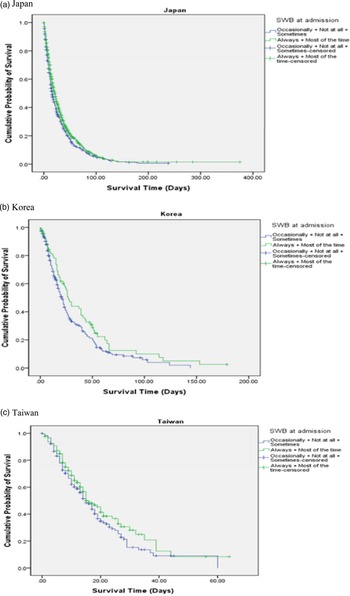
SWB was a significant factor associated with survival time in Taiwan in multivariate analysis. It was unexpected because we found an insignificant relationship between SWB and survival time in univariate analysis. There are two plausible explanations for this phenomenon from a statistical view point. Survival plots of Taiwanese patients suggested possible differences between groups with Worse and Better SWB. However, some outliers who had lived far longer narrowed the difference at the end of plots (Figure 1). Second, the influence of SWB was contradictory in univariate analysis and thus it appeared significant after adjustment in multivariate analysis. The unique result may reflect intensive spiritual care in Taiwanese PCUs. A previous study from Taiwan reported that spiritual care was an essential component of palliative care, especially at the very end of life in Taiwan and Clinical Buddhist Chaplains (CBCs). It is a mainstay of Taiwanese hospice care, and often spiritual care is provided to patients and families during life-limiting illness (Bhikshu, Reference Bhikshu2012; Tao et al., Reference Tao, Wu and Luo2020). Therefore, the difference in SWB at admission may have been maintained until death. Meanwhile, in Japan and Korea, spiritual care may be provided to patients with lower SWB, which may have reduced the difference in SWB at admission. The shortest survival of two weeks in the Taiwanese group may affect the relationship between SWB and survival time because the impact of intensive spiritual care provided after hospitalization might be relatively less for the shortest duration of hospitalization, which may have narrowed the SWB difference in hospitalization between groups with Worse and Better SWB. Another biological plausibility is that SWB can affect survival time based on its link with physical symptoms (Christakis and Lamont, Reference Christakis and Lamont2000; Glare et al., Reference Glare, Erychmueller and Mcmahon2004). Spirituality could be protective against physical symptoms (Bhai et al., Reference Bhai, Brunbaker and Meghani2018; Bovero et al., Reference Bovero, Leombruni and Miniotti2016), while the intensity of physical symptoms is known to be associated with survival time of patients having advanced cancer (Liu et al., Reference Liu, Xi and Xia2011; Barata et al., Reference Barata, Cardoso and Custodio2016). Thus, better SWB may prolong survival time. Since the IPOS item for SWB assessed “peacefulness” of the patient, medical professionals may regard patients with better SWB as “being free from suffering.” In fact, we observed a weak relationship between SWB and survival time in Japan based on the results of multivariate analysis (p = 0.06). Therefore, SWB had a borderline significance on survival time in Japan. In univariate analysis, the median survival time of the Korean group with Worse SWB at admission was 22.0 days and it was longer than in Japanese and Taiwanese groups with Better SWB at admission (respectively, 22.0 and 17.0 days). Therefore, we presume that SWB affects survival time significantly when death is near. Probably, Korean patients were not the population affected by SWB because of their longest survival time. Another possibility is that SWB is rated according to IPOS implicit overall well-being to some degree. The effect of SWB on survival time may overlap with that of physical distress. Especially in Japan, although SWB was significant in univariate analysis, its role in survival was diminished by other physical symptoms in multivariate analysis. A previous Korean study (Shin et al., Reference Shin, Suh and Sun-Hyun2018) showed that SWB was not related to survival time. The median survival time of the study participants was about 20 days, which was comparable to our study. Hence, our results involving the Korean group are consistent with the previous study.
Kaplan-Meier plots of survival time vs. spiritual well-being of patients in different countries. (a) Japan, (b) Korea, and (c) Taiwan. Abbreviation: SWB, spiritual well-being.

Previous studies reported that the intensity of physical symptoms such as dyspnea and anorexia were related to survival time of inpatients with advanced cancer (Liu et al., Reference Liu, Xi and Xia2011; Barata et al., Reference Barata, Cardoso and Custodio2016). Notably, dyspnea has been reported to indicate psychosocial and spiritual distress (Chiu et al., Reference Chiu, Hu and Lue2004; Ho et al., Reference Ho, Hsu and Li2012). The lower KPS, fewer oral intakes, and dyspnea at rest among Japanese patients were related to shorter survival time as in Korea and Taiwan. These variables have been consistently known to be poor prognostic factors for survival time (Pirovano et al., Reference Pirovano, Maltoni and Nanni1999). Moreover, the intensity of anorexia and dyspnea play a predictive role in the survival time of inpatients with advanced cancer (Liu et al., Reference Liu, Xi and Xia2011; Barata et al., Reference Barata, Cardoso and Custodio2016). Our results are consistent with previous studies. Korean patients showed similar results for lower KPS, decreased oral intake, and dyspnea at rest, similar to Japanese cases described above. Taiwanese patients had significantly lower KPS, and decreased oral intake and dyspnea at rest with survival, similar to those of Japanese and Korean groups.
Surprisingly, married patients had shorter survival in Japan. Most of the married patients lived with their spouses and children, and their families could be caregivers at home. Therefore, married patients had many opportunities for caregiver support and stayed longer at home. In other words, the survival of married patients was shorter when they were admitted to PCUs. The survival of married Koreans was shorter similar to married Japanese patients. Similar assumptions as the Japanese group may be applied to the Korean group. Thus, unmarried, divorced, or widowed patients might survive longer, thereby reflecting the Korean medical environment, where such patients tend to be admitted to PCUs earlier, thanks to the supportive nationwide health insurance coverage. The conditions were more favorable for cancer patients in hospice institutes, where half of all the patients received professional caregiver services at very affordable rates in Korea.
This study has several limitations. First, we used IPOS to evaluate SWB. In this study, IPOS was evaluated by physicians and/or nurses, which may lead to differences between patients’ subjective assessments and physicians’ and/or nurses’ objective assessments. Prior studies reported that the inter-class correlation of SWB for IPOS-Patient and IPOS-Staff was 0.581 in Japan (Sakurai et al., Reference Sakurai, Miyashita and Morita2021) and 0.348 in Taiwan and the correlation ranged from fair to moderate. Therefore, we regard IPOS-Staff as an acceptable tool. Second, the evaluation by IPOS may not capture every domain of spirituality. For instance, IPOS cannot be used to measure “meaning of life,” “connectedness,” or “faith” simultaneously. Those concepts may play a role in prolonging survival time, and thus, a further study via in-depth assessment of SWB will be meaningful. In addition, the IPOS SWB may be regarded by medical professionals as an assessment of psychological well-being including SWB, which can be affected by physical condition. Third, the raw score of SWB differed by country. However, the relationship between SWB and survival time was investigated within each country. Therefore, we believe that the difference of mean of SWB score among countries would not affect our conclusion. Third, our patients do not represent a general population of patients with far advanced cancer, and thus, our findings may differ from patients living at home or in a general ward. Therefore, it is required to evaluate the SWB of patients receiving care at home or general ward in near future. Additionally, the relationship between SWB and survival time was demonstrated in Taiwan alone. Further studies are needed to generalize these results. Fourth, other covariates, such as delirium, edema, and C-reactive protein, affect the survival time. We were unable to evaluate all such factors, suggesting the need for further studies to elucidate their role.
In conclusion, SWB of far advanced cancer patients is related to survival time in Taiwan but not in Japan and Korea. We suggest that spiritual care may contribute to prolonged survival of patients with advanced cancer. And we think spiritual care should be included as a routine part of end-of-life care, since many dying patients suffer from spiritual distress. In near future, a prospective study is needed to investigate the relationship between SWB of patients with far advanced cancer and survival time.
Data Availability Statement
The data that support the findings of this study are available from the corresponding author, Sang-Yeon Suh, upon reasonable request. All authors agree to provide data to the journal for review if needed.
Acknowledgments
We appreciate contribution of all EASED investigators in Japan, Korea, and Taiwan. We are grateful to Harrisco Encorrection (Seoul, South Korea) for proofreading this manuscript for grammar and clarity.
Funding
This work was supported in part by a Grant-in-Aid from the Japanese Hospice Palliative Care Foundation; Grant Numbers 16H05212 and 16KT0007.
Conflict of interest
The authors declare that there is no conflict of interest.
Ethics approval
This study obtained was approved by the local Institutional Review Boards of all participating institutions. The independent ethics committee of Tohoku University School of Medicine (approval no. 2016-1-689) approved this study.
Consent to participate
In accordance with the ethical guidelines for human research of the Ministry of Health, Labor, and Welfare in Japan, patients’ informed consent was waived in Japan because of the completely observational nature of the study. Patients were provided the opportunity to opt out. In South Korea and Taiwan, informed consent was obtained from the patients or their families (in case the patient lacked the capacity to decide).