Religion in the contemporary United States is often characterized by division rather than unity. Recently, much attention has been given to the partisan sorting of religious believers (Layman, Reference Layman2001; Claassen, Reference Claassen2015; Margolis, Reference Margolis2018) and the rise of secularism in America (Burge, Reference Burge2021; Campbell et al., Reference Campbell, Layman and Green2021). Christian nationalism has also emerged as a prominent mechanism which may cause religious division in contemporary politics (see McDaniel et al., Reference McDaniel, Nooruddin and Shortle2011; Whitehead and Perry, Reference Whitehead and Perry2020; Gorski and Perry, Reference Gorski and Perry2022) by leveraging a “cultural framework” of myths, traditions, symbols, narratives, and value systems (Whitehead and Perry, Reference Whitehead and Perry2020, 10) to mark boundaries and exclude. Following the Donald Trump campaign and presidency, as well as the January 6, 2021 insurrection, there has been exponential attention to the influence of Christian nationalism in America and the mechanisms by which religion further polarizes the public.
As the popular and scholarly attention to Christian nationalism has grown, some have offered a less exclusive version of national identity—civil religion—as a counterweight to Christian nationalism. Like Christian nationalism, civil religion promotes “beliefs, symbols, and rituals” that can promote transcendent values about America's founding and the country's values (Bellah, Reference Bellah1967). In the ideal type, civil religion can be inclusive instead of exclusive, serving as an opportunity to hold on to the “vital center” of America (Gorski in Green, Reference Green2017; see also Bellah, Reference Bellah1967; Soper and Fetzer, Reference Soper and Fetzer2018). In contrast to the Christian nationalism of Trump, Presidents Barack Obama and Joe Biden have often appealed to the civil religion tradition (Silk, Reference Silk2017; Graham, Reference Graham2021), leading one scholar to call Obama the “high priest of American civil religion” (Silk, Reference Silk2017).
While civil religion, in theory, might provide opportunities to unify rather than divide, many scholars of civil religion were skeptical a generation or two ago. Robert Bellah, who brought examinations of civil religion into public conversation, became pessimistic about its unifying properties, writing “today American civil religion is an empty and broken shell” (Reference Bellah1975, 142). Robert Wuthnow described how the concept of civil religion was split into two forms—conservative and liberal—which provided a framework for division rather than unity (Reference Wuthnow1988). Williams has identified a “tribal” civil religion, emphasizing how the concept has been racialized by some on the right Reference Williams(2013), though this interpretation has been underappreciated by those seeking to distinguish between civil religion and Christian nationalism.
Research on the public's views toward and response to civil religion has been quite dormant for the past three decades. Because of this, the effectiveness and dimensionality of civil religion has been under-analyzed in the current political environment of hyper-polarization. In addition, a direct assessment of the relationship between civil religion and Christian nationalism is missing from the literature. It is critical to identify where these concepts are similar and different in mass opinion.
In what follows, we initiate analyses to determine how civil religion is evaluated in public opinion today. We develop a measurement strategy for the public's support for civil religion and not only compare how it fares across partisans, but also how it differs from Christian nationalism. We then test the effectiveness of appeals to civil religion, using a series of survey experiments. Building on literature discussing the varied dimensions of civil religion, we identify two dimensions of civil religion within the mass public: “priestly” and “prophetic” civic appeals (see Fairbanks, Reference Fairbanks1981; Williams and Alexander, Reference Williams and Alexander1994; Roof, Reference Roof2009). When incorporating civil religion appeals into survey experiments, we find that appeals to civil religion exacerbate the stark divisions among the public, being incorporated into our polarized politics. At the same time, civil religion emerges as a concept distinct from Christian nationalism. This finding is important for future conversations about Christian nationalism and civil religion.
1. Literature review
Civil religion has been described as the story of America (Gorski, Reference Gorski2017) or the unifying values and “common elements of religious orientation that the great majority of Americans share” (Bellah, Reference Bellah1967). While calls to civil religion have long been documented in American political rhetoric (see, e.g., Chapp, Reference Chapp2012), the potential civil religion holds to transcend political and cultural divides has led to recent calls for a revitalized civil religion (Gorski, Reference Gorski2017). While the Donald Trump presidency courted division and nationalism, there has been hope that the Biden presidency, like the Obama presidency, would appeal to the American rhetorical tradition of civil religion (Gorski, Reference Gorski2017; Chelini-Pont and de la Ferrière, Reference Chelini-Pont and de La Ferrière2021; Graham, Reference Graham2021).
The idea that civil religion can unify public consciousness has long been debated (Bellah, Reference Bellah1975; Gehrig, Reference Gehrig1981; Demerath and Williams, Reference Demerath and Williams1985; Beiner, Reference Beiner2010; Bellah and Hammond, Reference Bellah and Hammond2013; Gorski, Reference Gorski2017), all while scholars have attempted to examine the presence of civil religion in the mass public (Thomas and Flippen, Reference Thomas and Flippen1972; Cole and Hammond, Reference Cole and Hammond1974; Wimberley, Reference Wimberley1976). These studies largely pre-date the era of polarization, especially in the mass public. Under these conditions, marshaling a unifying civil religion seems less likely, as evidenced by findings that objections to Obama could be explained by racialized expressions of civil religion (Williams, Reference Williams2013) and that appeals to civil religion by Donald Trump “emboldened” division over race, sexuality, and gender roles (Hickel and Murphy, Reference Hickel and Murphy2022). Still, the connection of civil religion to mass polarization in the contemporary era has been under-analyzed.
While civil religion may represent unifying American values, much of the scholarship understood that these claims may appeal to division. In Bellah's (Reference Bellah1967) foundational piece “Civil Religion in America,” he identified civil religion's potential to unite through mobilizing “deep levels of personal motivation for the attainment of national goals,” and divide by serving as “cloak for petty interests and ugly passions.” A decade after his seminal essay, Bellah became even less optimistic about the unifying nature of civil religion in practice, though he thought a better civil religion was possible and should be encouraged (Bellah, 1975).
Building upon this potential for division, scholars have identified multiple dimensions of civil religion (Richey and Jones, Reference Richey and Jones1974; Hammond, Reference Hammond, Bellah and Hammond1980; Kim, Reference Kim1993; Bellah and Hammond, Reference Bellah and Hammond2013), though they may flow from a common civil religious source. Applying Weber's (Reference Weber1920) terminology of “priestly” and “prophetic” religious orientations to civil religion, for example, scholars have identified “priestly” and “prophetic” dimensions within the American civil religious tradition (Fairbanks, Reference Fairbanks1981; Williams and Alexander, Reference Williams and Alexander1994; Roof, Reference Roof2009). Therefore, civil religion can be “priestly” (i.e., justifying America's actions due to its chosen status) or “prophetic” (i.e., calling America to account). Wuthnow (Reference Wuthnow1988) distinguishes “conservative” civil religion from “liberal” civil religion, and Coe and Chenoweth (Reference Coe and Chenoweth2013) develop a different typology, using the categories of “God figures,” “sacred texts,” “manifestations of religion,” and “leaders and followers.” Again, there may be multiple dimensions of a common civic religious tradition, but these dimensions are ripe to be used for political ends.
The different dimensions of civil religion may complicate the core argument for civil religion's unifying potential, and they deserve updating in the contemporary era. The questions become: which civil religion or whose civil religion? If there are multiple strands of civil religion, do different political groups favor one style of civil religion over another? Does polarization limit the ability of civil religion to make appeals across groups? One of the strongest critiques of civil religion as a positive national identity is that it is a “tool” not for unifying but for differentiating “social movements and interest group politics” (Demerath and Williams, Reference Demerath and Williams1985, 154). As such, civil religion may be a “cultural myth”—“not a constant or a unifying belief system, but rather a discourse” (Williams and Demerath, Reference Williams and Demerath1991, 418).
The growth of mass polarization in recent decades may exacerbate these differences in how civil religion is interpreted, as it is likely linked in different ways to groups and party politics. If this is the case, politics shapes the use of and attachment to a particular stream of civil religion; yet the effects of polarization on civil religion need more attention. Increasingly, the Republican Party has become the party of nationalistic, flag-waving patriotism, while the Democratic Party has increasingly been more critical of the United States' failure to consistently live out democratic ideals. If politics structures religious identity and perceptions that may enhance polarization (Ahler and Sood, Reference Ahler and Sood2018; Margolis, Reference Margolis2018; Claassen et al., Reference Claassen, Djupe, Lewis and Neiheisel2021), and partisanship and polarization are connected to social identities (Iyengar et al., Reference Iyengar, Sood and Lelkes2012; Mason, Reference Mason2015, Reference Mason2018), it is likely that these effects are similar for civil religion. As an example, a recent study found that support for (priestly) civil religion “exacerbated the effects of symbolic racism and sexism on support for Trump” (Hickel and Murphy, Reference Hickel and Murphy2022, 247). In this project we examine the efficacy of civil religion in a time of increased polarization. Can civil religion be used to unify the American public, or is it a rhetorical “tool” to increase divisions?
There is reason to expect that in a time of growing mass polarization, there would be partisan differences in responses to civil religious rhetoric. Studies identify partisan differences in reception to cultural-religious appeals by politicians. Evangelicals, for example, tend to be more supportive of civil religion (Green and Guth, Reference Green and Guth1988) and calls to Christian nationalism than are individuals who identify with other religious traditions (Green and Guth, Reference Green and Guth1988; Whitehead et al., Reference Whitehead, Schnabel and Perry2018). Evangelicals are also more likely to pick up on these cultural-religious appeals (Djupe and Calfano, Reference Djupe and Calfano2013), and “dog-whistle” appeals tend to be persuasive for the religious Right (Albertson, Reference Albertson2015; see also Kuo, Reference Kuo2006). Although there is evidence that politicians of both parties use civic religious appeals (e.g., Coe and Chapp, Reference Coe and Chapp2017), there is less known about the effect of religious appeals on the Left.
2. Hypotheses
We expect that civil religion is more divisive than unifying. As such, we expect:
(1) There will be at least two civil religion dimensions that largely map onto U.S. political divides.
(2) Appeals to civil religion will not bridge partisan divides.
(3) Civil religion attitudes will operate similarly to partisan attitudes in regard to their impact on public behavior and political opinion.
(4) Civil religion will be distinct from Christian nationalism, despite some similarities.
3. Analytical strategy
In this paper, we use a two-pronged approach. We use cross-sectional data to help us untangle the partisan dimensions of civil religion and how they interact with partisanship, and then we employ survey experiments to analyze the effects of those dimensions of civil religion. Experiments have long been used to assess the role of religion in shaping the American political context, with a particular focus on religious messaging (e.g., Calfano and Djupe, Reference Calfano and Djupe2009; Albertson, Reference Albertson2011, Reference Albertson2015; Djupe and Calfano, Reference Djupe and Calfano2013; Campbell and Cowley, Reference Campbell and Cowley2014; Creighton and Jamal, Reference Creighton and Jamal2015). Some studies explicitly explore how partisanship moderates this relationship (McDermott, Reference McDermott2009; Djupe and Calfano, Reference Djupe and Calfano2013; Castle et al., Reference Castle, Layman, Campbell and Green2017). More work is needed, however, to explore how civil religious appeals to national identity vary based on partisanship. This is a space into which our study can enter, utilizing both cross-sectional and experimental data.
4. Data and methods
We use two datasets to test the validity of our civil religion measures. Using two separate cross-sectional surveys in 2020 and 2021, we identify multiple dimensions of civil religion. The first survey was fielded using Qualtrics panels in March 2020, with 3,136 participants. Though the Qualtrics survey was a non-representative national sample, it largely mirrored census demographics. In this survey, we deployed a civil religion battery, investigating the dimensionality of civil religion attitudes. The second survey was fielded using the Lucid platform in May 2021. The study population included 2,393 participants who are representative of America on all major demographic characteristics. Screening questions and other forms of fraud protection were implemented by Lucid to ensure quality data (Berinsky et al., Reference Berinsky, Margolis and Sances2014; Aronow et al., Reference Aronow, Kalla, Orr and Ternovski2020; Berinsky et al., Reference Berinsky, Margolis, Sances and Warshaw2021). In the Lucid survey, we again deployed the civil religion battery, while also integrating a survey experiment measuring the effect of varied civil religion justifications.
On both surveys, we tested agreement with five statements measuring civil religion, building on prior work on measuring civil religion (e.g., Mockabee and Monson, Reference Mockabee and Monson2018). Factorial analyses of our initial survey data points toward two forms of civil religious speech. We make use of the “priestly” and “prophetic” styles, reimagining these iterations of civil religion in a modern context. Like others before us, we suggest that civil religious language exists in two dimensions (Fairbanks, Reference Fairbanks1981; Williams and Alexander, Reference Williams and Alexander1994; Roof, Reference Roof2009).
Our conceptualization of priestly civil religion includes the following statements: “It is important for school children to regularly recite the Pledge of Allegiance,” “‘In God We Trust’ is out of place on the nation's currency,” and “Burning the American flag is wrong because it is sacred.” Our conceptualization of prophetic civil religion includes the following statements: “Freedom must be for everyone, in order to be the ‘land of the free,’” and “We must make amends for our country's original sins.” (The complete question wording is in the Appendix.) We suggest these five statements can assess civil religion given that they refer to ideals so essential to the American experience that they take on the status of the sacred. While interpreted differently in a modern context, the action of pledging allegiance to the flag or emphasizing America as the land of the free are beliefs so ingrained in national identity that they speak to its very definition; in other words, for some, agreeing with these statements is more than mere opinion, but rather a belief system akin to, and sometimes borrowing language from, religion itself. At the same time, they are not exclusive claims to a particular religion, distinguishing them from Christian nationalism. We attempt to verify these two dimensions of civil religion in both our 2020 and 2021 data. We then generate two separate scales and test their predictive capability.
We deploy several experiments on our 2021 survey to not only verify the dimensions of civil religion, but also to improve on the causal mechanisms that link civil religion to political behavior. In the first survey experiment, we randomize the type of language a politician uses when discussing coronavirus mask mandates, including a control treatment and four treatments that vary on ideological positions and civil religion language. In the second, we randomize a group who is engaging in a political protest (control, Black Lives Matter, Trump supporters), while keeping the civil religion language constant. (The experimental vignettes and follow-up questions are in the Appendix.)
These experiments allow us to do two things: (1) compare how specific civil religious language affects attitudes and (2) explore how one's agreement with civil religion interacts with political scenarios. Our main focus is the interaction between partisanship, experimental treatment, and civil religion. Because our treatments randomized well, we do not incorporate additional control variables.
5. Results
Our theory hinges on the relationship between civil religious language and political attitudes. We first test how five variables included in our civil religion measure load together. As shown in Table A1, the unique variance analysis of both the 2020 and 2021 data suggests that the statements load onto two distinct factors.
Continuing in the tradition of applying Weber's (Reference Weber1920) terminology to civil religious dimensions (see Fairbanks, Reference Fairbanks1981; Williams and Alexander, Reference Williams and Alexander1994; Roof, Reference Roof2009), we refer to the statements that tend to support or celebrate the status quo as “priestly” expressions of civil religion. These statements include “It is important for school children to regularly recite the Pledge of Allegiance,” “‘In God We Trust’ is out of place on the nation's currency (reverse coded),”Footnote 1 and “Burning the American flag is wrong because it is sacred.” These three statements load onto one factor with eigenvalues of 1.70413 (2020) and 1.75767 (2021), providing confidence that the three statements hold together well.
We also assess several statements of prophetic civil religion (i.e., statements that call our American systems to account) including “Freedom must be for everyone, in order to be the ‘land of the free’” and “We must make amends for our country's original sins.” These two statements load onto a single factor with eigenvalues of 1.16801 (2020) and 1.16673 (2021) (For complete factor analysis results, see Appendix Table A1.)
The consistency across the two datasets gives us confidence that our civil religious measures are assessing what we intended. We add the measures together, creating both a priestly civil religion scale and a prophetic civil religion scale. Higher values represent greater agreement with the statements that make up each distinct civil religion dimension. We use standardized versions of these scales (recoded to be between 0 and 1) to predict attitudes toward protest after being exposed to different scenarios.
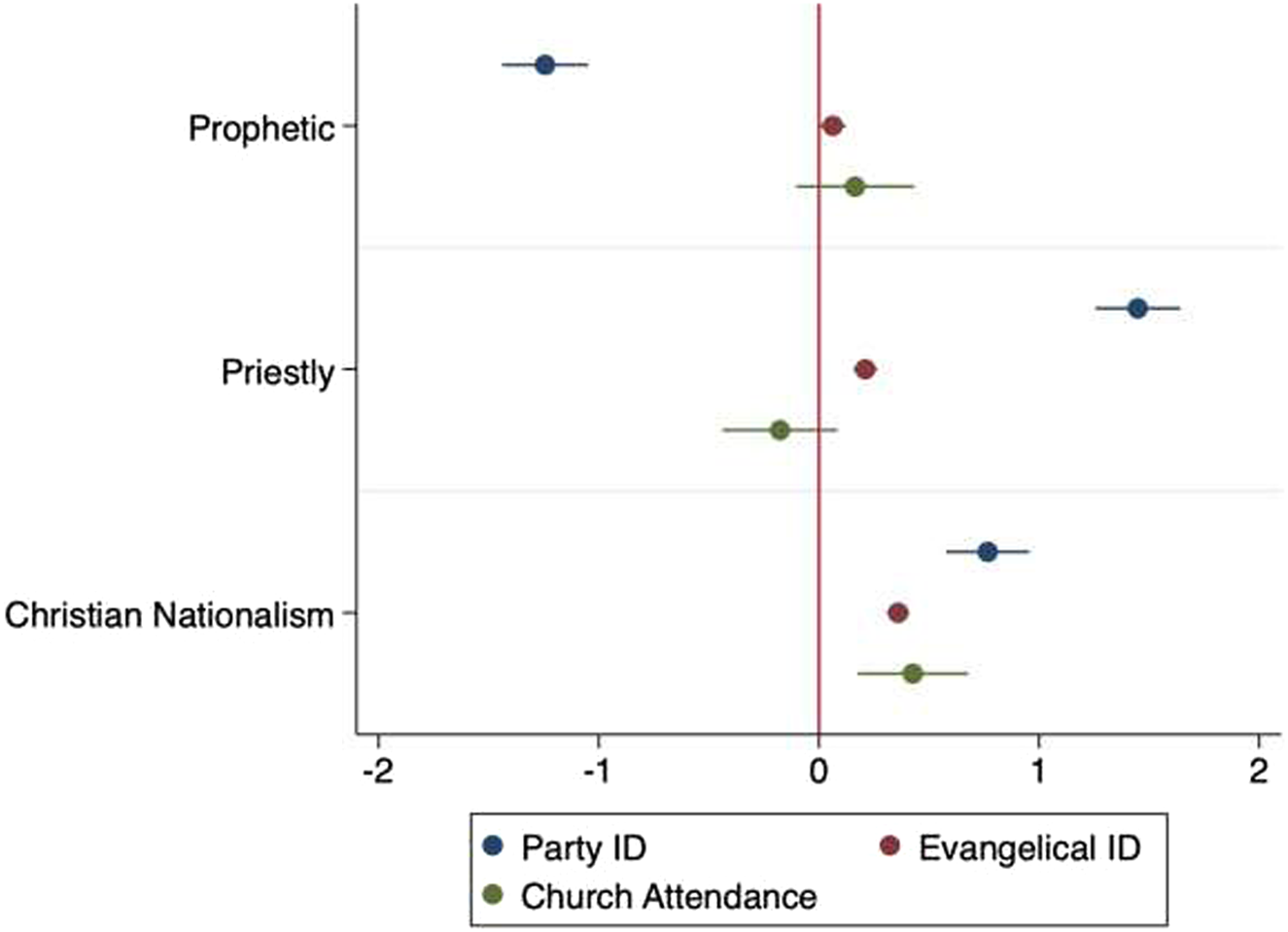
These two civil religion measures are not only distinct from one another, but distinct from related measures, namely Christian nationalism. To confirm this, we tested how our conceptualizations of civil religion differ from the Christian nationalism measure employed prominently by Whitehead and Perry (Reference Whitehead and Perry2020), as well as others. Statistical comparisons indicate that priestly civil religion, prophetic civil religion, and Christian nationalism are measuring somewhat different things and are linked to different identities, attitudes, and behaviors.Footnote 2 Moreover, priestly civil religion and Christian nationalism remain distinct, having statistically significant differences, despite assumptions that both are more conservative in orientation. For example, as shown in Figure 1, those who score higher on the prophetic civil religion measures are more likely to be Democrats, while those who score higher on the priestly civil religion and Christian nationalism scales are the opposite—more likely to be Republicans (with priestly civil religion being significantly more likely). At the same time, the Christian nationalism scale is more strongly correlated to both warmth for Donald Trump than the priestly civil religion scale and coolness toward Muslims (for full analysis see Appendix B). Adherents of priestly civil religion are overall less religious than Christian nationalists. Those who score higher on the Christian nationalism scale are more likely to be evangelicals and attend religious services more often than those who score higher on the priestly civil religion scale (Figure 1).Footnote 3
Effects of prophetic civil religion, priestly civil religion, and Christian nationalism on Republican ID, evangelicalism, and church attendance. OLS models without additional controls and 90% confidence intervals.

Overall, while civil religion (especially the priestly variety) and Christian nationalism are similar, they appear distinct both in concept and in public opinion. These models also confirm the sharp partisan difference between the two types of civil religion; priestly and prophetic civil religion operate in different political worlds.
5.1. Experiment 1: coronavirus mask mandates
To test the role of civil religious language in a different way, we fielded a survey experiment in which we vary the type of language a politician uses when discussing coronavirus mask mandates. We used both pro-mask and pro-choice (or anti-mask) arguments that either used no civil religious language or some form of civil religious language. We then examined respondents' support for the politician and their evaluation of the effectiveness of masks, comparing each treatment to a control group where the politician expressed support for bike lanes.
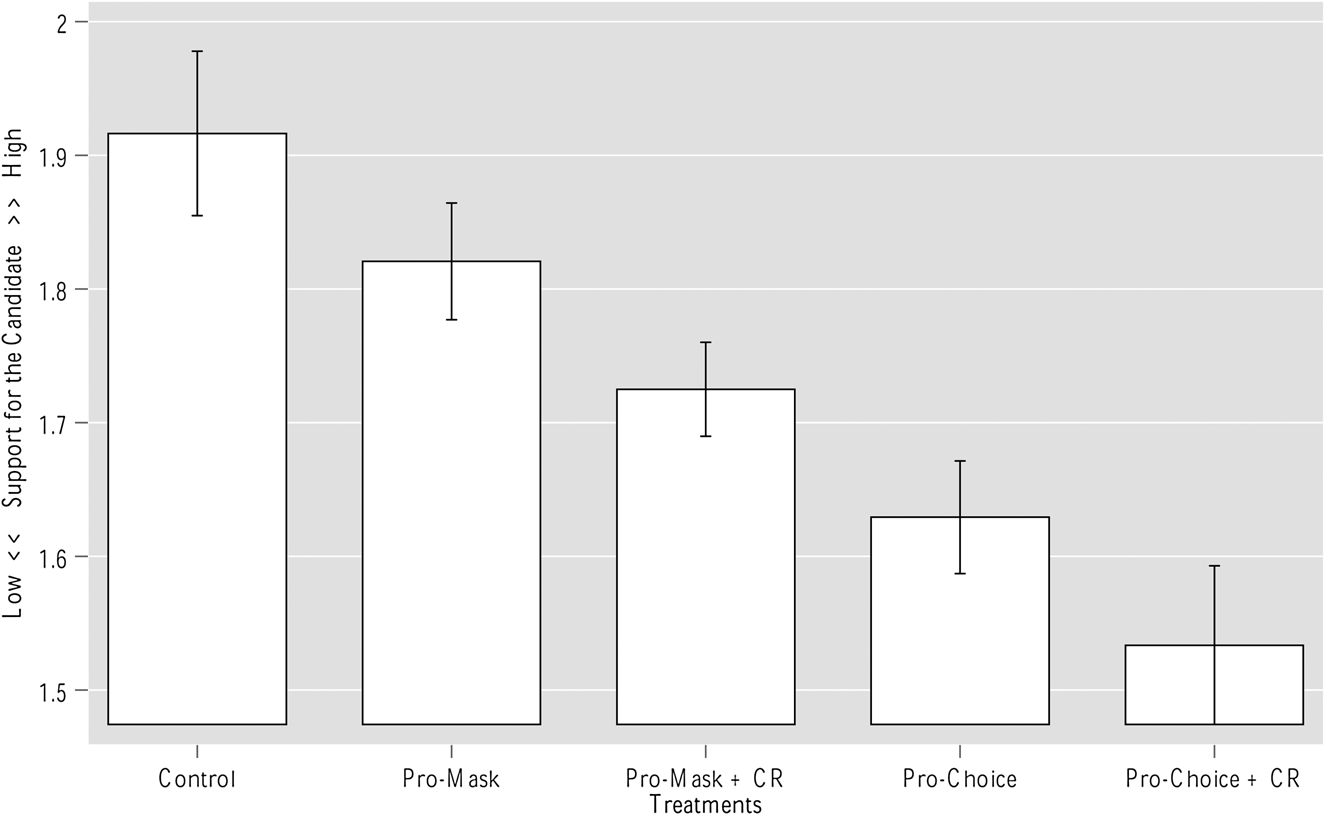
Figure 2 shows how support for the candidate varies by both their support for mask mandates and their use of civil religion. Respondents viewed candidates less favorably as they were opposed to mask mandates. Importantly, however, statements leveraging civil religion led to less support than statements without civil religion. For both the pro-mask and anti-mask statements, civil religion arguments led to less support for the candidates.
Support for candidates based on their position toward mask mandates and their use of civil religion language. Comparing two confidence intervals produces a 90% test.

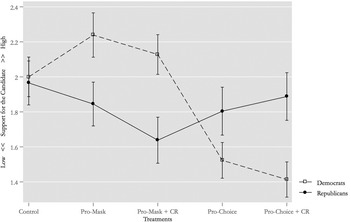
The partisan responses to civil religion justifications appear to drive these results, as out-party members rate candidates negatively when they incorporate civil religion language. Figure 3 shows this partisan backlash. Democrats rate civil religion justifications against mask mandates the most negatively, and Republicans react the same to civil religion arguments in favor of mandates. Rather than unifying, civil religion appeals exacerbate partisan division.
Support for candidates based on their position toward mask mandates and their use of civil religion language, by party-ID. Comparing two confidence intervals produces a 90% test.

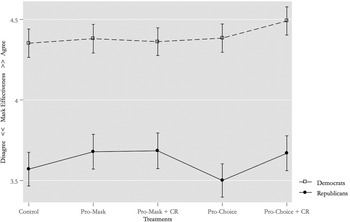
We see a similar partisan divide when it comes to evaluating the effectiveness of masks, as shown in Figure 4 below. For Democrats, they were significantly more likely to support the effectiveness of facemasks for preventing COVID-19 after reading about a politician leveraging civil religion language to oppose mask mandates.
Support for the effectiveness of facemasks in reducing COVID-19 following civil religion appeals, by party-ID. Comparing two confidence intervals produces a 90% test.

5.2. Experiment 2: protest
We further test the impact of civil religion on attitudes toward protesting. We measured the level of agreement participants expressed with priestly and prophetic statements of civil religion, based on the two dimensions of the analyses above. Then, participants were exposed to one of three treatments about a protest: (1) a story about a general destructive protest, with no further details (control group), (2) a destructive pro-Trump/Make America Great Again (MAGA) protest (Treatment 1), or (3) a destructive Black Lives Matter (BLM) protest (Treatment 2). We then measured assumptions about whether protests are generally peaceful or violent, seeking to understand how the civil religion types interacted with the treatments.
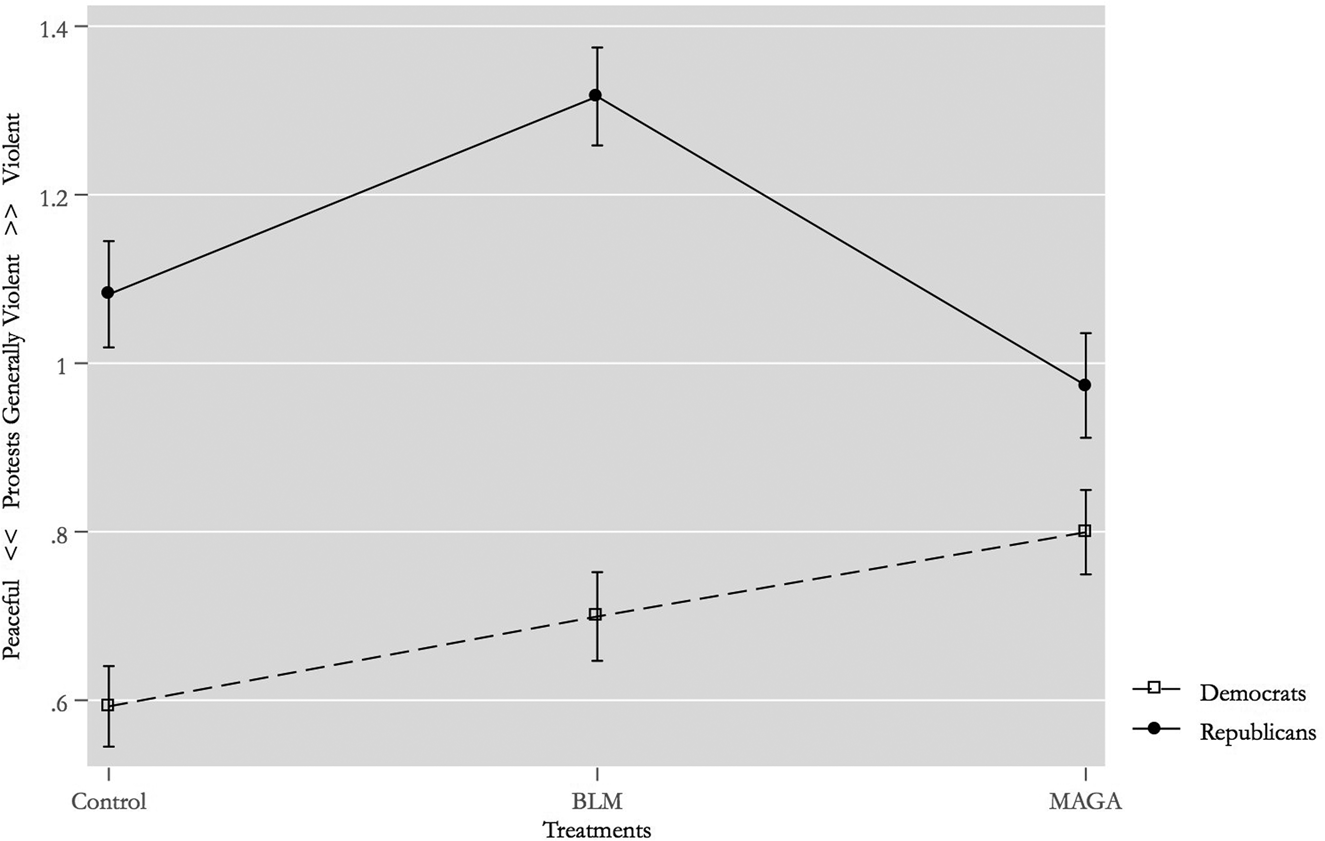
In general, respondents who were exposed to the MAGA protest scenario were significantly more likely to view protests as violent, though both the BLM and MAGA treatments led to rating protests as more violent compared to the control group. Republicans, however, described protests as being more violent after being exposed to the BLM treatment and rated protests as more peaceful when exposed to the MAGA treatment (Figure 5).
Rating of protests as violent or peaceful after being exposed to a protest scenario featuring a control, BLM, or MAGA, by party-ID. Comparing two confidence intervals produces a 90% test.

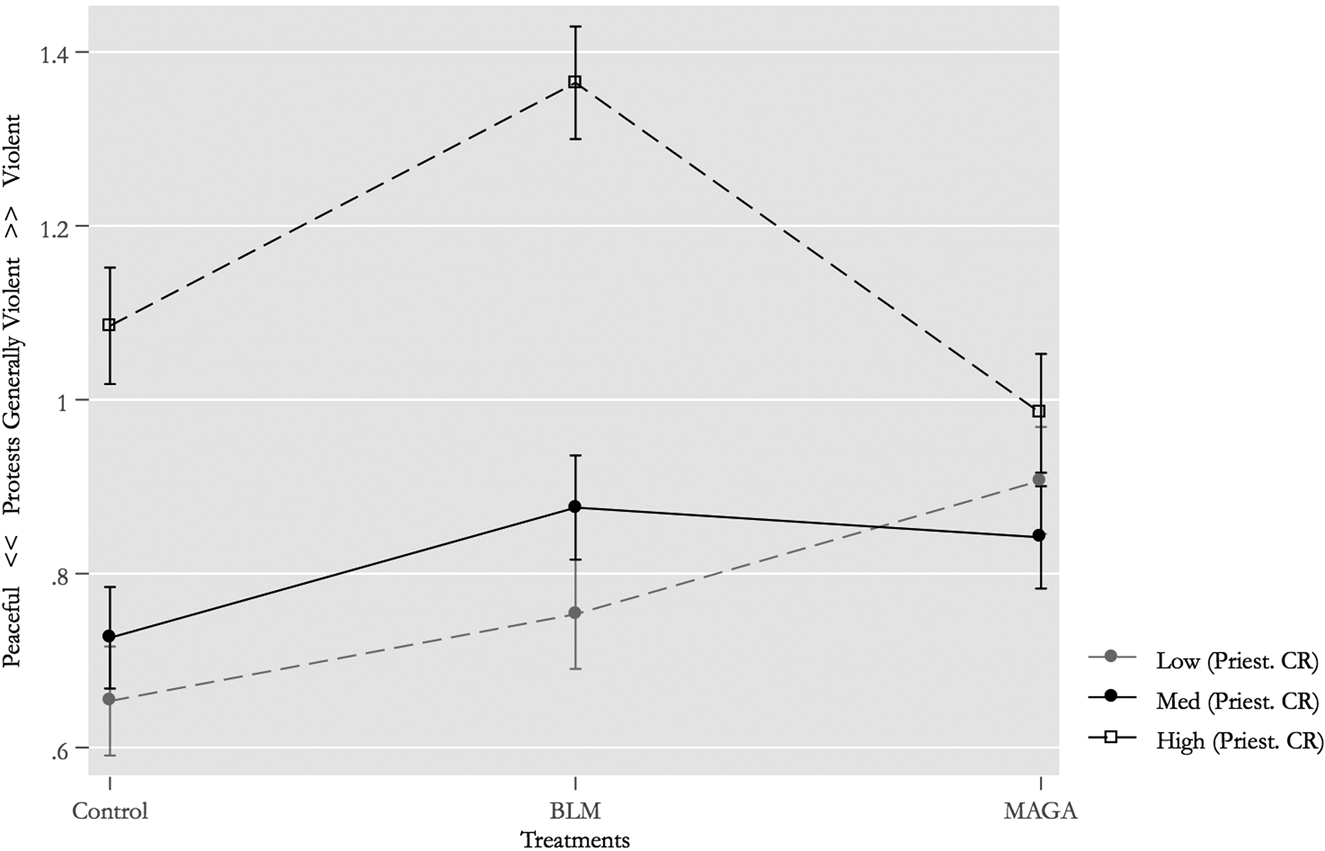
Civil religion attitudes have a similar effect as partisanship, as Figures 6 and 7 show. Those who are high on priestly civil religion (top 25%) were much more likely to respond that protests are violent after being exposed to the BLM scenario, compared to the control. Those with medium levels of priestly civil religion (25–75%) were somewhat more likely to report that protests were violent after seeing both the BLM and MAGA protest scenarios, while those with low priestly civil religion (bottom 25%) only responded that protests were violent after reading about the MAGA protests.
Rating of protests as violent or peaceful after being exposed to a protest scenario featuring a control, BLM, or MAGA, by low (>25%), medium (25–75%), and high (75%+) levels of priestly civil religion. Comparing two confidence intervals produces a 90% test.

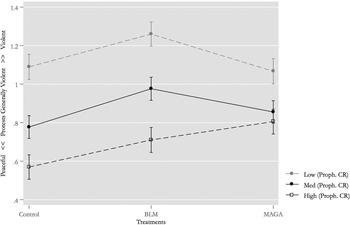
Rating of protests as violent or peaceful after being exposed to a protest scenario featuring a control, BLM, or MAGA, by low (>25%), medium (25–75%), and high (75%+) levels of prophetic civil religion. Comparing two confidence intervals produces a 90% test.

For prophetic civil religion, the results are essentially the opposite (Figure 7). Those who are low on prophetic civil religion are more likely to rate protests as violent after reading about BLM. Those who score high on the scale are more likely to say that protests are violent after reading about the MAGA scenario.
6. Discussion and conclusion
While civil religion has been leveraged by prominent politicians and touted as a bridge for our divided politics, current analysis of public opinion suggests something different. In line with earlier theories of civil religion, in this contemporary, polarized era of American politics, public attitudes toward civil religion survey questions still load onto two dimensions, a priestly and a prophetic version. Moreover, not only are these two types of civil religion distinct from each other, but they also are distinct from related ideologies, specifically Christian nationalism.
The priestly and prophetic dimensions have differential partisan effects. Prophetic civil religion is much more accepted in the Democratic coalition, while priestly civil religion has strong attachments to Republican politics. Because of this, different visions of civil religion are likely to use different language, engage different networks, and support different political values and ideologies. While both prophetic and priestly civil religion may be derived from a single civil religious tradition, the political environment makes their applications quite distinct. Thus, any analysis of the role civil religion should have in American politics should begin with—which civil religion?
Rather than being a force of unification, civil religion is a tool for partisans to express a polarized vision of American politics. As such, we find that appeals to civil religion can lead to more backlash among out-partisans than not invoking civil religion at all. In lieu of a cure, civil religion has been consumed and reshaped by partisanship. Instead of communicating bridge building, appeals to civil religion seem to be driven by polarization and to trigger partisan group identity. In 1988, Robert Wuthnow argued that the two civil religious visions of America “have been the subject of disagreement and polarization more than of consensus and mutual understanding.” His conclusion persists and is likely even more evident today.
We also initiated an examination of the comparison between civil religion and Christian nationalism. Importantly, civil religion is distinct from Christian nationalism. Civil religion solemnizes rituals and beliefs of collective identity, but at its core it is non-sectarian (Bellah, Reference Bellah1967). Christian nationalism, by contrast, is more exclusive, marking theological and political boundaries (Gorski, Reference Gorski2017; Whitehead and Perry, Reference Whitehead and Perry2020). Our data bears this out. Christian nationalist beliefs are more strongly correlated with conservative political beliefs than civil religion attitudes are—even the patriotic, priestly dimension. Christian nationalism also has a stronger religious connection, being more likely to be held by white evangelicals and those who attend church more frequently. While our work touches on this inquiry, more work is needed to lay out the theoretical and empirical boundaries between civil religion and Christian nationalism.
While civil religion has broader appeal than Christian nationalism, it remains prone to partisan divisions. Along with a recent study which finds civil religious Americans are more divided than non-civil religious Americans on their opinions of Donald Trump (Hickel and Murphy, Reference Hickel and Murphy2022), our findings suggest that hope for a unifying civil religion is grounded in a politics that no longer exists and may have never existed. While Bellah (Reference Bellah1967) described a civil religion that was “in need-as any living faith-of continual reformation” but was not “incapable of growth and new insight,” our current political divisions are exacerbated rather than alleviated by civil religious appeals. In many ways, this confirms the reservations that scholars have long had about civil religion (e.g., Bellah, 1975; Wuthnow, Reference Wuthnow1988). Each political party has cultivated their own style of civil religion, which can entrench existing social identities and political views. Therefore, partisan backlash to civil religious appeals seems more likely than moderation. To begin where we started, it is unlikely that civil religion can hold the “vital center” of our polarized American politics.
Supplementary material
The supplementary material for this article can be found at https://doi.org/10.1017/S1755048322000402.
Acknowledgements
The authors are grateful for a small grant from the Religion and Politics Section of the American Political Science Association, which was used to field a survey used in this study. The manuscript was improved from the critique and feedback from panelists at the 2021 American Political Science Association's annual meeting, as well as two anonymous reviewers and the journal editor. The revisions have greatly improved the manuscript. All remaining mistakes and errors, however, are the authors' own.
Financial support
The authors are grateful for a small grant from the Religion and Politics Section of the American Political Science Association, which was used to field a survey experiment in this study.
Conflict of interest
None.
Abigail Vegter is an assistant professor of political science at Berry College. Her scholarship focuses on religion and politics, public opinion, and gun politics in the United States.
Andrew R. Lewis is an associate professor in the School of Public and International Affairs at the University of Cincinnati. He has published widely on the relationship between religion, politics, and law in the United States.
Cammie Jo Bolin is an assistant professor of political science at University at Albany, SUNY. Her research explores identity, participation, and women's leadership in political and religious contexts in the United States.