Introduction
Wildlife plays a significant role in the development of tourism in Nunavut. In 1967, the Guide Bleu Hachette on Canada, a detailed travel guidebook, devoted a section to wildlife in its brief presentation of the Northwest Territories. Since then, the wealth and uniqueness of the wildlife in the Canadian Arctic have widely contributed to the appeal of these tourist landscapes, thus constituting the heart of the ‘wilderness experience’ (Etienne and others Reference Etienne, Mercier and André2005). Two different forms of tourism activities based on Arctic wildlife can be distinguished in Nunavut (Notzke Reference Notzke, Treseder, Honda McNeil, Berkes, Berkes, Dragon, Notzke, Schramm and Hudson1999). On the one hand, wildlife tourism can refer to hunting tourism, also called sport hunting: that is, a hunt ‘where the hunter or hunters pursue their quarry for recreation or pleasure’ (Leader-Williams Reference Leader-Williams, Dickson, Hutton and Adams2009: 11). Hunting tourism is a consumptive form of tourism (Freese Reference Freese1998), since an animal is deliberately killed or removed during the activity. In the Arctic, hunting tourism is well developed, and the most sought-after trophies are polar bears, caribou, musk ox and walrus.
On the other hand, wildlife tourism can also simply be wildlife viewing, usually considered a non-consumptive form of tourism (Duffus and Dearden Reference Duffus and Dearden1990; Bulbeck Reference Bulbeck2005; Newsome and others Reference Newsome, Dowling and Moore2005), insofar as the use of the wildlife does not involve direct and deliberate killing or removal of animals (Freese Reference Freese1998). Wildlife viewing tourism is ‘tourism undertaken to view and/or encounter wildlife. It can take place in a range of settings, captive, semi-captive and in the wild, and it encompasses a variety of interactions from passive observation to feeding and/or touching the species viewed’ (Newsome and others Reference Newsome, Dowling and Moore2005: 18–19). Both of these forms of tourism question resource use.
Resource use depends on and provides different perceptions of the wildlife linked to it. Resources are ‘elements which [human beings] have the knowledge and technology to utilize and which provide desired goods and services’ (Johnston and others Reference Johnston, Gregory, Pratt, Watts and Smith2000). According to E. Zimmerman (Reference Zimmermann1951: 15), ‘resources are not, they become’ when humans assign a utility value to an entity. Animals are part of the natural resources used by humans to procure certain goods. Traditionally, the goods derived from animals include food, clothes and the stories that compose the indigenous cosmology (Randa Reference Randa1986; Laugrand and Oosten Reference Laugrand and Oosten2010). Thus, in the Arctic, the Inuit survived for decades only on subsistence hunting (Bennett and Rowley Reference Bennett and Rowley2004). Polar bear meat was traditionally used for food, the skin could be used for clothes or bedding, and bones were used to make tools or games (Randa Reference Randa1986). Moreover, in southeastern Greenland, the polar bear head was a cultural item used for death rituals (Randa Reference Randa1986). Today, resource use has evolved, and although wildlife is still used for subsistence hunting in the Arctic, new uses have appeared, such as wildlife tourism. Thus the animals will be used in different ways depending on the stakeholders. For the Inuit, wildlife can be used for food, for the transmission of traditional ecological knowledge (Tyrrell Reference Tyrrell, Freeman and Foote2009) and as a monetary resource (Wenzel Reference Wenzel2008). For tourists, it will be a hunting trophy (Wenzel Reference Wenzel2008), a decorative item and/or a sight (Urry Reference Urry2002; Lemelin Reference Lemelin2006).
The neoclassical school considers a resource as a productive factor that must be managed (Thiombiano Reference Thiombiano2004). In this view, the main issues are the resource's benefits and management. Concerning polar bears, this approach to the resource led to the study of the biological impacts of the changing environment and global warming (Stirling and Derocher Reference Stirling and Derocher1993; Dyck and others Reference Dyck, Soon, Legates, Baliunas, Ball and Hancock2007, Reference Dyck, Soon, Legates, Baliunas, Ball and Hancock2008; Stirling and others Reference Stirling, Derocher, Gough and Rode2008), and the biological impacts of human activities such as hunting (Taylor and others Reference Taylor, Laake, McLoughlin, Born, Cluff, Ferguson, Rosing-Asvid, Schweinsburg and Messier2005), wildlife viewing (Dyck and Baydack Reference Dyck and Baydack2004) and research (Dyck and others Reference Dyck, Soon, Legates, Baliunas, Ball and Hancock2007). Moreover, studies have also been conducted on polar bear management systems. Vongraven (Reference Vongraven2009) explains the protective measures adopted at an international level, whereas others have studied the management conflict between the Inuit and scientists regarding the polar bear quotas linked to perception issues (Tyrrell Reference Tyrrell2006; Dowsley and Wenzel Reference Dowsley and Wenzel2008; Dowsley Reference Dowsley2009b).
Another approach to resources studies is to focus on the resource's appearance and its dynamics. For example, Lemelin and others (Reference Lemelin, Dawson and Stewart2011) edited a book on the appearance of so-called ‘last chance tourism’, a new tourism market involving tourists who explicitly ‘seek vanishing landscapes or seascapes, and/or disappearing natural and/or social heritage’ (Lemelin and others Reference Lemelin, Dawson, Stewart, Maher and Lueck2010: 478). From a theoretical point of view, studies of resource appearance and transformation have been carried out by French geographers and economists (Kébir and Maillat Reference Kébir and Maillat2004; Gumuchian and Pecqueur Reference Gumuchian and Pecqueur2007; Pecqueur Reference Pecqueur, Querejeta, Landart and Wilson2008; Peyrache Gadeau Reference Peyrache Gadeau2008) in the conceptual framework of the ‘territorial resource’. This territorial resource analysis aims to study the interrelationship between a resource and the context in which it is produced. The wealth of a territory does not exist in advance but can be created, depending on the way in which the stakeholders are coordinated. The territorial resources have a wide range of possibilities, which can be identified, reinforced and revealed, and can generate value for territorial development. This article draws support from this resource approach. Our goal is to look at the emergence of wildlife as a tourism resource for Inuit communities, and to question the tourism dynamics and stakeholder strategies linked with wildlife tourism. A chapter in Last chance tourism (Lemelin and others Reference Lemelin, Dawson and Stewart2011) on the transformation of polar bear viewing in the Hudson Bay region in Canada deals directly with issues that are at the core of the second part of this article. The authors explore ‘the emergence of Churchill as a last chance tourism destination, and the relationship between climate change, polar bears and projected shifts in habitat range’ (Stewart and others Reference Stewart, Lemelin, Lemelin, Dawson and Stewart2011: 90). Nevertheless, their study focuses on wildlife viewing and the transformation linked with climate change. This article adopts a different angle, considering both sport hunting tourism and wildlife viewing tourism, trying to understand wildlife tourism dynamics linked to multi-scale changes.
This article is an exploratory study of a broader research project in which wildlife as a tourism product could be promoted to develop territories. Analysing the territorial dynamics linked to wildlife tourism is one way to better understand the interrelationship between landscape, tourism, and cultural and natural heritage. First, the article will discuss how wildlife contributes to Nunavut's tourism development, and then it will focus on a specific example, the polar bear species, to analyse wildlife tourism issues in a global, multicultural world.
Methodology
This article draws from preliminary work based on an analysis of multiple information sources. Both diachronic and synchronic methods were used to understand and review the scientific literature on wildlife management and tourism development in Nunavut. Official documents from the Governments of Nunavut and Canada were studied, as well as tourist brochures and websites. I analysed whether or not wildlife tourism was mentioned in these different sources and if it was, the amount and type of information provided. I also conducted a media review examining articles on wildlife management and tourism activities in the Nunatsiaq newspaper between January 2008 and November 2010. A content analysis was carried out on these subjects (a thematic and lexical review was performed), and I particularly focused on Inuit testimony to collect the inhabitants’ perceptions. Finally, interviews were carried out with tourism operators. I participated in a workshop on the Nunavut Land Claim Act Agreement in November 2009 during which tourism issues were discussed, and I collected information on a tourism development project in Nunavut. I also spoke with Nunavut tourism representatives during the autumn of 2010, and met with Nunavut Tunngavik tourism development advisers in October 2010 and May 2011. The range of issues covered included wildlife tourism and wildlife management at different scales. The data collected was transcribed and a content analysis (thematic review) of the information was carried out. Finally, all information sources were compared and contrasted to better understand wildlife tourism in Nunavut and the issues linked with it.
Wildlife: an attraction factor for a territory
Wildlife in Nunavut tourism marketing
The number of tourists visiting the Arctic region increased steadily for thirty years (Hall and Johnston Reference Hall and Johnston1995). Nevertheless, in the years that followed the creation of the Nunavut Territory, the tourism sector remained a ‘small component of the Nunavut economy if measured through GDP exclusively’. In the future, ‘it should grow over the next five to ten years’ (Nunavut Economic Forum 2010: iii) due to ‘cruise ships, conferences and niche markets’ such as wildlife viewing tourism (Nunavut Economic Forum 2010: 67). Official tourism surveys show that 10,900 tourists visited Nunavut in 2006, and 13,889 in 2008, representing an increase of 27% over only two years (DataPath Systems 2009). Nevertheless, half of these visitors came to Nunavut for business or work. Leisure visitors engaged mostly in shopping for art and visiting natural areas. According to the survey figures, wildlife tourism does not seem to play a significant role in the tourism industry. Indeed, the 2008 survey indicated that only 16% of the tourists reported that they had participated in a wildlife viewing activity and only 5% in hunting and fishing tourism (DataPath Systems 2009). At first glance, these low figures could question the significance of wildlife tourism in Nunavut.
It is important to balance these data with a qualitative approach by looking at wildlife's role in the marketing strategy of the Nunavut territory. Indeed, tourism largely depends on tourists’ image of a region, which is the result of different agents or information sources acting independently to form a single image in the mind of the individual. The factors influencing image formation include both information obtained from sources such as literature, films and newspapers, and the characteristics of the individual (Beerli and Martin Reference Beerli and Martin2004). Today, marketing efforts carried out by the tourism industry are a way to influence the tourist image of a destination. They should reflect the assets of the location in order to create a sustainable setting that attracts visitors (Hall Reference Hall2009). Wildlife became a tourism resource when it was considered as an element that could be advertised to develop tourism.
While consumptive wildlife tourism was excluded from the 1980s marketing strategy by the Northwest Territory Government (Corless Reference Corless1999), both consumptive and non-consumptive activities are included in the Nunavut tourism marketing strategy today. In this strategy, wildlife occupies a specific place insofar as the organisation publishes special thematic guides on wildlife tourism (Nunavut Tourism 2010a). In 2010, there was no such thematic guide on cultural tourism, nor on adventure tourism. Moreover, in the main tourist brochures (Nunavut Tourism 2010b), wildlife is the first element presented, right after the geographical information on Nunavut. A wide range of activities follows this presentation, most of which allow fauna viewing. Thus, campsites are presented as areas with ‘excellent lookout views of passing wildlife’ (Nunavut Tourism 2010b: 18); kayaking as a way ‘to view walrus and other marine mammals, to admire pristine Arctic lands that are home to magnificent herds of musk ox and caribou’ (Nunavut Tourism 2010b: 20); and an ice floe trip as a good opportunity to admire the wildlife that ‘gathers in abundance along the floe edge including walrus, seals, polar bears, narwhales, bowhead and beluga whales, plus an astonishing variety of birds’ (Nunavut Tourism 2010b: 22). This excerpt shows that the different kinds of activities possible in Nunavut are promoted and enhanced thanks to the wildlife viewing possibilities.
Finally, Nunavut Tourism (2010a) has also published a map to present the Nunavut territory. The map presents the different Inuit communities, the protected areas, and the important wildlife areas in red. The red colour and the fact that it is the only element drawn on the map shows that wildlife is the most significant aspect in the marketing strategy used by the official Nunavut tourism organisation.
Marketing, tourist expectations and limits
It is important to underline that tourist landscapes are visited for various reasons. A tourist will go to Nunavut to have the chance to view polar bears but also to appreciate the Arctic landscape and cultural heritage (Amoamo and Boyd Reference Amoamo and Boyd2005). Cruise ship tourism is a good example: its numbers have increased, with a doubling of the number of trips between 2005 and 2006 (Buhasz 2006). In order to satisfy their customers and attract new ones, travel agencies expand the range of their activities, offering, for example, cultural camps and national park visits (Stewart and others Reference Stewart, Howell, Draper, Yackel, Tivy, Hall and Saarinen2010). Wildlife plays a significant role in this kind of tourism (Maher Reference Maher, Hall and Saarinen2010). For instance, the Baffin region is well known for its wildlife viewing possibilities during a cruise: tourists may have the chance to watch charismatic fauna such as polar bears, whales, walrus and migratory birds. A report written on the Orlova cruise ship in the Northwest Passage explains that after days of travelling in difficult weather and sailing conditions, ‘the tourists finally get what they really want after the Orlova heads east through the Bellot Strait: no fewer than seven polar bears during the three hour transit’ (Nunatsiaq News (Nunavut), 18 September 2009: 13).
The Arctic landscape is often depicted with close-up photos of wildlife, which does not necessarily mean that tourists will have the chance to encounter any during their trip, or to get close enough to photograph it as well as in the magazines. As Lippard (Reference Lippard1999: 52) says: ‘after the pictorial seduction, people flock to places not because of their beauty but because of their promise’. Marketing generates tourist expectations, and if these expectations, or ‘promises’, are not met, this can create some frustration. Thus, a survey conducted by Maher and Meade in 2008 in Nunavut showed that the cruise ship tourists interviewed were disappointed not to have seen more wildlife during their trip (Stewart and others Reference Stewart, Howell, Draper, Yackel, Tivy, Hall and Saarinen2010).
According to Stewart and others (Reference Stewart, Howell, Draper, Yackel, Tivy, Hall and Saarinen2010), the longevity of cruise tourism is called into question. With the ice melting, more cruise ship routes are opening, yet the melting of the sea ice is a threat to many species. Moreover, the increasing number of cruise ships could also alter the migration routes of some animals. Thus, this tourism, which relies to some extent on wildlife viewing, is probably contributing to limit the source of its own development (Dawson and others Reference Dawson, Maher and Slocombe2007; Dawson and others Reference Dawson, Stewart, Scott, Hall and Saarinen2010; Stewart and others Reference Stewart, Howell, Draper, Yackel, Tivy, Hall and Saarinen2010b). Some marketing strategies are playing on the fear of seeing the Arctic environment disappear. Tourism operators are selling some travel experiences in the Arctic as ‘last chance tourism’ or ‘doomsday tourism’ (Dawson and others Reference Dawson, Stewart, Scott, Hall and Saarinen2010a; Lemelin and others Reference Lemelin, Dawson, Stewart, Maher and Lueck2010; Lemelin and others Reference Lemelin, Dawson and Stewart2011).
Integrating tourism in multi-purpose wildlife resources
To use wildlife as a tourism resource challenges the traditional relationship that the Inuit have with animals. One of the major challenges encountered in the 1980s and 1990s in wildlife tourism was the cultural shock between the Inuit culture and the tourists. The growing sector of wildlife viewing tourism poses a cultural problem for the tourism industry. In the literature, wildlife viewing tourism is often depicted as a non-consumptive form of tourism, leading to an encounter between two different cultures: the Inuit culture where the subsistence economy is still part of a way of life, and the culture of certain tourists who come to view wildlife, preferably alive. Johnston (Hall and Johnston Reference Hall and Johnston1995: 38–39) explained that ‘the actions of the tourists and the Inuit guides are in sharp contrast: the visitors immediately start snapping photographs; the Inuit, after a suitable amount of time for photo-taking, shoot the animal in question’. Likewise, Hinch (Reference Hinch1998) explains that this kind of situation could have negative consequences for both parties. From the Inuit point of view, it could imply the dissemination of videos, which out of their contextual framework could lead to negative publicity for the region. From a tourist's point of view, watching the live killing of an animal when you are not a hunter can negatively affect the quality of your holidays. This is why, after several complaints, southern outfitters now warn their customers to respect local economies and to stay neutral with respect to subsistence fishing and hunting activities (Antomarchi Reference Antomarchi2009). Today, certain territorial management measures have also been taken to avoid a confrontation between non-consumptive tourism and hunting activities. For instance, the management plan of the Auyuittuq National Park (Parks Canada 2010) forbids tourist access to ‘areas of special importance to the Inuit’ during the narwhal hunt. This spatial distribution allows the Inuit to continue their traditional activities in parallel with tourism development.
Tourism is a sector of activity which is not stable and can be affected by either internal or international events. Moreover, wildlife tourism has to take into account wildlife protection policies established to protect live beings. The second part of this article focuses on a polar bear case study to understand certain stakeholders’ strategies in capitalising on wildlife as a tourism resource and the associated dynamics in a changing environment.
A wildlife tourism resource: case study of the polar bear
Polar bear sport hunting
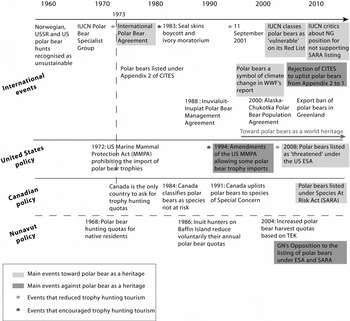
Historically, the first form of tourist activity linked to polar bears was sport hunting tourism (Notzke Reference Notzke, Treseder, Honda McNeil, Berkes, Berkes, Dragon, Notzke, Schramm and Hudson1999). Polar bear trophy hunting has been forbidden since 1973 by the International Agreement on Polar Bears. Only subsistence hunting is authorised. Nevertheless, Canada is the only signatory country that requested the possibility to allocate some Inuit tags to trophy hunting. Legally, this requires an Inuit community to allocate some of its tags to sport hunters through the Hunters and Trappers Organization (HTO). It also requires the presence of at least one Inuit guide and a dog sled team – the hunt should be as traditional as possible; foreign hunters cannot use a Skidoo during the chase. Finally, the trophy hunting tourism industry requires a network of stakeholders working at different scales to organise this kind of hunt (Freeman and others Reference Freeman, Hudson and Foote2005; Wenzel Reference Wenzel2008). Wenzel (Reference Wenzel1991, Reference Wenzel2008) explains that trophy hunting increased a great deal in the 1980s due to the European seal ban and the moratorium on ivory. These policies reduced part of the revenue in Nunavut from international customers, thereby encouraging Inuit communities to allocate more and more tags to sport hunting and fewer to subsistence hunting. The sport hunting market took an additional step forward in 1994 when the US modified the Marine Mammal Protection Act to allow some polar bear trophy hunting in the country, and the US market became the leading trophy hunting market for Inuit communities.
There is a strong link between the Inuit culture and wildlife. The Inuit believe that they must respect wildlife or it will retaliate on their community (Randa Reference Randa1986; Bennett and Rowley Reference Bennett and Rowley2004). According to this tradition, from the Inuit perspective, recognising polar bears as a tourism product is not relevant, because polar bear sport hunting could be seen as a way to play with the animal, and thus indicate disrespect (wildlife viewing guide, personal communication, Arviat, May 2011). This is why certain communities refuse to allocate some polar bear tags to sport hunting even if they could generate several thousand dollars for the village economy. For instance, in the 1980s, a tourism survey reported ‘that the majority of Clyde River residents [were] opposed to the sale of polar bear tags to sport hunters even for a substantial amount of money’ (Marshall and others, quoted in Corless Reference Corless1999: 80). Moreover, a community's decision to allocate some polar bear tags to sport hunting can fluctuate. Communities who chose to develop sport hunting thirty years ago may change their mind today. This was the case of Arctic Bay, for example. In October 2010, Arctic Bay voted that, contrary to previous years, the HTO would not allocate tags to trophy hunting in 2010 (Nunavut News North, 11 October 2010).
Nevertheless, polar bear trophy hunting remains a way for Inuit communities to develop a tourism sector that is lucrative, but also a way to use and share that which is at the heart of Inuit culture: traditional hunting knowledge. This has become very important today due to the changes occurring in Inuit society. Inuit youth are becoming increasingly disconnected from traditional activities such as hunting and fishing, losing some of their relationship and link with the territory and its wildlife (Collignon Reference Collignon, Bonnemaison, Cambrézy and Quinty-Bourgeois1999, Reference Collignon2006). An anthropological study conducted by Tyrrell (Reference Tyrrell, Freeman and Foote2009) in Arviat showed that in this context, trophy hunting could be a way for younger Inuit to learn from their elders and to return to certain hunting and fishing activities. To become a hunting guide, a young man must spend time with his elders to learn to live out on the land. It is an opportunity to learn some traditional knowledge, return to his roots, rediscover a set of values and stay close to the practice of the elders. Finally, trophy hunting, through the encounters with southerners, who are usually successful businessmen at least wealthy enough to pay a high price for polar bear hunting, allows the Inuit to be proud of their culture in front of these foreigners.
To sum up, sport hunting brings a substantial amount of money to the communities and provides jobs requiring traditional knowledge, such as guiding and dog sledding. This activity is therefore significant for communities from a socio-economic and cultural point of view. Some authors indicate that this kind of hunt in Nunavut could be recognised as ecotourism, and refer to this hunting tourism as ‘conservation hunting’ (Dowsley Reference Dowsley2009a; Tyrrell Reference Tyrrell, Freeman and Foote2009). This ‘refers to a form of sustainable recreational hunting that provides conservation benefits to local rural communities’ (Freeman and Wenzel Reference Freeman and Wenzel2006: 22). The trophy hunting market as a tourist activity can be affected by international events such as an economic crisis, but it is also a specific form of tourism due to its direct impact on wildlife. Thus it is also affected by wildlife protection measures, such as the Convention on International Trades in Endangered Species of Wild Fauna and Flora (CITES). Today, polar bear trophy hunting is at stake. Polar bears are increasingly considered as an aspect of the Arctic's natural heritage at risk due to global warming. More and more measures are taken to protect the species, struggling with complex interactions with both climate change and humans (Dyck and others Reference Dyck, Soon, Legates, Baliunas, Ball and Hancock2007; Dyck and others Reference Dyck, Soon, Legates, Baliunas, Ball and Hancock2008). Measures adopted to protect polar bears contribute to curbing this kind of sport hunting.
Polar bears: natural heritage at risk?
The polar bear's image is widely used to attract the attention of the international community to the global warming issue. The species is often presented as a species at risk, which will disappear with the sea ice (Freeman and Foote Reference Freeman and Foote2009). The International Union for Conservation of Nature (IUCN) Polar Bear Specialist Group has recognised that there is ‘a real risk that the world's population of polar bears could be reduced by 30% or more within three polar bear generations’ (Vongraven Reference Vongraven2009: 324). As a consequence of this assessment, polar bears were recognised as a vulnerable species on the IUCN's Red List of threatened species. IUCN members are then ‘obliged to support and facilitate the objectives, activities and governance of the IUCN’ (IUCN 2008 in Vongraven Reference Vongraven2009: 324), and take note at a national level of the IUCN listing (Fig. 1).
The polar bear: natural heritage under construction.

The international measures taken to protect the species have several consequences for the tourism sector in Nunavut. The most important measure has been the classification of polar bears under the United States Endangered Species Act in 2008, which followed the IUCN classification (Vongraven Reference Vongraven2009). Even if this measure has no impact on the number of polar bears killed, the Inuit still have hunting quotas based on the polar bears’ population dynamics; as a counterpart this law has stopped the import of polar bear products into the United States (Freeman and Foote Reference Freeman and Foote2009). Therefore, it sharply reduced the United States trophy hunting market in Nunavut, previously the leading market for this hunt.
Even if polar bear trophy hunting still exists, due to its reorganisation towards a new market (mostly European and Japanese), and to the fact that the CITES refused to ban the trade of polar bear products (CITES 2010), the US focus on the polar bear issue has increased the symbolic impact of the species as well as the perception of its vulnerability. Polar bears are increasingly being seen as an international heritage that should be protected (Fig. 1). The measures adopted directly reduced the consumptive use of polar bears, such as in sport hunting, but did not directly affect wildlife viewing tourism, even if issues concerning wildlife viewing tourism in Churchill, Manitoba were expressed at the 12th Working Meeting of the Polar Bear Specialist Group (Calvert and others 1998, cited in Dyck and others Reference Dyck, Soon, Legates, Baliunas, Ball and Hancock2007: 75). To some extent, the evolution toward wildlife viewing tourism could be a window of opportunity for some local communities (Stewart and others Reference Stewart, Lemelin, Lemelin, Dawson and Stewart2011; Arviat HTO, personal communication, May 2011; Nunavut Tunngavik Incorporated adviser, personal communication, Ottawa, October 2010, and Arviat, May 2011).
Tourism transformation: a case study of Arviat
Some Inuit communities could face the end of polar bear trophy hunting due to the decrease in their polar bear hunting quotas, as is the case in the Arviat community. Paradoxically, this community, located in the western part of the Hudson Bay, 260km north of Churchill, seems to benefit from its geostrategic position in order to develop wildlife viewing tourism. Indeed, Churchill, Manitoba is referred to as the polar bear capital, due to its wildlife viewing industry known the world over. With the climate change issue, operators have started looking northwards to Arviat in order to follow the bears’ migration if the Churchill population decreases due to early ice melting (Stewart and others Reference Stewart, Lemelin, Lemelin, Dawson and Stewart2011).
Arviat is involved today with Nunavut Tunngavik Incorporated (NTI), an Inuit organisation which ensures that the promises of the Nunavut Land Claim Act (NLCA) are met (NTI 2010). The community would like to develop an ecotourism project around polar bears. This project was born out of the Inuit Impact and Benefit Agreement (IIBA) for National Wildlife Areas and Migratory Bird Sanctuaries (IIBA 2006). To compensate for the creation of protected areas in Nunavut, certain parts of the IIBA were signed with the affected Inuit communities. In the case of this IIBA, more than eight million dollars have been earmarked to develop the tourism industry (IIBA 2006). A study was performed on the 12 affected communities and Arviat was selected as a priority due to its high tourism potential (NTI adviser, personal communication, Ottawa, 5 October 2010). A tourism project is underway to develop caribou viewing in springtime and polar bear viewing in autumn. In Arviat, this project would allow the readjustment of existing trophy hunting networks and the creation of some new ones. Indeed, polar bear trophy hunting has been open since 1996, but in Arviat the number of tags for polar bear hunting has decreased considerably.. (The situation might change again in the future, due to an increase in the hunting quota in the autumn of 2011 by the government of Nunavut (Government of Nunavut 2011), decided on against the Polar Bear Specialist Group's advice (IUCN 2011).) According to the Polar Bear Specialist Group, the western Hudson Bay polar bear population is declining even without harvesting, therefore the IUCN classifies this subpopulation as being at very high risk (IUCN Polar Bear Specialist Group 2010). In Arviat, the hunting quotas allocated from 2008 to 2011 were for security reasons.
With this wildlife viewing project, hunters are invited to become guides, not for hunting activities but for photography purposes. Some polar bear sport hunting guides are attending training to complete their hunting skills and adapt to new customers. They also learn to safely approach wildlife and specifically polar bears without shooting them. Finally, training has been organised to develop the tourism sector in the entire community. In 2011, Arviat organised two tourism test runs and invited some tour operators to show them what the community has to offer to the tourism industry. One of these travel agencies has already advertised the new polar bear viewing spot and some trips started in the autumn of 2011.
Conclusion
The study of the polar bear case makes it possible to analyse the issues from a dynamic perspective, examining the causes and consequences of tourism and its transformation over time. If the polar bear sport hunting tourism resource is affected by measures taken to protect polar bears, the example of the Arviat community shows that the tourism resource could be transformed into a wildlife viewing tourism project. The transfer of the guides’ knowledge from sport hunting tourism to wildlife viewing tourism fits into the scheme of a cultural pattern; the Inuit are used to adapting to their environment, and this capacity is harnessed today to adapt to a changing tourism market.
Today, wildlife viewing is a form of tourism that seems to better fit Westerners’ representation of nature (Kellert Reference Kellert1979; Franklin Reference Franklin1999). The symbolic significance of the polar bears from a Western perspective increasingly imposes non-consumptive use. This type of nature usage leaves the impression that nature is being protected, but behind the facade it is possible that wildlife viewing tourism is not entirely environmentally friendly. Indeed, polar bear watching could have consequences for the polar bear population, such as location disturbance, habitat destruction, or behaviour changes. (Dyck Reference Dyck2001; Dyck and others Reference Dyck, Soon, Legates, Baliunas, Ball and Hancock2008; Dyck and Baydack 2004; Eckhardt Reference Eckhardt2005). Therefore, the classification of wildlife viewing tourism as ‘non-consumptive’ tourism erroneously suggests that this type of tourism has no impact on species or their environments (Tremblay Reference Tremblay2001; Lemelin Reference Lemelin2006). Lemelin (Reference Lemelin2006: 518) explains that wildlife viewing tourism is a ‘different dimension of consumption. . . . While the gaze itself may be virtually harmless, this form of leisure is still dependant on the transformation of landscapes (Williams Reference Williams2001), and tourism infrastructures (transportation accommodations, services, etc.) which may or may not be sustainable. For all intents and purposes it is simply one more new or different product, which can be purchased and consumed.’ Moreover, there is a wide range of polar bear watchers; not all types of tourists have the same relationship with nature and some do not fit with the archetypal definition of what could be seen as ecotourism (Lemelin and Smale Reference Lemelin and Smale2007; Lemelin and Wiersma Reference Lemelin and Wiersma2007; Lemelin and others Reference Lemelin, Fennell and Smale2008). Nevertheless, the international mobilisation around polar bears is creating a moral judgement on the accepted use of the species: consumptive tourism is rejected, whereas a ‘non-consumptive’ use such as wildlife viewing tourism appears to be more acceptable (Kellert Reference Kellert1979; Franklin Reference Franklin1999). Certain studies carried out in other parts of the world (K. Zimmermann Reference Zimmermann2007) have suggested that hunting tourism is better than wildlife viewing tourism because it brings more money to the community with fewer tourists (Milne and others 1997, cited in Dowsley Reference Dowsley2009a) and thus less rubbish than wildlife viewing tourism. Nowadays, the increasing amount of waste and the cost of recycling is a major issue for a fragile environment that should also be taken into account. Moreover, there is no ecological access to the north. A study on Churchill, located in northern Manitoba near the Nunavut territory, showed that the distance required to travel to Churchill to watch polar bears requires transportation that generates greenhouse gases. Thus, wildlife viewing tourism is contributing to damage to an environment that tourists declare they want to protect (Dawson and others Reference Dawson, Stewart, Lemelin and Scott2010a, Reference Dawson, Stewart, Scott, Hall and Saarinen2010b). In order to protect the environment, the following question could be raised: from an overall standpoint, is wildlife viewing tourism more protective of the environment than hunting tourism?
Additional research is necessary to better understand the impact on nature of different types of tourism in the Arctic. Moreover, the dichotomy between consumptive and non-consumptive activities is increasingly being challenged by scientists (Tremblay Reference Tremblay2001; Lemelin Reference Lemelin2006; Meletis and Campbell Reference Meletis and Campbell2007). It will be interesting to see in the future if this challenge will be integrated at a larger scale and, if so, to analyse the consequences that it could have on the public perception of tourism's impacts.
Acknowledgements
This study was conducted as part of a Ph.D. research project on tourism dynamics linked to wildlife, supported by a fellowship from the Rhône-Alpes region and the Dialog indigenous research network.