Introduction
The social meanings of fronted versus alveolar (s)—[s+] vs. [s]—have been studied in English by several researchers. The use of [s+] in English seems to often evoke stereotypical perceptions of male speakers as gay (Levon Reference Levon2006; Campbell-Kibler Reference Campbell-Kibler2011; Mack & Munson Reference Mack and Munson2011). In Danish [s+] also seems to be quite strongly associated with femininity or gayness. However, [s+] has also been observed to be used in social and linguistic contexts where the social meanings appear to be different. In this article we report on an experimental investigation of this.
Linguistic features do not carry specific indexical meanings of their own, but can have different meanings in different clusters of features. Two such clusters of features are stereotypically associated with “modern Copenhagen speech” on the one hand, and “street language” on the other. These clusters—which we refer to as modern and street—are associated by young Copenhageners with categories of speakers that stereotypically have very different social characteristics.
Our study is based on data from speaker-evaluation experiments (using the matched guise technique) where listeners react to [s] and [s+] inserted in samples of modern and street speech. Built on previous findings and acquaintance with public discourse about the subject, our main question is to which extent [s+] contributes to different social meanings in the two types of speech. Is the use of [s+] observed in street part of a composition where the femininity or gay indexicality is used in combination with other features and other indexical meanings to create a sum of different indexical meanings? Or does the use of [s+] in this type of speech not construct femininity or gayness at all—but does it instead contribute to the overall heterosexual masculinity associated with this type of speech?
The analyses and conclusions presented in this article contribute to the understanding of the relationship between single features and clusters of features, and to the further development of theories of indexicality and enregisterment. Fundamentally we ask how two variants of (s) are interpreted socially when occurring in different prosodic contexts. This opens a discussion of how important specific features are for the construction and recognition of social meaning. We present a method to examine whether a specific feature known to be socially significant in one cluster of features carries the meaning along when occurring in another cluster of features. We find that [s+] is an unnoticed ingredient of street rather than a marker of, say, gayness.
Indexicality
As part of her study of “Pittsburghese” prints on t-shirts, Johnstone (Reference Johnstone2009) discusses what makes a linguistic variant noticeable:
The variation between one speaker and another, or between the same person's speech in one situation as opposed to another, is often unnoticeable to a particular hearer. In order to become noticeable, a particular variant must be linked with an ideological scheme that can be used to evaluate it in contrast to another variant. (Johnstone Reference Johnstone2009:159–60)
In Johnstone's approach the basic analytical unit is the linguistic “feature” (even though she also uses terms like “form,” and “variant” as in the above quote). She stresses that the evaluation of a particular feature depends on the interlocutor's comprehension potential in the shape of ideological schemes. It follows from her description that some linguistic features get linked to certain ideological schemes in ways that give them a high symbolic value. Our [s+]-variant is an example of such a linguistic feature, as we see below. Johnstone states, “the same feature can be enregistered in several different ways” (Johnstone Reference Johnstone2009:160). The same feature may be linked to different ideological schemes. What, then, determines which ideological schemes the listeners invoke in their evaluation? And particularly important for our study: Do some ideological schemes ascribe higher symbolic value to a particular linguistic feature than other ideological schemes? In our study we aim to shed further light on the connection between how noticeable a feature is and which ideological schemes it is evaluated in. We do so by focusing on the same linguistic feature in different prosodic contexts.
As we discuss below, our choice of stimulus material is based in studies of language perception and use. In this sense our approach to linguistic features can be explained by Agha's concept of registers:
… registers are cultural models of action that link diverse behavioral signs to enactable effects, including images of persona, interpersonal relationship and type of conduct. (Agha Reference Agha2007:145)
Agha describes how clusters of linguistic features may be associated with social value. Linguistic registers are resources for the construction and recognition of personae. Including interactional use as well as metalinguistic knowledge in his description, Agha considers how registers with their social packages and potentials come into being. He labels this process enregisterment and defines it as:
processes and practices whereby performable signs become recognized (and regrouped) as belonging to distinct, differentially valorized semiotic registers by a population. (Agha Reference Agha2007:81)
As discussed below, street as well as modern may be viewed as registers linked to different types of persona and in different stages of enregisterment. Agha's concept of register is quite similar to other scholars' concept of style (e.g. Coupland Reference Coupland2007; Eckert Reference Eckert2008). Eckert refrains from using the term register herself, due to the tradition in sociolinguistics of using this term to signify another phenomenon. However, she explains that, “Asif Agha's account of enregistered voices is quite precisely what I am talking about here, locating register in a continual process of production and reproduction” (Reference Eckert2008:456). The reason we choose to use the concept register here, is that processes of enregisterment are foregrounded in Agha's approach. It is in the process of enregisterment that social meaning come to be associated with certain linguistic features or clusters of features. In this article we are examining indexicality and enregisterment of two registers and two features in combination. Referring to Silverstein's “total linguistic fact” (Reference Silverstein, Mertz and Parmentier1985) we are not concerned with form, use, or domain here, but we are concerned with ideology.
As Blommaert (Reference Blommaert2005:43) reminds us, “We understand something because that something makes sense in a particular context.” By context, Blommaert primarily addresses large societal structures and framed activities, but it may be applied to very local contexts as well. The social meaning potential of a particular variant depends on a range of situational factors (see for example Snell Reference Snell2010; Sharma Reference Sharma2011) as well as the co-occurring (linguistic) resources associated with styles or registers. It is already well established in sociolinguistics that the same linguistic variant may be associated with different stereotypes and personae in different situations. Thus, Podesva (Reference Podesva, Shaw, Wagner and Yasui2008) carries out interactional analyses of the doctor “Heath's” use of released /t/ and argues that the feature is used both in the construction of a competent professional doctor persona and in the construction of a prissy gay diva persona (where the long and intense release bursts are important). Released /t/ does not carry a specific social meaning, but can be used together with other features to construct different social meanings.
Similarly, Moore & Podesva (Reference Moore and Podesva2009) argue that the use of tag questions can index quite different social meanings. They investigated the use of tag questions among female students at Midland High—a school in northwest England (Moore Reference Moore2003, Reference Moore2004) and found that even though all uses of tag-questions conduced organized talk, there was not one distinct social meaning of the tag questions. Using Silverstein's framework (see below) they see “conducive” as an nth order indexical value, and the other different indexical meanings they find as n + 1st order indexical values (Moore & Podesva Reference Moore and Podesva2009:477). Moore & Podesva follow Coupland (Reference Coupland2007) in seeing social meaning as operating at three different levels of abstraction: the micro-level, the meso-level, and the macro-level. The social meanings of tag questions varied at all three levels of abstraction (Moore & Podesva Reference Moore and Podesva2009:479).
Specific variants' potentiality for indexing different social meanings has been further investigated by Podesva, Jamsu, Callier, & Heitman (Reference Podesva, Jamsu, Callier and Heitman2014). They examine the social meanings of different realizations of /t/ in the speech of six well-known American politicians and find that the already existing interpretation of a speaker has a strong influence on the way subtle phonetic differences are perceived and evaluated.
In the same vein Campbell-Kibler (Reference Campbell-Kibler2010) shows that the long-standing variable (-ing) in US English may have a wide range of connotations, and that the two variants [in] and [iň] are not necessarily just tied to opposing ends of evaluative scales (although they are contrarily associated with some personality traits, such as being intelligent, educated, and articulate). Relative to a neutral guise, however, only the alveolar variant shows an effect on listeners' perceptions of the formality of speakers, and, for a subset of listeners, the alveolar variant also influenced perceptions of gayness, whereas the velar variant showed no influence on these traits (Campbell-Kibler Reference Campbell-Kibler2010:430–35). Similarly, Campbell-Kibler (Reference Campbell-Kibler2011) found that the perception of [s+] is strongly tied to gayness and masculinity, whereas backed /s/ has more varying connotations, yielding “country” associations when occurring in the speech of some Southern US English speakers, but having no effect in the evaluation of non-Southern US English speakers.
Eckert (Reference Eckert2008) has suggested using Silverstein's (Reference Silverstein2003) notion of indexical field to theorize the link between features and indexical meanings. In Silverstein's framework the indexical meanings of a feature are always co-present, available for use. Silverstein refers to the different indexical meanings of a feature as “orders of indexicality.” An nth order usage is always available for reinterpretation in discourse, which will lead to an n + 1st order indexical value. Silverstein takes the distinction between indicators, markers, and stereotypes (Labov Reference Labov and Fishman1971) as an example of different orders of indexicality. Indicators are variables that index group or category membership, and in Silverstein's terms they are first-order indexes: “That is, the formal linguistic difference is a (presupposing) index of group- or category-identity of the Speaker, a 1st-order indexicality” (Silverstein Reference Silverstein2003:217). These first-order indexes can over time come to be associated with the social evaluations of the category membership they indicate. The variant would then become a marker (or even stereotype), and its indexical meaning would be a second-order indexical value. Silverstein's theory of indexicality leads Eckert to a tentative illustration of the indexical field as a field consisting of differing, however related, indexical meanings for a specific feature. The indexical field is an ideological field, and it is bound to be unstable, constantly changing, and dynamic. Meaning making takes place in interaction, and since the indexical field is both the basis for and the outcome of this interactional meaning making, indexical meanings are to a large extent shared. People are likely to have developed somewhat different indexical fields, but basically the fields are collectively shared, not individual constructs.
Enregisterment of [s+]
In Danish phonology, the alveolar articulation of /s/ is described as the “standard” pronunciation, both in Copenhagen speech, and in Danish in general (Grønnum Reference Grønnum2005:111). The use of [s+] has not been examined very much in Danish research. The few existing studies have been carried out in an audiologopedic framework where [s+] use is understood as speech impediment (Hutters & Bau Reference Hutters and Bau2006) and not as sociolinguistic variation. At the same time, it has been noted that this “speech disorder to be cured for” is mainly tied to female speakers, and [s+] has been referred to as “young girls' lisp” (ungpigelœsp) (Hutters & Bau Reference Hutters and Bau2006). In public discourse, [s+] is also known as “gay s” (bøsse-s) when used by male speakers. Previously collected experimental data in connection with a study of linguistic practices among young Copenhageners (Maegaard Reference Maegaard2007) include many reactions like example (1) to speech samples with [s+]-tokens.
(1) Bøsse – det kan man høre på hans s'er
‘Gay – you can tell from his s'es’
In young people's writing in new media, the fronted variant is often signalled by use of the letter z. Example (2) is from Arto, an internet forum for children and teenagers (age 10+), where a girl writes an open message to her friend. Among several stereotypically “girly” features, she uses z for almost every s—a usage that is also found in many other messages from girls in this forum.
(2) Hej zøde, zmukke, zeje, dejlige tøz!
elsker dig mahn!
glad for venskabet?
samme her!
håber vi zez znart zøde..
Knuzzer din michelle..Footnote 1
‘Hi zweet, beautiful, cool, lovely girl!
love you mahn
happy we're friends?
me too!
hope to zee you zoon zweetie..
hugz your michelle..’
Example (3) is taken from Habbo Hotel, another internet forum for teenagers. In a discussion about whether or not it is gay to use the term tihi ‘teehee,’ the user writes about a presumably gay person who “actually said teehee quite often,” and here the user writes bøzze ‘gay’ with double z instead of double s as in Danish spelling (where z is correctly used only in very few words).
(3) Han var såkaldt bøzze, og han sagde faktisk meget tit tihiFootnote 2
‘He was so-called gay, and actually he said teehee quite often’
One of Denmark's main daily newspapers (Politiken) makes its contribution to the [s+] enregisterment by regularly letting imaginary young girls (from Copenhagen's high-status northern suburbs) comment on people and events in its backpage “making-fun” column—in a language where all s's are substituted by z's.
It seems from examples such as these, that the use of [s+] is strongly linked to ideological schemes that have to do with certain gendered identities and sexuality. This, together with the high level of awareness of this variant, means that it might be interpreted as a stereotype in Labov's sense. This interpretation, however, is probably too simplistic.
In a recent study of phonetic variation in a Copenhagen school, it was found that [s+] was used mainly by the group of girls labelled “the nice Danish girls” (Maegaard Reference Maegaard2007, Reference Maegaard, Quist and Svendsen2010). This is not surprising in the light of how the variant is present in public discourse and awareness. However, the study also showed a relatively high frequency of [s+] in the group of boys known in school as “the foreign boys,” where “foreign” is used by the adolescents themselves to label people with a minority background.Footnote 3 This connection is more surprising, because the linguistic style, clothing, and behavior associated with these boys are stereotypically linked to a streetwise, heterosexual masculinity that is very different from gay masculinities or hyper-femininity. Nevertheless, the “foreign” association has also been found in another study of Copenhagen youth (Stæhr Reference Stæhr2010), and additionally in examples from popular culture where [s+] is used in parodic constructions of personae like “tough immigrant boy.” This is, for instance, seen in a Danish 2005 film Terkel i knibe ‘Terkel in a spot,’ where the immigrant character Zaki uses [s+]. It may seem, then, that [s+] does not index gayness or femininity for all male speakers but rather contributes to constructing a kind of masculinity with heterosexuality and toughness as prominent parts. An association between these boys and use of [s+], however, is less established in public discourse and awareness.
In brief, it seems that [s+] is linked to different ideological schemes depending on the context in which it occurs. An important question is then if (and how) the ideological schemes are connected. The present experimental perception study is an attempt to throw further light on the nature of the ideological schemes and relations between them.
Enregisterment of modern and street
The linguistic features that are associated with the concept of street have been described in a number of sociolinguistic studies (Quist Reference Quist2000, Reference Quist2008; Maegaard Reference Maegaard2007; Madsen Reference Madsen2008; Møller Reference Møller, Maegaard, Gregersen, Quist and Jørgensen2009; Ag Reference Ag2010; Hansen & Pharao Reference Hansen, Pharao, Quist and Svendsen2010; Madsen, Møller, & Jørgensen Reference Madsen, Møller, Jørgensen, Madsen, Møller and Jørgensen2010; Stæhr Reference Stæhr2010; Møller & Jørgensen Reference Møller, Jørgensen, Møller and Jørgensen2011). They include segmental features, notably palatalization of /t/ and devoicing of word initial /r/, as well as characteristic prosodic patterns. Our stimulus samples include only one characteristic feature of street, namely the prosodic patterns (described at length in Hansen & Pharao Reference Hansen, Pharao, Quist and Svendsen2010 and briefly later in this article). In this section we summarize results from previous evaluation studies.
Møller (Reference Møller, Maegaard, Gregersen, Quist and Jørgensen2009) is a qualitative study in which four speech samples, including street, were played to twenty people during individual sociolinguistic interviews. The informants were in their mid-twenties and had a Turkish-Danish minority background. They were asked to characterize the speakers behind the four speech samples. The informants described the person behind the street sample as indvandrer ‘immigrant’ or wannabe-indvandrer ‘wannabe immigrant’ and as gangster ‘gangster’ or bølle ‘thug’ (Møller Reference Møller, Maegaard, Gregersen, Quist and Jørgensen2009:243). Characterizations contained very detailed ideas about the person's attitude, appearance, age, ethnicity, status, and so on. The study reflects enregisterment at a stage where the cluster of features associated with street invokes rich and similar descriptions of the person behind the voice. The association with “tough” types such as “gangsters” or “thugs” makes linguistic features associated with street a potential resource for identity work in interaction. Madsen (Reference Madsen2008) analyzed the use of this cluster of features in interactions among Copenhagen taekwondo fighters and found that, “The features of the style appear to be used for construction of a tough masculine youth identity” (154).
The concept of the type of speech we have labeled modern is also well described in Danish sociolinguistics. In a series of speaker-evaluation experiments, where modern was represented in the stimulus material, Kristiansen and colleagues have obtained “covert” (subconsciously offered) language attitudes in different parts of Denmark. Modern is consistently found to be evaluated more positively than “Conservative Copenhagen speech” (and more positively than the local dialect as well) on scales concerning self-assurance, fascination, coolness, and pleasantness (for an overview of this research, see Kristiansen Reference Kristiansen2009). This is in line with other studies of language attitudes involving modern. Maegaard (Reference Maegaard2005) conducted a speaker evaluation experiment in the city of Århus with open-ended questions and found that the most frequent categorizations of the two male voices representing modern were social, lively, and young. Møller (Reference Møller, Maegaard, Gregersen, Quist and Jørgensen2009) found that the voice representing modern may be generalized as not so intelligent, cool, and like us.
These short summaries of studies of language-ideological structures point to important differences in how street and modern are perceived. Street is associated with a well-defined type of user, specifiable in terms of age, ethnic background, clothing, habits, place of living, and so on. In contrast, the typical user of modern is described in a much more abstract manner, for example, with adjectives such as cool. At the same time, it should be stressed that all of these studies have obtained largely homogeneous responses. In other words, people do recognize the features associated with the concepts of street and modern and react to them in accordance with established, highly shared, ideological schemes.
This leads to the following questions: In which ways do the social meanings of [s] and [s+] interplay with co-occurring prosodic features associated with street and modern? What does [s+] do when it is used in street? Does it downplay the masculine bully stereotype, or is it rather perceived as a part of street? If so, is [s+] a significant or relatively unimportant linguistic feature in the street cluster?
Experimental design
We investigated the social meanings of [s+] in the two different registers using a variant of the matched guise technique (Lambert, Hodgson, Gardner, & Fillenbaum Reference Lambert, Hodgson, Gardner and Fillenbaum1960; Ryan, Giles, & Hewstone Reference Ryan, Giles, Hewstone, Ammon, Dittmar and Mattheier1988; Giles & Coupland Reference Giles and Coupland1991; Garrett, Coupland, & Williams Reference Garrett, Coupland and Williams2003; Kristiansen Reference Kristiansen2009; Garrett Reference Garrett2010). The method is traditionally presented as “indirect” (e.g. Giles & Coupland Reference Giles and Coupland1991; Garrett et al. Reference Garrett, Coupland and Williams2003:51; Garrett Reference Garrett2010:39 ff.) because studies using this method do not elicit reactions to direct questions about linguistic variation. It is often the case, however, that studies using this methodology use questionnaires containing questions that are likely to direct the respondents' attention to language. Furthermore, researchers within this paradigm usually present themselves as linguists to the respondents. This means that there is a high probability that the respondents will be aware that they are taking part in a linguistic study, and this might influence their responses (for more on this issue, see Kristiansen Reference Kristiansen2009; Maegaard Reference Maegaard, Maegaard, Gregersen, Quist and Jørgensen2009). Contrary to this approach, in our study we did not present ourselves as linguists, and in the questionnaire we avoided questions that focused directly on language. When conducting the experiment, after the first round of questionnaires had been collected from the respondents, we asked them what they thought it was all about. The respondents never expressed that they suspected linguistic diversity or similar themes to be the subject of the investigation. They did, however, react to the fact that several guises were almost identical (see the description below), and they found this strange. But they did not express any suspicion that this had to do with the experiment being part of a linguistics study.
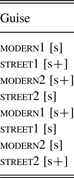
To investigate the social meanings of [s+] in modern, and thereby study the extent to which a single variant can change the social perception of a speaker (as opposed to an entire set of variants), we designed stimuli that differed only in the quality of the sibilant. This was done by splicing tokens of [s] and [s+] into short samples of speech, thereby creating completely matched guises of modern. The two variants of (s) were taken from recordings of adolescent boys participating in a map-task game in connection with a different study (Hansen & Pharao Reference Hansen, Pharao, Quist and Svendsen2010). The [s] variant was taken from the recording of a boy judged to be speaking modern, and the [s+] variant was taken from the recording of a boy judged to be speaking street. Similar studies (e.g. Campbell-Kibler Reference Campbell-Kibler2011; Mack & Munson Reference Mack and Munson2011) used (s) tokens produced by professional linguists, whereas our tokens were taken from spontaneously occurring variants that both auditorily and acoustically show characteristics of the alveolar versus the fronted articulations. The acoustic characteristics of the two variants are given in Table 1. Each token was manipulated to have the same duration and intensity as the original it replaced.
Acoustic characteristics of the variants of (s) used in the guises.

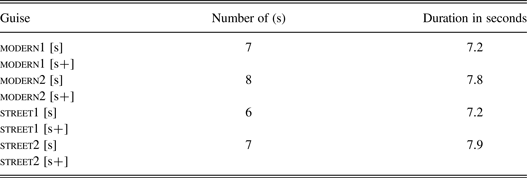
Two utterances were used to represent modern. These utterances were selected from the same set of map-task recordings, but using different speakers than the ones who had supplied the tokens of the variants of (s). The utterances were selected to represent modern adolescent male speech. One lasted 7.2 seconds and contained seven instances of (s), the other lasted 7.8 seconds and contained eight instances of (s). Two versions of each utterance were created, one in which all instances of (s) were replaced with the variant [s], and another where all instances were replaced with the variant [s+], yielding a total of four modern guises. By manipulating both versions of each utterance, we minimize the risk that responses to the guises in the speaker-evaluation experiments can be ascribed to a difference between natural and manipulated tokens of (s). In addition to evaluating the guises ourselves, we also presented them to several colleagues, none of whom remarked that any of the guises sounded manipulated.
To investigate how the social meaning potential of a single variant is affected by the cluster of linguistic features with which it co-occurs, we also created guises representing street. As with the modern guises, two utterances were selected to represent street. A salient difference between modern and street is a difference in prosody, mainly the perceived rhythm (cf. Quist Reference Quist2000): street is heard as more staccato than modern, and generally does not maintain the distinction between short and long vowels (which is phonemic in standard Copenhagen; cf. Hansen & Pharao Reference Hansen, Pharao, Quist and Svendsen2010). We selected utterances that exhibited shortening of the long vowels and were perceived to sound staccato. Neither palatalized /t/ nor devoiced word initial /r/ (features also associated with street, cf. above) occurred in the utterances. One was 7.2 seconds long and contained six instances of (s), the other lasted 7.9 seconds and contained seven instances of (s). As with the modern utterances, two versions of each of the street utterances were created: in one version all instances of (s) were replaced with [s], in the other with [s+], yielding a total of four street guises for the experiment. Their characteristics are summarized in Table 2.Footnote 4
Characteristics of the guises.

The stimuli were played in a fixed order during lessons in classrooms to all groups of listeners who participated in the experiments,Footnote 5 and they were played on loudspeakers in plenum. We did so in order to be able to compare the different high school classes to each other and thereby catch instances of local enregisterment or students influencing each other during the data collection. As it turned out there was not any significant difference between the different classes. The stimuli were used in two experiments, each consisting of two tasks. We begin by presenting the method and the results from the first experiment.
Experiment 1: Open questions
Methodology
The experiment was carried out at two high schools (gymnasium) in Copenhagen. One school is situated in central Copenhagen and one in a western suburb. The two schools differ mainly in the proportion of pupils with an immigrant background, the suburban school having the larger proportion. The informants were between sixteen and eighteen years old, fifty four were recruited from the urban school and sixty two from the suburban school, yielding a total of 116 informants.
Experiment 1 consisted of two tasks. In the first task we used an open-ended questionnaire. The informants were told that they were going to hear eight different boys of their own age, and that immediately after hearing each one, they should write down in a few words their immediate impression of the speaker. We said that some of the recordings might sound very similar without being the same. We did not tell about the s'es, of course. The guises were played one by one, and there was a thirty-second break between each guise.
The second task addressed informants' experiences with the different ways of speaking represented in the guises, and their linguistic awareness. We played the stimuli again, and this time the questionnaire contained several questions, but here we focus on only one: “What did you notice about this way of speaking?”. Finally, informants completed a questionnaire with demographic information.
Experiment 1 was designed to elicit immediate impressions of speakers. For us to be able to draw conclusions about the indexical meanings of [s] and [s+], we had to begin by asking the informants for the categories that to them were meaningful and relevant with regard to the variation under study (Garrett et al. Reference Garrett, Coupland and Williams2003:ch. 3; Garrett, Williams, & Coupland Reference Garrett, Williams, Coupland, Jaworski, Galasinski and Coupland2004; Maegaard Reference Maegaard2005). These categories could then be put to use in a subsequent experiment with a pre-established answering format (Experiment 2 below).
Coding the responses
The responses to the open-ended questionnaire are of many different kinds. Some informants give responses that are very complex and detailed, whereas others answer with much simpler responses.
(4) Han virker til at være en ballademager. Går nok sjældent i skole. Ligeglad med skolen.
Dårlig opvækst. (response to street1 [s+])
‘He seems to be a troublemaker. Probably seldom goes to school. Doesn't care about school. Bad childhood.’
(5) Homoseksuel, fimset, lyst hår, sidder med benene over kryds, mode
(response to modern2 [s+])
‘Homosexual, slick, blonde, crossed-legged, fashion’
While examples (4) and (5) are relatively simple and uncomplicated to categorise, other responses are more difficult to interpret.
(6) Virkelig, virkelig DEJLIG type! Lidt feminin. SØD [tegnet hjerte bagefter]
(response to modern1 [s+])
‘Really, really LOVELY type! A bit feminine. SWEET [followed by a drawing of a heart]’
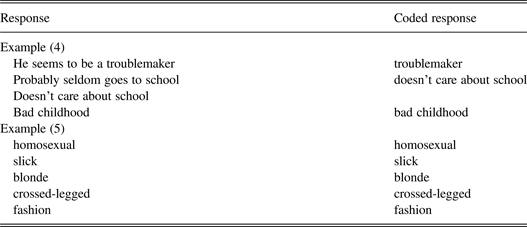
There is no doubt that the response in (6) is a positive statement, but exactly how to interpret the notion of “really LOVELY type” or the drawing is a difficult matter. In the coding we have followed a procedure where we divide each response into different parts based on an analysis of the semantic content of the response. Coding of the responses in (4) and (5) are shown in Table 3.
Examples of coding of free characterizations of stimulus voices.
Each response usually contains more than a single categorisation. Every categorisation is coded. If the “same” categorisation, however, is produced several times in the response (as in (4) above), the categorisation is coded as one and counted only once. This means that responses containing the same category repeated many times. For instance, Perle. Perle. Perle ‘Pearl. Pearl. Pearl’Footnote 6 would count as only one instance of this categorisation. It is clear that there might be a qualitative difference between the response Perle. Perle. Perle and just Perle. Quantifying responses to open questions, however, involves a simplification of the data, and this is always problematic. By contrast, this is inevitable if we do not want to use predefined categories in a study like this. In our view, it is of great importance in this study to gather the categories from the informants themselves, in order to avoid conducting an investigation of irrelevant categorisations, and consequently Experiment 1 is crucial to the validity of the categories used in the subsequent Experiment 2. The coding procedure is described in more detail in Maegaard, Møller, Pharao, & Kristiansen (Reference Maegaard, Møller, Pharao and Kristiansen2014), and since Experiment 1 is not the focus of this article, we do not present detailed accounts for this analysis here.
We look at the main trends in the many different responses by relating them to the two distinctions that were hypothesized to be most relevant on the basis of popular beliefs about the use of [s+] in male speech, and on the results from Maegaard (Reference Maegaard2007) and Stæhr (Reference Stæhr2010): “immigrant” vs. “Dane” and “gay” vs. “straight.” Consequently, we focus on categorisations that position speakers with respect to ethnicity, and categorisations that position speakers with respect to gender or sexuality. With respect to the first type of categorisations, we are interested in the distinction between “Danes” and “foreigners” or similar distinctions. In the analyses presented below we focus on the categorisations of speakers as “non-Danish,” “nonwhite,” or similar. This type of categorisations is for instance seen in responses like: indvandrer ‘immigrant,’ kommer fra et andet land ‘is from another country,’ sort ‘black,’ and pakistaner ‘Pakistani.’ Similarly, with respect to gender and sexuality, we focus on responses containing categorisations of speakers as “homosexual,” “feminine,” or similar. This type of categorisations is for instance seen in responses like: homo ‘homo,’ bøsse ‘gay,’ svans ‘poof,’ and feminin ‘feminine.’ Results of this coding are presented below.
Results
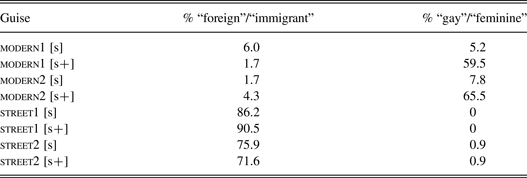
Table 4 shows the distribution of responses representing categorizations of ethnicity and gender/sexuality across all 116 informants in the open questionnaire experiment. Labels concerning ethnicity most often had to do with labeling the speaker “immigrant-like” or “foreign,” and only seldom as “Danish.” Similarly, labels concerning sexual orientation always involved labeling a speaker as “gay,” “queer,” and so on, that is, none of the informants ever used terms connoting heterosexuality, for example, “straight” or “ladies man.” Finally, with respect to “femininity,” it was observed that no responses contain categorizations like “masculine,” “male-sounding,” and so on.
Distribution of responses to the guises (n = 116).
There were no statistically significant differences between the voices used to represent each style, that is, the differences between modern1 and modern2 were nonsignificant as were the differences between street1 and street2 (p > 0.05 in all cases). This is true both for responses concerning ethnicity as well as for responses concerning gender/sexuality.
As is immediately apparent, the main differences in both domains of social meaning are between the modern guises on the one hand and the street guises on the other. The modern guises are almost never labeled as foreign, whereas the street guises are very often labeled as foreign. This is true irrespective of the variant of (s) in the guise. With respect to perceived sexuality, the street guises are (almost) never labeled as gay, whereas the modern guises are, and crucially much more often in the [s+]-versions (p < 0.001 in both cases). These patterns in the responses were the same for all groups of listeners, for example, there was no differences between the two schools.
Taken together, these results indicate that the fronted variant of (s) has different potentials for social meaning depending on the prosodic context it occurs in: when [s+] occurs in the context of street prosodic traits, there is no apparent effect, but when it occurs in modern speech, there is a very strong effect in one particular domain of social meaning. The observed effect is what is to be expected on the basis of popular beliefs about males who use [s+]. There is no sign that [s+] leads to perceptions of the speaker as more “street” sounding, despite the fact that the [s+] variant has been observed in spontaneous speech among boys who use features from the street cluster, and is also a common trait in imitations of street. While the responses give a clear indication that a single phonetic variant may cause a drastic shift in perceptions of speakers, we cannot be certain that the lack of an effect in the street guises can be interpreted as a sign that [s+] cannot have the same social meaning in this style. Even though the responses to the street guises taken together do indicate that [s+] is simply perceived to be a feature of the street cluster, or at least not in conflict with the street cluster, it is also possible that our young informants have felt that the labels “foreign” and “gay” cannot be combined, either because of a stereotypical belief that adolescent boys with a foreign background are not gay, or because the sexuality trait is not as salient when categorizing street as traits concerning ethnicity are. Furthermore, we did not explicitly test whether the informants perceived the difference in the pronunciation of (s) in the different versions of the matched guises. Some of the participating pupils mentioned that they had noticed the (s)-quality, but only seventeen out of all 116 informants mentioned this in the last questionnaire, where they were asked to write down specific traits.
Therefore, we decided to conduct a follow-up experiment in which we would both (i) require the informants to rate all guises on a set of fixed scales, and (ii) explicitly test whether informants heard the variants of (s) that had been inserted into the guises. By ensuring that all informants rate all guises with respect to both ethnicity and sexuality, we should be able to tell whether the two domains are largely mutually exclusive in the perceptions of male identity by adolescent listeners, or whether the lack of an effect on perceived sexuality for the street guises in the open-questions experiment is more likely due to the fact that ethnicity is the more salient domain of social meaning.
Experiment 2: Fixed scales
Methodology
Experiment 2 was carried out at the same two high schools, eighteen months after Experiment 1. There were ninety-seven participating pupils from the urban school and 117 from the suburban school, yielding a total of 234 informants. None of the informants from Experiment 1 participated in Experiment 2.
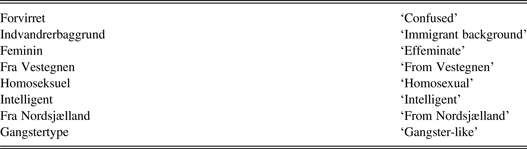
Based on the responses to the open-ended questionnaires, eight traits were identified as particularly important to the adolescents. New groups of listeners were asked to rate each of the guises on eight scales corresponding to those traits. The scales are shown in Table 5.
The eight evaluative items used in the experiment.
Note that Vestegnen denotes the Western suburbs of Copenhagen, which are traditionally associated with low middle-class and working-class families, whereas Nordsjœlland denotes the Northern suburbs of Copenhagen, which are traditionally associated with upper middle-class and upper-class families.
Each scale ranged from 1 to 5 with 1 corresponding to “No, not at all” and 5 corresponding to “Yes, very.” After completing the ratings, the listeners were presented with the two (s)-variants and asked to say which type of (s) they heard in each of twelve short recordings, namely the eight guises and four fillers. Finally, informants supplied demographic information through the same questionnaire as used in Experiment 1.
Results: The guises
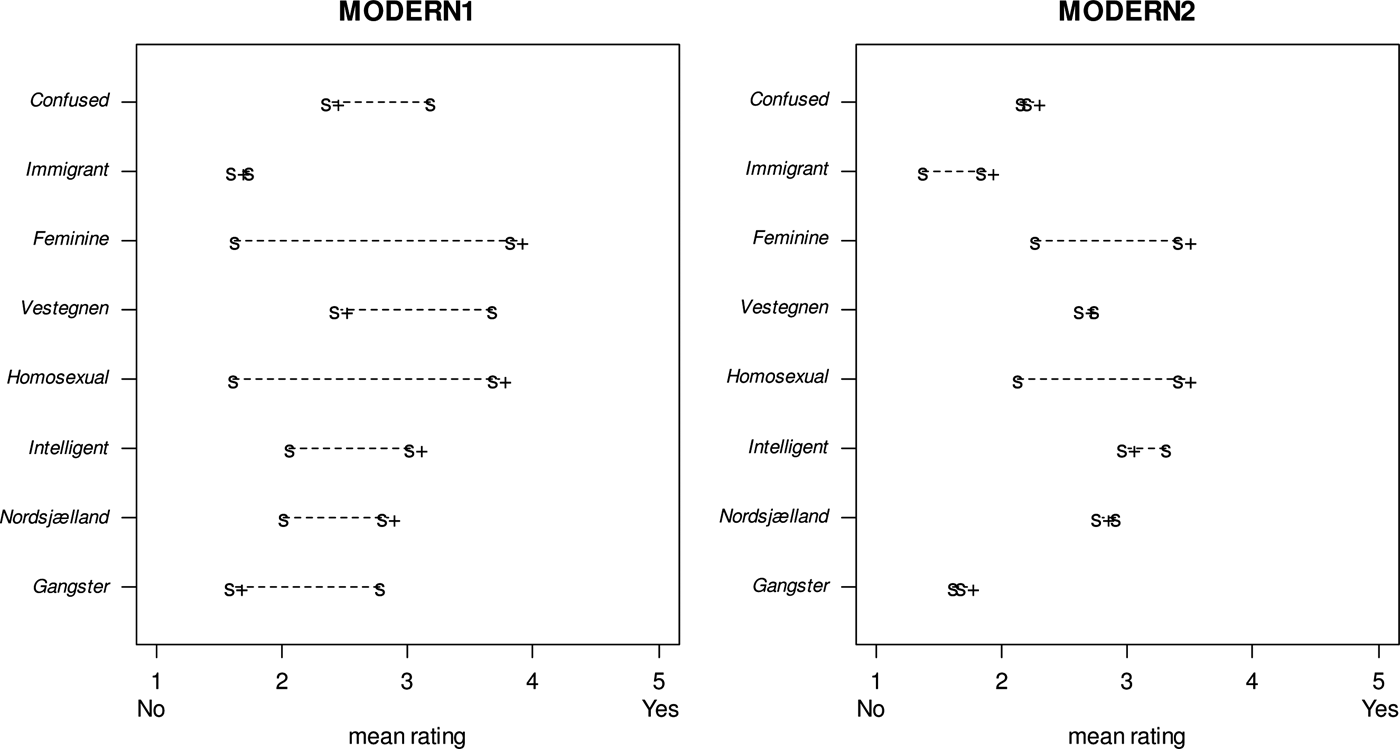
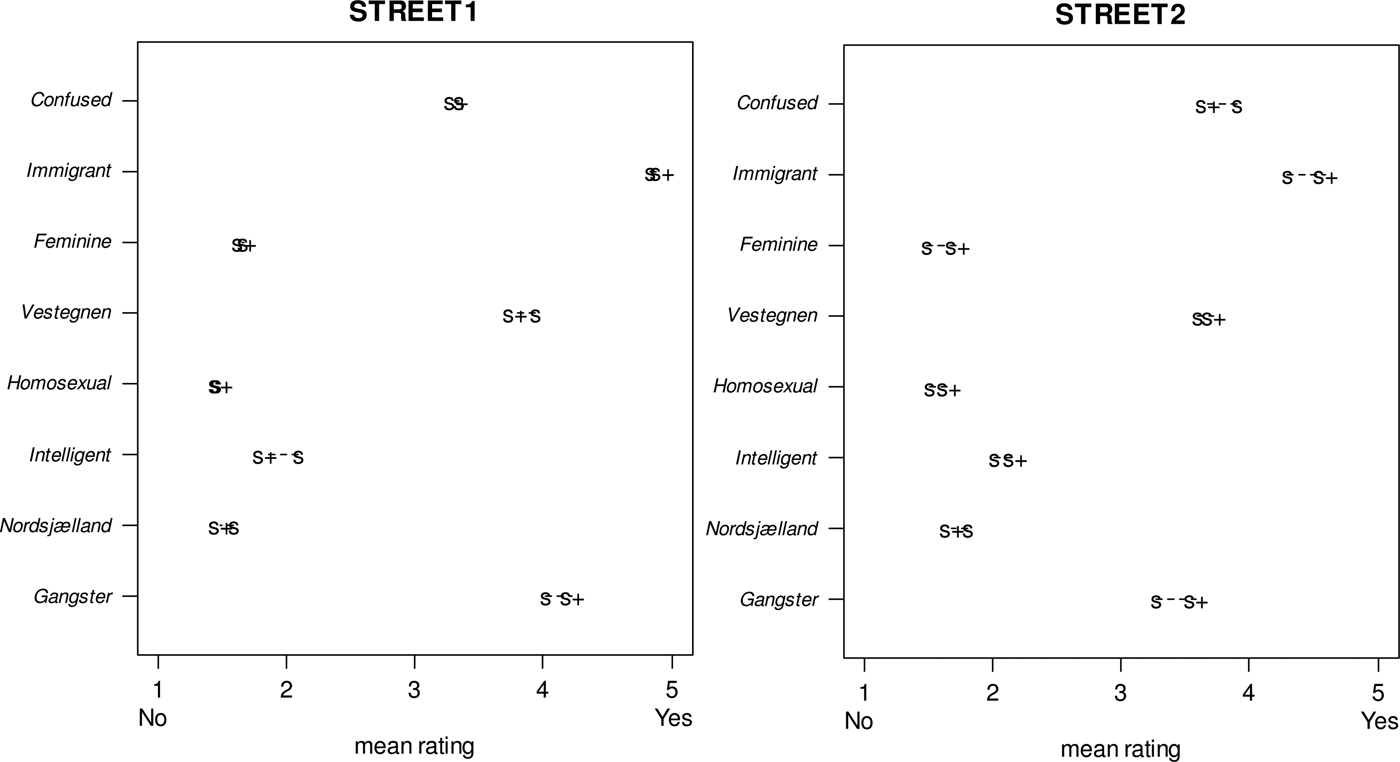
We start by presenting the results for each of the guises in Figures 1 and 2 below. The names of the scales are given on the y-axes and are shown in the order they appeared on the questionnaire. The mean rating on each of the eight scales is shown with ‘s’ marking the mean rating for the guise containing [s] and ‘s+’ marking the mean rating for the guise containing [s+].
Average ratings of the modern guises.
Average ratings of the street guises.
The graphs show a number of similarities and differences in the ratings of the two modern voices. The major difference is that the variation in (s) quality has a greater effect on the rating of the modern1 voice than in the rating of the modern2 voice. In fact, the difference in average rating for the modern1 voice is statistically significant on seven of the eight scales (p < 0.001 in all cases according to Wilcoxon rank tests). The only scale where the variation in (s) shows no effect is the immigrant background scale (p = 0.38), where both means are relatively low, indicating that the modern1 voice is never perceived as having an immigrant background, irrespective of the variant of (s). The modern2 voice also shows statistically significant differences between the ratings as a function of the variant of (s), but only on the scales immigrant background, feminine, homosexual, and intelligent (in all cases p < 0.005 or better). The effect of (s) variation is similar for the two modern voices on the scales feminine and homosexual: both guises with [s+] have higher means on these scales indicating that the majority of informants judged them more feminine and homosexual. As mentioned, there was no effect on the immigrant background scale for modern1, but for modern2 the [s+] guise was perceived more immigrant-background-like than the version with [s]. It is worth noting, however, that the mean scores are 1.1 for the [s] guise and 1.6 for the [s+] guise, meaning that both modern2 guises were evaluated as not seeming very much like a speaker with an immigrant background. Curiously, the two voices are also perceived differently on the intelligent scale, with modern1 seeming more intelligent in the [s+] guise, and modern2 seeming less intelligent. It is plausible, however, that the effect observed for modern1 stems from the fact that his [s] guise was the first sample played. Listeners may have been unprepared for the fact that the samples were taken from map-task dialogues, hence leading to the perception of this guise as confused and less intelligent sounding.
Taken together, the comparison of the two modern voices shows that while there are differences between the two, they are both consistently perceived to seem more feminine and gay in the [s+] guise, in accordance with our examples from public discourse about men who speak with [s+]. Next we look at the street voices, again with the [s] and [s+] guises plotted together.
Looking at the ratings of the two street voices, we see that the patterns are very similar with respect to the variants of (s). There is a somewhat larger effect for street2 than for street1, but all in all the mean ratings on each scale are very similar for the two voices and for the two guises of each voice. Some of the differences between the guises, however, are statistically significant: Street1 is judged to seem more like an immigrant in the [s+] guise, and this guise is also judged to seem less intelligent (p < 0.005 in both cases). Street2 is also judged to seem more like a speaker with an immigrant background in the [s+] guise (p = 0.002) as well as more feminine (p = 0.02) and more gangster-like (p = 0.007). A last difference between the two street voices concerns the scale confused, since the difference in rating with respect to the variant of (s) is statistically significant for street2 also on this scale: he is judged to seem less confused in the [s+] guise (p = 0.02). It is worth noting, however, that any difference in the ratings between the guises of the street voices is quite small compared to the differences observed for the modern voices. The largest difference in means for any of the street guises is 0.3 on the immigrant background and gangster scales for the street2 guises. The fact that the differences are found on these scales supports the hypothesis that there is some awareness of the use of the fronted variant of (s) in the street register (cf. above and Maegaard Reference Maegaard, Maegaard, Gregersen, Quist and Jørgensen2009). The differences, however, are generally larger for the modern voices with a difference of 2.3 in the mean rating of modern1 on the feminine scale, and a difference of 2.1 on the homosexual scale; the modern2 guises show a difference of 1.2 and 1.3 on the feminine and homosexual scales.
Looking at the patterns together, the ratings support the findings from Experiment 1 using open questions: variation in the pronunciation of (s) is sufficient for triggering different perceptions of a male speaker, in particular when the variation occurs in a modern prosodic context. When the variation occurs in a prosodic context associated with the street register, the effect is only small, and generally concerns different personality traits, although as mentioned above both of the modern guises and the street2 guise show an effect of (s)-quality on the feminine scale.
Results: The scales
To analyze the responses in more detail, a logistic regression model was fit to the responses on each of the scales, with the responses modeled as an ordered factor. The predictors included in the model were: s-quality in the guise, prosodic frame, language(s) spoken with friends, language(s) spoken at home, and the informant's gender. These background factors were chosen on the assumption that linguistic background and experience might be of importance to the perception of the guises. Other demographic factors typically used in sociolinguistic studies include age, social class, and ethnicity. As all respondents were between sixteen and eighteen years old, we did not ask about age. We also avoided asking about ethnicity and social class as these factors may be difficult to assess, and, more importantly, unpleasant to be inquired about for many of the informants. This also applies to a factor like sexuality, which would have been interesting to this study, but difficult to elicit data on from these young respondents.
Final models were stepped down from this full model and further validated and penalized (using the function pentrace in R 2.7.2) to provide the most accurate tests for significance and to avoid inflated estimates of coefficients (cf. Baayen Reference Baayen2008:203–6 for details).Footnote 7
Background factors for the informants were included in order to be able to check for possible differences between informants who spoke only Danish and those who spoke a variety of languages among friends or at home, as well as to check for differences between male and female informants. The central interest in this study, however, is how the s-quality of the guise, as well as the prosodic frame, affect responses on the scales, in particular responses on the scales homosexual, feminine, immigrant, and gangster-like. Based on the responses to the open questions, we would expect an interaction of s-quality and prosodic frame on the scale homosexual and possibly also on the feminine scale. This is because an increase in labeling speakers as gay-seeming was only found for the modern guises that had [s+], whereas there was no sign of an effect of s-quality for the street guises. For the immigrant and gangster scales, we expect simple main effects of s-quality and prosodic frame only.
Homosexual
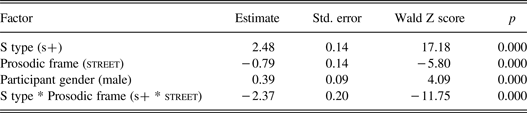
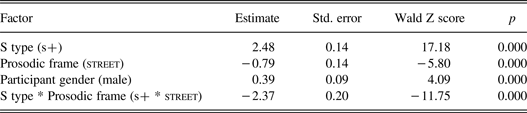
The final model for the scale homosexual is shown in Table 6. Factors are given in the first column with the modeled level given in parentheses.
Model summary for the scale homosexual.
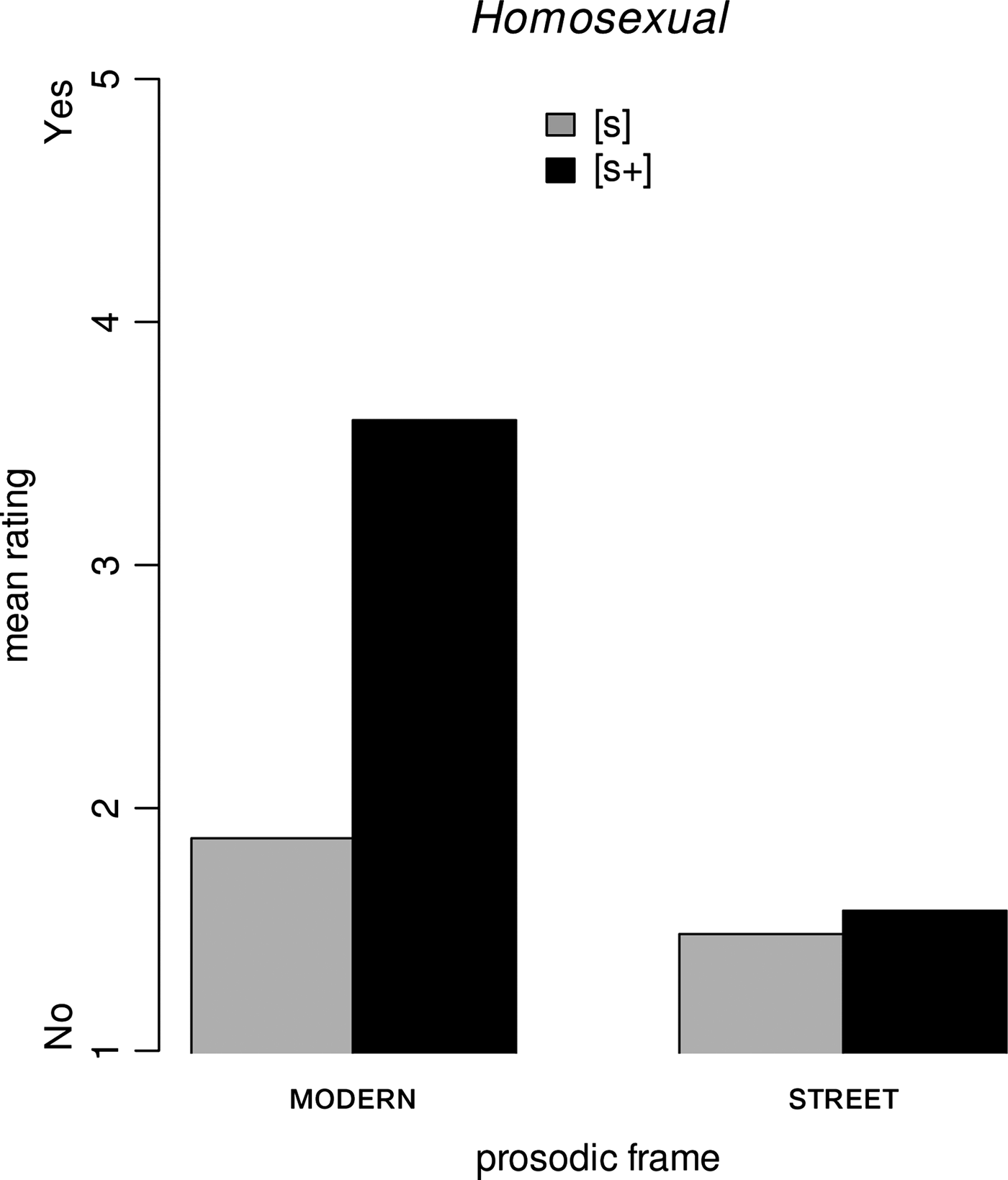
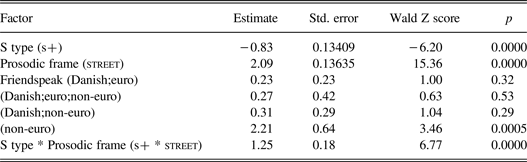
Estimates are given in log odds, and positive values show that the given factor level leads to an increase in mean rating on the scale, for example, [s+] leads to a higher rating compared to [s], and negative values show that the factor level leads to a decrease in mean rating, for example, the street frame leads to a lower mean rating compared to the modern frame. Note that the values of the estimate do not correspond to units on the rating scale. Statistical significance of the factors and possible interactions are given in the last column. The mean ratings are displayed in Figure 3.
Average ratings on the scale homosexual.
As can be seen from the model, the interaction of s-quality and prosodic frame is statistically significant with gender also showing a slight effect indicating that male listeners were more likely to label a guise as seeming more gay than female listeners.Footnote 8 The interaction is displayed in Figure 3. The diagram shows the expected effects: there is a big difference in the average rating for modern guises as a function of s-quality, with [s+] guises being rated higher on the homosexual scale than [s] guises. For the street guises, however, there is no effect of s-quality; they are always rated low on the homosexual scale.
Feminine
We observe similar effects for the scale feminine. The final model is shown in Table 7.
Model summary for responses on the scale feminine.
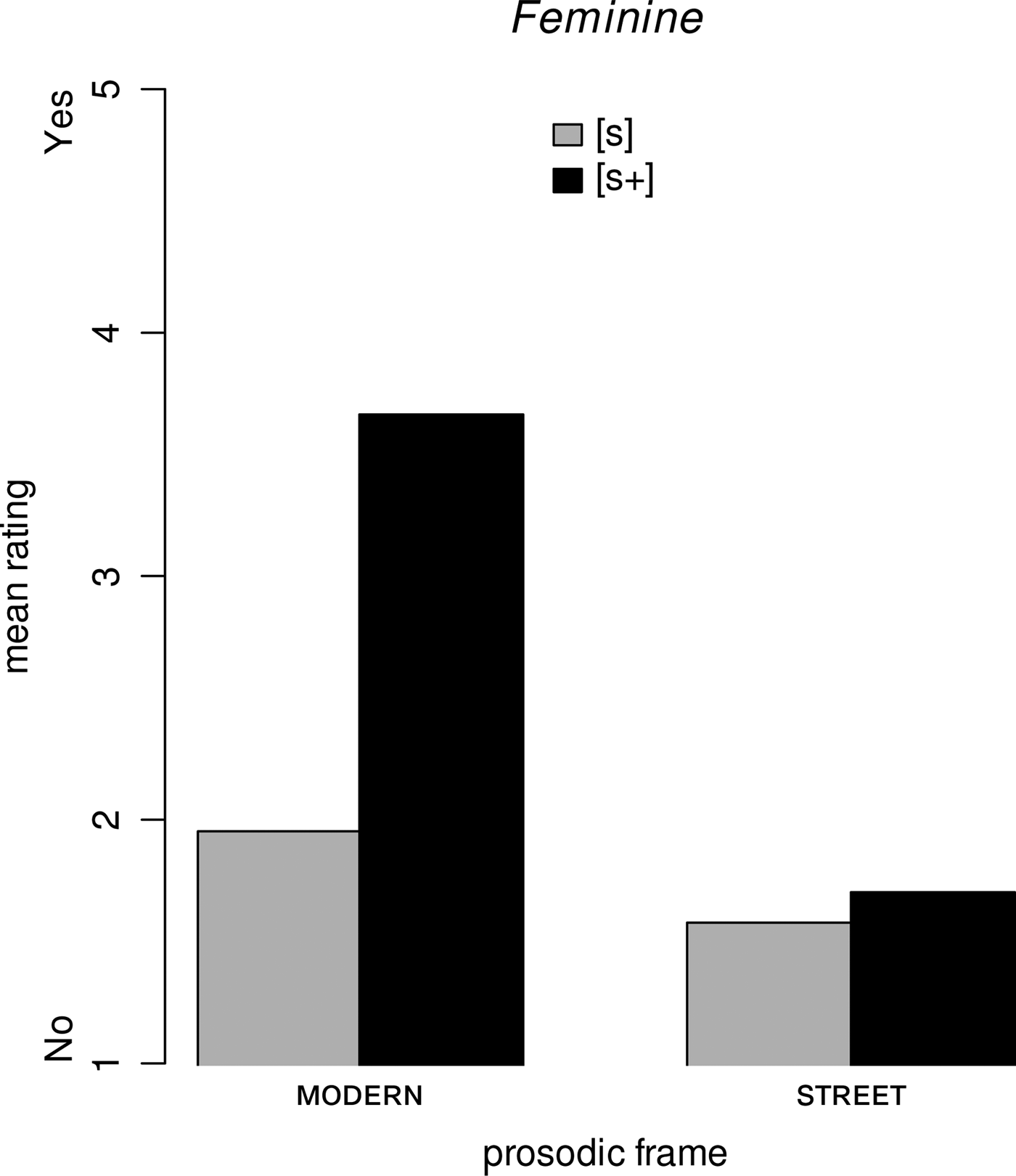
This model is very similar to the model for the responses on the scale homosexual. The interaction of s-quality and prosodic frame is shown in Figure 4.Footnote 9 Again, the effect found on the responses to the feminine scale is what we would expect from the open questions: s-quality makes a big difference in the average rating of modern guises, but has no effect on the street guises. Street guises are always rated low on the feminine scale, whereas modern guises with [s+] are rated fairly high on the feminine scale on average.
Average ratings on the scale feminine.
Taken together, the results from the scales homosexual and feminine indicate that the patterns found in the answers to the open questions cannot necessarily be attributed to a reluctance towards labeling speakers with more than one negative stereotype, nor that the immigrant stereotype is more relevant in the evaluation since even when listeners are forced to evaluate all guises on the scales of sexuality and gender, we only find an effect for the modern guises. Thus it is clear from the results that [s+] does not contribute to the same social meaning when used in street as when used in modern.
Immigrant
We turn now to the evaluation of the guises on the scales pertaining to male youth in ethnically mixed environments. The prosodic frame of the street register is strongly associated with ethnicity (cf. Møller Reference Møller, Maegaard, Gregersen, Quist and Jørgensen2009, and above), and therefore we would expect a simple main effect of prosodic frame on the ratings (which is also what we saw in the answers to the open questions). As mentioned earlier, however, [s+] has also been observed in spontaneously occurring street speech and appears to be part of the popular image of the street register. Therefore we could expect a simple main effect of s-quality, too. We start by looking at the scale immigrant; the final model is shown in Table 8.
Model summary for responses to the scale immigrant.

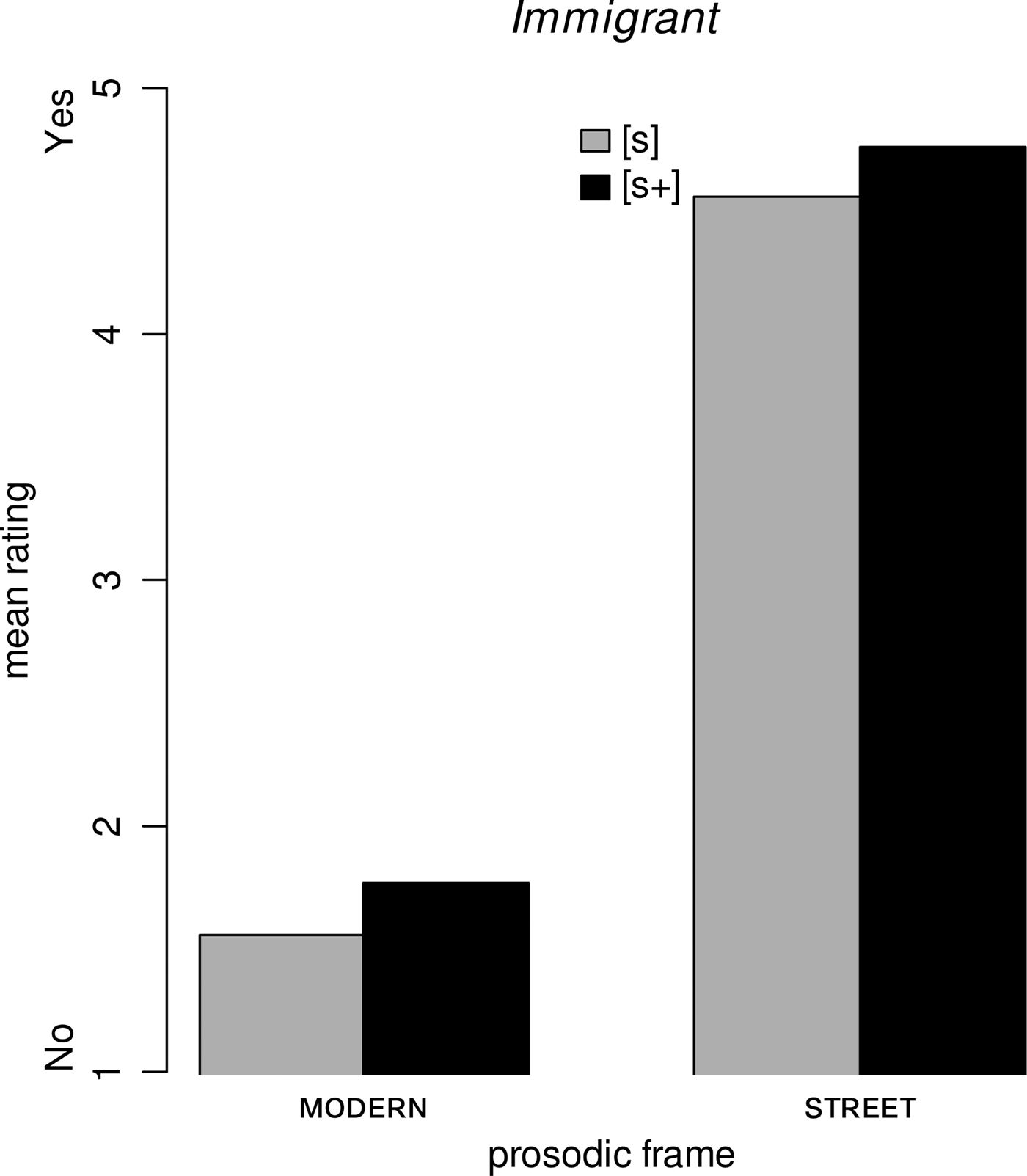
The interaction of s-quality and prosodic frame did not emerge as significant (p = 0.137). Only the main effects of s-quality and frame emerge as significant, and they are shown in Figure 5. Once again, the responses have been grouped by prosodic frame of the guise, even though there was no interaction of the two factors.
Average ratings for the scale immigrant.
As can be expected from the estimates of the model, the diagram shows that the prosodic frame has the strongest effect on responses on this scale: street guises are much more likely to be rated as immigrant-seeming than modern guises are. Within each prosodic frame there is a slight (but statistically significant)Footnote 10 effect of s-quality, with [s+] guises being more likely to be labeled as immigrant-seeming. Again, the results from responses to the scales are very similar to that found in the open questions, except that the effect of s-quality emerges as statistically significant.
Gangster
As before, the full model was fit, stepped down, validated, and penalized, and the final model is shown in Table 9.
Model summary for responses to the scale gangster.
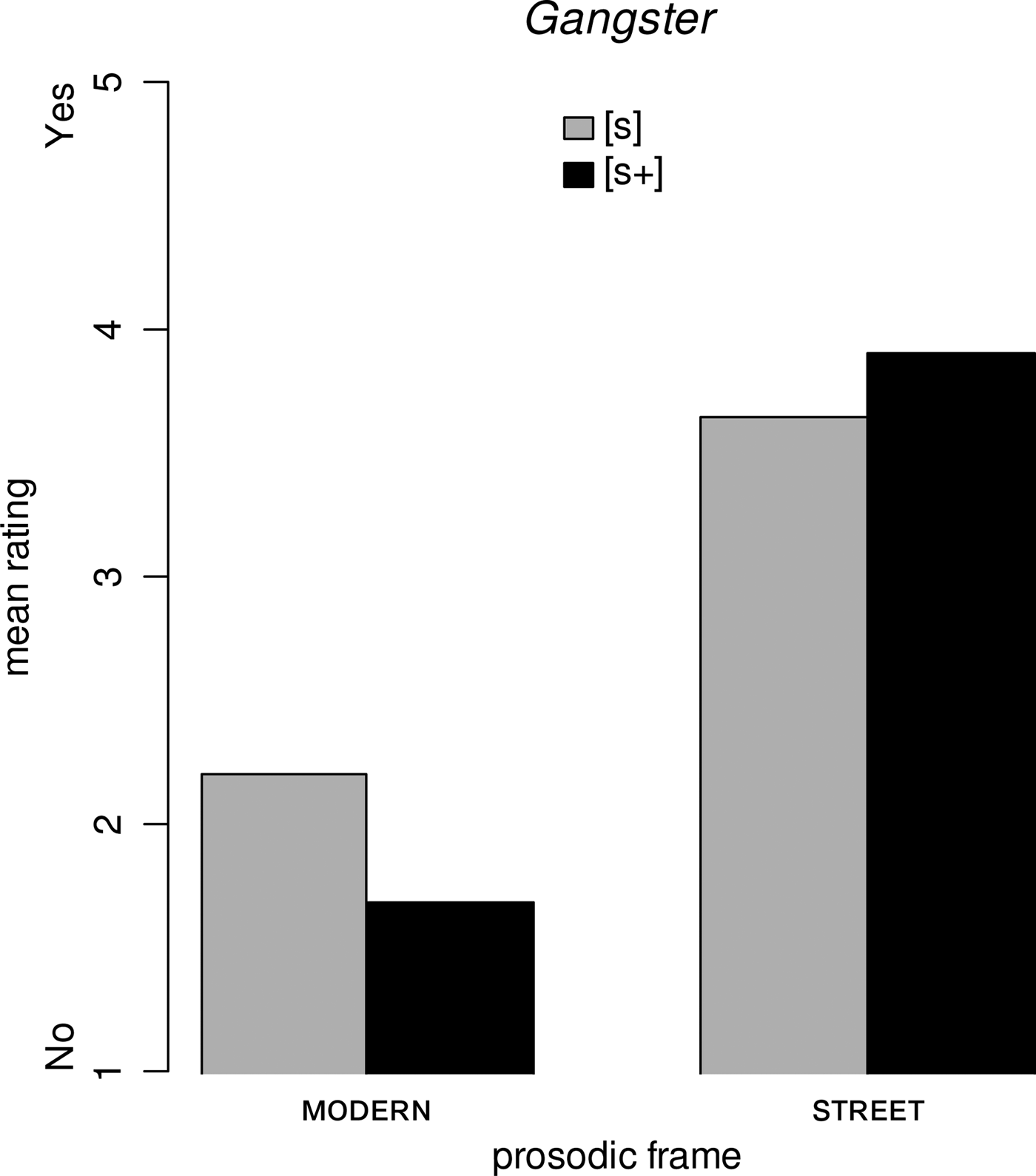
Interestingly, the interaction of s-quality and prosodic frame emerges as significant, and there is also a main effect of language(s) spoken with friends.Footnote 11 The interaction of s-quality and prosodic frame is shown in Figure 6.
Average ratings on the scale gangster.
As with the immigrant scale, street guises are generally rated higher on the gangster scale, whereas modern guises are rated low. [s+] gives a slight increase in gangster rating for street guises, but shows a decrease in gangster rating for modern guises. In other words the exact same representation of [s+] has opposite effects on the perceptions concerning the gangster scale depending on the prosodic frame. This indicates that [s+] is associated with distinct ideological schemes across the street and modern guises and, furthermore, that [s+] actually contributes actively to the gangster persona and therefore should be viewed as part of the street register on the condition that it co-occurs with other enregistered street features such as the prosodic frame. As mentioned, [s+] diminishes a gangster association when occurring in the modern guises. A possible explanation is that a high score on the gangster scale is not compatible with the high scores we found for the [s+] modern guises concerning the scales feminine and homosexual (see Figures 3 and 4). We also know from Experiment 1 that gangster is not a relevant category when the respondents describe the modern guises.
Competence and regional background
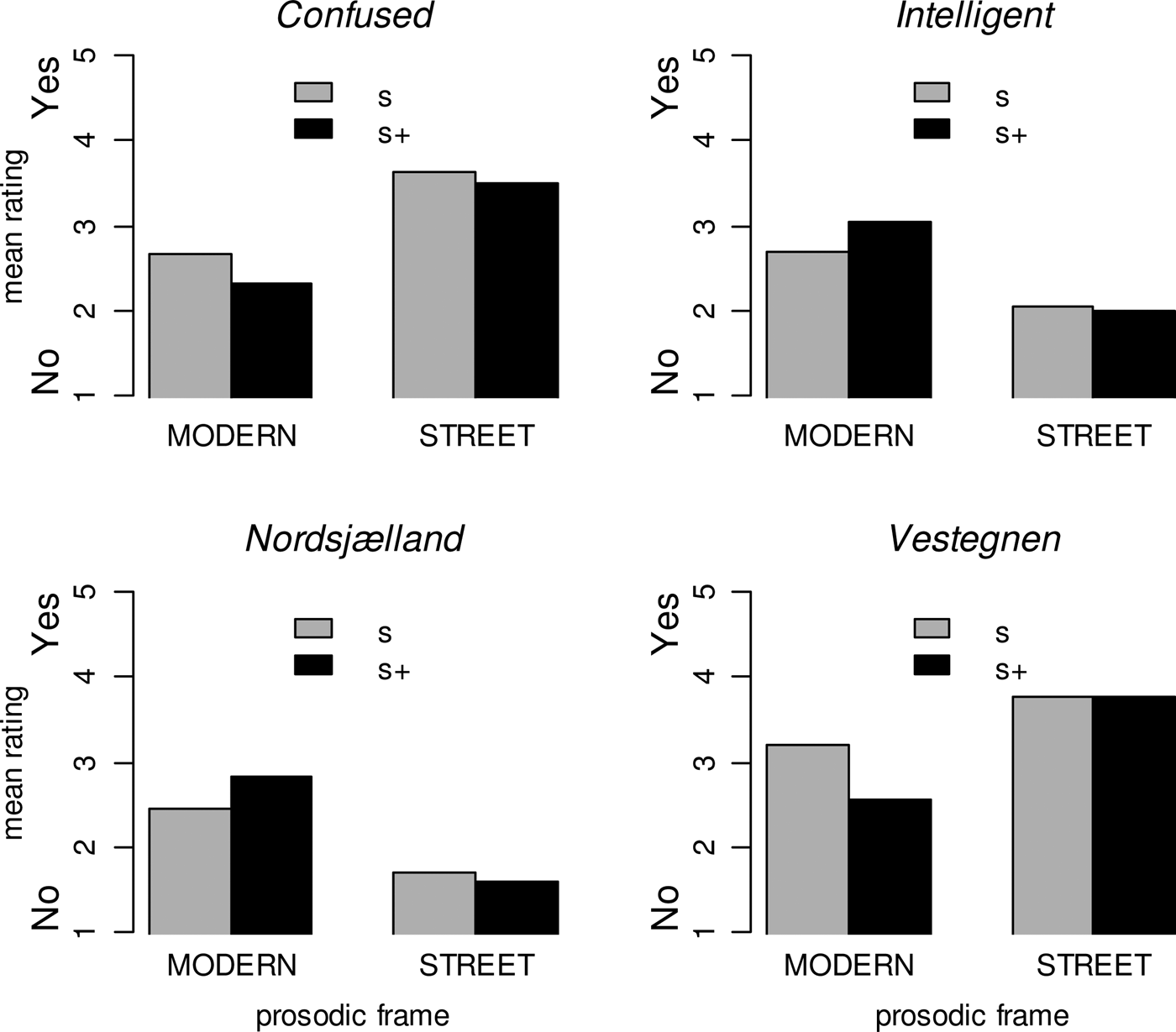
The focus so far has been on the traits that emerged from Experiment 1, in particular to see whether asking informants to rate the guises on traits having to do with gender and sexuality and traits having to do with ethnicity and “street-credibility” would yield different patterns from the ones we found using the open questions. However, we also used traits having to do with competence, that is, confused and intelligent, and traits having to do with regional background, that is, whether the listener thought the guises were spoken by a boy from Nordsjælland (the area north of Copenhagen) or from Vestegnen (the area west of Copenhagen). These traits were all chosen because they frequently occurred as descriptive labels in the answers to the open questions. The traits concerning regional background are particularly interesting, since they seemed to show an association between [s+] and being perceived as being from Nordsjælland, and street prosody seemed to be associated with Vestegnen. The s-quality and the prosodic frame had statistically significant effects for each of the four scales.Footnote 12 The effects are shown in the graphs in Figure 7.
Average ratings on scales of competence and regional background.
For the scale confused there were simple main effects of s-quality and prosodic frame, [s+] guises were rated slightly less confused, whereas street guises were generally rated more confused. For the scales intelligent, Nordsjælland, and Vestegnen there was an interaction of the two linguistic parameters. The interactions for intelligent and Nordsjælland are similar: the street guises generally score low on these scales and the s-quality does not change this (just like there was no effect of s-quality on the ratings on the scales homosexual and feminine). The modern guises are rated somewhat higher on the two scales, and importantly [s+] guises show a statistically significant increase. For the trait Vestegnen the effect of [s+] is again only relevant for the modern guises, since all street guises are rated high on the scale, suggesting that listeners associate street prosody with the western part of the greater Copenhagen area. Modern prosody also looks to be a speech trait that is associated with this area, but not as much for the [s+] guises. This complements the finding on the Nordsjælland scale, and taken together the results on the two regional scales suggest that there is an association between [s+] and being from the northern part of the greater Copenhagen area.
Nonlinguistic effects
In addition to the effects of s-quality and prosodic frame, a number of the background factors also have an effect on the evaluation of the guises. These factors all emerged as simple main effects in the models, and thus show general tendencies for differences in evaluations on the scales, and not tendencies associated with the phonetic differences between the guises. Therefore we do not go into detail with these effects here, but only briefly mention a few patterns that emerge from the regression models. The gender of the informants affect their rating of the guises on the scales homosexual and feminine, where male informants generally rate the guises higher than female informants do. This is also the case for the scale Vestegnen, whereas female informants rate guises more highly on the scale intelligent.
We asked informants to write down the languages they spoke with their friends and at home. So far, we have treated this background information in a relatively coarse-grained way, by dividing the languages into three categories. We find some interesting tendencies that emerge from the regression models, for example, that informants who report speaking languages not primarily associated with European communities with their friends are more likely to rate guises highly on the gangster-like and Vestegnen scales. Assuming that the indication of the languages that they speak can be interpreted to reflect their background and identification with particular groups of people, this result would seem to indicate that informants who associate themselves with a minority background (those that speak a certain type of foreign languages) are also more likely to rate the guises highly on scales associated with a particular type of identity, here, that of the gangster-like minority boy who lives in the less affluent suburbs of Copenhagen. However, more detailed work is needed in order to gain a better understanding of the associations between the different scales themselves and between the scales and the background of the informants.
Results: Recognition of (s)-variant
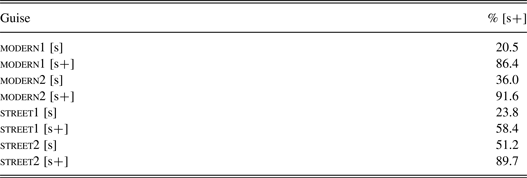
The similarities in the evaluations of the street samples indicate that it does not matter much whether street speech contains [s] or [s+]. This raises the question if the informants hear the difference at all. Our last type of data partly answers this question. After rating the guises on the eight scales, all 234 informants were introduced to the two types of (s), were asked to listen to the audiorecording once more and mark which variant they heard in each of the eight guises (and four additional fillers). The percentage of informants that said they heard [s+] is given for each guise in Table 10.
Percentage of respondents that reported to hear [s+] by guise (n = 234).

The tendency is that the informants heard the variants correctly, in the sense that the majority classified the (s) of the guise in agreement with the variant that had been spliced in. This tendency is strongest for the modern guises, where the informants relatively successfully marked the [s+] variant. Still, a lot of them hear [s+] in the samples where [s] had been inserted. This may be explained by the task where we specifically ask the informants to focus on the s-quality. The tendency for marking the inserted variant correctly in the street guises is not as clear even though it is still there. There is a difference between the two street guises that we do not find in the modern guises. In street1 [s] the informants identify the [s] with approximately the same frequency as they did in modern1 [s] but when it comes to identifying the [s+] in street1 [s+] the frequency is just above 50%, indicating that the recognition of [s+] for a range of informants did not occur in this specific linguistic context. For the street2 pair of guises the situation is exactly the opposite: the [s+] guise is recognized with a high frequency (89.7%) but the [s] guise is judged to contain [s+] in 51.2% of the answers. These results indicate that the informants have more difficulties distinguishing the two types of (s) in the street guises than in the modern guises. Since it was the same tokens of [s+] and [s] that were used, this result suggests that the linguistic context (in this case prosody) not only plays a role for the social meaning potential but also for the fundamental recognition of certain variants. In other words, it is possible that the more social potential a specific linguistic variable has, the more potential the variant has to be recognized. This is not a surprising link, considering theories of salience, where the more sociolinguistically salient features are usually thought to be either adopted or avoided (Trudgill Reference Trudgill1986; Hinskens Reference Hinskens1996; Kerswill & Williams Reference Kerswill, Williams, Jones and Esch2002); either way, they will be noticed in the speech of others to a larger degree than other features. This proposal, however, needs further exploration to be substantiated.
Discussion
The results from the above analyses are interesting in several ways. One of the main findings is the very different social meaning of a linguistic feature depending on the register in which it occurs. The [s] and [s+] contributes to very different social meanings when appearing as part of the two different registers modern and street.
This finding supports results from researchers such as Campbell-Kibler (Reference Campbell-Kibler2011) and Podesva (Reference Podesva, Shaw, Wagner and Yasui2008) who have examined the diversity of social meanings that can be linked to specific linguistic features. Our results can be said to further strengthen this line of research. In their complexity they seem hard to encompass in Silverstein's theoretical framework, where the indexical meanings of a feature are related, in that the “n + 1st order indexicality is thus always already immanent as a competing structure of values potentially indexed in-and-by a communicative form of the n-th order, depending on the degree of intensity of ideologization” (Silverstein Reference Silverstein2003:194). Our study, suggests two (more or less) distinct indexical fields, each tied to a specific register. It is clear that listeners invoke very different ideological schemes, dependent on the register, and this is perhaps not surprising, recalling Johnstone's observation, that “the same feature can be enregistered in several different ways” (Reference Johnstone2009:160). The radical nature of this difference is striking, however, and calls for further developments of theories of indexicality.
Furthermore, the perception tests have shown that the same phonetic feature is recognized to different degrees depending on the register. Judging from our results it seems that when a feature has strong indexical potential it is more easily recognized than when it has weak indexical potential.
While these results show a strong effect of a single feature, they also clearly indicate the importance of clusters of features in the evaluation and hence ascription of social meaning by listeners. This raises the question of how linguistic features are grouped by listeners and whether other features might be combined with [s+] to trigger different perceptions. Here we have found prosody to be important, but another segmental feature, palatalized /t/, is also known to be prevalent in the street register (Maegaard Reference Maegaard2007, Reference Maegaard, Quist and Svendsen2010), and manipulations involving different combinations of variants of (s) and (t) might be interesting in future research on the topic.
Appendix: Transcripts of the guises used in Experiment 1 and Experiment 2
MODERN1
Så kommer der sådan en vej der går opad og kører ud i den der sø. Den hedder Stakitvej. Øh og der er så øh der er også sådan en øh sort prik. Det er en scooterbutik.
‘The there is like a road that goes up and ends in that lake there. It's called Stakitvej. Erm and then there's erm there's also like um a black dot. That's a scooter shop.’
MODERN2
Er du klar? Så går du ned af og så øh lige inden det der næste kryds der der går til venstre ikk? Så sætter du Lagunevej.
‘Are you ready? Then you go down and um right before the next intersection there that goes to the left right? There you put Lagunevej.’
STREET1
Så går du til øhh venstre, så kommer der Bananvej. Lige den der streg hvor du drejer. Og så er der en streg sådan der til øh højre.
‘Then you go um left, then that's Bananvej. Right at that line where you turn. And then there's a line like um to the right.’
STREET2
Så skal du skrive øhh bikuber bikuberne ikk? Lige så snart du kommer nedad og så nedeunder gaden så skal du skrive Cubavej.
‘Then you should write erm beehives the beehives right? As soon as you go down and then below the street you have to write Cubavej.’