Introduction
Major depressive disorder (MDD) and bipolar depression (BD) are prevalent and burdensome mood disorders; they are among the number-one causes of disability across medical diseases, in terms of years lived with disability.1 One of the major challenges in treating mood disorders is the related poor response/treatment resistance to standard pharmacological treatments.Reference Nemeroff2–Reference Carvajal4 Indeed, major international treatment guidelines recommend pharmacological and nonpharmacological augmentation strategies in such contexts.Reference Bauer, Whybrow and Angst5, Reference Kennedy, Milev and Giacobbe6
Among nonpharmacological augmentative strategies, transcranial direct current stimulation (tDCS) is a non-invasive brain stimulation intervention that has been studied for the treatment of major depression and resistant depression with encouraging results.Reference Fregni, Boggio and Nitsche7–Reference Palm, Schiller and Fintescu15 In tDCS, a weak current passes through the scalp, increasing or decreasing the cortical activity of the stimulated area. In particular, anodal tDCS leads to neuronal depolarization and, consequently, to an increased excitability of the local cerebral cortex. On the other hand, cathodal tDCS determines hyperpolarization, reducing cortical activity.Reference Nitsche and Paulus16, Reference Nitsche and Paulus17 Given the possible presence of a prefrontal perfusion asymmetry in depressed patients, with hypoactivity in the left dorsolateral prefrontal cortex (DLPFC) and related hyperactivity in the right DLPFC,Reference Grimm, Beck and Schuepbach18 tDCS delivered bilaterally, with the anodal electrode placed over the left DLPFC and the cathodal one over the controlateral area, is supposed to restore the premorbid functional balance between the two hemispheres.Reference Dell'Osso, Zanoni and Ferrucci19 Moreover, findings from electrophysiological studies have revealed that tDCS may strengthen synaptic connections through a mechanism similar to long-term potentiation, may modulate neurotransmitter systems, and may promote brain derived neurotrophic factor–dependent synaptic plasticity.Reference Dell'Osso, Priori and Altamura20 Finally, tDCS seems to induce changes in resting membrane potential, spontaneous neuronal firing rates, cerebral blood flow, and metabolism.Reference Ardolino, Bossi, Barbieri and Priori21, Reference Liebetanz, Fregni and Monte-Silva22
Given that the modulatory effects of tDCS over the cortex can be long-lasting, its action on cognitive and emotional functions has been the object of investigation in healthy subjects as well as in neurologic (eg, stroke rehabilitation) and psychiatric disorders (eg, major depression).Reference Dell'Osso, Priori and Altamura20 Taken as a whole, relatively few acute studies with tDCS have been published in the treatment of major depression.Reference Dell'Osso, Zanoni and Ferrucci19, Reference Kalu, Sexton, Loo and Ebmeier23, Reference Brunoni, Valiengo and Baccaro24 Among these, 6 studies have examined the effect of the technique in a double-blind, sham-controlled design in depressed patients,Reference Fregni, Boggio and Nitsche7, Reference Boggio, Rigonatti and Ribeiro8, Reference Loo, Sachdev and Martin11, Reference Blumberger, Tran, Fitgerald, Hoy and Daskalakis13, Reference Palm, Schiller and Fintescu15 while the remainder examined patients with treatment-resistant depression (TRD) under open-label conditions.Reference Ferrucci, Bortolomasi and Vergari10
To the authors’ knowledge, in previous studies, the maximum follow-up period after acute tDCS consisted of 1 month. In particular, Boggio etal Reference Boggio, Rigonatti and Ribeiro8 studied the effects of tDCS in 40 drug-free depressed patients under double-blind conditions. Their findings showed that the clinical benefits of tDCS were maintained for 1 month after the treatment.
In a recent open study conducted by our group, further improvement of depressive symptoms in 23 patients, after 10 acute tDCS sessions, was observed after 1 week of follow-up, with no added maintenance sessions.Reference Dell'Osso, Zanoni and Ferrucci19
Two recent studies, moreover, with depressed patients receiving maintenance tDCS treatment for a period up to 6 months, reported overall positive results except for patients with previous treatment resistance.Reference Martin, Alonzo and Ho25, Reference Valiengo, Benseñor and Goulart26 Given the limited availability of post-acute reports about the efficacy and tolerability of tDCS, particularly in terms of discontinuation effects (ie, with no maintenance session), the present study was aimed to evaluate such aspects over the mid-term follow-up period, up to 3 months (T4) after acute tDCS.
Methods
The acute tDCS trial, with related stimulation parameters, has been described in detail elsewhere.Reference Dell'Osso, Zanoni and Ferrucci19
All of the 23 outpatients who completed the acute trial entered a 3-month follow-up observation. Medications were required to be maintained substantially unchanged for the entire duration of the follow-up, and no patient had changed medication regimen for at least the 4 weeks preceding the beginning of the study. With respect to the follow-up observation, in particular when patients needed the addition of a benzodiazepine or a minor dose adjustment of an already prescribed compound (ie, ≤ 25% of the current dose), these were maintained in the follow-up. On the other hand, when a major change in therapy was necessary according to clinical judgment (eg, administration of a new compound or major dose change of a previous one), those patients were excluded from the follow-up.
Primary outcome measures consisted of: the Hamilton Depression Rating Scale (HAM-D) 21-item versionReference Hamilton27 and the Montgomery–Asberg Depression Rating Scale (MADRS).Reference Montgomery and Asberg28 These measures were administered at the end of the acute treatment (T1) by raters who were blind to the treatment that the patients were receiving, 1 week after the end of treatment (T2), 1 month after T1 (T3), and 3 months after T1 (T4). The Young Mania Rating Scale (YMRS)Reference Young, Biggs, Ziegler and Meyer29 was administered in order to assess whether manic or hypomanic switch occurred over the follow-up period.
A quantitative analysis of the HAM-D, MADRS, and YMRS total scores was performed using analysis of variance (ANOVA) for repeated measures for different time-point completers. Furthermore, HAM-D sub-items, which assess melancholicReference Dell'Osso, Zanoni and Ferrucci19, Reference Dell'Osso, Priori and Altamura20 and anxiety/somatization symptoms,Reference Bech, Allerup and Gram30 were grouped and separately analyzed with the same model. The following melancholic items included: (1) depressed mood, (2) guilt feelings, (6) late insomnia, (7) work and everyday activities, (8) retardation, (16) loss of weight, and (18) diurnal variation. Anxiety/somatization items were represented by the following: (4) early insomnia, (9) agitation, (10) anxiety–psychological, (11) anxiety–somatic, (12) somatic symptoms–gastrointestinal, (13) somatic symptoms–general, (15) hypochondriac symptoms, (19) depersonalization and derealization, and (21) obsessive and compulsive symptoms.
In addition, a qualitative analysis on the basis of HAM-D treatment response (HAM-D total score reduction ≥ 50% versus baseline) and remission (HAM-D total score < 8)Reference Hamilton27, Reference Nierenberg and DeCecco31 was performed at T2, T3, and T4, and was compared across time-points using the chi-square test.
Given the duration of the follow-up period and the restrictive criteria for follow-up exclusion due to therapeutic regimen changes, the possibility of a significant and progressive drop-out rate was expected a priori; we conducted an additional comparison analysis of the main demographic and clinical variables between follow-up completers and drop-outs. In addition, main drop-out reasons, concurrent medication regimens, and HAM-D/MADRS total scores at T0 and T1 of completers versus drop-outs were collected and compared in order to exclude any selection bias.
The level of significance was set at 0.05 (alpha error) for all the analyses and was not adjusted. All statistical analyses were performed using the Statistical Package for the Social Sciences for Windows software version 17.0 (SPSS Inc., Chicago, Illinois, USA).
Results
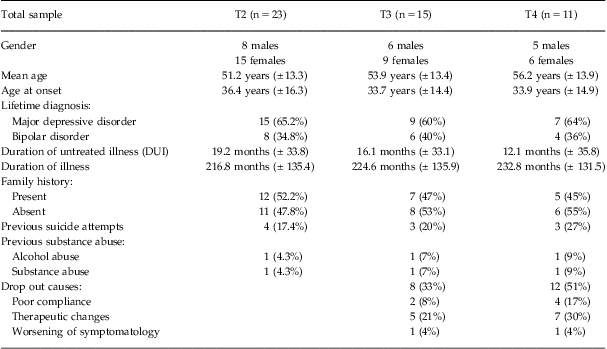
The main demographic and clinical variables of the sample are summarized in Table 1.
Demographic and clinical data of study sample at different time-points

Mean values for continuous variables and number of patients for dichotomic ones are provided. Standard deviations for continuous variables and percentages for dichotomic ones are shown in parentheses.
T2 = assessment at 1 week after the end of the treatment, T3 = assessment at 1 month after the end of the treatment, T4 = assessment at 3 months after the end of the treatment.
The following rates of subjects completing the different time-point evaluations were observed: at T2, 22 patients (95.65% of the total sample); at T3, 15 patients (65.21% of the total sample); and at T4, 11 patients (47.82% of the total sample).
The quantitative analysis showed a significant reduction in HAM-D total score over the course of the follow up (14.36 at T1 versus 12.64 at T2 versus 12.15 at T3 versus 12.00 at T4; F = 16.591, p < 0.0001, repeated measures ANOVA) (Figure 1). The same result was found for the MADRS total score (19.73 at T1 versus 16.09 at T2 versus 15.02 at T3 versus 14.36 at T4; F = 16.197, p < 0.0001, repeated measures ANOVA) (Figure 1). Melancholic symptoms were significantly reduced as well (11.83 at T1 versus 9.11 at T2 versus 8.6 at T3 versus 7.4 at T4; F = 19.189, p < 0.0001, repeated measures ANOVA) (Figure 1). The HAM-D and MADRS scores were not influenced by diagnosis or gender (repeated measures ANOVA with diagnosis and gender as between subjects factors: p = 0.5, p = 0.773 for HAM-D; p = 0.272, p = 0.884 for MADRS).
Outcome measures (mean scores) of the study completers at the different time-points. T1 = assessment at the end of the treatment, T2 = assessment at 1 week after the end of the treatment, T3 = assessment at 1 month after the end of the treatment, T4 = assessment at 3 months after the end of the treatment. For definition of HAM-D melancholic items, see the text.
A significant score reduction was observed from T1 to T2 in the total scores of the HAM-D (t = 2.183; p = 0.041, paired t test) and MADRS (t = 2.241; p = 0.036, paired t test). On the other hand, no further significant score reduction was found between T2 and T4: HAM-D (p = 0.398), HAM-D melancholic items (p = 0.418), HAM-D anxiety/somatization items (p = 0.589), MADRS (p = 0.138); between T2 and T3: HAM-D (p = 0.383), HAM-D melancholic items (p = 0.855), HAM-D anxiety/somatization items (p = 0.158), MADRS (p = 0.659); and between T3 and T4: HAM-D (p = 0.694), HAM-D melancholic items (p = 0.905), HAM-D anxiety/somatization items (p = 0.332), MADRS (p = 0.582).
With respect to YMRS scores, no significant increase was observed over the follow-up period (T1–T2, p = 0.329; T2–T3, p = 0.334; T3–T4, p = 1.000).
In terms of response and remission, at T1, among the 4 (17.39%) patients who responded to the treatment, 2 subjects (8.69%) were remitters. At T2, of the 22 patients (95.65% of the total sample) who completed the assessment, 7 subjects (31.81%) were considered treatment responders and 2 patients (9.09%) were remitters. At T3, 15 patients (65.21% of the total sample) completed the assessment, with rates of response and remission being 26.66% (4 patients) and 6.66% (1 patient), respectively. Eleven patients (47.82% of the total sample) completed the final assessment (T4), showing rates of treatment response and remission of 45.45% (5 patients) and 36.36% (4 patients), respectively. No statistically significant differences were observed comparing response (χ2 = 1.51, p = 0.68) and remission (χ2 = 2.56, p = 0.464) rates across different time-points.
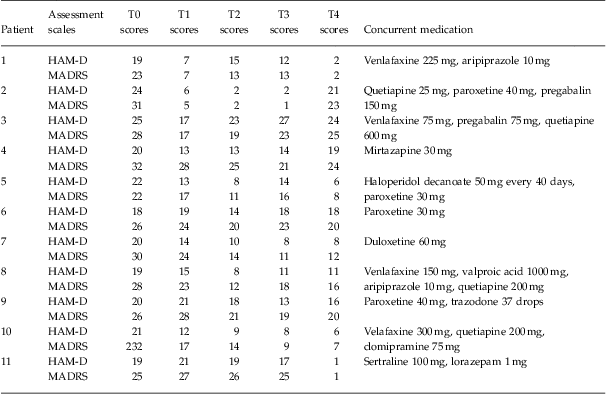
Given the significant drop-out rate, a further comparison between the groups of completers versus drop-outs was performed in relation to age, duration of illness, lifetime number of hospitalizations, diagnosis, numbers of responders/remitters, sex, and HAM-D/MADRS total scores at T0 and T1, in order to exclude any influence of the aforementioned variables over follow-up completion rates. Concurrent medications and HAM-D/MADRS total scores at T0 and T1 of follow-up completers are listed in Table 2.
Follow-up scores and concurrent medications of follow-up completers
T0 = assessment at baseline, T1 = assessment at the end of the treatment, T2 = assessment at 1 week after the end of the treatment. T3 = assessment at 1 month after the end of the treatment, T4 = assessment at 3 months after the end of the treatment.
Such analysis did not show any statistically significant difference (age: t = 0.13, p = 0.89; duration of illness t = 0.19, p = 0.84; lifetime number of hospitalizations t = 1.08, p = 0.29; HAM-D T0: t = 1.42, p = 0.16; HAM-D T1: t = 1.73, p = 0.09; MADRS T0: t = 0.16, p = 0.87; MADRS T1: t = 0.9, p = 0.37; diagnosis: p = 0.3; sex: p = 0.13).
No statistically significant differences were observed comparing response (χ2 = 1.51, sig = 0.68) and remission (χ2 = 2.56, sig = 0.464) rates across different time-points.
Major causes of drop-out were collected. The most frequent ones were represented by major modifications in therapeutic regimen (30%)—introduction of a new compound and major dose adjustment, in particular—followed by poor compliance (17%) and severe symptom worsening (4%) (eg, increased suicidal ideation), which led to patient hospitalization.
Discussion
As already discussed in our previous study,Reference Dell'Osso, Zanoni and Ferrucci19 tDCS was shown to be efficacious in the first week of follow-up, after having completed 10 previous sessions of stimulation. In the present article, we extended the follow-up observation to 3 months, observing that the clinical benefit, obtained in the first two weeks after baseline (T0 to T1 and T2) and in the first week of follow-up (T1 to T2), was maintained through the subsequent time-points (T2 to T3 and T4), without any further improvement, in overall half of the original sample. In addition, no post-acute emerging side-effect was observed over the entire follow-up duration.
To the authors’ knowledge, this is the first study that has investigated the discontinuation effects of tDCS in the mid-term, and, therefore, no comparison with other literature studies can be performed. In fact, the other studies exploring the efficacy of the technique beyond the short-term, though reporting positive results, differed from the present study since they included maintenance stimulation sessions.Reference Boggio, Rigonatti and Ribeiro8, Reference Martin, Alonzo and Ho25, Reference Valiengo, Benseñor and Goulart26 Indeed, the present study specifically assessed discontinuation effects, in terms of efficacy and tolerability. With such a perspective, it is the authors’ opinion that a preliminary assessment of tDCS discontinuation effects in the mid- to long-term is of great clinical interest in order to orient any maintenance protocols beyond the acute treatment.
tDCS maintenance effect beyond the acute phase may depend on different factors, including acute stimulation parameters (eg, electrode size, shape, and position; duration of treatment; intensity of the current), which need to be further investigated in order to improve the therapeutic effects of the technique. In addition, it would be worthwhile to additionally evaluate whether it is possible to obtain a longer period of clinical benefit after more sessions of acute tDCS or by means of maintenance sessions afterward. For instance, Loo etal Reference Loo, Alonzo and Martin14 studied the effects of tDCS in a 3-week, sham-controlled trial on 64 depressed patients, with 3 further weeks of open-label continuation. Results suggested that acute benefit, in terms of neuropsychological functioning, persisted after 3–6 weeks of stimulation.Reference Loo, Alonzo and Martin14 More recently, 2 open continuation tDCS studies found maintenance stimulation, at different protocols, to be a useful strategy to prevent relapse in the follow-up period (up to 6 months after acute tDCS).Reference Martin, Alonzo and Ho25, Reference Valiengo, Benseñor and Goulart26 Of note, in both studies, the cumulative survival rate (lack of relapse) at 6 months was between 47% and 51%, and previous treatment resistance was found to be a predictor of relapse. Taken as a whole, such findings are consistent with results from the present study. With regard to possible novel stimulation parameters, Martin etal Reference Martin, Alonzo and Mitchell32 have recently observed that 20 sessions of fronto-extracephalic tDCS (F-Ex tDCS), which was applied to patients who had previously received bifrontal tDCS with no benefit or who had relapsed, showed encouraging results. However, F-Ex tDCS led to hypomanic switch in a bipolar II patient, and this might be due to stimulation of deeper limbic brain regions.Reference Gálvez, Alonzo and Martin33 In a more recent study, another case of hypomanic switch was reported after 6 weeks of active stimulation.Reference Loo, Alonzo and Martin14 In terms of possible manic switch induced by tDCS, in the present study, 7 patients of the total sample had a diagnosis of BD, and none of them experienced such an adverse event.
In the present study, the antidepressant effect of tDCS, as observed at the end of the acute trial, seemed to persist in the completer subgroup throughout the entire follow-up period of 3 months. Indeed, patients’ symptoms showed a further improvement during the first week of follow-up (T1–T2), then remained stable over the subsequent time points (T3, T4). Such improvement was confirmed by the qualitative analysis, which showed an increased number of remitters at T4. This is worth noting for several reasons. First of all, other nonpharmacological techniques, with the exception of electroconvulsive therapy (ECT), generally require a longer period of treatment in order to manifest a significant effectiveness. For instance, recent trials with transcranial magnetic stimulation have defined the need to stimulate for more than 2 weeks (4–6 weeks) to produce a significant symptom improvement.Reference O'Reardon, Solvason and Janicak34 In addition, other brain stimulation interventions, such as vagus nerve stimulation and deep brain stimulation, which are more invasive than tDCS, show a significant antidepressant effect only some months after the implant.Reference Groves and Brown35, Reference Lozano, Giacobbe and Hamani36 Nevertheless, it should be mentioned that both interventions are considered to be established therapies for resistant cases (with specific approvals in some countries for resistant depression), while tDCS is still experimental. On the other hand, ECT is particularly effective in treatment-resistant depression, even though it is characterized by a significant invasiveness profile, as well as by the high rate of relapse within 6 months of discontinuation.Reference Sackeim, Haskett and Mulsant37
Taken as a whole, results from present and recent tDCS studies in the acute- and long-term treatment of major depressives highlight, on one hand, the growing interest in such an evolving field and, on the other hand, the urgent need of further controlled investigation. In this perspective, in fact, confidence in the reported results in terms of efficacy is limited by the following factors: (1) the limited follow-up period (3 months), (2) the small dimension of the sample, and (3) the high rate of drop-out. In fact, approximately 35% of patients were lost by follow-up at T3 and approximately half of patients at T4. The main reasons for drop-out were major therapeutic changes and poor adherence to follow-up visits (eg, impossibility to reach the patient, frequently observed in psychiatric research settings),Reference Navarro38 and, partly, due to the worsening of clinical conditions. It needs to be noted, however, that patients had to maintain the same therapeutic regimen for at least 1 month before tDCS and for the whole duration of follow-up. Therefore, such a restrictive inclusion criterion may have contributed to the exclusion of some patients over the follow-up period, given the frequent occurrence of therapeutic modifications.Reference Gourion, Galinowski, Baraille and Picard39 In fact, in relation to other possible drop-out contributors, additional analysis of follow-up completers versus drop-outs did not show any statistical difference that might be interpreted as responsible for the high drop-out rate. Finally, a possible interaction with concomitant pharmacological treatments, in both acute phase and follow-up, might have influenced the results. Recently, in fact, a study by our group that investigated the interactions between tDCS and drug therapy in 82 unipolar and bipolar depressed patients showed that concomitant benzodiazepine use seemed to hinder tDCS efficacy, while antidepressant use appeared to boost it.Reference Brunoni, Ferrucci and Bortolomasi40 Therefore, specific patterns of pharmacological treatment combined with tDCS might have contributed to its efficacy over the acute treatment/follow-up observation.
With respect to tolerability issues, in our previous study, tDCS was well tolerated in the acute phase of treatment, and these results were consistent with the safety and tolerability data present in literature.Reference Brunoni, Fraguas and Fregni41
Indeed, present mid-term follow-up data seem to further support the overall safety of the technique, showing no post-acute emerging side-effects/adverse events.
Conclusions
In conclusion, the present findings seem to suggest that the post-acute tDCS benefit was maintained in the follow-up period, with further improvement in the first week of follow-up and with no maintenance stimulation sessions, only in patients who completed the study (half of the sample, approximately). Such a result may be interpreted in different ways. On one hand, it may support the short-term efficacy of the technique with sustained effects up to mid-term observation in some patients. On the other hand, the significant drop-out rate that was observed during the follow-up period and was likely due to different causes, somehow limits the confidence in the results of the completers subgroup, highlighting how non-invasive neuromodulation techniques may lead to symptom relapse in some patients, arguably requiring maintenance treatment sessions. Double-blind studies with tDCS on larger samples of treatment-resistant depressed patients, along with better definition of stimulation parameters, are needed in order to further assess post-acute tDCS effects.
Disclosures
Prof. A. Carlo Altamura does not have any affiliation or financial interest in any organization that might imply a conflict of interest with the content of the present article. He is a consultant for Roche, Merck, AstraZeneca, Bristol-Myers Squibb, Janssen-Cilag, Lundbeck, Sanofi, Eli Lilly and Pfizer. Prof. Alberto Priori is president and shareholder of the company Newronika Srl, Milan, and reports his patent pending “Process for reducing neuromuscular fatigue caused by exercise,” Patent number: WO2008155114 (A1). Dr. Bernardo Dell'Osso does not have any affiliation or financial interest in any organization that might imply a conflict of interest with the content of the present article. He has been part of the speaker bureau of AstraZeneca, Bristol-Myers Squibb, Janssen-Cilag, Eli Lilly, Pfizer, GlaxoSmithKline, Lundbeck, Cyberonics, and Italfarmaco. Drs. Roberta Ferrucci, Maurizio Vergari, Cristina Dobrea, Beatrice Benatti, and Chiara Arici do not have anything to disclose.