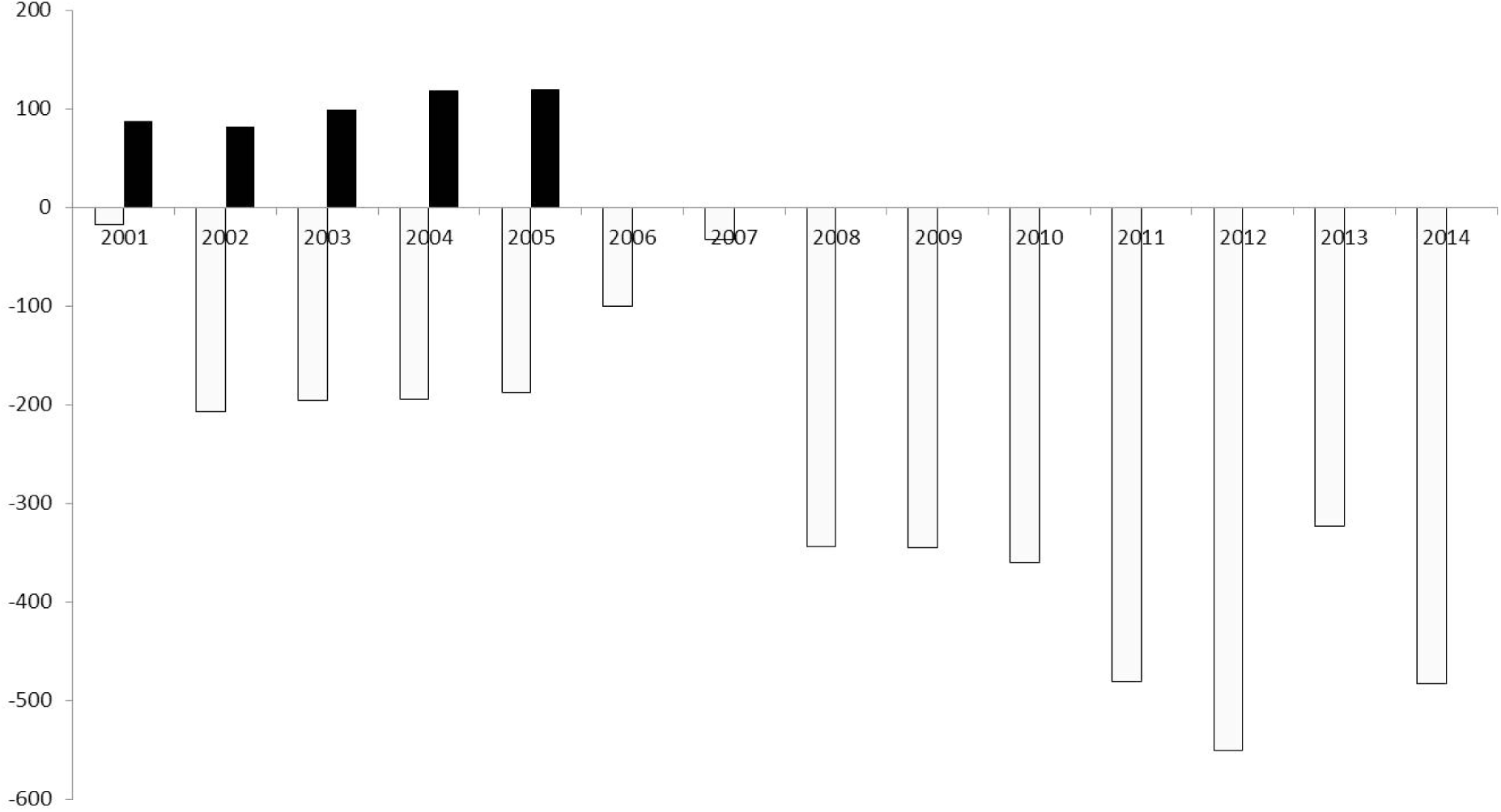
In 2006, the accounting regime for defined benefit (DB) pensions in the United States changed dramatically, for the first time sponsoring companies had to recognize on the balance sheet the funded status of their pension schemes. Before this, information was only disclosed in the notes to the financial statements, with an accrual on the balance sheet that bore little relation to the true surplus/deficit it was meant to summarize: as Figure 1 shows, the average company was recognizing an asset on its balance sheet despite having a pension deficit.Footnote 1 In this paper, I investigate whether the move from disclosure to recognition changed investors' perception of DB pensions, comparing their value relevance under the two accounting regimes and identifying the effect of the introduction of Statement of Financial Accounting Standards (SFAS) No. 158 in 2006.
Pension funding under SFAS Nos. 87 and 158.
Notes: The chart shows the average reported pension asset/liability under SFAS No. 87 (black columns) and the average funding status of DB schemes disclosed in the notes to the financial statements before SFAS No. 158 and recognized on the balance sheet afterwards (shaded columns), in million USD.
Source: Author's calculations.

A large body of research has investigated whether disclosure in the footnotes is a substitute for recognition in the financial statements. The efficient market hypothesis in semi-strong form implies that there should be no difference, as long as the information is publicly available. However, standard setters tend to view disclosure and recognition as different: for instance, the Financial Accounting Standards Board (FASB) affirms that ‘footnote disclosure is not an adequate substitute for recognition’ (FASB, 2006, paragraph 116). Recent research in accounting tends to agree, finding that disclosure and recognition are different in terms of value relevance (e.g., Davis-Friday et al., Reference Davis-Friday, Buky Folami, Liu and Fred Mittelstaedt1999; Ahmed et al., Reference Ahmed, Kilic and Lobo2006; Michels, Reference Michels2017), with market participants placing more weight on recognized information. The literature finds that there are significant costs of monitoring, acquiring and analysing firms' disclosure, even for professional investors.Footnote 2 This study contributes to this debate by studying the valuation implications of disclosure versus recognition for pension surpluses/deficits. The introduction of SFAS No. 158 provides a good framework for testing this hypothesis, as it did not change how the funding status of DB pensions is calculated. Hence, in this setting disclosure and recognition can be compared for exactly the same items. Moreover, SFAS No. 158 became mandatory for all companies at the same time, limiting the selection problem that is linked with the possibility of early adoption.
This study also contributes to the literature that debates the valuation implications of DB pensions. Despite the fact that pension scheme's assets and liabilities are formally separated from the company, the shareholders are ultimately responsible for its solvency hence pension surpluses/deficits should affect the firm's value. SFAS No. 158 makes this pension asset/liability explicit by mandating its recognition on the sponsor's balance sheet. The literature on the value relevance of DB pensions focused mostly on the years before its introduction, when the funded status of pension plans was disclosed in the notes to the financial statements. As I discuss in Section 2, the evidence on the valuation of DB pensions is mixed, but a number of recent studies argue that pension surpluses/deficits are at best only partially reflected in the sponsors' equity, either because investors do not price off balance sheet pension liabilities correctly (Franzoni and Marin, Reference Franzoni and Marin2006; Picconi, Reference Picconi2006) or because they focus on the earnings impact of DB pensions while disregarding their funding status (Coronado and Sharpe, Reference Coronado and Sharpe2003; Coronado et al., Reference Coronado, Mitchell, Sharpe and Blake Nesbitt2008). Results of this study contribute to this debate by highlighting how the value relevance of pension surpluses/deficits differs between the recognition and disclosure regimes.
The introduction of SFAS No. 158 itself has also been studied extensively, with a number of papers asking a research question similar to the one I am addressing, such as Beaudoin et al. (Reference Beaudoin, Chandar and Werner2011), Mitra and Hossain (Reference Mitra and Hossain2009) and Yu (Reference Yu2013). However, their results are mixed and at times contradictory: Beaudoin et al. (Reference Beaudoin, Chandar and Werner2011) find that the off balance sheet component of pension surplus/deficits is incorporated in equity valuations under both disclosure and recognition, whereas Yu (Reference Yu2013) finds the opposite, in his sample amounts disclosed in the notes are not value relevant either before or after the introduction of SFAS No. 158.Footnote 3 As both papers use the same identification strategy, the different results seem to depend on the sample under consideration. Beaudoin et al. (Reference Beaudoin, Chandar and Werner2011) use only data for 2005 and 2006 (as do Mitra and Hossain, Reference Mitra and Hossain2009), whereas Yu (Reference Yu2013) uses data from 1999 but stops in 2007, thus failing to take into account the increase in pension deficits due to the financial crisis and the subsequent fall in interest rates from 2008 onwards (Figure 1 shows the worsening of the funded status of DB pensions from 2008 onwards). This is potentially problematic, as the funding position of DB schemes in 2006 and 2007 is significantly better than that in the following decade.Footnote 4 The results of Fried and Davis-Friday (Reference Fried and Davis-Friday2013) give another reason to reassess the impact of SFAS No. 158 using a longer sample that stretches beyond the most immediate years after the accounting reform. They document that firms' management reacted to the new accounting standard, attempting to mitigate the increase in recognized pension deficits by increasing the discount rate on pension liabilities during 2006 and 2007.
This study contributes to this debate by using a larger sample and a different econometric technique that allows me to identify more precisely the effect of the accounting change in 2006. As my analysis stretches to 2014, the longer sample should mute any strategic reaction to the change in accounting rules while also incorporating the deterioration of pension funding after 2008. Overall, results of this study suggest that investors treat disclosed and recognized information differently, focusing on the number recognized on the balance sheet and thus mispricing DB pension surpluses/deficits before the introduction of SFAS No. 158. Using a sample of 2,590 firms (21,063 observations), I document that the funded status of DB pensions is value relevant only after 2006, while before only the balance sheet accrual recognized under SFAS No. 87 accounting is value relevant. Then I focus on the introduction of SFAS No. 158 and try to pin down its effect using a panel of 773 DB sponsors and 956 control firms over the 10 years surrounding the accounting reform. To improve the validity of estimates of this study, I also match DB sponsors with peers that do not have DB pensions using different techniques. Results of this study suggest that the new accounting standard is indeed responsible for the change in investors' perception of pension schemes' surpluses/deficits.
This result is different from the findings of earlier papers that have investigated the introduction of SFAS No. 158, but in line with the wider literature that argues that investors treat disclosed and recognized information differently, highlighting the importance of looking at the impact of accounting changes beyond the years immediately after the reform. Although my identification strategy is different from that of Beaudoin et al. (Reference Beaudoin, Chandar and Werner2011) and Yu (Reference Yu2013), I provide results using their methodology in the Appendices and discuss in more detail the differences between these studies and mine in Section 2.1.Footnote 5
The rest of the paper is organized as follows. Section 1 describes pension accounting before and after SFAS No. 158. Section 2 develops my research hypothesis and places it in the wider context of the literature on DB pensions and disclosure versus recognition, discussing the links between my contribution and the papers that have tackled the same issues. Sections 3 and 4 present the empirical strategy and the data I use to address my research question, whereas Section 5 discusses results of this study. Section 6 discusses the potential confounding effects of the Pension Protection Act of 2006 and of the measurement date provision of SFAS No. 158. The last section concludes. Further robustness tests are provided in the Appendices.
1. Pension accounting before and after SFAS No. 158
Accounting for DB pensions has evolved continuously in the past 20 years. From 1987 until 2006 the relevant standard for DB pensions was SFAS No. 87 Employers' accounting for pensions (FASB, 1985), which mandated the reporting on the balance sheet of a net prepaid pension asset or accrued pension liability that represented only a part of the sponsor's pension assets and liabilities. In particular, the funding status recognized on the balance sheet was the result of netting several off balance sheet items: pension assets, pension liabilities (measured as projected benefit obligation or PBO), prior service cost, actuarial gains and losses, the difference between expected and realized return on plans' assets and net transition assets or liabilities. The rationale behind these adjustments is to have a smoothed measure for the pension surplus/deficit, eliminating the effects of fluctuations in the value of assets and liabilities. The resulting asset or liability recognized on the balance sheet was essentially the cumulative difference between pension expenses recognized by the company in its income statement and cash contributions to the pension fund, with a net asset arising if contributions were above pension expenses or a liability in the opposite case. The accrual computed under SFAS No. 87 could be significantly different from the underlying surplus/deficit of the pension fund, as Figure 1 shows.
The disclosure requirements for pension schemes were significantly expanded by the introduction of SFAS No. 132 in 1998 (and its revised version issued in 2003), but neither standard changed the measurement or recognition requirements of SFAS No. 87. Both of these requirements changed with the introduction of SFAS No. 158 in December 2006. The most important requirements of SFAS No. 158 are that companies have to fully recognize the funding status of their pension schemes on the balance sheet and recognize in other comprehensive income (OCI) the financial effects of certain plan events when they occur.Footnote 6 Thus, the balance sheet recognition of previously disclosed items requires an OCI offset.
The introduction of SFAS No. 158 typically increased reported pension liabilities, as under the previous standard companies were allowed to recognize an asset even if their schemes were in deficit. The FASB's objective in introducing this new reporting standard was to increase the transparency and usefulness of reported pension information. In the rest of the paper, I investigate if this is the case for equity investors.
2. Literature review and hypothesis development
This study contributes to two large strands of literature, one focusing on the value relevance of disclosed versus recognized accounting information and the other regarding the valuation of DB pensions. This section develops my research hypothesis by placing it in the context of the wider literature, whereas the next subsection discusses the difference between this study and the papers that have investigated the introduction of SFAS No. 158.
Whether disclosure and recognition are good substitutes has been a central question in accounting research, with recent empirical evidence suggesting that investors underweight disclosed information. Ahmed et al. (Reference Ahmed, Kilic and Lobo2006) find that recognized derivative positions are value relevant while the disclosed ones are not, whereas Davis-Friday et al. (Reference Davis-Friday, Buky Folami, Liu and Fred Mittelstaedt1999) find modest evidence that market participants place more weight on recognized rather than disclosed information in the context of post-retirement benefits other than pensions. Schipper (Reference Schipper2007) discusses disclosure from various standpoints, arguing that it is perceived differently from recognition, whereas Barth et al. (Reference Barth, Clinch and Shibano2003) provide a theoretical treatment of the differences between these two accounting regimes. In their review of the literature on disclosure processing costs, Blankespoor et al. (Reference Blankespoor, de Haan and Marinovic2020) characterize firms' disclosure as costly private information, highlighting that disclosed information cannot be considered public due to the cost involved in gathering and processing such data. The introduction of SFAS No. 158 provides an ideal setting to compare the difference in value relevance between disclosed and recognized accounting information, as it did not change the measurement of pension assets and liabilities. Hence, in this instance it is possible to assess the effect of moving from disclosure to recognition for exactly the same item. Moreover, early adoption was not permitted.
DB pensions have a great influence in many aspects of corporate life and have been studied extensively. Here, I focus only on the stream of literature that discusses the valuation implications of this type of pensions, the closest to this study. For a recent comprehensive review of the literature on DB pensions I refer to Cocco (Reference Cocco2014). Although pension funds are formally separated from the sponsoring company, its shareholders are ultimately responsible for these pension promises. Hence, pension surpluses/deficits should affect the value of the sponsoring firm. However, the empirical evidence on the value relevance of DB pensions is mixed. An earlier set of papers found that stock prices fully reflect the funding status of DB schemes, such as Feldstein and Seligman (Reference Feldstein and Seligman1981), Feldstein and Morck (Reference Feldstein, Morck, Bodie and Shoven1983) and Bulow et al. (Reference Bulow, Morck, Summers, BBodie, Shoven and Wise1987). Coronado and Sharpe (Reference Coronado and Sharpe2003) and Coronado et al. (Reference Coronado, Mitchell, Sharpe and Blake Nesbitt2008) find that instead investors focus on the earnings impact of pensions while disregarding their funding status, arguably the most important information in determining the future cash flows of the sponsoring firm and hence its value. Hann et al. (Reference Hann, Heflin and Subramanayam2007a) find that both income statement and balance sheet variables are value relevant. Using an asset pricing approach, Franzoni and Marin (Reference Franzoni and Marin2006) find that companies with severely underfunded DB pensions earn significantly lower returns, showing that investors do not price these liabilities correctly. Their findings are reinforced by Picconi (Reference Picconi2006), who also show that analysts systematically fail to take DB pensions into account when forecasting earnings.
Most of the studies on the value relevance of DB pensions focused on periods when SFAS No. 87 was the relevant standard. My contribution is to extend this literature, investigating the value relevance of DB pensions under two different accounting regimes, disclosure (under SFAS No. 87) and recognition (under SFAS No. 158). As the same information about the funded status of pension funds is publicly available under both regimes, market participants should value it in the same way. Formally, I test the following hypothesis:
Hypothesis: The funded status of DB pension schemes is equally value relevant whether disclosed (under SFAS No. 87) or recognized (under SFAS No. 158).
The literature has put forward various competing explanations as to why disclosure and recognition might be perceived differently by market participants, with a stream of literature suggesting that recognized information is more reliable, such as Davis-Friday et al. (Reference Davis-Friday, Liu and Mittelstaedt2004) and Frederickson et al. (Reference Frederickson, Hodge and Pratt2006). Another set of papers argue that the difference is due to information processing, either because users of financial statements lack the competence to understand disclosure (Dearman and Shields, Reference Dearman and Shields2005) or because of cognitive biases (Hobson and Kachelmeier, Reference Hobson and Kachelmeier2005; Koonce et al., Reference Koonce, McAnally and Mercer2005). Hirshleifer and Teoh (Reference Hirshleifer and Teoh2003) argue that if investors have limited attention and processing power they might disregard off balance sheet items, showing that under this assumption disclosure and recognition are not substitutes.
A limitation of this paper is that I don't address the question of what motivates the different reaction to disclosed and recognized information, but rather focus on establishing the difference between the two in a setting that minimizes the many research design problems typical to this type of study, as discussed in Bernard and Schipper (Reference Bernard and Schipper1994).
2.1 Literature on the introduction of SFAS No. 158
A set of recent papers investigate the effects of the introduction of SFAS No. 158, asking a research question very close to mine. This short section discusses their results and differentiates my contribution from that of earlier studies.
Mitra and Hossain (Reference Mitra and Hossain2009) find a negative relation between stock returns and the pension transition adjustment in 2006, the adoption year of SFAS No. 158, a relationship driven by large S&P 500 firms. Beaudoin et al. (Reference Beaudoin, Chandar and Werner2011) use a slightly different sample and compare the value relevance of the funded status of DB schemes in 2005 (disclosure year) and 2006 (recognition year), finding that investors price this information correctly in both accounting regimes.Footnote 7 Later study by Yu (Reference Yu2013) uses a larger sample, stretching from 1999 to 2007. Before considering the role of analyst following and institutional ownership, he finds that investors focus on the recognized portion of pension surpluses/deficits, ignoring the disclosure in the notes, and that this does not change after 2006. Controlling for institutional ownership and analyst following, he finds that off balance sheet information is value relevant for companies with high level of institutional ownership and analyst following. He also finds that recognition improves the value relevance of pension funding only for firms with a low level of institutional ownership and analyst following.
As Beaudoin et al. (Reference Beaudoin, Chandar and Werner2011) and Yu (Reference Yu2013) use the same strategy to identify the impact of SFAS No. 158, it is surprising that they find opposite results before accounting for investor sophistication. Beaudoin et al. (Reference Beaudoin, Chandar and Werner2011) also partition their sample by firm size, using that as a proxy for investor sophistication. They find that their result is driven by large firm, but that recognition does not improve the value relevance of pension for smaller companies. This is again in contrast to Yu (Reference Yu2013). The different results between these two studies highlight that their inference might depend on the sample under analysis, especially given that both papers use the same model.
Another potential problem with both studies is that they analyse the value relevance of the net pension position by dividing it between its on and off balance sheet components even after the introduction of SFAS No. 158. Although this distinction is appropriate under the prior standard, both components are actually recognized on the balance sheet after 2006, so there is no reason to expect them to be valued differently, at least a priori. Allowing their coefficients to be estimated separately might cloud the identification of the overall impact of the net position of the pension funds on firm value, arguably the most important effect. How the surplus/deficit of each pension fund is divided between its on and off balance sheet components under SFAS No. 87 depends on the specific history of each company.Footnote 8 Hence, two companies with similar pension assets and liabilities might have a very different number recognized on the balance sheet.Footnote 9 Although it is a priori unclear if this distinction introduces any bias in the estimation after 2006, in my data companies tend to paint a rosier picture of their pension funding position on the balance sheet than in the notes, as highlighted in Figure 1 and Tables 3 and 4.
This study differs from these three papers in that it uses a significantly larger sample of firms and years, and a different econometric technique that allows me to pin down more effectively the introduction of SFAS No. 158 and thus the move from disclosure to recognition. Another difference is that I cluster standard errors by company in all my specifications, while none of the papers quoted above controls for correlation in standard errors. As Petersen (Reference Petersen2009) points out, failing to cluster the standard errors in a panel setting leads to inflated t statistics that may jeopardize the inference. To facilitate the comparison with the previous literature, I provide results using the same model as Beaudoin et al. (Reference Beaudoin, Chandar and Werner2011) and Yu (Reference Yu2013) in Appendix C. I also test explicitly the effects of institutional ownership and analyst following on value relevance in Appendix D, following Yu (Reference Yu2013).
3. Research methodology
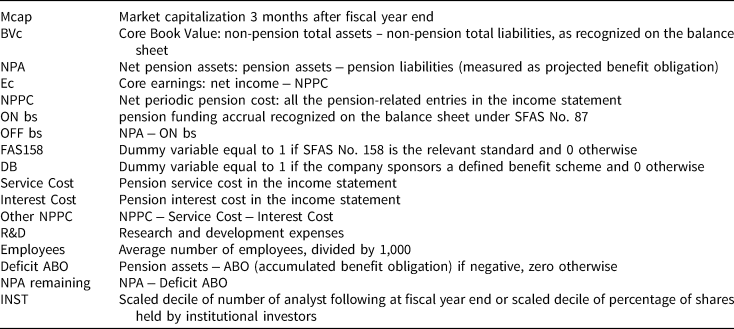
Barth et al. (Reference Barth, Beaver and Landsman2001) suggest that levels models are better specified to address the question of what is reflected in firms' value, while changes models are appropriate to investigate timeliness of accounting amounts. Given my research question of how pension surpluses/deficits influence the valuation of the sponsoring company, a levels model appears the most appropriate. In doing so, I follow the extensive literature that has addressed this issue before (for instance Coronado and Sharpe, Reference Coronado and Sharpe2003; Hann et al., Reference Hann, Heflin and Subramanayam2007a, Reference Hann, Lu and Subramanyam2007b; Coronado et al., Reference Coronado, Mitchell, Sharpe and Blake Nesbitt2008; Yu, Reference Yu2013). Hence, the main model I employ to investigate empirically the valuation of DB pensions is a parsimonious specification of the residual income model, put forward by Feltham and Ohlson (Reference Feltham and Ohlson1995). In their model, the market value of a firm's equity is expressed as the sum of the value emanating from the company's non-financial core activities plus the unrelated financial activities. I modify this model to make room for pensions as in the previous literature, dividing both income statement and balance sheet variables into pension and non-pension components. The next subsection describes the model I use to analyse the value relevance of DB pensions in cross section, highlighting the expected coefficients. The following subsection presents the modifications I make to my research design to focus on the effect of the introduction of SFAS No. 158. Table 1 provides a detailed description of all the variables I use in my analyses.
Variable definition

Source: Author's calculations.
3.1 Value relevance of pensions in cross section
I start by investigating the value relevance of DB pensions under two different accounting regimes, disclosure (under SFAS No. 87) and recognition (under SFAS No. 158). Consistent with prior research, the model I use for my analysis in cross section is the following, where all variables are standardized by total company assets to make the series stationary and reduce heteroscedasticityFootnote 10:

This model expresses the market value of equity (Mcap) of firm i in year t as a function of the core book value of equity (BVc) defined as non-pension assets minus non-pension liabilities.Footnote 11 Net pension assets (NPA) represent the funded status of the DB pension schemes of the company; I define it as pension assets minus pension liabilities (measured as the PBO, as the relevant accounting standards prescribe). Although entering pension assets and liabilities separately into the model rather than the net position might be useful for my analysis, the high correlation between the two items means it is not practical to do so. Regarding income statement variables, I divide earnings into core earnings (Ec) defined as net income minus net periodic pension cost (NPPC) and NPPC itself. NPPC collects all the pension related entries in the income statement: service cost (benefits accrued during the accounting period), interest cost (the effect of time on the pension obligation), expected return on plan's assets, temporary events such as curtailments and settlements, and the recycling into income of the unrecognized pension deficit if this is bigger than a certain threshold.Footnote 12 As NPPC is a pre-tax measure, I multiply it by 0.65 to compare it with earnings (assuming a tax rate of 35%). S and Y are industry (I use the first four digit of GISC, with 24 industry groups in total) and year dummies, respectively.
I expect the coefficient on book value to be positive and close to 1. NPA is positive when pension funds are in surplus and negative when they have a deficit, so its coefficient should be positive if DB pensions are at least partially value relevant. As contributions to pension funds are tax deductible in the United States, full value relevance implies that the coefficient on NPA should be bracketed between 1 and (1 − t), where t is the marginal tax rate that the average company faces. Earnings are clearly positively associated with market value, so I expect a positive coefficient. I expect its magnitude to depend on the level of fixed effects imposed in the regression. NPPC takes a negative value when the company reports a cost in its income statement and a positive one when DB pensions contribute positively to the firm's profitability. As it is an income statement item, I expect NPPC to have the same coefficient as earnings if it is value relevant.
For the part of my sample where SFAS No. 87 is the relevant standard, I also test whether investors apply different weights to the accrual recognized on the balance sheet to summarize the funding of the company's DB schemes and the amount disclosed in the notes. To do so, I create two new variables: ON bs, equal to the accrual recognized under SFAS No. 87 and OFF bs, equal to the difference between NPA and ON bs. In doing so, I follow a part of the literature that splits the pension obligations in the same way, such as Yu (Reference Yu2013) and Beaudoin et al. (Reference Beaudoin, Chandar and Werner2011). So, I bring to the data the following specification:

The variables ON bs and OFF bs sum up exactly to NPA, so this specification is equivalent to equation (1). Hence, if DB pensions are value relevant both the coefficients on ON bs and OFF bs should be between 1 and (1 − t). On the contrary, if market participants focus on information recognized on the balance sheet and disregard disclosure in the notes, only ON bs should be value relevant.
I also test both models by year, thus running a battery of regressions of both equations (1) and (2), dropping the year dummies.Footnote 13 Further robustness tests are provided in the Appendices.
3.2 The introduction of SFAS No. 158
To refine my investigation and identify the changes caused by the recognition of NPA on the balance sheet under SFAS No. 158, I use a balanced panel of companies (with and without DB schemes) that reported under both accounting regimes. The goal is to pin down the effect of the introduction of SFAS No. 158 on the value relevance of pensions. To identify the effect of the reform, I first run equations (1) and (2) using company rather than sector fixed effects. Then I use the constituents of this panel to match DB sponsors with peers that do not have DB obligations using different algorithms and run an estimation in the spirit of difference in differences using the following equation:

where FAS 158 is a dummy that takes the value 1 if SFAS No. 158 is the relevant accounting standard and 0 otherwise, and DB is a dummy that takes the value 1 if the company sponsors a DB scheme. The variable of interest is the interaction between NPA and FAS 158, which captures the incremental effect on the sponsor's valuation of the recognition of NPA on the balance sheet. If the introduction of SFAS No. 158 increased the value relevance of NPA, this interaction term should be positive and significant. If, on the contrary, the move from disclosure to recognition did not change investors' perception of DB pensions, the coefficient on the interaction term should be zero. The coefficient on the DB dummy captures the difference in valuation between firms that sponsor a DB pension and those who do not. A positive value implies that DB sponsors enjoy a premium valuation, all else equal. Similarly, the interaction between the DB and FAS 158 dummies identifies if there has been a change to the relative valuation of DB sponsors after the introduction of SFAS No. 158: a positive (negative) value implies an increase (decrease) in the valuation of DB sponsors against firms that do not have a DB pension.
4. Samples selection and description
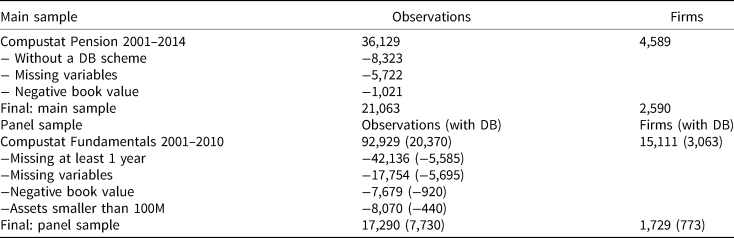
My main sample to investigate the value relevance of pension schemes funding consists of all the firm-year observations from 2001 to 2014 available in the Compustat Pension database. I then merge it with the Compustat Fundamentals Quarterly database to obtain the information for the accounting variables and the share prices. I delete all entries that do not have a DB scheme (companies that either have missing data for both pension assets and liabilities, or whose PBO is zero) and all observation with missing values to calculate independent variables. Furthermore, I delete all the companies with a negative book value of equity. These firms are likely to be in, or close to, financial distress and the literature has shown that they should be valued separately (see for instance Jan and Ou, Reference Jan and Ou2011). In my robustness analysis, I find that they have a disproportionate effect on the results and, given the public insurance on DB pensions provided by the Pension Benefit Guarantee Corporation, there are good reasons to believe that the valuation of DB pensions is different for sponsors close to financial distress. As Table 2 shows, excluding firms with a negative book value reduces the observations in my main sample by about 5%.
Samples description

Source: Author's calculations.
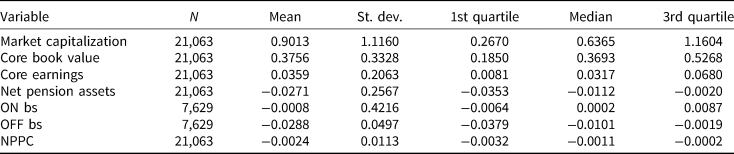
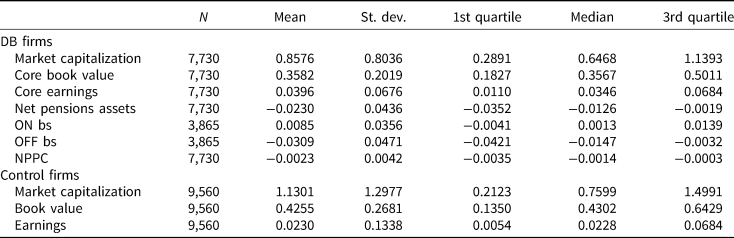
Table 3 presents the descriptive statistics for the main sample. As observed in Figure 1, the accrual on the balance sheet representing the funding of DB pensions under SFAS No. 87 underestimates the underfunding of pension schemes in my sample. On average, it is very close to zero when divided by assets, but a significant number of companies recognize a surplus despite disclosing a deficit in the notes.
Main sample descriptive statistics

Notes: All variables are standardized by total company assets and were collected on the balance sheet closing date, except for market capitalization which was retrieved one-quarter after the end of the fiscal year. All the variables are defined in Table 2.
Source: Author's calculations.
I use this sample to investigate the value relevance of NPA in cross section. In order to focus on the effect of the introduction of SFAS No. 158, I build a panel of companies that have full data in the years around the accounting reform. I stop my sample in 2010 to limit the loss of observations, as this leaves me with 5 years of data under each accounting regimes. I include also companies that do not sponsor any DB scheme as control group. For the panel sample, I keep the same requirements as the main sample and further eliminate all companies with total assets smaller than 100 million US dollars. Excluding these small companies serves primarily to ensure that the control group of companies with no DB schemes is not too different from the companies sponsoring a DB pension. In fact this exclusion reduces significantly the number of firms in the control group, whereas it eliminates only 44 DB sponsors. Including these 44 firms in my analysis does not alter the estimates (results not reported).
Table 4 collects the descriptive statistics for the panel sample. The companies that sponsor DB pensions have very similar characteristics across the two samples, whereas companies without DB schemes are on average smaller, less profitable, better capitalized and have a higher market value when standardized by assets. The sector composition of the two groups of companies that make up my panel sample is however quite different. Companies with a DB scheme tend to dominate traditional industries such as energy, materials and utilities, while the majority of firms in the IT and consumer discretionary sectors do not sponsor any DB pension.
Panel sample descriptive statistics

Notes: The table includes all firms in the panel sample, from 2001 to 2010. All variables are standardized by total company assets and were collected on the balance sheet closing date, except for market capitalization which was retrieved one-quarter after the end of the fiscal year. All the variables are defined in Table 2.
Source: Author's calculations.
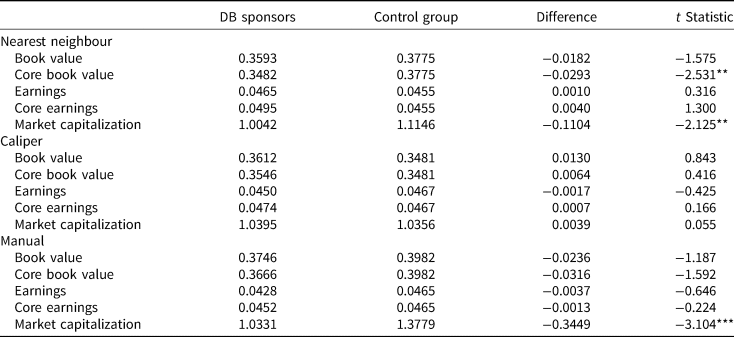
To address the potential concerns raised by the differences between DB sponsors and control firms, I use the panel sample to match companies that sponsor a DB with a peer that does not. I calculate the probability that a company sponsors a DB scheme in 2005, the year prior the introduction of SFAS No. 158, using the following probit model, where all independent variables are standardized by total assets as in the rest of the paper:

and use the resulting propensity score for matching. First I use nearest neighbour matching without replacement. In this case, the sample includes all DB sponsors, for a total of 773 matched pairs of companies. Then I impose a maximum allowed caliper to limit the possibility of bad matches, reducing the sample size to 445 matched pairs.Footnote 14 Finally, I create another matched sample manually, in this case trading off bigger differences between DB sponsors and control companies to ensure that the matched pairs are in the same sector. For this sample, I mechanically pair each DB sponsor with a peer in the same industry group (four digit GICS code), matching them by size (total assets) and breaking ties using market capitalization. I impose the constraint that no firm in the matched pair should be bigger than twice their counterpart in 2005, the last year prior to the introduction of SFAS No. 158. This leaves me with 302 pairs in the manually matched sample, for a total of 604 companies.
Table 5 shows that firms in the matched samples are indeed comparable: DB sponsors and control firms have very similar descriptive statistics prior to the introduction of SFAS No. 158. As expected, adding a maximum allowed caliper shrinks the sample while increasing the comparability of matched pairs. The sample of manually matched pairs trades off a bigger difference in firms' characteristics to ensure that the matched pairs are in the same sector.
Matched samples descriptive statistics

Notes: All variables are standardized by total company assets and were collected on the balance sheet closing date, except for market capitalization which was retrieved one-quarter after the end of the fiscal year. All the variables are defined in Table 2.
Source: Author's calculations
5. Results
This section presents results of this study on the value relevance of NPA in cross section using the main sample, whereas the next subsection focuses on the impact of SFAS No. 158. In my specifications, I divide the sample using the introduction of SFAS No. 158 as cut-off date (15th December 2006) rather than identifying the effect of the new standard with a dummy and interactions as in Yu (Reference Yu2013) and Beaudoin et al. (Reference Beaudoin, Chandar and Werner2011). However, in my case both methods yield the same results and I provide estimates using a dummy and interactions to identify the accounting reform in Appendix C.
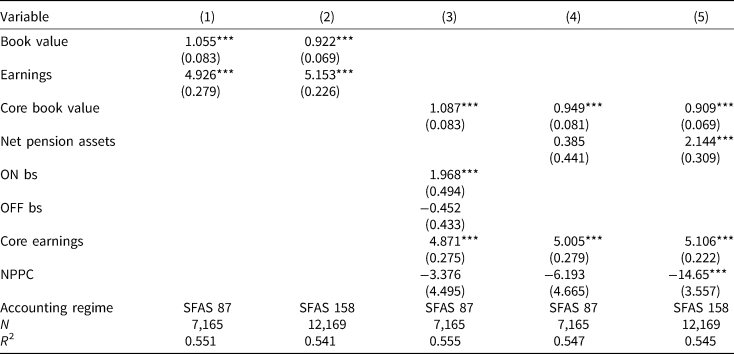
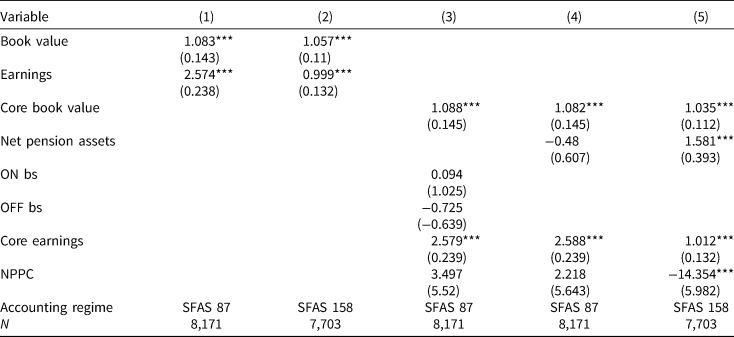
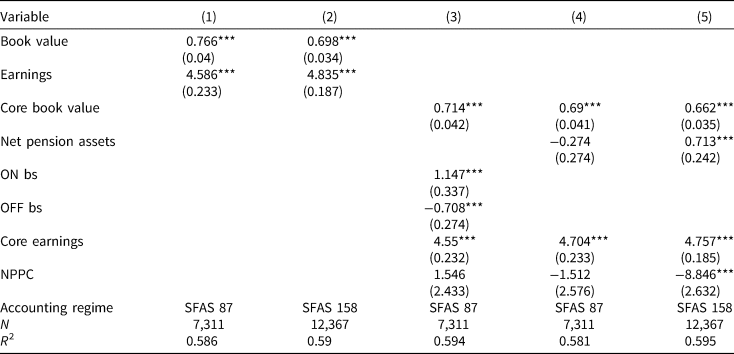
Columns 1 and 2 of Table 6 report the parameters' estimates for the basic Ohlson model before and after the introduction of SFAS No. 158, using only book value and earnings as independent variables, with sector and year fixed effects. The parameters' estimates correspond quite closely to those found in the literature (see, e.g., Dechow et al., Reference Dechow, Hutton and Sloan1999; Hann et al., Reference Hann, Heflin and Subramanayam2007a) and my modification of the model to make room for pensions does not alter the estimated coefficients on either book value or earnings. Columns 3 and 4 show estimation results for equations (2) and (1), respectively. NPA are not value relevant in this part of the sample. Investors seem to focus on the accrual recognized on the balance sheet under SFAS No. 87 accounting rather than the net funding of pension schemes disclosed in the notes, arguably the most important piece of information to determine future cash flows and hence firm value. Column 5 indicates that this changed after the introduction of SFAS No. 158, in this part of the sample NPA is strongly significant. Its point estimate of about 2 is above what the theory would imply, perhaps indicating that investors believe that companies underestimate pension liabilities in their accounts.Footnote 15 In columns 4 and 5, I also find that NPPC is value relevant, but with the wrong sign: the result implies that pension costs are positively related to the market value of sponsors. This is due to the service cost anomaly, first documented in Barth et al. (Reference Barth, Beaver and Landsman1992) and later confirmed by most of the literature on DB pensions. I discuss this issue in Appendix A.
Value relevance of pensions under SFAS No. 87 and SFAS No. 158

The table presents my estimation results using the main sample, covering data from 2001 to 2014. The independent variable is market capitalization one-quarter after the fiscal year end. All the variables are defined in Table 2. All the variables are standardized by total company assets. All specifications include year and four digit industry code dummies, standard errors are clustered at the company level. To mute outliers I exclude the top and bottom 1% of all variables.
Source: Author's calculations.
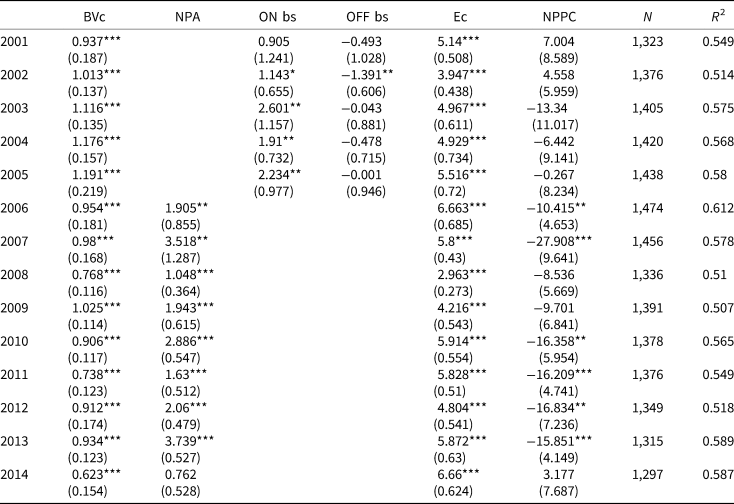
The results in Table 7 confirm and reinforce the insights from Table 6. In Table 7 I run a battery of yearly regressions of equation (1) (when SFAS No. 158 is the relevant standard) and equation (2) (in the period when companies report under SFAS No. 87). Estimating equation (1) before 2006 indicates that NPA is never significant in this period (results not reported for brevity), whereas the results for equation (2) suggest again that investors focus on the amount recognized on the balance sheet disregarding the disclosure in the notes, with DB pensions contributing positively to firm value even when they are in deficit. From 2006 onwards, NPA is always significant (except for 2014) and with a coefficient above 1, confirming my interpretation of the results in Table 6. Table 7 also highlights that my results are not driven by the years around the financial crisis, as the coefficient on NPA is precisely estimated in all the samples and does not change dramatically from one year to the next.
Yearly regressions

The table presents my estimation for a battery of yearly regression from my main sample, covering data from 2001 to 2014, using standard errors clustered at the industry level. The independent variable is market capitalization one-quarter after the fiscal year end. All the variables are defined in Table 2. All the variables are standardized by total company assets. All specifications include four digit industry code dummies. To mute outliers I exclude the top and bottom 1% of all variables.
Source: Author's calculations.
These results imply that the accounting reform introducing SFAS No. 158 and the recognition of pension deficits/surpluses on the balance sheet changed investors' perception of these items. In the next subsection, I turn to my panel sample to provide additional evidence to support this claim.
5.1 Effects of the introduction of SFAS No. 158
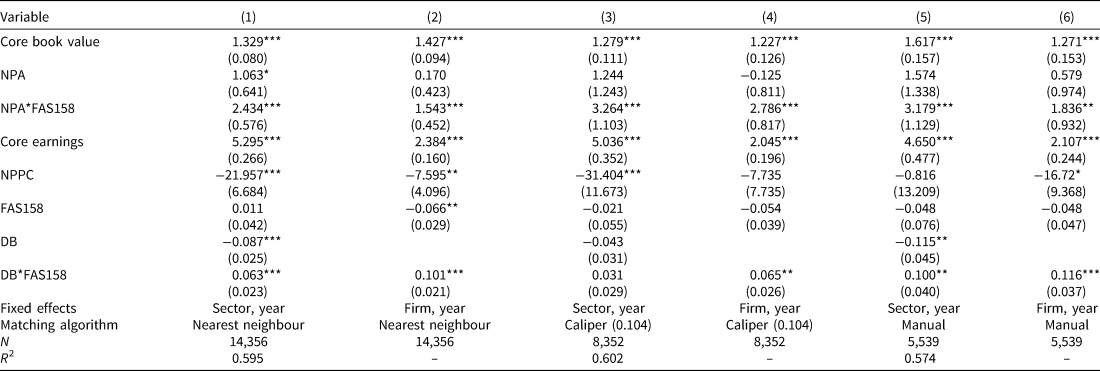
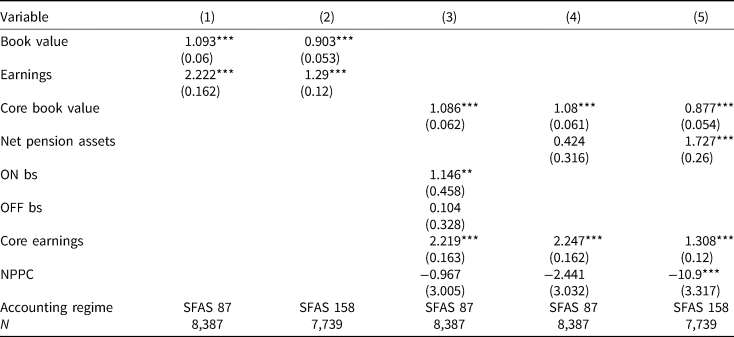
Using a panel of companies allows me to use firm fixed effects rather than performing a cross-sectional analysis similar to in the previous section. Table 8 shows the same estimations as Table 6, using firm and year fixed effects in the panel sample, including all companies.Footnote 16 The small difference in the number of observations between the pre and post SFAS No. 158 specifications is due to firms closing their accounts before the calendar year end, so that some companies still do not report under SFAS No. 158 in 2006 (my cut-off date is the introduction of the standard, so the 15th of December 2006). The estimates confirm that after the introduction of SFAS No. 158 NPA are priced in the market value of the schemes' sponsors and show that this result is robust to using firm level fixed effects. Comparing the parameters with Table 6, the coefficient on core earnings is significantly lower, especially after 2006. This is due to controlling for firm fixed effects, in fact the earnings' coefficients are in the same range as those estimated by Yu (Reference Yu2013), one of the few papers that use the same battery of controls. Again, comparing columns 4 and 5 with columns 1 and 2 I find that my modification of the Ohlson model to make room for pensions does not unduly influence the coefficients on book value and earnings.
Value relevance panel sample

The table presents my estimation results using the panel sample with data from 2001 to 2010, using standard errors clustered at the company level. The independent variable is market capitalization one-quarter after the fiscal year end. All the variables are defined in Table 2. All the variables are standardized by total company assets. All specifications include year and firm dummies. To mute outliers I exclude the top and bottom 1% of all variables.
Source: Author's calculations.
The main difference with Table 6 is in column 3. In this sample, market participants seem to disregard DB pensions completely before the introduction of SFAS No. 158, whereas in cross section I found that the accrual recognized on the balance sheet under SFAS No. 87 was value relevant. A possible explanation for this difference lies in the smoothing nature of such accrual: ON bs does not vary much over time compared with NPA, as it was designed to do. Using firm fixed effect is equivalent to subtracting to each variable its mean (by company), leaving very little variation in this variable and constraining its significance. A battery of yearly regressions in the panel sample confirms the results in the previous tables.Footnote 17 To ensure that the years around the financial crisis are not driving my results in this sample, I estimate the specifications in Table 8 using a shorter sample, stretching from 2004 to 2007. The results have the same interpretation, with bigger standard errors.Footnote 18
Next, I turn my attention to the accounting reform and try to pin down the introduction of SFAS No. 158. Table 9 presents various estimates of equation (3), where I identify the accounting reform using the interaction between the FAS 158 dummy and NPA, much in the spirit of a difference in differences estimation.Footnote 19 Columns 1 and 2 of Table 9 report estimates using nearest neighbour matching without replacement. In this case, all of the DB sponsors are matched, creating a sub sample similar to the full panel sample. Columns 3 and 4 use matching with a caliper of 0.104, reducing the sample significantly.Footnote 20 Finally, columns 5 and 6 use the sample of manually matched pairs. Odd columns use sector and year fixed effect, whereas even columns use company and year fixed effects.
Effect of the introduction of SFAS No. 158

The table presents my estimation results for equation (3). The first two columns use nearest neighbour matching, columns 3 and 4 use caliper matching with a radius of 0.104 and the last two columns use manual matching. The independent variable is market capitalization one-quarter after the fiscal year end. All the variables are defined in Table 2. All the variables are standardized by total company assets, standard errors are clustered at the company level. To mute outliers I exclude the top and bottom 1% of all variables.
Source: Author's calculations.
The main variable of interest in Table 9 is the interaction between NPA and the FAS 158 dummy, which is always zero before the introduction of the new standard and then switches to NPA for companies that sponsor a DB scheme while remaining at zero for control firms. Irrespective of the matching technique used, this interaction is always positive and precisely estimated. On the contrary, NPA seems to be value relevant only when interacted, reinforcing my previous finding that investors did not value pension deficits/surpluses when they were only disclosed and suggesting that SFAS No. 158 did change investors' perception of NPA. Odd columns indicate that DB sponsors are on average less valuable than firms that do not have such pensions (the DB dummy is negative and significant), but this negative premium is almost completely absent after the introduction of SFAS No. 158.Footnote 21 The coefficients' estimates for the other variables in Table 9 are very similar to what I found before, moreover there is no meaningful difference in the estimates between the three samples obtained with different matching techniques, thus reinforcing the general result.
These results strengthen the claim that SFAS No. 158 did indeed change investors' perception of DB pensions, making the recognized NPA value relevant.
6. Possible confounding effects: PPA and measurement date provisions
The Pension Protection Act of 2006 (PPA) was introduced on the 17th of August 2006. Given that SFAS No. 158 was introduced almost at the same time, it is possible that the provisions of the PPA had an effect on the value relevance of pension deficits/surpluses and that my previous results are spurious, driven by the PPA rather than the move from disclosure to recognition. Indeed, the accelerated funding requirement of the PPA is likely to increase future contributions towards unfunded pension schemes, thus possibly increasing the value relevance of unfunded pension commitments. Another potential confounding effect in my previous estimations is that SFAS No. 158 mandates that pension assets and liabilities should be measured at fiscal year end, while the previous standard allowed sponsors to measure them at a date of their choosing in a 3 month window before the closure of the accounts. This section addresses the two issues.
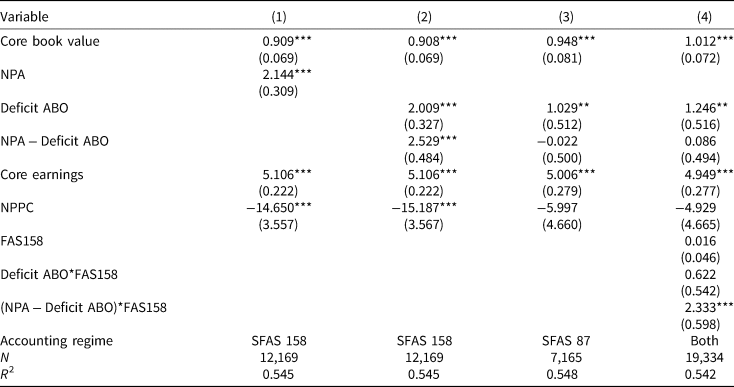
The accelerated funding provision of the PPA uses as a funding target the present value of all the benefits accrued or earned under the pension scheme's rules at the beginning of the year. Thus, the funding measure used by the PPA is very close to the accumulated benefit obligation (ABO), rather than the PBO on which accounting standards focus and that I have used throughout the paper. If the PPA had an effect on value relevance, that should concentrate on the unfunded portion of the ABO rather than the wider measure of pension deficit/surplus that I have focused on. I test this proposition empirically, by dividing my measure of NPA in two components: one captures the underfunded portion of the ABO (ABO deficit), while the other is equal to NPA − ABO deficit. If a company's pension assets are bigger than its ABO, then ABO deficit is zero.Footnote 22 If the PPA had a confounding effect on my previous results, then ABO deficit should be more value relevant than the remaining component of NPA under SFAS No. 158.
Table 10 presents the results of this estimation. Column 1 is just a repetition of column 5 in Table 6 to facilitate comparisons. Column 2 divides NPA into the underfunded portion of the ABO (ABO deficit) and its residual component, NPA remaining (equal to NPA − ABO deficit). Both components seem equally value relevant, with coefficients' estimates that are very close and statistically indistinguishable, hinting that the introduction of the PPA did not influence my previous results. This is reinforced by the results in column 3, where I run the same specification as in column 2 but in the period when SFAS No. 87 was the relevant standard and the PPA was not in force yet. In this case, ABO deficit is value relevant, while the other component of NPA is not: this is due to the fact that under SFAS No. 87 companies had to recognize on the balance sheet the underfunded portion of the ABO as a minimum funding liability, thus confirming my claim that financial statement recognition has an impact on the value relevance of pension items. Column 4 uses the full sample and identifies the introduction of SFAS No. 158 with a dummy and its interactions. If the PPA is driving the results, the interaction between ABO deficit and the SFAS No. 158 dummy should be significant, while ABO deficit should not be value relevant when not interacted. The results of column 4 point in the opposite direction, confirming my previous inference: the underfunded portion of ABO is value relevant when recognized (the coefficient on ABO deficit is positive and significant), while the introduction of the PPA did not increase its value relevance (the coefficient on the interaction is indistinguishable from zero). The residual component of NPA is value relevant only under SFAS No. 158, as I have found in the previous sections.
Confounding effects of the PPA

The table presents my estimation results to investigate the confounding effects of the PPA, using the main sample with data from 2001 to 2014. The independent variable is market capitalization one-quarter after the fiscal year end. All the variables are defined in Table 2. All specifications include year and four digit industry code dummies, standard errors are clustered at the company level. To mute outliers I exclude the top and bottom 1% of all variables.
Source: Author's calculations.
As the results of Table 10 point to precisely the opposite effect that one could expect from an impact of the PPA on value relevance, I conclude that my previous results are not unduly influenced by the introduction of this legislation.
To test if the measurement date provision of SFAS No. 158 is driving my results, I repeat the estimations in Tables 6 and 8 using only companies that did not change the measurement date of their pension assets and obligations after the introduction of SFAS No. 158. The results are nearly identical to those presented for the full samples, indicating that the measurement date provision is not driving my results.Footnote 23
7. Conclusion
This paper investigates whether there is a difference in the value relevance of disclosed versus recognized pension liabilities. I find that before the introduction of SFAS No. 158 investors focused on the accrual recognized on the balance sheet, disregarding the net position of pension funds disclosed in the notes. As this accrual computed under SFAS No. 87 bore little relationship with the funded status of DB schemes, equity markets participants were not valuing DB sponsors correctly, often underestimating the impact of their pension commitments. Investors' perceptions changed with the recognition regime brought by SFAS No. 158 in 2006. DB pension schemes' surpluses/deficits are value relevant when reported on the balance sheet. Further analyses in the years around the accounting reform suggest that the introduction of SFAS No. 158 is indeed responsible for the increased value relevance of pension commitments.
Although my results differ from earlier research on this topic, they are in line with the wider literature that finds an incremental valuation effect of recognized versus disclosed information, such as Ahmed et al. (Reference Ahmed, Kilic and Lobo2006), Davis-Friday et al. (Reference Davis-Friday, Buky Folami, Liu and Fred Mittelstaedt1999) and Michels (Reference Michels2017). My analysis strengthens and confirms the conclusions of these studies, using a setting where there is no issue of selection bias and where exactly the same information is disclosed or recognized, an opportunity the accounting environment rarely provides. In contrast to earlier results (such as Yu, Reference Yu2013), I do not find that this effect is dependent upon investor sophistication. The different inference between this study and that of earlier papers that have looked at the introduction of SFAS No. 158 highlights the importance of considering enough data around an accounting reform to assess its impact rather than focusing on the most immediate years after its introduction.
Overall, my analysis suggests that the FASB achieved its objective of increasing the transparency of pension reporting and that this improved equity investors' valuation of DB schemes sponsors. My result is also consistent with the view that investor do not process disclosed information as well as recognized one. The literature has put forward different explanations of why the valuation effects of disclosed information are different from those of recognized one. An interesting avenue for future research would be to disentangle empirically the competing explanations for this phenomenon.
Appendix A: Service cost anomaly
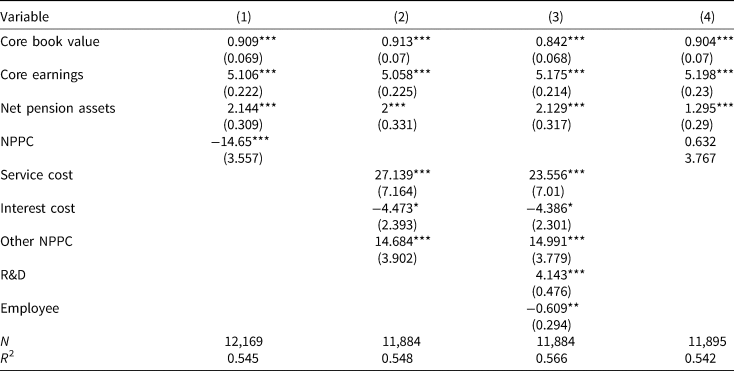
According to the service cost anomaly, first documented in Barth et al. (Reference Barth, Beaver and Landsman1992), the negative sign on pensions expenses is due to service cost being a proxy for human capital formation in the company and hence contributing positively to firm value. In Table 11, I investigate if this anomaly is driving the negative sign that I find for NPPC after the introduction of SFAS No. 158. Column 1 of Table 11 is just a repetition of column 5 in Table 6 to facilitate comparisons. Column 2 separates the elements of NPPC and shows clearly the service cost anomaly in my data: service cost is positively related to firm value despite being a cost.Footnote 24 Hann et al. (Reference Hann, Heflin and Subramanayam2007a) include research and development expenses and the number of employees as controls for human capital and show that the anomaly disappears. I replicate their analysis in column 3, but in my sample the inclusion of these two controls does not have any effect on the estimates for the components of NPPC.Footnote 25 An alternative strategy used by Coronado and Sharpe (Reference Coronado and Sharpe2003) and Coronado et al. (Reference Coronado, Mitchell, Sharpe and Blake Nesbitt2008) is to consider service cost as a core rather than a pension expense, thus using a measure of NPPC that includes only accruals. I replicate their method in column 4, where service cost is included in core earnings rather than in NPPC. In this case, the coefficient on pension expenses loses its value relevance, while the earnings coefficient is little changed.
Service cost anomaly

Appendix B: Results by shares
This appendix presents my main results standardizing all variables by the number of shares outstanding one-quarter after the fiscal year end rather than by total assets as in the main paper. I believe that the asset specification is better defined, suffers less from problems of collinearity and its coefficients have a more straightforward economic interpretation. However, various studies in this literature used a standardization by shares, so I include these results as robustness for my main estimations.Footnote 26 Standardizing the variables by sales as in Hann et al. (Reference Hann, Lu and Subramanyam2007b) and Yu (Reference Yu2013) yields very similar results.
Table 12 presents the same specifications as Table 6, standardizing the variables by shares. In terms of signs and significance, the results are similar to those in Table 6, even if the point estimates of coefficients are slightly different. The minor difference in the number of observations in the regressions in Tables 6 and 12 is due to the exclusion of outliers. A slightly puzzling difference is the negative coefficient on the variable OFF bs in column 3. I believe that this is due to the high correlation of variables describing pensions when these are standardized by shares: ON bs and OFF bs have a correlation of nearly 0.93 before the introduction of SFAS No. 158, while NPA and OFF bs are perfectly collinear.Footnote 27
Value relevance of pensions under SFAS No. 87 and SFAS No. 158 (by share)

Table 13 presents the same estimations as Table 8, again standardizing all variables by the number of shares outstanding one-quarter after the fiscal year end rather than by total assets. Here, almost all the coefficients are statistically undistinguishable from the ones in Table 8, confirming my inference in the main paper.
Value relevance panel sample (by share)

Appendix C: Reconciliation with previous literature
Since Yu (Reference Yu2013) and Beaudoin et al. (Reference Beaudoin, Chandar and Werner2011) have looked at the same research question as this paper but with a different methodology, this section shows that my results are robust to their estimation strategy. Both papers use a dummy for SFAS No. 158 and its interactions with the other regressors to identify the effect of the introduction of that accounting standard. I believe that the use of a control sample as in Section 5.1 is more appropriate to identify such effect; however, for completeness I report also estimates obtained with their technique. It involves bringing to the data modifications of the following equation:

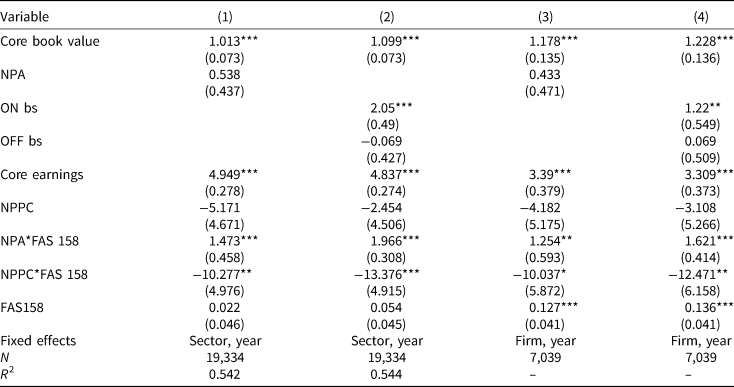
where I standardize all variables but the FAS 158 dummy by total company assets as in the main paper. I also test a slight modification of equation (C.1), substituting NPA with its on and off balance sheet components when SFAS No. 87 is the relevant standard, much like in equation (2). The first two columns of Table 14 report estimates using my main sample with sector and year fixed effects, while columns 3 and 4 use the panel sample (I excluded all companies without a DB scheme as it does not make much sense to include them using this estimation strategy) with firm and year fixed effects. I report only the coefficients' estimates for the interactions of interest for brevity (also, using only interactions on the pension variables rather than the full model does not unduly influence my results). The different specifications in Table 14 all have the same interpretation, the interaction between FAS 158 and NPA is always positive and significant as expected, confirming my claim that DB pensions are value relevant when their net position is recognized on the balance sheet. In columns 1 and 3, NPA is not significant when not interacted, indicating that market participants tend to disregard the pension deficit/surplus when this is disclosed in the notes. Columns 2 and 4 support my claim that investors focused on the accrual recognized on the balance sheet when valuing DB sponsors prior to 2006, without considering the additional disclosure in the notes to the financial statements.
Alternative models

Appendix D: Analyst following and institutional ownership
The main result of Yu (Reference Yu2013) is that the value relevance of pensions depends upon institutional ownership and the number of analyst following the firms. He finds that off balance sheet items are more value relevant for firms that are followed by more analysts or have a higher percentage of institutional ownership, while the introduction of SFAS No. 158 increased the value relevance of previously disclosed items more significantly for firms that enjoy less attention from analysts and have a lower level of institutional ownership. In this section, I test these hypotheses on my data.Footnote 28
I obtain the number of analyst following each firm at fiscal year end from I/B/E/S and the data for institutional ownership at the security level from Thompson Reuters S34 data. The latter data are available at calendar quarter frequency, so for firms whose fiscal year end does not coincide with a calendar quarter I used the most recent available disclosure before they close the accounts (i.e., for firms with fiscal year ends in April, the institutional ownership data are collected at the end of March). To follow the estimation strategy of Yu (Reference Yu2013) as closely as possible, I calculate the scaled rank of institutional ownership or analyst following for each firm by ranking these variables into deciles and dividing each group number by 9, such that the scaled rank ranges between 0 and 1. This strategy has the downside of excluding all the observations for which data on institutional ownership or analyst following is not available, thus reducing my sample.Footnote 29 I then bring to the data a model similar to equation (1), testing if the value relevance of NPA under disclosure and recognition is dependent upon institutional ownership or analyst following using two separate samples:

where INST is the scaled rank of either institutional ownership or analyst following. I standardize all variables but INST by total company assets as in the main paper.Footnote 30 I also test a slight modification of equation (D.1), substituting NPA with its on and off balance sheet components when SFAS No. 87 is the relevant standard, much like in equation (2).
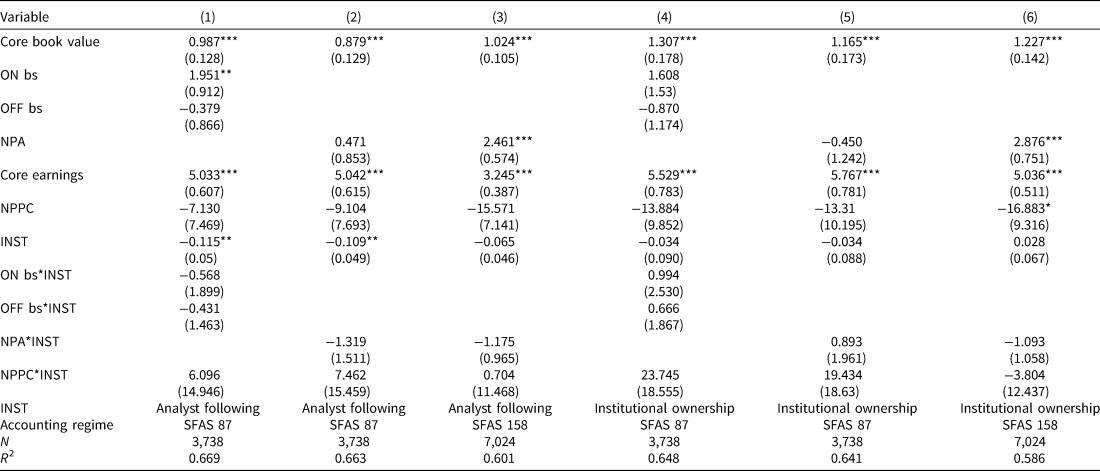
Columns 1–3 in Table 15 show the results using analyst following, while columns 4–6 repeat the estimation using institutional ownership, reporting only the coefficients' estimates for the interactions of interest for brevity. Using this estimation strategy, it does not seem that either analyst following or institutional ownership have a statistically meaningful impact on the value relevance of pensions: the interaction of NPA with INST is never significant, while the coefficients on the other variables of interest are very similar to what I found in the main paper, thus confirming its results. Also, INST loses significance in most of the specifications when interacted with all the other variables (this is not the case when interactions are omitted).
Value relevance including analysts and ownership

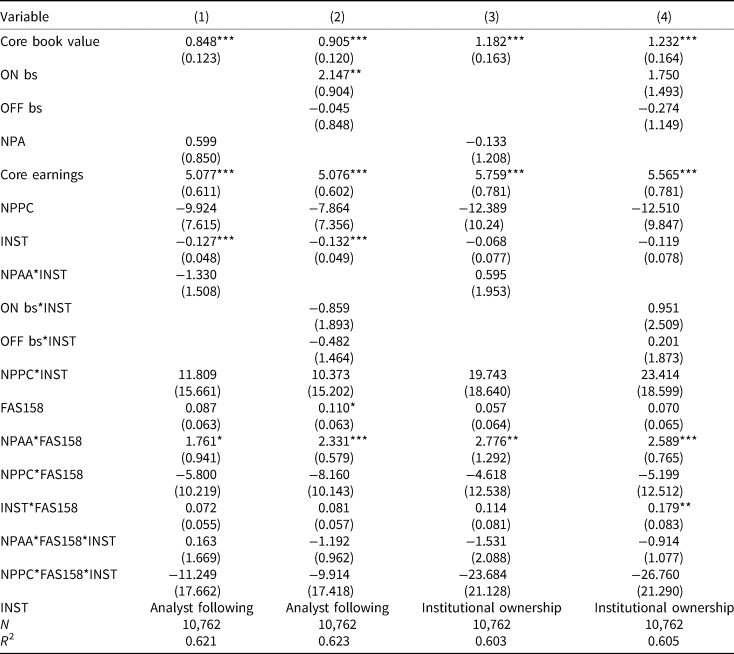
I also test the effect of institutional ownership and analyst following on value relevance with a model that closely resembles that used by Yu (Reference Yu2013), merging the disclosure and recognition periods in one sample and identifying the additional value relevance under recognition using a dummy and its interactions with the other model variables, thus testing:

where FAS158 is a dummy equal to 1 if SFAS No. 158 is the relevant standard and zero otherwise. As before, all variables but INST and FAS158 are standardized by total assets and I also test a specification where NPA is divided into its on and off balance sheet components when SFAS No. 87 is the relevant standard.Footnote 31 In this specification, the coefficients of interest are β 2, β 7, β 12 and β 17. β 2 measures the value relevance of pensions under the disclosure regime for firms in the lowest INST rank (INST = 0), while β 7 measures the incremental effect of INST on the value relevance of NPA under disclosure. β 12measures the change in value relevance under SFAS No. 158 for firms in the lowest INST rank, while β 17 measures the incremental effect of INST on the change in value relevance of NPA due to SFAS No. 158.
Columns 1 and 3 in Table 16 show the results for equation (D.2) using analyst following and institutional ownership, respectively. Columns 2 and 4 split NPA into its on and off balance sheet components under SFAS No. 87, where INST uses analyst following in column 2 and institutional ownership in column 4. Both β 7 and β 17 are never significant in these estimations, indicating no statistically meaningful additional effect for analyst following and institutional ownership under either disclosure or recognition. Moreover, additional statistical tests indicate that the sum of β 2 and β 7 is not statistically different from zero, meaning that even for observations with the highest rank of INST NPA are not value relevant when disclosed. The other coefficients' estimates confirm what I found in the main paper: β 12 is positive and precisely estimated, indicating that SFAS No. 158 increased the value relevance of pensions. Splitting NPA into its on and off balance sheet components as in columns 2 and 4 does not provide additional insights, as the value relevance of these items does not seem to depend on the rank of INST.
Analyst following and institutional ownership

Appendix E: Additional matching results
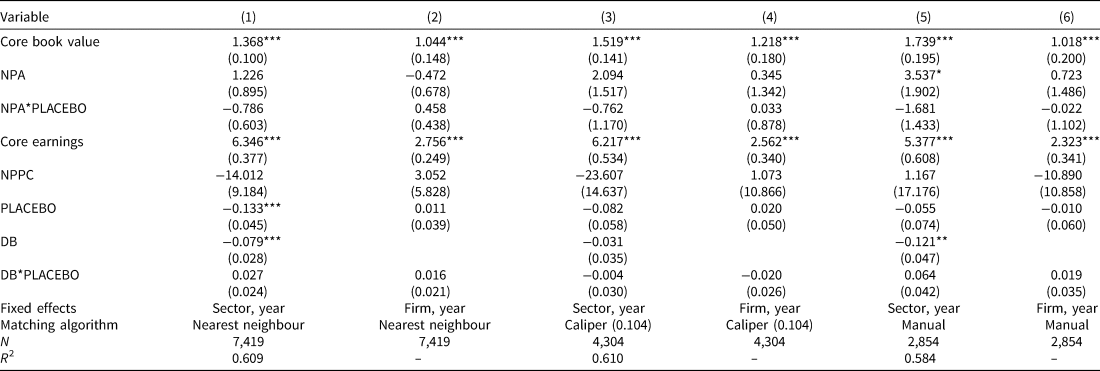
This section provides additional results to confirm the robustness of estimates presented in Section 5.1. To provide a test of the validity of my difference in differences approach, I design a statistical test for the parallel trend hypothesis prior to the introduction of SFAS No. 158 using a placebo reform in the part of the sample where SFAS No. 87 is the relevant standard. Hence, I create a new dummy variable called PLACEBO that takes value of 1 for the years after 2003 and zero before, running the same estimations as in Section 5.1, using the placebo dummy instead of the one identifying the introduction of SFAS No. 158.Footnote 32 If the parallel trend hypothesis is satisfied, I expect the interaction between NPA and PLACEBO not to be value relevant. Table 17 presents the results, using the same matched samples as Table 9. These results indicate the validity of the parallel trend hypothesis: the interaction between PLACEBO and NPA is never significant.
Parallel trends hypothesis test

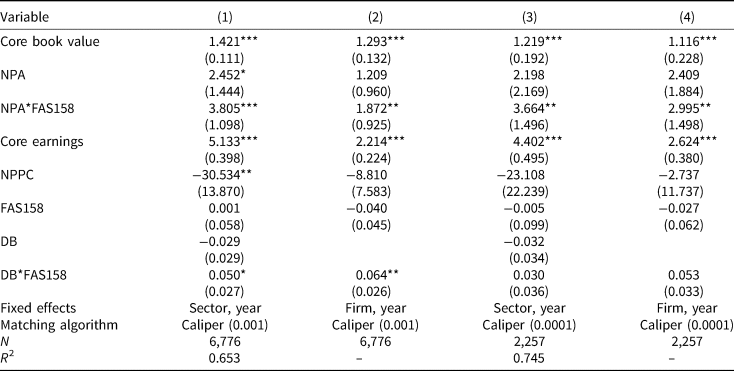
To provide further robustness of the results presented in Table 9, I generate two additional samples of matched pairs using the same matching algorithm as in Section 5.1 but progressively reducing the caliper. Shrinking the caliper has the benefit of reducing the differences between DB sponsors and the control sample, reducing the possibility of bad matches by using a smaller sample. Table 18 presents the estimation results for equation (3) on samples matched using a caliper of 0.001 (columns 1 and 2) and of 0.0001 (columns 3 and 4). The results are very similar to those presented in Table 9, thus confirming the inference in Section 5.1.
Matching robustness