

Education systems around the world are engaged in valiant efforts to address significant issues affecting classrooms and schools, including school violence, illiteracy, reactive and negative school climates, school dropout, mental health, disproportionality and inequitable access to services and supports (Jimerson, Nickerson, Mayer, & Furlong, Reference Jimerson, Nickerson, Mayer and Furlong2012; Kauffman & Landrum, Reference Kauffman and Landrum2013; Walker et al., Reference Walker, Horner, Sugai, Bullis, Sprague, Bricker and Kaufman1996; Walker, Ramsey, & Gresham, Reference Walker, Ramsey and Gresham2004). Ironically, many evidence-based interventions and practices have been identified to tackle these kinds of challenges; however, their adoption, impact, durability, and scaled or systems-wide implementation have not been widely demonstrated (Fixsen, Blase, Horner, & Sugai, Reference Fixsen, Blase, Horner and Sugai2010; Fixsen, Blase, Metz, & Van Dyke, Reference Fixsen, Blase, Metz and Van Dyke2013; Fixsen, Naoom, Blase, Friedman, & Wallace, Reference Fixsen, Naoom, Blase, Friedman and Wallace2005; Wandersman, Alia, Cook, Hsu, & Ramaswamy, Reference Wandersman, Alia, Cook, Hsu and Ramaswamy2016; Wandersman et al., Reference Wandersman, Duffy, Flaspohler, Noonan, Lubell, Stillman and Saul2008). Instead, implementation fidelity and sustainability seem to be lessened by (a) professional development that is short in duration, cursory in nature, and led by outside experts; (b) misalignment with actual student, classroom, and school need; (c) competing initiatives and efforts that have overlapping outcome goals but nonoverlapping implementation plans; (d) approaches without well-documented effectiveness and cultural or contextual relevance; (e) inattentiveness to basic teaching and learning tenets; (f) insufficiently prioritised and supported leadership policy and resources; or (g) some combination of these factors (Nese et al., in press; Pinkelman, McIntosh, Rasplica, Berg, & Strickland-Cohen, Reference Pinkelman, McIntosh, Rasplica, Berg and Strickland-Cohen2015; Strickland-Cohen, McIntosh, & Horner, Reference Strickland-Cohen, McIntosh and Horner2014; Turri et al., in press).
Fortunately, an existing and rapidly growing literature base is available to guide education systems toward improved practice adoption, alignment, and integration; long-term implementation fidelity; and meaningful improvement in the academic and behavioural outcomes for all children and youth. However, to achieve these systemic results, school improvement stakeholders must ‘work smarter’ (i.e., more effectively, efficiently, and relevantly) by adopting a defendable and relevant theoretical perspective, providing and engaging in embedded professional development activities that are informed by adult teaching and learning principles, and investing in the establishment of expert, durable, and local content and implementation capacity at the leadership level.
The purpose of this paper was to describe the importance of capacity development (CD) in the high fidelity and sustained implementation of empirically supported practices within a multi-tiered system of support (MTSS). After describing the rationale for and descriptions of CD, prevention and behavioural sciences, and MTSS, we present a framework for the development of local implementation capacity based on basic teaching and learning principles, system implementation tenets, and shared and distributed leadership precepts. Throughout these sections, we used positive behavioural interventions and supports (PBIS) as an example of a CD framework.
Why Focus on CD?
Although many countries, states, and local school systems have established prohibition of reactive and ineffective disciplinary practices (e.g., corporal punishment, seclusion), in some countries around the world, the academic achievement and progress of children and youth are negatively affected by significant social and political issues. Classroom and school climates are characterised as negative and unsafe because of bullying and violent and antisocial behaviour (Gage, Larson, Sugai, & Chafouleas, Reference Gage, Larson, Sugai and Chafouleas2016; Sugai, Watanabe, & Shimamune, Reference Sugai, Watanabe and Shimamune2014; Walker et al., Reference Walker, Ramsey and Gresham2004). Ineffective reactive management strategies (e.g., removal from class, reprimands and public humiliation, in and out of school suspension, corporal punishment) have become common disciplinary practices because of their short-term seemingly positive effects, despite their actual negative long-term academic and behavioural costs. Students of colour who are from poor and disadvantaged families are overly represented in reactive disciplinary systems and least likely to get equitable access to proactive resources (De Valenzuela, Copeland, Qi, & Park, Reference De Valenzuela, Copeland, Qi and Park2006; Fenning & Rose, Reference Fenning and Rose2007; Gregory & Weinstein, Reference Gregory and Weinstein2008; Skiba, Poloni-Staudinger, Gallini, Simmons, & Feggins-Azziz, Reference Skiba, Poloni-Staudinger, Gallini, Simmons and Feggins-Azziz2006). Although no more frequent than in previous years, episodes of school violence are more deadly and intense, and student, educator, and family member perceptions of school safety are at low levels (Benbenishty & Astor, Reference Benbenishty and Astor2005; Dwyer, Osher, & Warger, Reference Dwyer, Osher and Warger1998; Furlong & Morrison, Reference Furlong and Morrison2000; Furlong, Morrison, Cornell, & Skiba, Reference Furlong, Morrison, Cornell and Skiba2004). In addition, concerns about school leaving (dropping out), gang involvement, unemployment, and substance use, for example, have increased over recent years (Kauffman & Landrum, Reference Kauffman and Landrum2013; Walker et al., Reference Walker, Ramsey and Gresham2004).
In the United States (US), for example, federal (e.g., U.S. Departments of Education, Health and Human Services, and Justice) and state education entities have responded with policies and legislative acts that prioritise positive school climate, school mental health, character education, and social skills instruction. PBIS is an example of a federal investment and systemic approach to address the above concerns by promoting the organisation and implementation of evidence-based practices within a multi-tiered prevention framework. Rather than disseminating through traditional professional development approaches that rely on external experts to train school staff members on interventions and practices, the PBIS framework focuses on developing and improving the implementation capacity of school and district personnel and organisational units (Blase, Fixsen, Sims, & Ward, Reference Blase, Fixsen, Sims and Ward2015; OSEP Technical Assistance Center on Positive Behavioral Interventions and Supports, 2015a).
What is PBIS?
PBIS was introduced in the 1990s through an investment by the Office of Special Education Programs, U.S. Department of Education, to improve the adoption and implementation of evidence-based behavioural practices (http://www.pbis.org). Technical assistance is focused on establishing a continuum of evidence-based practices for all students, but especially students with disabilities and behaviour disorders (Safran & Oswald, Reference Safran and Oswald2003; Sugai & Horner, Reference Sugai and Horner1999; Sugai et al., Reference Sugai, Horner, Dunlap, Hieneman, Lewis, Nelson and Ruef2000). Over the past 10 years, the database in support of PBIS practices and systems has grown (Bradshaw, Koth, Bevans, Ialong, & Leaf, Reference Bradshaw, Koth, Bevans, Ialongo and Leaf2008; Bradshaw, Koth, Thornton, & Leaf, Reference Bradshaw, Koth, Thornton and Leaf2009; Bradshaw, Mitchell, & Leaf, Reference Bradshaw, Mitchell and Leaf2010; Bradshaw, Reinke, Brown, Bevans, & Leaf; Reference Bradshaw, Reinke, Brown, Bevans and Leaf2008; Bradshaw, Waasdorp, & Leaf, Reference Bradshaw, Waasdorp and Leaf2012; Childs, Kincaid, George, & Gage, Reference Childs, Kincaid, George and Gage2016; Horner, Sugai, & Anderson, Reference Horner, Sugai and Anderson2010; Horner et al., Reference Horner, Sugai, Smolkowski, Eber, Nakasato, Todd and Esperanza2009). In addition, a number of district- and state-level examples have been described in the published literature (e.g., Sadler, Reference Sadler2000; Sadler & Sugai, Reference Sadler and Sugai2009; Simonsen et al., Reference Simonsen, Eber, Black, Sugai, Lewandowski, Sims and Myers2012; Spaulding, Horner, May, & Vincent, Reference Spaulding, Horner, May and Vincent2008). In the following sections, we describe the main features that characterise PBIS (OSEP Technical Assistance Center on Positive Behavioral Interventions and Supports, 2015a, 2015b; Sugai & Horner, Reference Sugai and Horner2009a, Reference Sugai, Horner, Sailor, Dunlap, Sugai and Horner2009b).
Foundations in behavioural science
PBIS is based on behavioural science principles and tenets, in particular, applied behaviour analysis (ABA; Cooper, Heron, & Heward, Reference Cooper, Heron and Heward2007; Gresham, Reference Gresham2004; Nelson et al., Reference Nelson, Hurley, Synhorst, Epstein, Stage and Buckley2009; Wolery, Bailey, & Sugai, Reference Wolery, Bailey and Sugai1988). Although physiology and cognitive abilities are important considerations, the emphasis is on the individual's behaviour and learning history, which is shaped and affected by features and actions of the environments in which behaviours are learned, occasioned or triggered, and reinforced (Skinner, Reference Skinner1953). As such, what children, youth, and adults say and do is influenced by their prior learning experiences and the characteristics of the classroom and nonclassroom settings (Vargas, Reference Vargas1977, Reference Vargas2009). Developing an understanding of learning history and behaviour–environment functional relationships guides implementation decisions.
Prevention focus
PBIS emphasises a prevention science approach by giving priority to decisions and actions that prevent the development of new problem behaviour (incidence) and reduce the frequency, occurrence, intensity, and/or complexity of existing problem behaviour (prevalence; Biglan, Reference Biglan1995, Reference Biglan2015; Embry, Reference Embry2004; Mayer, Reference Mayer1995). As such, the focus is on (a) teaching expected and appropriate social skills that represent and support academic and social success; (b) adding antecedent and consequence changes that prompt and maintain, respectively, desired behaviour; and (c) removing antecedent and consequence changes that prompt and maintain, respectively, undesirable behaviour.
Multi-tiered framework
The PBIS framework is based on a multi-tiered prevention logic that is derived from the public health and disease control approach and generally emphasises implementing the most effective prevention practices for all members of a particular community or population, and providing additional, more specialised supports for individuals whose behaviours are already high risk or have been proven to be unresponsive to more universal interventions (Biglan, Reference Biglan1995; Colvin, Kame'enui, & Sugai, Reference Sugai and Tindal1993; Lewis & Sugai, Reference Lewis and Sugai1999; McIntosh & Goodman, Reference McIntosh and Goodman2016; Walker et al., Reference Walker, Horner, Sugai, Bullis, Sprague, Bricker and Kaufman1996). Generally, a three-tiered logic is emphasised in education contexts. Tier 1 practices (a) support all students and staff members across all classroom and nonclassroom settings and (b) focus on directly teaching and positively reinforcing desired or expected social skills and behaviours and their setting-specific variations. Tier 2 practices are small-group oriented for students whose behaviours are less responsive to Tier 1 practices and require more frequent, intensive, and targeted intervention supports. Tier 3 practices are the most individualised and specialised for students whose behaviours are unresponsive to Tiers 1 and 2 and have the greatest risk of academic and/or behavioural failure.
Critical implementation elements
PBIS operates through the integration of four implementation elements. First, all decisions are focused on specification and achievement of important academic achievement and social behaviour outcomes of all students. Second, data are used to inform decisions about student goals, practice selection, and implementation fidelity (Gresham, Reference Gresham1989; Hagermoser Sanetti & Kratochwill, Reference Hagermoser Sanetti and Kratochwill2014). Third, the selection of the best evidence-based practices is based on student data and alignment with student benefit. Finally, systems are established to ensure that data-based decisions, appropriate goals, and evidence-based practices are selected and implemented with fidelity. School and district leadership teams make decisions regarding data, student outcomes, evidence-based practices, and implementation systems by giving careful attention to learning histories and local contextual and cultural norms and characteristics of students and family and staff members (e.g., language, ethnicity, neighborhood; Sugai, O'Keeffe, & Fallon, Reference Sugai, O'Keeffe and Fallon2012). The goal is to establish local implementation capacity for sustaining and generalising the use of all four elements.
Focus on building local capacity
Traditional efforts to change and improve classroom and school practices tend to be ‘train-and-hope’ events that are episodic (e.g., ‘PD day’), acquisition focused (e.g., ‘here's the manual and what it looks like’), teacher implemented (e.g., ‘give it a try’), and inadequately supported over time (e.g., ‘let us know how it goes’; Latham, Reference Latham1992). In contrast, implementation of the PBIS framework (outcomes, data, practices) is focused on establishing effective, efficient, and relevant teaching and learning environments by embedding professional development structures, supports, and activities to maximise local and durable implementation capacity.
What is Implementation CD?
MTSS, like PBIS, focuses on establishing local content expertise and long-term implementation competence so that educators have improved opportunities to select and implement evidence-based practices with high fidelity, sustain and adapt their implementation over time and contexts, and scale or extend their implementation with fidelity to other contexts and settings (i.e., classrooms, schools, districts, regions; Durlak & DuPre, Reference Durlak and DuPre2008; McIntosh & Goodman, Reference McIntosh and Goodman2016). As such, CD is described generally as the ‘process through which individuals, organizations, and societies obtain, strengthen and maintain the capabilities to set and achieve their own development objectives over time’ (United Nations Development Programme, 2009, p. 4).
Although the empirical literature is not well developed (Wandersman, Chien, & Katz, Reference Wandersman, Chien and Katz2012), the conceptual consideration of CD exists. For example, Wandersman and his colleagues have developed a useful heuristic (Scaccia et al., Reference Scaccia, Cook, Lamont, Wandersman, Castellow, Katz and Beidas2015; Wandersman et al., Reference Wandersman, Duffy, Flaspohler, Noonan, Lubell, Stillman and Saul2008) within which ‘empowerment evaluation’ and ‘getting to outcomes’ are proposed so organisations increase their capacities to achieve important outcomes through the efficient implementation of evidence-based interventions. In particular, Scaccia et al. (Reference Scaccia, Cook, Lamont, Wandersman, Castellow, Katz and Beidas2015) emphasise ‘(a) motivation to implement an innovation, (b) general capacities of an organization, and (c) innovation-specific capacities needed for a particular innovation’ (p. 484). Tools, training, technical assistance, and quality assurance and improvement are suggested as four key components within an ‘Iteractive Systems Framework for Dissemination and Implementation’ (Wandersman et al., Reference Wandersman, Duffy, Flaspohler, Noonan, Lubell, Stillman and Saul2008, p. 171).
We extend the Wandersman et al. (Reference Wandersman, Duffy, Flaspohler, Noonan, Lubell, Stillman and Saul2008) heuristic within the PBIS context to suggest that CD is the establishment of competent and sustainable school, district, and state organisational systems such that academic and behaviour practice implementation is (a) culturally responsive, high fidelity, and sustained over time; (b) continuously adapted and regenerated based on decisions that are data-based; (c) locally coordinated and professionally developed; and (d) formally authorised and institutionalised (OSEP Technical Assistance Center on Positive Behavioral Interventions and Supports, 2015a; Shannon, Daly, Malatchi, Kvarfordt, & Yoder, Reference Shannon, Daly, Malatchi, Kvarfordt and Yoder2001). In addition, three important sets of conceptual principles guide development of implementation competence and capacity: phases of learning, implementation drivers and phases, and MTSS.
How do phases of learning relate to development of implementation capacity?
Teaching academic skills and social behaviours to students occurs in phases — each of which guides how success and progress are assessed and what kind of instruction is needed (Colvin et al., Reference Colvin, Kame'enui and Sugai1993; Colvin & Sugai, Reference Colvin and Sugai1988; Haring, Liberty, & White, Reference White and Haring1980; White & Haring, Reference White and Haring1980). The same logic applies to professional development and adult learning. During the acquisition phase, teacher-led direct instruction (e.g., describe, tell, model, practice, regular corrective and positive feedback) and accurate and complete responding are emphasised (Sugai & Tindal, Reference Sugai and Tindal1993). Following acquisition, instruction shifts to fluency building, by providing guided practice and feedback regarding consistency and rate of responding. After accurate and fluent responding are documented, durable or sustained responding is achieved in the maintenance phase by systematically removing instructional prompts and assistance and shifting feedback and consequence supports to naturally available contingencies. The generalisation and adaptation phase involves teaching with new and varied examples so student and adult learners will learn to use their acquired skills in contexts and conditions that were not included in initial instruction and where instructional supports are not available.
When this teaching and learning phase logic is applied to adult learners, professional development becomes more than, for example, book discussions, motivational speakers, 1-hour webinars, or one-time half-day workshops. Whereas traditional professional development involves episodic and brief exposure to a new teaching practice, a capacity-focused approach provides professional development supports that target accurate, fluent, durable, and generalisable practice use. This shift requires that professional development be embedded within existing organisational structures and regularly occurring teaching routines and activities. As such, development of local implementation capacity is centred around supporting adult learning that is guided by phase of learning.
How does implementation phase relate to development of implementation capacity?
Implementation phase is an important consideration in establishing implementation capacity and integrates into the learning phase logic. Researchers at the National Implementation Research Network propose that practice implementation occurs in five phases (http://nirn.fpg.unc.edu/; Blase & Fixsen, Reference Blase and Fixsen2013; Bradshaw, Debnam, Koth, & Leaf, Reference Bradshaw, Debnam, Koth and Leaf2009; Fisher, Shortell, & Savitz, Reference Fisher, Shortell and Savitz2016; Fixsen et al., Reference Fixsen, Naoom, Blase, Friedman and Wallace2005; Metz & Bartley, Reference Metz and Bartley2012). During the exploration and readiness phase, implementers are introduced to a practice by highlighting and operationalising the need, proposing a viable practice to achieve the need, and securing commitments and readiness for implementation (Dymnicki, Wandersman, Osher, Grigorescu, & Huang, Reference Dymnicki, Wandersman, Osher, Grigorescu and Huang2014; Scaccia et al., Reference Scaccia, Cook, Lamont, Wandersman, Castellow, Katz and Beidas2015). This introduction is often presented by practice developers or external professional trainers. The next phase, initial implementation, involves organising resources, developing schedules, preparing personnel, and engaging in initial practice implementation. During this phase, extra supports (e.g., grants, supplemental personnel) are sometimes utilised to ensure adoption and implementation success. Self-sustaining continuous improvement with local resources is the long-term target.
If initial efforts are successful and adjustments are made to accommodate the local implementation conditions, implementers commit to full use of a practice across the organisation (e.g., > 80% of personnel). During this phase, coaching and leadership coordination are frequent and direct. If the goal of full implementation with fidelity is achieved, implementation efforts focus on sustaining or maintaining implementation by shifting from external and extra support to more local resources and supports. In addition, resource efficiency adaptations are made so that sustainability and scaling can occur with existing supports (CD).
Finally, if full implementation provides a convincing and cost-effective demonstration of practice use and meaningful student outcomes, planning and support are established to enable implementation expansion (i.e., scaling) across other similar organisational units (e.g., classrooms, grade levels, schools, districts). Again, the goal is to reduce dependence on external, nonsustainable resources (e.g., funding, personnel, time).
How does MTSS relate to development of implementation capacity?
To increase the efficiency and relevance of professional development and capacity enhancement efforts, an MTSS logic approach can be useful (McIntosh & Goodman, Reference McIntosh and Goodman2016; Sugai & Horner, Reference Sugai and Horner2009b). As previously described, MTSS is characterised by the development of a tiered system of practices and supports that are delivered based on student behaviour responsiveness to a given intervention. If responsiveness is low or if the student has demonstrated high risk, more intensive and specialised supports are provided.
A similar responsiveness-to-professional development logic is applied to CD. If an educator or group of educators (e.g., grade level, school faculty) is unresponsive to efforts to increase practice use and fidelity through general professional development, more intensive and specialised supports may be indicated (Myers, Simonsen, & Sugai, Reference Myers, Simonsen and Sugai2011; Simonsen et al., Reference Simonsen, MacSuga-Gage, Briere, Freeman, Myers, Scott and Sugai2014). For example, a district team may support initial implementation of a practice within a school, and discover that 75% of the school staff are ‘onboard’ with implementation using a school-based team (Tier 1). Before moving to full implementation, additional professional development may be needed for the other 25% (Tier 2), and a few staff members may require more direct and individualised encouragement from the school administrator (Tier 3).
Summary
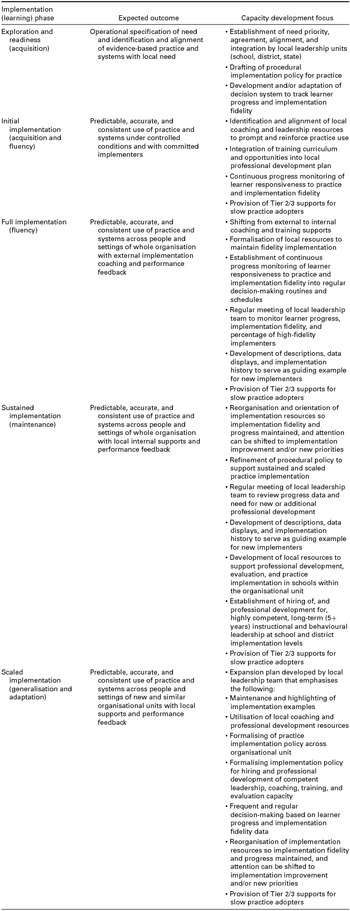
By integrating the logic of teaching and learning phases, implementation phases, and MTSS, professional development and the establishment and operation of implementation capacity can be more deliberate, prescriptive, sustainable, and self-improving. Again, the objective is to give local school organisational units (e.g., school, district) the capacity to provide meaningful and formative professional development, achieve durable implementation fidelity, reduce their dependence on external unsustainable supports, make contextually relevant implementation decisions, and extend or scale their implementation across their organisational unit. In Table 1, implementation and learning phases, expected outcomes, and CD focus are described.
Implementation and Learning Phases, Expected Outcomes, and Capacity Development Focus

How Is Local Implementation Capacity Developed and Maintained?
Local implementation capacity exists when (a) reliance on external professional development and technical assistance supports are minimally required to maintain full and scaled implementation of an evidence-based practice; (b) continuous improvement decisions are routinely made about implementation of existing efforts; and (c) existing resources and leadership structures can be directed toward new, high priority needs.
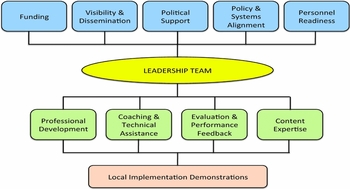
Because individual schools typically do not have the resources for major shifts in implementation efforts, CD is most often focused at the district or region where groups of schools administratively pool their resources. However, this way of doing business requires a high level of implementation and organisational efficiency. Using PBIS as an example, development of district-level implementation capacity considers four main drivers (Algozzine et al., Reference Algozzine, Horner, Sugai, Barrett, Dickey, Eber and Tobin2010; Duda et al., Reference Duda, Ingram-West, Tedesco, Putnam, Buenrostro, Chaparro and Horner2013; OSEP Technical Assistance Center on Positive Behavioral Interventions and Supports, 2015a): (a) organisational agreement that considers priority, policy, duration, and authority; (b) administrative team leadership that emphasises stakeholder participation, data-based decision-making, action-based implementation planning, and practice alignment and integration; (c) tiered professional development and evaluation that is embedded within daily routines, continuous, and high-fidelity implementation; and (d) exemplary practice implementation that considers documentation, replicable data-based descriptions, and high visibility. These drivers are represented in the PBIS Implementation Blueprint shown in Figure 1.
PBIS Implementation Blueprint. Figure 1 adapted with permission from the OSEP Technical Assistance Center on Positive Behavioral Interventions and Support, University of Oregon, Eugene (http://www.pbis.org).

Organisational agreement
Establishing effective and durable implementation capacity requires administrative leadership agreement and commitment. High priority must be established for the identified need, selected practice for addressing that need, and supports for implementing the practice. Across the district, developing and sustaining implementation capacity for a specified practice should be among the top three to five annual priorities. This level of commitment is expressed by formalising policy and procedural guidelines, securing school and community support from stakeholders, maintaining high visibility of implementation and outcomes, ensuring adequate recurring (3–5 years) funding, and engaging in supportive personnel hiring. The final and most important agreement is the designated authority to lead and make decisions related to priority, policy, stakeholders, hiring, and funding. At the school level, leadership authority must be expressed by the principal or designee (e.g., assistant principal). At the district level, superintendents and school board members or trustees must give decision-making authority to its lead individual of the implementation leadership team.
District and school professional development capacity should establish and maintain local content or practice expertise to back school implementation and reduce dependence on external supports. This practice expertise then would be the foundation for staff member training, implementation coaching, and progress evaluation. Although schoolwide training events may be necessary to maintain consistency and establish agreements, most training and coaching should be coordinated by school-level implementation teams and embedded within typical school routines and structures (e.g., grade level, department, and all faculty meetings; regular assemblies and student activities).
Administrative team leadership
An effective leadership team must be established. Effectiveness is linked to having decision-making authority, stakeholder representation, and implementation expertise. Decision-making authority is particularly important to establish and maintain implementation priority and durability, and is established when a given need or priority is explicitly expressed in district-level goals and when high-level administrators (e.g., superintendents, school board members) endorse the effort through highly visible disseminations, development of policy, and allocation and alignment of resources.
The work of this team is guided by an annual action plan based on implementation phases and focused on sustainable implementation capacity 3–5 years into the future. Regular reporting to district leaders on learner progress, implementation visibility, and implementation exemplars also would be action plan activities. In particular, an emphasis on implementation fidelity using the MTSS logic to deliver and distribute professional development and coaching supports.
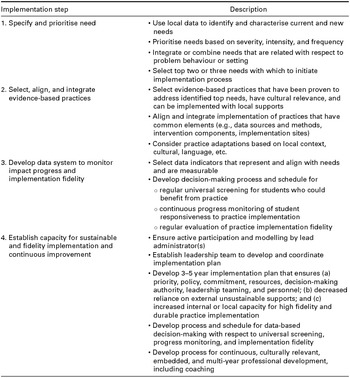
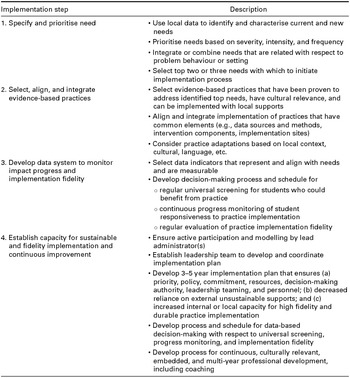
A primary function of the leadership team is to select, align, and integrate evidence-based practices within an MTSS framework using data on school-level implementation fidelity and continuous student progress monitoring. This function would necessitate collaborative implementation across leadership teams, projects and initiatives, and prioritisation of school and district needs. In general, this process consists of five main steps: specify, prioritise, align, integrate, and implement. Although a linear sequence is suggested in Table 2, the process is a reiterative logic, meaning that it is cyclic, overlapping, continuous, and dynamic based on data-documented needs and priorities.
Leadership Implementation Process Steps
Implementation Example: PBIS
In the 1990s, the reauthorisation of the Individuals with Disabilities Education Act provided for the establishment of a Technical Assistance Center on Positive Behavioral Interventions and Supports (http://www.pbis.org; Horner & Sugai, Reference Horner and Sugai2015). The Center's purpose was to collect and disseminate evidence-based behavioural practices for students with behavioural challenges, especially students with disabilities. Rather than adopting a more traditional technical assistance approach that focused on collecting and generally disseminating a wide range of behavioural practices to educators, an implementation blueprint and logic were developed having the following key foundational features (Horner & Sugai, Reference Horner and Sugai2015; Sugai, in press): (a) multi-tiered prevention framework (Biglan, 1995; Colvin et al., Reference Colvin, Kame'enui and Sugai1993; Sugai & Horner, Reference Sugai and Horner2009a; Walker et al., Reference Walker, Horner, Sugai, Bullis, Sprague, Bricker and Kaufman1996), (b) positive behaviour supports principles (Carr et al., Reference Carr, Dunlap, Horner, Koegel, Turnbull, Sailor and Fox2002; Sugai et al., Reference Sugai, Horner, Dunlap, Hieneman, Lewis, Nelson and Ruef2000), and (c) applied behaviour analysis (Cooper et al., Reference Cooper, Heron and Heward2007).
This approach resulted in the development of a multi-layered implementation and technical assistance network of PBIS practices and systems where local CD is emphasised at all tier levels. At the national level, an annual PBIS Leadership Forum is conducted each fall to introduce newcomers to PBIS features, practices, and systems. Forum sessions are presented by school, district, state, and national presenters who are exemplars of content and implementation expertise for new and veteran PBIS implementers. More importantly, forum activities are linked to a network of PBIS state coordinators and leadership teams where follow-up and ongoing implementation supports, school and district exemplars, and training and coaching opportunities and resources are indicated.
The Center maintains a website (http://www.pbis.org) that organises practice and system content around a tiered logic and emphasises data-based decision-making so that needs are aligned with evidence-based practices and implementation resources and capacity (Flay et al., Reference Flay, Biglan, Boruch, Castro, Gottfredson, Kellam and Ji2005). Implementation, professional development, and evaluation blueprints and self-assessments are provided to emphasise implementation fidelity and local CD. To strengthen the importance of implementation within and across academic and social settings, practices and systems are considered within four contexts: (a) classroom, where academic instruction and social behaviour support interact; (b) nonclassroom (e.g., hallways, cafeterias, assemblies, sporting events), where self-managed and interpersonal behaviours are emphasised; (c) family, where cultural factors are acquired; and (d) community, where external social influences come to bear. The three-tiered logic is applied within and across each of these contexts.
At the district and regional levels, leadership team structures and procedures are in place to support school team implementation. These supports include, for example, professional development (training and coaching), local exemplars, policy development, initiative alignment, funding and resource supports, data-based decision-making, long-term action planning, and content and practice expertise. Rather than emphasising the promotion of any specific published program, curriculum, or intervention, the Center highlights their core practice and system elements or features to reinforce the importance of selection, prioritisation, alignment, and integration in the context of progress monitoring and implementation fidelity.
At the school level, school administrators and leadership implementation teams establish systems capacity to sustain implementation of school-wide PBIS practices, especially in classroom and nonclassroom contexts. Whereas district and regional level implementations become system implementation exemplars, school-level implementations serve as practice implementation exemplars.
Although peer-reviewed research publications are important in documenting implementation CD efforts, the Center gives equal attention to tools and procedural guides that encourage fidelity implementation and local implementation capacity. These practices and systems supports include, for example, action planning self-assessments, procedural implementation blueprints, professional development and evaluation technical assistance briefs, and practice workbooks and examples. More specific examples and supports are provided through regional networks in the US (e.g., Northwest, mid-Atlantic, Northeast, Midwest) where local trainers, coaches, and examples are highlighted.
Another important aspect of the sustainability and scaling of PBIS is its spread outside the US (McIntosh, Kim, Mercer, Strickland-Cohen, & Horner, Reference McIntosh, Kim, Mercer, Strickland-Cohen and Horner2015). Because its primary funding is from US tax dollars, the PBIS Center limits technical assistance activities to the 50 states and US territories. However, the International Association for Positive Behaviour Supports (APBS; http://www.apbs.org) functions as a professional organisation for all individuals and groups who are interested in positive behaviour supports (including PBIS) and represents community agencies, early childhood, families, higher education, schools and districts, and statewide leadership (http://www.apbs.org/about-apbs.html). Like the PBIS Center, APBS provides an annual networking conference, regular webinars, network opportunities, and research and practice resources that are extended internationally (e.g., Africa, Asia, Australia, Caribbean, Europe, New Zealand, North and South America) with emphasis on the same core principles (e.g., behavioural sciences, prevention, tiered systems of support, implementation CD, leadership; e.g., Greflund, McIntosh, Mercer, & May, Reference Greflund, McIntosh, Mercer and May2014; Jimerson et al., Reference Jimerson, Nickerson, Mayer and Furlong2012; Sørlie & Ogden, Reference Sørlie and Ogden2015). Over the past 5 years, an important body of PBIS sustainability implementation work has been conducted and published by Kent McIntosh and colleagues (McIntosh et al., Reference McIntosh, Kim, Mercer, Strickland-Cohen and Horner2015; McIntosh et al., Reference McIntosh, Massar, Algozzine, George, Horner, Lewis and Swain-Bradway2016; McIntosh et al., Reference McIntosh, Mercer, Hume, Frank, Turri and Mathews2013; McIntosh, Mercer, Nese, & Ghemraoui, in press; McIntosh, Mercer, Nese, Strickland-Cohen, & Hoselton, in press; McIntosh, Predy, Upreti, Hume, Turri, & Mathews, Reference McIntosh, Predy, Upreti, Hume, Turri and Mathews2014; McIntosh & Turri, Reference McIntosh, Turri, Reynolds, Vannest and Fletcher-Janzen2014; Meng, McIntosh, Claassen, & Hoselton, Reference Meng, McIntosh, Claassen and Hoselton2016; Nese et al., in press; Pinkelman et al., Reference Pinkelman, McIntosh, Rasplica, Berg and Strickland-Cohen2015).
At the international level, PBIS implementation capacity development also has been demonstrated. For example, the New Zealand Ministry of Education has implemented PBIS with support through a national initiative called ‘Positive Behaviour for Learning’ (http://pb4l.tki.org.nz/PB4L-School-Wide). A unique feature of this implementation is the systematic and deliberate integration of the values, customs, and language of the Maori culture. Similar nationally supported efforts include the Caribbean countries (e.g., Cayman Islands, Jamaica, U.S. Virgin Islands, Bermuda, Puerto Rico), Australia (e.g., New South Wales, Tasmania, Victoria, Queensland), Europe (e.g., United Kingdom, Wales), Scandinavian countries (e.g., Norway, the Netherlands, Denmark), and Middle East (e.g., Qatar, Saudi Arabia, Turkey).
Concluding Comments
Given the variability (e.g., size, culture, location) that exists in individual classrooms, grade levels, schools, districts, regions, states, and countries, recommending a single approach to systemic practice implementation is not possible. However, to maximise student benefit, implementation efforts must be effective, efficient, relevant, sustainable, and scalable. We developed this paper as a means of focusing on the importance of CD in the high fidelity and sustained implementation of empirically supported practices within an MTSS. In addition, rather than focusing on interventions and practices, we emphasised foundational tenets from the behavioural and prevention sciences, basic teaching and learning principles, and practice implementation.
Changing the character and operation of classrooms, schools, and districts includes motivating implementers and change agents, disseminating content knowledge, and distributing materials and resources; however, they are insufficient in achieving implementation that is high fidelity, sustainable, scalable, and continuously regenerated over time. Although we acknowledge that some level of external technical assistance and support may be required, we suggest that greater attention must be directed toward establishing local, high-quality, efficient, and relevant implementation capacity.
As a starting point, we used a definition of CD developed by the United Nations Development Programme (2009) that emphasised process, organisations, maintenance, and goal-setting and analysis capabilities. Within the PBIS context, we extended this definition by (a) focusing on schools, districts, and states as the basic organisational units of change; and (b) emphasising factors that influence academic and behaviour practice implementation (cultural responsiveness, high fidelity and sustainable use, formative data-based decision-making, locally coordinated and high-quality professional development, and institutional and authorised supports). We suggested three important sets of conceptual principles to guide development of implementation competence and capacity: phases of learning, implementation drivers and phases, and multi-tiered support systems.
Given this description of CD, we highlighted the main drivers to this process, for example, leadership teaming, integrated policy authority, recurring funding, visibility and dissemination, targeted personnel hiring practices, professional development, decision-based evaluation, and high-quality implementation examples. To illustrate further this process, we used the development and implementation of the federally funded PBIS Center as an example of how capacity development drives the technical assistance efforts provided to US schools, districts, and states.
Although the research and exemplar database is developing, the conceptual and implementation features of effective and efficient CD are becoming more clearly defined and operationalised. We are encouraged by the possibility that all children and youth will have increased access to and benefit from evidence-based interventions and practices because local implementation capacity is high quality, durable, and adaptable.
Acknowledgements
The development of this paper was supported in part by a grant from the Office of Special Education Programs, U.S. Department of Education (H029D40055). Opinions expressed herein are those of the authors and do not reflect necessarily the position of the U.S. Department of Education or the University of Connecticut, and such endorsements should not be inferred.