Introduction
The Mediterranean fruit fly, Ceratitis capitata (Wiedemann) is among the most important pests of cultivated fruits (Malacrida et al., Reference Malacrida, Gomulski, Bonizzoni, Bertin, Gasperi and Guglielmino2007). Among the Tephritidae, the medfly is the most known polyphagous species, attacking more than 200 host plant species, and causing large economic losses to a wide range of agriculture crops (Liquido et al., Reference Liquido, Shinoda and Cunningham1991; Aluja & Mangan, Reference Aluja and Mangan2008; Lance et al., Reference Lance, Woods, Stefan, Gordh and McKirdy2014).
Medfly management is mainly based on chemical insecticides, especially through the use of Malathion bait spray (Kheder et al., Reference Kheder, Trabelsi, Aouadi, Larramendy and Soloneski2012; Ovruski & Schliserman, Reference Ovruski and Schliserman2012). Even though these insecticides are commonly effective at higher doses, they cause insect resistance, environmental and human health problems (Kumari et al., Reference Kumari, Madan and Kathpal2008; Ferencz & Balog, Reference Ferencz and Balog2010; Osman, Reference Osman and Stoytcheva2011). Therefore, the developments of alternative strategies are required urgently to control this devastating fruit pest (Manrakhan et al., Reference Manrakhan, Kotze, Daneel, Stephen and Beck2013).
Biological control by using microorganisms and microbial insecticides could represent a suitable alternative strategy to chemical control of fruit flies (Imoulan et al., Reference Imoulan, Alaoui and El Meziane2011; Thakur, Reference Thakur2011). Among microorganisms, species belonging to Streptomyces, Saccharopolyspora, Bacillus, Beauveria and Metarhizium genera have received considerable attention as potential biological control agents of Medfly (Burns et al., Reference Burns, Harris, Moreno and Eger2001; Ekesi et al., Reference Ekesi, Maniania and Lux2002; Quesada-Moraga et al., Reference Quesada-Moraga, Martin-Carballo, Garrido-Jurado and Santiago-Alvarez2008; Aboussaid et al., Reference Aboussaid, El-Aouame, El-Messoussi and Oufdou2010; Imoulan & El Meziane, Reference Imoulan and El Meziane2014; Samri et al., Reference Samri, Baz, Jamjari, Aboussaid, El Messoussi, El Meziane and Barakate2015).
Actinobacteria are often considered as the most prolific source of bioactive compounds with diverse biological activities (Berdy, Reference Berdy2005; Demain & Sanchez, Reference Demain and Sanchez2009). It has been estimated that approximately two-thirds of naturally occurring antibiotics have been isolated from actinobacteria (Okami & Hotta, Reference Okami, Hotta, Goodfellow, Williams and Mordarski1988; Mahajan & Balachandran, Reference Mahajan and Balachandran2014). Some antibiotics have been found to possess insecticidal properties (Shiomi et al., Reference Shiomi, Hatae, Hatano, Matsumoto, Takahashi, Jiang, Tomoda, Kobayashi, Tanaka and Ōmura2005; Liu et al., Reference Liu, Qin, Wang, Li and Zhang2008; Karthik et al., Reference Karthik, Gaurav, Rao, Rajakumar and Rahuman2011; Ababutain et al., Reference Ababutain, Aziz and Al-Meshhen2012; Vijayabharathi et al., Reference Vijayabharathi, Kumari, Sathya, Srinivas, Abhishek, Sharma and Gopalakrishnan2014). Moreover, actinobacteria produce many bioinsecticidal compounds such as avermectins, milbemycins and polynactins (Tanaka & Omura, Reference Tanaka and Omura1993; Berdy, Reference Berdy2005; Ōmura, Reference Ōmura2011). Almost 20% of the microbial insecticidal agents are produced by the genus Streptomyces (Dhanasekaran & Thangaraj, Reference Dhanasekaran and Thangaraj2014). Currently, Spinosad®, a derivative of the naturally occurring actinomycete Saccharopolyspora spinosa Mertz and Yao (Dow Agrosciences, 2001), combined with ammonium acetate, is the only actinobacterial based bioinsecticide used in monitoring programmes (Mangan et al., Reference Mangan, Moreno and Thompson2006; Gazit et al., Reference Gazit, Gavriel, Akiva and Timar2013; Navarro-Llopis et al., Reference Navarro-Llopis, Primo and Vacas2013). However, concern was raised about the impact of spinosad on non-target organisms (Biondi et al., Reference Biondi, Mommaerts, Smagghe, Viñuela, Zappalà and Desneux2012; Martinou et al., Reference Martinou, Seraphides and Stavrinides2014) and the development of resistance to some pest insects in laboratory experiments (Hsu & Feng, Reference Hsu and Feng2006; Su & Cheng, Reference Su and Cheng2013; Abbas et al., Reference Abbas, Khan and Shad2014).
Accordingly, the present study has been undertaken to evaluate the insecticidal activity of actinobacteria isolated from various Moroccan habitats, including terrestrial (rhizospheric soils) and endophytic (medicinal plants) isolates through biological screening against first- and third-instar larvae, pupae and adults of C. capitata. The crude extract obtained from the most active isolate was separated using thin layer chromatography and fractions obtained were screened for insecticidal activities against C. capitata. To our knowledge, this report is the first work describing the insecticidal activity of Moroccan Actinobacteria against medfly.
Materials and methods
Actinobacterial strains
The actinobacterial isolates used in this study were from the collection of the Laboratory of Biology and Biotechnology of Microorganisms, Cadi Ayyad University, Marrakesh. They were isolated from various Moroccan habitats including rhizospheric soils and endophytic of endemic plants such as Argania spinosa and medicinal plants such as Ormenis scariosa, Arenaria pungens, etc. (Barakate et al., Reference Barakate, Ouhdouch, Oufdou and Beaulieu2002). All strains were maintained in 20% glycerol at −20°C.
A total of 210 Moroccan actinobacterial isolates were previously screened for their insecticidal activity on the basis of biological and chemical screening (Samri et al., Reference Samri, Baz, Jamjari, Aboussaid, El Messoussi, El Meziane and Barakate2015). The 12 most promising isolates were selected and investigated for their insecticidal activity against different life stages of C. capitata.
Fermentation
Each actinobacteria isolate was inoculated into a 500 ml baffled Erlenmeyer flask containing 100 ml of Bennett's liquid medium (Beef extract 1 g l−1, glucose 10 g l−1, peptone 2 g l−1, yeast extract 1 g l−1, agar 15 g l−1, pH 7.2). The flasks were incubated on a rotary shaker (250 rev min−1) at 28°C for 48 h. A volume of 500 ml of this culture was used as inoculum for a 5-litre jar fermenter containing 4 litres of the culture medium described above. Starting pH was 7.2 and the aeration was 5 l min−1 with agitation of 120 rev min−1. The fermentation was carried out at 30°C for 7 days. The culture supernatant was used directly in bioassay of C. capitata pupae or was freeze-dried and used for larval and adult bioassays. The same supernatant was used in the primary chemical separation.
Biological screening
Insect rearing
Ceratitis capitata used in these tests was obtained from a mass-reared stock maintained at the laboratory of Molecular and Ecophysiological Modelisation (University Cadi Ayyad, Faculty of Sciences Semlalia, Marrakesh, Morocco). The flies were maintained and all the experiments were carried out at 25 ± 2°C and 60–80% relative humidity under 16:8 light and dark cycles. Larvae were reared in clear plastic containers (20 × 14 × 7 cm3) on a diet composed of wheat bran, sucrose, brewer's yeast, Nipagin, Nipasol, benzoic acid and water at a volumetric ratio of (25:7:3:1:1:1:62). A mixture of sucrose and Brewer's yeast (4:1) was used as adult food (Aboussaid et al., Reference Aboussaid, Vidal-Quist, Oufdou, El Messoussi, Castañera and González-Cabrera2011).
Bioassays with C. capitata larvae
The susceptibility of C. capitata first-instar and third-instar larvae to each actinobacterial isolate was tested according to Molina et al. (Reference Molina, Cana-Roca, Osuna and Vilchez2010) with some modifications. Ten larvae were placed in plastic recipients (50 mm3) containing 5 g of sterilized artificial diet and 0.5 g from the freeze-dried 4-l bacterial fermentation. A negative control was prepared with the freeze-dried Bennett's medium. Each actinobacteria isolate was tested in five replicates. After 7 and 14 days of exposure, the number of dead larvae was counted and the pupae were transferred to sterile Petri dishes (9 cm) until adult emergence.
Bioassays with C. capitata pupae
The susceptibility of C. capitata pupae was tested using a single-dose test according to the method of Malan & Manrakhan (Reference Malan and Manrakhan2009) with some modifications. Ten 1-day-old pupae were transferred to plastic recipients (50 mm3) containing 25 g of sterile sand mixed with 2 ml of each actinobacterial culture supernatant. The control receives 2 ml of Bennett's medium. After 7 and 14 days of exposure, emerged adults and dead pupae were counted and the percentage of pupal mortality was calculated. To keep emerging flies alive, a cotton wool soaked with adult food was placed over the container. Five repetitions were performed per experiment.
Bioassays with C. capitata adults
The susceptibility of C. capitata adults to each actinobacterial isolate was tested under laboratory conditions. Each bioassay was performed in a plastic bioassay chamber (25 × 25 × 10 cm3) with at least 20 newly emerged flies (1–2 days old). In each set of bioassays, 0.5 g from the freeze-dried 4 litres bacterial fermentation was mixed with 5 g of sterilized adult diet. Water was provided to the flies using a yellow sponge. A negative control was prepared using the freeze-dried Bennett's medium mixed with adult diet. Fly mortality was recorded daily for 7 days. Five replicates were carried out per assay.
Thin-layer chromatography of actinobacteria LD-37 culture broth
Four litres of fermentation culture of the most active isolate LD-37 were filtered through a filter press by adding celite. The obtained mycelial cake and the aqueous phase were extracted three times with acetic ester with a ratio of 1:1 (v/v). The organic phases were collected and evaporated in vacuum at 40°C until dryness. The obtained powder (106 mg) was defatted with hexane and dissolved in methanol. The resulting dark red crude extract was subjected to a preparative thin-layer chromatography using the system solvent chloroform–methanol (9:1) and then sprayed with p-anisaldehyd-sulphuric acid reagent (McSweeney, Reference McSweeney1965) to localize the separated spots on the basis of their color, UV absorbance and retention factor (Rf). All fractions were tested for their larvicidal activity against C. capitata as described above with a single dose of 500 ppm.
Identification of the actinobacterial isolate LD-37
Morphological and physiological characterization
The morphological, cultural, physiological and biochemical characteristics of the selected isolates were evaluated as described in the International Streptomyces Project (ISP) (Shirling & Gottlieb, Reference Shirling and Gottlieb1966). Cultural characteristics were observed on yeast extract–malt extract agar (ISP2), oatmeal agar (ISP3) and inorganic salts–starch agar (ISP4) media at 30°C for 7–21 days and the color series were determined according to the system proposed by Nonomura (Reference Nonomura1974). Melanin production was detected by growing the isolate on ISP6 and ISP7 media (Shirling & Gottlieb, Reference Shirling and Gottlieb1966). The growth on different carbohydrates as sole carbon sources at concentration of 1% (w/v) was studied by using the ISP9 medium (Shirling & Gottlieb, Reference Shirling and Gottlieb1966). The chemical analysis of the diaminopimelic acid (DAP) isomer was performed as described by Becker et al. (Reference Becker, Lechevalier, Gordon and Lechevalier1964). Spore chain morphology and spore shapes were observed on the same media using light microscopy.
Molecular identification and sequence analysis
The DNA of the isolate LD-37 was extracted according to the procedure described by Hopwood et al. (Reference Hopwood, Bibb, Chater, Kieser, Bruton, Kieser, Lydiate, Smith, Ward and Schrempf1985). The 16S rDNA gene was amplified by PCR using the primers 27F (5′-AGAGTTTGATCCTGGCTCAG-3′) and 1492R (5′-GGTTACCTTGTTACGACTT-3′) (Lane, Reference Lane, Stackebrandt and Goodfellow1991).
The PCR product was sequenced using an automated sequencer (Applied Biosystems ABI 3130) with the same primers as above. The 16S rRNA sequence has been deposited in the GenBank database with the accession number KP 176616. The obtained sequence was compared with those of public databases as well as EzTaxon-server available at http://eztaxon-e.ezbiocloud.net/ (Kim et al., Reference Kim, Cho, Lee, Yoon, Kim, Na, Park, Jeon, Lee and Yi2012). Phylogenetic analyses were conducted using MEGA version 5 (Tamura et al., Reference Tamura, Peterson, Peterson, Stecher, Nei and Kumar2011). The 16S rRNA gene sequence of strain LD-37 was aligned with neighboring nucleotide sequences using CLUSTALW (Larkin et al., Reference Larkin, Blackshields, Brown, Chenna, McGettigan, McWilliam, Valentin, Wallace, Wilm and Lopez2007). Phylogenetic trees were reconstructed by using the neighbour-joining method (Saitou & Nei, Reference Saitou and Nei1987) with the model of Kimura's two-parameter model (Kimura, Reference Kimura1980), the maximum-likelihood method (Felsenstein, Reference Felsenstein1985) with Kimura's two-parameter and maximum-parsimony (Fitch, Reference Fitch1977) methods. The topology of the trees was evaluated by bootstrap analysis based on 1000 replicates (Felsenstein, Reference Felsenstein1985).
Data analysis
All experiments were conducted in five replicates; the data were presented as means ± standard error (SEM). The recorded data were not normally distributed, as tested by the Kolmogorov–Smirnov (P < 0.05). Thus, larval, pupal and adult mortalities were arcsine square root transformed. The corrected mortality was expressed as follows (Abbott, Reference Abbott1925):
 $$M = \displaystyle{{(A - B - N)} \over {(G - N)}} \times 100,$$
where M = the percentage of the killed insects, A = the number of dead insects, B = the average number of dead insects in the blind samples, N = the number of dead insects before starting the test, and G = the total number of insects.
One-way ANOVA was used first to investigate differences between larval, pupal and adult corrected mortality with regard to tested actinobacterial isolates, and thereafter to show differences between adult emergence and control. A post hoc Tukey test was used to identify significant differences between actinobacterial isolates, when a particular effect was significant overall. Finally repeated measures analysis of variance (rANOVA) was performed to assess the time effect on larval and pupal corrected mortality after 7 and 14 days of treatment. All statistical analyses were performed utilizing IBM SPSS Statistics software (version 21). The significance was set at P < 0.05.
Results
Biological screening
Bioassays with C. capitata larvae
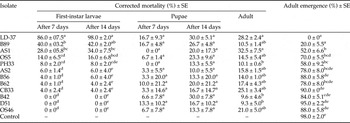
The 12 actinobacterial isolates selected from our previous primary screening (Samri et al., Reference Samri, Baz, Jamjari, Aboussaid, El Messoussi, El Meziane and Barakate2015) were tested against the first and third instar larvae of C. capitata. The results (table 1) showed that the corrected mortality ranged from 0 to 86% and from 0 to 98% after 7 and 14 days of exposure, respectively, and that no mortality was recorded for negative controls.
Percentages (±SE) of corrected mortality of first-instar larvae, pupae, adult and the adult emergence of C capitata.

Means followed by different letters with in a column are significantly different according to Tukey's test (P < 0.05).
Among the 12 tested actinobacteria, isolates LD-37, B89 and AS1 caused significant mortality against the first-instar larvae after 7 days of exposure (F 11,48 = 17.9, P < 0.05). While after 14 days, OS5 in addition to these three isolates caused significant larvae mortality (F 11,48 = 21.8, P < 0.05). The highest larval activity was obtained after 14 days with isolate LD-37 (98%), whereas no mortality was observed with isolates B42, D51 and OS46. Regarding the time effect, rANOVA showed significant difference in larval mortality of C. capitata fed with freeze-dried actinobacteria's fermentations after 7 and 14 days of exposure (P = 0.02, n = 5).
On the other hand, only five actinobacteria isolates inhibited adult emergence of C. capitata, and the ANOVA test showed a significant difference between isolates (F 12,52 = 27.5, P < 0.05) (table 1). Indeed, the isolates LD-37 and B89 caused the highest reduction in adult emergence (100 and 80%, respectively) (table 1). However, no isolate have shown larval activity against the third-instar larvae of C. capitata.
Bioassays with C. capitata pupae
Results of the biological screening against pupae (table 1) showed that the corrected mortality of the tested isolates ranged from 0 to 16.7% and from 10 to 30% after 7 and 14 days of exposure, respectively with no significant differences between isolates (P > 0.05). The highest corrected mortality was obtained after 14 days with the isolates LD-37 and B89 (30 and 26.7%, respectively), whereas the average mortality rates was 6.7% in the negative controls. As obtained for larval mortality, rANOVA showed that the time exposure effect on the mortality of C. capitata pupae after 7 and 14 days was significant (P < 0.01, n = 5).
Bioassays with C. capitata adults
Bioassays on medfly adults (table 1) showed that the corrected mortality ranged from 9.3 to 32.5% after 7 days treatment with the 12 actinobacteria isolates, and the average mortality in the negative controls was 9.3%. The highest corrected mortality against adults was obtained with the isolates AS1 and LD-37 (32.5 and 28.2%, respectively), while no significant differences were obtained with isolates B42, D51 and PH33 as determined by the ANOVA test (F 11,48 = 3.7, P > 0.05).
Identification of the isolate LD-37
The most promising endophytic isolate LD-37 for its high insecticidal activities was identified up to species level using cultural, morphological, physiological, biochemical and phylogenetic analysis. Based on morphological characteristics, the strain LD-37 showed grey mycelia substrate and white colored aerial mycelia on ISP media, and no melanoid pigments were elaborated in ISP6 and ISP7 media. Biochemical and physiological properties of isolate LD-37 showed that the sugar cell wall component was the L-DAP acid and different abilities to assimilate tested carbon sources as it was able to use arabinose, fructose, galactose, glucose, mannitol, rhamnose, sorbitol, sucrose and xylose as sole carbon sources whereas maltose, mannose and dextrin were not used.
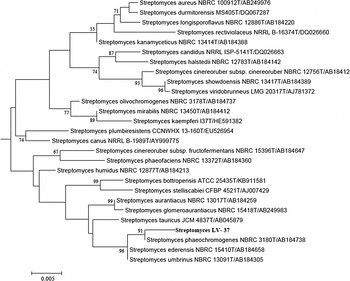
Based on all previous results, the isolate LD-37 was assigned to the genus Streptomyces. Phylogenetic analysis of the 16S rRNA gene sequence (GenBank accession number: KP 176616) confirm the belonging of strain LD-37 to genus Streptomyces and its high similarity to S. phaeochromogenes (99.4%); as indicated in the neighbour-joining dendrogram (fig. 1).
Phylogenetic tree for species of the genus Streptomyces calculated from almost complete 16S rRNA gene sequences using Kimura's 2-parameter (Kimura, Reference Kimura1980) evolutionary distance model and the maximum-likelihood method (Felsenstein, Reference Felsenstein1985). This illustrates the taxonomic position of strain LD-37 relative to the other species of the genus. Numbers at the nodes are bootstrap values, expressed as a percentage of 1000 resamplings (only values >50% are shown). Bar 0.01 nucleotide substitution per site.

Purification of the Crude extract of isolate LD-37
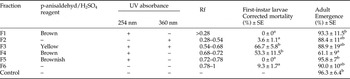
The crude extract of Streptomyces strain LD-37 was separated into six fractions using preparative thin layer chromatography. Table 2 showed differences between fractions according to the UV absorbance analysis at 254 and 360 nm, and colouration of spots with the p-anisaldehyd-sulphuric acid reagent.
Thin-layer chromatography, larvicidal activity and adult emergence of Streptomyces strains LD-37's fractions against C. capitata first-instar larvae.

(–): Not active fraction.
Means followed by different letters within a column are significantly different according to Tukey's test (P < 0.05).
The insecticidal activity of the six fractions (F1–F6) was evaluated against the first instar larvae of C. capitata. The corrected mortality obtained ranged from 0 to 66.7% after 7 days of exposure, and only the F3 and F4 fractions caused significant corrected mortality of 66.7 and 53.3%, respectively (P < 0.05). Furthermore, the F4 fraction inhibited significantly the emergence of adult C. capitata (P < 0.05).
Discussion
Current control measures of C. capitata are mostly based on insecticidal bait-spray applications (Kheder et al., Reference Kheder, Trabelsi, Aouadi, Larramendy and Soloneski2012; Ovruski & Schliserman, Reference Ovruski and Schliserman2012). In Morocco, synthetic insecticides are still the major control agents for medfly (Hafraoui et al., Reference Hafraoui, Harris and Chakir1980; Harris et al., Reference Harris, Hahrauni and Toulouti1980; Benziane et al., Reference Benziane, Abbassi and Bihi2003; Wadjinny & Bounfour, Reference Wadjinny and Bounfour2005). However, the intensive use of synthetic insecticides for crop protection causes undesirable effects on human health and the environment (Popp et al., Reference Popp, Pető and Nagy2013). Moreover, the development of resistance in insect populations results in decreasing of insecticide effectiveness (Magaña et al., Reference Magaña, Hernández-Crespo, Ortego and Castañera2007; Vontas et al., Reference Vontas, Hernández-Crespo, Margaritopoulos, Ortego, Feng, Mathiopoulos and Hsu2011).
Microbial insecticides can serve as an additional strategy to ensure environmental protection and commercial sustainability through reduced application of conventional insecticides. In Morocco, spinosad, a derivative of the naturally occurring actinomycete S. spinosa is the only microbial insecticide used for the medfly control (Smaili et al., Reference Smaili, Wadjinny and Bakri2010). However, the development of insect resistance limits its use (Hsu & Feng, Reference Hsu and Feng2006; Su & Cheng, Reference Su and Cheng2013; Abbas et al., Reference Abbas, Khan and Shad2014; Gassmann et al., Reference Gassmann, Petzold-Maxwell, Clifton, Dunbar, Hoffmann, Ingber and Keweshan2014). Therefore, new microbial insecticides from indigenous actinobacteria are needed.
A total of 12 highly active Moroccan actinobacterial isolates against A. salina (100% mortality) (Samri et al., Reference Samri, Baz, Jamjari, Aboussaid, El Messoussi, El Meziane and Barakate2015) were tested against different life stages of C. capitata (larvae, pupae and adults) in order to choose the most efficient control strategy against the fruit fly.
The first-instar activity of the 12 tested Moroccan actinobacterial isolates varied significantly from 0 to 98% according to isolate types and the duration of exposure (7 or 14 days). The isolate LD-37 caused the highest corrected mortality (98%) of medfly larvae and inhibited the emergence of adult. However, all isolates showed no insecticidal activity against third-instar larvae or pupae of C. capitata. This difference in susceptibility to insecticide between early and late larval instars of medfly was also reported by Vinuela et al. (Reference Vinuela, Adan, Smagghe, Gonzalez, Medina, Budia, Vogt and Estal2000). Price & Stubbs (Reference Price and Stubbs1984) suggested that longer period of time spent on diet was responsible for the observed differences. Moreover, Skelly & Howells (Reference Skelly and Howells1987) found that cuticular proteins, potential targets for inhibitors of insect development, changed remarkably during larval growth in L. cuprina. These cuticular modifications could explain the differential susceptibility of the early and later larval instars.
Comparing adult emergence from treated larvae and adult mortality of C. capitata, the results showed that only isolates LD-37 and AS1 acted on both larval and adult stages.
The biological screening of the actinobacterial isolates revealed high medfly larvicidal activity compared to adult's mortality. The same finding against medfly was reported by Jemâa & Boushih (Reference Jemâa and Boushih2010) and Vinuela et al. (Reference Vinuela, Adan, Smagghe, Gonzalez, Medina, Budia, Vogt and Estal2000) using Cyromazine and Azadirachtin, respectively. Indeed this difference could be explained by the fact that nutritional needs vary widely between larval and adult stages of C. capitata (Chang, Reference Chang2004; Demirel, Reference Demirel2007).
In this study, our major focus was on the isolate LD-37 which was the most promising candidate for future production of insecticidal compounds. The morphological, biochemical and physiological characteristics clearly suggested that the isolate LD-37 belongs to the genus Streptomyces according to the Bergey's Manual of Systematic Bacteriology (Goodfellow et al., Reference Goodfellow, Kämpfer, Busse, Trujillo, Suzuki, Ludwig and Whitman2012). The 16S rDNA gene sequencing and the phylogenetic analyses showed 99.4% genetic similarity of LD-37 to Streptomyces phaeochromogenes.
The chemical screening of the acetic ester crude extract of S. phaeochromogenes LD-37 strain using a preparative thin layer chromatography allowed its separation into six different fractions. Only the fractions F3 and F4 showed significant larvicidal activity against C. capitata and inhibition of adult emergence. These two fractions showed different chemical and biological characteristics. The difference in absorbance and coloration between these fractions indicates that they might possess diverse compounds with possible insecticidal activity. Moreover, the fractions F3 and F4 had similar larvicidal activity and different inhibition against adult C. capitata. Although each fraction was less active than the original crude extract, it could be explained by synergistic insecticidal effect of different fractions in the whole crude extract. To our knowledge, this paper may be considered as the first record of insecticidal activity of S. phaeochromogenes. This species is known to be a source of phaeochromycins, an anti-inflammatory polyketides (Graziani et al., Reference Graziani, Ritacco, Bernan and Telliez2005), and many industrially useful enzymes, including glucose isomerase (Basuki et al., Reference Basuki, Ilzuka, Ito, Furuichi and Minamiura1992), xylose isomerase (Sanchez & Quinto, Reference Sanchez and Quinto1975), bromoperoxidase (Van Pee & Lingens Reference Van Pee and Lingens1984), cystathionine gamma-lyase (Nagasawa et al., Reference Nagasawa, Kanzaki and Yamada1984) and arogenate dehydrogenase (Keller et al., Reference Keller, Keller and Lingens1985).
In conclusion, the Moroccan S. phaeochromogenes strain LD-37 is a potential candidate that could be exploited commercially for future production of useful insecticidal compounds. Further studies on the purification and structure elucidation of active fractions produced by this strain are underway.
Acknowledgements
This work was supported by the Excellence grant awarded by the Ministry of Higher Education of Morocco [No. d3/027] and the German Academic Exchange Service (DAAD) grant.