Introduction
Cigarette smoking, the leading cause of preventable morbidity and mortality in the US, is often initiated during adolescence (Johnston, O’Malley, Miech, Bachman, & Schulenberg, Reference Johnston, O’Malley, Miech, Bachman and Schulenberg2015). Despite a decline in adolescent smoking over the past several years, rates of smoking remain high, while quit rates are low. Half of adolescent smokers make an unsuccessful quit attempt (CDC, 2010); as a result, many adolescents continue smoking well into adulthood (Mermelstein, Reference Mermelstein2003; Stanton, Lowe, & Gillespie, Reference Stanton, Lowe and Gillespie1996). Because smoking rates among adolescents tend to remain constant throughout the life cycle, it is crucial to prevent and reduce smoking early on (Johnston et al., Reference Johnston, O’Malley, Miech, Bachman and Schulenberg2015).
Tobacco use prevention programmes are necessary, but not sufficient to reduce tobacco initiation. School-based cessation clinics, in which tobacco programmes are delivered to small groups of students, are the most widely used setting for delivering tobacco cessation interventions to adolescents (Mermelstein, Reference Mermelstein2003) and have been shown to be effective (Curry, Mermelstein, & Sporer, Reference Curry, Mermelstein and Sporer2009; Sussman, Reference Sussman2002). Unfortunately, most extant research on adolescent tobacco cessation comprises efficacy and effectiveness studies, with much less known about the factors affecting the translation of these programmes from research to community settings (Curry et al., Reference Curry, Emery, Sporer, Mermelstein, Flay and Berbaum2007; Reference Curry2010; Reference Curry, Mermelstein, Emery, Sporer, Berbaum and Campbell2013). Given the availability of evidence-based cessation programme resources and the number of counties offering cessation programmes (validated or not) to youth (Curry et al., Reference Curry, Emery, Sporer, Mermelstein, Flay and Berbaum2007), it is important to study how these types of programmes are adopted in real-world settings. Rogers’ Diffusion of Innovations Theory has been the predominant model for conceptualising the process of translation of school-based programmes (Rogers, Reference Rogers1983; Rohrbach, Ringwalt, Ennett, & Vincus, Reference Rohrbach, Ringwalt, Ennett and Vincus2005). Unfortunately, linear diffusion models such as this have focused primarily on individual adopters of innovations, neglecting the organisational- and system-level contexts in which adoption decisions are made.
To address these limitations, researchers have proposed new models of decision-making called ‘systems thinking’ or ‘systems models’ which take into account the organisational culture and priorities of an institution (Estabrooks & Glasgow, Reference Estabrooks and Glasgow2006). Applying this to school-based research we must take into account the multiple systems (e.g., state agencies, school districts, school administrators, teachers, unions, school boards, etc.) affecting decision-making within schools.
Previous adoption research is focused almost exclusively on the individual policy decision-maker without taking into account the context in which these decisions are made. The current study addresses this gap by exploring factors from multiple levels that influence the process of adoption of evidence-based tobacco cessation programmes in schools. There is some precedent for this type of research but it focuses almost exclusively on prevention programmes. Because tobacco cessation programmes have unique characteristics (e.g., indicated for a specific high risk population, implemented outside of class), it is important to study what factors affect adoption of these programmes. Using prevention programmes as a guide, factors at multiple levels of influence, including community, organisational, and individual, should be considered influential in the process of adoption of tobacco cessation programmes in schools (Durlak & DuPre, Reference Durlak and DuPre2008).
Beliefs of the individual decision-maker regarding the value of the programme are associated with the adoption and use of evidence-based programmes (Rohrbach et al., Reference Rohrbach, Ringwalt, Ennett and Vincus2005). When making adoption decisions, agencies look to lists of ‘best practice,’ ‘research-validated,’ and ‘evidence-based’ programmes with proven effectiveness (NCI & SAMHSA, 2010; SAHMSA). Often, programmes are scored from weak to strong, and as new research becomes available lists are updated. Decision makers must be active in discerning the evidence-base and applying that information to their adoption decisions.
Community characteristics that have been positively associated with adoption include the consideration of tobacco and substance use as a community priority (Little, Pokhrel, Rohrbach, & Sussman, 2014) and larger district size (Little et al., Reference Little, Pokhrel, Sussman and Rohrbach2015; Rohrbach et al., Reference Rohrbach, Ringwalt, Ennett and Vincus2005). Organisational characteristics such as the amount of effort that a district-level coordinator devotes to substance use prevention (SUP) and the presence of a programme champion are also associated with adoption (Little et al., Reference Little, Pokhrel, Sussman and Rohrbach2015; Rohrbach et al., Reference Rohrbach, Ringwalt, Ennett and Vincus2005). Aspects of the organisational climate (e.g., district innovativeness, collaboration, and open communication) have also been associated with adoption (Beets et al., Reference Beets, Flay, Vuchinich, Acock, Li and Allred2008; Ringwalt et al., Reference Ringwalt, Ennett, Johnson, Rohrbach, Simons-Rudolph and Vincus2003; Rohrbach et al., Reference Rohrbach, Ringwalt, Ennett and Vincus2005). Given the high costs associated with implementing tobacco programmes, dedicated funding is a critical determinant of programme adoption (Cho, et al., Reference Cho, Hallfors, Iritani and Hartman2009; Hallfors & Godette, Reference Hallfors and Godette2002). While funding was widely available in the past, funding climates are changing, largely for the worse, with most entitlement funding eliminated.
Study Aims
In the current study, we address several gaps in the literature by examining associations between factors at the community-, organisation-, and individual-levels and adoption of evidence-based tobacco cessation programmes in a sample of school districts and county offices of education in California. This state is of specific note due to targeted funding initiatives put in place to reduce tobacco use. The California Tobacco Use Prevention Education (TUPE) fund was established in 1989, after the passage of a statewide referendum (Proposition 99) that increased the tax on tobacco products (Rohrbach, et al., Reference Rohrbach, Howard-Pitney, Unger, Dent, Howard and Cruz2002). These funds, which are administered by the California Department of Education (CDE), are designated to be used on school-based tobacco-specific student instruction, tobacco related awareness events, reinforcement activities, and intervention and cessation programmes for students. Schools that are awarded competitive TUPE funds are expected to select and implement evidence-based programmes as well as research-based activities listed in the CDE's publication Getting Results (CDE, 2011a). Before 2009, school districts in California were provided with an annual entitlement to spend on tobacco-specific student instruction based on student enrollment in grades 4–8. Recently, California law has eliminated these entitlements and established a competitive grant process for TUPE funds for programming in grades 4–12.
Methods
Target Sample
Data were collected between January and October 2011. The target study sample was identified from available education agencies, including school districts and county offices of education.
The target study sample (N = 268) was drawn from two matched groups: (1) those that submitted an application to the CDE in 2009 for competitive TUPE funds (n = 134); and (2) a matched group that had not applied (n = 134). Matching was conducted using three key demographic variables obtained from the Quality Education Direct (QED) California District 2008 file (QED Inc., 2009) that were potential confounders: population density, agency size, and student ethnicity. The final target sample included 268 education agencies (n = 240 school districts and n = 28 country offices of education, with districts and county offices evenly split across those who applied and did not apply for funding).
Information Providers
In each education agency (school district or county office), the target respondent was the SUP or TUPE coordinator. In education agencies that did not have a coordinator, the target respondent was the individual that knew the most about the tobacco prevention programmes currently being offered to students in schools in the district, as determined by the agency. This individual was invited by phone and/or email to complete a 25-minute online survey containing 89 self-report items for $20 compensation. We made a maximum of five attempts to reach the target respondent and obtain his/her informed consent to participate in the survey.
Final Study Sample
A total of 205 (76.5%) of the administrators from among the identified education agencies (N = 268) completed the survey. Of the 205 administrators, 183 were from school districts and 22 were from county offices of education.
Measures
Independent Variables
Community factors
Measures of community characteristics, including population density (urban, suburban, or rural), agency size (number of schools in the district or served by the county office, 1 = 1 school, 2 = 2–3 schools, 3 = 4–6 schools, 4 = 7–11 schools, 5 = 11–18 schools, 6 = >18 schools), and student ethnicity were obtained from QED's California District 2008 file (QED Inc., 2009). For data analysis, population density was dichotomised (0 = suburban/rural, 1 = urban) and the percentage of white students was used to represent race/ethnicity. Organisations were classified into type of agency (0 = district; 1 = County Office of Education).
Additional community factors obtained from administrators included one item assessing the degree to which tobacco use cessation was a priority in the community (1 = not a priority at all to 4 = high priority), and one item assessing perceptions of how big of a problem tobacco use was in the community (1 = smallest problem to 6 = biggest problem; Curry et al., Reference Curry, Mermelstein, Emery, Sporer, Berbaum and Campbell2013).
Organisational factors
Organisational factors included the presence of a school-level SUP coordinator who is primarily responsible for tobacco use education within each school (0 = no, none of the schools in the agency have an SUP coordinator, 1 = over half, but not all schools in the agency have an SUP coordinator, 2 = yes, each school in the agency has an SUP coordinator), the coordinators’ (average) effort devoted to tobacco use education (1 = 0–4 hours to 6 = 40 hours or more per week) and the presence of a programme champion, a strong advocate for choosing the tobacco curricula used most in the schools (0 = no or 1 = yes). We also assessed the level of agency support for tobacco education, including items such as ‘Principals and teachers support our districts’ tobacco/SUP and cessation efforts’ (Ringwalt et al., Reference Ringwalt, Ennett, Johnson, Rohrbach, Simons-Rudolph and Vincus2003; 4 items; 1 = strongly disagree to 5 = strongly agree; α = 0.79). Last, we assessed positive climate which included items such as ‘In general, people who work in the school district are treated fairly’ (Ringwalt et al., Reference Ringwalt, Ennett, Johnson, Rohrbach, Simons-Rudolph and Vincus2003; 4 items; 1 = strongly disagree to 5 = strongly agree; α = 0.79).
Individual factors
Measures of individuals’ beliefs included the administrators’ perceived effectiveness of evidence-based interventions including classroom curricula and tobacco use policies (two items; 4-point scales; 1 = not effective at all to 4 = very effective; r = 0.21) and perceived input in the decision to use the tobacco programme (0 = none to 4 = a great deal). Normative beliefs were assessed by asking administrators their perception of the prevalence of TUPE applicants across California (1 = 0–25% to 4 = 75–100%), and their perceptions of California agencies’ satisfaction with the evidence-based tobacco programmes they were using (1 = very dissatisfied to 5 = very satisfied). The perceived compatibility of the tobacco programme included the cost, apparent ease of use, and programme qualities (e.g., layout, materials, number and length of lessons; 3 items; 1 = did not consider at all to 4 = a great deal; α = 0.58).
Funding
The names of school districts and county offices of education that had been awarded a competitive TUPE grant were provided by the CDE (CDE, 2011b). Education agencies were considered currently funded if they were awarded a competitive TUPE grant between 2008 and 2011 (0 = not funded, 1 = funded), and previously funded if they were awarded a competitive TUPE grant between 2006 and 2007 (0 = not funded, 1 = funded).
Dependent Variable
Use of an evidence-based tobacco cessation programme
Administrators and coordinators were asked to identify which tobacco cessation curriculum they were using the most with their students. Respondents were provided a list of evidence-based teen tobacco cessation programmes to choose from. A programme was coded as ‘evidence-based’ (1) or not (0) if it was identified in one of the following state or federal registries as a school-based programme that is effective in reducing tobacco use behaviours. The registries included: California Healthy Kids Resource Center (California Healthy Kids Resource Center, 2010), National Registry of Evidence-based Programmes and Practices (NREPP) (SAMHSA, 2010), Exemplary and Promising: Safe, Disciplined, and Drug-Free Schools Programmes (OSDFS & US Dept of Education, 2010), and Research-Tested Intervention Programmes (NCI & SAMHSA, 2010).
Data Analysis
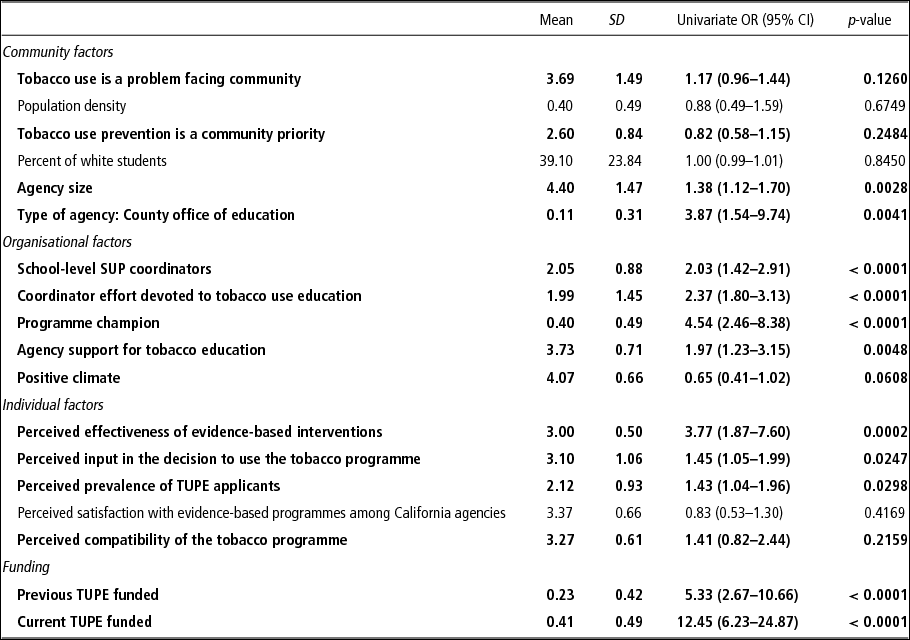
Descriptive statistics including means, standard deviations, and proportions were generated for all independent and dependent variables (see Table 1). To compare the final samples of county offices of education and school districts, we utilised chi-square or t-tests to assess differences on key demographic variables, including population density, agency size, and student ethnicity (p value at the 0.05 level, two-tailed). Relative to the county offices, the school districts were comprised of a larger number of schools (mean = 4.6, SD = 1.5 vs. mean = 3.2, SD = 0.9; p < 0.0001) and had a smaller proportion of white students (mean = 37.3, SD = 23.5 vs. mean = 53.9, SD = 21.4; p = 0.002). There were no significant differences on any of the other key demographic variables. Therefore, we chose to combine county offices and school districts for analytic purposes and control for the potential confounding that this variable may cause in our final multivariate model. Current or past funding status was retained as an independent variable.
Descriptive statistics of community/organisational/individual factors and funding and univariate associations with adoption of an evidence-based tobacco cessation programme

Note. (N = 205). Variables with a p-value of p < 0.25 and thus included in the multivariate analyses are presented in bold.
To examine correlates of adopting an evidence-based tobacco cessation programme among the sample of 205 school districts and county offices of education, we applied simple and multivariable logistic regression analyses. First, all variables were regressed on the adoption of an evidence-based programme. Next, a stepwise selection of variables approach was used to determine the most parsimonious combination of variables that explained adoption of an evidence-based programme. Community, organisational, individual, and funding variables that were significant in the univariate analyses at the liberal threshold of p < 0.25 were fitted in the multivariate model. We then used a backward elimination logistic regression procedure with a retention cut-off of p < 0.05. Crude and adjusted odds ratios (ORs) and their respective 95% confidence intervals were calculated using two-tailed significance tests. All analyses were conducted using the SAS (v.9.1.3) statistical package (SAS Institute Inc. SAS/C Online Doc TM, 2000). Associations were considered significant at the α level of 0.05.
Results
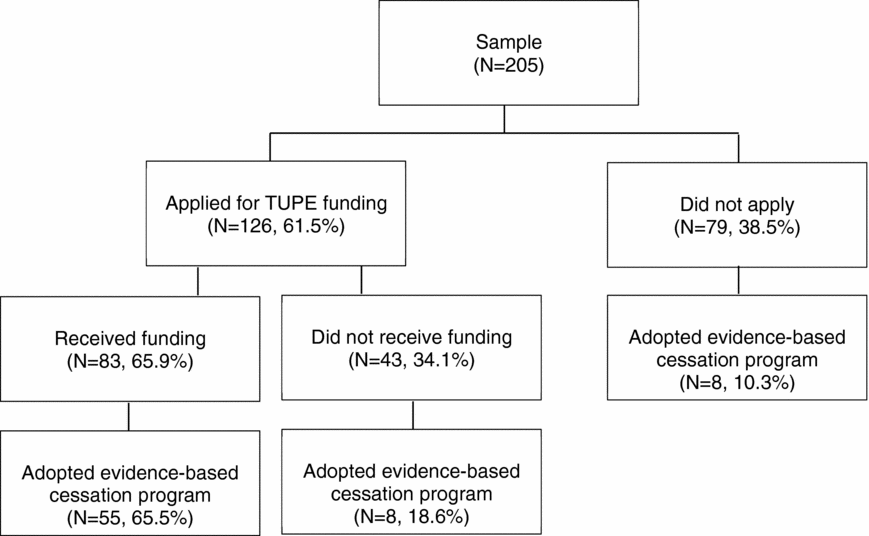
In the final sample that had administrators who completed surveys (N = 205), 61.5% had applied for competitive TUPE funds; and of those, = 65.9% had received funding. Half of the agencies had over six schools, with 35.6% having over 18 schools. Across all agencies, 38.6% of students were white and 36.5% were of Hispanic ethnicity. Nearly half of the agencies were located in suburban areas (46.3%). Figure 1 shows the TUPE funding status and adoption of evidence-based cessation programmes among the agencies.
TUPE funding status and adoption of evidence-based tobacco cessation programmes among agencies

The most prevalent evidence-based programme was the combination of Helping Teens Stop Using Tobacco/Teen Education Group (53.1%). Other programmes that organisations reported using were Project Ex (7.1%), I Decide (5.1%), I Quit (5.1%), and Not-On-Tobacco (2.0%).
Correlates of Adoption of Evidence-based Programmes
Agency size and being a County Office of Education were positively associated with adoption (p < 0.05; see Table 1). Having school-level SUP coordinators, greater coordinator effort devoted to tobacco use prevention, a programme champion, and agency support for tobacco education were associated adoption (all ps < 0.05). In addition, individual perception items such as perceived prevalence of TUPE applicants, perceived input in the decision to use the tobacco programme, and perceiving that evidence-based interventions are effective tobacco cessation strategies among adolescents were all associated with adoption (all ps < 0.05). Finally, having past and current funding was associated with 5.33–12.45 times higher odds of adopting a cessation programme (ps < 0.0001).
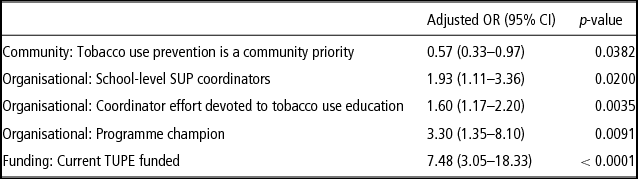
The final stepwise logistic regression model retained five variables that were significantly associated with adoption of an evidence-based tobacco cessation programme: identifying tobacco use prevention as a community priority, having school-level SUP coordinators, greater coordinator effort devoted to tobacco use prevention, having a programme champion, and currently receiving TUPE funds (all ps < 0.05; see Table 2).
Final stepwise logistic regression model of correlates associated with adoption of an evidence-based tobacco cessation programme

Note. (N = 205). Odds ratios adjusted for all other variables in the model.
Discussion
The current study utilised data from a cross-sectional sample of school district and county office of education administrators throughout California to explore the role of factors at the community-, organisational- and individual-level in the adoption of evidence-based tobacco cessation programmes. By elucidating the factors associated with the adoption and use of evidence-based tobacco cessation programmes, researchers can help to shape policies that will increase schools’ use of tobacco prevention and cessation programmes and ultimately reduce the long-term consequences of adolescent tobacco use.
Across all education agencies sampled, almost half of the agencies reported using a tobacco cessation programme, but only about a third reported using an evidence-based tobacco cessation programme. These results are antithetical to a key assumption of the Diffusion of Innovations that posits that effective research will naturally be adopted by consumers (Estabrooks & Glasgow, Reference Estabrooks and Glasgow2006). In light of the substantial demands placed on schools to meet core benchmarks (Kaftarian, Robertson, Compton, Davis, & Volkow, Reference Kaftarian, Robertson, Compton, Davis and Volkow2004), the use of evidence-based tobacco cessation programmes is unlikely to increase without considerable efforts to disseminate information about the benefits of using programmes with proven effectiveness.
Funding was the most influential factor associated with the decision to adopt an evidence-based tobacco cessation programme. However, consistent with previous research (Cho, et al., Reference Cho, Hallfors, Iritani and Hartman2009; Rohrbach, et al., Reference Rohrbach, Ringwalt, Ennett and Vincus2005), a number of community-, organisational- and individual-level factors were associated with the decision to adopt a tobacco cessation programme. Specifically, organisations with coordinators at both the school and district office with adequate time to spend championing and coordinating tobacco education were significantly more likely to adopt. In past research, larger agencies receiving more dedicated tobacco education funds were found to be more likely to hire full-time prevention coordinators and use evidence-based programmes (Rohrbach et al., Reference Rohrbach, Ringwalt, Ennett and Vincus2005). In the current study, univariate relationships showed that larger agencies were more likely to adopt evidence-based programmes, but size was not in the final multivariate model. In this new climate where funding is not distributed based on entitlements, coordinators are critical to the adoption of evidence-based cessation programmes, irrespective of agency size.
Surprisingly, identifying tobacco use prevention as a community priority was associated with a lower likelihood of adopting an evidence-based tobacco cessation programme. Furthermore, in the final model, beliefs about the effectiveness of cessation programmes were not related to use of evidence-based programmes, despite previous support for this association (Rohrbach, et al., Reference Rohrbach, Ringwalt, Ennett and Vincus2005).One may speculate that administrators felt that the prevention programming would eliminate the need to adopt a more expensive evidence-based programme. Future work should explore in more detail subjective judgements pertaining to use of prevention and cessation programming.
Prevention coordinators are responsible for organising trainings, ensuring teachers have the resources and materials needed for implementation, and identifying potential problems before they become major obstacles. They provide direction, leadership, and motivation to keep evidence-based programmes on track (Mihalic, Fagan, & Argamaso, Reference Mihalic, Fagan and Argamaso2008). A consistent finding in the literature is that the proportion of the dedicated staff member's total effort devoted to prevention programme coordination is positively associated with adoption and successful implementation of evidence-based programmes (Blake, et al., Reference Blake, Ledsky, Sawyer, Goodenow, Banspach and Lohrmann2005; Rohrbach, et al., Reference Rohrbach, Ringwalt, Ennett and Vincus2005). In the current study, three of the five factors retained in the final model were related to having a prevention coordinator. Our results confirm that coordinators are a crucial component in aiding the adoption of evidence-based cessation programmes. In order to increase the adoption of evidence-based programmes, administrators should designate a coordinator to manage the adoption process. Policy makers and funding agencies would be wise to require applicants to designate a prevention coordinator and ensure resources to support this position throughout the implementation period.
Limitations and Future Directions
Our findings should be considered in light of limitations. The data are cross-sectional. Therefore, relationships are associational and directionality cannot be assessed. However, the results can be used to inform studies incorporating longitudinal data. Also, we relied exclusively on administrator reports to assess adoption. Due to limited resources, we were unable to collect data on programme implementation. Thus, we do not know the extent to which students in the study districts were exposed to the evidence-based programmes and whether the programmes were implemented with fidelity. Future studies should include comprehensive assessments of both adoption and implementation from multiple data sources such as teacher self-reports and classroom observations of implementation. This data will allow for extensive analyses to answer more targeted questions.
Another limitation is that the results may not be generalisable to organisations where state-supported funding for implementation is unavailable. The TUPE programme represents an opportunity for schools to receive additional funds, but may not be representative of the resources available in other states. Future work should explore adoption in states without such funding systems in place. Despite these limitations, this study represents an important exploratory step to understanding the factors contributing to evidence-based tobacco cessation programming in the school system, and provides groundwork for future studies in this area.
Conclusions
The current study explored the role of community, organisational, and individual-level factors as well as funding on schools’ adoption of evidence-based tobacco cessation programmes. This is one of the few studies to explore the process of adoption of evidenced-based adolescent cessation programmes in real-world settings, and the only study we are aware of to focus solely on school settings. Although it is not surprising that the availability of dedicated tobacco education funds is important, our results demonstrate that strengthening existing capacity may lead to increased adoption of cessation programmes, independent of dedicated tobacco education funding.
Acknowledgements
The authors wish to thank Gaylene Gunning for her advice and support in conducting the study.
Financial Support
This research was supported by a dissertation grant from the Tobacco-Related Disease Research Programme (grant #19DT-0002) to Melissa Little. During development of the project, Dr. Little was supported as a predoctoral fellow on a training grant from the National Cancer Institute (grant #T32-CA 009492). While writing the manuscript, Dr. Little was supported by a postdoctoral fellowship from the National Cancer Institute (grant #R25 CA90956).
Conflict of Interest
Steve Sussman is the developer of Project Ex. The programme is owned and copyrighted by the University of Southern California. Proceeds from the sale of programme materials are deposited in a discretionary account that supports research activities such as pilot drug abuse prevention projects. All other authors declare that they have no competing interests.
Ethnical Standards
The authors assert that all procedures contributing to this work comply with the ethical standards of the relevant national and institutional committees on human experimentation and with the Helsinki Declaration of 1975, as revised in 2008.